 By Liz Nicholls, 12thnight.ca
A Forever Home is for dreaming in. For feeling you have a place in the world, imagining your potential, getting creative.

To help support 12thnight.ca YEG theatre coverage, click here.
At 42, Rapid Fire Theatre, Edmonton’s premier improv company and its longest running, is experienced at sleeping on other people’s couches, so to speak. They are, after all, an agile ensemble of performers who pack light and specialize in making it up as they go along. They’ve always known how to make do — with other people’s spaces and stuff, corners of other people’s lobbies, back shelves in other people’s bar fridges.
They had Theatresports matches in the old Theatre Network when it was an ex-Kingdom Hall dive near the Coliseum. They spent 20 years of late nights in the old Varscona, another eight downtown in the Citadel’s Zeidler Hall. And for the last year they’ve been in the black box warehouse space now occupied by Workshop West (the Gateway).
 And now, as I got to see last weekend, Rapid Fire has a home sweet (forever) home of their own, specially designed for improv. In the ‘hood that is their natural habitat, the lively Old Strathcona entertainment district. With their own red door, and their inspirational welcome sign, a light-up mantra in red neon, hanging over their own bar: Let’s Make Shit Up.
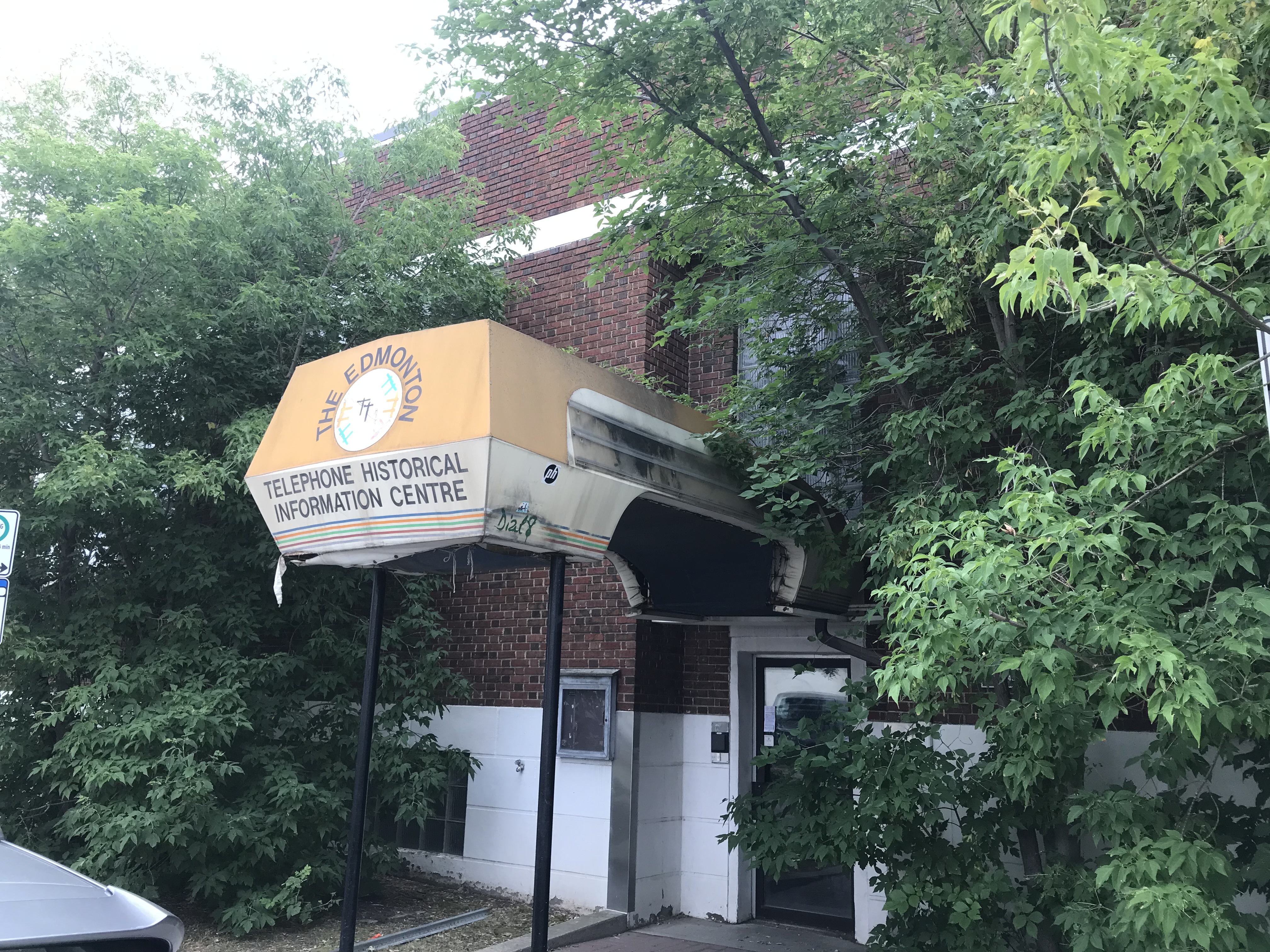
They’ve moved into the Strathcona Exchange Building, a historic old telephone exchange-turned-phone museum on 83rd Ave. that we all recognize from its summers as a Fringe venue — less than 50 steps from the Next Act, the Strathcona theatre bar. Telus still uses part of the building for phone and internet digital services.
It’s a February Sunday afternoon, a scant year after the entire interior of the old building has been gutted, and a fleeting 14 months since RFT signed a long-term lease (20 years, with two 10-year renewals) with Telus. Which has got to be some sort of land speed record for re-builds. Phase 1, which includes a 160 to 170-seat mainstage theatre specially designed for improv, is a $3.5 million re-fit designed by Group2 the architecture/ interior design firm responsible for Theatre Network’s new Roxy on 124 St.
And I’m on a RFT Forever Home tour with artistic director Matt Schuurman and general manager Sarah Huffman. They positively revel in the historical antecedents of a building that dates back more than a century — intriguing in itself since they’re a hip improv company that’s all about the immediate unscripted moment.
Huffman has a special connection. It was only when she got her RFT job a year ago, just after the fateful signing of the lease, that she discovered that her grandfather had worked on creating a phone museum in the building.
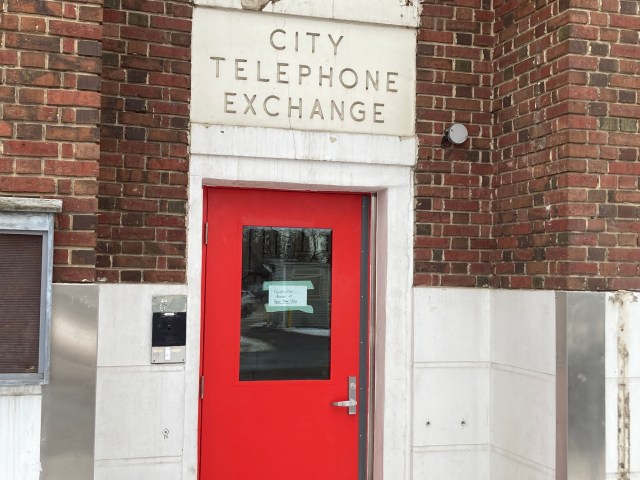
‘City Telephone Exchange’ is carved over the front door. “I love the idea: communication, bringing together, exchange,” says Schuurman an improviser himself, and a videographer and projection artist. “I love the fit! It’s literally what we do….”
As a Fringe venue the Phone Exchange involved worming your way into the “theatre,” and there were lots of wrong turns. The old building was a cramped, much-divided space with low ceilings and dingy grey-brown carpets about which nostalgia is futile. We’d race up the stairs inside the front door, and squeeze down a skinny hallway to get into the makeshift “theatre,” do an abrupt U-turn since you were on the “stage” by then, and clamour up improvised bleachers.

The lobby of Rapid Fire Theatre’s Forever Home.
A revelation happens up the stairs: the startling sight of a pleasingly airy, spacious, high-ceilinged, light-filled lobby, with windows giving out on Old Strathcona. Where did all the space and light come from? Walls are gone. “We ripped out the ceiling and got an extra three or four feet (of height) that way,” says Schuurman.
Minus the gross carpet, the floor turned out to be chic cement inlaid with rock. Schuurman points out a series of smallish plugged circles embedded in it. That’s where wires from the phone operators of yore in the basement exchange came out. You imagine them all down there, head sets on, just like in Bells Are Ringing, the 1956 Judy Halliday musical revived by Plain Jane Theatre a few years ago.

Rapid Fire Theatre lobby.
The box office is at the entrance end of the lobby. Against a brick wall at the other, there’s a bar (bi-level for wheelchair patron accessibility) and its adaptable glowing pep talk. Turn off two letters and “Let’s make shit up” becomes “Let’s make it up.” Or how about just leaving “sh”?
The Rapid Fire ensemble, about 45 performers strong at the moment, really need, and use, a lobby: hanging out translates into new improv teams, new long-form concepts, new festivals. “It’ll be so great to have people in here, a space people can enjoy before, or after, performances,” says Huffman.
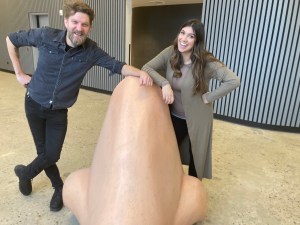
Rapid Fire artistic director Matt Schuurman and general manager Sarah Huffman, and The Nose.
In the middle of the floor awaiting a wall mounting is a giant nose, acquired from a World of Science body exhibit auction. “Our performers were ‘we have to have the nose!’,” reports Schuurman. “So someone is making glasses and a moustache for it, and it will really be OURS.”
And they’ve kept a round window in the floor, an outsized glass manhole cover with a view to the subterranean caverns where the telephone operators of old did their work. “We’re not sure what we’ll use it for. A lighting installation maybe?” says Schuurman. In any case, Rapid Fire is the only theatre in town with a “cable vault” and a wall hanging of phone switcher units, “another little nod to the origin of the space. Even the (configuration) of the sound proofing is based on old cable diagrams.”

a wall hanging from telephone exchange history.
An attractively curvilinear wall, slatted with foam and fabric for soundproofing and acoustics, separates the lobby from the theatre. “There’s a continuous flow to it,” says Huffman of the undulating impulse that leads you into the house.

RFT artistic director Matt Schuurman and general manager Sarah Huffman in the deluxe new all-gender theatre bathroom
And that’s where we’re going, after a moment to ogle the local gender-inclusive washroom, all stalls, with locally designed showbiz lighting. The re-fit has happened under the watch of an “accessibility consultant.” And, unique to Edmonton theatre, there’s a dedicated “mindfulness” room, “for anyone who needs, for whatever reason, a quiet time away from a crowd,” says Schuurman.

The main theatre in Rapid Fire Theatre’s Forever Home. Photo by yours truly.
The theatre itself, with 160 to 170 soft seats, some red some charcoal (and all with cup-holders), is a beauty. Six rows gently curve around a shallow moon-shaped stage, a proscenium modified with a thrust. It’s low, only about six inches high, a gilt-edged invitation to step off and into the audience, and vice versa.
 It’s a theatre that satisfies the deal-breaker requirement for improv: closeness, intimacy with the audience. Improv plays with the audience. The audience is part of the show, and performance is a constant interaction, an exchange of cues and people between stage and the house seats. It’s not a passive entertainment. The new improv theatre is everything the long narrow Zeidler — the long narrow ex-cinema at the Citadel — wasn’t.
At the back of the house you’re only six rows from the stage. Behind that is a drinks counter and bar stools, defined by “cage-match” mesh, a motif that honours Rapid Fire’s flagship improv entertainment Theatresports (Schuurman calls it “the wrestling match of theatre”). From the stage you’ll be able to see the expressions on faces in the back row of the audience.
There’s room closest to the stage for two rows of “loose, detachable seats, removable for for wheelchair access, or cabaret tables, or in the case of kids shows, cushions on the floor. Flexibility is a big asset: RFT is the busiest theatre in town with a rotating roster of some 300 performances a year, some weekly, some one-off.
So what can an improv theatre company get up to in a 14,000 square-foot space, 7,000 or so on each floor? Phase 1 is all about the public spaces (it’s a Junos venue in March). Outside the scope of that budget for now — fund-raising is ongoing — is a big empty future green room on the east side of the space, fixtures and furniture to come. It looks bigger that the Shoctor green room at the Citadel, but then it might need to hold three dozen or more festival participants from time to time. Dressing rooms, including one that’s barrier-free and suitable for pre-show smudging, await completion too.
The classes and public workshops that are Rapid Fire’s bread and butter will happen in the 7,000-plus square feet of basement, says Huffman. So will a second stage, a smaller flexible black box rehearsal and performance space, capacity less than 100 (take note, Fringe). And for the first time Rapid Fire will have offices, lighted through the glass brick along the west side of the building. “Maybe we’ll start with a folding table,” grins the latter.
Yes, the improvisers with a four-decade history of making it up have dreamed big plans. And now they’re home.
 12thNight.ca