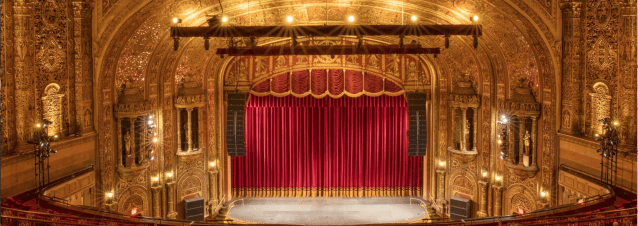
United Palace Theatre, NYC, home of the Tony Awards 2023. Photo from the UP website.
By Liz Nicholls, 12thnight.ca
History got made at the 76th Tony Awards Sunday night in an astonishing, gilt-lined vaudeville house. And, hey, it happened despite the usual sprinkling of winners thanking their agents (thankfully no mentioned their lawyer).

To help support 12thnight.ca YEG theatre coverage, click here.
Improv came into its own.
It’s not easy to capture the liveness of live theatre on television. What made the awards show Sunday so watchable and, dare one say, fun, was just that it actually celebrated live by being un-scripted. It was formatted, yes. and timed. But in solidarity with the WGA strike (a compromise having been reached and a no-Tony night in the offing), there was no written script. No offence to writers and writing (and the Tonys have almost always been far more artfully written than the Oscars, for example), it seemed a lot fresher and faster for that.
Led by the appealing Ariana DeBose, evidently an improviser of note, it was a tribute to the community of artists — we have one, too — who do amazing things in-person live, front of real people eight times a week. That Black artists had major presence, and two of the winners, for best featured and best leading actor in a musical, are openly non-binary seems celebratory too (Alex Newell and J. Harrison Ghee, for Shucked and Some Like It Hot, respectively).
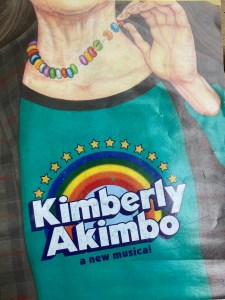 And here’s a surprise (a surprise, that is, until you see it). A musical with the most unpromising premise and thoroughly un-Broadway dimensions, won the best new musical Tony. Kimberly Akimbo is charming and soulful, it’s touching without ever being a wallow, it’s sweet without being saccharine. And it’s funny. I loved it. Its heroine is a 15-year-old girl who has a rare condition of speeded-up aging. She’s played by the wonderful Victoria Clark, who’s in her ‘60s, who amply deserves her Tony in a very thoughtful performance — intricate and exuding simplicity. Amazing, as the New York Times pointed out, that the best Broadway musical of the season defies all the rules about Broadway musicals.
The rise of anti-semitism and fascism was addressed by New York theatre this season, and more than a a few of its Tony winners. I haven’t yet seen the current Broadway revival of Jason Robert Brown’s 1998 musical Parade, which recounts the 1913 trial, imprisonment, and lynching of the Jewish American Leo Frank in Georgia. The Broadway previews attracted protests by neo-Nazis. And the musical’s star Ben Platt said, ugly as they were, it was a reminder of why it’s important to revive the piece.
But I can attest to the power of the best play winner, Leopoldstadt by 85-year-old Tom Stoppard, is a milestone event. Not least because English theatre’s leading living playwright turns his sharp-eyed attention to his own family history. I saw it in New York in January. And at the end of its harrowing two-and-a-half hour chronicle of a wealthy, cultivated Jewish family in Vienna across the terrible span of the first half of the last century,1899-1955, the audience stayed in their seats. We couldn’t move.
In the course of Patrick Marber’s production, a set of real domestic magnificence is gradually dismantled, in scene after scene. And a huge family has been decimated; an almost unthinkable history has caught up with them. It’s a show I’ll never forget.
I also saw Fat Ham and Between Riverside and Crazy, both nominated in the best play category. The former is James Ijames’ riotously entertaining, joyful modern take on Hamlet, set in a Black family who run a Carolina barbecue joint. What would happen to Hamlet if the characters simply refused to be in a tragedy, one propelled by revenge, escalating in violence, that traditionally leaves the stage littered with dead bodies?
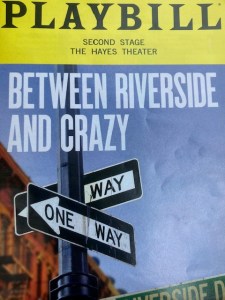 Stephen Adly Guirgis’s Between Riverside and Crazy, another Pulitzer Prize winner, takes us to a rent-controlled New York apartment where a prickly, lovable, stubborn ex-cop with a secret (Tony-nominated Stephen McKinley Henderson, who’s great) presides. He’s surrounded himself, through a kind of subterranean compassion, with a ‘family’ of outliers and hustlers, including Junior, who fences stuff from his bedroom, a Church Lady who isn’t one, a girlfriend who’s maybe an accountancy student. A riot of mixed motives and hidden agendas, in a unique tragi-comedy.
August Wilson’s 1990 Pulitzer Prize winner The Piano Lesson, set in Pittsburgh of the 1930s, was up for best revival of a play (ultimately won by Suzan-Lori Park’s Top Dog/Underdog). And what a mysterious, truly strange play it is, about a family haunted by a secret, the legacy of slavery, and ghosts with names. It has the kind of authenticity in LaTanya Richardson’s production that makes you just long to see Wilson’s whole Pittsburgh Cycle.
Without scripted glue for the evening, the Tony Awards show was a little hint of a community producing … itself. And that felt fun.
 12thNight.ca