
Some Like It Hot. Photo by Marc J Franklin
By Liz Nicholls, 12thnight.ca
NEW YORK — Funny how every conversational fragment that free-floats floats your way when you’re in summer holiday mode, walking and people-listening in Central Park in the morning, sounds like it comes out of a show.
New Yorkers talk loud. “It’s the ratio,” declares an elderly gentleman on a bench, to his companion, “so many bad guys, so few heroes.” Or, in a jog-past, “it’s all about motivation” (hmm, actors?). Or “I told them at the meeting, I have to be more out there!”
Then “OK, it blew my mind!” (a passing cyclist on his cellphone in the a.m.) became “you coulda knocked me over (ov-ah) with a feather (feath-ah),” later in the day. It WAS a line in a show, a rather deluxe production number, stunningly performed by the Tony Award-winning J. Harrison Ghee in Some Like It Hot. Based on the 1959 Billy Wilder film, the musical comedy (by Matthew López and Amber Ruffin) with music by Marc Shaiman and Scott Wittman (of Hairspray fame) is a caper about a couple of Prohibition era musicians on the lam after they witness a mob takeout, who pose as women to join a travelling all-girl band.
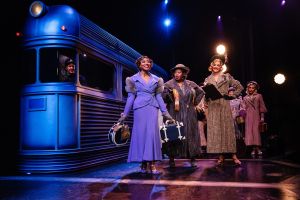
Some Like It Hot. Photo by Marc J Franklin.
The show (directed and choreographed by Casey Nicholaw (The Book of Mormon, The Drowsy Chaperone, Aladdin …) rejoices in old-school Broadway glamour and entertainment. OK, the music tends to generic if expertly crafted evocations of ‘50s Broadway musicals, but there’s a 17(!)-piece orchestra to play it. And the visuals are a knock-out: a non-stop array of fabulous costumes and a succession of art deco sets, a farcical chase scene of maximum intricacy, hot dancing that erupts into tap at every conceivable (and inconceivable) opportunity.
Joe (Christian Boyle) and Jerry (J. Harrison Ghee), in the Tony Curtis and Jack Lemmon roles, don’t just play the sax and the bass, respectively, but are, yes!, a tap-dance duo, the Tip Tap Twins, one white one Black. Sugar (Kayla Pecchioni, the outstanding understudy we saw ), the Marilyn Monroe role, is Black too. So is band-leader Sweet Sue (the terrific NaTasha Yvette Williams), which ups the stakes for her in this re-worked story of travelling the America of 1933. Yes, Some Like It Hot has been re-tuned for our moment with race in mind.
The most savvy update, and one that relies on a great performance by the non-binary Ghee, is the way it addresses gender identity and ambiguity in transcending comic sight gags. It’s Jerry’s discovery that he feels at home and more fully alive as Daphne. He blossoms into his true self, and You Coulda Knocked Me Over With A Feather nails it.
It did cross my mind that this might be a case of political correctness weight-lifting. But it’s negotiated with graceful dexterity by the actor. And it’s matched with Borle’s top-drawer comic chops, and a very funny performance by spaghetti-legged Kevin Del Aguila as the supple millionaire who falls in love with Daphne.

Annaleigh Ashford and Josh Groban in Sweeney Todd. Photo by Matthew Murphy and Evan Zimmerman
Speaking of fulsome bands, we sought out the full-scale production of Sweeney Todd, Sondheim’s gruesome and hilarious 1979 masterwork directed by Hamilton’s Thomas Kail. And it was thrilling, a breath-taking wall of sound from an orchestra of 26 and a cast of 25 led by Josh Groban and Annaleigh Ashford.
Sweeneys come in all sizes and shapes; theatrical masterpieces inspire creativity. I’ve seen it rock in size small. This past season, the Plain Janes gave Edmonton a riveting 8-actor one-piano chamber revival, ingenious, up-close, and dangerous, set in the break room of a meat-packing plant. I remember the Off-Broadway Sweeney Todd from The Tooting Arts Club in the south London suburbs that crossed the pond to the Barrow Street Theatre in Greenwich Village a few years ago. Not only did the production (for a cast of eight and a trio of instruments) reproduce the English lunch-counter setting of a real London pie and mash shop, but it actually served up meat pies, created by a former chef of the Obamas.

Gaten Matarazzo and Annaleigh Ashford in Sweeney Todd. Photo by Matthew Murphy and Evan Zimmerman.
There’s a irresistible kind of grand-scale musical and theatrical magnificence about the Broadway production that’s on now — a vast and murky bi-level world with rotating iron-work towers, extraordinary lighting … and all that stunning music. Groban may not be the most menacing of of Sweeneys ever to go on a serial killing rampage onstage, but he’s an impressive singer. His resonant baritone fills the house with Sweeney’s grief and sense of loss. And Ashford’s Mrs. Lovett, the creative capitalist who bakes the deceased into meat pies, is a very funny, original creation, an outstanding comic performance. And there’s shading, too, witness the touching scene she shares with her assistant Tobias (Gaten Matarazzo).

Here Lies Love, Broadway Theatre. Photo by Liz
After a decade, Here Lies Love, David Byrne and Fatboy Slim’s disco party musical imagining the life of Imelda Marcos (spun from their 2010 concept album) has moved to Broadway from the Public Theatre. And you’re entitled to wonder in advance how that kind of Off-Broadway immersive theatre could work in a big Broadway house.
How? Ingenious high tech (and an enormous budget). The massive Broadway Theatre, on Broadway and 53rd, was gutted entirely to create a giant dance pit à la Studio 54 for the audience to dance (with instructions from a DJ). Retractable stages and platforms, moveable gangways for actors to arrive up on the mezzanine, screens and neon everywhere in every shape and size, flashing lights, newsreel projections, live simulcasts..… It’s a sensory barrage, to the pounding rhythm of Fatboy Slim’s beats and (in response to musicians union protests) a live band of 12 in addition to tracks. You can buy a ticket for the dance floor (we opted for mezzanine seating).

Here Lies Love, Broadway Theatre. Photo by Liz
It’s the first show on Broadway to have an entirely Filipino cast. But the show has taken some heat for humanizing, or trivializing, a particularly brutal and violent regime, guilty of countless abuses and crimes against the Filipino people. The headline in a New York Times story during previews was ‘Here Lies Love Pairs Disco with a Dictator. It’s a controversial choice’.
The musical’s story of the rise and fall of Imelda Marcos does begin with an innocent country beauty queen, it’s true, with music to match. It charts the inflating ego, and boundless appetite for adulation and acquisition that, once empowered, knew no bounds. And the immersive staging of Alex Timber’s disco production is a way to conjure that world of hedonistic excess. But Here Lies Love doesn’t shy away from revealing the monster unleashed, in a mix of dramatic scenes and news footage. Imelda dumps her best childhood friend in one scene, coldly tries to buy off her nanny in another. Her claims to be helping the poor and supporting the arts are blown apart with news footage. The assassination of political rival Aquino, once a boyfriend, confirms an unrestricted capacity for cruelty.
To me, the disco storytelling, and the performance by Arielle Jacobs, vividly convey the corruptible provincial girl and the narcissistic killer. But the story seems thin when it comes to exploring the transition between the two. Imelda is one, then, boom, she’s the other. There isn’t even a song for the actor to work with, dramatically.
Here Lies Love is a unique theatrical experience, though, created by artists who know exactly what to do with big tech. You might feel a bit perplexed by a story with threadbare patches, but you can’t help but feel involved in its telling.
 A couple of shows I saw won’t make it through the summer; the vagaries of the commercial theatre market see to that. An English import, The Life of Pi, Lolita Chakrabarti’s stage re-telling of the Yann Martel novel about a young boy stranded on a lifeboat with a quartet of animals, including a Bengal tiger, is a magical piece of stagecraft from the National Theatre. The seascapes conveyed by Tim Lutkin’s lighting on a mostly bare stage are thrilling in themselves. And the play is a test case for puppet/human interaction.
The puppet characters, including the hyena, the zebra, the orangutan (creations of Nick Barnes and Finn Caldwell), are cunningly set forth, in detailed movements by onstage puppeteers you instantly forget about. And (like the boy) I couldn’t take my eyes off the tiger with the enigmatic name, Richard Parker.
Grey House is that most unusual of Broadway offerings, an original horror story. And it’s genuinely creepy, in Joe Mantello’s production. I was originally attracted to it because the great Laurie Metcalfe is in it, as a strange, dishevelled old lady that greets a couple of stranded travellers in a remote mountain cabin — during a blizzard (of course) with no telephone (of course). Metcalfe presides over a gaggle of very odd, menacing little girls, the kind that might move you to wonder if they’re ghosts. Yup, an evening of death and retribution.
The holiday trip included a couple of Brit imports. One, from the West End, was The Doctor at the Park Avenue Armory, a challenging play chiselled by director Robert Icke from Arthur Schnitzler’s 1912 Professor Bernhardi. The tricky issue of identity, and the hierarchies of identity, and their intersection with race, religion and class, are worked over relentlessly. And just when you think you might know what you think, you don’t.
With the exception of the doctor, played with riveting intensity by the formidable English actor Juliet Stevenson, the casting is across gender and race. When the doctor, a secular Jew, bars a priest from giving the last rites to a 14-year-old patient dying of a botched self-abortion, on medical grounds, all hell (including anti-semitism) breaks loose. A white actor plays the priest, whom we later learn is a Black character. And so on.
The play is smart, its characters fiercely articulate, but I found it rather issue-crammed. And Act II, in which the doctor is humiliated and made to re-discover her humanity, seemed to be a whole different play grafted on.
In Good Vibrations, a punk rock musical from Northern Ireland, at the Irish Arts Center, takes up the ’70s story of a real-life Belfast personnage, the ‘godfather of Belfast punk’. Terri Hooley (Glen Wallace) is the stubborn music junkie idealist who opened a record shop in downtown Belfast across sectarian lines. One thing leads to another: promoting, producing, starting his own record label, gave bands like The Outcasts, The Undertones, and Feargal Sharkey their start — and royally screwed up his own life.
The music bites into a dire period; the band and the actors really commit. As a bonus, we got to see former Edmontonian Ben Wheelwright (who’s graduated from Hogwart’s on Broadway) onstage; he’d replaced one of the Irish actors.
There have been stories of late about the crisis in American theatre, especially the not-for-profit and regional sector (the Public Theatre alone has laid off 19 staff and reduced programming). To be in New York in the summer is to be reminded how much Broadway relies on development in these smaller houses, on both sides of the Atlantic. It’s exciting to see theatre on a grand scale, and it’s a cautionary tale, too.
 12thNight.ca