
Creating (way) outside the mainstream, and finding a place, a home, an audience, and inspiration in Canada at the Fringe: a story of two original pond-crossing theatre artists. Part 1: Cameryn Moore, “muse: an experiment in storytelling and life drawing”. Part 2: Dead Rabbits Theatre, “Tiger Lady”

Cameryn Moore, muse: an experiment in storytelling and life drawing, Little Black Book Productions. Photo by Hassan Ghoncheh
By Liz Nicholls, 12thnight.ca
Part 1
For Cameryn Moore, life and art have a complicated mutual-support relationship. And the Fringe is its enabler.
If Moore hadn’t discovered the Fringe, in Montreal, would she still be a phone sex worker? Or a stand-up? A journalist writing ‘creative non-fiction’ or an artist’s life-drawing studio model?

To help support 12thnight.ca YEG theatre coverage, click here.
Would she ever have discovered herself as a theatre-maker, a playwright, a solo performance artist/creator with seven solo shows in her artistic inventory? Ah, or the creator of muse: an experiment in storytelling and life drawing? That unique artistic “event” (as she describes it) invites audiences to use (or bring) art supplies, draw her in a variety of nude poses, watch and listen, ask her questions. It’s at the the Edmonton Fringe starting Aug. 19 (Stage 5, Acacia Hall).

Cameryn Moore, “muse,” Little Black Book Productions. Photo by Hassan Ghoncheh.
“Ah, people are writing, and doing, their own plays!” That was the sense of possibility Moore unlocked in 2009, “my entry point to solo performing.” True, she’d taken dance in college in California, and as a director and choreographer started a dance company for plus-size dancers in San Francisco and Boston. “Everything after that was me saying ‘I want to try this’ or ‘I’ve heard abut this’ or ‘I went to the Fringe and saw this!’.”
Life provided the raw material, as Moore (an exuberant conversationalist, with one of those great multi-angled showbiz voices) describes. “In 2008, when everything crashed, I got laid off from my job as a marketing assistant in a (Boston) publishing house, and a friend said ‘you should do phone sex; you have a great voice.” So she did, and thought: “wow, there’s so much more to this than anyone knows…. Performance seemed like the natural way for me to explore and share it.” Six months into that seven-year gig (“grocery money, and my only income from 2009 to 2016)”), she’d turned those real-life experiences into Phone Whore, which toured the Canadian fringe circuit. In the show “I got four phone calls from clients, pretty challenging calls, and the audience eavesdropped on them.”
“Traditional theatre” Phone Whore may be, at least in structure, as Moore argues. “Nonetheless it engages with the audience in a very active sort of way … It asks them to sit with what’s happening onstage, a one-hour slice of life, and have their own feelings.” By all accounts, audiences and critics found it a powerful, raw, mind-blowing experience.
Nerdfucker, too, a tense and surprising heartbreaker of a play which came to the Edmonton Fringe in 2016, engaged with its audiences in an unusually direct, active way. Moore doesn’t seem to be a four-wall kind of theatre-builder. It opened in a striking way, with the half-dressed character startled to see us, as she waits with us for her “genius” lover to arrive. And we realize she’s been cruelly used by him for a new gaming concept, which makes us complicit.
“Nerdfucker and Phone Whore are my best plays so far, traditional format, definitely with the most impact. And they’re the ones I love the most,” declares Moore who has taken her plays, including Slut Revolution, to the Edinburgh Fringe, and won “risk-taker” awards there.
Moore moved to Europe in 2017 from the U.S. when Trump was elected, and has continued her work (as noted puckishly on her website) of “global sexification and outreach.” And since moving to the U.K. didn’t work out (“they’re as xenophobic as any other country; they just have a nicer accent”), she picked Berlin because it was “more friendly to English-speaking immigrants.”
On the Fringe circuit and in Europe she subsidizes her theatre income (“who makes money doing theatre?”) by doing Smut Slams, an open-mic experience in which people are invited to come up onstage and tell their own sex stories.
“A performer/performance artist is quite different than a playwright/performer,” Moore says. In muse she is neither. “And I am not a (visual) artist. Nope. No visual arts experience at all. My only experience is as a live model. I started when I moved to Berlin “and needed grocery money, very motivating.”
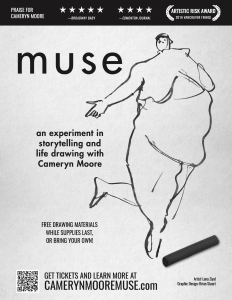
Muse: an experiment in storytelling and life drawing, Cameryn Moore. Photo supplied
Muse isn’t a play. It’s not scripted. And Moore doesn’t play a character. Since the audience can ask her questions (or not) as they draw her (or not), the shows are more like conversations, and they’re not repeatable. “The only thing that happens the same is the same time marks for the poses: five poses for one minute each, three poses for three minutes each, and a six, seven, eight and 10 minute pose.” And Moore says “I have stories in my (laughter) non-existent pocket I tell to kickstart the conversation…. I talk a bit; it’s stream-of-consciousness.”
“I will say, that muse, arguably, is the fringiest show on the Fringe.”
And in the end, “audiences walk out so surprised — with themselves,” Moore says happily. “My production crew in Winnipeg started listening to what people said when they came in, a non-scientific sample.” When they’re invited to take drawing materials and asked ‘would you like to draw today?’, “80 per cent of them will say something like ‘I’m no good at this. I’ve never done this, I haven’t done this since second grade’. They talk down on themselves….”
“When they leave they talk about how they feel. People feel differently about themselves. It’s just beautiful.” And this, Moore says, “is the over-arching sense of what I do: creating safe places for people to explore something, to be vulnerable. We are told that telling stories is for performers and making art is for artists. I’m making space where that’s not so. And the results are joyful and fascinating and wonderful.”
And in its way that gets to the heart of the Fringe.
 12thNight.ca