 By Liz Nicholls, 12thnight.ca
He couldn’t have realized it at the time. But In 1985 at the three-year-old Edmonton Fringe, Kenneth Brown created something that would turn his life upside down (and put its stamp on Edmonton’s summer theatre extravaganza too).
The play was Life After Hockey, a lyrical ode to the mystical, quintessentially Canadian, bond between man and ice and puck. It was an instant hit. A life-changer for the young playwright/actor/director. Thirty-eight years later, Life After Life After Hockey, Brown’s new show (directed by Sean Quigley), premiering at the 42nd annual Edmonton Fringe this week, is all about that, an original theatrical reflection (complete with music by singer-songwriter Dana Wylie and guests) on remarkable success and where it leads.
In the next 17 years Brown would play Rink Rat Brown, a hockey-obsessed Canuck prairie kid more than 1,200 times. He criss-crossed the country; he played in every region, Yellowknife to Port Harvey, east to west and back again. “Every place in Canada big enough to have a theatre,” he laughs. “I exaggerate, but only slightly.” From 1986 to 1988, the show went on three different national tours — “big, $200,000 tours” — and one international tour, too. How many Canadian theatre artists star in their own work at the Helsinki Festival. On skates?
“The year we toured Europe, the (Tom Radford) film of Life After Hockey played the Fringe.” And Wayne Gretzky himself did the voiceover of the hockey god from on high, responding direct from the celestial spheres, “Dear No Backhand,” to Rink Rat’s humble fan question, “Dear 99….” This, incidentally, got me my first and only sports interview, in which the Great One expressed the view that hockey and theatre were very much alike: “it’s ‘practice practice practice’.”
After Brown himself hung up his stage (roller)skates, Life After Hockey has played four countries in three languages, in an assortment of productions. And there are still two or three productions a year. “Completely out of the blue,” as Brown says, amused, “I got an offer from New York to make Life After Baseball. Really.”
“I think of it as only tangentially about hockey,” he now thinks. “It’s really about our culture. What we remember, preserve, and adore about this country.” And as for the character himself, Brown, a National Theatre School grad, says he’d “originally thought of Rink Rat Brown as “a Commedia character.” He’d been trained in masks at the National Theatre School. “And I aimed to create the Canadian Arlecchino.”
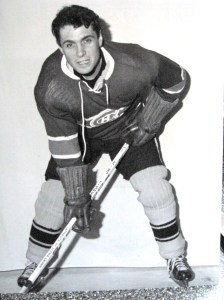
Kenneth Brown as Rink Rat Brown in Life After Hockey. Photo supplied.
Our Arlecchino turned out to be an indelible hockey aspirant dreaming of the big time under the starry prairie sky. “My big mistake,” sighs Brown, “was to name him Kenny Rink Rat Brown…. I hate the name Kenny; I used to beat up my older brothers when they called me that. And for years afterwards, people would phone and ask for Kenny Rink Rat Brown.”
Life After Hockey in 1985 wasn’t Brown’s first encounter with the Edmonton Fringe. He’d been “an observer,” he says of “dropping in on Edmonton” in 1981 on his way back west from the National Theatre School in Montreal with his first wife Heather Redfern (a theatre artist too and now the artistic director of The Cultch in Vancouver).
He and Redfern loved what they saw. “We were in hog heaven,” he says of living in a co-op a block away from the Fringe in Old Strathcona. The Fringe was steps away. In 1983 he played guitar in a George Rideout Fringe show. In 1984, he wrote and starred in Floundering, a stage adaptation of Günter Grass’s doorstopper novel The Flounder, a measure of Fringe elasticity if ever there was one. He took Dickens, Fielding, Shakespeare in hand in original chamber adaptations. He wrote experimental solo fantasias; he wrote a trilogy of plays (Spiral Dive) that followed a young Canadian pilot through World War II. The Brown archive is four dozen-plus plays long.
A theatre-maker who, he says, “was never going to be a leading man” in Canadian theatre he says (“too short, too weird”), “the Fringe phenomenon” was an ideal playground. “It was the perfect opportunity for Edmonton (artists) who wanted to create new theatre … a definitive event really.” And that’s the spirit he carried into his job teaching in the new Grant MacEwan theatre program Tim Ryan had started.
An inspiring teacher and mentor by all accounts then and since, Brown was all about urging, by example and by pedagogy, his theatre students to create and perform their own work (Sheldon Elter’s Métis Mutt is a striking example). And there was a festival for it, in Old Strathcona. It was a striking synchronicity, and for 40 years Edmonton audiences have been the beneficiaries.
And then came the 1985 Fringe, and the hockey hit that would, on the plus side, give him a theatre career with a national profile, a theatre company (with a budget),THEATrePUBLIC, a young company spin-off (RIBBITrePUBLIC) — not to mention the chance to play shinny with Rocket Richard. But there was a price in life, as Brown addresses in Life After Life After Hockey.
“It’s about “that meteoric rise, in profile and financial fortune. And how hard it was…. I went from being a young, hopeful optimistic guy,” he says ruefully of his younger self, and the trap of success. “It was a runaway train. I wouldn’t see my daughter for weeks.…” It cost him two marriages. “And I do blame the play.”
“And all that time I kept writing Fringe plays,” says Brown. He wrote, acted, directed, dramaturged, produced at the Fringe, “sometimes as many as five and often three or four shows” a summer for the last 40. It’s an amazing, exhausting record.
And it could be coming to a grand finale at The Answer Is Fringe. “It’s me looking backward,” says Brown cheerfully of Life After Life After Hockey. “Dana Wylie and I are doing tunes. There’s a surprise appearance by one of my ex-wives. There’s poetry by Pierrette (his life partner and a former Edmonton poet laureate Pierrette Requier). A celebration of wonderful creative people…. This is not just me mall-walking”
“I’ve always been fascinated by flying,” says Brown, as his Spiral Dive trilogy and Letters From Wartime attest. His new “hobby” (his word), flying gliders, is drawing his attention away from 10-hour rehearsal days. There are metaphorical implications for a theatre artist. “The act of staying airborne as long as you can, there’s poetry in that,” he says.
Brown isn’t saying he won’t be back at the Fringe. But “next year: a lot more flying and a lot less learning lines.”
Life After Life After Hockey runs at the Edmonton Fringe, La Cité francophone (Stage 13) Friday through August 27. Tickets: fringetheatre.ca
 12thNight.ca