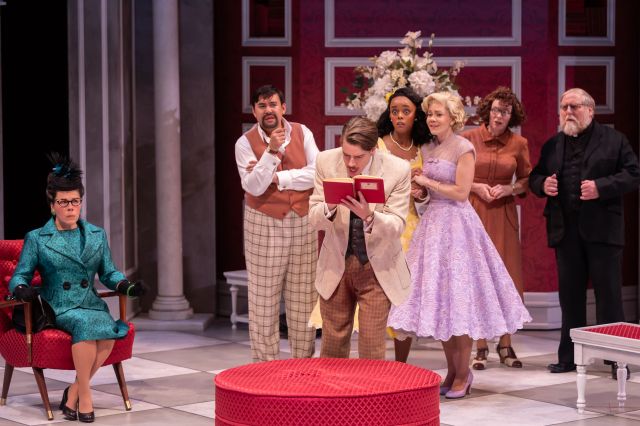
Nadien Chu, Alexander Ariate, Jeff Lillico, Helen Belay, Amelia Sargisson, Davina Stewart, Julien Arnold in The Importance of Being Earnest, Citadel Theatre. Photo by Nanc Price.
By Liz Nicholls, 12thnight.ca
The last time the distinguished director Jackie Maxwell was in town — working at the Citadel for the first time, amazingly, in 2018 — she brought to the stage a darkly funny, disturbing group portrait of three generations of disappointed people in one family. The play was the Canadian premiere of Stephen Karam’s 2015 Tony winner The Humans.

To help support 12thnight.ca YEG theatre coverage, click here.
Five years later, it’s another first (also amazingly) for Maxwell, the former artistic director of the Shaw Festival. The Importance of Being Earnest, Oscar Wilde’s high-Victorian comic masterpiece of 1895, is positioned right smack in the original festival mandate of plays of Shaw and his contemporaries. But Maxwell’s production of Earnest, which goes into previews Saturday night to launch the new Citadel season, is, to her delight, the first time she’s directed the sparkler — a veritable repository of paradoxical wit that’s been called the most perfectly constructed comedy in English language theatre.
The importance of Being Earnest was in the lineup in Maxwell’s first year at Shaw, in her 2002 to 2016 tenure there. But she asked her predecessor Christopher Newton to direct it. “And he did do a lovely production!”
“We did two or three more Wildes (including An Ideal Husband) under my watch. But not this one.” So she found Citadel artistic director Daryl Cloran’s invitation irresistible: “I’m loving giving it a whirl, totally up for it, especially when Daryl said it’d be on the Maclab thrust stage, oh yeah!” Staging The Importance of Being Earnest on a thrust, where we surround the action and nothing can be hidden, comes with its own challenges, to be sure. But Maxwell finds those spaces “more conversational.”
And she’s taken the bold initiative of relocating Earnest from its original setting into … the 1950s. Hang on, more of this in a moment.

director Jackie Maxwell. Photo supplied.
“I do like theatre that’s a bit smarty-pants,” says Maxwell of the play, subtitled “a trivial play for serious people. “And this is full of smart, funny people.” People like high-society bachelors Algernon Moncrieff and Jack Worthing, who for romantic motives (named Cecily and Gwendolyn) scramble, ever more preposterously, to keep up the pretence of being a man named Ernest.
The hilarity of The Importance of Being Earnest couldn’t be more different from the dark, morbid comedy of the other Maxwell production running at the moment. Halted by COVID in 2020 two weeks into rehearsal and now, finally, onstage at the Shaw Festival, The Playboy of the Western World by the Irish playwright J.M. Synge is set in motion when the title character walks into a bar on the wild west coast of the Emerald Isle. He announces that he’s killed his father, and becomes an instant star in the village.
“Dark but funny,” says Maxwell, who loves the play. Its premiere in 1907 caused riots (it was deemed an affront to the Irish character) and the Dublin police had to be called in. Needless to say this hasn’t happened in Niagara-on-the-Lake. For one thing, she thinks, “people’s sensibilities have been shifted” by our exposure to the plays and films of Martin McDonagh (most recently The Banshees of Inisherin). Synge is “not as crazily violent” as his contemporary dark comedy heir, to be sure. But “there’s an underlying violence, and audiences have become a little more accustomed to it.”
Has Maxwell unearthed a hitherto undiscovered vein of darkness in Earnest? She laughs. “I’m not pushing to go down to a darker place. Wilde wanted to write a sock-‘em sold-out comedy. And he did!… And yet it’s sophisticated too. The laughs are earned; they’re built beautifully. The characters are funny but they have a core to them.”
“So there may not be a darkness in it, but there is a base for it,” says Maxwell, whose long and illustrious theatre career began as a little kid in her native Belfast (which retains a very light lyrical touch-down on her cadences). “The people come from somewhere. They have connections and all of them are hiding things” — from the crisp governess Miss Prism to the redoubtable social dragon Lady Bracknell, down to the young debonair layabouts with the Ernest alter-egos.
The characters “are smart and interesting people who’ve … gotten themselves into scrapes, and have to decide how they going to deal with them, what they really want…. They’re leading double lives.” As Maxwell points out, the cruellest irony of the play’s history is that the glittering opening night triumph of Wilde’s most popular hit was followed, shortly thereafter, by his being hauled up for leading a double life himself. Having launched an ill-fated libel suit, he was tried for homosexuality and convicted of “gross indecency.”
Part of the fun of “a trivial comedy for serious people” is the running commentary on money, status, class, social obligations, education, smoking, manners, morals, marriage, cucumber sandwiches, delivered, hilariously, by earnest people who are inadvertent satirists of their world. They’re led by the formidable Lady Bracknell, a social realist of adamantine views on respectability. “There’s meat on the bones,” as Maxwell puts it. “They have to look fabulous, but it’s not just a total ‘put them in pretty dresses’.”
Speaking as we are of the frocks, “the couture of the 1950s,” as Maxwell says, “is one of the most glamorous of eras…. The people have to be recognizably fashionable,” as fashionable as they were in 1895. And the play needs the reality of being in- or out of fashion to work. When Maxwell announced her intention to pry the play out of its period setting, that suggestion of the ‘50s came from the designer Michael Gianfrancesco. “So much has happened of course between 1895 and 1955.” says Maxwell. “But it’s only in the ‘60s or ‘70s that politics would wrench things around a lot more.” In the ‘50s the class system still held sway.” When I read the play in that light, I thought this could really be fun!” She reports that “actors swooned when they saw the costumes!”
As part of her research, Maxwell says she immediately re-watched the first two seasons of The Crown. “You know, those parties with Princess Margaret….”
She thinks the distinctive qualities of the ’50s “have allowed us to stay very true (to the original)…. I can’t tell you how little we had to change the text.” The set pieces on the Maclab stage are “quite Edwardian…. in the ‘50s people still lived in those beautiful houses in fashionable such-and-such Square. A foot in each era.”
“I’ve really tried to see what we would lose by moving the play to the 1950s. And there was so little I saw as impediments…. The last thing I would ever want do is to take away from the core of the play.”
“Everybody working on it is enjoying the sense of really making sure that the way we present the world of the play is as rich and clear, as vivid and as right for the play as it would be doing it in the original.”
“I just think it’ll have a new bounce in its step.”
PREVIEW
The Importance of Being Earnest
Theatre: Citadel
Written by: Oscar Wilde
Directed by: Jackie Maxwell
Starring: Nadien Chu, Alexander Ariate, Jeff Lillico, Helen Belay, Amelia Sargisson, Julien Arnold, Davina Stewart, Doug Mertz
Running: Saturday through Oct. 15
Tickets: citadeltheatre.com, 780-425-1820
 12thNight.ca