
Nadien Chu as Lady Bracknell in The Importance of Being Earnest, Citadel Theatre. Photo by Nanc Price
By Liz Nicholls, 12thnight.ca
In a glum age where the things to be serious about are piling up by the second, there is something inspirational about launching a season with a comedy whose airy architecture is built, rock solid, on topsy-turvy inversion. A comedy that that takes triviality seriously, by balancing its intricate symmetries on a pinpoint.

To help support 12thnight.ca YEG theatre coverage, click here.
That’s what the Citadel has done, via Jackie Maxwell’s delectable production of The Importance of Being Earnest, Oscar Wilde’s comic masterpiece of 1895. “I am sick to death of cleverness,” sulks Jack Worthing (Jeff Lillico), one of a pair of best friends, debonair young men-about-town whose romantic aspirations come up against the adamantine obstacle of not having the perfect name: Ernest. “Everyone is clever nowadays. You can’t go anywhere without meeting clever people….The thing has become an absolute public nuisance.”
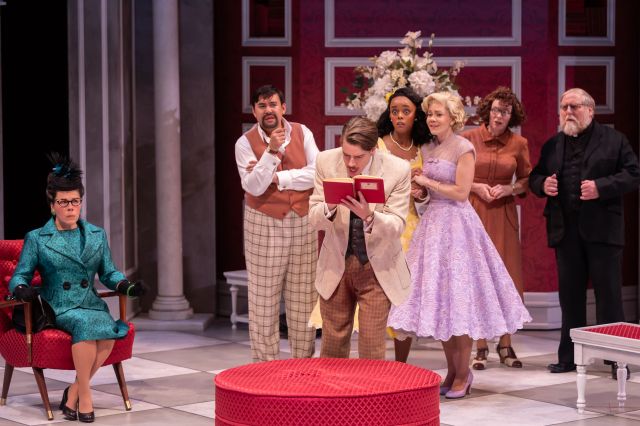
Nadien Chu, Alexander Ariate, Jeff Lillico, Helen Belay, Amelia Sargisson, Davina Stewart, Julien Arnold in The Importance of Being Earnest, Citadel Theatre. Photo by Nanc Price.
Sorry Jack, but the comedy that’s been called the most perfectly constructed in English theatre — and is almost certainly the repertoire’s wittiest — is full of clever people. And they’re repositories of Wilde’s paradoxical wit and hyper-articulate playfulness (“divorces are made in heaven” or “in matters of grave importance style, not sincerity is the vital thing”). But they’re not kidders. They’re in deadly earnest about the social realities of their glittering world — marriage, money, class, the sexes, respectability. Which makes them hilarious, and the play a cross between a romantic comedy and an eagle-eyed satire.
Maxwell has bravely chosen to dislodge Earnest from its high-Victorian setting, and take it ahead by a full half a century into the 1950s. You’re bound to have some reservations in advance. Earnest relocations are risky in theory (witness a long line of Earnests stranded with their thumbs up their epigrammatic backsides in time periods where the nuances of class, parental authority, and social respectability don’t quite resonate). But check your reservations at the door. One of the chief delights of Maxwell’s decision is immediate: Michael Gianfrancesco’s ’50s high-style costumes are an eyeful, the dizzying array of checked trousers, ravishing pastel cocktail frocks, silky lounging jackets, brocade suits. And don’t get me started on the shoes.
Tellingly, the fortunes, privileges and high-handed assumptions of the upper classes sit just fine 50 years later. Surprise! The great social revolution is still on hold. Witness the pair of butlers played very amusingly by Doug Mertz, one urban one country, one sublimely implacable and the other wheezily disintegrating as his hair levitates.
The implacable arbiter of the social status quo at the centre of it all, “a monster without being a myth,” as Jack says, is Lady Bracknell. This magisterial role is occupied with fierce un-ironic gravitas and an entire arsenal of withering looks by Nadien Chu. From her first entrance, feet planted like Cortez claiming a continent, her facial expression is set to disapproval. She’s perpetually ready to have her worst suspicions confirmed by an entire generation — starting with her unreliable nephew Algernon (Alexander Ariate), who’s forever reneging on his social obligations by claiming the need to visit his fictional invalid relative Bunbury. Her lips are pursed, and she spits out the consonants of Bunbury’s name like someone expelling rancid cashews at a distance.
Lady Bracknell’s checklist of questions for male eligibility are very funny, mainly because they’re grimly practical. And Chu never wavers. She demands to know if her daughter Gwendolyn’s potential beau smokes. He admits he does. “I am glad to hear it. A man should always have an occupation of some kind.” Designer Gianfrancesco decks her out in a succession of wonderful hats with feathers that positively quiver with a sense of righteous outrage.
A hard-headed realist, Lady Bracknell has her views on every aspect of modern life, from the inadvisability of long engagements (“they give people the opportunity of finding out each other’s character before marriage”) to the financial merits of investments vs land (the latter “has ceased to be either a profit or a pleasure; it gives one position, and prevents one from keeping it up”). Modern education? “Ignorance is a delicate exotic fruit. Touch it and the bloom is gone.”
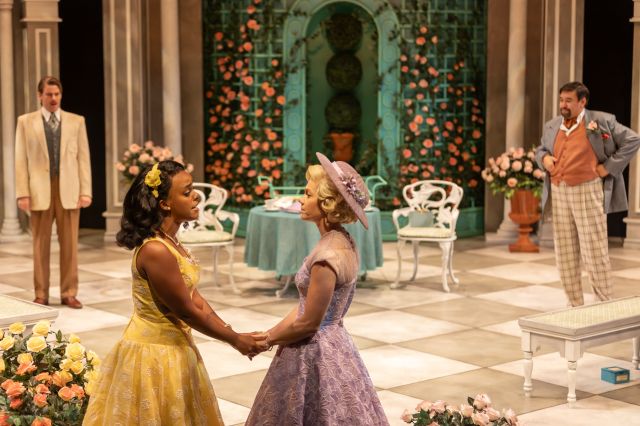
Jeff Lillio, Helen Belay, Amelia Sargisson, Alexander Ariate in The Importance of Being Earnest, Citadel Theatre., Photo by Nanc Price
One of the great delights of the production is the way there are hints, especially when she’s crossed, that Amelia Sargassin’s utterly charming but flinty Gwendolyn (“I am never wrong”), in a first-rate comic performance, is her mother’s daughter. They have matching daytimers, that snap shut like alligator jaws on an arm.
The scenes in a country garden crammed with roses (including Patrick Beagan’s lighting and two women who look enchanting in their frocks), are great fun. The worldly sophisticate Gwendolyn discovers to her dismay that her fiancé Ernest has an “excessively pretty” 18-year-old ward. In a matching performance Cecily (delightful Helen Belay), the country “innocent” brought up on a steady diet of romantic novels, strikes poses, writes lurid fictional entries in her diary, bats her eyes — and when a rival for Ernest arrives, rises to the occasion with impressive steel.
The fractious relationship between Jack and Algernon, the former with top notes of exasperation and the latter with a certain mischievous insouciance, is convincingly supple. And they surf the cadences of Wilde’s epigrammatic wit in very different ways, which irritates both of them.
In the country scenes, the ‘50s leave their mark on the production in a more relaxed, less decorous, physicality. Characters fling themselves onto settees. Lady Bracknell’s arrival leaves both couples either prone or crawling. Victorians would gasp.

Davina Stewart, Helen Belay, Julien Arnold in The Importance of Being Earnest, Citadel Theatre. Photo by Nanc Price
As the rural cleric Canon Chasuble, Julien Arnold is droll, expansively generous in his theological references and embrace; he provides his own footnotes as he delicately approaches Miss Prism. As Cecily’s prim governess, Davina Stewart has an unusually fluttery and slightly addled take on a character who is more often formidably drab. She’s amusing (especially since her auburn hair is set like two Brillo pads on the either side of her head). Clearly Miss Prism is a novelist manqué, who’s been waiting to be swept off her feet rather than just doling out German grammar on a Draconian quota system.
The play is an amazing comic construction. And the pleasures of a production in which the characters are so attentive to each other are manifold, a treat of a way to start the season.
REVIEW
The Importance of Being Earnest
Theatre: Citadel
Written by: Oscar Wilde
Directed by: Jackie Maxwell
Starring: Nadien Chu, Alexander Ariate, Jeff Lillico, Helen Belay, Amelia Sargisson, Julien Arnold, Davina Stewart, Doug Mertz
Running: through Oct. 15
Tickets: citadeltheatre.com, 780-425-1820
 12thNight.ca