
Daniel Radcliffe, Jonathan Groff, Lindsay Mendez in Merrily We Roll Along. Photo by Matthew Murphy.
By Liz Nicholls, 12thnight.ca
NEW YORK — Here I am, 10 days ago, sitting in a vintage wooden booth in the Old Town Bar (an 1892 classic just off Union Square) eating fried clams. Overhearing from the next table a cheerfully loud — New Yorkers aren’t, by and large, a sotto voce crowd — assessment of a football game. Reviews are mixed: “I don’t see it! I don’t see it!”
And I’m musing on the uncanny way theatre here, whatever its original age, experienced in a cluster in this richly endowed theatre destination, seem to speak to The Moment. And it comes with visual art to match.

To help support 12thnight.ca YEG theatre coverage, click here.
Maria Friedman’s wonderful Broadway production of the 1981 Sondheim musical Merrily We Roll Along — hitherto regarded as a combination of glorious music and an elusive, possibly unstageable, George Furth book— seems destined to lodge forever, rent-free, in the mind. Not least because of the superb, interlocking performances of the appealing trio of actors at its centre, Jonathan Groff as composer Franklin, Daniel Radcliffe as playwright Charley, and Lindsay Mendez as novelist turned theatre critic Mary.
This Merrily comes after many valiant revivals — “after 43 years in the wilderness” as The New Yorker put it — that have never quite risen to its challenge of relationships that unspool backwards in time scene by scene. I remember seeing one of those ‘nice try but no’ revivals, the undersung 2019 Fiasco production. In a way it’s a coming-of-age story in reverse, a story of growing up as disillusionment, a story of a three-way friendship, and a betrayal of friendship, ideals, and talent. We meet Franklin, successful, rich and a sell-out, at a Hollywood party packed with sycophants. Mary (Lindsay Mendez) is an unravelling drunk; Charley is nowhere to be seen.
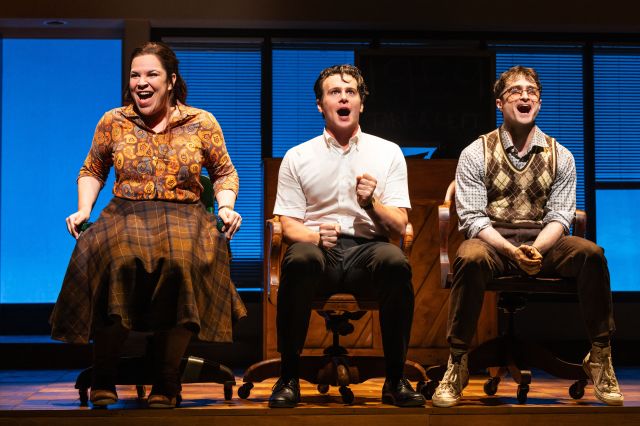
Lindsay Mendez, Jonathan Groff, Daniel Radciffe in Merrily We Roll Along. Photo by Matthew Murphy.
“How did you get to be here?” The question (a profound one for every era, and maybe especially ours) gets tossed our way in the opening number. “What was the moment?” And in this beautiful and heartbreaking musical with the marvellous score, the answer unrolls, incrementally, in reverse. Back 20 years to the world-is-your-oyster moment of infinite possibility on a rooftop, and the exhilarating anthem Our Time, “it’s our time, breathe it in: worlds to change and worlds to win….”
A band of 13 sits above the stage and its serviceable far-from-lavish design (Radcliffe must be the first Broadway star to wear a brown knitted argyle vest for almost the whole show). And the delicious irony of Merrily finally hitting its true stride as a hit, with a song about young struggling, aspirational artists, wonderstruck the first time they hear audience applause and know they have a future, is lost on none of us cheering at the Hudson Theatre.

Annaleigh Ashford and Josh Groban in Sweeney Todd. Photo by Matthew Murphy and Evan Zimmerman
Not least because its current Broadway mate is the 1979 Sondheim masterwork Sweeney Todd in a grand-scale production, with its thrilling wall of sound from a band of 25 — and the starry pairing of Josh Groban as the demon barber of Fleet Street and Annaleigh Ashford as his ever-creative capitalist partner Mrs. Lovett. They’ve now left the show, and about to step up to the killing floor, so to speak, are Aaron Tveit and Sutton Foster.
At Under The Radar (a festival nearly lost to post-pandemic malaise and rescued in the nick of time), Volcano, a four-hour dance/theatre amalgam by the Irish artist Luke Murphy at St. Ann’s Warehouse adopts the form of the contemporary TV mini-series. In four 45-minute episodes for two performers (Murphy and Will Thompson) encased in a glass living room with shabby accoutrements, we glean they’ve signed on to an experiment in defining humanity for potential extraterrestrial life. And within the pod apparently travelling through space the piece unfolds in a explosively inventive pas de deux, pop culture homage scenes (like William Shatner’s spoken-word version of Rocketman), and more baffling lost-in-space explorations.
With Purlie Victorious, a 1961 satire by the American actor/ director/ playwright/ activist Ossie Davis, with its jaunty subtitle A Non-Confederate Romp Through The Cotton Patch, returns to the Broadway stage in a Kenny Leon production. A comedy about race and racism revived 60 years later? It would seem, in theory, to be a risky prospect.
I’ve never seen anything quite like this ebullient, funny, wildly raucous farce, a highly original combination of sassy, scathing and, in its own way, affectionate. The star is the charismatic Leslie Odom Jr. (the original Aaron Burr of Hamilton) as the hustling, fast-talking travelling preacher of the title. Purlie returns to his rural Georgia town to reclaim an inheritance that’s been co-opted by white blowhard plantation owner (Jay O. Sanders). The law has proclaimed de-segregation, but is that the reality?
The entire cast fearlessly sets forth stereotypes, and explodes them. Billy Eugene Jones as Gitlow, a yes-man to Ol’ Cap’n the boss, whose subservience is a savvy performance designed to inflate and lull the boss’s gullibility, is outstandingly funny. “What’s wrong with running? It emancipated more people than Abe Lincoln ever did.”
As the stock character of the dimbulb country maid, Lutiebelle Gussiemae Jenkins, Kara Young is especially hilarious. The scenes where Gussiemae, on a roll, disastrously improvises, are laugh out loud. In this entertaining and insightful play, complacency gets mocked, in a spirit that recognizes and revels in the outrageous and the absurd.

Outside The Palace Of Me by Shary Boyle, American Museum of Art and Design.
Intriguingly, a rainy late January day the day gains a special New York coherence about it, with a stunning multi-media exhibit at the Museum of Arts and Design at Columbus Circle. Theatre, and the idea of performance as a way of testing out identities, is the premise of Outside The Palace Of Me, a solo show — playful, ingenious, full of pop-culture references, with a taste for the surreal — by the Canadian artist Shary Boyle. And it happens in a variety of forms and materials. Overhead projections, animation, video, film, puppetry, ceramics, sculpture, porcelain. And they’re set forth like a theatrical production. Part I, The Dressing Room, is all about the mirrored gaze, Part II; Part II, The Stage; then The Star and The March/Parade (“one person’s parade is another’s riot.”).

Outside The Palace of Me by Shary Boyle, Museum of Arts and Design in NYC.
Appropriate, a title that works both as an adjective and verb, is the Broadway debut of Black playwright Branden Jacobs-Jenkins (Everybody, The Comeuppance). And it’s a barn-, er estate-burner, a full-bodied full-throttle intergenerational — and white — family drama, a (very) dark comedy à la August: Osage Country about damning secrets, brute agendas, a cultural inheritance that is really a haunting.
What brings a scattered white family, siblings and kids, back to an Arkansas plantation on the eve of an estate auction, is the recent death of the patriarch, in debt and given to hoarding. And what gets unearthed, along with simmering grievances and agendas, is something appalling and shameful, the legacy of a whole secret life.
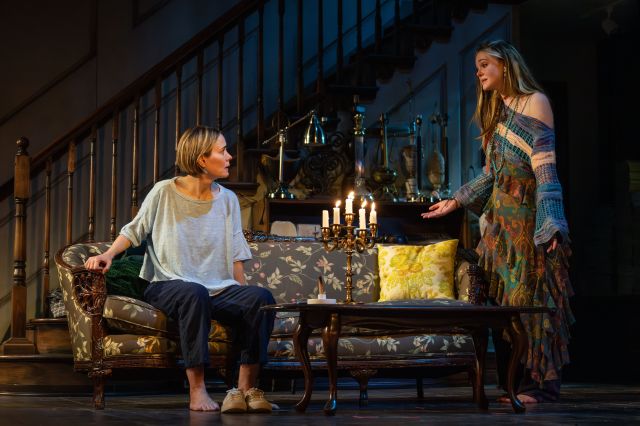
Sarah Paulson and Elle Fanning in Appropriate. Photo by Joan Marcus
Should it be acknowledged as a responsibility? Should it be denied? Should it explained away (or, worse, sold on eBay)? And there’s this: is atonement, or forgiveness, or change, even possible? Appropriate wonders.
The characters, led by Toni, a churning reservoir of toxic fury and fierce denial in Sarah Paulson’s blistering performance, are vividly positioned, and at different angles, to questions of racism, consumerism, responsibility. Rachel (Natalie Gold of Succession fame), who’s married to Toni’s avaricious brother, has overheard the father referring to Bo’s “Jew wife.” Lila Neugebauer’s production is intricate, thoughtful, and absorbing. And it saves some of its secrets for a big reverberant ending.
Appropriate comes with a Chekhov epigraph, the peasant Lopakhin gloating over his triumphant purchase of the fateful cherry orchard from the landed aristocracy. More directly from the Chekhovian orchard is Aristocrats by the Irish playwright Brian Friel and part of Irish Repertory Theatre’s Friel Project. A kind of group portrait of a decaying and inert Irish land gentry at the dead end of entitlement, the play from the author of Dancing At Lughnasa and Translations, is pretty dull, in truth (and makes you appreciate the humour and nuances of Chekhov by contrast). And there isn’t anything about Charlotte Moore’s production that will reinvent or enliven it.

The Connector, MCC Theater, Photo by yours truly
The Connecter, the new musical by Jason Robert Brown (The Last Five Years, Parade) and Jonathan Marc Sherman at MCC Theatre, and brought to the stage in a scintillating way (designed by Beowulf Boritt) by the composer’s longtime collaborator Daisy Prince, has the singe of real life fire about it. First, its story is inspired by the falsified news stories by Steven Glass and Jayson Blair that sucked in The New Republic and the New York Times. And second, though it’s been in the works since 2011 evidently, its relevance to a world where “truth” has been contaminated beyond redemption and fact and fiction have no meaningful frontier, has only been enhanced by the Trumpist declension into chaos.
To me, Sherman’s storytelling, which seems set forth as a tale of seduction by the escalating demands and lure of success, has a fundamental flaw. If the apparently idealistic young writer whose fabrications at a New Yorker-type magazine are discovered and brought home in the course of the musical, is corrupt from the start.
Brown’s score and lyrics are unfailingly witty. And, as you might imagine, a story of the demise of real journalism is an alluring subject for exploration. As in the song from Merrily, Now You Know.
 12thNight.ca