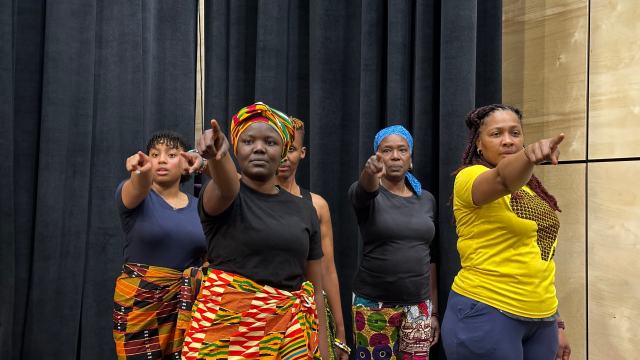
Ogboingba Tries To Change Her Fate, Jabulani Arts Festival. Photo by Beshel Francis.
By Liz Nicholls, 12thnight.ca
A new Edmonton arts festival makes its debut this week. And it’s designed to celebrate, and showcase, the rich diversity of Edmonton’s African, Caribbean, and Black Albertan culture.

To help support 12thnight.ca YEG theatre coverage, click here.
In the inaugural edition of the Ribbon Rouge Foundation’s new Jabulani Arts Festival (May 2 to 4 at Theatre Network), you’ll experience music, dance, visual art, poetry — and theatre. The theatrical centrepiece of the interdisciplinary Jabulani festivities, named after the Zulu word for “rejoice,” is an original play about bravery, re-discovery, transformation.
Ogboingba Tries To Change Her Fate adapts for our time and place a traditional story from the Ijaw people of Nigeria. At its centre is a woman with chutzpah who steps up to confront the creator, reassess her destiny, and make changes in her life.
Lebo Disele, one of the play’s creator/performers, explains that the play was developed over the past two-and-a-half years in an unusually collaborative way. The “inter-generational inter-cultural” troupe, Ribbon Rouge’s Artspace Theatre team, has embraced input from “seven different cultures, seven different backgrounds and upbringings.”
First came the story gathering. The central story, explains Disele, who’s from Botswana (and has a PhD in theatre studies from the U of A), was brought to the group by storyteller/writer Tololwa Mollel, originally from Tanzania. And embedded in the play are two other stories, one from Ghana, one from Tanzania. Disele says they’ve found echoes of Beauty and the Beast, “but without the Disney ending.”
The Black Albertans in the cast of six women, the creative team and crew, and the five musicians (who play live: “it’s a party!”), are joined by a whole cross-section of African and Caribbean artists — from Kenya, Botswana, Trinidad, Jamaica, Ghana, Nigeria….
Africa itself has distinct regions, with different world views and cultural vision, and that’s “even before you go into specific countries,” says Disele. “And when you talk about Blackness in Edmonton, it’s a very diverse population” that includes Caribbean and African immigrants, and Black descendants of North American enslavement.

Ogboingba Tries To Change Her Fate, Jabulani Arts Festival. Photo by Beshel Francis.
Amazingly, the traditional stories the troupe has discovered had roots that spread across cultural lines. “The scenes we focussed on,” Disele says, “were the ones that recurred, and spoke to us regardless of whether we grew up in Edmonton or Ghana…. What have been our experiences as women, in different re-locations? What brings us here? Who are we here? You’ll see in the play that it’s been important for us to speak to the Canadian context.”
That idea aligns with the play’s director Jan Selman, a U of A drama professor with a long and distinguished specialty in community engagement and collective creation in theatre. Selman’s own theatre project “Old Stories and New Ways” isn’t about taking an issue and creating a play about it. It works the other way round: it’s about “taking familiar, traditional stories and looking at how they speak to this community, now,” Disele says. “It’s what happens if we start with the theatre rather than the issue.”
“If we’re really serious about Black Lives Matter, for example, we have to have theatre that is made by people who live that life,” Selman says. “And you can’t do that by bringing in American plays that have Black characters, though that has its place too….”
At the heart of “Old Stories and New Ways” is adaptation,” Selman says. “How is a story of long ago relevant today?” There were many choices for the core story that anchors the new play. The response by the whole group sealed the deal. “We’re all women…. It’s how we’re seen as women, how we like to be seen, the pressure of trying to be many, too many, things.” Ogboingba Tries To Change Her Fate, she says, “came out of which story grabbed us the most and made us ask those questions, made us feel the most.”
What the Artspace group discovered was the remarkable way stories recur and resonate, in different ways, across cultural traditions. For creator/performer Yasmine Lewis-Clarke, who’s from Jamaica, the connection with the story of the woman who tries to change her fate has a personal reverb. As she describes it, in a lively and eloquent way, her upbringing was traditional, and strict. “Coming to Canada, it’s almost like I had to start over, even with my (four) kids, even the way I talk to them. In my culture we were afraid to even talk to our parents…. If you’re the kid and you’re not being spoken to, you don’t talk.”
There are, she muses, “different boundaries here…. I’ve learned a lot; I’ve had to adapt!” Lewis-Clarke tells a moving story about her own mother, who has 14 kids, and embraced change when she started to visit other countries. “You don’t have to bring up your kid this certain way just because that is the culture. It’s just a culture, and the culture is not always right!”
For Lewis-Clarke, the heart of the play’s central story is that the protagonist “got something she asked for and thought she wanted, but eventually (discovered) that she wanted something else. Something was missing from her life, and she didn’t know what….”
“The story is very personal to all of us,” says Disele, who was back in Botswana, a world away from her kids who were in Canada when the international travel ban started during COVID. “It will resonate with students,” she thinks. Education trains you for something specific, “you dedicate years of your life to it, and then you discover you’ve grown and changed….”
As Selman points out, the group is a tangible seminar in how “the richness of life experience” counts more than one pre-determined kind of Canadian theatre school training. “It’s all fodder for the theatre…. Theatre lets us bring our own (selves), our own sense of how come things matter, to the stage, to be shared in the community.” She herself turned to theatre as a teenager. “I found it because of the ‘60s,” she says, “and the idea of telling our own stories…. By 17 or 18 I was hooked; theatre lets more of you count than anything else does.”
“We mostly made the play on our feet,” as Selman describes the process. It started with improvising theatrical images as a way to tell the story. And “it led to the style you’ll see on the stage,” where the storytelling happens in dance and movement (choreographer Eric Awuah, from Ghana, is also a drummer). as well as songs and spoken text. All the edits, in the script and the unrolling of scenes, were collaborative choices.
“We didn’t start out to make an all-woman theatre group, but that’s what evolved…. What do we all have in common? We’ve tried to keep all of our voices in the process.”
PREVIEW
Ogboingba Tries To Change Her Fate
Created collectively by: Lebo Diesel, Yasmine Lewis-Clarke, Larissah Lashley, Abigail ‘Ameley’ Quaye, Noreta Lewis-Prince, Elsa Robinson, Jan Selman
Directed by: Jan Selman
Performed by: Lebo Disele, Larissah Lashley, Noreta Lewis-Prince, Yasmine Lewis-Clarke, Abigail ‘Ameley’ Quaye, Elsa Robinson
Musicians: Eric Awuah, Robert Kpogo, Stennie Noel, Yaw Ansu-Kyeremeh, Prince Owusu
Where: Theatre Network, 10708 124 St.
Running: May 2 to 4
Tickets and full schedule of Jabulani Arts Festival events: theatrenetwork.ca
 12thNight.ca