
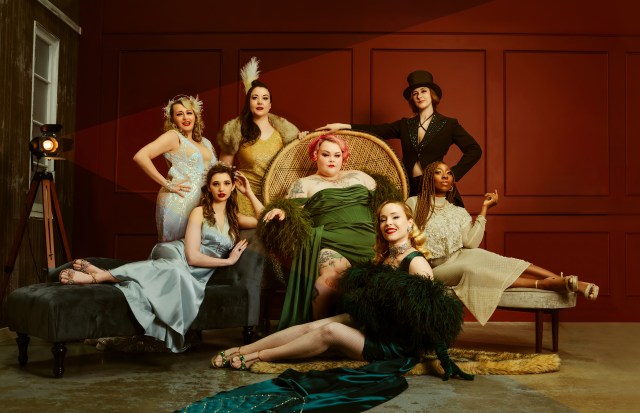
Golden Grind: A Hollywood Burlesque Show, House of Hush Burlesque. Photo by Brennan Royt.
Golden Grind: A Hollywood Burlesque Show (Stage 11, Varscona Theatre)
By Liz Nicholls, 12thnight.ca
If all dissertations were as lively as Golden Grind, academia would be the new showbiz hotspot, professors would not be wearing brown corduroy, and the Ivory Tower would have much better lighting.

To help support 12thnight.ca YEG theatre coverage, click here.
Luster Kitten, soon to be Dr. Luster Kitten (Kristi Hansen), is presenting her Film Studies dissertation as a live powerpoint in this, the latest from House of Hush Burlesque. Her subject is the Golden Age of Hollywood. And her research unzips, so to speak, the treatment of women and gender-diverse people under all the gilt-edged sequined glamour. Is it ready for its closeup?
By its very nature, burlesque is a teasing, playful sort of vaudeville, that dances to the rhythm of the cover-up and the reveal. And our intrepid film historian, who presides with arch cordiality from a lectern, has a lighthearted way with metaphor and applies it to uncorseting the careers of some of Hollywood’s legendary glamour queens. All that glitters, she points out noting the double-sided show title, is not gold.
Dr. Kitten argues that Ziegfeld in New York was the pioneer, in the 20s, of a razzle-dazzle spectacle that gave women performers financial stability, choices, and hence a certain groundbreaking autonomy. In a succession of numbers, the House of Hush cast pay tribute to stars who had something more to reveal than the Hollywood imagery that defined them. Doris Day, for example, was “more than the girl-next-door. LeTabby Lexington’s witty homage to DD’s goody-two-shoes rep, twirls the tassels and golden fringes of the all-American girl and finds a naughtier one inside.
The Wizard of Oz in 1939, “the story of a woman who kills anther woman for her shoes” as our host puts it, made a star of the young Judy Garland. And Dr. Kitten reminds us that the indelible film was an apotheosis of whiteness; “shockingly,” it wasn’t until 1975, Diana Ross in The Wiz, changed that. A House of Hush trio fashions an amusing number from that yellow brick road route to stardom.
Violette Coquette’s inventively sexy tribute to Marlene Dietrich, the sultry, radically elusive star who famously kissed another woman on the lips, happens to a version of La Vie en rose. Sharpay Diem as Hedy Lamar, who challenged the assumption that brains and beauty couldn’t mix, gets an homage from Sharpay Diem, a stage name that can’t fail to make you smile. And the spirit of Mae West, the wiseacre star, lives on in a winking performance by Jezebel Sinclair.
Charlee Queen tributes Dorothy Dandridge, the first African-American movie star to get a best actress Oscar nomination. And the sister act, Canuck in provenance, of the Pickfords Mary and Lottie, as imagined by LeTabby Lexington and Violette Coquette, is the funniest number, a sort of double fan peekaboo that’s all about upstaging. There’s a big Marilyn Monroe finale; my lips are sealed.
Hansen’s script, which she delivers with an entertaining mix of sweet and tart, is full of droll asides and segués. And the show is an eyeful, from the costumes to Audra Dacity’s choreography. Hoot, holler, don’t turn off your cellphone. What fun.
 12thNight.ca