

Funny Beyond Words: A Physical Comedy Cabaret at Edmonton Fringe 2024. Photo supplied.
By Liz Nicholls, 12thnight.ca
After 11 days and nights of sunshine and stars (and also wind, smoke, rain both horizontal and vertical), the 43rd annual edition of our monster summer theatre bash is about to exit the stage tonight. “Our Fringers are hardy,” says artistic director Murray Utas in admiration.

To help support 12thnight.ca YEG theatre coverage, click here.
By Sunday noon (with an afternoon and evening of shows still to come), Find Your Fringe had found itself with some warming box office stats, starting with the 127,000 tickets sold to its 216 shows (update later).
That’s a sizeable increase from the 114,000-plus tickets to the 185-show Fringe landscape of 2023. And, perhaps most impressively, the payout to artists, who take home 100 per cent of the ticket sales (minus the Fringe surcharge), has climbed to $1.3 million. Which is up, relative to the number of shows, from the seam-bursting 258-show 2019 Fringe with its $1.4 million pay-out, spread among a lot more artists, and the $1.2 million that went back to artists at The Answer Is Fringe last summer. In fact, says Fringe Theatre executive director Megan Dart, “it’s the second-highest payout ever at the festival!”
Another box office number that delights Dart and Utas is 397 sold-out performances as of Sunday noon, and 11 totally sold-out runs of Fringe shows. As Dart pointed out Friday, that number includes Fringe shows whose entire runs were sold out before the festival even began. And the visits to the festival’s Old Strathcona site were calculated at 750,000, up from 550,000 last year. Which will have happy consequences for Sea Change beer sales when the final tally is in.
Alas, though, the Sustain Fringe hasn’t arrived at its $300,000 end-of-Fringe goal (it was at $228,000 at noon Sunday). But Dart does report that the 34 monthly donors who signed up when the campaign launched in March have become more than 500. “We were quite vulnerable when we put out a call for help…. It’s a testament to the important of this event here,” this in a country where fully 25 per cent of arts organizations didn’t make it through the pandemic. Sustainability on a scale remains in crisis mode in a landscape pummelled by rocketing production costs and shrinking funding.
The 2024 edition of Edmonton’s theatre extravaganza, though, was big and defiant. New this year was the move of the Late-Night Cabaret, a midnight tradition that’s been a hot ticket and a gathering place for Fringe artists for more than a decade — from the Backstage Theatre to the Granite Curling Club. Not only is the venue much larger — “a backup (300-seat) venue in case of smoke, rain, snow, hail…” says Dart, but the move eliminates the need to keep the Backstage configured as a cabaret space. “Yup, we returned a theatre venue to a theatre festival!” says Utas. A meteorologist on call has turned out to be a good move too, custom-made predictions minute by minute for planning at a festival with a large-scale outdoor carnival component. “So well written, they could have been read by Judi Dench,” says Utas.

Meegan Sweet in The S.P.O.T.T., Squawk Theatre at Edmonton Fringe 2024. Photo supplied
If you like me were thwarted by Sold Out notices in your quest to see, say, The Flying Doctor, Empress of Blandings’ small-cast contemporary update of the Moliere comedy, or a solo show starring a raccoon who dreams of being a human, Meegan Sweet’s The S.P.O.T.T., you’ll recognize the continuing, rejuvenating surprise that is the Fringe. Indie theatre is forever a struggle, and the Fringe and Fringe audiences are a boost to its artists, both in the development and springboarding of new work.

Lauren Brady’s OWEAaDEBT, HEYwire Theatre at Edmonton Fringe 2024. Photo by Joel Sims.
There are, to be sure, obvious ways audience participation happens, at a festival where fourth walls are in short supply. Lauren Brady’s OWEaDEBT, for example (held over this week at the Fringe), unleashes a sly and winking sense of humour about including the audience directly in a highly original, reimagined version of Swan Lake, with its urgency about the transformative power of romantic love. In Stéphanie Morin-Robert’s Soft Spot, an elastic-sided mix of comedy, karaoke, and something a lot queasier and more traumatic, she asks us “does anyone want to come up here and save me, I’m drowning,” And someone does.

Jenny McKillop and Garett Ross in Rob and Chris (Bobby + Tina) – a new musical, Plain Jane Theatre. Photo by Ryan Parker.
But the Fringe audience, more directly accessible to Fringe artists in small informal venues, participates in other ways, too, more subtle perhaps but important in developing a script or testing a creative idea. Sometimes it’s via feedback; sometimes it’s just a matter of being there, and reacting. Kate Ryan, the artistic director of Plain Jane Theatre, directed Rob and Chris (Bobby + Tina), an experiment in making musical theatre that’s held over this week at the Varscona Theatre. It took up the challenge of turning Collin Doyle’s beautiful and intricate hit play Let The Light of Day Through into a musical (with composer Matt Graham) with a future. Changes happened right till the curtain went up on opening night, and then kept happening at every performance.
“Fringe,” says Ryan, “has definitely been an invaluable part of the process of this new musical! So many parts to balance with script and music. We knew that an audience would be a part of the new step in the development…. Collin, myself, and Matt, who’s playing live are at every performance, listening and feeling it, and checking in with actors after. There has been a couple of script and song additions, and allowing moments to breathe more. We’re excited about the next steps for this piece. And grateful for any and all feedback too. We want it all!.”
Garett Ross, who co-stars with Jenny McKillop, thinks Fringe audiences “have had an impact on how far we could go with the lightness and darkness of the piece. This was something I didn’t realize until we actually had an audience, how willing they would be to buy in to the joy and the grief….”
“Fringe audiences lean in. They want to be moved, affected…. They take time off work to invest in this! I totally love this about them. I love standing at the door to greet them as they enter and leave. I learn about how the show impacts them. And I’ve heard it all — the best learning experience for me as a director.
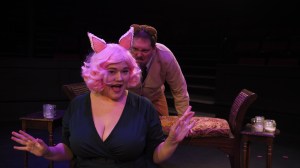
Stephanie Johnson and Thomas Buan in Who’s Afraid of Winnie The Pooh? Clevername Theatre at Edmonton Fringe 2024. Photo supplied.
Is the Fringe still the right place for indie theatrical experiments? It’s a question that gets asked yearly. Dart takes “the freedom to experiment at the festival” as one of its great strengths. On their first visit to Edmonton, Minneapolis-based Clevername Theatre would agree. They brought us an audacious production, Alexander Gerchak’s bold and unusual Who’s Afraid Of Winnie The Pooh? which actually does present the Edward Albee scorcher with the A.A. Milne characters. It premiered at the 2022 Minnesota Fringe, like many of the company’s most experimental pieces.
“It always involves a bit of a leap of faith taking a newer work to a new community,” says Gerchak, “even when the venue is geared toward more experimental work…. We have been incredibly pleased to find that Edmonton has connected to our show in a big way…. Our company is a big believer in the strange and provocative and thought-inducing. And after getting a chance to see a number of other works at the Edmonton Fringe, and the audience’s engagement with them I believe the festival is a welcome home for such work (and for ours).”
Mermaid Entertainment’s Alison Wunderland, a kooky high-speed musical comedy which sold out every performance in its months-long run at the tiny commercial Spotlight Cabaret, the Fringe was an experiment in moving from Off-Off Broadway to the big house, the Garneau Theatre (and it’s held over this week at the Varscona Theatre). “Audiences did show up!” says Aimée Beaudoin, in the cast herself with her Spotlight co-producer Jeff Halaby. “We averaged 225 people per show which was wonderful.”
A show based on playing directly, up close, hand-on-shoulder so to speak, with the Spotlight dinner-show audience had to change in an exponentially larger venue. “We relied on the script,” says Beaudoin, “since there’s no time to talk to the audiences before the show and gather ‘intel’. In a way I like this better, using the actual jokes we wrote, rather than throwing in a joke about ‘Bob’s 50th birthday’ for a cheap laugh. It gives the show more integrity, and the audience is just as delighted with a straight-up show.”
“The Fringe,” she thinks, “opens us up to new audiences and this is wonderful for Spotlight! We’d love more of the theatre crowds to come see what we’re doing in our regular season.”
And in the end, that link between the Fringe and the theatre scene the rest of the year is something that shouldn’t be fragile or hit-and-miss. It’s the research-and-development branch of theatre, where a lot of the excitement of new talent and new ideas happens, and the risks get taken. It’s what keeps us coming back for more.
Have you checked out holdovers of Fringe shows in three venues?
 12thNight.ca