

Mump and Smoot in Exit (Michael Kennard and John Turner), at Theatre Network. Photo supplied
By Liz Nicholls, 12thnight.ca
When a pair of horror clowns named Mump and Smoot take to the Roxy mainstage Oct. 8 for the first time in a decade, those interplanetary existentialists from Ummo will be launching Theatre Network’s 50th anniversary season. And that’s a history in which they’ve played their part.

To help support 12thnight.ca YEG theatre coverage, click here.
The Network premiere of their new show, Mump and Smoot in Exit (Oct. 8 to 27) — directed by Karen Hines, a masterful clown satirist herself — is part of a big-birthday lineup of three productions that renew the theatre’s connection with premier artists who have a past with an influential little company that’s Canadian through and through.
As artistic director Bradley Moss describes the opening graveside gambit of the new Mump and Smoot show coming our way, the macabre pair with the knack for gore (Edmonton audiences first met them at the 1989 Fringe) “come out onstage with their bodies, to bury them … only to realize, ‘oh we’re still here, what now?’.”
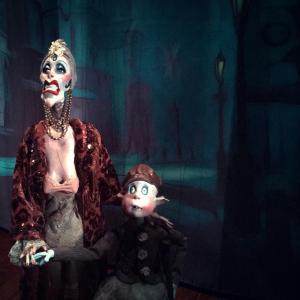
Esmé Massengill and Schnitzel in Little Dickens, Ronnie Burkett Theatre of Marionettes, at Theatre Network.
Mump and Smoot and Moss, which sounds like a show title, go back. In 1999 Mump and Smoot in Something Else With Zug was part of Moss’s second Theatre Network season. His first featured the weird and wonderful Street of Blood by another true Canadian original, marionettist/ playwright/ actor/ designer Ronnie Burkett, whose seven-show history with Network dates back to the gothic romance mystery thriller musical Awful Manors in 1990.
Last season Burkett premiered Wonderful Joe — a transcendent vision of a multi-cultural urban ‘hood through the eyes of an aged outlier — on the Roxy stage. And he’s back for the big five-oh.
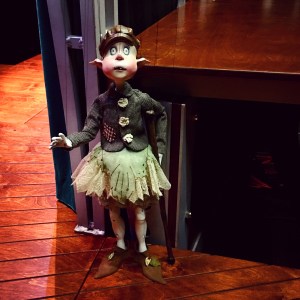
Schnitzel as Tiny Tim, Little Dickens, Ronnie Burkett Theatre of Marionettes at Theatre Network. Photo supplied.
The Ronnie Burkett Theatre of Marionettes’ returns Dec. 3 to 22 with a Christmas show, Little Dickens. And that show, says Moss, was where he started assembling the 50th anniversary season. After Little Willy (the Daisy Theatre takes on the Bard) and Wonderful Joe Moss wondered if he should wait a year. “And then I came to my senses,” he laughs.
Little Dickens is the raucous (adult!) Burkett version of that seasonal roasted chestnut A Christmas Carol, with a marionette cast that includes Daisy Theatre stars: the aging diva Esmé Massengill as the flinty Scrooge and the fairy child Schnitzel as the Yuletide heartthrob Tiny Tim. “C’mon! How funny and fun is that going to be!” says Moss. Since a Burkett show is never without its improvised moments, “you can be pretty sure he’ll have a go at the American election.”
The third of the trio on the Nancy Power mainstage, Jupiter (April 1 to 20) — “a full-bodied family drama with a beautiful dog” as billed — is the premiere of a new play commissioned from two-time Governor General’s Award winner Colleen Murphy (Pig Girl, The December Man). Moss, who’s directed Network productions of Pig Girl, Armstrong’s War, The Society For The Destitute Present Titus Bouffonius among others, admires the playwright for a fearless tough-mindedness that never loses sight of the need to be entertaining.

Monk, in Jupiter by Colleen Murphy, Theatre Network. Photo supplied.
As he describes, Jupiter is set in the living room of a multi-generational working class family with dark secrets. It unfolds in three different time periods, separated by 10 years, to follow the fortunes of “a young girl with a lot of smarts, a promising talent.… And you see her world unravel.” The production is big: a cast of seven and a dog. Ah yes, a handsome golden retriever named Monk is the only actor who’s been cast so far.
The season also includes the return of Nextfest (June 5 to 15), the multi-disciplinary festival of emerging artists, for its 27th annual edition, and the Phoenix Series, in which Network hosts other companies and indie artists.
In a half a century Theatre Network has had its dramatic, not to say seismic, re-locations, renos, struggles, not to mention flames and flood. It’s a story that includes the devastating fire in 2015 that destroyed Network’s ex-cinema Roxy home on 124th St. in the midst of its 40th anniversary season. It seemed like the end. That the story turned out a new chapter instead, and seven years later a spiffy new $12 million Roxy, rising from the ashes of the old, amazingly on the same footprint, is nothing short of a theatrical coup. But there were near-death experiences before that: read on.
The challenge to generate new Canadian work and support local artists, and along with it draw an audience, isn’t exclusive to Network, to be sure. Fortunes are not to be made that way. As Moss puts it, “if the focus is on art: are you a hit-chaser or a hit-maker?”
The Network story began 50 years ago as a collective of young U of A theatre school grads, creating on location and touring the results. Tanya Ryga, one of the original group, recalls that “the group came together courtesy of Pierre Trudeau’s Opportunity For Youth Grants.” The story of a hard-knock Alberta town, Elnora, bypassed by the new highway, caught the eye of one of their number, Dennis Robinson. “And in the spring of 1975, six of us headed there…. We lived and worked among the farmers, teachers, children, merchants, hospital staff, bar staff and families to create Theatre Network’s inaugural play Two Miles Off or Elnora Sunrise With A Twist of Lemon.”

actor/playwright Tanya Ryga, part of the collective that started Theatre Network. Photo supplied
“I cringe sometimes when I think of our hippie attire and urban demeanour, long hair, beards, bra-less 20-something know-it-all artistes descending on this quiet village of 211 people. But they didn’t flinch.” All 211 showed up for opening night.
Two Miles Off… toured across Alberta and across the country. And until 1981 the core group, Ryga says, “continued pioneering the ‘immersive experience becomes the next play’ approach.” The most notable Network play of the period was hatched in Fort McMurray “where we lived in a school bus in the summer of 1977,” and got odd jobs to sustain the enterprise.
By the summer of 1978, with help from playwrights Gordon Pengilly and Leslie Saunders, the musical Hard Hats and Stolen Hearts: A Tarsands Myth was ready for an international trek, “through Alberta, across the prairies to the National Arts Centre, the Maritimes and finally Off-Off Broadway.”
By 1981 the touring collective had transitioned; they put down roots in a 140-seat ex-Kingdom Hall on a cul-de-sac near the old Coliseum that had been home to the Tournesol dance company. And not only was it a dive, it was “unfindable,” says Stephen Heatley, who became artistic director in 1982. All tickets came with instructions about where to turn left.
“We wanted to be an Edmonton theatre. But we didn’t have an Edmonton audience…. We needed to re-establish the connections with the community….
“My brag line,” laughs Heatley, now a drama prof at UBC, “was that in my first season I increased the box office 1,000 per cent. And it wasn’t that hard….”
“We had no money and no audience. So we figured we’d better spread our seed a bit,” by touring. Raymond Storey’s Country Chorale was part of his first season, and in the cast was a big-boned gal from southern Alberta, an unknown named k.d. lang.
“For the first three seasons (which included the charming The Other Side of the Pole and a musical adaptation of The Shooting of Dan McGrew), we did joint productions with Red Deer College,” where the shows got built and rehearsed, and where they played after Edmonton. Gradually audiences started to find the little theatre, and hits emerged. The musical Your Wildest Dreams, by Marianne Copithorne and Murray McCune, which extended for a week before touring to Victoria and Ontario, was one. Heatley remembers a city councillor phoning him during the holdover to say “you can’t be sold out; I need to see the show.” Heatley suggested that since there were literally no more chairs in the joint he might be able to sit on someone’s lap.
As Ryga says “we had all grown up seeing British and American plays dominating our training and gracing our Canadian stages. We wanted tell our own stories.” At Network, as Heatley says, the theatrical fare was “not just Canadian but almost exclusively Albertan….” And that came with challenges. “We weren’t doing popular hits from Off-Broadway; we worked by the grace of the audience who grew to trust that our shows would be done with integrity. They were our stories. And they’d forgive us one or two bad ones for the ones that were movers and shakers.”
By Christmas 1989, “we had a sense we’d done as much as we could in that building, and probably more.” So it came to pass that Network moved across town to the Roxy, the funky ex-cinema on 124th St. that Nancy Power “sold to us for a song ( $200,000)….”
“It had a history before we moved in,” as Heatley says. “I often felt there were ghosts.” With ghostly spaces to match, like the crawl space under the stage where the unlucky stage hand pushed things up onto the stage through trap doors. (side note: touring that space made me the claustrophobe I am today).
“I was a little nervous about the idea of a theatre company owning property,” admits Heatley, who left the company in 1993 when the board vetoed his production of Conni Massing’s The Aberhart Summer as too large-scale (it later happened at the Citadel). “But I’ve re-thought that over the years….”
The old Roxy wasn’t luxurious digs, to say the least, and survival never stopped being precarious. Heatley remembers continuing arguments with Equity about the chemical toilets backstage (“we didn’t have the money for plumbing”). The low water mark of the Network story might actually be in plumbing. In the 1994-95 season when artistic director Ben Henderson and general manager David Hennessey “inherited a mess,” as Moss puts it, “the toilets and hot water tank were re-possessed, and the theatre operated out of the phone box across the street.”
A certain ramshackle bohemian quality, that flourished under that perpetually leaky roof, was arguably part of its charm. “It was beautiful,” says Moss, “because as a small theatre we were able to surpass your expectations. You walked in, tiny little lobby, crappy bathrooms, and then, inside, there was magic. Ronnie or Lorne (Cardinal) onstage. And you walked out going Wow! Now (laughter) it’s the opposite: people walk into a great building with expectations!”
So many plays important to the Canadian theatre repertoire were developed, produced, presented, at the well-named Theatre Network, in all its locations. And so many notable Canadian playwrights are connected to the big-impact little theatre: names like Raymond Storey, Conni Massing, Frank Moher, Brad Fraser, Beth Graham, Collin Doyle, Eugene Stickland, Vic Albert, Karen Hines, Michael McKinlay, the playwrights of this 50th anniversary season (Murphy, Burkett, Kennard and Turner) linger in the air. The list goes on. And Moss, who grew up in Quebec, has made a point of producing Quebecois playwrights (Michel Tremblay, Dominique Champagne and more).
Supporting artists is the crucial thing, says Moss. “We want to be the venue where a show evolves and grows. The show you arrive with isn’t the show you should leave with…. The craft is a process. And the missing ingredient is always the audience.” .
Further information, subscriptions, tickets, memberships: theatrenetwork.ca.
 12thNight.ca