
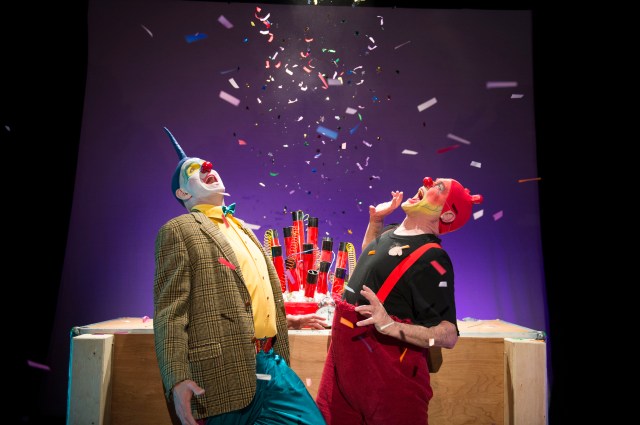
Mump and Smoot in Exit, at Theatre Network. Photo supplied.
By Liz Nicholls, 12thnight.ca
It took them a while to get back here with a show. A decade to be precise. But there was something entirely natural about finding Mump and Smoot and their director Karen Hines last week in the basement of the Roxy under an arch of skulls, discussing death.

To help support 12thnight.ca YEG theatre coverage, click here.
Not for the first time has that favoured subject come up with Canada’s horror clown duo. By no means. It’s deeply grooved into the Mump and Smoot psyche, sensibility, and comedy aesthetic. And you know it if you’ve followed the riotously nightmare oeuvre of the interplanetary travellers from Ummo — ever since their arrival at the 1989 Fringe on a trail of gore and giblets and severed limbs.
Even the title of their new show Mump and Smoot in Exit, launching Theatre Network’s 50th anniversary season next week, has a double-edged black comedy frisson about it. Exit stage left? Exit from … life?
They have a history with death, you might say. The Ummonian pair have taken us to a funeral, where the leg comes off the corpse and then the head, and they can’t resist improvising a game of baseball with their new bat and ball. Since then they’ve taken us to the wilderness to face their demons. They’ve tested the theory that what goes up must go down, by undertaking air travel. They’ve pushed their fraught relationship in visits to a surgeon, or the dentist (feel free to flinch). In Cracked, which played the Roxy in 2010, we actually went home with Mump and Smoot, back to their place on Ummo; they’ve died and been reborn.

Mump and Smoot open Theatre Network’s 50th anniversary season, in Exit. Photo supplied.
Michael Kennard and John Turner, Mump and Smoot’s artist alter-egos, have always played along the frontier where the clown question “what can go wrong?” might just get max’ed. Turner, who plays the oft-aggrieved Smoot, the more impulsive and suggestible of the two, says, “we need to throw in the word ‘mischief’….” Their shows are not exactly satire, of the micro kind that Hines executes brilliantly with her own pop culture-soaked clown character Pochsy. “It’s macro … critical thinking about life and death, a view of the world,” says Hines of the thoughtful pair, three old friends who all met at Second City in Toronto. “Bigger things, like life and death, and spaghetti dinners,” Turner laughs. They all laugh.
Kennard, who plays Mump, the bossier, more aggressively confident of the two, says “death is so prominent right now. The world is being threatened by death everywhere….” He says of the new show “we don’t have war onstage, or famine. It’s all about their relationship, and what happens when you die. We’re just proposing that question. It’s all about death.”

Mump and Smoot in Exit (Michael Kennard and John Turner), at Theatre Network. Photo supplied
“It’s dark, true…. But I’ve laughed more (in rehearsal) than I have at any other show,” says Hines, who has high standards in dark comedy. “The show feels like it’s questioning the societal take on death, how upset we are by it, and isn’t it OK to go, and how lucky we are to be here.”
There was an inspirational Mump trip to Mexico for the Day of the Dead celebrations. Turner adds that MAID (medical assistance in dying) “has brought the discussion about death to the forefront; it’s all about choice.”
“For me the setting is juicy right away,” he says. Hines points out that “even Mump and Smoot’s very first show took us to a wake.” Kennard argues that “death is the high stakes of theatre…. Almost all fear, to me, is derived from death.” That takes the trio back to Mump and Smoot’s official five-point credo, established early and oft referred to, which in addition to fear also includes “enjoy the process of living,” as Hines points out.
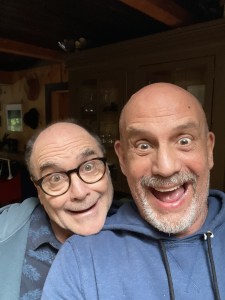
John Turner and Michael Kennard, aka Smoot and Mump, in serious writing mode. Photo supplied.
So, back to the question, downstairs at the Roxy under the glare of a gargoyle with light-up red eyes: where have they been for the last 10 years? Kennard has been here, a U of A drama prof who like Turner and Hines is a prized mentor to the next generation(s) of artists. Turner’s Clown Farm headquarters on Manitoulin Island in Ontario burned to the ground in 2014 (a year before the same fate overtook the old Roxy, Theatre Network’s ex-cinema home on 124th Street), and the rebuilt clown school there didn’t survive two years of pandemic shutdown. He and his wife have moved to Cape Breton (“I suddenly realized I’m living on an island in the North Atlantic!”) and he teaches regularly at One North Clown in Sudbury. Hines, based in Calgary and frequently to be found in Toronto, has been writing full-length plays (Crawlspace and All the Little Animals I Have Eaten among them) and after 15 years returned Pochsy, her toxic pixie character, to the stage at Network last season, with the sequel Pochsy IV.
“It takes a lot of energy to put up a show,” Kennard sighs. “It takes us longer and longer to get around to it…. The struggle to put up new creative work doesn’t get easier. And it’s not like things are way better for artists than they were 30 years ago.” Au contraire. It’s harder than ever, and “not just because of our age but because of the world…. We keep trying to exit theatre, and we keep getting brought back. From beyond the grave” (laughter).
“What keeps bringing us back is, hmm, that we can’t stop,” he says. Besides, “we have fun. It’s such a great time,” says Kennard.
Did Hines, who has evidently mastered the rarefied art of directing Mump and Smoot shows, egg them on to create a new one? “I said ‘please don’t!’” she jokes, to general amusement. “No, I patiently watched from the outside. Honestly I wouldn’t have been surprised if they’d said ‘we’re gonna sign off’…. But it’s a calling, and you just can’t ignore that.”
“On one side you feel, a bit betrayed, having put in so much time, and ‘what? you’re making it harder?’” says Turner of diminishing support and artistic freedom that’s more not less circumscribed. On the other, the disintegrating state of the world is the “hot fire that inspires the next creation.” Kennard shrugs, “it has always been a struggle, and it always will be be. Because we’re clowns.” Says Hines, “the (clown) challenge is to get away with it.”
Turner remembers the lucrative contract to tour to kids’ schools that got dangled in front of them in their first year of being Mump and Smoot in the ’80s. They turned it down because “we were fighting against preconceptions of what (the art form) clown is and who it’s for.” Mind you, they did spend three summers in Fredericton N.B. working on a kids’ TV show. “Thirteen shows in seven days,” says Kennard. “Was it great TV? You’ll notice we didn’t tell you the title.” Hines shudders: “I watched it. Once.” But the $9,000 they made was how Turner bought the Manitoulin farm, so chalk it up to experience, in a good cause.
They decided to go ahead with Mump and Smoot in Exit “even without money.” The Canada Council turned their grant application down; only recently did the CC reconsider. What aspect of the show has changed the most as a result? wonders Hines. “It didn’t afford us more time. But we could up the production values,” says Kennard. “Home Depot!” He points to the skull arch, and they laugh.
“And the artists are getting paid properly,” he says of the cast, the director, and the addition to the cast of Lauren Brady (OweADebt), a clown mentee of both Kennard and Hines. “We were facing doing the show without a stage manager,” just like their early days at the Edmonton Fringe, when they camped at Rainbow Valley, and put their makeup on in a tent.
By now Kennard and Turner, often a big wide country apart, have a Mump and Smoot way of putting a show together. This past summer they spent two weeks together at Kennard’s “in-the-bush place in Ontario,” as Turner describes the rustic cabin. “After those two weeks they did send me a script. It was a scant two pages long, and in point form,” says Hines. Last week it had grown to four pages. And the unique process of rehearsing a Mump and Smoot show was underway.
“We go in to each scene and each moment to to make sure it’s perform-able and repeatable, solid enough so they can break out of it to improvise,” she says. In rehearsal “sometimes they wear (clown) noses; sometimes they don’t.” And on the route from outline to show, they flesh out the scenes on their feet. “There’s something about developing shows onstage that makes it feel incredibly spontaneous, that it’s happening for the first time.”
Mump and Smoot do play with the audience: there’s improv, to be sure (“we give ourselves 10 minutes wiggle room,” says Kennard). But there is always a solid infrastructure to a Mump and Smoot production. “Freedom, the freedom to go anywhere, through structure,” as Turner puts it. “Lack of structure is chaos, and is actually a prison…. We have to take (the audience) into our world. And if we don’t have a world we have nowhere to take them.” Creating that world is “the mischief and fun of it!”
“Some clowns don’t like directors,” says Kennard. He and Turner are emphatically not of that camp. “I get on their wavelength, try to envision their vision,” says Hines. I call myself a ‘realizer’. They already know in their bones what they’re doing. And I have to help make it real.”
PREVIEW
Mump and Smoot in Exit
Theatre: Theatre Network
Created and performed by: Michael Kennard and John Turner
Directed by: Karen Hines
Running: Oct. 10 to 27
Tickets: theatrenetwork.ca
 12thNight.ca