A theatrical index to a beloved novel: Little Women at the Citadel, a review

Hayley Moorhouse, Donna Leny Hansen, Christina Nguyen, Nadien Chu, Erin Pettifor in Little Women, Citadel Theatre. Photo by Nanc Price.

By Liz Nicholls, 12thnight.ca

The March siblings, growing up in genteel poverty in Civil War America, might well be literature’s most famous sister act since Jane Austen’s Bennets. And ever since they stepped out from the pages of Louisa May Alcott’s hit 1868/69 coming-of-age novel Little Women, Jo, Meg, Amy, and Beth have gathered the stage and screen history to prove it.

In every kind of adaptation — plays, musicals, operas, ballets, movies, animations, TV series — there they are, teenage sisters  jostling with each other and the expectations of their world. They’re a permanent temptation to writers of every age to use the bleached-out word “iconic” as the younger generation of March’s struggle, each in her own way, with the novel’s ever-renewable central question. What does it mean to be a woman?  — a “little woman” or a big one for that matter — and claim a meaningful life?

To help support 12thnight.ca YEG theatre coverage, click here.

In the season finale production of Little Women at the Citadel, the characters are set forth by Jenna Rodgers’ excellent cast in a vivid, recognizable way. And they’re led onstage by a heroine for us to love. Jo (an amusingly brisk, abrupt, exasperated performance from Hayley Moorhouse) is the impulsive, fretful, difficult sister, chafing at the confines of her 19th century life and the way it squanders her talents and stifles her creativity.

Adapting Little Women doesn’t take virtuoso brilliance to ferret out contemporary relevance. It’s a self-renewing resource that way. For one thing it’s perennially war somewhere, as well we know. And as for family squabbling, or the tension between renegade feminine ambition and cultural expectation, well, they haven’t exactly vanished from the earth either. So it’s curious to find a stage adaptation so tied (the word might be shackled) to the novel, incident by incident, that it seems more like a very long series of vignettes than a play.

Donna Leny Hansen, Christina Nguyen, Hayley Moorhouse (rear), Erin Pettifor in Little Women, Citadel Theatre. Photo by Nanc Price

Commissioned from the Canadian playwright Jordi Mand by the Stratford Festival (where it premiered in 2022), this Little Women unrolls, at three long hours (including intermission), as an exhaustive index of famous moments. And though they’re annotated by Jo, a narrator with an appealing skepticism about her as Moorhouse conveys, there an awful lot of them (Little Women was originally two novels). And they’re given more or less equal weight.

One scene ends, another begins: the Christmas breakfast, the skit, the skating episode, the curling iron fiasco, the hair-cutting incident, the scarlet fever near-miss, the grand party and ankle sprain, the Jo meets Laurie scene, the visit to Aunt March, the news from the front and the departure of Marmee, the gift of the piano from Laurie’s rich gruff Mr. Laurence (Troy O’Donnell), the return of father, Jo meets Friedrich, Jo visits a publisher in New York, on and on…. If you’re familiar with the book, or the book via an assortment of movies, you won’t feel shortchanged by the dutiful scene count. Au contraire. But it’s by no means an exciting build-up of momentum.

Erin Pettifor, Hayley Moorhouse, Donna Leny Hansen, Christina Nguyen, Nadien Chu in Little Women, Citadel Theatre. Photo by Nanc Price

Still, there’s entertainment to be had seeing the familiar portraiture come to life in 3-D onstage. As played by Donna Leny Hansen, Meg, the beautiful and conventional sister who finds she wants marriage and motherhood, has Meg-ish charm. Erin Pettifor is suitably mild and conciliatory as poor doomed Beth. Christina Nguyen is an amusingly sulky whiner as self-centred Amy, who suffers from the family poverty more than anyone, as she’s fond of saying.

Hayley Moorhouse and Troy O’Donnell in Little Women, Citadel Theatre. Photo by Nanc Price

And Moorhouse as the would-be writer (the Alcott stand-in), is appealing as the awkward sister, who never quite knows where to put her arms and whether to shake hands or salute, as men do, when she meets people. “I need to leave; I need to be somewhere else; I need to do something new.” By the third hour you may well feel the same.

Their fractious sibling dynamic is conveyed in scenes refereed by Marmee (Nadien Chu), the maternal paragon who advises her girls to be charitable, look within, and find a true self to be. It’s a tall order. She confesses to a continuous secret anger that you’d like to know more about. “I am angry every day of my life,” she says unexpectedly to hot-tempered Jo, who’s amazed.

Gabriel Richardson and Christina Nguyen in Little Women, Citadel Theatre. Photo by Nanc Price. Costumes by Deanna Finnman

The smaller roles are ably filled: Gabriel Richardson as rich boy Laurie, Steven Greenfield as the kindly, bookish Friedrich Bhaer, the German professor Jo falls for in NYC; Patricia Darbasie as imperious Aunt March, Troy O’Donnell as gruff but generous Mr. Laurence, Paul-Ford Manguelle as the professional tutor. And Deanna Finnman’s beautifully detailed period costumes identify the nuances of soci0-economic class in a way that the dramatized scenes aren’t always able to do.

Robin Fisher’s un-atmospheric set, a skeletal house (lighted by Whittyn Jason) with beige walls — the writing is literally on the wall — is austere enough but seems rather vast under the March family circumstances.

In the end, this is a production that gives you what you need to remember a cherished book from your childhood (or conjure a prize story from your movie-going). That said, it won’t propel you into a fresh new engagement.

REVIEW

Little Women

Theatre: Citadel Theatre

Based on the novel by Louise May Alcott

Adapted by: Jordi Mand

Directed by: Jenna Rodgers

Starring: Hayley Moorhouse, Nadien Chu, Donna Leny Jansen, Erin Pettifor, Christina Nguyen, Gabriel Richardson, Patricia Darbasie, Troy O’Donnell, Steven Greenfield, Paul-Ford Manguelle

Running:  through May 25

Tickets: citadeltheatre.com, 780-425-1820


Posted in Reviews | Tagged , , , , , | Comments Off on A theatrical index to a beloved novel: Little Women at the Citadel, a review

Shadow Theatre announces a four-show upcoming season, launched by a new Canadian musical

By Liz Nicholls, 12thnight.ca

Shadow Theatre’s upcoming four-production 32nd season will launch with the premiere of a much-anticipated new Canadian musical.

In Morningside Road, by the remarkably versatile Edmonton artists Mhairi Berg (book) and Simon Abbott (music), a girl connects to her grandmother’s stories of growing up on the title street in Edinburgh — with the gathering complication that the old woman’s memory is being eroded and diverted by dementia. Can truth and fiction be unknotted?

To help support 12thnight.ca YEG theatre coverage, click here.

The Celtic-flavoured musical breathed its first public air at Nextfest and a staged reading followed at Script Salon. Morningside Road received a Sterling Award nomination for its Fringe incarnation last summer. The Shadow production directed by Lana Michelle Hughes (Oct. 15 to Nov. 2),  Shadow’s associate artistic director, is its expanded full-length premiere. Berg and Maureen Rooney are joined onstage by a three-piece band led by Abbott, Grindstone Theatre’s resident composer/musical director.

The lineup announced by artistic director/ Shadow co-founder John Hudson includes two American plays, both with classical antecedents and contemporary resonances. An Iliad, by the team of Lisa Peterson and Denis O’Hare, is a modern re-telling of the Homer epic. “Our narrator is Homer,” says Hudson. “He’s been travelling and telling the story for 3,000 years. And he stumbles into our theatre with a suitcase,” says Hudson. “He arrives onstage at the (Varscona) theatre at a very specific point in a 10-year war” — you know, that famously infamous Trojan War.

“Powerful and funny,” says Hudson of the award-winning 2012 piece that digs into “the ongoing stupidity and horror of war…. It really points the finger at all of us.” He directs the Shadow production (Jan. 21 to Feb. 8, 2026)) starring Michael Peng, who’s onstage with one musician.

The four characters in The Revolutionists, by the prolific American star playwright Lauren Gunderson (Christmas at Pemberley), are real historical head-strong women who lived on the knife edge of their time, the Reign of Terror during the French Revolution. The doomed queen Marie Antoinette, playwright cum feminist activist Olympe de Gouges, the Marat assassin Charlotte Corday, and the Haitian activist spy Marianne Angelle.  “They interact, back and forth, in and out, during this very smart and witty play,” says Hudson, whose initial idea for his production (March 18 to April 5, 2026) is “period punk.” Alex Dawkins will play Olympe; other casting remains to be announced.

The English playwright Peter Quilter has been in touch with Shadow Theatre ever since the Edmonton company produced his play Glorious! (the story of the supremely untalented celebrity soprano Florence Foster Jenkins) in 2008. Quilter’s 2023 comedy Autumn is the finale of the upcoming Shadow season, “a beautiful two-hander about two eccentric sisters … lovely, full of heart, and very funny,” as Hudson describes. The play unfolds during their preparations for the wedding of the daughter of one of them. Hughes directs the Shadow production May 6 to 24, 2026.

Meanwhile, the current season continues with Kristen Da Silva’s Where You Are, through May 18. The 12thnight review is here.

Further information and subscriptions for the 2025-2026 Shadow season: shadowtheatre.org.


Posted in Features, Previews | Tagged , , , , | Comments Off on Shadow Theatre announces a four-show upcoming season, launched by a new Canadian musical

Family secrets and country air: Where You Are at Shadow, a review

Coralie Cairns, Davina Stewart, Nikki Hulowski in Where You Are, Shadow Theatre. Set and lighting Daniel vanHest, costumes Leona Brausen. Photo by Marc J Chalifoux.

By Liz Nicholls, 12thnight.ca

There’s no shortage of funny one-liners in Where You Are. And a lot of them happen in the opening scenes of the carefully constructed 2019 comedy by the Canadian playwright Kristen Da Silva.

To help support 12thnight.ca YEG theatre coverage, click here.

We meet two retirement-age sisters who live in idyllic tranquillity on Manitoulin Island. They’re high-contrast siblings. Suzanna (Coralie Cairns) is the flamboyant extrovert, who emerges at the crack of noon declaiming at the chickens, and looking like Sarah Bernhardt after a bender. Glenda (Davina Stewart) is the calm one with the dry, undercutting wit. She’s just back from church, an expedition on behalf not of organized religion but of gathering gossip about the neighbours and selling home-made jam.

Where You Are, Shadow Theatre. Set and lighting Daniel vanHeyst, costumes Leona Brausen. Photo by Marc Chalifoux.

In John Hudson’s handsomely appointed production, they live in an old-fashioned wood-framed two-storey house (with shed and hydrangeas), in another fulsome and beautiful design by Daniel vanHeyst. His lighting captures a suffusing golden glow at every time of day into summer night. This is the rural Ontario of your dreams; it occurred to me that I’ve never lived in a house as nice as the one on the Varscona stage (maybe they do rentals).

Coralie Cairns and Davina Stewart in Where You Are, Shadow Theatre. Photo by Marc J Chalifoux. Set and lighting Daniel vanHeyst, costumes Leona Brausen.

The sibs, a sitcom duo, are set boldly forth, in performances by Cairns and Stewart. Cairns has a high-beam smile that could melt the ice in a rum punch at 100 paces. The latter leans to the bemused eye-roll and deadpan comeback. They have comic rapport onstage. And their repartee lobs some hand-picked lines our way — about country life (“I’ve seen productions of King Lear with less conflict,” says Glenda), veterinary science, nosy townsfolk, mother-daughter friction.

And their neighbour Patrick (Brennan Campbell), a handsome but forlorn vet they keep tabs on, joins in. Not only has he been dumped by his fiancée at the altar (“no!” he amends, “I was still at the hotel”), but, worse, she’s getting married. To “a vegan butcher.” And worse still Patrick is actually going to the wedding; his date is the border collie over whom he has joint custody.

The keynote of Campbell’s performance is addled awkwardness that is charming, with a self-deprecating laugh, but ramped up to a level of intensity that makes you wonder if Patrick should consider a wee shot of the tranquillizers he gives to his equine patients.

Nikki Hulowski and Brennan Campbell in Where You Are, Shadow Theatre. Set and lighting Daniel vanHeyst, costumes Leona Brausen. Photo by Marc J Chalifoux.

Anyhow, these are the prelims to a visit by Suzanna’s grown-up daughter Beth (Nikki Hulowski), a doctor in the city, that follows broad indicators hinting that mother and daughter don’t get along. “Just be nice. Don’t be pushy,” says Glenda to her sister. “Whatever you feel like saying … don’t.”

If Glenda and Suzanna have an unresolved dark secret (this is Canadian theatre, after all, built on unresolved dark secrets), Beth has one too. And her mom is relentless about unearthing it. “I didn’t know you even had a relationship status,” she says, aggrieved by the discovery that Beth has been withholding personal info about a fiancé, now -ex. How dare she? Hulowski is delightful as Beth, who’s funny and smart, and probably the sanest person in the play. This is the kind of play where “I don’t want to talk about it” is a prompt for whole scenes of talking about it. And Hulowski actually makes the artifices amusing, and seem downright impromptu.

Glenda and Suzanna are assisted materially (i.e. literally, with material) in their double-portraiture by Leona Brausen’s wonderful array of costumes. They’re more than apt, they’re actively fun to see, a visual comedy in themselves: the theatrical robes in which Suzanna is decked vs the genteel ruritanian Constable painting look of Glenda.

As the play folds and refolds along its familiar comedy crease lines (all captured in Darrin Hagen’s score), there are other costuming coups, too. In some ways you could argue that costuming actually is the storytelling. It’s certainly the source of the sight gags and narrative developments. Hmm, why does  Beth arrive wearing khaki pants from the Gap, apparently so unlike her usual style of dress? “She’s dressed like she works in a car rental place,” sniffs Suzanna, on her bloodhound hunt for personal info. Why is the ‘little black dress’ so little?

You know a rom-com has been embedded in Where You Are when Beth emerges from the house in a skimpy nightdress and runs into Patrick, who’s taken his shirt off because it’s hot out and he’s been badgered, passive-aggressively into fixing the roof of the sisters’ deck.

Where You Are is nothing if not cannily constructed to be a comedy of the “I laughed; I cried” variety. It’s rather overtly determined to be heart-warming as well as funny. When things turn that corner of comedy, you realize you’ve been on a trail of clues that have planted on the route to play descriptives that lean into family, love, loss, grief, laughter and tears. I found it all a little assiduous and calculated. But I’m in the minority with these reservations, judging by the opening night audience. They loved it, and leapt to their feet in appreciation.

Having said that I must add that there’s fun to be had at this amiable show, beautifully produced. Da Silva is deft hand with comic lines. And Hudson’s cast, Cairns, Stewart, Hulowski and Campbell, are actors with comic chops who know how to make the most of them.

REVIEW

Where You Are

Theatre: Shadow Theatre

Written by: Kristen Da Silva

Directed by: John Hudson

Starring: Coralie Cairns, Davina Stewart, Nikki Hulowski, Brennan Campbell

Where: Varscona Theatre, 10329 83 Ave.

Running: through May 18

Tickets: shadowtheatre.org

Posted in Reviews | Tagged , , , , | Comments Off on Family secrets and country air: Where You Are at Shadow, a review

Getting our Canadian stories, our voices, our dreams off the page and onto the stage: meet director Jan Selman

Bright Burning by Colleen Murphy, premiering at Studio Theatre, directed by Jan Selman in 2017. Photo by Ed Ellis.

By Liz Nicholls, 12thnight.ca

You could call it “retirement.”

After a quarter century at the U of A, in which she has directed every sort of play, taught acting and directing, encouraged young playwrights, commissioned new Canadian plays, sat on countless academic committees, instigated theatre research projects, chaired the drama department for a decade, Jan Selman is exiting her university office.

But retirement? It was revealing last week that Selman was en route to a rehearsal hall. She made time for a lunch en route to Theatre Network, and rehearsals for This Is Canada, Too, the production she’s directing at the Jabulani Festival in its second year of celebrating and showcasing Edmonton’s Caribbean, African, and Black Albertan artists.

director Jan Selman

“I’m retiring from the university; I’m not retiring from the theatre,” says the director emphatically. “I want to do more!” And Edmonton theatre — of every aesthetic stripe, large and small-scale, in formal theatres and found spaces — is in luck: now Selman has the time to do exactly that.

This Is Canada, Too (running tonight through Sunday on the Roxy mainstage) is “interactive storytelling.” As Selman describes, it’s an intricate, elastic way of theatre-making that listens on the spot to the community and its diversity of voices and stories. The audience gets to talk to the characters, “some newcomers to Canada and some who’ve lived here for a long time, as they face some new challenge.”

“The characters get into situations, have dilemmas, and get to a crisis point where they say to the audience ‘what the hell can I do? What are my options?’.” The characters work it out, with the audience. “And that’s “part of the show, not just the post-show discussion….”

Ogboingba Tries To Change Her Fate, Jabulani Arts Festival. Photo by Beshel Francis.

“Using theatre as a way to build conversation. And keeping it theatrical. That’s my thing!” Last year’s Jabulani Festival theatrical centrepiece Oboingba Tries To Change Her Fate, was Selman’s thing too, a play collectively created by a multi-cultural ensemble that found contemporary relevance in a traditional Nigerian tale. Selman’s decade-long (and continuing) theatre research project, “Old Stories in New Ways, “has gathered creative partners both in Canada and Africa.

“Working with the Black community of artists on projects that need doing, so they can tell the stories they’re dreaming, and finding a place to showcase them” has taken her back to her roots, she says. Both Jabulani shows, in different ways, return Selman to early days of a theatre career that started in Victoria, her original hometown, and a BFA degree in theatre in 1974. “I made my living as an actor for a year after school, a big long school tour in B.C. in Alberta…. But it was never ‘I have to be on the stage; I just never saw myself that way. Directing was always where I wanted to go.”

A vague plan to go into urban planning didn’t stand a chance when she met the late great Tom Peacocke, the charismatic and influential U of A drama prof who became one of her cherished mentors. “I came here to do an MFA in directing. And this was THE place in the country to do that; I’m a Canadianist.”

Like Gerry Potter and Stephen Heatley, who arrived here as directing students and stayed to launch theatre companies (Workshop West and Theatre Network respectively), Selman was “very interested in the Canadian voice, and how to get our plays, our stories, onto the stage.” The Farm Show, the legendary 1972 play, collectively created at Toronto’s Theatre Passe-Muraille (director Paul Thompson sent actors out to research farm life on location) was a big influence, she says.

Another was David Barnet, a collective creation specialist at the U of A who founded Catalyst Theatre, a project-to-project operation at the time, with a social action mandate.  Selman was Catalyst’s first full-time artistic director (1978 to 1985).  It was a total immersion gig: under Selman the company, whose first headquarters was Barnet’s basement, became a professional year-round theatre, with an amazing output of 15 shows and popular projects a year.

“I learned on the job,” Selman says. And she had the lineage to match. “I came from a family of people interested in adult education, and community development initiatives. So it fit.”

“Theatre happens on major stages, and people have to come to you. Or theatre goes out to the community, on the road, in church halls, basements … We need both of those for theatre to stay really relevant to the community,” Selman thinks.  “Theatre is an art form that wants to be live, to be communal.”

As you will glean, “community” is a Selman mantra. And it hovers over a long, distinguished (and continuing) resumé that leans heavily, though not exclusively, into the contemporary Canadian repertoire. In a striking way the trajectory of her career is an insight into the story of Edmonton theatre, the flowering of an art form authentically attached to its creators in this mid-sized city in the middle of the prairies. The question for her, and she’s passionate about it, has always been “how do we stay porous and really engaged with the places we’re in?…. We Canadians built a Canadian theatre, and it’s happened in our lifetime, since the late ‘60s, (the urge) to tell our own stories…. People were hungry for it.”

Creeps by David Freeman, directed by Jan Selman 1981. Photo from Workshop West archives.

She’s directed some of the seminal plays in the Canadian repertoire. Frank Moher’s 1985 Odd Jobs, for example, a Catalyst commission that premiered at Theatre Network in a Selman production, holds a place of honour in her list of favourite directing experiences. In 1981 she directed a Catalyst-Workshop West co-production of David Freeman’s Creeps, a Canadian theatre groundbreaker with its disabled characters in a sheltered workshop. She directed Jane Heather’s landmark interactive play about teen sexuality for young audiences Are We There Yet?, which has toured extensively under the Concrete Theatre banner (Selman was “principal investigator”). For the U of A’s Studio Theatre and its graduating classes of actors, Selman commissioned, and directed plays by Canadian stars Colleen Murphy (Bright Burning, 2017) and Greg MacArthur (Missionary Position, 2013).

Penguins by Michael McKinlay, directed by Jan Selman, 1987. Photo from the Theatre Network archives.

It’s a record of stepping up to complicated theatrical challenges. In one of the earliest Catalyst shows Selman directed, an interactive piece called Project Immigration in the late ’70s,, the actors played a diverse assortment of people hoping to emigrate to Canada, and the audiences made the decisions. It’s had multiple iterations since.

This Baby Belongs To All Of Us, Kwe Kalyet: an Old Story In A New Way. Photo credit: Ignite Afrika

And her work in using theatre as a means of community engagement and multi-cultural outreach has extended across the sea: Selman is a co-founder of Ignite Afrika, an umbrella organization for arts creation and development in western Kenya, with a festival to match.

Christine Lesiak and Tara Travis in The Spinsters, Small Matters Productions, directed by Jan Selman. Photo by Ian Walker.

Although she’s published extensively — on feminist and popular theatre, theatre for social change, interactive theatre — there’s never been anything ivory tower about Selman. In academia “the teachers I most admired were out there, doing it,” as she puts it. And as a freelance director, for example, she’s taken on such off-centre directing assignments as The Spinsters, a high-style physical clown show by Small Matters Productions.

[Blank], U of A Studio theatre, directed by Jan Selman. Photo by Brianne Jang, BB Collective Photography

Selman’s grand finale show at the U of A’s Studio Theatre in March points to the future. [Blank] by the English playwright Alice Birch “gives you 100 scenes, and you pick from them to make them into a play,” as she describes. “It’s a work-out. The characters are not named; there’s no indication which scenes are linked together. You’re making the play from a world (women and youth involved in the social justice system). And I really responded to that.”

What especially appealed to her was “the way (the playwright) trusts other artists, people  she doesn’t even know, as collaborators; ‘do what you will’….” Selman says she worked on it every day from last August through December.”

“That invitation to collaborate on something new, and more traditional theatre … it’s all a continuum. I need all of it to do any of it well!” she says. Indie theatre, mainstage theatre, creation theatre … “let’s have it all.”

When asked about her theatre dreams, Selman remembers her younger self always answering “when I’m older I’m going to direct  direct Lillian Hellman’s The Autumn Garden. “It’s about middle-aged characters and I was young…. Now that I am older, it doesn’t have the same appeal,” she laughs.  Now Selman is up for anything, but leans more into the contemporary, the new. And untethered from the organizational and leadership work at the university of teaching and coordinating acting and directing programs, Selman will be exploring the theatrical spectrum as a freelance director.

“I’m in theatre because it uses the most of me,” she says. “There are really smart people, bright sharp minds, at every echelon of theatre. And I feel lucky to be part of that.”

And in an age “when it’s so easy to stop seeing people” and stay glued to screens, theatre crucially is “a live exchange. With human beings…. If we’re going to get through this divisive, unfair, unjust world we seem to have built, we’ve got to be in rooms together. Talking and feeling and witnessing together. Live theatre fits with all that.”

Posted in Features | Tagged , , , , , , , , , | Comments Off on Getting our Canadian stories, our voices, our dreams off the page and onto the stage: meet director Jan Selman

Lots to see on Edmonton stages this week, a small survey of the landscape

Coralie Cairns and Davina Stewart in Where You Are, Shadow Theatre.

By Liz Nicholls, 12thnight.ca

Hey, Edmonton. You have choices for your evenings out at the theatre this week: two Canadian comedies, a wicked Brit satire, a multi-disciplinary arts festival, a stage adaptation of a much-loved novel, a prairie love story, a big Broadway musical…. Here’s a scan of the E-town stage landscape.

To help support 12thnight.ca YEG theatre coverage, click here.

In the Canadian comedy that opens Thursday on the Varscona stage, Shadow Theatre’s season finale, we meet two sisters, retired, on the front porch of their home on Manitoulin Island. And in Where You Are, by actor/playwright Kristen Da Silva, the tranquil surfaces of their lives, and the family secrets slumbering within, are disturbed by the visit of one sister’s daughter — with secrets of her own.

John Hudson’s production stars Coralie Cairns and Davina Stewart as the retired siblings, Nikki Hulowski, and Brennan Campbell. It runs through May 18. Tickets: shadowtheatre.org.

•At the Citadel, we meet the March sisters, Jo, Meg, Amy and Beth, growing up in genteel poverty in Civil War America. They step from the pages of Louisa May Alcott’s evergreen two-part novel Little Women of 1868/69 in a stage version by Toronto-based playwright Jordi Mand that premiered at the Stratford Festival in 2022. The production directed by Jenna Rodgers, Concrete Theatre’s new artistic director, stars Hayley Moorhouse as Jo, the sparky sister with the writerly ambitions, along with Donna Leny Hansen as Meg, Christina Nguyen as Amy, and Erin Pettifog as Beth. Little Women starts previews Saturday and opens officially next week, through May 25. Tickets: citadeltheatre.com.

•Jabulani returns Thursday to take over Theatre Network’s Roxy Theatre Thursday through Sunday, in a second annual edition of Ribbon Rouge Foundation’s multi-disciplinary arts festival named after the Zulu word for “rejoice.” It’s designed to celebrate — in theatre, visual arts, dance, music, poetry — Edmonton’s African, Caribbean and Black Albertan community.

One Too Many, A Thousand, a community-based theatre initiative in collective storytelling, explores, as billed, “the lived experiences of LGBTQ+ immigrants and people of colour in Edmonton.” It runs Friday  Rooted in collective storytelling, it examines themes of displacement, resilience, identity, and belonging. One Too Many, A Thousand is a community-based theatre performance that explores with audiences the lived experiences of LGBTQ+ immigrants and people of colour in Edmonton. It runs Friday through Sunday on the Nancy Power stage.

The characters of This Is Canada, Too, running Thursday, Saturday and Sunday, is an interactive performance based on exchange between audiences and characters — some recent immigrants, some long-time Canadians — facing some new challenges. Jan Selman, who directed Jabulani’s mainstage theatre production Oboingba Tries To Change Her Fate, directs the new ArtSpace Theatre Company show.

Tickets for both One Too Man, A Thousand and This Is Canada, Too: theatrenetwork.ca.

Eli Yaschuk and Rain Matkin in Radiant Vermin, Northern Light Theatre. Photo by Brianne Jang, BB Collective Photography

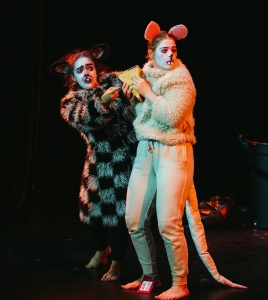
•Northern Light’s crack Trevor Schmidt production of Radiant Vermin, which continues through Saturday, is a wicked satire by the English writer Philip Ridley in which an appealing young couple (played by Rain Matkin and Eli Yaschuk) tell us about their, er,  unusual shortcut to their dream home. En route to triumphant real estate acquisition, they peel back the thin veneer of morality. Which turns out to be thinner than vinyl siding. Shocking and funny. Have a peek at the 12thnight preview and review. Tickets: northernlighttheatre.com.

Alphabet Line, an unusually lyrical new play by AJ Hrooshkin that’s the season finale at Fringe Theatre, kicks up the prairie dust on the rural-urban divide. In 1940s Saskatchewan a queer man living alone on a family farm reaches out every day by radio, and hears nothing back from a big empty world. Until one day he gets a response, from a grad student out in the countryside for the summer. Can they, will they, connect on the land? Check out the 12thnight review and an interview with the playwright here. Giulia Romano’s Prairie Strange production runs through Saturday. Tickets: fringetheatre.ca.

Niko Combitsis and Kory Fulton in Jersey Boys, Mayfield Theatre. Photo by Marc J Chalifoux

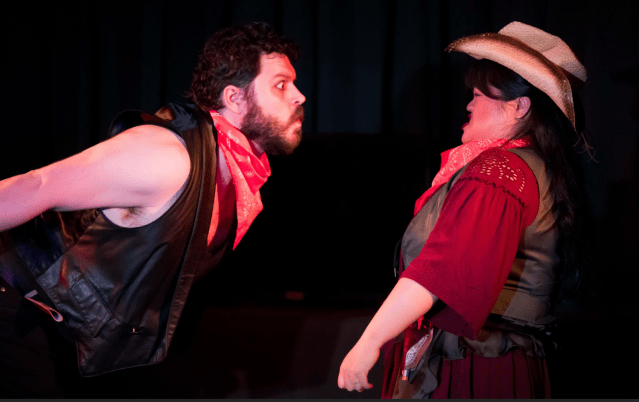
At the Mayfield, Jersey Boys, in a jukebox musical class of its own, tells the classic story of the rise and fall of a pop band — that happens to be true. Danny Austin’s music-filled production continues through June 8.  Tickets: mayfieldtheatre.ca. Check out 12thnight’s interview with the director here; the review here.

•At Walterdale, Edmonton’s community theatre, Louise Mallory’s production of Stag and Doe continues through Saturday. The 2014 comedy by the Canadian playwright Mark Crawford (Bed and Breakfast), is set in a community hall kitchen, the traditional intersection of cross-hatched local pre-nup rituals. And, let’s face it, weddings have an uncanny ability to bring out the worst in people.  Tickets: walterdaletheatre.com.

[And if you’re a little east of town, like 2,000 miles east, check out Punctuate! Theatre’s premiere production of a new play by Matthew MacKenzie (Bears, First Métis Man of Odesa). Takwahiminana opens in Toronto Thursday, at Soulpepper. Like MacKenzie’s wonderful First Métis Man, it’s a cultural fusion that makes sparks from two fires. Developed as part of Punctuate!’s Pemmican Collective, it follows the fortunes of a Métis woman born in India who’s moved back to her ancestral home in Alberta. Michael Washburn stars in Mike Payette’s production. It runs through May 11. Tickets: soulpepper.ca. Surely, an Edmonton production awaits?]

Posted in Features, Previews | Tagged , , , , , , , , , , , , | Comments Off on Lots to see on Edmonton stages this week, a small survey of the landscape

“Is anyone out there?” En route to love, the long way round: Alphabet Line at Fringe Theatre. A review

Sam Free and Zachary Parsons-Lozinski in AJ Hrooshkin’s Alphabet Line, Prairie Strange Productons at Edmonton Fringe Theatre. Photo by Kaylin Schenk.

By Liz Nicholls, 12thnight.ca

“My name is Duncan J Hayes. I live in Yonker on the Alphabet Line. Is anyone out there?”

The recurring refrain in Alphabet Line is a call out into the wild blue yonder of the Saskatchewan prairies. Every day Duncan, who’s queer and living alone on his family farm in the 1940s — which equals alone times a hundred — attends to the cows, “re-coops” the chickens, and puts out the call by radio.

To help support 12thnight.ca YEG theatre coverage, click here.

Whether the refrain, a declaration of identity, belongs to a conversation instead of a solo declaration remains to be seen in the play by AJ Hrooshkin, the finale to the Fringe Theatre season. In the prairies the horizon is infinitely far away. At least with yodelling, the sound bounces back off an Alp or two.

Even Gilchrist’s  poetic design is all about sky. It’s constructed with tilting disconnected canvases evoking the prairie sky, with flashes of green (Duncan’s favourite colour), and gaps that lighting designer Whittyn Jason fills with sunrises and golden afternoons.

But Duncan (Zachary Parsons-Lozinski) occupies only half the stage in Giulia Romano’s Prairie Strange production. And one day, to his surprise, his call is answered. It’s by Nicholas (Sam Free), a grad student from the city in exile for the summer on his aunt and uncle’s farm. And the opening scenes are a counterpoint of their daily rituals: the steady rhythm of Duncan’s chores with the animals he loves vs the frantic catch-up, fuelled by resentment, of Nicholas’s assignments. He snaps his rubber gloves, the voice of his hostile aunt echoing in his head as the daily grind begins. “5:54 a.m. Every. Single. Day…. ‘Make us breakfast’…. ‘Do you know what hard work is, Nicholas?’”

Sam Free and Zachary Parsons-Lozinski in Alphabet Line, Prairie Strange Productions at Edmonton Fringe Theatre. Photo by Kaylin Schenk.

Alphabet Line is a collision of worlds. Can the distances between the farm kid and the urbanite, the man who says “the land feeds me … I can see and smell everything” and the psychology grad student from the city who says “I hate this place,” be bridged? It’s a question that seems on the surface to be complicated by queerness. But it will also be clarified and focussed by queerness, both simplified and in its way enhanced, by the connection that one acknowledges and the other represses. This may be a love story but it’s not the Montagues and the Capulets and dangerous love at first sight.

Zachary Parsons-Lozinski in Alphabet Line, Prairie Strange Productions at Edmonton Fringe Theatre. Photo by Kaylin Schenk.

As Romano’s production acknowledges in its languid pacing, the story has a long, slow build-up, through radio calls that become part of both characters’ daily routine, interspersed with soliloquized thoughts and asides. The characters are wary; it’s a relationship that has Proceed With Caution written all over it. And Duncan, who’s never been to a city much less a university, is intrigued but defensive about the urbanite scholar, a “head-shrinker” apparently slumming it out in the middle of nowhere. “I’ve met someone who thinks I’m worth talking to,” he says, with a tone tinged by wonder.

Nicholas is curious too. He thinks that Duncan has a “safe” quality about him. “I don’t want to solve Duncan, I want to know him.” He has a certain wry surface briskness that ruffles Duncan’s feathers.

Sam Free and Zachary Parsons-Lozinski in Alphabet Line, Prairie Strange Productions at Edmonton Fringe Theatre. Photo by Kaylin Schenk.

As Duncan Parsons-Lozinski negotiates the musing, self-awareness of a man who’s spent a lot of time, day after day, by himself, while hoping for a human connection that seems out of reach. And as Nicholas, the displaced urbanite having a terrible time out in the countryside, Free captures the alert wit of a man who’s used to concealment, from himself and others, as a way of life that the play considers part of the urban experience. The erosion of his well-built defences is charted thoughtfully by the actor.   

Hrooshkin’s play is built on reverse expectations. Being gay and rural in 1946 would seem like the ultimate blueprint for loneliness. But it’s Nicholas who talks about loneliness; Duncan can live with being “alone.” It would seem to more easeful to be gay in an urban setting; Duncan, though, is the one who’s less fearful, better adapted to his natural habitat.

Most notably, it’s the philosopher farmer Duncan who’s the more articulate and experienced in relationships. He gets Hrooshkin’s longer poetic, lyrical passages, which occasionally veer into seeming “written” — not just odes to the land but ruminations on the self. “I am an open book and my door is flung wide,” he declares. Doesn’t he get lonely? Nicholas wonders. Duncan, who relies, he says, on “memory and imagination,” says of his truncated romantic history “just because it isn’t happy doesn’t mean it’s sad.”

The drift, as Nicholas puts it, is to get beyond “subterfuge and twisted speech.” It requires bravery in 1946 (and now, come to that) to “ask for time and intimacy” much less love across a rural/urban divide that seems pretty well fortified. And both of those, time and intimacy, also invite friction into the radio encounters between the characters.

Alphabet Line is an unusual play, not afraid to drift and settle while the ante gets gradually upped. The ending isn’t a surprise, by any means. It requires (and repays) curiosity and patience from the audience, like the relationship that gradually unfolds.

REVIEW

Alphabet Line

Theatre: Edmonton Fringe Theatre and Prairie Strange Productions

Written by: AJ Hrooshkin

Directed by: Giulia Romano

Starring: Zachary Parsons-Lozinski and Sam Free

Where: Westbury Theatre, Fringe Arts Barns, 10330 84 Ave.

Running: Friday through May 3

Tickets: fringetheatre.ca

Posted in Reviews | Tagged , , , | Comments Off on “Is anyone out there?” En route to love, the long way round: Alphabet Line at Fringe Theatre. A review

Crossing the great rural-urban prairie frontier: AJ Hrooshkin’s Alphabet Line, a preview

By Liz Nicholls, 12thnight.ca

There can be nothing quite like the vast isolating distances of the prairies for locating a play about disconnection — between rural and urban, farm and city, booking learning and blue-collar life experience.

To help support 12thnight.ca YEG theatre coverage, click here.

And the playwright AJ Hrooshkin brings a considerable store of first-hand knowledge about all of the above to Alphabet Line, premiering Friday as part of the Fringe Theatre season. “Almost everything I do is blue collar, rural, and a little bit queer,” says a good-humoured, droll voice on the phone from out in Sturgeon County north of the city.

A Doukhobor from Veregin, Sask., Hrooshkin (they/them), who signs onto social media as “gayhick,” has been leaving the countryside and driving to rehearsals for the Prairie Strange Productions premiere of their play directed by Giulia Romano at the Westbury Theatre. But only as needed. “Gas ain’t cheap when you drive an old truck.”

Alphabet Line, titled after the alphabetical nomenclature of towns on the rail line across the prairies, is set in Yonker, Sask. (that’s after Xena and before Zelma) in the late 1940s. Duncan (Zachary Parsons-Lozinski), a queer farm kid, reaches out of his isolation by radio. And one day Nicholas (Sam Free), a grad student from Saskatoon answers the call to connect. Will a love story emerge? “I’m a sappy sappy romantic,” says Hrooshkin cheerfully.

“There are bits of me in both,” they say of the two characters in a play inspired by their own experience of “the urban/rural dichotomy, practical education vs book education….” The winner of the 2024 Westbury Family Theatre Award, Hrooshkin, whose dad lost the family farm when they were very young, grew up “all over rural Saskatchewan and Alberta. Nine schools, everywhere from Saskatoon and Prince Albert, acreages, farms, Lamont, Lloydminster, high school in Fort Saskatchewan…. All over the map.” Why? “My mom’s a hippie.” (affectionate laughter).

“What I learned about the land and how to be on it, I learned from my dad,” they say. “Alphabet Line is partly a love letter to that. And partly it’s ‘what could I have been if I’d had the full experience of that life?’.

And then we have the university-educated Hrooshkin: they have an honours degree in gender studies from the University of Saskatchewan. And queerness can be at home in both environments, they’ve found.

Hrooshkin’s dad, as they describe appreciatively, is “a farmer who writes poetry, very supportive of the arts and curious about what I do … farmer, trucker, handyman, contract worker; you name it he’s done it. The fatal flaw of the Hrooshkins: they can’t say No to work.” They come from a long line of “farmers, plumbers, cement pourers; everyone’s done construction….”

It’s a blue-chip blue-collar lineage. And that “did cause a little tension with my peers in urban settings,” they concede, remembering their high school years. “I like to garden; I like to plant things. I come from a family that hunts; I’ve had a firearms licence since I was 16,” says Hrooshkin. “In my late teens I pushed back on my upbringing; ‘I’m gonna get out of this and go get an education’…. I don’t regret it; it got me here and I wouldn’t be myself without it. And education is a beautiful thing. But it’s not a replacement for practical knowledge.”

“My experience is unique, and I’ll own that,”  Hrooshkin laughs. “I’ve been kicked around for my redneck sensibilities…. But I have to say I’ve taken more shit in the city for being a small-town rural hick than I have ever taken for being out and queer in a small town. Ever.”

Hrooshkin is emphatically not in sync with the common view, oft expressed in CanLit and theatre, of small towns as an isolating experience compared to cities, and especially fraught for queer folk. “In those smaller places even if I’m alone I know that I can go the local coffee shop, general store, bar or whatever. I can talk to people. And they talk to you back. And it’s not weird…. I never go in gay first; I go in AJ first. By the time me being queer, being trans, comes out, they already know I’m a person.”

As you’ll glean, Hrooshkin didn’t arrive in theatre via any of the conventional routes, like acting. Though, to be fair, they did turn in a starring performance in kindergarten as a sea anemone in the Clear Water Pageant in Saskatoon. “Then I took a 25-year hiatus.” They thought of themself as a novelist. It took an intervention by friend Samantha Fraughton (one of the creators and performers of the Fringe show Talk Treaty To Me) when they moved in with her during COVID. “You could write a novel,” Fraughton told them. “But a play’s more fun. Just write a play!” So they did.

They laugh. “My saving grace was that I had no idea what I was doing. Theatre was an experiment; I was just going to try it. And not knowing the industry, the conventions, helped a lot.”   

They were a late-comer to the Fringe and, for that matter, to theatre. Hrooshkin was inspired, in a powerful, life-changing experience, by watching Bruce Ryan Costella’s Fringe show Spooky & Gay (“a queer horror storytelling cabaret”). “I laughed. I cried. Such human-ness in that performance; it just sang. And it didn’t flinch away from the realities of what it is to be queer.”

As Hrooshkin remembers vividly, Costella said “Edmonton was the Fringe that made me brave.” And “him saying that allowed me to be brave too.”

Brave enough to take their play Train One To Coal Valley to the Fringe in 2023. As they describe, “it follows two gay men working on the railroad. A bit of a love story, a bit of a retrospective.” The themes are similar to Alphabet Line, they think: “connections, reckoning with yourself…. My goal is to show that there is queerness in these blue-collar spaces. It’s not the preserve of urbanites.”

Spring is “farm time; it’s labour season,” says Hrooshkin. After the run of their play they’ll be back to farm and garden work. “At the end of the day I get to stick my hands in the dirt; I get to be where food comes from. I get to spend time with the community; we‘re all out there together…. Being a redneck was the best theatre education I could ever have.”

PREVIEW

Alphabet Line

Theatre: Edmonton Fringe Theatre and Prairie Strange Productions

Written by: AJ Hrooshkin

Directed by: Giulia Romano

Starring: Zachary Parsons-Lozinski and Sam Free

Where: Westbury Theatre, Fringe Arts Barns, 10330 84 Ave.

Running: Friday through May 3

Tickets: fringetheatre.ca

Posted in Previews | Tagged , , , | Comments Off on Crossing the great rural-urban prairie frontier: AJ Hrooshkin’s Alphabet Line, a preview

We’re all good people, right? Up the property ladder in Radiant Vermin, a review

Eli Yaschuk and Rain Matkin, Radiant Vermin, Northern Light Theatre. Photo by Brianne Jang, BB Collective Photography. Set by Trevor Schmidt, lighting by Larissa Poho, projections by Matt Schuurman

By Liz Nicholls, 12thnight.ca

In a week when “housing crisis” and “starter home” got batted around like pingpong balls (in both our official languages) at the leaders’ debates, here’s a Faustian comedy that’s eerily in sync. It’s dark and smiley, snarky as hell, and very funny. And it was written a decade ago.

To help support 12thnight.ca YEG theatre coverage, click here.

Radiant Vermin, a 2015 satire by the Brit playwright Philip Ridley, evidently a theatrical denizen of the dark side, is made for the age when “affordable housing” is a breezy oxymoron. Like ours. It’s the perfect finale to Northern Light Theatre’s ‘Making A Monster’ season.

There have been been comedies before now that play in the  real estate abyss — Mamet’s Glengarry Glen Ross for one; Karen Hines’ Crawlspace for another. But the tale of Ollie and Jill, and their mysterious acquisition of their dream home isn’t really about the sleaze of The Deal, and the treachery and misrepresentation that go into landing The Deal. And it’s not just about the eternal question of whether the end justifies the means. With claws that feel freshly sharpened in Trevor Schmidt’s production, Radiant Vermin digs into wondering about the end, itself, that’s getting justified.

Do you have skin in the real estate game? You do, my friend with the clean hands, even if you’re 35 and still living in your parents’ basement. Mainly because it’s all about moral compromise. Self-perpetuating consumerism and greed … a morality comedy that puts the hell back in Hello. But I’m getting ahead of myself.

Eli Yaschuk and Rain Matkin in Radiant Vermin, Northern Light Theatre. Photo by Brianne Jang, BB Collective Photography

The couple we meet in Radiant Vermin are charming and peppy, eager to engage with us and get our approval. And our approval will, in the end, damn us. But that complicity is a gradual viral process in Schmidt’s smartly calibrated production.

You’ve got to really like Ollie and Jill for Radiant Vermin to work. And, by gawd, you really do, in winsome, funny performances from Rain Matkin and Eli Yaschuk. Jill is pregnant, and uses that to rule the roost, in a beaming passive-aggressive way that Matkin captures hilariously, like a screwball heroine. Yaschuk’s Ollie is more awkward, with an improvising eager-beaver nerdiness about him that makes you want him to survive and prosper, in his double role as husband and new father to be.   

The characters these two fine highly watchable young actors create have a kind of full-disclosure wholesomeness as they remember and re-create their dream home experience. There’s no shocking us — and Radiant Vermin is shocking, in its incremental way — without that rapport.

Jill and Ollie are onstage, in front of a chalky white two-dimensional house (designed by Schmidt), to confess to us, they say, and gain our understanding, which they’re pretty sure will be forthcoming. They have a kind of full-disclosure wholesomeness about them, as they remember and re-create their dream home experience, step by step. And they acknowledge us all along the way in asides; at one point Jill even consults us directly, asking for a show of hands.

Our struggling newlyweds live in a squalid council estate, where drug deals and suicide are the chief activity, with no hope of home ownership. Their ascent on the home ownership ladder starts with a letter from a mysterious Miss Dee offering a foothold into the property market. A free fixer-upper in a derelict neighbourhood, no strings attached, can be theirs. They’ve been chosen to be part of a government initiative to reclaim derelict neighbourhoods: Social Regeneration Through The Creation Of Dream Homes.

It’s almost too good to be true. Yes indeed. Ollie has some residual skepticism (is this a joke on the “desperate underclass?”), but he squelches it in the euphoria of the moment. Jill says “we did it all — for Baby!” a justification she’ll use again and again in the course of Radiant Vermin.

Holly Turner as Miss Dee in Radiant Vermin, Northern Light Theatre. Photo by Brianne Jang, BB Collective Photography. Set and costumes Trevor Schmidt, lighting Larissa Poho, projections Matt Schuurman.

Miss Dee, played by Holly Turner in grand Mephistophelean style — red power trenchcoat, tigerish smile, a contract as long as the Dead Sea Scrolls to sign — has a star entrance. “You’re good people,” she assures Jill and Ollie. The program, she says, is all about creating a “property hotspot” to attract other buyers. And suddenly, lurid flames seem to flicker behind the blank windows of the white house. The lighting by Larissa Poho and Matt Schuurman’s projections are, to say the least, an active participant in the storytelling, as the renos proceed in room by room transformations. And Chris Scott’s score is horror channelled through sitcom.

After a horrifying accident with a vagrant intruder, suddenly, magically, Jill’s perfect dream kitchen materializes. And it keeps happening, with the picture-perfect hallway. And the bathroom! I’m reluctant to tell you why and how. Let the shock be yours. Anyhow, at every stage, the ante is upped, along with the pace of Ollie and Jill’s self-justifications. Just when you think they’ve  arrived at the finish line, the finish line gets moved. They want more; sorry, they need more,.

Rain Matkin and Eli Yaschuk in Radiant Vermin, Northern Light Theatre. Photo by Brianne Jang, BB Collective Photography.

Gradually neighbours do move in; the Never Enough Shopping Centre is about to spring up in the footprint of a derelict factory. And the apotheosis of upward mobility is a garden party to celebrate Baby’s first birthday. Matkin and Yaschuk populate the festivities with all the neighbours, “the party from hell” as Ollie describes it, in a virtuoso comic scene.

Radiant Vermin has things to say about how thin and peel-able the veneer of morality is, and how supple humans are about justifying their choices. Jill has a brilliantly constructed speech about vagrants and social responsibility, beautifully calibrated by Matkin, in which she smugly extolls her Christian values, defends the homeless, and morality gradually gets skinned alive.

“It’s people like us,” she concludes,who’re standing between civilization and chaos.” As Miss Dee has reassured us, it’s a good thing we’re all good people.

REVIEW

Radiant Vermin

Theatre: Northern Light Theatre

Written by: Philip Ridley

Directed by: Trevor Schmidt

Starring: Eli Yaschuk, Rain Matkin, Holly Turner

Where: Studio Theatre, Fringe Theatre Arts Barns, 10330 84 Ave.

Running: through May 3

Tickets: northernlighttheatre.com

Posted in Reviews | Tagged , , , | Comments Off on We’re all good people, right? Up the property ladder in Radiant Vermin, a review

Four guys under a streetlamp: Jersey Boys at the Mayfield, a review

Niko Combitsis and Kory Fulton in Jersey Boys, Mayfield Theatre. Photo by Marc J Chalifoux

By Liz Nicholls, 12thnight.ca

All jukebox musicals are not created equal. And there’s a notable example, currently running at the Mayfield, that rises above the others the way Frankie Valli’s legendary falsetto levitates off the stage and into your brain. 

To help support 12thnight.ca YEG theatre coverage, click here.

True, Jersey Boys, the Tony Award magnet of 2005, is here to revisit the impossibly contagious string of No. 1 hits by the ‘60s pop quartet The Four Seasons. And, sure enough, no matter what your age (can nostalgia be inherited?) the first notes of Sherry and Big Girls Don’t Cry and Walk Like A Man, planted in the public consciousness by those helium high notes, are still irresistible, still somehow connected to your shoulders and possibly your pulse. The  Mayfield production directed by Jersey Boys expert Danny Austin, compressed in cast and stage size but not in music , conjures that distinctive Four Seasons sound impressively, before your very ears. The sound is where the hood opens with Jersey Boys.

And speaking of hoods (and ‘hoods)…. What you get with Jersey Boys is a kind of jukebox theatre triple threat: hit songs, a music industry trajectory — obscurity to Top-40 rise, setbacks, fall — and a compelling real-life story that adds rough-edged features like jail time, family breakdown, and the Mob to the slicker surfaces of the American Dream.

The extra lustre the songs get is that the story in which they’re embedded is actually true: four guys from the gritty Italian ‘hoods of blue-collar New Jersey c. 1962. Written by Marshall Brickman and Rick Elice and directed originally for Broadway by Des McAnuff, the early scenes in the flavourful script are all about members of the band-in-progress, always in and out of the slammer. The program comes with a Jersey language warning from co-writer Elice (“not the language you hear in church, or even in most Broadway shows”).

The hard-ass guitar player Tommy DeVito (Kory Fulton, who digs zestfully into the thuggish deadpan of the character), a break-and-enter specialist with a wit of his own, calls it “the Rahway Academy of the Arts.” The play is full of that kind of wit.

Which makes the design (by Douglas Paraschuk, with contributions by Ivan Siemens) — double-storey metal catwalks lighted glowingly, and sometimes luridly, by Kevin Fraser — entirely à propos. Whether characters are emerging from jail, meeting with mob enforcers or performing in seedy clubs, or (assisted by Matt Schuurman’s projection-scape) bowling alleys. Speaking of the latter, it takes bowling alley neon to finally christen the Four Seasons. Until then the lads have changed band names so often they can’t even remember whether they’re The Four Lovers, The Romans, The Varietones.

Anyhow this is the Garden State sans garden. As Tommy notes at the outset, there are three ways up and out of that hard-scrabble scene: “join the army, get mobbed up, or become a star.” Well, the army isn’t involved in this story.

Kory Fulton, Niko Combitsis, William Lincoln, Devon Brayne in Jersey Boys, Mayfield Theatre. Photo by Marc J Chalifoux.

Jersey Boys, which tells its true-life story of dreams and wild success and the pitfalls of fame from four standpoints, sets about individualizing the band members. The hothead swaggerer Tommy takes full credit for putting Jersey “on the map,” and creating a star from a kid with an amazing voice who’s studying to become a barber. “I take this raw clay and make like Michelangelo.”

That kid is Francis Castellucio, soon to be Frankie Vally, soon to be Frankie Valli (Nick Combitsis). His wife-to-be Mary (Jessica Wilson) tells him the spelling has to change because “‘y’ is a bullshit letter and you’re Italian.” And gradually, with much friction and struggle for air play, gigs in dives, backing up other bands, the Four Seasons take shape. Bob Gaudio (William Lincoln, in a wry and appealing performance), writes the hit songs. He’s a thoughtful sort. Amusingly, when he casually drops the name T.S. Eliot and “objective correlative” into bar chat, a girl says “you’re not from around here, are you?” Nick Massi (Devon Brayne) is the laconic bass player. There’s an engagingly wistful reserve built into Devon Brayne’s performance (he played the same role in the 2023 Citadel production).   

And suddenly “four guys under a streetlamp singing someone else’s songs” are singing one of their own. And the world is singing “Sherr-eeee” along with them.

Combitsis is at his best while Valli is singing; he captures the patented cadences, swoops, and improbable range to a T (or a high B-flat as the case may be). In dramatic scenes, though, the character fades away a bit, and flattens out. Even Frankie’s Jersey intonation seems on hold, along with a sense of wonder at the improbable ascension to the pop pantheon.

After the sweet close harmonies (and dippy lyrics) of Act I that turn four scrappy kids into a hit band, Jersey Boys becomes a musical where the songs are actually meant to push the story forward. That’s trickier; it’s a story that contains mob debts, tax evasion, the disintegration of families under the stresses of constant touring, and tragedy, including the death by drugs of Frankie’s daughter. There’s a hard-won comeback. The big climactic moment, Gaudio’s Can’t Take My Eyes Off Of You, born of personal tragedy and desperation, isn’t quite the showstopper the musical seems to have in mind.

Robbie Towns is amusing as the flamboyantly quirky record producer Bob Crewe, an astrology disciple devoted to the alignment of the stars. And that certainly applies to the ever-more prickly relationships of the band, too. Nick, in Brayne’s performance, seems to emerge, gradually, into three dimension from two. The scene in which he up and leaves the band is a highlight, comic and poignant. “When it’s four guys, and you’re Ringo …” he trails off sadly. “I just want to go home.”

The women of the piece (Wilson, Robyn Esson Kristin Unrah) position themselves generally in the generic, cartoon, bum-wiggling end of the spectrum. They’re collateral damage to the story — which is, of course, part of a story of fractured relationships, abandonment, the high price of fame. As Frankie’s wife Mary, though, Wilson is impressively fierce in the scene in which he comes home to claim the prerogatives of fatherhood that he’s jettisoned for the sake of his career.

The clockwork choreography of ‘60s pop groups, with their giddy synchronicity of arm movements and those sideways bends from the waist, is as fun to watch as tap-dancing in musical theatre. Originally created on Broadway by Des McAnuff’s choreographer colleague Sergio Trujillo, it’s re-worked smartly here for the smaller dimensions of the Mayfield stage by assistant director Christine Watson.

The musical values of Austin’s fast-paced production are impressively high, both from the singers and from the excellent band led by music director Jennifer McMillan. They do the hit jukebox songs proud.

Jersey Boys is a story of gain and loss, of four guys who struggled their way out of a landscape of low expectations, reached the stars, and paid a big price for that journey. “Some are born great, some have have greatness thrust upon them, some achieve greatness then fuck it up,” says Tommy in one of his more soulful moments.

The show returns at the end to the opening image of four guys under a streetlight, “when it was still ahead of us,” as sadder-but-wiser Frankie says. But it’s Gaudio’s poetic reflection that stays with you. Their fans, he says, weren’t the posh people or the music hippies. They were  the blue-collar people, the truck drivers, the girls with the dark circles under their eyes behind the counters in diners. It’s there, in the gap between performance and real life that Jersey Boys gets its juice, one of the few jukebox musicals that wouldn’t work just as well, or better, as a concert.

But, hey, resist those songs? You’ve got to be kidding. There’s a fun evening out waiting for you at the Mayfield.

REVIEW

Jersey Boys

Theatre: Mayfield Dinner Theatre

Written by: Marshall Brickman and Rick Elice (book), Bob Gaudio (music), Bob Crewe (lyrics)

Starring: Niko Combitsis, Robbie Towns, Connor Meek, Devon Brayne, William Lincoln, Kory Fulton, Demi Oliver, Mayson Sonntag, Kristin Unruh, Garrett Woods, Robyn Esson, Jessica Wilson, Caleb Di Pomponio

Running: through June 8

Tickets: mayfieldtheatre.ca, 780-483-4051

Posted in Reviews | Tagged , , , , | Comments Off on Four guys under a streetlamp: Jersey Boys at the Mayfield, a review

The high price of a dream home: Trevor Schmidt talks about the dark satire Radiant Vermin, at Northern Light


Eli Yaschuk and Rain Matkin in Radiant Vermin, Northern Light Theatre. Photo by Brianne Jang, BB Collective Photography. Set and costumes Trevor Schmidt, lighting Larissa Poho, video and projections Matt Schuurman

Eli Yaschuk and Rain Matckin in Radiant Vermin, Northern Light Theatre. Photo by Brianne Jang, BB Collective Photography.

By Liz Nicholls, 12thnight.ca

“Really shocking,” says Trevor Schmidt cheerfully of the wicked satire that opens Friday as the finale of Northern Light Theatre’s ‘Making A Monster’ season. “And really funny.”

He compares the appealing, perky young couple we meet in Radiant Vermin, to … the Macbeths. Think about that (and shudder): what would — or wouldn’t — that aspirational Scottish pair do to get their mitts on their dream home? Anyhow, Jill and Ollie stand before us to explain, jointly, their amazing shortcut, too good to be true?, up the property ladder to home ownership.

To help support 12thnight.ca YEG theatre coverage, click here.

“Once we’ve … explained – Why we did – What we did – Then you’ll understand. Because everything we did … We did it all – For baby!”       

At a time in our collective history when the housing crisis is big, and real, and infinitely discussable, the 2015 satire by the controversial Ridley, a leading figure in the “in-yer-face” theatre movement in ‘90s Britain, could scarcely be more timely. “It’s hit a big moment,” as Schmidt puts it. And with Radiant Vermin the playwright “has clearly mellowed since his early stuff, even more twisted and macabre.”

Schmidt himself was slated to be in a Calgary production (it never in the end went forward) of Ridley’s seminal 1990 play The Pitchfork Disney, with Rebecca Northan (Goblin: Macbeth). Among other things, he says of that play, “it’s about a group auctioning off an eight-year-old.” He compares Ridley to Mark Ravenhill, of Shopping and Fucking fame.   

Eli Yaschuk and Rain Matin, Radiant Vermin, Northern Light Theatre. Photo by Brianne Jang, BB Collective Photography

Schmidt’s production stars Eli Yaschuk and Rain Matkin, the hottest up-and-comers in Edmonton theatre. Recent grads of MacEwan University’s theatre program, the pair, real-life best friends, starred in Jim Guedo’s MacEwan production of Sunday in the Park With George. Since then they’ve impressed Edmonton audiences — Matkin in Romeo and Juliet’s Notebook at the Spotlight Cabaret; Yaschuk in The Noon Witch at Teatro Live!. Schmidt is so appreciative of their professionalism, their work ethic, their level of skill, he says. Their co-star, as the mysterious real estate agent cum facilitator Miss Dee, is the octogenarian actor Holly Turner, a long-time Northern Light fave (The Testament of Mary, Origins of the Species, The Busy World Is Hushed).

The show, Schmidt says, has “a lot of lines and a lot of choreography.” Ainsley Hillyard, a choreographer of the theatrical persuasion, “worked with them for three hours every day.”

At the extreme opposite end of the theatrical spectrum from the dark Faustian satire of Radiant Vermin, Schmidt is also directing this year’s “lawyer play,” Sondheim’s musical comedian dell’arte vaudeville A Funny Thing Happened On The Way To The Forum. The production, which runs May 9 at the Eva O. Howard Theatre, is the 18th annual edition of Players de Novo’s fund-raising initiative, cast entirely from amongst Edmonton’s legal professionals. It makes for a complicated rehearsal schedule, as Schmidt laughs, with a sigh.”Really I don’t even know what day it is….”

Eli Yaschuk and Rain Matkin, Radiant Vermin, Northern Light Theatre. Photo by Brianne Jang, BB Collective Photography

Since Jill and Ollie address us directly, and even consult us at one point, “the audience is so implicated,” says Schmidt of Radiant Vermin. “They make conscious choices to let the monster out…. They choose to ignore the red flags. And we’re cheering them.”

Yes, “wicked” is the right word, thinks Schmidt. “It’s about wickedness … the dark side of people’s souls.” The Northern Light archive, including the current season (Monstress, Angry Alan) has its share of plays that live on that dark side. “Horror” has a particular fascination for him. “I’m interested in protagonists with moral dilemmas — between protecting themselves and their responsibility to others. The struggle between being ‘a good person’ and selfish, cowardly things.”

He’s intrigued by characters who think “I’m going to do something that’s going to benefit myself. Can I get away with it, without suffering social repercussions?…. How bad can I be?” If you’re going to sell your soul to get what you want, the price is very high.

There’s a big spoiler alert attached to much about Radiant Vermin. So the application to real estate, property, and upward mobility is something we have to discover for ourselves.

PREVIEW

Radiant Vermin

Theatre: Northern Light Theatre

Written by: Philip Ridley

Directed by: Trevor Schmidt

Starring: Eli Yaschuk, Rain Matkin, Holly Turner

Where: Studio Theatre, Fringe Theatre Arts Barns, 10330 84 Ave.

Running: Friday through May 3

Tickets: northernlighttheatre.com

Posted in Previews | Tagged , , , | Comments Off on The high price of a dream home: Trevor Schmidt talks about the dark satire Radiant Vermin, at Northern Light