Bodies in motion: Azimuth Theatre’s Expanse Festival is back with a 20th anniversary edition

Expanse Festival 2025 poster, Azimuth Theatre.

By Liz Nicholls, 12thnight.ca

Its birth, 20 years ago, was dance. And gradually, Azimuth Theatre’s nimble, well-named Expanse Festival, returning Friday for an anniversary edition, has expanded the frontiers and expectations of dance to embrace “movement arts” and “body-based performance.”

That’s the welcome that Expanse has offered a variety of innovative, often unclassifiable theatrical offerings from here and across the country. “It was built, originally, to fulfill a community need,” as Azimuth co-artistic producer (with Sue Goberdhan) Morgan Yamada puts it. Its history that began with a bright idea partnered by Murray Utas and Amber Borotsik when Grant MacEwan College (in its pre-university days) cancelled its dance program.

“It was a response.” And two decades later, under the flag of community engagement, Expanse is still responding, as Yamada and Andrés Moreno, Azimuth’s associate artistic producer explained last week. The 2025 edition of Expanse, dubbed “Intertwined,” is particularly alert to “the political situation, the anti-trans legislation … where we are in terms of climate change and oil and gas… ” of our moment.

“Conversation” is a word that Yamada and Moreno use a lot, along with “celebration” and “accessibility.” All of the above apply to a lineup that takes over the Fringe Theatre Arts Barns with four mainstage offerings, workshops with their creators and performers, and between-show originals from The Lobbyists, led by Louise Casemore and Kijo Gatama. The Lobbyist ensemble partners this year with the Edmonton Poetry Festival.

Sissy Fit: Battle Cry, by and starring Brett Dahl, Expanse Festival 2025. Photo supplied

Sissy Fit: Battle Cry, billed as “a drag spectacle of pure cathartic release,” is the work of the versatile theatre artist Brett Dahl. As Yamada explains, it is “a direct response to the current political climate,” both “ferocious” in its battle-cry attack and an invitation to laughter and “radical joy.” It is an ode to the “showpersonship, the queer spirit that can’t be squelched…. We still have to to continue to fight for our rights.” With the support of local kings and queens in The Fantastiks, Dahl is joined onstage by four drag performers, Hunny Moon, Felicia Bonée, Orpheus, Voula Callas. Glitter is involved (costumes by Benjamin Toner), as well as Rory Turner’s lighting and projected media and scenic design by T. Erin Gruber, and Kena León’s sound design. And the show, which runs March 30 through April 4, is built for touring.

Claren Grosz in I Love The Smell of Gasoline, Pencil Kit Productions, Expanse Festival 2025. Photo supplied

Toronto’s Pencil Kit Productions brings to Expanse I Love The Smell of Gasoline, which could scarcely be more timely. Its creator and star, the queer multi-disciplinary theatre/visual artist Claren Grosz, a Toronto-based transplanted Calgarian, was inspired by her own family background — and the tension between her dad’s work in the Alberta oil patch, and the doom-laden momentum engendered by climate change. How can “the chasm of understanding” (as Grosz puts it) between the two, lived experience and global imperatives, be negotiated, much less reconciled? For their part Moreno thinks of the show as “an opportunity, a push for the audience to have conversations” about community, identity, different lived experience.

The solo show pairs Grosz’s performance with an original array of overhead projections. It runs Friday through March 30.

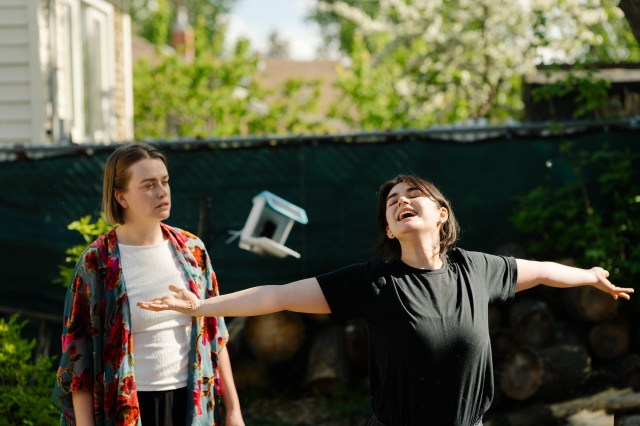
Hot Dyke Party, Expanse Festival 2025. Photo by Chelsey Stuyt Photography

The queer femme band Hot Dyke Party, Vancouver-based and six members strong, who recently played the High Performance Rodeo in Calgary, brings to Edmonton a kind of free-wheeling free-form multi-genre concert cum theatre piece cum community party. Moreno calls it “a celebration of femme voices, kinda punky kinda rockin’.” They play March 30 through April 4.

The Living Room Party, Expanse Festival 2025. Photo by Marc J Chalifoux.

The Living Room Party, as billed, is all about works in progress from the local artists. And it’s community-driven. Moreno calls it “a love letter to Edmonton … creating connections between artists and audiences.” The 12 acts, says Yamada, are “emerging pieces” in a wide variety of forms, including poetry, music, script excerpts, clown, burlesque. Ah, and this: “a new clown stand-up duo,” says Yamada mysteriously.

Integrated into the show is a piece by the winner of Good Women Dance’s New Work award, and this year’s winner will be announced on Expanse opening night.

The four workshops include Claren Grosz on overhead projections, Brett Dahl’s “Devising Devising,” “costume design for drag and the glamour of gender diversity” with Benjamin Toner, and “Workshopping Your Concept: Tools to Take Away” with Arthi  Chandra.

PREVIEW

Expanse Festival 2025

Theatre: Azimuth

Running: Friday through April 4

Tickets: fringetheatre.ca (all tickets are pay-what-you-can; suggested price for mainstage shows $35, for workshops $20)

Full schedule, times, and show details: azimuththeatre.com.


Posted in Previews | Tagged , , , , , | Comments Off on Bodies in motion: Azimuth Theatre’s Expanse Festival is back with a 20th anniversary edition

Springboards has sprung: the return of Workshop West’s signature new play festival

Design: Dave DeGagné.

By Liz Nicholls, 12thnight.ca

A rush of new Canadian plays is happening this week in this theatre town. And the timing couldn’t be better for a made-in-Canada festival.

With the return Tuesday of Springboards, Workshop West Playwrights Theatre’s signature new play festival, comes our annual chance to experience all-Canadian works-in-progress at every stage of their development en route to opening night.

To help support 12thnight.ca YEG theatre coverage, click here.

Their creators are playwrights at every stage in their careers, beginners to emerging writers to veteran Canadian stars. And their new work will get staged readings of every size, and breathe their first public air, in a cabaret setting at the Gateway Theatre.

For the two dozen playwrights in this year’s edition of Springboards, it’s an indispensable chance to see and hear their ideas brought to life by actors and directors, with design suggestions, in front of an audience. For us, the audience, it’s an invitation — “a backstage pass,” as Workshop West artistic director Heather Inglis has often said — to the world of creation, where ideas get hatched, honed, reworked. And not only that, to be part of the creative process, by engaging with artists up close, responding, offering feedback. As the  Springboards archive attests, it’s a first glimpse at plays-in-the-making that may well end up in a mainstage season. Conni Massing’s Dead Letter and Stephen Massicotte’s Stars On Her Shoulders, for example, both found their initial footing at Springboards.

“A script isn’t a play,” says Inglis. “It’s a recipe for a play.” And it’s a recipe that includes an audience. As playwright Beth Graham puts it, Springboards is the introduction of 3-D, “the lift-off from the page into the third dimension.” Graham’s new play Amber Hope Porter, which gets a staged reading Wednesday directed by Annette Loiselle (with actors Melissa MacPherson, Cody Porter, Meegan Sweet), is one of the festival’s quartet of most stage-ready offerings.

playwright Beth Graham

One of the country’s premium playwrights, Graham (Mermaid Legs, The Gravitational Pull of Bernice Trimble, Pretty Goblins, Weasel) says of her latest that it began as an idea for a mother/teen daughter play, at the Citadel Playwriting Unit in 2014. “It’s one of my first plays ever that’s not a memory play…. It happens in real time.” She imagines a stage divided between two apartments. The title teenager and her newly divorced mother move into one. In the other lives a widower in his ‘40s. An unlikely friendship between the teen and widower develops, along with dramatic complications. “I think I’m playing with loneliness, and how it seems to be growing, blossoming, blooming in our time,” says Graham. “And also loss. How it affects our lives and how we interact with people…. I wanted to explore divorce, the pain of it that isn’t always recognized.”

“It’s been a good thing for me to try moment-to-moment realism,” Graham thinks. “And also to experiment with space.” Springboards comes at an auspicious moment for the new play. “It feels like a great step. I have the play, and now I can hear it from actors’ mouths, with their feedback and questions. And I can listen with everyone and see how the audience experiences it, what kinds of questions they have, what everybody’s taking in.”

playwright Darrin Hagen, whose new play Pansies gets a staged reading at Springboards, Workshop West. Photo supplied

At a Springboards staged reading, the director’s goal, Inglis thinks, is “to show the playwright more of their play,” what it is, what it might be. Inglis herself directs Tuesday’s staged reading of Darrin Hagen’s nine-actor new play Pansies, a theatrical tour of the locales and stars of the Pansy craze that swept Prohibition era New York City. It was a vibrant culture that embraced queer and gender-fluid performers, and made them stars — in bars and on Broadway stages, in vaudeville and music halls. In the end it was lost to homophobia. Hagen first brought his research to life onstage in The Pansy Cabaret, at the 2022 Fringe. Now it’s expanded and evolved into a large-scale play. “The period mirrors the Weimar age,” says Inglis, “an age of sexual experiment, vibrant lively nightlife, lots of drag and cross-gender characters.”

Actor/ playwright/ composer/ musician Andrea House takes on the Mae West role for the reading, a co-presentation of Workshop West and the U of A drama department. Her cast-mates include Jason Hardwick, Jake Tkaczyk, Davina Stewart, Caley Suliak, Doug Mertz, Josh Travnik, Michael Watt, and D’orjay.

Natalie Meisner’s SubHuman, Saturday night’s offering, its its inspiration from a true story of the 1980s, in which highly trained Canadian military officers, tasked with protecting the country’s eastern seaboard from Russian submarines, were fired — for being lesbians. Lana Michelle Hughes directs; her cast includes Nadien Chu, Stephanie Wolfe, Michelle Todd, David Ley, and Paul Morgan Donald.

Gifted is by Lynda Celentano, an experienced writer of prose who’s taken up theatre in a big way. Her new play concerns the intricacies of a friendship between two girls. And the Springboards reading on Friday is directed by Amanda Bergen, with a cast that includes Sophie May Healey, Abby McDougall, Robyn Clark, Garett Ross, Michele Fleiger, Kaeley Jade Wiebe, and Hayley Moorhouse,

The festival lineup includes two cabarets. For the annual EdmonTEN, Thursday, the Alberta Playwright Network has chosen five new 10-minute plays by both seasoned and emerging playwrights. This year’s pieces in this hugely challenging form are by Nicole Moeller, Lily Davies, Gavin Bradley Evelyn Rollans, and Stephanie Swensrude. Amy DeFelice directs.

The Springboards Sunday night grand finale, as always a hot ticket, is a freewheeling and unpredictable cabaret featuring excerpts from new plays, interspersed with new music. This year’s edition of the Springboards Cabaret, live CanCon at its most exuberant,  is curated by Darrin Hagen and directed by Brian Deedrick.

Springboards New Play Festival runs Tuesday through Sunday at the Gateway Theatre. Tickets and a detailed schedule: workshopwest.org. All tickets at Workshop West are pay-what-you-will.

Posted in Previews | Tagged , , , , | Comments Off on Springboards has sprung: the return of Workshop West’s signature new play festival

Artists need champions: After Mourning – Before Van Gogh at Shadow Theatre. A review.

After Mourning – Before Van Gogh, Shadow Theatre. Photo by Marc J Chalifoux. Set and lighting design Ami Farrow, Costume design Leona Brausen, multi-media design Matt Schuurman.

By Liz Nicholls, 12thnight.ca

After Mourning – Before Van Gogh, a new play by Michael Czuba  premiering in the Shadow Theatre season, sets itself a fascinating challenge. It takes us behind the thick paint, the distinctive brushstrokes, the glowing light and swirling night skies of some of the world’s most celebrated paintings.

To help support 12thnight.ca YEG theatre coverage, click here.

It’s a backstage pass of sorts to the lives of the little-known supporting players in a famous drama. They’re the uncredited ones, the ones who’ve always lived in the shadows on the world stage, where the troubled Dutch genius Van Gogh stars, painting a starry night sky, sunflowers and almond blossoms, card players and wheat fields, a cafe terrace at night. His is a tragic story that we all know: a brilliant artist out of his time, difficult to be with, tormented by madness and poverty, unrecognized and unvalued till after he met his tragic end.  

The sharp-eyed Calgary-based playwright puts the spotlight on a woman whose name and story most of us didn’t know, Van Gogh’s sister-in-law Joanna Bonger. And as Czuba has discovered, hers is a story that counts as a bona fide contribution to the feminist re-examination of history, and the place of women in it.

Steven Greenfield and Lora Brovold in After Mourning – Before Van Gogh. Shadow Theatre. Photo by Marc J Chalifoux. Projections by Matt Schuurman, costumes by Leona Brausen

After the death of the artist’s brother Theo, Van Gogh’s art dealer sibling and sole means of support, the widowed Joanna, now a single mother saddled with 600 “worthless” paintings, took up Theo’s mission to make the world recognize and appreciate Van Gogh’s “modern” art. And this was a rocky, uphill road, and, as we learn in After Mourning, she met with resistance of every kind, artistic, sexist, domestic.

But Joanna persisted, with heroic stubbornness. And the stage itself, with Ami Farrow’s burnished wood set, dominated and glowingly animated by Matt Schuurman’s projections of Van Gogh paintings, in close-up and long shots, always in motion along with our optical distance, is a testament to the ultimate vindication of the crusader, an art suffragist if ever there was one.   

The play takes up the theme of Joanna’s wilful persistence, culled from letters and amplified from art history, and imagines it as a love story, woven from present (1891) moments and flashbacks. We meet the naive young woman (Donna-Leny Hansen) who falls in love with Theo (Steven Greenfield), with occasional intrusions from his impossibly demanding artist bro (Andrew Ritchie as Van Gogh). The older Joanna (Lora Brovold) observes, as if her memory has come to life.

In a counterpoint of scenes between the older Joanna and her resistant brother (Fatmi Yassine el Fassi el Fihri), her now-grown-up son Vincent Willem (Andrew Ritchie), her second husband Johan (el Fassi el Fihri) as well as her continuing conversations with Theo from beyond the grave, a story emerges with a lot of obstacles and a strong feminist drive.

It’s an elaborate, intriguing, somewhat teetery, pattern of storytelling, to be sure. And the efforts to include a considerable load of exposition occasionally do weigh it down. What makes it work is the luminous presence of Brovold onstage as the older Joanna. She is one of our most expressive, emotionally available actors, and the flickers of regret, exasperation, sardonic amusement, skepticism that play across her face are insights into the narrative complications and stakes that require no explanatory text.

Lora Brovold in After Mourning – Before Van Gogh, Shadow Theatre. Photo by Marc J Chalifoux

In Brovold’s captivatingly fierce performance, Joanna is a woman of heart, but not sentimentalism. When she finally garners some credit, from her brother and son, the compliment that she “saved a mad painter from obscurity,” she brushes it off. “I only created access,” she says, sounding a bit like a 21st century artistic director in an interview.

The writing for older Joanna is not without its witticisms (she evidently has an unusual talent for epigrams, like “he lost his mind and I lost my world”). But there are occasional jarring intrusions by an author from another age: “he showed me a vulnerability I couldn’t dismiss.”

In the production jointly directed by John Hudson and Lana Michelle Hughes, Hansen’s appealing performance as the younger Joanna, naive and in love, learning about art by experiencing it, captures the sense of toughness that will sustain her older self. And as Theo, warm-hearted and perpetually harried, caught between the conflicting demands of pragmatism and loyalty, love and recognition of genius, Greenfield thoughtfully negotiates a performance that speaks to contemporary issues of art and artists, and the unending quest, against the odds, to find champions with vision.

Andrew Ritchie, After Mourning – Before Van Gogh, Shadow Theatre. Photo by Marc J Chalifoux

Those odds (and the price to be paid) are set forth tangibly in Ritchie’s capture of a mercurial genius, self-centred and maddening, driven not only by artistic inspiration but a sense of grievance, only very occasionally paused by gratitude. “For many days I have been absolutely distraught.” The characters of Joanna’s brother and her son aren’t fleshed out more than human obstacles for her to overcome.

Finding a language that’s both of a period (as in the letters between Theo and Van Gogh, and Theo and Joanna) and somehow contemporary is a tricky thing. It meets with variable success here. “Your reaction is exactly why we must write our own history. It can’t only be about the money. We can’t let anything distract from the art.” This isn’t easily digestible as conversation, to say the least, despite Brovold’  best efforts.

Steven Greenfield and Donna-Leny Hansen in After Mourning – Before Van Gogh, Shadow Theatre. Photo by Marc J Chalifoux.

The sense in the story of a novice gradually learning about modern art and finding her own analogies, in sound and music, is persuasive, though. And Dave Clarke’s lovely sweeping sound score is a vital participant, along with Leona Brausen’s vivid period costumes. Lighted by Farrow, the latter enable the actors to create human stage paintings of their own in the production. The love scenes between young Joanna and Theo are set forth, on a spread-out canvas, like a 3-D Déjeuner sur l’herbe. “We went beyond the paint,” says Joanna.

And so does the story about, not an artist, but a champion of arts who, against formidable pressures, stepped up to make a difference, for reasons of her own that gradually become broader in vision. “If I get too close to the painting I can still see the colour but I lose the image,” says Joanna the observer-turned-activist. There’s a lesson in that for all of us who are audiences, supporters, champions of art and its practitioners. When Joanna finally pulls off a big, important life-changing exhibition of Van Gogh paintings you want to cheer.

REVIEW

After Mourning – Before Van Gogh

Theatre: Shadow Theatre

Written by: Michael Czuba

Directed by: John Hudson and Lana Hughes

Set and lighting design: Ami Farrow; Costume design: Leona Brausen; Multi-media design: Matt Schuurman.

Starring: Lora Brovold, Fatmi Yassine El Fassi El Fihri, Steven Greenfield, Donna-Leny Hansen, Andrew Ritchie

Where: Varscona Theatre, 10329 83 Ave.

Running: through April 6

Posted in Reviews | Tagged , , , , | Comments Off on Artists need champions: After Mourning – Before Van Gogh at Shadow Theatre. A review.

A crime caper steals onto the stage: Arun Lakri’s Heist at the Citadel, a preview.

Heist, Grand Theatre, set by Beyata Hackborn, costumes by Jessica Oostergo, lighting by Siobhán Sleath, projection design by Corwin Ferguson. Photo by Dahlia Katz.

By Liz Nicholls, 12thnight.ca

The play that starts previews this weekend at the Citadel defies the laws of probability, or teases them, in all kinds of ways.

To help support 12thnight.ca YEG theatre coverage, click here.

Heist, as you can’t not know from the title, is a crime caper, an impossibly ingenious robbery pulled off against long odds. The latest from playwright Arun Lakra takes the complications of a heist, whose natural home is on screen, witness films like Ocean’s Eleven, into the 3-D world of live theatre. Which ups the ante and the challenges, dramatically, since everything onstage happens before our very eyes.

And then, as Lakra explains on the phone from his Calgary home base, Heist adds “a whodunnit element so the audience is also engaged with a mystery: double-crosses, who’s done what, a trail of breadcrumbs along the way.…. I self-indulgently call it “a heist whodunnit.”

There is, as well, a certain long-shot improbability built into the double-optic career of Lakra himself, the rare, and possibly exclusive, occupant of the theatre subset of ophthalmological surgeon-playwrights. Lakra, genial and amused in conversation, calls himself, modestly, “the accidental playwright.”   

The last time Edmonton audiences saw a Lakra play, Sequence at Shadow Theatre in 2014, we found ourselves watching an award-winning “science thriller,” two stories intertwined in an ingenious double-helix wrapped around ideas about probability, luck, random chance, coincidence. In one, a professor urgently researching the genetic code for her impending blindness is visited by a student who has managed, against formidable odds, to get every answer on a 150-question multiple-choice test wrong. The other strand of the play’s DNA concerns an improbably lucky author who’s predicted the Super Bowl coin-toss 19 years in a row.

playwright Arun Lakra, whose latest play Heist runs at the Citadel in a co-production with the Grand Theatre.

And speaking as we are of unlikely double helixes, there was the way Lakra managed, in a time-management coup, to divide his week between medicine (his ophthalmic specialty: refractive surgery) and “creative days.” He wrote short stories; he wrote screenplays, songs, novels. And he “stumbled onto playwriting…. I had this idea for a story, but didn’t have the first idea about playwriting; I had to learn the craft.” And he gives the Calgary theatre community credit for that. “I was surrounded by people who were encouraging and supportive.”

“I still dabble in other forms of writing, screen and prose. To my naive eye, it’s all about the story…. I try to let the story dictate the medium.”

”Three years ago, Lakra’s delicate three day/ two day balance changed suddenly. “I’d been dealing with a chronic medical condition,” he says, “and it started to affect my hands…. My hands are important for my medical job, so I had to make a pretty quick, and jarring, decision to close my practice. By default I had see if I could make a go of it as a writer. No more excuses; I tried to look at that as a silver lining.”

“Abrupt, yes. But it’s given me time and energy for the creative side of things,” says Lakra. “I’m still trying to figure out what this new phase looks like…. I’m so happy to have something I feel passionate about!”

Sequence, which won both the Alberta Playwriting Competition and the Gwen Pharis Ringwood Drama Prize, was, amazingly, Lakra’s second play ever. Since then, Heist, an improbable hybrid born of “a stage and screen duality,” has been workshopped at the Citadel, it’s had a staged reading in the Collider Festival, it premiered in 2024 at Calgary’s Vertigo Theatre. And now, ramped up in scale, budget, and high-tech accoutrements — lasers, drones, projections, guns, live video, an aerialist (!) — in the production directed by Haysam Kadri, artistic director of Calgary’s Alberta Theatre Projects, it’s on the Citadel mainstage after a run at the Grand in London, Ont.

The Grand Theatre cast of Heist, a co-production with the Citadel Theatre. Set design Beyata Hackborn, costume design Jessica Oostergo, lighting by Siobhán Sleath, projection design Corwin Ferguson. Photo by Dahlia Katz.

Sequence was quite cerebral, a play of ideas,” says Lakra. “This one is popcorn. It isn’t going to make anyone want to ponder the big existential questions of our time…. Although they’re quite disparate in subject matter and intention, in a strange way, they were equally complex to write.” He laughs, “it’s taken a fair bit of brain power, and not only my own; it’s taken multiple brains. We want to be smart and ahead of the audience.”  He and Kadri and an entire team of technical whizzes have “gone through the exercise of trying to assess at every moment what the audience could be thinking, and surgically directing that.”

Heist came about, as Lakra explains, during the pandemic when Chad Rabinovitz, the artistic director of Indiana-based Constellation Stage and Screen, “knocked on my door with a proposal: could I write for him a theatrical version of a heist? Can we take something that’s traditionally a cinematic genre and tell the story onstage in a way that is equally satisfying?”

Heist, Grand Theatre co-production with Citadel Theatre, Photo by Dahlia Katz. Set design Beyata Hackborn, costume design Jessica Oostergo, lighting design Siobhán, projection design Corwin Ferguson.

Lakra was intrigued, but he initially had his doubts. “I can’t figure out how to make this work. There’s a reason heist stories haven’t been onstage! There are things you can do in film: camera angles, flashbacks, what you’re focussing on, what you’re not showing the audience. You can steer the audience towards and away from what you want them to see.” In theatre, “this was the challenge: how can you fool an audience? surprise an audience?”

Lakra persisted. And in this, he explains, he was partly motivated by the perpetual parental quest to find something that his family, including two teenage kids, could all enjoy, together. Not easy, as every parent and every kid knows. “The one thing we could all agree on was the Ocean movies.”

”I started this adventure thinking that although we’re constrained in theatre — we can’t tell the audience what to watch and what not to watch — we also have certain opportunities with a theatrical heist that we don’t have onscreen,” says Lakra. “We have to stay ahead of the audience, to end up having them be surprised and satisfied.”

And he’s been gratified by the response. “Somehow I’ve stumbled on this thing that attracts a young crowd, in their teens and 20s, and a new audience, people who don’t traditionally go to the theatre.” He laughs. “Teenagers can be picky (laughs) especially when they’re your own. And this does seem to appeal to a younger generation, with its fast pace and high-tech.” After the Vertigo premiere, Lakri’s son paid him a moment-to-cherish compliment: “Dad, I didn’t hate it.” Then he brought his friends.

Currently, among other projects Lakri is working on a Sequence companion piece, Consequence, as part of Toronto’s Tarragon Theatre playwriting unit. He’s pondering his film version of Heist (ironically, “I’m not sure it will translate,” he says).

And meanwhile, there’s the theft of a very very expensive jewel to enjoy. With its array of theatrical challenges and technical complications, Heist is, par excellence, a vindication of the theatrical principle of creative collaboration. “We’re all exercising muscles we haven’t exercised before, collectively, figuring things out on the fly. It’s been quite an adventure!”

PREVIEW

Heist

Theatre: Citadel Theatre and Grand Theatre

Written by: Arun Lakri

Directed by: Haysam Kadri

Set design: Beyata Hackborn; Costume design: Jessica Oostergo; Lighting design: Siobhán Sleath; Projection design: Corwin Ferguson

Starring: Alexander Ariate, Belinda Cornish, Devin MacKinnon, Callan McKenna Potter, Gillian Moon, Priya Narine

Running: through April 13

Tickets: citadeltheatre.com, 780-425-1820

Posted in Previews | Tagged , , , , , | Comments Off on A crime caper steals onto the stage: Arun Lakri’s Heist at the Citadel, a preview.

From the shadows of history into light: Michael Czuba’s After Mourning – Before Van Gogh premieres at Shadow Theatre

Steven Greenfield and Lora Brovold in After Mourning – Before Van Gogh. Shadow Theatre. Photo by Marc J Chalifoux. Projections by Matt Schuurman, costumes by Leona Brausen

By Liz Nicholls, 12thnight.ca

“I have never heard of her…. This has to be a play.”

That’s the thought, inspired by the History Channel series Raiders of the Lost Art, that piqued the curiosity of playwright Michael Czuba in 2018. And it set him on the fateful creative course that leads to the premiere of After Mourning – Before Van Gogh Thursday as part of the Shadow Theatre season.

To help support 12thnight.ca YEG theatre coverage, click here.

Lora Brovold in After Mourning – Before Van Gogh, Shadow Theatre. Photo by Marc J Chalifoux

Without Joanna Bonger, the widow of the artist’s brother Theo, “we don’t know Van Gogh. That painter Van Gogh doesn’t exist,” as Czuba discovered the more he researched. “Every artist needs a champion.” The troubled, famously difficult Dutch genius, who sold but one painting in his lifetime, left behind 600 canvases, dismissed as “worthless.” And it was his plucky sister-in-law who made it her mission, against unremitting resistance both artistic and sexist, to bring them to the world’s attention. “It took fortitude and vision.” And in these she was taking up the cause of Theo who “had worked at a gallery to be able to send money; he paid for everything, paints, canvases, everything, (for his brother) every two weeks for 10 years.”

“You know the famous story,” says Czuba of the turbulent nine weeks Van Gogh and fellow painter Gauguin spent as Provençal roommates in Arles, before the former mutilated his ear and the latter fled to Paris. “Without Joanna, Van Gogh would be (just) a footnote in Gauguin’s biography.”

The Calgary-based writer, originally from Montreal  — he came west to get an MFA in playwriting at the University of Calgary — has written plays before now re-imagining historical figures: one on Rosa Luxemberg, one that pairs the composer Erik Satie and the poet/writer Jean Cocteau, one on the French symbolist Alfred Jarry of Ubu Roi fame. And as Czuba has discovered the course of his researches, “for everything we learn about an ‘important artist’, there are 15 to 20 artists lost to time, marginalized by history…. History deletes people, to make it more understandable” He points as examples to the Swedish artist Hilma of Klimt, one of the first abstract painters, and the German avant-gardiste Baroness Elsa von Freytag-Loringhoven. Not names in your own culture rolodex? Exactly.

AFter Mourning – Before Van Gogh, Shadow Theatre. Photo by Marc J Chalifoux

Not only did Joanna, a teacher by trade, save the Van Gogh paintings from obscurity, she curated the letters between the brothers, translated them, taught herself about art, negotiated with galleries … a tireless promoter and a self-educator about art. She was married to Theo only for a year before he died, but in After Mourning the love story of this unusually equal relationship continues after that. “She loved the work. And she loved her husband.” And there’s a young Joanna (Donna Leny-Hansen) and an older Jo (Lora Brovold) in the play, “a ghostly quality . and it’s also about memory.…”

Steven Greenfield and Donna Leny-Hansen in After Mourning – Before Van Gogh, Shadow Theatre. Photo by Marc J Chalifoux

Czuba, a painter himself as he modestly admits, was fascinated as he took on the challenge of translating, into words, the particular and mysterious magic of Van Gogh’s distinctive paintings with their vigorous brush strokes, and golden, smoky, rippling light. “The focus on colour, the movement of them,” says Czuba, who consulted not only the letters between Theo and Vincent, but Joanna’s own letters. “I leaned into the idea of ‘composing’ a canvas. Composing, as in music: notes and colours, the flow…. It’s all metaphor!” he says. “Art to me is in general one big overlap.”

It’s a veritable Czuba mantra. He’s a dramaturge for dance companies, among his various arts gigs, from film to stage. In fact, one of his partners in Dancing Monkey Laboratories, the “interdisciplinary and weird stuff” performance collective he co-founded, is a dancer/choreographer, Melissa Tuplin. “We’re interested in how we merge text — scripts, dialogue, story — and movement. Their other Dancing Monkey partner, in a revolving roster of talents, is musician/composer Nathaniel Schmidt. And Czuba’s own book No Shortcuts — The Five Chambers, A Practical Guide to To Finding Your Own Creative Process is all about self-discovery beyond frontiers.

Czuba’s career is multi-limbed. As he explains, Czuba came to theatre via film. And three of his screenplays were optioned before the deals fell apart. After “a gap year that turned into 17,” he went back to school, at Concordia in Montreal, in theatre. And now he teaches in the University of Calgary drama department.

Andrew Ritchie, After Mourning – Before Van Gogh, Shadow Theatre. Photo by Marc J Chalifoux

After Mourning has had six readings, starting at the Glenbow Museum in Calgary, and including stops in Chicago and Texas. “From the get-go, (Shadow artistic director) John Hudson was into the work,” says Czuba appreciatively. “There was a trust. And now it’s in space, with bodies! An absolute joy to feel the energy now it’s 3-D.”

“The writing process is solo. But theatre is collaborative,” as he says. He’s occasionally been asked if the painter’s role in After Mourning shouldn’t be bigger. It’s not really a play about him, is Czuba’s answer. “I wrote it about a lost part of history.”

PREVIEW

After Mourning – Before Van Gogh

Theatre: Shadow Theatre

Written by: Michael Czuba

Directed by: John Hudson and Lana Hughes

Starring: Lora Brovold, Fatmi Yassine El Fassi El Fihri, Steven Greenfield, Donna Leny-Hansen, Andrew Ritchie

Where: Varscona Theatre, 10329 83 Ave.

Running: Thursday through April 6

Tickets: shadowtheatre.org


Posted in Previews | Tagged , , , , , | Comments Off on From the shadows of history into light: Michael Czuba’s After Mourning – Before Van Gogh premieres at Shadow Theatre

But soft, what light through yonder Spotlight breaks? Romeo and Juliet’s Notebook, a review

Aimée Beaudoin, Rain Matkin, Jeff Halaby, Tyler Pinsent in Romeo and Juliet’s Notebook, Spotlight Cabaret. Photo by Mint Captures

By Liz Nicholls, 12thnight.ca

You know that hyped-up dust-up between the Montagues and the Capulets? A mere suburban skirmish compared to the “ancient grudge” and “new mutiny” of the Hendays vs the Yellowheads — “the longest feud in Alberta history … other than that one with the Trudeaus.”

To help support 12thnight.ca YEG theatre coverage, click here.

“Two households, both alike in dignity, in fair Strathcona where we lay our scene….” And to be precise, up the stairs (follow the twinkly chandeliers) and into the Spotlight Cabaret, across the street from Meat and the Next Act. That’s where you’ll find Romeo and Juliet’s Notebook, the latest original musical comedy spoof from the nimble wits of Spotlight’s co-proprietors/ co-hosts Aimée Beaudoin and Jeff Halaby.

And, in John Hudson’s production, that’s where you’ll find the star-cross’d lovers, Juliet Henday and Romeo Yellowhead, and “the fearful passage of their death-marked love.” After all, anything involving either the Henday or the Yellowhead is bound to be fearful. But I digress…. Can mad pash (and first-rate song-and-dance expertise) prevail in bridging the unbridgeable? The long-standing hostility between the ring-road bougies and the beer-drinking north end freeway types? And speaking of traffic, and “bike lanes everywhere but no bikes,” the cast is dismayed by the prospect of “the three-hours’ traffic of our stage”— “Whaaat?” — until they get reminded that three hours includes dinner.

Ah, not to mention themed cocktails, whimsically named, along with the delish four-course menu that includes such choices as When Worlds Collide Chicken and Beef Between Us, as well as vegetarian and vegan creations. I can personally recommend the Mine Forever Mahi Mahi.

Anyhow, this is R&J as house party. And Beaudoin and Halaby preside with an air of genial amusement that includes the audience — improvising with them, threading what they learn about anniversaries, birthdays, retirements into the show to follow. No-threat audience participation at its kookiest. And, hey, it’s educational. For centuries Shakespeare scholars have somehow been missing the clear references in Romeo and Juliet to Sturgeon County and the Leduc Canadian Tire (“with a garden centre”). Here is the cabaret that fills in that gap.   

When the show starts, with Don’t You Worry Child (Swedish House Mafia), Beaudoin and Halaby dip with energetically into an array of costumes, accents, and wigs (designer: Beaudoin), as the earthy lifestyle coach Nurse, a manic Italian Friar Laurence (his hair will make you smile), the hothead Mercutia, the cowboy Tybalt, the high-contrast dads, Henday and Yellowhead, and Lord Escalade of St. Albert (a ringer from the audience). They are busy.

Tyler Pinsent and Rain Matkin in Romeo and Juliet’s Notebook, Spotlight Cabaret. Photo by Mint Captures

And we meet the starry love-struck teenagers: Rain Matkin, as the dewy innocent Juliet, who’s got a lot more on the ball than the dimbulb Yellowhead son and heir Romeo, played with amusingly goofy charm by Tyler Pinsent. Matkin, a recent MacEwan theatre grad, is one of the season’s hottest new prospects, highly watchable and with a supple voice that wraps around songs like Nelly Furtado’s I’m Like A Bird or Carly Rae Jepsen’s Call Me Maybe with ease.

Coming up is the social event of the year, the Henday Holiday Costume Party. Romeo’s buddies come up with “two tickets to paradise,” as per the Eddie Money song, in a mashup with Pink’s I’m Coming Out. Under musical director Simon Abbott, who’s the reigning monarch of the witty, apt mashup, the cast mines an  Millennial-fave song list dozens and dozens long. With choreography to match from Mhairi Berg and Sarah Dowling. Yup, as they say, “Strathcona knows how to party.”

The sound is perfectly judged for the space by design whiz Aaron Macri, who also does the romantic (and anti-romantic) lighting. “But soft what light through yonder window breaks?”

Rain Matkin and Tyler Pinsent in Romeo and Juliet’s Notebook, Spotlight Cabaret. Photo by Mint Captures.

Romeo is an interloper, a Yellowhead who’s crashed the big Henday bash, but, hey, the guy’s willing to change his name for love — “Motorhead? Blackhead?”. The scene in which R and J discover just how much they have in common is a charmer (with thanks to Ed Sheeran and Perfect). My own personal favourite is the reassessment of Alanis Morissette’s Ironic. Is it irony or just bad luck? The Nurse has thoughts on that.

It’s all framed, à la Notebook, by an older version of the characters, Romeo and Juliet on video (Glenn Nelson and Davina Stewart) remembering their younger selves. And the stage design includes old-school painted backdrops by Jaimie Cooney.

Romeo and Juliet’s Notebook is light on its feet, it’s silly-smart, smart-ass, and the songs keep coming at you. The shameless comical way local references are part of the romance — Spotlight is devoted to local in pursuit of fun — will make you laugh. As Lady Gaga has it, “I don’t wanna be friends; I want your bad romance.”

REVIEW

Romeo and Juliet’s Notebook

Theatre: Spotlight Cabaret, 8217 104 St.

Created by: Aimée Beaudoin and Jeff Halaby

Directed by: John Hudson

Starring: Rain Matkin, Tyler Pinsent, Aimée Beaudoin, Jeff Halaby

Running: through May 15

Tickets: spotlightcabaret.ca

Posted in Reviews | Tagged , , , , | Comments Off on But soft, what light through yonder Spotlight breaks? Romeo and Juliet’s Notebook, a review

From tragedy to triumph: Tina Turner: The Tina Turner Musical, a review

Jayna Elise in Tina Turner: The Tina Turner Musical, Broadway Across Canada Touring. Photo by Julieta Cervantes.

By Liz Nicholls, 12thnight.ca

Tina: The Tina Turner Musical, now on the Jube stage in a Broadway Across Canada touring production, is framed by two images of the star, the famous lion mane in silhouette, from the back.

To help support 12thnight.ca YEG theatre coverage, click here.

The opener has her, in red leather mini-dress, at the base of a golden staircase, meditating, to a Buddhist chant. Her hard-ass childhood emerges from her memory and materializes on the stage. The finale has her, in that signature dress, mounting the golden staircase in triumph, to the dazzling light of 180,000 fans at a record-breaking concert in Rio.

In between is a remarkable story — much more dramatic than your average jukebox musical — that’s tumultuous in both its biographical narrative and its showbiz glamour and grit. And at the centre of both, in this touring version of Phyllida Lloyd’s original 2018 production, is a sensational performance from Jayna Elise as the genre-busting queen of rock n’ roll.

Not only does Elise have the powerhouse voice and the exuberant signature physicality of Turner (choreography: Anthony Van Laast), to deliver the songs you love (River Deep-Mountain High, Simply The Best, Private Dancer, Proud Mary, What’s Love Got To Do With It…) in a thrilling way, she is actually believable in the timespan of the bio-jukebox musical, from the teenage Turner to the comeback superstar in her 40s. And without a charismatic, energizing performance on this scale — Elise is almost never off the stage in two-and-a-half hours — a Tina Turner musical just wouldn’t take root. Even as a jukebox of mega-hits, much less a vivid backstage-onstage bio-story of courage and persistence against the odds, written only sketchily by the playwright Katori Hall (The Mountaintop) with Frank Ketelaar and Kees Prins.

Act I charts Turner’s humble origins as Anna-Mae Bullock in the cotton patch town of Nutbush, Tenn.. She’s a neglected kid from an abusive family, with an unfeeling mother and a preacher father who slaps his wife around. The young Anna-Mae, played by a young actor with a startlingly big voice, Taylor Brice, is forever being warned by her ma (ably played on opening night by understudy Aniah Long) before she walks out, not to sing so loud in church. So much for maternal advice in life. The rejoinder, in effect, is Turner’s Nutbush City Limits.

Jayce Elise as Tina Turner in Tina Turna: The Tina Turner Musical, Broadway Across Canada Touring. Photo by Julieta Cervantes

When she moves north to St. Louis, on the advice of her grandmother (Deirdre Lang), Anna-Mae gets “discovered,” on a night out on the town with her sister. She’s plucked out of the audience by band leader/businessman Ike Turner (a dangerously kinetic performance by Sterling Baker-McClary), a philandering bully, abuser, and sexist pig who knows a star voice when he hears it. He takes her over, changes her name to Tina Turner to go with his, and the touring Ike and Tina Turner Revue is born. At 18, her career is launched, by a brutal man and against a backdrop in the South where the band gets turned away from white motels and has to pay the motel fee anyway.

Bruno Poet’s lighting, smoky, slatted visions of the American underbelly, with mist rising off the Mississippi, is a gorgeous evocation of time and place. And lighting has a dramatic role to play in a story of a journey from dark into (very bright) light.

Sterling Baker-McClary as Ike Turner in Tina Turner: The Tina Turner Musical, Broadway Across Canada Touring. Photo by Julieta Cervantes

The sexy dance routines, with the Ikettes, in I Want To Take You Higher and River Deep-Mountain High (produced by Phil Spector, played by Bear Manescalchi) are a knock-out, enhanced by Mark Thompson’s glittering costumes, which seem to have a life of their own. And Jeff Sugg’s hypnotic psychedelic projection-scape runs to creating whole backdrops of undulating sound waves and kaleidoscopes spiralling into colour caverns behind spinning eyeballs. As domestic brutality escalates, even the Ikettes think Turner should leave Ike. And by intermission, and a lot of bruises and hospital visits to go with rising stardom, Turner has finally had enough. Which makes Proud Mary an anthem of resistance, and I Don’t Want to Fight No More something equally visceral.

Act II has obstacles of another kind: in addition to poverty and white racism, there’s ageism, and in cross-Atlantic encounters, preposterous accents. Turner the divorced single mother is reduced to Vegas bar shows to pay the rent. And she persists. But the avenging fury of Ike pursues and haunts her, even in a trip to London to record. There’s a beautiful scene of London in the rain, evoked by umbrellas, and street reflections conjured by projections. But the dramatic scenes with record producers and execs — Aussie producer Roger Davies (Joe Hornberger) and the gentle German Erwin Bach (Steven Sawan) — though, are pretty thin and unconvincing. And the dialogue, which runs to “well, what do you want to sing?” or “we want to bring it into the Now…” in recording studios, borrowed from the off-the-rack musical biography outlet, seems perfunctory and threadbare.

There’s high-tech sophistication in the lighting and the visual effects in Tina: The  Tina Turner Musical. And there’s the leading lady herself, in Elise’s explosive performance, who turns skimpy moments into songs, and takes charge of her own career, an unequalled “comeback” that translates into super-stardom. You’ll cheer for her and for her uncontainable joie de vivre in performing. And the encores will have you on your feet and dancing. It’s that kind of show.

REVIEW

Tina: The Tina Turner Musical

Broadway Across Canada Touring

Directed originally by : Phyllida Lloyd

Choreographed by: Anthony Van Laast

Starring: Jayna Elise, Sterling Baker-McClary, Elaina Walton, Meghan Dawnson, Deidre Lang, Taylor Brice

Where: Jubilee Auditorium

Running: through Sunday

Tickets: ticketmaster.ca, https://edmonton.broadway.com/shows/tina/

Posted in Reviews | Tagged , , , , , | Comments Off on From tragedy to triumph: Tina Turner: The Tina Turner Musical, a review

Unleashing girl power: Dance Nation at SkirtsAfire, a review

Dance Nation, SkirtsAfire Festival. Photo by Brianne Jang, BB Collective Photography

By Liz Nicholls, 12thnight.ca

Smarten up, world. That way you have of underestimating, sidelining, denying even, the sheer visceral power of pre-teen girls means you’re missing out, world.

To help support 12thnight.ca YEG theatre coverage, click here.

There’s a play now running at the SkirtsAfire Festival that’s all about that: power and rage, under pressure and ready to explode. Dance Nation, by the American writer Clare Barron, will startle you mid-plié, so to speak, and knock you back in your seat. It’s insightful, it’s disturbing, it’s frightening.

There are plenty of plays set on the threshold between childhood idylls and the problematic complexities of grown-up world. And just as many about those infamously vexatious high school years: how does anyone survive that peer group meanness, the bullying, the competition?. Dance Nation really isn’t like those.

As the production directed by SkirtsAfire’s new artistic producer Amanda Goldberg reveals, the 2018 play, nominated for a Pulitzer, ranges freely between the dancers now and the women they become looking back in time to their younger selves. Goldberg’s nine-actor ensemble, who vary in age between 20-something and 50-something, takes us into the locker room, onto the stage, and sometimes into the future, with a competitive dance team of dance-crazy 13-year-old girls (plus one boy), and their relentless trainer/coach/director Dance Teacher Pat (Troy O’Donnell).

Dance Nation, SkirtsAfire Festival. Photo by Brianne Jang, BB Collective Photography

Their specific aspiration is a trip to the national finals. And there’s a lot of perfect high kicks and extensions to be executed, and angst and anxiety to be overcome, en route to this monumental goal. In this drive, Dance Nation has been compared to the soccer team girls of Sarah DeLappe’s The Wolves, produced here by The Maggie Tree several seasons ago. But Dance Nation is a stranger swirl of theatrical experiences, and like the characters  struggling to make dance fit life and vice versa, it never lets you quite settle.

The opening scene leads you to expect a musical comedy: a perky synchronized number with beaming girls in matching sailor suits. The number comes crashing down when one of the dancers has a devastating fall and fracture, never to be seen again, which seems to perturb Dance Teacher Pat not at all.

His vision for upping the competitive ante, rather hilariously, is an interpretive dance exploration of Gandhi. None of the girls has heard of him. And then Dance Teacher Pat (“I am making the future,” he declares) has the further inspiration of double starring roles: Gandhi and The Spirit of Gandhi.

Dance Nation, SkirtsAfire Festival. Photo by Brianne Jang, BB Collective Photography

There’s ensemble camaraderie, to be sure. The dancers, with varying skill, throw themselves into performance. And the girls verbally support, encourage, and console each other (“your turns were amazing!”). But there’s an undercurrent of competition, both for the leading roles and individual honours, and there’s doubt.

The anxious and uncertain Zuzu (the appealing Kristen Padayas), who’s dreamed of being a dancer forever, gets the lead role — even though, as she knows, she isn’t as good a dancer as Amina (Sydney Williams). “I hope I’m not losing my spark,” Zuzu says to her best friend, hoping for reassurance. The knotted relationship between the two is the centre from which ripples spread outward. And the scenes between the two are beautifully played by the two actors.

Backstage, the young dancers kibbutz, reveal insights, crises, fears, tensions…. In very sharply written scenes, subjects like menstruation and masturbation (“what do you think about when you masturbate?”), the cost of dedication, naturally seem to come and go, ignite and flicker out, among them. Thirteen is a dangerous, confusing age to be, on the brink of something big, but not just between worlds. At age 13, one girl plays with toy horses, while another tries to get the hang of masturbation. And there are glinting reveals of mother-kid relationships in scenes between the dancers and their moms (all smartly played by Kristi Hansen).

The excellent sound score by Kena León captures that sense of volatile confusion, with its cross-hatching of motifs. Stephanie Bahniuk’s design, a dance studio with panels of distorting mirrors, speaks to the age, too.

Kristen Padayas in Dance Nation, SkirtsAfire Festival. Photo by Brianne Jang, BB Collective Photography

Sometimes there are monologues. Amino, as Williams vividly conveys, is afraid to admit her own special talent, and her own ambition. She’s straining under the opposing pressures to deliver and to not be better than the others. Padayas’s Zuzu can’t reconcile her big dreams and her moderate talent, always struggling to live up to the proxy ambitions of her mother, a former dancer. Ashlee (Kijo Gatama) starts her monologue with confidence in her smartness and sexuality — “I think I might be frickin’ gorgeous” — and it escalates into a rage-filled manifesto. “I am your god, I am your second coming.” Gatama knocks it out of the park. One of the most wistful touch-downs comes from Kristin Johnston in a moment as a woman remembering her younger dancer self who had an unexpected magic power, and then somehow lost it.

Unnerving are the chants that erupt — furious, violent, aggressive. Fangs erupt; blood is drawn. As Ashlee says, stepping back to consider her declaration of domination, “what am I going to do with all this power?” That’s the question. And Dance Nation shakes you up and leaves you to think about it.

Check out the 12thnight preview to learn more, from Amanda Goldberg, about her debut SkirtsAfire production.

REVIEW

Dance Nation

SkirtsAfire Festival 2025

Written by: Clare Barron

Directed by: Amanda Goldberg

Starring: Sydney Williams, Kristen Padayas, Kijo Gatama, Veenu Sandhu, Kristin Johnston, Linda Grass, Tristan Hafso, Troy O’Donnell, Kristi Hansen

Where: Gateway Theatre, 8529 Gateway Blvd.

Running: through March 16

Tickets: skirtsafire.com


Posted in Reviews | Tagged , , | Comments Off on Unleashing girl power: Dance Nation at SkirtsAfire, a review

‘I have had a most rare vision’. A Midsummer Night’s Dream: The 70s Musical at the Citadel, a review

Jameela McNeil (centre) in A Midsummer Night’s Dream: The 70s Musical, Citadel Theatre. Photo by Nanc Price. Costumes by Deanna Finnman, set buy Hanne Loosen, lighting by Jareth Li.

By Liz Nicholls, 12thnight.ca

“Welcome mortals!” declares the wandering “knavish sprite” in the glittering red jumpsuit (Luc Tellier as Puck) who bounds aerobically through the crowd on fabulous Fluevog platforms, with an orange mullet that makes other mullets look apologetic. “It’s almost fairy time.”

To help support 12thnight.ca YEG theatre coverage, click here.

In the big festive ensemble number that opens the Citadel’s new adaptation of A Midsummer Night’s Dream, you get to see the chaos potential of love, set forth onstage in all its exuberant danceable complications (kudos to choreographer Gianna Vacirca). And you’ll hear it too, courtesy of Shakespeare’s first (and possibly only) collaboration with Supertramp: “Give a little bit, of your love to me….” By intermission, with romantic hypertension at peak levels and everyone with the wrong someone, there’s another production number, Ballroom Blitz.

As the delighted Friday night crowd confirmed by their shared laughter, in quantity, there’s a kind of hilarity, and nutty apt ingenuity, about pairing the rom-com hit of the 1590s, to a 25-song jukebox of ‘70s radio hits that are virtually part of mortal DNA by now. This is the cross-century match-making inspiration of Citadel artistic director Daryl Cloran, along with Shakespeare on the Saskatchewan artistic director Kayvon Khoshkam, in A Midsummer Night’s Dream: The ‘70s Musical.

A Midsummer Night’s Dream: The ’70s Musical. Luc Tellier (centre) as Puck, Citadel Theatre. Costumes by Deanna Finnman, set by Hanne Loosen, lighting by Jareth Li. Photo by Nanc Price.

Is this Dream a brooding existential meditation? A dark excursion into the labyrinthine unconscious? An explosion of the poetic impulse? Lord, no. “The spirit of mirth” prevails all night long in this pairing of Shakespeare’s most popular romantic comedy and ‘70s hits that you know from their first chords. This new collaboration is reflected on Hanne Loosen’s set, lighted by Jareth Li: the classic symmetry of double staircase design, but with sparkles, metal-work trellises, shimmering trees, and a psychedelic forest floor.

Who knew that an interest in the intricacies of love — ecstasy, near-misses, waywardness, romantic miscues, rejections, ambivalence, confusion —would be something the Bard and the Everly Brothers have in common? “When will I be loved?” sings the girl who’s furiously pursuing a guy who is furiously pursuing someone else, in an enchanted wood with a fairy organizer. True, “it happens every time” isn’t exactly poetry, but it cuts to the chase.

Luc Tellier and Charlie Gallant in A Midsummer Night’s Dream: The 70s Musical, Citadel Theatre. Photo by Nanc Price.

Ah yes, the chase. There are no fewer than four storylines interwoven into A Midsummer Night’s Dream. And as the co-creators of the musical have discovered, in lopping big chunks off the play, the ‘70s cough up songs that surprise you by capturing moments or tangents in all four. Occasionally bits and pieces of the text are actually made into extra lyrics for those songs by orchestrator/ arranger Ben Elliott.

There’s a quartet of lovers, on the lam from from authority and, as it will transpire, each other. There’s the court, where the Duke (Charlie Gallant) is preparing to wed his fiancée Hippolyta (Jameela O’Neil). In fairyland, the fairy king Oberon and his consort Titania (Gallant and O’Neil) are at loggerheads, for reasons that have been cut from the musical. And a garage band of “hempen homespuns” — rustic artisans and amateur thespians led by carpenter-turned-director Peter Quince (Ruth Alexander), and taken over by a bossy stagestruck weaver, Bottom (in John Ullyatt’s hilarious performance)  — are rehearsing a show to perform at court.

The go-between, MC, and fairy go-fer/ fixer is the lithe Ziggy Stardust figure of Puck, whose amusement as an agent of mischief and connoisseur of chaos has a soupçon of malice, all captured to a T by Tellier. Our entertainment (and his own) is his not-so-secret agenda.

And this four-part weave — lovers, courtiers, fairies, “rude mechanicals” — comes with costumes to match, a treat for the eyes from designer Deanna Finnman. The Athenians are a riot of bell-bottoms, fringes, polyester shirts. The amusingly melancholy, sad-eyed Demetrius (Chirag Naik) chases his beloved through the woods wearing a full banana-coloured suit with big lapels.

The fairies, led by Titania and Oberon, have a sexy Vegas showbiz razzle-dazzle about them. And the endearing, born-again theatre makers (led by Bottom in droopy moustache and a greaser ‘do), whose day jobs are tinker, tailor, bellows-mender, joiner, are denim flare people. They’re an excellent band, actually. And their earnest rehearsals have sport at the expense of theatre rituals — including their attention to trigger warnings, director’s notes from Ruth Alexander’s Peter Quince, and Bottom’s magnanimous offer to play all the parts, not just Pyramus. Their triumphant emergence from their woodland “garage” as full-fledged entertainers, in purple satin bellbottoms, is one of the comic highlights of the evening.

There’s double-sided comedy in attaching the hot-house intensity of love in Shakespeare’s play to the power ballads of the 70s, bleached into submission by decades of covers. And in Cloran’s production, the detailed, and heightened, comic performances of the lovers as they deliver the songs capitalize on the fun of that. It’s the kind of fun that  happens when real actors listen to the lyrics and take those very familiar songs — “that’s the way I like it, uh-huh” — head-on, dramatically.

Chirag Naik and Christina Nguyen in A Midsummer Night’s Dream: The 70s Musical, Citadel Theatre. Photo by Nanc Price

Christina Nguyen as the little spitfire Helena digs into Blondie’s One Way Or Another like she’s going to ignite. Alexandra Dawkins’ Hermia and Rochelle Laplante’s ebullient Lysander make a big-M dramatic Moment from their duet For Once In My Life.

As Oberon, king of the fairies, Gallant is very funny: a preening dope of a big-hair rock star, bare-chested save for a major pendant. His delivery of It’s More than A Feeling will make you laugh out loud. When crossed, he gets sulky, in a diva sort of way. McNeil’s Titania, stunning in a sequinned gown, is not impressed, witness her powerhouse rendition of I Will Survive, with back-up fairies.

McNeil is the strongest singer of the company, an r&b and soul natural. And when, as an instrument of Oberon’s revenge, she falls in love with Bottom who’s magically wearing an ass’s head thanks to Puck, Let’s Get It On is single-minded and full-throttle. Vacirca’s choreography of the scene, which involves Bottom’s evolution from incredulity through skepticism to participation, is a riot in itself.

John Ullyatt as Bottom, A Midsummer Night’s Dream: The 70s Musical, Citadel Theatre. Photo by Nanc Price.

In the last four centuries, it’s the “rude mechanicals,” the theatre wannabes, who have a way of stealing A Midsummer Night’s Dream. And it’s true here, too. Their rehearsals, and their climactic production on the night, bring down the house. Francis Flute the bellows mender played with amusing wide-eyed innocence by Oscar Derkx, is initially dismayed to discover he’s been assigned the woman’s part, Thisbe. But he gamely rises to the occasion — on rollerskates he can’t control. And in Ullyatt’s performance, Bottom, rising to the histrionic potential of his new career in the starring role of Pyramus, delivers an unforgettably funny death scene — to the BeeGee’s Stayin’ Alive. You’ll leave the theatre still laughing; I did.

As Theseus and and his new wife say of the entertainment choices for their wedding night, “how shall we beguile the lazy time, if not with some delight?” Exactly. In times like these, when delight is at a premium, a production that boldly gives up a lot of the lyrical magic and poetry of a dreamy play in order to give new, and comic, juice to the lyrics of a 70s anthem like Kool and the Gang’s Celebration, is fun that’ll take you by surprise. Talk about “a most rare vision.” Seek it out, my friends. “Let’s have a great time, come on.”

Have you seen the 12thnight preview with Citadel artistic director Daryl Cloran and Luc Tellier?

REVIEW

A Midsummer Night’s Dream: The ‘70s Musical

Theatre: Citadel Theatre

Adapted by: Daryl Cloran and Kayvon Khoshkam

Directed by: Daryl Cloran

Starring: Ruth Alexander, Billy Brown, Alexandra Dawkins, Oscar Derkx, Taylor Fawcett, Charlie Gallant, Kristel Harder, Rochelle Laplante, Jameela McNeil, Chirag Naik, Christina Nguyen, Biboye Onanuga, Bernardo Pacheko, Dean Stockdale, Luc Tellier, John Ullyatt

Running: through March 23

Tickets: citadeltheatre.com. 780 425-1820

Posted in Reviews | Tagged , , , , | Comments Off on ‘I have had a most rare vision’. A Midsummer Night’s Dream: The 70s Musical at the Citadel, a review

A two-festival week in Edmonton theatre: SOUND OFF and SkirtsAfire

I Know You Are But What Am I?, SOUND OFF Festival of Deaf Theatre. Photo supplied

By Liz NIcholls, 12thnight.ca

We know how to get festive in this theatre town. It’s a two-festival week in Edmonton.

SOUND OFF, the influential six-day national festival of Deaf theatre with homegrown origins, returns to its birthplace with a ninth annual edition (through March 9).  The brainchild of the versatile actor/playwright/director Chris Dodd, SOUND OFF is dedicated to Deaf performing arts and artists — and theatre that’s accessible and welcoming to both Deaf and hearing audiences. Multi-disciplinary and multi-lingual (ASL and English) it gathers performances from across the country, B.C. to Quebec. And they happen both live (at the Fringe Arts Barns) and online.

Sthenos Broken Curs, SOUND OFF Festival of Deaf Theatre. Photo supplied.This year’s lineup features five main productions. Sthena’s Broken Curse, a “family-friendly adventure” as billed, stars a misunderstood monster. 100 Decibels, a physical comedy mime troupe from Winnipeg, is bringing their new show, Deaflix and Chill. All We Can Do Is Trust, originally written in English by Vancouver-based hearing artist Kelsi James and translated into ASL, explores asexuality. I Know You Are But What Am I?, created by Deaf dancer and choreographer Cai Glover of the Montreal company A Fichu Turning, captures the experience of someone disoriented by the disabling world after losing his hearing.

Upside Down, Imago Theatre. Photo supplied

There’s a four-show digital lineup, including Fable Deaf, starring four Saskatchewan actors between the ages of 12 and 74, and Upside Down by Montreal’s Imago Theatre. And the festivities include panel discussions with Deaf artists, Deaf-led workshops, staged readings of plays by Deaf playwrights.

And, yes, there’s SOUND OFF’s perennially popular improv collaborations with Rapid Fire Theatre: a SOUND OFF edition of Maestro online and a SOUND OFF Theatresports, where Deaf and hearing improvisers go head to head. The Deaf improvisers, you won’t be surprised to learn, are formidable players since they’re expert, of worldly necessity, at physical theatre.

SOUND OFF runs at the Fringe Arts Barns and online through Sunday. Full schedule and tickets: soundofffestival.com.

Dance Nation, SkirtsAfire Festival. Photo by Brianne Jang, BB Collective Photography

SkirtsAfire, a multi-disciplinary festival, devoted to celebrating the work of female artists, is back Thursday for a 13th annual edition at a variety of Strathcona locations. And on the mainstage, Amanda Goldberg’s production of Dance Nation, the Alberta premiere of a play (by American writer Clare Barron) that takes us into a group of 13-year-old girls, hoping for a big win in a national dance competition. Find out more in the 12thnight preview: the director, SkirtsAfire’s new artistic producer, amplifies her ideas about the play, and the festival. SkirtsAfire runs March 6 to 16. Tickets: skirtsafire.com.


Posted in Previews | Tagged , , , , | Comments Off on A two-festival week in Edmonton theatre: SOUND OFF and SkirtsAfire