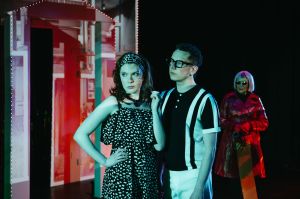
A family haunting: Jupiter, Colleen Murphy’s new Canadian epic at Theatre Network. A review

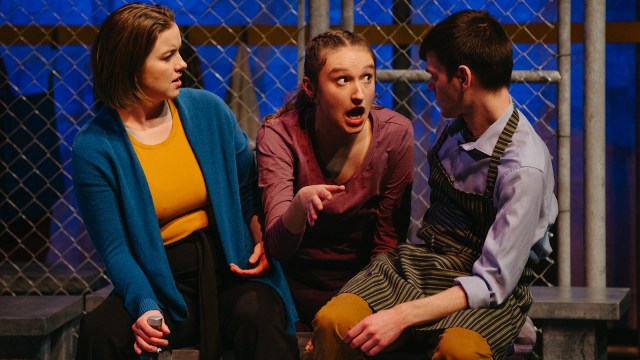
Gabriel Richardson and Ellie Heath in Jupiter, Theatre Network. Photo by Ian Jackson.

By Liz Nicholls, 12thnight.ca

“The future doesn’t happen ahead of time,” says a character in Jupiter, clinging to shards of hope for change. But the baleful grandeur, and dark vivid theatricality, of this new multi-generational family epic from the dauntless Canadian playwright Colleen Murphy argue otherwise.

To help support 12thnight.ca YEG theatre coverage, click here.

Jupiter premieres in a stunning Bradley Moss production at Theatre Network. The grand finale of the company’s 50th anniversary season, powerfully acted and directed, reunites a playwright and director with a long-time association (Pig Girl, Armstrong’s War, The Society for the Destitute Present Titus Bouffonius). And it populates the stage, a single living room designed by Tessa Stamp, with three generations of the working-class Hutchinson family (five humans and a dog) in a present (2015) that’s simultaneously embedded as the past in a three-decade time span (2030 and 2050).

“Kill me yesterday,” says exasperated mom and step-mom Violet (Cathy Derkach) in a throwaway line that echoes tellingly in the sealed time chamber in which the Hutchinsons struggle. Exactly. This is a family that has a lot of trouble burying their dead — people or dogs, bodies or ashes. And in time, beer-soaked patriarch Winston (Brian Dooley), who refers to newspaper astrology columns as “horrorscoops,” will have trouble remembering who’s alive and who’s dead.

No wonder. The Hutchinsons are haunted — by ghosts, chronic dysfunction, dark secrets, whole subterranean veins of passion, grievance, and guilt.

Ellie Heath, Cathy Derkach, Brian Dooley in Jupiter by Colleen Murphy, Theatre Network. Photo by Ian Jackson.

Welcome to Murphy’s working-class, hourly-wage House of Atreus. As the play opens, the Hutchinsons are preparing a 21st birthday celebration  — with balloons, cake and wieners, all Vi’s doing — for Toby (Gabriel Richardson), Winston’s son by his first wife. And against the backdrop of criss-crossed bickering you realize is chronic, we meet Emma (Ellie Heath), Vi and Winston’s daughter. She’s a bright and brainy high school achiever kid immersed in a science experiment involving germ cultures and dog saliva, with dreams of med school. And she’s in tough chez Hutchinson.

Near the outset we also meet Axel, the stage debut of charismatic golden retriever Monk Northey, a scene-stealer in his brief time onstage. His presence is a fractious family’s bond; his entrance is greeted by the audience with a collective sigh of happiness. Axel is effortlessly redeeming himself from having dug around in Vi’s peonies. No other redemption in Jupiter has the same unqualified success.

Ellie Heath, Brian Dooley, Monk Northey in Jupiter by Colleen Murphy. Photo by Ian Jackson

Designer Stamp creates the Hutchinson living room, in detail, complete with plastic plants, time-worn couch, and crocheted afghan, lighted by Larissa Poho as a sort of working-class headquarters. It’s by no means a dive, as tended by the indefatigable Violet; the empties accumulate invisibly in the back yard and downstairs. The sound design, by Darrin Hagen and Morag Northey, has a curious combination of lyrical cello riffs and a sort of ticking pattern, the metronome of passing time?

One of the challenges to which Moss’s excellent cast rises impressively is that the same actors play the characters at different ages. Jupiter doesn’t live in one-directional chronology, forward or back. The characters so seamlessly slide into older versions of themselves, leaving to grab a beer or find the dog and re-entering 15 years later — or the reverse 15 or 30 years earlier— that it comes to seem almost simultaneous. Are we inhabited inevitably and forever by our future and past selves? Jupiter has us wonder about that. It’s a disturbing line of inquiry. But when has Murphy ever shied away from human disturbances? The list of those here, as you’ll glean from a fulsome warnings list, includes addiction, suicide, and more.

Brian Dooley, Dayna Lea Hoffmann, Ellie Heath in Jupiter, by Colleen Murphy. Theatre Network. Photo by Ian Jackson

This might sound free-form. But Jupiter has an infrastructure. In a terrific performance by Heath, the arc of the play belongs to Emma. What happens to the promising kid, the vivacious smartie and her big plans, as she ages into her ‘30s, cracking a beer before work, and then furiously into her ‘50s? And Heath is compellingly watchable in transformations, back and forth in time, scene to scene.

The performances in Moss’s production are unafraid of harshness, and there’s a certain morbid hilarity in that. The Hutchinsons aren’t exactly shy sentimentalists; they call each other out and interrupt furiously at top-volume, in an intricate texture of overlapping shit-talking that’s captured, and vigorously, in the production. They have views, and they’ll argue about, well, any damn thing. Who ate the rest of the jam? Should poems rhyme? Is rehab just for “recovering losers”? They’re hard to impress. And as for family togetherness, consider that one of the few images of that is the comical moment they’re clustered around a controversial small portable fan in a heat wave.

Dooley’s alcoholic Winston, who has a work history in oil and meat-packing, seems to unravel before us, foul-mouthed, prickly, judgmental, full of denial and grievance and all-round negativity, with a certain dead-pan sense of humour. You kind of wince and kind of smile when you hear him describe his daughter’s seniors’ home care-giver job as “diaper-whisperer.”

Violet, the bustling mom/step-mother who waits tables in a diner, does the heavy lifting for the family. There’s a softer side to her, which seems to come from reading homilies and borrowing mantras from women’s magazines. Forgiveness, she says quoting Gandhi, is for strong people. Derkach is funny and convincing as a tough cookie whose ground zero is exasperation. “Do I look like I speak French?” she snaps, in a rejoinder to a gambit. Or “there are very few things I look forward to. A decent salad is one,” she says, briskly countering Emma’s incredulous look when prodded to do the croutons for the Caesar.

Richardson as stepson Toby, a screw-up car mechanic with a love for his truck only matched by his love for his dog, conjures a young man up against limited prospects. And as played by the excellent Dayna Lea Hoffmann, Emma’s daughter Avalon, the third generation of the play and the character least fleshed out by the script, sets her surly teenage self resolutely on a course apart. Whether she can find the exit to the living room, so to speak, is the question the play leaves with us.

An epic of unfulfillment, of disappointment, of anger and lost love, unfolds. “Sometimes you have to force yourself to dream up a happy ending,” according to Violet. And repeating a favourite quotation from something she’s read, she says “hope is like a bird that senses dawn, and starts to sing when it’s still dark.”

Well, it’s still dark, and the bird has been let out of the cage. And as this new absorbing new Canadian play sets forth, our options for self-creation are curtailed by what we inherit, and what we’re prepared to give up.  Murphy has never been afraid to have her doubts, and face the tab.

Meet the playwright in this 12thnight preview.

REVIEW

Jupiter

Theatre: Theatre Network

Written by: Colleen Murphy

Directed by: Bradley Moss

Starring: Ellie Heath, Brian Dooley, Cathy Derkach, Gabriel Richardson, Dayna Lee Hoffmann, Monk Northey

Where: Theatre Network’s Roxy Theatre, 10709 124 St.

Running: through April 20

Tickets: theatrenetwork.ca

Posted in Reviews | Tagged , , , , | Comments Off on A family haunting: Jupiter, Colleen Murphy’s new Canadian epic at Theatre Network. A review

New plays, revivals, festivals, cabarets, improv, genre switcheroos: we survey an intriguing week in Edmonton theatre

Ellie Heath, Cathy Derkach, Brian Dooley in Jupiter by Colleen Murphy, Theatre Network. Photo by Ian Jackson.

By Liz Nicholls, 12thnight.ca

A big opening by a premier Canadian playwright, an improbable steal by big-budget theatre, a powerful verbatim-theatre production, a musical by a new-ish company — and another two-festival week on Edmonton stages, one devoted to the body in motion and another devoted to crazily inspired innovations in making stuff up. Intrigued? Keep reading.

To help support 12thnight.ca YEG theatre coverage, click here.

•A new play by Colleen Murphy is always a Canadian theatre event. Jupiter, premiering Thursday at Theatre Network, in a Bradley Moss production, sets a working class family (with dog!) onstage, in motion through three decades. The playwright, one of the country’s most fearless theatre risk-takers — did you see The Society For The Destitute Presents Titus Bouffonius? — is trying something new with Jupiter, she says. 12thnight.ca had a fun, and as usual provocative, conversation with Murphy by way of preview for the new play. Moss’s production, starring Ellie Heath, Brian Dooley, Gabriel Richardson, Cathy Derkach, Dayna Lea Hoffmann, and Monk Northey runs through April 20 at the Roxy, 10709 124 St, the finale of the company’s 50th anniversary season. Tickets: theatrenetwork.ca.

Priya Narine, Gillian Moon, Alexander Ariate, Devin MacKinnon in Heist, Citadel and Grand Theatres. Photo by Nanc Price

At the Citadel, Heist continues to defy probability in a witty way with a  play by Calgary-based Arun Lakra that steals, for your amusement, a genre right from under the nose of the movies. That would be the crime caper. And Haysam Kadri’s production, a collaboration between the Citadel and the Grand Theatre in London, Ont., references the cinema in its array of snazzy visuals — lasers, drones, aerial feats. The creative team, including Beyata Hackborn (set), Siobhán Sleath (lighting), Corwin Ferguson (video and projections), Richard Feren (composition and sound), costumes (Jessica Oostergo) are on the money. 12thnight.ca had a chance to talk to the eye surgeon-turned-playwright in this preview. And here’s the 12thnight review. It runs through April 13. Tickets: citadeltheatre.com.

At the U of A, Studio Theatre’s 75th anniversary continues with a production of The Laramie Project. The 2000 play, by Moisés Kaufman and his Tectonic Theater Company, is a powerful verbatim-theatre response  — fashioned from on-location interviews with townspeople — to the 1998 torture and murder of gay University of Wyoming student Matthew Shepard in Laramie, Wyoming. It’s been produced at professional theatres, community theatres, theatre schools, colleges, and high schools across the continent and beyond ever since. And, needless to say, at a fraught moment in our collective history, when human rights are teetering everywhere and the 2SLGTBQIA+ community is under pressure, it continues to be important, and timely. Melanie Dreyer-Lude’s student production opens Friday and runs through April 12. Tickets: showpass.com.   

Screenshot, at Bonfire Festival 2025, Rapid Fire Theatre.

Rapid Fire Theatre’s Bonfire Festival, an annual play-with-fire excursion into irresistibly  combustible innovations in long-form improv, returns Thursday at their Exchange Theatre headquarters in Strathcona. The festivities open with Made in Japan, which proposes reimagining your favourite book, movie, TV show as an animé. The audience gets to choose the world that gets improvised onstage. Crazy! In Nonsense and Sensibility, improvisers make up an entire Jane Austen novel, in all its Regency complexity and witty banter, on the spot. Clearly impossible, or is it? Screwball is an improvised screwball comedy, in the great Preston Sturges tradition. Also intriguingly impossible. Poetrysports is a collaboration between Rapid Fire’s deluxe improvisers and the Edmonton Poetry Festival. Will a haiku be created, and set in motion, on the spot? Or (no, it can’t be!) a sonnet? Needless to say, you have to be there to find out; Bonfire is graduate studies in the unpredictable. Check out the whole roster of Bonfire shows and the schedule, plus tickets (pay-what-you-will): rapidfiretheatre.com. 

Miles From Broadway, a three-year-old Edmonton theatre company devoted to the musical theatre repertoire, is bringing their production of the 2008 rock musical Next to Normal to the Gateway Theatre Thursday through Sunday. A Pulitzer Prize winner, the challenging, much-awarded musical by Brian Yorkey and Tom Kitt broke new and rockier ground at the time for the musical theatre: it took us into the heart of a suburban family where the mother is struggling to find her footing in a treacherous and mapless terrain. Diane is bi-polar. And the ripple-effects tear through her family.

Martin Galba, the actor/director/artistic director who founded the company with the amusingly worldly name, directs the production of Next to Normal that stars Erin Foster O’Riordan. And he also plays Dan, the father, with his real-life daughter Cassidy Galba as Diane and Dan’s troubled daughter Natalie. And Galba’s cast also includes Liam Lorrain, Jayden Leung, Nicole Gaskell.

Miles From Broadway is not the first theatre company the enterprising and versatile Galba has started. The semi-professional Two One-Way Tickets To Broadway produced some 22 productions in its 10 seasons before its grand finale production of Rent in 2016. So far the Miles From Broadway archive includes The Last Five Years and Nunsense. Tickets:  showpass.com.  

Also continuing….

Sissy Fit: Battle Cry, by and starring Brett Dahl, Expanse Festival 2025. Photo supplied

•the 20th anniversary edition of Azimuth Theatre’s Expanse Festival continues at the Fringe Arts Barns. You can still catch Brett Dahl’s Sissy Fit: Battle Cry and Hot Dyke Party continue Thursday and Friday. Check out the 12thnight.ca preview here. Tickets (pay-what-you-can): fringetheatre.ca.

¶at Spotlight Cabaret, a riotously localized version of Romeo and Juliet, in a cabaret concoction by Aimée Beaudoin and Jeff Halaby. Will the young lovers prevail against the ancient grudge of the Hendays vs the Yellowheads? Romeo and Juliet’s Notebook runs through May 15. Have a peek at the 12thnight review. Tickets: spotlightcabaret.ca.

After Mourning – Before Van Gogh, Shadow Theatre. Photo by Marc J Chalifoux. Set and lighting design Ami Farrow, Costume design Leona Brausen, multi-media design Matt Schuurman.

•at Shadow Theatre, Michael Czuba’s new play After Mourning – Before Van Gogh, is a chance to be immersed in the visuals of the great artist’s paintings, embedded in the story of the persistent woman whose self-imposed mission it was to rescue the work of the troubled genius from dismissal and obscurity, and shine the light of history on it. Check out the 12thnight.ca preview interview with the playwright, and the 12thnight review here. It runs through Sunday; tickets: shadowtheatre.org.

Posted in Features, Previews | Tagged , , , , , , , , , , , | Comments Off on New plays, revivals, festivals, cabarets, improv, genre switcheroos: we survey an intriguing week in Edmonton theatre

A family, a living room, a dog, and, yes, conflict! Colleen Murphy’s new play Jupiter premieres at Theatre Network

Ellie Heath, Brian Dooley, Monk Northey in Jupiter by Colleen Murphy. Photo by Ian Jackson

By Liz Nicholls, 12thnight.ca

The last time a Colleen Murphy play was onstage in this town, a Theatre Network production five years ago, the gore flew so enthusiastically that the front rows of the audience were equipped with splatter shields and bibs.

To help support 12thnight.ca YEG theatre coverage, click here.

That was the riotously funny (very) dark comedy The Society For The Destitute Presents Titus Bouffonius, Murphy’s first adaptation (that signed over to bouffon clowns a particularly grisly Shakespeare tragedy she described at the time as “really boring”).

The fearless Canadian playwriting star arrived at Theatre Network in 2020 with two Governor General’s Awards for plays exploring the repercussions of horrific acts of public violence (The December Man and Pig Girl). And an archive of theatrically adventurous, risk-embracing pieces, including films, and opera librettos. Consider, for example, a 23-actor play with a time span of 500 years and a polar bear protagonist (The Breathing Hole). Or a six-hour two-part 33-character epic designed to challenge assumptions about the 1759 Battle of the Plains of Abraham (Geography of Fire/ La furie et sa géographie). Or an opera (with composer Aaron Gervais) about a young Ukrainian woman lured into the sex trafficking world by a Russian recruiter (Oksana G.).

playwright Colleen Murphy

Back to the present. After a three-day cross-country train trip (she doesn’t fly) from her Toronto home base, the intrepid Murphy, now an Order of Canada recipient, is back at Theatre Network, her favourite Edmonton destination. And her favourite director, Bradley Moss, is in charge of the world premiere of her latest, Jupiter, the fourth of her plays to be produced at Theatre Network (after Pig Girl, Armstrong’s War and Titus Bouffonius). It opens Thursday at the Roxy, the grand finale to the company’s 50th anniversary season.

On St. Patrick’s Day, we’re sitting in the light-filled rehearsal hall at Theatre Network. And after a conversational dissection of the depressing political news from south of the border, Murphy is describing her new play with a certain wry understatement, as “not just a family in a living room with a dog.”

True, there is a family (multigenerational, working-class, five in number). And there is a dog (an appealing golden retriever played by Monk Northey, who was the first of Moss’s ensemble to be cast). Hold on, has Murphy gone domestic on us? “It’s an experiment in time,” she says of Jupiter, a commission from the Morris Foundation which seeks out “plays that touch on mental health and addiction.”

Brian Dooley, Dayna Lea Hoffmann, Ellie Heath in Jupiter, by Colleen Murphy. Theatre Network. Photo by Ian Jackson

“I thought I’d show the consequences of a life,” Murphy says, “so you could see the future coming out of the present…. Jupiter happens during four days in 2015, the present, and how that plays out in the near future in 2030, and in the far future, 2050 — in the same living room. And the same actors play the characters at different ages. “I’ve always loved cause and effect in human behaviour…. I’m not saying that everything that happens to us when we’re young affects us later. But a lot of things do.”

That was a choice, says Murphy of her decision not to have different actors playing the same character. “I didn’t want that…. This is a bit harder and perhaps a bit more limiting. But I also felt that audiences have a relationship, however unconsciously, with the actor who’s playing the character.” Actors love that kind of challenge. And, on a pragmatic note, for a small theatre “five actors instead of eight is more practical.”

There has to be a dog; he’s crucial for the story as it unfolds. So Moss and his cast have put aside the famous old W.C. Fields showbiz saw about never working with children or dogs. “In 2015 a young girl in the family (Ellie Heath) is doing a science experiment with dog saliva and bacteria and stuff.” Murphy has already bonded with Monk, who belongs to Moss’s partner. “I’ve always had golden retrievers, and Monk is the dearest thing…. He’s not on for very long, but he has to hang around rehearsals so he feels at home; he has relationships with the actors and the director.”

Monk is the latest animal to get a plum role in a Murphy play. In the Murphy canon, animals figure prominently: “it’s so interesting, the audience’s instant emotional response.” In The Breathing Hole, which premiered in 2022 at the National Arts Centre, “the audience was extremely compelled by, emotionally connected to, the bear, a puppet with a man inside.” Of the 45 characters in Geography of Fire, 12 are animals and birds. For the Arts Club Theatre in Vancouver, Murphy is working on a commissioned adaptation of Ibsen’s whistle-blower drama An Enemy of the People, “and I want an orangutang…. It’s set in the 21st century, with an emphasis on climate change.” And she’s changed Ibsen’s locale spa baths, a town’s prime tourist draw, are found to be polluted — to the zoo.

Ellie Heath, Cathy Derkach, Brian Dooley in Jupiter by Colleen Murphy, Theatre Network. Photo by Ian Jackson.

The family we meet in Jupiter, infiltrated by addiction and alcohol, is not some fictional version of Murphy’s own family. “I never try to do that,” she says. But the Hutchinsons are from the same kind of working class mining community environment in which Murphy, the daughter of a miner originally from Rouyn-Noranda in Quebec, grew up in northern Ontario.

The explosively contained milieu of a family in a room is a first for her, she says. “There’s no drama without conflict,” is the Murphy mantra. And, ah yes, family has turned out to be a fertile ground for her sensibility. “There’s no family on this earth without some kind of conflict. Just by the nature of family. We love and we hate, and sometimes when we’re older we forgive. Or we regret….”

As Murphy, an artist who’s not apt to hedge, told 12thnight.ca in 2017 before the premiere of Bright Burning (she’s renamed it I Hope My Heart Burns First) at the U of A, “our big fat myth is that we are a classless society.” In the play, commissioned from Murphy by the Lee Playwright in Residence program, the characters were meth addicts, prospect-less kids who loot an upscale suburban mansion to settle a drug debt.

She takes up that theme now. “You do not see the working class onstage nowadays. That is my observation,” Murphy declares decisively. In the world of Canadian theatre at the moment, “they’re contaminated…. We do not exist!” And now, onstage at Theatre Network, they are here. And I’m happy about that.”

“I love the working class. I am from the working class.”

It’s a language she knows. “I never want my audience to work hard to figure out what’s going on. My plays are not intellectual; they’re not abstract…. “My dialogue and plays are (a pause and a smile) pedestrian. Which sounds like not a good thing. I mean just straight-up. Ordinary people talking the way ordinary people talk. Nothing high fallutin’. I like to make an offer to an audience … to come on a journey.”   

As usual Murphy is working on multiple projects at the same time. She’s co-directing a film version of Armstrong’s War (“in English Canada, an endless process!”). As well as the Arts Club commission, she’s in progress with a new play for Brian Dooley, who’s a member of the Jupiter cast, an actor with whom she’s regularly worked, in projects across the country. “He’s been after me for ages to write a play for him. And I’ve always told him ‘I don’t write for actors. I can’t think that way’…. But then one morning I woke up with an idea.” And the result is a two-hander, a comedy about (laughter) death. One of my favourite subjects. Funny and charming.” It’s heading towards a production in Quebec.

Meanwhile there’s a working-class family (Dooley plays the dad), three generations, and what happens to them and their dog in the three-decade aftermath of the Jupiter‘s present moment unspooling into the future.

“There’s Greek in this play,” Murphy thinks. “I love Greek tragedy…. There’s a reasons those stories continue to be interesting in the modern world. They’re psychological; they’re deeply emotional; they’re always about human behaviour, why we do what we do. That’s the most fascinating thing about drama. I never tire of that.”

PREVIEW

Jupiter

Theatre: Theatre Network

Written by: Colleen Murphy

Directed by: Bradley Moss

Starring: Ellie Heath, Brian Dooley, Cathy Derkach, Gabriel Richardson, Dayna Lee Hoffmann, Monk Northey

Where: Theatre Network’s Roxy Theatre, 10709 124 St.

Running: Thursday through April 20

Tickets: theatrenetwork.ca

Posted in Previews | Tagged , , , , | Comments Off on A family, a living room, a dog, and, yes, conflict! Colleen Murphy’s new play Jupiter premieres at Theatre Network

High-level thievery in an elaborate plot: Heist at the Citadel, a review

Gillian Moon in Heist, Citadel/Grand Theatre co-production. Photo by Nanc Price. Set design by Beyata Hackborn, lighting by Siobhán Sleath, projection and video by Corwin Ferguson, costumes by Jessica Oostergo.

By Liz Nicholls, 12thnight.ca

There’s complicated high-level thievery going on at the Citadel.

To help support 12thnight.ca YEG theatre coverage, click here.

Just for fun, a genre has been lifted, improbably, right from under the nose of the cinema, its natural owner. Heist is a theft on behalf of live big-budget theatre, for your amusement. It comes with the trimmings — a crazily convoluted plot and stop-motion flashbacks to its set-up, a gang of criminal specialists, an appetite for technology, an assortment of double-crosses that might be triples. Ah yes, and a con (or two, or three) with the bends, and the cheeky theatre add-on of speculation designed to make you wonder who’s an actor “acting,” and who’s an actor acting but “real.”

Live theatre stealing from cinema is kind of like running a half-marathon uphill with a broad-sword attached to your ankle, hoping you don’t nick an artery en route. Or so you’d think. Read on.

All-Canadian in its creation and execution, Heist, by the Calgary-based playwright Arun Lakra, is no mere back-alley stickup. Judging by the ingenious, visually lavish Citadel/Grand Theatre co-production directed by Haysam Kadri, it’s more like high-tech graduate studies in shell games, incidentally the lowball street-level fall-back of one of the gang who’s fallen on hard times. What you see (and it’s an eyeful) is not what you see.

Alexander Ariate, Devin MacKinnon, Gillian Moon, Callan McKenna Potter in Heist, Citadel and Grand Theatres. Photo by Nanc Price. Set design by Beyata Hackborn, lighting by Siobhán Sleath, projection and video by Corwin Ferguson, costumes by Jessica Oostergo

As connoisseurs appreciate — Ocean’s Eleven being the industry standard — heists are all about humans exercising their wits against formidable odds, in pursuit of the apparently unattainable. Naturally, this is even more gratifying if the target is morally suspect (i.e. filthy rich and crooked, as opposed to some worthy not-for-profit regional theatre), which gives a Robin Hood lustre to the whole enterprise. But really that’s hardly a necessity. As Marvin (Devin MacKinnon) the gang boss notes, “it’s not the pay-off, it’s the thrill.” And part of that thrill, the ’can they pull it off?’ suspense, is, in this case, the sheer unlikeliness that the heist is live onstage.

A heist is the ultimate test of what the endlessly overused corporate jargon of the age calls “strategic planning” and everyone else calls “planning.” And as Heist begins Marvin, a bluff guy with a shifting Irish accent in MacKinnon’s performance, is assembling a team, member by member, a process that includes, in an assortment of flashbacks that involved either random chance (or is it?) or personal baggage with each other. The goal: to steal a big-ass ruby encased in glass and lasers, and every other kind of sophisticated security.

Priya Narine, Gillian Moon, Alexander Ariate, Devin MacKinnon in Heist, Citadel and Grand Theatres. Photo by Nanc Price

Angie (Gillian Moon, who thinks nothing of conversing upside down from a wire) is the impossibly agile aerialist Angie, the “Mary-Ann,” whose skills are crucial to any jewel heist. Ryan (Callan McKenna Potter) is the “Gilligan,” the handsome but unthreatening guy with the con-person gift of likeability. Kruger (Alexander Ariate) is the “Popeye,” the muscle, crappy at shell games and on a short fuse. He’s a big-mouth blusterer who gets the funniest lines (and Lakra is a witty writer). Fiona (Priya Narine, genuinely amusing) is the “Geek, a be-spectacled awkward IT brainiac with no social skills (and an unlimited data plan), attached permanently to her laptop.

Developments (I’m being vague here on purpose, on your behalf), setbacks, dissension within the ranks, shifting alliances, doubts ensue. Is there perhaps a traitor on Marvin’s team? A second heist is set in motion, the plucking of an even more valuable diamond on a mission even more impossible.

Lakra’s heist plot is elaborately formed and layered; I predict you won’t see developments coming (at least I sure didn’t), until later, and even then…. You have to unspool the scenes in retrospect, in flashbacks — six months, two weeks, two days — that pause the ongoing action.

Anyhow, we meet the second target, the Spider. She’s formidably self-possessed, polished, and possibly lethal, of mysterious mittel-European provenance, the collector of expensive wines. And, as Belinda Cornish’s wonderfully icy performance atop red-high-heeled boots (costume designer Jessica Oostergo) makes clear, not to be trifled with. Scruples? Are you kidding? She even defrauded UNICEF. She’s bad. She arches a perfect eyebrow with incredulity at the activity of the Keystone Kriminals at work. And by then, it’s Act II, and we’re inclined to agree with her.

Priya Narine, Alexander Ariate, Devin MacKinnon, Callan McKenna Potter, Gillian Moon in Heist, Citadel and Grand Theatres. Photo by Nanc Price.

The visual preface to Kadri’s production, including an amusing set of projected credits (hey, just like in the movies!), is outstanding — swooping aerial shots of the magic kingdom of Manhattan, a swoop down toward the twinkling cap of the Chrysler Building, glittering urban streets at night from every angle, close-ups and long shots. They transform, back and forth, into the imagery of labyrinthine computer blueprints and circuitry. This 3-D illusionist wizardry, that puts us at constantly shifting distances from the action, is the brilliant work of projection and video designer Corwin Ferguson, partnering with Beyata Hackborn’s set.

Her design, lighted by Siobhán Sleath, is dominated by a screens — one large and two towers of multi-angled smaller screens — and an angled staircase that cuts the space like a wink at the audience. A lot of plexiglass died for this production.

The music (score, composer, sound designer Richard Feren) references James Bond and The Pink Panther, and is underscored with a suspenseful thudding cinematic heartbeat.

What seems a little cumbersome in the production by contrast is the deliberate way the plot loops back to re-visit scenes and reassemble the disbanded team — by repeating the member by member enlistment after they’ve been dispersed. It’s not because the script is deficient in ingenuity. Partly a certain sense of theatrical unwieldiness is because the characters have a tendency to bellow at each other in group scenes. They may be able to detect the sound resonances from a diamond in a hidden safe (who knew?). But when you next hire a team of top-drawer criminals for a secret mission to steal one, you might want to consider operatives who talk less, and more softly, than this shout-y bunch.

It’s a commonplace that live theatre should be wary about trying to imitate what cinema does best; cultural appropriation of that sort tends to be self-defeating. It’s entertaining, though, to see what happens when theatre defies the wisdom of the ages, and steps up, brazenly (big budget in hand), to that kind of larceny. Heist looks great; it unleashes  big-theatre resources and a creative team at the top of their game and gives them a playground for their impressive skills.

The dramatic scenes … well …. It’s true that the broadness of the acting is partly at the service of a plot that, in a comic nod to the theatre, deliberately wonders about acting as a form of deception. Or is it a satirical shiv at the tropes of heist movies? Marvin even says, in tribute to the aerialist’s alleged histrionic chops, that of all the skills of master criminal con-persons, acting is the most under-valued. Maybe that’s true here, too.

Did you see the 12thnight PREVIEW interview with playwright Arun Lakri? It’s here.

REVIEW

Heist

Theatre: Citadel Theatre and Grand Theatre

Written by: Arun Lakri

Directed by: Haysam Kadri

Set design: Beyata Hackborn; Costume design: Jessica Oostergo; Lighting design: Siobhán Sleath; Projection design: Corwin Ferguson; Sound design and composer: Richard Feren

Starring: Alexander Ariate, Belinda Cornish, Devin MacKinnon, Callan McKenna Potter, Gillian Moon, Priya Narine

Running: through April 13

Tickets: citadeltheatre.com, 780-425-1820

Posted in Reviews | Tagged , , , , , | Comments Off on High-level thievery in an elaborate plot: Heist at the Citadel, a review

Raise a glass to World Theatre Day

Michael Cox (centre) and the cast of The Full Monty, Mayfield Theatre. Photo by Marc J Chalifoux.

By Liz Nicholls, 12thnight.ca

It’s World Theatre Day, and the moment to reflect on the art form that, above all others, is about human connection — stories told live; beauty and sorrow, insights and experiences shared live — across cultures, ethnicities, generations, genders, and across time.

To help support 12thnight.ca YEG theatre coverage, click here.

This week on Edmonton stages, you can join the excitement of two festivals (Expanse at Azimuth and Springboards at Workshop West). Until Sunday you can see a group of unemployed steel workers devise a brave, funny plan to rescue their lives, their identities and their self-esteem (The Full Monty at the Mayfield).

Lora Brovold in After Mourning – Before Van Gogh, Shadow Theatre. Photo by Marc J Chalifoux

You can have the fun of seeing an ingenious crime caper go wrong and scramble to right itself, in front of your very eyes (Heist, opening at the Citadel tonight). Until Sunday you can see a bunch of jaded showbiz stars take up the cause of a lesbian high school girl to realize her modest romantic dream in a conservative and disapproving town. realize her dream (The Prom at MacEwan University). You can see the world’s most famous tragic lovers go local, with hilarious specificity, and get it on against the family feud that separates the Hendays and the Yellowheads (Romeo and Juliet’s Notebook at Spotlight Cabaret). You can be moved by one-woman’s mission to put the work of a genius artist in front of the eyes of the world (After Mourning – Before Van Gogh at Shadow).

On World Theatre Day you can feel possibilities, in a harsh world that often feels like an assortment of dead ends. And for that, we owe our theatre artists, big time. As Michael Czuba’s new play After Mourning tells us, “every artist needs a champion.”

Posted in Features | Tagged , , , , , , , , , | Comments Off on Raise a glass to World Theatre Day

Bodies in motion: Azimuth Theatre’s Expanse Festival is back with a 20th anniversary edition

Expanse Festival 2025 poster, Azimuth Theatre.

By Liz Nicholls, 12thnight.ca

Its birth, 20 years ago, was dance. And gradually, Azimuth Theatre’s nimble, well-named Expanse Festival, returning Friday for an anniversary edition, has expanded the frontiers and expectations of dance to embrace “movement arts” and “body-based performance.”

That’s the welcome that Expanse has offered a variety of innovative, often unclassifiable theatrical offerings from here and across the country. “It was built, originally, to fulfill a community need,” as Azimuth co-artistic producer (with Sue Goberdhan) Morgan Yamada puts it. Its history that began with a bright idea partnered by Murray Utas and Amber Borotsik when Grant MacEwan College (in its pre-university days) cancelled its dance program.

“It was a response.” And two decades later, under the flag of community engagement, Expanse is still responding, as Yamada and Andrés Moreno, Azimuth’s associate artistic producer explained last week. The 2025 edition of Expanse, dubbed “Intertwined,” is particularly alert to “the political situation, the anti-trans legislation … where we are in terms of climate change and oil and gas… ” of our moment.

“Conversation” is a word that Yamada and Moreno use a lot, along with “celebration” and “accessibility.” All of the above apply to a lineup that takes over the Fringe Theatre Arts Barns with four mainstage offerings, workshops with their creators and performers, and between-show originals from The Lobbyists, led by Louise Casemore and Kijo Gatama. The Lobbyist ensemble partners this year with the Edmonton Poetry Festival.

Sissy Fit: Battle Cry, by and starring Brett Dahl, Expanse Festival 2025. Photo supplied

Sissy Fit: Battle Cry, billed as “a drag spectacle of pure cathartic release,” is the work of the versatile theatre artist Brett Dahl. As Yamada explains, it is “a direct response to the current political climate,” both “ferocious” in its battle-cry attack and an invitation to laughter and “radical joy.” It is an ode to the “showpersonship, the queer spirit that can’t be squelched…. We still have to to continue to fight for our rights.” With the support of local kings and queens in The Fantastiks, Dahl is joined onstage by four drag performers, Hunny Moon, Felicia Bonée, Orpheus, Voula Callas. Glitter is involved (costumes by Benjamin Toner), as well as Rory Turner’s lighting and projected media and scenic design by T. Erin Gruber, and Kena León’s sound design. And the show, which runs March 30 through April 4, is built for touring.

Claren Grosz in I Love The Smell of Gasoline, Pencil Kit Productions, Expanse Festival 2025. Photo supplied

Toronto’s Pencil Kit Productions brings to Expanse I Love The Smell of Gasoline, which could scarcely be more timely. Its creator and star, the queer multi-disciplinary theatre/visual artist Claren Grosz, a Toronto-based transplanted Calgarian, was inspired by her own family background — and the tension between her dad’s work in the Alberta oil patch, and the doom-laden momentum engendered by climate change. How can “the chasm of understanding” (as Grosz puts it) between the two, lived experience and global imperatives, be negotiated, much less reconciled? For their part Moreno thinks of the show as “an opportunity, a push for the audience to have conversations” about community, identity, different lived experience.

The solo show pairs Grosz’s performance with an original array of overhead projections. It runs Friday through March 30.

Hot Dyke Party, Expanse Festival 2025. Photo by Chelsey Stuyt Photography

The queer femme band Hot Dyke Party, Vancouver-based and six members strong, who recently played the High Performance Rodeo in Calgary, brings to Edmonton a kind of free-wheeling free-form multi-genre concert cum theatre piece cum community party. Moreno calls it “a celebration of femme voices, kinda punky kinda rockin’.” They play March 30 through April 4.

The Living Room Party, Expanse Festival 2025. Photo by Marc J Chalifoux.

The Living Room Party, as billed, is all about works in progress from the local artists. And it’s community-driven. Moreno calls it “a love letter to Edmonton … creating connections between artists and audiences.” The 12 acts, says Yamada, are “emerging pieces” in a wide variety of forms, including poetry, music, script excerpts, clown, burlesque. Ah, and this: “a new clown stand-up duo,” says Yamada mysteriously.

Integrated into the show is a piece by the winner of Good Women Dance’s New Work award, and this year’s winner will be announced on Expanse opening night.

The four workshops include Claren Grosz on overhead projections, Brett Dahl’s “Devising Devising,” “costume design for drag and the glamour of gender diversity” with Benjamin Toner, and “Workshopping Your Concept: Tools to Take Away” with Arthi  Chandra.

PREVIEW

Expanse Festival 2025

Theatre: Azimuth

Running: Friday through April 4

Tickets: fringetheatre.ca (all tickets are pay-what-you-can; suggested price for mainstage shows $35, for workshops $20)

Full schedule, times, and show details: azimuththeatre.com.


Posted in Previews | Tagged , , , , , | Comments Off on Bodies in motion: Azimuth Theatre’s Expanse Festival is back with a 20th anniversary edition

Springboards has sprung: the return of Workshop West’s signature new play festival

Design: Dave DeGagné.

By Liz Nicholls, 12thnight.ca

A rush of new Canadian plays is happening this week in this theatre town. And the timing couldn’t be better for a made-in-Canada festival.

With the return Tuesday of Springboards, Workshop West Playwrights Theatre’s signature new play festival, comes our annual chance to experience all-Canadian works-in-progress at every stage of their development en route to opening night.

To help support 12thnight.ca YEG theatre coverage, click here.

Their creators are playwrights at every stage in their careers, beginners to emerging writers to veteran Canadian stars. And their new work will get staged readings of every size, and breathe their first public air, in a cabaret setting at the Gateway Theatre.

For the two dozen playwrights in this year’s edition of Springboards, it’s an indispensable chance to see and hear their ideas brought to life by actors and directors, with design suggestions, in front of an audience. For us, the audience, it’s an invitation — “a backstage pass,” as Workshop West artistic director Heather Inglis has often said — to the world of creation, where ideas get hatched, honed, reworked. And not only that, to be part of the creative process, by engaging with artists up close, responding, offering feedback. As the  Springboards archive attests, it’s a first glimpse at plays-in-the-making that may well end up in a mainstage season. Conni Massing’s Dead Letter and Stephen Massicotte’s Stars On Her Shoulders, for example, both found their initial footing at Springboards.

“A script isn’t a play,” says Inglis. “It’s a recipe for a play.” And it’s a recipe that includes an audience. As playwright Beth Graham puts it, Springboards is the introduction of 3-D, “the lift-off from the page into the third dimension.” Graham’s new play Amber Hope Porter, which gets a staged reading Wednesday directed by Annette Loiselle (with actors Melissa MacPherson, Cody Porter, Meegan Sweet), is one of the festival’s quartet of most stage-ready offerings.

playwright Beth Graham

One of the country’s premium playwrights, Graham (Mermaid Legs, The Gravitational Pull of Bernice Trimble, Pretty Goblins, Weasel) says of her latest that it began as an idea for a mother/teen daughter play, at the Citadel Playwriting Unit in 2014. “It’s one of my first plays ever that’s not a memory play…. It happens in real time.” She imagines a stage divided between two apartments. The title teenager and her newly divorced mother move into one. In the other lives a widower in his ‘40s. An unlikely friendship between the teen and widower develops, along with dramatic complications. “I think I’m playing with loneliness, and how it seems to be growing, blossoming, blooming in our time,” says Graham. “And also loss. How it affects our lives and how we interact with people…. I wanted to explore divorce, the pain of it that isn’t always recognized.”

“It’s been a good thing for me to try moment-to-moment realism,” Graham thinks. “And also to experiment with space.” Springboards comes at an auspicious moment for the new play. “It feels like a great step. I have the play, and now I can hear it from actors’ mouths, with their feedback and questions. And I can listen with everyone and see how the audience experiences it, what kinds of questions they have, what everybody’s taking in.”

playwright Darrin Hagen, whose new play Pansies gets a staged reading at Springboards, Workshop West. Photo supplied

At a Springboards staged reading, the director’s goal, Inglis thinks, is “to show the playwright more of their play,” what it is, what it might be. Inglis herself directs Tuesday’s staged reading of Darrin Hagen’s nine-actor new play Pansies, a theatrical tour of the locales and stars of the Pansy craze that swept Prohibition era New York City. It was a vibrant culture that embraced queer and gender-fluid performers, and made them stars — in bars and on Broadway stages, in vaudeville and music halls. In the end it was lost to homophobia. Hagen first brought his research to life onstage in The Pansy Cabaret, at the 2022 Fringe. Now it’s expanded and evolved into a large-scale play. “The period mirrors the Weimar age,” says Inglis, “an age of sexual experiment, vibrant lively nightlife, lots of drag and cross-gender characters.”

Actor/ playwright/ composer/ musician Andrea House takes on the Mae West role for the reading, a co-presentation of Workshop West and the U of A drama department. Her cast-mates include Jason Hardwick, Jake Tkaczyk, Davina Stewart, Caley Suliak, Doug Mertz, Josh Travnik, Michael Watt, and D’orjay.

Natalie Meisner’s SubHuman, Saturday night’s offering, its its inspiration from a true story of the 1980s, in which highly trained Canadian military officers, tasked with protecting the country’s eastern seaboard from Russian submarines, were fired — for being lesbians. Lana Michelle Hughes directs; her cast includes Nadien Chu, Stephanie Wolfe, Michelle Todd, David Ley, and Paul Morgan Donald.

Gifted is by Lynda Celentano, an experienced writer of prose who’s taken up theatre in a big way. Her new play concerns the intricacies of a friendship between two girls. And the Springboards reading on Friday is directed by Amanda Bergen, with a cast that includes Sophie May Healey, Abby McDougall, Robyn Clark, Garett Ross, Michele Fleiger, Kaeley Jade Wiebe, and Hayley Moorhouse,

The festival lineup includes two cabarets. For the annual EdmonTEN, Thursday, the Alberta Playwright Network has chosen five new 10-minute plays by both seasoned and emerging playwrights. This year’s pieces in this hugely challenging form are by Nicole Moeller, Lily Davies, Gavin Bradley Evelyn Rollans, and Stephanie Swensrude. Amy DeFelice directs.

The Springboards Sunday night grand finale, as always a hot ticket, is a freewheeling and unpredictable cabaret featuring excerpts from new plays, interspersed with new music. This year’s edition of the Springboards Cabaret, live CanCon at its most exuberant,  is curated by Darrin Hagen and directed by Brian Deedrick.

Springboards New Play Festival runs Tuesday through Sunday at the Gateway Theatre. Tickets and a detailed schedule: workshopwest.org. All tickets at Workshop West are pay-what-you-will.

Posted in Previews | Tagged , , , , | Comments Off on Springboards has sprung: the return of Workshop West’s signature new play festival

Artists need champions: After Mourning – Before Van Gogh at Shadow Theatre. A review.

After Mourning – Before Van Gogh, Shadow Theatre. Photo by Marc J Chalifoux. Set and lighting design Ami Farrow, Costume design Leona Brausen, multi-media design Matt Schuurman.

By Liz Nicholls, 12thnight.ca

After Mourning – Before Van Gogh, a new play by Michael Czuba  premiering in the Shadow Theatre season, sets itself a fascinating challenge. It takes us behind the thick paint, the distinctive brushstrokes, the glowing light and swirling night skies of some of the world’s most celebrated paintings.

To help support 12thnight.ca YEG theatre coverage, click here.

It’s a backstage pass of sorts to the lives of the little-known supporting players in a famous drama. They’re the uncredited ones, the ones who’ve always lived in the shadows on the world stage, where the troubled Dutch genius Van Gogh stars, painting a starry night sky, sunflowers and almond blossoms, card players and wheat fields, a cafe terrace at night. His is a tragic story that we all know: a brilliant artist out of his time, difficult to be with, tormented by madness and poverty, unrecognized and unvalued till after he met his tragic end.  

The sharp-eyed Calgary-based playwright puts the spotlight on a woman whose name and story most of us didn’t know, Van Gogh’s sister-in-law Joanna Bonger. And as Czuba has discovered, hers is a story that counts as a bona fide contribution to the feminist re-examination of history, and the place of women in it.

Steven Greenfield and Lora Brovold in After Mourning – Before Van Gogh. Shadow Theatre. Photo by Marc J Chalifoux. Projections by Matt Schuurman, costumes by Leona Brausen

After the death of the artist’s brother Theo, Van Gogh’s art dealer sibling and sole means of support, the widowed Joanna, now a single mother saddled with 600 “worthless” paintings, took up Theo’s mission to make the world recognize and appreciate Van Gogh’s “modern” art. And this was a rocky, uphill road, and, as we learn in After Mourning, she met with resistance of every kind, artistic, sexist, domestic.

But Joanna persisted, with heroic stubbornness. And the stage itself, with Ami Farrow’s burnished wood set, dominated and glowingly animated by Matt Schuurman’s projections of Van Gogh paintings, in close-up and long shots, always in motion along with our optical distance, is a testament to the ultimate vindication of the crusader, an art suffragist if ever there was one.   

The play takes up the theme of Joanna’s wilful persistence, culled from letters and amplified from art history, and imagines it as a love story, woven from present (1891) moments and flashbacks. We meet the naive young woman (Donna-Leny Hansen) who falls in love with Theo (Steven Greenfield), with occasional intrusions from his impossibly demanding artist bro (Andrew Ritchie as Van Gogh). The older Joanna (Lora Brovold) observes, as if her memory has come to life.

In a counterpoint of scenes between the older Joanna and her resistant brother (Fatmi Yassine el Fassi el Fihri), her now-grown-up son Vincent Willem (Andrew Ritchie), her second husband Johan (el Fassi el Fihri) as well as her continuing conversations with Theo from beyond the grave, a story emerges with a lot of obstacles and a strong feminist drive.

It’s an elaborate, intriguing, somewhat teetery, pattern of storytelling, to be sure. And the efforts to include a considerable load of exposition occasionally do weigh it down. What makes it work is the luminous presence of Brovold onstage as the older Joanna. She is one of our most expressive, emotionally available actors, and the flickers of regret, exasperation, sardonic amusement, skepticism that play across her face are insights into the narrative complications and stakes that require no explanatory text.

Lora Brovold in After Mourning – Before Van Gogh, Shadow Theatre. Photo by Marc J Chalifoux

In Brovold’s captivatingly fierce performance, Joanna is a woman of heart, but not sentimentalism. When she finally garners some credit, from her brother and son, the compliment that she “saved a mad painter from obscurity,” she brushes it off. “I only created access,” she says, sounding a bit like a 21st century artistic director in an interview.

The writing for older Joanna is not without its witticisms (she evidently has an unusual talent for epigrams, like “he lost his mind and I lost my world”). But there are occasional jarring intrusions by an author from another age: “he showed me a vulnerability I couldn’t dismiss.”

In the production jointly directed by John Hudson and Lana Michelle Hughes, Hansen’s appealing performance as the younger Joanna, naive and in love, learning about art by experiencing it, captures the sense of toughness that will sustain her older self. And as Theo, warm-hearted and perpetually harried, caught between the conflicting demands of pragmatism and loyalty, love and recognition of genius, Greenfield thoughtfully negotiates a performance that speaks to contemporary issues of art and artists, and the unending quest, against the odds, to find champions with vision.

Andrew Ritchie, After Mourning – Before Van Gogh, Shadow Theatre. Photo by Marc J Chalifoux

Those odds (and the price to be paid) are set forth tangibly in Ritchie’s capture of a mercurial genius, self-centred and maddening, driven not only by artistic inspiration but a sense of grievance, only very occasionally paused by gratitude. “For many days I have been absolutely distraught.” The characters of Joanna’s brother and her son aren’t fleshed out more than human obstacles for her to overcome.

Finding a language that’s both of a period (as in the letters between Theo and Van Gogh, and Theo and Joanna) and somehow contemporary is a tricky thing. It meets with variable success here. “Your reaction is exactly why we must write our own history. It can’t only be about the money. We can’t let anything distract from the art.” This isn’t easily digestible as conversation, to say the least, despite Brovold’  best efforts.

Steven Greenfield and Donna-Leny Hansen in After Mourning – Before Van Gogh, Shadow Theatre. Photo by Marc J Chalifoux.

The sense in the story of a novice gradually learning about modern art and finding her own analogies, in sound and music, is persuasive, though. And Dave Clarke’s lovely sweeping sound score is a vital participant, along with Leona Brausen’s vivid period costumes. Lighted by Farrow, the latter enable the actors to create human stage paintings of their own in the production. The love scenes between young Joanna and Theo are set forth, on a spread-out canvas, like a 3-D Déjeuner sur l’herbe. “We went beyond the paint,” says Joanna.

And so does the story about, not an artist, but a champion of arts who, against formidable pressures, stepped up to make a difference, for reasons of her own that gradually become broader in vision. “If I get too close to the painting I can still see the colour but I lose the image,” says Joanna the observer-turned-activist. There’s a lesson in that for all of us who are audiences, supporters, champions of art and its practitioners. When Joanna finally pulls off a big, important life-changing exhibition of Van Gogh paintings you want to cheer.

REVIEW

After Mourning – Before Van Gogh

Theatre: Shadow Theatre

Written by: Michael Czuba

Directed by: John Hudson and Lana Hughes

Set and lighting design: Ami Farrow; Costume design: Leona Brausen; Multi-media design: Matt Schuurman.

Starring: Lora Brovold, Fatmi Yassine El Fassi El Fihri, Steven Greenfield, Donna-Leny Hansen, Andrew Ritchie

Where: Varscona Theatre, 10329 83 Ave.

Running: through April 6

Posted in Reviews | Tagged , , , , | Comments Off on Artists need champions: After Mourning – Before Van Gogh at Shadow Theatre. A review.

A crime caper steals onto the stage: Arun Lakri’s Heist at the Citadel, a preview.

Heist, Grand Theatre, set by Beyata Hackborn, costumes by Jessica Oostergo, lighting by Siobhán Sleath, projection design by Corwin Ferguson. Photo by Dahlia Katz.

By Liz Nicholls, 12thnight.ca

The play that starts previews this weekend at the Citadel defies the laws of probability, or teases them, in all kinds of ways.

To help support 12thnight.ca YEG theatre coverage, click here.

Heist, as you can’t not know from the title, is a crime caper, an impossibly ingenious robbery pulled off against long odds. The latest from playwright Arun Lakra takes the complications of a heist, whose natural home is on screen, witness films like Ocean’s Eleven, into the 3-D world of live theatre. Which ups the ante and the challenges, dramatically, since everything onstage happens before our very eyes.

And then, as Lakra explains on the phone from his Calgary home base, Heist adds “a whodunnit element so the audience is also engaged with a mystery: double-crosses, who’s done what, a trail of breadcrumbs along the way.…. I self-indulgently call it “a heist whodunnit.”

There is, as well, a certain long-shot improbability built into the double-optic career of Lakra himself, the rare, and possibly exclusive, occupant of the theatre subset of ophthalmological surgeon-playwrights. Lakra, genial and amused in conversation, calls himself, modestly, “the accidental playwright.”   

The last time Edmonton audiences saw a Lakra play, Sequence at Shadow Theatre in 2014, we found ourselves watching an award-winning “science thriller,” two stories intertwined in an ingenious double-helix wrapped around ideas about probability, luck, random chance, coincidence. In one, a professor urgently researching the genetic code for her impending blindness is visited by a student who has managed, against formidable odds, to get every answer on a 150-question multiple-choice test wrong. The other strand of the play’s DNA concerns an improbably lucky author who’s predicted the Super Bowl coin-toss 19 years in a row.

playwright Arun Lakra, whose latest play Heist runs at the Citadel in a co-production with the Grand Theatre.

And speaking as we are of unlikely double helixes, there was the way Lakra managed, in a time-management coup, to divide his week between medicine (his ophthalmic specialty: refractive surgery) and “creative days.” He wrote short stories; he wrote screenplays, songs, novels. And he “stumbled onto playwriting…. I had this idea for a story, but didn’t have the first idea about playwriting; I had to learn the craft.” And he gives the Calgary theatre community credit for that. “I was surrounded by people who were encouraging and supportive.”

“I still dabble in other forms of writing, screen and prose. To my naive eye, it’s all about the story…. I try to let the story dictate the medium.”

”Three years ago, Lakra’s delicate three day/ two day balance changed suddenly. “I’d been dealing with a chronic medical condition,” he says, “and it started to affect my hands…. My hands are important for my medical job, so I had to make a pretty quick, and jarring, decision to close my practice. By default I had see if I could make a go of it as a writer. No more excuses; I tried to look at that as a silver lining.”

“Abrupt, yes. But it’s given me time and energy for the creative side of things,” says Lakra. “I’m still trying to figure out what this new phase looks like…. I’m so happy to have something I feel passionate about!”

Sequence, which won both the Alberta Playwriting Competition and the Gwen Pharis Ringwood Drama Prize, was, amazingly, Lakra’s second play ever. Since then, Heist, an improbable hybrid born of “a stage and screen duality,” has been workshopped at the Citadel, it’s had a staged reading in the Collider Festival, it premiered in 2024 at Calgary’s Vertigo Theatre. And now, ramped up in scale, budget, and high-tech accoutrements — lasers, drones, projections, guns, live video, an aerialist (!) — in the production directed by Haysam Kadri, artistic director of Calgary’s Alberta Theatre Projects, it’s on the Citadel mainstage after a run at the Grand in London, Ont.

The Grand Theatre cast of Heist, a co-production with the Citadel Theatre. Set design Beyata Hackborn, costume design Jessica Oostergo, lighting by Siobhán Sleath, projection design Corwin Ferguson. Photo by Dahlia Katz.

Sequence was quite cerebral, a play of ideas,” says Lakra. “This one is popcorn. It isn’t going to make anyone want to ponder the big existential questions of our time…. Although they’re quite disparate in subject matter and intention, in a strange way, they were equally complex to write.” He laughs, “it’s taken a fair bit of brain power, and not only my own; it’s taken multiple brains. We want to be smart and ahead of the audience.”  He and Kadri and an entire team of technical whizzes have “gone through the exercise of trying to assess at every moment what the audience could be thinking, and surgically directing that.”

Heist came about, as Lakra explains, during the pandemic when Chad Rabinovitz, the artistic director of Indiana-based Constellation Stage and Screen, “knocked on my door with a proposal: could I write for him a theatrical version of a heist? Can we take something that’s traditionally a cinematic genre and tell the story onstage in a way that is equally satisfying?”

Heist, Grand Theatre co-production with Citadel Theatre, Photo by Dahlia Katz. Set design Beyata Hackborn, costume design Jessica Oostergo, lighting design Siobhán, projection design Corwin Ferguson.

Lakra was intrigued, but he initially had his doubts. “I can’t figure out how to make this work. There’s a reason heist stories haven’t been onstage! There are things you can do in film: camera angles, flashbacks, what you’re focussing on, what you’re not showing the audience. You can steer the audience towards and away from what you want them to see.” In theatre, “this was the challenge: how can you fool an audience? surprise an audience?”

Lakra persisted. And in this, he explains, he was partly motivated by the perpetual parental quest to find something that his family, including two teenage kids, could all enjoy, together. Not easy, as every parent and every kid knows. “The one thing we could all agree on was the Ocean movies.”

”I started this adventure thinking that although we’re constrained in theatre — we can’t tell the audience what to watch and what not to watch — we also have certain opportunities with a theatrical heist that we don’t have onscreen,” says Lakra. “We have to stay ahead of the audience, to end up having them be surprised and satisfied.”

And he’s been gratified by the response. “Somehow I’ve stumbled on this thing that attracts a young crowd, in their teens and 20s, and a new audience, people who don’t traditionally go to the theatre.” He laughs. “Teenagers can be picky (laughs) especially when they’re your own. And this does seem to appeal to a younger generation, with its fast pace and high-tech.” After the Vertigo premiere, Lakri’s son paid him a moment-to-cherish compliment: “Dad, I didn’t hate it.” Then he brought his friends.

Currently, among other projects Lakri is working on a Sequence companion piece, Consequence, as part of Toronto’s Tarragon Theatre playwriting unit. He’s pondering his film version of Heist (ironically, “I’m not sure it will translate,” he says).

And meanwhile, there’s the theft of a very very expensive jewel to enjoy. With its array of theatrical challenges and technical complications, Heist is, par excellence, a vindication of the theatrical principle of creative collaboration. “We’re all exercising muscles we haven’t exercised before, collectively, figuring things out on the fly. It’s been quite an adventure!”

PREVIEW

Heist

Theatre: Citadel Theatre and Grand Theatre

Written by: Arun Lakri

Directed by: Haysam Kadri

Set design: Beyata Hackborn; Costume design: Jessica Oostergo; Lighting design: Siobhán Sleath; Projection design: Corwin Ferguson

Starring: Alexander Ariate, Belinda Cornish, Devin MacKinnon, Callan McKenna Potter, Gillian Moon, Priya Narine

Running: through April 13

Tickets: citadeltheatre.com, 780-425-1820

Posted in Previews | Tagged , , , , , | Comments Off on A crime caper steals onto the stage: Arun Lakri’s Heist at the Citadel, a preview.

From the shadows of history into light: Michael Czuba’s After Mourning – Before Van Gogh premieres at Shadow Theatre

Steven Greenfield and Lora Brovold in After Mourning – Before Van Gogh. Shadow Theatre. Photo by Marc J Chalifoux. Projections by Matt Schuurman, costumes by Leona Brausen

By Liz Nicholls, 12thnight.ca

“I have never heard of her…. This has to be a play.”

That’s the thought, inspired by the History Channel series Raiders of the Lost Art, that piqued the curiosity of playwright Michael Czuba in 2018. And it set him on the fateful creative course that leads to the premiere of After Mourning – Before Van Gogh Thursday as part of the Shadow Theatre season.

To help support 12thnight.ca YEG theatre coverage, click here.

Lora Brovold in After Mourning – Before Van Gogh, Shadow Theatre. Photo by Marc J Chalifoux

Without Joanna Bonger, the widow of the artist’s brother Theo, “we don’t know Van Gogh. That painter Van Gogh doesn’t exist,” as Czuba discovered the more he researched. “Every artist needs a champion.” The troubled, famously difficult Dutch genius, who sold but one painting in his lifetime, left behind 600 canvases, dismissed as “worthless.” And it was his plucky sister-in-law who made it her mission, against unremitting resistance both artistic and sexist, to bring them to the world’s attention. “It took fortitude and vision.” And in these she was taking up the cause of Theo who “had worked at a gallery to be able to send money; he paid for everything, paints, canvases, everything, (for his brother) every two weeks for 10 years.”

“You know the famous story,” says Czuba of the turbulent nine weeks Van Gogh and fellow painter Gauguin spent as Provençal roommates in Arles, before the former mutilated his ear and the latter fled to Paris. “Without Joanna, Van Gogh would be (just) a footnote in Gauguin’s biography.”

The Calgary-based writer, originally from Montreal  — he came west to get an MFA in playwriting at the University of Calgary — has written plays before now re-imagining historical figures: one on Rosa Luxemberg, one that pairs the composer Erik Satie and the poet/writer Jean Cocteau, one on the French symbolist Alfred Jarry of Ubu Roi fame. And as Czuba has discovered the course of his researches, “for everything we learn about an ‘important artist’, there are 15 to 20 artists lost to time, marginalized by history…. History deletes people, to make it more understandable” He points as examples to the Swedish artist Hilma of Klimt, one of the first abstract painters, and the German avant-gardiste Baroness Elsa von Freytag-Loringhoven. Not names in your own culture rolodex? Exactly.

AFter Mourning – Before Van Gogh, Shadow Theatre. Photo by Marc J Chalifoux

Not only did Joanna, a teacher by trade, save the Van Gogh paintings from obscurity, she curated the letters between the brothers, translated them, taught herself about art, negotiated with galleries … a tireless promoter and a self-educator about art. She was married to Theo only for a year before he died, but in After Mourning the love story of this unusually equal relationship continues after that. “She loved the work. And she loved her husband.” And there’s a young Joanna (Donna Leny-Hansen) and an older Jo (Lora Brovold) in the play, “a ghostly quality . and it’s also about memory.…”

Steven Greenfield and Donna Leny-Hansen in After Mourning – Before Van Gogh, Shadow Theatre. Photo by Marc J Chalifoux

Czuba, a painter himself as he modestly admits, was fascinated as he took on the challenge of translating, into words, the particular and mysterious magic of Van Gogh’s distinctive paintings with their vigorous brush strokes, and golden, smoky, rippling light. “The focus on colour, the movement of them,” says Czuba, who consulted not only the letters between Theo and Vincent, but Joanna’s own letters. “I leaned into the idea of ‘composing’ a canvas. Composing, as in music: notes and colours, the flow…. It’s all metaphor!” he says. “Art to me is in general one big overlap.”

It’s a veritable Czuba mantra. He’s a dramaturge for dance companies, among his various arts gigs, from film to stage. In fact, one of his partners in Dancing Monkey Laboratories, the “interdisciplinary and weird stuff” performance collective he co-founded, is a dancer/choreographer, Melissa Tuplin. “We’re interested in how we merge text — scripts, dialogue, story — and movement. Their other Dancing Monkey partner, in a revolving roster of talents, is musician/composer Nathaniel Schmidt. And Czuba’s own book No Shortcuts — The Five Chambers, A Practical Guide to To Finding Your Own Creative Process is all about self-discovery beyond frontiers.

Czuba’s career is multi-limbed. As he explains, Czuba came to theatre via film. And three of his screenplays were optioned before the deals fell apart. After “a gap year that turned into 17,” he went back to school, at Concordia in Montreal, in theatre. And now he teaches in the University of Calgary drama department.

Andrew Ritchie, After Mourning – Before Van Gogh, Shadow Theatre. Photo by Marc J Chalifoux

After Mourning has had six readings, starting at the Glenbow Museum in Calgary, and including stops in Chicago and Texas. “From the get-go, (Shadow artistic director) John Hudson was into the work,” says Czuba appreciatively. “There was a trust. And now it’s in space, with bodies! An absolute joy to feel the energy now it’s 3-D.”

“The writing process is solo. But theatre is collaborative,” as he says. He’s occasionally been asked if the painter’s role in After Mourning shouldn’t be bigger. It’s not really a play about him, is Czuba’s answer. “I wrote it about a lost part of history.”

PREVIEW

After Mourning – Before Van Gogh

Theatre: Shadow Theatre

Written by: Michael Czuba

Directed by: John Hudson and Lana Hughes

Starring: Lora Brovold, Fatmi Yassine El Fassi El Fihri, Steven Greenfield, Donna Leny-Hansen, Andrew Ritchie

Where: Varscona Theatre, 10329 83 Ave.

Running: Thursday through April 6

Tickets: shadowtheatre.org


Posted in Previews | Tagged , , , , , | Comments Off on From the shadows of history into light: Michael Czuba’s After Mourning – Before Van Gogh premieres at Shadow Theatre