A new adventure, fringe-style: two young actors are turning director at the Edmonton Fringe

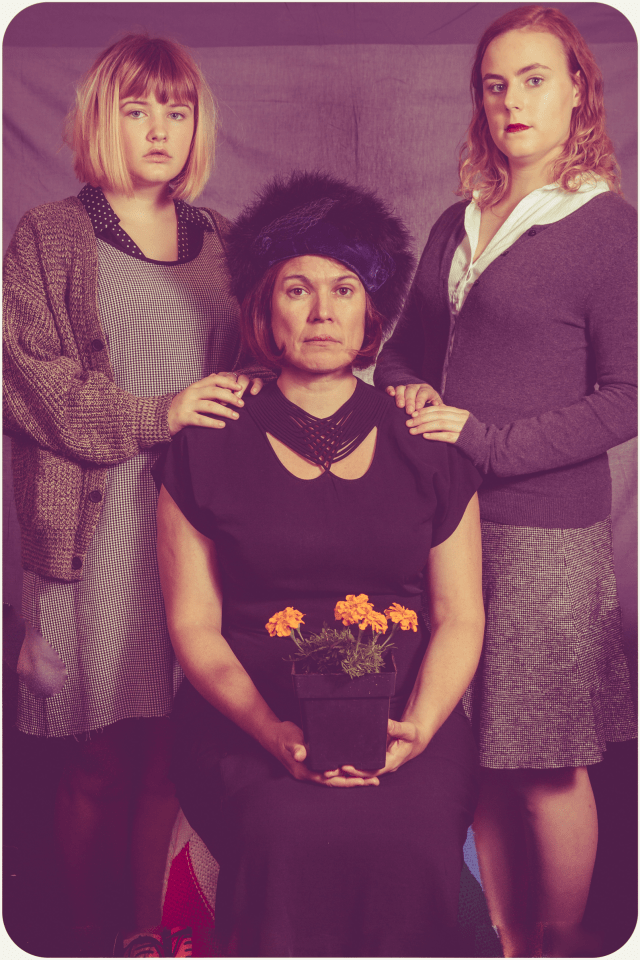
Jennifer Spencer, Jenny McKillop, Jenna Dykes-Busby in Myth of the Ostrich. Photo by Mat Busby.
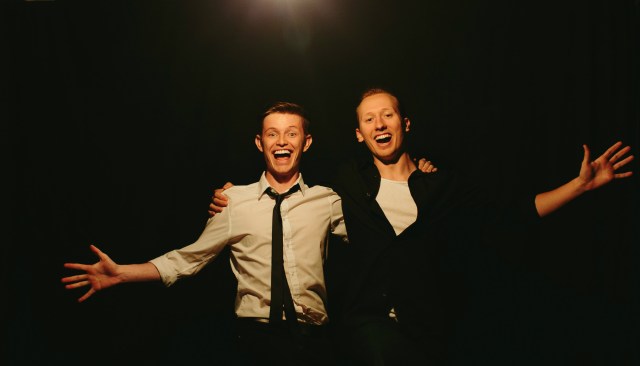
Luc Tellier and Braydon Dowler-Coltman in A Quiet Place. Photo by Mat Simpson.

By Liz Nicholls, 12thnight.ca

One of the durable strengths of the Edmonton Fringe — something that sets it apart from the legion of fringe spin-offs across the continent — is its organic rooting in the theatre community here. It’s not like that everywhere.

Our coterie of theatre artists fell in love with the Fringe early — and stayed that way. And they still want to be at the Fringe, creating work for it, testing out inspirations, finding an audience, expanding their repertoire of theatrical skills.

Meet two exceptional young Edmonton actors who have risen to the provocation of the Fringe., Kendra Connor and Evan Hall are making their directing debuts at the Fringe with comedies of very different stripe and stretch.   

Which explains why Connor found herself agonizing two weeks ago over the best way for her cast to build a blanket fort onstage in the course of a play. “Hours and hours!” she sighs, “building a fort, deconstructing it, then building it again.” And that was before the experiments with the Christmas lights began.

Connor is an actor: Most recently Edmonton audiences saw her clever and spirited comic performances in Theatre Network’s Irma Voth and Teatro La Quindicina’s I Heard About Your Murder. At the Fringe she’s a director.

The play is Myth of the Ostrich, a three-woman comedy by Canadian playwright Matt Murray that premiered at the 2014 Toronto Fringe. And Connor has  assembled “a three-Jen cast,” as she puts it: Jennifer Spencer, Jenna Dykes-Busby and Jenny McKillop. “Right away it got too confusing,” Connor laughs. “In rehearsal I call them by their characters’ names instead.” Some directorial tactics are clearly meant to be learned by improvising.

“I got to the place, as an actor in rehearsals, where I was thinking ‘I could figure out how to fix that’,” says Connor by way of explaining this new career venture. “By the rules of rehearsal, there’s only so much you can do as an actor; it’s taboo to direct your fellow actors, for example. But I’d be ‘hmmm, how would I do that differently?’”      

For Connor, who was tipped to the play by Edmonton director Brenley Charkow, the appeal of Myth of the Ostrich is that it isn’t “just another three-hander for women,” she says. “What I like about it is (its capture of) female friendship…. I like plays in which women don’t spend time tearing each other down, being catty, fighting over a man; I like plays where women support each other.”

Airswimming, the haunting Charlotte Jones play in which Connor appeared with McKillop last summer, was all about that. Myth of the Ostrich, says Connor of this new Praise Doris venture, “is about moms, parental love, female friendship…. There’s something great about having women onstage, and letting them be hilarious!”

Jennifer Spencer, Jenna Dykes-Busby, Jenny McKillop in Myth of the Ostrich. Photo by Mat Busby.

Spencer plays a liberal, permissive writer whose struggles to finish her book are interrupted in the course of an afternoon by tightly wound conservative type who’s discovered a letter from her son to the writer’s kid. “The afternoon turns to chaos” with the arrival of the “brassy Newfoundland gal” who gets most of the zingers, as Connor describes the situation.

“I’ve been learning a lot about talking to actors,” says Connor of this new turn in a theatre career. “You don’t want to give too many notes too early…. It’s about sitting back and knowing how much to give, how much not to.” 

“When you have actors as strong and competent as the three Jens, you don’t create a performance for them. You watch them make offers, you says ‘amplify this, more of that, but in front of the couch not behind it’.”

“For me, this is a good way to start out as a director,” Connor says. “Not too expansive, not too design-y. Not a fantastical journey. It’s people having a conversation.” And it’s a comedy. “When the rhythm is right, it starts to sparkle.” That’s something she knows all about.

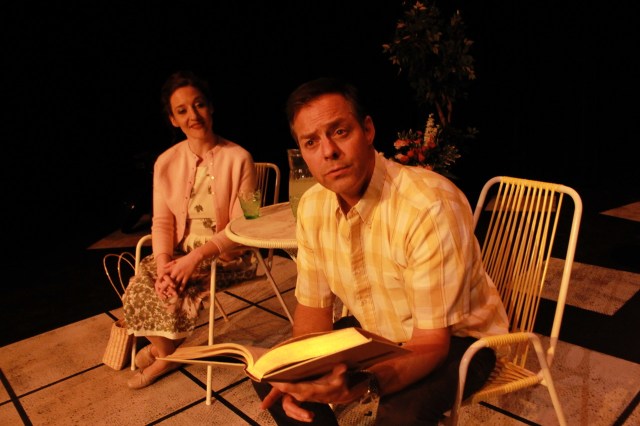
Braydon Dowler-Coltman and Luc Tellier in A Quiet Place. Photo by Mat Simpson.

Every time Evan Hall thought about directing — which he’s  done regularly for a couple of years — he was diverted by the irresistible lure of “getting to be in the play myself.”

“I’m fairly certain I wouldn’t be directing if there wasn’t a Fringe,” Hall says cheerfully. “There are a lot of indie companies here, and they have their own creator/directors…. The Fringe makes making your own work acceptable — both the opportunity and covering (a lot of) the cost.

“This is a bit out of my comfort zone. It’s great!”

Hall is making his directing debut with A Quiet Place, an intriguingly mysterious two-hander by actor/playwright Brendan Gall (Alias Godot). “I love plays that ride or die on their actors,” he says. “This is two people having an experience onstage… Two people in a room with a chair and a lightbulb.” 

“It’s a bit Beckett, a lot No Exit,” he says of the existential teaser in which the lights go down on a guy in a blank room, and when they come up, there’s another guy, tied to a chair.

“They don’t remember how they got there, or their names…. They have to figure that out. The play asks more questions than it answers; it’s a puzzle,” says Hall. “Fascinating! A cool little play, and totally do-able at the Fringe.”

He feels lucky to have at his disposal “two actors who are pretty fantastic!” in this Blarney production. Both Braydon Dowler-Coltman and Luc Tellier are, like Hall, actors who have taken up directing (as you’ll elsewhere at the Fringe in To Be Moved and Legoland, respectively). And Hall himself is appearing in Ron Jenkins’ Fringe production of Gruesome Playground Incidents.

“I’ve learned a lot,” says Hall of his new career venture. “I made a lot of mistakes early on. But I’m learning to have my own language, how to communicate with actors. I’d love to do it again!”

“At the Fringe you can just take bigger risks. It’s allowed to try new things!”   
  

Posted in Fringe 2017 | Tagged , , , , , , , | Comments Off on A new adventure, fringe-style: two young actors are turning director at the Edmonton Fringe

Fringe review: Ain’t True and Uncle False

Paul Strickland in Ain’t True and Uncle False. Photo by Dan R. Winters.

By Liz Nicholls, 12thnight.ca

Ain’t True And Uncle False (Stage 4, Academy at King Edward)

Here’s a new concept in horticulture: “implied garden.” It’s Will Perjure’s creative Eden of upside-down wine bottles and painted cups, handles skyward, with the sign “Mug Roots: Do Not Dig Up.”

The relationship between Art and Life doesn’t come much more whimsical than in this sly, verbally dexterous show from the Kentucky yarn-spinner Paul Strickland. In Ain’t True And Uncle False, this amiable and puckish heir to the great American Mark Twain storytelling tradition, returns to the Big Fib Trailer Park and Cul De Sac (scene of his hit Papa Squat, which I’m now awfully keen to see).

And he takes us around the place to meet its population of distinctively named tall-tale characters, with their own origin backstories, their own quirks, their own creative pursuits (like goldfish taxidermy), their own collective mythology.

We meet Fay and Brie Cation, for example, Siamese twins born 18 months apart, joined at the hand. We meet Ma and Papa Ganda, the latter the vice-president of the local pea-punching plant.

Pea punchers? They’re the consummate pros who make green peas into the black-eyed kind. We find out that the resourceful Will, who lost his left hand as a little kid — he couldn’t find it anywhere — becomes a pea kicker instead. 

There’s a loony brilliance to Strickland’s distinctive kind of quixotic playfulness. And it’s combined with a metaphorical cast of mind that gives Strickland’s stories, his aphorisms, and his songs a certain homespun philosophical resonance. Which may, after all, be the whole point of storytelling:  “gardens that will never grow, beauty that never dies.”  Storytelling with a distinctive Southern flavour and sneaky smarts. 

As seen at the Winnipeg Fringe.

Posted in Fringe 2017 | Tagged , , , | Comments Off on Fringe review: Ain’t True and Uncle False

Fringe review: Staycation

Staycation, White Collar Crimes Theatre. Photo supplied.

Staycation (Stage 2, Backstage Theatre)

By Liz Nicholls, 12thnight.ca

The good thing about being a career conspiracist with a specialty in apocalypses is this: it just takes one. The downside: being right and getting vindicated has a major built-in glitch.  

With Staycation, the agile Portland duo who brought us a couple of screw-up showbiz magicians in Perpetual Wednesday a Fringe or two ago are back, with a messy and meandering physical comedy adventure/vaudeville. It stars a couple of goofball roommates who barricade themselves in their apartment to save themselves from the end of the world. Which is, after all, no reason not to do spirited dance party numbers from time to time.

The clown dynamic is classic: Walter’s the manic bossy one, the obsessive upstager; the bespectacled Bruce is the malleable one with the wheedly voice. Walter, he of the fierce smile and the pointy tinfoil dunce helmet, sees apocalyptic signs everywhere — Dorito-flavoured Mountain Dew? “You’re welcome, Canada!”. Bruce, who wears socks with his Birkenstocks, is on his own career path: dolphin trainer. “Welcome, everyone, to Sea World.”

There’s a sort of bendable “plot,” involving a crack in “the wall” between realities, or our limited human comprehension of cosmic conspiracies, or whatever. Walter and Bruce are forever diving through a plastic curtain, and ending up as cut-out puppets in a kind of shadow-play wonderland ruled by a monster. “OMG, it’s the most beautiful effect I’ve seen at a Fringe!” declares Walter. Actually, it does look quite fancy, in a chaotic sort of way.

Speaking of walls (and the tearing down thereof), in time-honoured vaudeville fashion, the proverbial fourth wall is there to be spray-painted with vaguely topical slightly past-its-best-before jokiness. Or ignored altogether. “That seems like it’ll be pertinent in the next scene.”

There are pratfalls. There are songs. Someone will get slapped by a rubber fish.… You know, that sort of thing. 

It’s an amiable, scrambly entertainment by a couple of hard-working, likeable vaudevillians. Whether you find this riotous, temporarily diverting, or an over-extended very labour-intensive way to be playful depends a bit on your own sense that the end is nigh. I had the middling reaction.

As seen at the Winnipeg Fringe. 

Posted in Fringe 2017 | Tagged , , , , | Comments Off on Fringe review: Staycation

Review: SwordPlay: A Play of Swords

Katilin Morrow, Conor Bradbury in Swordplay: A Play of Swords, Sex T-Rex. Photo supplied.

SwordPlay: A Play of Swords (Stage 37, Suzanne Thibadeau Auditorium, La Cité francophone)

By Liz Nicholls, 12thnight.ca

With SwordPlay: A Play of Swords, the Toronto comedy troupe Sex T-Rex delivers live theatre with something everyone secretly wants: a video game on legs, with references they can’t fail to get.

That they do this, with pizzaz, on a bare stage using only five people with the gift of the gab, feathered hats, tights, rubber rapiers wielded with ruthless brio … well, that’s the kind of low-budget ingenuity that fuels improv comedy and fringe festivals world-wide. 

Inventive physicality, shameless pop-culture pilfering from sources like The Three Musketeers or Game of Thrones or The Princess Bride … that’s the engine of this zestful high-speed swashbuckler. The secrets of the plot, in all its daft convolutions, are safe with me: I couldn’t explain it even if I weren’t being held captive by a fire-breathing dragon.

Suffice it to say that classic scenarios of the thrust-and-parry genre are invoked, and stitched up with lavish outbreaks of swordplay. A kidnapped princess, abducted by someone nefarious related to someone royal, is in need of rescue. De-frocked swordsmen, in need of redemption after that whole sorry Roland fiasco (don’t ask), set forth on a heroic rescue mission — of the princess and their reputation — on the all-for-one one-for-all plan. They defy the auguries, crazy odds, unexpected obstacles, cheap-theatre limitations, mistaken identity crises, the new political realities, self-esteem issues. Did I mention the fire-breathing dragon?

As someone says, “you could have married a similar-looking girl with darker hair and no back story.” But no, my friends, if life were that simple, there would be no need for fancy fight choreography or warnings about “cartoonish violence and adult language.” 

The cast — Jon Blair, Conor Bradbury, Julian Frid, Kaitlin Morrow, Seann Murray — attack with gusto. The proper term for their kind of loopy, winking attachment to something flimsy is zany. And zany is fun, in a pure fringe-y 60-minute-max sort of way.

As seen at the Winnipeg Fringe. 

Posted in Fringe 2017 | Tagged , , , , | Comments Off on Review: SwordPlay: A Play of Swords

Fringe review: Drunk Girl

Thea Fitz-James in Drunk Girl. Photo by Dahlia Katz.

Drunk Girl (Stage 13, Old Strathcona Public Library)

By Liz Nicholls, 12thnight.ca

“Carpe diem!” beams the high-spirited woman before us, presiding over a selection of bottles. 

In the well-stocked repertoire of cautionary tales with sadder-but-wiser chasers, Thea Fitz-James’ solo show isn’t just one for the road. Drunk Girl, it turns out, is a smart, challenging show that doesn’t just sip the risky high-test stuff (and spit it out when no one’s looking), but declares bottom’s up.

The Fringe is full of solo shows that allude to complexity and cultural contradictions. Drunk Girl actually takes them on — in surprising ways that don’t include resolving them. It’s brave and kind of feisty that way.

“Let’s take a gander, shall we?” grins Fitz-James, charismatic and cordial, as she flips open her yearbook. She’s funny. And we’re with her on that classic threshold of maximum possibility: For a small-town Quebec girl and her classmates, “probable destination” is  mostly “anywhere but here.”  

In the course of Drunk Girl, amusement — she calls it “nostalgic whimsy” — turns to disappointment, underscored by a rage that masquerades as high spirits but is more like profound sadness.

It’s charted in a steady escalation of onstage drinks, and ever more expansive annotations, as our college-girl protagonist and her party-girl alter-ego come up, time and time again, from different angles, against something confounding  and irreducible. The fun that empowers you, as a young woman out to participate on equal footing in the world, also penalizes you.

“I am the queen of Ladies’ Night!” declares the party girl who drinks with her friends because she can (and why shouldn’t she since boys can and do and will?). “Alcohol is my fuckin’ revolution!” The professional grad who doesn’t drink at conferences — except white wine, which doesn’t really count, right? — invokes Kafka, and “conceptual” drinking games.

The alter-egos come together in a terrible moment, where only the feeling of violation is unequivocal. “No is an extraordinarily complicated word when you’re drunk,” she says.

Fitz-James has such an easy, amiable instant rapport with the audience that you almost don’t realize the high-risk zones into which Drunk Girl sallies forth. One is an audience-participation chug-a-lug that seems to startle even the performer. The other — and this is only partly successful I think — is the summing up by the playwright.

Certainly she’s earned it. She’s done the research, and presented chunks of it, too. But the show is perhaps vivid and strong enough on its own to just leave us with its provocative, combative ideas and the poetry that surrounds them.

“Sometimes I feel like the Titanic — big, beautiful, too big to fail….” She is. 

As seen at the Winnipeg Fringe. 


Posted in Fringe 2017 | Tagged , , | Comments Off on Fringe review: Drunk Girl

Fringe review: Prophecy

Carmen Nieuwenhuis in Prophecy, Impossible Mongoose. Photo supplied.

By Liz Nicholls, 12thnight.ca

Prophecy  (Stage 31, Strathcona Baptist Church)

“Ignorance can be bliss, but knowledge is not power,” Prophecy tells us in this vivid meditation on a violent male world seen through the eyes of women. They see destruction coming and know its consequences.

Last time out, Impossible Mongoose, an adventurous Edmonton indie tore into a zany, breathlessly high-speed five-generation chronicle of terrible behaviour in a dysfunctional family. In Jessy Ardern’s The Fall of the House of Atreus, the years of the Trojan War flew by in madcap minutes.

With Ardern’s witty and powerful new play, Impossible Mongoose returns to that war. In a powerhouse performance from newcomer Carmen Nieuwenhuis, we meet a succession of women whose tragedy is to see ahead in time and know too much. The poster child for this long-distance vision is Cassandra, the clever Trojan princess whose god-given gift of prophecy comes with a stinger: she will never be believed. 

In Corben Kushneryk’s production, Cassandra is reduced by the backlash from her peculiar talent — “was/ is/ will be… death”  — to re-purposing assorted stuff from a janitor’s closet to re-tell the story of destruction of her country and her family in an unending war. The rationale for this storytelling concept isn’t quite clear; a minor tweak could fix that, I think.

“This will be my father,” she says picking up the bucket that stands in for Priam. Her brother Hector gets to be a mop.

We meet Cassandra’s tart-tongued mother Hecuba, with her worldly edge of cynicism — again nailed by the resourceful Nieuwenhuis. She describes her son Paris — whose mad-pash for Menelaus’s glamorous but slutty wife Helen will ignite the Trojan War — a hat with feathers on it, “the human fascinator, beautiful but useless.”

We meet Andromache, the beleaguered foreign-born widow of Hecuba’s son Hector, “a queen with no king.” And we meet another woman with a tumultuous history of exploitation by the military men around her. “I practise getting smaller; eventually I will disappear,” says the concubine Briseis who, in Nieuwenhuis’s performance, does seem to be shrinking before our very eyes. .

The atmospheric lighting, from flashlights and footlights, has a kind of homespun ghostliness about it; it casts distorted large-scale shadows of a turbulent historical epic on the wall behind the women.   

“Your job is to tell the truth when no one is listening…. That’s what keeps you human.” The ending, which flings Prophecy into the immediate present, is a punch to the solar plexus. 

As seen at the Winnipeg Fringe.

Posted in Fringe 2017 | Tagged , , , , , , , | Comments Off on Fringe review: Prophecy

And on my summer holidays … I went to the Winnipeg Fringe

This is just a little note to tell you that I’m about to start posting 12thnight.ca reviews of shows I saw on my excursion last month to the country’s second-largest Fringe festival, in Winnipeg. They’re 16 of the shows you could be seeing come Thursday, when the 36th annual Edmonton Fringe starts its 11 day (and night) bash in 42 venues.

I know you’re all studying the 220-show Fringe roster, and getting excited. At 12thnight.ca we’re here to egg you on (and to pique your own curiosity for theatre exploration)!


Posted in Fringe 2017 | Tagged , , , , | Comments Off on And on my summer holidays … I went to the Winnipeg Fringe

No stars for the star rating system of Fringe reviews

By Liz Nicholls, 12thnight.ca

To star or not to star.

There’s a question that’s been debated in beer tents, box offices, and press rooms since Hamlet gave director’s notes to the travelling players.

There are arguments to be made on both sides, and I’ve made them. And I’m still of two minds. But as a theatre reviewer who’s covered the Edmonton Fringe and its astonishing growth spurt since 1983 (please, don’t do the math!) I’m thinking that the star rating system, the shortest possible shorthand review, has outlived any real meaning for artists and audiences it might once have had. So, for my short Fringe reviews on my theatre website, 12thnight.ca, I’ve decided not to go that way. 

In a star-studded Fringe universe peppered indiscriminately by a proliferation of four-and-five star ratings from an ever-widening spectrum of writers — just look at the program — artists and Fringe-goers alike tell me (loudly and convincingly) that 3 1/2 stars is a pall, and three is a pasting, worse at the box office than no review at all. Two? Don’t even bother writing a review. To pursue that thought to its reducto ad absurdum, why even bother writing a review anyhow, and provide evidence for your critical reaction, if a star chart with its top-heavy four and five-star clusters, is all that counts?

I get that the 220-show lineup in this latest edition of our summer theatre bash is dauntingly full of choices for ticket-buying audiences. But if critical reaction is reduced to four- and five-star assignments, we’re in a sorry era of a pass-fail system for Fringe shows. Only four? Sorry, you flunk.

And, my Fringe-going compatriots, isn’t that a slam at the whole idea of having a Fringe, a theatre festival with alternative cred, with a mixture of bright ideas, experiments, works-in-progress, polished touring shows?

Star ratings were never a nuanced, stand-alone system, I think. What journalist wants their work not to be read? Not me, that’s for sure. What’s happened to the critical imperative to explain your reactions?

To pick the most problematic of the ratings, what does a three-star rating slapped on a review mean? Potentially, very different things. A theatrical experiment with aspects of brilliance and notable flaws, perhaps, worthy of seeing and discussing? Or perhaps a piece that strikes you as competent but only mildly interesting? How many stars should a fascinating failure get? How do you weigh ambition against execution?

These reactions cry out for a review, no matter how short. And it shortchanges everyone concerned, onstage and off-, artist and audience, to off-load that responsibility onto a star chart.

Which is why I’m venturing outside the star rating system for my Fringe reviews on 12thnight.ca. I’ve thought and thought about this, since the Fringe is SO big. And artists need, and deserve, some cross-country box office traction from their experience at the continent’s biggest and oldest Fringe, some way of recording the response to their work.

I’ll be trying hard to be more quotable; it’s only fair. Stay tuned.

Posted in Fringe 2017 | Tagged , , , , | Comments Off on No stars for the star rating system of Fringe reviews

All in the family: Ryan history is onstage at the Fringe

Sadie Bowling, Kate Ryan, Emma Wilmott in The Effect of Gamma Rays on Man in the Moon Marigolds. Photo by db photographics.

By Liz Nicholls, 12thnight.ca

Something big and important, something you could call life-changing, happened to Kate Ryan 31 years ago. And it sheds light, both the theatrical and the personal kind, on why her theatre company, The Plain Janes, is doing a straight play at the Fringe, along with the sort of off-centre musical that is its more usual fare.   

Back to 1986. It was a family affair. Kate and her sister Bridget appeared with their actor mother Maralyn in a production directed by their father Tim, Ryans all. The play was The Effect of Gamma Rays on Man in the Moon Marigolds, a wrenching 1971 Pulitzer Prize-winner by American playwright Paul Zindel. His breakthrough into the big time, culled from his own experience, was an exploration of family dysfunction: an embittered and controlling widowed mother, and her two teenaged daughters.

“It was a thrilling time,” says Ryan recalling her teen self in the production. “A huge turning point!”

Not that the theatre life was a discovery. She and her sister had grown up in rehearsal halls, when the Ryans lived (and started theatre companies) in Cleveland. They’d been in musicals; Maralyn had founded the St. Albert Children’s Theatre, and regularly directed kids in big Broadway musicals and plays.

“But it was our first time working with mom as an actor, our first time working with Tim as a director.And it was terrifying!” she laughs. “He demanded a lot from us…. No concessions! He was all about respecting the work, what the world of the play needed. And I realized if you choose to be an artist, this is what you commit to….”

Kate Ryan, Maralyn Ryan, Bridget Ryan in The Effect of Gamma Rays on Man in the Moon Marigolds, 1986. Photo supplied.

“I remember mom saying ‘it’s not going to be easy’. She remembers going backstage, and thinking how hard it is to be this woman, to live her….”

Ryan is finding this out first-hand. This time she plays Beatrice the monster mom in Amy DeFelice’s Plain Janes Fringe production of Marigolds. And Ryan’s teenaged daughter Emma Wilmott, newly graduated from Vic (the performing arts high school) and fresh from a summer theatre intensive at RADA (the Royal Academy of Dramatic Arts) in London, is playing the role she once had: Ruth, the daughter most damaged by her mother’s hatred of the world. Sadie Bowling plays Tillie, the shy daughter who rises above the toxic environment by blooming.

“Tim didn’t rehearse us together; he kept us apart,” recalls Ryan. “Same thing with (director) Amy and I this summer…. (The play) is written that way. The mother isolates herself from her daughters; her connections are full of conflict..”

Ryan was a theatre kid; how could you be a Ryan and not be immersed? I remember Maralyn once telling me the relief of working with other Ryans on a production was that at least everybody in the house had anxiety about the same show. But, says Kate, “I didn’t know what it really meant to be an actor, a theatre artist…. After Marigolds I knew I wanted to be an actor, to go to Juilliard.”

So her father, who started the theatre arts program at MacEwan, took her, at 17, to New York to audition. “The nerve of it!” she laughs. “And the disappointment when it didn’t work out! But I did it! I picked myself up after that…. This business is so cruel, so hard on the soul. I see that in Emma, the stress, the disappointment, the dreams of success.”   

Beatrice, an isolationist steeped in rancour, has the configuration of a monster. But, like Amanda in Tennessee Williams’ A Glass Menagerie, she has a past full of struggles and disappointments, says Ryan. “In the dark days of parenting, I’ve felt that myself: why is the world so much happier than I am? The woman goes to the darkest places.”

“It’s the hardest thing I’ve ever done.” Ryan laughs. “That, and learning Sondheim.”

Which explains, in a roundabout way, why Ryan spent a morning at home last week, waiting for the arrival of a cat skeleton for the show. You can get anything at Amazon. 

The Effect of Gamma Rays on Man in the Moon Marigolds runs at Walterdale Theatre (Stage 3) Aug. 18 to 27.

Tim Ryan and Maralyn Ryan in The Apple Tree, Cleveland 1973. Photo supplied.

Madelaine Knight in The Apple Tree, The Plain Janes at the Fringe. Photo by db photographics.

A CODA: Meanwhile, there’s a Ryan history attached to the Janes’ other Fringe show, too, a witty little 1966 musical by the storied Fiddler on the Roof/ She Loves Me team of Sheldon Harnick and Jerry Bock. Ryan’s father and mother starred in a 1973 production of The Apple Tree in Cleveland, before they arrived here, and started making theatres, and theatre companies. 

Dave Horak of Edmonton Actors Theatre, Ryan’s brother-in-law, is directing The Apple Tree, in a production starring Graham Mothersill and Madelaine Knight as the world’s first couple Adam and Eve, and Jocelyn Ahlf as the Snake. It runs at the Varscona (stage 12) starting Thursday. 

Posted in Fringe 2017 | Tagged , , , , , , , , | Comments Off on All in the family: Ryan history is onstage at the Fringe

Edmonton Fringe 2017: a selection of hit return engagements

By Liz Nicholls, 12thnight.ca

Belinda Cornish and Jeff Haslam in The Exquisite Hour (2013), Teatro La Quindicina. Photo by Andrew MacDonald-Smith.

True, the unpredictability factor is built into the 220-show edition of the Edmonton Fringe that opens Thursday. But hits do have a way of showing up again. Will they be back in buffed-up, revised, re-muscled, enhanced form? Maybe, maybe not.

In the lineup, I noticed a smattering of shows I’ve seen and enjoyed before, in past summers. Here’s a selection… 

The Exquisite Hour. A gem One of my favourites of all the Stewart Lemoine canon returns to the Fringe as part of Teatro La Quindicina’s 2017 summer season. When the playwright’s only two-hander premiered, in 2002, it was Teatro’s temporary farewell to the Fringe, a momentous threshold in itself. And everything about this beautiful and insightful little real-time piece seemed to open new vistas — for the playwright, the actors, the characters. When a mysterious woman arrives in the backyard of an unassuming “supervisor of merchandise receiving” one summer evening and asks him politely “will you let me have this hour?”, nothing can be the same.

Jeff Haslam is back in the role of the “ordinary” man who discovers the possibility of the extraordinary. He originated Mr. Zachary Teale in the 2002 premiere (with Kate Ryan) and resumed in the 2013 revival, with Belinda Cornish, who returns, too, as Mrs. Darimont.

Weaksauce. If you’ve never seen a show by Sam Mullins, one of the country’s best monologuists, you’re now in a position to fix that. Give yourself a treat. There’s something compellingly natural about the way he mines his own experiences, and turns them into something fresh. Weaksauce takes us into the strange new topsy-turvy world of his 16-year-old self, who falls in love for the first time. The coming-of-age turf is familiar; it’s exploration by Mullins feels fresh and newly discovered.

Johnnie Walker in Redheaded Stepchild. Photo supplied.

Redheaded Stepchild: Johnnie Walker was a delight as a much-persecuted 11-year-old carrot-top in this hilarious and poignant coming-of-age 2012 solo show from Toronto’s Nobody’s Business Theatre. You’ll never see an adult play a kid — a danger-fraught enterprise — with more unforced charm.

Nayana Fielkov and Matthew McCorkie in Falling Awake, Ragmop. Photo by Kai Hou.

Falling Awake. Last summer I was enchanted by a strangely surreal little physical comedy from the Vancouver duo Ragmop, beckons you into a dreamworld where memory and fantasy get to play by their own elastic rules. It’s back to play along the frontier between waking and sleeping. Funniest sex scene at the Fringe (until proven otherwise). Bonus: you get to use the word “surreal” with impunity.

Stéphanie Morin-Robert in Blindside. Photo by Tristan Brand.

Blindside. I loved this charmer when I saw it last year in Winnipeg.  In one way Stéphanie Morin-Robert’s memoir is an ode to childhood resilience — she gave up her left eye to cancer at age two — but it stands apart from that repertoire for its wry sense of humour, its unexpected bounce, its playful end-run around sentimentality. She’s very apt to pop out her glass eye and enjoy it when we flinch. Apparently, the creator/performer (who’s also in the highly original two-hander The Merkin Sisters) has re-written and re-worked for this return engagement at our Fringe. 

Jem Rolls in The Inventor Of All Things. Photo supplied.

The Inventor of All Things. The virtuoso performance poet Jem Rolls directs his fierce verbal dexterity at a subject as compellingly eccentric as his own performance style. Leo Szilard was the Hungarian physicist who devised the science of the atomic bomb, and then, in an act of little-known heroism, figured out how to keep that knowledge from Hitler. But that’s not all he was. Rolls’ show is an homage to unstoppable, multi-faceted creativity, and its unexpected byways.

The Pre-History of Moses P. For years the South African storyteller Erik de Waal has delivered Fringe audiences vivid glimpses into a richly variegated culture and its traditions. And he’s done it in a sonorous, incantatory style like no other. His kids’ stories feature animals. His adult shows, like The Pre-History of Moses P (here half a dozen Fringes ago), explore the high cost of a human culture arranged and separated strictly by colour. I remember this show for its weave of two storylines that come together with tragic force.


Posted in Fringe 2017 | Tagged , , , , , , , , , , , , , | Comments Off on Edmonton Fringe 2017: a selection of hit return engagements