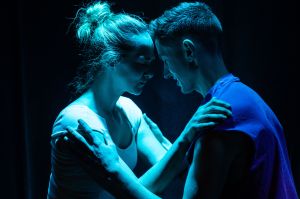
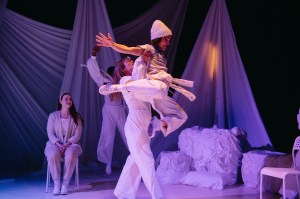
Party time in 19th century Russia: Natasha, Pierre & the Great Comet of 1812 at MacEwan

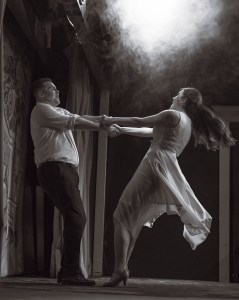
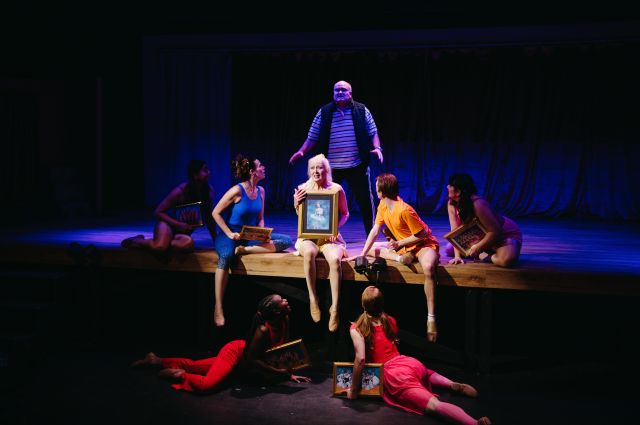
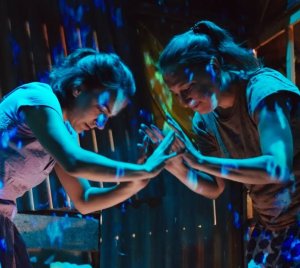
Natasha, Pierre & the Great Comet of 1812, MacEwan University Theatre Arts. Daniela Masellis (set design), costume design (Skye Grinde), sound design (David Bowden), lighting design (Ken Matthews). Photo by Brianne Jang, BB Collective Photography.

By Liz Nicholls, 12thnight.ca

A black box theatre at MacEwan University (the Tim Ryan Theatre Lab) has been transformed into a red and black Russian cabaret — overhung with velvet  draperies, twinkling lights, a glittering chandelier, imperial insignia of the old regime.

To help support 12thnight.ca YEG theatre coverage, click here.

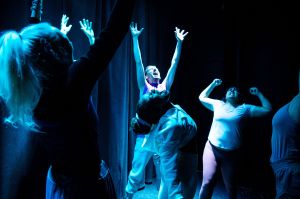
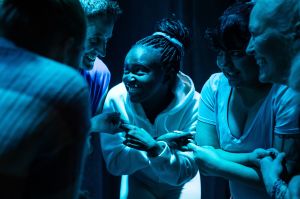
And we’re sitting in clusters, some of us at cabaret tables, others tucked here and there in between. There is a “stage,” yes, a long scarlet gangway, up a stair or two, and a couple of other stages, too, for an assortment of musicians. But in Jim Guedo’s MacEwan University production of Natasha, Pierre & the Great Comet of 1812, the cast of 14 and the orchestra of eight (supplemented by actors who also pick up a violin, an accordian, a clarinet) only ever touch down on it briefly. They’re scattered through the club; they thread their way among us, always on the move, sitting next to us, dancing and singing, mingling.

I’ve seen the musical twice before in New York, once in a tent and once in a full Broadway theatre, sacked for the occasion with interlocking catwalks, to make that audience immersion possible. And this production, like those, feels like a party. I got a chance, unexpectedly, to experience it on the final weekend of a sold-out run.

I say ‘experience’ because we’re included in the storytelling of Dave Malloy’s boldly offbeat through-sung “electropop opera,” with its 19th century love story, and its wildly eclectic score, a mix of electronic rock, opera recitative, Russian folk music flavours.

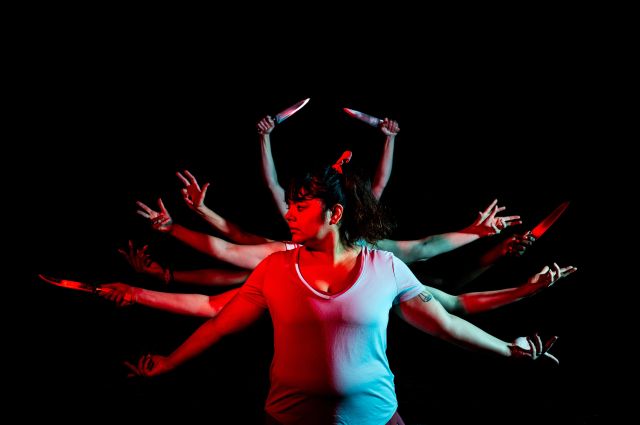
Natasha, Pierre & the Great Comet of 1812, MacEwan University Theatre Arts. Daniela Masellis (set design), costume design (Skye Grinde), sound design (David Bowden), lighting design (Ken Matthews). Photo by Brianne Jang, BB Collective Photography.

The design (Daniela Masala’s set, Ken Matthews’ glowing lighting, Skye Grinde’s clever costumes, David Bowden’s sound design) embraces the audience in this intricate multi-optic enterprise. And so does Guedo’s theatrical and inventive stagecraft, which propels a story excavated from a 70-page chunk of Tolstoy’s door-stopper War and Peace.

The characters sometimes refer to themselves in the third person, or provide their own stage directions, all in song. And they’re playful about our involvement. In the catchy prologue number, they give us some advice. “You’re gonna have to study up a little bit/ if you wanna keep up with the plot/ cause it’s a complicated Russian novel/ everyone’s got nine different names.” The program has a centrefold family tree, with arrows, and relationships. “Mariya’s old-school, Sonya’s good, Natasha’s young, and Andrey isn’t here.”

Guedo’s cast of student actors (with students working the crew, too, under the mentorship of  theatre pros) are about to graduate and emerge into the big bad world of professional theatre. And they throw themselves into the challenges, musical and dramatic, of this innovative musical at full tilt, with full commitment and then some: a talent scout alert.

At the centre of the complications is a love story that turns out to be the story of innocence lost. While her betrothed (Nathaniel Cherry as the dashing Prince Andrey) is away at war, beautiful young Natasha, unmoored by the heady whirl of Moscow society (as Lisa Kotelniski conveys so convincingly), is tempted into a ruinous affair with the callow married swaggerer Anatole, conjured in Liam Lorrain’s performance.

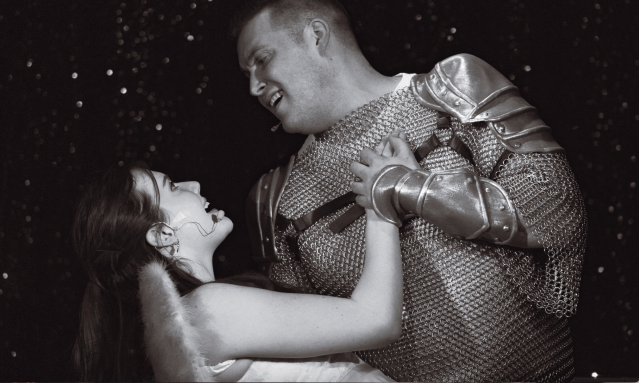
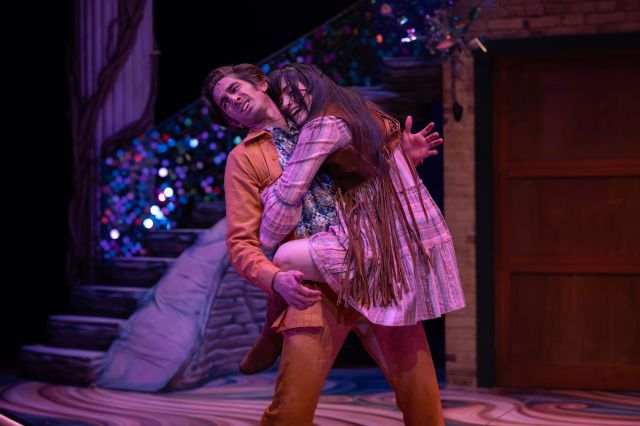
Natasha, Pierre & the Great Comet of 1812, MacEwan University Theatre Arts. Daniel Masellis (set design), Skye Grinde (costume design), David Bowden (sound design), Ken Matthews (lighting design). Photo by Brianne Jang, BB Collective Photography.

The Pierre of the title, played compellingly by strong-voiced Matthew Gregg in a top-drawer performance, is a depressed nobleman philosopher having a mid-life existential crisis in a sea of booze. Pierre’s scornful, amoral wife Helene (the striking Layne Labbe) is amusing herself with Natasha’s destruction. And there are notable performances by Ashlin Turcotte as Natasha’s friend Sonya (who gets the musical’s only real pop ballad, and nails it), Jaden Leung, Camryn Bauer, Marina Mikhaylichenko.

Some of the voices do seem more suited to the musical theatre idiom than the jagged and demanding operatic intervals into which Malloy’s adventurous score pulls them. But the characters spring, intensely, to life. And they’re surrounded by a zestful ensemble, including such exuberant figures as the troika driver Balaga (Kohen Foley), who flings himself manically through the pulsing number devoted to him.

Like the music and the costumes by Grinde which put jeans, 19th century military jackets and ballgowns together, the choreography by Anna Kumin finds a way to be both “historical” and contemporary. The party energy from characters who are also narrators is non-stop.

There’s something irresistible about this innovative musical, with its soulful ending. In a student production, full of emerging talent, the idea of the comet, that wrests something beautiful, life-changing, and hopeful from the imminence of total destruction seems to speak to our Moment.

Last performance Sunday Feb. 16. It’s officially sold-out. But if you have a chance, you might score a return ticket, in person at the MacEwan box office (1111 104 Ave.), half an hour before the show.   

Posted in Reviews | Tagged , , , , | Comments Off on Party time in 19th century Russia: Natasha, Pierre & the Great Comet of 1812 at MacEwan

Teatro Live introduces a younger generation of stars (and Hungarian street snacks) in The Noon Witch. Meet Eli Yaschuk.

Eli Yaschuk, Nina Vanderham, Aidan Laudersmith in The Noon Witch, Teatro Live! Photo supplied.

By Liz Nicholls, 12thnight.ca

Thirty years ago, Teatro La Quindicina audiences caught sight of a highly idiosyncratic witch who preferred sunlight to night time, and lured men to their watery death with caloric fatty snacks so they sink.

To help support 12thnight.ca YEG theatre coverage, click here.

Playwright Stewart Lemoine has said that his inspiration for The Noon Witch was a 20-minute Dvorak tone poem (Op. 108, B196) whose point of origin was an eccentric Hungarian legend. Needless to say, there’s nothing quite like it in Canadian theatre.

Much has changed since The Noon Witch took us to 1920s Budapest in 1995. The ex-firehall Chinook Theatre in Strathcona became the Varscona and then the “new Varscona.” Teatro has become Teatro Live!. What hasn’t changed is that a Stewart Lemoine comedy that introduced a new generation of young actors to Teatro (and Edmonton theatre) stardom — Jeff Haslam, John Kirkpatrick, and the late great Julien Arnold among them — is poised to do the same again.

Davina Stewart and Jeff Haslam in The Noon Witch (1995), Teatro Live!. Photo supplied

A revival of The Noon Witch, directed by the playwright, opens Friday in the Teatro Live! season. And in Lemoine’s cast are four newcomers — Eli Yaschuk, Aidan Laudersmith, Nida Vanderham, Ethan Lang — recent theatre school grads from MacEwan and the U of A, alongside the experienced Teatro sparkler Michelle Diaz.

Yaschuk and Laudersmith are Joszef and Anatol, a couple of Budapest lads-about-town, “park bench philosophers” as billed, who fall under the sweet but possibly lethal spell of Tinka, who has supernatural powers and an alluring way of proffering cream cakes.

If you were lucky and caught Jim Guedo’s MacEwan theatre arts production of Sondheim’s Sunday in the Park with George, this past season, you’ve already met Yaschuk, in a fierce, compelling performance in the title role of the driven French painter Georges Seurat immersed in his work, neglecting his lover Dot. Art and making art and mapping out the sky: the Sondheim musical masterpiece has things to say to young artists, fresh from theatre school.

Eii Yaschuk. Photo supplied.

Yaschuk’s entry point onto the stage, if you don’t count a childhood “always in the backyard making shows,” wasn’t Les Miz singalongs. It was Ukrainian dance, 13 years’ worth. A familiarity with being onstage, and an “obsession with musical theatre,” as he says, led him straight to MacEwan University’s theatre arts (and one of MacEwan’s first new BFAs in musical theatre). And like his fellow artists who bravely set forth into the world of theatre in 2020, that fateful year that COVID started shutting down shows, it was a largely Zoomed-in education for the first couple of years, as arranged of necessity by a creative faculty. “Somehow we did two months in person that fall…. And right before Halloween we got sent home, and spent most of the term online…. I’d go down to my basement for my 9 a.m. dance class. On Zoom.”

“And actually,” he says, “it wasn’t horrible. We were new theatre kids. And we hadn’t known anything else.”

At MacEwan, Yaschuk, a bona fide triple-threat, found himself in an assortment of roles, with distinctive theatrical qualities, like Mr. Cellophone in a Kander and Ebb revue. He was Man in Chair, the musical theatre devoté who conjures an entire 20s-style musical in his imagination in The Drowsy Chaperone. By second year, he and class-mate Rain Matkin, who co-starred with him in the Sunday in the Park (Dot to his Georges), “would go to theatre, to see what was out there.” There’s nothing like a Zoomed existence to make artists (and audiences) appreciate the live experience.

The first Teatro show they saw? Fever Land, a sad/funny 1999 Lemoine play that marked the company’s return to live performance in the fall of 2021. Like The Noon Witch it involves supernatural intervention in human affairs. And Yaschuk was drawn to the style, “heightened, bubbly, very articulate characters who think and speak in full sentences.”

Those distinctively Lemoinian features find their way into The Noon Witch, along with the challenge of making unusually literate language sound natural. “For the first few days it felt … new,” says Yaschuk. “I’m running out of breath! Now we’re on our feet it does feel natural!”

Even the characters Yaschuk and Laudersmith play in The Noon Witch, Joszef and Anatol, have a history at Teatro. Five years before The Noon Witch they first appeared in a park discussing opera in Lemoine’s The Unremembered Budapest (the playwright jokes he apparently had “a Hungarian period”). As per the Teatro tradition of real food onstage, Hungarian goulash was served onstage at a climactic moment. This time, it’s “baked goods,” a term far from current in the contemporary lexicon. Ditto “foodstuffs,” which Yaschuk particularly likes. Teatro’s newsletter Aieeeee! even includes a recipe for ‘langos,” a traditional Hungarian street snack.

Joszef, as Yaschuk describes, “is a delightful man. Quirky. A worrier, Full of anxiety about backed goods (he’s concerned about getting plump), tightly wound.. Super-fun to play.” Joszef might actually shudder at the sight of a cream tart. Which makes him highly resistant to the charms of Tinka.  Anatol, on the other hand, says Yaschuk of the character Laudersmith plays, is “very articulate. A bit smarter, to be honest. He thinks a lot more; he always has a plan…. It’s a classical dynamic.”

At the other end of the theatrical spectrum from Lemoine’s fantastical comedy, we’ll be seeing Yaschuk in April, opposite Matkin, in the Northern Light Theatre production of Radiant Vermin in April. Philip Ridley’s darkly funny and knowing satire has a go at the housing market and consumerist greed: a young couple achieves their dream home … at a horrifying price.

Yaschuk and Matkin created a “cabaret play” together (“we spur each other on”), and In My Room was at Grindstone last summer. Look for them at this summer’s Fringe together in Victor and Victoria’s Terrifying Tale of Terrible Things, a macabre 2011 goth thriller cum scary bedtime story by Beth Graham and Nathan Cuckow. Jim Guedo, returning to the Fringe after a long absence, will direct.

Meanwhile, there’s the fun of a Teatro rehearsal — with foodstuffs.

PREVIEW

The Noon Witch

Theatre: Teatro Live!

Written and directed by: Stewart Lemoine

Starring: Eli Yaschuk, Aidan Laudersmith, Nida Vanderham, Ethan Lang, Michelle Diaz

Where: Varscona Theatre, 10329 83 Ave.

Running: Feb. 21 through March 9

Tickets: teatrolive.com

Posted in Previews | Tagged , , , , , | Comments Off on Teatro Live introduces a younger generation of stars (and Hungarian street snacks) in The Noon Witch. Meet Eli Yaschuk.

Hey, wanna see a show? Look at your choices on Edmonton stages this week!

Chariz Faulmino and Mark Sinongco in Disney’s Frozen: The Broadway Musical, Citadel Theatre and Grand Theatre. Photo by Nanc Price.

By Liz Nicholls, 12thnight.ca

If there ever was a week to expand your horizons at the theatre….  Don’t even think about staying home. Your choices are many: Broadway musicals of every size and personality, improv, a clown show that takes us to the B side of a fairy tale, a play that wonders about theatre as a magic trick, an adventure in straddling two cultures … and first, a new theatre company with a cabaret calling card.

To help support 12thnight.ca YEG theatre coverage, click here.

Trevor Schmidt and Mark Meer co-host the debut PepperMunt Cabaret. Photo supplied

•That would be MUNT, the new performance theatre in town. It’s the brainchild of artistic director Jake Tkaczyk. Among MUNT’s goals in theatrical subversion is a late-night cabaret of the no-holds-barred, unfiltered stripe. The debut edition, hosted by Mark Meer and Trevor Schmidt, both notably quick thinkers on their feet, happens at the Gateway Theatre (8529 Gateway Blvd) Saturday at 10:30 p.m.

MUNT (formally MUNT Performance Association) got its unusual name, as Tkaczyk explains, from Wilhelmina Mints and free-associating with Josh Travnik, his cast-mate in 10 Funerals. EdMUNton, MUNTorship, theme of the MUNT … you get the idea. That christening is as non-linear as the artistic bent of the new theatre company, devoted to prying loose the linear/narrative/plot stronghold on Canadian theatre , in favour of something more experimental, unexpected, more immersive (“for want of a better word,” as Tkaczyk puts it).

That kind of creative experimenting aligns with Tkaczyk’s research for his impending PhD in creative practice from Liverpool John Moores University and the Transart Institute. Such bold experimenters as Punchdrunk and Frantic Assembly in the U.K. and Belgium’s Forced Entertainment (Fight Night) , who experiment with “re-integrating audience and performers,” are right up Tkaczyk’s alley.

A “conservatory-trained actor with a BFA from the University of Alberta, Tkaczyk, who’s also the general manager of Workshop West, is an experimenter in his own play creation. Witness his “live bouffon seminar” Bedeutung Krankenwagen, which was at the Play The Fool Festival. Or his Fringe piece The Big Fat Surprise (with Sarah Ormandy), which “uses the stage as a way to critique populist theatre and (address) the death of experimentation.” He and Ormandy, devising a new piece, are on the Fringe slot waiting list.

Tkaczyk’s current works-in-progress include Ytrap Ruovaf, (Party Favour spelled backwards). And he’s thinking about a show that’s “a dinner party for 16 in a high-rise apartment, site-specific and in real time.”

“How can performance art be part of theatre?” That’s a question that interests the actor/playwright/director. And the MUNT cabarets, slated to happen every two months, are a way, as he describes, to support and encourage artists with off-centre ideas, and provide audiences with “experimental experiences.”

Saturday night’s debut edition of PepperMUNT the cabaret features contributions from Ormandy, from Cody Porter (fresh from a run of Angry Alan at Northern Light Theatre), Sammy Lowe, Shamama, Jason Hardwick, Madi May, drag queen Teen Jesus Barbie, and Tkaczyk himself. And there’s a live jazz band led by Holly Sangster. Dayna Lee Hoffmann of Batrabbit Productions (Rat Academy), an experimenter herself, is doing the projection design.

“Expect the crazy, the fun, the things you didn’t see coming.” Don’t expect to be discussing the narrative through-line.  Tickets (for the +18 crowd only): https://tinyurl.com/ybcuuv5d.

As for the three Broadway musicals, they couldn’t be more different:

Kelly Holiff in Disney’s Frozen: The Broadway Musical, Citadel Theatre and Grand Theatre. Photo by Nanc Price.

•At the Citadel, Disney’s Frozen: The Broadway Musical is about sisterly love, friendship, and the lovely ways snow and ice can be lighted onstage, adapted from one of Disney’s hottest animations ever. Rachel Peake’s spectacular production runs through March 2. Check out the 12thnight review here. Tickets: citadeltheatre.com, 780-425-1820.

Michael Cox (centre) and the cast of The Full Monty, Mayfield Theatre. Photo by Marc J Chalifoux.

•At the Mayfield, The Full Monty, the warm-hearted blue-collared musical by Terrence McNally (book) and David Yazbek (music and lyrics) lets us meet a bummed-out group of unemployed steelworkers in Buffalo, adrift in their new job-less lives, frustrated, anxious, depressed. And gives them catchy songs, as they devise a plan to make some much-needed cash … as a strip act. Talk about showbiz experimenters. Will they have the jam to go through with it, and take it (all) off? Kate Ryan’s production runs through March 30 Have a peek at the 12thnight review. Tickets: mayfieldtheatre.ca.

•Dave Malloy’s groundbreaking electro-popera Natasha, Pierre & the Great Comet of 1812 takes a 70-page chunk of Tolstoy’s War and Peace for its highly unconventional pairing of music and storytelling. Jim Guedo directs the MacEwan University theatre arts production up close in the Tim Ryan Theatre Lab, Wednesday through Sunday.  Tickets: tickets.macewan.ca.

•At the Aviary, Theatre Yes continues its run (through Wednesday) of Tim Crouch’s An Oak Tree, an enigmatic and challenging piece that wonders about transformation, belief,  and the magic that underpins theatre itself, whereby an actor becomes a character right in front of you. Max Rubin, the company’s co-artistic director, appears onstage as a hypnotist, every night opposite a different actor who has never seen the play or the script. The full list of participants is on the Theatre Yes website. 12thnight talked to Rubin and director Ruth Alexander in a preview. And a 12thnight review of the experience is here. Tickets: theatreyes.com.

Ruth Wong-Miller meets Waymun the Lion in King of the Yees, Walterdale Theatre. Photo by Scott Henderson, Henderson Images

•At Walterdale, Barbara Mah directs Lauren Yee’s King of the Yees, a comedy that takes us on adventure through Chinatown, and the bi-cultural experience of a thoroughly North American adult kid of immigrant parents. Have you read 12thnight’s preview interview with director Mah, whose life experience and the playwright’s are uncannily in sync? The show runs through Saturday at the venerable Edmonton community theatre. Tickets: walterdaletheatre.com.

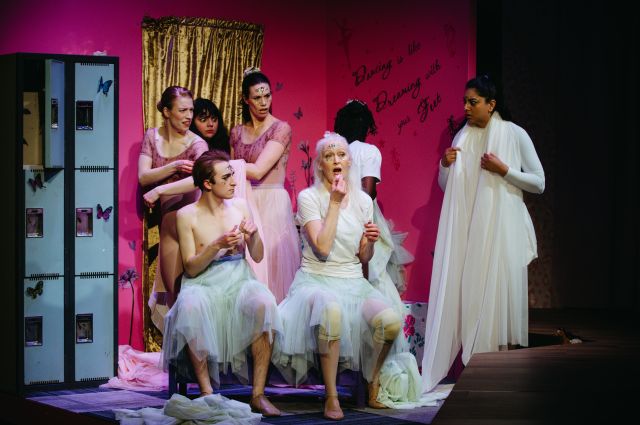
•At the Fringe, Small Matters Production’s The Spinsters, created by Christine Lesiak and Tara Travis, and a whole bunch of brilliant costume designers, returns to the Westbury Theatre, in full ball regalia, Thursday through Saturday. C’mon, haven’t you ever wondered what’s going on with Cinderella’s Ugly Stepsisters? Did they get a bum rap? Check out the 12thnight review from January 2024 here. Tickets: fringetheatre.ca.

Belinda Cornish and Jana O’Connor in Three Ladies. Photo supplied.

•At Rapid Fire Theatre, two of Edmonton’s favourite actor/improvisers, Belinda Cornish and Jana O’Connor have tea together onstage, with a special guest, to trade gossip and discuss … stuff. And they invite a different actor for every performance at RFT’s Exchange Theatre in Strathcona (10437 83rd Ave.). Three Ladies continues Friday and Saturday, then Feb. 21 and 22 at the Exchange. Tickets: rapidfiretheatre.com.

[Blank], U of A Studio theatre. Photo by Brianne Jang, BB Collective Photography

•At the U of A’s Studio Theatre, the 75th anniversary season continues with Jan Selman’s production of the challenging [Blank] by the English writer Alice Birch. The script contains 100 scenes and vignettes, which take us into the lives of women impacted by the criminal justice system. And the director selects from among them, mix and match. It’s at the Timms Centre for the Arts (87th Ave. and 112th St.) through Saturday. Tickets: showpass.com.

Posted in Features | Tagged , , , , , , , , , , , | Comments Off on Hey, wanna see a show? Look at your choices on Edmonton stages this week!

Bummed out in Buffalo: will they? won’t they? The struggles of the blue-collar male in The Full Monty at the Mayfield, a review

The Full Monty, Mayfield Dinner Theatre. Photo by Marc J Chalifoux

By Liz Nicholls, 12thnight.ca

The guys we meet in The Full Monty are up against it.

To help support 12thnight.ca YEG theatre coverage, click here.

They’re unemployed steel workers in rustbelt Buffalo. And, as one points out, in the opening musical number “it’s a long night when you’re scrap…. It’s a slow town when you don’t know where to go.”

Edmonton can surprise you. The Full Monty is, remarkably, the second Broadway musical I’ve seen this past week with a big catchy 11 o’clock anthem called ‘Let It Go’. In Disney’s Frozen, at the Citadel, ‘Let It Go’ is a detachable global hit sung by ice royalty, an exiled queen with a terrible secret power. In The Full Monty, the charmer that’s running at the Mayfield in Kate Ryan’s funny and touching production, ‘Let It Go’ is the grand finale of the guys’ plan, born of blue-collar desperation, to make some much-needed cash … by forming a strip act for a one-night-only stand. Will they … let it (all) go?

Culled from an appealingly low-key 1997 Brit film comedy, the 25-year-old Broadway musical is the creation of all-star American playwright Terrence McNally and composer/lyricist David Yazbek (The Band’s Visit, Dirty Rotten Scoundrels). And it re-locates the cluster of jobless steelworkers — along with their anxiety and depression, their battered self-esteem as men, husbands, fathers, breadwinners — from the north of England to America.

A striking design (by Lieke den Bakker and Ivan Siemens) is on that Atlantic crossing. It locates the characters in a derelict factory of brick, dominated by a big tilted window through which Marr Schuurman’s videos give us glimpses of Buffalo ‘hoods and seasons. Gail Ksionzyk’s lighting, as you will discover later, is an important player, with a coup de thêâtre up its sleeve (OK, it doesn’t have sleeves).     

It need hardly be said that the bummed-out fellas we meet, who self-identify as losers, aren’t obvious candidates for the dud-doffing bare-ass razzmatazz of showbiz. And Robin Calvert’s smartly un-slick choreography is all about figuring out how characters who are unemployed steelworkers not dancers dance if they happen to be in a musical.

The Full Monty, Mayfield Dinner Theatre. Photo by Marc J Chalifoux.

There’s life to consider. The cheers of women, the new breadwinners having a girls’ night out at a Chippendales show, are a revelation to their desperate men. McNally’s script and Yabek’s songs, which range from rock to pop ballads to patter songs, sketch in the details, for some characters more fully than others. And Ryan’s cast fleshes out the individual dimensions (gee, I wish I’d worded that differently).

Anyhow, in order for The Full Monty to take hold of you and charm you, you have to fall a little in love with these these tough/fragile dudes. You have to want these underdog shleppers to triumph, as they struggle and resist the upending of their lives and open another beer in the middle of the day. And you really do, in Ryan’s production.

There are stakes. If Jerry (the engaging Michael Cox), the instigator and stage manager of the bright idea, doesn’t come up with some child-support dough soon, he’ll lose joint custody of his son Nathan (Will Brisbin). Their father-son scenes together are a wry and heart-tugging flip of the father-son dynamic: Jerry as the vulnerable supplicant and his kid as the adult. Both performances are excellent. Cox, possessor of supple musical theatre chops, has a wistfully reflective Yazbek ballad, “Breeze Off The River” (“I never feel like somebody somebody calls a father…”) that’s a highlight.

Jerry’s overweight best friend Dave (the winsome Daniel Williston) is paralyzed by body image, certain he’s seeing the end times for his marriage. Here’s an image that lingers: Dave, anxious about his upcoming debut as a stripper, wraps his midriff in Saran Wrap to lose weight fast. And there he is, sitting on the can tucking into a bag of chips. The power ballad ‘You Rule My World’, that gets passed from man to man, with different resonances, is Dave’s address to his own ample belly.

Michael Cox (centre) and the cast of The Full Monty, Mayfield Theatre. Photo by Marc J Chalifoux.

The Full Monty, as you will suspect if you saw the sleeper hit movie, is its own oddball thing, an original mixture of raucous and melancholy, dark comedy and heart-felt regret. And Ryan’s production, strongly sung, gives full weight to this high-contrast palette; it’s underpinned by affection, not mockery. And it’s reflected in the performances under her direction. The musical’s funniest song is Jerry and Dave’s helpful duet of buddy support, ‘Big-Ass Rock’, on behalf of the sad-sack Malcolm (Ryan Maschke), who’s s trying to off himself at the time.

Let the recruitment for the new strip act Hot Metal begin. The audition scene is a hoot, hilarious and rueful. Gavin Hope as Noah (nickname: Horse) has a showbiz history, a rocking number “Big Black Man,” and a bad hip. Paul Cowling plays the class-conscious factory manager Harold who’s been concealing his own unemployment from an adoring wife (Christine Bandelow) he can’t afford to either support or lose. Cameron Chapman is the aspirational Ethan, who’s “always wanted to be a dancer (pause) but I can’t dance.” His particular endowment wins him an instant spot in Hot Metal. There’s a very funny cameo of a spectacularly inept stripper hopeful (Evan Dowling) wrestled to the ground by his own T-shirt.

Her deadpan comic performance as the jaded, seen-it-all rehearsal pianist, who cracks wise from the keyboard, marks the welcome return to the stage of Maureen Rooney. Her name-dropping song, “things could be better ‘round here,” is a winner.

Performances from the wives and the -ex’s — frustrated, exasperated by the male intransigence to take greeter jobs at Walmart — include stand-outs by Bandelow as the bourgie wife, Autumn-Joy Dames as Dave’s other half, and Rachel Bowron as Jerry’s ‘ex, the one with the child support ultimatum. And there’s a sort of Greek chorus of Furies,   a a gaggle of scornful women, who criss-cross the stage from time to time as a power-walking gag, to terrify the strippers-to-be.

A first-rate band is an expectation at the Mayfield. And it’s fully met in The Full Monty (musical director Jennifer McMillan). The musical values and the sound quality are exemplary.

Which brings us to the big reveal. Will they chicken out? Will they go ‘the full monty’ as they’ve promised their ticket-holders? Will they totally flame out? This is a playful evening, my ticket-holding friends, and I wouldn’t dream of spoiling the fun you’re going to have.

REVIEW

The Full Monty

Theatre: Mayfield Dinner Theatre, 16615 109 Ave.

Created by: David Yazbek (music and lyrics) and Terrence McNally (book)

Directed by: Kate Ryan

Starring: Michael Cox, Daniel Williston, Paul Cowling, Will Brisbin, Rachel Bowron, Autumn-Joy Dames, Ryan Maschke, Gavin Hope, Maureen Rooney, Christine Bandelow, Cameron Chapman, Andrew McAllister, Jahlen Barnes, Devin Alexander, Karina Cox, Even Dowling, Sarah Dowling

Running: through March 30

Tickets: mayfieldtheatre.ca, 780-483-4051

Posted in Reviews | Tagged , , , | Comments Off on Bummed out in Buffalo: will they? won’t they? The struggles of the blue-collar male in The Full Monty at the Mayfield, a review

Two sisters and a snowman: Frozen will thaw your cold cold heart, a review

Chariz Faulmino and Mark Sinongco in Disney’s Frozen: The Broadway Musical, Citadel Theatre and Grand Theatre. Photo by Nanc Price.

By Liz Nicholls, 12thnight.ca

There’s a moment in Disney’s Frozen the Broadway Musical, just before intermission, when you just can’t help cheering the liveness of a musical that challenges itself to bring to the stage one of Disney Corp’s hottest animation properties.

To help support 12thnight.ca YEG theatre coverage, click here.

An ice queen, with formidable secret winterizing powers she can’t control — “conceal it, don’t feel it” — has exiled herself for her country’s good. She plants herself in the gorgeous ice palace she’s built with her super-powers, throws off her indoor royal robes (and her indoor voice). Poof! There she is, in a sparkly white showbiz gown. And as Elsa, Kelly Holiff lets ‘er rip in a killer version of the show’s biggest hit “Let It Go.”

It’s sort of a cold-weather Wicked-style anthem. And it will be reprised late in the show by Elsa’s impulsive little sister Anna, played by the firecracker ice-melter Chariz Faulmino, equally strong of voice.

Frozen, which is all about magical transformations, whole kingdoms at a time, is no pushover for live theatre. For one thing the battalions of adorable little girls, heroine-worshippers in sequinned party dresses (and winter boots) in the Citadel audience on opening night, have expectations. They are ready for enchantment, and they are not to be denied.

Kelly Holiff in Disney’s Frozen: The Broadway Musical, Citadel Theatre and Grand Theatre. Photo by Nanc Price.

The story, which takes Han Christian Andersen’s The Snow Queen far far away from everything but its Scandinavian origins, doesn’t bear close analysis. Just warm your hands on it, and let it go: it’s about salvation by love, sisterly love that rescues a princess who never gets cold from her own unmanageable power to induce hypothermia in others. The bond between Elsa and Anna is severed by safety-conscious parents, who don’t reveal why, but make Elsa wear gloves. The former grows up afraid of human contact; the latter grows up in unexplained solitude.

It’s a narrative with a wild assortment of characters: spirited heroines, a dashing handsome prince with romance on his mind (but wait …), a pompous misogynist of a duke, a really nice guy with a reindeer best friend and a modest career in ice-selling, a snowman with a gift of the gab, dancing fairy-tale trolls with some medical expertise.…

Rachel Peake’s spectacular Citadel/Grand Theatre production of the musical, adapted and musically enhanced by Kristen Anderson-Lopez and Robert Lopez (Avenue Q and The Book of Mormon) from the 2013 Disney animation hit, is theatrically ingenious and fulsome about the visual magic of the story.

Not that Frozen leans into environmental impact, but needless to say we have high standards in blizzards, snowfall and snowpersons in these parts to begin with. Big theatre and its big-budget resources, including a creative team at the top of their game, come into their own in Frozen The Broadway Musical. Since this is live theatre not film, special effects are actually special. Amelia Scott’s projections are dazzling stars of the storytelling, along with Jareth Li’s lighting, that conjure wild storms at sea, the northern lights, spring blizzards, snowy mountain ranges, giant icicles that frame the world, the particular way light filters through gently falling snow….

The projections and lighting have a play-date with Cory Sincennes’ set, a kind of playful pop-up storybook with interlocking set pieces; they slide onstage or arrive from above for form interiors at the Arendelle palace and, in later scenes, ice-bound caverns and wintry peaks.

Nothing much can be done with the hokey operetta-style preamble, the singing, dancing villagers doing the exposition, Ainsley Hillyard’s always inventive choreography notwithstanding. The palace family scenes clunk, too, on the vast Citadel mainstage, despite terrifically charming, confident performances by a couple of young talents with big voices (and careers) ahead: Georgia Kellerman as the young Elsa (who alternates with Elowyn Temme) and Aubrey Malacad (who alternates with Zeia Ayuno) as the young Anna. Their tuneful duet “Do You Want To Build A Snowman,” and lyrics woven with the narrative of the sister separation, is a knock-out.

Frozen the musical is an oddly formed piece, both narratively and musically. Suddenly Elsa and Ayuno (along with Olaf the snowman) will grow up when the score suddenly turns full-fledged pop, an oddball kind of time-travelling. And that’s when Peake’s stagecraft, with its attention to theatrical stylization, to the power of suggestion, to visual coups de théâtre that stick to your retina, comes into its own theatrical coherence.

Warm-hearted Olaf the puppet snowman is an audience favourite, not least because we fully see the puppeteer (Izad Etemadi) who manipulates him and sings a lovely ode to summer. In his warm weather fixation Olaf sets a standard in personal sacrifice that puts Frosty to shame. Sven the winsome pantomime reindeer (Richard Lee Hsi) dances in a spirited way that captivates us, along with his sweet sidekick Kristoff (Mark Sinongco), not least because we know there’s a human actor under those antlers. Theatrical expertise is why, in an elaborate production, an arduous mountain-climbing scene — as Anna desperately looks for her sister, and has a fine duet with Kristoff (“What Do You Know About Love?”) — needs only a rope and cool lighting to establish itself.  This is a production that’s smart about when to say when.   

Frozen has a major asset in Hillyard, one of the most theatrically savvy choreographers around. And the comically bonkers drinking scene in which a whole Scandinavian dance troupe, semi-clothed, emerges from a sauna in a conga line, with branches, shows off her powers of invention. The costumes by designer Sincennes, dozens and dozens of them, fairy tale suits and peasant dresses, velvet frocks, troll pants, sequinned showbiz outfits, are always fun to look at.      

Peake’s production does the Anderson-Lopez and Lopez score (much expanded from the movie) proud, with a cast of strong singers and an excellent band led by music director Steven Greenfield. Holiff, who has a silky lyrical range and a belt voice that could knock out the power in Greenland, is everything you might want in an Elsa, including a brooding sense of inner conflict. And as a hyperactively perky little sister who’s spent way too much time alone, as she says, and is desperate for attention, Faulmino nails Anna, too. The meet-cute scene in which Anna tries too hard with Hans (Aran Wilson-McAnally), the 13th son in line for the throne of the Southern Isles, who tries too hard, too (they share a duet “Love Is An Open Door”) is amusing and charming.

But it’s the sister relationship — two sisters lonely for different reasons, one who takes charge of saving the other from herself — that’s the beating heart of Frozen. And it will thaw yours.

REVIEW

Disney’s Frozen The Broadway Musical

Theatre: Citadel Theatre and Grand Theatre (London, Ont.)

Created by: Kristen Anderson-Lopez and Robert Lopez (music and lyrics) and Jennifer Lee (book)

Directed by: Rachel Peake

Starring: Kelly Holiff, Charliz Faulmino, Mark Sinongco, Aran Wilson-McAnally, Richard Lee Hsi, Andrew Cownden, Izad Etemadi, Georgia Kellerman, Aubrey Malacad, Elowyn Temme, Zeia Ayuno, Vance Avery, Sam Boucher, Andy Cohen, Jennifer Harding, Andrew MacDonald-Smith, Julia Pulo, Tahirih Vejdani, Stephanie Wolfe

Running: through March 2

Tickets: 780-425-1820, citadeltheatre.com

Posted in Reviews | Tagged , , , , | Comments Off on Two sisters and a snowman: Frozen will thaw your cold cold heart, a review

Is theatre itself a form of hypnosis? An Oak Tree at Theatre Yes, a review

Max Rubin in An Oak Tree, Theatre Yes. Photo supplied.

By Liz Nicholls, 12thnight.ca

At the Aviary, a little performance space off the beaten track that’s nobody’s idea of a conventional theatre (except there’s a bar), something weird is happening. It’s magic and you have to be there to experience it.

To help support 12thnight.ca YEG theatre coverage, click here.

An Oak Tree, the latest from Theatre Yes, messes with your mind. You try to wrap your brain around it, good luck with that, and it slips out of those coils and grabs at your heart instead with questions about grief. That it does this right before your very eyes, with no pretence at concealment, says something about theatre itself — the transformation of actors into characters and a script into emotion. It’s a demo of the power of suggestion that goes beyond the temporary suspension of disbelief into questions that take the old arts/life mutual dependency for a spin. I’ve seen An Oak Tree before, on a trip to the Edinburgh Fringe long ago. And I can’t quite shake it.    

An Oak Tree is, in effect, a test case for transformation and belief. The fascinating artifice of the 2004 play by the English theatre experimenter Tim Crouch is named after Michael Craig-Martin’s installation now in the National Gallery of Australia: a glass of water on a glass shelf, entitled “An Oak Tree.”

In the two-hander directed by Ruth Alexander, Max Rubin, who’s usually Theatre Yes’s resident director, is onstage in a sequinned showbiz vest, as a hypnotist. And opposite him is an actor — a different one every night — who has never before seen the play or the script. The showbiz hypnotist Rubin plays, who has an addled huckster vibe about him, has accidentally killed a 12-year-old girl in his car some months before. And the actor, the terrific Belinda Cornish on opening night, plays the bereaved father of the girl, who shows up one night at the hypnotist’s show and volunteers for the act. This requires a dramatic transformation in itself since Andy is a 46-year-old man with (we’re told) muddy shoes and grey hair.

The dynamic is unsettling: is the father looking for … confrontation? closure? confession of guilt? We don’t know yet. And what’s more we don’t know if the hypnotist knows yet.

Over and over, we are reminded, explicitly, that we are watching a play. It’s like taking the splintered shards of the so-called ‘fourth wall’ and juggling them to see what shape they take. Rubin keeps stepping outside his role as the hypnotist to be Rubin the actor in scenes with Cornish, or Rubin the stage manager giving directions, or feeding lines, to Cornish the actor playing Andy the grieving father, hypnotized into playing other characters. Did you follow that? I just re-read that last sentence, and I think I may need professional help or a rest cure in a sensory deprivation tank. “Say yes,” and Cornish does. “Please put the headphones on,” and Cornish does.

Sometimes the two pass the script between them, on a whispered cue or inaudible headphone instruction. Sometimes there’s a narrator: “the house began to fill with grief.” Sometimes the hypnotist is the grieving father’s desperate wife; sometimes Andy is the wife or the little girl. Sometimes the hypnotist and the father are talking to each other; sometimes one is directing the other (sotto voce, perhaps a little too sotto, on opening night); sometimes each is talking to the audience. “These are the last speeches of the play,” says the actor playing the hypnotist, introducing … the last speeches of the play.

The layers of sound, which escalate from whispers to mic’ed hucksterism, velvety hypnotist cues to a blast of Carmina Burana in Alexander’s production, are an invitation into the playbook of theatre, how the magic is created. That An Oak Tree does this while still asking the audience to believe in the magic is audacious, for sure, even brazen. That it’s moving, too, is unexpected.

An Oak Tree is a veritable fun house of mirrors. The strange audacity of it is there right from the start when the hypnotist says “I will never lie to you.” Which is of course a lie. He’s already lied about the “volunteers.” What’s amazing is our escalating emotional investment, amid the constant transformations of the characters, in the question of what on earth you do with a huge, unwieldy, intractable grief. Or guilt of roughly the same size. Is there an exit from the house of mirrors? Can a child be an oak tree?

Theatre says yes, and yes, according to An Oak Tree. Maybe theatre itself is a form of hypnosis. We can look at the tree and see a tree and a child, simultaneously. It’s a puzzle, this theatre magic. As the hypnotist says, in his introduction, “welcome to my hypnotic world. Give me a piece of your mind.”

Do that and you will be intrigued. Your mind will be bent a bit out of shape (for an indeterminate length of time, I’m finding). And, despite everything, your heart will be touched. Weird and wonderful.

REVIEW

An Oak Tree

Theatre: Theatre Yes

Written by: Tim Crouch

Directed by: Ruth Alexander

Starring: Max Rubin, with (in successive performances) Belinda Cornish, Mark Meer, Luc Tellier, Patricia Zentilli, Patricia Darbasie, Dayna Lea Hoffmann, Oscar Derkx, Nikki Hulowski

Where: The Aviary, 9314  111 Ave.

Running: through Feb. 12

Tickets: theatreyes.com


Posted in Reviews | Tagged , , , | Comments Off on Is theatre itself a form of hypnosis? An Oak Tree at Theatre Yes, a review

A big week at the Mayfield: The Full Monty, a new artistic director, a new season

The Full Monty, Mayfield Dinner Theatre. Poster image supplied.

By Liz Nicholls, 12thnight.ca

Kick off your Sunday shoes. It’s a big week at the Mayfield.

To help support 12thnight.ca YEG theatre coverage, click here.

For one thing, the theatre’s 50th anniversary season continues with a Broadway musical hit, blue of collar, warm of heart. The Full Monty, opening Friday with the largest cast (17 actors) of the season, is a classic underdog triumph story: a group of unemployed steelworkers in Buffalo take charge of their failing fortunes and dwindling self-esteem — by creating a strip act. It’s the first show that musical theatre veteran Kate Ryan, whose Mayfield experiences date back 35 years, directs in her new gig as the theatre’s interim artistic director. And it was last staged at the Mayfield 17 years ago by Ryan’s father Tim Ryan.

For another, Ryan announced the lineup of shows she’s picked for the  upcoming 2025-2026 Mayfield season. As befits a theatre company that, as Ryan says, prides itself on “great music and high-quality musical experiences,” — a focus she intends to continue — it includes a much-requested classic Broadway musical with the catchiest of songs, a rockin’ holiday compilation show, a celebration of a seminal musical artist. And the season finale, in the summer of 2026, is a Canadian comedy with a quintessentially Canuck setting, a curling rink.

The whole point of Footloose, the celebratory 1998 Broadway musical based on the 1984 movie, is song and dance, a perennial Mayfield mantra. “High energy, contagious music — the tunes are visceral! — and such a relatable story,” says Ryan, who has taken her cue on all of the above from the production of Grease she directed a season ago, “one of the Mayfield’s highest grossing shows ever.”

Dean Pritchard, of Fame fame is the writer. And Footloose, as Ryan describes, is “smart, funny, with a score that combines top-40 hits (like Holding Out For A Hero) and original music (by Tom Snow, Kenny Loggins and others). “The story of the city kid who moves to a small town and fights for the right to dance  — how timely is that? — is all about how music can bring communities together.” The Mayfield production runs April 14 to June 14.

The season opens in the fall (Sept. 2 to Nov. 2) with Dean Elliott’s much-travelled The Simon & Garfunkel Story, which tells the story of the world’s most successful musical duo with the distinctive sound — formerly ‘Tom and Gerry’ when they were in high school in New York City. “Much more than a tribute show,” as Ryan describes, the production includes video design, old photos, and film footage, not to mention a full live band. And the hit-studded song list — Mrs. Robinson, The Sound of Silence, Bridge Over Troubled Water, Cecilia — is one that, as she puts it, connects you to your memories, “songs that really influenced, and moved, us.” Brit-based Elliott himself, who starred in Buddy: The Buddy Holly Story when it played the Mayfield, comes to direct the show.

The holiday show, the longest-running show of the season and traditionally a Mayfield audience fave, is devoted to the ‘90s  — its music, its aesthetic, its cultural trends. The ‘90s! It’s All Coming Back To Me Now (Nov. 11, 2025 to Jan. 25, 2026) is written and curated by the husband-and-wife team of Kevin Dabbs  and Christine Bandelow, the former an actor/musician himself and the latter an actor/choreographer of note who have extensive Mayfield experience on their resumés.

They mine the decade of the Spice Girls and the Backstreet Boys, Céline Dion, the Tragically Hip, Sheryl Crow, Bryan Adams, Alanis, Shania…. for this new show. The co-creators have a lot to work with. “Music videos were the new ‘90s trend,” as Ryan says. “What effect did they have? And hit songs in films?”

Following upon the huge response to last season’s One Night With The King, starring Matt Cage as Elvis, Dabbs and Bandelow have have created a new show for the multi-talented tribute artist/actor. One Night With Roy Orbison (Feb. 3 to April 5, 2026), starring Cage, is designed to celebrate the work of the influential musical artist with the unmistakeable voice, and showcase his musical journey from his rock and roll beginnings in the 50s to the 60s hits like Pretty Woman, Blue Bayou, and Only the Lonely, including his participation in the super-star fantasy band The Travelling Wilburys and his celebrated duet Crying with k.d. lang.

Hurry Hard, the season finale, Jun 23 to July 26, 2026, takes us to a curling rink and the long-standing friction between the men’s and the women’s team at the Stayner Curling Club. When a crisis occurs, only burying the hatchet and coming together as one team will secure the trophy at the bonspiel. “Smart fun writing and great characters,” says Ryan, who “laughed aloud” when she read the five-actor comedy by the Ontario-based Canadian actor/playwright Kristen Da Silva. “I enjoyed her skill as a writer, her fast-paced wit and relatable characters. She puts them in high-stress situations and lets them muddle in the mud…. She allows us to laugh at challenging life circumstances.”

Although she’s both directed and acted at the Mayfield since 1991, the artistic directorship of a commercial company in a hotel, in a big theatre with a tricky stage, and dinner!, has been a learning curve, says Ryan, the founding artistic director of the indie musical theatre company Plain Jane. Because the “entertainment experience” at the Mayfield includes dinner, the audience tends to lean back from the show, not into it, she’s found. “And you don’t want to push with a (straight) play.” So for last last summer’s popular Mayfield production of On Golden Pond, experimenting with mic-ing the actors created greater intimacy, and “made for more nuanced moments.”    

Season 50 continues with The Full Monty (through March 30), Jersey Boys, another blue-collar Broadway hit, April 8 to June 8, and a summer show, the perennial solo fave Shirley Valentine June 17 to July 20. Meanwhile, Meanwhile, Ryan is immersed in The Full Monty, music and lyrics by David Yazbek (Dirty Rotten Scoundrels, The Band’s Visit, Women On The Verge Of A Nervous Breakdown) and book by the star American playwright Terrence McNally. “The scenes aren’t numbered in the script,” Ryan says. “It’s the wildest thing, so filmic; it flows from one to the next as ‘transitions’…. We’ve created a template, our own little scene breakdowns.”

“I love the characters. They’re lovable jerks and we lean into their flaws,” she says happily.

Tickets and 2025-2026 season subscriptions: 780-483-4051, mayfieldtheatre.ca.

Posted in Features, Previews | Tagged , , , | Comments Off on A big week at the Mayfield: The Full Monty, a new artistic director, a new season

Straddling cultures on an adventure in Chinatown: Barbara Mah directs King of the Yees at Walterdale

Ruth Wong-Miller meets Waymun the Lion in King of the Yees, Walterdale Theatre. Photo by Scott Henderson, Henderson Images

By Liz Nicholls, 12thnight.ca

When director Barbara Mah discovered King of the Yees, she knew she’d found a soul-mate of a play. An alignment of the stars perhaps?

To help support 12thnight.ca YEG theatre coverage, click here.

The Walterdale community theatre production that opens Wednesday is the result of this match-making between a director and a writer who share “the lived experience of being born in North America to Chinese parents.”

“She calls it the most autobiographical of her plays,” says Mah of Lauren Yee (Cambodian Rock Band), who’s a writer character in her own comedy, at a play reading in the first scene. Her 2017 play is about “trying to bridge the communication and culture gap between herself, very much a modern American living in San Francisco, and her dad, who was raised in Chinatown.”

“There are plenty of plays about newcomers and the immigrant experience,” says Mah. “Not so many about people born to immigrant parents and having to straddle both cultures.”

The story of King of the Yees is set at the time of the California State Senate race of 2015, when the real-life Senator Leland Yee was found guilty of corruption “and the Lee name went to pot,” as Mah puts it. “Lauren’s father disappears into Chinatown to try to restore the dignity of the name, and Lauren tries to find him….” Her quest “turns out to be a fantastical adventure where she has to negotiate all the things she pooh-poohed earlier, in order to ask questions and get help to find her father.”

Ruth Wong-Miller and Stan Woo in King of the Yees, Walterdale Theatre. Photo by Scott Henderson, Henderson Images.

“It’s all about a father (Stan Woo) and a daughter (Ruth Wong-Miller) coming to the point of understanding where each comes from. And Lauren gains a greater appreciation of her heritage and how it relates to her modern life.”   

As Mah describes, “the play takes place in the Yee Family Association. “The Yees, the Wongs, and the Mahs, have ‘family associations’ which arose out of necessity due to racist policies of the time built into the Canadian Immigration Act, and in the U.S. the Chinese Exclusion Act.”

Tim Lo (centre, as Model Ancestor), Grace Li, Ivy Poon in King of the Yees, Walterdale Theatre. Photo by Scott Henderson, Henderson Images

It all rings a bell with her, says Mah, Walterdale’s artistic director. She’s the daughter of Chinese immigrants who arrived here as part of a wave of Chinese newcomers in the late 50s at the time of the Communist takeover, when exclusionary legislation in North America was lifted. “I was born in 1961, and I’m among the oldest of the first generation of Chinese Canadians….”

Her grandfather Henry Mah, who owned a grocery story in Chinatown, was a founder of the Mah Family Association in Edmonton. And her dad assisted him. More recently, some of the younger Mahs here got a grant to research family history, “and put together a  timeline and a fascinating exhibit of the Edmonton Mahs, The Journey of the Horse (Mah is ‘horse’ in Chinese). “They interviewed surviving elders late in 2022, including my dad (now, alas, deceased) and my aunt. I was present during the interviews and heard stories I’d never heard…. Part of the culture is not showing the bad things,” she laughs.

‘The Journey of the Horse’ exhibit is on the walls of the Mah Family Society in Chinatown. As Mah explains, the ‘family societies’ became basically drop-in social clubs. “To this day every other Friday they give free pay-what-you-can mahjong lessons, as part of Chinatown revitalization.”

In their time “the family societies helped people come over here…. If you didn’t need your legal papers, because you weren’t planning to emigrate, you sold them to other who needed them.” And you took whatever name was on paper. Mah’s dad, a civil engineer for the Alberta government till he retired, was a so-called “paper son’. When the Canadian government granted amnesty to ‘paper sons’, says Mah, “no one took them up on it…. The Chinese immigrants had made themselves at home. They were successful. They’d fit into Canadian society and I don’t think they wanted to rock the boat.”

Mah herself  “didn’t learn English (her parents spoke Toisanese) till I got dumped into a kindergarten.” But she didn’t grow up in Chinatown. “We moved to an upper middle-class white neighbourhood when I started school,” she says. “And until I was in high school, my sisters and I were the only Asian people in our school, until the ‘boat people’ started coming over.”

Piano and ballet lessons “were the done thing” for white kids in that milieu. “So I got sent to them,” says Mah, who has both a biology degree and a business degree. Much to the dismay of her parents, “the dance classes really took, and I ended up in university touring with a musical theatre dance troupe.” Parental dreams of a Dr. Mah in the family ended there. “It’s touched on tangentially in the play,” says Mah of the playwright, who went to Yale theatre school and married a white man.

Mah has assembled an all-Asian cast for the Walterdale production, including nine Chinese actors and one Filipino, and the stage manager is Asian, too. “Some were born here, one is a recent immigrant to Canada. And it was interesting to share with people how much this play reflects their experience,” says Mah of rehearsals. “It’s fun working with actors who have backgrounds similar to yours. And lived experience enriches their characters onstage. Five or six in the cast work regularly in theatre; for the other half of the cast King of the Yees is their first time onstage. And they’re having a riot…. It’s a wonderful thing that Walterdale is a teaching theatre.”

Erhu player Ivy Poon, King of the Yees, Walterdale Theatre. Photo by Scott Henderson, Henderson Images.

In the course of Lauren’s trip through a “heightened version of Chinatown” she meets a ‘lion dancer’. “So we sent our actors to a lion dance studio, the Hung Mon Athletic Club, to get authentic training. And the club did our choreography for us. There’s an erhu player in the show, too. And the violinist in the cast has been taking up the challenge of that Chinese instrument, a challenging cross between the violin and the bass.     

Above all, says Mah, King of the Yees is a comedy. Stereotypes come under comic attack. “The playwright pokes real fun at the perception North Americans have of Asian and Chinese people.” She points to a scene where “two Chinese actors are rehearsing, trying to teach other other how to do a Chinese accent.” Or a scene in which the FBI is looking for a gangster, “and someone says it doesn’t matter who they catch: we all look alike to them.” Stage directions indicate that Model Ancestor “appears by way of RuPaul.” Says Mah, “our actor (Tim Lo) has been having so much fun chewing the scenery!”

Most of all “it’s a comedy about miscommunication,” says Mah, to be enjoyed by “anyone who’s had parents,  ever. Very funny, heart-warming in places. The audience will have a good time!”

PREVIEW

King of the Yees

Theatre: Walterdale

Written by: Lauren Yee

Directed by: Barbara Mah

Starring: Andrew Kwan, Kingsley Leung, Ruth Wong-Miller, Tim Lo, Ivy Poon, Stanley Woo, Rupert Gomez, Tsz Him Hymns Chu, Grace Li, Helen Massini

Running: Feb. 5 through 15

Tickets: walterdaletheatre.com

Posted in Previews | Tagged , , , , | Comments Off on Straddling cultures on an adventure in Chinatown: Barbara Mah directs King of the Yees at Walterdale

War as the human constant through time: After The Trojan Women, a review

Autumn Strom, Tatiana Duque, Jasmine Hopfe in After The Trojan Women, Common Ground Arts Society. Photo by Brianne Jang, BB Collective Photography

By Liz Nicholls, 12thnight.ca

The centrepiece of the stage is a gory altarpiece that looks a red tree upended, or maybe a giant artery wrenched out by its roots.

To help support 12thnight.ca YEG theatre coverage, click here.

Alison Yanota’s striking design for After The Trojan Women cuts to the heart of the matter, literally and figuratively. There’s never a wrap on war; there’s never a war to end all wars, as the world  continues to demonstrate.  And women have never stopped paying a heavy price — in grief and suffering and loss, as displaced survivors. “The men are back in the dark earth, the women remain.”   

From the eternal topicality of Euripides’ great anti-war play The Trojan Women — performed first in 415 BEC in the aftermath of the Trojan War and adapted ever since — a pair of contemporary playwrights, Amena Shehab and Joanna Blundell, have taken their cue.

In their ambitious new play, After The Trojan Women, produced by Common Ground Arts Society, they find a continuity across time in the plight of women wrenched from their home by non-stop wars in the Middle East. Three contemporary Syrian women and three women of ancient Troy find themselves on the same shore, looking across towards Greece, destiny or fate depending on how you figure it.

The former are fleeing the upending violence and lethal chaos of their homeland, and stopped by the sea mid-narrative. The latter — Hecuba, her problematic seer daughter Cassandra, her daughter-in-law Andromache — are victims on the losing side of the Trojan War, soon to shipped off to slavery in Greece as the commodities, the spoils of war. Separated by thousands of years they may be, but both trios are mourning the human cost of war, the loss of husbands, children, home, prospects, hope.

There’s no shortage of adaptations of The Trojan Women, which hits home in every age. After The Trojan Women, though, is unusual in that it throws women of ancient Troy and contemporary Syrian women actually together on the stage, in conversation, in a liminal space, so they can compare notes, so to speak.

It’s a vivid theatrical idea, visually and verbally, but one that seems to require more than a little exposition, in two cadences of language that slide into each other. Bold, yes, and a context for remarkable gut-wrenching real-life stories from modern Syrian women. But straddling classical tragedy this way by counterpoint is all a bit beyond the dramatic resources and weight of the production directed by Liz Hobbs.

Tatiana Duque, Julia van Dam, Monica Gate in After the Trojan Women, Common Ground Arts Society. Photo by Brianne Jang, BB Collective Photography

“We’re all in this together” doesn’t seem to quite rise to the occasion that’s been set up. The Syrians are only mildly surprised to be sharing a beach with Hecuba and Cassandra, and vice versa. But in addition to their annotations — “war brings nothing but mindless pitiless violence” — the Trojans have to explain to their modern sisters, and us, who they are and what their terrible prospects are, for one thing. There are periodic invocations by a moon goddess (impressively delivered by Tatiana Duque); there are moments where a sort of Chorus forms, to comment. As proposed by the goddess, the search for a happy story is pretty much doomed in this female company. “A happy story? Seriously?!” as one of the Syrian characters says.

It feels like a lengthy process, where repetition is the point. And, as it unrolls onstage, you can’t help longing for more about the haunting, and horrifying, stories of individual Syrian women, and less time spent on establishing the classical framework.

In any case, a cast of nine, variable in experience, do really commit to the show. And there are stand-out individual performances, Annette Loiselle’s for one, as Hecuba, a queenly mother figure whose family has been decimated by war. Kristi Hansen plays a hard-edged, sardonic female prison guard, a fascinating character who stands her ground when attacked by her Syrian sisters and crumbles when the truth about her fiancé is revealed. When she says “wanna hear a story?” we do … hers. And it’s a startling one.

After The Trojan Women, Common Ground Arts Society. Photo by Brianne Jang, BB Collective Photography.

Michelle Todd as a fierce, grieving mother, and Monica Gate as a mother whose daughter has vanished in a checkpoint incident create characters whose stories do eventually land, in the midst of the rather cumbersome theatrical complications.

All the characters get big moments, but their impact is reduced by scenes that seem to be there to re-establish what we already understand about the insight that war never goes away and what was true in 415 BEC remains tragically current now.  “We tried to escape war, and we ended up in another one,” says Huriya (Todd).

Yanota’s lighting against a backdrop of translucent plastic drapery captures a disturbing sense of elusive reality — internal organs in motion? — behind the scenes. Rebecca Cypher’s costumes and Ashley Weckesser’s sound score are there to reinforce the sense of time as an echo chamber where time gathers but doesn’t move forward.

The stories of survival against the odds, and unthinkable human losses suffered by women: these are the worthy heart of After The Trojan Women. “I never wanted to leave home,” says one of the Syrian characters. And look what happened. This is a country populated by immigrants and refugees who know something about the world that we should need to know. “Ordinary life is a privilege.”

REVIEW

After The Trojan Women

Theatre: Common Ground Arts Society

Written by: Amena Shehab and Joanna Blundell

Directed by: Liz Hobbs

Starring: Tatiana Duque, Michelle Todd, Monica Gate, Kristi Hansen, Annette Loiselle, Julia van Dam, Stephanie Bessala, Autumn Strom, Jasmine Hopfe

Where: Backstage Theatre, Fringe Arts Barns, 10330 84 Ave.

Running: through Feb. 8

Tickets: tickets.fringetheatre.ca

12thnight talked to co-playwright Amena Shehab, a refugee herself, in this preview. 

Posted in Reviews | Tagged , , , , | Comments Off on War as the human constant through time: After The Trojan Women, a review

We’ve lost a remarkable theatre artist: a tribute to the late great John Wright

John Wright and Marianne Copithorne in Jim Guedo’s Phoenix Theatre producion of A Lie of the Mind, 1987. Photo by Ed Ellis.

By Liz Nicholls, 12thnight.ca

With the passing of John Wright last weekend, far too soon at 74, the Canadian theatre and its audiences have lost not only a superb artist and mentor but an engaging, authentic, real-life character with a uniquely magnetic presence off the stage too. Edmonton theatre has been the particular beneficiary of his multiple gifts.

To help support 12thnight.ca YEG theatre coverage, click here.

At last Sunday’s sad news, a strange and wonderful reaction started happening on Facebook. FB erupted with tributes to a formidable talent lost, of course. And these were accompanied by a virtual gallery of re-posts by the recipients of the beautiful, personalized digital birthday cards, with portraits, specially designed by Wright for the members of his beloved theatre ‘family’. As his health declined in the last few years and he retired from the stage, Wright, who’d taken up photography in a very creative way, fashioned individual pieces of art for his fellow artists and theatre lovers. And there’s something very Wright-like in that sharing.

The theatre community is saluting, in an outpouring of admiration, the electric connection Wright always made onstage with audiences, in a wide range of roles, the classics to contemporary theatre, Scrooge to Lear, low-life hitmen to unravelling kings, booze-soaked patriarchs to preening aristocrats to washed-up poets. And they’re remembering the offstage Wright with great affection: the wicked sense of humour, the signature combination of crusty on the surface — he was the reigning monarch of the withering observation about the state of the culture, politics, the theatre industry — kind and sweetly thoughtful within.

John Wright as Macbeth, Freewill Shakespeare Festival 1999. Photo by Ryan Parker

That warm embrace is why summer Shakespeare cast parties invariably happened in his garden, a kind of Midsummer Night’s Dream nature walk in itself, that Wright created behind the Westmount house where he lived with his theatre star wife Marianne Copithorne and an assortment of dogs.

Wright’s curmudgeon carapace was droll, witty, at times daunting to the uninitiated (but not when you’d spent any time with him). ”I’m remembering the crusty guy, the gruff guy, whom no one was ever afraid of,” says John Ullyatt, who’s shared many a stage and a green room with Wright. “I’m remembering that same guy who giggled, sometimes at his own jokes, often with shared silliness.”

“He was such a titan,” says actor/director/playwright Belinda Cornish. “A simply magnificent actor and a hell of an inspiration, and, beneath his determinedly curmudgeonly exterior, just the kindest, warmest man. He was a no-bullshit kind of fellow, in the very best possible way.”

“His crusty exterior shrouded the most beautiful heart,” says James MacDonald, the first Freewill Shakespeare Festival artistic director and both a Wright director and cast-mate. “He cared so deeply for the theatre, for his fellow artists, for his friends, for the work, and for the audience. He was the most generous, honest, and soulful scene partner…. John Wright is the person who taught me to direct.”

The current Freewill artistic director Dave Horak echoes the thought. “John was indeed a bit terrifying, at first. He certainly played many characters that had a certain dark and ‘masculine’ energy. And yet once you pierced the exterior you found a real sweetie.”

The last of a distinguished Canadian theatre family that included his three sisters, Susan, Janet, and Anne, Wright came to Edmonton from his home town of Saskatoon. He’d been here before, touring with the Citadel On Wheels during the John Neville years in the 1970s (and had a supply of funny touring stories).

It was director Jim Guedo, a Wright friend and colleague of 48 years standing, who brought his fellow Saskatchewanian (along with Wright’s sister Susan) here in 1987 for his inaugural production as the new artistic director of Phoenix Theatre: Sam Shepard’s A Lie of the Mind. The Phoenix repertoire leaned into the new, the raw-edged, the contemporary. It suited Wright’s particularly earthy, grounded intensity, and his go-for-the-gusto rapport with gritty dark comedy. And best actor Sterling Awards for such productions as Road and Sight Unseen would follow.

“The first show I saw John in was Persephone Theatre’s Cruel Tears in 1975,” says Guedo.” The premiere and cross-country tour of Ken Mitchell’s country/folk/trucker version of Othello, a Canadian theatre landmark as it turned out, was a Wright family affair; “John shared the stage with sisters Janet and Anne.”

“Arriving at the University of Saskatchewan in 1977,” says Guedo, “I watched from the wings and booth to see him play Alan Strang, the young boy in Equus. He directed me a year later in Play It Again Sam for our U of summer stock….” Their theatre history together includes eight shows in which they acted together, “and I directed him in 18, as well as designing five shows he appeared in.” Together Guedo and Wright did Shakespeare, Pinter, Mamet, and Shepard in Saskatoon.

And then came Edmonton. A Lie of the Mind at Phoenix was momentous for Edmonton theatre in more ways than one. It’s where Wright met and fell in love with Marianne Copithorne, the actor (then director, then artistic director of the Freewill Shakespeare Festival) who would become his wife. And Edmonton theatre would turn on its axis.

“John came back a season later to do Being At Home With Claude and Hurlyburly” at Phoenix, says Guedo, now a theatre prof at MacEwan University and artistic director of the indie company Wild Side Productions. “He stayed on in Edmonton, and the rest is Edmonton theatre history.”

John Wright, Shaoon Larson, Paul Morgan Donald, Daniel Arnold, John Kirkpatrick in Much Ado About Nothing, Freewill Shakespeare Festival 2000. Photo supplied.

That history would soon include Wright appearances at every company in town, including many at the Citadel — and notable summer excursions into the great outdoors in Freewill Shakespeare Festival productions where you can look characters in the eye in broad daylight. Which suited Wright just fine.

John Wright and Belinda Cornish in The Merchant of Venice, 2017. Photo by Ryan Parker.

Belinda Cornish remembers the experience of co-starring with Wright in Copithorne’s Freewill Shakespeare Festival production of Titus Andronicus in 2009. The weather, the ultra-violent play, the role, the whole thing was a bit overwhelming as she found one day in rehearsal. And she disappeared into the loo for a cry. When she emerged, Cornish recalls, “John looked at me with gruff concern and asked if something had happened. I told him I was fine, it had all just been a bit much. He nodded kindly, and said, ‘Yep, sometimes you just need to go and cry it all out’. Then he briskly patted my shoulder and said ‘just don’t do it on stage’. Fine advice from one of the finest, most generous, funniest and most deeply loved actors I have ever had the privilege to work with.”

John Wright and Ron Pederson in The Merry Wives of Windsor, Freewill Shakespeare Festival. Photo by Ryan Parker.

Ron Pederson says “I was in awe of John when I first saw him in those amazing Jim Guedo productions at the Phoenix…. He had an intimidating cool and intensity, and I was so nervous working with him the first time,” which happened at Workshop West in Marty Chan’s (spiky political satire) The Old Boys’ Club. “John had to strangle my weasley character to death at the end of Act 1. And the twinkle in his eye I’ll never forget.”

“He was a fun and sardonic curmudgeon backstage and (talking) about the business, but when he played he was mischievous and full of joy.”

Marianne Copithorne and John Wright in Macbeth, Freewill Shakespeare Festival. Photo supplied.

Wright seemed to have a natural rapport with Shakespeare, witness his original performances in big roles — Macbeth, Titus Andronicus, Claudius the murderous usurper in Hamlet, Prospero in The Tempest, Shylock (twice) in The Merchant of Venice, Leontes the king undone by jealousy in The Winter’s Tale … “and all the dukes over the years,” as Ullyatt says.

Was it his natural, always intelligible, way with iambic pentameter? Was it his complete commitment to character? The sense that he conveyed of thinking on his feet in the immediate present?

All of the above. “I’m remembering John’s style of acting,” says Ullyatt. “He was never bombastic or overly musical; he didn’t push. It seemed effortless, but somehow you got every word that he said, every meaning. He understood it and felt it and shared it….”

Dave Horak and John Wright in King Lear, Freewill Shakespeare Festival 2013. Photo supplied

Horak, who played the Fool to Wright’s Lear (directed by Guedo) in his first Freewill show in 2013, was “fascinated with John’s ability to really pull that Shakespearean text ‘off the page’. He excelled at thinking through the words and you really believed he was making it up in the moment. There were times onstage when I forgot we were ‘acting’ and he forced me to really listen to him. He was unpredictable … totally committed to being completely present.”

Annette Loiselle and John Wright, Twelfth Night, Freewill Shakespeare Festival 1997. Photo supplied

“I know he sometimes suffered from stage fright and so I think it took a lot out of him to be onstage,” Horak says. “And I think he made a decision that if he was going to be there, it had better matter.” Ullyatt has a similar thought: Wright as “someone who, as mighty as he could be onstage, also seemed fragile of heart and soul.”

The great fight choreographer and director J.P. Fournier found himself unfailingly impressed by the actor’s charisma. As Burgoyne, the witty British general in Fournier’s U of A production of Shaw’s The Devil’s Disciple, “John would come on in the last 20 minutes, and he walked away with the show every night! In that, and so many productions, you couldn’t take your eyes off him” says Fournier. “You couldn’t not watch him! A fabulous actor.”

John Wright as Propero in The Tempest, Freewill Shakespeare Festival 2002. Photo supplied.

“Whenever he was onstage, I was hooked. Every time…. He never ‘acted’. He was SO in the moment.” And Wright was a great asset to the young actors of the company. “His suggestions were so casual, so full of depth.”

You had to love an artist whose outrage at the state of the world didn’t peter out. Wright devoted energy to exasperation, as well I know. In the last 38 years how many times did I hear him say, after a show or over an occasional barbecue in his magical garden, that he’d had it with theatre and the lack of real support from the culture? A dozen times? He didn’t need theatre, he’d done his last show, and he was thinking of retiring, going back into the family electrical business in Saskatoon to make a proper living instead. We were all so lucky for a long time that he didn’t actually do it.

As MacDonald says, “John and Marianne were such leaders together in our community…. We will truly never see his like again.”

A GoFundMe has been created to support John Wright’s wife Marianne Copithorne: https://tinyurl.com/499dbpe8.


Posted in Features | Tagged , , , , , , | Comments Off on We’ve lost a remarkable theatre artist: a tribute to the late great John Wright