The scary funhouse of memory and identity: Fetch, a Fringe review

Fetch (Stage 5, Acacia Hall)

By Liz Nicholls, 12thnight.ca

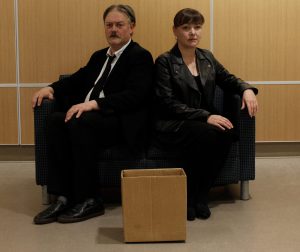
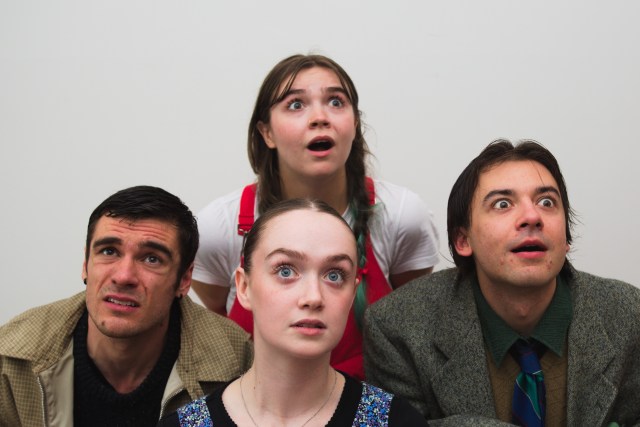
Two women, in identical dresses, stand before us with identical cardboard boxes in this unnerving, tightly wound little 2018 thriller by the Edmonton playwright Cat Walsh, whose muse runs to dark unnerving comedy.

They are both Hannah Morgan. And both Hannah Morgans (Abby Krushel and Shyanne Duquette) have a lot to say, about their family, and their last-ever family vacation to a Florida theme park. Are they mirror images? Alternate versions of Hannah Morgan? Alter-egos? In alternate realities? And what, exactly, is hidden in the box?

To help support 12thnight.ca YEG theatre coverage, click here.

That is a mystery, set intriguingly forth by Steven Sobolewski’s production. One Hannah Morgan is an only child; one is the youngest of a passel of siblings. Their memories of childhood and family life, and intertwined accounts of that fatal trip, have jarring discrepancies, too. And there’s this ominous observation passed on by one of them: “all accidents are surprises but not all surprises are accidents.”

Both Hannah Morgans at six were precocious children — the actors are excellent at this kid capture — but, eerily, in slightly different ways. One (Krushel, who never stops beaming) is consumed by her dream of being an amateur crime photographer; she has a macabre obsession with gory crashes and terrible injuries, as an antidote to “my dull boring yawn of a life.” Duquette’s Hannah Morgan, equally morbid, is more of a skeptic and conspiracy theorist, an eye-roller more directly complicit with the audience. “Children are very very easy to lie to,” she says.

And everywhere the Hannah Morgans go, somehow a small stuffed dog named Mr. Anderson, a favourite childhood companion, pursues them, past childhood into adulthood, relentlessly. This cunning, intricate little play turns the puzzle of identity into a kind of horror story, where the past keeps showing up in the present. You don’t say Fetch! or Heel! to a memory (try it, and you’ll see for yourself). Memories fetch themselves. It’s a scary thought.

Posted in Fringe 2026, Reviews | Tagged , , , , | Comments Off on The scary funhouse of memory and identity: Fetch, a Fringe review

From history into a world of puppet poetry: the fascinating, elusive challenge of Object of Divinity

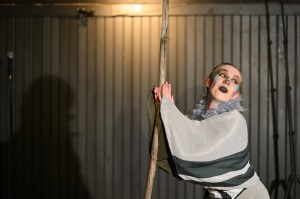
The Public Universal Friend, Object of Diviinity by Calla Wright and SILKRØAD. Fringe 2026. Image provided.

Object of Divinity (Stage 3, Nordic Studio Theatre)

By Liz Nicholls, 12thnight.ca

Object of Divinity is a strangely timeless and timely story that underpins this enigmatic human/puppet show by actor/playwright Calla Wright, with an electro-industrial score, created and performed live by SILKRØAD.

They have unearthed from the mists of history (misty to me, at least) an amazing real-life 18th century figure, “the Public Universal Friend,” a gender-less nameless pronoun-less preacher, who’d been born female, with Quaker-esque views on slavery, emancipation, and war.

Wright has wrested a sort of beyond-trans story, a mother and child (Wright and Maya Wright), domestic rejection, religious crisis, from this shadowy self-created character who actually lived from 1752 to 1819. And they’ve imagined the trauma of their origins at a time when a female outside social conventions was a vessel awaiting — no, inviting — possession by gathering demonic forces. “Even the faithful are afraid in the end.”

The puppet iconography transforms homely objects; call it a performance installation.  The puppets, who “enter” the piece after a long introductory monologue by Wright as a kind of evangelist, are extrapolated, I think, from the story of the Public Universal Friend: outsized chalk-white objects including a hairbrush, a plumed pen that writes in invisible ink on a white sheet, a hand with many fluttering fingers that won’t stay still.

Can I explain this? I’m afraid not. The historical narrative of the Public Universal Friend — a self-reinventing character who puts themself deliberately out of time and possibly this world — is fascinating. But Object of Divinity moves beyond the “story” to unspool theatrically as a challenge so stylized and allusive that meaning seems always, deliberately, always, just beyond the grasp of the fingers (at least mine). It’s more a poetic fantasia than a “play,” by one of our most challenging artists.

Posted in Fringe 2026, Reviews | Tagged , , , , , | Comments Off on From history into a world of puppet poetry: the fascinating, elusive challenge of Object of Divinity

Can these two connect in the darkness? Here’s a mysterious little gem that’s about that. Being Norwegian, a Fringe review

Cody Porter and Clarice Eckford in Being Norwegian, Trunk Theatre. Photo supplied.

Being Norwegian (Stage 22, The de Villars Jones LLP Stage at Holy Trinity Church

By Liz Nicholls, 12thnight.ca

This little gem of a two-hander by star Scottish playwright David Greig is something rare: a perfectly formed 45-minute rom-com where the shangri-la is more modest, more tentative, and more elusive, than romance. It’s simple human connection for two people who have somehow gotten flung off the grid into solitude.

To help support 12thnight.ca YEG theatre coverage, click here.

It’s started, just before the play, in a pub. Sad-sack Sean (Cody Porter) has surprised himself by inviting lively Lisa (Clarice Eckford) back to his apartment for a drink, an impromptu decision that he now regrets. And the awkwardness of that encounter, conveyed in two beautifully calibrated performances in Amy DeFelice’s production of Being Norwegian, is comic, in an anxiety-making kind of way.

Lisa, who’s chipper and almost suspiciously game, admires the urban view from the window. Sean, who hasn’t unpacked the boxes in his apartment for a year, has an apparently practised ability to see the depressing lining in any cloud. The view, he assures Lisa, is “not so pretty in day time (desperate pause). Or when it’s raining.”

“It reminds me of Oslo” is not a conversational gambit Sean has any idea how to return. “I’ve got to go there some day,” he says, after another desperate pause. Nope, Sean is not slick. And Lisa, who says she’s Norwegian and references Norway at every pause, is resourceful, and unusually persistent under these circumstances. “I think talking is over-rated,” she says, an amusingly conciliatory response to Sean’s fumbling confession that’s not used to … talking to, well, you know, actual people.

She is oddly determined to be enchanted, and make the most of a moment, even when the fall-back position for “conversation” is discussing the dimmer on the light switch. Norwegians, she says, are comfortable with darkness. His resting position is sadness and, in company, the state of being non-plussed.

There’s mystery attached to both characters. And Porter and Eckford are impressively skilled at comic pauses, and not salting the anxiety into something spicier, or giving anything away too soon about characters who’ve evidently spent whole lives alone with their secrets. “Things like this don’t happen to me,” says Sean at last. “I’m not … entertaining.”

At a festival full of characters who are more than ready to entertain you at all hours of the day and night, here are two who are struggling to speak, much less sit next to each other the way strangers might do on a bus. And you really want them to find each other in the great dark that surrounds us all. Small victories are something to cheer. Highly recommended.

Posted in Fringe 2026, Reviews | Tagged , , , , , | Comments Off on Can these two connect in the darkness? Here’s a mysterious little gem that’s about that. Being Norwegian, a Fringe review

Singing and dancing with ghosts in a haunted, and haunting, musical: Ghost Quartet. A Fringe review

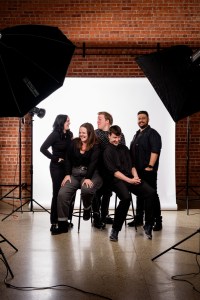
Ashlin Turcotte, Lisa Kotelniski, Ethan Bintu-Watt, Matthew Gregg, the cast of Ghost Quartet in daylight, Brave Spaces Theatre, Fringe 2026. Photo by Charlie Janzen.

Ghost Quartet (stage 36, ArtsHub Ortona)

By Liz Nicholls, 12thnight.ca

This haunted, and haunting, musical invites us into an atmospheric lamp-lit bar under a spacious vault (the venue, as arranged by director/designer Jim Guedo is just right) where whiskey gets drunk, eerie stories get told, dances get danced, and songs get sung.

To help support 12thnight.ca YEG theatre coverage, click here.

The latter are by Dave Malloy the highly original New York creator of Natasha, Pierre and the Great Comet of 1812. And they’re kind of ethereal and kind of earthy at the same time, in an assortment of styles, jazz, folk, Celtic-flavoured rock. In Guedo’s atmospheric production they’re delivered by four actors in motion — Ashlin Turcotte, Ethan Bintu-Watt, Lisa Kotelniski, Matthew Gregg — who sing and turn their hand to assorted instruments — piano, autoharp, xylophone, drums, accordian.

There isn’t one single narrative: ghost stories, tales from Sheherazade, myths, folk tales, snapshots of New York … start and float away, open-ended. Two sisters, Rose and Pearl (Kotelniski and Turcotte) recur, and have their doubts whether they’re alive or dead, in the present or the past. You know that feeling? “I don’t know if this is me or just some ghost of me,” the sisters who don’t yet know they’re sisters sing at the outset, in a camera shop. “Now I don’t know but I’ve been told and that’s true of everything I think I know….”

Time passes, centuries maybe, and the image of photographyt, taking a photo at the end of the world, recurs at the end of the four sided, multi-track show.  As one of the sisters says, “this is a circular story.”

Sometimes the performers seem to step right out of their characters to be modern people who talk of ghosts, or dance with them. “And if you could be a dead guy what kind of dead guy would you be?” Answer: “I’d be a ghost.… Don’t  wanna be a vampire cuz they can’t feel the sun.”

Strangeness that gets under your skin. That’s what haunting is all about. A show to savour.

Posted in Fringe 2026, Reviews | Tagged , , , , , | Comments Off on Singing and dancing with ghosts in a haunted, and haunting, musical: Ghost Quartet. A Fringe review

I’ll have what she’s having (or not): Queens of Romance, a 12thnight Fringe review

Queens of Romance (Stage 11, Varscona Theatre)

By Liz Nicholls, 12thnight.ca

In Trevor Schmidt’s latest play for 100% More Girls, we’re in a pink-hued world (designer: Schmidt), at the finale event of the Hopeless Romantics’ seventh annual Love and Romance conference. The Queens of Romance panel gathers onstage three celebrity writers, stars of the romance novel, to discuss their craft, their writing history, their aspirations, their works-in-progress.

As introduced by the nervous moderator and fangirl Missy short for Melissa (Schmidt, in a sparkly pink tiered dress and pink runners), they are a high-contrast trio, and their costumes (by Schmidt) are a shorthand character sketch in themselves.

The elderly Nausea Wildenheart (Jason Hardwick), the grande dame of the genre, encrusted with rhinestones, has 723 titles (so far) in her archive, including In His Arms, Her Heart’s Wild Journey, and Tender is the Dusk. She’s (very) old-school: in her best-sellers beautiful people — one well-heeled man, one dewy young woman in the 16 to 21 bracket, find each other, fall in love, get married, make love, live happily ever after.

Janet van Herpen (Michelle Todd), in a flashy silk jumpsuit and draped in gold accessories, has ‘liberated’ female characters who have lots of sex with lots of men, and freewheeling commitment-free sex-in-the-city lives. Her work includes Trophy Wives of Minor Astronauts.

Karin Cutler (Jake Tkaczyk with amusingly corporate hair) is a PhD in gender studies, whose romance output, as she briskly describes, includes queer, gender-fluid, and polyamorous characters. There is a difference, as she points out in exasperation to her stage companions, between dominatrixes and sex workers.

There are witty lines in the script’s delineation of these stereotypes (no Schmidt script is without them). The novel titles are funny, and Dame Nausea’s intermittent deafness occasions some amusing misunderstandings. And top-drawer actors commit to drawing, convincingly, the cartoon portraits. But nothing really happens onstage — either between the characters or their pre-cast, unbridgeable points of view. Arguments among stereotypes tend to be setups; the antagonisms are pre-ordained and hard to animate.

There’s no arguing with Missy’s conciliatory, and worthy, position that there’s room in every genre (including the so-called romance novel), for all kinds of writing and points of view. But there’s a theatrical shortfall when entrenched positions are just set forth onstage.  

Posted in Fringe 2026, Reviews | Tagged , , , , , | Comments Off on I’ll have what she’s having (or not): Queens of Romance, a 12thnight Fringe review

Match-making at the Fringe: the hummable hilarity of Rodgers and Hammerstein’s ROBOCOP The Musical. A Fringe review

Rodgers and Hammerstein’s ROBOCOP The Musical, Cousins in Law Productions. Photo supplied.

Rodgers and Hammerstein’s ROBOCOP: The Musical (Stage 11, Varscona Theatre

By Liz Nicholls, 12thnight.ca

Here’s weird. If Rodgers and Hammerstein were such musical theatre big shots, with clout, how come “their most ambitious show ever” never made it to opening night? Till now.

To help support 12thnight.ca YEG theatre coverage, click here.

When a cop in a crime-ridden city (Andrew Boyd, who has startlingly big, lustrous musical theatre pipes) bursts onto the stage, and into song, stealing Curly’s euphoric anthem — “Oh what a fine Detroit morning, Oh what a great Detroit day!” — you know you’re in the presence of the showbiz premise you never knew you were waiting for.

It is the mind-cracking inspiration of Cousins-In-Law Productions (whose last outing, SPEED: a 1940s radio drama was a Sterling winner this year) to hook up musical theatre royalty, purveyors of a sacred canon of indelible melodies, memorable characters, lush orchestrations, with the 1987 cyberpunk action film.

And in the course of this lunatic first (and only) date, co-created by Boyd and director Lauren Boyd), you’ll hear songs from nearly every corner of the R&H archive, The Sound of Music, South Pacifc, Oklahoma! … with lyrics re-worked for the occasion. There is no way this should be a fit, which is the whole Fringe-y point of it. But, somehow, amusingly, it does, more than you’d predict. Police HQ is a convent, the cops are nuns, and Murphy, the Maria of the piece till he’s, like, brutally murdered (“so long, farewell…”) reports to Chief Mother Superior.

The ingenious team of Boyd and Boyd even make room for some contemporary satire. “How do you solve a problem like the crime rate?” (work with me here, dear reader; imagine the tune). Law enforcement has been handed over to a big global corporation. Where could that ever happen?

There’s even a dream ballet, for heaven’s sake, and since Jason Hardwick is part of the 11-actor cast of strong singers and dancers that Lauren Boyd sets in motion, I’m assuming he did the choreography, full of DeMille allusions.

You know the musical references with altered lyrics — even if you don’t think you do, and hate musicals. And for musical theatre junkies this is comedy cocaine. In fact there’s a big production number ode to that elixir, from a drug gang in sailor get-up: “There is nothing like cocaine…” pilfered from the South Pacific stash.

Bonkers, and as the red velvet Varscona curtains open, it’s on a production scale rarely found at the Fringe. As the song, with its new lyrics, goes, “everythin’s up to date in Detroit city; we’ll take about as much as we can get.”

Posted in Fringe 2026, Reviews | Tagged , , , , | Comments Off on Match-making at the Fringe: the hummable hilarity of Rodgers and Hammerstein’s ROBOCOP The Musical. A Fringe review

Backstage at the underground: Shrute and Tungsta, a Fringe review

Shrute and Tungsta, Dirty Fish Theatre. Fringe 2026. Photo supplied

Shrute and Tungsta (Stage 3, Nordic Studio Theatre)

By Liz Nicholls, 12thnight.ca

Since the ‘80s, the underground’s kinda gone … underground. Wanna know where the diehard denizens have been been holding out?

In the bathroom of a big Berlin techno club that’s shaking from the pounding reverb. That’s where Shrute and Tungsta, German ‘performance artistes’ slightly frayed around the edges, are rattling around, crouched over a speaker.

How long have they been there? The duo seem starved for company, eager to impress us, shock us maybe with their avant-garde groove. Shrute (Harper Oud) is the bigger, talkier, more extroverted one, doing close-ups selfies of themself eating (OK, that is pretty gross) and being punk sexy. They’re the one that ventures into the audience. Tungsta (Aidan Collins) is small and expressionless, silent and surly till they’re doing show-and-tell with tiny prize ‘objets’. And there’s even a masked third party, a burly dancer (and go-fer) who enters, and gets shoo-ed off the stage from time to time. I’ll leave the plastic wrap sequence with you to discover.

When the pair gets gets offered a recording contract a big underground label, ah, the seduction of money and fame — there’s dissension. Shrute is pro; Tungsta is against selling out. “They don’t even know what art is.” Will this spell the end of their relationship (and German accents)?

Collins and Oud are a couple of this town’s up-and-coming artists (watch for them), and their show is inventive, deadpan fun, and unlike anything you could possibly see anywhere else. It’s risky by being playful about risky-ness. And doesn’t your Fringe need something weird like that?


Posted in Fringe 2026, Reviews | Tagged , , , | Comments Off on Backstage at the underground: Shrute and Tungsta, a Fringe review

Begin Again. Martin Dockery: Forbidden City! returns to solo-storytelling form, a guest Fringe review by Fawnda Mithrush 

Martin Dockery: Forbidden City, Concrete Drops Theatre, Fringe 2026. Photo supplied.

Martin Dockery: Forbidden City! (Stage 1, ATB Westbury Theatre)

By Fawnda Mithrush

Couched in a story about a family trip to China is the kernel of Martin Dockery’s greatest hangup: Endings.

To help support 12thnight.ca YEG theatre coverage, click here.

Beginnings are easy enough: Starting over is less painful when you haven’t spent a lot of time investing in the path. The “begin again” premise demonstrated in the show’s repeated opening sequence and ever-looping return to the instructions for the Forbidden City audio guide does start to grate on your psyche—in a good way.

It’s this cyclical stuckness that Dockery admits is the essence of all his storytelling shows; they’re just “a long series of introductions,”albeit seeded with purpose in each iterative segment. Those seeds eventually sprout into the satisfying realizations that while the path may have seemed like a strange loop, it really was taking you somewhere insightful after all.

Without unravelling the smartly-wound sweater that’s knitted here, know that any audience impatience is matched by Dockery’s own vein-pulsing exasperation; the physical and vocal effort literally scrape through each return, ramping in a way that must, you hope, eventually end in relief.

What is lovely about the ending is that it’s actually the biggest beginning of Dockery’s life, one for which he’s brilliantly unready. You don’t learn anything about the Forbidden City, after all. No one does if they stay stuck in the entry.

Posted in Fringe 2026 | Comments Off on Begin Again. Martin Dockery: Forbidden City! returns to solo-storytelling form, a guest Fringe review by Fawnda Mithrush 

F*ck off, we’re STEEPING: Erika MacDonald: Tea TIME, a guest 12thnight Fringe review by Fawnda Mithrush

Erika MacDonald: Tea TIME, Fringe 2026. Photo supplied

ERIKA MACDONALD: Tea TIME (Stage 28, Roots on Whyte)

By Fawnda Mithrush

One of life’s great comforts, tea is truly front and centre in this piece. It’s a good thing, too, because it’s a keen assurance of safety and comfort that allows Erika MacDonald to expertly cover some Very. Tough. Subjects. She does so with a wit and soft candour that is remarkable.

To help support 12thnight.ca YEG theatre coverage, click here.

Tea TIME lays down a series of ritualistic adages that at first describe the routine making of tea; “it doesn’t take forever, but it does take time” takes on deeper meaning each time MacDonald utters it. Once the disclosures of mental health challenges emerge, you’re fully aware that while tea is indeed being brewed onstage, there’s also something else happening, something warm and assuring and entirely steeped with love.

MacDonald’s demeanour is of a tender auntie; her bonafide grin and sincerity buffer any sort of unease that might come up when talking about depression, and it’s easy to trust her fully as she guides the audience through a “felt three minutes,” which you absolutely must do once in your life in a room full of strangers. Each procedural step to arrive at a well-made cup is a shelter and an affirmation that each moment is to be savoured, even if only in its simplicity or quietness.

It won’t have the same impact on everyone, but no one could walk away from Tea TIME without a genuine appreciation for MacDonald’s vulnerable and endearing way with her audience. Buckle up and enjoy the cup.


Posted in Fringe 2026, Reviews | Tagged , , , | Comments Off on F*ck off, we’re STEEPING: Erika MacDonald: Tea TIME, a guest 12thnight Fringe review by Fawnda Mithrush

God is Sexy: Brother Love’s Good Time Gospel Hour sends up Jesus, Satan and Timothee Chalamet, a guest 12thnight Fringe review

Brother Love’s Good-Time Gospel Hour, Lester W. Productions. Fringe 2026. Photo by Nick Olson

Brother Love’s Good Time Gospel Hour (Stage 20, Mile Zero Dance Stage)

By Fawnda Mithrush

Playwright and frontman Noam Osband leads his congregation through an evangelical hot mess and singalong hour — we say ‘hot’ here because of the persistent metaphor for spiritual thirst as sexual desire, not because the show is on fire.

The songs are catchy and Brother Love lets his distaste (or attraction) for society’s hyper-sexed obsessions to permeate the songbook. Once you bind the penetration angle with religion, the innuendos come easy: The trinity as a gangbang, only god can fill your spiritual hole, Jesus is a power bottom — you get the shrift.

A mid-week afternoon house may not be quite enough pints in to appreciate the fevered silliness and intentionally overwrought puns, but any Fringer could acknowledge Osband’s comparison to Timothee Chalamet as Satan as fitting. I mean, he’s just too good looking, right?

Posted in Fringe 2026, Reviews | Tagged , , , , | Comments Off on God is Sexy: Brother Love’s Good Time Gospel Hour sends up Jesus, Satan and Timothee Chalamet, a guest 12thnight Fringe review