We’ve lost a remarkable theatre artist: a tribute to the late great John Wright

John Wright and Marianne Copithorne in Jim Guedo’s Phoenix Theatre producion of A Lie of the Mind, 1987. Photo by Ed Ellis.

By Liz Nicholls, 12thnight.ca

With the passing of John Wright last weekend, far too soon at 74, the Canadian theatre and its audiences have lost not only a superb artist and mentor but an engaging, authentic, real-life character with a uniquely magnetic presence off the stage too. Edmonton theatre has been the particular beneficiary of his multiple gifts.

To help support 12thnight.ca YEG theatre coverage, click here.

At last Sunday’s sad news, a strange and wonderful reaction started happening on Facebook. FB erupted with tributes to a formidable talent lost, of course. And these were accompanied by a virtual gallery of re-posts by the recipients of the beautiful, personalized digital birthday cards, with portraits, specially designed by Wright for the members of his beloved theatre ‘family’. As his health declined in the last few years and he retired from the stage, Wright, who’d taken up photography in a very creative way, fashioned individual pieces of art for his fellow artists and theatre lovers. And there’s something very Wright-like in that sharing.

The theatre community is saluting, in an outpouring of admiration, the electric connection Wright always made onstage with audiences, in a wide range of roles, the classics to contemporary theatre, Scrooge to Lear, low-life hitmen to unravelling kings, booze-soaked patriarchs to preening aristocrats to washed-up poets. And they’re remembering the offstage Wright with great affection: the wicked sense of humour, the signature combination of crusty on the surface — he was the reigning monarch of the withering observation about the state of the culture, politics, the theatre industry — kind and sweetly thoughtful within.

John Wright as Macbeth, Freewill Shakespeare Festival 1999. Photo by Ryan Parker

That warm embrace is why summer Shakespeare cast parties invariably happened in his garden, a kind of Midsummer Night’s Dream nature walk in itself, that Wright created behind the Westmount house where he lived with his theatre star wife Marianne Copithorne and an assortment of dogs.

Wright’s curmudgeon carapace was droll, witty, at times daunting to the uninitiated (but not when you’d spent any time with him). ”I’m remembering the crusty guy, the gruff guy, whom no one was ever afraid of,” says John Ullyatt, who’s shared many a stage and a green room with Wright. “I’m remembering that same guy who giggled, sometimes at his own jokes, often with shared silliness.”

“He was such a titan,” says actor/director/playwright Belinda Cornish. “A simply magnificent actor and a hell of an inspiration, and, beneath his determinedly curmudgeonly exterior, just the kindest, warmest man. He was a no-bullshit kind of fellow, in the very best possible way.”

“His crusty exterior shrouded the most beautiful heart,” says James MacDonald, the first Freewill Shakespeare Festival artistic director and both a Wright director and cast-mate. “He cared so deeply for the theatre, for his fellow artists, for his friends, for the work, and for the audience. He was the most generous, honest, and soulful scene partner…. John Wright is the person who taught me to direct.”

The current Freewill artistic director Dave Horak echoes the thought. “John was indeed a bit terrifying, at first. He certainly played many characters that had a certain dark and ‘masculine’ energy. And yet once you pierced the exterior you found a real sweetie.”

The last of a distinguished Canadian theatre family that included his three sisters, Susan, Janet, and Anne, Wright came to Edmonton from his home town of Saskatoon. He’d been here before, touring with the Citadel On Wheels during the John Neville years in the 1970s (and had a supply of funny touring stories).

It was director Jim Guedo, a Wright friend and colleague of 48 years standing, who brought his fellow Saskatchewanian (along with Wright’s sister Susan) here in 1987 for his inaugural production as the new artistic director of Phoenix Theatre: Sam Shepard’s A Lie of the Mind. The Phoenix repertoire leaned into the new, the raw-edged, the contemporary. It suited Wright’s particularly earthy, grounded intensity, and his go-for-the-gusto rapport with gritty dark comedy. And best actor Sterling Awards for such productions as Road and Sight Unseen would follow.

“The first show I saw John in was Persephone Theatre’s Cruel Tears in 1975,” says Guedo.” The premiere and cross-country tour of Ken Mitchell’s country/folk/trucker version of Othello, a Canadian theatre landmark as it turned out, was a Wright family affair; “John shared the stage with sisters Janet and Anne.”

“Arriving at the University of Saskatchewan in 1977,” says Guedo, “I watched from the wings and booth to see him play Alan Strang, the young boy in Equus. He directed me a year later in Play It Again Sam for our U of summer stock….” Their theatre history together includes eight shows in which they acted together, “and I directed him in 18, as well as designing five shows he appeared in.” Together Guedo and Wright did Shakespeare, Pinter, Mamet, and Shepard in Saskatoon.

And then came Edmonton. A Lie of the Mind at Phoenix was momentous for Edmonton theatre in more ways than one. It’s where Wright met and fell in love with Marianne Copithorne, the actor (then director, then artistic director of the Freewill Shakespeare Festival) who would become his wife. And Edmonton theatre would turn on its axis.

“John came back a season later to do Being At Home With Claude and Hurlyburly” at Phoenix, says Guedo, now a theatre prof at MacEwan University and artistic director of the indie company Wild Side Productions. “He stayed on in Edmonton, and the rest is Edmonton theatre history.”

John Wright, Shaoon Larson, Paul Morgan Donald, Daniel Arnold, John Kirkpatrick in Much Ado About Nothing, Freewill Shakespeare Festival 2000. Photo supplied.

That history would soon include Wright appearances at every company in town, including many at the Citadel — and notable summer excursions into the great outdoors in Freewill Shakespeare Festival productions where you can look characters in the eye in broad daylight. Which suited Wright just fine.

John Wright and Belinda Cornish in The Merchant of Venice, 2017. Photo by Ryan Parker.

Belinda Cornish remembers the experience of co-starring with Wright in Copithorne’s Freewill Shakespeare Festival production of Titus Andronicus in 2009. The weather, the ultra-violent play, the role, the whole thing was a bit overwhelming as she found one day in rehearsal. And she disappeared into the loo for a cry. When she emerged, Cornish recalls, “John looked at me with gruff concern and asked if something had happened. I told him I was fine, it had all just been a bit much. He nodded kindly, and said, ‘Yep, sometimes you just need to go and cry it all out’. Then he briskly patted my shoulder and said ‘just don’t do it on stage’. Fine advice from one of the finest, most generous, funniest and most deeply loved actors I have ever had the privilege to work with.”

John Wright and Ron Pederson in The Merry Wives of Windsor, Freewill Shakespeare Festival. Photo by Ryan Parker.

Ron Pederson says “I was in awe of John when I first saw him in those amazing Jim Guedo productions at the Phoenix…. He had an intimidating cool and intensity, and I was so nervous working with him the first time,” which happened at Workshop West in Marty Chan’s (spiky political satire) The Old Boys’ Club. “John had to strangle my weasley character to death at the end of Act 1. And the twinkle in his eye I’ll never forget.”

“He was a fun and sardonic curmudgeon backstage and (talking) about the business, but when he played he was mischievous and full of joy.”

Marianne Copithorne and John Wright in Macbeth, Freewill Shakespeare Festival. Photo supplied.

Wright seemed to have a natural rapport with Shakespeare, witness his original performances in big roles — Macbeth, Titus Andronicus, Claudius the murderous usurper in Hamlet, Prospero in The Tempest, Shylock (twice) in The Merchant of Venice, Leontes the king undone by jealousy in The Winter’s Tale … “and all the dukes over the years,” as Ullyatt says.

Was it his natural, always intelligible, way with iambic pentameter? Was it his complete commitment to character? The sense that he conveyed of thinking on his feet in the immediate present?

All of the above. “I’m remembering John’s style of acting,” says Ullyatt. “He was never bombastic or overly musical; he didn’t push. It seemed effortless, but somehow you got every word that he said, every meaning. He understood it and felt it and shared it….”

Dave Horak and John Wright in King Lear, Freewill Shakespeare Festival 2013. Photo supplied

Horak, who played the Fool to Wright’s Lear (directed by Guedo) in his first Freewill show in 2013, was “fascinated with John’s ability to really pull that Shakespearean text ‘off the page’. He excelled at thinking through the words and you really believed he was making it up in the moment. There were times onstage when I forgot we were ‘acting’ and he forced me to really listen to him. He was unpredictable … totally committed to being completely present.”

Annette Loiselle and John Wright, Twelfth Night, Freewill Shakespeare Festival 1997. Photo supplied

“I know he sometimes suffered from stage fright and so I think it took a lot out of him to be onstage,” Horak says. “And I think he made a decision that if he was going to be there, it had better matter.” Ullyatt has a similar thought: Wright as “someone who, as mighty as he could be onstage, also seemed fragile of heart and soul.”

The great fight choreographer and director J.P. Fournier found himself unfailingly impressed by the actor’s charisma. As Burgoyne, the witty British general in Fournier’s U of A production of Shaw’s The Devil’s Disciple, “John would come on in the last 20 minutes, and he walked away with the show every night! In that, and so many productions, you couldn’t take your eyes off him” says Fournier. “You couldn’t not watch him! A fabulous actor.”

John Wright as Propero in The Tempest, Freewill Shakespeare Festival 2002. Photo supplied.

“Whenever he was onstage, I was hooked. Every time…. He never ‘acted’. He was SO in the moment.” And Wright was a great asset to the young actors of the company. “His suggestions were so casual, so full of depth.”

You had to love an artist whose outrage at the state of the world didn’t peter out. Wright devoted energy to exasperation, as well I know. In the last 38 years how many times did I hear him say, after a show or over an occasional barbecue in his magical garden, that he’d had it with theatre and the lack of real support from the culture? A dozen times? He didn’t need theatre, he’d done his last show, and he was thinking of retiring, going back into the family electrical business in Saskatoon to make a proper living instead. We were all so lucky for a long time that he didn’t actually do it.

As MacDonald says, “John and Marianne were such leaders together in our community…. We will truly never see his like again.”

A GoFundMe has been created to support John Wright’s wife Marianne Copithorne: https://tinyurl.com/499dbpe8.


Posted in Features | Tagged , , , , , , | Comments Off on We’ve lost a remarkable theatre artist: a tribute to the late great John Wright

What makes the theatre magical? An Oak Tree at Theatre Yes, a preview

By Liz Nicholls, 12thnight.ca

There is nothing predictable, run-of-the-mill (or run-of-deMille for that matter) about the Theatre Yes production that opens a short run Wednesday.

To help support 12thnight.ca YEG theatre coverage, click here.

Just for starters, An Oak Tree happens in a venue where you’ve probably never seen theatre before (The Aviary, 9314 111 Ave.). And that’s just the start of its surprises.

Then there’s this: the co-artistic directors of Theatre Yes have switched roles for the occasion. Actor/ musician/ playwright Ruth Alexander is the director — “my directing debut in Canada,” as she says over coffee one Saturday morning not long ago. Director Max Rubin, Alexander’s husband, who “hasn’t been onstage in 15 years,” is one of the two actors in the show.

Ruth Alexander, Theatre Yes. Photo supplied.

And then there’s the play itself, by the insurrectionist English playwright Tim Crouch whose body of work, says Rubin, is “a full-frontal assault on everything about the conventions of going to the theatre. He never allows the audience to settle into a routine they’re familiar with.”

Max Rubin, Theatre Yes. Photo supplied.,

The play gets its title from a painting, in the National Gallery of Australia, of a glass of water. The title of the painting? “An Oak Tree.” An art-life confrontation that’s a bit like 180-degree reverse Magritte, and the Belgian artist’s painting of a pipe entitled Ceci n’est pas une pipe.

There’s no set, no costumes, no sound or light cues. So the lights don’t go down in the time-honoured signal that a play is about to begin. And Rubin is onstage with an actor, a different one every performance, who has never seen or read the play, much less rehearsed it.

An Oak Tree has its own disturbing premise. A stage hypnotist has accidentally killed a child with his car. And months after that, the child’s father volunteers for the act. Rubin plays the hypnotist. “But as the play goes on,” he says, “it becomes less and less clear whether I’m that character or the actor, or the ‘stage manager’ instructing the other actor…. And then the roles reverse, and the other actor instructs me.”

Adds Alexander, “sometimes the hypnotist will play the wife of the father, sometimes the father…. A lot of devices in it to disconcert the audience on purpose. And remind you you’re looking at a play…. And you’re still emotionally involved!”

“Fascinating,” she says. “It’s ‘look at how the magic works’. And it’s still magic, and amazing. And that’s theatre!”

It’s not improv, though; every word the second actor says is scripted, but after that, “there’s huge leeway in how they do it.” The play is created on the spot, discovered by the audience and the second actor at the same time, and “I imagine each show is going to be quite different,” as Rubin says.

Says Alexander, “the second actor can’t prepare, can’t ‘act. All they can do is to be open and to listen. They can make decisions but they can’t plan anything; they have to be in the moment…. It’s what everyone at drama school always tells you.”

“They can’t make friends with the audience, or clown. They have to be vulnerable.”

Alexander and Rubin, experimenters par excellence, re-located from England to Edmonton in 2017. And they announced their arrival at Theatre Yes with The Play’s The Thing, a two-night collective production of Hamlet, with each scene randomly assigned to a different Edmonton performing arts company, to be presented in their own signature style. For An Oak Tree they’ve assembled a starry roster of game and experienced actors of varying ages who might — who will — come with very different affiliations to parenting and grief. Belinda Cornish, Mark Meer, Luc Tellier, Patricia Zentilli, Patricia Darbasie, Dayna Lea Hoffmann, Oscar Derkx, Nikki Hulowski.

“You need experience from the second actor,” Alexander thinks. “They’re literally creating a character cold, in the moment.”

Directing An Oak Tree “isn’t really a directing job,” she says. Which is why she agreed to do it. “This is making sure the story is clear for the audience, and also fully supporting the second actor.” As for Rubin, “well, my wife made me do it,” he jokes. The hypnotist “isn’t really an acting part; he’s more of a a facilitator.…” It’s not a ‘go into character and stay there’ situation.

“There are different versions of the hypnotist character, and they bleed into each other,” says Rubin, who was last onstage in 2011 as Satan in a Lodestar Theatre production of The Master and Margarita in England. “I’m just not remotely interested in acting any more. But this is an entirely new challenge!”

“It really says ‘what’s the theatre?’,” says Rubin of the play. “What makes the theatre magical?” Alexander thinks of it as “philosophy in action. A statement, a manifesto. It’s about transformation, and the power of suggestion.” One of the first lines of the play, as Rubin says, is “ask me what I’m being. I’m being a hypnotist.”.

You wonder what Theatre Yes rehearsals can possibly be like, since half the cast won’t, can’t, be present. “We rehearse in our living room, and move the dogs,” Alexander laughs. “I read all the father’s lines…. We have four ‘stooges’, rehearsal actors (to be the second actor), so Max has four cracks at it, to see what works.”

As Rubin reports, in honing the script for 18 years, Crouch has compared that process to kintsugi, the Japanese art of repairing broken pottery with gold, so it’s more beautiful than ever. “I love that!” Rubin says.

“This is the ultimate non-theatre theatre show.”

PREVIEW

An Oak Tree

Theatre: Theatre Yes

Written by: Tim Crouch

Directed by: Ruth Alexander

Starring: Max Rubin, with (in successive performances) Belinda Cornish, Mark Meer, Luc Tellier, Patricia Zentilli, Patricia Darbasie, Dayna Lea Hoffmann, Oscar Derkx, Nikki Hulowski

Where: The Aviary, 9314  111 Ave.

Running: Feb. 5 to 12

Tickets: theatreyes.com


Posted in Previews | Tagged , , , , | Comments Off on What makes the theatre magical? An Oak Tree at Theatre Yes, a preview

‘A story lives forever’: Meet Amena Shehab, whose new epic play After The Trojan Women premieres at Common Ground

After The Trojan Women, Common Ground Arts Society. Photo by Brianne Jang, BB Collective Photography.

By Liz Nicholls, 12thnight.ca

There is a certain inevitability that theatre artist Amena Shehab would find inspiration from Greek tragedy in creating (with Joanna Blundell) her first and “very personal” play. After The Trojan Women premieres Saturday at the Backstage Theatre, in a Liz Hobbs production under the Common Ground Arts Society flag.

To help support 12thnight.ca YEG theatre coverage, click here.

In so many ways The Trojan Women, Euripides’ tragedy of 415 BCE, one of the theatre repertoire’s most powerful explorations of war, its aftermath, and the heavy price paid by women, tells a harrowing story of displacement and migration that speaks to her own. Shehab’s is the story of a refugee fleeing the perpetual war zone that is the Middle East, on the move country to country, leaving from Qatar and finding a destination here in 2013, with her three children, ages 15, 12 and 3 1/2 at the time.    

playwright Amena Shehab. Photo supplied.

As a Palestinian born and raised in a Syrian refugee camp, Shehab couldn’t help but be struck by the uncanny geography of the Euripides tragedy — and the image of the enslaved women of the vanquished Troy across the sea from Greece, home of the victors and at their mercy. Izmir, on the Turkish coast — a name carved into the collective consciousness in 2015 news stories of millions of dangerous Mediterranean crossings towards Greece — is not far from ancient Troy.

“Always people leaving the shore, the same shore, with the same destiny. Three thousand years of fleeing from war,” as Shehab puts it. She’s thinking of the people she knows, her own relatives, desperate on the shores of Turkey, terrified but hopeful “trusting the sea more than the land. And when the the sea, in a boat, is more stable than the land, well….”

Stephanie Bassala in After The Trojan Women, Common Ground Arts Society. Photo by Brianne Jang, BB Collective Photography.

Is human history one long, eternal war? Shehab is inclined to think so. “It never goes away. Ever. Ever. Ever. Death never stops.” She says “the characters we chose are fictional. But the stories, blended, are real,” says Shehab of After The Trojan Women, in which a trio of modern Syrian women and the women of Troy — Hecuba, Cassandra, Andromache — are fleeing war and occupy the same shoreline, across time. “We’re talking about women’s suffering, children’s suffering, the human stories…. It’s not a news story or a documentary; it’s the human story that makes (the Euripides tragedy) live for three thousand years….”

“It’s women who pay the price for war, and it’s a very expensive one.”  It’s the point Euripides made all those centuries ago. Shehab cites a telling line from her play. “Now the men are back in the dark earth and the women remain.”

And the Middle East, where east, west, north and south intersect is “a messy kitchen,” as Shehab puts it. “Many people cooking meals, and boiling, and everyone involved.” It’s an axis of money and power and the men who “take over, rule everything, make the rules….”

Autumn Strom, Tatiana Duque, Jasmine Hopfe in After The Trojan Women, Common Ground Arts Society. Photo by Brianne Jang, BB Collective Photography

“What’s home?” There’s a question that doesn’t have one answer in Shehab’s experience. “I lived in many countries. And I try to make a home where I go, to survive and have peace where I go, even in small places, even an office…. Home for me is a concept not walls.”

It’s a lesson Shehab learned as the youngest of 10 children in a Palestinian family that’s been constantly uprooted by war since 1948. “My mother lost both parents and a brother at 12, and lived through five wars…. Nothing is impossible. As women we learn how to survive. Life will never be easy. My mother would say if your heart falls down, pick it up and run. Don’t ever give up…. If you don’t run and do something, you will lose.”   

Shehab studied classical theatre (with a specialty in theatre criticism!) in Damascus and worked as a TV producer before returning to her first love, the stage. She met her British writing partner Blundell, a journalist for Al Jazeera English at the time, when they were both living in an international compound in Qatar, with people from around the world. They’ve never lost touch.

“When I left home I tried to close the doors behind me,” says Shehab, who’s friendly, warm, and intense in conversation. “But the doors are heavy.” And I couldn’t really close them.” There was a human story to be told. As Horeya, one of the Syrian women, says, “I want my story to be told.”

How does Canada figure in her story? Shehab smiles, and remembers her younger self, a Grade 7 girl, in Al Yarmouth refugee camp, where Canadians had assisted in building the first real school there, “with real classrooms, not an old house….”

“The Canadian flag was there. And a Canadian soldier arrived from the embassy — clean clothes, beautiful! — for the launch of the school.  We had a translator and I was the host, and read a poem. The guy took my hand and said ‘thank you’. And I said ‘one day I will go to Canada’. And he said ‘you’ll need a jacket!’.”

In Canada Shehab and her kids have found a home. “I’m happy where I am!” she says. You know if you’ve prevailed, she thinks, “if your kids come out of the school smiling.” Hers do. “We did this together,” she says of becoming Canadian en famille, adapting to a new language, new weather, new customs, new food, new air. “I jump off the cliff: I start learning English; I start to act.” She laughs, “I’m brave and I’m crazy. I don’t look; I just jump.”

Edmonton audiences saw her in the Maggie Tree production of Nine Parts of Desire in 2017. Since then, she’s appeared onstage regularly, including Dave Horak’s production of E-Day, and a solo show, Hagar: War Mother, that played the Edmonton Fringe in 2023, and the Edinburgh Fringe in 2024. She’s the coordinator of The Shoe Project, a Workshop West/ SkirtsAfire initiative to empower newcomer women to tell their stories.

And now Shehab is a playwright with a story to tell. In 2019, Blundell came to Edmonton and “we spent three weeks in my basement” working to make a play. What followed, after the forced hiatus of the pandemic, were workshops in London and in Toronto. “And now our baby is ready to see the light,” Shehab beams.

Tatiana Duque, Julia van Dam, Monica Gate in After the Trojan Women, Common Ground Arts Society. Photo by Brianne Jang, BB Collective Photography

The script may be in its ninth draft. “The structure has changed,” says Shehab, who writes in Arabic and then translates. “But the story, never.” Hobbs’s production isn’t a small undertaking by the standards of indie theatre: nine actors, including six characters, with a Greek chorus of three. “The chorus is the voice of the people.”

“You can destroy a city. But a story lives forever.” That’s Shehab’s mantra. “I don’t believe in messages. I believe in feelings and stories, and sharing. I can’t change the world. But I can tell the story.”

PREVIEW

After The Trojan Women

Theatre: Common Ground Arts Society

Written by: Amena Shehab and Joanna Blundell

Directed by: Liz Hobbs

Starring: Tatiana Duque, Michelle Todd, Monica Gate, Kristi Hansen, Annette Loiselle, Julia van Dam, Stephanie Bessala, Autumn Strom, Jasmine Hopfe

Where: Backstage Theatre, Fringe Arts Barns, 10330 84 Ave.

Running: Saturday through Feb. 8

Tickets: tickets.fringetheatre.ca

Posted in Previews | Tagged , , , | Comments Off on ‘A story lives forever’: Meet Amena Shehab, whose new epic play After The Trojan Women premieres at Common Ground

The Citadel announces their upcoming 60th anniversary season

By Liz Nicholls, 12thnight.ca

Edmonton’s largest playhouse, which entered the scene 60 years ago, celebrates this anniversary — and an expanding repertoire of local, national, and international connections — in the 2025-2026 season unveiled Monday.

To help support 12thnight.ca YEG theatre coverage, click here.

At the centre of the upcoming 11-production $13-$14 million Citadel Theatre lineup announced by artistic director Daryl Cloran is his new production of a great American classic staged in the theatre’s very first season in 1965, and the world premiere of a new Canadian musical based on a beloved national story trove.

The latter, Vinyl Cafe: The Musical (Nov. 8 to 30, 2025) is spun for the stage, by Georgina Escobar and the composer team of Colleen Dauncey and Akiva Romer-Segal, from the late Stuart McLean’s legendary CBC Radio story collection. It’s a Cloran idea, “a few years in development,” as he says. “A full singing and dancing musical, holiday-themed, built on some of the most popular Dave and Morley stories” of the Toronto couple, their kids, their neighbours, their ‘hood — ‘Dave Cooks The Turkey’ among them.

The signature sense of humour, the quintessential Canadian-ness, the national and inter-generational reach, all appealed to Cloran, who directs the new musical. “I feel it has great potential for national interest,” and with audiences across the border too (Vinyl Cafe has a considerable coterie of American fans too).

“At our workshop in December, people were laughing at the jokes before we got to them. People are so connected with the characters; people have a history with the stories. Cloran is one of those people. He remembers going to McLean’s live-audience holiday shows as a family tradition.

In this project, an heir to such Citadel musical premieres as Full Moon and Prison Dancer, the theatre has partnered with long-time Vinyl Cafe producer Jess Milton, who now has a podcast called Backstage At The Vinyl Cafe.  “When we were looking for the right book writer and composer, we asked (candidates) to musicalize a section…. Morley has a line in ‘Dave Cooks The Turkey’ describing how to be a mother at Christmas, ‘I am a train!’. Colleen and Akiva turned the line into a gorgeous song.”

In a nod to Citadel history in this anniversary season, Cloran’s production of Death of a Salesman, Arthur Miller’s ageless 1949 gut-wrencher (Jan. 24 to Feb. 15, 2026), returns Willy Loman, the iconic travelling salesman of American Dream mythology to the mainstage, where he hasn’t been for 14 years. In the 2011 production directed by Bob Baker, John Ullyatt played Biff, Willy Loman’s football hero-turned-drifter son, crushed by the weight of his father’s delusions. This time Ullyatt plays Willy Loman, tattered purveyor of dreams, with Nadien Chu as Willy’s long-suffering wife and enabler Linda.

Cloran cites in particular “the incredible work John (Ullyatt) has done with Scrooge” (a role to which he returns in the 2025 edition of A Christmas Carol). “He’s so ready to sink his teeth into a role like Willy.” And along with Ullyatt a theatre star of apparently limitless versatility, Chu,“so funny so fierce in The Three Musketeers,” as Cloran says, is “one of the finest actors in Edmonton if not Canada.”

The season opens (Sept. 13 to Oct. 5, 2025) with Life of Pi, adapted by the English writer Lolita Chakrabarti from the Yann Martel novel. Life of Pi has been onstage in the West End and moved to Broadway. “We’re the first theatre to be licensed to create our own production, a non-replica…. It’s a real coup for us,” says Cloran, “and speaks to the Citadel’s reputation that the company gets a crack at it.”

The story of the title hero, stranded on a lifeboat in the middle of the Pacific with a Bengal tiger as his companion, comes with particular theatrical challenges, including visual imagery and puppetry. “It’s such a great theatrical re-imagining of a story that so many people love,” says Cloran, “with all the things that are great about theatre.” Haysam Kadri, the artistic director of Alberta Theatre Projects in Calgary, directs.

Casey and Diana (April 4 to 26, 2025) is by actor/playwright Nick Green, a U of A theatre school grad well known to Edmonton audiences for such plays as Happy Birthday Baby J and Coffee Dad, Chicken Mom and the Fabulous Buddha Boi. It’s Edmonton’s first look at a notable play that premiered at Stratford in 2023, and has since played to full houses and critical raves elsewhere. Set in the AIDS crisis of the 1990s, the play, “a beautiful story and a beautiful theatrical idea” as Cloran describes, takes us to Casey House, a Toronto AIDS hospice as its residents prepare for a visit by Princess Diana, whose public compassion helped changed the harsh optics of the era.

The director for the Citadel/Alberta Theatre Projects co-production has yet to be announced.

The season finale (May 2 to 24, 2026)) is a new adaptation of Cyrano de Bergerac, the swashbuckling Edmond Rostand romantic adventure where the wordplay is as crucial as the swordplay. It’s commissioned from Edmonton actor/ playwright Jessy Ardern (Queen Lear Is Dead), who’s made something of a specialty of contemporary re-thinks of the classics. “She really gets the humour, the romance, the poetry of it,” Cloran says. Amanda Goldberg’s production will come to the stage in full period flourish, but with “contemporary resonance.”

“Our audiences love sword-fighting and luscious design,” laughs Cloran, citing enthusiasm for the lavish Citadel/ Arts Club production of The Three Musketeers, about to open in Vancouver.

Besides Vinyl Cafe, the season’s roster of four musicals includes a classic of the repertoire, a Broadway hit, and the return (with holiday trimmings) of an Indigenous Alberta-made take on a ‘70s fave.

The “big family musical” is The Wizard of Oz (March 7 to April 12), which as Cloran points out wryly, takes up the conversations of the moment about the buzzy prequel to the whole yellow brick road story, Wicked. “Good timing, right?” Thom Allison, who appeared as an actor at the Citadel in Kat Sandler’s double-bill The Party and The Candidate, returns to direct The Wizard of Oz, the 1987 version (for the Royal Shakespeare Company) of the indelible L. Frank Baum story that licenses the stellar music of the 1939 movie.       

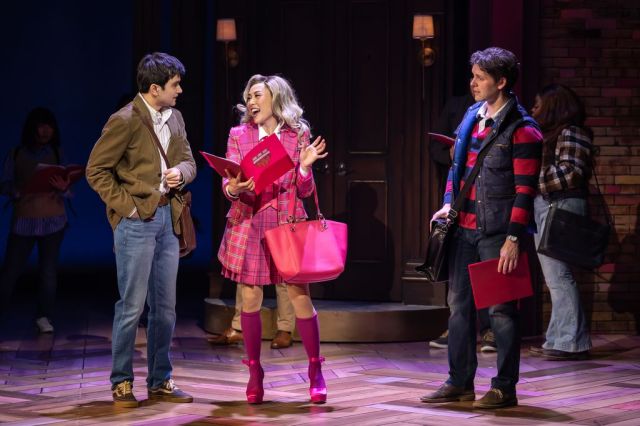
Expect to see a vivacious, plucky pink-clad heroine this summer at the Citadel. Legally Blonde (July 5 to Aug. 3, 2025), a bouncy 2007 Broadway musical blockbuster of the optimistic, heartwarming stripe (“super-positive, super-catchy tunes, speaks to different ages and backgrounds,” as Cloran describes) is the show. Stephanie Graham, of Thousand Islands Playhouse, directs and choreographs.

And the holiday season includes a quick six-performance run (Dec. 18 to 21) of LightningCloud Productions’ Bear Grease: Shack Up For The Winter – Holiday Special. It’s the holiday edition (with additional songs and scenes to match) of their Indigenous variety show take on the 1978 musical Grease. “A great local Indigenous success story,” as Cloran puts it, the show directed by Crystal Lightning, “which more than doubled our sale expectations” this past fall, returns to Edmonton after an Off-Broadway run in the summer. “This is a victory lap for them!” says Cloran.    

Both shows in the Citadel’s returning Highwire Series in the Rice Theatre, have theatre cred elsewhere, and strong Edmonton connections. Big Stuff (Oct. 18 to Nov. 9, 2025) is the work of married improv artists Matt Baram, who grew up here, and Naomi Snieckus, who met at Second City in Toronto, along with director Kat Sandler. “It lives very much in the world of Every Brilliant Thing,” as Cloran describes the comedy memoir that proved a hit in Toronto this past November/December.

“So funny, so heartfelt, so surprisingly moving…. It’s about stuff — the stuff you hang onto in your life and the stuff you can’t let go of, because of their connection to people you’ve lost” There is, he says, “an element of gentle audience interaction,” involving writing on a card an object that you’ve held onto, for use during the show.

The solo play Burning Mom, which arrives in Edmonton (Feb. 14 to March 8, 2026) as part of an Arts Club tour, is the work of playwright/director Mieko Ouchi, the associate artistic director of the Citadel. The play, which premiered in Winnipeg a season ago, is inspired by Ouchi’s own family. When her husband passes away, and the dreams of an RV retirement tour seem to be kaput, a 63-year-old widow takes to the road herself for a odyssey of discovery to the Burning Man art festival in the middle of the desert.

Meanwhile, season #59 continues apace at the Citadel, with Goblin: Macbeth running through Sunday in the Rice Theatre, and Disney’s Frozen: The Broadway Musical, A Midsummer Night’s Dream: The 70s Musical, Heist, and Little Women to come.

Subscription packages for the upcoming season are on sale now (780-425-1820, citadeltheatre.com), with Legally Blonde tickets on sale March 19, and single tickets for the rest of the 2025-2026 season July 4.  

Looking ahead at the Citadel’s 2025-2026 season

Mainstage series: Life of Pi (Sept. 13 to Oct. 5, 2025); Vinyl Cafe: The Musical (Nov. 8 to 30, 2025); Death of a Salesman (Jan. 24 to Feb. 15, 2026); The Wizard of Oz (March 7 to April 12, 2026); Casey and Diana (April 4 to 26, 2026); Cyrano de Bergerac (May 2 to 24, 2026).

Summer presentation: Legally Blonde (July 5 to August. 3, 2025).

Highwire series: Big Stuff (Oct. 18 to Nov. 9, 2025); Burning Mom (Feb. 14 to March 8, 2026).

Holiday productions: A Christmas Carol (Nov. 23 to Dec. 24, 2025); Bear Grease: Shack Up For The Winter – Holiday Special (Dec. 18 to 21, 2025).

Posted in Features, Previews | Tagged , , , , , , , , | Comments Off on The Citadel announces their upcoming 60th anniversary season

Portrait of a men’s movement recruit: Angry Alan at Northern Light, a review

Cody Porter in Angry Alan, Northern Light Theatre. Photo by Brianne Jang, BB Collective Photography

By Liz Nicholls, 12thnight.ca

There are so many reasons to dismiss a guy like Roger, the protagonist of Angry Alan, a smart, surprising little stinger of a play, and the latest in Northern Light Theatre’s ‘Making A Monster’ season.

To help support 12thnight.ca YEG theatre coverage, click here.

I mean, c’mon, how does a guy with half a brain get won over, by the preposterous claims of the ‘men’s rights’ movement? And yet….

As a perfectly judged performance by Cody Porter reveals, in this Trevor Schmidt production of Penelope Skinner’s 2018 Edinburgh Fringe hit, Roger is a mark, ripe for recruitment. And his radicalization is a win for toxic masculinity, a monster in innocuously reasonable online camouflage.    

Roger, as he explains at the outset, is stuck. He used to have a snazzy job with AT&T. Now he’s the third assistant store manager at a Safeway, “the man you can yell at.” He’s estranged, sort of (for reasons he doesn’t understand), from his son who lives with his ex-wife. He feels indefinitely stalled, under-appreciated. He’s a frustrated, chronic underachiever with bargain basement self-esteem, a simmering sense of injustice, and a building cache of resentment about his life.

Angry Alan is a fictional surrogate for Jordan Peterson, Joe Rogan, Andrew Tate and their ilk in the online world, captured by sound and projection designer Amelia Chan. And when he stumbles on the website of the title, Roger gets the acknowledgment for which he’s been hungering. He has an epiphany, a life-changer, what he calls “a red pill moment.”

Cody Porter in Angry Alan, Northern Light Theatre. Photo by Brianne Jang, BB Collective Photography

The “Google vortex” leads Roger to Angry Alan’s explanation — “with data!” — of what’s gone wrong with his life. Roger has been in a cage, the “gynocentric sexism” created by the excessive outreach of feminism and “the witch hunts of #MeToo.” And “the red pill doesn’t solve the problem,” he says. “I’m still in the cage. But I know about the cage….”

Angry Alan acknowledges, validates, and gives voice to Roger’s frustrations. “Hey, I’m Roger. I feel like I could have done so much more with my life. I feel inadequate. I feel like a failure. And until this morning I didn’t even know that’s what I was feeling.”

In Porter, the play finds an ideal Roger, a Roger who makes the seductiveness of the men’s movement plausible. He’s not some sort of aggressively male maniac, on the make. He’s a decent guy, sincere, trustworthy, likeable even. When called out by his partner Courtney for his new preoccupation with the online world, he still helps with the dishes. He has no beef with her recent discovery of feminism in a women’s studies course at the local community college. He’s rueful, even genuinely wounded, by the alienation of his son.

Cody Porter in Angry Alan, Northern Light Theatre. Photo by Brianne Jang, BB Collective Photography

As Porter’s performance reveals, Roger’s susceptibility to the narrative proposed by Angry Alan has a certain (albeit maddening) quality of innocence about it. That it’s compelling to Roger makes a cautionary tale of recruitment of  “ordinary” men to a preposterous cause funny, yes, but a whole lot scarier. What this says about developments across the border is downright chilling.   

Schmidt’s production starts with Roger at a microphone, with illustrations on the outsized computer screen where YouTube photos, chapter headings, and text message exchanges with his son appear. There’s a web of strings attached to the screen, metaphorical and literal, as part of Schmidt’s design, dominated by a conference table strewn with water bottles and paper clutter. The inventive sound design by Amelia Chan has the suspenseful clang of a TV thriller. The lighting by Rae McCallum has an online flicker about it.

What Porter brings to Roger’s monologue is the air of evaluating, of thinking thoughts in the moment as he revisits the story of his “enlightenment.” The highlight is his re-creation of excitement about his weekend at a men’s movement conference in Cincinnati. OMG, the real Angry Alan will be speaking live! A dream come true for Roger.

I’m going to stop telling you about the story, just to say that this is a play with a real kicker of an ending. A quick, gut-punch theatre thriller.

REVIEW

Angry Alan

Theatre: Northern Light Theatre

Written by: Penelope Skinner

Directed by: Trevor Schmidt

Starring: Cody Porter

Where: Studio Theatre, Fringe Arts Barns, 10330- 84 Ave.

Running: through Feb. 8

Tickets: northernlighttheatre.com

Posted in Reviews | Tagged , , , | Comments Off on Portrait of a men’s movement recruit: Angry Alan at Northern Light, a review

Mapping the frontier of empathy: Bea at Shadow Theatre, a review

Kristin Unruh in Bea, Shadow Theatre. Photo by Marc J Chalifoux

By Liz Nicholls, 12thnight.ca

The Varscona stage is dominated by a bed. And in the opening moments of Bea, we see a young girl using it the time-honoured kid way — bouncing on and off it, dancing, singing along with Pink. “I think I’ll get outta here, where I can run, just as fast as I can….”

That’s Bea (Kristin Unruh), or more specifically Bea’s younger self, playful, high-spirited, joyful. In reality, that bed is a prison, a trap. The former Bea has been lost, in eight punishing years (and counting) of immobility with an unnamed degenerative illness. And the catalyst of the long and challenging 2010 play by the Northern Irish writer Mick Gordon, currently onstage at the Varscona in a Shadow Theatre production, is Bea’s decision to call quits on her life (“there are worse things than death”). God is out, for obvious reasons; “the only thing I can believe in is release.”

To help support 12thnight.ca YEG theatre coverage, click here.

What if freedom, that worthiest of goals in theory, is freedom from the body?

The play isn’t so much about Bea’s resolve to die, in itself, as the challenge to her litigator mother and her care-giver Ray that her request — “no, demand!” — for assistance sets in motion. Is there a frontier to compassion, to the human capacity for empathetic connection, before “mind-blindness,” as caregiver Ray puts it, kicks in?

Bea wonders about that, and so does its title character, as she sets forth her case and encounters understandable resistance. “Maybe empathy has a limit,” Bea muses, “a geography.” When you say you’d do anything for someone you love, is it just a figure of speech?

What Bea is asking, an assisted release from a punishing existence, is a dilemma for parental love, for friendship, for the kindness of strangers (hold that thought), for professional responsibility. Bea’s rather self-possessed mother (Kate Newby) is not only a parent but a lawyer, after all, and the act of assisting your child to die is — at least in 2010 in the U.K. when Bea was born — illegal. Ray (Michael Watt) is nutty, voluble, and naturally insubordinate, which makes him pal material for Bea, but he is a contract care-giver.

Kristin Unruh, Michael Watt, Kate Newby in Bea, Shadow Theatre. Photo by Marc J Chalifoux.

Death, dying, and assisted suicide are meaty human issues, to be sure, and like suffering come with all kinds of emotional strings attached. But the play and the production directed by Amanda Goldberg spend most of their time (pushing two hours) and energy in making sure comedy is in the forefront.

The actors are up for it, even if the characters (deliberately?) don’t mesh. Bea, in Unruh’s performance, is devoted to non-stop physical motion, presumably to demonstrate the self the character has lost. The lighting by Whittyn Jason does assist in differentiating past and present, imaginary and real, Bea. But for much of the play, Bea, flirtatious and girlish, flings herself in and out of bed so continually you might be forgiven for wondering at any moment if she’s remembering her young self or being her bedridden current self on an improbably good day. In either case, this does wear thin, perhaps because the physical limitations of the character in her current state, eight years’ worth, aren’t defined very persuasively.

Kristin Unruh and Michael Watt in Bea, Shadow Theatre. Photo by Marc J Chalifoux.

As the nervous, free-associative chatterbox Ray, who seems to have arrived fully formed from some other play, Michael Watt barely stops to take a breath in long comic free-standing monologues that could easily be lifted out of Bea and inserted elsewhere. The question of whether or not Ray is gay, put teasingly to him by Bea over and over and denied in shocked shrieks, seems a little dated, in truth, even for the high-dose playfulness on display here. But Ray’s account of A Streetcar Named Desire for Bea’s benefit (he has a soft spot for Stanley) is a showstopper. And his elucidation of the appeal of theatre — “I do like a good intermission” — is amusing too. Watt, an appealing actor (and a playwright himself), does his best with the bits and pieces of a character who doesn’t seem to quite exist except as an authorial creation.

Kate Newby and Kristin Unruh in Bea, Shadow Theatre. Photo by Marc J Chalifoux

As the formidable lawyer mom, Newby takes charge of a wry, sardonic tone in a performance of crisp confidence that gradually disintegrates in the course of the dilemma put before the character. It’s all charted thoughtfully by Newby, who exudes smart-ness as Mrs. James. And the way mother and daughter come together, in an alliance of laughter, turns out to be one of the most affecting developments of the evening, unlikely as it is. Empathy, we see, takes many unexpected forms.

The glittering back wall of Ximena Pinilla’s striking set design is composed of panels of hundreds and hundreds of earrings, agonizingly made one at a time by Bea in her eight-year imprisonment. Despite a weightily symbolic ending that seems like one scene too many, the earrings that will never be worn are the image you take away with you.

There are many big human issues at play in Bea, which has ambitions and an embrace beyond its characters. Loss, the irreversible loss of the joyful self, is its most compelling focus.

REVIEW

Bea

Theatre: Shadow Theatre

Written by: Mick Gordon

Directed by: Amanda Goldberg

Starring: Kristin Unruh, Michael Watt, Kate Newby

Where: Varscona Theatre, 10329 83 Ave.

Running: through Feb. 9

Tickets: shadowtheatre.org


Posted in Reviews | Tagged , , , , | Comments Off on Mapping the frontier of empathy: Bea at Shadow Theatre, a review

The theatre of big questions: playwright Mick Gordon talks about Bea, his most produced play, in this preview

Karen Unruh and Michael Watt in Bea, Shadow Theatre. Photo by Marc J Chalifoux.

By Liz NIcholls, 12thnight.ca

“Death,” says the pleasant Irish voice on the phone from across the Atlantic, “is the great unifier.”

To help support 12thnight.ca YEG theatre coverage, click here.

The voice belongs to the much-awarded Northern Ireland writer/director Mick Gordon, whose his most-performed play Bea is now running in the Shadow Theatre season, directed by Amanda Goldberg. “Death, the great arc we all go through in life and our characters go through in drama.”

It’s a preoccupation that’s always been present, ever-present,” in the work of Gordon and his Irish countrymen, “both north and south, Beckett of course and my great mentor Brian Friel,” as he puts it. And it accounts, he thinks, for the “unanimously emotional and contemplative” reactions to Bea in theatres across cultures and around the world. “It’s true in London, in Ireland, definitely in the European productions I’ve seen, in South Korea, Australia, South America.”

playwright Mick Gordon. Photo supplied.

In the 15-year-old play that introduces us to the playwright, death as well as life comes with certain strings attached. In the real world the title character is trapped, motionless and helpless, by a paralyzing disease. But she also lives, in her imagination and memory, as a vibrant, lively, mischievously creative alter-self. What she asks of her mother and her care-giver is … well, extreme. A dilemma beyond the call of motherhood, friendship, and the kindness of strangers, to be purposely vague.

Says Gordon, Bea “questions the limits of empathy. And in order to look at empathy, compassion, and try to put yourself in somebody’s shoes, it sets up a situation that no one, particularly no parent, would like to be in or could possibly empathize with…. And within that terrible dilemma is an examination of what it means to be loving, considerate, compassionate, funny — and the whole gamut of experience in between.”

Gordon, who’s based in the little seaside town of Bangor near Belfast, traces the origins of Bea to the end of the decade he spent working with the company On Theatre. “We produced theatre in an attempt to map theatrically aspects of the human experience.” And, perhaps unsurprisingly, death came up, a subject in which “we as human beings have curiosity and a vested interest.”

As he explains, Gordon was a director, as a student at Oxford, before he was a writer. And his career is unusually international, with theatre and opera credits in Buenos Aires, Sweden, Hong Kong…. His is a long and distinguished resumé, that includes the artistic directorship of the London company the Gate Theatre notable for its European connections, the associate directorship (with Trevor Nunn) of the National Theatre, and the artistic directorship of the national Aarhus Teater in Denmark.

He talks of “being fascinated by using theatre to explore questions of contemporary concern, philosophical questions. That’s why we started On Theatre. That’s why I started writing, and that’s when Bea emerged.”

Gordon’s early work led him into the world of fairy tales, with productions of Alice in Wonderland, The Jungle Book, Grimm’s stories. And that interest continues, he says, in his latest theatre venture, into the enchanted world of A.I. “At the moment I’m finishing a trilogy considering a re-definition of what it means to be human in light in artificial intelligence. The first is called Algorithms: A Fairy Tale, and it very much continues the fairy tale work … the hallucinatory power and appeal of A.I.”

Is that subject not scary to a theatre artist? “I don’t find the subject as frightening as I find the very small group of people who are both deploying it, will develop it, and will benefit from it,” says Gordon, who teaches script-, play-, and screenwriting at Queen’s University Belfast.

“I believe that the theatre is an emotional thinking space,” he says. “It is the art form that is the representation of (pop psychologist Daniel Kahneman’s) ‘think fast and slow simultaneously’…. The theatre offers us a space where we can consider emotionally as human beings huge philosophical ideas and themes that are difficult and complicated. And ironically it’s one of the oldest art forms, the oldest arenas of intelligence.”

“We are both experience (the biggest questions) and have time to think about them. Which is not the case when we are engaging with anything digital.” And the liveness of live theatre is crucial. “The ritual of a group of people coming together to watch another group of people pretend to be other people is in one way absolutely ridiculous,” says Gordon. “And in another way it gives us a sense of being present that we never have when we engage with the digital.”

Karen Unruh in Bea, Shadow Theatre. Photo by Marc J Chalifoux

Bea and its framing dilemma, the one that catches the Bea’s mother and her care-giver, is an example, as Gordon says. “The life of the character Bea is absolutely full in the moment. But it’s a life that she wants to discontinue for a very good reason.”

“They’ve been very good at updates,” says Gordon, impressed by the Shadow team led by Goldberg, the new artistic producer of SkirtsAfire Festival. “I only wish I could be in the room with other people to see the production.”

PREVIEW

Bea

Theatre: Shadow Theatre

Written by: Mick Gordon

Directed by: Amanda Goldberg

Starring: Karen Unruh, Michael Watt, Kate Newby

Where: Varscona Theatre, 10329 83 Ave.

Running: through Feb. 9

Tickets: shadowtheatre.org

Posted in Previews | Tagged , , , | Comments Off on The theatre of big questions: playwright Mick Gordon talks about Bea, his most produced play, in this preview

The improbable magic of theatre (as discovered by goblins) in Goblin: Macbeth. A review.

Wug and Kravga in Goblin: Macbeth, Spontaneous Theatre at the Citadel Theatre. Photo by Nanc Price.

By Liz Nicholls, 12thnight.ca

Three striking, masked figures — pointy ears, black topcoats — stride through the Citadel box office lobby from … the Lee Pavilion? the parking lot? the cosmos? And they instinctively know how to gather an audience en route downstairs to the Rice Theatre.

Say what you will about goblins (they lament the stereotyping in Tolkien), they have stage presence.

To help support 12thnight.ca YEG theatre coverage, click here.

In Spontaneous Theatre’s Goblin: Macbeth, three curious goblins have come across The Complete Works of William Shakespeare. And, fascinated by the big-deal #1 human playwright with the predilection for witches, fairies, and ghosts, they decide to have a go at theatre. They choose the play in that prized volume with the most blood (and witches, and a ghost).

That Macbeth is the play with a built-in curse (actors won’t even say the title in a theatre for fear of unleashing it), and that high violence/ horror quotient, is a goblin bonus. The goblins have gravitated to a play with a hero (“valour’s minion”) who follows his “vaulting ambition and gradually becomes a murderous “hell hound.” Right up their alley, it turns out, but not entirely for the reasons you predict. As self-educators of the experimental stripe set loose in the human ritual of theatre, Kragva, Moog, and Wug really dig in.

It’s no surprise to find that Spontaneous Theatre’s Rebecca Northan, Bruce Horak, and Ellis Lalonde (its co-creators and stars) are expert improvisers, superlative at being with — and not just in front of —  an audience. They’re playful, quick-witted, dexterous at involving the audience in an easeful, unforced kind of immersive theatre experience. As I say, if you’ve seen Spontaneous at work before (Blind Date, Undercover, Legend Has It) this is impressive but not unexpected.   

Kragva and Wug in Goblin: Macbeth, Spontaneous Theatre at the Citadel. Photo by Nanc Price.

But what you might not anticipate (I didn’t, really) was that the goblins actually do a three-actor production of Macbeth. It’s inventive and intelligible. And since this is an onstage/backstage kind of production, outfitted theatrically with a couple of mirrors, a dagger, a lantern or two and Anton DeGroot’s lighting, this a particularly complicated assignment.

The goblins step in and out of Macbeth — stage directions, asides, amusing arguments about interpretation, line delivery, pronunciation, style, punctuation insights into iambic pentameter — with startling skill. Admit it, you’ve always sold goblins short. With multiple characters who are themselves pretending affections and loyalties they don’t have, roistering feasts, battle scenes, soliloquies and dramatic dialogues (not to mention Scottish accents), Macbeth is a big test of concentration and skill. You see Wug play Macbeth and Banquo simultaneously. Kragva is Lady Macbeth, Macduff, Malcolm, and assorted others. I’d say they do this without breaking a sweat, but who knows if goblins get sweaty anyhow.

That the goblins negotiate a wide emotional terrain in close-fitting silicon masks (by the company Composite Effects) without so much as a change in costume (designer: Philip Edwards) is particularly breathtaking. The three actors bring a physicality and body language to these masks — a shrug, a tip of the head, a skeptical arm gesture — that seem to transcend their fixity, to make them improbably malleable and transparent. If Macbeth has his doubts about the frontier between fantasy and reality, so will you. “Nothing is but what is not.” It’s a veritable theatre manifesto.

Kragva, Moog and Wug in Goblin: Macbeth, Spontaneous Theatre at the Citadel. Photo supplied

This will sound absolutely frenzied. And hey there’s a dizzy high-speed comedy about it for sure, witness the whirl of entrances and exits. But the show takes the time for an amusing little dad-son scene between Banquo and the teenage Fleance, the latter much put out to be ordered to stop playing Smoke On The Water on his accordion. There are moments of stillness, of affection and mutual support between the Macbeths. And there are moments of reassessment, when the goblins are thinking and so are the characters.

At one crucial dramatic moment Moog, who’s the onstage one-goblin band in charge of the score and sound effects (surrounded by a bank of assorted instruments), gets creative and indulges himself in a Parisian accordion riff. There’s a pause. And Kragva, who’s playing an assassin Macbeth contracts to kill Banquo and his kid, tries French-ifying the character, with hilarious results.

Goblin: Macbeth is an inventive blend of comedy and tragedy, the macabre and the out-and-out funny. You laugh; you catch your breath. What Shakespearean, and the man himself, wouldn’t want that? It’s a lot of fun: that f-word isn’t something you expect to unleash at productions of The Scottish Play.

And in the end, the outsiders with the signature ears and their copy of the Collected Works of William Shakespeare have a genuine question to ask about the curious human ritual of theatre. What’s it for? wonders Kragva. All that running around onstage pretending to be someone else and doing pretend violence with a pretend dagger?

There’s the attention and ego-stroking you get when you “do” theatre, sure. Acknowledged. But Kragva’s cast-mate Wug, who’s been playing the war hero turned usurper turned tyrant on a tragic arc, is onto something more profound. It’s the way the people watching theatre together share something. They breathe together; their hearts even begin to beat in sync. Crazy, yes, but powerful magic indeed. Highly recommended.

Have you seen the 12thnight PREVIEW interview with Spontaneous Theatre’s Rebecca Northan. It’s here.

REVIEW

Goblin: Macbeth

Citadel Highwire Series

Theatre: Spontaneous Theatre

Created by: Rebecca Northan and Bruce Horak, with Ellis Lalonde

Starring: Kragva, Moog, Wug

Where: Citadel Rice Theatre

Running: through Feb. 2

Tickets: citadeltheatre.com, 780-425-1820


Posted in Reviews | Tagged , , , , | Comments Off on The improbable magic of theatre (as discovered by goblins) in Goblin: Macbeth. A review.

Meet a man with a grievance, and the actor who plays him: Cody Porter in Angry Alan at Northern Light

Cody Porter in Angry Alan, Northern Light Theatre. Photo by Brianne Jang, BB Collective

By Liz Nicholls, 12thnight.ca

“For the first time in a really long time I feel like someone is speaking to me in a language which I completely understand … something which makes me feel good about myself.” Roger in Angry Alan

In the solo play that opens Friday in the Northern Light Theatre season, we meet a man with a grievance — a lot of grievances.

To help support 12thnight.ca YEG theatre coverage, click here. 

The protagonist of Angry Alan, a 2018 Edinburgh Fringe hit by the Brit playwright Penelope Skinner (Fucked, Meek, The Village Bike), is seething with resentment. The third assistant manager of a Safeway, Roger feels under-appreciated, stalled indefinitely in his rise to status. It’s when he discovers an online website, Angry Alan, which feeds on the frustrations of under-achieving white males, he finds a home for his smouldering, then burning, sense of injustice. The new recruit is radicalized — empowered by the mens’ rights movement that lashes back at #MeToo and all that implies.

Roger, a poster boy for the manipulation of toxic masculinity, is a juicy role, to be sure, — but a tricky guy to play. Cody Porter agrees, and laughs. “I was very surprised and delighted when Trevor (Northern Light artistic director Trevor Schmidt) asked me to do the show! And, yes, I was conflicted about it on a first reading, not knowing if I agreed with (anything about) Roger. Which I fully, obviously, don’t.”

The versatile Porter, whose resumé is full of character roles, isn’t a stranger to solo shows either. “The thing about them,” he jokes, “is that the cast parties are just not as fun.”

At the 2023 Fringe audiences saw him in Amor de Cosmos: a delusional musical, a solo musical (by Lindsey Walker and Richard Kemick) — 90 minutes foreshortened for Fringe purposes to a frenetic 60 — about a real-life eccentric. The 19th century loon Amor de Cosmos might have been an ideal candidate for recruitment by a movement like Angry Alan. He became the second premier of B.C., an M.P, and then slid into the crazy right-wing.  In 2014, he starred in the Will Eno solo play thom pain: based on nothing, a complex kind of free-associative existential comedy à  la Beckett. Porter laughs, “I’m all about making things simple and straightforward.”

Rehearsing Angry Alan is downright leisurely in comparison to speed-up Fringe preparations, says the actor, a University of Regina and AMDA (American Musical and Dramatic Academy in New York) grad.  He moved to Edmonton in the early 2000s to manage the Princess Theatre in its arthouse heyday.

Lately Porter the actor has been introduced to Porter the improviser (“I try to do workshops outside my discipline if I can”). A quick-witted sort, he did improv workshops at Grindstone Theatre; he’s  joined the Die-Nasty cast in their gold rush season. And the improv skill set, he’s found, certainly doesn’t go amiss in preparing solo shows.

“I’m a bit of preparation hound,” says Porter cheerfully. “I like to feel confident about what I’m doing onstage…. Taking (improv) on has really changed my perspective and my practice. There are no emergencies any more (laughter). If something doesn’t go the way you want, just breathe! Once you get over the idea you have a plan … find where you are, and move on.”

“Actors have some advantages doing improv,” he thinks, since that repertoire of skills included “what direction to face onstage, how to project, how to use your physicality and voice, how to build a character quickly.” Which speaks to the unusually strong link between improv and theatre that’s enhanced the quality of both on Edmonton stages.  “You’re a stronger over-all performer when you get different perspectives on practising the craft.”

Roger’s a handful. “The challenge for a progressively-minded person is is to find the humanity of the character, to not make him the butt of a joke,” says Porter, who was part of the Freewill Shakespeare Festival ensemble in their mobile production of The Tempest this past summer. “I want to think there’s still hope of finding the common humanity we all have…. To understand that however polarized we are a society, the great equalizer is the idea of empathy. And it’s totally absent from some of the movements out there.”

“If Roger were just a pathetic loser,” or an incomprehensible whack-job, “it might be a different play…. What appealed to me (about the play) is that if you take it in the right way it’s not satire,” Porter thinks. “It’s not just crazy people who believe these things; there are real human beings who are disaffected, in a world operating in ways it hasn’t before….”

“The pendulum is swinging … trying to equalize a long-established power dynamic. And if that’s your identity.… Well, we all need to find a place to belong in this world.”

Roger’s “search for something better,” inevitably, takes him through the fateful portal into the internet world. “That’s where the answers are,” Porter sighs. “Scary. And also true…. We seek out things we agree with, things we believe.” He remembers, nostalgically, going to parties where you could disagree with people “and they’re not your enemy.”

Porter laughs, a bit ruefully. “Now that we’re into Part 2 of the administration (you know, that one across the border), Angry Alan isn’t dated at all.”

PREVIEW

Angry Alan

Theatre: Northern Light Theatre

Written by: Penelope Skinner

Directed by: Trevor Schmidt

Starring: Cody Porter

Where: Studio Theatre, Fringe Arts Barns, 10330- 84 Ave.

Running: Jan. 24 through Feb. 8

Tickets: northernlighttheatre.com

Posted in Previews | Tagged , , , , , | Comments Off on Meet a man with a grievance, and the actor who plays him: Cody Porter in Angry Alan at Northern Light

Nevermore, now evermore on film: a week of the macabre in Edmonton theatre

Scott Shpeley and Shannon Blanchet in Nevermore: The Imaginary Life and Mysterious Death of Edgar Allan Poe, Catalyst Theatre. Photo by Tim Nguyen.

By Liz Nicholls, 12thnight.ca

It’s a big week for the (deliciously) macabre in Edmonton.

To help support 12thnight.ca YEG theatre coverage, click here.

Catalyst Theatre premieres a new film of their signature musical play cum gothic fantasia Nevermore: The Imaginary Life and Mysterious Death of Edgar Allan Poe at the Citadel’s Zeidler Hall Saturday. Broadway Across Canada brings Beetlejuice the Musical to the Jube stage Tuesday through Sunday. And in the Citadel’s Rice Theatre, three goblins, intrigued by the human activity called theatre, have picked the bloodiest play they can find in the Shakespeare canon and they’re staging a production of Macbeth (Goblin: Macbeth).

Nevermore, arguably Alberta’s most successful and travelled theatrical export ever, has crossed the country, the border, and the pond. Catalyst’s original creation (book, music and lyrics by Jonathan Christenson; set, lighting and costumes by Bretta Gerecke) is a true original, macabre and inventive. It imagines, in a playfully theatrical and witty way — in rhyme, music, striking surreal imagery, stylized physicality — the haunted (and haunting) doom-laden life of Edgar Allan Poe as one of his own hallucinatory thrillers.

Nevermore: The Imaginary Life and Mysterious Death of Edgar Allan Poe, Catalyst Theatre. Photo by Tim Nguyen.

Co-commissioned by the Luminato Festival in Toronto and the Magnetic North Festival in Ottawa, it premiered in 2009 jointly at the National Arts Centre and the Winter Garden in Toronto after preview runs at Keyano Theatre in Fort McMurray and Catalyst’s black-box Strathcona headquarters at the time (now the Gateway Theatre). Since then the Nevermore archive includes London runs; it’s played LIFT (the London International Festival of Theatre) and BITE (Barbican International Theatre Events). It’s been at the  PuSh Festival in Vancouver and the High Performance Rodeo in Calgary, and many other theatres across the country. Nevermore has been in New York twice, at the New Victory Theatre on 42nd St., and Off-Broadway at New World Stages in 2015. It was nominated for three Off-Broadway Lucille Lortel Awards, including best new musical (and lost to an obscure little concoction called Hamilton).

Years in the making, the film, directed like the stage play by Christenson, reassembles the original seven-member cast led by Scott Shpeley as Poe (and including Shannon Blanchet, Sheldon Elter, Beth Graham, Ryan Parker, Garett Ross, Vanessa Sabourin). After Saturday’s premiere, which coincides with Poe’s 216th birthday, Nevermore will be available as a digital rental later this month. Details at catalysttheatre.ca.

Madison Mosley and Justin Collette in Beetlejuice the Musical, Broadway Across Canada. Photo by Matthew Murphy

•Based on the 1988 Tim Burton movie of the same name, Beetlejuice the Musical (music and lyrics by Eddie Perfect, book by Scott Brown and Anthony King) chronicles the fortunes of a bereaved teenager Lydia, and the haunting of a house by the deceased couple who fell to their deaths through the floorboards. There’s a jaunty song for that, just so you know! Tickets for the touring production: ticketmaster.ca.

Kragva, Moog and Wug in Goblin: Macbeth, Spontaneous Theatre at the Citadel. Photo supplied

•The cast of Goblin: Macbeth, a joint creation by Rebecca Northan and Bruce Horak of Spontaneous Theatre, are goblins curious about humanity, its weird theatrical practices, and its star playwright who includes witches, ghosts, and fairies in his plays. It opens Thursday in the the Citadel’s Highwire Series in the Rice Theatre and runs through Feb. 2. Tickets: citadeltheatre.com, 780-425-1820.  Have you seen the 12thnight.ca PREVIEW with Northan?  

Posted in Features, Previews | Tagged , , , , , | Comments Off on Nevermore, now evermore on film: a week of the macabre in Edmonton theatre