Lethal power games as performance art: The Maids introduces a new indie theatre

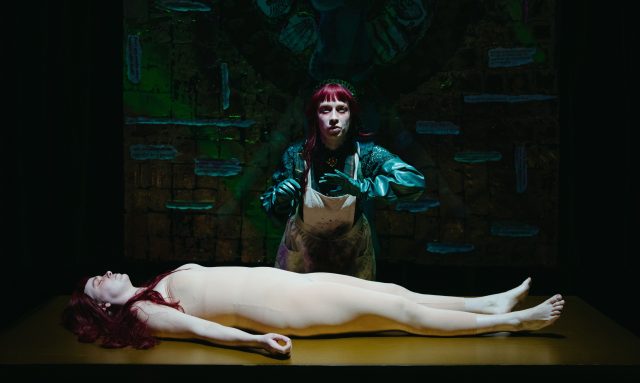
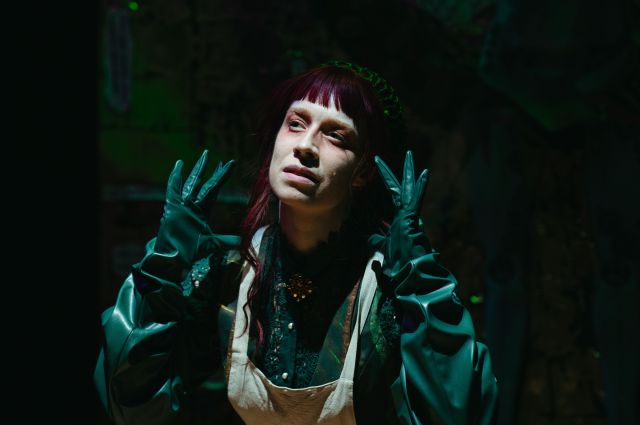
Hannah Wigglesworth and Julia van Dam in The Maids, Putrid Brat. Photo supplied.

By Liz Nicholls, 12thnight.ca
There’s something exactly right about entering the theatre through an unmarked door, down the stairs and into a space that invites reinvention and expands before your very eyes. It’s a world ready and waiting for actors to play in.

To help support 12thnight.ca YEG theatre coverage, click here.

The Pendennis Building downtown is where Putrid Brat, a new Edmonton indie theatre, introduces itself by producing an unsettling play that will fray the edges of your nerves (how quintessentially bratty is that?). That Jean Genet’s The Maids, forever young at 77 years old, is a piece all about performance, its seductions, its dangers, its artifices and limitations, is an intriguing calling card from two young actors, Julia van Dam and Hannah Wigglesworth, with director David Kennedy.

It’s a complicated game that Genet’s two maids play, a ceremony in which they take turns playing the mistress they both despise and idolize, and they play each other too. Claire (van Dam) and Solange (Wigglesworth) exist on a densely layered plane of adulation and grievance, oppression and fury. In a space that’s both claustrophobic and too big for them, they create their own theatre of sliding identity, in which their oft-rehearsed script leaks at the seams. And they dream, in a complex way, both of violence and love, homicidal revenge and emulation, a bloodstream of revolution.

Hannah Wigglesworth and Julia van Dam in The Maids, Putrid Brat. Photo by Kyle Tobiasson and PoppyRose Media

I had a chance, late in the run — and you have the chance till Sunday — to watch two very skilled actors in this tricky assignment. In the opening scene Van Dam (we’ll see her next week in Northern Light’s new Trevor Schmidt play Monstress) and Wigglesworth as Claire and Solange are in heightened mid-performance as the aggrieved maids. Claire plays the cruel, sneering Mistress and Solace is Claire, so reviled she’s not even fit to kiss the Mistress’s shoe.

“Take up the slack, you slut,” Mistress commands servant. “If you insist on snivelling, then snivel in your attic.” The translation by Brit playwright Martin Crimp has a kind of muscular danger, and humour, of its own.

When the Mistress herself comes home, you hear in Alexandra Dawkins’ detailed comic performance the noblesse oblige notes her maids have sounded and exaggerated in their impersonation — power wielded by the iron hand in the velvet glove, yes, and also condescension ambiguously camouflaged as disarming kindness. In the performance the Mistress projects a kind of vulnerability to men, to the servant class; it’s lethal to the maids’ plans, and she overplays self-consciously for her own benefit. In the dangerous game of attraction/revulsion, aggression and retreat, the maids have raised the stakes in their latest move, which they analyze over and over.

This intricate network of role-playing, alterations, second thoughts, reversals, in a world where fury and fear are in a tug-of-war for supremacy, is captured in Kennedy’s production.

Putrid Brat has attracted a top creative to their debut passion project: Kennedy’s direction, Even Gilchrist’s scenic design, Beyata Hackborn’s costumes, Nick Kourtides’s sinister sound design. And you have the opportunity to see two remarkable, and enterprising, actors at work. Keep your eye on these U of A theatre grads. They’re going places.

The Maids runs through Sunday at the Pendennis Building, 9660 Jasper Ave. Tickets: www.showpass.com/themaids/

Posted in Reviews | Tagged , , , , , , | Comments Off on Lethal power games as performance art: The Maids introduces a new indie theatre

Playwright Stephen Massicotte talks about Stars On Her Shoulders, his latest, premiering at Workshop West

Dana Wylie, Gabby Bernard, Dayna Lea Hoffmann in Stars On Her Shoulders, Workshop West. Photo by Marc J Chalifoux.

By Liz Nicholls, 12thnight.ca
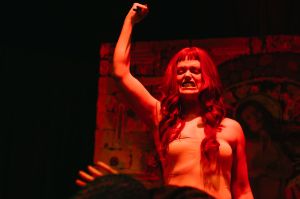
In 2002, a story of first love, a dreamscape looped against the horrific backdrop of World War I, changed the life of the graphic designer-turned-actor who’d “jumped into theatre cold.” as he puts it.

To help support 12thnight.ca YEG theatre coverage, click here.

Since its Calgary premiere two decades ago, Mary’s Wedding, Stephen Massicotte’s first full-length play has been on a mainstage odyssey across the country, the border, and the pond. In the elite pantheon of bona fide Canadian classics, it has a special place.

Stars On Her Shoulders, the new Massicotte play that opens the Workshop West season Friday (all tickets are pay-what-you-will!), returns the playwright to Canada (he’s lived in New York since 2007), to the World War I vault where Canadian history lies sleeping — and to the theatre where Mary’s Wedding began life as a Springboards staged reading.

It shares the World War I setting with Mary’s Wedding. But “it’s a totally different style,” says Massicotte of his new play, which he traces back to a first draft at Calgary’s Alberta Theatre Projects in 2016. If Mary’s Wedding is a lyrical, poetic wander through time and space, present and past, Stars On Her Shoulders reflects the brisker influence of Noel Coward, “and particularly Terence Rattigan,” he says of the English master of the traditional ‘well-formed play’. Especially “the feminist suffragette character” in Rattigan’s The Winslow Boy. “An articulate, smart, witty kind of woman of that period.”

The characters, five women in 1918 in the aftermath of a German bombing of a hospital in Doullens, France, are nurses. Two of them, “the heroes of the play,” work through the night rescuing survivors, saving patients’ lives, “putting fires out with their hands.” As Massicotte describes, “a lot of nurses came from prominent families, educated quite well. … I thought it’d be fun to have them (take on) an Oscar Wilde vibe, in the cleverness of their speech.” And he fashioned his play in that vein.

playwright Stephen Massicotte, Stars On Her Shoulders, Workshop West Playwrights’ Theatre. Photo supplied.

The old-school structure he’s chosen is, he thinks, a marked contrast to contemporary theatre practice of “many short, intense scenes in different locations,” a reflection of a generation tied to watching TV and movies, and quick small-screen interpolations. “Tennessee Williams, Chekhov … those guys all wrote like that, long scenes that don’t drop the tension by cutting to black-out.”

“It’s a lost art,” he says. “Setting: the drawing room, for a half-hour scene in that location, with people coming and going. Then, the next scene, ‘the drawing room later that day’ … changing from two-hander scenes to three, to four, back to three, in different configurations. It’s quite a feat, really. And it makes you go farther with a scene than you normally might.”

Canadian history provided Massicotte, a military history buff, with a controversy involving what sort of medal of bravery should be awarded the nurse heroes. “Canadian authorities pointed out to the British war office that, although they appreciated this honour, Canadian nursing sisters were officers,” and so should get the military cross. Elsewhere nurses were “regular soldiers,” eligible for a medal on a lower rung in the hierarchy of military distinctions.

He’d mined the incident for one of the “Canadian Heritage Minute” pieces he was enlisted to write. “Heritage Canada didn’t really want to get into the controversy, and focussed on the bravery.” But he’d seen the seeds of a play in it. Massicotte is amused by the fact that the costumes assembled and designed by Brian Bast include some from the Heritage Minutes as per their labels, an inadvertent testimonial to career continuity.

The seven-year arc to opening night, which includes the (alas) familiar COVIDian fits and starts, is, he says, “the longest period I’ve ever worked on a play…. What was good about it is that every time I thought it was ready, I re-wrote it some more. And now I’m pretty proud of it.” Originally Massicotte had planned to write only one more World War I play. Now he has a trilogy, that includes The Oxford Roofclimber’s Rebellion, encounters between war hero Lawrence of Arabia and the poet Robert Graves.

“I’m pretty stoked,” says the genial Massicotte, not least because “this is all women…. It’s a fact that over the years, less roles have gone to women. So anything woman in acting has to be that much better prepared, that much better skilled, that much better talented. Whereas with men, there are great actors out there of course. But sometimes a male actor can get by for a long time just by being OK, OK to work with, reliable.”

“I’ve never written a play with more females than male. And the place is crammed with talent. I’m so impressed,” Massicotte says of Heather Inglis’s production. “The whole cast is crackerjack, really on the ball. And they’re funny! This sounds like a heavy play, but it’s quite funny, I think, in places.”

Massicotte’s own storyline is an original, anything but predictable. “When people ask me where I’m from I don’t say Thunder Bay, where I grew up; I say Calgary,” Massicotte says. “It’s where I did my first plays; it’s where I had my first theatre success.” And he can claim Edmonton roots as well, since he took his earliest writing, The Boy’s Own Jedi Handbook plays, to the Fringe, and other one-acts to Nextfest here.

And, as a graphic design grad of Cambrian College in Sudbury he might never had ended up in theatre at all, if it weren’t for having a crush on a girl who happened to be a stage manager in the college theatre department. “I painted sets, built some set pieces, and thought to myself ‘I wonder if I could do that; I bet I could do that!’” He took improv classes at Magnus Theatre in Thunder Bay; he got cast in an amateur production of Sharon Pollock’s Blood Relations.

Why Calgary? “At the time I was an air cadet, and in summer I used to teach at the cadet camp in Penhold, and many any of my best friends at the time lived in Calgary.” So, theatre school at the University of Calgary, as an actor, followed, along with occasional thoughts like “What have I done?”

Todd Houseman and Tai Amy Grauman in Mary’s Wedding, a Métis version. Citadel Theatre. Photo by Arthur Mah.

In Calgary he did plays, TV, commercials, “whatever came along.” And then came Mary’s Wedding, “and everything exploded. Oh, I guess I’m a writer now!” And it’s a career that catapulted him to theatre stardom, without a single writing class. “I still write from an actor’s point of view,” he thinks. “What would be fun for actors to do? What would they really enjoy sinking their teeth into? And I try to make even the small roles exciting to play.”

In New York, where he’s been for 17 years, with an American partner (“she went to McGill; she’s Canada-qualified!” he laughs), he writes mostly screenplays for TV and film, especially of the horror stripe. He and his film collaborators have an indie horror film How We Ended ready to go, and they’re looking for distribution. And he’s been working on a youth-oriented fantasy novel. “Stars on Her Shoulders is my first new play in a long time,” he says.

Do his explorations of horror and war have a certain continuity? He muses on the question. “I suppose they’re similar in that people are facing an existential danger. In plays it’s a bit more subtle, of course: someone facing a loss of hope, a loss of the ability to carry on. And having to recover even the tiniest thread of something that can keep them going.”

That is “a something you can get from human interaction, love, friendship, that can help you survive,” even those moments when “nothing seems to matter but we’re all supposed to keep going…. Even when living one more day is an act of defiance in the face of oblivion, sorrow, grief. Hope is this precarious act of profound bravery.”

It applies to the nurse characters of his new play, up against war and the circumscribed rights of women. And “when you have enough plays to look at,” he says, “you realize how much you’re writing about yourself.”

PREVIEW

Stars On Her Shoulders

Theatre: Workshop West Playwrights Theatre

Written by: Stephen Massicotte

Directed by: Heather Inglis

Starring: Hayley Moorhouse, Meegan Sweet, Gabby Bernard, Dayna Lea Hoffmann, Dana Wylie

Where: Gateway Theatre, 8529 Gateway Blvd.

Running: Friday Nov. 1 to 17

Tickets: All tickets are pay-what-you-will this season at workshopwest.org.

Posted in Previews | Tagged , , , , , , | Comments Off on Playwright Stephen Massicotte talks about Stars On Her Shoulders, his latest, premiering at Workshop West

Two actors, a passion, and a mission: Jean Genet’s The Maids, three years in the making, opens downtown

Julia van Dam and Hannah Wigglesworth in rehearsal for The Maids, Putrid Brat. Photo supplied.

By Liz Nicholls, 12thnight.ca

In the chiller of a play that opens October 25 in an eerie downtown basement, you’ll watch two sisters act out a dangerous, nerve-wracking, possibly lethal, role-playing game with each other — in a theatre of their own making.

To help support 12thnight.ca YEG theatre coverage, click here.

In a way Claire and Solange, the title characters of Jean Genet’s tense and suspenseful 1947 play The Maids, are performance artists. The sisters, maids in a love/loathe relationship with their mistress, take on, and exchange, roles across the class and power divide. Their ritual is to take turns playing imperious, casually disdainful Madame, and each other. They drink a cocktail of contempt and admiration, and fantasize murderously about what it would take to change their world.

Theatre, roles, performance, fantasy that drifts into reality, inequities of power … it all sheds light on the imaginative hold the play has had for three years on Hannah Wigglesworth and Julia van Dam, two  young up-and-coming actors who emerged from the U of A’s BFA acting program in 2021 with a theatrical mission.

Hannah Wigglesworth and Julia van Dam in The Maids, Putrid Brat. Photo by Kyle Tobiasson and PoppyRose Media

The pair, theatre school classmates, have turned producers; they’ve written dozens of grant applications, raised money, sought out an award-winning director, found a venue in the newly restored Pendennis Building on Jasper Avenue. And they’ve named their new indie troupe Putrid Brat (from a line in The Maids translation by Brit playwright Martin Crimp). All in pursuit of the upcoming production directed by U of A drama professor David Kennedy, in which they play the maids, with Alexandra Dawkins as Madame.

As they explain over a pre-rehearsal coffee, Wigglesworth and van Dam were moved to collaboration after a scene study with Kennedy from The Maids during the pandemic. “We were really drawn to it, so much to dig into,” says Wigglesworth. And in Kennedy they both appreciated “a really great director, so passionate about the work…. “

The pair dreamed of a full production. “We just thought ‘when theatre comes back …IF theatre comes back….”

As they think about it now, it is perhaps no coincidence that Wigglesworth and van Dam were so attracted to a play about a power imbalance, and the longing to reclaim some control over their lives. They felt it. For one thing, they were part of a U of A graduating class that spent most of their arduous and intense four-year BFA program online, thanks to COVID — a particularly unsatisfying scenario in an art form that’s all about connecting with an audience.

As a theatre student in an all-consuming total-immersion program, a psycho-drama of its own, “your time is really not your own; it’s hard to have a second to think for yourself, and look beyond,” Wigglesworth says…” And at the best of times an actor’s life, after that, involves “a lot of waiting by the phone,” or the inbox. But in times of huge uncertainty, and at the start of theatre careers, they felt especially at the whim of others, of circumstances, of the world. “We were wanting to take some power back,” she thinks as van Dam nods. “To have some control of our own destiny, taking control of anything we could because we felt so out of control.…”

As van Dam puts it, producing The Maids was a kind of statement for them: “I’m not going to let this place (the university) define me. There’s a life beyond this! Anger was really a strong motivation for me.”

A farm kid from the Netherlands who moved to Canada at age six, van Dam drifted away from theatre into film and TV after graduation. The Brandon Rhiness indie film Grotesque, a lot of commercials, and one big American production, Under The Banner of Heaven with Andrew Garfield, shot in Calgary are on her resumé.

She credits Trevor Schmidt’s Northern Light Theatre production of A Phoenix Too Frequent last fall — she played a widow who gives up grief in favour of falling in love — with bringing her back to the stage. And next month Edmonton audiences will see her in the new Schmidt play Monstress at NLT, with more stage work to come this season.

Wigglesworth, originally from Winnipeg, went to Stratford for two seasons, as part of the Birmingham Conservatory, and ended up onstage with the Stratford heavy-hitters, like Colm Feore, in Richard III, as well as The Miser, the Brad Fraser adaptation of Richard II, and a modern take on Love’s Labour’s Lost. She’s now re-located to Toronto, for film and TV opportunities.

All the while, van Dam and Wigglesworth were brainstorming, long distance, about The Maids. The production history of Genet’s play includes every kind of venue, and staging it in a formal theatre was never in their plans. “From the start we thought warehouse,” says van Dam. But they considered every kind of “theatre,” an Airbnb, Rutherford House…. They considered casting a child, or a puppet, as Madame. “Crazy! When we found the space (in the Pendennis Building), it solidified a lot of things for us.”

Three years later, they’re still passionate about the theatre project they’ve built from the ground up. The 1947 play has invited every sort of interpretation: in some productions Claire and Solange are played by men, adding another level of artifice to the role playing, and taking their cue from Genet’s own introduction. Some productions are driven by the class struggle and economic inequities; others lean into the  homo-erotic potential available in The Maids. It seems to speak to every age.

So how does a 1947 play sit in 2024?  “Lately I’ve been feeling it focus on the patriarchy,” says Wigglesworth. “The three women onstage are, in different ways, jostling for their spot in this hierarchy created by men…. You think Madame has all the power, but she’s struggling too with the same things (the maids) are, at a very different level.”

Though the men are never seen onstage, the characters “are very aware of how they’re seen by men.” As van Dam puts it, “who has more value in the eyes of men?”

“When you feel powerless, what are you willing to do, what lengths will you go to to get some agency back in your life?” says Wigglesworth. It’s a question that resonates powerfully in The Maids, and for two young actors at the start of theatre careers. “I feel like Hannah actually is my sister,” grins van Dam.

PREVIEW

The Maids

Theatre: Putrid Brat

Written by: Jean Genet, translated by Martin Crimp

Directed by: David Kennedy

Starring: Julia van Dam, Hannah Wigglesworth, Alexandra Dawkins

Designed by: Even Gilchrist (set), Beyata Hackborn (costumes), Nick Kourtides (sound)

Where: Pendennis Building, 9660 Jasper Ave.

Running: Oct. 25 through Nov. 3

Tickets: www.showpass.com/themaids/

Posted in Previews | Tagged , , , , | Comments Off on Two actors, a passion, and a mission: Jean Genet’s The Maids, three years in the making, opens downtown

Bear Grease: an Indigenous makeover for the classic musical, at the Citadel

Bear Grease the Musical, a LightningCloud production at the Citadel Theatre. Photo by Nanc Price

By Liz Nicholls, 12thnight.ca

Call it cosmic inevitability if you will. Or maybe an irresistibly cool idea whose time is overdue. But some shows can’t not be born.

To help support 12thnight.ca YEG theatre coverage, click here.

Bear Grease, the hit Indigenous makeover of that classic 1972 musical that takes us all to the ‘50s, is like that. The inspiration of Henry “Cloud” Andrade and Crystle Lightning, Bear Grease re-launches the Citadel’s Highwire Series Friday after a year’s hiatus. And it arrives on the Maclab stage after three years of touring, 169 shows worth, to sold-out houses on both sides of the border.

And it started here, at the 2021 Edmonton Fringe. That was the year Fringe artistic director Murray Utas invited the husband and wife duo to perform in their hip-hop group LightningCloud on a dedicated Indigenous stage in the festival’s new Pêhonân series. “Hold on!” Andrade told him. “We wrote something new (back then it was called Bannock Grease). And it’s pretty freakin’ hilarious. Can we try that instead?” From Utas, as is his wont, it was a Yes! And tickets for the entire run got snapped up instantly.

Lightning, who’s from the Enoch Cree Nation, recalls the random spark that got ignited one night when she and Andrade were watching the 1978 John Travolta/ Olivia Newton-John movie, one of their faves, on cable. “Wouldn’t it be amazing if we had a show like this?…. There’s no representation out there. And this is so cool, it’s funny,  it’s contemporary. No buckskin, no scenes on the back of a horse! ” In this Lightning speaks from experience. She moved to L.A. age nine with the family and her actress mom, and film and TV started happening for her right away (her first lead role: 3 Ninjas: Knuckle Up).

“An all-Native Grease … we just started laughing,” says Andrade, an Indigenous Mexican (Huichol/ Wixárika) born and raised in L.A. His solo show Evandalism chronicles his hard-ass upbringing there and his rescue from gang culture when he found the arts (or vice versa). “I’ve always been in theatre,” he says, “ever since fourth grade, Rudolph the Red-Nosed Reindeer and I was Rudolph.” But he drifted away from theatre: “I was kinda type cast, Gangster #3 or Cholo #2.”

But theatre was still on his mind. “And I used music to scratch that itch.” Hiphopera, the marriage of theatre and hip-hop, brought him back, he says. And he started writing, too.

On the fateful night of Grease on cable, brainstorming instantly began. Andrade is, after all, an award-winning MC, and holds the Guinness record for “longest freestyle rap,” a mind-boggling 18 hours. Summer Nights, the Danny/Sandy duet that’s permanently lodged in your brain, got a twist, with the Indigenous slang for making out, hooking up. You know the tune, I know you do. “Summer snaggin’, had me a blast; summer snaggin’, happened so fast…. I met a girl, she’s Enoch Cree. I met a boy who’s not related to me.”

“We wrote the whole song that night,” Andrade says. And the pandemic lockdown was the chance to amplify the 35-minute Fringe edition of Bear Grease. “We wrote in all the missing songs.” Some are in the spirit of Grease parodies, with new, Indigenized lyrics (“meet me at the powwow, you’re the one that I want”); some are from LightningCloud albums. “We knew the audience was going to want ‘something Grease’,” as he puts it. “Then  we started rapping.”

“We put in some hip-hop while still keeping the ‘50s flavour,” says Lightning, whose theatre training at the Beverly Hills Playhouse was of the full-on classical stripe. “That was important to us. We kept the melody and feel of it, the vibe, carved out the words, added our own, added some Native slang….”

Henry “Cloud” Andrade (centre) and the touring cast of Bear Grease, 2023. Photo by KGE Photography

The production reflects that, says Lightning, who played Sandy in much of the Bear Grease touring so far, but removed herself from the cast after show #140 to pass the torch and make her directing debut (Andrade, who was Danny, is the music director and stage manager). “The poodle skirts are still A-line. But instead of a poodle, there’s a bear and ribbons. The guys are still wearing black leather, but now they have beautiful bead-work medallions and kookum scarves. Sometimes they wear moccasins instead of Chuck Taylors….”

Crystle LIghtning and Henry “Cloud” Andrade in the touring Bear Grease, 2023. Photo by KGE Photography.

The ensemble, all Indigenous, are from  is from actors in the diverse, all-Indigenous cast bring with them their own localized traditions and cultural flavours. New to the current cast are three performers, Justin Giehm and Raven Bright, both Dene Navajo from New Mexico, as Sonny and Roger respectively, and Tesla Wolfe as Frenchie. And everywhere Bear Grease goes, “we try to have local references,” Lightning say. “What is the local thing?” In Treaty 6 territory, for example, the show is threaded with Cree here and there, and place names.   

Why take on Grease, instead of, say, any other quintessential American musical? Andrade, amused, remembers playing Sonny in a high school Grease. Lightning says her teenage parents’ first date was watching Grease at the Enoch drive-in. “And nine months later I was born!”

“I wasn’t a rapper at first,” she says. “I started out as DJ, working Hollywood clubs.” She and Andrade met in L.A., at a magazine photo shoot, and they fell in love.  “He asked me to DJ for him for a couple of shows, and then for a 12-day tour…” And then, as she started rapping onstage with Andrade, LightningCloud was born, “first one song, then another, and soon we’re a full-on hip-hop group.” Albums and awards, and touring on both sides of the border, ensued.

The Lightning and Andrade love story gets a dramatic boost at River Cree. Lightning is seven months pregnant and onstage there when her water breaks, which pretty much redefines the ‘actor’s nightmare’. And while she’s at the Misericordia Hospital for the birth of their son, filmmaker Michelle Latimer calls to offer her “a delicious starring role” in the CBC Trickster series.  And she won a Canadian Screen Award as best actress in a drama series for her work. “When my son was born, my world was opened up to roles I’d always dreamed of,” she says.

The couple moved from L.A. to Edmonton, Lightning’s home turf. “Even when I was just visiting (with a touring hip-hop improv group called Free Daps, Orlando-based) I could see that this is a theatre town,” says Andrade. “A town that embraces the performing arts.”

And Bear Grease isn’t just a celebration of Indigenous cultures married to a much-loved musical, as Lightning muses. It’s a crucial “what-if?” proposition, too. After all, Grease conjures an era, the ‘50s, when “opportunities (for Indigenous artists) were non-existent. And they still kind of are…. We have to create for ourselves; no one’s knocking on our door.”

“What if we’d gotten this opportunity before?” she asks. “What if colonization had never happened? Would we have been out there like Olivia Newton-John and John Travolta.”

“But because our reality was a bit different, we had to re-create in a parallel universe….” she says. There are references to darker subjects (residential schools), but the show takes a more oblique route to understanding. “It’s a comedy! And we want everyone to be entertained and have fun.”

Ah, with more to come, says Lightning. “What about Bearspray? Or Rez Side Story?.” Stay tuned.

PREVIEW

Bear Grease

Theatre: LightningCloud in the Citadel Highwire Series

Created by: Henry “Cloud” Andrade and Crystle Lightning

Directed by: Crystle Lightning

Starring: Raven Bright, Kean Buffalo, Bryce Morin, Melody McArthur, Tammy Rae, Teneil Whiskeyjack, Rodney McLeod, Skylene Gladue, Justin Giehm, Tesla Wolfe

Running: Oct. 17 to 27

Tickets: citadeltheatre.com, 780-425-1820

Posted in Previews | Tagged , , , , , , , | Comments Off on Bear Grease: an Indigenous makeover for the classic musical, at the Citadel

Don’t look now, but who’s that behind you? The Woman in Black, at Teatro Live! A review.

Geoffrey Simon Brown and Julien Arnold in The Woman in Black, Teatro Live! Photo by Marc J Chalifoux

By Liz Nicholls, 12thnight.ca

“Have sympathy for your audience!” roars The Actor (Geoffrey Simon Brown) emphatically at the start of The Woman In Black, the hit thriller that launches the Teatro Live! season at the Varscona. “Draw on your emotions and our imagination.”

To help support 12thnight.ca YEG theatre coverage, click here.

Andrew Ritchie’s crack production does both.

The Actor has been hired to coach a stiff elderly solicitor, one Arthur Kipps (Julien Arnold), in the fine art of performance. Arthur is a test case for beginner thesp lessons (one of our best actors, Arnold tackles bad acting expertly). But he persists. He feels a compelling need to release the nightmare burden that’s haunted him for 30 years by telling his story to an audience, his family. “Terrible things have happened to me,” he says. “The story must be told.”

The story is a classic old-school goth chiller, of Edwardian provenance. It takes us to a gloomy mansion in a desolate salt marsh on the northeast coast of England, a house so isolated it’s only accessible across a skinny causeway at low tide. But as for the storytelling, the fun of The Woman In Black, a cunning and intricate 1987 adaptation by English playwright Stephen Mallatratt of Susan Hill’s novel — it ran in the West End for 34 years before it closed in 2023 — is that it belongs so fully to the theatre.

It engages “our emotions and our imagination” in the ingenious ways it uses deliberately minimalist theatrical props (a trunk, a couple of chairs, a door, a doll) designed by Alison Yanota, and the technical resources of the theatre. It’s a study in unlocking the power of suggestion to create suspense. When a rocking chair rocks, by itself, in Act II, the audience gasps. Which reminds you how fun it is to share a gasp with an audience.

Geoffrey Simon Brown and Julien Arnold in The Woman in Black, Teatro Live! Photo by Marc J Chalifoux.

Ritchie’s production, and his team of designers, are inspired by the possibilities of this theatre playground. Leona Brausen’s costumes — bowlers, Edwardian suits, rustic garb for the northerners — locate the story in time. The Actor and Arthur Kipps marvel at the “recorded sound,” as they put it, and there’s unnerving live sound too, interspersed with creaks, the whoosh of wind, disembodied shrieks at various imaginary distances, all part of Tori Morrison’s dramatic sound design. And the lighting created by T. Erin Gruber is a character too, an unsettling landscape of semi-visibility, shadows, darkness erupting into startling flashes, flickering lights from mysterious sources. Lighting and sound surround us in this storytelling, from behind, through the aisles, in the unexplored pockets of darkness at the edges of the stage.

Both sound and light play across a gauzy screen that separates past and present. And it opens to reveal — no, suggest — the mysterious labyrinth of Eel Marsh House, in Yanota’s design.

In short, the theatre feels occupied, so to speak, by the story. The play begins in a darkened Edwardian theatre, and the Varscona, with its proscenium, its red velvet curtains, its brick and wood, turns in a fine period performance. That Strathcona venue has never felt smaller, and that’s a compliment.

Geoffrey Simon Brown in The Woman in Black, Teatro Live! Photo by Marc J Chalifoux.

I’ve left the narrative to the last, because there’s a lot that mustn’t be revealed in advance (as The Actor says at the outset, “have sympathy for the audience” and I’m all for that.”). The Woman In Black is a play within a play, and there’s a moment when the inner play slides in and takes over, and the actors switch places. Geoffrey Simon Brown plays the younger Arthur Kipps, a skeptical lawyer sent by his London office to the village on the marsh, to settle the affairs of the elderly occupant, deceased, of Eel Marsh House. He doesn’t believe in ghosts, but…. The performance charts the gradual escalation of his unease into terror. “What are you holding back? I must know!” he cries to a local.

Julien Arnold and Geoffrey Simon Brown in The Woman in Black, Teatro Live! Photo by Marc J Chalifoux.

And Arnold, unleashing a whole arsenal of accents, plays everyone else the young Kipps meets on his life-changing journey north, taciturn villagers and eerie pony cart drivers included. In Arnold’s performance the characters are precisely differentiated. “You may doubt,” says one village dweller. “We know.”

In a thriller with only two credited actors (and one uncredited dog, excellent in the role of Spider), the challenge to the actors to conjure the full cast is extreme. And these are actors who dig in. This, incidentally, is the second production of the theatre season in which a character will holler “Stella!” at top volume.

There’s the tickling suspense of wondering, and there are scary surprises, my friends, in this season of the scary. Buy in — the invitation offered by the production is alluring — and see what live theatre can do.

Check out 12thnight’s PREVIEW interview with director Andrew Ritchie.

REVIEW

The Woman In Black

Theatre: Teatro Live!

Written by: Stephen Mallatratt from a novel by Susan Hill

Directed by: Andrew Ritchie

Starring: Julien Arnold, Geoffrey Simon Brown

Where: Varscona Theatre, 10329 83 Ave.

Running: through Oct. 27

Tickets: teatrolive.com

Posted in Reviews | Tagged , , , , , | Comments Off on Don’t look now, but who’s that behind you? The Woman in Black, at Teatro Live! A review.

The existentialists from Ummo are back: Mump and Smoot in Exit, at Theatre Network. A review.

John Turner (Smoot) and Michael Kennard (Mump) are back, in Mump and Smoot in Exit, Theatre Network. Photo by Ian Jackson, Epic Photography

By Liz Nicholls, 12thnight.ca

Mump and Smoot arrive, as always, from a mysterious place, through the crowd — inhabitants of another mysterious place, the theatre (that’s us!). And, as always, they’re mid-adventure, mid-conversation, en route to the stage.

To help support 12thnight.ca YEG theatre coverage, click here.

It’s dark; they’re carrying lanterns. Each is chained to the heavy burlap sack they’re dragging. And we’re never quite sure whether their nightmare is us, or vice versa.

After a decade’s absence, the ‘clowns of horror’ from the planet Ummo are back among us, at Theatre Network to premiere a new show, Mump and Smoot In Exit. And it’s an original, unusual even in an archive with a notable attraction to the grotesque and the macabre.

In their collected canon, the interplanetary travellers, who speak Ummonian (a language that hints now and then at English, “Wow”, “I’m outta here”), have found themselves in locations we’ve all experienced: a tent in the wilderness, a wake, an airplane, a restaurant negotiating spaghetti…. Eruptions of blood and gore, unhinged entrails, severed limbs, rarely to be found in Trip Advisor, just happen. The familiar is a slippery slope it seems.

Anyhow, in Mump and Smoot in Exit, the latest from the prize Canadian theatre artists Michael Kennard, John Turner and director Karen Hines (whose character Pochsy is one of the country’s great creations too), they have arrived in a smoky place where none of us has been. And we’re discovering it together. There are clues, to be sure (design consultant: Andraya Diogo). It’s a landscape dominated by a skeletal tree (Beckett’s vagabonds, waiting around Godot to show up, would recognize it), full of bones and skulls, enigmatic monuments, a gargoyle with glowing red eyes. The entrance is an electrified archway of skulls. And they are not always alone there (Lauren Brady, listed in the credits as “Actor,” in full spectral get-up).

Mump and Smoot (Michael Kennard and John Turner) In Exit, with Lauren Brady as Gog. Theatre Network, photo by Ian Jackson, Epic Photography.

There will be a moment for Mump and Smoot when it dawns on them where they are; it’s a moment we’ve been wondering about, too. Incidentally this poses a special problem for a writer: there’s so little I can tell you about the story without spoiling it. So I’m leaving that aside, for your own good.

Mump (Kennard) is the bossier, shirtier, more aggressive one in a tuxedo jacket, with the single periscope horn. He’s the one who takes charge and gets mightily irritated when things go south. Heavy is the head that wears the crown. Smoot (Turner) is more pliable and impulsive, distracted by the audience, and ready to play. If he were to see a skull (and he does) he’d pick it up and give it a pat on the bonce. I’m pretty sure I heard “alas poor Yorick” emerging from the Ummonian phrase book. Ditto “don’t touch” from Mump. Everything that happens in In Exit is a test of this comically fraught, signature relationship.

Mump (Michael Kennard) and Smoot (John Turner) “In Exit,” Theatre Network. Photo by Ian Jackson, Epic Photography.

They arrive onstage in a kind of daze, as if the show is an aftermath of something. Smoot isn’t feeling 100 per cent. Mump, who’s whispering, isn’t quite his usual confident self either; he looks oddly bewildered, then downright appalled. They are trying to remember how they got where they are. And it’s a measure of Kennard and Turner as actors in action, in detailed comic performances, that we understand, without language, an existential conundrum.

Smoot, with his chipmunk voice, is the follower, the voluble one who ingratiates himself with the audience (we go “awwww” and Mump grimaces). Mump, the skeptic, rolls his eyes; he makes of congenital exasperation an entire repertoire of reactions in Kennard’s performance. His characteristic gesture is throwing his hands up, an eloquent ‘whatever’ at moments of maximum aggro.

Victor Snaith Hernandez’s lighting is rather spectacular. And Greg Morrison’s superb original score, with its strange jagged dissonances and mad violin riffs, is in itself an aural exposition.   

It’s a show unusually laden with props. And much to Mump’s chagrin (and the general hilarity in the house), they were wayward on opening night. But hey, that gave us a chance to appreciate Kennard and Turner’s skills as improvisers. For me, the more overt sequences with the audience, a group invocation to Ummo for example and a bilingual conversation soliciting individual audience members to answer a question, might be tuned up, along with the scenes involving puppet versions of the characters. So far, the seams do show a bit.

The particular genius of Mump and Smoot is the way they put the physical — no, the visceral — into dark comedy. We’re only held together by a wing and a prayer, apparently; otherwise our arms and legs would fly off, a foot here, a bone or two there. These things happen when you’re a clown of horror. And, speaking as we are of visceral, there’s lip-smacking fine dining onstage.

But in Mump and Smoot in Exit, black comedy is infiltrated by questions of good and evil, life and death. Religion — they are disciples of the god Ummo — is put to the test. Is memory a haunting? Can you really know if you’re in a bad dream or actually conscious? Mump and Smoot In Exit wonders about things like that. And so do we. It’s high-stakes hilarity, and we laugh and keep on laughing.

REVIEW

Mump and Smoot in Exit

Theatre: Theatre Network

Created and performed by: Michael Kennard and John Turner

Directed by: Karen Hines

Running: through Oct. 27

Tickets: theatrenetwork.ca

Posted in Reviews | Tagged , , , , , , | Comments Off on The existentialists from Ummo are back: Mump and Smoot in Exit, at Theatre Network. A review.

Let’s do the Time Warp again: on being Dr Frank-N-Furter in Grindstone’s cult classic season opener

Zachary Parsons-Lozinski as Frank-N-Furter in Rocky Horror Show, Grindstone Theatre. Photo supplied.

By Liz Nicholls, 12thnight.ca

It’s time warp time. Picture this: a little kid in the single-digit age bracket, with Halloween insomnia, sneaks downstairs way past his bedtime and turns on the TV. He flips through the channels; he stumbles on a sight, and an attitude, he would never forget. He finds himself immersed in the fun and games at Dr. Frank-N-Furter’s place.

To help support 12thnight.ca YEG theatre coverage, click here. 

“It was the first authentically queer film I ever watched,” says the exuberant Zachary Parsons-Lozinski, of The Rocky Horror Picture Show. The 1975 celluloid incarnation of a sci-fi rock n’ roll goth fantasy cult musical devised two years earlier by an out-of-work B-movie-obsessed London actor (that would be Richard O’Brien) made an indelible impression. “I was swept away by the outrageousness and the irreverence, not knowing either of those words — and the aggressive unashamed queerness of it!” Talk about “another dimension, with voyeuristic intention,” as the Time Warp number has it.

Zachary Parsons-Lozinski in Rocky Horror Show, Grindstone Theatre. Photo supplied.

That was the ‘90s. And Parsons-Lozinski’s awestruck, and receptive, younger self (“I don’t know what this is, but I’m confident I AM this!”) could hardly have predicted that his grown-up theatre artist self would be onstage in the Halloween season of 2024, starring as the “sweet transvestite from Transexual, Transylvania” in the cult classic. Byron Martin’s production of Richard O’Brien’s Rocky Horror Show launches Grindstone Theatre’s first-ever mainstage series of big musicals at the Orange Hub (Oct. 18 to Nov. 3). “I think shows come into your life when they’re meant to!”

“I jokingly say that the plot is ‘straight couple makes gay friends’,” declares Parsons-Lozinsky, who arrives at a Strathcona coffee joint in pink sequinned clogs and a leopard coat with cuffs the size of truck tires (“my fashion sense is ‘enthusiastic’”). He has one of those laughs that could pop the earbuds out of email-ers three tables away.

Bella King, Zachary Parsons-Lozinski, Cameron Chapman in Rocky Horror Show, Grindstone Theatre. Photo supplied.

If you’ve ever snapped your rubber gloves along with Frank-N-Furter at an interactive performance on stage or screen, I don’t need to tell you this. But, what the hey, it involves the dark-and-stormy-night arrival of newly engaged innocents Brad (Cameron Chapman) and Janet (Bella King) at the mansion of the enterprising scientist, “an unapologetically queer space” as Parsons-Lozinski puts it. The raucous (singing) household includes the show-stopping creepy butler Riff Raff (Josh Travnik) and his sister Magenta (Kendra Humphrey) — and Frank-N-Furter’s pièce de résistance. Which is the unveiling of his latest lab creation, the muscular specimen of the title (Mark Sinongco).

Parsons-Lozinski arrives in fishnets (“and lots of skin”) on the Orange Hub stage that once belonged to his alma mater MacEwan Theatre Arts, and his student performance as Man #1 in The Music Man, now lost, alas, in the mists of time. He brings with him a resumé packed with punk, club dates, cabarets, drag shows as his high-heeled persona Lilith Fair, and playwriting (The House That Fucks played Off-Broadway in the Fringe Encore series in 2022).

His drag debut was in a show for a vanished Edmonton troupe wth an enigmatic name, Rabbit Marmot. And after graduation he worked for Aimée Beaudoin (now the co-owner and co-producer of Spotlight Cabaret) on the Jubilations Dinner Theatre circuit. He was the first full-time drag cast member in their Orange Is The New Pink — as Lilith Fair.

He’d long been fascinated by drag and its theatrical possibilities. A remount of Guys in Disguise’s BitchSlap! was “the first drag show I’d seen where the drag wasn’t the joke; it was the medium for telling the story.” And he held that thought.

The Pansy Cabaret, starring Zachary Parsons-Lozinski and Daniel Belland. Photo supplied.

Recently, Parsons-Lozinski, Calgary-based “for now,” has been leaning into theatre. “I feel like I’m moving into a different stage of my career,” he says. The turning point, he thinks, was The Pansy Cabaret at the Fringe in 2022, Darrin Hagen’s meticulously researched exploration of a vivid, playful, and brave chapter of showbiz history: the flowering of queer and drag culture on Broadway and vaudeville during the Prohibition era in New York. And its utter erasure by homophobia in a single decade when Prohibition ended. The jaunty performance style, the sounds of that era and its cheeky and sometimes poignant Edwardian song repertoire, the sassy interaction with the audience … all were well within the Parsons-Lozinski compass in a bold, resourceful star performance, as Edmonton audiences discovered.

“Darrin,” he says, “has been my biggest inspiration…. He changed my life by putting me in The Pansy Cabaret. That show put me on a completely different path.” And its “homage to the people who came before me and who bravely put it all out there so I can be the artist I am now” inspired a post-Pansy Cabaret creation of his own. Millennial Sex Witch is “a continuation of that thought, through a contemporary lens, what it’s like to be a drag artist now.”

Zachary Parsons-Lozinski and Thomas Jones in With Bells On, Theatre Network. Photo by Ian Jackson, EPIC Photography

In With Bells On, the 2023 Devanand Janki/ Tommy Newman holiday musical based on Hagen’s two-hander comedy of that name, Parsons-Lozinski played a drag queen, in full seasonal regalia, stuck in an elevator with a mousey sad-sack accountant. “Family friendly! A lovely heartwarming Christmas show. And transgressive because of that,” says the actor cheerfully.

At the other end of the spectrum, tonally speaking, is Liam Salmon’s furiously articulate, politically scathing solo play Local Diva which premiered at last summer’s Fringe. Fuelled by exasperation, then outrage, the Local Diva character was “the most aggressive thing I’ve ever done,” says Parsons-Lozinski. And it unleashed, not unexpectedly, a toxic deluge of homophobia on social media.

He’s done lots of musicals, and is about to do another. But even though he graduated from a theatre school specializing in musical theatre, Parsons-Lozinski doesn’t really think of himself as “a musicals person” per se, “I don’t read music. And I love to smoke…. I sound more like Kathleen Turner every day.”

Rocky Horror is “the perfect intersection of the aggression of Local Diva and the frivolous fun of With Bells On,” he thinks. “It’s so powerful to be able to come into this show which formed so much of the comfort I have with my identity now, and the body of work I would pursue. And to use it as a middle finger….”

The timing is right: “there’s so much aggression and resistance to queer work,” he says. “I have been on the receiving end of so much vitriol on social media, from people who want to vilify my community…. I’m channelling both my love for the material, and this anger I have about we are being talked about,” he says. “That aggression, that resistance … I feel like I’m able to throw it back!” And, hey, there’s no fourth wall.

Each performance of the show will feature a new guest as the Narrator. And Grindstone is going full-interaction with the production. Which makes Rocky Horror  “a great choice” for the little company that brought us Hot Boy Summer and Die Harsh. “Their roots are in improv,” as Parsons-Lozinski points out. And in this musical “the audience is its own character.”

With his club cred, Parsons-Lozinski has always savoured that direct connection. Be warned. He can hardly wait.

Check out Grindstone’s mainstage season lineup at the Orange Hub (where they manage the theatre spaces) here.

PREVIEW

Richard O’Brien’s Rocky Horror Show

Theatre: Grindstone Theatre

Created by: Richard O’Brien (music, lyrics, book)

Directed by: Byron Martin

Starring: Zachary Parsons-Lozinski, Bella King, Cameron Chapman, Kendra Humphrey, Mark Sinongco, Josh Travnik, Karlee Squires, Evan Dowling

Where: Orange Hub, 10045 156 St.

Running: Oct. 18 through Nov. 3

Tickets: showpass.com

Posted in Previews | Tagged , , , , , , | Comments Off on Let’s do the Time Warp again: on being Dr Frank-N-Furter in Grindstone’s cult classic season opener

The fun of being scared together: Andrew Ritchie directs The Woman In Black, to open the Teatro Live! season

Julien Arnold and Geoffrey Simon Brown, in reheasal for The Woman In Black, Teatro Live! Photo by Cassie Duval.

By Liz Nicholls, 12thnight.ca

“People love to be scared,” says Andrew Ritchie decisively. (And  he’s got a whole movie industry to back him up on that).

To help support 12thnight.ca YEG theatre coverage, click here.

The genial director of The Woman in Black, the atmospheric horror-thriller opening the Teatro Live! season on the Varscona stage Friday, hopes to “make us scream.” He has at his disposal a long-running hit that had been doing exactly in London’s West End for 34 years until it closed in 2023. What Ritchie has in mind, beyond the dread and the shivers and the jump scares is “sweeping us up in the story and making us care about the characters.”

Ritchie’s Teatro debut is an ingeniously theatrical two-actor adaptation, by the English playwright Stephen Mallatratt, of the gothic 1982 novel by Susan Hill. “Scary fun… and at the heart of it a tragic story,” as Ritchie says, looking for vagueness. “Real tragedy happens to some people … a family … families.…. I don’t want to give too much away!”.

The Woman In Black is an Edwardian era ghost story that takes us to the eerie windswept marshes of northeastern England, and a haunting. And it comes with all the classic remote country house trimmings, and “a Victorian era Dickensian sort of vibe,” as Ritchie puts it. “It lives in a similar world to the other ghost play that’s done in Edmonton every year, A Christmas Carol.”

The particular cleverness of The Woman In Black is that’s a play within a play, with a cast of only two who play many characters. And it starts in a theatre.

Geoffrey Simon Brown and Julien Arnold in rehearsal for The Woman in Black, Teatro Live! Photo by Cassie Duval.

An elderly lawyer, one Arthur Kipps (Julien Arnold), has hired an actor to turn the mysterious story of what happened to his younger self 30 years before into a drama. “The play is so theatrical, meta-theatrical,” says Ritchie in appreciation. “So much of the play someone hiring an actor/director to help him perform a piece of text — mirrors our own process in the (rehearsal) hall. You are watching a play. And we are working on a play together….”

A director friend described it to Ritchie as “the play tells you how the magic trick works, then shows you the magic trick,” he says. In effect, the theatre is the set. And this has delighted the founder and director of Thou Art Here Theatre, a company that specializes in site-specific original work. “The play is so theatrical, meta-theatrical…. It really embraces its medium; it embraces its space, and places itself in a theatre.”

“We’re really using the Varscona and being inspired by the space that we’re in,” he says of the formally old-school, red velvet curtain theatre. Theatres are famously haunted places. And the Varscona, the storied home of many companies, re-built from the ground up in 2016 to include bricks from its previous incarnation, has its share of ghosts. For Ritchie himself, it’s “a theatre where I spent a lot of time as a younger artist…. I feel very lucky; this is coming home to a place with a lot of memories.”

Andrew Ritchie is directing the Teatro Live! production of The Woman In Black. Photo supplied.

“Improv with Rapid Fire Theatre, that’s how I got my start,” he says. And the Varscona was the epicentre of RFT’s late-night improv, with full-house audiences lining up outside in every kind of weather. He still remembers his Grade 10 self, coming to the Varscona in 2003 to see Theatresports, at 11 p.m. “And it blew my mind! I fell in love with improv…. It led me back to the U of A to take a drama drama class, and eventually to directing. Improv was definitely my gateway drug….”

“There was just an energy around the Varscona. And it’s so cool to be back in the building, directing on that stage! Working on such a smart play…. I’ve been working a lot of new plays the last couple of years. Which is fantastic. But it’s a real shift and a welcome one, to work on something you could call tried and true.”

Scaring audiences in live theatre is tricky, to be sure. What the audience can see, and not see, is easier to control in film, with camera angles, cuts, “what you show, what you don’t.” The technical resources of theatre, the possibilities of light and sound, are the playground for the Teatro creative team.  Darkness figure prominently in the design of lighting whiz T. Erin Gruber, Ritchie says.

With its traditional ghost story accoutrements, the piece stands in high contrast to the usual original indie ventures of Thou Art Here Theatre, Ritchie’s theatrical home base. Next up there is his own Cycle (Dec. 11 to 22, at the Mile Zero Dance Warehouse), an exploration of urban bicycling, the gig culture, a vision of cities. Meanwhile he’s enjoying the liberation of being a freelance director at Teatro. As indie artists “we produce our own work, and fund-raise for ourselves. And the opportunity to be hired as a director, and focus on the craft of directing and not worry about (all that) is such a gift.”

Ritchie has collaborated with Brown before, in a variety of applications (the latter is the Cycle dramaturg, for example) but never directed him onstage. And it’s his first time working with Arnold, a veteran Edmonton theatre artist and Teatro star. “They’re great to work with,” he says, “very funny people, and they’re actors that love acting. They dive into their roles! …. And because there are just two actors, they have to trust each other.”

The play offers the kind of challenge expert actors love, says Ritchie. “A full range of emotions, multiple characters, different dialects, different physical bodies, switching between them very quickly.”

Is The Woman In Black an unusual choice for a self-identified “comedy company”? “The more I thought about it, the more it feels in the realm of what the company has always been doing,” says Ritchie. After all, the work of the company’s resident playwright (and founder) Stewart Lemoine “lives in a world with a certain kind of language, (fuelled by) the power of words and language. And The Woman In Black feels in that world, set like some of Stewart’s plays in a kind of nebulous past, a bygone time.”

And the Teatro Live! archive does include thrillers, Rope, Deathtrap, Sleuth among them. “It’s all about having fun, exploring different kinds of fun,” Ritchie thinks. “This one is scary fun…. Enjoyable horror, pleasurable fear. It’s pleasurable to be scared together.”

PREVIEW

The Woman In Black

Theatre: Teatro Live!

Written by: Stephen Mallatratt from a novel by Susan Hill

Directed by: Andrew Ritchie

Starring: Julien Arnold, Geoffrey Simon Brown

Where: Varscona Theatre, 10329 83 Ave.

Running: Oct. 10 to 27

Tickets: teatrolive.com

Posted in Uncategorized | Tagged , , , , , | Comments Off on The fun of being scared together: Andrew Ritchie directs The Woman In Black, to open the Teatro Live! season

Exploring the Great Beyond: ‘Mump and Smoot in Exit’ premieres at Theatre Network

Mump and Smoot in Exit, at Theatre Network. Photo supplied.

By Liz Nicholls, 12thnight.ca

It took them a while to get back here with a show. A decade to be precise. But there was something entirely natural about finding Mump and Smoot and their director Karen Hines last week in the basement of the Roxy under an arch of skulls, discussing death.

To help support 12thnight.ca YEG theatre coverage, click here.

Not for the first time has that favoured subject come up with Canada’s horror clown duo. By no means. It’s deeply grooved into the Mump and Smoot psyche, sensibility, and comedy aesthetic. And you know it if you’ve followed the riotously nightmare oeuvre of the interplanetary travellers from Ummo — ever since their arrival at the 1989 Fringe on a trail of gore and giblets and severed limbs.   

Even the title of their new show Mump and Smoot in Exit, launching Theatre Network’s 50th anniversary season next week, has a double-edged black comedy frisson about it. Exit stage left? Exit from … life?

They have a history with death, you might say. The Ummonian pair have taken us to a funeral, where the leg comes off the corpse and then the head, and they can’t resist improvising a game of baseball with their new bat and ball. Since then they’ve taken us to the wilderness to face their demons. They’ve tested the theory that what goes up must go down, by undertaking air travel. They’ve pushed their fraught relationship in visits to a surgeon, or the dentist (feel free to flinch). In Cracked, which played the Roxy in 2010, we actually went home with Mump and Smoot, back to their place on Ummo; they’ve died and been reborn.

Mump and Smoot open Theatre Network’s 50th anniversary season, in Exit. Photo supplied.

Michael Kennard and John Turner, Mump and Smoot’s artist alter-egos, have always played along the frontier where the clown question “what can go wrong?” might just get max’ed. Turner, who plays the oft-aggrieved Smoot, the more impulsive and suggestible of the two, says, “we need to throw in the word ‘mischief’….” Their shows are not exactly satire, of the micro kind that Hines executes brilliantly with her own pop culture-soaked clown character Pochsy. “It’s macro … critical thinking about life and death, a view of the world,” says Hines of the thoughtful pair, three old friends who all met at Second City in Toronto.  “Bigger things, like life and death, and spaghetti dinners,” Turner laughs. They all laugh.

Kennard, who plays Mump, the bossier, more aggressively confident of the two, says “death is so prominent right now. The world is being threatened by death everywhere….” He says of the new show “we don’t have war onstage, or famine. It’s all about their relationship, and what happens when you die. We’re just proposing that question. It’s all about death.”

Mump and Smoot in Exit (Michael Kennard and John Turner), at Theatre Network. Photo supplied

“It’s dark, true…. But I’ve laughed more (in rehearsal) than I have at any other show,” says Hines, who has high standards in dark comedy. “The show feels like it’s questioning the societal take on death, how upset we are by it, and isn’t it OK to go, and how lucky we are to be here.”

There was an inspirational Mump trip to Mexico for the Day of the Dead celebrations. Turner adds that MAID (medical assistance in dying) “has brought the discussion about death to the forefront; it’s all about choice.”

“For me the setting is juicy right away,” he says. Hines points out that “even Mump and Smoot’s very first show took us to a wake.” Kennard argues that “death is the high stakes of theatre…. Almost all fear, to me, is derived from death.” That takes the trio back to Mump and Smoot’s official five-point credo, established early and oft referred to, which in addition to fear also includes “enjoy the process of living,” as Hines points out.

John Turner and Michael Kennard, aka Smoot and Mump, in serious writing mode. Photo supplied.

So, back to the question, downstairs at the Roxy under the glare of a gargoyle with light-up red eyes: where have they been for the last 10 years? Kennard has been here, a U of A drama prof who like Turner and Hines is a prized mentor to the next generation(s) of artists. Turner’s Clown Farm headquarters on Manitoulin Island in Ontario burned to the ground in 2014 (a year before the same fate overtook the old Roxy, Theatre Network’s ex-cinema home on 124th Street), and the rebuilt clown school there didn’t survive two years of pandemic shutdown. He and his wife have moved to Cape Breton (“I suddenly realized I’m living on an island in the North Atlantic!”) and he teaches regularly at One North Clown in Sudbury. Hines, based in Calgary and frequently to be found in Toronto, has been writing full-length plays (Crawlspace and All the Little Animals I Have Eaten among them) and after 15 years returned Pochsy, her toxic pixie character, to the stage at Network last season, with the sequel Pochsy IV.

“It takes a lot of energy to put up a show,” Kennard sighs. “It takes us longer and longer to get around to it…. The struggle to put up new creative work doesn’t get easier. And it’s not like things are way better for artists than they were 30 years ago.” Au contraire. It’s harder than ever, and “not just because of our age but because of the world…. We keep trying to exit theatre, and we keep getting brought back. From beyond the grave” (laughter).

“What keeps bringing us back is, hmm,  that we can’t stop,” he says. Besides, “we have fun. It’s such a great time,” says Kennard.

Did Hines, who has evidently mastered the rarefied art of directing Mump and Smoot shows, egg them on to create a new one?  “I said ‘please don’t!’” she jokes, to general amusement. “No, I patiently watched from the outside. Honestly I wouldn’t have been surprised if they’d said ‘we’re gonna sign off’…. But it’s a calling, and you just can’t ignore that.”   

“On one side you feel, a bit betrayed, having put in so much time, and ‘what? you’re making it harder?’” says Turner of diminishing support and artistic freedom that’s more not less circumscribed. On the other, the disintegrating state of the world is the “hot fire that inspires the next creation.” Kennard shrugs, “it has always been a struggle, and it always will be be. Because we’re clowns.” Says Hines, “the (clown) challenge is to get away with it.”

Turner remembers the lucrative contract to tour to kids’ schools that got dangled in front of them in their first year of being Mump and Smoot in the ’80s. They turned it down because “we were fighting against preconceptions of what (the art form) clown is and who it’s for.” Mind you, they did spend three summers in Fredericton N.B. working on a kids’ TV show. “Thirteen shows in seven days,” says Kennard. “Was it great TV? You’ll notice we didn’t tell you the title.” Hines shudders: “I watched it. Once.” But the $9,000 they made was how Turner bought the Manitoulin farm, so chalk it up to experience, in a good cause.

They decided to go ahead with Mump and Smoot in Exit “even without money.” The Canada Council turned their grant application down; only recently did the CC reconsider. What aspect of the show has changed the most as a result? wonders Hines. “It didn’t afford us more time. But we could up the production values,” says Kennard. “Home Depot!” He points to the skull arch, and they laugh.

“And the artists are getting paid properly,” he says of the cast, the director, and the addition to the cast of Lauren Brady (OweADebt), a clown mentee of both Kennard and Hines. “We were facing doing the show without a stage manager,” just like their early days at the Edmonton Fringe, when they camped at Rainbow Valley, and put their makeup on in a tent.

By now Kennard and Turner, often a big wide country apart, have a Mump and Smoot way of putting a show together. This past summer they spent two weeks together at Kennard’s “in-the-bush place in Ontario,” as Turner describes the rustic cabin. “After those two weeks they did send me a script. It was a scant two pages long, and in point form,” says Hines. Last week it had grown to four pages. And the unique process of rehearsing a Mump and Smoot show was underway.

“We go in to each scene and each moment to to make sure it’s perform-able and repeatable, solid enough so they can break out of it to improvise,” she says. In rehearsal “sometimes they wear (clown) noses; sometimes they don’t.” And on the route from outline to show, they flesh out the scenes on their feet. “There’s something about developing shows onstage that makes it feel incredibly spontaneous, that it’s happening for the first time.”

Mump and Smoot do play with the audience: there’s improv, to be sure (“we give ourselves 10 minutes wiggle room,” says Kennard). But there is always a solid infrastructure to a Mump and Smoot production. “Freedom, the freedom to go anywhere, through structure,” as Turner puts it. “Lack of structure is chaos, and is actually a prison…. We have to take (the audience) into our world. And if we don’t have a world we have nowhere to take them.” Creating that world is “the mischief and fun of it!”

“Some clowns don’t like directors,” says Kennard. He and Turner are emphatically not of that camp. “I get on their wavelength, try to envision their vision,” says Hines. I call myself a ‘realizer’. They already know in their bones what they’re doing. And I have to help make it real.”

PREVIEW

Mump and Smoot in Exit

Theatre: Theatre Network

Created and performed by: Michael Kennard and John Turner

Directed by: Karen Hines

Running: Oct. 10 to 27

Tickets: theatrenetwork.ca

Posted in Previews | Tagged , , , , | Comments Off on Exploring the Great Beyond: ‘Mump and Smoot in Exit’ premieres at Theatre Network

Illusion and delusion: A Streetcar Named Desire at the Citadel. A review

Stafford Perry, Heidi Damayo, Lindsey Angell in A Streetcar Named Desire, Citadel/Theatre Calgary. Photo by Nanc Price

By Liz Nicholls, 12thnight.ca

One of American theatre’s greatest plays about illusion and delusion — and the power and limitations of both — is the season-opener at the Citadel. And in Daryl Cloran’s beautifully acted production of A Streetcar Named Desire, it comes wrapped onstage in all its contradictions — with weight to its enduring ambiguities.

To help support 12thnight.ca YEG theatre coverage, click here.

The centre of Tennessee Williams’ 1947 Pulitzer Prize winner is the memorable figure of the outsider — the solitary, white-gloved, pastel-hued Southern Belle, fleeing, in high heels, her own history. After the loss of the family plantation, Blanche DuBois (Lindsey Angell, in a finely tuned and magnetic performance) comes to New Orleans to stay with her sister Stella (Heidi Damayo) and husband Stanley (Stafford Perry).

Blanche’s visible shudder of distaste, the clear signal that the repertoire’s most celebrated fantasist feels herself slumming, is the catalyst for a valiant, if doomed, struggle for survival, space, and power. In this she is up against a new world, and on an individual level, the brutal carnal energy and masculine earthiness of her realist brother-in-law. And she says as much to her sister, cornered by Blanche’s arrival into the role of intermediary. “Don’t hang back with the brutes.”

The beauty of Angell’s performance is a certain steel, an unexpected fierceness in the increasingly desperate way she pitches her coyness and fall-back girlish flirtatiousness against something a lot more visceral and primal, in the person of Stanley. She poses teasingly, she semaphores with her hands; it’s a kind of Blanche ballet of physical closed captioning.  “A woman’s charm is 50 per cent illusion,” she tells Stanley, in response to his “don’t play dumb.”

In her way, as Angell conveys, Blanche is formidable. But she has the weight of reality resisting her ‘performance pieces’. These are not without cruelty, and as things chez Kowalski deteriorate they have an increasing harshness and vintage brittleness about them.

Stafford Perry, Heidi Damayo in A Streecar Named Desire, Citadel Theatre/ Theatre Calgary. Photo by Nanc Price.

It’s not easy to play Stanley the brute in 2024. And at first I couldn’t help thinking Perry, buff, and organized in both his physicality and the rejoinders that sometimes rise to acid wit, seemed an unusual choice for a character capable of Stanley’s kind of violence and physical brutality.  But in the course of the show I grew to appreciate that Perry’s performance doesn’t stack the deck to extremes in favour of sympathy for Blanche.

Andrés F Moreno, Paul-Ford Manguelle, Stafford Perry, A Streetcar Named Desire, Citadel/Theatre Calgary. Photo by Nanc Price

His Stanley is capable of exasperation, not just raw anger. Witness his reaction to Blanche’s continual casual taunts that he’s an animal, a thug.“I am not a Polack. People from Poland are Poles, not Polacks…. I am one hundred percent American, born and raised in the greatest country on earth….” The line has a very different ring, ominously populist but also not without dignity, in our time than it did in 1947. And Perry’s performance takes that into consideration.

Damayo negotiates the difficulties of being Stella, in a household full of volatile personalities and close-quarter tensions. “I am not in anything I want to get out of,” she says, standing up to the disapproval of her sister. And Sheldon Elter is simply terrific as Mitch, decent, awkward, a civilized fellow who, under the circumstances in a rough-house circle of the poker guys, is brave about holding his own. He has a heart available for the breaking, and succumbs to Blanche’s relentless campaign of charm because he recognizes a fellow solo traveller. It’s to Mitch that she finally reveals her guilt about the past, in a finely executed scene.     

Director Cloran frames the arrival of Blanche in the Kowalskis’ cramped two-room apartment in Elysian Fields (an irony not lost on Blanche), intermittently, with a kind of stylized swirl and buzz, the jostle of communal vitality. Music from a club with a live jazz trio (led by rich-voiced Jameela McNeil), neon, the odd passing vendor, the metallic din of the streetcar, the noise of voices from fractious upstair neighbours who bicker, and have sex, at top volume … they all stand in contrast to the tragic aloneness of the Southern belle in her last stand, on foreign soil, so to speak.

This Citadel/ Theatre Calgary co-production is your chance to savour the delights of a classic to which the resources and budget of a big theatre have been devoted, in a fulsome and atmospheric way. It is an absorbing evening in the theatre. And the time (two and three-quarters hours) flies by.

Blanche, who says “clothes are my passion,” finds an ally in designer Jessica Oostergo,  whose costumes are a treat to look at.

Heidi Damayo and Lindsey Angell in A Streetcar Named Desire, Citadel Theatre/ Theatre Calgary. Photo by Nanc Price.

Brian Dudkiewicz’s multi-level set sandwiches the Kowalski apartment between the singers above and the street life below, against a moody urban backdrop. It’s atmospheric, but the downside of the design is that the pitched battle that sets Streetcar in motion is pretty far upstage and removed from us, happening in a series of long-shots and tableaux. And in the back half of the theatre, lighter ‘Southern-style’ timbres like Stella’s, in contrast to Stanley’s vibrant bellows or Eunice’s hollers at her wayward husband, don’t always reach. Williams’ poetic text, after all, isn’t something you want to miss.

Jameela McNeil and Eric Wigston in A Streetcar Named Design, Citadel/ Theatre Calgary. Photo by Nanc Price

The music, by sound designer and composer Joelysa Pankanea, has impact. In addition to the urban soundscape of people living at close quarters, the production enfolds jazz standards like It’s Only A Paper Moon (“it wouldn’t be make-believe if you believe in me”) for their uncanny aptness. And McNeil (who also plays feisty upstairs Eunice) attacks them with gusto.

Bonnie Beecher’s outstanding lighting animates the drama and the storytelling wonderfully. And Streetcar is, in a sense, about lighting, and its transformational magic. One of the first orders Blanche has for her little sister is to turn off the light; “I won’t be looked at in this merciless glare.” She puts a paper lantern over the bulb: lighting is part of the package deal in denial and self-delusion. “I can’t stand a naked light bulb, any more than I can a rude remark or a vulgar action.”

It can’t help but end tragically, of course, in a world that is hard about softness. But via a flawed and fascinating heroine, Williams and this handsome production have made a case for art, poetry, creativity, love over bare-bones desire.  “I don’t want realism. I want magic!” Blanche cries in her own defence. “I don’t tell truth. I tell what ought to be truth.” And you can’t help admiring that human impulse.

REVIEW

A Streetcar Named Desire

Theatre: Citadel Theatre in association with Theatre Calgary

Written by: Tennessee Williams

Directed by: Daryl Cloran

Starring: Lindsey Angell, Stafford Perry, Heidi Damayo, Sheldon Elter, Jameela McNeil, Emily Howard, Elisa Marina Mair-Sanchez, Paul-Ford Manguelle, Daniel Briere, Ahmed Mokdad, Andrés F. Moreno, Eric Wigston

Running: through Oct. 13

Tickets: citadeltheatre.com.


Posted in Reviews | Tagged , , , , | Comments Off on Illusion and delusion: A Streetcar Named Desire at the Citadel. A review