Jabulani: a new arts festival, and a new play, to celebrate Edmonton’s African, Caribbean, and Black Albertan culture

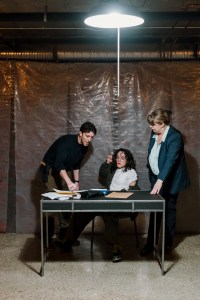
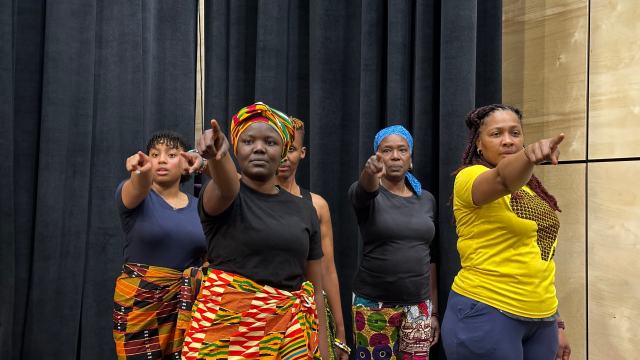
Ogboingba Tries To Change Her Fate, Jabulani Arts Festival. Photo by Beshel Francis.

By Liz Nicholls, 12thnight.ca

A new Edmonton arts festival makes its debut this week. And it’s designed to celebrate, and showcase, the rich diversity of Edmonton’s African, Caribbean, and Black Albertan culture.

To help support 12thnight.ca YEG theatre coverage, click here.

In the inaugural edition of the Ribbon Rouge Foundation’s new Jabulani Arts Festival (May 2 to 4 at Theatre Network), you’ll experience music, dance, visual art, poetry — and theatre. The theatrical centrepiece of the interdisciplinary Jabulani festivities, named after the Zulu word for “rejoice,” is an original play about bravery, re-discovery, transformation.

Ogboingba Tries To Change Her Fate adapts for our time and place a traditional story from the Ijaw people of Nigeria. At its centre is a woman with chutzpah who steps up to confront the creator, reassess her destiny, and make changes in her life.

Lebo Disele, one of the play’s creator/performers, explains that the play was developed over the past two-and-a-half years in an unusually collaborative way. The “inter-generational inter-cultural” troupe, Ribbon Rouge’s Artspace Theatre team, has embraced input from “seven different cultures, seven different backgrounds and upbringings.”   

First came the story gathering. The central story, explains Disele, who’s from Botswana (and has a PhD in theatre studies from the U of A), was brought to the group by storyteller/writer Tololwa Mollel, originally from Tanzania. And embedded in the play are two other stories, one from Ghana, one from Tanzania. Disele says they’ve found echoes of Beauty and the Beast, “but without the Disney ending.”

The Black Albertans in the cast of six women, the creative team and crew, and the five musicians (who play live: “it’s a party!”), are joined by a whole cross-section of African and Caribbean artists — from Kenya, Botswana, Trinidad, Jamaica, Ghana, Nigeria….

Africa itself has distinct regions, with different world views and cultural vision, and that’s “even before you go into specific countries,” says Disele. “And when you talk about Blackness in Edmonton, it’s a very diverse population” that includes Caribbean and African immigrants, and Black descendants of North American enslavement.

Ogboingba Tries To Change Her Fate, Jabulani Arts Festival. Photo by Beshel Francis.

Amazingly, the traditional stories the troupe has discovered had roots that spread across cultural lines. “The scenes we focussed on,” Disele says, “were the ones that recurred, and spoke to us regardless of whether we grew up in Edmonton or Ghana…. What have been our experiences as women, in different re-locations? What brings us here? Who are we here? You’ll see in the play that it’s been important for us to speak to the Canadian context.”

That idea aligns with the play’s director Jan Selman, a U of A drama professor with a long and distinguished specialty in community engagement and collective creation in theatre. Selman’s own theatre project “Old Stories and New Ways” isn’t about taking an issue and creating a play about it. It works the other way round: it’s about “taking familiar, traditional stories and looking at how they speak to this community, now,” Disele says. “It’s what happens if we start with the theatre rather than the issue.”

“If we’re really serious about Black Lives Matter, for example, we have to have theatre that is made by people who live that life,” Selman says. “And you can’t do that by bringing in American plays that have Black characters, though that has its place too….”

At the heart of “Old Stories and New Ways” is adaptation,” Selman says. “How is a story of long ago relevant today?” There were many choices for the core story that anchors the new play. The response by the whole group sealed the deal. “We’re all women…. It’s how we’re seen as women, how we like to be seen, the pressure of trying to be many, too many, things.” Ogboingba Tries To Change Her Fate, she says, “came out of which story grabbed us the most and made us ask those questions, made us feel the most.”   

What the Artspace group discovered was the remarkable way stories recur and resonate, in different ways, across cultural traditions. For creator/performer Yasmine Lewis-Clarke, who’s from Jamaica, the connection with the story of the woman who tries to change her fate has a personal reverb. As she describes it, in a lively and eloquent way, her upbringing was traditional, and strict. “Coming to Canada, it’s almost like I had to start over, even with my (four) kids, even the way I talk to them. In my culture we were afraid to even talk to our parents…. If you’re the kid and you’re not being spoken to, you don’t talk.”

There are, she muses, “different boundaries here…. I’ve learned a lot; I’ve had to adapt!” Lewis-Clarke tells a moving story about her own mother, who has 14 kids, and embraced change when she started to visit other countries. “You don’t have to bring up your kid this certain way just because that is the culture. It’s just a culture, and the culture is not always right!”

For Lewis-Clarke, the heart of the play’s central story is that the protagonist “got something she asked for and thought she wanted, but eventually (discovered) that she wanted something else. Something was missing from her life, and she didn’t know what….”

“The story is very personal to all of us,” says Disele, who was back in Botswana, a world away from her kids who were in Canada when the international travel ban started during COVID. “It will resonate with students,” she thinks. Education trains you for something specific, “you dedicate years of your life to it, and then you discover you’ve  grown and changed….”

As Selman points out, the group is a tangible seminar in how “the richness of life experience” counts more than one pre-determined kind of Canadian theatre school training. “It’s all fodder for the theatre…. Theatre lets us bring our own (selves), our own sense of how come things matter, to the stage, to be shared in the community.” She herself turned to theatre as a teenager. “I found it because of the ‘60s,” she says, “and the idea of telling our own stories…. By 17 or 18 I was hooked; theatre lets more of you count than anything else does.”

“We mostly made the play on our feet,” as Selman describes the process. It started with improvising theatrical images as a way to tell the story. And “it led to the style you’ll see on the stage,” where the storytelling happens in dance and movement (choreographer Eric Awuah, from Ghana, is also a drummer). as well as songs and spoken text. All the edits, in the script and the unrolling of scenes, were collaborative choices.

“We didn’t start out to make an all-woman theatre group, but that’s what evolved…. What do we all have in common? We’ve tried to keep all of our voices in the process.”

PREVIEW

Ogboingba Tries To Change Her Fate

Created collectively by: Lebo Diesel, Yasmine Lewis-Clarke, Larissah Lashley, Abigail ‘Ameley’ Quaye, Noreta Lewis-Prince, Elsa Robinson, Jan Selman

Directed by: Jan Selman

Performed by: Lebo Disele, Larissah Lashley, Noreta Lewis-Prince, Yasmine Lewis-Clarke, Abigail ‘Ameley’ Quaye, Elsa Robinson

Musicians: Eric Awuah, Robert Kpogo, Stennie Noel, Yaw Ansu-Kyeremeh, Prince Owusu

Where: Theatre Network, 10708 124 St.

Running: May 2 to 4

Tickets and full schedule of Jabulani Arts Festival events: theatrenetwork.ca

Posted in Previews | Tagged , , , , | Comments Off on Jabulani: a new arts festival, and a new play, to celebrate Edmonton’s African, Caribbean, and Black Albertan culture

Dear Sugar, what should I do? Tiny Beautiful Things at Shadow Theatre, a review

Brett Dahl, Michael Peng, Michelle Todd, Sydney Williams in Tiny Beautiful Things, Shadow Theatre. Photo by Marc J Chalifoux.

By Liz Nicholls, 12thnight.ca

I’m confused. I’m stuck. I’m torn. I’m undecided. I’m disappointed. I’m desperate. I’m stumped…. What should I do?

To help support 12thnight.ca YEG theatre coverage, click here.

We the people are all up against it — in ways, big and small, expected or not, that are as individually angled as our lives. At the centre of Tiny Beautiful Things, the season finale at Shadow Theatre, is the moving sense that we’re in it together, all of us improvising our lives, of necessity: to try and wrestle down loss and grief, pain and trauma, or look for love, to make changes, or make do. “We cannot possibly know what will manifest in our lives.”

The 2016 play was adapted by Winnipeg-born Nia Vardalos (of My Big Fat Greek Wedding fame) from a collection of the anonymous online advice columns Cheryl Strayed wrote for The Rumpus. And actually it might not be a play at all, at least in the conventional sense of an over-arching story that propels its characters forward (or backwards or sideways) and leads somewhere.

When Strayed (Michelle Todd) impulsively agrees to take on the Dear Sugar column, in the first scene of Tiny Beautiful Things — one day in her kitchen doing home-y things like folding laundry — she finds herself surrounded by a swirling pageant of letter-writing strangers invading her world. Each captures a human impasse, in an assortment of sizes — attached to a question: “Dear Sugar, what should I do?”

Tiny Beautiful Things is constructed, oddly and not very dramatically, as a non-stop barrage of letters, delivered by the agile trio of actors (Michael Peng, Sydney Williams, Brett Dahl) who wander through Sugar’s kitchen, and the responses they get back from Sugar, delivered by Todd.

Brett Dahl and Michelle Todd, Tiny Beautiful Things, Shadow Theatre, photo by Marc J Chalifoux

Sugar’s advice isn’t professionally glib or off-the-rack; it doesn’t come from a school of therapy or a self-help manual. As Todd’s performance beautifully captures, her advice is custom-made, and comes, however obliquely, from personal experience. It’s practical in that sense, not theoretical. Sometimes it’s free-associative. And Todd always conveys the sense that, hmm, she’s thinking and listening attentively, pausing to consider, appreciating the difficulties involved, remembering moments or predicaments in her own life that seem to shed light on the situation, musing on the possibilities. In short, she shares.

Let’s face it, people don’t generally write to agony aunts when they’re feeling euphoric, so be prepared. Sugar’s letter writers tell of miscarriage, of rape, of feeling trapped in a marriage, of being rejected or abused by parents…. And we learn quite a lot about Sugar’s own life as she formulates her responses: her rocky road through marriage, her grief over the death of her mother, her failed marriage, her life as a parent. Her saddest correspondent, and the most emotional example of sharing, is Sugar’s response to a father (Peng) whose grief for a son killed by a hit-and-run driver is infinite, and paralyzing. Irredeemable loss is a thought that takes Sugar back repeatedly to memories of her mother, the grandmother her daughter will never meet.   

The recurring subjects that anchor the letters Sugar gets are grief and trauma. She’s an empathetic listener, with a memory bank to match. And as an advice columnist Sugar is basically non-judgmental, and non-prescriptive, which could seem like a contradiction in itself (as some of her letter-writers note). But if there is a through line or at least a recurring motif, it’s the double-sided idea of forgiveness and self-worth, as a replacement for chronic anger and grievance. If in doubt about what to do, she advises, go the generous route and forgive, for your own sake.

Tiny Beautiful Things, Shadow Theatre. Photo by Marc J Chalifoux.

The other thought is that you own your life; it’s your most precious possession dammit and you have only one. So don’t waste time trying to “convince people to love you,” for example. It can’t be done. “Say no.” And there’s this: “tiny beautiful things,” which are sometimes all you can expect from huge loss, can be transforming.

The production directed by John Hudson is at pains, via Cindi Zuby’s detailed kitchen set (lighted by Ken Matthews), to emphasize that Sugar’s responses come from an ongoing real life and not a book. This results in a certain amount of arbitrary physical busy-ness for its own sake onstage. At one point, a correspondent opens Strayed’s fridge and pours herself an orange juice (don’t ask me why).

There isn’t any follow-up — to see what happens to the trans person abused by their parents, or the numbed woman who miscarried, or the girl who was raped and doesn’t know if she should tell her current boyfriend. Did people get their shit together, get happier, move forward? We don’t know. And there’s no real ending; it seems to end a few times; the play could be longer, or shorter. It’s cumulative, and really, that’s part of the emotional impact of it. Strayed’s responses are inconclusive, provisional, contradictory. They’re like life that way.

REVIEW

Tiny Beautiful Things

Theatre: Shadow Theatre

Written by: Nia Vardalos, adapted from Cheryl Strayed’s Tiny Beautiful Things

Starring: Michelle Todd, Michael Peng, Sydney Williams, Brett Dahl

Where: Varscona Theatre, 10329 83 Ave.

Running: through May 12

Tickets: shadowtheatre.org 


Posted in Reviews | Tagged , , , , | Comments Off on Dear Sugar, what should I do? Tiny Beautiful Things at Shadow Theatre, a review

Grab your swords, guys, and join the brawl: The Three Musketeers swashbuckles at the Citadel, a review

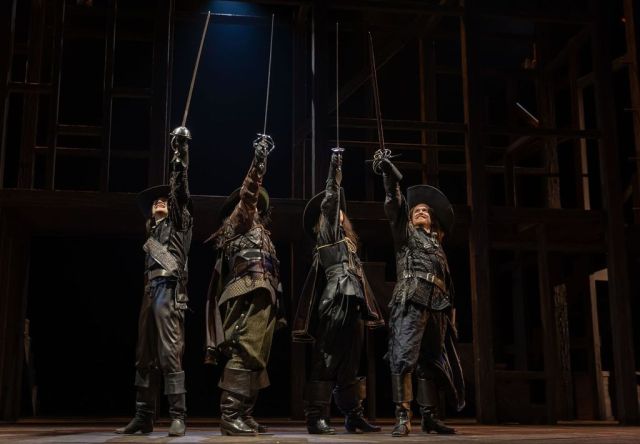
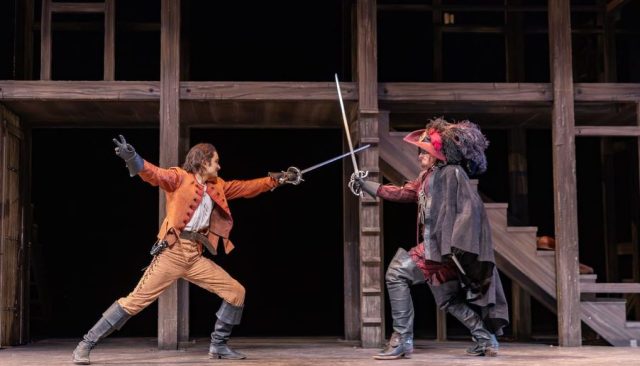
Daniel Fong, Alexander Ariate, Braydon Dowler-Coltman, Darren Martens in The Three Musketeers, Citadel Theatre. Photo by Nanc Price.

By Liz Nicholls, 12thnight.ca

The irresistible urge to pick up something pointy and dazzle someone with fancy moves, and possibly run them through, is everywhere on display in the big, entertaining production of The Three Musketeers that brings the Citadel season to a close.

Yes, they don’t call it swordplay for nothing.

To help support 12thnight.ca YEG theatre coverage, click here.

In fact, the Catherine Bush adaptation of Alexandre Dumas’s 1844 historical novel enjoys brawls so much it revisits them in flashbacks, amplified, or flash-forwards, in anticipation. In the very first scene of Daryl Cloran’s exuberant Citadel/ Vancouver Arts Club co-production is a brawl in a down-market tavern where the denizens (of all genders, by the way) are armed with shovels, brooms, tankards, as well as swords. Hey, just another night out in 17th century France.

And the show will replay, with trimmings, the acrobatic pleasures of that scene when Mme de Treville (Nadien Chu), the hot-tempered head of the elite royal troupe of official musketeers, demands an explanation from the star trio who just happened to be there energetically mixing it up. Duelling is against the law, she notes sternly. Which is, judging by this adaptation, a bit like pointing out that jaywalking is against the law in New York.

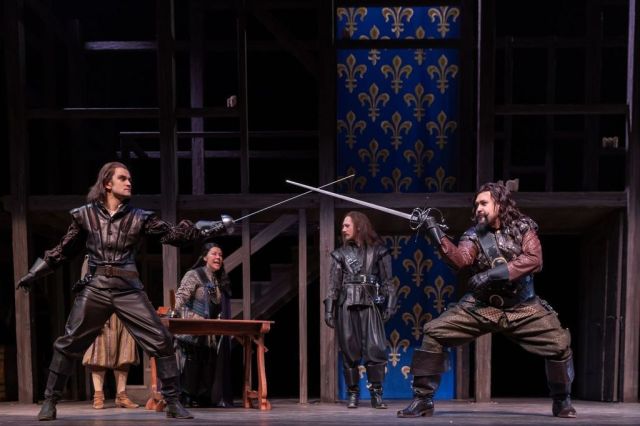
Daniel Fong, Nadien Chu, Braydon Dowler-Coltman, Alexander Ariate in The Three Musketeers, Citadel Theatre. Photo by Nanc Price.

Anyhow, every time Cardinal Richelieu’s elite guard bursts in anywhere to arrest people and take them to the Bastille (“once you go in, you never come out”) as they are apt to do, a fight breaks out. Or if you’re like d’Artagnan (the excellent Daniel Fong), a wide-eyed newcomer to Paris from the hinterland with dreams of being a Musketeer, getting called “boy” will make you grab your sword. Shoving someone, or just being a bad-ass in a bad mood, that’ll do it, too. And as for revenge, well, it’s not just an invitation, it’s an urgent necessity.

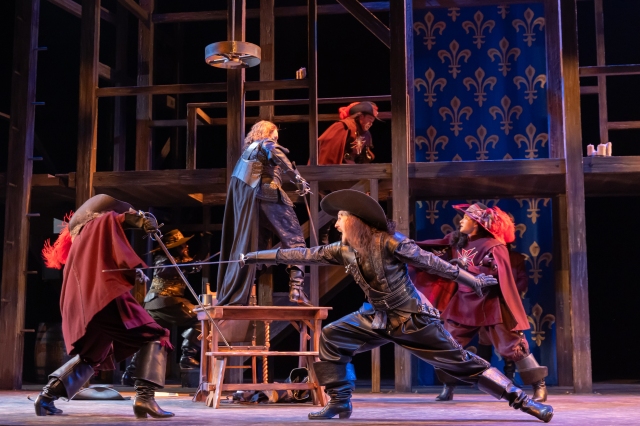
Felix LeBlanc, Alexander Ariate, Darren Martens, Braydon Dowler Coltman, Garett Ross, Morgan Yamada in The Three Musketeers, Citadel Theatre. Photo by Nanc Price

Fight choreographer Jonathan Hawley Purvis gives the 17-member cast swords (and daggers, and assorted sharp hardware), and an impressive arsenal of non-stop inventive moves. All good dangerous fun. In addition to a truly gorgeous array of period costumes and hats with vertiginous plumes, designer Cory Sincennes gives them a multi-layered three-tower wooden playground of wooden scaffolding to rebound off, with multiple staircases, on a revolve. Swashbuckling on revolving stairs is, as Hawley Purvis’s choreography confirms, no activity for the introspective. Ditto swinging from the chandeliers.

To say the least, you do not have to be a French lit major to follow the action of the (very long, very complicated) Dumas novel in this breezy adaptation. What does take the complications seriously is Jonathan Lewis’s grandly cinematic score, with its hints of the 17th century and lush gestures of adventure movies. A lot of French horns are involved, with strings for the romantic bits.

Daniel Fong, Alexander Ariate, Braydon Downler-Coltman, Darren Martens in The Three Musketeers, Citadel Theatre. Photo by Nanc Price.

The script takes its cue and Cloran’s production its comic lightness from a teasing contemporary view of the boisterous macho camarderie that underpins the story. The trio of Athos (Darren Martens), Porthos (Alexander Ariate) and Aramis (Braydon Dowler-Coltman) are all deluxe stand-up swordsmen to be sure, but they’re inseparable good time party lads, carousers par excellence.

They have distinct personalities under Cloran’s direction, and stand in high contrast to Fong’s d’Artagnan, the idealist bumpkin who dreams of joining them. Although, wait, come to think of it, his favourite expression is the grandiose “I swear by the sword of d’Artagnan….”

The wink at boys-will-be-boys male stereotypes of heroism is reinforced by Chu’s performance, with she/her pronouns, in the male role of the imperious Musketeer commander de Treville. Her ground zero is extreme exasperation. She never speaks; she shouts. And then, when her short fuse gets even shorter, she hollers even louder. Her cowed assistant Planchet is played by Farren Timoteo in an amusing performance that has a whirlwind show-stopper of a scene later in the show; Hawley Purvis’s choreography is a (shall we say) knock-out. The opening night audience cheered him on.

The funniest single performance is Timoteo’s double-turn as King Louis, a preposterous narcissist who wears Sincennes’ most flamboyant costume, with its inflatable brocade bloomers, and dance steps by Anna Kuman.    

Daniel Fong and John Ullyatt in The Three Musketeers, Citadel Theatre. Photo by Nanc Price.

As the treacherous spymaster Cardinal Richelieu, commander of the withering look and the acid tone, Scott Bellis is excellent. And his formidable henchman Rochefort is nailed by the sneering swagger of John Ullyatt’s performance. The inevitable duel between d’Artagnan and Rochefort is a fight highlight; the outcome is up for grabs.

There’s capital R Romance, to be sure. It’s treated comically in the case of d’Artagnan instantly falling head-over-heels for his landlord’s daughter Constance (Jade V. Robinson), a ninny who sounds like a character out of a comic book. And it has a more exotic edge in Athos, whose aristocratic past includes a relationship with the femme fatale Milady De Winter (Bahareh Yaraghi). He is, to say the least, a bit musket-shy when it comes to affairs of the heart: “love is a lottery in which the prize is death.”

With the exception of de Treville, who seems to ask for no credit for rising in a man’s world, the female characters in the story, and in performance, are pretty insipid, in truth. So just sit back, buckle your swash, and follow the clanging steel. There are letters, poisoned lockets, secret tattoos, purloined diamonds, secret identities, spy vs. spy — and swords. Merci, M. Dumas. And there’s fun to be had in this zestful well-armed swashbuckler of an adventure show. Seek it out, and see it soon before the cast gets impaled.

Have you read 12thnight’s preview interview with fight director Jonathan Hawley Purvis?  Read it here.

REVIEW

The Three Musketeers

Theatre: Citadel Theatre and Vancouver Arts Club

Written by: Alexandre Dumas, adapted by Catherine Bush

Directed by: Daryl Cloran

Starring: Alexander Ariate, Braydon Dowler-Coltman, Darren Martens, Daniel Fong, Scott Bellis, Jade V. Robinson, Garett Ross, John Ullyatt, Farren Timoteo, Bahareh Yaraghi, Morgan Yamada, Nadien Chu, Alexandra Lainfiesta, Felix LeBlanc

Running: through May 12

Tickets: 780-425-1820, citadeltheatre.com

Posted in Reviews | Tagged , , , , , , , | Comments Off on Grab your swords, guys, and join the brawl: The Three Musketeers swashbuckles at the Citadel, a review

En garde! The Three Musketeers at the Citadel, a fight director’s dream gig: meet Jonathan Hawley Purvis

Felix LeBlanc, Alexander Ariate, Darren Martens, Braydon Dowler Coltman, Garett Ross, Morgan Yamada in The Three Musketeers, Citadel Theatre. Photo by Nanc Price

By Liz Nicholls, 12thnight.ca

“Never fear quarrels but seek hazardous adventures….”  — The Three Musketeers, Alexandre Dumas

En garde. The actors are armed and dangerous.

To help support 12thnight.ca YEG theatre coverage, click here.

In the Citadel season finale (opening Thursday on the Shoctor stage), when you see light glint off steel blades, or hear the clang when blades cross, you’ll be seeing the intricate work of fight choreographer Jonathan Hawley Purvis.

The Three Musketeers, a high-speed high-spirited 2015 stage adaptation by the American playwright Catherine Bush of the 1844 historical swashbuckler by the French novelist Alexandre Dumas, is a veritable extravaganza of swordplay, with a story to match. And actor/ fight director/ stunt performer Hawley Purvis is in his element; The Three Musketeers is a swordplay connoisseur’s dream show. “It’s a swashbuckling adventure, fun to see, and fun to do live!”

“It’s a big show…. In the first act alone, there are five fights,” he says happily, making time to chat en route to a rehearsal day. “Every couple of pages, someone is trying to kill someone! (laughter). And there’s another four in the second act. It’s crazy!”

Romeo and Juliet and West Side story (both on the Hawley Purvis resumé) are loaded with hair-trigger violence and street combat, built into the plot. Julius Caesar and Antony and Cleopatra have their moments, to be sure. But The Three Musketeers is perhaps the ne plus ultra of combat challenges. And the Citadel/ Vancouver Arts Club co-production that Daryl Cloran directs is Hawley Purvis’s third version, all different adaptations, in all different assignments.

Fight director Jonathan Hawley Purvis

In his first, Bob Baker’s 2011 Citadel production of a Tom Wood adaptation, he played Jussac, a lieutenant of the villainous Cardinal Richelieu. At the St. Lawrence Shakespeare Festival, in an adaptation by director Rona Waddington, he not only played Aramis, one of the blue-chip ‘all for one/ one for all’ elite trio, but choreographed all the fights for everybody else, too. “It was fun to direct myself,” he laughs.

And now, a full-bodied version with a cast of 17, outsized action, unstoppable swordplay, treachery, romance…. “It’s got comedic moments that are really fun,” says Hawley Purvis, an actor first before he got captivated by swordsmanship in theatre school in Calgary at Mount Royal College (a semester with stage combat master J.P. Fournier was a turning point). “At the same time it doesn’t shy away from letting itself be dramatic and dark…. It’s like a really good adventure movie, Indiana Jones or Back to the Future. Real stakes, real drama.”

Daniel Fong, Alexander Ariate, Braydon Dowler-Coltman, Darren Martens in The Three Musketeers, Citadel Theatre. Photo by Nanc Price.

“It’s fast-paced, sticks to the plot,” says Hawley Purvis, of a version with “two different time lines, short scenes, scenes that are happening on top of each other, jumping from action to action. And it allows itself to get dark and sad and heartfelt, when it wants, and laugh at itself and be tongue-in-cheek, too.”

All of which “really encompasses a perfect adventure movie!” he declares. “Princess Bride!” And all of which resonates in the “tonality” (a favourite Hawley Purvis term) of the fight choreography. “Some of it is more flourish-y and fun,”  he says. “Some of it is darker and grittier….”

The biggest sword fight in the show? “Eight people, four against four. There are two other brawl-style fights that happen in various taverns that include even more people, 10 or twelve. And a couple of duels!” Yup, we’ve got a handful!”

Hawley Purvis has the kind of buoyant energy about him in conversation that makes you (briefly) wonder why on earth you didn’t take a turn or two with a foil yourself before now. He and director Cloran have collaborated in the past (Shakespeare in Love, for example). They held the Musketeer auditions together. “Everyone who came through the door we put a sword in their hand and (had them do) some sword fighting.”

As he points out, there are, routinely, dance calls for big dance musicals, like West Side Story; fight calls are much more rare. Everyone in the show we’ll see at the Citadel “has held a sword in their hand at some point in their careers. Which makes my job so much easier, and allows us to take it another level.”

The cast arrives at stage combat from different directions, with different skill sets, he explains. Hawley Purvis’s starting point was dance. He grew up in Calgary, a kid who was “pretty heavily into it, very busy with lots of competitions,” as he describes. “But in my heart I kinda knew I didn’t want to be a dancer as a career. I wanted to be an actor.”

“I totally fell in love with it and it made sense to me,” Hawley Purvis says of his theatre school discovery of stage combat. … I was always a huge nerd. Princess Bride was my childhood. I loved swords and knights in armour…. It took me on a long journey, as an actor who kept training (in combat workshops), into stunt work in film and TV…. I love action!”

In choreographing a show, Hawley Purvis, who moved back to his original home town Vancouver in 2018 with actor wife Alanna Hawley Purvis (their twins are nearly six, “can you believe it?”), is apt to borrow the dance lexicon in talking about stage combat. “Dancing more than fighting, as in martial arts or boxing… For one thing it’s something you’ve got to do with your partner,” otherwise, presumably, stages world-wide would be littered by punctured corpses.

The theatrical stylization of violence — “representing violence in a way that’s believable but comes from a place of storytelling and craft, the art and science of execution” — is at the heart of fight direction, as Hawley Purvis muses. “It’s problem-solving and it can get quite technical,” but the telling of the story is the thing.

There is never zero risk in stage combat, to be sure, although “risk mitigation” is central to Hawley Purvis’s line of work. That risk would seem to the outsider exponentially increased in stunt work (he did stunts for the TV series The Last of Us, filmed in Calgary).

Has he ever been terrified working in the stunt industry? Hawley Purvis pauses, and laughs. “The first time I was lit on fire…. Hmm, OK, not terrified because I knew what I was in for, and knew all the safety requirements were being met, but I remember being very aware that it’s taking a risk.”

“My first high fall into a pile of cardboard boxes…. You have to trust the people around you,” he says. “And they’re the most amazing people. Very cool, from very different backgrounds, smart, with amazing skill sets.” In Alberta many stunt people are “ex-rodeo folks, bull riders, chuck racers, often still with farms. In Vancouver, a lot of martial arts people, from gymnastics, a few dancers.“

In 2018 he and his wife, actor Alanna Hawley Purvis, who met in a Citadel production of Disney’s Beauty and the Beast, moved to Vancouver. “We wanted to start a family,” he says (their twins are almost six, “can you believe it?”), and film and TV contracts, shorter than theatre, are more amenable to home life. “And I’ve keep my foot in theatre through fight choreography. Something keeps driving me back!”

Daniel Fong and John Ullyatt in The Three Musketeers, Citadel Theatre. Photo by Nanc Price.

How does he start rehearsing a fight scene for the tumultuous world of 17th century France, as filtered through Dumas, Catherine Bush, and a cast of varied experience (including a couple of fellow fight directors) in gender-bending assignments?  Hawley Purvis’s mind works in questions. “I always come from story first. My first priority is ‘what is the point of this fight in the show? Why is it written in here, and what is the arc? Where does it begin? Where does it end? What is the arc?’”

And then, “‘what is the tone of the fight? how does it fit in tonally into the show?’” He doesn’t plan out individual moves in advance, though. He waits till he’s in the rehearsal room with actors, “discovering their individual strengths and weaknesses, what they’re comfortable with.”

Ah, and “what’s repeatable,” sword in hand. In theatre, unlike film, the actors perform live, eight shows a week, as we’re about to see. The theatre mantra belongs to the story: “All for one and one for all.”

PREVIEW

The Three Musketeers

Theatre: Citadel Theatre and Vancouver Arts Club

Written by: Alexandre Dumas, adapted by Catherine Bush

Directed by: Daryl Cloran

Starring: Alexander Ariate, Braydon Dowler-Coltman, Darren Martens, Daniel Fong, Scott Bellis, Jade V. Robinson, Garett Ross, John Ullyatt, Farren Timoteo, Bahareh Yaraghi, Morgan Yamada, Nadien Chu, Alexandra Lainfiesta, Felix LeBlanc

Running: through May 12

Tickets: 780-425-1820, citadeltheatre.com

Posted in Previews | Tagged , , , , , , , | Comments Off on En garde! The Three Musketeers at the Citadel, a fight director’s dream gig: meet Jonathan Hawley Purvis

Populating a world and reclaiming the past, all on a bare stage: Basic Training, a review

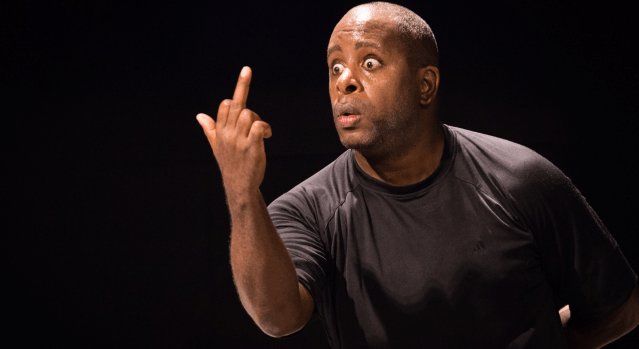
Kahlil Ashanti, creator and star of Basic Training. Photo supplied.

By Liz Nicholls, 12thnight.ca

In Basic Training, the impressively multi-character solo play currently running as part of the Edmonton Fringe Theatre season, Khalil Ashanti tells a fascinating story.

It is his own. It’s the story of a childhood terrorized by an abusive ‘father’, and a kid who escapes to find another family — by joining the American military and finding a gift for stand-up comedy. It’s also the story of a man who finally discovers his real roots, hitherto shrouded in mystery, and returns home to reclaim his family and re-write the ending.

To help support 12thnight.ca YEG theatre coverage, click here.

The title is double-sided. Basic Training is named both for the official boot camp that reduces people to nothingness and turns them into  soldiers — and for the domestic boot camp from which, in the end, it’s much harder to graduate. And Ashanti, a winsome and comically dexterous performer, populates both with some 23 characters — of all ages, sexes, persuasions, ethnicities, voices, accents.

The night before he leaves for boot camp, Ashanti’s mother tells him casually, in passing, that the violent man who has persecuted both of them forever isn’t his biological father.  And this knowledge haunts him through a career in the American military that includes getting chosen for Tops in Blue, the touring Air Force entertainment unit.

The fabric of the show is Ashanti’s high-speed, inventively physical, comic portraiture of the characters he meets in the course of basic training and his graduation into Tops in Blue in the 1990s. The furiously foul-mouthed drill sergeant, who practically levitates on the jet stream of his own highly original scatology, a figure familiar in American film, TV, and theatre, is heightened into comedy in Ashanti’s performance. And we meet Ashanti’s new pals, one with Tourette’s Syndrome, one with a flamboyant flounce, en route to a happy ending. It’s a journey interspersed with phone calls back home to his mom, a sympathetic figure trying to survive an impossible home regime.

The audition scene, in which he and other hopefuls, wildly varied in their talents, try out for Tops in Blue, is a lot of fun. Race is a recurring focus for Ashanti’s humour (the Black analysis of pool as an inherently racist game, vis-à-vis the supremacy of the white ball, is inspired). After all, as one character points out, it’s no coincidence that Black History Month is February, the shortest month of the year. And the most dangerous part of their world tour, not surprisingly the Middle East, snatches comedy from extreme danger — a busload of Black performers trading Black jokes, and a bus driver who pushes his luck. Always at the back of Ashanti’s mind is the thought of a dad, somewhere, identity unknown.

Perhaps the boldest, and certainly the uneasiest, idea of Basic Training is to intertwine in quick-change back-and-forth scenes, the brute of a drill sergeant and the brute tyrant of a step-father. The one is designed to be comic (the cornerstone of basic training seems to be verbal insults inflated to a fine art), and the other, detailing child abuse, horrifyingly not. This back-and-forth structure creates a disturbing equivalence; it places both characters on the same spectrum of violence. This structure, for me problematic, ups the stakes for Ashanti’s coming-of-age triumph, true, but in the process seems to let the abusive step-father off the hook somewhat; is he just the domestic version of a drill sergeant? It’s an idea that would seem to invite further exploration, beyond the scope, perhaps, of a 60-minute show.

In any case, Ashanti’s expertise in multi-character storytelling is enhanced by the fact that it happens on a bare stage. One man, one chair: what could be more quintessentially Fringe? That’s where this live show, with its zest for cameo captures, was born, as a 2004 production that was a hit in Montreal, has played other Fringes, including Edinburgh, since. The creation of a world, through solo performance, is a specialty of Fringes; so is the personal quest for identity. And there is no denying Ashanti’s protean talents. And, structural oddities notwithstanding, this is an unusual show, unafraid of sentiment, in which comedy and tragedy mingle and any happy ending is hard won.

REVIEW

Basic Training

Theatre: Edmonton Fringe Theatre

Created and performed by: Kahlil Ashanti

Where: Backstage Theatre, Fringe Arts Barns, 10330 84 Ave.

Running: through April 27

Tickets: fringetheatre.ca


Posted in Reviews | Tagged , , , , | Comments Off on Populating a world and reclaiming the past, all on a bare stage: Basic Training, a review

Onstage in Edmonton this weekend, choices! A survey

Joe and Mister in Wonderful Joe, Ronnie Burkett Theatre of Marionette. Photo by Ian Jackson, Epic Photography

By Liz Nicholls, 12thnight.ca

Your biggest problem this weekend in this theatre town is … choice. That, and the moment of truth for procrastinators. And the possibilities are high-contrast, to put it mildly, from companies of every size, aesthetic, and budgetary heft.

To help support 12thnight.ca YEG theatre coverage, click here.

What’s happening onstage? Productions at Theatre Network, Northern Light Theatre, the Citadel, Theatre Yes, Edmonton Fringe Theatre, the Mayfield, Rapid Fire Theatre, and more.

It’s your last chance to see a beautiful story about an old man and his dog by a great Canadian artist (and played by cast of marionettes); a strange original prairie-goth horror story about growing up as an outsider; a breath-sucking provocation of a story about the link between life and art; a play about an American hero up against time and cultural history.

Kahlil Ashanti, creator and star of Basic Training. Photo supplied.

And opening tonight, two shows:

One, the Edmonton Fringe Theatre season finale, is a hit solo memoir of survival through comedy. Basic Training, by and starring comedian/ actor/ playwright/ ex-soldier Kahlil Ashanti. It’s a story of violent childhood abuse transcended by a gift for entertainment. And it runs at the Backstage Theatre through April 27. Check out the 12thnight preview interview with Ashanti here. Tickets: fringetheatre.ca.

The other is a crazily inventive Rapid Fire hit, Improvised Dungeons & Dragons, led by Mark Meer as the Dungeon Master, leading a cast of the company’s top improvisers. It runs at RFT’s Exchange Theatre through May 4. Tickets: rapidfiretheatre.com.

You’ve been waiting for the weekend to venture forth, right? And now it’s your last chance to catch …

Wonderful Joe, Ronnie Burkett Theatre of Marionettes at Theatre Network. Photo by Ian Jackson, Epic Photograpy

•Ronnie Burkett’s wonderful, wonder-filled Wonderful Joe, premiering at Theatre Network. The characters come to vivid life as puppets and marionettes in the story of an old man and his old dog, in a last grand adventure in the world — Joe’s life-filled multi-cultural urban ‘hood on the wrong side of the tracks. Exquisitely designed, as always from the Ronnie Burkett Theatre of Marionettes, it’s a beauty of a piece, generous, funny, imaginative. Have a peek at the 12thnight preview interview with Burkett here, and the review here. It runs through Sunday. Tickets: theatrenetwork.ca.

Candy & The Beast, starring Jayce McKenzie and Jake Tkaczyk Northern Light Theatre. Photo by Brianne Jang, BB Collective Photography

Candy & The Beast, a new mystery thriller/ coming-of-age tale by Trevor Schmidt premiering at Northern Light Theatre. It takes us to a prairie small town where a serial killer, species uncertain, has been on the rampage. And we meet a couple of misfit kids (Jayce McKenzie and Jake Tkaczyk), who set about solving the mystery and finding themselves a place in their dark, eerie, exclusionary world. It runs through Saturday in a Schmidt production at the Studio Theatre in the Fringe Theatre Arts Barns. Tickets: northernlighttheatre.com. Have you read the 12thnight preview interview with McKenzie? The 12thnight review is here.

Brandon Mcpherson, Dayna Lea Hoffmann, Ruth Alexander in The Pillowman, Theatre Yes. Photo by Mat Simpson

•Martin McDonagh’s dark comedy The Pillowman, a queasily brilliant provocation that comes at you in a series of interlocking stories, each springloaded with horror, and questions about the relationship between life and art. In a police state, the writer protagonist is being interrogated for the uncanny similarity between a series of child murders in the town and her grisly fables. The Theatre Yes production directed by Max Rubin takes us to a venue we haven’t been before, the basement of the Pendennis Building downtown, lined with plastic for the occasion. Check out 12thnight interview with director Rubin, and the review. The Pillowman runs through Sunday. Tickets: theatreyes.com.

The Mountaintop, at the Citadel through Sunday. By the American writer Katori Hall, the play imagines the last night on earth of a hero: an encounter between Martin Luther King and a mysterious housekeeper, as the great man arrives back in his Memphis motel room after delivering his “mountaintop” speech. The two-hander has the same director (Patricia Darbasie) and cast (Ray Strachan and Patricia Cerra, both experienced in the roles and both excellent) as Shadow Theatre’s 2022 production. Tickets: 780-425-1820, citadeltheatre.com. Read the 12thnight review. (The Citadel production of The Three Musketeers directed by Daryl Cloran starts previews Saturday, and opens next week).

cast of Grease, Mayfield Dinner Theatre. Photo by Marc J. Chalifoux

Continuing:

•at the Mayfield, Kate Ryan’s vivid high-energy revival of the nostalgia magnet Grease, in which a cast of 18 is set in motion by Julio Fuentes’ sexy and inventive choreography. It runs through June 16. Tickets: mayfieldtheatre.ca. Check out the 12thnight review.

Posted in Features | Tagged , , , , , , , , , | Comments Off on Onstage in Edmonton this weekend, choices! A survey

Survival through laughter, a true-life story: Basic Training at Edmonton Fringe Theatre

Kahlil Ashanti, creator and star of Basic Training. Photo supplied

By Liz Nicholls, 12thnight.ca

The 23 characters who we meet at the Fringe’s Backstage Theatre Friday in Basic Training — conjured by a particularly agile playwright/ performer/ comedian have taken an unusually circuitous route to get here.

They’ve crossed borders, continents, oceans. Like their engaging creator they know, in a vivid way, the value of laughter. The characters who populate Kahlil Ashanti’s hit solo show live in a real-life story, on a spectrum that includes hilarity and heartbreak, violent abuse and redeeming creativity.

To help support 12thnight.ca YEG theatre coverage, click here.

“Survival,” says Ashanti succinctly of his entry point into showbiz, which came via Tops in Blue, the elite U.S. Air Force entertainment troupe. On the phone from Vancouver, his home base, he explains that his was the peripatetic childhood of a kid in an American military family. Born in Germany, where he lived till age three, he was in Japan till he was 11 or 12, and after that, he grew up in Davenport, Iowa.

“For a lot of American kids who aren’t rich, college isn’t an option,” he says of his younger self. “In the U.S. a university education is at least 10 times what it is in Canada.” Besides, “the military was the family business,” and signing up “was a way to make my dad proud.”

The night before he left for basic training, Ashanti’s world fractured. t“I have my escape plan. It’s 1992. It’s Davenport, Iowa. And six days after high school graduation I’m finally leaving!” And that’s when it happens. “My mother sees fit to let me know, ‘by the way the guy who’s been beating the shit out of you for as long as you can remember isn’t your real dad. I told you before; you probably just forgot’…. And that’s the beginning of the show!”

Ashanti hadn’t been a ‘performing arts kid’, he says. “That stuff costs way too much…. I played football, I ran track, but I was never really great at sports. Which is decidedly inconvenient when you’re Black and in Davenport, Iowa.” So, to return to his origins as a performer, “survival!” was the operative concept.

He describes being made to stand at attention overnight with his little brother, a belt across their feet, as their step-dad slept on the couch. “Because we’d done something wrong.” Like “I’d forgotten to paint the bottom of the rocks green.” The stepdad as an army man “insisted that everything be uniform. So the rocks around the edge of the lawn had to match the colour of the grass. That was one of my jobs.”

“If we were to move, the belt buckle would make a noise and we’d get a beating…. Crying was the ultimate betrayal. So if my brother started crying, I’d do impressions of my step-dad. Quietly. To make him laugh. Quietly.”

Though he can’t have known it at the time, a career was getting planted in this thorny home soil. “Helping other people forget about their pain was the first time I remember having a feeling of self-worth,” Ashanti says. And that feeling was duplicated at school in the ‘80s. “People would be in pain and I’d do my Eddie Murphy impression…. And then I got invited to do a talent show at school.”

Kahlil Ashanti, creator and star of Basic Training. Photo supplied

There was no conventional theatre education about this, needless to say, Ashanti laughs. When the Funny Bone Comedy Club opened in Davenport, “I was able to take this weird talent I have (forward)…. I got the opportunity to open for people like Jamie Fox,” and other alumnae of the In Living Color sketch comedy show, he says. “That was my high school job, performing at the Funny Bone, and I was able to hone my craft in a real way that wasn’t a performing arts school…. My friends weren’t old enough to get in because they served alcohol.”

Another eye-opener was “growing up seeing Eddie Murphy…. What? Comedians can be actors?” A revelation, and it came “much to the chagrin of my mother,” who’d envisaged her kid, who had a knack for drawing, becoming an architect, with all the perqs. But “the performing bug had caught me.”

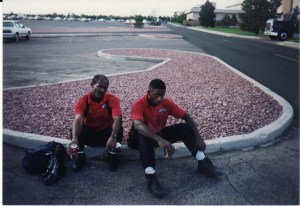
Kahlil Ashanti (right) and a Tops in Blue cohort “somewhere on tour.” Photo supplied.

When Ashanti got out of the military, he performed as a magician, in Japanese, at Caesar’s Palace in Las Vegas for three years. And then, “lo and behold,” he moved to L.A. And he did what showbiz hopefuls have always done, he took an acting class. What we’re going to see, in Basic Training, Ashanti says, is “the result of a storytelling exercise in Jeffrey Tambor’s acting class . where you’d have to come onstage and tell a story, the only stipulations being that the character leaves the story knowing something they didn’t know at the beginning.”

The early version of Basic Training “was just the funny parts; I didn’t have any of the abuse in there, the domestic violence,” Ashanti says. “Jeffrey pushed me to remind people, through my writing, the price I’d paid….”

“So I was living in L.A. And I couldn’t get hired to save my life,” he says. “I was going to have to figure it out on my own, and create my own opportunities. Of necessity.” And that’s where the Canadian Fringe circuit enters the Ashanti story, thanks to one of his classmates in Tambor’s acting course.

He took Basic Training, then called Father’s Day, to the Montreal Fringe in 2004, where it scooped up an impressive assortment of awards and ticket sales stats, and closed on … Father’s Day. And it played the Vancouver Fringe, too, an experience that comes with its own network of connections. Ashanti has remained a close friend of the Canadian Fringe stars master storyteller T.J. Dawe, and soloist Charlie Ross (of One-Man Star Wars Trilogy fame).

Ashanti has since taken Basic Training to the Off-Broadway Barrow Street Theater in NYC; he’s taken it to Australia; he’s taken it to the Edinburgh Fringe twice. And he’s signed a movie deal, too. Meanwhile he moved to Canada, to Vancouver. “It always seemed to come up in any of the lists of the five best places in the world to live” that he researched in the library. And, as he says, it was lot more accessible than Auckland or Bern.

The Fringe experience has inspired Ashanti in practical ways, too. He’d started Javascript coding in 1998 to support himself, and turned this expertise to creating “a digital pay-what-you-want solution for the arts” in 2018, an app he called We Show Up. “We’re growing up with a generation who have entertainment at their fingertips. And it’s never been harder to get your kids, or anyone under the age of 15, to care about theatre. Their spending habits reflect that…. And I don’t know if theatre can survive it.”

“This generation is used to controlling the narrative. They get to pick what series they’re going to binge today, as many episodes as they want for one price. And I decided to try that with theatre.” The idea of We Show Up (he shut it down when the pandemic descended) is that “you pay a couple of dollars up front, you come and see the show, and as you leave you get a text asking how much you thought the show was worth.” Fringe festivals, he says, “did not pick up on it.”

“I always stand at the exit after the show, and thank everyone who came to see it. And they tell me ‘I would have paid more for that!’.”

PREVIEW

Basic Training

Theatre: Edmonton Fringe Theatre

Created and performed by: Kahlil Ashanti

Where: Backstage Theatre, Fringe Arts Barns, 10330 84 Ave.

Running: through April 27

Tickets: fringetheatre.ca

Posted in Previews | Tagged , , , , | Comments Off on Survival through laughter, a true-life story: Basic Training at Edmonton Fringe Theatre

Back to our alma mater, for a class reunion at Rydell High. Grease at the Mayfield, a review

cast of Grease, Mayfield Dinner Theatre. Photo by Marc J. Chalifoux

By Liz Nicholls, 12thnight.ca

We all went to Rydell High. And none of us ever graduated.

To help support 12thnight.ca YEG theatre coverage, click here.

That’s the thing about Grease: every production of the 1972 musical by Jim Jacobs and Warren Casey is a class reunion, so to speak. Face it, You’re The One That I Want and Summer Nights have taken up permanent residency in your brain in a way that the periodic table, the subjunctive, or the plot of Beowulf never did.

“Grease is the time, is the place, is the motion,” as one of the opening numbers declares in the revival directed by Kate Ryan that’s currently running — and also leaping, bouncing, hand-jiving, twisting, doing back flips, all at a sensational rate — on the Mayfield stage. That, incidentally, is a location where it hasn’t been seen for the last 31 years. And Ryan’s cast of 18 is making up for lost time, in a go-for-the-gusto way.

Grease was always nostalgic, from its modest moment of origin (in a Chicago nightclub). And it’s a celebration and amiable spoof of the ‘50s that’s only gotten spoofier every decade since, especially after the John Travolta/ Olivia Newton movie of 1978. In the high-spirited Mayfield show, two competing planes of nostalgia intersect in the design by Lieke Den Bakker and Ivan Siemens, animated by Matt Schuurman’s cunning video design.

One is set in motion when the “kids” arrive — well, explode, dancing up a storm — into a brick inner-city courtyard, to announce that summer’s over and school’s back in. There’s urban grit in the look, but West Side Story this isn’t designed to be. The other is the fantasy that the famous soundtrack, with its heady nostalgic topnotes of young romance and angst (Raining on Prom Night), is coming at us direct from the giant car radio that dominates the stage. And it’s equipped with its own urbane conjuring genie, radio announcer Vince Fontaine (Vance Avery), with songs and worldly advice like “first day of school, play it cool.”

The costumes by Deanna Finnman are a riot of colour and crinolines, tight capris and pink satin bombers, black leather, pumps and saddle shoes. The spirit of showbiz, ‘50s nostalgia department, lives in these clothes; they’re always fun to look at. And when you see Ryan’s the cast dance and move in them, they really come into their own.

cast of Grease, Mayfield Dinner Theatre. Photo by Marc J Chalifoux

Julio Fuentes’ sexy, inventively athletic choreography — a departure from the long line of Grease productions which are considerably less demanding — captures the combination of brash exhibitionism and retreats that pretty much cuts to the chase in Grease. The plot, after all (to speak solemnly of something pretty blithe and airy), is based on the way its teen characters are torn between being their own individuals who “take no crap from nobody” (as Mark Sinongco’s Sonny LaTierri puts it) and the comfort of being part of a gang, like the T-Birds or the Pink Ladies. The choreography of peer group pressure, both the resisting of it and the succumbing to it, is the keynote of Ryan’s stagecraft too.

Take the principal love story, between hipster Danny Zuko (Kory Fulton) and the new girl in school, wholesome Sandy Dumbrowski (Kate Blackburn). Fulton’s performance is full of swagger, and uncertainty, confidence and ruefulness. His ventures into romance are always one step forward two back, with quick looks over his shoulder to make sure no one is looking.

Louise Duff (centre) and the cast of Grease, Mayfield Theatre. Photo by Marc J Chalifoux.

Uncertainty only comes later for the sardonic, apparently invincible tough cookie Rizzo, who makes even her Pink Ladies cohorts a bit nervous. She’s played with a range of mocking grins by Autumn-Joy Dames. And Trevor Coll is very funny as tough guy Kenickie, proud possessor of the broken down beater he’s christened Greased Lightning. He poses only at sharp diagonal angles and chews off every consonant like he was spitting tobacco.   

In a cast of strong singers and indefatigable dancers (Rydell is a high school of the performing arts?), the performances are fashioned in a comical mix of the cool and the sweetly earnest. May I single out Ryan Maschke as the moonstruck Roger and Jill Agopsowicz as the appealingly wide-eyed Jan, who serves Twinkies with Swiss Colony plonk because it’s “a dessert wine”? Chariz Faulmino as Frenchie, the dimbulb chronic drop-out, who got her name when she perfected “French inhaling,” is a hoot. Melissa MacPherson doubles as the cartoon purse-lipped teacher Miss Lynch, and a sultry Teen Angel who descends from the car radio to deliver her career counsel in Beauty School Dropout, surrounded by a chorus of angel cohorts in diner waitress (hey, it’s the ‘50s) uniforms.

The music values are, as always, high at the Mayfield, as led by musical director Jennifer McMillan and a band of five.

Consider if you will the hilarious manifesto of Grease authenticity: “we start believing now that we can be what we are.” Hmm. Think about that for a second or two, but not too hard. Do not ask why-y-y-y-y. It’s playful, yes, and nostalgic … about nostalgia. It good-naturedly spoofs its own kind of coming-of-age musical theatre, in an evening of high-spirited entertainment, expertly presented by a first-rate cast.

REVIEW

Grease

Theatre: Mayfield Dinner Theatre

Written by: Jim Jacobs and Warren Casey

Directed by: Kate Ryan

Starring: Kory Fulton, Kate Blackburn, Autumn-Joy Dames, Louise Duff, Vance Avery, Melissa MacPherson, Trevor Coll, Jill Agopsowicz, Ryan Maschke, Louise Duff, Ashley St. John, Mark Sinongco, Chariz Faulmino, Christine Desjardins, Cameron Chapman, Devin Alexander, Evan Taylor Benyacar, Sarah Dowling

Running: through June 16

Tickets: mayfieldtheatre.ca, 1-888-783-5076

Posted in Reviews | Tagged , , , | Comments Off on Back to our alma mater, for a class reunion at Rydell High. Grease at the Mayfield, a review

On the dark side of the fine art of storytelling: The Pillowman at Theatre Yes, a review

Brandon McPherson, Dayna Lea Hoffmann, Ruth Alexander in The Pillowman, Theatre Yes. Photo by Mat Simpson

By Liz Nicholls, 12thnight.ca

There’s a hooded figure, head bowed, waiting for us in a grim basement downtown. It’s a mysterious place we’ve never been before, and, ominously, it’s lined with plastic. Uh-oh.

With Martin McDonagh’s 2003 The Pillowman, Theatre Yes and director Max Rubin step up to a dark comedy with its own queasy brilliance. It’s a cunning set of interlocking stories — a veritable extravaganza of storytelling — each of them spring-loaded with horror, and with questions that seem to have answers. And then don’t.

To help support 12thnight.ca YEG theatre coverage, click here.

We are in an interrogation chamber in a totalitarian state (a completely convincing design by Heather Cornick). The prisoner, a writer (Dayna Lea Hoffmann), and her brain-damaged brother Michal (Kaden Forsberg) have been thrown in prison for reasons that elude her. True, you don’t really need a reason to get arrested in a police state; just ask Kafka. But there’s this: In the town, the horrifying child murders in Katurian’s (mostly unpublished) fables have been duplicated in real life. And a pair of menacing, and very funny, cops — the ‘good cop-bad cop’ team of Tupolski (Ruth Alexander) and Ariel (Brandon Mcpherson) — are toying with her before the inevitable execution. She can hear the sounds of her bro being tortured in the next room (hair-raising sound effects by Erik Richards).

Brandon Mcpherson, Dayna Lea Hoffmann, Ruth Alexander in The Pillowman, Theatre Yes. Photo by Mat Simpson

“I’m not trying to say anything!” Katurian argues on behalf of her gruesome stories, with their complement of severed toes, swallowed razor blades, premature burial. They’re not some how-to guide to murder. “Are you saying I shouldn’t write stories with child killings because in the real world there are child killings?”

“I don’t have themes,” Katurian adds. “Some poor little kid gets fucked up…. That’s your theme,” declares the jovial Tupolski, played with a hilarious and unsettling combination of good humour and hidden razor blades (so to speak) of exasperation by Alexander. Tupolski is constantly tussling with the more ferocious, cold-eyed Ariel, who’s itching to dispense with the prelims, and get to the torture. He’s played to a fine point of tension and danger by McPherson. Think of them as a vaudevillian pair, if you’re tuned to the key of dark.

And in the storytelling puzzle that is The Pillowman it turns out that the back stories of the two cops are germane, too. The literary ambitions of Tupolski are of maximum hilarity, masterfully delivered by Alexander.

Hoffmann, one of our most watchable young actors, is terrifically unsettling as Katurian. She argues, with some heat, for the vital importance of the imagination and storytelling, in life and in art. She’s willing to make any sort of deal, when the ultimate fate of her oeuvre comes up, a certain kind of literary fanaticism. The priority she places on her literary legacy, over everything including life, goes beyond mere dedication to craft, although the interrogation does make time for some judicious literary assessment. In this layered performance Hoffmann’s reassuring tone as a storyteller is both comical and sort of appalling. And as the child-like brother whose attention is constantly diverted, and whose great fear is boredom, Forsberg is touchingly wide-eyed and frightening in equal measure.  

Dayna Lea Hoffmann in The Pillowman, Theatre Yes. Photo by Mat Simpson

The plethora of grisly stories within the story, which get told, or re-told with crucial amendments, in some cases acted out in puppetry form, resist moralizing, to say the least. The title fable, which involves a soft, caring, and comforting childhood companion who counsels children towards suicide, so they can avoid the pain and suffering of the real world, is a leading example. There’s even a Shakespeare story that will make you laugh (OK, smile). The endings of these bedtime stories for insomniacs always have a malign screwball logic of their own, as you might expect if you’ve seen other McDonaghs (think of the fingers in The Banishees of Inisherin; no, try not to). Connoisseurs of being offended in the theatre will find a lot to work with here.

Have the last couple of decades diminished the shock value of McDonagh’s dark and disturbingly playful comedy? There’s a question to consider. And I’d have to say, as an audience member, it’s still a provocation in our moment, especially in the drift toward cultural fascism. The questions that get gleefully tossed up by The Pillowman continue to land just out of reach; it seems deliberately calculated to be a test case for all of them. Are artists responsible for the effect their work might possibly have on every possible audience? Are audiences not to be trusted to think what they think? Is prescriptive art a cop-out, or a bore, or an intrusion? Are true artists created by their own suffering?

You think you know what you know, especially about happy endings. And then you leave wondering.

REVIEW

The Pillowman

Theatre: Theatre Yes

Written by: Martin McDonagh

Directed by: Max Rubin

Starring: Dayna Lea Hoffmann, Ruth Alexander, Brandon Mcpherson, Kaden Forsberg

Where: Pendennis Building, 9660 Jasper Ave.

Running: April 11 to 21

Tickets: theatreyes.com


Posted in Reviews | Tagged , , , , | Comments Off on On the dark side of the fine art of storytelling: The Pillowman at Theatre Yes, a review

On the frontier between hilarity and horror: Martin McDonagh’s The Pillowman at Theatre Yes, a preview

The Pillowman, Theatre Yes. Photo supplied.

By Liz Nicholls, 12thnight.ca

Get your shudder muscles ready, Edmonton, for the (very) black and disturbing comedy that opens Thursday in a production from Theatre Yes. As in Yes, The Pillowman is coming for you.

To help support 12thnight.ca YEG theatre coverage, click here.

The 2003 play by the Brit playwright/screenwriter Martin McDonagh — the name is your tip-off that hilarity will come with a major flinch factor — begins in an interrogation. In an unnamed totalitarian state, a writer and her mentally challenged brother have been arrested and thrown in prison for questioning. In the town there’s been a rash of murders that bear an uncanny resemblance to those laid out in her memorably gruesome fables which lean into crimes involving children. Bedtime stories they’re not.

Max Rubin, the new co-artistic director of Theatre Yes (with his wife Ruth Alexander), has wanted to do The Pillowman for 15 years, long before the family relocated to Edmonton from the U.K. in 2017, with their theatre company Lodestar in tow. “It’s one of my favourite plays of all time,” he declares. “And it’s an incredibly uncomfortable play to watch in many ways.”

director Max Rubin. Photo supplied

“What I see in the play, at the centre, is that though all the characters do and say awful things at different times, they are all victims, or products, of their awful totalitarian environment.” Which puts us, the audience, in a bind when it comes to indulging our natural tendency to pick a side.

“I don’t really think the play is a political warning against extremism, although the results of that are evident on the stage. It has less to do with ‘content’ than what it confronts the audience with: all the characters are so deeply relatable,” says Rubin. “ It’s so skilfully written it’s almost impossible not to empathize with each of them.” And in a play that alights on

“At one moment you’re laughing, at something very human, the next… abhorrent cruelty.” Rubin says. “I think (McDonagh) never lets you settle on a point of view in the play. And I don’t think there are enough plays like this that genuinely challenge the audience to examine themselves in quite as direct a way. It’s that that excites me most about this play!”

Though issues around freedom of expression and censorship linger in The Pillowman, and in an age where authorities have returned to book-burning, how can they not? But Rubin argues that “it’s not in direct response to something that’s happened, it’s more universal than that.”

Our natural tendency, as Rubin puts it, “is to side with the good-ies. But we don’t have that privilege here… Our expectations are confounded constantly.” This is a play that makes you ask hard questions about what is wrong and what is right — in the play world, and our world too.”

“And at the same time it’s hilarious! Deeply funny and warm and tender. I’m just in awe of it as a piece of theatre writing,” says Rubin. The McDonagh signature — witness a canon of theatre and film that includes The Beauty Queen of Leenane, The Lieutenant of Inishmore, A Skull in Connemara, The Hangman, The Banshee of Inisherin — is to play along the treacherous, unstable frontier between the hilarious and the horrifying.

“He mixes comedy with unsettling content so skilfully. And nowhere in his work is it more on show than in this play,” says Rubin, “a cross between an early Pinter comedy of menace and a Quentin Tarantino or Guy Ritchie movie.”

Ruth Alexander in Dead in the Water, Lodestar Theatre and Theatre Yes. Photo supplied

When Rubin and Alexander jointly took on the artistic directorship of Theatre Yes in 2023, they started with Alexander’s original solo cabaret Dead in the Water. And last fall, for The Play’s The Thing, they invited 20 Edmonton stage companies, of every size and aesthetic, to perform one scene each from Hamlet, in their own signature house style. The result was a de-constructed re-constructed two-night production of Shakespeare’s most illustrious heavy-hitter.

The Play’s The Thing, Theatre Yes. Photo supplied.

So, as Rubin points out, The Pillowman is their first bona fide Theatre Yes production, “the first time we’re able to say Edmonton ‘this is our style. This is the kind of work we intend to make’.. And it’s a great vehicle for us because it allows us to be really inventive.”

The show “continues the Theatre Yes tradition of using non-theatre spaces,” says Rubin, who was delighted to discover the Pendennis Building, a renovated early 20th century hotel downtown which will eventually contain multiple venues, of many sizes and shapes. Theatre Yes, whose history includes producing plays in elevators, warehouses, a parkade,  opted for the basement (with seating for 50 max). “Vast, concrete feature-less … a perfect interrogation chamber,” Rubin says. “Creepy! So cool! It feels dank, oppressive, and claustrophobic!”

The Pillowman unfolds in a swirl of naturalistic scenes and scenes that replay, or at least conjure, Katurian’s horrifying fables, “that feel almost as if they’re dreams, or nightmares, or parts of he subconscious…. It’s been a thrilling challenge for us , how to tell these stories in a truly frightening and spectacular way with our tiny budget.”

“We’re really excited about the solutions we’ve found…. It’s all about economy and simplicity, about doing as much as we possibly can with as little as we possibly can.”

“We’re looking forward to sharing that with Edmonton,” the home, after all, of the mighty Fringe, where theatre gets made on a shoestring. “You don’t have to have a big budget, or any budget at all, to make something that’s truly compelling!”

Next up for Theatre Yes (either in November or next February, depending on venue availability), and in high contrast to The Pillowman, is An Oak Tree by the Brit playwright Tim Crouch. At each performance, an actor, who plays a hypnotist, is joined onstage by a second actor who has never seen the script and who doesn’t know the back story. “Ten performances, 10 actors of different genders, ages, ethnicities…. It will be fascinating to see how the performances are different and how they are the same,” says Rubin.

“We want to apply our style to a vast range of work, and keep our audience guessing!”

PREVIEW

The Pillowman

Theatre: Theatre Yes

Written by: Martin McDonagh

Directed by: Max Rubin

Starring: Dayna Lea Hoffman, Ruth Alexander, Brandon Mcpherson, Kaden Forsberg

Where: Pendennis Building, 9660 Jasper Ave.

Running: April 11 to 21

Tickets: theatreyes.com


Posted in Previews | Tagged , , , | Comments Off on On the frontier between hilarity and horror: Martin McDonagh’s The Pillowman at Theatre Yes, a preview