‘Staying together is the happy ending’: The Ballad of Johnny and June at the Citadel, a review

Christopher Ryan Grant and Patti Murin in The Ballad of Johnny and June, La Jolla Playhouse. Photo supplied.

By Liz Nicholls, 12thnight.ca

What happens to a happy ending “when it comes in the middle”?

To help support 12thnight.ca YEG theatre coverage, click here.

The’s what John Carter Cash, the only son of Johnny Cash and June Carter, wonders as he speculates onstage about his lineage and his parents’ famously challenging, tumultuous love story in The Ballad of Johnny and June. The new musical, written by Robert Cary and Des McAnuff (who directs), arrives on the Citadel mainstage from a premiere summer run at the La Jolla Playhouse. And it was greeted with a bona fide standing ovation by the cheering opening night Citadel crowd Thursday.

The story comes with built-in epic dimensions, to be sure, in the historical joining of two great musical stars whose convergence has  something to reveal about how country got to be country. The much-abused term “iconic” doesn’t go amiss here, and the musical comes with an expansive song list, and a famous anecdotal performance history, to match. June of the Carters, a family celebrated for their retrieval of an early folk tradition as much as for their own contributions, meets Johnny, who bursts the gospel buttons of his  harsh evangelical upbringing and erupts into the big bad world of rock and pop … and country.

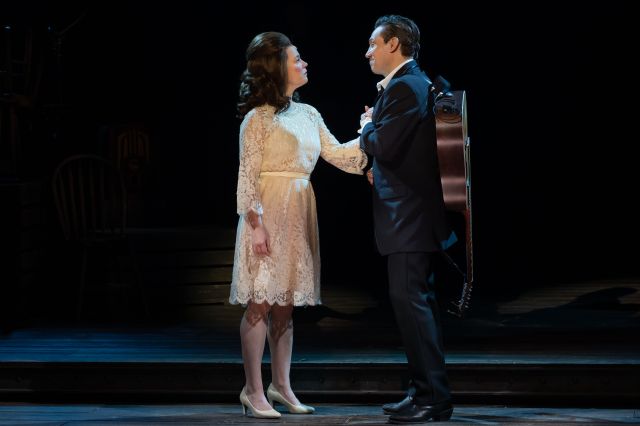
Patti Murin and Christopher Ryan Grant in The Ballad of Johnny and June, La Jolla Playhouse at Citadel Theatre. Photo by Nanc Price Photography.

As I say, epic. But the impact of The Ballad of Johnny and June, dramatically, as conceived by McAnuff and Cary, is on a human scale: an irresistible attraction, a lot of collateral damage, a dangerous drift toward chaos and tragedy (via booze and pills). And this kind of love story, with its happy ending in the middle and before-and-after struggles on either side, is smartly framed by musician/narrator/only son John Carter Cash.

The keynote of Van Hughes’ perfectly judged, and indispensable, performance, captures a wry, worldly, amusing skepticism that filter through The Ballad of Johnny and June, with a title song created by the co-writers and Ron Melrose. And it gives a story plucked from musical history and riddled with gruesome stories of bad behaviour, addiction-fuelled and with a point of view vis-à-vis “family addiction,” a certain (welcome) lightness of touch.

Christopher Ryan Grant in The Ballad of Johnny and June, La Jolla Playhouse. Photo supplied.

The imposing figure of Johnny Cash is well-trod jukebox musicals turf, to say the least: the entertainment repertoire, in clubs and dinner theatres alike, is crammed with clones and anecdotes and the hit song list. And, needless to say, you can’t put Johnny Cash onstage without an actor who can convincingly deliver the four most famous words in country music. “Hello. I’m Johnny Cash” is the “God bless us every one” of the jukebox musical. In McAnuff’s production, with its more dramatic compass, Christopher Ryan Grant goes far beyond that. He provides signature allusions to the celebrated man in black persona, yes. But his grave, intense performance exceeds mere impersonation — and arrives at a dimensional character, in the musical’s most compelling performance.

June Carter is less well defined in the collective consciousness as an individual personality with a known repertoire of physical and musical gestures. With the character created in Patti Murin’s performance, we meet a generically jolly, good-humoured personality (“keep on the sunny side of life!”), broadly comedic in performance, up against an elemental force and paying a price. As John Carter Cash acknowledges, in an origin story he proposes from several points of view, June’s romantic chemistry with Johnny is improbable, and with a considerable cost attached.

Patti Murin and Christopher Ryan Grant in The Ballad of Johnny and June, La Jolla Playhouse production at the Citadel Theatre. Photo by Nanc Price Photography

As our genial narrator notes, if there are two sides to every marriage, two marriages add up to four sides. It’s a complicated geometry. And in McAnuff’s expert stagecraft and the assortment of musical collaborators, relatives, and ex’s undertaken by an able nine-member cast, Gabriella Joy stands out as Johnny’s cherished, neglected, then abandoned, first wife Vivian. Drew Wildman Foster and Correy West as June’s ex-husbands Carl Smith and Rip Nix are limited to quick, vivid cameos. The kids from these early marriages are mostly reference points; the only offspring Johnny and June had together is the grown-up guy stage left, sitting on a stool, playing on the guitar, and commenting on contrasting versions of his pre-birth past.

Maddie Shea Baldwin and Gabriella Joy ih The Ballad of Johnny and June, La Jolla Playhouse production at Citadel Theatre. Photo by Nanc Price Photography

June’s sister and confidante Anita Carter (Maddie Shea Baldwin) returns to the scene from time to time to remind June, and us, of the hazards of hooking up with a problematic artist who measures the distance to the next city as “two-and-a-half pills.” Anita’s lyrical version of June’s Ring of Fire (written with Merle Kilgore), is the one that started that boisterous hit-to-be on its meteoric way (mariachis to come, thanks to Johnny Cash et al).

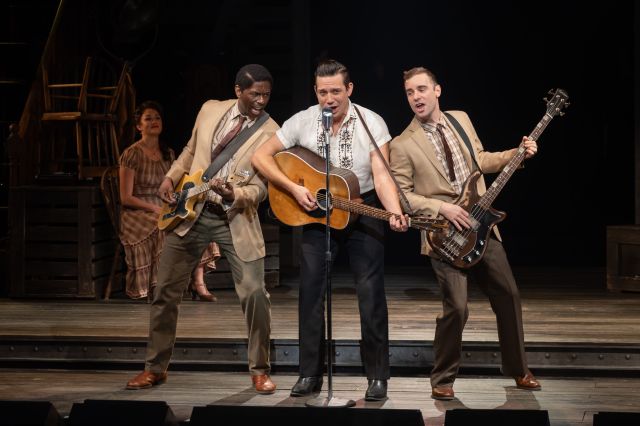
Correy West, Christopher Ryan Grant, Drew Wildman Foster in The Ballad of Johnny and June, La Jolla Playhouse at the Citadel Theatre. Photo by Nanc Price Photography

With its versatile ensemble and a crack six-member band of mostly local musicians led by musical director Lyndon Pugeda, the musical values of McAnuff’s production are first-rate (kudos to guitarist Joe Payne in particular). The sound and the sound mix (Peter Fitzgerald) throughout are impeccable. So the pleasures of a song list that includes I Walk The Line, Get Rhythm, Folsom Prison Blues, A Boy Named Sue, along with famous covers and lesser known songs from the Carter Family archive, are yours to savour. Periodic returns of Jackson make of its memorable lyric “we got married in a fever, hotter than a pepper sprout,” a sort of recurring chorus.

Maddie Shea Baldwin, Patti Murin, Gabriella Joy in The Ballad of Johnny and June, La Jolla Playhouse at the Citadel Theatre. Photo by Nanc Price Photography.

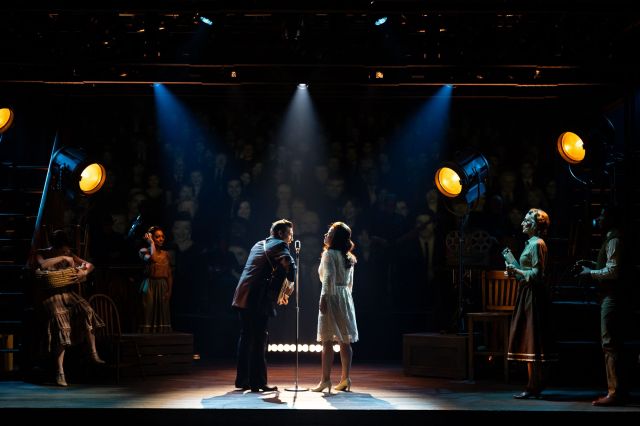
We hear the band before we see them. Our first glimpse comes at the outset through the lighted wooden slats of Robert Brill’s lovely boxcar set. The glints of light, and the play of golden and sepia light in tableaux that speak to an indeterminate past, are all part of Amanda Zieve’s striking lighting design, with its vintage onstage lighting instruments.

It turns out our narrator has an axe to grind, part of his multi-sided family inheritance. The musical gene, check. The predisposition to addiction, check. A certain wariness about marriage, check. “If you want to see God laugh, make plans,” he says. “If you want to see Him do a spit-take, get married.”

The show’s disclaimer on behalf of theatre, though, belongs to the narrator’s dad: never let the truth stand in the way of a good story. And this is a good one, dressed in sin and redemption colours, and with good pipes. Speaking as we are of circles unbroken, the second happy ending, the one that’s actually at the end, is the hardest one: “staying together is the happy ending.” It’s a thought that gives the show its celebratory finale.

Meet director Des McAnuff in this 12thnight preview.

REVIEW

The Ballad of Johnny and June

Theatre: La Jolla Playhouse presented by the Citadel Theatre

Created by: Robert Cary and Des McAnuff (book), music and lyrics by Johnny Cash, June Carter, and others

Directed by: Des McAnuff

Starring: Christopher Ryan Grant, Patti Murin, Van Hughes, Gabriella Joy, Drew Wildman Foster, Bart Shatto, Correy West, Paula Leggett Chase, Maddie Shea Baldwin

Running: through Dec. 8

Tickets: 780-425-1820, citadeltheatre.com


Posted in Reviews | Tagged , , , , , , , , | Comments Off on ‘Staying together is the happy ending’: The Ballad of Johnny and June at the Citadel, a review

What’s new? The weekend on Edmonton stages, that’s what: three new Canadian plays and a musical

Dana Wylie, Gabby Bernard, Dayna Lea Hoffmann in Stars On Her Shoulders, Workshop West. Photo by Marc J Chalifoux.

By Liz Nicholls, 12thnight.ca

Hey Edmonton! It’s a weekend to be surprised and excited by something new on the stages of this theatre town. As the country has found out, E-town has longtime cred as a generator and showcase of new plays. And this the weekend to explore a surge of possibilities, including two high-contrast plays set during World War I, a thorny and surging love story with music we know, an eerie goth thriller.

Patti Murin and Christopher Ryan Grant in The Ballad of Johnny and June, La Jolla Playhouse at Citadel Theatre. Photo by Nanc Price Photography.

•Opening tonight at the Citadel, a new musical about the challenges and intertwined lives of country music’s most celebrated couple, Johnny Cash and June Carter, a love story (with the famous musica) seen through the eyes of their only son. The Ballad of Johnny and June, which premiered at the La Jolla Playhouse last summer has been in further development here at the Citadel en route to the big bad world. Meet the director/co-writer of the musical Des McAnuff (Jersey Boys. The Who’s Tommy, Big River) in this 12thnight preview. It runs at the Citadel through Dec. 8. Tickets: citadeltheatre.com, 780-425-1820.

Garrett C. Smith in The Two Battles of Francis Pegahmagabow, Shadow Theatre. Photo by Marc J Chalifoux

•At Shadow Theatre, The Two Battles of Francis Pegahmagabow, by Neil Grahn, retrieves from Canadian history the remarkable story of the Indigenous warrior and Ojibwa Chief, who turned activist on behalf of his people when he returned from World War I to find he couldn’t even vote. Read the 12thnight preview interview with the playwright, and the 12thnight review here. The premiere production directed jointly by John Hudson and Christine Sokaymoh Frederick runs through Nov. 24 at the Varscona Theatre. Check out the 12thnight preview interview with Neil Grahn here, and the review here. Tickets: shadowtheatre.org.

Meegan Sweet and Gabby Bernard in Stars On Her Shoulders, Workshop West. Photo by Marc J Chalifoux

•Stephen Massicotte’s Stars On Her Shoulders, premiering at Workshop West Playwrights Theatre, has a World War I setting too. This latest play (from the author of the Canadian classic Mary’s Wedding), beautiful, funny and heartbreaking, takes us overseas to that terrible conflict, to a convalescent hospital in France. We meet five women, in a deft exploration of love and friendship, the position of women on the precarious threshold of a new world of equality. Highly recommended. Heather Inglis’s production, which runs through Sunday, is also the debut of Workshop West’s bold experiment at the box office: all tickets, for the entire season, are pay-what-you-will. Read the 12thnight interview with playwright Massicotte here, and the review here. Tickets: workshopwest.org.

Julia van Dam in Monstress, Northern Light Theatre. Photo by Brianne Jang, BB Collective Photography

At Northern Light Theatre, Monstress, a new gothic two-hander thriller from Trevor Schmidt (who directs, and designs set and costumes), spins a dark (and visually stunning) web from the Frankenstein story, and the thorny issue of the relationship between creator and creation. The two-hander (Sydney Williams and Julia van Dam) does its exploring from the female perspective: An ambitious doctor, thwarted in her career, brings back to life the daughter of a wealthy father. Is she God? And the play wonders “who is the monstress?” in the end. It runs through Nov. 23 at the Studio Theatre in the Fringe Arts Barns (10330 84 Ave.). 12thnight talked to playwright/director Trevor Schmidt in this preview. The 12thnight review is here. Tickets: northernlighttheatre.com.   

Posted in Features | Tagged , , , , , , | Comments Off on What’s new? The weekend on Edmonton stages, that’s what: three new Canadian plays and a musical

A love story with complications, in a new musical: Des McAnuff brings The Ballad of Johnny and June to the Citadel

Patti Murin and Christopher Ryan Grant in The Ballad of Johnny and June, La Jolla Playhouse production. Photo supplied

Christopher Ryan Grant and Patti Murin in The Ballad of Johnny and June, La Jolla Playhouse. Photo supplied.

By Liz Nicholls, 12thnight.ca

The Ballad of Johnny and June, the musical that opens Thursday at the Citadel is a love story, with complications. And its director and co-creator Des McAnuff, pre-rehearsal last week, is hunting for the big-impact historical equivalent.

To help support 12thnight.ca YEG theatre coverage, click here.

“Johnny Cash and June Carter coming together was the equivalent of a medieval wedding,” he declares, in a first for contemporary analogy-making. “It’s Henry II marrying Eleanor of Aquitaine.”

“By the late 50s Johnny Cash was the reigning prince of country music. And June Carter was the darling of the Carter family,” giants in the history of country music as not only performers but hunters and gatherers of songs that even date back to the 19th century…. When Johnny Cash marries June Carter (in 1968), the earth shakes.”

Des McAnuff, director and co-writer of The Ballad of Johnny and June, La Jolla Playhouse production at the Citadel Theatre. Photo supplied.

McAnuff, a delightful conversationalist as you will glean, arrives in town with the La Jolla Playhouse production of The Ballad of Johnny and June, en route to further engagements elsewhere (New York? London?). And at his disposal in conversation — a welcome antidote to the morning-after gloom of U.S. election night — is a distinguished cross-border theatre career that’s startling in its embrace. It ranges freely from La Jolla to Broadway (and hits like Big River, Jersey Boys, The Who’s Tommy, Ain’t Too Proud: The Life and Times of The Temptations), to a five-year artistic directorship of the Stratford Festival, and back. And it all starts in the Toronto suburb of Scarborough, with an American-born Canadian kid who played in rock bands and at folk clubs, and wrote music (and musicals).

McAnuff’s latest, which he co-wrote with playwright Robert Cary (“a very very smart cookie … a Yale wit, with a vast general knowledge”), premiered this past summer at the La Jolla Playhouse — a regional theatre brought back to life by his artistic directorship, and one of the country’s most significant Broadway try-out houses. The Ballad of Johnny and June arrives at Edmonton’s largest playhouse, with its La Jolla cast of actor/musicians (mostly New York-based), largely through McAnuff’s connection with Citadel artistic director Daryl Cloran. In this travel itinerary, it follows the trajectory of Hadestown and Six, which had developmental stops at the Citadel en route to Broadway.

Cloran was McAnuff’s assistant director on a couple of Stratford productions, Caesar and Cleopatra (starring Christopher Plummer), and A Funny Thing Happened On The Way To The Forum. “Daryl came to visit me in La Jolla,” recalls McAnuff. “To learn more about the mechanics of doing original work and how to get work out to other places,” a subject on which McAnuff is demonstrably a top-drawer expert. Witness the full third of La Jolla productions in his two regimes there that have been produced elsewhere, including 14 that have found their way to Broadway (with two best director Tonys for McAnuff). The international travels of Cloran’s Beatles-infused As You Like It, most recently to the Shakespeare Theatre Company in Washington D.C., please him enormously.

Christopher Ryan Grant in The Ballad of Johnny and June, La Jolla Playhouse. Photo supplied.

The immediate inspiration for The Ballad of Johnny and June, McAnuff explains, was that “the rights to the Johnny Cash catalogue and story became available.” And John Carter Cash, the starry parents’ only son together, and a musician and biography-writer himself, “wanted a story that was authentic…. We were given no instruction about what take to have on the story. But he was very interested in us not trying to romanticize the story of his parents.”

There have been other Johnny Cash musicals, Ring of Fire on Broadway and Walk The Line on film. But they promulgated “a kind of fairy tale,” wherein June rescues Johnny from a life of dissolution. Their son “was open to having the real story told.” It’s much more complicated than the mythology, since it includes June’s denial of her own substance abuse problems.

“He was very generous about sharing stories and information with us,” says McAnuff of the son who’s captured onstage as the musician narrator (played by Van Hughes), the “balladeer” of The Ballad of Johnny and June. “One of the wonderful things was John told me that my first Broadway musical, Big River (1985), was his dad’s favourite.”

“We went to Hendersonville (Tenn.) where he still lives, we listened to all the music, we did a lot of research, and spent an incredible amount of time together to figure out what the architecture of this musical would be … all before a word was written. We’d tell the story back and forth to each other, with the song structure, and it went through several incarnations.” Readings happened, and so, two years ago, did a rather fulsome workshop in New York.

The Ballad of Johnny and June, La Jolla Playhouse production. Photo supplied.

“You go in with curiosity and hopefully a sense of wonder about what you’re going to discover,” as McAnuff puts it. What he and Cary did discover was “a story that concerns family addiction.” DNA? nature vs nurture? In any case “it’s a disease that can be passed on.” And amidst our current opioid epidemic, when street drugs are scarily more available, and cheaper, than they were in the ‘50s, there’s no arguing its topicality.

“It’s a love story with challenges,” he says of The Ballad of Johnny and June, “terrible, debilitating, and potentially fatal problems…. Which makes it an important story.” But “not a downer,” McAnuff hastens to add. “I think it’s very moving to see people who love each other getting over their deep personal problems and addictions. Ultimately, it’s uplifting. Not a drag! The irony is that the music they’re playing is so exuberant.”

“There’s something between them, something that buoys them up!”

The sheer size and range of the McAnuff career archive as playwright, director, and actor, backs him up on the declaration that that “The joyous thing about theatre is you don’t always have to play the same role. You switch hats and nobody’s terribly shocked.… I want to do it all; I’m a glutton.” He laughs. “The kind way to put it is ‘eclectic’. If you used that word in the Russian theatre it would be a curse”

He’s an artist who wears his vast cross-border experience lightly in conversation. “I never decided to become a playwright or a director. I just woke up one day, and that’s what I was doing. No life goal; it was anarchy!” By the time he’d left Toronto for New York in 1976, age 23, to research on location in Soho a piece on Phil Oakes, “I’d run a lot of laps,” as he puts it.

There are Alberta roots in the McAnuff story (his mother was born in Drumheller, a grandfather in Bowden). And there’s no shortage of Canadian theatre cred. In high school in Scarborough he’d written a musical, Urbania, “and they had the moxy to produce the thing!” instead of Mame, as planned. He’s still a bit wonderstruck by this. “It was even controversial, a gay character, armed resistance in a city of the future … a little bit Brave New World.”

Leave It To Beaver Is Dead, by the 21-year-old McAnuff, had premiered at Hart House Theatre. For Toronto Free Theatre, he’d written a score for Michael Ondaatje’s The Collected Works of Billy the Kid, a non-linear adaptation of the poetry collection, and it got done at the Folger Theatre in Washington D.C. His friends were the movers and shakers of the happening alternative Toronto theatre scene of the ‘70s, Martin Kinch, Paul Thompson among them. He lived in the same house (different floor) as playwright Carol Bolt “who took me under her wing.”

One of his most influential mentors, as McAnuff enthusiastically describes, was Michael Langham, the English-born actor/ director/ Stratford artistic director (and sometime head of New York’s Juilliard School). “A brilliant man, and and I owe him so much!”.

New York and McAnuff took to each other, and “I’ve kept a place there ever since.” He arrived with his girlfriend of the time (actor Wendel Meldrum, from Edmonton), co-founded the Dodger Theater Company, and directed their inaugural show Gimme Shelter. “I arrived in May, had my 24th birthday in June, and got my first serious job in July.” He directed The Crazy Locomotive at the Chelsea Theatre Centre, and his own play Leave It To Beaver Is Dead at the Public Theatre (with a high-powered cast that included Mandy Patinkin, Dianne Wiest, Saul Rubinek, and Maury Chaykin).   

McAnuff remembers his years leading the Stratford Festival — he left his La Jolla artistic directorship in 2008 for that prime Canadian gig — with particular fondness for the possibilities of a rep company. “I had a fantastic time,” he says. “I believe playwrights flourish when they’re produced side by side with classical plays.”

Musicals (“I love all kinds of music”) thread their way through McAnuff’s career, alongside Shakespeare, Shaw, Chekhov….  He thinks of Jersey Boys, Ain’t Too Proud, and now The Ballad of Johnny and June  as “history plays,” like the Wars of the Roses cycle of Shakespeare. And in these post-royalist times, “musicians are our kings and queens.”

“I wouldn’t be interested in creating a fictional story to go with a body of songs” à la Mamma Mia, he says. “I’m only really interested in the biography…. The jukebox thing is meaningless to me.” He grins. “If Johnny Cash and June Carter were master chefs, there would be no songs in the show. There might be chateaubriand though….

PREVIEW

The Ballad of Johnny and June

Theatre: La Jolla Playhouse presented by the Citadel Theatre

Created by: Robert Cary and Des McAnuff (book), music and lyrics by Johnny Cash, June Carter, and others

Directed by: Des McAnuff

Starring: Christopher Ryan Grant, Patti Murin, Van Hughes, Gabriella Joy, Drew Wildman Foster, Bart Shatto, Correy West, Paula Leggett Chase, Maddie Shea Baldwin

Running: Thursday through Dec. 8

Tickets: 780-425-1820, citadeltheatre.com

Posted in Previews | Tagged , , , , , , , , , | Comments Off on A love story with complications, in a new musical: Des McAnuff brings The Ballad of Johnny and June to the Citadel

“I have become God”: Trevor Schmidt’s thriller Monstress premieres at Northern Light, a review

Julia van Dam and Sydney Williams in Monstress, Northern Light Theatre. Photo by Brianne Jang, BB Collective Photography

By Liz Nicholls, 12thnight.ca

You enter the Studio Theatre through fog, and discover you’re in a mysterious chamber, glowing with jewelled colours and overhung with dozens of scissors, blades pointing down at us.

To help support 12thnight.ca YEG theatre coverage, click here.

The centrepiece, a slab that might be a kind of altar, seems to float on rosy light from below, possibly from hellish sources. And you can just make out, if you squint, a back wall dominated by a Vitruvian Woman, splayed in the famous Leonardo square and circle.

There’s eerie magic in this improbable transformation of a small black box space, something of a specialty of Northern Light’s playwright/director/ designer Trevor Schmidt — a necromancy here assisted materially by the gorgeously atmospheric and dramatic lighting devised by Larissa Poho. And as you’ll quickly find out in Schmidt’s new Goth thriller Monstress, opening the NLT season, this reinvention speaks theatrically to the Frankenstein-ian experiment that’s at the centre of the play. Ah, the story is a tangible demo of the operating theatre as … theatre.

We’re in a doctor’s subterranean lab. “Am I the monstress?” wonders the “good doctor” (Sydney Williams) at the outset, speaking to us from the vaguely Victorian, even more vaguely English, past. “What have I become?”

Sydney Williams in Monstress, Northern Light Theatre. Photo by Brianne Jang, BB Collective Photography

This ambitious scientist, the first female doctor accepted to the Upper Harrington Academy of Anatomical Dissection and School of Medicine and Surgery, has been expelled. But she’s carried on. And now, she’s speaking to us from the precipice of a breakthrough “on the boundaries of life,” as she puts it. “Hubris has brought me here…. I have become God.”

Julia van Dam in Monstress, Northern Light Theatre. Photo by Brianne Jang, BB Collective Photography

Her experiments in “necromancy and re-animation” have come to the attention of a rich Colonel. He’s hired her to bring back from beyond the grave his dead daughter Lydia Chartreuse (Julia van Dam), her neck fatally broken when she was thrown from a horse. For the doctor it’s an invitation to pull back the curtain on the Great Secret of life and death, to cross the mysterious frontier between the two. Like Mary Shelley’s Viktor Frankenstein before her, the challenge to defy human limitations, operate outside boundaries of conventional morality, and exercise god-like power, is irresistible. In the male-dominated world of science the script and its witty title give this doctor’s single-minded quest a particularly feminist motivation, too.

Which is when you realize that the doctor is revisiting, and reassessing, her “triumph,” in a play that’s bookended by that opening question, “am I the monstress?” It’s really a question for the us, the audience.

As her experiment begins, relocated to the Colonel’s spooky country house, Dave Clarke’s clever sound design doesn’t just conjure the past in an unnerving, echo-y way — the fateful sound of horses’ hooves, for example, and voices that sound unlocked from a misty vault. The punctuation, so to speak, of Schmidt’s production is the recurring, and always horrifying sound of a neck cracking, in reverb. It will make you flinch, along with the doctor, every time.

There is much I shouldn’t tell you, for your own good, about what happens in Monstress. This you should know: both actors in Schmidt’s cast are excellent. The doctor’s re-creation of a person, and the education she instigates in how to be human, are strange, and queasy. In van Dam’s performance, which dispenses with any hint of English accent in favour of sounding neutral, Lydia Chartreuse has a chilling fixity, an outsized doll-like blankness (“a strangely clean slate”). The doctor as teacher introduces words, and words trigger memories that begin to add up.

And Williams is terrific as the instigator, increasingly flummoxed by the chain of direct life-and-death questions put to her by her “creation” — and by her own mounting doubts about her responsibility for the creature she’s returned to the land of the living.

Julia van Dam in Monstress, Northern Light Theatre. Photo by Brianne Jang, BB Collective Photography

“Are you my mother?” asks Lydia, who attaches herself more and more to her ‘benefactor’. “I brought you back to life,” answers the doctor cautiously. “How do you know I wanted that?” Lydia wonders.  “Am I good? Are you good?” And here’s one: “how does a father love a daughter?” The questions are wide-ranging, and kind of float through the play, attaching themselves here and there, on the thorns of the past.

The script, and the story, belong to the doctor’s first-hand account, and, in Williams’ thoughtful performance to her dawning realization about Lydia’s life and the ruthlessness of her own thwarted ambition. The doctor, the self-created god who rallies under the science flag, describes events as they happen. Times being what they are, in an age permeated by political skepticism about science, Monstress is unafraid to wonder about the ego of the scientist, and that’s unsettling in itself.

But what gives this highly theatrical piece its particular tension and suspense is the visual and aural imagery attached to a story about female drive and unrelenting ambition. The sight of Lydia like a beautiful, dangerous, outsized fairy, learning humanness from scratch from a self-appointed god, is something you’ll take with you. The big questions are the unanswerable ones.

REVIEW

Monstress

Theatre: Northern Light Theatre

Written by: Trevor Schmidt

Directed by: Trevor Schmidt

Starring: Julia van Dam and Sydney Williams

Where: Studio Theatre, ATB Financial Arts Barns, 10330 84 Ave.

Running: through Nov.23

Tickets: northernlighttheatre.com

Posted in Reviews | Tagged , , , | Comments Off on “I have become God”: Trevor Schmidt’s thriller Monstress premieres at Northern Light, a review

In a staccato barrage of scenes, a star is born: The Two Battles of Francis Pegahmagabow at Shadow Theatre, a review

Garrett C. Smith in The Two Battles of Francis Pegahmagabow, Shadow Theatre. Photo by Marc J Chalifoux

By Liz Nicholls, 12thnight.ca

In the opening moments of Neil Grahn’s The Two Battles of Francis Pegahmagabow, to the strains of Rule Britannia, a top soldier is getting a military medal from the Prince of Wales.

To help support 12thnight.ca YEG theatre coverage, click here.

Seconds later, as Francis Pegahmagabow is annotating, wryly, that the ceremony was “the best it ever got” in his relationship with Brit royalty, his limelight disappears, and he waves to the theatre technician behind us to restore it. “Reconciliation in action,” he quips, with a ghost of a smile. It’s funny, and it’s telling.

The new play, by a Métis writer with major comedy cred, has a fascinating true story to tell, inspired by Grahn’s research in the dark vaults of Canadian history where public consciousness rarely ventures. It’s about a remarkable Canadian, an Indigenous warrior whose deadly expertise as a sniper and scout in the bloody Front Line trenches of World War I made him prized abroad — in a way that never translated to basic respect, much less equality, at home. He could risk his life in nightly forays across the enemy line. But back in Canada he couldn’t even vote, or hire a lawyer, or secure a loan. It turned a war hero and Ojibwa Chief into an activist, a warrior on behalf of his people against the Canadian government and its lackeys.

In Shadow Theatre’s season-launching premiere production, directed jointly by John Hudson and Christine Sokaymoh Frederick, we meet the man in a star-power performance by Garret C. Smith. He impressively carries the play through its scattering of staccato scenes that are brief snapshots of moments ranging non-chronologically through time and space — from an orphan’s childhood, growing up hunting with an arsenal of traditional skills and connections to the Great Spirit, through World War I and its disillusioning aftermath, in what seems like no particular order. There are a lot of entrances and exits in this production.

Ben Kuchera and Garret C. Smith in The Two Battles of Francis Pegahmagabow, Shadow Theatre. Photo by Marc J Chalifoux

Like the second of Pegahmagabow’s “two battles” itself — the one in the trenches of Canadian bureaucracy, racism, and intransigence — all of them capture a moment, then end abruptly and inconclusively. The exit line is almost always a look from “Peggy”:  a telling deadpan, an ever-so-slight stoic’s grimace, the briefest of knowing glances at the audience that speak to the absurdity of the world, an almost-shrug. They never end in anything as overt as out-and-out exasperation, even the ones that demonstrate the character’s remembered capacity for anger.

Smith’s performance memorably conjures a character who is unusually self-possessed, a powerhouse of calm, gravity, grace and dignity under fire of all kinds. And his four cast-mates play everyone else — grandparents, in-laws, wartime officers, nurses, fellow Indigenous leaders, buddies — in an exaggerated style under Hudson and Frederick’s joint direction. It’s Peggy who commands the stage for the evening.  And the charismatic Smith is a real find for Edmonton theatre.   

The playwright fashions The Two Battles as a memory play, a scattergun assortment of very brief scenes hosted by Pegahmagabow. He annotates from time to time, including a reflection on his “terrible gift” for “hunting men.” In a story about heroism, Grahn’s comedy muse occasionally kicks in to undercut, in a puckish way, the solemnity of a moment by acknowledging its theatrical circumstances. “I’m sharing my inner thoughts here,” he says to another character, shooing him off the stage:. “This is not your story. I was already here.…”

Monica Gates, Julie Golosky, Garett C. Smith in The Two Battles of Francis Pegahmagabow, Shadow theatre. Photo by Marc J Chalifoux

The “here” is a striking curvilinear design by c.m. zuby, a kind of amphitheatre of screens, low-rise scaffolding and in the centre a tilted and slatted round wooden “stage” like a drum, sitting on a red target. It can be lighted (or un-lighted, in Patrick Beagan’s clever design) to conjure a campfire, or a gas attack, or evoke the sense of all-surround danger in trench warfare. Aaron Macri’s subtle soundscape finds a narrative continuity between the thunder of Indigenous drumming and the thunder of cannon fire. Pegahmagabow’s uncanny success and fortitude as a scout and sniper are directly related to his traditional Indigenous skills.

Interestingly (and oddly), Macri’s boldly painted projection-scape, which includes shadow puppet-play (animator: Lynette Maurice), emphasizes a certain storybook quality: memory scrolls horizontally, in a rustic, stylized, not to say historical, technique that dates back centuries. The full moon comes up like a painting; clouds of poison gas wafting through the trenches take on ghostly shapes.

Monica Gates and Garett C. Smith, The Two Battles of Francis Pegahmagabow, Shadow Theatre. Photo by Marc J Chalifoux

The acting style of the ensemble leans into comic exaggeration, in broad, quick, cartoon strokes that occasionally press their luck. Trevor Duplessis’s gift for comedy is on display in a variety of roles. The most touching, and droll, scenes, perhaps because of their stillness or quietness, are encounters between Pegahmagabow and his taciturn, amusingly undemonstrative wife Eva (Monica Gate), or with his white wartime buddy Glen (Ben Kuchera).   

The life and career of Francis Pegahmagabow is a great story, no question, and an important one to tell in this historically-challenged country. But the downside of storytelling in brief, abrupt scenes, constantly dislocated in time (which is, to be fair, the way memory and influences work in real life) is that the two-battle momentum of the story keeps getting deliberately interrupted and, I think, a bit dissipated in the process.

Garett C. Smith in The Two Battles of Francis Pegahmagabow, Shadow Theatre. Photo by Marc J Chalifoux

It’s the pointillist approach to biography — sketches on speed? — presumably with the thought that a lifetime isn’t one thing after another, it’s a simultaneous totality, with memorable glints here and there, back and forth. Something of the impact and double-weight of Pegahmagabow’s two wars, one that ended and one that continues to this day, is dispersed in this fractured landscape.

Ah yes, continuity: The Two Battles of Francis Pegahmagabow is an open-ended play that way, and an eloquent reminder to us Canadians of a past, still present, that has made outsiders of some of us.

REVIEW

The Two Battles of Francis Pegahmagabow

Theatre: Shadow Theatre

Written by: Neil Grahn

Directed by John Hudson and Christine Sokaymoh Frederick

Starring: Garett C. Smith, Trevor Duplessis, Ben Kuchera, Julie Golosky, Monica Gate

Where: Varscona Theatre, 10329 83 Ave.

Running: through Nov. 24

Tickets: shadowtheatre.org 


Posted in Reviews | Tagged , , , , , | Comments Off on In a staccato barrage of scenes, a star is born: The Two Battles of Francis Pegahmagabow at Shadow Theatre, a review

Who’s the real monster? Monstress, a new Trevor Schmidt thriller, launches the Northern Light season

Sydney Williams and Julia van Dam in Monstress, Northern Light Theatre. Photo by Briane Jang, BB Collective Photography

By Liz Nicholls, 12thnight.ca

Trevor Schmidt calls his latest play, launching the Northern Light Theatre season Friday, “my Lady Frankenstein show.”

To help support 12thnight.ca YEG theatre coverage, click here.

Playwright Schmidt, NLT’s long-time artistic director, has long been fascinated by the female perspective, female windows on the world, the female voice and vision. Ah, and much to the delight of female actors, roles for women. And Monstress, as its title wittily conveys, re-imagines Mary Shelley’s celebrated Gothic novel of 1818 — the complicated relationship between a doctor and his creation — in female terms.

“There have been lots of different versions of the Frankenstein story,” says Schmidt of the Shelley novel in which Dr. Viktor Frankenstein creates a living being from interred body parts. Some versions, he says, even have a female Dr. Frankenstein. But this question intrigued him: “what would be the difference if the two (Doctor and Creation) were both women?…. Might it be maternal in some way? What if the doctor doesn’t necessarily feel maternal? I wanted to explore the relationship,” he says, along with “a lot of ideas that were present in the original Frankenstein — hubris, doctors thinking they’re God, creation and what responsibility (the creator) has.”

The seed of it was planted in the Schmidt brain as a one-person show, then with a cast of two or three. “It shifted a lot” before Schmidt settled on the show as a two-hander.

Monstress, Northern Light Theatre. Photo by Brianne Jang

In Monstress, a doctor, a woman in the male-centric Victorian world who’s been expelled from medical school for experiments outside the curriculum (or possibly just for being a woman), “brings a dead woman back to life,” at the request of the dead woman’s rich father. The deceased has apparently been thrown off a horse and broken her neck.

It sounds, on the surface, as if there are similarities with the Emma Stone movie Poor Things that came out after Schmidt’s idea had become a script. And the playwright was much relieved to find that they, and their stories, are very different.

“I was a bit nervous about this,” says Schmidt of his dark new play. “People don’t realize how nerve-wracking it is to write a play, hand it to people, and hope they like it….” The excited  response he got back from designers Larissa Soho (lighting) and Dave Clarke (sound) turned things around for him. “It’ll be something!” he felt. Maybe not something for everyone, but “something!”

The design pair found the script “so creepy, so dark,” says Schmidt. “Weird?” He hadn’t quite realized it. “Well, OK,” he thought. “I had to think that maybe my taste level is skewed after years of weird work!” He leaned into it, “and now it’s quite unusual…. I think it’ll be quite unsettling for people.”

A designer himself (he does set and costumes for Monstress), Schmidt thinks the NLT production will be beautiful to look at. “Both Larissa (lighting designer Poho) and I really like intense saturated colours … the colours of the show are green and purple.”

Schmidt offered the role of her choice to Julia van Dam, who’d starred in his production of A Phoenix Too Frequent a season ago (she’s just finished a run of Putrid Brat’s production of The Maids). She chose to play The Body. Another hot up-and-comer, Sydney Williams, plays the doctor.

Gradually, a blurring of identities seems to happen between the doctor and her creation. When he was announcing this season’s NLT lineup, Schmidt wondered “which one is the real monster?”

“I’m always interested in plays with protagonists who are conflicted — what is best for themselves vs what is best for others — society, relationships, love.” In this case “notoriety, success, fame” are the lure. Hubris and ego have roles to play. “Does the doctor’s personal advancement take precedent over the human aspect of the woman she’s brought back (to life)? Where does the doctor’s responsibility lie? If she brought her back, does she have to care for her?”

“I could shape her any way that I want to,” thinks the doctor, as Schmidt describes the play. “Nature vs nurture … someone with the wrong motives gets their hands on an innocent lump of clay…. Ah, but conversely, is that person an innocent lump of clay once they’ve died and come back to life. How have they been changed?”

Monstress is a capper to a year and a half’s “creative surge as a writer,” as Schmidt puts it: no fewer than seven new plays, including two (Robot Girls and Candy & The Beast) last season and three (The Black Widow Gun Club, Microwave Coven, Mass Debating) at this past summer’s Fringe. With more to come.

“We’ll see if some of it is too much for audiences,” he says of Monstress, the opener to a season christened Making A Monster. “There’s disturbing stuff in it…. It’s not like anything that’s happening in town right now.”

PREVIEW

Monstress

Theatre: Northern Light Theatre

Written by: Trevor Schmidt

Directed by: Trevor Schmidt

Starring: Julia van Dam and Sydney Williams

Where: Studio Theatre, ATB Financial Arts Barns, 10330 84 Ave.

Running: Friday through Nov.23

Tickets: northernlighttheatre.com


Posted in Previews | Tagged , , , , | Comments Off on Who’s the real monster? Monstress, a new Trevor Schmidt thriller, launches the Northern Light season

The Two Battles of Francis Pegahmagabow, a new World War I play by Neil Grahn, premieres at Shadow Theatre

Garrett Smith in The Two Battles of Francis Pegahmagabow, Shadow Theatre. Photo by Marc J Chalifoux

By Liz Nicholls, 12thnight.ca

He was “arguably the greatest soldier this country has ever produced,” as playwright Neil Grahn puts it. “And nobody knows his name….”

To help support 12thnight.ca YEG theatre coverage, click here.

Grahn’s new play The Two Battles of Francis Pegahmagabow, premiering Thursday to open the Shadow Theatre season, chronicles the extraordinary life and career of one of Canada’s most decorated heroes in the horrific war that was supposed to end all wars. And when the star sniper and scout, an Ojibwa from Wasauksing First Nation near Lake Huron, returned home from fighting for his country in World War I, it was to a world where he didn’t even have a vote.

So, for the warrior/ Chief/ activist, the “second battle,” this time in the Canadian trenches, began, a battle that in so many ways has never been won in a war that has never ended.

It was when Grahn was researching the Princess Patricia’s Light Infantry Division for his World War I play The Comedy Company, which premiered at Shadow in 2018, that he kept coming across a name he’d never heard. Francis Pegahmagabow’s achievements were startlingly impressive. He’d signed up early, and he stayed on for the duration, fighting through injuries. And to his Military Medal in 1916 was added two bars for bravery and excellence as a scout and sniper in some of the bloodiest, most dangerous, battles of the most destructive war in human history: Ypres, Passchendaele, Amiens, the second Battle of Arras among them.

“Who is this guy?” Grahn wondered. “Why do I not know who this guy is? I felt embarrassed, just by myself, not knowing….”

An indefatigably curious researcher, Grahn, a Métis writer/director/sometime actor who works in theatre, film, TV, and improv comedy, set about finding out. And in the process he uncovered an amazing, and expansive, story. “So many of the early political movements for First Nations were inspired by returning Indigenous veterans…. They went over to World War I and they were peers, one of the soldiers,” in short equals. “But when they came back they were … Indians.”

“The army was quite a good place for being treated for who you were not what you were,” says Grahn. Indigenous soldiers “had been given autonomy and respect, and so when they came back and it was taken away, that inspired them to take action. Many veterans were the leaders” in the Indigenous activist movements that followed.

Ben Kuchera and Garrett Smith in The Two Battles of Francis Pegahmagabow, Shadow Theatre. Photo by Marc J Chalifoux

The injustice of Pegahmagabow’s situation was striking, to say the least. “He comes back a war hero and can’t even vote,” as Grahn says. He’s the Chief of his band, and his loan application — “he’d wanted to get some horses to improve his land and raise his station” — is turned down at least three times. “The Indian Agent felt he “‘wasn’t responsible enough’.” And an activist was born.

Grahn recounted the story to his friend Shadow artistic director John Hudson, with the annotation “this has got to be a movie!”. Hudson pushed him to make a play of it, “and I’m really glad he did,” Grahn says. The stylization built into theatre means that “cast of hundreds if not thousands” is conjured by the five actors of the Shadow cast led by Garrett Smith as Francis. “It’s very egalitarian,” says Grahn of the show we’ll see; “everybody plays everybody, women are soldiers; everybody is pitching in.” The only actor with a single role is Smith; he is, to say the least, busy. “It’s Francis’s story and he’s telling it…. I don’t think Garrett leaves the stage; he’s in everything! An exhausting adventure!”

“I am absolutely delighted with Garrett!” declares Grahn happily of the actor, a member of the Piikani and Kainai Nations of the Blackfoot Confederacy of southern Alberta “He’s the deal! He has a real physicality to him, and a way about him. I sit beside him, and I think ‘I wouldn’t want to fight this guy’…. He reminds me — similar energy and body type — of my buddy Shaun Johnston,” the actor who was a Shadow co-founder with Hudson.

The production is co-directed by Hudson and Christine Sokaymoh Frederick. It crossed Grahn’s mind to direct it himself, but he’s right in the midst of creating and directing season 2 of the APTN documentary series Horse Warriors (season 1 is airing right now). As Grahn describes, “it follows the ‘Indigenous relay circuit: Crazy! So dangerous! They race horses in relay fashion; they get on a horse — a highly strung super-fast thoroughbred — and do one lap, jump off and jump on other horse, and do another lap, and then again. And they do it bareback. This is insane!” he says appreciatively. “If it’s happening live anywhere near, go see it! It’ll blow your doors off.”

“It’s kinda like stock car racing if the car could just randomly turn and run you over.” The circuit follows the old plains tribes, Grahn explains. “Where the buffalo roam. Used to room,” he amends. “We’re about as far north  as they go.…”

A documentarian he is, but comedy, improv and sketch, are part of Grahn’s showbiz DNA too. In the late ‘80s he became the fourth member of the storied sketch troupe Three Dead Trolls in a Baggie, famously nutty in a highly literate sort of way, and pioneers in fashioning full-length plays from sketches. For seven years he was the head writer for The Irrelevant Show, CBC Radio’s hit sketch show. And he’s created and written seven TV series.

Steven Greenfield, Sheldon Elter, Andrew MacDonald-Smith, Jesse Gervais in The Comedy Company. Photo by Marc J Chalifoux Photography 2018

“I don’t think I’m capable of doing anything without finding some joy or laughter,” he figures. The true story, unlikely and unknown, that Grahn culled from the mists of Canadian history, the inspiration for The Comedy Company, is a test case. In the darkest days of the First World War, members of Princess Patricia’s Light Infantry Division were summoned by their commander to devise light musical comedy shows to divert and amuse their fellow soldiers — laughter in the face of death.

Grahn says his Indigenous connections have continued to inspire him. “The First Nations comedy sensibility is really dry,” he’s found, to his perpetual amusement. “As soon as I come in and they start to make fun of me, I know I’m in, I’m good. If they’re really polite I’m like ‘O No! What did I do wrong? I’ve pissed someone off’.” This continues to amuse him.

Francis Pegahmagabow, the Indigenous soldier whose life inspired the Neil Grahn play that launches the Shadow Theatre season. Photo supplied.

In the case of The Two Battles of Francis Pegahmagabow, “so much of my documentary background has really helped me with the script,” he says. “I’m a Métis guy writing an Ojibwa story,” so he consulted Ojibwa elders to see what they thought of that. “They all said ‘the story should be told, tell the story’.”

Theatre and TV have meant that time has proven in short supply in Grahn’s life. “I’d love to get back to weekly improv,” he says. “It’s so refreshing! When you’re improvising, if you’re doing it right, you’re nowhere else but there…. That, and pickleball (laughter). That’s where I’m at.”

And the research for the play was “brutal,” as he puts it cheerfully. Diving into the National Archives and newspaper sites was tricky, mainly because “not a lot of early First Nations political movements were covered much. You really have to dig.” He’s discovered that in 1927 the government effectively put a stop to First Nations activism by making it illegal for Indigenous people to hire and pay a lawyer.  “Whaaaat!?”

What was he like, Francis Pegahmagabow the man? “He could be fiery,” says Grahn. “And his beliefs were mixed. He was very very Catholic, and also very attached to the Great Spirit and traditional teachings as well…. There was a lot of magical thinking to him.”

PREVIEW

The Two Battles of Francis Pegahmagabow

Theatre: Shadow Theatre

Written by: Neil Grahn

Directed by John Hudson and Christine Sokaymoh Frederick

Starring: Garrett Smith, Trevor Duplessis, Ben Kuchera, Julie Golosky, Monica Gate

Where: Varscona Theatre, 10329 83 Ave.

Running: Thursday through Nov. 24

Tickets: shadowtheatre.org 

Posted in Previews | Tagged , , , , , , , | Comments Off on The Two Battles of Francis Pegahmagabow, a new World War I play by Neil Grahn, premieres at Shadow Theatre

Heartbreaking and funny, Stars On Her Shoulders premieres at Workshop West. A review.

Hayley Moorhouse and Dayna Lea Hoffman in Stars On Her Shoulders, Workshop West. Photo by Marc J Chalifoux

Meegan Sweet and Gabby Bernard in Stars On Her Shoulders, Workshop West. Photo by Marc J Chalifoux

By Liz Nicholls, 12thnight.ca

Every once in a while you find yourself in the theatre fully absorbed in a world that’s both distant and utterly close at hand. And you laugh through tears. It happened for me at Workshop West Playwrights Theatre Friday night.

To help support 12thnight.ca YEG theatre coverage, click here.

There is a moment, both heartbreaking and funny, in Stephen Massicotte’s beautiful new World War I play Stars On Her Shoulders, when one of the five nurse characters in a convalescence hospital in France undertakes to teach another the how-to’s of happiness — in a shattered world.

In Heather Inglis’s premiere production, Helen (Hayley Moorhouse), grim-visaged in the fortress of her own gallows humour, admits “I’ve lost the knack of it.” A feeling of hopelessness has trampled everything else.

How does happiness work? Can it be learned? Or, once lost, re-learned? Georgie (Dayna Lea Hoffmann), a new arrival on the ward, coaxes Helen into the fragmentary world of her own memory — and a moment at home in Canada before the war, a buried image of sunlight through a summer storm. It’s Helen’s first smile in the play, and it will touch you in a profound way.

Stars On Her Shoulders is like that. There is a love story embedded deep in the fibre of the play — it’s for you to discover so I won’t spoil it. But it wears its World War I setting in a much different way from Massicotte’s Mary’s Wedding, a dream of first love the conjures the terrible war overseas through the imaginary participation of a Canadian girl back home. For one thing Stars On Her Shoulders is poised on the precarious threshold between centuries, the prescriptive Victorian sense of a woman’s lesser place in the scheme of things and the elusive possibilities of a brave new world of equality between the sexes.

Dana Wylie, Meegan Sweet, Hayley Moorhouse in Stars On Her Shoulders, Workshop West. Photo by Marc J Chalifoux.

As if to conjure it visually, Inglis stages her production (beautifully designed by Brian Bast and lighted dramatically by Alison Yanota) on a gangway, a pathway between worlds that has us seated on either side. And Darrin Hagen’s original sound and composition design, with its whiffs of Edwardian music hall and its floating allusions to the “modern” world is in sync, too.

At the centre are Helen and Emma (Meegan Sweet), inspired by historical figures, who have braved grave danger to rescue the survivors in a German bombing of a Canadian hospital in Doullens, France in 1918. And these female heroes, who would not be happy with the designation ‘heroine’, are recuperating fretfully, anxious to get back to work. Both, in different ways, have a sharp-edged articulate wit about them that cuts through the traditionally sentimental male-owned landscape of heroism like a hot knife through butter, in the bright comic banter that Massicotte’s dialogue provides them. The play wears its narrative complications lightly, and carries its burden of exposition with expert ease.

Emma’s wounds are obvious: her head is swathed; her hands are bandage mittens. Helen’s are less obvious but less fixable, as we learn in the course of the play. Shell-shock and a shattering sense of “hopelessness” have overtaken her; “I’m lacking a variety of feeling,” she concedes in a rare unguarded moment without the mordant sardonic tone and entrenched irritability that Moorhouse captures so vividly in their performance. “The charm of doing nothing” has vanished, as she snaps. “Was I doing ‘nothing’ wrong?”

Meegan Sweet in Stars On Her Shoulders, Workshop West. Photo by Marc J Chalifoux

Sweet is terrific as Emma, a Canadian senator’s daughter of the activist Suffragist stripe, droll, bright, and crisply exasperated by a status quo that has kindly allowed women to participate, as nurses, in the lethal war abroad, but denied them the right to vote. Bandaged hands notwithstanding, she even smokes with a certain insouciance. And the character rises to every setback as a provocation to redoubled efforts. “Our voice was heard; the work continues!” she says of a failed protest launched on behalf of women’s gymnastics. “The answer is invariably No…. It’s persistence that pays.”

Helen and Emma are both, in their way, “odd women,” which is to say women who are out of step with the usual “husband project” — “not so beautiful, not so charming (pause), not so interested.”

Dana Wylie, Gabby Bernard, Dayna Lea Hoffmann in Stars On Her Shoulders, Workshop West. Photo by Marc J Chalifoux.

The pair are surrounded by the working nurses of the hospital. In command, under the male military hierarchy of course, is Maude, a Scot convincingly played by Dana Wylie making a welcome return to theatre from the world of music. She’s proud of her charges, but speaks, from experience you assume, to caution against pressing their luck by arguing about the status of the medal of bravery they’ve been offered. “Don’t spoil all you’ve worked for here” by reinforcing the stereotype of women as “ungrateful, melodramatic creatures.” Emma scorns that view; the new century cannot come into its own fast enough for her.

The performances in Inglis’s production are closely meshed. Hoffmann as Georgie, a repository of wispy period songs and a steadfast spokesperson for the much-battered notion of hope, is a compelling figure, a tantalizing glimpse of the might-have-been for Helen. And Gabby Bernard is very funny and charming as the innocent — in a drawing room comedy she’d be the maid — trilling away cheerfully and cleaving to ‘the rules’ until she’s gradually drawn into a more wayward route to the future.

I’ve made this sound perhaps more schematic than it is. In all, Stars On Her Shoulders is a remarkably rich, full-bodied theatrical experience. And it speaks so movingly, in its theatrical way, to moments in human history that somehow feel seminal, when “comfort and pleasant thoughts” or “carrying on the best we can” just won’t cut it, and vigilance is required. Moments like ours.

I loved it.

Meet the playwright in 12thnight’s PREVIEW.

REVIEW

Stars On Her Shoulders

Theatre: Workshop West Playwrights Theatre

Written by: Stephen Massicotte

Directed by: Heather Inglis

Starring: Hayley Moorhouse, Meegan Sweet, Gabby Bernard, Dayna Lea Hoffmann, Dana Wylie

Where: Gateway Theatre, 8529 Gateway Blvd.

Running: through Nov. 1 to 17

Tickets: All tickets are pay-what-you-will this season at workshopwest.org.

Posted in Reviews | Tagged , , , , | Comments Off on Heartbreaking and funny, Stars On Her Shoulders premieres at Workshop West. A review.

Lethal power games as performance art: The Maids introduces a new indie theatre

Hannah Wigglesworth and Julia van Dam in The Maids, Putrid Brat. Photo supplied.

By Liz Nicholls, 12thnight.ca

There’s something exactly right about entering the theatre through an unmarked door, down the stairs and into a space that invites reinvention and expands before your very eyes. It’s a world ready and waiting for actors to play in.

To help support 12thnight.ca YEG theatre coverage, click here.

The Pendennis Building downtown is where Putrid Brat, a new Edmonton indie theatre, introduces itself by producing an unsettling play that will fray the edges of your nerves (how quintessentially bratty is that?). That Jean Genet’s The Maids, forever young at 77 years old, is a piece all about performance, its seductions, its dangers, its artifices and limitations, is an intriguing calling card from two young actors, Julia van Dam and Hannah Wigglesworth, with director David Kennedy.

It’s a complicated game that Genet’s two maids play, a ceremony in which they take turns playing the mistress they both despise and idolize, and they play each other too. Claire (van Dam) and Solange (Wigglesworth) exist on a densely layered plane of adulation and grievance, oppression and fury. In a space that’s both claustrophobic and too big for them, they create their own theatre of sliding identity, in which their oft-rehearsed script leaks at the seams. And they dream, in a complex way, both of violence and love, homicidal revenge and emulation, a bloodstream of revolution.

Hannah Wigglesworth and Julia van Dam in The Maids, Putrid Brat. Photo by Kyle Tobiasson and PoppyRose Media

I had a chance, late in the run — and you have the chance till Sunday — to watch two very skilled actors in this tricky assignment. In the opening scene Van Dam (we’ll see her next week in Northern Light’s new Trevor Schmidt play Monstress) and Wigglesworth as Claire and Solange are in heightened mid-performance as the aggrieved maids. Claire plays the cruel, sneering Mistress and Solace is Claire, so reviled she’s not even fit to kiss the Mistress’s shoe.

“Take up the slack, you slut,” Mistress commands servant. “If you insist on snivelling, then snivel in your attic.” The translation by Brit playwright Martin Crimp has a kind of muscular danger, and humour, of its own.

When the Mistress herself comes home, you hear in Alexandra Dawkins’ detailed comic performance the noblesse oblige notes her maids have sounded and exaggerated in their impersonation — power wielded by the iron hand in the velvet glove, yes, and also condescension ambiguously camouflaged as disarming kindness. In the performance the Mistress projects a kind of vulnerability to men, to the servant class; it’s lethal to the maids’ plans, and she overplays self-consciously for her own benefit. In the dangerous game of attraction/revulsion, aggression and retreat, the maids have raised the stakes in their latest move, which they analyze over and over.

This intricate network of role-playing, alterations, second thoughts, reversals, in a world where fury and fear are in a tug-of-war for supremacy, is captured in Kennedy’s production.

Putrid Brat has attracted a top creative to their debut passion project: Kennedy’s direction, Even Gilchrist’s scenic design, Beyata Hackborn’s costumes, Nick Kourtides’s sinister sound design. And you have the opportunity to see two remarkable, and enterprising, actors at work. Keep your eye on these U of A theatre grads. They’re going places.

The Maids runs through Sunday at the Pendennis Building, 9660 Jasper Ave. Tickets: www.showpass.com/themaids/

Posted in Reviews | Tagged , , , , , , | Comments Off on Lethal power games as performance art: The Maids introduces a new indie theatre

Playwright Stephen Massicotte talks about Stars On Her Shoulders, his latest, premiering at Workshop West

Dana Wylie, Gabby Bernard, Dayna Lea Hoffmann in Stars On Her Shoulders, Workshop West. Photo by Marc J Chalifoux.

By Liz Nicholls, 12thnight.ca

In 2002, a story of first love, a dreamscape looped against the horrific backdrop of World War I, changed the life of the graphic designer-turned-actor who’d “jumped into theatre cold.” as he puts it.

To help support 12thnight.ca YEG theatre coverage, click here.

Since its Calgary premiere two decades ago, Mary’s Wedding, Stephen Massicotte’s first full-length play has been on a mainstage odyssey across the country, the border, and the pond. In the elite pantheon of bona fide Canadian classics, it has a special place.

Stars On Her Shoulders, the new Massicotte play that opens the Workshop West season Friday (all tickets are pay-what-you-will!), returns the playwright to Canada (he’s lived in New York since 2007), to the World War I vault where Canadian history lies sleeping — and to the theatre where Mary’s Wedding began life as a Springboards staged reading.

It shares the World War I setting with Mary’s Wedding. But “it’s a totally different style,” says Massicotte of his new play, which he traces back to a first draft at Calgary’s Alberta Theatre Projects in 2016. If Mary’s Wedding is a lyrical, poetic wander through time and space, present and past, Stars On Her Shoulders reflects the brisker influence of Noel Coward, “and particularly Terence Rattigan,” he says of the English master of the traditional ‘well-formed play’. Especially “the feminist suffragette character” in Rattigan’s The Winslow Boy. “An articulate, smart, witty kind of woman of that period.”

The characters, five women in 1918 in the aftermath of a German bombing of a hospital in Doullens, France, are nurses. Two of them, “the heroes of the play,” work through the night rescuing survivors, saving patients’ lives, “putting fires out with their hands.” As Massicotte describes, “a lot of nurses came from prominent families, educated quite well. … I thought it’d be fun to have them (take on) an Oscar Wilde vibe, in the cleverness of their speech.” And he fashioned his play in that vein.

playwright Stephen Massicotte, Stars On Her Shoulders, Workshop West Playwrights’ Theatre. Photo supplied.

The old-school structure he’s chosen is, he thinks, a marked contrast to contemporary theatre practice of “many short, intense scenes in different locations,” a reflection of a generation tied to watching TV and movies, and quick small-screen interpolations. “Tennessee Williams, Chekhov … those guys all wrote like that, long scenes that don’t drop the tension by cutting to black-out.”

“It’s a lost art,” he says. “Setting: the drawing room, for a half-hour scene in that location, with people coming and going. Then, the next scene, ‘the drawing room later that day’ … changing from two-hander scenes to three, to four, back to three, in different configurations. It’s quite a feat, really. And it makes you go farther with a scene than you normally might.”

Canadian history provided Massicotte, a military history buff, with a controversy involving what sort of medal of bravery should be awarded the nurse heroes. “Canadian authorities pointed out to the British war office that, although they appreciated this honour, Canadian nursing sisters were officers,” and so should get the military cross. Elsewhere nurses were “regular soldiers,” eligible for a medal on a lower rung in the hierarchy of military distinctions.

He’d mined the incident for one of the “Canadian Heritage Minute” pieces he was enlisted to write. “Heritage Canada didn’t really want to get into the controversy, and focussed on the bravery.” But he’d seen the seeds of a play in it. Massicotte is amused by the fact that the costumes assembled and designed by Brian Bast include some from the Heritage Minutes as per their labels, an inadvertent testimonial to career continuity.

The seven-year arc to opening night, which includes the (alas) familiar COVIDian fits and starts, is, he says, “the longest period I’ve ever worked on a play…. What was good about it is that every time I thought it was ready, I re-wrote it some more. And now I’m pretty proud of it.” Originally Massicotte had planned to write only one more World War I play. Now he has a trilogy, that includes The Oxford Roofclimber’s Rebellion, encounters between war hero Lawrence of Arabia and the poet Robert Graves.

“I’m pretty stoked,” says the genial Massicotte, not least because “this is all women…. It’s a fact that over the years, less roles have gone to women. So anything woman in acting has to be that much better prepared, that much better skilled, that much better talented. Whereas with men, there are great actors out there of course. But sometimes a male actor can get by for a long time just by being OK, OK to work with, reliable.”

“I’ve never written a play with more females than male. And the place is crammed with talent. I’m so impressed,” Massicotte says of Heather Inglis’s production. “The whole cast is crackerjack, really on the ball. And they’re funny! This sounds like a heavy play, but it’s quite funny, I think, in places.”

Massicotte’s own storyline is an original, anything but predictable. “When people ask me where I’m from I don’t say Thunder Bay, where I grew up; I say Calgary,” Massicotte says. “It’s where I did my first plays; it’s where I had my first theatre success.” And he can claim Edmonton roots as well, since he took his earliest writing, The Boy’s Own Jedi Handbook plays, to the Fringe, and other one-acts to Nextfest here.

And, as a graphic design grad of Cambrian College in Sudbury he might never had ended up in theatre at all, if it weren’t for having a crush on a girl who happened to be a stage manager in the college theatre department. “I painted sets, built some set pieces, and thought to myself ‘I wonder if I could do that; I bet I could do that!’” He took improv classes at Magnus Theatre in Thunder Bay; he got cast in an amateur production of Sharon Pollock’s Blood Relations.

Why Calgary? “At the time I was an air cadet, and in summer I used to teach at the cadet camp in Penhold, and many any of my best friends at the time lived in Calgary.” So, theatre school at the University of Calgary, as an actor, followed, along with occasional thoughts like “What have I done?”

Todd Houseman and Tai Amy Grauman in Mary’s Wedding, a Métis version. Citadel Theatre. Photo by Arthur Mah.

In Calgary he did plays, TV, commercials, “whatever came along.” And then came Mary’s Wedding, “and everything exploded. Oh, I guess I’m a writer now!” And it’s a career that catapulted him to theatre stardom, without a single writing class. “I still write from an actor’s point of view,” he thinks. “What would be fun for actors to do? What would they really enjoy sinking their teeth into? And I try to make even the small roles exciting to play.”

In New York, where he’s been for 17 years, with an American partner (“she went to McGill; she’s Canada-qualified!” he laughs), he writes mostly screenplays for TV and film, especially of the horror stripe. He and his film collaborators have an indie horror film How We Ended ready to go, and they’re looking for distribution. And he’s been working on a youth-oriented fantasy novel. “Stars on Her Shoulders is my first new play in a long time,” he says.

Do his explorations of horror and war have a certain continuity? He muses on the question. “I suppose they’re similar in that people are facing an existential danger. In plays it’s a bit more subtle, of course: someone facing a loss of hope, a loss of the ability to carry on. And having to recover even the tiniest thread of something that can keep them going.”

That is “a something you can get from human interaction, love, friendship, that can help you survive,” even those moments when “nothing seems to matter but we’re all supposed to keep going…. Even when living one more day is an act of defiance in the face of oblivion, sorrow, grief. Hope is this precarious act of profound bravery.”

It applies to the nurse characters of his new play, up against war and the circumscribed rights of women. And “when you have enough plays to look at,” he says, “you realize how much you’re writing about yourself.”

PREVIEW

Stars On Her Shoulders

Theatre: Workshop West Playwrights Theatre

Written by: Stephen Massicotte

Directed by: Heather Inglis

Starring: Hayley Moorhouse, Meegan Sweet, Gabby Bernard, Dayna Lea Hoffmann, Dana Wylie

Where: Gateway Theatre, 8529 Gateway Blvd.

Running: Friday Nov. 1 to 17

Tickets: All tickets are pay-what-you-will this season at workshopwest.org.

Posted in Previews | Tagged , , , , , , | Comments Off on Playwright Stephen Massicotte talks about Stars On Her Shoulders, his latest, premiering at Workshop West