Back-combing the ’60s: Hairspray at the Jube, a review

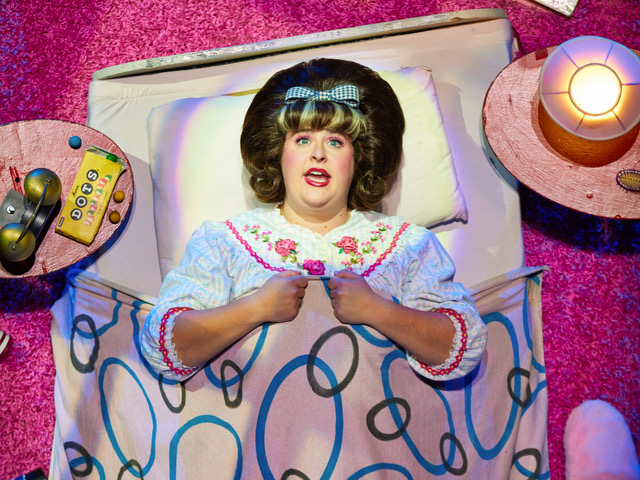
Caroline Eisman in Hairspray, Broadway Across Canada. Photo by Jeremy Daniel.

By Liz Nicholls, 12thnight.ca

Something has happened to the light-hold flexible Hairspray we’ve always known. It’s gone Ultra-Clutch.

In a world of chronic downsizing — of prospects, budgets, the polar ice cap … — there’s something reassuring, in theory, about the candy-coloured Broadway hit musical of 2003 that’s arrived with a big beehive of early ‘60s for the Jube stage. Hairspray is all about size large, in hair, in heart, in girth.

To help support 12thnight.ca YEG theatre coverage, click here.

I have to tell you that a sold-out opening night house Tuesday, who rose to their feet cheering, decisively will not agree with me here. But judging by this hard-driven, relentlessly brassy Broadway Across Canada production, the period piece musical (teased from the 1988 John Waters movie) that captivated us with its endearing bouffant combo of satirical and sweet, goofy and earnest, has lost something en route to 2023. Too much back-combing? Too much conditioner? Overheated blow dry? A dated ‘do?

For starters, the sound mix in Act I, at least on opening night, was so heavily band-forward it was pretty hard to figure out which character was singing onstage. Much less hear the Scott Wittman/ Marc Shaman lyrics, a shame since they’re cheeky and witty. The sound improved somewhat in Act II, but retained a nasty metallic sheen.

To look on the bright side, you can have no cavil about size. Size Large the production truly is, with a cast of nearly three dozen (and a band of six). The actors are a treat to look at, in William Ivey Long’s ‘60s costumes, all ice cream soda colours and argyle vests, re-created for the tour. And Jerry Mitchell’s choreography, reworked by Robbie Roby, reinvents the movement lexicon of the ‘60s, both its retro (white) comb-over and its capture of the forward-looking (Black) moves of the time. Which turns out to be a key narrative distinction.

“I got my own way of moving and I got my own voice,” as Seaweed (supple Josiah Rogers) and his sister Inez (Kaila Simone Crowder) tell us in the song Run and Tell. And plus-size radical Tracy Turnblad (Caroline Eiseman), up against the skinny white status quo, is the beneficiary of their example in her quest to be on TV and capture the fancy of heartthrob Link (Skyler Shields).

To return to the story, Tracy and her equally outsized mama Edna Turnblad, played by Greg Kalafatas (an actor of sturdy build, as per the tradition established by Divine and Harvey Fierstein), find themselves at a moment in history in Baltimore 1962 when social revolution is at hand. The local TV teen dance extravaganza, The Corny Collins Show, a take-off on Baltimore’s Buddy Deane Show, is looking for a replacement performer. Tracy pines to to be a Corny Collins dancer, and the secret of her success is her Black moves. So racial integration just makes perfect sense to her. And a mother-daughter team of outcasts-turned-ample activists is set in motion.

With some exceptions, guileless charm of the wide-eyed variety is in short supply in the well-lacquered production directed for the tour by Matt Lenz (Jack O’Brien was the original director). Performances are directed to dial up comic grimacing, double-takes, and mugging. And you’d be forgiven for wondering from time to time whether you might be watching a Hairspray parody.

Tracy, a repository of optimism, moves with a skip and a bounce — and here a certain tooth-gritting determination, as if her life (or at least her portfolio) depended on them. In this version she isn’t exactly the endearing, vulnerable heroine whose fortunes in romance and showbiz are a big part of your Hairspray investment.

Greg Kalafatas in Hairspray, Broadway Touring Production. Photo by Jeremy Daniel.

Edna, she of the “extra-large largesse,” tends to go directly for the laughs, winking at her own cross-gender casting. But Kalafatas’s performance did grow on me in the course of the evening. And Edna’s vaudevillian soft-shoe number with her husband Wilbur (the delightful Ralph Prentice Daniel), owner of the Har De Ha Hut joke shop, which dials back, or diverts, comic posturing in favour of a different kind of laughter, is a lot of fun, and something of a relief.
Josiah Rogers and Scarlett Jacques in Hairspray, Broadway Across Canada touring production. Photo by Jeremy Daniel.

There’s not much girl chemistry between Tracy and her nerdy BFF Penny (Scarlett Jacques). But the latter performance does land on comic moments without hammering them into the stage. Performances in smaller roles, like Penny’s bigoted mother or the school principal who doubles as the Corny Collins corporate sponsor, are grotesquely exaggerated, to remind us I guess that we’re watching a comedy in case we’ve blanked on that. The mother-daughter pair of villains “from the white side of the tracks,” Velma and Amber Von Tussle, are gamely played by Sarah Hayes and Caroline Portner.

Kudos to the Supremes-like trio who emerge from a poster mid-performance with sage advice — “doncha let nobody try to steal your fun/ ‘cause a little touch of lipstick never hurt no one” — and to Deidre Lang’s Motormouth Maybelle, who powerfully delivers the racial anthem I Know Where I’ve Been.

Speaking as we are of stealing your fun, You Can’t Stop The Beat, as the show’s signature number puts it (and Hairspray history has reinforced). But in this production, to me, the  the beat is a hammering.

REVIEW

Hairspray

Broadway Across Canada touring production

Created by: Marc Shaiman (music), Marc Shaiman and Scott Wittman (lyrics), Mark O’Donnell and Thomas Meehan (book)

Where: Jubilee Auditorium

Running: through Sunday

Tickets: ticketmaster.ca

Posted in Reviews | Tagged , , , , , | Comments Off on Back-combing the ’60s: Hairspray at the Jube, a review

Springboards, Workshop West’s signature new play festival, is back

By Liz Nicholls, 12thnight.ca

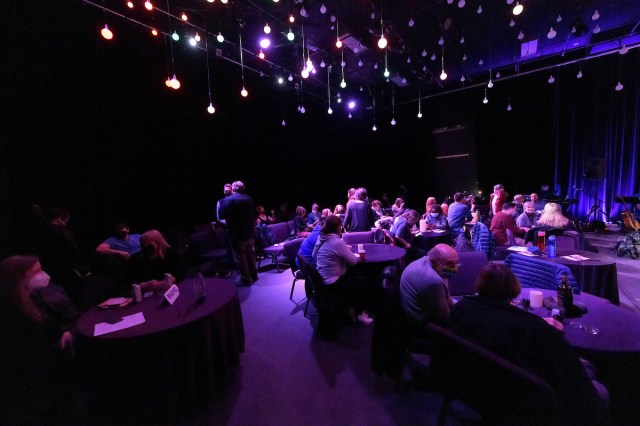
Springboards is back this week. And with it, our annual backstage pass to the world of artistic creation, where new plays get born and develop.

To help support 12thnight.ca YEG theatre coverage, click here.

Workshop West Playwrights Theatre’s new play festival, which returned after a 10-year absence in 2022, is a signature event for a 46-year-old company devoted to the discovery and development, the honing, expansion and profile, of the Canadian repertoire. And in this edition, works-in-progress at every stage of their evolution by some 22 playwrights at every stage of their careers, from beginners to veteran Canadian stars like George F. Walker, will get staged readings of every size in a cabaret setting at the Gateway Theatre — with an audience (that’s us!).

As Workshop West’s artistic producer Heather Inglis has often reminded us, the first engagement of a new play with a live audience is a crucial part of its journey to the opening night mini-quiches — revealing for the playwright and exciting for us watchers. Springboards is all about that. And restoring it was a priority for Inglis when she got the Workshop West job just before COVID brought live theatre to a shuddering halt in 2020.   

In this year’s expanded festival, Monday through March 31, replete with staged readings of every size, workshops, talkbacks, cabarets, and panel discussions, there’s even a night (Tuesday) devoted to a “Workshop on Workshops,” that, as Inglis puts it, “pulls back the curtain on what happens when a play gets workshopped, the rules of engagement for a good workshop.” It’s led by actor/ director Trevor Ruegar, the Calgary-based executive director of the Alberta Playwrights Network.

And by way of launch, the opening night of Springboards 2024 is an evening in the company of an artist with “an encyclopedic knowledge of Edmonton theatre,” and an unfailing generosity of spirit in sharing it. Ask Jim stars Jim DeFelice, actor, director, teacher, mentor, an unparalleled resource for everyone who works in the field, and everyone who loves live theatre. “Cynical is not part of his DNA,” as Inglis says of the puckish Edmonton “theatre elder” now in his ‘80s.

Hosted by the star playwright Conni Massing, whose new comedy Dead Letter (part of last year’s Springboards) is the Workshop West season finale in May, the evening includes an onstage interview of DeFelice, and questions from the audience. Bring yours.

Both DeFelice and Massing have a long history with Workshop West. The former was on the WWPT board for 17 years, with a wealth of experience and connections in new play creation. Six of the latter’s plays have premiered at Workshop West.

Springboards 2023, Workshop West Playwrights Theatre. Photo supplied.

The full-length featured staged readings include new plays by award-winners Collin Doyle (Let The Light Of Day Through, Terry And The Dog, The Mighty Carlins) and Nicole Moeller (The Ballad of Peachtree Rose, An Almost Perfect Thing, The Preacher). Doyle’s Summer Solstice, set in 2002, takes a character back to her home town in northern Alberta for the funeral of her father, a man’s she’s removed from her life 30 years before. Inglis, who describes the playwright as “such a smart, careful, passionate writer,” directs Friday’s reading, with a cast that includes Beth Graham, Doug Mertz, and Marianne Copithorne.

Moeller’s The Resurrection of Dottie Reed, as Inglis describes, concerns a woman in her ‘60s, a victim of an internet scam, who has had enough,” and devises her revenge. With recent productions of Mob and Subscribe Or Like, Workshop West has stepped into the dangerously volatile online world in which we all at least partly live and struggle to retain our agency and identity. This time, a character fights back, “using a lifetime of experience.” Tracy Carroll directs Chris Bullough, Michele Fleiger, Kristin Johnston and Maureen Rooney in Saturday’s reading.        

EdmonTEN, the bright idea of Carroll and Conni Massing and now “an Edmonton tradition,” arrives back at Springboards Wednesday in partnership with The Alberta Playwrights’ Network. Five 10-minute plays, selected blindly from submissions, get a debut reading. And the playwrights run the gamut of experience. The evening includes Beth Graham’s Galloping Heart, Leslea Kroll’s Riverside, Shawn Marshall’s The Chart, Cat Walsh’s The Sun Sets In Apartment 506, and Alexandria Fortier’s Stuck With You.

The 10-minute play is a concentrated form that’s intensely difficult to craft, as Inglis points out. “It requires such a tight command of tension.” Amy DeFelice directs a cast of three: Trevor Rueger, Michelle Diaz, and Danielle LaRose.

All three of the artists, relative newcomers to the scene, who have contributed scripts to Thursday’s Wildside Cabaret are actors-turned-playwrights. Intriguingly two of their three high-contrast offerings — all directed by Ben Henderson (former Theatre Network artistic director and ex-city councillor) — involve animal characters. One of the queer couple in the third is played by a puppet.

Angus, the protagonist of Spencer Kells’s Sheep Play, is a sheep with big dreams and, in a post-human world, challenges to match. The cast of Lora Brovold, Brennan Campbell, Alex Dawkins, and Cody Porter take on sheep-ish assignments. Kole Durnford’s Horseplay chronicles the best-friends relationship between Jaques, a jockey, and Horse who is one. They’re up against the threat of separation if they don’t start winning races. Inglis calls it “a beautifully sad and hopeful coming of age play.”  Vince Forcier and Aran Wilson-McAnally step up to the gate. In Michael Watt’s Arthur and Titi (“whimsical and fun” as Inglis describes) we meet a couple, a man and a puppet, trying to make things work between them.

Sunday’s grand finale is the third annual Springboards Cabaret, curated by Darrin Hagen and directed by Jake Tkaczyk. It’s a mashup of excerpts from soon-to-be hot new plays, new music, special guests, billed as “an evening of adult fun.”

The playwright list for this cabaret, always a hot ticket, is wildly eclectic. As usual it’s attracted submissions from a mix of newcomers and experienced writers: Stephen Allred, Mikayla Boutin, Louise Casemore, Kijo Gatama, Seth Gilfillan, Katherine Koller, Emily Lizotte, Natalie Meisner, Kristine Nutting, Zachary Parsons-Lozinski, Andrew Torry, Jaquelin Walters, Lindsey Walker … and George F. Walker. The latter, one of the country’s celebrated veterans, has credits in the Workshop West archive. In the 1999-2000 season, the company produced two of Walker’s Suburban Motel plays. Bradley Moss directed Problem Child; David Mann The End of Civilization.

Inglis has discovered that “Jim DeFelice wrote the first article ever about Workshop West for the Canadian Theatre Review, in 1985…. It’s been fascinating to see what hasn’t changed — the struggle for (acknowledged) relevance of Canadian work.” Now, she says, “it’s still considered an incredible risk to put new Canadian plays onstage.” Inglis sighs, and laughs. “But that’s what we do! I love an underdog story!” And there’s nothing more heartening than an underdog celebration.

For more information, and the full detailed schedule, check workshopwest.org.

Springboards New Play Festival, 2024

Theatre: Workshop West Playwrights Theatre

Where: Gateway Theatre, 8529 Gateway Blvd.

Running: Monday through March 31

Tickets: all pay-what-you-will at the door. In advance at showpass.com.

Posted in Features, Previews | Tagged , , , , | Comments Off on Springboards, Workshop West’s signature new play festival, is back

An evening in the park with Sondheim and up-and-comers at MacEwan, and more

Rain Matkin and Eli Yaschuk in Sunday In The Park With George, MacEwan University Theatre Arts. Photo by Lindsey Tran, @understudystudio_. Set design Ross Nichol, costume design Deanna Finnman, lighting design Travis Hatt, video design Matt Schuurman

By Liz Nicholls, 12thnight.ca

Last night in a packed theatre I got a chance to see the only musical in the repertoire where the rhyme of “rapturous” and “capture us” floats through the air.

To help support 12thnight.ca YEG theatre coverage, click here.

Both apply to the experience of Jim Guedo’s MacEwan University production of Sunday In The Park With George, Stephen Sondheim’s groundbreaking, mysteriously emotional, 1984 masterwork. In the repertoire it is, of course. But Sunday in the Park With George is so rarely staged — its technical, theatrical, and musical challenges are particular, rarefied, and daunting — it’s a special occasion to see it. And the audience in the Triffo Theatre was full of people who know the music through and through, and whose eyes mist over at the first chord of the swelling ensemble anthem Sunday, but who’ve never seen a production live.

It’s inspired by a modernist painting, Georges Seurat’s Sunday Afternoon On The Island Of La Grande Jatte. It captures, in Seurat’s signature pointillist style, well-dressed French suburbanites in a park on a sunny day off, just hanging out. There’s a kind of haunting stillness to it, and a shimmer that results from the points of colour applied, like dots, for the viewers to assemble in their minds. And Sondheim and playwright James Lapine, in this their first partnership, aim for a theatrical and musical equivalent. Wrap your mind around that.

It’s not a narrative per se, but the figures in the painting come to life, and criss-cross the “canvas” with things to say and to sing. And at the centre there’s the story of the artist, George, intensely immersed in his art, sketching and painting and neglecting his lover Dot, who’s modelling for him, and longing for something more than the artist gaze and exhortations to “concentrate.”

Cast of Sunday In The Park With George, MacEwan University Theatre Arts. Photo by Lindsey Tran, @understudystudio_. Set design Ross Nichol, costume design Deanna Finnman, lighting design Travis Hatt, video design Matt Schuurman.

The optics are intricate. It starts with the blank canvas (the first word in the musical, spoken by George, is “white.” And the sophisticated design of Guedo’s production, the joint achievement of Ross Nichol (set), Travis Hatt (lighting), Matt Schuurman (video), is a matter of screens, and washes where the dots accumulate and assemble into scenery — trees, and grass, and people beautifully costumed by Deanna Finnman. It’s artistic creation in motion. “Composition. Balance, Light. And harmony.” And Act II, which happens a century later, reveals what happens when the search for something passionately new and original becomes co-opted by the marketplace — a struggle that has been part of Sondheim’s own life, as you read in his two-part memoir.

Eli Yaschuk as George in Sunday In The Park With George, MacEwan University Theatre Arts. Photo by Lindsey Tran, @understudystudio_, Set design (Ross Nichol), costume design (Deanna Finnman), lighting design (Travis Hatt), video design (Matt Schuurman).

The cast of 17, student actors about to graduate from the theatre arts department, create vivid characters who emerge and retreat into the scenery in a captivating rhythm under Guedo’s direction, with choreography by Amber Borotsik. They’re led by wonderful performances from Eli Yaschuk as George, fierce and prickly in his intensity and focus, and Rain Matkin as Dot, lovestruck and knowing, quick-witted and chafing in frustration as she fantasizes about being a Follies girl.

Both are strong singers, with a feel for delivering a song. Remember their names; you’ll be seeing them soon in cast lists across Edmonton theatres. In fact Yaschuk and Matkin will star in Radiant Vermin, already announced in the upcoming season at Northern Light Theatre.

Rain Matkin as Dot in Sunday In The Park With George, MacEwan University Theatre Arts. Photo by Lindsey Tran, @understudystudio_. Set designer Ross Nichol, costume designer Deanna Finnman, lighting designer Travis Hatt, video designer Matt Schuurman.

The music of Sunday in the Park is complicated and jagged, veering from the lyrical to the a-rhythmic and off-centre in its intervals, with silent moments of anticipation. The actors and an orchestra of six (who are non-student pros) negotiate the difficult score under the musical directors Steven Greenfield and Shannon Hiebert. And the sound design of David Bowden does it proud.

There is something moving about seeing young actors, on the brink of professional careers, tackle a musical that’s all about the magic, and the loneliness, of being an artist. “However you live, there’s a part of you always standing by, mapping out the sky finishing a hat, starting on a hat….”

Sunday In The Park With George runs through Sunday on MacEwan’s Triffo stage in Allard Hall. Tickets: tickets.macewan.ca.

MacEwan has just announced an upcoming season that launches with Tracey Power’s Glory, a Jazz Age hockey story directed by Amber Borotsik in the Tim Ryan Theatre Lab Oct. 30 to Nov. 3. Leigh Rivenbark directs Heathers The Musical in the Triffo Theatre Nov. 27 to Dec. 3. Jim Guedo’s Theatre Lab production of the highly original Dave Malloy musical Natasha, Pierre & The Great Comet of 1812 runs Feb. 12 to 16, 2025. And the season finale (March 26 to 30, 2025) is The Prom, directed by MacEwan alumnus Byron Martin, the artistic director of Grindstone Theatre. Subscriptions and tickets: tickets.macewan.ca or 780-497-4470.

At the Fringe’s Backstage Theatre … tonight and Saturday, is a celebration of Indigenous “winter storytelling,” ᐋᒋᒧᐃᐧᐣ âcimowin. It’s led by Elder Jerry Saddleback, a venerable repository of ancestral wisdom, followed by performances from the distinguished  actor/playwright Sheldon Elter, and MC Red Cloud who weaves personal narrative and hip-hop in his storytelling. Tickets: fringetheatre.ca.   

Posted in News/Views, Reviews | Tagged , , , , , | Comments Off on An evening in the park with Sondheim and up-and-comers at MacEwan, and more

Three musicals and a comedy: snow reason to stay home, the weekend onstage

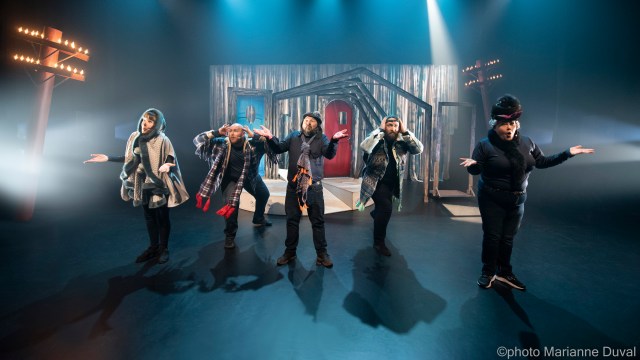
Vaches The Musical, Créations In Vivo at L’UniThéâtre. Photo by Marianne Duval.

By Liz Nicholls, 12thnight.ca

Edmonton, you have choices on stage this weekend, including a delightful and insightful comedy that sees into the complicated lives of teenage girls, and three musicals that land miles apart on the musical theatre spectrum  — a classic, a groundbreaker inspired by a painting, and a musical comedy that has fun with the musical form itself. Snow is merely a hint: get yourself to the theatre.

To help support 12thnight.ca YEG theatre coverage, click here.

•L’UniThéâtre, Edmonton’s only professional francophone theatre, launches its season, for the first time in living memory, with a musical.  Vaches The Musical, a spirited, light, and funny original by Stéphane Guertin and Olivier Nadon, music by Brian St-Pierre, arrives from Ottawa’s Créations In Vivo. In French, with English subtitles, the five-actor production is “freely inspired” by a true story, the dramatic Quebec ice storm of 1998.

Full of running gags, and light of touch, it’s set in Casselman, a village in rural Ontario “37 minutes” outside Ottawa. And the farmer protagonist Jean is up against it — his daughter (who wants to move to Toront0, the greedy mayor, the military, and then the ice storm. Jean is valiantly determined to save his cows from destruction. It’s a test of the resilience of small communities, and the spirit of collaboration. And as the title suggests, there’s fun to be had in winking at the grandiloquent conventions of musicals.

It opens tonight at La Cité francophone’s Théatre Servus Credit Union (8627 rue Marie-Anne Gaboury) and runs through Saturday. Tickets: lunitheatre.ca.

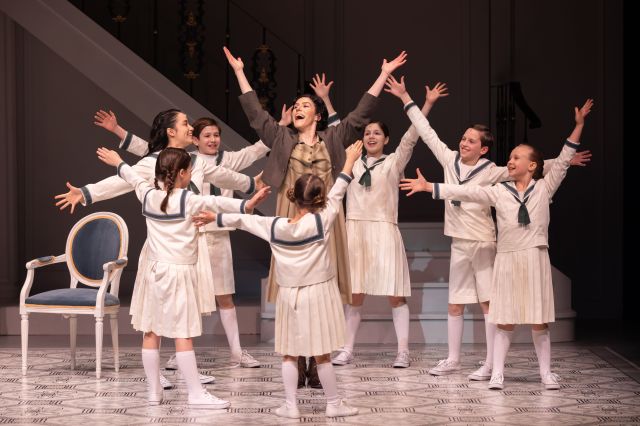
The Sound of Music (Priya Narine with guitar), Citadel Theatre/ Royal Manitoba Theatre Centre. Photo by Nanc Price.

•At the Citadel, The Sound of Music, the final collaboration of the most successful musical theatre partnership in history, Rodgers and Hammerstein, continues through March 31. And with this encouragement to take up mountain climbing, your chance to unleash a score that’s always simmering in your brain. Priya Narine as the high-spirited postulant and Charlie Gallant as the stern naval hero, and seven wonderful young actors (including Christina Nguyen as the oldest Liesl) as the kids, star in Rachel Peake’s Citadel/ Royal Manitoba Theatre Centre co-production. Have a peek at the 12thnight review. Tickets: citadeltheatre.com, 780-425-1820.

Cast of Sunday In The Park With George, MacEwan University Theatre Arts. Photo by Lindsey Tran, @understudystudio_. Set design Ross Nichol, costume design Deanna Finnman, lighting design Travis Hatt, video design Matt Schuurman.

•Jim Guedo’s production of Sunday in the Park With George at MacEwan University, running tonight through Sunday, is a rare chance to see the 1984 Stephen Sondheim masterwork. There’s something magical about this musical, which brings to life a pointillist painting, Georges Seurat’s Sunday Afternoon on the Island of La Grande Jatte. And it’s all about art, and artists, and making art, and the sacrifices in relationships, in life, that are built into the life of the artist. It runs on the Triffo Theatre stage at MacEwan University (11110 104 Ave.). Check out the 12thnight.ca preview with director Guedo here. Tickets: tickets.macewan.ca.

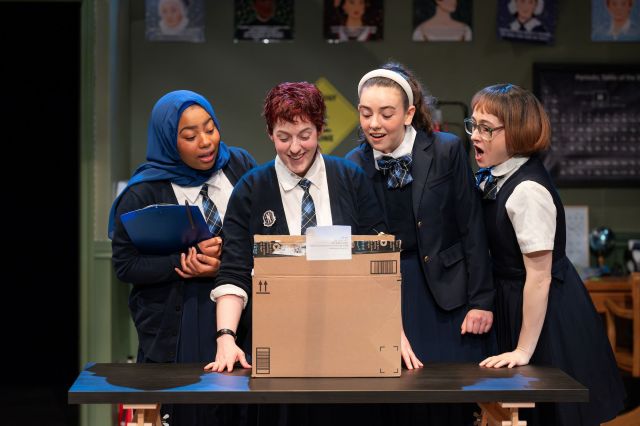
Larissah Lashley, Hayley Moorhouse, Abigail McDougall, Jayce McKenzie in Robot Girls, Shadow Theatre. Photo by Marc J Chalifoux.

•At Shadow Theatre, the premiere production of Trevor Schmidt’s captivating Robot Girls continues through March 31. A delightful cast of four — Jayce McKenzie, Abigail McDougall, Larissah Lashley, Hayley Moorhouse — are junior high girls who join the science club to build a robot for an international competition.  Funny, touching, landing lightly on the complications of a complicated time of life. Have a look at the 12thnight review. Tickets: shadowtheatre.org.

Posted in Features, News/Views | Tagged , , , , , , | Comments Off on Three musicals and a comedy: snow reason to stay home, the weekend onstage

A groundbreaking musical about making art: a rare chance to see Sondheim’s Sunday In The Park With George, at MacEwan

Cast of Sunday In The Park With George, MacEwan University Theatre Arts. Photo by Lindsey Tran, @understudystudio_. Set design Ross Nichol, costume design Deanna Finnman, lighting design Travis Hatt, video design Matt Schuurman.

By Liz Nicholls, 12thnight.ca

“There’s a part of you always standing by, Mapping out the sky, Finishing a hat….”

Something rare and special is happening this week at MacEwan University: a production of Sunday In The Park With George.

To help support 12thnight.ca YEG theatre coverage, click here.

There is an elusive magic about Stephen Sondheim’s groundbreaking 1984 Pulitzer Prize winner. For one thing it’s a musical inspired by a painting, and a landmark modernist painting at that: Sunday Afternoon on the Island of La Grande Jatte, by the French pointillist painter Georges Seurat. For another, the musical, the first partnership between Sondheim and playwright/director James Lapine, is about art and the making of art, artists and the shimmering possibilities of what they see as they create.

“It’s a musical that speaks especially to artists, to musicians, to painters, to any discipline of creative artist,” says Jim Guedo, who directs the production of Sunday In The Park (17 actors and a live orchestra of six) that runs on the Triffo Theatre stage Thursday through Sunday. “It really resonates; if people invest in it, it’s a beautiful thing.”

Everything about Sunday In The Park is unusual in a musical. The lyrics, as Sondheim has put it, “are one long uninterrupted sentence, with a through line.” There’s no story; it captures the figures in the Seurat painting as characters, as well as Georges the artist painting them, in a sort of theatrical equivalent of pointillism, where separate points of colour add up in the viewer’s mind. Georges and his neglected lover Dot: theirs is, as Guedo puts it, “a love affair that finally gets resolved a century later in Act II, where the artist is an American sculptor, a great-great grandson of Seurat, creating multimedia pieces for the voracious commercial art marketplace, struggling to claim his own vision.

The musical gets a place of honour on Guedo’s bucket list, he says. Forty years ago Guedo saw the original Off-Broadway production of Sunday in the Park in New York. And since then “I’ve made it my goal in life to see every major production I could …” on both sides of the Atlantic. When people ask him, as they do, “what’s your favourite Sondheim?” his answer is “on a great day, it’s Sunday in the Park With George; if my mood is darker it’s Sweeney Todd. To me these are the two peaks of Sondheim.”

Sunday In The Park With George, MacEwan University Theatre Arts. Photo by Lindsey Tran, @understuystudio_. Set design Ross Nichol, costume design Deanna Finnman, lighting design Travis Hatt, video design Matt Schuurman

With the exception of a 2005 Tim Ryan production at MacEwan in its pre-university college days, Sunday In The Park has never been done in Edmonton. “Now we actually have the space (the spanky new Triffo Theatre,” and the talent honed in the course of a four-year degree program, “we’re able to make this happen,” Guedo says.

His inspiration was the pared-down-to-essentials 2017 New York production starring Jake Gyllenhaal and Annaleigh Ashford. “It was reverse engineering,” he says of the MacEwan production Edmonton audiences will see starting Thursday. “I had to find a staging that would be evocative but simple,” given constraints of budget and time. Under the monitorship of heavy-hitter working theatre professionals like videographer/projection specialist Matt Schuurman and costume designer Deanna Finnman, for example, students are both on- and backstage, in the cast and the crew.

After the flop of Merrily We Roll Along in 1981 (a flop that has been reversed by this year’s Broadway production), Sondheim had found himself at a low ebb. As Guedo points out, partnering with Lapine “kickstarted him…. When he looked back at everything before and after James Lapine, there was a seismic shift, a new frame of feeling. He started to dig more deeply, get more emotional, more vulnerable. He turned to family, to children, to art,” witness Into The Woods (1987) and Passion (1994).

There is something mysterious about the effect that Sunday In The Park has on audiences. I’ve been lucky enough to see it twice, once in London and once in New York. It is not a sad show but both times, the audience, myself included, cried almost all the way through. Why? We were never quite sure. Guedo thinks it’s the way the characters are “captured … in a perfect moment that’s just transcendental. A moment that captures the best versions of someone.”

“It’s what would ring through the minds of these characters if they knew they’d be in a work of art that would last forever . that they were part of something bigger.”

In the course of a 45-year (and counting) career, Guedo thinks “you can count on your hands the shows — you know the keepers — and the moments that will last forever, etched into your mind.” He thinks of Philip Seymour Hoffman as Willie Loman in Death of a Salesman. Or “the moment of seeing Angela Lansbury and Len Cariou rising out of the pit in Sweeney Todd.

“What we do (in theatre) is transitory. But when it hits and sticks….”  Sunday in the Park is like that, he thinks. “It’s about people trying to create something new.” And it’s about the cost of being an artist. “People don’t realize how hard it is,” says Guedo. “It’s about what you knowingly choose to give up, the collateral damage…. George knows what he’s sacrificing. There’s a cost to it.”

“A great show for the fourth-years to end on,” he says of his graduating theatre students. “A show that validates them, a show about making art.”

Guedo’s production of Sunday In The Park With George runs Thursday through Sunday in the Triffo Theatre in Allard Hall, at MacEwan University (11110 104 Ave.). Tickets: tickets.macewan.ca.

Posted in Previews | Tagged , , , , , , | Comments Off on A groundbreaking musical about making art: a rare chance to see Sondheim’s Sunday In The Park With George, at MacEwan

The Edmonton Fringe in crisis, and you can help: our beloved summer theatre festival launches a campaign to sustain it

By Liz Nicholls, 12thnight.ca

The Edmonton Fringe, our beloved summer theatre festival, has announced it’s in crisis. And the community that this the oldest and biggest of the continent’s fringe festivals has done so much to enhance and enliven, needs to step up and help in this financial emergency.

As announced Monday by Fringe Theatre’s executive director Megan Dart, the Fringe is launching a campaign to ensure the Fringe’s sustainability, vitality, and identity, in short its future, at a moment when all of the above are in doubt. ““Rest assured the 43rd annual (edition of the) Edmonton Fringe will take place this year (Aug. 15 to 25),” says Dart. “And we’re committed to sustaining our impact. But without immediate support, the festival we know and love will look very different.”

To help support 12thnight.ca YEG theatre coverage, click here.

As she points out, “when you buy a ticket to a Fringe show you are supporting the work of the artist onstage. And we are so proud to return 100 per cent of the ticket price back to the artist,” says Dart of a $1.2 million return to artists last summer. “However that doesn’t offset the costs of producing the festival … the stages, lights, sound, professional technicians, the engaged audiences. “Artists who perform on Fringe stages receive more than $10,000 in support.”

“We honour the role we play in supporting artists and building the creative economy across Canada.” But the festival is up against “a confluence of factors,” says Dart. The hard costs of producing the festival are up up up at every level; they’ve more than doubled in the last couple of years. “Insurance is up 45 per cent; utilities are through the roof,” as we all know. And at the same time funding for the festival at every level of government is either frozen or actually dwindling. The Fringe, says Dart, is looking at a 20 per cent cut in funding from Canadian Heritage, for example, “back to 2015 levels.” And COVID recovery support, via grants, has generally expired.

The situation is exacerbated by the COVIDian cancellation of the festival in 2020, with an attendant loss of $3 million in revenue that has proven daunting to recoup so far.

Dart is hoping that in the face of more than $16 million in the Fringe’s local economic impact every year, the business community will rise to the occasion with sponsorships, and partnerships (“they can be custom-made”). The Fringe is calling on Fringe patrons and ticket-buyers to donate and to volunteer. And to pledge $5 a month. “If the 20,000 subscribers to Fringe fan club newsletter did that,” for example, “the festival would immediately become sustainable.”

The post-pandemic economic crisis, coupled with inflationary pressures, is industry-wide, as Dart notes. Just For Laughs in Montreal is in receivership. The Shaw Festival, announcing its largest deficit ever, is facing cuts.

Similar campaigns have been launched by the Toronto and Vancouver Fringes. And both of those festivals have reduced the size of their events. The Vancouver Fringe, for example, will have only two-thirds the number of shows of last summer.

“We’re not reducing the number of shows,’ says Dart of the upcoming edition of the Edmonton Fringe. “But, realistically, if nothing changes, the site will be smaller, for one thing.” And the critical mass that goes into Edmonton’s massive theatre celebration, one of the sources of both its healthy and vibrancy, will be much reduced.

“This is crunchy reality for us.” The civic impact of our Fringe, Edmonton’s brightest idea ever, has been transformative. The moment is at hand to ensure that this can continue.

To offer support, visit fringetheatre.ca/sustain or email give@fringetheatre.ca.

Posted in News/Views | Tagged , , , | Comments Off on The Edmonton Fringe in crisis, and you can help: our beloved summer theatre festival launches a campaign to sustain it

Building a robot and making friends: fresh and funny Robot Girls premieres at Shadow Theatre, a review

Larissah Lashley, Hayley Moorhouse, Abigail McDougall, Jayce McKenzie in Robot Girls, Shadow Theatre. Photo by Marc J Chalifoux.

By Liz Nicholls, 12thnight.ca

It’s fresh. It’s funny. Its sharp-eyed insights into the fraught high-stress lives of junior high teenage girls are blended into fast-acting chemistry in Trevor Schmidt’s winsome, hilarious, often touching, new comedy Robot Girls.

To help support 12thnight.ca YEG theatre coverage, click here.

It’s a tricky age, both to live through and to convey onstage. Of course it is: these are personalities in motion, with malleable sides, and room to grow in. And the quartet of characters we meet — “three young women … and one girl” at the Nellie McClung Charter School For Girls — are a bit worldly and a bit not, scrambling to figure things out for themselves, buffeted between home and school, getting rubbed the wrong way by parental, cultural, and historical (from “the olden days”100 years ago) expectations,  carrying residual catchphrases in their backpacks.

Hey, that’s what friends are for: allies, armour, critical mass at a red-alert time of life. And Robot Girls is, among other things, a love letter to girl grit and friendship. It starts with joining a science club, a little act of gender defiance in itself, to build a robot for an international competition. The weekly after-class meetings happen in a cluttered room (designer: playwright Schmidt) with the kind of linoleum that is a time-honoured part of the educational system.

Abigail McDougall, Hayley Moorhouse, Larissah Lashley, Jayce McKenzie in Robot Girls, Shadow Theatre. Photo by Marc J Chalifoux.

The script, and the Shadow production directed jointly by John Hudson and Lana Michelle Hughes, are, together, an intricate piece of work. No one says anything in this show without getting interrupted, or annotated, or sidetracked. Everything, and nothing, is a non sequitur when you’re a junior high girl. And characters regularly step outside the group in asides (lighted glowingly by Even Gilchrist) to reveal their real thoughts — which happens less and less frequently as they make friends and get more confident about sharing secrets in person.

Abigail McDougall, Hayley Moorhouse, Larissah Lashley, Jayce McKenzie in Robot Girls, Shadow Theatre. Photo by Marc J Chalifoux.

The actors are a delight. This cast is one of the most perfectly meshed ensembles of the season, and the characters are vividly, endearingly, drawn by the actors. They all wear identical knee socks and charter school pleated skirts (costumes: playwright Schmidt). But their performances, imbued with expertly timed overlaps and comic pauses, are calibrated so that ages 12, 13, 14 are differentiated. And so is the looping texture of breezy rejoinders and head-on reactions.

Chashida (Larissah Lashley), the serious grade eight-er with the conservative parents who’s also on the students’ union, takes charge of reading the club rules at their first meeting, before the robot kits (the teacher supervisor never arrives but is spotted crying in the staff room from time to time). “I’m popular,” Chashida concedes, “but nobody likes me.” There’s a subtle distinction the adult world might learn from. Interestingly, her club-mates might wonder what exactly a Muslim is (when a Secret Santa plan is a no-go), but don’t seem to even notice the hijab.

Deep-voiced “Bloody Mary,” the “grade nine-er,” arrives with the reputation of tough-ass jock (running shoes dangle from her backpack). And there’s a certain starchy lack of meekness about her, in the very funny performance from Hayley Moorhouse. “Why can’t we own it?” she declares, in response to the peer group mockery of “robot girls” in the war zone that is school. What’s wrong with that club name? “We’re girls. And we build robots. And we’re cool.”

Larissah Lashley, Abigail McDougall, Jayce McKenzie, Hayley Moorhouse in Robot Girls, Shadow Theatre. Photo by Marc J Chalifoux.

Darby, in a perfectly pitched performance by Abigail McDougall, is smart, and tentative, frazzled by a constant series of phone call demands for baby sister pick-up at daycare. And the youngest, Vanessa, slightly dazed in the august presence of grade eights and nine-ers, and always a beat behind, is played, with great comic pizzaz and timing by Jayce McKenzie. Vanessa is the “girl” among “young women,” the innocent whose reactions are, amusingly, a veritable generation away from her science club cohorts.

She’s the one who dances the robot moves and thinks about sleep-overs. She’s the one who inadvertently spills the secret that she has a child psychologist, and the big spoiler alert news — her cohorts struggle not to roll their eyes — that there is no Santa Claus.

Her twin sister is in Drama Club, in rehearsals for The Crucible. The robot girls’ assessments of that play are a lot of fun. Darby is the one who knows it’s about the McCarthy prosecutions. Vanessa is incredulous: “you mean the witches are the bad guys?”

“Are we communists?” she wants to know. “Not officially,” says Bloody Mary.

Their discussions about gender and pronouns (they want the robot to be both gender-less and a ‘she’), their hyper-sensitive tuning to the rumour mill, their awareness of the commonplaces about boys ‘owning’ science, their reactions to inconsistent adult behaviour (“mothers are so embarrassing, right?”) … these are the fabric of the play. Robot Girls touches down lightly on a broad swath of complications and insecurities in the characters’ lives. And the actors negotiate it all with ease, and not so much as a whisper of kid-acting condescension.

And as they divide up the tasks involved in robot-creation, you find yourself caring about these characters, and wanting their collective creation that plants a girl flag in the field of science, to feel like a triumph for them. It’s a lot of fun, and you’ll recognize your younger self onstage, struggling to survive. Hey, I seem to have something in my eye….

REVIEW

Robot Girls

Theatre: Shadow

Written by: Trevor Schmidt

Directed by: John Hudson and Lana Michelle Hughes

Starring: Larissah Lashley, Hayley Moorhouse, Abigail McDougall, Jayce McKenzie

Where: Varscona Theatre, 10329 83 Ave.

Running: through March 31

Tickets: shadowtheatre.org


Posted in Reviews | Tagged , , , , | Comments Off on Building a robot and making friends: fresh and funny Robot Girls premieres at Shadow Theatre, a review

This is no weekend to stay home: see some theatre

Abigail McDougall, Hayley Moorhouse, Larissah Lashley, Jayce McKenzie in Robot Girls, Shadow Theatre. Photo by Marc J Chalifoux.

The Theory of Relativity, Concordia University. Photo by Mat Simpson.

By Liz Nicholls, 12thnight.ca

Wheee. It’s the weekend, and your entertainment on Edmonton theatre stages awaits. Check out some possibilities.

To help support 12thnight.ca YEG theatre coverage, click here.

In a cross-company pooling of talent, Trevor Schmidt’s new comedy Robot Girls premieres at Shadow Theatre. Four teenage girls at a charter school join the science club, and undertake building a robot together for an international competition. It’s a comedy, yes, but for Schmidt comedy always has darker undertones or top notes. Schmidt, the artistic director of Northern Light Theatre, has compared Robot Girls in tone to Kathryn Walat’s Victoria Martin: Math Team Queen, a play about a girl changing the boy culture at her school that Northern Light Theatre, under Schmidt, staged a few seasons ago.

Robot Girls runs at the Varscona Theatre through March 31. A 12thnight review is coming up shortly. Tickets: shadowtheatre.org.  And while you’re at it, have a peek at 12thnight’s preview of the upcoming Northern Light season, Making A Monster, announced 10 days ago.  

The Sound of Music (Priya Narine with guitar), Citadel Theatre/ Royal Manitoba Theatre Centre. Photo by Nanc Price.

•At the Citadel, the halls are alive with The Sound of Music. Check out the 12thnight review of this musical theatre classic, a shared Citadel/ Royal Manitoba Theatre Centre production directed by Rachel Peake (The Garneau Block, 9 to 5). It runs through March 31 on the Shoctor stage.

•Darrin Hagen directs a cast of 24 —“20-year-olds playing 20-year-olds” — in The Theory of Relativity at at Concordia University. He calls the unconventional musical cum song cycle “a love letter from 20-year-olds to all the people who got them to this point. And it’s beautiful! So full of positivity!” In this it reminds Hagen of the spirit infusing Fame.

The 2014 song and monologue cycle by Neil Bartram and Brian Hill, commissioned by the Canadian Musical Theatre Project at Sheridan College (a theatre school specializing in musical theatre), was a suggestion from musical director Cathy Derkach. “It’s full of lead roles,” Hagen says of “a smart musical” that’s ideal for young actors. “Everyone gets a song!”

It doesn’t have a plot per se, but themes weave in and out and characters recur. Hagen, a songwriter himself (as well as an actor/ playwright/ sound designer/ composer/ activist), admires the way the musical touches on love and loss, home and childhood, relationships, disappointment, divergent paths through life, all the issues of that pivotal moment of life — from the immigrant experience to diversity — “but touches down lightly.” Apples and Oranges, for example, is “all about being queer,” but without leaning on it, says Hagen.   

“And I got to do girl group choreography for the first time in 20 years!”

The Theory of Relativity runs at Concordia University’s Al and Trish Huehn Theatre March 15 to 24. Tickets: concordia.ab.ca.

•Continuing at the Mayfield: One Night With the King runs through March 31. Tickets: mayfieldtheatre.ca.


Posted in Features, Previews | Tagged , , , , , , | Comments Off on This is no weekend to stay home: see some theatre

A glorious score that’s already in your brain: The Sound of Music at the Citadel, a review

Priya Narine (centre) in The Sound of Music, Citadel Theatre. Photo by Nanc Price.

By Liz Nicholls, 12thnight.ca

The Sound of Music, now delighting audiences at the Citadel, is at the top of a tiny list of resistance-is-futile musicals whose mere titles dig into the tune retention part of the brain and won’t let go.

To help support 12thnight.ca YEG theatre coverage, click here.

“My heart wants to sing every song it hears,” as Maria’s title song has it. “I know I will hear what I’ve heard before….” Exactly.

The 1959 Rodgers and Hammerstein classic, the final collaboration of the most successful musical theatre partnership in history, has an oddball history, to be sure. The story is based on the autobiography of Maria Von Trapp, and the producers originally (what were they thinking?) were keen to include only music that the Von Trapps actually sang in their concerts, with just one song by Rodgers and Hammerstein. The latter pair nixed that, needless to say, and the world continues to sing along.    

Even hardcore cynics who habitually seek out irony in song lyrics are helpless in the face of the glorious score, and The Sound of Music’s distinctive combination of inspirational nuns, adorable kids, a love story, Nazis, and Alps. And to this unique mix has been added the vocal and physical flourishes of the signature 1965 Julie Andrews film that’s indelibly imprinted, right down to the arm gestures, on the collective consciousness.

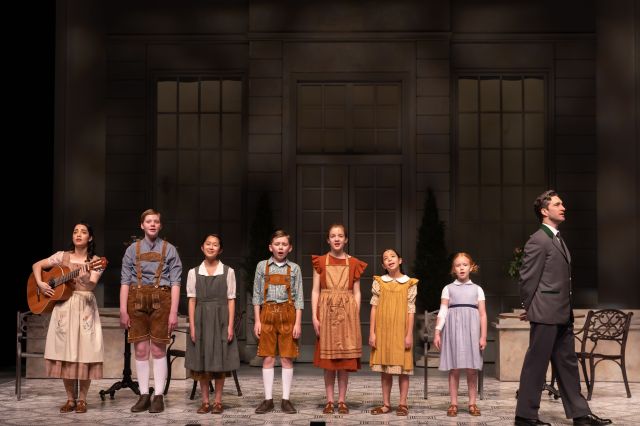
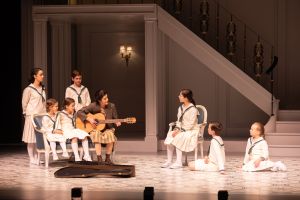
The Citadel/ Royal Manitoba Theatre Centre co-production directed by Rachel Peake, now the artistic director of the Grand Theatre in London, Ont., is on a lavish scale: a cast of two dozen including alternating casts of Von Trapp kids, and an excellent band of 12. It doesn’t shirk the cultural duty to weave allusions to the movie throughout, in tableaux on the serviceable multi-framed set designed by Lorenzo Savoini, with evocative dawn and dusk lighting by Larry Isacoff and Even Gilchrist. But it’s smartly playful about reanimating the epic storytelling for the stage.

The Sound of Music, Citadel Theatre. Photo by Nanc Price.

After the nuns singing devotionals in the abbey (shimmery sound design by Emily C. Porter), we meet the wayward, free-spirited postulant Maria (Priya Narine) who enters the musical from among us, descending towards the Shoctor stage, down a mountain or two, singing “the hills are alive.” Indeed, yes we are. And whenever anyone refers to the mountains, they look out at … us, in all our stand-in alpine glory. This is not a production that conjures Alps with projections or cutouts.

You know the story, set in Austria on the eve of the Anschluss in 1938. High-spirited novitiate gets booted from the abbey to be governess to the seven children of a stern naval war hero widower (Charlie Gallant) who’s a steel-ribbed Austrian nationalist. He’s got principles, yes, but he’s so nutbar tyrannical on the domestic front that he’s even forbidden music in the household (in a musical! good luck with that). And he blows a whistle, military-stye, to have the children line up for inspection.

The movement score by choreographer Ainsley Hillyard is responsive to the music, supple and flexible for nun and kid alike, never too studied.

Maria’s inherent exuberance (and musical inclinations) win over the children first, and then melts the frozen heart of the Captain. And, long story short, the kids get their dad back, and a vivacious new mother. And they form a family singing group with a kooky act that will stand them in good stead later in the plot.

The Sound of Music (Priya Narine with guitar), Citadel Theatre. Photo by Nanc Price.

From the start every producer of The Sound of Music has to solve a problem like Maria. And Narine (whom Freewill Shakespeare audiences saw as Isabella in Measure For Measure) is a captivating Maria, with a bright impulsive charm and comic energy about her. It’s not a performance particularly strong of voice, but it is spirited in delivery. Maria’s scenes with the children are winners. Not least because the kid actors (the Whiskers corps the night I saw the show, including Elowyn Temme, Penelope Carew, Halle Leschert, Elizabeth Shakeshaft, Ben Hill, Pierce Briggs) are terrific and touching, and deliver individualized characters under Peake’s direction.

As Liesl, the eldest of the Von Trapp kids, Christina Nguyen captures all the hopeful nervous grace of “sixteen going on seventeen.” It’s a lovely version of that song, one of the musical’s most tuneful the number she shares with Rolf (Jesse Drwiega), the boy who will break her heart by being fatefully seduced by Third Reich upward mobility.

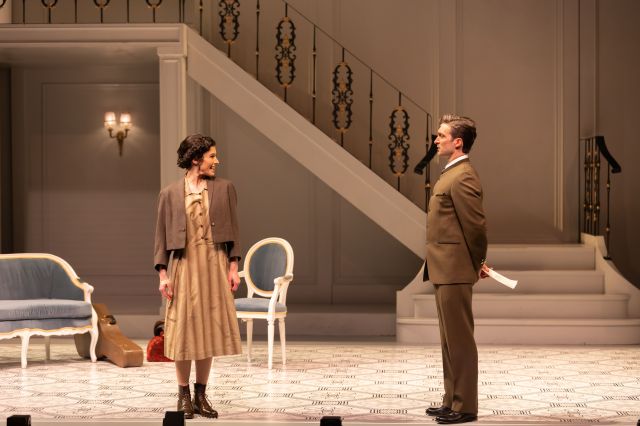
Priya Narine and Charlie Gallant in The Sound of Music, Citadel Theatre/ Royal Manitoba Theatre Centre. Photo by Nanc Price.

As for Captain Von Trapp, the role occupied grudgingly (according to his memoir) in the film by Christopher Plummer, Charlie Gallant’s performance doesn’t exactly bristle with charisma, or set forth in early scenes a portrait of a dauntingly stern disciplinarian whose formidable defences will be gradually worn down in the course of the musical. As is often the case in productions of The Sound of Music, the Captain is a little bland, in short. He arrives at romance, if not chemistry, and committed fatherhood in the end — and he really lands Edelweiss, his emotional solo number near the end. But it sells a little short the discovery of a self he had long suppressed, the infrastructure of the storytelling.

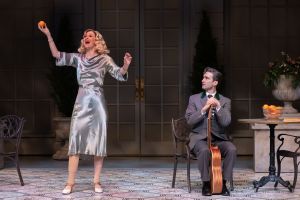
Kristi Hansen and Charlie Gallant in The Sound of Music, Citadel Theatre/ Royal Manitoba Theatre Centre. Photo by Nanc Price.

Kristi Hansen is an exceptional Elsa, Von Trapp’s wealthy, entitled fiancée, who sails onto the stage in a slither of satin (costumes: Jessica Oostergo) and noblesse oblige. And her numbers with the amusing impresario and born compromiser Max (the excellent Kevin Klassen), both songs that didn’t make it into the film — No Way To Stop It and How Can Love Survive?, the one a political shrug and the other a tease — are sung with wry pizzaz.

And as the Mother Abbess, Lara Ciekiewicz, who’s from the world of opera, has stage presence for days and rocks the rafters with her big voice in her big number. When she sings Climb Ev’ry Mountain, she’s not kidding: the Von Trapps take her advice, get backpacks, and walk to Switzerland.

The family exit from Austria, cleverly stage-managed by Maria (and by Peake), will lift your heart. And so will a musical that’s all about … music. Here’s a full-bodied production that gives you the welcome chance to renew your bond with one of the most loved musical scores in the canon.

REVIEW

The Sound of Music

Theatre: Citadel Theatre and Royal Manitoba Theatre Centre

Written by: Richard Rodgers (music) and Oscar Hammerstein II (lyrics), Howard Lindsay and Russell Crouse (book)

Directed by: Rachel Peake

Starring: Priya Narine, Charlie Gallant

Where: Citadel Shoctor Theatre

Running: through March 31

Tickets: 780-425-1820, citadeltheatre.com

Posted in Reviews | Tagged , , , , , | Comments Off on A glorious score that’s already in your brain: The Sound of Music at the Citadel, a review

Life lived precariously, on land and sea: some thoughts on Mermaid Legs at this year’s SkirtsAfire Fest

Dayna Lea Hoffman (aloft) in Mermaid Legs, SkirtsAfire Festival. Design by Narda McCarroll (set), Whittyn Jason (lighting) and Rebecca Cypher (costumes). Photo by Brianne Jang.

By Liz Nicholls, 12thnight.ca

At the very last moment on the weekend I finally got the chance to see Mermaid Legs, the theatrical centrepiece of this year’s SkirtsAfire Festival.

To help support 12thnight.ca YEG theatre coverage, click here.

And there was magic to it. Not only was Sunday the final performance of Beth Graham’s new “surreal theatre dance fantasia,” it was the finale of an annual multidisciplinary celebration of female artists that, from birth, has always been resourceful, adaptable, experimental in spirit and light on its feet.

And the closing performance of Annette Loiselle’s production of Mermaid Legs was, too, a celebration of the dozen years of her artist-led artistic directorship since the festival she and her actor friends started was born.

Since 2013’s debut edition, a small, but not that small, bright idea has grown roots in this theatre town, and expanded. It’s worked to acquire audiences, profile, venues, grants, sponsors, multi-disciplinary branches. It’s re-calibrated itself, in agile live and online ways, through a pandemic shutdown. Like another festival (Freewill Shakespeare) of which Loiselle was a co-founding parent, the SkirtsAfire that its new artistic producer Amanda Goldberg inherits have become a venerable and elastic-sided cultural institution.

A lively post-show video paid tribute, with testimonials of all sorts, to Loiselle’s sunny temperament, a chronic tendency to say yes and why not?,  and present a welcoming demeanour to new ideas from artists of every stripe at every stage of development.

A veteran actor turned playwright and director who habitually uses the pronoun “we” instead of “I”, Loiselle bids not farewell but au revoir to SkirtsAfire with her premiere production of Graham’s Mermaid Legs, a festival commission. And, fittingly, its intricate vivid theatrical conjuring of the great mystery of mental illness, is a veritable testimonial to the possibilities of multidisciplinary collaboration.

Dayna Lea Hoffmann (centre), Mermaid Legs, SkirtsAfire Festival. Photo by Brianna Jang

The text from Graham, a witty and clever writer with a sharp ear for minute adjustments in family chemistry, gives us verbal exchanges along fracture lines that widen dangerously, like cracks in the ice you aren’t sure are weight-bearing, over a bottomless lake. The movement script, a collaboration between choreographer Ainsley Hillyard, playwright Graham, and director Loiselle for cast of three actors and four dancers takes us into the realm of feeling that explores an illness where words are beached on the shore. The title of the play, after all, conjures a hybrid creature who is neither entirely committed or fully suited to water or land, and must adapt to life in both.

At the centre is a trio of jostling sisters, responding in high contrast ways to the continuing series of crises ignited by the unpredictable behaviour of one of them. “How are you feeling?” the unseen therapist asks Billie (Dayna Lea Hoffmann, who’s terrific), the “problematic” sister whose unexpected disappearance from an apartment left in disastrous disarray prompts the sibling red-alert.

Noori Gill, Mel Bahniuk, Dayna Lea Hoffmann in Mermaid Legs, SkirtsAfire Festival. Photo by Brianne Jang.

How are you feeling? There’s the crux of Mermaid Legs in one unanswerable question. And the way Billie’s inner disorder triggers an existential conundrum for all three sisters, beautifully played by Hoffmann, Mel Bahniuk and Noori Gill, is the beauty of this insightful and moving piece. Ava (Bahniuk) is inclined to cheery optimism; she has faith in the salutary bonds of sisterly support. Scarlet (Gill), the sardonic seething one, is a powerful portrait of weary frustration at the chaos Billie’s illness creates for the people around her. Both sisters are up against the endless delays in finding the right health professional, not to mention the elusive mix of medication and dose that might help Billie find some sort of equilibrium between wild fluctuations in order and impulse, calm and chaos.

In the opening moments, we see Billie struggling to join an ensemble in which she is ever so slightly out of alignment if not actively contrary to the group momentum. And Mermaid Legs captures a pattern in which Billie, imprisoned in fathomless despair within and without, sometimes bursts free of her chains in escapades of pure joy — conjured in ecstatic physicality and liberating bursts of colours and light (expressive lighting designed by Whittyn Jason) that play across the white drapery of Narda McCarroll’s graceful set design.

That whiteness of design, reflected in Rebecca Cypher’s costumes, is sometimes clinical, the bleached metaphorical straitjacket of mental illness. And sometimes the stage is in motion like the dancers, billowing like wind-moved sails. Binaifer Kapadia’s original score grasps both harsh solitude and warm harmony.

Mermaid Legs, SkirtsAfire Festival. Photo by Brianne Jang.

As Loiselle’s captivating production conveys theatrically, Mermaid Legs is a story of life lived precariously, in a stormy world of extremes. Hoffmann memorably captures, the way Billie ricochets between them in a jagged rhythm, struggling for footing, or for air, or for survival, grasping at moments of sheer raw unedited happiness that don’t seem sustainable. Her sisters, on the other hand, plant their feet on terra firma, and find the map dissolving and the ground splintering beneath them.

The play is billed as “a fantasia” rather than a story. Narratives drift toward resolution, but in Mermaid Legs, the truisms about human connection and the human journey toward meaning are constantly subverted by an isolating illness without a “cure” in the usual sense. It’s a tricky challenge, in life and in art, to embrace tension without trying to eliminate it. And this insight has moved a top-flight ensemble of artists, led by playwright Graham, to shine light on a mystery terrain in a mix of words and images and sounds.

If the Skirt fits, is a holdover out of the question?


Posted in News/Views, Reviews | Tagged , , , | Comments Off on Life lived precariously, on land and sea: some thoughts on Mermaid Legs at this year’s SkirtsAfire Fest