The delectable fun of The Importance of Being Earnest at the Citadel, a review

Nadien Chu as Lady Bracknell in The Importance of Being Earnest, Citadel Theatre. Photo by Nanc Price

By Liz Nicholls, 12thnight.ca

In a glum age where the things to be serious about are piling up by the second, there is something inspirational about launching a season with a comedy whose airy architecture is built, rock solid, on topsy-turvy inversion. A comedy that that takes triviality seriously, by balancing its intricate symmetries on a pinpoint.

To help support 12thnight.ca YEG theatre coverage, click here.

That’s what the Citadel has done, via Jackie Maxwell’s delectable production of The Importance of Being Earnest, Oscar Wilde’s comic masterpiece of 1895. “I am sick to death of cleverness,” sulks Jack Worthing (Jeff Lillico), one of a pair of best friends, debonair young men-about-town whose romantic aspirations come up against the adamantine obstacle of not having the perfect name: Ernest. “Everyone is clever nowadays. You can’t go anywhere without meeting clever people….The thing has become an absolute public nuisance.”
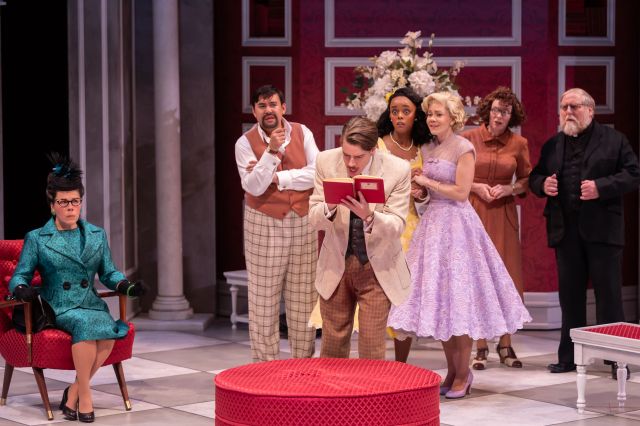
Nadien Chu, Alexander Ariate, Jeff Lillico, Helen Belay, Amelia Sargisson, Davina Stewart, Julien Arnold in The Importance of Being Earnest, Citadel Theatre. Photo by Nanc Price.

Sorry Jack, but the comedy that’s been called the most perfectly constructed in English theatre — and is almost certainly the repertoire’s wittiest — is full of clever people. And they’re repositories of Wilde’s paradoxical wit and hyper-articulate playfulness (“divorces are made in heaven” or “in matters of grave importance style, not sincerity is the vital thing”). But they’re not kidders. They’re in deadly earnest about the social realities of their glittering world — marriage, money, class, the sexes, respectability. Which makes them hilarious, and the play a cross between a romantic comedy and an eagle-eyed satire.

Maxwell has bravely chosen to dislodge Earnest from its high-Victorian setting, and take it ahead by a full half a century into the 1950s. You’re bound to have some reservations in advance. Earnest relocations are risky in theory (witness a long line of Earnests stranded with their thumbs up their epigrammatic backsides in time periods where the nuances of class, parental authority, and social respectability don’t quite resonate). But check your reservations at the door. One of the chief delights of Maxwell’s decision is immediate: Michael Gianfrancesco’s ’50s high-style costumes are an eyeful, the dizzying array of checked trousers, ravishing pastel cocktail frocks, silky lounging jackets, brocade suits. And don’t get me started on the shoes.

Tellingly, the fortunes, privileges and high-handed assumptions of the upper classes sit just fine 50 years later. Surprise! The great social revolution is still on hold. Witness the pair of butlers played very amusingly by Doug Mertz, one urban one country, one sublimely implacable and the other wheezily disintegrating as his hair levitates.

The implacable arbiter of the social status quo at the centre of it all, “a monster without being a myth,” as Jack says, is Lady Bracknell. This magisterial role is occupied with fierce un-ironic gravitas and an entire arsenal of withering looks by Nadien Chu. From her first entrance, feet planted like Cortez claiming a continent, her facial expression is set to disapproval. She’s perpetually ready to have her worst suspicions confirmed by an entire generation — starting with her unreliable nephew Algernon (Alexander Ariate), who’s forever reneging on his social obligations by claiming the need to visit his fictional invalid relative Bunbury. Her lips are pursed, and she spits out the consonants of Bunbury’s name like someone expelling rancid cashews at a distance.

Lady Bracknell’s checklist of questions for male eligibility are very funny, mainly because they’re grimly practical. And Chu never wavers. She demands to know if her daughter Gwendolyn’s potential beau smokes. He admits he does. “I am glad to hear it. A man should always have an occupation of some kind.” Designer Gianfrancesco decks her out in a succession of wonderful hats with feathers that positively quiver with a sense of righteous outrage.

A hard-headed realist, Lady Bracknell has her views on every aspect of modern life, from the inadvisability of long engagements (“they give people the opportunity of finding out each other’s character before marriage”) to the financial merits of investments vs land (the latter “has ceased to be either a profit or a pleasure; it gives one position, and prevents one from keeping it up”). Modern education? “Ignorance is a delicate exotic fruit. Touch it and the bloom is gone.”
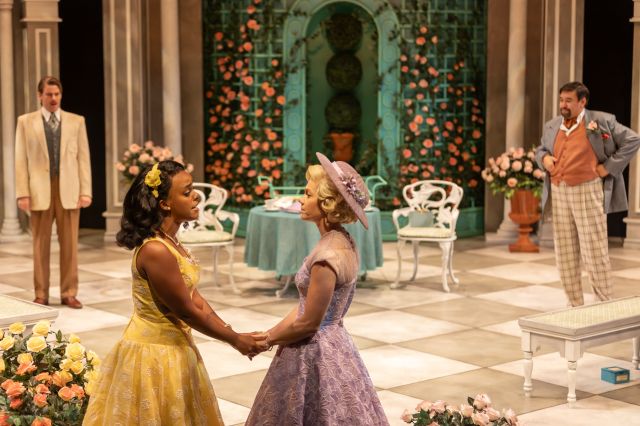
Jeff Lillio, Helen Belay, Amelia Sargisson, Alexander Ariate in The Importance of Being Earnest, Citadel Theatre., Photo by Nanc Price

One of the great delights of the production is the way there are hints, especially when she’s crossed, that Amelia Sargassin’s utterly charming but flinty Gwendolyn (“I am never wrong”), in a first-rate comic performance, is her mother’s daughter. They have matching daytimers, that snap shut like alligator jaws on an arm.

The scenes in a country garden crammed with roses (including Patrick Beagan’s lighting and two women who look enchanting in their frocks), are great fun. The worldly sophisticate Gwendolyn discovers to her dismay that her fiancé Ernest has an “excessively pretty” 18-year-old ward. In a matching performance Cecily (delightful Helen Belay), the country “innocent” brought up on a steady diet of romantic novels, strikes poses, writes lurid fictional entries in her diary, bats her eyes — and when a rival for Ernest arrives, rises to the occasion with impressive steel.

The fractious relationship between Jack and Algernon, the former with top notes of exasperation and the latter with a certain mischievous insouciance, is convincingly supple. And they surf the cadences of Wilde’s epigrammatic wit in very different ways, which irritates both of them.

In the country scenes, the ‘50s leave their mark on the production in a more relaxed, less decorous, physicality. Characters fling themselves onto settees. Lady Bracknell’s arrival leaves both couples either prone or crawling. Victorians would gasp.

Davina Stewart, Helen Belay, Julien Arnold in The Importance of Being Earnest, Citadel Theatre. Photo by Nanc Price

As the rural cleric Canon Chasuble, Julien Arnold is droll, expansively generous in his theological references and embrace; he provides his own footnotes as he delicately approaches Miss Prism. As Cecily’s prim governess, Davina Stewart has an unusually fluttery and slightly addled take on a character who is more often formidably drab. She’s amusing (especially since her auburn hair is set like two Brillo pads on the either side of her head). Clearly Miss Prism is a novelist manqué, who’s been waiting to be swept off her feet rather than just doling out German grammar on a Draconian quota system.

The play is an amazing comic construction. And the pleasures of a production in which the characters are so attentive to each other are manifold, a treat of a way to start the season.

REVIEW

The Importance of Being Earnest

Theatre: Citadel

Written by: Oscar Wilde

Directed by: Jackie Maxwell

Starring: Nadien Chu, Alexander Ariate, Jeff Lillico, Helen Belay, Amelia Sargisson, Julien Arnold, Davina Stewart, Doug Mertz

Running: through Oct. 15

Tickets: citadeltheatre.com, 780-425-1820

Posted in Reviews | Tagged , , , , , | Comments Off on The delectable fun of The Importance of Being Earnest at the Citadel, a review

‘Celebrate amazingness!’ The Play’s The Thing has 20 Edmonton stage companies do Hamlet

The Play’s The Thing, Theatre Yes. Photo supplied.

By Liz Nicholls, 12thnight.ca

Talk about a hold on the collective consciousness. For 400-plus years the world has been wondering, and arguing, analyzing and thinking about Hamlet, the most celebrated and mysterious of plays by history’s most celebrated and mysterious playwright.

To help support 12thnight.ca YEG theatre coverage, click here.

It’s been four centuries of wildly divergent interpretations (face it, being dead hasn’t slowed Shakespeare down much). But the production of Shakespeare’s Hamlet that happens over two nights Oct. 7 and 8 on the Westbury stage under the Theatre Yes flag, will be like no other the world has ever seen. By definition.

The Play’s The Thing is the bright idea of Theatre Yes, and the calling card of its two new co-artistic directors Ruth Alexander and Max Rubin,. They invited 20 different Edmonton stage companies, of every proclivity, size and aesthetic, to perform one scene each from Hamlet in their own signature house style. Saturday night, 10 companies do Hamlet Act I scene i to Act III scene iii. Sunday night, 10 companies carry Hamlet forward Act III scene iv to the big finale of Act 5 scene ii.

Really, haven’t you always secretly wondered what a Mile Zero or Good Women Dance Hamlet would look like? Or what the House of Hush Burlesque take would be? What if Teatro Live! did Hamlet? How would the sketch comedy trio Girl Brain dig in? Or the neo-bouffon collective Batrabbit?

When Theatre Yes put the call out to the theatre community, they weren’t sure what to expect. Alexander and Rubin, relative newcomers to the scene here who emigrated from Britain seven years ago with their own company (Lodestar) and a zest for experimentation, were amazed and delighted by the response. Within a week 20 Edmonton performance companies had said Yes. The only No they heard was from Punctuate! Theatre, and only because they’re on tour (with First Métis Man of Odesa).

“Edmonton is quite the theatre town,” says Rubin in admiration. “There’s so much going on.” In Liverpool, where Lodestar did site-inventive Shakespeare among other off-centre ventures, casting about for 20 companies to go on a theatre adventure “would have been a real struggle,” says Alexander. “There’s not nearly the volume or breadth….”

The raison d’être of The Play’s The Thing, in this post-pandemic out-of-joint time when theatres are hoping to get audiences back through the doors full strength, is “to show us what we’ve got!” As Rubin puts it, “we need to create something for everybody to celebrate the amazingness of the theatre scene here…. So we hope it does!”

When Theatre Yes was casting about for new artistic leadership (after the departure of Heather Inglis for Workshop West), the couple, who’ve now retired Lodestar, couldn’t believe how perfectly it aligned with their own theatre profile and proclivities. “It’s exactly what we’ve done for that last 15 years!” says Rubin. “Innovation was in the Theatre Yes mandate. And that’s us: we’ve taken great delight in experimenting, in making things that are new to us, and to other people. That unknown-ness is really exciting to both of us.” The Play’s The Thing is built on that very principle of unknown-ness.

The Play’s The Thing, Theatre Yes. Photo supplied

Why Hamlet? “It’s the most iconic play in the world.” And not only does everyone have their own idea about what it is, it’s a play that seems always to speak to the moment. And there’s this: it’s nice and big, Shakespeare’s longest, a size large 20-scene play, “pretty capacious with a great big range of characters.” Some of the scenes are huge, others fleeting. “I can’t wait to see what people do with them, how many people they use, what their approach will be.”

“There’s a real sense of ‘we’re in this together’:  the audience and the cast are discovering the whole play together” for the first time. In this, it follows the original practice at Shakespeare’s Globe, says Rubin, where the first nights of plays were more expensive than subsequent performances — “because no one knew what was going to happen.”

The artistic spectrum from the companies who stepped up to do Hamlet is unexpected, and fascinating. There are established text-based theatres like Shadow, Northern Light, Workshop West, and L’UniThéâtre. Catalyst, which specializes in marrying bold theatricality, music, and poetic text, will do a scene. There’s an emerging artist collective, Ready Go Theatre, and an indie company that seeks out the off-centre in musical theatre, the Plain Janes. There are artists of the improv persuasion (Rapid Fire Theatre). There’s drag (Guys in Disguise), burlesque (House of Hush), sketch comedy (Girl Brain), and dance (Mile Zero and Good Women Dance). And there are even theatres that specialize in matters Shakespearean: the Freewill Shakespeare Festival, Thou Art Here Theatre, and Theatre Prospero. You can see the full list on the Theatre Yes website.

What will happen, scene by scene? What sort of Hamlet will it all add up to? That, my friends, is a mystery, not least to Rubin and Alexander. “We have no idea!” says the former happily. “And we can’t wait to see. No one will know till it happens. And that’s the joy of it!” Says Alexander, “all the companies are under strict instructions not to tell us anything.” And between-company collaboration is absolutely verboten, too. “They have to keep everything secret, and they’re finding it hard apparently,” she laughs.

Theatre Yes gave every company $1,000. The only stipulation in spending it is that “every Equity member they use in their scene has to be paid (the required) amount. “For considerations of space”  the maximum cast size is 10.  “What’s important to us is that their company ethos and style is foregrounded…. We wanted people to go crazy with their signature style, for them to show everybody what’s at their core. The original text of Hamlet is less important than that.”

You won’t get lost. The sketch comedy troupe Marv N’ Berry hosts, and introduces the scenes. There are graphic prompts to the story. And “all the Hamlets have to wear black, and no one else can.”

The Play’s The Thing is a celebration of “our community of artists,” says Rubin, “all focussed on the same goal, to raise as much money as we can for a really good cause.” All proceeds go to the Food Bank.

“It cross-pollinates and re-vitalizes audiences between companies,” hopes Alexander. “We’ll all benefit from that…. And it shows Edmontonians what they have here in the city.”

It’s “hi community! We’re here and we’re ready to work and collaborate!”

[The Theatre Yes adventure continues. Next spring (April 11 to 21), look for a production of the gruesome, disturbing Martin McDonagh play The Pillowman in the Pendennis Building on Jasper Ave. downtown.]

PREVIEW

The Play’s The Thing

Theatre: Theatre Yes

Directed by and starring: 20 Edmonton performance companies each doing a scene from Hamlet

Where: Westbury Theatre, Fringe Arts Barns, 10330 84 Ave.

Running: Oct. 7 and 8

Tickets: fringetheatre.ca, theatreyes.com

Posted in Previews | Tagged , , , , , , , , , , , , , , , , | Comments Off on ‘Celebrate amazingness!’ The Play’s The Thing has 20 Edmonton stage companies do Hamlet

A beautiful day in the neighbourhood: Laurel Canyon and the ‘California Sound’ in Rock The Canyon at the Mayfield

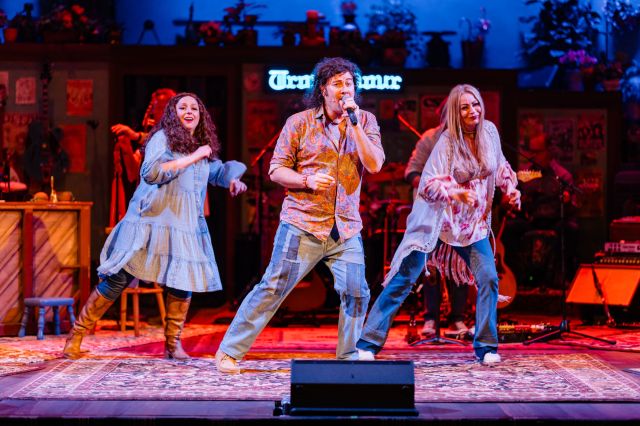
Andrea House, Brad Wiebe, Pamela Gordon in Musicians Gone Wild: Rock The Canyon, Mayfield Theatre. Photo by Mat Simpson.

By Liz Nicholls, 12thnight.ca

When the poet Joni Mitchell referred in song to “pouring music down the canyon,” the image attaches its mythical reverb to a real locale in a real city — and a real, remarkably expansive five-year period in the history of popular music.

It’s Laurel Canyon in the Hollywood Hills, in an epochal five-year span in the late 60s early ‘70s. Capturing in its music and intricate iconic sound that place, that time, and the mysterious visceral attraction of music (and musicians to each other) is the raison d’être of Musicians Gone Wild: Rock The Canyon. The season-opener at the Mayfield, a theatre with a particular strength in first-rate bands and stylish musical captures, launches a proposed to-be-continued series celebrating seminal eras in pop culture history.

Rock the Canyon traces a tangled genealogy of hit songs, bands, generations of artists back to an idyllic sort of “hippie haven” (as the narration has it), in a magical ‘day for a daydream’. Musicians who’d been poor in the Village in New York (and left unlikely places in Canada) began California dreamin’. And by dint of a mysterious magnetism, they found themselves in Laurel Canyon, where the leaves weren’t brown, the sun shone and the rent was do-able. Where they smoked each other’s weed, ate out of each other’s fridges, slept with each other, and inspired each other to make music.

Designer Narda McCarroll creates a bi-level ‘sweet dream’ of aquas, pinks, paper lanterns, plants with green leaves. Ah, and the proverbial couch from which a generation of folkies arose, reinvented themselves as folk-rock stars — and formed and re-formed themselves as couples and in bands. It’s a fantasy theatre world bathed in Jillian White’s rosy lighting.

There have, of course, been books and documentaries before now about Laurel Canyon in that halcyon period. Rock The Canyon co-creators Tracey Power and Van Wilmott have assembled a terrific cast of 10 musician-performers and set about capturing it in music. The Eve in this Eden seems to be a Mama Cass figure (Andrea House), assisted by a Michelle Phillips figure (Pamela Gordon). They, along with Brad Wiebe, riff narratively on the poetic attractions of a place where you can ‘go where you wanna go, do what you wanna do’, and a sound quintessentially related to a certain guitar, the Rickenbacker 12-string.   

The show opens with California Dreamin’ and Mr. Tambourine Man, borrowed from Bob Dylan and turned into a pop hit by The Byrds. And the more-than-ample song list is a whole musical landscape of memorable mood-enhancing memory-triggering songs you know, beautifully delivered — even if you (like me) don’t know the exact chronology of Crosby, Stills, Nash and sometimes Young. Who was sleeping with whom is even more complicated; let’s just say Laurel Canyon didn’t need a Welcome Wagon. The show has an easy, pleasant way of alighting on the songs created from shacking up, then splitting up.

In Laurel Canyon, and the Troubadour (the L.A. club where everyone showed up and performed) the show has a blue-chip entry card into a remarkable collection of hit songs from The Mamas and Papas, The Byrds, The Lovin’ Spoonful, Buffalo Springfield, The Doors, the Turtles, then Joni Mitchell, Crosby Stills and Nash, Neil Young, James Taylor, Carly Simon. Even the Beach Boys; a visitation by Brian Wilson occasions Good Vibrations, in all its orchestral and choral complications, beautifully delivered by the cast.

The Monkees, manufactured for a TV show, were in the ‘hood. So was Carole King. The fascinating eccentric Frank Zappa moved in, too. The Eagles and Jackson Browne were there. Brad Wiebe does a lovely version of Desperado.

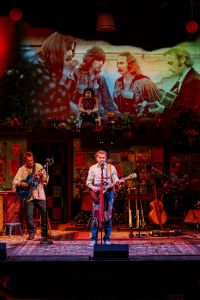
Mark Sterling and Harley Symington, Rock The Canyon, Mayfield Theatre. Photo by Mat Simpson.

‘60s activism is invoked, though in curiously elliptical ways, by the Laurel Canyon crowd. Joni Mitchell didn’t actually go to Woodstock, though her song about it is a memorable generational anthem. Stephen Stills’ For What It’s Worth, inspired by the Sunset Strip so-called “riots,” has a certain observational detachment: “something’s happening here; what it is ain’t exactly clear.” Mark Sterling’s rendition of the Neil Young angry Kent State ode Ohio, in a guitar duet with Harley Symington, is memorable too.    

Power’s production wisely isn’t about impersonating the name players. But the forces under Wilmott’s musical direction are unerring, as you’ll hear, in nailing a range of styles, most involving complex harmonies. Andrea House, a singer of amazing versatility, has a wonderful way with the supple colours and strange lyricism of Joni Mitchell, including Carey from the Blue album. Pamela Gordon’s version of the Carly Simon song You’re So Vain, is a killer; ditto her version of Linda Ronstadt’s great cover You’re No Good.

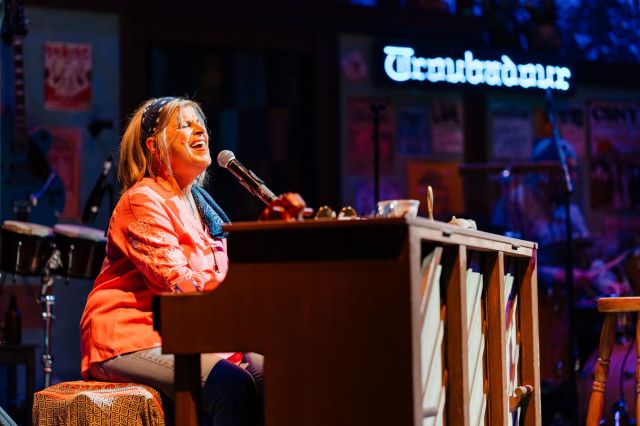
Lisa MacDougall in Rock The Canyon, Mayfield Theatre. Photo by Mat Simpson.

It’s a multi-talented cast, who move seamlessly through the song list. John Banister, who brings his native Brit cadences to Graham Nash songs (including Our House), sings and plays a whole variety of instruments, including keyboards, trumpet and violin. Harley Symingston plays a whole variety of guitars, including the fateful “Ricky 12”. Perhaps the most unusual voice in the cast, a smoky earthy mezzo, belongs to Lisa MacDougall, a pianist of rare skill. And the sound is impeccable, by now a Mayfield signature.

Come to that, Happy Together might be one of the cultural anthems of the production. Narrative interpolations like “we felt we were on top of the world” or Joni’s “I thrive on change” or “for me, Laurel Canyon was like the elixir of life” pale in comparison to the song lyrics. It’s hard to know how to fashion a finale from such a rich pageant of songs. But commentary about the effect of music on the human psyche might not, in the end, be the way to go. Still, the narrative bits and assorted choreographic accompaniments do stick the songs together, and fashion a chronological genealogy of sorts.

Laurel Canyon, the narration tells us, “gave us community and freedom…. But it was always about the music.” And so is this music-rich highly enjoyable evening.

REVIEW

Musicians Gone Wild: Rock The Canyon

Theatre: Mayfield Dinner Theatre

Created by: Tracey Power and Van Wilmott

Directed by: Tracey Power

Starring: John Banister, Andrea House, Pamela Gordon, Steve Hoy, Paul Lamoureux, Lisa MacDougall, Mark Sterling, Derek Stremel, Harley Symington, Brad Wiebe

Running: through Nov. 5

Tickets: mayfieldtheatre.ca

Posted in Reviews | Tagged , , , , | Comments Off on A beautiful day in the neighbourhood: Laurel Canyon and the ‘California Sound’ in Rock The Canyon at the Mayfield

‘A new bounce in its step’: The Importance of Being Earnest at the Citadel relocates to the ’50s. A preview

Nadien Chu, Alexander Ariate, Jeff Lillico, Helen Belay, Amelia Sargisson, Davina Stewart, Julien Arnold in The Importance of Being Earnest, Citadel Theatre. Photo by Nanc Price.

By Liz Nicholls, 12thnight.ca

The last time the distinguished director Jackie Maxwell was in town — working at the Citadel for the first time, amazingly, in 2018 — she brought to the stage a darkly funny, disturbing group portrait of three generations of disappointed people in one family. The play was the Canadian premiere of Stephen Karam’s 2015 Tony winner The Humans.

To help support 12thnight.ca YEG theatre coverage, click here.

Five years later, it’s another first (also amazingly) for Maxwell, the former artistic director of the Shaw Festival. The Importance of Being Earnest, Oscar Wilde’s high-Victorian comic masterpiece of 1895, is positioned right smack in the original festival mandate of plays of Shaw and his contemporaries. But Maxwell’s production of Earnest, which goes into previews Saturday night to launch the new Citadel season, is, to her delight, the first time she’s directed the sparkler — a veritable repository of paradoxical wit that’s been called the most perfectly constructed comedy in English language theatre.

The importance of Being Earnest was in the lineup in Maxwell’s first year at Shaw, in her 2002 to 2016 tenure there. But she asked her predecessor Christopher Newton to direct it. “And he did do a lovely production!”

“We did two or three more Wildes (including An Ideal Husband) under my watch. But not this one.” So she found Citadel artistic director Daryl Cloran’s invitation irresistible: “I’m loving giving it a whirl, totally up for it, especially when Daryl said it’d be on the Maclab thrust stage, oh yeah!”  Staging The Importance of Being Earnest on a thrust, where we surround the action and nothing can be hidden, comes with its own challenges, to be sure. But Maxwell finds those spaces “more conversational.”

And she’s taken the bold initiative of relocating Earnest from its original setting into … the 1950s. Hang on, more of this in a moment.

director Jackie Maxwell. Photo supplied.

“I do like theatre that’s a bit smarty-pants,” says Maxwell of the play, subtitled “a trivial play for serious people. “And this is full of smart, funny people.” People like high-society bachelors Algernon Moncrieff and Jack Worthing, who for romantic motives (named Cecily and Gwendolyn) scramble, ever more preposterously, to keep up the pretence of being a man named Ernest.

The hilarity of The Importance of Being Earnest couldn’t be more different from the dark, morbid comedy of the other Maxwell production running at the moment. Halted by COVID in 2020 two weeks into rehearsal and now, finally, onstage at the Shaw Festival, The Playboy of the Western World by the Irish playwright J.M. Synge is set in motion when the title character walks into a bar on the wild west coast of the Emerald Isle. He announces that he’s killed his father, and becomes an instant star in the village.

“Dark but funny,” says Maxwell, who loves the play. Its premiere in 1907 caused riots (it was deemed an affront to the Irish character) and the Dublin police had to be called in. Needless to say this hasn’t happened in Niagara-on-the-Lake. For one thing, she thinks, “people’s sensibilities have been shifted” by our exposure to the plays and films of Martin McDonagh (most recently The Banshees of Inisherin). Synge is “not as crazily violent” as his contemporary dark comedy heir, to be sure. But “there’s an underlying violence, and audiences have become a little more accustomed to it.”

Has Maxwell unearthed a hitherto undiscovered vein of darkness in Earnest? She laughs. “I’m not pushing to go down to a darker place. Wilde wanted to write a sock-‘em sold-out comedy. And he did!… And yet it’s sophisticated too. The laughs are earned; they’re built beautifully. The characters are funny but they have a core to them.”

“So there may not be a darkness in it, but there is a base for it,” says Maxwell, whose long and illustrious theatre career began as a little kid in her native Belfast (which retains a very light lyrical touch-down on her cadences). “The people come from somewhere. They have connections and all of them are hiding things” — from the crisp governess Miss Prism to the redoubtable social dragon Lady Bracknell, down to the young debonair layabouts with the Ernest alter-egos.   

The characters “are smart and interesting people who’ve … gotten themselves into scrapes, and have to decide how they going to deal with them, what they really want…. They’re leading double lives.” As Maxwell points out, the cruellest irony of the play’s history is that the glittering opening night triumph of Wilde’s most popular hit was followed, shortly thereafter, by his being hauled up for leading a double life himself. Having launched an ill-fated libel suit, he was tried for homosexuality and convicted of “gross indecency.”

Part of the fun of “a trivial comedy for serious people” is the running commentary on money, status, class, social obligations, education, smoking, manners, morals, marriage, cucumber sandwiches, delivered, hilariously, by earnest people who are inadvertent satirists of their world. They’re led by the formidable Lady Bracknell, a social realist of adamantine views on respectability. “There’s meat on the bones,” as Maxwell puts it. “They have to look fabulous, but it’s not just a total ‘put them in pretty dresses’.”   

Speaking as we are of the frocks, “the couture of the 1950s,” as Maxwell says, “is one of the most glamorous of eras…. The people have to be recognizably fashionable,” as fashionable as they were in  1895. And the play needs the reality of being in- or out of fashion to work. When Maxwell announced her intention to pry the play out of its period setting, that suggestion of the ‘50s came from the designer Michael Gianfrancesco. “So much has happened of course between 1895 and 1955.” says Maxwell. “But it’s only in the ‘60s or ‘70s that politics would wrench things around a lot more.” In the ‘50s the class system still held sway.” When I read the play in that light, I thought this could really be fun!” She reports that “actors swooned when they saw the costumes!”

As part of her research, Maxwell says she immediately re-watched the first two seasons of The Crown. “You know, those parties with Princess Margaret….”

She thinks the distinctive qualities of the ’50s “have allowed us to stay very true (to the original)…. I can’t tell you how little we had to change the text.” The set pieces on the Maclab stage are “quite Edwardian…. in the ‘50s people still lived in those beautiful houses in fashionable such-and-such Square. A foot in each era.”

“I’ve really tried to see what we would lose by moving the play to the 1950s. And there was so little I saw as impediments…. The last thing I would ever want do is to take away from the core of the play.”

“Everybody working on it is enjoying the sense of really making sure that the way we present the world of the play is as rich and clear, as vivid and as right for the play as it would be doing it in the original.”

“I just think it’ll have a new bounce in its step.”

PREVIEW

The Importance of Being Earnest

Theatre: Citadel

Written by: Oscar Wilde

Directed by: Jackie Maxwell

Starring: Nadien Chu, Alexander Ariate, Jeff Lillico, Helen Belay, Amelia Sargisson, Julien Arnold, Davina Stewart, Doug Mertz

Running: Saturday through Oct. 15

Tickets: citadeltheatre.com, 780-425-1820

Posted in Previews | Tagged , , , , | Comments Off on ‘A new bounce in its step’: The Importance of Being Earnest at the Citadel relocates to the ’50s. A preview

We’ve lost a giant: celebrating the life of Thomas Peacocke, the small-town kid who changed Canadian theatre

Thomas Peacocke as Père Athol Murray in the 1981 film The Hounds of Notre Dame. Photo supplied by TW Peacocke.

Last fall, theatre here and across the country sustained a huge blow with the passing ot Tom Peacocke at 89. It still seems hard to believe. In him the much diluted term “legacy” is restored to its full lustre and strength, in his profound influence on Canadian theatre and generations of its working artists. It’s the moment to acknowledge gratitude for the inspiration: a celebration of his life happens Saturday at the U of A’s Timms Centre for the Arts. In Tom’s honour, I’m re-posting my 12thnight tribute, which ran Nov. 23, 2022.   

By Liz Nicholls, 12thnight.ca

A giant is gone. 

With the passing of Thomas Peacocke last week at 89, we’ve lost at one go an actor/director/teacher/mentor/administrator/advocate who has played a leading, vivid role in building and shaping theatre here in this theatre town and across the country. Making it better, and kicking its butt when it fell short.  

Thomas Peacocke

Larger-than-life in personality, fierce and fearless, loyal and challenging in equal measure, Peacocke didn’t tiptoe through the world. The rumble of his footsteps onstage and off- could be felt everywhere in Canadian theatre. And that distinctive bark-laugh of his has echoed through the years too.

There’s a subtext in the multitude of Peacocke tributes that have flowed our way from east and west: the suspension of disbelief hasn’t come easy. I guess we all assumed Tom was immortal. And in that Canadian theatre is full of working professionals — actors, directors, theatre founders and artistic directors and, hey, the odd critic — who’ve been inspired by him to up their game, that’s not entirely far-fetched. 

The ripples go beyond theatre, of course, from the artist and the mentor to manifold arts initiatives that have a Peacocke hand in them, the countless committees, panels, juries, and boards on which he sat, from the Alberta Motion Picture Development Corporation to the National Theatre School, the National Screen Institute to the Neighbourhood Playhouse School in New York City.

To help support 12thnight.ca YEG theatre coverage, click here.

There are improbabilities — and a play, a Canuck Our Town perhaps — in the story of the prairie kid from Barons, AB (population then and now 365). He grew up in a two-room shack with his dad, the town telephone’s switchboard whose headquarters was the back room. Maybe there’s a segue to theatre — to Willy Loman, Big Daddy, and Père Athol Murray — in that back story, a visceral connection to the real world that gave dimensional heft to his performances on stage and screen. 

Thomas Peacocke as Willy Loman in Death of a Salesman at the Vancouver Playhouse. Photo supplied by TW Peacocke.

Peacocke’s sons Chris and TW Peacocke (the former a retired school principal and the latter a Toronto-based TV and film director) remember their dad saying that “the gossip he’d overheard was the reason he got involved in theatre in the first place.” And they figure he wasn’t entirely joking. 

First he got a U of A education degree and taught drama at Vic (the future Edmonton arts high school) in the late ‘50s. Then he got a master’s degree and assistant professor teaching gig at Carnegie Mellon in Pittsburgh. It was another Peacock (this one without an ‘e’), Gordon Peacock, who lured him back across the border in the early ‘60s to teach acting —  and to fashion the country’s first Bachelor of Fine Arts professional actor training program — in the U of A’s new drama department. Quickly, the U of A became one of Canada’s top theatre schools. And Peacocke was head of drama at the Banff School of Fine Arts in the ‘70s, too. 

He was a builder, says U of A drama professor Jan Selman, like him a sometime department chair and one of Peacocke’s MFA directing students.“He built it, led it, protected it,” she says of the U of A’s influential acting program. “And Tom never blew his own horn about it, endlessly advocating, getting scholarships, teaching, supporting, mentoring … for five decades of actors. He was hugely important. Can you tell? I’m a fan!”

Thomas Peacocke as Big Daddy in Cat On A Hot Tin Roof, 1966. Photo supplied by TW Peacocke.

This is the story of a small-town kid who arrived in the big city — and changed it. There’s a veritable history of Edmonton theatre written in the 11 pages of Peacocke’s crammed resumé. A recurring theme, as Chris points out, was his dad’s efforts to integrate the university and the professional arts community. 

In the late ‘50s and ‘60s, theatre here was a  town-and-gown affair, a mixture of students, amateurs, professionals, in shows at Studio Theatre, Torches Theatre (the U of A’s outdoor summer courtyard theatre headed by Peacocke), Walterdale, the Citadel.… And they were all family chez Peacocke, as TW and Chris describe the expansive household where they and their sister Jill grew up. 

Thomas Peacocke as Sir Toby Belch in Twelfth Night, 1960. Photo supplied by TW Peacocke.

The hospitality was both artistic and domestic. “There were always actors hanging around,” says TW, remembering “fun, late-night piss-ups” and his dad’s “legendary omelette parties.” And “at the end of every production, there’d be a big meal, and mom cooked….. As little kids we knew all the students in all the classes.”

The young Peacockes got enlisted. “I was in The Trojan Women,” says Chris of his single-digit-age self. His bro was in Antigone. Jill was in Thieves’ Carnival. Later TW would gravitate toward film. “Dad helped me make a movie when I was 10. Dr. Jekyll and Mr. Hyde: Chris was Dr. Jekyll; my best friend was Mr. Hyde; my eight-year-old cousin played a whore.” Chris became an educator, and carried the Peacocke sense of priorities, “the importance of fine arts,” into every school where he was a teacher or principal.

The Peacockes presided over an all-ages post-show late-night salon of sorts. Actors everywhere, from every cast in town. “And our friends loved coming over, too; mom and dad engaged them in conversation.” But “you knew you were up against the real thing,” says TW. He and Chris are amused to remember a boyhood friend playing the guitar, and their dad plying the youthful guitarist with questions. “What are you playing? Did you write it? No? No wonder. You don’t play like you mean it!” 

Playwright Wilfred Watson and director Thomas Peacocke, in rehearsal for Oh Holy Ghost, Dip Your Finger in the Blood of Canada, And Write I Love You.” at Studio Theatre, 1967. Photo supplied by TV Peacocke.

What made Peacocke the ideal mentor? “When he was working with you,” thinks Selman, “from that moment he was completely with you, 100 per cent…. It fits with being a really good actor. You felt extremely seen and heard.”

“He was both kind and fierce,” she says. “It was always always about making the work better.” That’s a thought echoed by director Stephen Heatley, a former artistic director of Theatre Network and now the chair of the UBC drama department. He was another of Peacocke’s MFA directing students. “Curmudgeonly but SO fiercely loyal!” says Heatley of his gruff mentor. “He was one of a kind. They don’t build ‘em like that any more.” 

“Tom was always challenging, but in the best possible way,” says Heatley. “He was supportive; he was always pushing me to be better. Such a huge influence on me…. I remember trying to make up a name for some ‘style’ I was proposing for a production, and him just looking at me for a moment and then saying “and what does that mean?” 

As a theatre reviewer, a line of work about which he had his doubts, I can conjure that signature Peacocke look, a bit amused, worldly, quizzical, and a lot skeptical. He wasn’t a hedger. “Liz, I read your review,” he’d say. “And I have to say that I couldn’t disagree with you more!”

Colleen Dewhurst and Thomas Peacocke in Road to Avonlea. Photo supplied by TW Peacocke.

He dismissed jargon like so much lint off a lapel. And you’d be on the spot to account for yourself. “What,” he’d say emphatically (meaning ‘what on earth?’), are you talking about?” I learned a lot from every encounter — about plays, making theatre and writing about it, the state of the culture (not to mention the dismal disrepair of the media). 

With Peacocke mentorship didn’t stop with graduation. Gerry Potter, the founder of Workshop West Theatre, calls him “one of my special teachers and mentors who always supported my learning and later my work in theatre, but was always honest enough to advise on areas that needed improvement.” Potter, like others, says he still uses what he learned from Peacocke; he’s the voice in your ear that doesn’t go away.

“He was a father figure to us,” says opera and theatre director Brian Deedrick. “I consider him my theatre dad. And I bet countless people feel that way.” And Tom’s lively, charming wife Judy, who passed away a year ago was “den mother.” Chris Peacocke laughs. “We have a lot of surrogate brothers and sisters.” 

Opinionated? Deedrick laughs. “You always knew where you stood with Tom! You always knew he’d be dead honest.” So when Deedrick ventured from theatre into directing operas, Peacocke’s was the assessment he most valued and feared. “I did a Turandot in Edmonton, and he left a phone message after the show: ‘you know, kid, that was really good’. And it meant more to me than what anybody else thought.”

Thomas Peacocke directing Francis Damberger in Saturday, Sunday, Monday at Studio Theatre. Photo supplied by Francis Damberger

“Tom was our first-year acting teacher,” says filmmaker Francis Damberger, another Peacocke student and friend. “And since I was from Tofield we used to kid around a lot about small-town Alberta.” Last year Damberger sent Tom a new screenplay he’d written. “He called me a couple of days later cussing. He thought it was really funny and powerful. He was mad because he started it reading, stopped to go to bed, then got up during the night and kept reading till late morning. So, no sleep.” 

“He had a huge influence on my life as he did with so many others,” says actor/ director/ filmmaker/ teacher Larry Reese, who was in The Hounds of Notre Dame with him. He cites “his role as as a humanitarian, mentor, teacher, father figure, and friend, who passionately went all out to inspire and help change lives….” 

Peacocke himself talked about heroism when he got up onstage in Toronto to receive a best-actor Genie Award for his charismatic star performance as Père Murray in The Hounds of Notre Dame. He was funny, people laughed, and then you can hear the silence. “ I’m playing a Canadian hero, and no one’s seen the movie,” he declared. “And that says a lot about our industry. And our country.”

Heroes step up and speak out. And so did Peacocke.  


Posted in Features, News/Views | Tagged , , , , , , , | Comments Off on We’ve lost a giant: celebrating the life of Thomas Peacocke, the small-town kid who changed Canadian theatre

‘ClownProv’ headliners: Play The Fool is back to send in the clowns

Isaac Kessler and Ken Hall of 2-Man No-Show, Play the Fool Festival 2023. Photo supplied.

By Liz Nicholls, 12thnight.ca

Two of the country’s most energetic, hyperkinetic clown stars are the headliners of this year’s eighth annual Play The Fool Festival, returning Thursday for four days.

To help support 12thnight.ca YEG theatre coverage, click here.

Toronto’s Isaac Kessler and Ken Hall, who have evidently never seen a fourth wall they didn’t want to bounce off, catapult over, or smash into a zillion pieces, have brought their “clownprov” hit 2-Man No-Show to open festivities Thursday. “And they are incredibly physical,” says Play The Fool artistic director Christine Lesiak, who can’t keep the smile out of her voice when she talks about them.

“They bridge clown and improv,” she says of the pair, who are, basically, the conceptual opposite of talking heads. “They use clown techniques to inform improv.” Their comedy cred, across a spectrum of festivals and Fringes, is blue-chip. Hall, who’s worked with Cirque du Soleil, performs regularly and teaches at The Second City; he’s a star of Netflix’s The Umbrella Academy. Kessler’s 1-Man  No-Show was the artists’ pick at the 2022 Edmonton Fringe. They’ll be onstage with Edmonton musician/composer/musical director Erik Mortimer.

They’ve brought two different formats of 2-Man No-Show. On Saturday night, Kessler and Hall debut their brand new Balls Out edition of the show. As Lesiak explains, the audience is provided with soft balls, and in response to what’s happing onstage, they’re invited to throw them. “A whole new kind of audience involvement,” as Lesiak says, laughing. “A little more hands-on than usual.”

Christine Lesiak in For Science!. Photo supplied.

An expert clown herself with a gallery of alter-egos (including Sheshells and self-help guru Aggie), Lesiak takes the sole honours in the clown/space physicist department of the comedy industry.

Which explains her hilarious hit hybrid For Science!: it applies the scientific method to a series of experiments conducted by a beaming Professor and her lab assistant (Ian Walker).

The raison d’être of Play the Fool is to showcase the species clown, in all its glorious permutations from the cerebral to the physical, the voluble to the silent — the classic red-nose innocent to the more abrasive Euro bouffon, the grotesque satirist to the playful explorer of a brave new world — and (since clowns are natural rule-breakers) every permutation of the above. The high-contrast trio in the 2023 Triple-Bill, running Friday and Saturday night, constitute a tangible seminar in clownly variety.

Terry Knickle aka Tchotchke the Gig in The Problem With Opera, Play The Fool Festival. Photo supplied.

In The Problem With Opera, the red-nosed Terry Knickle unleashes the dramatic tenor within, by creating an opera that hinges on a full-flourish operatic crisis: running out of milk. They are a trained opera singer and music teacher. And much to Lesiak’s delight, the piece, directed by Mark Vetsch (who’s created physical/clown comedy for such theatres as Thou Art Here and the Freewill Shakespeare Festival), hatched from Knickle’s Rookie Cabaret contribution at the 2022 Play the Fool.

The Radical Re-education of Generation Z, Internet Hygiene and Being AFK  is the work of the neo-bouffon troupe Batrabbit Collective., whose Fringe show Rat Academy (which has roots at Nextfest and Play the Fool) was a bona fide hit this past summer. In the multimedia piece by Abby McDougall and Dayna Lea Hoffmann, a representative of Generation Z  explains, with power point (hey, just like TED), the complexities of a life as lived in the interface between the online world and so-called reality. McDougall stars; Hoffmann directs.

The third offering of the Triple Bill, The Routine, is by Vancouver-baed mime Joylyn Secunda. “We don’t see a lot of mime,” says Lesiak, who’s an appreciator of a form as high-precision in its way as magic or sleight-of-hand. “Mime is hard!, and their work is “immaculate,” she says of Secunda.

Friday night’s Festival Spectacular Cabaret, hosted by 2-Man No-Show, includes eight five- to 10-minute pieces. “Always big fun,” says Lesiak. “And all it of is brand new work from artists in full experimental throttle. Michael Kennard, of Mump and Smoot, for example, is testing a new idea. So is Sophie May Healey, whose clown Hysteria Winthrop “is trying out a new thing with an autoharp.” Candace Job’s contribution is “a brand new mask piece.”

The traditional Saturday night Play the Fool finale is always the Rookie Cabaret, by artists trying out a new art form. “Artist-led” and mentored by Lesiak, “they always kill! That’s why it’s the finale.”

Sunday afternoon is devoted to online discussion clowning with an expert international online panel: Ingrid Hansen (SNAFU Productions),  Jacqueline Russell (Wee Witches Productions), Dayna Lea Hoffmann (Batrabbit Collective), Aitor Basauri (Spymonkey). It’s free, moderated by Jake Tkaczyk.

“Life is really heavy these days. It’s grim out there,” as Lesiak says, and we all know it. Hey, Edmonton, we have a picker-upper of a festival.

Festival headquarters is the Backstage Theatre at the Fringe Theatre Arts Barns, 10330 84 Ave. Check the festival website playthefool.ca for times and tickets, and information about masking policy, which varies, show to show, from “mask friendly” (with masks required for the Backstage Theatre lobby, bar and bathrooms) and “mask required” for shows with immuno-compromised performers.


Posted in Features, Previews | Tagged , , , , , , , | Comments Off on ‘ClownProv’ headliners: Play The Fool is back to send in the clowns

Bienvenue: a new artistic director and a new season for L’UniThéâtre

Steve Jodoin, artistic director of L’UniThéâtre. Photo supplied.

By Liz Nicholls, 12thnight.ca

“I’m pretty stoked!” declares Steve Jodoin, the (perfectly bilingual) new artistic director of L’UniThéâtre, Edmonton’s only professional francophone theatre company.

In these post-pandemic times he has the sense that the venerable company has emerged into the light. “We disappeared for a bit. We just want to get back on the map.” To that end Jodoin has assembled a new leadership team, with fellow actor and long-time friend Mireille Moquin as administrative director. And this week, in addition to a new website, Jodoin has unveiled his first full season of shows, all four with national connections (and contemporary resonances for anglophone audiences too).

To help support 12thnight.ca YEG theatre coverage, click here.

The season-opener, Michel(le) is a solo show created and performed by Joey Lespérance, and inspired by the real-life story of the actor and his “bro-sister.” The Vancouver-based actor/playwright, familiar to L’UniThéâtre audiences, was most recently seen here as Pierre Trudeau in Darrin Hagen’s The Empress and the Prime Minister, which premiered at Theatre Network in 2019.

As kids Joey and Michel played together. And they escaped their environment in ‘60s and ‘70s Quebec by finding their way to artistic paths on opposite sides of the country — the former into an acting career in Vancouver, the latter into the Montreal drag scene. Tragically, Michel’s dreams of finding a new and truer identity as Michelle were never realized. Jodoin, who was struck hard by “the generosity and honesty of the play” describes it as “Joey’s love letter, homage, to his bro-sister. A very moving story….”

Michel(le), a production by Vancouver’s Théâtre La Seizième, runs Oct. 26 to 28 at La Cité francophone.

Lespérance and Jodoin have a long history as actors. “Our first time onstage together was in 2005, Kenneth Brown’s Cowboy Poetré,” recalls Jodoin. Originally from Quebec City, he came west for a year, to Jasper, to learn English, and never left. He ended up at Grant MacEwan in 2002, in the time of theatre arts program founder Tim Ryan and Brown. Professional gigs, in both French and English, were immediate.  “I missed grad in 2004 to do a show with L’UniThéâtre.” After that came a “western life documentary series,” in which he played an innocent from the city learning western culture. “I felt very connected,” Jodoin laughs.

Jodoin’s season, New Perspectives, includes a musical, unusual in itself for L’UniThéâtre,. The origins of Vaches The Musical, by Stéphane Guertin and Olivier Nadon, are to be found, loosely, in the news: it’s “freely inspired” by a true story, the dramatic Quebec ice storm of 1998. The farmer protagonist Jean is up against it — the mayor, the military, the elements — as he tries to save hundreds of cows from certain death.

It has “a light touch,” says Jodoin of Vaches. “Funny and touching, comedy with heart, about community, family, standing tall against adversity … a beautiful show.” The five-actor production, from Ottawa’s Créations In Vivo, runs March 21 to 23.

Jodoin himself is in the cast of Claudia Dey’s Trout Stanley (May 9 to 12), the play’s first French incarnation (translation by Manon St-Jules), with two actors from Quebec City’s Théâtre Niveau Parking, L’UniThéâtre’s co-producer.

The play, which has an eccentric, not to say weird,  gothic charm about it, is set in a remote B.C. town between Misery Junction and Grizzly Alley, where two orphaned twin sisters (who used to be triplets) on the eve of the big 3-oh, are awaiting the bad news that invariably attends on their birthdays. A stripper, who’s the town Scrabble champ, has gone missing. And the arrival of a mysterious, possibly sinister drifter changes the dynamic, as a love triangle emerges.

L’UniThéâtre’s touring show for the season is “an adventure story” that obliquely invites conversations about grief. The Théâtre La Seizième production of Anaïs Pellin’s La Befana alights in schools in B.C. and Alberta May 21 to June 14.

All L’UniThéâtre productions come with English surtitles. Subscriptions and tickets for the 2023-2024 season are available at lunitheatre.ca.

Posted in News/Views, Previews | Tagged , , , , , , | Comments Off on Bienvenue: a new artistic director and a new season for L’UniThéâtre

Close encounters in the borderlands: Workshop West announces a new season

Lora Brovold in Dead Letter, Workshop West Playwright’s Theatre. Photo by Dave DeGagné

By Liz Nicholls, 12thnight.ca

There’s a cross-country vision to Workshop West Playwright Theatre’s upcoming 45th season, Borderlands, Encounters on the Outskirts, announced Monday from their Strathcona headquarters, the Gateway Theatre.

The trio of 2023-2024 mainstage productions at Workshop West, a theatre devoted from the start to the development and showcasing of the Canadian repertoire and its writers, is bookended by plays, both mysteries in high-contrast ways,  one from Quebec and one from Edmonton. And between the two is a highly unusual touring production, an experiment in audience collaboration created by one of most exciting and inventive of the new generation of Canadian theatre artists.

To help support 12thnight.ca YEG theatre coverage, click here.

The season grand finale, one of the most anticipated premieres of the Edmonton season, is Dead Letter, by star Canadian playwright Conni Massing whose history with Workshop West goes back decades (most recently Matari in 2018). Born during the pandemic at WW’s Playwright’s Exchange, and workshopped at last year’s  Springboards New Play Fesival and Script Salon, it’s “a comedic mystery,” as WW artistic director Heather Inglis describes, spun from the small, hidden mysteries of our lives.

“Part rom-com part mystery,” Dead Letter is triggered by the arrival in the protagonist’s mailbox of a letter that’s years old. Suddenly it begins to add up to her, a clear signal of “larger forces at work” in a world where meaning is elusive — a cosmic connection between the letter, those single socks gone AWOL from the drier, the missing Tupperware lids….

Massing’s characters, says Inglis, “always feel lived in … down to what they eat, and even the recipes.” In the case of Dead Letter they’re in “a whodunnit that’s surprising and delightful.” Inglis’s production (May 17 to June 2), which happens in the round, stars husband and wife Collin Doyle and Lora Brovold (last seen together onstage in Conni Massing’s Oh Christmas Tree at the Roxy in 2018), along with Maralyn Ryan. And the multi-talented actor/playwright/composer Rebecca Merkley has been enlisted for the sound design.

Kristin Johnston in Mob, Workshop West Playwrights Theatre. Photo by Dave DeGagné

The season opens with Mob (La Meute), by the Quebec TV and film star-turned playwright Catherine-Anne Toupin. The touchstone of the hit psychological thriller, which premiered at La Licorne in Montreal in 2018 (and was remounted twice there), is Hitchcock, and especially Pyscho, says Inglis who directs the Workshop West production (Oct. 25 to Nov. 12).

“A slow burn,” as Inglis describes it, the play builds on concealed identities, and turns on a point of unease, restraint,  and escalating menace. Sophie, “a refugee from her job,” arrives at a remote B&B out of town in the Eastern Townships “looking for solace.” And she meets the inhabitants, including “a young man who’s a little odd, living with his aunt.” Ring a bell?

Not much more about Mob can be revealed in advance, as Inglis says, save that it’s “a dark, challenging piece, and super-well-written.” Her production, the play’s English language debut in western Canada, stars Kristin Johnston (“I’m a big fan … ever since We Had a Girl Before You” at Northern Light), with Graham Mothersill and Davina Stewart. Workshop West hasn’t done a Quebec play since the mid-‘80s, Inglis thinks: a production of Michel Tremblay’s Hosanna. “We’re primarily about Alberta voices, but other sensibilities enrich our writers as well….”

The English version, which premiered at the Centaur in Montreal in 2020, has an estimable pedigree: it’s translated by Chris Campbell, a former literary manager at the Royal Court Theatre in London.

This Is The Story Of The Child Ruled By Fear, Workshop West Playwrights Theatre. Photo by Dave DeGagné

Found Festival audiences in 2021 had a chance to see an early sighting of This Is The Story Of The Child Ruled By Fear, David Gagnon Walker’s uniquely immersive experiment in storytelling. Since then, it’s been at SummerWorks in Toronto, the High Performance Rodeo in Calgary and Vancouver’s Pi Theatre, among other theatre to destinations, in a cross-country tour by the playwright’s company Strange Victory Performance. The short Edmonton run, Jan. 31 to Feb 4, is part of that ongoing journey.

It reminds Inglis, she says, of Spalding  Gray’s monologue Swimming To Cambodia, “but with  significant visual elements, multi-media design and projections.” And this: the audience is invited to join Gagnon Walker in telling the story, a fantastical poetic fable of the rise and fall of an imaginary civilization, with imaginary creatures in a state of slowly unfolding emergencies. Inglis calls it “a communal play reading.” You can participate to your own comfort level, reading for a character, joining the chorus, or sitting back to watch.” It was originally developed during COVID, “but it’s not specifically about that,” says Inglis. “Really it’s about coming together, the art of storytelling as a metaphor…. A reminder, in production form, of the power of just reading a play.” Christian Barry of 2b Theatre in Halifax, directs with Judy Wensel.

The third Edmonton iteration of The Shoe Project, designed to seek out and amplify the voices and stories of immigrant women, is part of the season in partnership with the SkirtsAfire Festival (March 2 and 3). And the lineup also includes the return of Workshop West’s signature Springboards New Play Festival (March 25 to 3), with readings of plays at every stage of development by playwrights at every level of experience. Presented in a cabaret setting, it’s a chance, as Inglis says, for writers to hear their works read by actors, supplemented by selected design possibilities, light, and sound.

For audiences, it’s our chance to go backstage in the process of theatre-making, where the artists hang out, and their ideas begin to take theatrical form. And, as plays like Dead Letter demonstrate, Springboards is a launching pad into full productions and onto stages of all sizes. Sneak previews with wine.

Consult workshopwest.org for subscriptions, schedules, and news about the company’s assorted  playwright development programs, including Writes of Passage, Indigenous Playwrights’ Circle, Edmonton Playwrights’ Circle, and Playwrights’ Reading Program.

Posted in News/Views, Previews | Tagged , , , , , , | Comments Off on Close encounters in the borderlands: Workshop West announces a new season

Play time! Prospects to intrigue you in the new season on Edmonton stages

Larissah Lashey, Jayce McKenzie, Abigail McDougall, Hayley Moorhouse in Robot Girls, Shadow Theatre. Photo supplied

Hannah Whitley and J. Antonio Rodriguez in Hadestown, North American Tour. Photo by T Charles Erickson

By Liz Nicholls, 12thnight.ca

The Answer Is Fringe, the 42nd annual edition of our giant summer theatre bash, with its 114,000 or so tickets sold, was a sign. Theatre is getting its groove back, after three hard years that have tried the ingenuity, resourcefulness, agility — not to mention the patience — of its artists. And it’s dawning on audiences what they’ve been missing, the excitement of the live in-person experience.

To help support 12thnight.ca YEG theatre coverage, click here.

Theatre companies and artists are returning to stages large and small, with thoughts about how to venture forth in a darkened, possibly absurd, world. Yes, the theatre season is starting. Musicians Gone Wild: Rock the Canyon, the first instalment of a new series designed to highlight seminal eras in pop music, opens at the Mayfield this week. The funniest, most perfectly formed, comedy in English language theatre, The Importance of Being Earnest, launching the Citadel season in a production directed by Jackie Maxwell, later this month, is in rehearsal.   

There’s a new Conni Massing, Dead Letter, premiering at Workshop West Playwrights Theatre. L’UniThéatre opens a new season with Joey Lespérance’s Michel(le). And there will be more to come (indie theatre works that way). But to whet your appetite, from what we know so far, here’s a selection of intriguing shows (in no particular order) to look forward to.

The Play’s The Thing, Theatre Yes. Photo supplied.

The Play’s The Thing: Here’s an irresistibly wild idea, a real community-builder season-opener, from Theatre Yes’s new co-artistic directors Max Rubin and Ruth Alexander, Twenty Edmonton performance groups of every stripe and specialty, have signed up to create and perform a scene from Hamlet in their own style. Theatre companies, dance companies, sketch comedy troupes, burlesque artists, musical theatre specialists, collectives of the Shakespearean persuasion, a circus theatre … the variety in The Play’s The Thing has crazy showbiz fabulosity attached to it. And in its very essence it’s of this place. The first 10 scenes of Hamlet are on Oct. 7, with 10 the next night, at the Westbury Theatre. Proceeds to the Food Bank.

Wonderful Joe: The playwright/marionettiste extraordinaire Ronnie Burkett, who has a three-decade history with Theatre Network (renewed with last season’s Little Willy), returns to the Roxy this season to premiere his latest (April 2 to 21, 2024), billed as “a love letter to the imagination.” Faced with separation and homelessness, old Joe and his dog Mister head into a broken world for a last grand adventure. Has the magic of the world been irretrievably lost? Are we looking in the wrong places to find it? In the course of Wonderful Joe, the pair encounter Mother Nature, Santa, Jesus, and the Tooth Fairy. The music is by John Alcorn.

Wonderful Joe by Ronnie Burkett Theatre of Marionettes. Brochure photo.

Candy & The Beast: A new “multidisciplinary murder mystery thriller with music” by artistic director Trevor Schmidt premieres as the finale of the upcoming Northern Light season. The setting of Candy & The Beast, the dark demi-monde of a small prairie town, will remind you of the 2022 prairie goth musical Two-Headed/ Half-Hearted by Schmidt and Kaeley Jade Wiebe. There’s a serial killer on the rampage, and a couple of trailer-park outliers, Candy and her little brother Kenny, set forth to track down the monster (April 4 to 20, 2024). Jayce MacKenzie and newcomer Bret Jacobs star in Schmidt’s production.

Candy & The Beast, Northern Light Theatre. Graphic by Curio Studio.

Robot Girls: Another Trevor Schmidt play premieres this season, and in a cross-company venture, it’s at Shadow Theatre. Robot Girls chronicles the tensions and coming-of-age stresses of a quartet of teens, junior high-age girls in a science club who are building a robot for an international competition. John Hudson’s production (Jan. 17 to Feb. 4) stars Jayce MacKenzie, Hayley Moorhouse, Larissa Lashley, and Abigail McDougall.

Pith! A lot has happened in the 10 years since Stewart Lemoine’s 1997 theatrical homage to the transforming power of the imagination was last seen here. Teatro La Quindicina is now Teatro Live!. The 42-year-old company, born at the Fringe, has exited those summer festivities. And leading man Andrew MacDonald-Smith, who starred as the instigator Jack Vail in the 2013 revival of Teatro’s most popular, widely travelled, play, is now co-artistic director of the company (along with Belinda Cornish). He returns to the role of the vagabond Jack, who arrives in Providence, R.I. in 1931, and re-starts the stalled life of a gloom-laden widow forever by engaging her in an imaginary journey. The playwright directs (Feb 9 to 25) a cast that includes Kristin Johnston as the widow.   

Mermaid Legs: Three sisters in crisis are the centre of Beth Graham’s intriguingly named new play, premiering on the SkirtsAfire Festival mainstage (Feb. 29 to March 10). Billed as  “a surreal theatre dance fantasia about the difficulty of truth, the complications of family, and the bonds of sisterhood.” Annette Loiselle’s production, her grand finale as SkirtsAfire’s founder and artistic director, sets in motion three actors and four dancers, who evoke the inner and outer landscape of the piece, developed with choreographer Ainsley Hillyard.

Karen Hines in Pochsy IV, Theatre Network. Photo from Theatre Network website

Pochsy IV: The toxic kewpie we first met in 1992, attached to an intravenous pole, in Karen Hines’ brilliant hit series, bathed in the eerie light of gallows humour, is back after an absence of 15 years. Pochsy IV, workshopped at the 2022 Play The Fools Festival, is in the three-play all-Canadian Theatre Network season. Where has Pochsy been (the people want to know)? An ex-employee of Mercury Packers (where, yes, she packed mercury), is again looking to the future. Michael Kennard of Mump and Smoot directs (Oct. 17 to Nov. 5).     

The Three Musketeers: The grand finale of the Citadel’s upcoming season is a large-scale swashbuckler — a big cast with a built-in ensemble mantra (“all for one and one for all”), big costumes, and a lot of swords (fight director: Jonathan Purvis). Daryl Cloran directs this highly comic adaptation by the prolific and much-produced American playwright Catherine Bush (April 20-May 12).

Hadestown: Edmonton figures prominently in the production history of Anaïs Mitchell’s richly evocative folk opera musical: the Citadel is where it made its preparations in 2017 en route to a Tony Award-winning Broadway run that’s still playing to packed houses. Rachel Chavkin’s production, radically reworked for New York, is back in town, in a Broadway Across Canada touring production at the Jube Nov. 14 to 19. Your chance is at hand to go to hell and back, wrapped in a ravishing dream of two intertwined love stories, inspired by the Orpheus and Eurydice myth.

Sunday in the Park With George: Sondheim’s glorious 1983 masterpiece, in which the past wraps itself around the present, is a mesmerizing, shimmering tribute to art: the creation of it, the human price tag on creating it, the people who make art and the people who surround the people who make art. It’s spun from the famous painting by the pointillist master Georges Seurat, Sunday Afternoon on the Island of La Grande Jatte. Productions are rare; the MacEwan Theatre Arts production directed by Jim Guedo is one to seek out (March 20 to 24).   

Botticelli in the Fire: Sex and art and violent populism collide in this fascinating 2016 one-act by the young Canadian playwriting star Jordan Tannahill. At its centre is the queer Renaissance painter Botticelli, working on his masterpiece The Birth of Venus, in a contemporary landscape of escalating danger. The resonances with our world are multiplying as we speak. The seven-actor production was originally slated for this past April, and this season it’s happening. Sarah Emslie makes their directing debut, as part of Fringe Theatre’s curated season (April 19 to 27).

Glenn Nelson, Reed McColm in The Drawer
Boy, Shadow Theatre. Photo supplied.

The Drawer Boy: It’s been a couple of decades since Edmonton audiences saw this funny, moving Canadian theatre classic. Michael Healey’s 1999 Governor General’s Award winner, in which art and life mingle unforgettably, tells of the adventures of a young actor in the Ontario farming heartland. He’s there as part of a Toronto theatre company researching farm life, on location, for the play that would become another Canadian classic, the seminal The Farm Show. The Shadow Theatre production (Jan. 18 to Feb 4)  directed by John Hudson, stars Glenn Nelson, Reed McColm, and Paul-Ford Manguelle.

Indecent: Paula Vogel’s play is another a play about a play — with a theatre story, a real one, that connects us to the explosive historical and cultural currents of the last century. A company of actors brings Sholem Asch’s 1907 Yiddish groundbreaker God of Vengeance (in which a rabbi’s daughter falls in love a prostitute in the brothel downstairs from the family) from the capitals of Europe to New York. And with it, across the Atlantic, the first lesbian kiss on an American stage. Warmly received in Greenwich Village in 1921, the move uptown to Broadway two years later had disastrous results. Ben Smith directs, at the U of A’s Studio Theatre Dec. 1 to 9.

Private Lives: There’s one for the archives in the unique casting of Teatro Live’s production (July 11 to 28) of the spiky and insightful Noel Coward comedy Private Lives. The company’s two co-artistic directors Belinda Cornish and Andrew MacDonald Smith star as the divorced couple who re-discover each other on their respective honeymoons with new spouses, and re-kindle their passion and their marital war. A third artistic director, Max Rubin of Theatre Yes, directs the romantic fray.  

A cross-company sampling: The Theatre 8-Pack, a bargain at the price ($210), includes a production from each of eight Edmonton theatres: A Phoenix Too Frequent (Northern Light Theatre), The Drawer Boy (Shadow Theatre), Pith! (Teatro Live!), Mermaid Legs (SkirtsAfire Festival), Rough Magic (Studio Theatre), The Swearing Jar (Walterdale Theatre), Trout Stanley (L’UniThéâtre), and Dead Letter (Workshop West Playwrights’ Theatre). Tickets and full schedule: edmontonarts.ca.

Posted in Features, News/Views, Previews | Tagged , , , , , , , , , , , , , , | Comments Off on Play time! Prospects to intrigue you in the new season on Edmonton stages

The Answer Is Fringe! The 42nd annual edition of our Fringe signs off: more tickets sold, more take-home for artists

The Answer is Fringe

By Liz Nicholls, 12thnight.ca

If The Answer Is Fringe, as we’ve long suspected, our giant summer theatre festival has arrived at the last day of exploring, and playing with, the Questions.

After 11 days and nights of sun, smoke, flood and mosquitoes, the 42nd annual edition of Edmonton’s summer theatre binge, the first and biggest of its kind on the continent, signs off Sunday night. And by Sunday morning, with a full day and evening of shows still to go (updates to come), the Fringe had sold 114,000 tickets to its 185 indoor shows in 35 venues.

The number of shows, artists, and tickets sold are substantially up, to be sure, from the 2022 edition, with its sales tally of 94,500 tickets to 164 shows in 27 indoor venues. But what pleases Fringe director Murray Utas the most, he figures, is the payout, exceeding $1.2 million, to Fringe artists, who take home 100 per cent of ticket sales (minus the $3 festival surcharge). That’s up from 2022. And it’s an even more impressive return, proportionate to shows, than the epic 2019 Fringe (258 productions) and the $1.4 million returned to artists that year.

To help support 12thnight.ca YEG theatre coverage, click here.

A Fringe artist himself by temperament and background, the ebullient director/ actor/ playwright/ producer Utas points, with delight, to the 365 sold-out houses at The Answer Is Fringe, compared in relative terms to the 440 of of the 258-show 2019 edition, with audiences spread out over a much larger landscape of shows.

“There’s nothing more adventurous than Fringe audiences,” he says. “And I want to honour them…. We’ve hit a new place in (audience-artist) interaction!” As he tells Fringe artists “show me your heart, and Fringe audiences will care for you…. We are all in this together.”

Elena Belyea in This Won’t Hurt, I Promise, Tiny Bear Jaws, Edmonton Fringe 2023. Photo supplied

In this he echoes actor/playwright Elena Belyea, whose solo show This Won’t Hurt, I Promise has been held over by Fringe Theatre Adventures Sept. 1 and 2. The muse-in-residence at the adventurous indie company Tiny Bear Jaws, Belyea says “the Fringe audience just isn’t a typical audience. They’re so ready to dive in head first … so game to play!” As a point of comparison, Belyea has taken her play Miss Katelyn’s Grade Threes Prepare For The Inevitable to both theatre seasons and to curated festivals, as well as the Fringe. “I’ve loved doing it for Fringe audiences best.”

For an indie artist, even one as experienced and accomplished as Belyea, getting an audience for an indie production is a struggle. “With Smoke and I Don’t Even Miss You (award-winners both), I’d get a 30-person audiences. With this show, at the Fringe, it’s 150 a night…. It’s a (better) way to try out something new, see what works.”

With the Fringe, “you don’t have to convince people to come; there’s a giant infrastructure and a built-in audience…. ” Belyea feels “a different kind of contract with the audience” at the Fringe,” and it’s very conducive to experimenting, as she did with a solo show that expands the notion of standup into a piece that sets about helping deal with a world that’s maddening and toxic.

“If I hadn’t got the Fringe slot I wouldn’t have made the show.”

Vance Avery and Chris W. Cook in Fiji, Shatter Glass Theatre, Edmonton Fringe 2023. Photo supplied

Lora Brovold, an actor with a distinguished Edmonton theatre resumé, ventured into directing for the first time — on request of a new young producing team, playwright Michelle Robb and partner Gavin Dyer — with one of the Fringe’s trickiest, weirdest plays. Fiji starts out as a meet-awkward rom-com, and ends up taking audiences ever so gradually, plausibly even, into the truly shocking discovery of where the quest for human connection can lead.

The play itself is risky, to say the least. But then, as Brovold points out, the Fringe itself is a gamble … perfect for artists and for me, taking a creative risk.” And “because it’s all about risk, that takes away the fear that sits on my shoulder.” The audience seemed to be hip to that synchronicity of risk-taking, she reports. Nearly every performance of . was sold out.

Rat Academy, Batrabbit Productions, Edmonton Fringe 2023

Utas, for his part, loves the co-mingling and collaboration at the Fringe of experienced artists and relative newcomers, as the four-show holdover series he’s curated attests. The delightful Rat Academy, a very skilful and funny dark-side clown show by the team of Dayna Lea Hoffmann and Katie Yoner, young heirs to the great Mump and Smoot tradition, is one (Sept. 1 and 2).

The Cabin on Bald Dune, held over by the Varscona Theatre Wednesday (Aug. 30), is another example. It’s a resonant, expertly turned out thriller by the young playwright Jezec Sanders. And it attracted an all-star cast, Jenny McKillop and Kristi Hansen.

The adventurously off-centre theatre-maker Steve Pirot, a former Nextfest director and the artistic director of iHuman Youth Society (a multi-disciplinary arts collective for marginalized youth), was onstage at the Fringe for the first time in half a dozen years. He brought his own new show Unkl Stiv’s Looping Machine, a case of  “Steve bringing his weird to the festival!” as Utas declares happily. 8-5 Crew on Cypher Avenue (85th Avenue), for young up-and-comers, a multi-disciplinary mural street-scene initiative for impromptu, music, dance and the visual arts, is a shared-custody brainchild with Utas, in its second year.  The idea is to nurture the next generation of artists.

As the townspeople in What Was Is All, a startlingly ambitious new folk-rock musical I caught this weekend at the Roxy, wondered (in song), “is it too late to try on a new life? The Fringe steps up and always answers No. Congrats to all the artists and audiences who hitchhiked together through the galaxy.

Posted in Fringe 2023, News/Views | Tagged , , , , , , , | Comments Off on The Answer Is Fringe! The 42nd annual edition of our Fringe signs off: more tickets sold, more take-home for artists