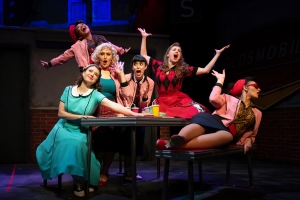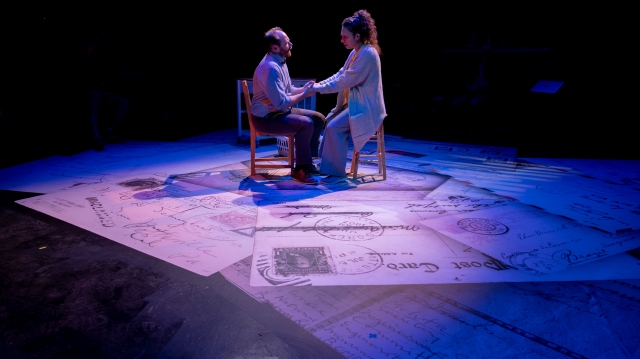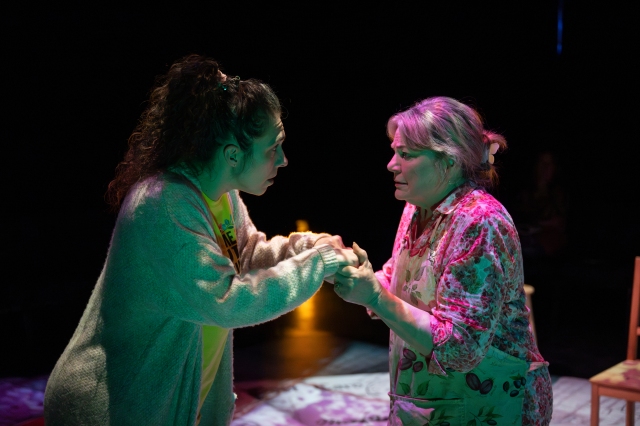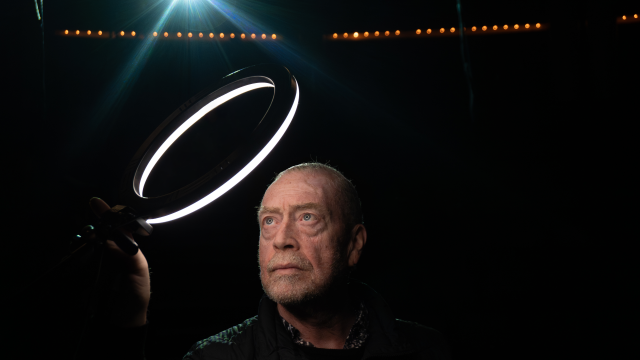
A thrilling and beautiful musical testimonial to what art and artists are all about: Hadestown at the Jube, a review

Amaya Braganza, Will Mann, J. Antonio Rodriguez in Hadestown, Broadway Across Canada touring production. Photo by T Charles Erickson

By Liz Nicholls, 12thnight.ca

The musical/ folk opera that returns to Edmonton in the thrilling touring Broadway production onstage at the Jube this week will take you to Hell and back.

And all along that eerie, high-stakes route through darkness, you’ll be warmed, and chilled, by a feverish dream — of love, of loss, of how to live in a world that’s “hard and getting harder all the time.”

To help support 12thnight.ca YEG theatre coverage, click here.

Yes, I say “returns” to us — in re-designed form. Anaïs Mitchell’s Hadestown, a marvellously imaginative and resonant theatrical creation 13 years in the making with director Rachel Chavkin, has been here before. In a 2017 workshop production at the Citadel that was its Canadian premiere — after its 2010 concept album origins, its 2016 Off-Broadway incarnation, and before Broadway and 14 Tony nominations and awards as best musical and best original score. As the personable, worldly wise god Hermes (the terrific Will Mann, in a snazzy silver suit), our narrator, tells us in song, “how to get to Hadestown, ya have to take the long way down.” Theatre artists get that.

Lana Gordon in Hadestown, Broadway Across Canada touring production. Photo by T Charles Erickson.

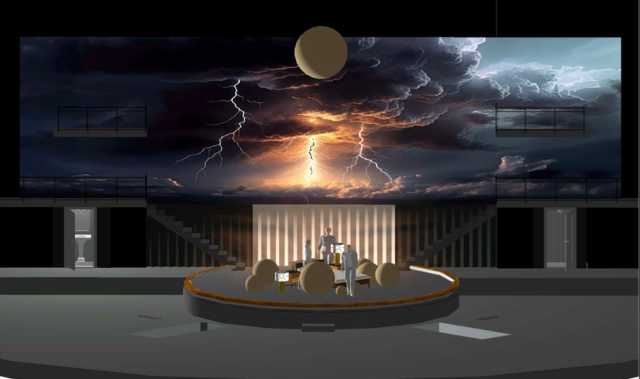
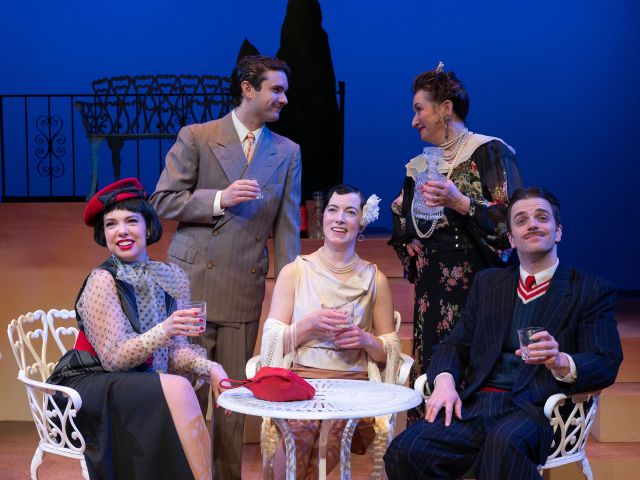
At the Citadel Hadestown happened on an open stage, Depression era minimalist, with a huge bare tree across which the passing seasons played in light (lighting genius Bradley King)  and double revolves dominated by the train track to hell. This time Rachel Hauck’s beautiful design locates us in an atmospherically smoky sepia-tinted cafe club, taking its location cue from the New Orleans jazz that infuses the score, along with folk, pop, blues, and musical theatre flavours (that hint at Rent, for example). So, distressed walls, wood, and a wrought-iron balcony from which Hades and his wife Persephone in shadow survey the action above the ground. King’s stunning lighting creates painterly effects in a domed, colour-saturated world. That’s where we find our musician hero Orpheus in his bus-boy gig, wiping off tables. And that’s where Eurydice, shivering in her meagre coat, arrives asking for a match.

There’s a new (to us) informality about the setting; the cast gathers and engages with us at the beginning in a way that didn’t happen before. Hermes performs for us; so does Persephone, who looks for allies among us.

Mitchell’s narrative inspiration is, as Hermes puts it, “an old tale from way back when.” That’s the Greek myth of Orpheus, the career singer-songwriter who ventures into the Underworld, the kingdom of the dead (or “the dead to the world, anyway”), to retrieve his lost love Eurydice. And he actually wins a dispensation from Hades, the reigning monarch of that subterranean realm. Orpheus can lead Eurydice back, provided he doesn’t look back.

What Mitchell and director Chavkin make of the myth — in luscious songs and stunning staging, respectively — is a contemporary/vintage musical with two intertwined love stories, both troubled. One is the story of Orpheus and his mission to the Underworld, a journey ingeniously set forth in swinging industrial lights. The other is Hades and his part-time consort Persephone. She spends half the year underground in the stronghold of the “king on the chromium throne” while the world above congeals in the cold, and half the year above ground where her annual arrival “with a suitcase full of summertime” is a celebration of greenery, flowers, wine, light, music, as per her song Living It Up On Top.

Will Mann, Amaya Braganza, J. Antonio Rodriguez in Hadestown, Broadway Across Canada. Photo by T Charles Erickson

Hadestown is about music and artistic creation; it alights on romantic idealism, climate change, capitalism, political populism with its fear and hatred of “the other.” It is an unusual achievement, masterfully set forth onstage in Chavkin’s production. And it begins in the thought that Orpheus, the penniless artist obsessed with writing the perfect song, sees “the world as it could be, not as it is.” Eurydice, “no stranger to the wind,” falls in love despite herself. Cold, starving, pursued by the Fates (“whatcha gonna do when the chips are down?” they sing provokingly), she can’t help leaning into the pragmatic. Can the promise of the heart stand up to the urgent demands of the belly?

Wintry privations in a world that’s “dark and getting darker all the time,” have made Eurydice wary that we can have “the world we dream about,” and susceptible to the proposition — security in return for soul-sucking labour in his factory — offered by Hades the ruthless oligarch of the heated, prosperous capitalist stronghold underground.

The magic of the piece, as you’ll know if you saw the production at the Citadel in 2017, is the imaginative way, as myths do, it speaks to the moment. When Hades, in his ribcage-rattling bass notes, sang Why We Build The Wall at the very moment that Trump had been unleashed on the world, it was if Mitchell had just written that powerful 10-year-old (!) anthem to hanging on to what you have. “The enemy is poverty. And the wall keeps out the enemy.” It continues to speak to the barricading of privilege, of course. This time the Fates seem to aim, with uncanny precision, at this very year of no return. “In the fever of a world in flames/ In the season of the hurricanes/ Flood will get you if the fire don’t/ Any way the wind blows.” Eurydice is on it, from personal experience. “It’s either blazing hot or freezing cold…. Any way the wind blows.” How could this not be about Now?

The band, seven strong, remains onstage, which seems vital to the sheer dramatic vitality of the piece (Edmonton-based trombonist Audrey Ochoa delivers a smashing opening riff). And this new touring cast make the roles vividly their own. Rodriguez is an endearing naif of an Orpheus, who thinks he can change the world with his art. And Braganza is an unusually feisty and resistant Eurydice, vocally and physically.

Lana Gordon, Will Mann (left), J. Antonio Rodriguez (right) in Hadestown, Broadway Across Canada. Photo by T Charles Erickson

As Hades, with his rumbling bass voice, Matthew Patrick Quinn in his long black coat and shades, is a chillier, angrier Hades than Patrick Page, who had a veneer of suavity about him that was almost seductive. But the character he creates is compelling and scary; Hades knows how to make an entrance. And Lana Gordon’s Persephone, the desperate party girl who rails against her marital imprisonment with a wild, charismatic energy, has a trapped-between-worlds eccentricity that makes her electrifying onstage.

David Neumann’s choreography is startlingly original in the way it creates movement that is never circumscribed by the notion of ‘dance’ — whether for the ensemble numbers or for the worker’s chorus, trapped on the revolve, who get a movement lexicon of slashing diagonals, the repetitive motion of labourers, riveting and hammering in their servitude. How do you get to Hadestown? By last-ditch choice, through the open jaws of a sort of giant steam shovel.

The finale of a production that reaches out to us, across the footlights — including an acoustic toast to solidarity — gives the floor to Hermes. He reminds us why we revisit stories, tragedies and sad songs that “we sing anyway.”

It’s a beautiful and moving tribute to what art tries to do. You shouldn’t miss your chance to go to hell.

REVIEW

Hadestown

Broadway Across Canada touring production

Created by: Anaïs Mitchell, developed with Rachel Chavkin

Directed by: Rachel Chavkin

Starring: Amaya Braganza, J. Antonio Rodriguez, Lana Gordon, Will Mann, Matthew Patrick Quinn

Where: Northern Alberta Jubilee Auditorium

Running: through Sunday

Tickets: ticketmaster.ca


Posted in Reviews | Tagged , , , , , , | Comments Off on A thrilling and beautiful musical testimonial to what art and artists are all about: Hadestown at the Jube, a review

How To Ruin The Holidays, a new feature film from improv stars Kevin Gillese and director Arlen Konopaki

By Liz Nicholls, 12thnight.ca

“At Christmas all roads lead home.”

As the stand-up comedian heroine (Amber Nash) of How To Ruin The Holidays discovers, evasionary tactics may stall this inevitable Yuletide GPS, but it will not change the destination.

To help support 12thnight.ca YEG theatre coverage, click here.

There’s a parallel inevitability that has led Kevin Gillese and Arlen Konopaki from Edmonton, onstage and live, across this country and the border, through Europe, Down Under — to this their first feature film, a resonantly funny comedy with a bold palette of dark tones, starring Amber Nash.

Written and produced by Gillese and directed by Konopaki, How To Ruin The Holidays has been a fave on the festival circuit so far. And it’s having a month of theatrical releases in select cities, like L.A., Atlanta, Toronto and Edmonton (where a debut at Metro Cinema earlier this month will be topped up with another screening there Nov. 25), before it has a digital release through Amazon in December.

Filmmaker/producer Kevin Gillese. Photo by Ryan Parker

“It seems like all roads were leading to this for many years!” declares Gillese, with the kind of buoyant vigour Edmonton theatre audiences know from his time here as the artistic director of Rapid Fire Theatre and his Fringe appearances then and since with Konopaki in their improvised show Scratch!. “We had the short film That Was Awesome (an award-winner in 2018 and now available on YouTube). And this is a natural progression!”

The word “organic” does not go amiss in this Gillese/Konopaki improv-to-film story. The writer and the director are in the Zoom ether hovering over America. Gillese is in his adoptive home town of Atlanta where he moved from Edmonton in 2010 to spend a decade as the artistic director of Dad’s Garage, Rapid Fire Theatre’s sibling improv company. Konopaki, a U of A theatre school grad, is in West Hollywood where he moved from the Big Apple after five and a half years (and a master’s degree in film directing and cinematography from NYU’s Tisch School of the Arts).

“We wouldn’t be doing a feature film if Arlen didn’t have the passion for film and directing he has,” says Gillese, who identifies his own passion as writing…. I’m not married to any particular form, improv, plays, film. It’s what you’re doing with it that counts. I also have a passion for bringing things together and making them happen.”

Konopaki muses on their drift from stage to screen. “I think even when were doing Scratch! full-time, we always had an eye on film and television.” Screen, it turned out, was the itch that had to be Scratch!-ed.

The pair met at Rapid Fire Theatre, as star improvisers. By 2005 they’d created Scratch!, one of the company’s biggest, and most internationally travelled, hits. In this intricate format, the duo intertwined three high-contrast storylines all based on audience suggestions — at escalating speed, with pellmell physicality, switching characters on the fly as they went — until, improbably, the narrative threads came together at the end.

“Kevin and I bonded creatively,” as Konopaki says. “And we both had a vision of what we wanted to do, make it our full-time thing…. “If we do a really good job, get really good at it, and stand out anywhere, it can support us financially.” Says Gillese, “I remember a turning point…. If we want to make this a full-time gig we can’t half-do it. We have to kind of go for it!”

And they did. Scratch! never stopped touring, one-night stands in Australia, Europe, across the Fringes. “Looking back at that period,” says Konopaki, “it was a really gratifying time…. We put the work in, to be as good as we could be, to do a show that would stand out, that everyone would remember and talk about. And I think we did. We took pride in that.”

In 2015 Gillese and Konopaki took the Scratch! format, with its intercutting of narratives and genres, and role-switching, into a 10-episode web series with an absurdist bent. Hart of America, produced by Dad’s Garage, is named for the hard-ass tough-talking cop character Grace Hart played by Nash (best known as the voice of the combative Pam Poovey in FX’s animated series Archer), Gillese’s wife and a comic actor of striking versatility, witness the assortment of other characters she takes on in the series.

Kate Lambert, Colin Mochrie, Luke Davis, Amber Nash in How To Ruin The Holidays. Still by Felipe Vara de Rey

In How To Ruin The Holidays, Nash is Michelle, an increasingly exasperated stand-up struggling to make a go of it in L.A., who finds herself cornered into going home to Atlanta for Christmas for the first time in years. Which means dealing with her dysfunctional family: Dad (Canadian comedy star Colin Mochrie), an eccentric doomsday preparation-ist; sister Andrea (Kate Lambert), a hopeful screenwriter; and lively special needs brother Mark (Luke Davis). It’s at a moment that turns out to be a turning point in all their lives.

The idea, as Gillese explains, has personal roots, planted when he moved to Atlanta 13 years ago. “All my family is up in Edmonton. So I know what it’s like to be living away from your family, only getting updates, from snapshots, once you pop home for the holidays.” And, as in his movie, he has a special needs brother.

“It was easy for me to take those experiences and put them into a narrative…. L.A. is a substitute for Atlanta. And Atlanta is a sub-in for Edmonton. When it’s framed like that, it sounds very dramatic. But It wasn’t much of a stretch to use humour as a lens…. Me and my siblings we’ve always used humour to handle all things!”

In How To Ruin The Holidays, “my number one goal was making the actors shine,” says director Konopaki. “Which wasn’t hard!” He and Gillese discovered Davis, a wonderful special needs actor, in a Dad’s Garage partnership with an Atlanta acting program for adults with cognitive, developmental, or intellectual disabilities. Davis, the star of their That Was Awesome, is a true find, funny and charismatic.

Colin Mochrie in How To Ruin The Holidays. Film still by Felipe Vara de Rey.

Gillese’s goal, he says, was to give the cast a chance to show what they could do, beyond more usual audience expectations. Mochrie, for example has intensely dramatic, emotional moments, like the intimate scene where he talks to Michelle about her brother. “It’s one of my favourites,” says Konopaki.

Amber Nash in How To Ruin The Holidays

And the film gives Nash, “best known for voice work” as Gillese says, the chance to show her on-screen range as an actor, a character “who’s constantly under siege from everyone around her.”

For a remarkable $300,000 Gillese and Konopaki have made an indie movie that looks and sounds top-drawer. Included among the favours the pair got was the expertise of an entire sound department (from Floyd County Studio, who make Archer). And, unusually, raising the money started with crowd funding, before other sponsorships were landed.

There are startlingly dark aspects to this new holiday comedy. And Gillese admits he initially had his doubts about its “genre-breaking” aspects. “It is for sure a Christmas movie. It is for sure a comedy with elements that aren’t.”

“Early in the process I’d gotten feedback to ‘pick a lane’, either go for a heartwarming Christmas movie or an adult comedy … don’t muddy the water. I found that very distressing; I think the best work is when you have both those flavours next to each other.”

It was Mochrie to the rescue, with a pep talk. “Kevin, you’ve got the rest of your career to compromise. Just do what you think is good!”

Tickets for the Nov. 25 screening at Metro Cinema of How To Ruin The Holidays: metrocinema.org.


Posted in Previews | Tagged , , , , , , , | Comments Off on How To Ruin The Holidays, a new feature film from improv stars Kevin Gillese and director Arlen Konopaki

How did we get here? the question, the cabaret, the new play, the anniversary production

The young Jason Hardwick

By Liz Nicholls, 12thnight.ca

Consider for a moment the question that’s been asked — in every tone of voice, every degree of exasperation or relief, bemusement or amazement, wonder or perplexity — by every one of us, especially in the last three years. How did we get here?

To help support 12thnight.ca YEG theatre coverage, click here.

How did we get here? The cabaret. It’s the name Jason Hardwick has given his new solo cabaret, his first one-man show How Did We Get Here?, happening Thursday at Grindstone Theatre as part of Conwitz Productions’ An Evening With .. series. “How did we, as a collective, get to this point?” asks actor/ dancer/ improviser Harwick. And he’s quick to add that he doesn’t mean the royal “we.” Nor is he looking for the conventional cabaret raison d’être of using his own personal bio as a coat rack on which to hang musical theatre songs.

“We quit theatre during the pandemic. And now we’re back at it. How did we decide to come to this show?”  Hardwick says “I sit and talk to the audience … face down the fears of doing it on my own. And then I sing songs,” accompanied by pianist/composer Daniel Belland. “I just love when I get to sing those songs…. Is there an arc? I’m not sure there is.”

the current Jason Hardwick

Hardwick, who’s droll and self-effacing, frequently performs with Guys in Disguise (most recently in Puck Bunnies at the Fringe). He’s also the artistic director of Die-Nasty, the weekly improvised soap opera at the Varscona, currently (through Dec. 11) in its circus mini-series Monday nights. Hardwick is Clarl the clown. He’s particularly known as a dancer, and even more particularly as a virtuoso in the rarefied art of tap dance (he teaches it at MacEwan University). Which is why, he explains, there will be no tap in How Did We Get Here?. “Everyone expects it, and I guess I’m tired of that expectation.”

He’d started to wonder if he landed roles just because he could tap. “This show is ‘look what else I can do’?” The 13-song playlist leans into the musical theatre repertoire, as you might expect from an actor who performs frequently with Plain Jane Theatre. “But, hey, there might be a Taylor Swift song; I’ve hear she’s popular…. And every song is taken out of context.”

“I find myself humming O What A Beautiful Morning every day,” says Hardwick, “and I’m not even from Oklahoma!” Another of his favourites, in the cabaret song list, is Empathy, “about having big feelings for inanimate objects.”

The lyrics will be up onstage with Hardwick, on a music stand. “I also want to say something about ‘perfection procrastination’,” putting off doing something because it won’t be perfect. “This is not going to be perfect, but it’s going to be something. And we’ll have fun!”

Hardwick’s special guest is Kayla Gorman. “I have so many talented friends who deserve to be in the spotlight, more than they are!” Tickets: showpass.com.

playwright Harley Howard-Morison

How did we get here? The new play-in-progress. Speaking as we are of extreme versatility, this Sunday’s edition of Script Salon (a bona fide Edmonton success story) is a veritable live demo. It’s a staged reading of a new play, Redd Meats, by Harley Howard-Morison. Beef and beefs are involved.

Howard-Morison is a writer, a theatre maker, the founder of the indie company Cardiac Theatre; he’s the managing director of Theatre Network. Among other Cardiac bright ideas was The Alberta Queer Calendar Project (13 plays in podcast form by queer Alberta playwrights, including Makram Ayache’s The Hooves Belonged to the Deer, which recently ran in a fully staged indie production at the Westbury Theatre).

Intriguingly the protagonist of Redd Meats, set in the prairie hamlet of Redd, is “a scholarship vet student and part-time butcher,” a combination that seems to invite conflict from the get-go, who’s unexpectedly confronted by a ghost from the past. Theatre Network artistic director Bradley Moss directs a cast that includes Quinn Contini, Marianne Copithorne, Nikki Hulowski, and Mark Sinongco.

It happens at the Upper Arts Space at Holy Trinity Anglican Church (10037 84 Ave.) at 7:30 p.m. Admission is free; donations are enthusiastically welcomed.

•How did we get here? The birthday production. The indie company Foote in the Door Productions celebrate their 10th anniversary of musical theatre productions with a real charmer of a ‘60s rom-com. She Loves Me has Broadway cred, to say the least. It’s by the composer/lyricist team of Jerry Bock and Sheldon Harnick, the starry team who also brought the world Fiddler on the Roof and Fiorello!. The book (by Joe Masteroff) is an adaptation of the 1937 play Parfumerie by the Hungarian playwright Miklós László, set in a Budapest perfume shop in the 1930s.

Two sparring employees, the Beatrice and Benedick so to speak of She Loves Me, take solace from this job irritation in writing letters to their “secret admirers.” And here’s the romantic complication: their anonymous penpals are … each other. You might recognize the setup from the 1998 film You’ve Got Mail.

Melanie Lafleur directs the Foote in the Door production, which runs Nov. 17 to 26 at La Cité francophone. It stars the two company co-founders Ruth Wong-Miller and Russ Farmer, who met, as the theatre name tips off, at the Citadel’s Foote Theatre School.  Tickets: eventbrite.com.   

Posted in Previews | Tagged , , , , , , , , | Comments Off on How did we get here? the question, the cabaret, the new play, the anniversary production

The freaky tangle of connections in the digital world: Mob, the thriller that opens the Workshop West season. A review

Kristin Johnston, Davina Stewart and Graham Mothersill in Mob, Workshop West Playwright’s Theatre. Photo by Marc J Chalifoux.

By Liz Nicholls, 12thnight.ca

The opening moments of Mob nail you to your seat, and there’s no getting relaxed after that in the Quebec thriller that is Workshop West’s genuinely disturbing season opener.

A woman (Kristin Johnston), mysteriously traumatized, drives all night and arrives — randomly? inevitably? — at a remote B&B outside the city in the middle of nowhere. The inhabitants she meets might have been unalarming — a comically awkward young man (Graham Mothersill), and his reassuring older auntie (Davina Stewart)— without the Hitchcockian inheritance of Psycho.

What happens after that, moment by moment in Catherine-Anne Toupin’s 2018 hit, for the first time in the West in Heather Inglis’s production, will surprise you, freak you out, set in motion a sense of unease and quease that feels visceral. The secrets of the thriller narrative, expertly constructed by the Quebec actor/playwright/TV and film star, are safe with me (and I didn’t see them coming). Just to say it’s the morning after opening night. And I can’t stop thinking about Mob, with a little involuntary shudder.

Kristin Johnston and Graham Mothersill n Mob, Workshop West Playwrights Theatre. Photo by Marc J Chalifoux.

Sophie has lost her job. She’s angry and hurt, looking, she tells her hosts, to “take a step back.” That’s what we do, too, step back to reconsider the giant, tilted light-up grid-work screen that dominates Beyata Hackborn’s outstandingly atmospheric, and striking, design. It’s a sort of high-tech quilt of frosted tiles, across which the flickering image of Sophie’s face in close-up plays as Mob begins.

It’s accompanied by a barrage of sound fragments, with lots of “blah blahs” thrown in: “restructuring,” “survival of the business,”  “calm the storm,” “nothing I could do,” “no one should get the idea that …” “better if I left,” “think of it as an opportunity.…” Yes, it’s the corporate-speak soundtrack of someone getting fired, by someone trying to smother the responsibility.

There’s nothing about the unlikely connection between the characters that I can tell you (the entire play is a spoiler alert on legs with great lighting). But the performances by a trio of our best actors are all compelling, committed, and responsive to an emotional topography that seems to change at every turn.

As Sophie, who arrives in misery and gets hold of herself, Johnston radiates intelligence and watchfulness, a wary kind of assessing and reassessing, at every moment. It’s not every actor who can convey the sense of thinking, of thought in progress, in quite so compelling a way. Mothersill’s excruciatingly awkward Martin is so hapless, uncomfortable and oddly needy, you wince every time he opens his mouth and blurts something he’ll scramble ineptly to retract. His laughter, often misplaced, has a way of going AWOL or turning uncomfortably shrill. It’s a raw, itchy, vulnerable portrait. And Stewart as his aunt Louise, apparently calm and reserved, the adult of the two, is reassuringly conciliatory.

Kristin Johnston in Mob, Workshop West Playwrights Theatre. Photo by Marc J Chalifoux.

The visuals are stunning collaboration between Alison Yanota’s lighting and Hackborn’s striking, possibly abstract, design. The question of whether it’s a dream world stays live throughout. The playing area is defined by its frames. Four lighting instruments, two on each side, create the impression that the B&B is a kind of studio. Light plays off the ultra-shiny surfaces — floor, furniture, back screen — to which nothing can stick.

Characters enter and exit through fateful light-up doorways. And the crackle of short circuitry is part of the dramatically ominous soundscape that designer Darrin Hagen has created for this world. It has a persistently menacing industrial thud to it, a kind of aural pulse  that never quite explodes altogether or becomes “music.” It’s a very clever participant in Mob’s exploration of language, and the violent uses to which it can be put.

In the world(s) in which we live, Mob is a play you must see. Even the title is disturbing. There are no loners, in the end, no single misogynists, no isolated predators. There is no dipping a toe into the toxic internet sea, and retracting it if you don’t like the temperature. Mob is there to disturb our complacency about the heavy toll exacted by our digital connectivity. In the internet age of anonymous alliances and invisible alter-egos and threats, no one is alone. Is that a consoling thought? It shouldn’t be.

REVIEW

Mob

Theatre: Workshop West Playwrights Theatre

Written by: Catherine-Anne Toupin

Directed by: Heather Inglis

Starring: Kristin Johnston, Graham Mothersill, Davina Stewart

Where: Gateway Theatre, 8529 Gateway Blvd

Running: through Nov. 12

Tickets: workshopwest.org

Posted in Reviews | Tagged , , , , , | Comments Off on The freaky tangle of connections in the digital world: Mob, the thriller that opens the Workshop West season. A review

Excitement in a theatre town: you have to be there. Theatre possibilities this week

Kristin Johnston in Mob, Workshop West Playwrights Theatre. Photo by Dave DeGagné

By Liz Nicholls, 12thnight.ca

More proof, as if you needed any, that Edmonton is a theatre town: A week of exciting possibilities for your nights out. A Quebec thriller. A musical about the struggle to write a musical about the struggle to writer a musical…. A comedy pastiche of a celebrated adventure, a new feature film by a deluxe improviser/writer, an art exhibition by a notable actor/playwright/director/filmmaker. And more.

To help support 12thnight.ca YEG theatre coverage, click here.

•The Workshop West Playwrights Theatre season opens Friday with a hit thriller from Quebec. The reverb of Mob (La Meute) is Hitchcock, especially Psycho (a B&B in the boondocks with mysteriously odd inhabitants). But in Catherine-Anne Toupin’s 2018 play, in translation and in the West for the first time, the ante is upped by the existence and sinister presence of the online nexus. Heather Inglis’s production stars Kristin Johnston, Graham Mothersill and Davina Stewart. We found out what not to ask in advance — we’re keen to not spoil your thriller excitement— by talking to the in-demand Johnston in this 12thnight PREVIEW. Tickets: workshopwest.org.

•The MacEwan University theatre arts season opens with a charmer of a self-referential backstage onstage 2004 musical about the creation of … itself. [title of show] chronicles the odds-against struggles of Jeff Bowen and Hunter Bell to write and produce an original musical in the three weeks before the inaugural New York Musical Theatre Festival.

Named for the blank on the festival application form, it follows the fortunes of two young guys with aspirations (and day jobs) and two of their actress friends as they prepare this very musical, which had an Obie-winning Off-Broadway run, and ended up on Broadway in 2008. Genial, heartfelt, and likeable, it is, in effect, a love letter to the musical theatre and to the musical theatre-besotted (the MacEwan theatre arts program is full of young artists like that).

The MacEwan production runs Wednesday through Sunday in the Tim Ryan Theatre Lab. Tickets: tickets.macewan.ca or 7800-497-4470.

It’s your last chance this weekend to catch …

The Hooves Belonged To The Deer, In Arms Collective at Edmonton Fringe Theatre. Photo of Tarragon Theatre production by Cylla von Tiedemann

… a full stage production by an indie troupe,  of an startlingly far-reaching, epic, richly layered new play, Makram Ayache’s The Hooves Belonged To The Deer. I’ve seen a podcast version (in The Alberta Queer Calendar Project) and Buddies in Bad Times’ audio play, and wondered how on earth it might live onstage.  I’m coming late to this exciting prospect this final weekend of the run, held up by shoulder surgery. It’s play to discuss, and it’s at the Westbury Theatre in the Fringe Arts Barns through Saturday night. Tickets: fringetheatre.ca. Ayache’s own fascinating story is part of its inspiration; read 12thnight’s preview interview here.

Crescendo by Sandy Paddick, Shadow Theatre. Photo by Marc J Chalifoux.

 … Crescendo, the season-opener at Shadow Theatre. Sandy Paddick’s musical is more like a musical collage than a play with music. It takes us into the world of choirs, and the needs, the traumas, the life setbacks, the hopes of people who join, so that they can sing together and somehow transcend their own solo voices. It’s onstage at the Varscona through Sunday. Tickets: shadowtheatre.org. Check out 12thnight’s preview interview with playwright Paddick here, and review here.

Karen Hines, Pochsy IV, Keep Frozen Productions at Theatre Network. Photo by Gary Mulcahey

Pochsy IV, on the Theatre Network mainstage through Sunday, is the work of one of the country’s true originals, Karen Hines. She’a  bold, funny, witty satirist. And her creation Pochsy is a sort of tarnished pixie with a dark, glittering, apocalyptic vision of the world wrapped in capitalist catchphases, pop-culture truisms,  self-help pep talk clichés, market-driven mantras. There is nothing like it — an unmissable show, running through Sunday. The 12thnight review is here. And you can meet Hines, along with her director Michael Kennard of the horror clown duo Mump and Smoot, here. Tickets: theatrenetwork.ca.

Musicians Gone Wild: Rock The Canyon, at the Mayfield, is a musical portrait designed to capture and celebrate a place (Laurel Canyon in the Hollywood Hills), an epochal time (late 60s early 70s), and that California dreamin’ sound. A highly entertaining, music-rich evening out, through Sunday. Check out the 12thnight review here. Tickets: mayfieldtheatre.ca.

Continuing …

Tenaj Williams in Little Shop of Horrors, Citadel/Arts Club Theatre Company. Photo by Nanc Price

… at the Citadel,  Little Shop of Horrors, in a co-production with Vancouver’s Arts Club Theatre starring the adorable Tenaj Williams as hapless florist’s assistant Seymour, and the burgeoning plant he inadvertently cultivates. Yup, Audrey II has a strong voice (like everyone else in the cast) and an insatiable appetite for human blood. See what musical theatre experts made of the ultra-cheesy Roger Corman horror film of 1960 when they turned it into this funny, clever 1982 sci-fi musical comedy. Running through Nov. 19. Tickets: citadeltheatre.com, 780-425-1820.

… at Spotlight Cabaret, the comic subversives in residence there take on one of literature’s most famous travellers. Their season opener comedy Alison Wunderland (through Jan. 21) follows our heroine down the rabbit hole, with music from the 70s to now.

Larry Reese

•For the first time in more than 15 years Larry Reese is having an exhibition of his paintings. Worlds of Wonder opens this weekend at the Trinity Gallery at Holy Trinity Anglican Church in Strathcona. Reese’s artist history is something of a mind-blower. His very crowded theatre and film resumé as an actor, director, filmmaker, teacher, mentor includes credits at every theatre in town and the Shaw Festival, and in major film releases like Brokeback Mountain and Unforgiven. He’s a co-founder of Red Deer College’s motion picture arts program. Most recently he received a best actor nomination at this year’s AMPIA Rosie Awards for his performance in the film rom-com Team Bride. And Reese has a musical pedigree too. This includes chops on the sitar (really!), a stint as resident musical director at the Citadel, and a U of A music degree in French horn and composition.

The opening reception for Reese’s new exhibition is Saturday at Holy Trinity, 1 to 5 p.m. Jan Randall provides live music. And there’s a reading by Janice MacDonald from her mystery novel The Eye of the Beholder.

Colin Mochrie and Amber Nash in How To Ruin The Holidays. Photo by Chelsea Patricia.

• Kevin Gillese, a star improviser and playwright we know from his Fringe shows and his time in Edmonton as artistic director of Rapid Fire Theatre, has made a holiday feature movie, an unusually personal comedy. How To Ruin The Holidays, starring Amber Nash, is directed by Gillese’s Scratch! partner Arlen Konapaki, now L.A.-based.  The first of two Metro Cinema screenings happens Monday (7 p.m.); the second is Nov. 25 (3:30).  More about this soon from 12thnight. Stay tuned.


Posted in Features, Previews | Tagged , , , , , , , , , , , , , | Comments Off on Excitement in a theatre town: you have to be there. Theatre possibilities this week

Audrey II is coming for you: Little Shop of Horrors at the Citadel, a review

Tenaj Williams in Little Shop of Horrors, Citadel/Arts Club Theatre Company. Photo by Nanc Price

By Liz Nicholls, 12thnight.ca

If there ever was a musical that makes a case for smart people taking a dumb movie in hand and re-potting it — a strategy that’s backfired elsewhere with depressing regularity this century — it’s got to be Little Shop of Horrors.

To help support 12thnight.ca YEG theatre coverage, click here.

Yes, the daffy, sassy, appealing 1982 musical that Howard Ashman and Alan Menken coaxed out of the soil of Roger Corman’s super-shlocky 1960 B-movie, brought the Citadel’s opening night crowd to its feet to cheer the triumph of vegetation over urban decay. And in the Citadel/ Vancouver Arts Club co-production directed by Ashlie Corcoran, the toothsome and bloodthirsty perennial Audrey II does seem, in the startlingly booming voice and vocal bite of Madeleine Suddaby, entirely capable of world domination.

Synthia Yusuf and Tenaj Williams in Little Shop of Horrors, Citadel/ Arts Club Theatre Company. Photo by Nanc Price

The musical tells the Faustian tale of nebbish Seymour (Tenaj Williams), a klutzy  florist’s assistant who labours away in Mr. Mushnik’s failing Skid Row flower shop. When this chronic underachiever accidentally cultivates an unusual potted plant that’s a big customer draw, it seems that success is finally at hand. Surely Mr. Mushnik (the excellent Ashley Wright) will let up on treating him like crap; surely his crush, Seymour’s much-abused and -bruised co-worker Audrey (Synthia Yussuf), his match in low self-esteem, will be impressed. A star botanical innovator is born.

Little Shop of Horrors, Citadel/ Arts Club Theatre Company. Photo by Nanc Price.

Yeah, yeah, there’s a sinister downside: Seymour’s inadvertent discovery that the plant feeds on human blood. And when his own supply dwindles, Seymour is lured to look farther afield, if you take my meaning. There’s a trio of narrative interventionists, a Skid Row Greek chorus, if you like, of upwardly mobile street urchins who are an homage to vintage girl-group pop, with names to match: Crystal (Ali Watson), Ronnette (Ivy Charles) and Chiffon (Rochelle Laplante)

The charm of Little Shop sprouts in the way the sci-fi musical comedy is wrapped by its creators in faux-vintage sass and wit. The doo-wop/ R&B/ ‘60s rock score is accompanied by a crack six-piece band led by Ruth Alexander. The choreography, witty and allusive, is by Gianna Vacirca. It’s a tricky kind of theatrical horticulture, this oddball combination of wistful and horrifying, the wide-eyed and the snarky. Little Shop is affectionate about shlock. And the playfully cheeky chorus, who annotate and intervene from time to time, consistently capture the spirit of the venture. And so does Williams as the increasingly beleaguered nouveau-capitalist Seymour.

But there’s something loud, brassy, and hard-sell about the production in its first act (at least on opening night). Synthia Yusuf, for example, who has great pipes, plays Audrey for comedy in its opening scenes, in a heightened performance that leans into comical grimaces and postures. It has the (no doubt unintended) effect of making fun of the character. And the seminal number Somewhere That’s Green in which Audrey reveals her version of the American dream — “a matchbox of our own/, a fence of real chain link … I cook like Betty Crocker/ And I look like Donna Reed”) is funny and beautifully sung, but without the extra and endearing nuance of heartbreak and innocence the performance discovers in Act II.

Similarly, the big opening ensemble number Skid Row (“downtown, where the cabs don’t stop; downtown, where the food is slop”), a witty removal of any sentimental residue attached to life on Skid Row, loses something of its kooky off-centred-ness when its so hard-driven. It’s also a bit over-amplified, which makes it a bit of a challenge to hear Ashman’s lyrics.

Ashley Wright and Tenaj Williams in Little Shop of Horrors, Citadel/Arts Club Theatre Company. Photo by Nanc Price.

It all comes on a bit strong (honourable exception to the Act I tango Mushnik and Son in which Mr. Mushnik adopts his newly successful assistant). Since the cast are all very accomplished actor/singers, the show settles into a more satisfying palette of sass and comedy, and hence charm in Act II. Little Shop works best when it stays in touch with its Off-Off Broadway origins.

John Ullyatt in Little Shop of Horrors, Citadel/ Arts Club Theatre Company. Photo by Nanc Price

In addition to Audrey II, the character who really should come on strong is Orin, Audrey’s swaggering abusive biker/dentist boyfriend (“I know Seymour’s the greatest, but I’m dating a semi-sadist,” as Audrey puts it). As the ultimate dental psycho John Ullyatt makes one of the great comic posturing entrances in Mr. Mushnik’s shop. And the performance makes a meal (a root canal?) of the horror of dentistry and the gruesomely comic scene with Seymour (fight choreography by Jonathan Hawley Purvis) in which Orin Scrivello D.D.S gets his. You’d want to call it a classic of its kind, except that it’s probably the only one of its kind. Anyhow, this is a terrific, detailed, and agile performance.

Tenaj Williams in Little Shop of Horrors. Photo by Moonrider Productions for Vancouver Arts Club Theatre

The bland costumes (Carmen Alatorre) don’t exactly reek of urban grit or period pizzaz. But Beyata Hackborn’s set design creates a kind of storybook Skid Row, all wonky angles with moveable tenement fronts, windows in which singers appear, and a revolve for inside and outside takes on Mr. Mushnik’s shop. And Audrey II with her (its?) menacing velvet tentacles, expressively manipulated by puppeteer Braydon Dowler-Coltman, is a creation to be reckoned with — a sort of outsized lava lamp pod that turns out to be all mouth. Scarrrry.

Savvy Sci-fi musical comedies with ridiculously catchy music and love stories, a little scent of capitalist satire, and a lean toward the vegetarian (don’t feed the plants), aren’t easy to come by. This isn’t an entirely satisfying production, but it’s a fun go-for-the-gusto evening out.

REVIEW

Little Shop of Horrors

Theatre: Citadel/ Vancouver Arts Club Theatre Company

Created by: Howard Ashman and Alan Menken

Directed by: Ashlie Corcoran

Starring: Tenaj Williams, Synthia Yusuf, John Ullyatt, Ashley Wright, Madeleine Suddaby, Ivy Charles, Rochelle Laplante, Ali Watson

Where: Citadel Shoctor Theatre

Running: through Nov 19

Tickets: 780-425-1820,  citadeltheatre.com,

Posted in Reviews | Tagged , , , , | Comments Off on Audrey II is coming for you: Little Shop of Horrors at the Citadel, a review

The corrected version: The art of the thriller and what not to tell you about Mob, opening the Workshop West season. Meet star Kristin Johnston

Kristin Johnston in Mob, Workshop West Playwrights Theatre. Photo by Dave DeGagné

By Liz Nicholls, 12thnight.ca

There are many things you can’t, mustn’t, know in advance about Mob. For your own good. So many, in fact, that it’s tricky for Kristin Johnston to talk about the hit Quebec thriller that opens the Workshop West Playwrights Theatre season Friday.

To help support 12thnight.ca YEG theatre coverage, click here.

So here’s an uncontentious backstory I can tell you. Mob (La Meute), which premiered at Montreal’s Théâtre La Licorne in 2018 (and was remounted twice there), is by the Quebec film and TV star-turned-playwright Catherine-Anne Toupin. The English language premiere (it’s translated by Chris Campbell, a former literary manager of the Royal Court Theatre in London) was at the Centaur Theatre in 2020.

And the Heather Inglis production in which Johnston appears, along with Graham Mothersill and Davina Stewart, is the first time Mob has been west. Johnston, whose tall, willowy presence, deep voice, and ace comic timing have increasingly been part of the Edmonton theatre scene of late, plays Sophie. And by way of set-up, this I can tell you: Sophie has lost her job; she arrives at a remote out-of-town B&B, in a remote corner of the Eastern Townships, for a respite from this enraging, humiliating setback.

Johnston, who’s funny and quick on the uptake in conversation, is on the phone last week from home where, like her cast-mates and the Mob creative team, she’s been rebounding from COVID (which explains why the Workshop West opening was delayed till Nov. 3). “I’ll tell you what happened when I read it for the first time. On the very first page, I was ‘what is happening? Is this character the victim? The villain? Am I going to kill somebody?’ I had no idea where this is going.”

“As I kept turning the pages I was Oh no, WHAAT?, Oh no, and kept turning…. It was very exciting!”  She laughs. Which is a veritable hands-on definition of a well-made thriller, Johnston agrees. “The playwright has done a great job.” As Toupin has acknowledged in interviews, the touchstone is Hitchcock. And the B&B set-up, in which Sophie meets the odd inhabitants, has an unmistakeable Psycho reverb.

And this ups the ante: “it was written at a time, unlike Hitchcock’s, when the internet was in play. It’s a big part of Mob,” Johnston says. Ah, a sinister thought, worthy of a thriller, creeps in: the internet as the invisible web in which we are caught, playing with identities. “And the anonymity you can feel, that emboldens people to behave in ways they would never normally behave if they weren’t hidden behind this cloak of online….”

Edmonton audiences first met Johnston in a decisively off-centre comic role in Rebecca Merkley’s 2017 Fringe sleeper hit The Unsyncables. It’s an underdog comedy about a ragtag synchronized swim team (the cast never took their bathing caps off) up against a snooty fancy shmancy swim “club”. And there we saw Johnston as a somewhat perplexed eastern European import who couldn’t swim, wore water wings, and treated us to a reprise of her showstopper in a school production of Grease.

It was a tip-off that the graduate of Victoria’s Canadian College of Performing Arts, who grew up in Stettler, would flourish in roles, often boldly comic, always far from the pastel end of the spectrum where ingenues live and breathe. In Merkley’s Rivercity The Musical, spun from the Archie comics, Johnson bent her long frame not around Betty or Veronica, but the character of Reggie.

She arrived in those Dammitammy productions pretty directly from the domestic front, she says. “I was mostly parenting and doing community theatre…. I still wanted to be in theatre, but we had made the conscious decision to always have a full-time parent with the kids.” Community theatre was perfect: “I could pop out in the evening when Ash (Johnston’s husband) could be with the kids.”

She loved it. “Community theatre is great: everybody’s doing it for the love of theatre, nobody’s jaded, nobody’s ‘it’s just a job’…. That enthusiasm is just so admirable!”

Origin of the Species, Northern Light Theatre. Photo by Ian Jackson, Epic Photograph

And then, suddenly, Johnstone was a Northern Light leading lady. Her first role with the company couldn’t have been a stranger debut for a continuing theatre relationship. In a demanding and weird assignment, she played a four million year-old woman discovered by an elderly archaeologist on a dig in Trevor Schmidt’s 2018 production of Bryony Lavery’s Origin of the Species.

Kristin Johnston in Baroness Bianka’s Bloodsongs, Northern Light Theatre. Photo by Ian Jackson, Epic Photography.

Johnston’s is a story with oddball segues. “One night Trevor came backstage and asked ‘do you play the piano?’ Well, yes. ‘Do you play the accordion?’ Well, no. ‘But you could learn, right?’” And so she did. And it came to pass that Johnstone found herself strapping on that instrument, to star as a sultry gothic cabaret artiste obsessed with red blood and the blood supply in NLT’s delicious Baroness Bianca’s Bloodsongs. “Everybody has got a leetle addiction.”

And there was another full-throttle challenge, this one multi-character, in Schmidt’s solo gothic thriller We Had A Girl Before You — yes, a solo thrillerin which Johnston dexterously populated the world and, in a compelling virtuoso performance, made us wonder just how unreliable the narrator of the tale really is.

Kristin Johnston in We Had A Girl Before You. Photo by Ian Jackson, Epic Photography

Thrillers are a special challenge, as Johnston says. “You know what your character’s intentions are. But you have to play cards very close”: what to reveal, what to hold back. Mob, she says, “is very precise; every word is carefully chosen…. Because the playwright is an actor she understands the beats, the pauses. There’s lots to work with!”

Now that her kids are older, with lives of their own (she’s even appeared with one of them in the Citadel’s A Christmas Carol), Johnston is returning to theatre in a full way. And she’s much in demand.

Most recently at NLT, we saw Johnston as half a pair of flight attendants disturbed about earthly developments 30,000 feet below them in Enough. And, in a comic performance that stole the show, a love-struck assistant to the villain, “kind of a villain herself,” in 9 to 5 at the Citadel.

“I don’t usually get to play gentle characters,” she laughs, thinking of the rather self-effacing soul she played in her Teatro Live debut, the thriller-within-a-thriller Deathtrap, last season. And there’s a plum Teatro role coming up, a melancholy-soaked widow rescued from grief by an imaginary journey in the company’s revival of Stewart Lemoine’s Pith!.

Director Inglis has called Mob “dark and challenging.” And Johnston echoes the thought. “It’s a really interesting story. Exciting because it will make people talk.” It’s not one of those theatrical excursions, she says, “where you leave the theatre and (shrug) ‘well, that was fun’. This will spark discussion…. I wish I could leave with the audience and hear them discussing.”

PREVIEW

Mob

Theatre: Workshop West Playwrights Theatre

Written by: Catherine-Anne Toupin

Directed by: Heather Inglis

Starring: Kristin Johnston, Graham Mothersill, Davina Stewart

Where: Gateway Theatre, 8529 Gateway Blvd

Running: Nov. 2 (in preview) through Nov. 12

Tickets: workshopwest.org

Posted in Previews | Tagged , , , , , , , , , | Comments Off on The corrected version: The art of the thriller and what not to tell you about Mob, opening the Workshop West season. Meet star Kristin Johnston

The art of the thriller and what not to tell you about Mob, opening the Workshop West season. Meet star Kristin Johnston

Kristin Johnston in Mob, Workshop West Playwrights Theatre. Photo by Dave DeGagné

By Liz Nicholls, 12thnight.ca

There are many things you can’t, mustn’t, know in advance about Mob. For your own good. So many, in fact, that it’s tricky for Kristin Johnston to talk about the hit Quebec thriller that opens the Workshop West Playwrights Theatre season Friday.

To help support 12thnight.ca YEG theatre coverage, click here.

So here’s an uncontentious backstory I can tell you. Mob (La Meute), which premiered at Montreal’s Théâtre La Licorne in 2018 (and was remounted twice there), is by the Quebec film and TV star-turned-playwright Catherine-Anne Toupin. The English language premiere (it’s translated by Chris Campbell, a former literary manager of the Royal Court Theatre in London) was at the Centaur Theatre in 2020.

And the Heather Inglis production in which Johnston appears, along with Graham Mothersill and Davina Stewart, is the first time Mob has been west. Johnston, whose tall, willowy presence, deep voice, and ace comic timing have increasingly been part of the Edmonton theatre scene of late, plays Sophie. And by way of set-up, this I can tell you: Sophie has lost her job; she arrives at a remote out-of-town B&B, in a remote corner of the Eastern Townships, for a respite from this enraging, humiliating setback.

Johnston, who’s funny and quick on the uptake in conversation, is on the phone last week from home where, like her cast-mates and the Mob creative team, she’s been rebounding from COVID (which explains why the Workshop West opening was delayed till Nov. 3). “I’ll tell you what happened when I read it for the first time. On the very first page, I was ‘what is happening? Is this character the victim? The villain? Am I going to kill somebody?’ I had no idea where this is going.”

“As I kept turning the pages I was Oh no, WHAAT?, Oh no, and kept turning…. It was very exciting!”  She laughs. Which is a veritable hands-on definition of a well-made thriller, Johnston agrees. “The playwright has done a great job.” As Toupin has acknowledged in interviews, the touchstone is Hitchcock. And the B&B set-up, in which Sophie meets the odd inhabitants, has an unmistakeable Psycho reverb.

And this ups the ante: “it was written at a time, unlike Hitchcock’s, when the internet was in play. It’s a big part of Mob,” Johnston says. Ah, a sinister thought, worthy of a thriller, creeps in: the internet as the invisible web in which we are caught, playing with identities. “And the anonymity you can feel, that emboldens people to behave in ways they would never normally behave if they weren’t hidden behind this cloak of online….”

Edmonton audiences first met Johnston in a decisively off-centre comic role in Rebecca Merkley’s 2017 Fringe sleeper hit The Unsyncables. It’s an underdog comedy about a ragtag synchronized swim team (the cast never took their bathing caps off) up against a snooty fancy shmancy swim “club”. And there we saw Johnston as a somewhat perplexed eastern European import who couldn’t swim, wore water wings, and treated us to a reprise of her showstopper in a school production of Grease.

It was a tip-off that the graduate of Victoria’s Canadian College of Performing Arts, who grew up in Stettler, would flourish in roles, often boldly comic, always far from the pastel end of the spectrum where ingenues live and breathe. In Merkley’s Rivercity The Musical, spun from the Archie comics, Johnson bent her long frame not around Betty or Veronica, but the character of Reggie.

She arrived in those Dammitammy productions pretty directly from the domestic front, she says. “I was mostly parenting and doing community theatre…. I still wanted to be in theatre, but we had made the conscious decision to always have a full-time parent with the kids.” Community theatre was perfect: “I could pop out in the evening when Ash (Johnston’s husband) could be with the kids.”

She loved it. “Community theatre is great: everybody’s doing it for the love of theatre, nobody’s jaded, nobody’s ‘it’s just a job’…. That enthusiasm is just so admirable!”

Origin of the Species, Northern Light Theatre. Photo by Ian Jackson, Epic Photograph

And then, suddenly, Johnstone was a Northern Light leading lady. Her first role with the company couldn’t have been a stranger debut for a continuing theatre relationship. In a demanding and weird assignment, she played a four million year-old woman discovered by an elderly archaeologist on a dig in Trevor Schmidt’s 2018 production of Bryony Lavery’s Origin of the Species.

Kristin Johnston in Baroness Bianka’s Bloodsongs, Northern Light Theatre. Photo by Ian Jackson, Epic Photography.

Johnston’s is a story with oddball segues. “One night Trevor came backstage and asked ‘do you play the piano?’ Well, yes. ‘Do you play the accordion?’ Well, no. ‘But you could learn, right?’” And so she did. And it came to pass that Johnstone found herself strapping on that instrument, to star as a sultry gothic cabaret artiste obsessed with red blood and the blood supply in NLT’s delicious Baroness Bianca’s Bloodsongs. “Everybody has got a leetle addiction.”

And there was another full-throttle challenge, this one multi-character, in Schmidt’s solo gothic thriller We Had A Girl Before You — yes, a solo thrillerin which Johnston dexterously populated the world and, in a compelling virtuoso performance, made us wonder just how unreliable the narrator of the tale really is.

Kristin Johnston in We Had A Girl Before You. Photo by Ian Jackson, Epic Photography

Thrillers are a special challenge, as Johnston says. “You know what your character’s intentions are. But you have to play cards very close”: what to reveal, what to hold back. Mob, she says, “is very precise; every word is carefully chosen…. Because the playwright is an actor she understands the beats, the pauses. There’s lots to work with!”

Now that her kids are older, with lives of their own (she’s even appeared with one of them in the Citadel’s A Christmas Carol), Johnston is returning to theatre in a full way. And she’s much in demand.

Most recently at NLT, we saw Johnston as half a pair of flight attendants disturbed about earthly developments 30,000 feet below them in Enough. And, in a comic performance that stole the show, a love-struck assistant to the villain, “kind of a villain herself,” in 9 to 5 at the Citadel.

“I don’t usually get to play gentle characters,” she laughs, thinking of the rather self-effacing soul she played in her Teatro Live debut, the thriller-within-a-thriller Deathtrap, last season. And there’s a plum Teatro role coming up, a melancholy-soaked widow rescued from grief by an imaginary journey in the company’s revival of Stewart Lemoine’s Pith!.

Director Inglis has called Mob “dark and challenging.” And Johnston echoes the thought. “It’s a really interesting story. Exciting because it will make people talk.” It’s not one of those theatrical excursions, she says, “where you leave the theatre and (shrug) ‘well, that was fun’. This will spark discussion…. I wish I could leave with the audience and hear them discussing.”

PREVIEW

Mob

Theatre: Workshop West Playwrights Theatre

Written by: Catherine-Anne Toupin

Directed by: Heather Inglis

Starring: Kristin Johnston, Graham Mothersill, Davina Stewart

Where: Gateway Theatre, 8529 Gateway Blvd

Running: Nov. 2 (in preview) through Nov. 12

Tickets: workshopwest.org

Posted in Previews | Tagged , , , , , , , , , | Comments Off on The art of the thriller and what not to tell you about Mob, opening the Workshop West season. Meet star Kristin Johnston

The collision of worlds and mythologies: Makram Ayache brings The Hooves Belonged To The Deer home to Edmonton

The Hooves Belonged To The Deer, In Arms Collective at Edmonton Fringe Theatre. Photo of Tarragon Theatre production by Cylla von Tiedemann

By Liz Nicholls, 12thnight.ca

Five years ago Edmonton audiences saw an explosive new play about an immigrant kid, Arab and gay, negotiating the conflicting calls of cultures and generations, trying to find his way into a new life.

To help support 12thnight.ca YEG theatre coverage, click here.

That was how we met Makram Ayache, a young theatre artist in the U of A’s Bachelor of Fine Arts acting program. For his play Harun, theatrically striking and tense with ideas, memories, thoughts, arguments, Ayache had mined the complications of his own experience as the child of Lebanese immigrants.

Since 2018 Ayache, who divides his time between Toronto and Edmonton, has become one of the country’s hot up-and-coming theatre artists. Witness the development arc of his challenging, grandly epic play The Hooves Belonged To The Deer, which opens Friday on the Westbury stage in an indie production directed by Peter Hinton-Davis. I heard it first in podcast form in 2021, commissioned as part of the Alberta Queer Calendar Project. A year later, as an audio play, it was part of Toronto’s Buddies in Bad Times streamed series Queer, Far, Wherever You Are. And last April The Hooves Belonged To The Deer premiered on the mainstage of Toronto’s Tarragon Theatre, directed by Hinton-Davis.

And now, it’s come home. Back home to Edmonton, where Ayache says he “came of age” as an artist, where “so much transformed and took root…. Edmonton will always be home.” And back to Alberta where much of his play happens in a small prairie town — the parts, that is, that don’t take us to an ancient world, and a new creation mythology in the Garden of Eden.

12thnight.ca caught up with the playwright/ actor/ producer/ theatre-maker by email last week, to find out more about the seeds of his play, his theatrical vision — and the inspiration for Izzy, the queer Muslim teenage protagonist of The Hooves Belonged To The Deer.     

What is your play about? The Hooves Belonged to the Deer is about how religion is weaponized against queer people. When Izzy’s family immigrates to small-town Canada, the young queer Middle Eastern boy becomes the salvation pet project of the Christian Youth Pastor Isaac. In his attempt to reconcile his sexuality and conflicting faiths, he invents an imaginary Garden of Eden where Aadam and Hawa (Eve in Arabic) have their lives turned upside down by the arrival of Steve, a white-skinned Northerner.”

Eric Wigston and Makram Ayache in The Hooves Belonged To The Deer, In Arms Collective at Edmonton Fringe Theatre. Photo from Tarragon Theatre production by Cylla von Tiedemann

A certain (maybe quintessentially Canadian) improbability attaches to your own immigrant story…. “My parents left Lebanon at the end of a 15-year civil war in the early ‘90s. Before I was eight years old I had lived in Abu Dhabi, Los Angeles, Edmonton, and then finally Oyen, where I stayed until I graduated high school in 2008.”

playwright Makram Ayache. Photo supplied.

Could you talk a bit about your experience growing up in conservative, white, Christian, small-town southern Alberta as a child of Muslim immigrants? Oyen was a peculiar place to grow up in. On the one hand, there were people that really championed my artistic desires – particularly a teacher, Mrs. White, who introduced me to theatre very early after we moved there. And I had a great group of friends who, in high school, I was able to safely and privately come out to. This was diametrically in opposition to the other face of this town, one that was full of what I can now recognize as white supremacist, nationalist ideals.

“The September 11 terrorist attacks took place a year after we moved to Oyen, and Arabs became a negative focal point of media.  So I certainly had people who would tell me things like ‘your uncle looks like Osama Bin Laden’. That happened a lot in my childhood. Then in my teenagehood, I was outed in school and that became a really scary moment. Not in any sensational way; people weren’t violent or overtly cruel, to be perfectly clear. But there was bullying, teasing, snickering, and ostracism that caused a lot of psychological stress in those days.”

The Hooves Belonged To The Deer, In Arms Collective, Edmonton Fringe Theatre. Photo of Tarragon Theatre production by Cylla von Tiedemann

That high-stress environment sounds like a veritable collision of multiple worlds — culturally, religiously, at home, at school.… “It all happened concentrically and kaleidoscopically, so many worlds blending into worlds. At home I was Arab and I grew up in a family who loved being Arab, especially my dad. Politics was a regular conversation in our home. I was also deeply closeted and terrified of my parents ever finding out. At school I was Canadianized, an English-speaking, pop star-loving, book-reading, geeky artist-type with a group of strong friends whom I was able to be my truest of selves with.”

And does the Pastor of your play have a real-life prototype in the prairie life of the teenage Makram? “There was the Christian youth church I became part of from 12 to 18 years old. The pastor was a charming and generously spirited man who offered me a space of deep introspection…. But his motive was Christian conversion. By the time I was 15, he was the first person I ever came out to — but of course his belief was that I was demonically possessed. Wild. In retrospect, it is surreal to think I ever believed him. But in the moment, and really well into my early 20s I had to undo a lot of the misinformation and lies he espoused about how I was made….”

Was your entry point into “showbiz” as an actor? Were you already a writer? “In 2015 I graduated with a bachelor or education in drama. I taught for one year and I remember watching my theatre students with a sense of … envy…. I needed to try theatre and the artistic pursuit for myself.”

During my time in the BFA, I kept having a feeling of returning to my child self, the one that would scribble stories and draw pictures for hours on end. I felt a release and an ecstatic expression of joy. By the end of that year I’d written Harun and was welcomed into the Alberta Playwrights’ Network’s mentorship program where Kim McCaw helped shape so much of my formative playwriting knowledge.”

Is the optic of the outsider crucial to your work? “In so many ways I am an outsider, and in so many other ways I am absolutely centred. I’m extroverted, able-bodied, masculine-presenting, a cis-man, and I’m high functioning. These are all qualities centred in patriarchy and capitalism; I can’t ignore the reality of how those have served me. And in other ways I have spent so much of my life watching from the outside, particularly in childhood. An Arab in white Canada and a gay boy in a straight family and town really sculpted my views.”

Yours is a bi-city (or maybe cross-country) theatre career. Is this a deliberate complication? It’s a lot of work to do an indie production; you’re making the effort to ensure Edmonton gets to see The Hooves Belonged To The Deer. “Right now I feel being between two cities is right. I love the theatre community in Edmonton and I love creating and sharing work here. There is a rich sense of integrity for theatre. And Toronto challenges me and changes me in ways that I so welcome….

The Hooves Belonged To The Deer is an extremely Alberta story. It did well in Toronto; people really responded because a rural Canadian experience can be felt across this land. But I was able to build upon the dramaturgical and theatrical successes and learning of the Tarragon production, and refine, sharpen, strengthen, and focus the script. It feels like it’s all led to this production and I’m so excited to share it!”

Is there another Ayache play underway, in formative stages? The most immediate is Small Gods (At The Start of the World), which has a world premiere in Toronto next fall. It’s a huge, bombastic, queer comedy that follows the lives of five teens as they work in a mall and prepare to graduate high school. I love this play! It’s a big love letter to my younger self and a love letter to young and old queer people today. It’s a look at queer celebration, joy, and creativity. And it’s a comedy, which is new and exciting for me! I’m hoping to bring Small Gods to Alberta as well…. Truthfully, the mall they work at is definitely inspired by West Edmonton Mall.

I’m also working on a graphic novel that’s full of fantasy, magic, and queer Middle Eastern mythology. It’s been a huge labour of love and a great joy to explore storytelling through the medium of graphic novel writing and drawing!”

PREVIEW

The Hooves Belonged To The Deer

Theatre: In Arms Theatre Collective, with Edmonton Fringe Theatre

Written by: Makram Ayache

Directed by: Peter Hinton-Davis

Starring: Makram Ayache, Eric Wigston, Brett Dahl, Adrian Pavone, Bahareh Yaraghi, David Ley

Where: Westbury Theatre, Fringe Arts Barns, 10330 84 Ave.

Running: Friday through Nov. 4

Tickets: fringetheatre.ca


Posted in Previews | Tagged , , , , , , | Comments Off on The collision of worlds and mythologies: Makram Ayache brings The Hooves Belonged To The Deer home to Edmonton

Finding harmony: stories from inside the choir. Crescendo! at Shadow Theatre, a review

Crescendo!, Shadow Theatre. Photo by Marc J Chalifoux

By Liz Nicholls, 12thnight.ca

What exactly is it about singing, and especially singing with other people, that lures people into choirs to make music together?

To help support 12thnight.ca YEG theatre coverage, click here.

That’s the question at the heart of Sandy Paddick’s Crescendo!. And not only is it demonstrated in a heartfelt way, it gets asked again and again, simply and explicitly, in this engaging new Canadian musical, the first musical Shadow Theatre has ever done in 30 seasons. The answers are as varied as the characters who step up to explain, in close-up or fleeting cameos, in Kate Ryan’s production.

Underwriting the play-with-music is the mysterious and universal magnetism of music itself — possibly visceral, certainly beyond rational explanation. Creating sound, acquiring a voice beyond words: much has been written about that phenomenon. And when Ryan’s cast sings together, it gives you a thrill to understand. But as the musical’s assortment of women who meet on Thursday nights for community choir practice attest — in both fragmentary and more extended form — motivations to join a choir, as opposed to a chess club or a curling team, reach into daily life and personal back stories.

These are the fabric — er, the ground bass — of Crescendo! Some of the characters are in the Crescendos as a respite from the routines, pressures, and multiple connections of their lives; some are there to acquire all of the above. For some, choir is an antidote; for others it’s a pick-me-up.

Bobby (Colleen Tillotson), who has a church bent, and Darla (Michelle Diaz), who decisively doesn’t, are temporary roommates: they’re in rehab. The former, struggling with an eating disorder, just loves to sing; the latter, who’s hostile and sardonic in Diaz’s amusing performance, is in tow for drugs, and needs something to do. Natalie (Jenny McKillop), who has seven kids and is a professional babysitter of unshakeable cheeriness, is there to have a world outside child-minding. She arrives invariably late, apologetic, and breathless, pushing a pram. May (Kirstin Piehl) is socially challenged, and she’s at choir to practice making connections and conversation. Her fallback in every moment of stress and hostility is to appeal to routine and organization.

And then, at the centre  there’s Pat (Cathy Derkach), the fierce, stern conductor who has a past that includes a shot at an opera career. Flashbacks that reveal what happened to that youthful dream include a comic audition scene with warring judges. Piehl, a gifted singer, plays the young Pat, torn between conflicting commands to reinterpret the Queen of the Night aria from The Magic Flute.

“Count! Breathe!” commands Pat, leading a warm-up before the Thursday night practice begins, in the early moments of Crescendo!. In a new wrinkle she’s exhorting her charges to pair sound and colour. “Think blue. Paint the wall blue with your air…. Now try orange.” May is good on “count!”,  and baffled by the colour of sound.   

Between scenes and fourth-wall breakouts of the principal characters there are little glimpses of other choir members, with assorted reasons for joining the choir you might not expect. “I’m Jody, “a professor. With tenure. Choir is an excellent mental challenge.”  Amanda explains that she can arrive at choir practice feeling low and “when I leave I feel like I won the Lotto.” One mother says she joined to have an activity that would distract her from trying to run her kids’ lives. “A win-win for everyone.” One daughter joined the choir to keep her mom company; another as a tribute to her late father.

Crescendo by Sandy Paddick, Shadow Theatre. Photo by Marc J Chalifoux.

The cast steps up to create tiny individual portraits. And the reasons for singing with each other evidently have enough gravitational pull on their lives to overcome the stresses and indignities set forth in Crescendo!. How strong? Strong enough to lead people to sing Christmas songs in crowded shopping malls whilst wearing Santa hats. Strong enough to put up with the tightly wound Pat, who’s stern and fierce, and says things like “let’s come to a place of readiness.” It’s enough to send you reeling towards the Civil War Re-enactment Club … until the cast starts singing, that is.

Crescendo! doesn’t operate as a crescendo, narratively speaking. It’s more scattered and kaleidoscopic than that, reflected in a glowing colours of the set design by Lieke Den Bakker. In the end, the way the multiple stories are tied together narratively feels a little perfunctory, or convenient, to me. But it’s definitely not one of those musicals where your mind drifts to wondering why the people onstage are bursting into song. The songs and the singing have to be there: Crescendo! is a musical about making music, after all.

And there’s a selection of original songs composed by Jen McMillan, along with her arrangements of choral favourites. Her pastiche number Baby Jesus is particularly amusing, especially when accompanied by Pat’s ferocious exhortations to really feel it, as a battle cry. “Baby Jesus shakes his rattle as a sword….” Composer McMillan is a superb pianist, who leads the music from the onstage grand piano.

Cathy Derkach and Kirstin Piehl in Crescendo!, Shadow theatre. Photo by Marc J. Chalifoux.

Since this is a play about sound and making sound, the design by Lana Michelle Hughes, with its echo effects and amplifications and diverse aural distances, bridges the gap between art and life — between the music inside one head and the remarkable way choral music is more than the sum of its individual parts. That’s the transcendence part of this choir story, the rush you get from joining other voices to create one big, resonant, enlivening voice.

REVIEW

Crescendo!

Shadow Theatre

Written by: Sandy Paddick with music by Jennifer McMillan

Directed by: Kate Ryan

Starring: Cathy Derkach, Michelle Diaz, Jenny McKillop, Kirstin Piehl, Colleen Tillotson

Where: Varscona Theatre, 10329 83 Ave.

Running: through Nov. 5

Tickets: shadowtheatre.org

Posted in Reviews | Tagged , , , | Comments Off on Finding harmony: stories from inside the choir. Crescendo! at Shadow Theatre, a review