Vástáus Eana/ The Answer Is Land, Edmonton Fringe Theatre and Mile Zero Dancel Photo by Antero Hein.

Andrea Menard in Rubaboo, in performance at the Grand Theatre. Photo by Dahlia Katz.
By Liz Nicholls, 12thnight.ca
We salute the startling range of Edmonton theatre. It’s a week when …

To help support 12thnight.ca YEG theatre coverage, click here.
… Métis singer-songwriter/actor/playwright Andrea Menard takes to the Citadel MainStage with Rubaboo (the Michif word for a rich stew), an original song and story cycle (with music by Menard and Edmonton’s Robert Walsh). It starts previews on Saturday; stay tuned for a 12thnight interview of this engaging artist. Rubaboo runs through March 3. Tickets: citadeltheatre.com.

Kristin Johnston, Andrew MacDonald-Smith and Jana O’Connor in Pith!, Teatro Live. Photo by Marc J Chalifoux.
… you can catch the Teatro Live! revival of Stewart Lemoine’s 1997 comedy Pith!, one of the company’s most popular plays ever — a bare-stage adventure that’s veritable “love letter to theatre,” and a tribute to the power of the imagination, as it’s often been described. Check out the 12thnight PREVIEW with Jana O’Connor, who’s in Lemoine’s cast along with the company artistic director Andrew MacDonald-Smith and Kristin Johnston. It runs Friday through Feb. 25. Tickets: teatroq.com.
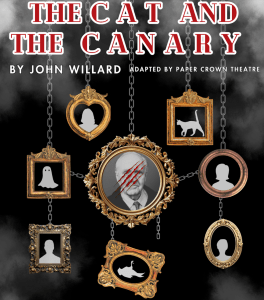 … you can meet a new Edmonton theatre company. Paper Crown Theatre takes to the Gateway Theatre stage starting Tuesday with a 12-actor adaptation of a vintage 1922 murder mystery by John Willard. The Cat and the Canary comes with shivery Agatha Christie trimmings like a deserted mansion at midnight, the the reading of a will, a sanity caveat that threatens the sole heir. The Paper Crown production directed by Lauren Tamke features a different ending every night of the run, Feb. 13 to 18. Tickets: showpass.com.
… you have a rare chance to see Shakespeare’s Troilus and Cressida, in a production adapted and directed by Brett Dahl. It’s at the U of A’s Studio Theatre opening Friday. Viciously satirical in its treatment of both war and love, scathing about the hypocrisies that rage through both, you could make a case for Troilus and Cressida being Shakespeare’s most cynical and anti-heroic play. Its characters are morally ambiguous when they’re not actively sleazy; it plays along the palette of disillusionment, in both the private and public spheres. How contemporary is that?

Troilus and Cressida, Jaquelin Walters (centre), U of A Studio Theatre. Photo by Brianne Jang
Dahl, whom audiences saw this past summer in the Freewill Shakespeare’s Festival’s alternating Romeo and Juliet and Twelfth Night, takes this up. They argue in their director’s notes that Troilus and Cressida is “one of Shakespeare’s most experimental and modern plays.” And they opt in this thesis production to see it “through a modern queer lens” as part of an approach they term “queering the classical canon.”
Troilus and Cressida runs through Feb. 17 on the Timms Centre For the Performing Arts stage. Tickets: 780-492-2495, showpass.com.

playwright Grace Fitzgerald. Her play Carter and the Train is at Nextfest Playwrights Weekend.
… you can catch Nextfest’s next bright idea. The 29th annual edition of the multidisciplinary 11-day festival of emerging artists that got dreamed up at Theatre Network in 1996, doesn’t happen till the end of May. But creative potential doesn’t stay put on any calendar. And neither does your chance to see what the next generation of artists is up to, and hear new voices gathered by the indefatigable Nextfest team led by Ellen Chorley.
This weekend at the Roxy we get a sneak peek of five new plays by five new and aspiring playwrights, four of them created by participants in a Nextfest initiative called My First Play. When the first-ever six-week program was launched in October, 22 (!) new playwrights signed up to learn about the craft of fashioning a script. And in this debut edition of Nextfest Playwrights Weekend, Friday through Sunday, 15 actors will breathe life into the new plays.
Friday night (7 p.m.) audiences will see Ghostbox by Scott Muyser and DMV by Logan Stefura. Saturday (7 p.m.), it’s Televangelists by Mika Boutin and S. Botson: a six hour revolution by Sage Milnthorp. And the Sunday matinee 2 p.m. slot is reserved for Grace Fitzgerald’s Carter and the Train, which will premiere at Nextfest 2024 and then be presented by the festival at this summer’s Fringe.
After each show, there’s a talk back so the up-and-coming playwrights can gather feedback. And the bar is open. Tickets: at the door or in advance at theatrenetwork.ca.
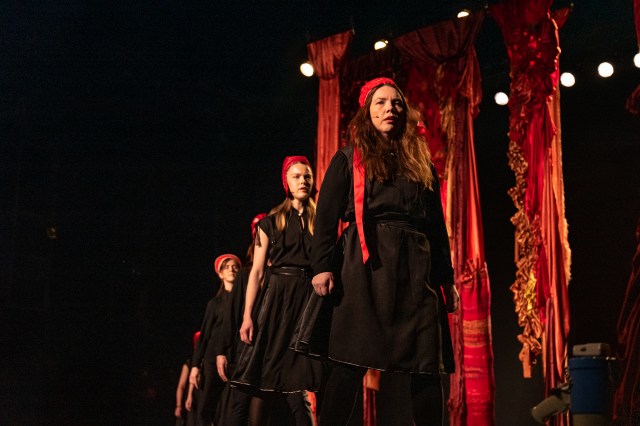
Vástádus Eana/ The Answer Is Land. Photo by Knut Aaserud.
… you can experience a uniquely unclassifiable performance steeped in traditional Sámi culture. Vástádus Eana/ The Answer Is Land started with a poem, eight lines of poetry placed along the border between Norway and Finland, part of a sign project called The Kiss From The Border. “Land is the question, the answer is land.” The notable Norwegian Sámi choreographer and muse Elle Sofe Sara was struck by the unusual form and energy of that the project, “political and activist art that is driven by love instead of anger,” as she says in her program notes. The result was , an award-winning performance piece inspired by Sámi spiritual rituals, traditional polyphonic Sámi yoik songs, and the movement vocabulary of Sámi formation dance.
“Is it dance, is it a performance concert, theatre or what? In my opinion there is no need to define,” says Sara.
An exploration of community, the sense of what it means to be home, and the bond between humanity and nature, this is the piece that Edmonton Fringe Theatre and Mile Zero Dance have partnered to bring to the city for a single night Feb. 18. Dress warmly, advises the Fringe. The audience gathers in the Westbury lobby, moves outdoors as the performance begins, and then moves into the theatre.
Tickets: fringetheatre.ca.

Jeff Halaby in Gatsby’s Cabaret, Spotlight Cabaret. Photo supplied
… you can have fun and feel decadent at an original cabaret that is, as billed, a champagne-soaked mash-up of The Great Gatsby and Cabaret. Gatsby’s Cabaret, the latest musical comedy satire from the Spotlight Cabaret team of Jeff Halaby and Aimée Beaudoin, fresh from their sold-out run of Alison Wunderland, is set in pre-war Berlin. A showgirl and a playboy find themselves in a jazz club, thrown together in a tango. And, you know, one joke leads to another. John Hudson’s cast includes Halaby, David Anderson, Donna-Leny Hansen, and Gillian Moon. Comedy with a lavish four-course dinner, it opens this weekend at Spotlight Cabaret (8217 104 St.) and runs through April 28. Tickets: spotlightcabaret.ca.
… you can revel in the Elvis songbook. A Night With The King, starring the notable Elvis tribute artist Matt Cage, premieres at the Mayfield Theatre this weekend and runs through March 31. Tickets: mayfieldtheatre.ca. Check out their upcoming 50th anniversary lineup here.


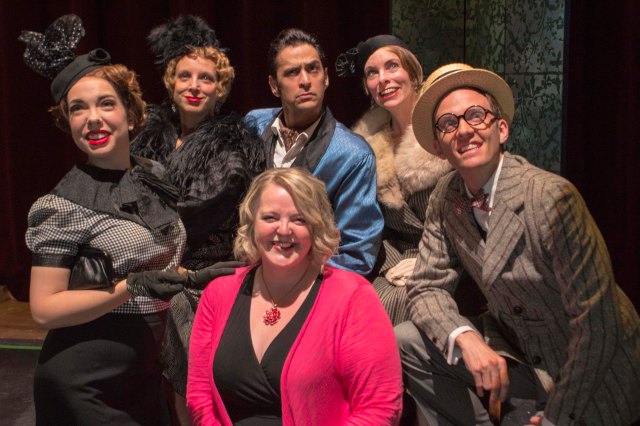

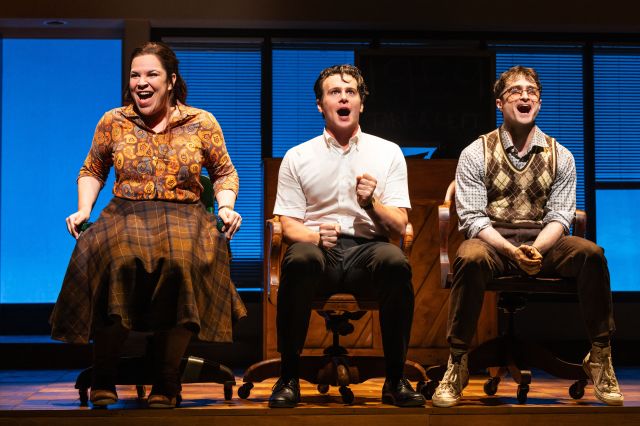



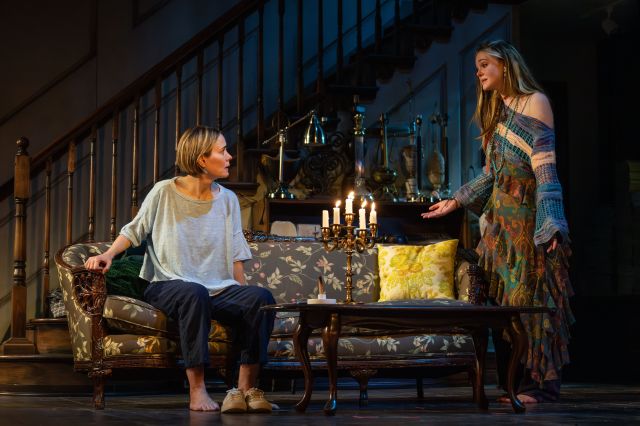

 By Liz Nicholls,
  The “Christmas show,” the Mayfield’s perennial best-seller — this season Canada Rocks: The Reboot had a record-breaking run — is an original homage to the theatre’s 50th. Flashback Fever (Nov. 12 2024 to Jan. 26 2025), billed as a “rock and roll dinner party,”
 Jersey Boys (April 8 to June 8, 2025) finds its blue-collar pizzaz in the mean streets of New Jersey. And it gets its dramatic traction from telling a real-life story, grit included: the rise from obscurity to top-40 stardom of The Four Seasons. That’s what sets this Tony- and Olivier Award-winner apart from the jukebox musical crowd — that, and a string of two dozen indelible chart-topping hits, including the likes of Sherry, Big Girls Don’t Cry, Walk Like A Man. “A great musical, perfect for our audience and our venue,” says Wilmott, buoyed by the availability of rights between American tours of Jersey Boys, and undaunted by the recent Citadel production. As for The Full Monty, the cast and director have yet to be announced.
 The summer of 2025 (June 17 to July 20) is the perennially popular 1986 solo play Shirley Valentine by the Brit playwright Willy Russell. It’s been 14 years since the Mayfield last produced it. The middle-aged title character is a veritable poster child for life-changing re-discovery. When Shirley steps out of the rut of her humdrum life with an emotionally distant husband and wins a trip to Greece, nothing will ever be the same.


 By Liz Nicholls,
  A Midsummer Night’s Dream: The 70s Musical, premiering on the Maclab stage), has a highly unusual companion piece in the Citadel’s Rice Theatre. A trio of goblins, in full goblin gear, happen upon a Complete Works of William Shakespeare, and pick the goriest to perform. Goblin:Macbeth (Jan. 11 to Feb. 2), which arrives trailing raves from successful runs at Vancouver’s Bard on the Beach, Stratford and currently Calgary’s Vertigo Theatre, is the work of the unstoppably inventive theatre artist Rebecca Northan (Blind Date, Undercover) along with Bruce Horak. And this Spontaneous Theatre Creation re-launches the Citadel’s Highwire Series after a year’s hiatus. “Everything you love about Rebecca Northan…. Such a cool mix of the improv and the Shakespeare,” as Cloran describes. “Great comedy and moments of profound Shakespeare acting.”
 With The Ballad of Johnny and June (Nov. 2 to 24), the Citadel collaborates with the La Jolla Playhouse — the California theatre where many Broadway musicals, including Come From Away and Jersey Boys, got their start — on a new musical love story about country music stars Johnny Cash and June Carter. The production “has its sights set clearly on Broadway,” says Cloran. And it brings back to Canada notable director Des McAnuff, whose resumé includes a stint as Stratford Festival artistic director, and Broadway hits like Ain’t Too Proud, the Donna Summer Musical, and The Who’s Tommy.
 The fourth of the season’s musical offerings is the LightningCloud production of Bear Grease (Oct. 17 to 27). It’s a much-travelled Indigenous take by (and starring) the Edmonton couple Crystle Lightning and Henry RedCloud Andrade (Evandalism) of the Enoch Cree Nation, on the 1978 classic Grease. “Super-fun,” says Cloran of the piece, which premiered at the Edmonton Fringe. “Really smartly done…. And they have big dreams for the show.” Inclusion in the Highwire Series, returning after a year’s hiatus, is “a great way for us to showcase local artists, get behind a local group and amplify their success, shine a light on it nationally,” says Cloran.
 The 2024-2025 season opens (Sept. 21 to Oct. 13) with Cloran’s own production of A Streetcar Named Desire, the Tennessee Williams masterwork he has long wanted to direct, as he says. “A great story, iconic characters,” he says of the co-production with Theatre Calgary. Casting announcements await.
 The season finale (May 3 to 25, 2025), is the North American premiere of a London stage production of Rod Serling’s The Twilight Zone, in the playwright’s 100th anniversary year. A hit at London’s Almeida Theatre which transferred to the West End, the production is an adaptation by Keith Reddin (Life During Wartime) and Anne Washburn (Mr. Burns, a post-electric play) of multiple Twilight Zone stories from the CBS TV series. And after a New York workshop the show brings to Edmonton the much-awarded English director Richard Jones, to build and hone at the Citadel with an eye to Broadway, à la Hadestown and Peter Pan Goes Wrong in which the theatre had a hand.
 Before the season starts, the Citadel’s summer production