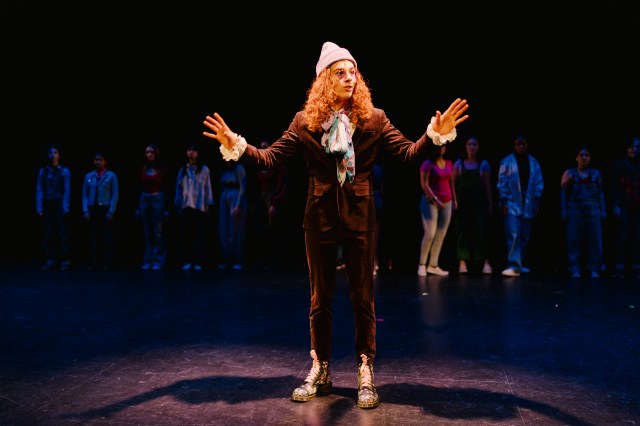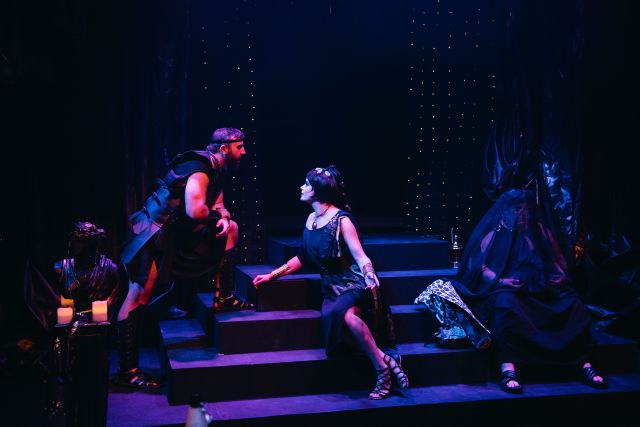
Listen, Listen: a new Teatro Live ‘Muzak-al comedy’ by Elyne Quan. Meet the playwright in this preview

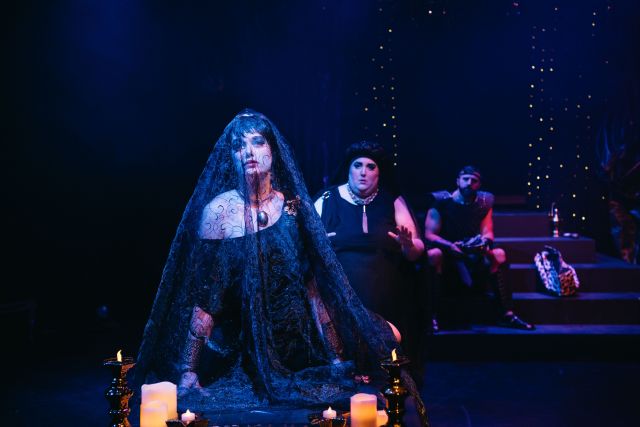
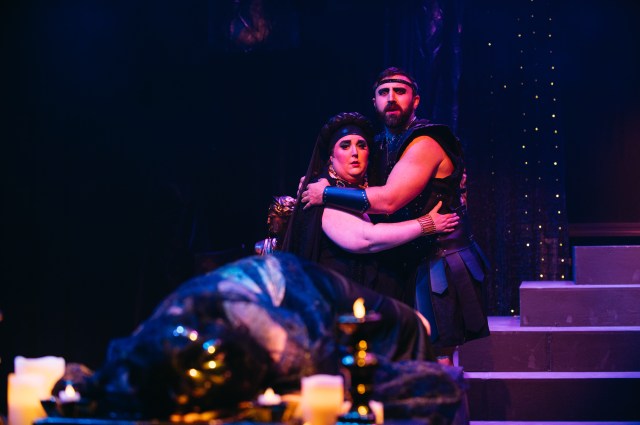
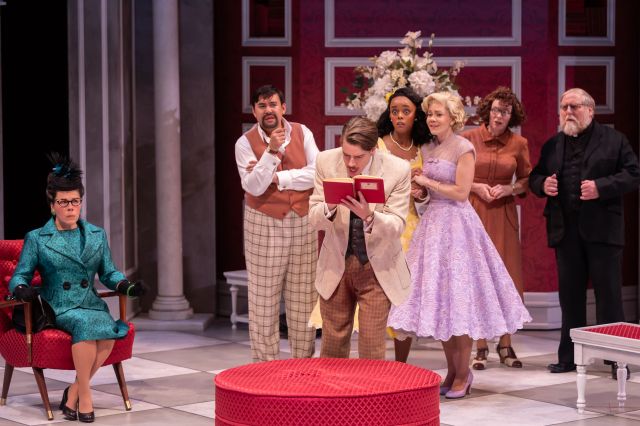
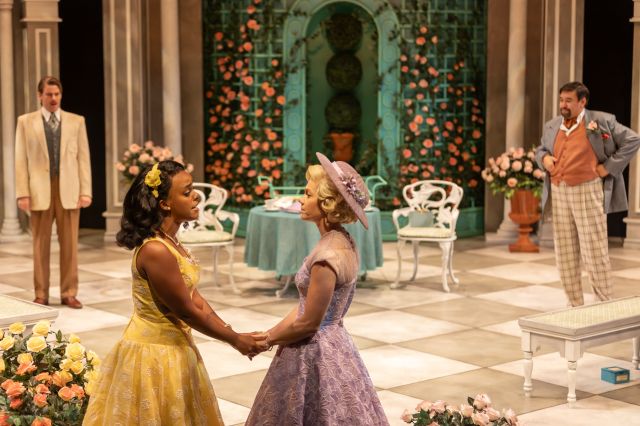
Farren Timoteo in Listen, Listen. Teatro Live. Photo by Ryan Parker.

By Liz Nicholls, 12thnight.ca

For five years or so, a character has taken up residence in a back corner in Elyne Quan’s writer brain. He’s an ideal renter. He lives quietly; he doesn’t play his music loud.

Montague Gray, who has a name as grand as he isn’t, is modest and unobtrusive. But he has a passion, “a much-maligned interest,” as Quan puts it. “He’s a Muzak enthusiast.”

“I didn’t know what to do with him,” laughs the Edmonton-born playwright (cum television/ film/ digital media writer) on the blower from her Toronto home base. And now, thanks to a Teatro Live commission, Montague has a Quan comedy to star in. In Listen, Listen, premiering at Teatro Live Friday on the Varscona stage, Montague is faced with a crisis, and a call to action. Muzak, the music he loves, as mild-mannered as he, is under threat in the world. In a mall in 1986, heroism is called for: Montague must take a stand.

To help support 12thnight.ca YEG theatre coverage, click here.

“I’d been thinking of the odd things people become obsessed with,” says Quan. And obsession is a great comedy driver, as the Teatro archive of Stewart Lemoine plays demonstrates. Think, for example, of Lemoine’s 2015 comedy Hey Countess!, in which an ordinary guy, irritated beyond measure by the atrocious dubbing in an art house Italian film, impulsively undertakes a quest.

The Teatro commission, which came during the pandemic, was delightful, and unexpected, says Quan cheerfully. As Teatro co-artistic director Belinda Cornish explained, the company founded by playwright Lemoine, “was re-structuring and re-branding, ushering in a new era by wanting to include some new voices.” Witty and droll as Quan is in conversation, comedy, the Teatro specialty, counts as a departure for her. “I was so flattered. But I don’t really write comedies,” she says, of a playwriting resumé dotted with award-winners from her time here at Concrete Theatre and Workshop West and in New York, where she graduated from NYU with an MFA in dramatic writing in 2005.

playwright Elyne Quan. Photo supplied.

“Besides my kids’ stuff (including the hit two-hander Lig & Bittle, with Jared Matsunaga-Turnbull), most of my plays are dark and very firmly drama.” Amused, she remembers talking about one of her plays with the drama department chair at the U of A (where she graduated with an honours B.A. in drama). “He said ‘So Elyne, how bad do you want to make your audiences feel?’ (Laughter). I want them to feel something: that was my answer at the time.”

The proposition from Teatro wasn’t prescriptive, she says. And after all, the Teatro “comedy-forward” thrust has been to expand the usual boundaries attached to comedy. Quan didn’t have a story in her pocket, but she did have the Muzak-obsessed Montague, “the kind of character who’s so concerned about not being fussy that he’s fussy.”

“Coming out of the pandemic there was a shift in the kind of TV I wanted to watch,” Quan muses. The urge “to see stuff that’s lighter, that’s not so emotionally draining” had started earlier, during a couple of years of illness. And the pandemic changed the tonal palette for everyone, she thinks.

Her entry point into theatre was acting, back to the era of the Citadel’s Teen Fest, and roles in Brad Fraser’s Blood Buddies and Conni Massing’s Terminus. Edmonton audiences saw her in Marty Chan’s Forbidden Phoenix. “If I was still in Edmonton, I’d still be acting, probably,” says Quan who moved to Toronto in 2007 — post-New York and post-teaching at the U of A — feeling the need to be in a bigger city.

Studying at the Canadian Film Centre was a helpful way to get started again. And gradually TV, film, assorted digital media projects, including interactive website with games, began to happen for her. “It took a long time,” she says. And the pandemic was immensely destructive. “But the reality of being in this (writer’s) career is you have to do a lot of different things,” as she says. “There a reason theatre people, playwrights, are really good at television. We’re used to wearing a whole bunch of hats all the time. We’re  able to think on our feet, do a whole bunch of jobs, be flexible….”

She noticed “a real difference between the U.S. and Canada about “who gets to be in the room.” At NYU, “the energy was that TV was always looking for the next hot young thing, willing to give young inexperienced artists an opportunity….” In Canada, “there was way less of that, a lot of resistance to it. It was ‘we’re going to give it to the seasoned TV guy, usually a guy, who’s going to run the show, who knows how to work with our budgets, who’s a known quantity’. And he’d have his own group of people to work with, young versions of him who looked liked him…. It was very very difficult.”

“Things started to shift in a big way a few years ago, before the pandemic,” she says of cultural attitudes in the wake of seismic events like the murder of George Floyd. “A lot of people were talking about visibility and diversity in rooms, demanding more, seeing the value in it.”

Quan had been exploring ethnic diversity long before that, in many of her early plays (including her contributions to Triptych and Rice: Stories With A Slant, at Concrete Theatre here). But “it all changed when I got into the Netflix-sponsored “diversity in voices” initiative at the Banff Media Centre,” she says. She brought a project to pitch, and though it wasn’t produced, “out of it came a new agent and a nice confidence boost…. The ball started rolling.”

One of her biggest supporters and mentors, in a diversified, multi-limbed career, has been playwright/ screenwriter/ story editor Mark Haroun, a friend from Edmonton theatre days whose kids play A Giraffe in Paris premiered at the Citadel. He gave Quan her “first writing room TV job” for the CBC series Heartland. “Fun, and extremely instructive,” she says of the experience. “You learn so much, so fast. That show has been around for a long time, a well-oiled machine.”

“I didn’t have an episode in that season. But that job has led to every other TV job I’ve had. And I’m busier than I’ve ever been!” says Quan gratefully.

It’s taken time, she sighs, and laughs. “That’s the difference between Edmonton and Toronto. In a bigger city where resources are really scarce, it’s ‘who are you?’. Edmonton energy is ‘we’re all here; let’s make the best of it!’”

She quotes the great American playwright Tony Kushner, who told Quan’s NYU class that he’d written American theatre’s most produced play, with multiple productions, translated, around the world. “And one night of Angels in America on HBO, more people saw it than the entire history of the play.” The moral? “You can’t afford to be just a playwright any more.”

Right before the pandemic, Quan worked on a 10-episode Snap project in which your bitmoji avatar is placed inside an animation, “a real engineering feat at the time.” The viewership of the first two-minute episode? 10 million. The economics of TV writing and the imminence of newer digital technologies and AI creation have all contributed urgency to the current WGA strike, as Quan points out. “If we don’t protect these (writer) careers now…”

Which has made the writing of Listen, Listen,  even more special, she thinks. “I did enjoy it, the chance to stretch different muscles!” says Quan of her excursion into comedy. “Forced out of his comfort zone by everyone he meets and his circumstances, Montague undertakes a journey to have his innocuous music restored in his workplace.”  For Quan it’s been a journey from dark into light.

PREVIEW

Listen, Listen

Theatre: Teatro Live

Written by: Elyne Quan

Directed by: Belinda Cornish

Starring: Farren Timoteo, Nadien Chu, Alex Ariate, Nikki Hulowski

Where: Varscona Theatre, 10329 83 Ave.

Running: Friday through Jun 11

Tickets: teatroq.com

Posted in Previews | Tagged , , , , , , | Comments Off on Listen, Listen: a new Teatro Live ‘Muzak-al comedy’ by Elyne Quan. Meet the playwright in this preview

The fascinating contradictions of Anahita’s Republic, a review

Roya Yazdanmehr and Yassine El Fassi El Fihri in Anahita’s Republic, AuTash Productions. Photo by Henderson Images

By Liz Nicholls, 12thnight.ca

Anahita’s Republic is a thriller set in a mysterious world of concealed faces and shadows, secret agents, secret police, hidden agendas. That world is contemporary Iran.

The playwriting duo of Hengameh E. Rice, one half Iranian and the other Edmontonian, have created a gripping and complicated story that takes us further and further into the subterranean cross-currents of a sophisticated society … where women have no rights. That’s the fascinating contradiction that drives the storytelling of Anahita’s Republic. It’s a rare insider view, and an opportunity not to be missed.

The hijab, a powerful symbol of compliance, is mandatory. Marriages are arranged, by men. The family is ruled, by men. Public life is orchestrated, and restricted, by men, who have a freedom only dreamed of by women.

Women are the insurrectionists against an oppressive regime, and widespread protests notwithstanding, their struggle for change is underground, conducted by networking. Smart, educated, and driven, Anahita (Roya Yazdanmehr) runs a successful import business from inside her luxurious villa prison, a tangible seminar in the working-from-within model. Since there’s no equality for her in the Republic, she’s made her own republic-within-a-republic where she roams defiantly, sans hijab and in a bathing suit.

Her agent in the world is her brother Cyrus, who’s something of a go-fer for Anahita’s business plan. “He is my chador,” as she says of her identity-concealing double life. When she says “my republic is not the kingdom of men,” she’s not taking some sort of  religious side-swipe. She’s simply describing her regime. And, interestingly, it’s a harsh one, goal-oriented, that’s just not interested in her brother’s own dreams and happiness. It is a high price tag on single-mindedness.

The red alert catalyst is the arrival of a mysterious woman (Jennie George) in a chador and expensive sunglasses at Anahita’s gate. Is she who she claims to be? Is she to be trusted? An ally? A spy? Her appearance is an event that triggers suspicion, and demands wariness, interpretation, and response from everyone in the play. And the play bravely doesn’t shy away from wondering about Anahita herself, a fierce and contradictory figure who’s both heroic and repressive.

Brian Dooley’s production for the indie company AuTash (Farsi for “fire”) is noir-ish and atmospheric. His cast commits to a sense of high-alert urgency throughout. Whittyn Jason’s design picks up on that, the idea of layering in a dangerous world. It’s a succession into depth of panels, turned by human agency, that glow like stained glass, through which we discern shadowy movements.

In the end, the admirable ambitions of the storytelling to reveal a whole culture do overtake the plot, I think. The complications accumulate, and spread thinner and thinner, scattering impact in scenes that are harder to sustain. Anahita’s Republic sets about shedding light on every corner of private and public life in a mysterious country, including higher education, the family embedded in the state, foreign relations, ethnic prejudices in the big wide world. “I can swim here. I know the water. Everywhere else I’d drown,” says Anahita, who’s nothing if not decisive about life choices for other people.

Anahita’s Republic is a story you won’t know in advance, about people who are up against it, trying to make decisions in a never-ending state of emergency. A worthwhile theatrical expedition.

Brian Dooley’s production stars Roya Yazdanmehr, Jennie George, Yassine El Fassi El Fihri, Michael Peng. Running: at the Backstage Theatre through June 4. Tickets: fringetheatre.ca.


Posted in Reviews | Tagged , , , | Comments Off on The fascinating contradictions of Anahita’s Republic, a review

The improbable magic of live: Flop! the improvised musical, a little review

Ron Pederson and Ashley Botting in Flop! The Improvised Musical. Photo by Dahlia Katz.

By Liz Nicholls, 12thnight.ca

Calling an improvised musical Flop! is like calling a plastic surgery practice Oops! or an aerial circus Thud!. It’s irresistible; you can’t not look.

To help support 12thnight.ca YEG theatre coverage, click here.

But then, it’s clearly impossible: making up an entire musical, with an opening number, romantic ballads, cute patter songs, songs of self-discovery, song-and-dance, an 11 o’clock number, a finale. AND, since there are only two of them onstage, the duo of Ron Pederson and Ashley Botting, along with pianist Erik Mortimer, improvise the story and play all the characters, too — the leads, the sidekicks, the cameos, the comic distractions — at every performance of Flop!

There’s a kind of magic to the live-ness of it all, the risk. And we’re involved. Pederson and Botting create Flop! from the chaos of audience cues, with side commentary, self-appraisal, and adjustments. It’s kind of like virtuoso trapeze artists already in the air commenting that the ropes in the rigging look a bit frayed.

Ron Pederson and Ashley Botting in Flop! The Improvised Musical. Photo by Dahlia Katz

At Saturday’s show, Flop! was a romantic comedy all about a wedding, a mismatched couple, best friends…. Scenes happened in a deli, a laundromat, an arcade, none of them cues I’d have called promising. Like make-overs, improv is all about working with what you’ve got. There was a scene where movement turned into tap dancing. Elton John was there. There were songs in German. And French. Really.

And it was a riot to see disaster and the laws of gravity averted so dexterously. Pederson, whom Edmonton audiences know from the deluxe improv trio Gordon’s Big Bald Head, and Botting, a Second City veteran, are agile and funny. And they have an instinct for musical theatre form, when the songs should happen, when it’s amusing to have them happen when they shouldn’t. When things went askew, they acknowledged it. One of them would step out and say “what do we need here?” or “what if the best friend had a song?”

And with Mortimer, Pederson and Botting have the matching expertise of a terrific musical improviser who can anticipate the narrative needs of the moment, and play in any style.

As I say, it’s all impossible. And watching the impossible actually be entertained, and executed, before your very eyes makes you shake your head (and laugh out loud).

Flop!, as Pederson explains at the end, is a workshop, a work-in-progress en route to Off-Broadway in the fall. The try-out is at Rapid Fire Theatre’s new Exchange Theatre in Strathcona. It’s a welcoming, cleverly designed space for improv, mere steps away from the showbiz bistro bar The Next Act and a dozen other Strathcona eateries. These are cues; improvise yourself a fun outing.

Check out 12thnight’s preview interview with Pederson, Botting, and producer Alan Kliffer hereFlop! runs through May 28. Tickets: rapidfiretheatre.com. 

Posted in Reviews | Tagged , , , , , , | Comments Off on The improbable magic of live: Flop! the improvised musical, a little review

The dark pathways to coming-of-age: Boy Trouble at Fringe Theatre, a review

Maxwell Hanic and Romar Dungo in Boy Trouble, Amoris Projects. Photo by Mat Simpson

Boy Trouble, Amoris Project. Photo by Mat Simpson

By Liz Nicholls, 12thnight.ca

The theatre is dim, lit with a barrage of come-hither text messages: “send a vid”, “wyd”, “join me and a couple buds”, “your cute”, “no pic no chat” “my truck?”.

When the lights come up, you can make out a playground: a sort of treehouse, stylized trees, a bench (set and lighting, both eloquent, by Even Gilchrist). 

To help support 12thnight.ca YEG theatre coverage, click here.

The queer teenage characters of Mac Brock’s explosively performed Boy Trouble ricochet through the liminal space between these axes — the portal between childhood friendship and a shadowy “adult” world of mysterious connections. Both are underscored, in different ways, by secrecy.

Brock’s new play, premiering in Fringe Theatre’s Spotlight Series in a production directed by the playwright, explores the intricacies and ambiguities of coming-of-age. Save the word “bittersweet,” oft slathered on such stories, for some other play. Here it’s a veritable minefield for characters discovering their sexual identity in a world that’s both small and hostile (like school and family), and big and available (like Grindr and the internet).

It’s 2015. And at 16 boyhood friends Kay (Maxwell Hanic) and Anthony (Romar Dungo) are gay, but at different angles. The former, who has white affluence and a mother with a girlfriend on his side, hasn’t fully opened the closet door, just in case. The latter, who has found himself gay friends his own age, is from a struggling immigrant Filipino family with conservative Catholic expectations.       

Keepers of each other’s secrets, allies against bullying, the friends have fallen out. And in the course of the six-year span of Boy Trouble, a completely rewritten version of Brock’s 2019 play, we find out why.

In Brock’s production, two compelling, physically dexterous actors don’t just occupy the stage. They clamour over it at top speed, swing through it, tumble off and under it. They’re in perpetual motion, physically restless even when they (barely) stop to text, upside down right side up  — a test of sturdiness for Gilchrist’s evidently hurricane-proof playground design. They lob cellphones as they go in a way that will make you queasy. The video design by Tori Morrison and Judah Truong is a simultaneous participant.

Romar Dungo and Maxwell Hanic in Boy Trouble, Amoris Projects. Photo by Brianne Jang, BB Collective.

As kids, the performances reveal, Kay and Anthony’s friendship is a perpetual motion game of tag, a choreography of jostling playful movement that will leave you just a bit breathless. And as teenagers this hyperactivity translates, in narrative terms, into a questing for the equilibrium and footing that are heartbreakingly elusive. Moving targets are harder to impale, after all. Rare moments of stillness are genuinely disturbing  in Brock’s production.

The friends have been bonded by secrecy. In the play’s present, secrecy and the threat of exposure, with the attendant shame, have driven a wedge between former allies. What was playful and teasing has an edge, sometimes almost violent sometimes almost sexual. The fight and intimacy direction, a continuity in this play, are by Sam Jeffery.

Coming-of-age has made Kay furtive and cautious, as Hanna’s wonderfully nervy performance charts. Dungo, a discovery for Edmonton theatre, brings a certain sweet boyish earnestness to Anthony that’s turned to unease at the edges. You believe both characters: Kay who’d been a dispenser of advice, and Anthony, who’s taken on that self-assignment. And you really want these queer kids to find some sort of happiness and repose to go with their smiles.

Brock is a sharp-eared writer of staccato dialogue that shoots out in overlapping fragments and shards. In the hands of the actors the text feels convincingly alive — tentative, quickly withdrawn, amended, re-introduced. And the situation feels fraught, twitchy, momentous (which as the news reminds us is by no means an over-reaction). Boy Trouble plants a flag on the tough terrain where the going should be easier than it is, and the path of self-discovery is rockier than ever.

REVIEW

Boy Trouble

Theatre: Amoris Projects

Written and directed by: Mac Brock

Starring: Maxwell Hanic and Romar Dungo

Where: Studio Theatre, ATB Financial Arts Barn, 10330 84 Ave.

Running: through May 27

Tickets: fringetheatre.ca

Posted in Reviews | Tagged , , , | Comments Off on The dark pathways to coming-of-age: Boy Trouble at Fringe Theatre, a review

Spinning an urban story on wheels: Thou Art Here opens its season with Cycle

Andrew Ritchie, Cycle, Thou Art Here Theatre. Photo supplied

By Liz Nicholls, 12thnight.ca

Andrew Ritchie has spent the last year spinning his wheels.

He’s been up on his bike writing the solo play that shares a lane with an audience this weekend for the first time. Cycle, which launches the 2023 Thou Art Here season, is up on its wheels, literally, for a two-night workshop production in Studio B at Fringe headquarters. And Ritchie will be on his bicycle for the duration.

To help support 12thnight.ca YEG theatre coverage, click here.

He’s playing “versions of myself and other characters,” he says. And he’s been experimenting: “spin classes for the first time, intense! Trying a fat tire bike, interviews with people around Edmonton about their bike experiences, a lot of reading about bike history, studying urban design….”

Thou Art Here’s co-founder (with Neil Kuefler) and artistic director, Ritchie has a history with urban bicycling that weaves through his high school years, university, after university. It was his mode of transportation in Edmonton, Regina, and Toronto where he got a master’s degree in directing and theatre creation at York University. His experiences as a bicycle food courier in Toronto were, he says, one of the vivid inspirations for Cycle. “As someone who couldn’t afford a car for a long time, I saw pretty quickly how we prioritize (that) one way to move around a city, how we design our roads, our neighbourhoods….”

Cycle explores the links between bicycling and some of the hot urban issues of our time. “There’s been a shift in thinking in North American cities, due to increasing population, inflation, the climate crisis catastrophe,” says Ritchie. “It’s about how do we design our cities to be more people-focused and less car-focused.”

“There’s a reason Whyte Avenue is the way it is, the density of businesses and activities. And there’s a reason there isn’t a Whyte Avenue in Windermere right now.”

If you’ve casually dropped “bike lanes” into dinner conversation lately, you know what it’s like to create a provocation. Ritchie, who does have a car (and drives in the city and loves road trips), points out that there’s frustration about traffic, too. “People say bike lanes take over their parking or driving lanes. But for every person walking or biking, there’s one less car on the street. And it’s a huge difference…. There are more people biking in Edmonton since bike lanes were introduced. Way more.”

Let’s face it, you had to be a risk-taker extraordinaire to be a cyclist in the Edmonton traffic of yore. “As we take on the infrastructure to make it safer, it’s more likely that families, the elderly, e-bikes for people with different mobility levels, are going to be out and about.”

And Ritchie doesn’t buy the winter argument that Edmonton weather should negate civic spending on bike lanes. “There are tons of things we use for different seasons — ice rinks, outdoor swimming pools that are well loved and open for a couple of months in the two months in the summer…. We’re a winter city. I think the possibilities exist if you open your mind to it.”

Cycle is the start of a new identity and mission for Thou Art Here, a 12-year-old theatre collective that took Shakespeare to the people wherever they were … rarely in conventional theatre spaces. The season is comprised of all new Canadian work, in-progress for full productions to follow.

Performed atop a bicycle along with some members of the audience also on bikes, Cycle does reference the old Thou Art Here, though, since it is, in its own way, site-specific. Ritchie, along with director Kristi Hansen and choreographer Ainsley Hillyard, “have been exploring all the kinds of movement I can do on a bicycle.”

Besides, you can’t help thinking that if there had been bike lanes between Verona and Mantua, that whole misunderstanding in the Capulets’ tomb could have been averted. And Romeo and Juliet would be alive today.

PREVIEW

Cycle

Theatre: Thou Art Here

Written by: Andrew Ritchie

Directed by: Kristi Hansen

Choreographed by: Ainsley Hillyard

Where: Studio B, ATB Financial Arts Barn, 10330 84 Ave.

Running: Friday and Saturday

Tickets: fringetheatre.ca

Posted in Previews | Tagged , , , , | Comments Off on Spinning an urban story on wheels: Thou Art Here opens its season with Cycle

Anahita’s Republic: a thriller takes us into the world of Iran and the struggle for women’s rights

By Liz Nicholls, 12thnight.ca

The thriller that gets its Alberta premiere Friday at the Backstage Theatre takes us to a tense world where “freedom” reverberates at a frequency very different from our own. The disparity between its application to men and to women is dramatic. And so is the separation of public and private life.

To help support 12thnight.ca YEG theatre coverage, click here.

Welcome to Iran. AuTash Productions, a new indie theatre based here and named for the Farsi word for “fire,” takes us there.

The title character of Anahita’s Republic is a wealthy and accomplished woman of business who refuses to wear the hijab. She decides to build her own republic, “where she can dress how she wants, speak how she wants, and have all the liberties she’s always dreamed of,” as playwright Hengameh E. Rice puts it.  “And she manipulates her brother to do things for her” out in the world — because as a man he can.

Hengameh E. Rice is actually a writing duo: one is Iranian-born, the other from Edmonton. And their preference, in these complicated times, is for the collective designation. “It’s female-focused,” says the Iranian partner, “to show the impact the regime has had on Iranian women…. But it’s not a political play; it’s a very human play.”

There is heightened global awareness of the fight for women’s rights in Iran — witness the protests world-wide that attended the terrible fate of 22-year-old Mahsa Amina in 2022 at the hands of the Iranian morality police for wearing her hijab improperly. But the struggle goes back generations.

“I’ve lived here most of my life,” says the Iranian half of Hengameh E. Rice, who emigrated to Edmonton with her family in 1978. Her mom got accepted to do a PhD in economics at the U of A, just before the Islamic revolution of 1979 that made the hijab mandatory. “I’ve kept my Iranian identity separate from my Edmonton/Canadian identity,” she says. It’s never been easy to explain to people “just how defiant and brave Iranian women are.”

A turning point for her was the 2009 election, 30 years after the revolution. There was widespread hope of Iranians for a moderate candidate and a new age of civil liberty, “a regime to free Iran from its isolationism, and give women more rights.”

She went back to Iran to vote, “and there was dancing in the streets…. Then all hell broke loose the next day as the results came back and it became clear the election had been rigged by ultra-conservative forces. “People demonstrated, millions protested in Azadi Square (ironically, it translates as “Freedom Square”) in Tehran. “We were at the university and we couldn’t leave.” A week later, the day she and her mother finally left, Neda Agha Soltan was killed, a 26-year-old just going to visit a friend. “Those memories haunted me for a long time.”

Anahita’s Republic was born in that haunting. “I had a story in my head.” And every visit back to Iran reinforced her commitment to telling it. “I had to wear a hijab; as a woman in that world I was constantly told that I had to be very careful how I acted…. No man gets harassed in that way.”

She wasn’t a playwright, but her Hengameh E. Rice (and real-life) partner, a veteran writer who’d worked at ACCESS TV, was. They met at Walterdale. And she “just got the theatre bug.”

The Edmonton half of the pair — the Rice half — says the play started with “a long one-person monologue, with six or more characters all played by one person…. We crunched it together.” Now the play has four characters, two men and two women, including Anahita and her brother Cyrus. “And the balance of power shifts constantly,” in ways that reflect “gender, generational, and class conflict.”   

They acquired the services of the distinguished Canadian director/dramaturge/ actor Brian Dooley, who’s headed the Citadel’s new play development program and became the artistic director of L’UniThéâtre for a time (he’s now Montreal-based). He organized the first workshop of the play, and encouraged them to continue.

“They were passionate. And dogged!” Dooley says of the play’s history that includes a workshop at Tarragon Theatre in Toronto, the Stratford Festival 2022 writers’ retreat, and a Toronto production from Bustle & Beast directed by Brenley Charkow. When Hengameh E. Rice asked him to direct the production of Anahita’s Republic that Edmonton will see, his first reaction was “you do know I’m an old white guy, right?”

He’s experienced Iran in person, twice. In 2010 he was at Fajr, Iran’s venerable international theatre festival (where Nassim Soleimanpour, creator of White Rabbit Red Rabbit, was his interpreter). Later he led mask workshops for men and women, an all-ages crowd, in Iran. “Nobody was wearing hijabs,” he says. “The hijab as metaphor for the desire for freedom … that interested me about the world of the play.”

He found the the premise on which Anahita’s Republic is built, the gap between public and private lives in Iran, real and fascinating. “The secrecy, the deceit…. It’s what they have to do to survive, and get things done.” The covert smuggling operation, the family business that Anahita runs, is “absolutely real,” he says. “The interaction between female and male characters, the way they share status, and exchange it in order to move forward….”

“The big question,” says Hengameh E. Rice, “is who do you trust?” And after all, that’s a question, as Dooley adds, “that resonates beyond the world of the play, in this age of disinformation, AI, surveillance….”

The action of the play, and the explosive question of trust, is triggered when a woman wearing a chador comes to the gate of Anahita’s headquarters, bearing a dangerous secret. Dooley calls it “a suspenseful drama.” Hengameh E. Rice calls it “a very entertaining play.”

“When you say you’re going to Iran, people always say ‘isn’t that dangerous?’,” says the playwright as Dooley nods. But there’s so much more to it, as they both point out: the history, the ancient culture, “the bravery of the people, their warmth, their honesty.” Persian hospitality is storied, and in the absence of bars and the attendant aspects of Western culture, theatre has a crucial importance. “It’s such an old country, and the people are fascinating.”

“In Anahita, you see a woman fighting for change in her country,” says the playwright. “She’s not leaving her country; she’s fighting to live in her country…. And women are the engine of change,” she says, pointing to the Woman Life Freedom movement. “It’s run by the younger generation, the 20- 25- 30-year-olds. This regime is all they’ve ever known. And they’ve had had enough!”

“It’s very important to tell the story. The news will only tell you so much….”

PREVIEW

Anahita’s Republic

Theatre: AuTash Productions

Written by: Hengameh E. Rice

Directed by: Brian Dooley

Starring: Roya Yazdanmehr, Jennie George, Yassine El Fassi El Fihri, Michael Peng

Where: Backstage Theatre, ATB Financial Arts Barn, 10330 84 Ave.

Running: Friday through June 4

Tickets: fringetheatre.ca

Posted in Previews | Tagged , , , , , , , , , | Comments Off on Anahita’s Republic: a thriller takes us into the world of Iran and the struggle for women’s rights

A new Canadian musical tells a Filipino story: Prison Dancer premieres at the Citadel. A review

Prison Dancer The Musical, Citadel Theatre and Prison Dancer Inc. Photo by Nanc Price

By Liz Nicholls, 12thnight.ca

A human sparkler stands before us, a queen with gorgeous chiffon wings, in prison orange. That’s prisoner Ruperto Poblador, aka Lola (played by the charismatic Julio Fuentes), onstage to reveal how she became an internet influencer in the pre-TikTok pre-Snapchat olden days.  

To help support 12thnight.ca YEG theatre coverage, click here.

Prison Dancer, a new Canadian pop musical premiering at the Citadel before a fall run at the National Arts Centre, has a knock-out premise. It’s inspired by an amazingly weird 2007 YouTube sensation, a video of 1,500 inmates in a maximum security Filipino prison in Cebu dancing to Michael Jackson’s Thriller. Created by the team of Romeo Candido and Carmen De Jesus (it’s already been a film and a web series), the musical proposes a back story of sorts to this strange dance concoction, with its highly theatrical visuals and Vincent Price-ian voice-overs.

The production itself has a back story, one that introduces Canadian theatre to an impressive (and hitherto largely untapped) talent pool. From the creative and production teams to director Nina Lee Aquino and her 12-member cast, it’s all-Filipino. And on opening night, a packed crowd with a heartwarming representation from the younger Filipino-Canadian community, cheered every song, every move, every big-M emotional moment. And that sense of community and connection feeds the story, too.   

Julio Fuentes in Prison Dancer, Citadel Theatre. Photo by Nanc Price.

“If you have imagination you can turn this hell into heaven,” says the sinuous Lola, who doesn’t walk when she can do dance moves, in high heels. She rules the roost on the inside, under the mantra “celebrate whenever we can wherever we can.” And her fellow inmates, locked up for drug offences and running drugs from inside, indulge her, some less genially than others. They do, however, take the time to beat up newcomer Christian (Daren Dyhengco), who’s trying to get clean.

The arrival of a new Warden (Jovanni Si), a pompous disciplinarian who believes in “cracking down,” “atonement,” and “rehabilitation” through punitive physical exercise, threatens to turn this summer camp for the vaguely artistic into military-style boot camp. Needless to say he’s really not a fan of drag.

Prison Dancer, with Julio Fuentes, Josh Capulong, Daren Dyhengco, Renell Doneza, Pierre Angelo Bayuga, Byron Flores, Citadel Theatre. Photo by Nanc Price.

Lola turns this group exercise regimen into dance. And the hard-ass Warden suddenly, whizz-bang without warning, turns into an enabler — a comic internet slut, with an insatiable appetite for “views” and an eye on his “legacy” as a rehabilitation expert. The Prison Dancer story is constructed at that intersection of those two developments. “Look alive, the world is watching,” as one of the musical’s livelier songs has it. And both the Warden and gradually the inmates take note.

The world of the show is Joanna Yu’s prison set, a moveable trio of revolving multi-level gridwork towers of bars, overhung with shorts and T-shirts, with dramatic lighting by Michelle Ramsay. In Prison Dancer authority, i.e. the Warden in his enforcer sunglasses, naturally gets the highest perch.

If art has a built-in tension in Prison Dancer — dance that is coerced from a captive audience can become joyful and redemptive —  so has love. Two relationships, thwarted by circumstance, get scenes and big matching ballads of lamentation. One is Lola’s relationship with Shakespeare (Dominique Brillantes), who has a wife on the outside. The other, sketched rather than fully occupied, belongs to Christian and his wife Cherish (the affecting Diana Del Rosario). She believes in the power of love to wrest happy endings from sad stories; he’s distancing himself, for her sake. Evermore is the big emotional pop ballad of the piece, reprised climactically.

The prevailing idea of the musical is the transformative power of dance, tested to the extreme in a maximum security prison. And I’m wondering, on this first viewing, why it doesn’t come more thrillingly alive and present in this premiere production. Although Julio Fuentes’ choreography is witty, and seasoned with MJ and Thriller allusions, the show’s premise promises more dancing than it actually delivers, even when the inmates get down with the new program. So far it’s a bit hard to imagine a Broadway destination for the production without some big, visceral, extended dance numbers.

The storytelling and the dialogue, by Candido and De Jesus, are laced with wit and amusing insights into individual characters like Shakespeare and the Warden. This isn’t the reclamation of hardened criminals; this is all about making life inside for the inmate collective more tenable through dance (being in maximum security need not be a barrier to artistic fulfilment, whew). The cultural references, in the Christmas Morning number for example, or the Filipino snack that Cherish brings to the prison, help give Prison Dancer its unique flavour. Bring them on!

With exceptions Candido’s score, though, has a certain sameness about it; it leans heavily into ballads with similar thoughts about “new beginnings” and “freedom.” The musical arrangements, for an able band of three, don’t do it any favours. And on opening night, the lopsided sound mix favoured the piano over audible lyrics, a correctable problem to be sure.

The idea of Prison Dancer as a speculative back story to a mysterious internet phenomenon is very appealing. It has built-in theatricality, it has a live-wire and specific cultural connection, it has a universal message about feeding the soul. And it’ll l be dancing its way into future incarnations. Further development awaits.

PREVIEW

Prison Dancer The Musical

Theatre: Citadel and Prison Dancer Inc.

Created by: Romeo Candido and Carmen De Jesus

Directed by: Nina Lee Aquino

Starring: Julio Fuentes, Norm Aloncel, Pierre Angelo Bayuga, Dominique Brillantes, Josh Capulong, Diana Del Rosario, Renell Doneza, Daren Dyhengco, Chariz Faulmino, Byron Flores, Jovanni Sy, Stephen Thakkar

Running: through May 28

Tickets: 780-425-1820, citadeltheatre.com

Posted in Reviews | Tagged , , , , , , , | Comments Off on A new Canadian musical tells a Filipino story: Prison Dancer premieres at the Citadel. A review

Boy Trouble: a new play about growing up the hard way, queer and without role models

Romar Dungo and Maxwell Hanic in Boy Trouble, Amoris Projects. Photo by Brianne Jang, BB Collective.

By Liz Nicholls, 12thnight.ca

The teenage characters we meet in Boy Trouble are growing up the hard way: queer and on the Prairies.

To help support 12thnight.ca YEG theatre coverage, click here.

Coming-of-age, the universal struggle for identity, is harder times 100 when you’re figuring out your sexuality for yourself, in a lonely world of secrecy and shame.

“The only thing worse is to not talk about it,” says playwright Mac Brock. His play Boy Trouble, opening Thursday as part of Fringe Theatre’s Spotlight Series, is all about that. “The reality is that (kids) are going through it; they’re thinking about it; it’s happening in their lives. And the more we pretend it isn’t, that their problems don’t exist, the worse the world is for them.”

Kay (Maxwell Hanic) and Anthony (Romar Dungo) are childhood friends, who’ve had, for reasons we discover in the play, a falling out. And we meet them “at a pivotal moment when one of them has learned a secret. And they’re trying to figure out what to do about it….” The show unspools into their past, their memories, the moments that led to their estrangement.

Boy Trouble takes us to 2015, as a wave of new queer TV and movies — Love, Simon, Drag Race and the rest — is about to hit. “A lot of awesome stuff, nice new pathways for the next generation of queer people about to happen,” says Brock, who directs the production that opens Thursday. “Hopeful, joyful. But a lot of the queer stories that made it into the mainstream were sanitized, the magical first kiss, people coming out, to be embraced with wide open arms….”

It was a blinkered vision. All “shiny, happy stories, and we were grateful to have (queer content). But we didn’t see ourselves and our experiences in them,” as Brock says. “It’s what was supposed to happen, and didn’t for us. The expectations add a whole other layer of shame. ” The internet, and its buffet of dating apps with their promise of anonymous access, “allows you to get into some pretty dark corners.”

Boy Trouble has had a dramatic transformation — “a complete rewrite!” — since the original version that premiered at Nextfest in 2019, then went to the Fringe that summer. “The characters outgrew the story,” laughs Brock, who arrived here seven years ago from Regina as an theatre artist with a bent for devised theatre and improv, headed for MacEwan’s arts management program. “Acting? Tried it, hated it!” he declares cheerfully.

The new version of Boy Trouble we’ll see “asks the same questions” as the original, but he and a queer/ trans/ non-binary team of artists “have built an entirely new story.”

Three years ago, we saw a story for one, set in the present: Kay (Hanic), “our troubled gay teen trying to pass as straight and figure things out for himself because he doesn’t see anybody around him who can help him navigate it…. There was so much we loved about that show but we knew it wasn’t done.”

Romar Dungo and Maxwell Hanic in Boy Trouble, Amoris Projects. Photo by Brianne Jang, BB Collective.

Now there are two characters, from very different backgrounds: Kay is upper-middle-class and white; Anthony, from an immigrant Filipino family, has been out for a while. “They have separate stories. And this is about their collision as they try to figure themselves out.”

“We finally get to build the playground that’s always been in my head!” grins Brock, of Even Gilchrist’s design. “We got Astroturf off-cuts dirt cheap; the City gave us a bench….”

Queer “encompasses such a huge wealth of experience,” as the strikingly diverse Boy Trouble team has found in rehearsing the play, Brock reports. “Class, culture, race, language, power, status…. And there are queer hierarchies too. All kinds of fracture lines. There’s a multitude of ways (the characters) can hurt each other that aren’t just about being queer.”

Brock throws out a question to challenge complacency in theatre world. “How often do you meet multiple queer characters in a show? And how often do they end up together…. We’ll find out if there’s a path for them,” says Brock of his play. “We get to have this conversation! It’s not like we got marriage rights, and then everyone’s happy.”

Boy Trouble was “my first production, my first real go at anything in Edmonton,” says Brock, these days the managing producer of  Common Ground Arts, responsible for the Edmonton incarnation of RISER (the national initiative to support indie theatre) and the annual Found Festival. It’s been three years of big changes for him. “Yup, three years of credit card debt!” he laughs. “I didn’t see my first gay couple holding hands in public till I moved to Edmonton. I was barely out before I moved here! And dating Even (Brock’s theatre designer/playwright partner Even Gilchrist) has changed my relationship to queerness, too…. ”

The three intervening years, accelerated lately by the alarming slide to the right here and across the border, have seen the world spin backwards in many ways. Is a new age of secrecy at hand? After all,  it’s ‘don’t say gay’ in Florida. It’s protesting drag performance (“a gateway, the long-term goal is erasing queer stories”). It’s the surgical removal of gay characters from high school drama, and the promotion of “grooming,” the idea that talking about sexuality with kids is akin to promoting their sexual exploitation.

Boy Trouble, says Brock, explores “what’s at risk.”

PREVIEW

Boy Trouble

Theatre: Amoris Projects

Written and directed by: Mac Brock

Starring: Maxwell Hanic and Romar Dungo

Where: Studio Theatre, ATB Financial Arts Barn, 10330 84 Ave.

Running: May 16 to 27

Tickets: fringetheatre.ca

Posted in Previews | Tagged , , , , , | Comments Off on Boy Trouble: a new play about growing up the hard way, queer and without role models

Wait, who’d be crazy enough to improvise a musical? Meet the creators of Flop!

Ron Pederson and Ashley Botting in Flop! The Improvised Musical. Photo by Dahlia Katz

By Liz Nicholls, 12thnight.ca

They’re onstage at the new Rapid Fire Theatre Exchange, looking at each other and the audience.

To help support 12thnight.ca YEG theatre coverage, click here.

They were supposed to have written the new musical they’re supposed to be performing for 10 nights (it says so in their contract). And OMG they just never got around to it.

No sheet music. No script. No director.… A no-fail recipe for showbiz disaster, surely, with an exclamation mark for good measure. That’s Flop!, the musical that two of the country’s star improvisers, Ron Pederson and Ashley Botting, will create live and on the spot from audience suggestions every night at the Exchange. And after the tryout run with Edmonton’s improv-savvy audiences, New York producer Alan Kliffer plans to take Flop! Off-Broadway next fall or winter.

Life and showbiz are full of uncertainties. But an improvised musical for a cast of two leans into the unknown, and fears thereof, at a particularly precarious angle. What possesses Pederson and Botting, and Kliffer?

We set about finding out, on Google Meet. Kliffer is in NYC, where he relocated from Toronto six years ago. Botting is in her Toronto bedroom alongside a trampoline (“My pandemic fitness program. Is there dust on it? YES!”). Pederson is at Pearson, getting ready to fly to his boyhood home town, where Edmonton audiences recently saw him onstage in the musical First Date at the Mayfield. That’s where we’ll see him again come June, along with his Gordon’s Big Bald Head cohorts Jacob Banigan and Mark Meer, in Clusterflick in which they’ll improvise an entire movie.

As Pederson explains, he and Botting met in One Night Only, the Toronto improv hit Kliffer “invented” in 2016.“We were the two Canadians” in the cast of five who’d have played Birdland (the lower level of the storied New York jazz club) in 2019 — until Lin-Manuel Miranda’s improvised hip-hop Freestyle Love Supreme moved into the Booth Theatre, “Alan’s dream theatre,” 300 metres to the left. Then came the pandemic.

“Coming from Edmonton I know a lot of terrific musical improvisers,” says Pederson, with a nod to Grindstone’s The 11 O’Clock Number and Rapid Fire’s Off Book. “But I realize how hard it is to find people who can improvise a song, lyrics, dance moves, be rhythmic physically, do a dream ballet if they have to. More rare than I thought…. That’s how Flop! came about.”

“I’d call him ‘a tenacious visionary’,” says Botting of Kliffer, who says “I feel that the improvised musical really comes from Canada.” Pederson laughs, “I call Alan the Great Ziegfeld.” For his part Kliffer calls the Flop! duo  “improv ninjas,” agile on their feet in a form, musical theatre, that rarely unfolds as a two-hander.

Botting, a Second City veteran whom his stage partner calls “one of the greatest improvising lyricists ever,” does a solo cabaret in which she improvises 10 songs. At first Pederson thought he might try that in Edmonton. He changed his mind after consulting with Botting. “It’s lonely,” she told him. “Not fun. I know I’m doing a really great tightrope walk. I know I’m working at the top of my intelligence and ability. I know I’m impressing people. But I don’t want to be up there alone…. I want to be looking at Ron Pederson, and seeing that little shit-disturber look in his eye, and I’m gonna say ‘don’t do it Ron’. And he’ll do it anyway….”

Ron Pederson and Ashley Botting in Flop! The Improvised Musical. Photo by Dahlia Katz.

“What Ron and I have in common,” she thinks, “is that we play the theatricality of it, not the shtick-y game-y sense. And we both have a deep love of musicals, of the art form. It’s in our bones.… What Ron and I like is to be very precise and impressive with our craft. And very stupid with our content! That’s the balance we both thrive in!” Pederson and Kliffer smile.

“We have a richer attack because we’re both Jason Robert Brown nerds,” laughs Pederson. “We have a lexicon of things to reference and pay homage to.” He knows first-hand the extreme challenges of long-form improv, of “taking care of a story, and making audiences care about it, for an hour.” Gordon’s Big Bald Head regularly sell out houses for their annual Fringe foray, in which they improvise any one of the shows listed in the Fringe program. The National Theatre of the World, the Toronto improv troupe he co-founded in 2008 with Matt Baram and Naomi Snieckus, premiered plays that famous playwrights like Ibsen or Tennessee Williams somehow forgot to write.

Though musical theatre-crazy, like Pederson, Botting’s entry point into showbiz was improv rather than musicals because “Second City was a thing I could do instantly and really well” when she decided to be a performer. “I didn’t go to theatre school…. And I didn’t see myself as a clear archetype in musicals when I was coming up. I wasn’t old enough to be what I essentially am, a funny sidekick character (with a voice to match). I wasn’t blonde enough to be an ingenue. Improv kept saying Yes to me. So that’s what I did.”

Both Botting and Pederson come at musical improv with a skill set that includes writing and directing. The former has been in Halifax this year writing for This Hour Has 22 Minutes; she’s directed Second City mainstage shows recently. Pederson, who directed the Winnipeg premiere of his play The Player King at Shakespeare in the Ruins in Winnipeg, is currently working on a theatre commission.

“Musical improv seems to bring together all the things I have to offer,” says Pederson. It’s a thought echoed by Botting, who came to the 2019 Edmonton Fringe with Second City’s She The People. “Whenever I return to musical improv I bring all the skill sets I’ve acquired.”

They’re thinking of the Edmonton premiere of Flop! as “a way to figure out what it is,” as Pederson puts it, with a smile. “The failure aspect,” as the title blurts out, is a way to engage the audience’s assistance. The improvisers are in trouble, “when you have an hour and there are only two people….” And a musical raises the improv stakes exponentially; “it’s got failure in the recipe.”

“I boldly say it synthesizes all the the things I do, but it never fails to make me go ‘why the hell am I doing this?’ before I walk onstage,” says Pederson. He describes going to a doctor lately to get an Ativan prescription, for flying. “He’d seen me improvise and asked ‘why do you need these pills…. I’ve seen what you do’.”

Ron Pederson and Ashley Botting in Flop! The Improvised Musical. Photo by Dahlia Katz.

The conceit of the show, as the pair describe, is that the audience has the fun of helping bail out the beleaguered improvisers onstage, (a duo plus the dexterous musical improviser Erik Mortimer at the keyboard).

“Our goal,” says Botting, “is to be self-referential. We can step outside the show and say ‘Hi, audience! How’s this going?’.” Says Pederson, “we’re letting the audience in on the negotiation that goes on, stepping outside the musical to talk about structure, or where the hell it’s going to go…. I hope to get them to sing along with us. It’s engaging them to sit forward because we could come at them at any moment with ‘OK, now what’”?

“I love playing with the audience. I love when you get a bit of an emotional something from the audience, why they care about something, what’s important to them.”

The storyline takes care of itself, they argue. “When you get the Who? and the Where?, the What? will show up,” says Pederson. “As long we’re not too Bourne Identity,” adds Botting.

In improv, the element of surprise is the terror and the joy, both addictive as Pederson and Botting describe. “Surprise is the engine of the whole thing,” says the former. “I am as surprised as the audience is; I’m just experiencing it differently,” says the latter.

“We’re all in the same sort of magic. It’s not like I’m doling out something I already know I’ll be doing. It’s allowing it to be whatever it is. And enjoying the journey.”

PREVIEW

FLOP!

Created by: Ron Pederson, Ashley Botting, producer Alan Kliffer

Starring: Ron Pederson, Ashley Botting, musical director Erik Mortimer.

Where: Rapid Fire Exchange, 10437 83 Ave.

Running: May 18 to 28

Tickets: rapidfiretheatre.com 

Posted in Previews | Tagged , , , , , | Comments Off on Wait, who’d be crazy enough to improvise a musical? Meet the creators of Flop!

Dreaming (and dancing) big: Prison Dancer premieres at the Citadel’s Collider Festival

Prison Dancer, with Julio Fuentes, Josh Capulong, Daren Dyhengco, Renell Doneza, Pierre Angelo Bayuga, Byron Flores, Citadel Theatre. Photo by Nanc Price.

By Liz Nicholls, 12thnight.ca

It’s a theatre festival that thinks big about the new — creating it to live on large performance spaces across the country and beyond, developing, celebrating and showcasing it. The Citadel’s Collider Festival, a collision of artists and forms and larger-scale inspiration with potential producers, is back Thursday for a third annual edition.

And with Collider comes the premiere of Prison Dancer, a new musical that’s billed as “the world’s first transmedia musical with an all Filipino-Canadian and Filipino-American creative and producing team.” Ah, and an all-Filipino cast of 12 from across this country, including four from Edmonton.

To help support 12thnight.ca YEG theatre coverage, click here.

Prison Dancer, the Citadel’s mainstage season finale (playing opposite Punctuate! Theatre’s First Métis Man of Odesa in the Citadel’s Rice Theatre), is the joint creation of Romeo Candido and Carmen De Jesus, Filipino-Canadian artists both. Their inspiration? The 2007 video, which instantly went viral on YouTube, of 1,500 inmates in a maximum-security Filipino prison dancing to Michael Jackson’s Thriller.

At Collider, as Citadel artistic director Daryl Cloran points out, there’s new work of every provenance, poised for future productions in national and cross-border (and -ocean) partnerships. The back story of Prison Dancer, and its launch as a stage musical, has the longest lead time, and the most multi-platform history. By far.  Prison Dancer has lived in many different ways on its journey here,” as Cloran says. 

“Romeo and Carmen started to develop Prison Dancer for the stage over 10 years ago.” And it made a splash and collected awards at the 2012 New York Musical Theatre Festival. But that’s mid-story. As far back as 1993, when Candido and De Jesus were both in the cast of a Toronto production of Miss Saigon, they were already dreaming of a collaboration that would tell an authentically  Filipino story and celebrate Filipino talent.

A decade ago, an Off-Broadway future was thwarted by the arrival on the scene of another musical with a Filipino story: Here Lies Love, the immersive David Byrne/ Fat Boy Slim musical, tells the Imelda Marcos story. “It had more momentum and cachet, so Prison Dancer stalled a bit,” says Cloran. Ironically, just as Prison Dancer if officially launching after a decade in the making, Here Lies Love is preparing for a large-scale Broadway run this summer.

Cloran’s own connection to the project comes via one of the producers, Ana Serrano. She ran a digital media lab at the Canadian Film Centre (where Cloran had a residency), and she encouraged the Prison Dancer creators “to imagine it in different ways, living on many platforms.”

Julio Fuentes in Prison Dancer, Citadel Theatre. Photo by Nanc Price.

Prison Dancer has been a web series and an award-winning film. And, inspired by the Citadel’s own history of commercial partnerships honing pre-Broadway runs of Hadestown and Six, Serrano reached out. “Edmonton has such a vibrant, and large, Filipino community, it felt like a great connection,” says Cloran. Money from the National Arts Centre’s National Creation Fund, designed to galvanize large projects, was indispensable. And work on Prison Dancer as a stage musical resumed. The production that opens Thursday is directed by Filipino-Canadian artist Nina Lee Aquino — the former artistic director of Factory Theatre and new head of the National Arts Centre English Theatre — who also delivers Friday night’s keynote address.

The story is a validation, under extreme circumstances, of the redemptive power and joy of song and dance (choreographer: Julio Fuentes). And Candide’s original music, embracing pop, house, R&B, is, says Cloran, “the most poppy electronic dance score that we’ve done here….”

Prison Dancer’s Asian Heritage Month premiere at Collider, a Citadel- Prison Dancer Inc. co-production, is a fruitful collision between the not-for-profit and commercial theatre.  And so is one of the four new plays getting a reading at Collider: Evening Train, a musical by Ursula Rani Sarma and Mick Flannery, partners the Citadel with Irish commercial producers. In fact, the entire team of Irish creators and producers arrives from Ireland for Friday night’s reading, along with the Hadestown musical supervisor and dramaturge from New York.

Says Cloran, the project validates the international networking of the Citadel in Hadestown, Six, and most recently Peter Pan Goes Wrong, all currently running on Broadway. As Cloran explains, the Irish singer-songwriter Flannery was interested in building his concept album Evening Train into a play. “He was talking to his musician friend Anaïs Mitchell (the creator and composer of Hadestown) about how to do that. And she said ‘call the Citadel’,” he laughs.

“Because so many companies in Edmonton develop great new work on small stage, or at the Fringe, or at the 200-seat level,” Collider “is us trying to figure out what we can offer playwrights.” The question it addresses is “how to create work for a large stage” (both the Maclab and the Shoctor, for example, are 700-seat houses).

“What does it need to live on a big stage? Does it have to have a cast of 20? A giant set? What do audiences expect when they come into a big theatre?” There is no one answer, witness the success of Mieko Ouchi’s solo play Burning Mom, on the (very large) mainstage at the Royal Manitoba Theatre Centre, “on a big, beautiful, transformational set,” as Cloran puts it.

playwright Collin Doyle

The Takeoff, which gets a reading Saturday night directed by Dave Horak, is a 10-actor play by Edmonton star playwright Collin Doyle. His stellar archive includes such intense, darkly humorous relationship dysfunction plays as The Mighty Carlins, Let The Light of Day Through, Terry and the Dog — all of them for small casts. Collider is a chance for creation on  a larger scale. Cloran describes it as “a lovely script….. A great intertwined narrative about families, couples, finding love later in life.”

“We’re engaged with the Collider plays all in different ways,” says Cloran of the Citadel’s new play development wing headed by playwright/director Mieko Ouchi.” Just Like Paris, by Jamaica-born Toronto-based Marcia Johnson, is a commission from an idea the actor-playwright pitched a year ago. Set in 1943, it follows a Jamaican nurse who ends up in Lethbridge, home of the largest German prisoner-of-war camp in the country. Patricia Darbasie directs the Sunday 2 p.m. reading.

Blow Your House Down by Edmonton’s Louise Casemore had development time in the Citadel’s Playwrights Lab and Punctuate! Theatre’s Playwrights Unit. It populates the stage with real estate heavy hitters, gathering to speculate and whisper about the workplace and a developing industry scandal. “Hilarity and havoc,” as billed, ensue. Cloran directs Sunday night’s reading.

“None of them are guaranteed to hit our stage,” he says of the four new plays getting Collider one-off readings. “But all are of legitimate interest to us for future production.” And festival also includes workshops and panel discussions for theatre makers (see citadeltheatre.com for a full schedule).

“Our goal was to be  a hotbed of new play activity.… And it seems to be working. Artistic directors are coming to town; people who love the excitement of new play development will want to get themselves to Edmonton for the weekend.”

PREVIEW

Collider Festival 2023

Theatre: Citadel

Running: Thursday through Sunday, with Prison Dancer continuing its run through May 28, and First Métis Man of Odesa through May 13.

Tickets and full schedule: citadeltheatre.com.

Posted in Previews | Tagged , , , , , , , | Comments Off on Dreaming (and dancing) big: Prison Dancer premieres at the Citadel’s Collider Festival