‘I would never do that.’ A different kind of horror in Squeamish at Northern Light Theatre

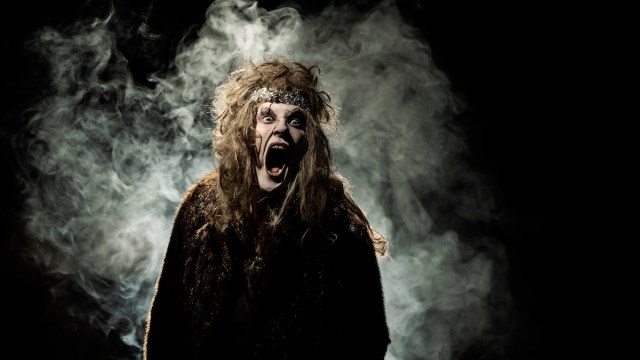
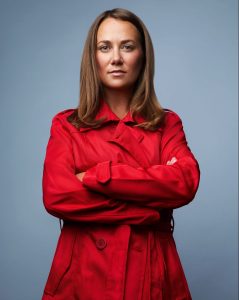
Davina Stewart in Squeamish, Northern Light Theatre. Photo by Ian Jackson.

By Liz Nicholls, 12thnight.ca

A couple of weeks ago director Trevor Schmidt and an actor friend were driving back from a day’s excursion to Calgary where she had an audition. “It was getting dark, and we put on a recording of Squeamish,” he says. “And Kristin nearly drove us off the road.”

To help support 12thnight.ca YEG theatre coverage, click here.

“It’s ‘Oh no no NO. O no, you’re not gonna …’ (breath intake, wince … ) Schmidt says of the line-crossing escalations of the one-woman horror story by the New York playwright Aaron Mark, launching the Northern Light Theatre season Friday.

Davina  Stewart, who stars in Schmidt’s production of Squeamish, says that when she first picked up the script she couldn’t read it straight through. “There was a moment I had to put it down for a while. It was … too much.” Stage manager Liz Allison-Jorde nods. So does Schmidt. “It gets ya!”

When rehearsals started, it was on Zoom because Schmidt was out of town, on the stage himself in a Calgary production of The House of Bernard Alba at Sage Theatre. The cast and crew watched each other flinch in horror reading the script.    

Squeamish comes equipped with a content warning to the squeamish: there will be blood. But it’s not a matter of buckets of it, or a stage awash in gore. “It’s all words,” says Stewart. It’s storytelling. “Yup, it’s just a story,” says Schmidt cheerfully. “And it gets creepier and darker and scarier.”

Stewart plays Sharon, a New York Upper West Side therapist who has shown up in the middle of the night at the home of her own therapist. She’s just back from Texas and the funeral of her nephew, who committed suicide. And, “shrink to shrink,” she’s telling the ever-more terrifying story of what’s happened on this trip. Sharon never  leaves her chair — possibly (as Stewart points out) the modern New York equivalent of the campfire around which scary stories traditionally get told.

Horror for the stage takes a deft hand — especially if it’s a one-hander. Schmidt has written one-woman horror plays before now. We Had A Girl Before You — a Gothic thriller in which we’re never sure if the woman before us, telling us the story, has cast herself as the heroine of a romantic novella — was a Halloween season hit in 2020. 

As you quickly find out in Squeamish, Sharon’s is a family with a long history of mental illness, addiction, and suicide. An extreme hemophobe and recovered alcoholic, Sharon has been on psychotropic drugs since she was 14. And, in an urge “to find out who she really is,” beyond the agents of numbing as Stewart puts it, she makes the decision to go on the fateful trip without them. “Maybe I’m some alien creature,” says Sharon, “and I’m just not fundamentally equipped to participate in this indulgent, needy, whiny, vain, overmedicated digital age, where nobody can sit still for five minutes, nobody knows to have a basic human interaction anymore….”

“We talk about things being second nature,” says Stewart. “So what is our first nature? How do we discover what has been suppressed? Finding out what’s ‘normal’ is a big part of it: what does it even mean to be normal post-trauma in a toxic world?   

“To me, it’s a play about addiction, and the horror of what we put ourselves through. Even though we know we are harming ourselves and others. Even though we know it will end badly.” Coffee, binge-watching, smoking, video games  … we all have our addictions, she argues. Without acknowledging, or facing, the need to escape or numb our pain, we just keep trading one for another.

The confidence that we are in control is a kind of arrogance. As Schmidt says, “you go ‘I would never do that. I would never cross that line; I would never go that far’…. And then you find yourself going that far.”

“What is your true nature? Who are you really?” Squeamish is horror that’s scares you in a much different way than sci-fi horror or supernatural horror, or being chased by a killer down a cul-de-sac. Schmidt calls it ‘body horror,” a sub-genre occupied by the Saw movies, Black Swan, Kafka’s Metamorphosis, Mary Shelley’s Frankenstein, all with disturbing violations of the body  

“I can be startled by Alien. But this is the kind of horror story that really scares me,” says Allison-Jorde. “This is real horror.” In her work, she always worries about accidentally dropping spoilers at home with the family. With Squeamish? “Absolutely not going to happen.”

 “The choices we make lead us to the horror,” says Stewart. “And these are real, possible choices,” says Schmidt.

PREVIEW

Squeamish

Theatre: Northern Light Theatre

Written by: Aaron Mark

Directed and designed by: Trevor Schmidt

Starring: Davina Stewart

Where: Studio Theatre, ATB Financial Arts Barns, 102330 84 Ave.

Running: Oct. 21 to Nov. 5

Tickets: northernlighttheatre.com

Posted in Previews | Tagged , , , | Comments Off on ‘I would never do that.’ A different kind of horror in Squeamish at Northern Light Theatre

Crazy or inspired: the what-if? of The Wrong People Have Money, premiering at Shadow Theatre

Linda Grass and Julien Arnold in The Wrong People Have Money, Shadow Theatre. Photo by Marc J Chalifoux.

By Liz Nicholls, 12thnight.ca

Here’s a what-if? to stop you in your tracks and make you smile. What if you moved Greenland south to the middle of the Atlantic? Think of the benefits, for human habitation and commerce.

To help support 12thnight.ca YEG theatre coverage, click here.

In The Wrong People Have Money, the comedy launching the Shadow Theatre season Thursday, that’s the assignment a professor presents to his “tethering the moon” class on speculative thinking and human ingenuity. After all, as a character will argue later in the play, “all great innovations started out as crazy ideas.” 

Playwright Reed McColm is something of a connoisseur of outrageous claims and absurd provocations. “Moving Greenland: I used to do it as a party joke,” he says. “Whenever I met a scientist I’d ask them about something absurd. Silent gunpowder for example (also mentioned in his play). And I’d ask is this possible?” 

The reactions were varied, says the jocular McColm. They included “why are you asking me such a stupid thing?” But frequently, “in the course of outlining how things were impossible, they’d start thinking how they were possible. Which is exactly what I wanted them to do…. So that’s how the play started,” he says of The Wrong People Have Money, which would have opened the 2020-2021 Shadow season had the world been different. 

“In my lifetime I’ve seen some things I didn’t think were possible.…  I guess I wanted to know if there were limits,” he says. “Are there actual ‘can’t do that, ever’ restrictions?” Cellphones, check. Human teleportation, likely in progress. Well, live theatre has some. He teases set designer Cindy Zuby with outrageous design requirements, “you know, a water buffalo ballet, or a fully functional swimming pool that appears only in the first scene.” She hasn’t strangled him yet. 

McColm, who grew up here and went to Harry Ainley High in the days of legendary theatre guru Ken Agrell-Smith, returned to his home town nine years ago after 32 in the U.S., mostly in L.A. He came back with a master’s degree in professional writing from USC, and — since he wrote for TV, including episodes of Star Trek: The Next Generation — an expansive view of possibility. Question for the Star Trek writer’s room: “why do we even have shields when they’re always down to 30 per cent; one hit and they’re down!” McColm wants to know. Anyhow, that’s where he met John de Lancie (Q in various Star Trek series), whose name is in the dedication to the play along with Shadow director John Hudson. 

When McColm started writing The Wrong People Have Money, it was with de Lancie in mind, he says of a friend he admires as “endlessly curious and SO knowledgeable. But “it’s evolved quite differently. It was supposed to be about how Professor Delancey’s strange ideas have made him mad. It’s not that any more. The idea of moving Greenland was so strong it kind of took over the play.” Is it lunacy, or is it an attractive business opportunity?

Among his other negative accomplishments, Trump has done huge damages to satire world-wide, “mainly by exceeding it,” as McColm says. What outrageous claim can survive a Trumpian assault on reality? “When Trump explored buying Greenland from Denmark, or swapping it out for Puerto Rice, I thought he’d killed my play….But really, Greenland is just a prop for making a larger point, the one in my title.” McColm laughs.
“I deal in absurdities. And there are plenty to choose from….” 

In The Wrong People Have Money, a deep-pocketed financial consortium, NexThought, led by the mysterious Mme D’Aulnoy (Linda Grass), is intrigued by the profit potential of Professor Delancey’s class assignment. She challenges him to conduct a serious feasibility study of an idea that had been designed as an intellectual workout. “I wanted to write about Delancey’s own circuitous journey toward believing something. I wanted him to have a journey of faith, from a character who is cynical and faith-less…. And he comes closer to believing something than he ever thought he could.” 

“I hope people are moved to thought and conversation,” says McColm of his play, his first to hit the stage in his home town in a professional production. “I want people to talk: ‘here’s something I like; here’s something I question’.” In Spokane, he was artistic director of the now defunct Interplayers Theatre. He remembers a member of the audience querying why he’d programmed a certain play. ‘I don’t go to the theatre to think’, the man said. I told him ‘well, where do you go and I’ll meet you there!” 

“I got into this for the same reason everyone does. And that’s the money,” McColm jokes. “The money and the awards! I’ve been doing theatre for a long time and I’m still waiting for either….” 

When he lost his work visa in his ‘50s and came back here from the States, “I felt a little bit at sea, after 32 years in the U.S.,” McColm says. “Everyone has a story; that’s life…. But I had a hard time finding my footing and starting again from scratch, and proving myself.” He’s had to step up to the question “what relevance do you have now?”  He’s very grateful for the liveliness of theatrical activity here, and for the chance to have a play professionally produced at Shadow. 

The contributions of the Shadow actors and director Hudson count big with him in honing and refining his play, “The cast (led by Julien Arnold as Professor Delancey) is as professional and adept as any I’ve ever worked with in my career!”

PREVIEW

The Wrong People Have Money

Theatre: Shadow

Written by: Reed McColm

Starring: Julien Arnold, Linda Grass, Andrea House, Steven Greenfield, Elena Porter

Where: Varscona Theatre, 10329 83 Ave.

Running: Oct. 20 through Nov. 9

Tickets: 780-434-5564, shadowtheatre.org

Posted in Previews | Tagged , , , | Comments Off on Crazy or inspired: the what-if? of The Wrong People Have Money, premiering at Shadow Theatre

Fending off the weasel en route to the stage: Weasel, noun, verb, and now Beth Graham play, premiering at Studio Theatre

Aaron Refugio, Karen Gomez Orozco, Yassine El Fassi El Fihri in Weasel by Beth Graham, U of A Studio Theatre. Photo by Brianne Jang, BB Collective.

By Liz Nicholls, 12thnight.ca

The Beth Graham play that premieres Thursday on the Timms stage takes us into the heart of a mysterious world that is collaborative but hierarchical, creative but rule-bound, populated by high-octane people pretending to be someone else.

To help support 12thnight.ca YEG theatre coverage, click here.

Weasel (“a noun and a verb” as the playwright notes, laughing) is about theatre. It’s a view from the inside out, where the actors live, and rehearse and perform. Commissioned from the U of A’s multi-award-winning playwright-in-residence, it’s custom-made for the cast of this premiere production, the 14-member class of BFA student actors, eight women and six men, who’ll graduate from the university’s theatre school in the spring. 

It’s a world Graham knows well; she graduated from the U of A as a BFA actor herself in 1998, before she would have called herself a playwright. Before she and her theatre school classmate Daniela Vlaskalic co-created the hit The Drowning Girls (then Comrades, Mules, The Last Train). And years before such award-winning plays as Victoria’s Terrifying Tale of Terrible Things (with Nathan Cuckow), The Gravitational Pull of Bernice Trimble,  Fortune Falls, and many more. Her latest collaboration with Vlaskalic, Dora Maar: the wicked one, launches the Workshop West season Oct. 27. 

Graham connected with the actors on Zoom, then in person. “We talked, got to know each other…. I asked them their expectations of the project, what kind of theatre got them going.” And she heard things like ‘edgy, risky, funny, something to stretch themselves’. She went to all their class presentations, their Greek monologues, movement pieces, plays; she saw their version of Our Town, outside of necessity, in a little park on campus. 

“A weird time, I know,” smiles Graham of the moment Weasel began to take shape in 2020, the start of the punishing pandemical era in which live theatre’s identity, its very existence, were open to question — and playwrights-in-residence were in-residence at home. “What I wanted to write about was my relationship to theatre; what was it then? what is it now?. Why had I become so jaded about it? That’s what I was grappling with,” she says.  And in a way, it was the right time for creating a play about theatre, Graham muses. “It gave me an appreciation for what wasn’t there any more…. And I realized there was a longing.”  

“I just started, and (suddenly) I had heaps of scenes … and I had to populate them. ” 

Weasel by Beth Graham, U of Studio Theatre. Photo by Brianne Jang, BB Collective.

Which brings us to another improbability of Weasel, written as it is for 14 (!) actors — in a period when three or four actors onstage counts as Size Medium.  Characters immediately started to emerge from the agile Graham brain and gather, “all kinds of different characters.” Soon there were 36 of them, “some just little fragments in short scenes…. It was hard to keep track!” There are moments in Weasel when we’ll see all 14 on the stage at once, a rare sight in Canadian theatre. And Graham began to wonder “why am I not just writing seven two-person scenes?”

“I’d been back to the university, of course, and done things as an actor there,” says Graham. “But this was different, going in to write…. I looked at all the faces, thinking ‘that was Me’…. What would I say to my younger self? Who was that person? Who am I know? What did I extract from the theatre? What did I want from it?” 

After their first in-person meeting she remembers sitting in her car in the Timms parkade thinking she’d just met her younger self times 14. “OK, this is weird. Unsettling and a bit exciting!” 

Playwright Beth Graham. Her play Weasel premieres at Studio Theatre.

With commissions, of which Graham has had more than a few, playwrights can sometimes struggle to find a fit with their own voice. No such problem with Weasel.  “Oh, I get where I fit. I get that time in my life!” she says. And who was that young Graham, training for a career in theatre? “Idealistic, hopeful, eager to take on the world…. Theatre was power.”

Each draft of the play was “drastically different,” she reports. The two university dramaturges, Kenneth T. Williams and Kate Weiss, though strikingly different artists in their approach and thinking, “picked up on a through line.” And that was Charlie.

We follow Charlie, an actor (who’s been a theatre school student) “trying to step onto the stage, and finding it very difficult.” What is the source of this mysterious fear? The character tries to understand where the feeling comes from. It’s not at all chronological, says Graham of Weasel. “I was trying to capture the save the panic-struck, trauma- and fear-filled mind works, the non-linear illogical way we think.” 

There are scenes with directors, other actors, her aunt, past and current relationships. Some scenes take Charlie into rehearsals. “I used Charlie as the main seed, and branched out from there.”

In writing Weasel Graham found herself exploring how theatre works. “The way power works in the (rehearsal) room, what we learn, how we behave as actors…. I recognized that I wasn’t going into the room the way I used to. I was going into the room defeated. I called it ‘doormatting myself’. And I’d witness it in other actors too. And I wondered what’s going on here? What had I chosen to learn, and how can I unlearn that?.” 

“It’s changing,” she thinks of the power structures of theatre. “And it’s complicated, too…. Some things that happen in difficult (rehearsal) room are incredible!” She muses. “When we look back,” as Charlie does, “we try to simplify, but it’s complicated.”

“Why is there only one way to do it? How do we work differently? I like there to be a decision-maker in the room. But sometimes we’re trained as actors to just obey…. We’re taught to serve the play and realize the director’s vision.” 

In Weasel, four different actors play Charlie; sometimes they’re onstage  at the same time, different versions of the character. “It’s really interesting when actors share a role…. Tricky, yes, but something to be inspired by; it’s got a special kind of theatricality to it.”  And there are four weasels, too. “Interesting, disturbing, exciting!” 

”Fourteen voices in a room make a lot of noise!” Graham laughs. In one draft all 14 actors played weasels, a veritable chorus of weasels. “I almost called the play that, A Chorus of Weasels.”

As an actor Graham, who returns to acting this season in a revival of Catalyst’s Nevermore at Vertigo Theatre in Calgary, had heard actors refer to “the weasel of fear” before they went onstage — as in  “the weasel of fear is with me tonight.” And she assumed it was an expression shared by actors everywhere. “Nope. It’s an Edmonton thing.” 

At the end of writing Weasel, what does Graham think of her chosen profession? “It turns out that I do have a love of theatre. It still exists within me! I know it’s there!” She smiles. “I don’t have to LOVVVVVVE it. I can just love it, and find the joy in it.” 

PREVIEW

Weasel

Theatre: Studio Theatre, U of A drama department

Written by: Beth Graham

Directed by: Kevin Sutley

Starring: the U of A’s graduating class of BFA actors

Where: Timms Centre For The Arts, 112th St. and 87th Ave. 

Running: Oct. 13 through Oct 22

Tickets: ualberta.ca/arts/shows/theatre  

Posted in Previews | Tagged , , , , | Comments Off on Fending off the weasel en route to the stage: Weasel, noun, verb, and now Beth Graham play, premiering at Studio Theatre

The soccer field and the planet of teenage girls: The Wolves at the Citadel, a preview

The Wolves, a Maggie Tree Production at the Citadel Theatre. Photo by Nanc Price for the Citadel

By Liz Nicholls, 12thnight.ca

The Wolves, opening the Citadel’s Highwire Series Thursday, does something no production has ever done at the big brick-and-glass playhouse downtown. It turns the Rice, the smallest of the Citadel’s theatres, into an indoor soccer field, complete with AstroTurf.

To help support 12thnight.ca YEG theatre coverage, click here.

That’s where we’ll see, up (very) close from the sidelines, nine teenage members of a girls’ soccer team, 16- and 17-year-olds, warming up for games on successive Saturdays. One is an outsider, struggling to find a place in an established team. Later they’re joined briefly by a tenth character, a soccer mom. 

“A planet of teenage girls”: that’s how the young American playwright Sarah DeLappe puts it in introductory notes to her 2016 Pulitzer-nominated play, amazingly her first to be produced. There are no fathers, or boyfriends, or teachers. “We meet them with each other. We’re on their turf. They’re not on ours.”

It’s a Maggie Tree production, part of a Citadel initiative to collaborate with smaller companies and amplify their audiences and profile. With The Wolves, originally planned for 2020, the indie company — started by Kristi Hansen and Vanessa Sabourin to produce and showcase the work of female artists — is back. 

Director Vanessa Sabourin, The Wolves, The Maggie Tree at the Citadel. Photo supplied

Sabourin is directing; Hansen is producing. We caught up with the pair pre-rehearsal this past week to talk about a play that takes us into the world of teenage girls on the move, both physically and emotionally, as they stretch and jog, converse and interrupt each other, about teen things and about the world and their place in it. It’s a view from the confusing coming-of-age bridge they’re about to cross. 

“That’s the beautiful thing about the piece,” says Sabourin. The players “are trying to get ready physically for a game, of course, warming up; they have a goal. But they’re also dealing with big questions in the world.” Says Hansen, “it’s thresholds! thresholds they’re about to cross.”

producer Kristi Hansen, The Wolves, The Maggie Tree at the Citadel. Photo supplied.

The most obvious is that they’re pre-game. “But there’s also childhood into adulthood,” says Sabourin. “Being responsible for things you say, between understanding political as a global thing but also understanding it as a personal thing. This is teens trying to figure out how and where they fit in the world — what they think as opposed to saying the things their parents say. Figuring out what happens when someone holds you accountable for something; the ‘oh, I don’t know if I can back that up’.”

Ten actors? In the Rice? The Maggie Tree partnership with the mighty regional is mutually beneficial, both parties have said. “In the theatre eco-system where we co-exist,” as Sabourin points out, “indie companies can have an agility that institutions sometimes have to work a little harder to achieve.” 

It was Citadel artistic director Daryl Cloran who proposed the script originally. And its appeal to Sabourin and Hansen, who often use the term “community-building,” was multi-faceted. “We liked the idea of giving a group of young performers at various stages of their craft and careers the opportunity to dive into something that was both physical and had so many layers of story to it.” The “integration of text and movement” gave the Maggie Tree the chance to work again with long-time collaborator Amber Borotsik, a choreographer with an expansively creative sense of what that term means.

The Wolves, a Maggie Tree production at the Citadel Theatre. Photo by Nanc Price for the Citadel.

Written, astonishingly, in three weeks (“the first scene written on a train, on a phone!” Hansen marvels), The Wolves presents a unique sort of ensemble-building challenge. The players are identified by numbers, not names. And, as you’ll discover in the script, they seem to all talk at the same time, over each other, in a cross-hatching of simultaneous conversations and fragments. 

“It only started to  be clear when people were moving, on their feet,” says Sabourin, who made photo tags for the actors, to put faces to the numbers. Gradually, even in reading the script, you begin to distinguish the individual personalities.  

Their original audition call elicited 140 applications. “We could have cast the show ten times over,” Hansen says of the response. Some of those actors have inevitably moved on since 2020. The cast we’ll see, a mix of Equity and non-Equity actors, are all local, from a variety of backgrounds and theatre experience. No  soccer expertise was required; Sabourin’s cousin, a long-time coach to teenage soccer teams, came in to help out with skills.   

The only requirements were “being able to pick up movement, and not be afraid of the ball,” Sabourin laughs. “In auditions we heard ‘OK, I don’t know how, but I’m going to go after that ball!’” 

There are improv stars like Marguerite Lawler (who plays the captain #25), for example, and musical theatre triple-threats like Jameela McNeil (#14) and Michelle Diaz (#13). “It’s very helpful,” says Sabourin who’s discovered “a certain musicality” in the script, and the way it builds and subsides.

The rhythms of the play are complicated, she says. One moment there’s an exchange about how to pronounce Khmer Rouge, the next about pads vs. tampons. The players “warm up, they get distracted (by talk) on another path, they come back together…. It’s about finding the ebb and flow of that, and how the movement informs it.” 

“It has to breathe and be in motion: so much fun for a director.” 

A soccer “team” on the field and a theatre “team on the stage? Not a big stretch, of course. “One of the crucial questions for us,” says Hansen, “was what’s this team we’re going to make? What’s the experience we’re going to offer? Where can we give? Where can we take?” The idea is ‘to care for our team as best we can.”

When The Wolves was postponed indefinitely in 2020, Hansen says they wondered “could we do this outside? in a park? in a field? But it’s such an intimate script.” Sabourin says they even thought, for a second, “could we do this with a camera? Uh, no.” 

“When we came back to the script after the pandemic, we were all different. Something (about everything) feels different…. A theme we heard so often at auditions was ‘transition’, ‘transformation’, A lot of people are carrying grief they weren’t carrying before. We’re all  managing so much more than we did before.….”

There’s a kind of gradual immersion experience in The Wolves, as Hansen describes. People are talking all at once. “It starts out ‘my ears don’t understand! How do I listen to and watch this play?’ It’s a bit like Shakespeare that way,” she laughs.

The Wolves, a Maggie Tree production at the Citadel Theatre. Photo by Nanc Price for the Citadel.

In a succession of Saturday morning warm-ups, “each scene is a little bit different, in how it focuses, in its rules of theatricality,” says Sabourin. “People are talking all at once, and then it’s ‘oh, there’s a story here’. At first you’re super-attentive and then because you can’t follow it all anyhow, you take a step back, and you start to surf. And it’s fun!” 

“You’re listening in a different way…. I can literally feel my ears shift in their listening!” Hansen, who’s been watching rehearsals, calls it “releasing yourself into the experience.” 

And in the end, there’s an unpredictable cast member you can never quite control. The ball. “Balls don’t always do what you want them to,” grins Sabourin …. They require the performer to be alive and in the moment. Balls don’t let you go on auto-pilot.” 

PREVIEW

The Wolves

Theatre: The Maggie Tree in the Citadel Highwire Series

Written by: Sarah DeLappe

Directed by: Vanessa Sabourin

Starring: Michelle Diaz, Lebo Disele, Daniela Fernandez, Marguerite Lawler, Jameela McNeil, Sokhana Mfenyana, Pauline Miki, Dean Stockdale, Asia Weinkauf-Bowman, Kaeley Jade Wiebe

Where: Citadel Rice Theatre

Running: through Oct. 30

Tickets: 780-425-1820, citadeltheatre.com

Posted in Previews | Tagged , , , | Comments Off on The soccer field and the planet of teenage girls: The Wolves at the Citadel, a preview

Let the spirits move you: Dead Centre of Town returns to Fort Edmonton to haunt a theatre

Colin Matty, Dead Centre of Town, Catch the Keys Productions. Photo by Marc J Chalifoux

By Liz Nicholls, 12thnight.ca

“Every good theatre has its ghosts,” says playwright Megan Dart, an intrepid explorer of haunted terrain over the  past dozen years.

To help support 12thnight.ca YEG theatre coverage, click here.

Which is why it was only a matter of time till Catch The Keys Productions ventured into the Capitol Theatre on 1920 Street in Fort Edmonton Park for edition XIII of Dead Centre of Town. They are, after all, specialists in ghostly exhumations in the boneyard where our own civic history, with all its macabre secrets, lies buried. 

Theatre: there is a reason that the single caged bulb that burns on the stages of dark and possibly empty theatres is called a “ghost light.”   

The Capitol is an elegant reproduction of the vintage vaudeville theatre c. 1929 that once stood on Jasper Avenue, in the heart of a flourishing Edmonton theatre district. “It’s been on our wish list forever, the opportunity to haunt that space,” says Dart, the indefatigable researcher who unearths our ghosts, and writes scripts for the Catch The Keys expeditions into our past. The other half of Catch the Keys is Dart’s sister Beth Dart, who directs the immersive roving thrillers that take us deep into the eerie darkness of fall nights in the river valley. 

Thirteen spooky seasons ago, Dead Centre of Town got its inspiration and title from the morbid nickname of early last century for the intersection of Jasper Ave. and 109th St. A mortuary, one of this town’s first, stood on the corner, surrounded by coffin shops and embalmers. And business was brisk; the train stopped there to unload dead soldiers from the century’s assorted wars. By the time Catch the Keys disinterred this macabre history, the mortuary was a nightclub, the Globe. And Dead Centre of Town was a one-night only event.

Christine Lesiak, Dead Centre of Town, Catch the Keys Productions. Photo by Marc J Chalifoux.

Since that first edition, Dead Centre of Town has haunted an abandoned train station, an ex-cinema, a former tinsmith shop, among other eerie buildings with lurid pasts. And at Fort Edmonton, in the flickering light of bonfires, Dead Centre of Town has occupied a ghost carnival, a defunct air hangar, and in 2019 (the last Dead Centre before it went … underground) the Mellon Farmhouse at the top of 1920 Street. “The spaces do so much of the work for us,” says Dart happily.

This time, starting Wednesday as the veil between present and past grows thinner and thinner, the locale is a theatre; “the research this year was a lot of fun,” says Dart. Though a mere youngster as cities go, Edmonton has a lot of theatre ghost potential as she points out. “We were always a theatre town,” so lots of ghost-in-residence positions available. There are stories of ghosts at the Princess, the Garneau cinema (what happened to the projectionist?), Walterdale (an ex-firehall haunted by the ghost of a dead fireman), and the Bus Barns, headquarters of Fringe Theatre (of which Dart is the executive director). 

At the Capitol Theatre itself, says Dart, “we’ve heard tell of a rambunctious playful spirit who might appear in a mirror behind you, or be giggling somewhere near…. It’s the best backdrop.” Stories, as she says of the evocative mixture of urban lore and historical fact, “are part of our collective history. And they live on in their telling.” 

“There is unfinished business,” a shivery thought which might, come to think of it, be why there are ghost lights in theatres. And in a way they are haunted spaces by very definition, since actors inhabit other people and breathe life into them.

Adam Keefe, Dead Centre of Town, Catch the Keys Production. Photo by Marc J Chalifoux

Since the Darts, their actors, and their crew are theatre people, “it’s very nice to be in a space we know well.” And, ah, the notion of ‘inside’ speaks powerfully to a company that has “chased people through fields or shoo-ed goats off the ‘stage’ at times. I seem to recall warming my hands over an assortment of fires (“we’ve lit a few,” says Dart). In Dead Centre of Town X, the year of the Johnny J Jones midway at Fort Edmonton, the only part of the experience that wasn’t under the stars, if memory serves, was briefly inside the giant glass box where the classic ghostly merry-go-round dreams its decades away.

The core company returns year after year to disturb your equilibrium. Colin Matty, a genuinely unnerving presence, returns for his ninth year as narrator. Improv skills are required; we’re up very close to the action. Christine Lesiak, artistic director of the Play The Fool Festival, has been part of the cast for 10 years; Adam Keefe has found himself at the Dead centre of town since the very beginning 13 years ago, says Dart. The cast of seven this year, working two shows a night, includes Sarah Emslie, Dayna Lea Hoffman, Murray Farnell, Max Hanic, and Jake Tkaczyk. 

Back with the company are the special effects team of John and Kat Evans, along with Ian Walker (Dart calls him “our impossible machine wizard”). And since ghostly tales demand rarefied sound effects, sound designer Michael Caron “builds our world every year,” says Dart. 

PREVIEW

Dead Centre of Town XIII

Theatre: Catch The Keys Productions

Written by: Megan Dart

Directed by: Beth Dart

Where: Capitol Theatre, 1920 Street Fort Edmonton Park

Running: Oct 13 to 30, 7:30 and 9:30 p.m.

Tickets (which can be bundled with Dark): fortedmontonpark.ca

Posted in Previews | Tagged , , , , , , | Comments Off on Let the spirits move you: Dead Centre of Town returns to Fort Edmonton to haunt a theatre

Hey, Old Friend! The Janes and the Varscona toast Sondheim

By Liz Nicholls, 12thnight.ca

“But us, old friends, What’s to discuss, old friends? Here’s to us! Who’s like us? Damn few!” — Merrily We Roll Along, Stephen Sondheim 

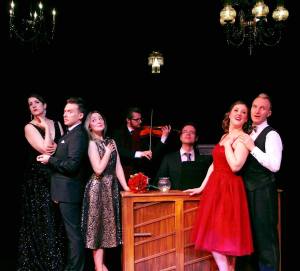
Edmonton’s top musical theatre artists gather on the Varscona stage Oct. 8 for an evening of music that celebrates the groundbreaking canon of the late great composer/lyricist. 

In Hey, old friend! An Evening of Sondheim, they’ll share favourite songs, stories of their experiences wrestling with the multiple complexities of Sondheim, memories of Sondheim shows they’ve done. And you, old friends, will hear songs from such Sondheim hits as Merrily We Roll Along, Into The Woods, A Little Night Music, Sweeney Todd.

To help support 12thnight.ca YEG theatre coverage, click here.

The all-star cast includes John Ullyatt, Andrea House, Ruth Alexander, Kendra Connor, Jenny McKillop, Sheldon Elter, Sue Goberdhan, Chariz Faulmino, Steven Greenfield and Jason Hardwick, as well was students from MacEwan University’s Theatre Arts. 

The evening, which includes a door prize raffle and silent auction (complete with art by Jason Carter), is a shared fundraiser for the Varscona and Plain Jane Theatre’s upcoming chamber-sized production of Sweeney Todd at Co*Lab in November.

Kate Ryan, artistic director of the Plain Janes, a company that lives and breathes in the off-centre lanes of musical theatre, grew up surrounded by Sondheim; his songs were the soundtrack of Ryan family life, “for as long as I can remember.” 

“My dad (the late great director Tim Ryan, founder of MacEwan’s musical theatre program) had a very large collection of albums from earlier work like Gypsy, Saturday Night, The Frogs, to Sweeney Todd and Into The Woods.” (Side note: I remember Tim Ryan gave me a copy of Meryl Secrest’s Sondheim biography; he had three). 

“The first Sondheim song I remember working on for an audition was What More Do I Need from Saturday Night. I loved Liz Callaway’s version from his Birthday Concert album.,” says Ryan. “I worked on it with my dad, who taught me not to gloss over the thoughts, to invest in each one and activate it: my first big introduction to ‘acting a song’…. I still go back to that song and learn more about it because of where I am today.”

Sondheim: the name conjures a world of emotional and psychological complication, verbal playfulness, musical richness in storytelling. Kendra Connor, the executive director of the Varscona, a Plain Jane star with a company history (her first show with Ryan was Drat, the Cat!), says “for me Sondheim kind of bridges the gap between classic and contemporary musical theatre…. He pulled the genre toward expressing human complexity through music and lyrics.” 
“Musical theatre now is so much more raw and real now.” muses Connor. “I’m thinking about shows like Fun Home, Light in the Piazza, Next to Normal, even Dear Evan Hansen — we would not have those without Sondheim.” 

When he adds it up, John Ullyatt has done quite a bit of Sondheim. He’s been the Wolf and Cinderella’s “Agony” Prince in Into The Woods, Tony in West Side Story, the Beadle in Sweeney Todd, Henrik in A Little Night Music, Company (in an Equity Fights Aid benefit)…. 

Into the Woods at the Citadel came early in Ullyatt’s career. So did Sweeney Todd, “a big show for me at the Phoenix…. Jim Guedo took a real chance with me and I had a ton of make-up on. I loved it, and as usual, met tons of people in the community. As a result we can talk about the time when we did that show!” 

“I think the best time I had was doing Henrik in A Little Night Music (at the Grand Theatre and Canadian Stage).” in Hey, Old Friend! he’ll sing Later from that show . “Later … When is later? All you ever hear is ‘later Henrik — Henrik, later’.” 

“I don’t know how many times I sang that song over four months,” says Ullyatt of his history with the part. “But it was never not hard to do.”  

Ah yes, hard. The musical and dramatic challenge of Sondheim is part of the attraction. Ryan, who’s directed Assassins and Into The Woods as well as the revue Sondheim On Sondheim, says when she did a Sondheim cabaret called It Takes Two with Susan Gilmour at the Citadel five years ago, “we spent a good four months learning the material.”

Says Ullyatt, “I guess what all actors seem to like about Sondheim, in fact put him on this massive pedestal, is that it’s difficult to do. But like Shakespeare, it’s all in the text. You really just have to sing the notes and not bump into the furniture. The music is so interesting and not always lovely. You don’t necessarily go out of the theatre singing the songs. But for an actor, you continuously get to dig around and see what else there is to be mined.” 

Connor talks about “how much extra thinking his songs require of the performer. That’s not a complaint! He just requires a lot of listening and concentration from the performer. His rhythms are frequently complex and the chords are often super crunchy. You have to think hard about singing in tune and on time. And then you to have to act on top of all of that.. It’s really satisfying when you nail it.” 

Ryan agrees that Sondheim is “a pinnacle musical theatre experience,” both for artists and audiences. “He leans into the messiness of humanity. He’s not afraid to share the darkness and find the humour and light. But it never comes easy. Sondheim once said ‘nobody goes through life unscathed. You write that, you touch people’.” 

PREVIEW

Hey, Old Friend! An Evening Of Sondheim

Theatre: Plain Jane Theatre and Varscona Theatre

Where: Varscona Theatre, 10329 83 Ave.

Running: Saturday Oct. 8, 7:30 p.m.

Tickets: 780-433-3399 or varsconatheatre.com


Posted in Previews | Tagged , , , , | Comments Off on Hey, Old Friend! The Janes and the Varscona toast Sondheim

Theatre Network at 48: a new season for a new building

Chariz Faulmino and Jameela McNeil (back), Cathy Derkach and Kristi Hansen (front) in Joni Mitchell: Songs of a Prairie Girl, Theatre Network and Wild Side Productions. Missing: Alison Wells. Photo by Ryan Parker

By Liz Nicholls, 12thnight.ca

There are many firsts attached to Theatre Network’s 48th season, announced Thursday. 

The trio of mainstage productions is led by Jim Guedo’s innovative all-new Joni Mitchell musical, and includes a powerful drama by Canadian star Hannah Moscovitch and the premiere of a new cross-disciplinary Eugene Stickland play-with-music. It’s the first full season to be built, rehearsed, and staged in the company’s beautiful new $12 Roxy Theatre, built (amazingly) on the same 124th Street footprint of the ex-cinema that burned to the ground in 2015.

To help support 12thnight.ca YEG theatre coverage, click here.

The mainstage season opens Nov. 22 to Dec. 11 with Stickland’s The Innocence of Trees, a Theatre Network commission and world premiere in which the acclaimed prairie and international star painter Agnes Martin enters a theatre and encounters her younger self. 

“It isn’t simply a bio-play. It’s not a chronology of the artist’s life,” says Theatre Network artistic director Bradley Moss. “Though you are going to learn about it,” the turbulent journey that took the painter from Macklin, Saskatchewan to MOMA, the Museum of Modern Art in New York.

Maralyn Ryan in The Innocence of Trees, Theatre Network. Photo by Ryan Parker.

“It’s aspects of Agnes Martin, it’s ’what drives people?’” says Moss of the play’s capture, an artist’s life and sensibility fraught with mental health challenges.  “It’s a deep dive on her, an exploration…. And the whole building will be engaged, an enhancement of your theatrical experience.” What Moss and TN’s visual arts curator Jared Tabler have in mind is a kind of wrap-around amplification. Some of Martin’s drawings are coming from the University of Lethbridge Art Gallery as well as a photographic series from her time in New Mexico. 

And a team headed by Darrin Hagen plans “to animate the Lorne Cardinal” (the black box second theatre downstairs from the Nancy Power mainstage), with stations and projections. “Wow! The building can do these things,” says Moss, delighted with the as yet unexplored possibilities of the new multi-space theatre. “We experiment and we learn!” 

Moss’s production, which stars Maralyn Ryan and her granddaughter Emma Ryan, includes a projection-scape by Ian Jackson and onstage live music played by cellist and sound designer Morag Northey.   

Something of the same multi-dimensional optic on an artist inhabits Joni Mitchell: Songs Of A Prairie Girl, “a non-linear musical on her life, music, and art” as billed. As creator/director Guedo explained to 12thnight, he spent the pandemic shutdown “completely re-writing” the musical he’d originally created, with Mitchell’s blessing, in 2007, in honour of the Saskatchewan centennial. It was later revived at the National Arts Centre in 2011. 

The complete re-write was motivated at least partially by the dramatic changes in Mitchell’s life since the original piece — a health crisis and a return to performing, notably at the Newport Folk Festival.

As Moss explains, five actors play different aspects of Mitchell, a Canadian artist to whom the descriptive “iconic” does not go amiss: The young Ingenue, the Free Spirit, the Explorer, the Critic, and the Sage. Guedo’s cast includes Alison Wells, Cathy Derkach, Kristi Hansen, Jameela McNeil and Chariz Faulmino, all of whom have to be able to play. And they’re accompanied a live band. The production, in association with Wild Side Productions, runs March 7 to 26. 

Gianna Vacirca in Sexual Misconduct of the Middle Classes, Theatre Network. Photo by Ryan Parker.

The MainStage finale, Moscovitch’s Sexual Misconduct of the Middle Classes, which was to have played TN in its Roxy-on-Gateway temporary home in the spring of 2020, will finally happen. “We would have had the second production in the country,” says Moss. “Now we’re the tenth.” 

“This one really moved me when I read it,” he says of the play that chronicles an affair between a university professor and a student. It’s “a discussion of power and the responsibility of that, such an important conversation in our world.” 

TN and Moscovitch go back, to productions of East of Berlin, Little One, Infinity, What A Young Wife Should Know. Moss is a huge admirer of her writing, “not too much in actors’ mouths, but so much going on! Funny, entertaining, serious….” 

As planned in 2020, Marianne Copithorne directs the TN production that runs April 25 to May 14. Gianna Vacirca will share the stage with John Ullyatt.

The Roxy Performance Series of indie productions in theatre, dance, comedy, music curated and supported by Theatre Network has been officially renamed the Phoenix Series (in honour of the 1997 union of TN with the late Phoenix Theatre). A complete Phoenix lineup hasn’t been finalized; “we announce stuff as it comes up,” says Moss of the work-in-progress. It opens with Alberta Musical Theatre’s production of Jack and the Beanstalk Oct 6 to 9 on the Nancy Power stage, and includes the hit sketch comedy troupe Girl Brain in the Lorne Cardinal Oct. 27 to 30.     

Everything’s a first in the new building. Behind the elegant store-front facade on a busy commercial street in a real neighbourhood, theatre has already been happening since April and Crow’s Theatre’s production of Cliff Cardinal’s As You Like It: A Radical Retelling. “Our first Nextfest” in the new Roxy happened in June. Ellen Chorley ran a theatre summer school there in July. It was a Fringe BYOV in August (Moss directed Ron Pearson’s magic show, his first show in the building). 

A full roster of equipment still awaits delivery and installation, held up by supply chain issues, says Moss. But now Alberta Musical Theatre is working upstairs in the sunlit rehearsal hall next to the offices. And a mainstage season is underway, starting with “our first show to be built in the shop here!” as Moss says of The Innocence of Trees. 

“All kinds of learning are going on,” he says. “Things get revealed; we have to live in a space to know the possibilities.” 

Subscriptions and tickets: 780-453-2440, theatrenetwork.ca.  

, 

Posted in News/Views | Tagged , , , , , , | Comments Off on Theatre Network at 48: a new season for a new building

Behind the scenes in war, a story of human resilience: Barvinok, a review

Barvinok by Lianna Makuch, Pyretic Productions. Photo by Dahlia Katz.

By Liz Nicholls, 12thnight.ca

“My Baba has a secret,” says Ukrainian-Canadian Hania in the opening moments of Barvinok. “A secret she is bringing with her to her grave.”

To help support 12thnight.ca YEG theatre coverage, click here.

As we learn in Lianna Makuch’s suspenseful and moving play, inspired by the experiences of her grandparents, it’s a secret lodged like a wound in Ukrainian history — a blood-soaked history that unspools into a never-receding past in war after war, generation after generation.

Makuch, the Ukrainian-Canadian theatre artist who plays Hania, has named her play after the Ukrainian word for periwinkle, a flower of rare persistence and resilience. And those unlikely survivors frame a story that’s beautifully fashioned from in-person on-location research by the Pyretic Productions team, including the playwright, director Patrick Lundeen and dramaturge Matt MacKenzie, who’ve been to Ukraine multiple times and workshopped the play in Kyiv with Ukrainian actors. 

Across the world from the horrifying “current war” in Ukraine, Baba is confused and tormented in old age by her secret, forged in the cross-hatching World War II brutalities of the Germans and the Russians. In Act I Hania tells us about her attempts to unravel the mystery of Baba’s obsession and nightmares. The old lady is a difficult patient in a long-term care home, haunted as she is by ghosts and convinced she’s been consigned to a prison camp. 

Lianna Makuch, Barvinok, 2018 Toronto production, Pyretic Productions. Photo by Dahlia Katz.

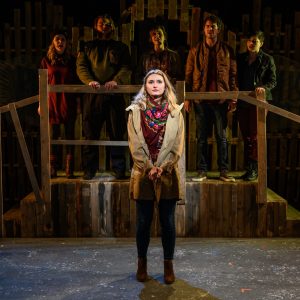
In this monologue Hania is accompanied by a five-member chorus, who sing traditional polyphonic Ukrainian music, and play Ukrainian instruments including the bandora and tsambaly. The musical score, arrangement and direction is the work of Larissa Pohoreski, and it’s a contributing player. In Lundeen’s stunning production, the painterly image of a contemporary Canadian woman surrounded by a shadowy chorus of singers and, in an alcove upstage, a woman playing the bandora, lingers in the mind.

Stephanie Bahniuk’s set design is a beautiful conjuring of memory in itself. Banks of movable, slatted wooden walls, through which light glows, open up and close. Across eight translucent windows, a projection scape (video design by Nicholas Mayne) of human faces and signs of human activity that flickers and disappears. 

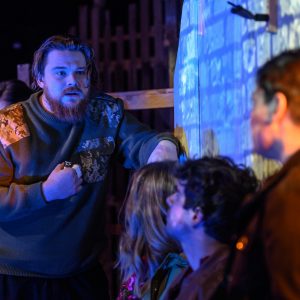
Lianna Makuch in Barvinok, Toronto 2018, Pyretic Productions. Photo by Dahlia Katz.

In Act II, Hania goes to war-torn Ukraine on the trail of Baba’s secret, and its source in another war, World War II, the violence perpetrated by Bolsheviks, and her flight on foot across borders from the German infantry in 1944. And the chorus takes on characters — the so-called “regular people” under perpetual duress Hania meets on her quest into the Eastern Ukraine war zone of 2017. Her goal: to find out what happened to Baba’s relatives.

Thanks to Google and its friend-of-a-friend-of-a-friend’s second cousin- type connections, she travels with a couple of Ukrainian 20-something “fixers,” Misha (Maxwell Lebeuf) and Pavlo (Gabriel Richardson), both played with a kind of gallows humour ease by the actors. The buddies have a jostling camaraderie, and shaded assessments of the war effort, and its costs. Their anecdotes have a mordant, very human kind of inconclusiveness, and their reassurances to Hania always come with a throw-away proviso. “All good. You’ll be fine (pause). Probably.”  

They see bombed-out ghost villages in the Donbas. They cross checkpoints, always insisting they’re neither journalists nor tourists. They see fields formerly occupied by sunflowers now by landmines. They meet wary people who’ve been constantly dislocated from their homes in the search for “a safe haven”: a mother (Kristen Padayas) whose heartbreakingly unattainable dream is simply “an apartment” so her daughter can have friends come and play; a pair of sisters (Alexandra Dawkins and Tanya Pacholok) with unexpectedly different responses to the Russian presence in this occupied territory. 

And what cumulates is a remarkable group portrait of “regular people” who aren’t regular at all. Like the tiny blue flowers, they somehow live and persist under the continual trauma of bloodshed and violence. “No one wanted this,” and the cost is high. “There are good days, and there are other days,” says Pavlo, who’s been terribly injured but sticks around “to fight in whatever way I can.” Says Misha “the farther I look into the future the more tired I am…. Hope dies last.”

Maxwell Lebeuf, Barvinok, Toronto 2018, Pyretic Productions. Photo by Dahlia Katz

He calls Canada Ukraine’s westernmost state. So Hania wonders “do you have family in Canada?” Misha shrugs. “Who doesn’t?” Five years after the play’s present, in the middle of a brutal war in a country across the sea, a country that resonates as never before with Canadians in 2022, Barvinok is a special kind of behind-the-scenes achievement in theatrical storytelling. Its story is gathered from real people; it’s fascinating, enlightening, and heartbreaking to meet them. You shouldn’t miss the chance to see it this weekend before it goes on tour in Alberta.

Have a look at 12thnight’s preview interview with Lianna Makuch here. 

REVIEW

Barvinok

Theatre: Pyretic Productions in association with Punctuate! Theatre

Written by: Lianna Makuch

Directed by: Patrick Lundeen

Starring: Lianna Makuch, Gabriel Richardson, Maxwell Lebeuf, Kristen Padayas, Alexandra Dawkins, Tanya Pacholok

Where: Westbury Theatre, ATB Financial Arts Barn, 10330 84 Ave.

Tickets: pyreticproductions.ca 

Running: through Sunday

Posted in Reviews | Tagged , , , , | Comments Off on Behind the scenes in war, a story of human resilience: Barvinok, a review

Assault by the (corporate) media: Network, opening the Citadel season. A review.

Jim Mezon as Howard Beale in Network, Citadel Theatre/ Royal Manitoba Theatre Centre. Photo by Nanc Price.

By Liz Nicholls, 12thnight.ca 

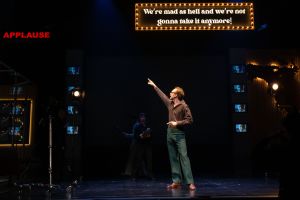
Before memes became meme-ish, when the medical profession had sole ownership of “viral,” there was the scene in Network, the Paddy Chayefsky film of 50 years ago, in which a veteran TV anchor declared “I’m mad as hell. And I’m not going to take this any more.” At that moment Howard Beale, madman, or prophet, or martyr, or all three, gave the television age its very own “to be or not to be” as he lit himself on fire with his own rage. 

Jim Mezon as Howard Beale in Network, Citadel/Royal Manitoba Theatre Centre. Photo by Nanc Price.

In an explosively charismatic, riveting performance by Jim Mezon, Howard Beale goes live on the stage and a dizzying assortment of screens, in the 2017 Lee Hall play, a hit in the West End and then on Broadway, that cracks open the new Citadel season with a mighty roar.

To help support 12thnight.ca YEG theatre coverage, click here.

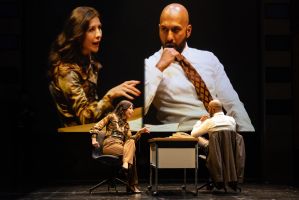
It can rightly be said that Network hits the stage in Daryl Cloran’s high-tech production. It’s a mesmerizing barrage, a multi-screen bombardment of multiplying, mutating imagery, a whirling mélange of ads for cat food and band-aids, news clips, sports footage, sitcom scenes. Real people and cameras, the instruments of surveillance, are right there perpetually moving through the red-alert world of Lorenzo Savoini’s set, obliterating the distinction between all of the above before your very eyes. And a big player is Hugh Conacher’s wonderfully hyperactive video design. 

Meanwhile the lines between so-called “real life” and screen capture shimmer into oblivion: no scene, whether sexual encounter or marriage breakdown or argument, is too intimate not to exist simultaneously in 3-D and close-up in 2- on a screen. And very often it’s the latter that grabs our attention. 

Which is, after all, one of the points of Network — the dehumanizing effect of non-stop media assault — that remain sharp as ever after half a century. “We’ll tell you any shit you want to hear,” cries Howard Beale in one of the extended rants that Mezon delivers so compellingly. “We deal in illusions, man…. We lie like hell.” Taken from Chayefsky’s screenplay more or less directly it is a harbinger of “fake news” and alternative facts. 

The other, of course — enraging both the Beale of 1976 and the Beale onstage at the Citadel in 2022 — is the vanishing point of truth and ethics in the corporatizing of “news,” and its re-creation and re-packaging as entertainment in the relentless pursuit of ratings. “We’re not in the business of morality; we’re in the business of business,” states the ruthless careerist TV producer Diana Christiansen, dismissing ethical objections to exploiting terrorism, or Howard’s apparent derangement, with the steely shrug of someone reporting that the law of gravity is in operation. She’s played with carnivorous obsessiveness — talk of market share as the ultimate aphrodisiac — by the excellent Alanna Hawley-Purvis.  

Jim Mezon in Network, Citadel Theatre/ Royal Manitoba Theatre Centre. Photo by Nanc Price

So, the story: At UBS (say it aloud and you’ll get the point) network, the ratings are tanking, and longtime TV anchor Howard Beale gets canned. When he has a spectacular meltdown on live TV and threatens to blow his brains out, ratings soar. And when he appears on the set in his pajamas, and exhorts his audience to rise up, stick their heads out the window and yell “I’m mad as hell!” the network boomerangs him back into his job. “We’ve hit the motherlode!” gloats Diana. 

In a series of messianic rants, Howard Beale becomes a media superstar. And Network, as a satire of very dark stripe, savours the irony that the ratings explode upward even when he denounces the network’s quest for ratings. Ah, until there’s a slide. And Beale becomes “this Beale business,” a thorn in everyone’s side.

Alana Hawley Purvis and Richard Young in Network, Citadel Theatre/ Royal Manitoba Theatre Centre. Photo by Nanc Price.

You can’t not watch Mezon. His blazing eyes and his booming voice follow you everywhere on a multitude of screens in this convulsive performance. Watchable, too, is Alex Poch-Goldin, very persuasive as Max, the beleaguered UBS news director who’s Howard’s best friend. The subplot in which Max’s own decency erodes enough for him to betray his wife (Nadien Chu) with the tiger who wants his job does seem a little improbable, in truth. So does Hacket, a shark-like upwardly mobile exec, who’s a (loud) one-note panic attack in Richard Young’s performance. 

Braydon Dowler-Coltman in Network. Photo by Nanc Price

There are some intriguing cameos. The fun of Brayden Dowler-Coltman as a preposterously athletic warm-up guy who engages directly with us is a welcome reminder that Network is meant to be a comedy. And so is Michael Peng as the inscrutable network chief Mr. Jensen, who has risen above (or maybe below) the fray. 

What starts in satire (a concept that continues to be eroded by “reality” over and over in the modern age) ends in something else altogether, in the contemporary nuances that this stage adaptation brings to Network. 

Network doesn’t date itself amidst the modern proliferation of screens, or even the disappearance of both fact and truth, and television as the authority that underpins them. No one believes that, which works fine in translating the movie 50 years into its future as a play. Lies and hypocrisy as media fodder, and corporate manoeuvring to wrap that thin diet sensationally, are part of the movie’s eerie prescience. 

But the play must (and in its way does) take into account the downside of advocating for mass populist anger, which hasn’t exactly provided a salutary social corrective. The rise of extremism amongst (scary) people who got mad has seen to that. Discuss!  

In the play, and Mezon’s performance, Beale’s journey into madness takes him from fiercely validating the humanity of the individual to the opposite, to a sense that our future lies in collectivism — we are all just bees in a hive — and beyond, into thoughts about absolutism and democracy. It’s a more elusive, and sometimes perplexing, work than the movie. And I have to admit there was a moment when it all started to get away from me. 

But the theatrical zest and smarts of  Cloran’s production in conjuring the frenzied world of media are irresistible. Network does feel like an immersive experience, a reflection of the way we live, assailed from every direction at high speed. Howard Beale may be crazy but he’s one of us.

REVIEW

Network

Theatre: Citadel and Royal Manitoba Theatre Centre

Written by: Lee Hall, adapted from the 1976 movie with screenplay by Paddy Chayefsky

Directed by: Daryl Cloran

Starring: Jim Mezon

Running: through Oct. 9

Tickets: 780-425-1820, citadeltheatre.com


Posted in Reviews | Tagged , , , , | Comments Off on Assault by the (corporate) media: Network, opening the Citadel season. A review.

Heart and soul in 2 Pianos 4 Hands at the Mayfield. A review.

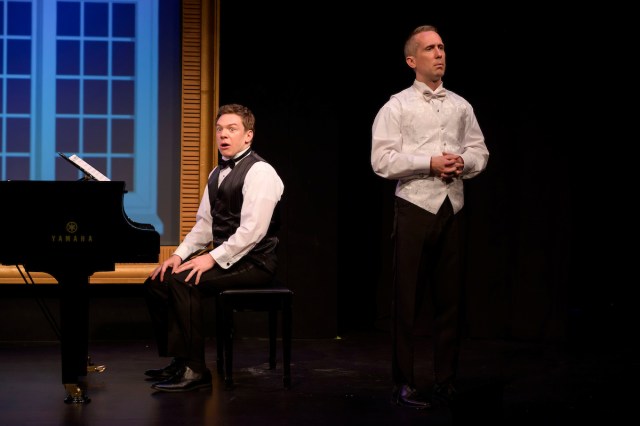
Jefferson McDonald and Matthew McGloin in 2 Pianos 4 Hands, Mayfield Theatre. Photo supplied

By Liz Nicholls, 12thnight.ca

The charming, poignant, and very funny musical comedy now at the Mayfield begins in classic concert fashion: the bow from the waist and the flipping of the tuxedo tails. Two men in formal tuxes take their seats at two facing (Yamaha) grand pianos onstage. 

After a flurry of fussing about 2 piano benches, and whose 2 hands will play which piano, the stars of 2 Pianos 4 Hands, Jefferson McDonald and Matthew McGloin, tuck briefly but impressively into Bach’s Concerto in D minor, a piece of music which to my knowledge has never been on the program music list at the Mayfield till now. No mere tickling of the ivories here. Then they instantly flip into the past, via that indelible signature tune of the youthful piano lesson memory bank world-wide, Heart and Soul.

To help support 12thnight.ca YEG theatre coverage, click here.

The audience emits the amused murmur of recognition. Personally I can’t hear it without remembering my mom yelling from the kitchen “that’s not what you’re supposed to be practising!”

2 Pianos 4 Hands, the much-awarded hit co-created by Canadian theatre stars Ted Dykstra and Richard Greenblatt in 1996 at the prompting of Toronto’s Tarragon Theatre, is a bona fide Canuck theatre success story. And it’s one that comes with a unique history, and a casting challenge to match. Where, after all, besides the co-playwrights, are you going to find actors who can be funny, compelling, and play Chopin Ballades and Liszt’s Mephisto Waltz, and then My Funny Valentine and Piano Man? Hurray for the Mayfield; in Tom Frey’s production they’ve done it. 

As for history, the play has travelled across the country, across borders (including runs Off-Broadway, at the Kennedy Center, in the U.K.), and around the world. Sometimes its creators have been at the 2 pianos (they’ve done 5,000 performances), sometimes not. I remembering previewing the 2013 run of 2 Pianos 4 Hands at the Citadel here in Dykstra’s home town (OK, he’s from St. Albert), one of their so-called “farewell tours.” Ah, more like “till we meet again”: this past June, they played their sixth sold-out Toronto run, at Mirvish’s Royal Alexandra Theatre, in honour of the show’s 25th anniversary. 

Anyhow it’s their story (with embellishments). The discovery they shared a past forged in piano lessons came in 1994 while they were doing a kids’ show, So You Think You’re Mozart, with Dykstra as the piano student and Greenblatt as Mozart, who comes out of the piano. 

Matthew McGloin and Jefferson McDonald in 2 Pianos 4 Hands. Photo supplied

It’s a shared story that will strike a chord (possibly a diminished seventh) with anyone who’s taken lessons in piano — or guitar, or singing, or hockey, or tennis, or … — and discovered they’re very good at it. Teddy and Richie are good enough to dream of being concert pianists, commanding the world’s stages, until the traumatic comeuppance moment, at age 17, when they come to realize that there’s some serious life distance being very good at something and being great. 

What gives 2 Pianos 4 Hands its resonance and its poignance is that turning point, with its realization that the dream, and even the talent,  aren’t enough. It’s about the odds-against factor built into greatness, and what you’d have to give up in order to have that dream come true. The matching scenes in which first Richie and Teddy receive the bad news, from a jazz school and a music conservatory respectively, are genuinely touching. 

In the play, the actors take turns as kid and cocky teen versions of Teddy (McDonald) and Richie (McGloin) and the adults — incessantly nagging parents, a hilarious succession of teachers with amazing accents and opposing instructions about everything, adjudicators, examiners, conservatory principals — in their lives. And McDonald and McGloin turn in sparky and resourceful comic performances, in both idiosyncratic cameos and in dramatic scenes. And that’s in addition to demonstrating major musical chops.

The story arc follows a couple of 10-year-old piano nerds through the aggro of practising when your friends are outside playing, parental intervention, the tension of competition. 

As for the latter, the Kiwanis Festival holds a special place in the nightmares of millions. Here, it’s led, hilariously, by McDonald as a morosely officious oldster announcing “Class 4,561, ‘Duet, 11-and-under,” to wit 67 pairs of children playing exactly the same piece, and lasting four hours. (Question to self: how did my parents survive it? Answer: by smoking outside). A fracas ensues on the piano bench, amusingly, as Teddy freezes and Richie fumes during a disastrous duet performance of In The Hall Of The Mountain King. 

It’s built into the experience of 2 Pianos 4 Hands that both Dykstra and Greenblatt gave up music at 17 and instead found stellar careers in theatre as actors and directors. Edmonton audiences know Dykstra, the artistic director of Toronto’s Coal Mine Theatre, as Ebenezer Scrooge in the Citadel’s A Christmas Carol, as well as the creator of the musical Evangeline. In a curious coincidence, both Dykstra and McMillan, the actor who plays him in 2 Pianos 4 Hands, have had experience pounding the keys as Jerry Lee Lewis, the former in the musical Fire and the latter in the Mayfield’s production of Million Dollar Quartet. 

That’s the thing about music, as you’ll reflect when you see 2 Pianos 4 Hands (and you should, it’s great fun). Music sticks with you. I remember Tommy Banks reminding me once in an interview that however aggravating practising was, you’ll never meet anyone who took piano lessons and quit who doesn’t say they wish they’d kept it up. 

REVIEW

2 Pianos 4 Hands

Theatre: Mayfield Dinner Theatre

Created by: Ted Dykstra and Richard Greenblatt

Directed by: Tom Frey

Starring: Jefferson McDonald, Matthew McGloin

Running: through Oct. 23

Tickets: 780-483-4051, mayfieldtheatre.ca


Posted in Reviews | Tagged , , , , , | Comments Off on Heart and soul in 2 Pianos 4 Hands at the Mayfield. A review.