Love and art in the time of war: First Métis Man of Odesa, at the Citadel. A review

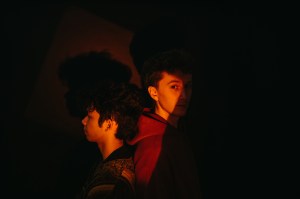
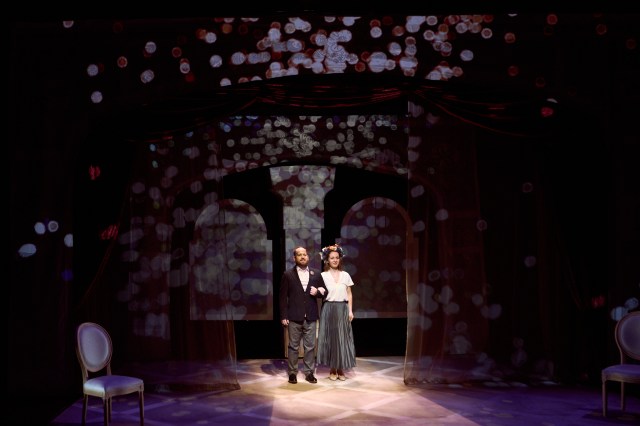
Matthew MacKenzie and Mariya Khomutova in First Métis Man of Odesa, Punctuate! Theatre. Photo by Alexis McKeown.

By Liz Nicholls, 12thnight.ca
“Is this real?” In love and in art it’s the smelling-salts of questions. It can get your attention, startle you, give you a pinch, make you cautious.

To help support 12thnight.ca YEG theatre coverage, click here.

And it gets asked, at every possible angle, with every weight, in First Métis Man of Odesa, a charming, very touching, boldly unconventional play created by and starring husband and wife theatre artists Matthew MacKenzie and Mariya Khomutova. For one thing, in Lianna Makuch’s Punctuate! Theatre production that arrives on the Citadel’s Rice stage as part of a cross-country tour, the pair play versions of themselves in a version of their own love story — bi-continental, wildly odds-against.

Is this real? Well, their own presence onstage together at the end means that after the play the story is to be continued, backstage so to speak, in real time in the real world. And the real world by the end, against the landscape of continuing Russian atrocities in Ukraine, isn’t what it was, to say the least.

Matt, the stage version of the notable Canadian Métis playwright MacKenzie (Bears, The Particulars, The Other), tells us at the outset that he’s not an actor. We have no reason to doubt him. But it does cross your mind that his performance, stand-and-deliver, wooden in an old-growth tree sort of way, suits his particular kind of wit: deadpan, self-deprecating, based on the humour of understatement and the well-timed pause.

In this MacKenzie stands in contrast to his wife, star Ukrainian actor Khomutova, who exudes easeful theatrical charisma onstage. Her performance is supple, engaging in every puckish aside and skeptical smile to the audience. Masha is teasing and fierce, romantic in a way that “the peculiar fellow with kind eyes and a big forehead” as she describes him, is not.

They engage the audience in different ways. Métis Man of Odesa has an appealingly oddball performance chemistry that finds its parallel in the story itself. In the courtship chapter, that’s fun, and funny.

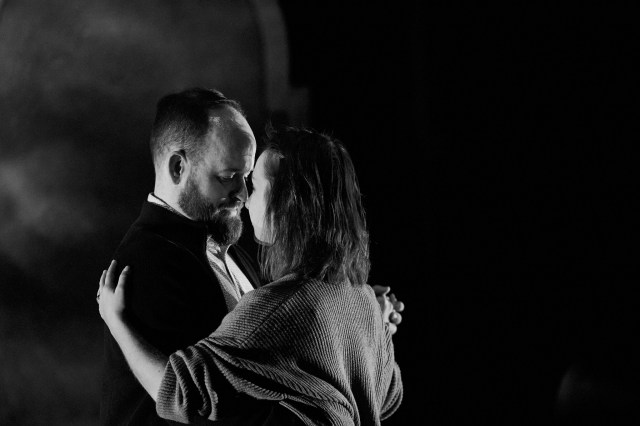
Matthew MacKenzie and Mariya Khomutova in First Métis Man of Odesa, Punctuate! Theatre. Photo by Alexis McKeown

Romantic comedies find their love stories in the attraction of couples who are unlikely, separated by obstacles to be overcome. Here, there are hints of dark global currents in the opening scene, and the chance meeting of the pair in a theatre in Ukraine, in a workshop production of Barvinok, by Métis Man of Odesa director Makuch. It’s based on real-life interviews with volunteer Ukrainian soldiers in the 2014 Russian invasion, and their ominous (and ignored) reminders that the Russians will not stop there.

True, Matt and Masha are both ‘theatre people.’ But MacKenzie comes from the world of indie Canadian theatre, with its embrace of the personal, the real-life confessional. Masha, on the other hand, is a creature of ‘high culture’, the classical theatre and its traditions. In art, the question “is this real?” has very different meanings for them.

The beautiful and witty design, by Daniela Masellis and projection specialist Amelia Scott, is a series of frames, with allusions to the red velvet drapes, the pillars and panels, of classical theatre.  There’s a gauze curtain too, which the characters pull across the stage intermittently, as a signal of separation and disconnection, stage business that doesn’t quite land, so far, in the production.

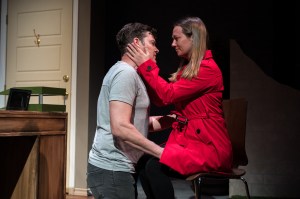
Matthew MacKenzie and Mariya Khomutova in First Métis Man of Odesa, Punctuate! Theatre. Photo by Alexis McKeown.

The banter and cross-cultural asides of the characters are amusing. “A premiere without champagne is … a field without wheat,” she teases him. In Canada, the good luck theatre mantra is “break a leg.” In Ukraine, it’s “I hope you don’t get a single feather,” equally enigmatic. I’ll just have to think about that one, and get back to you.

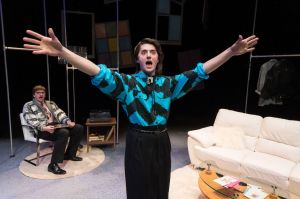
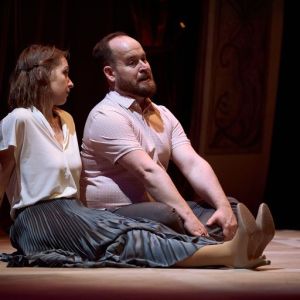
Mariya Khomutova and Matthew MacKenzie in First Métis Man of Odesa, Punctuate! Theatre. Photo by Alexis McKeown

Hundreds of FB messages later, the Atlantic gets crossed, both ways. For Matt, Odesa means euphoric starlight strolls by the Black Sea. And his future father-in-law likes him:. “He thinks I look like Paul Giamatti. And I’m not an alcoholic.” For Masha, “Toronto is amazing!” she declares. Pause. “I can’t believe she thinks Toronto is amazing,” declares Matt.

When the pandemic enters the story, a romantic comedy darkens, and the pace gets breathless, as the production conveys. Just as Masha discovers she’s pregnant, borders close, passports and nationalities and health care become real obstacles. And in a suspenseful race to “sneak into Ukraine” amid travel restrictions, to have a wedding so that Masha can come to Canada for the birth, Matt becomes an unlikely action hero. The wedding dance to the strains of Céline Dion, feels triumphal (recounted in hilarious shared fashion by the bride and the groom). And so does the birth of Ivan. This is the COVID love story iteration of Métis Man of Odesa we heard in a 2021 podcast from Factory Theatre.

And then the tone and the pace change again. When a story is stage-managed by “the real” that’s apt to happen, of course. A couple has been propelled by circumstances into each other’s arms before they’ve gotten to know each other, beyond differing views on the colonialist residue of classical theatre. At breakneck speed they’re an insta-family, married, with a perpetually sleepless baby, living in Toronto.

Mariya Khomutova in First Métis Man of Odesa, Punctuate! Theatre. Photo by Alexis McKeown.

Matt is suddenly a dad, with responsibilities. And Masha is a stranger in a strange land, who’s left everything and everyone thinking that it’s temporary until their return to Odesa. Which is when war breaks out, the stunningly brutal Russian invasion of February 2022. And Masha, as Khomutova conveys so heartbreakingly, is shattered, guilty about being so far from her family and her friends. For “everyone I have ever known,” life is now a matter of “Before and After,” as she says, longing for the time pre-Matt pre-Ivan “before life got real.”

The disconnect between the couple grows, not least because of the presence of Masha’s mom, rescued from Odesa. And when Matt suggests making a play from their experience, Masha accuses him of being a sort of trauma adventurer. “I’m not going to be the source of inspiration for your next play.”

We know that there’s a resolution, in love and art if not in war. We are, after all, watching that play, and Khomutova is the co-writer. What is the connection between art and life supposed to be? If ever there was a play that wondered about that relationship, it’s this one. It doesn’t fit together neatly, and director Makuch gives it room to be its own play, a captivating swirl of comedy, romance, dreams and setbacks, the personal and the geo-political. The proposition on offer, demonstrably, is that revealing the human side of terrible events in art is worthwhile, a cause for hope. And as the news rolls on, inexorably, we root for real people struggling to have a normal life.

Meet the co-creators (and stars) Matthew MacKenzie and Mariya Khomutova in this 12thnight PREVIEW.

REVIEW

First Métis Man of Odesa

Theatre: Punctuate! Theatre in the Citadel Highwire Series

Written and performed by: Matthew MacKenzie and Mariya Khomutova

Directed by: Lianna Makuch

Running: through May 13

Tickets: 780-425-1820, citadeltheatre.com

Posted in Reviews | Tagged , , , , | Comments Off on Love and art in the time of war: First Métis Man of Odesa, at the Citadel. A review

‘Legal but complicated’: Hannah Moscovitch’s Sexual Misconduct of the Middle Classes, at Theatre Network

John Ullyatt and Gianna Vacirca in Sexual Misconduct Of The Middle Classes, Theatre Network. Photo by Eric Kozakiewica Photography

By Liz Nicholls, 12thnight.ca

“You cannot shoot vampires during the day,” says Hannah Moscovitch, from a car across the world in Prague at 5 in the afternoon.

The star Canadian playwright is driving past beautiful old buildings and cherry trees in blossom. She’s en route to her nocturnal working day — in the pressurized world of television. Heading to the set where season 2 of Interview With The Vampire is in its third week of shooting. Last season, part of it spent in L.A.,  she was in the story room of the AMC series adapted from the hot Anne Rice novel, “working on scripts, pitching ideas.” This time, on a shoot that lasts till August, she’s on set as a co-executive producer, “a sort of writer/producer” she explains.     

“Vastly different from theatre,” says the Ottawa-born author of Sexual Misconduct of the Middle Classes, the Governor General’s Award winner of 2021, finally opening at Theatre Network Thursday. Moscovitch’s Canadian theatre life, of writing alone “during daycare” hours, has changed, dramatically. Nightly she sits on set, supervising scripts, “surrounded by 400 people, “people with 20 or 30 years of experience in television, people who worked on Mad Men, Breaking Bad, or The Crown….It’s like 12-hour cue-to-cue days” (the relentless technical countdown week to opening night in live theatre), but it’s for months at a time. “It’s like a year of being in previews.”

To help support 12thnight.ca YEG theatre coverage, click here.

And (blame vampires for this) again we’ve found ourselves talking about time: the way it turns night into day, or compresses itself to squeeze through cracks, or can be made — even if, like Moscovitch, you really don’t have any. Or not made. After all, she has never even had time to see the hefty two-part six-hour stage adaptation of Ann-Marie MacDonald’s sweeping novel Fall On Your Knees that she and director Alisa Palmer co-created in the course of 13 years, as it finally opened in four big Canadian theatres this season.

Last time we talked, five years ago, Moscovitch was in New York, for the Off-Broadway opening of the klezmer musical/ song cycle/ folk tale Old Stock: A Refugee Love Story, her hit collaboration with Ben Caplan and (her husband) Christian Barry of Halifax’s 2b Theatre.  It was the eve of Infinity at Theatre Network, a veritable Edmonton home for Moscovitch plays (their shared history that includes What A Young Wife Ought To Know, Little One, East of Berlin). And time was on her mind, not least because Infinity is a love story embedded into a time capture, the ultimately futile quest of a theoretical physicist to prove that time is “a persistent illusion.”

playwright Hannah Moscovitch

With Sexual Misconduct of the Middle Classes, the playwright is struck, she says, by its defiance of time. “A play I started writing in 2014, before Harvey Weinstein and #MeToo, before and Jeffrey Epstein” has, if anything, gained topicality.

Time has passed. Moscovitch’s theatre career has expanded explosively — into opera (Sky on Swings, 10 Days in a Madhouse) and onto the screen. Little Bird, co-created by Moscovitch (its executive producer) and Jennifer Podemski for Crave and APTN begins streaming May 26). As for Sexual Misconduct, originally planned and in rehearsal as the Canadian premiere at Theatre Network in 2020, the pandemic has delayed it again and again. The play has been produced across the country since then. TN, where time is no “persistent illusion,” has built and opened a entirely new theatre from the ground up in the time since Marianne Copithorne’s production was first programmed.

Gianna Vacirca in Sexual Misconduct of the Middle Classes, Theatre. Network. Photo by Ryan Parker

At the centre of Sexual Misconduct is the dynamic between a charismatic hotshot professor/ author at the end of his third marriage, and the talented 19-year-old student who’s a big admirer. Sexual attraction ensues, and escalates. The provocative edge is that Moscovitch has given the voice of the play to Jon, not Annie.

In 2017, Sexual Misconduct got a reading at Seattle Rep. “#MeToo hadn’t started; it’s almost impossible to stretch your mind back” to the before, says Moscovitch. “I was really frightened the entire audience would side with Jon, and despise Annie for exposing him…. And they didn’t! The opposite happened.”

“Maybe it was because it was Seattle? Maybe my own paranoia about how the story would be received by the audience? But I’ve never been so wrong, so fundamentally wrong, about audience reaction to one of my plays,” says Moscovitch. “They booed him at the end.”

The audience of 150 included a lot of female students. “And 30 or 40 stayed afterward to talk to me, one by one, about their similar experiences…. It was familiar to them; they knew what this was about.”

In retrospect, she can’t help but think “#MeToo was in the air, poised to happen. This was a precursor…. I hadn’t understood, in my mind, there had been a cultural shift. And people were thinking differently about whether it’s OK to sexually assault women. Because for so long it’s been kind of, you know, OK.”

Sexual Misconduct walks such a line,” says Moscovitch. “What happens in it isn’t illegal. It’s not rape. It’s not statutory rape; she’s 19. It’s consensual…. It’s one of these relationships in which there’s this massive imbalance of power. And also an age difference.” She says “I wanted to go after something that’s legal, but complicated.”

As Moscovitch points out, “it calls into question whose perspective through which we view these kinds of romances…. We’ve always watched them from a male perspective. And If you shift to a female one, you go ‘Oh? Really? What is happening? And why do we think it’s OK?” In a situation where a man has “a massive amount of power, to what degree does that sway one’s ability, truly, to consent?”

“I think about this a lot,” she says. “When I was growing up, there was Bill Clinton and Monica Lewinsky. And I know who took the blame. She was an intern and he was the president of America. She gave him a blow job and got called a slut and a whore and it ruined her life, and he came out of it beautifully. We know who’s to blame when any sexuality happens, consensual or not….”

“So that’s what I expected would happen with my play. And that’s NOT what happened,” says Moscovitch, returning to the idea of a cultural shift.

Cole Humeny and Merran Carr-Wiggin in What A Young Wife Ought To Know, Theatre Network. 2018 photo by Ian Jackson.

Moscovitch has explored blame, revenge, and guilt in other plays, among them What A Young Wife Ought To Know (directed at Theatre Network by Marianne Copithorne in 2018) with its cautionary perspective on reproductive oppression, and Bunny, in which a young woman reviews her sexual history. And the slide to the right and regressive social currents in the U.S. feel like they come from a similar place, Moscovitch thinks. “It’s fine to blame women for sexuality; it’s fine to punish women for having sex, for rape, for unplanned pregnancy, for sexual assault, for sexual harassment….” There’s an audible sigh from Prague on the phone.

So why hand the ball to Jon, like many of Moscovitch’s narrators aware that there may be some challenges from the audience? Why give him so much leeway to try and justify himself? “That’s the dominant perspective; that’s how our culture works. We’re all going to be on his side, “says Moscovitch. “I didn’t want to write a female point of view play. I wanted to make everyone shift their perspective at a certain point.”

“One of the funniest outcomes has been that men sometimes mansplain that I should have done it all through the female perspective. That I’m not a good feminist. Which makes me laugh every time.”

PREVIEW

Sexual Misconduct of the Middle Classes

Theatre: Theatre Network at the Roxy

Written by: Hannah Moscovitch

Directed by: Marianne Copithorne

Starring: Gianna Vacirca, John Ullyatt

Running: through May 14

Tickets: 780-453-2440, theatrenetwork.ca


Posted in Previews | Tagged , , , , , | Comments Off on ‘Legal but complicated’: Hannah Moscovitch’s Sexual Misconduct of the Middle Classes, at Theatre Network

After the funeral: Darrin Hagen’s dark comedy 10 Funerals premieres at Shadow Theatre

Nathan Cuckow and Doug Mertz in 10 Funerals, Shadow Theatre. Photo by Ian Jackson, Epic Photography.

By Liz Nicholls, 12thnight.ca

“Funerals,” says the booming baritone voice on the phone, “are so weird.”

Darrin Hagen is something of an expert. And if there ever was a year to confirm it, it’s been this one, allegedly (but only allegedly) post-COVID, says the playwright/ actor/ director/ composer/ sound designer/ queer activist/ historian. Funerals are a recurring Hagen motif, in life as well as art: scattering his father’s ashes, losing his best friend Catherine, mourning Richard Gishler, the skilled comic actor for whom he’d created a role in a dark comedy about funerals (and writing him a requiem instead). And there’s co-creation of Unsung, an immersive theatre piece he researched and co-created with Workshop West’s Heather Inglis that documents the experience of Alberta health care workers during the pandemic as the provincial government dithered and the death toll mounted.

To help support 12thnight.ca YEG theatre coverage, click here.

Yes, the author of 10 Funerals, finally premiering Thursday at Shadow Theatre after a two-year pandemical delay, has a history with funerals. After all, when he bolted from small-town Rocky Mountain House into the big city in the ‘80s, and was baptized into the flamboyant drag queen world, the AIDS crisis claimed cast-mates, friends, acquaintances, one after another. So much has changed, and so much hasn’t.

10 Funerals had double roots, as Hagen describes. One inspiration was comic: Vicious, a TV sitcom starring Ian McKellen and Derek Jacobi, about an old gay couple who’d been together for 50 years. “Why isn’t there more out there about aging gay couples?” wondered Hagen, who found it hilarious. “What about the end of the story?”

Then “I went to a funeral for a friend in 2016, and was just saddened by how few people were there, compared to the old Flashback days.” Unexpected perhaps, considering these more “enlightened” times.  “But there was a sense of community then, a defiance about showing up for the ‘chosen family’” when birth families often didn’t.

“Wouldn’t it be interesting,” Hagen asked himself, “to watch a couple aging through funerals…. Kevin (Hagen’s life partner Kevin Hendricks) and I were completely different people in the ‘80s. Funerals were a marker of our own development.”

Jake Tkaczyk and Josh Travnik in 10 Funerals, Shadow Theatre. Photo by Ian Jackson, Epic Photography

That idea has found its way into the structure of 10 Funerals, which follows a gay couple returning from a funeral in each of the play’s 10 scenes, “moving forward three years at a time from when they were in their 20s.” They’re played by Doug Mertz and Nathan Cuckow as the older couple version, Jake Tkaczyk and Josh Travnik, in a succession of wigs (costume designer: Leona Brausen), as the younger.  

Hair is ephemeral. Weight? Well, you never know. Time has its effect on life goals, relationship dynamics, ideas about mortality. “Only height doesn’t change,” laughs Hagen.

“Am I obsessed with death?” he wonders. 10 Funerals isn’t exactly his first rodeo in that respect. “Funerals are everywhere in the first thing I wrote, The Edmonton Queen (play and book),” says Hagen of his memoir of the small-town kid’s coming-of-age in the drag scene in Edmonton. Guys in Disguise’s first Fringe appearance Delusions of Grandeur  — “a two-hour drag show with a play at intermission” as he puts it — happened in 1987 on “the night a friend was murdered.”

But the show must go on, as that unforgiving theatre mantra has it. “That’s what kills me about this fucking business,” he sighs. Hagen, who’s “worked non-stop since last June” (his documentary about the 25th anniversary of the Vriend decision comes out this June), thinks that vis-à-vis death, “theatre is all embrace/denial. We can’t stop.”

playwright Darrin Hagen. Photo supplied.

Hagen’s Tornado Magnet, whose protagonist Dotty is the queen of the trailer park, opened on the 10th anniversary of Black Friday, a day of elemental fatality at the Evergreen trailer court. Pile Driver, inspired by the gay prairie wrestling circuit, marked one of the last theatrical appearances of Joe Bird, who passed away far too young in 2009. The list goes on.

Have the three pandemical and death-centric years that have intervened since the creation of 10 Funerals and its first workshop in 2018 changed the tone, the weight, the colours of a play created as a black comedy? Hagen considers. “When Richard (Richard Gishler) died, that changed everything,” he says finally “I was crushed, saddened…. It’s as if we’re just an accident of timing. I think how quickly life can change. And it really sent that home to me.”

“It’s such a cruel robber of our dreams. Richard’s last performance was his Zoom reading of my play. And it’s just not fair…. He died during that dark time. And the pandemic has made us all re-evaluate.”

“There’s a real-ness to the play now that can’t be avoided,” says Hagen. “And some lines get a new resonance.” A casual remark of the couple returning from an AIDS funeral, that “they’d never let that happen again” echoes with a new irony now in COVIDian times.

10 Funerals, after all, was written “pre-Black Lives Matter, pre-#MeToo, pre-schisms in the gay community,” says Hagen. “We’ve emerged back into a world that’s radically different. But after the Forced Pause, I still think it’s a comedy.”

PREVIEW

10 Funerals

Theatre: Shadow

Written by: Darrin Hagen

Directed by: John Hudson

Starring: Doug Mertz, Nathan Cuckow, Jake Tkaczyk, Josh Travnik

Where: Varscona Theatre, 10329 83 Ave.

Running: Thursday through May 14

Tickets: 780-343-5564, shadowtheatre.org

Posted in Previews | Tagged , , , , | Comments Off on After the funeral: Darrin Hagen’s dark comedy 10 Funerals premieres at Shadow Theatre

‘A dream within a dream’: Catalyst’s Nevermore, in a 15th anniversary concert version

Scott Schpeley as Poe in Nevermore: The Imaginary Life and Mysterious Death of Edgar Allan Poe, Catalyst Theatre. Photo by Joan Marcus

By Liz Nicholls, 12thnight.ca

“All that we see or seem is but a dream within a dream.”

Consider it a haunting (a subject on which Edgar Allan Poe is something of an authority). Nevermore: The Imaginary Life and Mysterious Death of Edgar Allan Poe, Catalyst’s much travelled musical play/fantasy/fairytale returns to celebrate its 15th anniversary in a concert version — with the original cast.

Weird and witty, and, yes, wrapped in the chilling mist of the Great Beyond, Catalyst’s original creation — book, music and lyrics by Jonathan Christenson; set, lighting and costumes by Bretta Gerecke — is a kind of theatrical hallucination. It imagines Poe’s doom-laden life as one of his own gothic phantasmagorical thrillers. As the number A Dream Within A Dream has it, “the terrors that troubled his sleepless nights/ crept increasingly into his days…. “

Nevermore, in a stripped down concert version that leans into the story and music, is here for three performances Friday and Saturday. Then the company leaves for a run of a full staged production at Vertigo Theatre in Calgary.

It’s a signature Catalyst piece — boldly stylized visuals and striking physicality, that marries music and text in an off-centre way. And it has a storied history. Co-commissioned by the Luminato Festival in Toronto and the Magnetic North Festival in Ottawa, it had a joint premiere in 2009 at the National Arts Centre and the Winter Garden in Toronto, after a preview run in Fort MacMurray and Catalyst’s former Strathcona black box (now the Gateway Theatre).

Nevermore is a traveller. It’s crossed the Atlantic to the London International Festival of Theatre (LIFT) and Barbican International Theatre Events (BITE). It’s played the PuSh Festival in Vancouver and the High Performance Rodeo in Calgary, among other theatres across this country. Gerecke’s wildly fancily costumes — “a LOT of masking tape, paper maché, landscape fabric, flex glue, and sticks from the back of our old building” says managing director Lana Michelle Hughes — have been to New York twice, and recorded a cast album there, too.

During a four-performance run at the New Victory Theatre on 42nd St. it caught the eye of producers M. Kilburg Reedy and Jason Grossman, and moved Off-Broadway at New World Stages in 2015. The omens were with it: The New York Times reported at the time that ravens, absent from New York for more than a century, had returned.

In Catalyst’s collaborative fashion, the piece has remained in the repertoire and in development, with changes in music, text and design every time out. “And it’s changed again,” says Shannon Blanchet. “It’s never the same. That’s part of what makes the rehearsal process fun.” Garett Ross agrees. “Everything feels new; it’s never complacent.

Speaking as we are of haunting, most of the original cast have remained with the show. Ross and Blanchet have been in every run of Nevermore, from the beginning in Fort MacMurray in 2008. “Every day we rehearsed; every night a different show,” remembers Blanchet, who plays Elmira, Poe’s first love. “Very exciting!” The song Edgar Met Elmira is “one of the least changed numbers in the show.”

The characters have evolved in each iteration. Ross, who plays Jock Allan, Poe’s reluctant businessman stepfather, thinks the character has become fuller since his “Disney villain” days.

The last time they did the show was 2015 in New York. Eight years later, director Christensen presides over a veritable cast reunion. The appeal of the piece and the ensemble remains. “I’ve always loved the macabre, and the darkness of the piece,” says Ross. “And the people, we clicked really well,” he says of his cast-mates (who include Sheldon Elter, Beth Graham, Ryan Parker, Vanessa Sabourin, and Scott Shpeley).

Blanchet, a drama prof at the University of Saskatchewan these days, talks about “the joyful rigour of Nevermore, what it asks of everyone, including the stage manager, production team, design…. It requires a focus that is restorative. That, and the poetry of the language, the mystery of the story. A beautiful piece of alchemy.”

As Poe put it, “there is no exquisite beauty … without some strangeness in the proportion.”

Nevermore In Concert runs live Friday at 7:30 and Saturday at 2:30 and 7: 30 p.m. at the Betty Andrews Recital Hall (Allard Hall at MacEwan University). The Saturday evening performance is also live-streamed. Tickets: catalysttheatre.ca.

Posted in News/Views, Previews | Tagged , , , , , | Comments Off on ‘A dream within a dream’: Catalyst’s Nevermore, in a 15th anniversary concert version

The Freewill Shakespeare Festival’s new home for the summer: a vintage spiegeltent at Edmonton EXPO Centre

Cristal Palace Spiegeltent, where Freewill Shakespeare Festival will perform this summer. Photo by West Coast Spiegeltents

By Liz Nicholls, 12thnight.ca

For their resident playwright, it’s the big 4-5-9. For the Freewill Shakespeare Festival, it’s season 34, and full of mid-play dramatic developments.

To help support 12thnight.ca YEG theatre coverage, click here.

Evicted from their home stage by the lunatic City plan of a three-YEAR closure for Hawrelak Park renos, the Freewill company has have been scrambling to find its footing on the move. As of Shakespeare’s birthday Sunday they have exciting news of a new home for their upcoming two-play rep edition — Twelfth Night alternating with Romeo and Juliet — that will rescue them from a life of wandering this summer.

A tent is involved. But no one (sane) would call it camping: it’s a vintage spiegeltent (Flemish for mirror tent, or travelling dance hall), built in Belgium in 1947. As Freewill artistic director Dave Horak explained at Will’s birthday bash Sunday at Metro Cinema, the hand-made spiegeltent where you’ll see a besotted duke declare “if music be the food of love, play on” and Juliet wonder “wherefore art thou Romeo?”, from Aug. 8 to Sept. 3, is a real beauty, a work of art in itself. This “Cristal spiegeltent,” as this example is called, is lined with hundreds of mirrors and stained glass; it has French oak floors. And it will house an audience of about 220.

Cristal Palace Spiegeltent. Photo by West Coast Spiegeltents.

Explore Edmonton’s arts programming manager Fawnda Mithrush explained that the tent — one of only three actively touring spiegeltents in North America (32 in the world) — will be set up at Edmonton EXPO Centre (7515 118 Ave.) for the entire summer. Rented from West Coast Spiegeltents, it will house shows during a reimagined version of Klondike Days and more; the lineup will be announced by Explore Edmonton in the next few weeks.

Cristal Palace Spiegeltent. Photo by West Coast Spiegeltents

The Shakespeare productions will be trimmed to suit the smaller spiegeltent venue. And both will happen in the round, surrounded by the audience. As Horak explained, a cast of 10, a mix of veterans and newcomers, will be in both productions, in the bold contemporary Freewill house style. He himself will direct Romeo and Juliet for the first time, “a beautiful quick, passionate, hot play,” he says. And Twelfth Night, a mysteriously manic and multi-hued blend of melancholy and joy, mistaken identity and self-discovery, will be under the direction of up-and-comer Amanda Goldberg. The comedy, she says, is a wonderful opportunity “to explore gender identity through the queer lens of today.”

Jessy Ardern and Christina Nguyen are Romeo and Juliet, star-cross’d victims of a long-standing generational feud. In Twelfth Night Nguyen is Viola, one of Shakespeare’s most resourceful and agile heroines, with Kristin Unruh as Olivia, Scott Shpeley as Orsino, and Troy O’Donnell as Malvolio. The double-duty Freewill cast also includes Brett Dahl, Dean Stockdale, Graham Mothersill, Nadien Chu, and Yassine El Fassi El Fihri.

Romeo and Juliet and Twelfth Night alternate between Aug. 8 and Sept. 3. Tickets (already on sale!) and the full performance schedule are at freewillshakespeare.com.

Posted in News/Views | Tagged , , , , , , , , | Comments Off on The Freewill Shakespeare Festival’s new home for the summer: a vintage spiegeltent at Edmonton EXPO Centre

Happy 4-5-9 Will! Brush up your Shakespeare with our quiz

By Liz Nicholls, 12thnight.ca

You get to know a lot of people in 459 years. And vice versa. It’s Shakespeare’s birthday today. And the Freewill Shakespeare Festival, evicted from their usual home in Hawrelak Park for a three-YEAR City of Edmonton reno (another story), announces their 34th annual summer season of two plays (Twelfth Night and Romeo and Juliet, as revealed in a January 4 12thnight post) this afternoon. It’s obviously the moment to test your knowledge of Freewill’s resident playwright, the heavy-hitter from Stratford. Try our little 12thnight.ca quiz. (Answers are at the bottom).

1.  Which of the following phrases was NOT created by Shakespeare? a. “let them eat cake” b. “sick at heart” c. “what the dickens” d. “the world is my oyster” e. “clothes make the man” f. “it was Greek to me” g. “from here to eternity”

2. Name the Shakespeare play that begins with … a. “O for a Muse of fire …”  b. “If music be the food of love, play on …” c. Who’s there? d. “Two households, both alike in dignity/ In fair Verona, where we lay our scene …” e. “Now is the winter of our discontent …”

3. Which of the following book/play titles is NOT taken from a Shakespeare play? a. The Mousetrap by Agatha Christie b. The Sound and the Fury by William Faulkner c. Brave New World by Aldous Huxley d. Sense and Sensibility by Jane Austen. e. The Wind in the Willows by Kenneth Grahame

4. Which of the following Shakespeare plays has never been produced by Edmonton’s Freewill Shakespeare Festival? a. Titus Andronicus b. Two Gentlemen of Verona c. All’s Well That Ends Well d. The Merry Wives of Windsor

5. To avoid terrible luck, according to theatre lore, which Shakespeare play should never be named aloud within a theatre? a. All’s Well That Ends Well b. Coriolanus c. Pericles d. Macbeth

6. Shakespeare was playwright-in-residence, for most of his career, at which theatre company? a. The South Bank Players b. The Lord Chamberlain’s Men c. The Stratford Little Theatre c. The Theatre Royal

7. Shakespeare is associated, most famously, with the Globe Theatre in the London entertainment district south of the Thames. But what was the first London theatre where Shakespeare’s company put on plays? a. The Theatre b. The Rose c. Blackfriars Theatre d. The Wintergarden

8. The first Globe Theatre burned to the ground in 1613. What caused the blaze? a. Groundlings smoking b. A dropped torch in Act I of Hamlet  c. The Great Fire of London d. a stage cannon igniting the thatched roof during a performance of Henry VIII

9. In which Shakespeare play do the following events occur? a. A man’s eyes are gouged out b. a queen is served a meat pie into which her sons have been baked c. a forest moves d. two pairs of lovers get re-matched when magic juice from a flower gets sprinkled on their eyelids.

10. Which Shakespeare character said …  a. “the slings and arrows of outrageous fortune” b. “all the world’s a stage …” c. “what’s done is done …” d. “once more unto the breach, dear friends, once more …” e. “we are such stuff as dreams are made on …” f. “but soft! what light through yonder window breaks?”

11. On the theory that “the man from Stratford” — an actor from the sticks who didn’t go to university — couldn’t possibly have written the Shakespeare canon, scholars and miscellaneous cranks have put forward a variety of names as alternative candidates. Which of the following names isn’t one? a. Edward de Vere, Earl of Oxford b. Francis Bacon c. Ben Jonson d. Sir Walter Raleigh e. William Stanley, Earl of Derby f. Christopher Marlowe

12. How many stand-alone sonnets did Shakespeare write? a. 226 b. more than 1,000 c. two dozen d. 154

13. Which Shakespeare play contains the following plot devices? a. a bear b. three caskets (one gold, one silver, one lead), a pound of flesh, and 3,000 ducats c. two sets of twins with the same name d. a bracelet, a trunk, a tranquillizing potion, and a headless corpse e. yellow stockings, cross-gartered

14. Which of the following Shakespeare plays involves a woman disguising herself as a man? a. Cymbeline b. Twelfth Night c. As You Like It d. The Merchant of Venice e. Two Gentlemen of Verona

15. Shakespeare’s dad was … a. a lute-maker b. a thatch-roofer c. an entertainment lawyer d. a glover 

16. In Shakespeare’s will he famously left which of the following to his wife Anne Hathaway?  a. a ruff from the premiere production of Twelfth Night at court b. his second-best bed c. his favourite quill pen set d. the script for a now-lost play called Cardenio e. his broadsword with the fancy hilt inscribed by Queen Elizabeth I

17. Which Shakespeare play has the most lines? a. King Lear b. The Comedy of Errors c. Hamlet  d. The Taming of the Shrew

And here are the answers: 1. a, g. 2. a. Henry V, b. Twelfth Night, c. Hamlet, d. Romeo and Juliet, e. Richard III. 3. d, e. 4. c. 5. d. 6. b. 7. a. 8. d. 9. a. King Lear, b. Titus Andronicus, c. Macbeth, d. A Midsummer Night’ Dream. 10. a. Hamlet, b. Jaques, c. Lady Macbeth, d. Henry V, e. Prospero, f. Romeo. 11. c., 12. d. 13. a. The Winter’s Tale, b. The Merchant of Venice, c. The Comedy of Errors, d. Cymbeline,  e. Twelfth Night. 14. all of them. 15. d. 16. b. 17. c.


Posted in Features | Tagged , , , | Comments Off on Happy 4-5-9 Will! Brush up your Shakespeare with our quiz

An incandescent performance in the kingdom of ice: A Hundred Words For Snow, a review

Dayna Lea Hoffman, A Hundred Words For Snow, Northern Light Theatre. Photo by Ian Jackson, Epic Photography

Dayna Lea Hoffmann in A Hundred Words For Show, Northern Light Theatre. Photo by Ian Jackson, Epic Photography

By Liz Nicholls, 12thnight.ca

We surround an ice floe that seems to float in a sea of white. It’s overhung by translucent icicles. And there on a pillar of ice, lit from within, is an urn.

Alison Yanota’s design for A Hundred Words For Snow, with Matt Schuurman’s projections and Daniela Fernandez’s otherworldly sounds, creates a kind of chimerical kingdom of ice. And the young character we meet in this solo play by the English writer Tatty Hennessy imagines it, dreams of its magical snow bears, conjures it for us. And propelled by grief, she sets forth towards it, a 15-year-old on her own, sans mom. It’s an adventure into the unknown, a coming-of-age journey in honour of her dad.

To help support 12thnight.ca YEG theatre coverage, click here.

He’s the occupant of the urn. At the outset Rory introduces us. “And this is Dad. Say hello, Dad…. He’s shy. Used to be a lot more talkative.” In life Dad was a geography teacher captivated by the idea of exploration and the great snow-enshrouded mystery of the North. “You never got to go, but I can take you.”

That’s her gift to him. His to her is a shared wonder about a world of ice, its magical white bears, its five North Poles, its mythologies to either embrace or debunk (the one about the thousand words for snow falls into the latter category), its “beardy” old-school explorers like Shackleton and Peary. This is a dad who read his kid Farthest North by Fridtjof Nansen instead of a bedtime story.   

It’s a complicated, not to say virtuoso, theatrical challenge to which Dayna Lea Hoffmann rises impressively in Trevor Schmidt’s production. In an incandescent performance this terrific actor creates and fully inhabits a dimensional teenage character who’s simultaneously telling us a story, remembering it, annotating it, and actively participating in it in the present moment. Rory is resourceful but naive, endearingly candid and witty about the fragility of self-esteem, and that acute teen feeling of being an outsider looking in, hoping to pass muster: starchy and confident one moment, tentative and doubt-filled the next.

The play is the voice of a teenager exploring the world outside and the world within, and both are exotic. Hoffmann’s performance effortlessly captures the teenage cadence — “mortifying” and “obviously” occur again and again. Rory’s no pushover; she’s quick to spot adult bullshit, environmental warming that threatens to strand the inhabitants of the ice kingdom, cultural prejudices, sexism (like the token display, on a pink board, of a woman explorer in the Tronsø Polar Museum in Norway). A smart kid, Rory’s a magnet for information and she enjoys her knowledge (the more arcane the better). But she’s open to revelations, including a seminal vision of joining the continuity of generations of women.

Dayna Lea Hoffmann in A Hundred Words For Snow, Northern Light Theatre. Photo by Ian Jackson, Epic Photography.

Rory’s fall-back position, as a teen skeptic, is wit. But she’s open to enthusiasm, too, as Hoffman’s engaging performance conveys. I’m thinking of Rory’s capture of the eerie experience of vast whiteness, in all its variegation, and her review of apparent  nothingness, on a scale and with a history: “It’s pretty amazing. Nothing. Amazing nothing. Nothing people died finding. Nothing full of bleached bones and tiny creatures and singing ice.”

Schmidt’s production has a rhythm of perpetual motion, with moments of stillness that Hoffmann’s performance animates with thought, and reassessment. Rory’s preparations to go to the North Pole, armed with a book, a backpack, and her mother’s credit card, have some fateful shortcomings, as she confesses. She’s a repository of obscure nordic information, true, but she needs to be rescued. And in the end, in a  touching way, she comes to realize that grief is something that can be shared.

Rory talks, more than once, about “the skin of the world.” It’s a reference to ice, but it resonates with the idea of exploration beneath the skin. It’s a play that speaks to the coming-of-age experience of loss, and how to remember someone you love — in their enthusiasms, in what they taught you, in what they’ve inspired you to teach yourself.

It turns out, as per Nansen, that “love is life’s snow”: is one of the mythical hundred words for snow “love”? As Rory says, “wherever we are we’ll always have been there.” It’s a mantra for theatre, so ephemeral and so indelible.

Check out 12thnight’s PREVIEW interview with Dayna Lee Hoffmann.

REVIEW

A Hundred Words For Snow

Theatre: Northern Light Theatre

Written by: Tatty Hennessy

Directed by: Trevor Schmidt

Starring: Dayna Lee Hoffmann

Where: Studio Theatre, ATB Financial Arts Barn

Running: through May 6

Tickets: northernlighttheatre.com

Posted in Reviews | Tagged , , , | Comments Off on An incandescent performance in the kingdom of ice: A Hundred Words For Snow, a review

Can you use it in a sentence? The 25th Annual Putnam County Spelling Bee spells f-u-n

Natalie Czar and Sam Daly, The 25th Annual Putnam County Spelling Bee, Grindstone Theatre. Photo by Mat Simpson

By Liz Nicholls, 12thnight.ca

“We hear the word. We breathe. We Wait. Unlike idiots we ideate….” — The 25th Annual Putnam County Spelling Bee

Don’t you love it when there’s ideation? Enough, though, of omphaloskepsis. You can have a lot of fun — yes, happiness of both the h-e-d-o-n-i-c and e-u-d-a-e-m-o-n-i-c kind — at Grindstone Theatre’s production of The 25th Annual Putnam County Spelling Bee.

To help support 12thnight.ca YEG theatre coverage, click here.

More given to creating their own musicals in the dark satirical comedy vein (Jason Kenney’s Hot Boy Summer, ThunderCATS, DIE HARSH), Grindstone has ideated their way into producing a funny and endearing 2005 Broadway musical comedy. And Byron Martin’s high-spirited production, onstage at the Campus St.-Jean, introduces an array of young musical theatre up-and-comers that should be attracting talent scouts across town.

The musical (music and lyrics by William Finn, book by Rachel Sheinkin) returns us to the quintessential school gym of our youth (designer: Raili Boe), complete with racks of basketballs, bleachers, snot-coloured walls, tumbling mats shellacked in generations of student sweat. If only we’d had a band like the top-drawer one led by Grindstone’s virtuoso musical director Simon Abbott to mute our pain.

We meet six pubescent misfits whose claims on being extraordinary, or even keeping up a minimal level of self-esteem, involve spelling “weltanschauung” correctly, out loud, first time.

True, it’s an era of the autocorrect where ‘it’s’ and ‘its’ much less ‘i-before-e’ have entered a kind of collective murk. But it’s also an era when nerdism has come gloriously into its own. And the musical builds its story from fragmentary vignette flashbacks: every misfit is a misfit in their own individual way in The 25th Annual Putnam County Spelling Bee, as Martin’s cast (costumed by Beverly Destroys) delightfully sets forth. Will they find validation, as did Rona Lisa Peretti, the host and a former Bee champion herself, who rose to spelling glory at the 3rd annual bee, with s-y-z-y-g-y?   

There’s the adenoidal, unfortunately named William Barfée (Sam Daly), who keeps reminding everyone, in vain, it’s pronounced with an accent aigu, and has but one functional nostril. He spells out words with his “magic foot” (and has a terrific song-and-dance number to demonstrate).

Unsmilingly brisk Marcy Parks is the overachiever saddled with the burden of being best at everything, from soccer to fencing, playing Mozart, gymnastics — all spectacularly revealed by Katelyn Cabala in the show-stopper I Speak Six Languages. “Winning is a job,” she sings, grimly.

There’s the home-schooled, completely unsocialized klutz Leaf Coneybear, who arrives in a cape (he makes his own clothes) and has never been in a gymnasium before. Sweetly played by Malachi Wilkins, he’s so used to being the family dummy (I’m Not That Smart) that he can only spell while in a trance. He seems to get only words for obscure South American rodents.

Rain Matkin, The 25th Annual Putnam County Spelling Bee, Grindstone Theatre. Photo by Mat Simpson

Olive is the wide-eyed, neglected kid dazed by the magic of being at the Bee: her dad’s too busy to pay the $25 entrance fee; her mom is on a nine-month spiritual quest in an ashram. Her best friend, her only friend really, is the dictionary. And, dazed by the magic of being at the Bee, she talks into her hand to spell. She gets two of the musical’s most wistful songs, and Rain Matkin really delivers, in an appealing, heartbreaking performance. The I Love You Song, triggered by the word “chimerical,” is a knockout.

Cameron Chapman, The 25th Annual Putnam County Spelling Bee, Grindstone Theatre. Photo by Mat Simpson

Last year’s champion Chip (Cameron Chapman), in chipper boy scout gear, is funny too, as the speller fatally distracted by pubescent lust. He gets a lament song, My Unfortunate Erection (“is destroying my perfection”). And Chapman nails it (an unfortunate verb choice on my part).

Logainne SchwartzandGrubenniere, played by Abby McDougall, whose whose bright smile is a perfect combination of brio and terror, is under huge pressure to win from her two gay dads (we meet them in flashback, arguing). Since she has a lisp, naturally she keeps getting words like “cystitis.”

There’s a cruel streak to all this, savoured (with gusto) by Czar as Ms. Peretti as the host, relentlessly perky and full of educational zeal that’s a bit carnivorous (she is now Putnam County’s leading realtor). That, my friends, is why there’s a “comfort counsellor,” on parole and doing his community service at the Bee. He’s the formidably imposing Paul-Ford Manguelle, who dispenses hugs and juice boxes to those whose spelling wasn’t quite good enough — as he thinks to himself (in song) “this is nothing, ya little freaks.”

Instead of the school superintendent who’s the usual Word Pronouncer (he’s apparently gotten himself stuck in the river valley amongst some tennis balls), Vice-Principal Douglas Panch has kindly stepped in. “As to that incident five years ago,” he says, “I’m in a much better place now. It’s amazing what a change in diet can do for a man.” He’s played, in fierce deadpan mode, by virtuoso improviser Donovan Workun, a sight to behold in bangs and his argyll sweater vest (costumes by Beverly Destroys). From him we hear amusingly  non-helpful assists, when contestants ask for a word to be used in a sentence. Phylactery: “Billy. Put down that phylactery. We’re Episcopalians.”

Paul-Ford Manguelle (centre) as the ‘comfort counsellor’ in The 25th Annual Putnam County Spelling Bee, Grindstone Theatre. Photo by Mat Simpson

Workun, Czar, and Manguelle ably improvise, too, with game audience volunteers who join the spellers, and get either impossible words or “cow.” They get made-up annotations from Ms. Peretti: “Emma is two pieces away from swallowing an entire board game.”

On opening night this week, I found the performances sometimes a bit over-seasoned for riotous comedy at the expense of vulnerability. But, theatre, like spelling bees, has opening night nerves. And hey, this is a musical with its own Pandemonium production number, dexterously choreographed by director Martin. In any case, the audience had a very good time, laughing at and laughing with. And the show has probably already found its equilibrium (e-q-u-i-l-i-b-r-i-u-m).

Natalie Czar, The 25th Annual Putnam County Spelling Bee, Grindstone Theatre Photo by Mat Simpson

Did I mention that Jesus puts in a guest appearance? That sounds big, but by the end, it’s the modesty of the revelations that will touch you, the momentous dimensions of small dreams. There can be only one trophy winner. But one lonely kid finally gets a friend. Another goes to college. Another shows his aggressive family that if he’s not the brightest bulb on the tree, he’s pretty smart sometimes too…. It’s a funny, touching oblique angle on a tough age.


REVIEW

The 25th Annual Putnam County Spelling Bee

Theatre: Grindstone

Created by: William Finn and Rachel Sheinkin, with additional material by Jay Reiss

Directed by: Byron Martin

Starring: Donovan Workun, Natalie Czar, Malachi Wilkins, Paul-Ford Manguelle, Rain Matkin, Abby McDougall, Katelyn Cabalo, Cameron Chapman, Sam Daly

Where: Campus St.-Jean Auditorium, 8406 91 St.

Running: through April 29

Tickets: grindstonetheatre.ca 

Posted in Reviews | Tagged , , , , , , | Comments Off on Can you use it in a sentence? The 25th Annual Putnam County Spelling Bee spells f-u-n

Coming of age in a warming world: meet Dayna Lea Hoffmann, the star of A Hundred Words For Snow

Dayna Lea Hoffman, A Hundred Words For Snow, Northern Light Theatre. Photo by Ian Jackson, Epic Photography.

By Liz Nicholls, 12thnight.ca

“It doesn’t feel that long ago since I was 15,” says Dayna Lea Hoffmann. “I look back and it was nearly 10 years ago….”

To help support 12thnight.ca YEG theatre coverage, click here.

“This is me kissing my youth goodbye,” she says at the advanced age of nearly-25, “a love letter to my youth.” Hoffman is musing on a  feeling of closeness to the teenage character through whose eyes we see the world, both in long-shots and close-ups, in A Hundred Words For Snow.

In the 2018 solo play by the English writer Tatty Hennessy, the finale of the Northern Light Theatre season, 15-year-old Rory sets forth on an expedition to the North Pole with her dad. The ashes of her dad, to be precise. In life he was a geography teacher fascinated by exploration in the north. “One day we’ll go,” he’d told Rory. It was his fondest dream. And, bright, feisty and grieving as she is, she decides to step up and make it happen.

The chords of that decision resonate with an actor who, a scant year out of U of A theatre school (with a BFA), has brought a startlingly varied theatrical skill set to the scene here. As you’ll know if you caught a 2021 Fringe production of the black comedy The Man Who Fell To Pieces, a literal deconstruction of a mental breakdown, dance, red-nose clowning, circus acrobatics, juggling are well within the Hoffmann compass. More recently, in All The Little Animals I Have Eaten, an edgy satire by Pochsy creator Karen Hines at Shadow Theatre, Hoffmann starred as a beleaguered debt-oppressed grad student surrounded by her alter-egos, a very physical sort of haunting.

Hoffmann is her own theatre story, with decisive segués. The opening chapters happen on the West Coast. Theatre, she says, “was never my parents’ first choice for a career. My mom was really set on my doing environmental toxicology.” But at a certain point, “fatigue with all the terrible things that are happening, climate change, global warming, deforestation, the decline of the environment …” set in.

“I don’t know if I could have seen myself working in that field, such a tough place to be mentally…. Instead I’m doing what I really love! And I think I made the right choice.”

Dayna Lea Hoffman, A Hundred Words For Snow, Northern Light Theatre. Photo by Ian Jackson, Epic PhotographyEnvironmental issues do weave their way through A Hundred Words For Snow, to be sure. Rory knows a lot about snow, and North Poles plural, and the fate of polar bears in a melting world, for example. “But the play talks about them without making the whole play about them,” as Hoffmann puts it. “The issues resonate in the character, and how she feels about (them). I think it’s more interesting, more captivating, to see a character struggling with a realization.” She loves the play for the way it doesn’t “preach to the choir.”

At 17, Hoffmann exited Surrey where she grew up, and in “extensive gap year” found herself at Douglas College, in a basement theatre studio with an excellent faculty. There was a circus school down the road,” she says. “I’d walk by and think that would be really cool to do one day.” When a job opened up there, “an amazing four years ensued: administration to juggling in my spare time to teaching juggling classes to learning aerial silks and balancing acts….”

That kind of training is “so expensive, not very accessible. So I’m very grateful I had the chance.” And if she had the opportunity to create a theatre experience performing with silks, “or something in the air,” she’d jump at it, she says.

““My dream is to produce a juggling show,” Hoffmann says. “Juggling is a passion I don’t think I’ll ever let go.” What’s the appeal? “It’s mental, it’s patterns, it’s math…. I’m really inspired by (the Euro troupe) Gandini. “They combine fractal shapes with partner juggling” and have an archive of shows that includes ballet-juggling hybrids and opera partnerships.

As for clowning, Hoffmann was so drawn to that theatrical art she deferred her entry into the U of A’s BFA acting degree program by a year, and came to Edmonton to study with the notable clown mentor Jan Henderson. The clown who emerged from that course, Jelby (“like jellybean”), was “silent and sweet.” Later studies at the U of A with Michael Kennard (aka Mump of the horror clowns Mump and Smoot) darkened that clownly palette).

We can look for Rat Academy, a clown show by Hoffman and her clowning partner Katie Yoner, at Nextfest and then the Fringe. Hoffmann is the last rat in Edmonton who mentors an escaped lab rat in survival skills.

When Hoffmann made her move from sea level to Edmonton, “my friends warned me you’re gonna hate it; you don’t get to see the ocean. I went into it blind,” she says. “I learned to drive, packed up and drove here. And I haven’t been home for longer than two weeks…. I don’t know that I’ll ever move back; the theatre community has been so welcoming here. I’ve had so many opportunities; l have friends.”

And this: “I work at the Fringe and I really love my job.” It’s been a multi-faceted learning experience, with all kinds of assignments.  “They’ve taught me to stage manage; I was stage manager for the outdoor stages. I’ve contracted musicians. I’ve worked at KidsFringe…. I started as a programming assistant (to Fringe director Murray Utas). They’ve hired me as a contract producer (for Fringe Theatre’s production of Evandalism, for example).”

This year Hoffmann is the “BYOV liaison” person. “They took me under their wing, and trained me. And I’m so grateful! All stuff I can apply to producing theatre myself.”

For Hoffmann it’s been a year, her first since graduation, of non-stop work, including last summer’s Freewill Shakespeare Festival and a plum role as an eerie little girl who knows too much about a haunted theatre in  Dead Centre of Town XIII. “I couldn’t  have hoped for a better emergence, really.”

As for the solo challenges of A Hundred Words For Snow, Hoffmann says “a year ago I was terrified. I read the play at least once a week for a year.” Even two months ago, she’d answer “no, I’m scared” to the question from friends “are you excited?”

Dayna Lea Hoffmann in All The Little Animals I Have Eaten, Shadow Theatre. Photo by Ian Jackson.

“I thought my butt’s gonna fall of, my heart’s going to fall out. What am I going to do?” It was the experience of All The Little Animals I Have Eaten that prepared her, she thinks. “I learned a lot in that show that’s helping me move forward in this one. It kind of showed me I can do work like this…. Especially for a recent grad who still has a lot to learn.” For one thing, reactions to that play, a dramatic departure in Shadow Theatre programming, were diverse (as I can confirm) and not all positive. “I felt very strongly about the play itself. And it taught me a lot about letting go of what people think of you, that fear of judgment.”

She feels a strong attachment to the story in A Hundred Words For Snow, too. “It’s a little more accessible; and I feel stronger about being able to tell a story regardless of what people think.”

For Hoffmann, it’s about “youthfulness and familial relationships. It’s about being reckless and not carefully considering consequences, making mistakes.” She’s bemused by the thought that “I’ve always been the youngest, in any given setting. It’s the last time I’m going to be able to play 15. Soon I’ll hit 25, and that’s a different world….”

Most obviously, the play is about grief, and a daughter-father bond. “I really connect with that,” says Hoffmann, who lost her own father in her teenage years. But “something that really strikes me is the relationship the character has with her mother, a mother-daughter thing. Something I have a lot of experience with; I didn’t get along great with my mom.”

This will be the first time her mother will have seen a show in which Hoffmann has appeared. “And that’ll be emotional…. It’s made the play so much more personal. It feels meant for me.”

PREVIEW

A Hundred Words For Snow

Theatre: Northern Light Theatre

Written by: Tatty Hennessy

Directed by: Trevor Schmidt

Starring: Dayna Lee Hoffmann

Where: Studio Theatre, ATB Financial Arts Barn

Running: through May 6

Tickets: northernlighttheatre.com


Posted in Previews | Tagged , , , , , , | Comments Off on Coming of age in a warming world: meet Dayna Lea Hoffmann, the star of A Hundred Words For Snow

Living a love story in real life, with real-life obstacles to a happy ending: First Métis Man of Odesa, at the Citadel

Matthew MacKenzie and Mariya Khomutova in First Métis Man of Odesa, Punctuate! Theatre. Photo by Alex McKeown.

By Liz Nicholls, 12thnight.ca

First Metis Man of Odesa, opening at the Citadel April 27, is at its heart a love story, ignited by a chance spark — a “something between us” — in a theatre across the world from here. And in the epic arc that real life provides, along with its characters, it’s to a theatre that the love story returns.

To help support 12thnight.ca YEG theatre coverage, click here.

In the course of it (as the title hints), continents are traversed, the vast world shrinks and expands, global events throw up monumental obstacles to human connectedness, a baby is born along with a play. And that play is currently crossing this country in a Punctuate! Theatre production directed by Lianna Makuch.

Art and life have refused to disentangle. Canadian Métis playwright Matthew MacKenzie of Edmonton and Toronto and Ukrainian actor/now playwright Mariya Khomutova of Odesa, husband and wife theatre artists, play versions of themselves onstage in the piece of theatre they’ve created together. First Metis Man of Odesa is their story. An awful lot of air miles are involved. And it’s a play that, as MacKenzie puts it, “we’re still living, still in the midst of…”

Matthew MacKenzie and Mariya Khomutova in First Métis Man of Odesa. Photo by Alex McKeown.

“I fall in love with Masha in the play,” says MacKenzie (he uses the character name interchangeably with Mariya). “And I also fall in love with Ukraine. That’s important: it wasn’t just a place of war and destruction and despair. It was this magical place!”

From their Toronto home, MacKenzie (Bears, The Other, After The Fire) reviews the high-speed history of their “sudden family,” that now includes two-year-old Ivan and Khomutova’s mother Olga. After a research trip the year before MacKenzie was back in Ukraine in 2018 as dramaturge for a workshop of Lianna Makuch’s Barvinok at the Wild Theatre in Kyiv. “They hired Ukrainian actors, Mariya spoke English, and we struck up a friendship there, and corresponded on and off for a year.”

“Was there a spark?” he asked Khomutova, via Facebook messaging. “Did you feel something? And she said she definitely did.”

She’s more romantically expansive. “I was an accidental person from outside,” she says of the gig. “He was this mysterious, silent, analyzing guy…. He didn’t speak a lot during the workshop. He was observing the work and the actors and probably doing notes inside his head.” She laughs. “We said goodbye after that workshop and I was sure it was a forever goodbye….”

“I think it was a call of fate.” The original connection, she thinks, was theatre. She was a theatre kid who knew, at 12 or 13, that “this is the most important part of my life, more important than school, more than English courses.” Like many in Odesa, Khomutova grew up in a Russian-speaking family (she still speaks Russian with her mom); her expressive and fluent English, acquired from age four on, even pre-dates her Ukrainian. The trilingual actor says her parents probably would have wanted her to be an English interpreter, a secure line of work in an international city like Odesa. “I said no no no, too boring for me.” The days of hearing Russian in the street, as it was before the brutal 2014 Russian invasion, are long gone, needless to say, replaced by Ukrainian.

At first it was distance that threw up obstacles to the real-life rom-com the couple were living. Khomutova visited MacKenzie in Toronto in 2019; he visited her in Odesa the following year to meet her parents. And MacKenzie loved it there. “Such a cool city, a city unto itself — the music, the food, the organized crime (laughter), everything! Lots of foreigners, lots of Jewish people….”  

Two days after he flew back to Canada,” COVID crashed into the story in a big way, “dramatically timed,” as he says. The international travel ban went into effect “and we didn’t know when we’d see each other again.” Then they discovered Khomutova was pregnant. In the race against time and closing borders, up against a global pandemic, would love prevail and arrange a happy ending? Would MacKenzie get back to Ukraine for a wedding? “Right out of an old movie,” he says. “A perfect golden day in the city…. No one I knew was there. Not a single person. Just me.” Then, as the ante got upped, could they could get to Canada for the birth of their son?

Matthew MacKenzie and Mariya Khomutova in First Métis Man of Odesa, Punctuate! Theatre. Photo by Alex McKeown.

And so it was that the crazy tempo of screwball comedy, albeit dark-hued by the pandemic, found its way into the first iteration of Métis Man of Odesa, which premiered in 2021 as part of Factory Theatre’s You Can’t Get There From Here Audio Series of podcasts.

Ivan was born in Edmonton at the Royal Alex. And he spent the first eight months of his life with his parents in a one-bedroom flat before the trio moved to Toronto (mainly to give Khomutova access to the film and TV industry). But they’ve spent a lot of time here in MacKenzie’s home town (for one thing, he’s Punctuate!’s artistic director).

A year and a half later in Toronto, “our lives are beginning to feel normal,” says Khomutova, “and I feel like a citizen with my ‘permanent resident’ status; Ivan is becoming more and more an independent person; I’m becoming a normal person.” Just then, war happens, a Russian invasion of horrifying brutality. And the equilibrium, so hard won, of this COVID love story was upended once more by global events.

Says Khomutova, “I didn’t expect that something could be more shattering in my life than moving to Canada so fast, being married, giving birth. What could be more?’” MacKenzie agrees that the love story he and Khomutova live in real life seems to have selected its dramatic obstacles for epic size. “It’s a relationship that’s been stress-tested in big ways.”

“Every person Mariya has even known has had their lives turned upside down by the war,” he says. Khomutova’s father Eugene, a neurologist, is still in Odesa (they hope to see him in Turkey this summer so he can meet his grandson). There’s guilt attached to being far away from the dangerous world of her friends. Some have died, some are refugees now, “and I am in a safe place. I’m not in Ukraine, helping, volunteering. And at the same time I’m not really in Canada. My head is not present with my husband and my child. I’m absent here and I’m absent there.…”

And there’s this: “the influence of Russian culture on me is huge,” she says sadly, thinking of her classical theatre training at university in Kyiv. She cites MacKenzie’s analogy between Shakespeare’s relationship with Canadian theatre, and Chekhov’s with Ukraine. “All things that were precious to me are suddenly broken, and they turn out to be a weapon of war….”

“If this amazing Russian culture couldn’t prevent war, or the evil that this country was going to bring, what was the good of it? What was it for? These are questions I ask in the play, because it’s a huge transformative act in my brain.”

“Who would think our small family would survive so many difficult things? But somehow it did.” And it was because of “the creative work” of theatre, as she puts it. “I am sure about that. If it wasn’t for theatre and Matthew’s proposition to write a play about it all, I would have collapsed…. It was therapy for both of us.”

Her husband concurs. “She was really disappearing inside herself, and it was definitely affecting our relationship…. Writing the play allowed us to learn what the other person was thinking, to air things out and talk about things we hadn’t developed the muscles as a couple yet to do. We figured them out as artists first, and it’s an ongoing process.” Says Khomutova, “it was like meeting my husband again, in a place where I hadn’t met him before.”

After all, when they did the math, they discovered they’d been together, in one place, a total of five weeks max, says MacKenzie.

War meant that their COVID love story, high stakes but with a certain farcical buoyancy, had to grow. “When war happened, we definitely needed to write about it. But we didn’t know how…. It felt like two totally different genres,” says MacKenzie. “But then we dug in more to the start of us, us meeting and coming together. The human side of things .…not the constant body count from the news stream.” And it’s been resonating with audiences, he reports from a tour that began in Kamloops and has just finished a run at the Theatre Centre in Toronto. “It’s a love story deeply impacted by the war. But when we leaned too much into the political, it didn’t feel like our story.”

Matthew MacKenzie and Mariya Khomutova in First Métis Man of Odesa, Punctuate! Theatre. Photo by Alex McKeown.

And then there was the question of casting; it’s a tricky business playing yourself onstage. Khomutova is a star actor, fine-tuned, experienced. But Mackenzie had his doubts about his thespian skills. “I’d been onstage before. But I made my friends promise to never let me do that again.” Encouraged by the example of Ravi Jain and his real-life non-actor mom playing themselves in A Brimful of Asha, and by advice from actor friend Sheldon Elter (the star of Bears) to go for it, MacKenzie did. “It seems so far people find my line-flubbing or weird stiffness as charming or authentic … rather than just bad,” he laughs.

For Khomutova, steeped in the classical Russian theatre tradition, the multi-tasking world of Canadian theatre where people wear many hats, and especially “the idea of real people/ real world theatre” (as MacKenzie puts it), took some getting used to. “It took a while for Mariya to see what we were doing as theatre.” She agrees. “I didn‘t consider personal stories onstage as a piece of art for a long time. It was not theatre for me. It was closer to a stand-up as a genre.”

She approached writing with some hesitation. “I didn’t want to do it at first,” she says. “I thought Matthew was trying to use my emotions and my experience, my parents and my friends as material for a play…. I thought it was not ethical in the beginning.” Then gradually, she found herself writing “for myself, like a diary…. I’d send Matthew the pages, a bizarre amount of pages. And because he’s a great playwright he was choosing, choosing. That’s how the play was written.”

Khomutova still can’t quite believe that her introduction to Canadian theatre is performing in a play that’s a personal story still in progress. “After the war happened, the whole understanding of the meaning of the theatre is shifting for me. What stories should I participate in, what language do I want to speak, what texts should I promote…. What is art itself, and whether it‘s needed, and why…. So, it’s a big crisis with big changes inside of me. And our show reflects on it too.”

PREVIEW

First Métis Man of Odesa

Theatre: Punctuate! Theatre in the Citadel Highwire Series

Written and performed by: Matthew MacKenzie and Mariya Khomutova

Directed by: Lianna Makuch

Running: April 22 (in preview) through May 13

Tickets: 780-425-1820, citadeltheatre.com

Posted in Reviews | Tagged , , , , , | Comments Off on Living a love story in real life, with real-life obstacles to a happy ending: First Métis Man of Odesa, at the Citadel