Hey, Old Friend! The Janes and the Varscona toast Sondheim

By Liz Nicholls, 12thnight.ca

“But us, old friends, What’s to discuss, old friends? Here’s to us! Who’s like us? Damn few!” — Merrily We Roll Along, Stephen Sondheim 

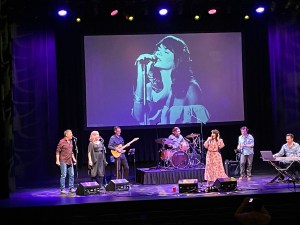
Edmonton’s top musical theatre artists gather on the Varscona stage Oct. 8 for an evening of music that celebrates the groundbreaking canon of the late great composer/lyricist. 

In Hey, old friend! An Evening of Sondheim, they’ll share favourite songs, stories of their experiences wrestling with the multiple complexities of Sondheim, memories of Sondheim shows they’ve done. And you, old friends, will hear songs from such Sondheim hits as Merrily We Roll Along, Into The Woods, A Little Night Music, Sweeney Todd.

To help support 12thnight.ca YEG theatre coverage, click here.

The all-star cast includes John Ullyatt, Andrea House, Ruth Alexander, Kendra Connor, Jenny McKillop, Sheldon Elter, Sue Goberdhan, Chariz Faulmino, Steven Greenfield and Jason Hardwick, as well was students from MacEwan University’s Theatre Arts. 

The evening, which includes a door prize raffle and silent auction (complete with art by Jason Carter), is a shared fundraiser for the Varscona and Plain Jane Theatre’s upcoming chamber-sized production of Sweeney Todd at Co*Lab in November.

Kate Ryan, artistic director of the Plain Janes, a company that lives and breathes in the off-centre lanes of musical theatre, grew up surrounded by Sondheim; his songs were the soundtrack of Ryan family life, “for as long as I can remember.” 

“My dad (the late great director Tim Ryan, founder of MacEwan’s musical theatre program) had a very large collection of albums from earlier work like Gypsy, Saturday Night, The Frogs, to Sweeney Todd and Into The Woods.” (Side note: I remember Tim Ryan gave me a copy of Meryl Secrest’s Sondheim biography; he had three). 

“The first Sondheim song I remember working on for an audition was What More Do I Need from Saturday Night. I loved Liz Callaway’s version from his Birthday Concert album.,” says Ryan. “I worked on it with my dad, who taught me not to gloss over the thoughts, to invest in each one and activate it: my first big introduction to ‘acting a song’…. I still go back to that song and learn more about it because of where I am today.”

Sondheim: the name conjures a world of emotional and psychological complication, verbal playfulness, musical richness in storytelling. Kendra Connor, the executive director of the Varscona, a Plain Jane star with a company history (her first show with Ryan was Drat, the Cat!), says “for me Sondheim kind of bridges the gap between classic and contemporary musical theatre…. He pulled the genre toward expressing human complexity through music and lyrics.” 

“Musical theatre now is so much more raw and real now.” muses Connor. “I’m thinking about shows like Fun Home, Light in the Piazza, Next to Normal, even Dear Evan Hansen — we would not have those without Sondheim.” 

When he adds it up, John Ullyatt has done quite a bit of Sondheim. He’s been the Wolf and Cinderella’s “Agony” Prince in Into The Woods, Tony in West Side Story, the Beadle in Sweeney Todd, Henrik in A Little Night Music, Company (in an Equity Fights Aid benefit)…. 

Into the Woods at the Citadel came early in Ullyatt’s career. So did Sweeney Todd, “a big show for me at the Phoenix…. Jim Guedo took a real chance with me and I had a ton of make-up on. I loved it, and as usual, met tons of people in the community. As a result we can talk about the time when we did that show!” 

“I think the best time I had was doing Henrik in A Little Night Music (at the Grand Theatre and Canadian Stage).” in Hey, Old Friend! he’ll sing Later from that show . “Later … When is later? All you ever hear is ‘later Henrik — Henrik, later’.” 

“I don’t know how many times I sang that song over four months,” says Ullyatt of his history with the part. “But it was never not hard to do.”  

Ah yes, hard. The musical and dramatic challenge of Sondheim is part of the attraction. Ryan, who’s directed Assassins and Into The Woods as well as the revue Sondheim On Sondheim, says when she did a Sondheim cabaret called It Takes Two with Susan Gilmour at the Citadel five years ago, “we spent a good four months learning the material.”

Says Ullyatt, “I guess what all actors seem to like about Sondheim, in fact put him on this massive pedestal, is that it’s difficult to do. But like Shakespeare, it’s all in the text. You really just have to sing the notes and not bump into the furniture. The music is so interesting and not always lovely. You don’t necessarily go out of the theatre singing the songs. But for an actor, you continuously get to dig around and see what else there is to be mined.” 

Connor talks about “how much extra thinking his songs require of the performer. That’s not a complaint! He just requires a lot of listening and concentration from the performer. His rhythms are frequently complex and the chords are often super crunchy. You have to think hard about singing in tune and on time. And then you to have to act on top of all of that.. It’s really satisfying when you nail it.” 

Ryan agrees that Sondheim is “a pinnacle musical theatre experience,” both for artists and audiences. “He leans into the messiness of humanity. He’s not afraid to share the darkness and find the humour and light. But it never comes easy. Sondheim once said ‘nobody goes through life unscathed. You write that, you touch people’.” 

PREVIEW

Hey, Old Friend! An Evening Of Sondheim

Theatre: Plain Jane Theatre and Varscona Theatre

Where: Varscona Theatre, 10329 83 Ave.

Running: Saturday Oct. 8, 7:30 p.m.

Tickets: 780-433-3399 or varsconatheatre.com


Posted in Previews | Tagged , , , , | Comments Off on Hey, Old Friend! The Janes and the Varscona toast Sondheim

Theatre Network at 48: a new season for a new building

Chariz Faulmino and Jameela McNeil (back), Cathy Derkach and Kristi Hansen (front) in Joni Mitchell: Songs of a Prairie Girl, Theatre Network and Wild Side Productions. Missing: Alison Wells. Photo by Ryan Parker

By Liz Nicholls, 12thnight.ca

There are many firsts attached to Theatre Network’s 48th season, announced Thursday. 

The trio of mainstage productions is led by Jim Guedo’s innovative all-new Joni Mitchell musical, and includes a powerful drama by Canadian star Hannah Moscovitch and the premiere of a new cross-disciplinary Eugene Stickland play-with-music. It’s the first full season to be built, rehearsed, and staged in the company’s beautiful new $12 Roxy Theatre, built (amazingly) on the same 124th Street footprint of the ex-cinema that burned to the ground in 2015.

To help support 12thnight.ca YEG theatre coverage, click here.

The mainstage season opens Nov. 22 to Dec. 11 with Stickland’s The Innocence of Trees, a Theatre Network commission and world premiere in which the acclaimed prairie and international star painter Agnes Martin enters a theatre and encounters her younger self. 

“It isn’t simply a bio-play. It’s not a chronology of the artist’s life,” says Theatre Network artistic director Bradley Moss. “Though you are going to learn about it,” the turbulent journey that took the painter from Macklin, Saskatchewan to MOMA, the Museum of Modern Art in New York.

Maralyn Ryan in The Innocence of Trees, Theatre Network. Photo by Ryan Parker.

“It’s aspects of Agnes Martin, it’s ’what drives people?’” says Moss of the play’s capture, an artist’s life and sensibility fraught with mental health challenges.  “It’s a deep dive on her, an exploration…. And the whole building will be engaged, an enhancement of your theatrical experience.” What Moss and TN’s visual arts curator Jared Tabler have in mind is a kind of wrap-around amplification. Some of Martin’s drawings are coming from the University of Lethbridge Art Gallery as well as a photographic series from her time in New Mexico. 

And a team headed by Darrin Hagen plans “to animate the Lorne Cardinal” (the black box second theatre downstairs from the Nancy Power mainstage), with stations and projections. “Wow! The building can do these things,” says Moss, delighted with the as yet unexplored possibilities of the new multi-space theatre. “We experiment and we learn!” 

Moss’s production, which stars Maralyn Ryan and her granddaughter Emma Ryan, includes a projection-scape by Ian Jackson and onstage live music played by cellist and sound designer Morag Northey.   

Something of the same multi-dimensional optic on an artist inhabits Joni Mitchell: Songs Of A Prairie Girl, “a non-linear musical on her life, music, and art” as billed. As creator/director Guedo explained to 12thnight, he spent the pandemic shutdown “completely re-writing” the musical he’d originally created, with Mitchell’s blessing, in 2007, in honour of the Saskatchewan centennial. It was later revived at the National Arts Centre in 2011. 

The complete re-write was motivated at least partially by the dramatic changes in Mitchell’s life since the original piece — a health crisis and a return to performing, notably at the Newport Folk Festival.

As Moss explains, five actors play different aspects of Mitchell, a Canadian artist to whom the descriptive “iconic” does not go amiss: The young Ingenue, the Free Spirit, the Explorer, the Critic, and the Sage. Guedo’s cast includes Alison Wells, Cathy Derkach, Kristi Hansen, Jameela McNeil and Chariz Faulmino, all of whom have to be able to play. And they’re accompanied a live band. The production, in association with Wild Side Productions, runs March 7 to 26. 

Gianna Vacirca in Sexual Misconduct of the Middle Classes, Theatre Network. Photo by Ryan Parker.

The MainStage finale, Moscovitch’s Sexual Misconduct of the Middle Classes, which was to have played TN in its Roxy-on-Gateway temporary home in the spring of 2020, will finally happen. “We would have had the second production in the country,” says Moss. “Now we’re the tenth.” 

“This one really moved me when I read it,” he says of the play that chronicles an affair between a university professor and a student. It’s “a discussion of power and the responsibility of that, such an important conversation in our world.” 

TN and Moscovitch go back, to productions of East of Berlin, Little One, Infinity, What A Young Wife Should Know. Moss is a huge admirer of her writing, “not too much in actors’ mouths, but so much going on! Funny, entertaining, serious….” 

As planned in 2020, Marianne Copithorne directs the TN production that runs April 25 to May 14. Gianna Vacirca will share the stage with John Ullyatt.

The Roxy Performance Series of indie productions in theatre, dance, comedy, music curated and supported by Theatre Network has been officially renamed the Phoenix Series (in honour of the 1997 union of TN with the late Phoenix Theatre). A complete Phoenix lineup hasn’t been finalized; “we announce stuff as it comes up,” says Moss of the work-in-progress. It opens with Alberta Musical Theatre’s production of Jack and the Beanstalk Oct 6 to 9 on the Nancy Power stage, and includes the hit sketch comedy troupe Girl Brain in the Lorne Cardinal Oct. 27 to 30.     

Everything’s a first in the new building. Behind the elegant store-front facade on a busy commercial street in a real neighbourhood, theatre has already been happening since April and Crow’s Theatre’s production of Cliff Cardinal’s As You Like It: A Radical Retelling. “Our first Nextfest” in the new Roxy happened in June. Ellen Chorley ran a theatre summer school there in July. It was a Fringe BYOV in August (Moss directed Ron Pearson’s magic show, his first show in the building). 

A full roster of equipment still awaits delivery and installation, held up by supply chain issues, says Moss. But now Alberta Musical Theatre is working upstairs in the sunlit rehearsal hall next to the offices. And a mainstage season is underway, starting with “our first show to be built in the shop here!” as Moss says of The Innocence of Trees. 

“All kinds of learning are going on,” he says. “Things get revealed; we have to live in a space to know the possibilities.” 

Subscriptions and tickets: 780-453-2440, theatrenetwork.ca.  

, 

Posted in News/Views | Tagged , , , , , , | Comments Off on Theatre Network at 48: a new season for a new building

Behind the scenes in war, a story of human resilience: Barvinok, a review

Barvinok by Lianna Makuch, Pyretic Productions. Photo by Dahlia Katz.

By Liz Nicholls, 12thnight.ca

“My Baba has a secret,” says Ukrainian-Canadian Hania in the opening moments of Barvinok. “A secret she is bringing with her to her grave.”

To help support 12thnight.ca YEG theatre coverage, click here.

As we learn in Lianna Makuch’s suspenseful and moving play, inspired by the experiences of her grandparents, it’s a secret lodged like a wound in Ukrainian history — a blood-soaked history that unspools into a never-receding past in war after war, generation after generation.

Makuch, the Ukrainian-Canadian theatre artist who plays Hania, has named her play after the Ukrainian word for periwinkle, a flower of rare persistence and resilience. And those unlikely survivors frame a story that’s beautifully fashioned from in-person on-location research by the Pyretic Productions team, including the playwright, director Patrick Lundeen and dramaturge Matt MacKenzie, who’ve been to Ukraine multiple times and workshopped the play in Kyiv with Ukrainian actors. 

Across the world from the horrifying “current war” in Ukraine, Baba is confused and tormented in old age by her secret, forged in the cross-hatching World War II brutalities of the Germans and the Russians. In Act I Hania tells us about her attempts to unravel the mystery of Baba’s obsession and nightmares. The old lady is a difficult patient in a long-term care home, haunted as she is by ghosts and convinced she’s been consigned to a prison camp. 

Lianna Makuch, Barvinok, 2018 Toronto production, Pyretic Productions. Photo by Dahlia Katz.

In this monologue Hania is accompanied by a five-member chorus, who sing traditional polyphonic Ukrainian music, and play Ukrainian instruments including the bandora and tsambaly. The musical score, arrangement and direction is the work of Larissa Pohoreski, and it’s a contributing player. In Lundeen’s stunning production, the painterly image of a contemporary Canadian woman surrounded by a shadowy chorus of singers and, in an alcove upstage, a woman playing the bandora, lingers in the mind.

Stephanie Bahniuk’s set design is a beautiful conjuring of memory in itself. Banks of movable, slatted wooden walls, through which light glows, open up and close. Across eight translucent windows, a projection scape (video design by Nicholas Mayne) of human faces and signs of human activity that flickers and disappears. 

Lianna Makuch in Barvinok, Toronto 2018, Pyretic Productions. Photo by Dahlia Katz.

In Act II, Hania goes to war-torn Ukraine on the trail of Baba’s secret, and its source in another war, World War II, the violence perpetrated by Bolsheviks, and her flight on foot across borders from the German infantry in 1944. And the chorus takes on characters — the so-called “regular people” under perpetual duress Hania meets on her quest into the Eastern Ukraine war zone of 2017. Her goal: to find out what happened to Baba’s relatives.

Thanks to Google and its friend-of-a-friend-of-a-friend’s second cousin- type connections, she travels with a couple of Ukrainian 20-something “fixers,” Misha (Maxwell Lebeuf) and Pavlo (Gabriel Richardson), both played with a kind of gallows humour ease by the actors. The buddies have a jostling camaraderie, and shaded assessments of the war effort, and its costs. Their anecdotes have a mordant, very human kind of inconclusiveness, and their reassurances to Hania always come with a throw-away proviso. “All good. You’ll be fine (pause). Probably.”  

They see bombed-out ghost villages in the Donbas. They cross checkpoints, always insisting they’re neither journalists nor tourists. They see fields formerly occupied by sunflowers now by landmines. They meet wary people who’ve been constantly dislocated from their homes in the search for “a safe haven”: a mother (Kristen Padayas) whose heartbreakingly unattainable dream is simply “an apartment” so her daughter can have friends come and play; a pair of sisters (Alexandra Dawkins and Tanya Pacholok) with unexpectedly different responses to the Russian presence in this occupied territory. 

And what cumulates is a remarkable group portrait of “regular people” who aren’t regular at all. Like the tiny blue flowers, they somehow live and persist under the continual trauma of bloodshed and violence. “No one wanted this,” and the cost is high. “There are good days, and there are other days,” says Pavlo, who’s been terribly injured but sticks around “to fight in whatever way I can.” Says Misha “the farther I look into the future the more tired I am…. Hope dies last.”

Maxwell Lebeuf, Barvinok, Toronto 2018, Pyretic Productions. Photo by Dahlia Katz

He calls Canada Ukraine’s westernmost state. So Hania wonders “do you have family in Canada?” Misha shrugs. “Who doesn’t?” Five years after the play’s present, in the middle of a brutal war in a country across the sea, a country that resonates as never before with Canadians in 2022, Barvinok is a special kind of behind-the-scenes achievement in theatrical storytelling. Its story is gathered from real people; it’s fascinating, enlightening, and heartbreaking to meet them. You shouldn’t miss the chance to see it this weekend before it goes on tour in Alberta.

Have a look at 12thnight’s preview interview with Lianna Makuch here. 

REVIEW

Barvinok

Theatre: Pyretic Productions in association with Punctuate! Theatre

Written by: Lianna Makuch

Directed by: Patrick Lundeen

Starring: Lianna Makuch, Gabriel Richardson, Maxwell Lebeuf, Kristen Padayas, Alexandra Dawkins, Tanya Pacholok

Where: Westbury Theatre, ATB Financial Arts Barn, 10330 84 Ave.

Tickets: pyreticproductions.ca 

Running: through Sunday

Posted in Reviews | Tagged , , , , | Comments Off on Behind the scenes in war, a story of human resilience: Barvinok, a review

Assault by the (corporate) media: Network, opening the Citadel season. A review.

Jim Mezon as Howard Beale in Network, Citadel Theatre/ Royal Manitoba Theatre Centre. Photo by Nanc Price.

By Liz Nicholls, 12thnight.ca 

Before memes became meme-ish, when the medical profession had sole ownership of “viral,” there was the scene in Network, the Paddy Chayefsky film of 50 years ago, in which a veteran TV anchor declared “I’m mad as hell. And I’m not going to take this any more.” At that moment Howard Beale, madman, or prophet, or martyr, or all three, gave the television age its very own “to be or not to be” as he lit himself on fire with his own rage. 

Jim Mezon as Howard Beale in Network, Citadel/Royal Manitoba Theatre Centre. Photo by Nanc Price.

In an explosively charismatic, riveting performance by Jim Mezon, Howard Beale goes live on the stage and a dizzying assortment of screens, in the 2017 Lee Hall play, a hit in the West End and then on Broadway, that cracks open the new Citadel season with a mighty roar.

To help support 12thnight.ca YEG theatre coverage, click here.

It can rightly be said that Network hits the stage in Daryl Cloran’s high-tech production. It’s a mesmerizing barrage, a multi-screen bombardment of multiplying, mutating imagery, a whirling mélange of ads for cat food and band-aids, news clips, sports footage, sitcom scenes. Real people and cameras, the instruments of surveillance, are right there perpetually moving through the red-alert world of Lorenzo Savoini’s set, obliterating the distinction between all of the above before your very eyes. And a big player is Hugh Conacher’s wonderfully hyperactive video design. 

Meanwhile the lines between so-called “real life” and screen capture shimmer into oblivion: no scene, whether sexual encounter or marriage breakdown or argument, is too intimate not to exist simultaneously in 3-D and close-up in 2- on a screen. And very often it’s the latter that grabs our attention. 

Which is, after all, one of the points of Network — the dehumanizing effect of non-stop media assault — that remain sharp as ever after half a century. “We’ll tell you any shit you want to hear,” cries Howard Beale in one of the extended rants that Mezon delivers so compellingly. “We deal in illusions, man…. We lie like hell.” Taken from Chayefsky’s screenplay more or less directly it is a harbinger of “fake news” and alternative facts. 

The other, of course — enraging both the Beale of 1976 and the Beale onstage at the Citadel in 2022 — is the vanishing point of truth and ethics in the corporatizing of “news,” and its re-creation and re-packaging as entertainment in the relentless pursuit of ratings. “We’re not in the business of morality; we’re in the business of business,” states the ruthless careerist TV producer Diana Christiansen, dismissing ethical objections to exploiting terrorism, or Howard’s apparent derangement, with the steely shrug of someone reporting that the law of gravity is in operation. She’s played with carnivorous obsessiveness — talk of market share as the ultimate aphrodisiac — by the excellent Alanna Hawley-Purvis.  

Jim Mezon in Network, Citadel Theatre/ Royal Manitoba Theatre Centre. Photo by Nanc Price

So, the story: At UBS (say it aloud and you’ll get the point) network, the ratings are tanking, and longtime TV anchor Howard Beale gets canned. When he has a spectacular meltdown on live TV and threatens to blow his brains out, ratings soar. And when he appears on the set in his pajamas, and exhorts his audience to rise up, stick their heads out the window and yell “I’m mad as hell!” the network boomerangs him back into his job. “We’ve hit the motherlode!” gloats Diana. 

In a series of messianic rants, Howard Beale becomes a media superstar. And Network, as a satire of very dark stripe, savours the irony that the ratings explode upward even when he denounces the network’s quest for ratings. Ah, until there’s a slide. And Beale becomes “this Beale business,” a thorn in everyone’s side.

Alana Hawley Purvis and Richard Young in Network, Citadel Theatre/ Royal Manitoba Theatre Centre. Photo by Nanc Price.

You can’t not watch Mezon. His blazing eyes and his booming voice follow you everywhere on a multitude of screens in this convulsive performance. Watchable, too, is Alex Poch-Goldin, very persuasive as Max, the beleaguered UBS news director who’s Howard’s best friend. The subplot in which Max’s own decency erodes enough for him to betray his wife (Nadien Chu) with the tiger who wants his job does seem a little improbable, in truth. So does Hacket, a shark-like upwardly mobile exec, who’s a (loud) one-note panic attack in Richard Young’s performance. 

Braydon Dowler-Coltman in Network. Photo by Nanc Price

There are some intriguing cameos. The fun of Brayden Dowler-Coltman as a preposterously athletic warm-up guy who engages directly with us is a welcome reminder that Network is meant to be a comedy. And so is Michael Peng as the inscrutable network chief Mr. Jensen, who has risen above (or maybe below) the fray. 

What starts in satire (a concept that continues to be eroded by “reality” over and over in the modern age) ends in something else altogether, in the contemporary nuances that this stage adaptation brings to Network. 

Network doesn’t date itself amidst the modern proliferation of screens, or even the disappearance of both fact and truth, and television as the authority that underpins them. No one believes that, which works fine in translating the movie 50 years into its future as a play. Lies and hypocrisy as media fodder, and corporate manoeuvring to wrap that thin diet sensationally, are part of the movie’s eerie prescience. 

But the play must (and in its way does) take into account the downside of advocating for mass populist anger, which hasn’t exactly provided a salutary social corrective. The rise of extremism amongst (scary) people who got mad has seen to that. Discuss!  

In the play, and Mezon’s performance, Beale’s journey into madness takes him from fiercely validating the humanity of the individual to the opposite, to a sense that our future lies in collectivism — we are all just bees in a hive — and beyond, into thoughts about absolutism and democracy. It’s a more elusive, and sometimes perplexing, work than the movie. And I have to admit there was a moment when it all started to get away from me. 

But the theatrical zest and smarts of  Cloran’s production in conjuring the frenzied world of media are irresistible. Network does feel like an immersive experience, a reflection of the way we live, assailed from every direction at high speed. Howard Beale may be crazy but he’s one of us.

REVIEW

Network

Theatre: Citadel and Royal Manitoba Theatre Centre

Written by: Lee Hall, adapted from the 1976 movie with screenplay by Paddy Chayefsky

Directed by: Daryl Cloran

Starring: Jim Mezon

Running: through Oct. 9

Tickets: 780-425-1820, citadeltheatre.com


Posted in Reviews | Tagged , , , , | Comments Off on Assault by the (corporate) media: Network, opening the Citadel season. A review.

Heart and soul in 2 Pianos 4 Hands at the Mayfield. A review.

Jefferson McDonald and Matthew McGloin in 2 Pianos 4 Hands, Mayfield Theatre. Photo supplied

By Liz Nicholls, 12thnight.ca

The charming, poignant, and very funny musical comedy now at the Mayfield begins in classic concert fashion: the bow from the waist and the flipping of the tuxedo tails. Two men in formal tuxes take their seats at two facing (Yamaha) grand pianos onstage. 

After a flurry of fussing about 2 piano benches, and whose 2 hands will play which piano, the stars of 2 Pianos 4 Hands, Jefferson McDonald and Matthew McGloin, tuck briefly but impressively into Bach’s Concerto in D minor, a piece of music which to my knowledge has never been on the program music list at the Mayfield till now. No mere tickling of the ivories here. Then they instantly flip into the past, via that indelible signature tune of the youthful piano lesson memory bank world-wide, Heart and Soul.

To help support 12thnight.ca YEG theatre coverage, click here.

The audience emits the amused murmur of recognition. Personally I can’t hear it without remembering my mom yelling from the kitchen “that’s not what you’re supposed to be practising!”

2 Pianos 4 Hands, the much-awarded hit co-created by Canadian theatre stars Ted Dykstra and Richard Greenblatt in 1996 at the prompting of Toronto’s Tarragon Theatre, is a bona fide Canuck theatre success story. And it’s one that comes with a unique history, and a casting challenge to match. Where, after all, besides the co-playwrights, are you going to find actors who can be funny, compelling, and play Chopin Ballades and Liszt’s Mephisto Waltz, and then My Funny Valentine and Piano Man? Hurray for the Mayfield; in Tom Frey’s production they’ve done it. 

As for history, the play has travelled across the country, across borders (including runs Off-Broadway, at the Kennedy Center, in the U.K.), and around the world. Sometimes its creators have been at the 2 pianos (they’ve done 5,000 performances), sometimes not. I remembering previewing the 2013 run of 2 Pianos 4 Hands at the Citadel here in Dykstra’s home town (OK, he’s from St. Albert), one of their so-called “farewell tours.” Ah, more like “till we meet again”: this past June, they played their sixth sold-out Toronto run, at Mirvish’s Royal Alexandra Theatre, in honour of the show’s 25th anniversary. 

Anyhow it’s their story (with embellishments). The discovery they shared a past forged in piano lessons came in 1994 while they were doing a kids’ show, So You Think You’re Mozart, with Dykstra as the piano student and Greenblatt as Mozart, who comes out of the piano. 

Matthew McGloin and Jefferson McDonald in 2 Pianos 4 Hands. Photo supplied

It’s a shared story that will strike a chord (possibly a diminished seventh) with anyone who’s taken lessons in piano — or guitar, or singing, or hockey, or tennis, or … — and discovered they’re very good at it. Teddy and Richie are good enough to dream of being concert pianists, commanding the world’s stages, until the traumatic comeuppance moment, at age 17, when they come to realize that there’s some serious life distance being very good at something and being great. 

What gives 2 Pianos 4 Hands its resonance and its poignance is that turning point, with its realization that the dream, and even the talent,  aren’t enough. It’s about the odds-against factor built into greatness, and what you’d have to give up in order to have that dream come true. The matching scenes in which first Richie and Teddy receive the bad news, from a jazz school and a music conservatory respectively, are genuinely touching. 

In the play, the actors take turns as kid and cocky teen versions of Teddy (McDonald) and Richie (McGloin) and the adults — incessantly nagging parents, a hilarious succession of teachers with amazing accents and opposing instructions about everything, adjudicators, examiners, conservatory principals — in their lives. And McDonald and McGloin turn in sparky and resourceful comic performances, in both idiosyncratic cameos and in dramatic scenes. And that’s in addition to demonstrating major musical chops.

The story arc follows a couple of 10-year-old piano nerds through the aggro of practising when your friends are outside playing, parental intervention, the tension of competition. 

As for the latter, the Kiwanis Festival holds a special place in the nightmares of millions. Here, it’s led, hilariously, by McDonald as a morosely officious oldster announcing “Class 4,561, ‘Duet, 11-and-under,” to wit 67 pairs of children playing exactly the same piece, and lasting four hours. (Question to self: how did my parents survive it? Answer: by smoking outside). A fracas ensues on the piano bench, amusingly, as Teddy freezes and Richie fumes during a disastrous duet performance of In The Hall Of The Mountain King. 

It’s built into the experience of 2 Pianos 4 Hands that both Dykstra and Greenblatt gave up music at 17 and instead found stellar careers in theatre as actors and directors. Edmonton audiences know Dykstra, the artistic director of Toronto’s Coal Mine Theatre, as Ebenezer Scrooge in the Citadel’s A Christmas Carol, as well as the creator of the musical Evangeline. In a curious coincidence, both Dykstra and McMillan, the actor who plays him in 2 Pianos 4 Hands, have had experience pounding the keys as Jerry Lee Lewis, the former in the musical Fire and the latter in the Mayfield’s production of Million Dollar Quartet. 

That’s the thing about music, as you’ll reflect when you see 2 Pianos 4 Hands (and you should, it’s great fun). Music sticks with you. I remember Tommy Banks reminding me once in an interview that however aggravating practising was, you’ll never meet anyone who took piano lessons and quit who doesn’t say they wish they’d kept it up. 

REVIEW

2 Pianos 4 Hands

Theatre: Mayfield Dinner Theatre

Created by: Ted Dykstra and Richard Greenblatt

Directed by: Tom Frey

Starring: Jefferson McDonald, Matthew McGloin

Running: through Oct. 23

Tickets: 780-483-4051, mayfieldtheatre.ca


Posted in Reviews | Tagged , , , , , | Comments Off on Heart and soul in 2 Pianos 4 Hands at the Mayfield. A review.

Rising Sun Theatre throws a magic/music bash

magician Ron Pearson, photo supplied.

By Liz Nicholls, 12thnight.ca

Magic and music: some of this theatre town’s top-drawer talent in both are featured in Rising Sun Theatre’s benefit bash at the Gateway Theatre Oct. 1.

To help support 12thnight.ca YEG theatre coverage, click here.

Ron Pearson, a virtuoso magician/illusionist with a theatrical bent (Minerva: Queen of the Handcuffs), is on the playbill. So is singer-songwriter/actor/playwright Dana Wylie, whose clever solo memoir Makings of a Voice was the headliner at the 2021 SkirtsAfire Festival.

Dreamer’s Cantata, Plain Jane Theatre. Photo supplied.

And the cast of Dreamer’s Cantata, the new Plain Jane Theatre revue that premiered at the Fringe this past summer — Larissa Poho, Bella King, Alanna McPherson, Steven Greenfield — will present songs from that show, dedicated to the witty challenges served up by contemporary musical theatre creators who are all women or gender-non-conforming.

singer-songwriter Dana Wylie. Photo suppied

Rising Sun, co-founded in 2004 by Gerry Potter, is a not-for-profit company with a distinguished history of providing opportunities for cognitively disabled people to practise the art of theatre.

Potter, the founding father of Workshop West Theatre, explains that the all-ages troupe collaborates in the creation and performance of original work. “Ideas, scenes, characters” are developed collectively through improv and discussion. And the ensemble, which numbers a dozen or more, is led by an assortment of Edmonton’s theatre professionals — directors, choreographers, designers, storytellers, composers.

“It’s fun work,” says Potter, who started by directing the Rising Sun shows and is now in the double-role of producer and board member. “There’s a lot of undiscovered talent among people labelled as intellectually disabled…. Very often they’re strong on imagination and emotional intelligence; they sense what’s going on” even when words aren’t their go-to mode of expression. “The professionals learn as much as the (casts).”

Some of Rising Sun’s usual granting sources, at both the city and provincial level, have alas disappeared; hence the need for a benefit. But the evening (which includes snacks and silent auction items) places a high priority on … fun.

Further information about the Oct. 1 event: risingsuntheatre.ca. Tickets: eventbrite.ca


Posted in Previews | Tagged , , , , , , | Comments Off on Rising Sun Theatre throws a magic/music bash

Mad as hell: Network launches the Citadel season. A preview

Jim Mezon as Howard Beale in Network, Citadel/Royal Manitoba Theatre Centre. Photo by Nanc Price.

By Liz Nicholls, 12thnight.ca

The word “prescient” has been floating over the Citadel for weeks now, threading through rehearsals for the play getting its Canadian premiere Thursday on the Shoctor stage. 

It’s attached to a (very) dark comedy satire about our complicated, toxic relationship with the media — and the media’s complicated, toxic relationship with news, truth, and showbiz.

To help support 12thnight.ca YEG theatre coverage, click here. 

Network, the Citadel 2022-2023 season opener directed by Daryl Cloran, started life as a movie  (with an Oscar-winning screenplay by Paddy Chayefsky) that is, amazingly, nearly half a century old. Fully 45 years later, Network was turned into a West End and Broadway stage hit starring Bryan Cranston as an inflammable TV anchor, in a 2017 stage adaptation by the Brit playwright Lee Hall and directed by the Belgian avant-gardiste Ivo van Hove. 

And now, after a couple of years of COVID-ian delays, Network’s first post-Broadway production, a high-tech 16-actor collaboration between the Citadel and the Royal Manitoba Theatre Centre, is close at hand.

Prescient: there’s that word. “It’s so prescient in so many ways!” declares Jim Mezon, the veteran Shaw Festival star actor/director who inherits the role of UBS network anchor Howard Beale, owner of the echoing cry “I’m mad as hell and I’m not gonna take this any more.”

“All you have to do is open the paper (or, more probably, look at your assorted screens) and there’s another news story that has a direct relationship with this play,” says Mezon who was “a young actor in Winnipeg when he saw Network for the first time. “It had a huge impact on me, in so many ways. From that initial shock of seeing what that medium could and might possibly do….” 

“Fifty years ago, and a lot of it has come true. What does that say about us as a species that we’ve allowed that to happen?” He muses, “I don’t think we’d thought of it in those terms till Chayefsky showed up and wrote it….” It’s like (Chayefsky’s) Hospital, a dark and stinging satire of medical practice, that way, Mezon thinks. “These institutions are minefields.” 

Nadien Chu, Network, Citadel Theatre/Royal Manitoba Theatre Centre. Photo by Nanc Price.

“For something written in the ‘70s, before cellphones and social media, it really is amazingly prescient,” says Cloran. “So accurate in depicting our very complicated relationship with the media….” Fifty years of technological complication in defining and delivering “news” have ensued, and the internet has pretty much squelched television in that regard, but “the story of Network has only become more relevant, more timely.” 

“The show is very specifically set in the 1970s; all references to current events are ‘70s. But you don’t have to work very hard to find contemporary equivalents, for sure,” notwithstanding the proliferation (and splintering) of media platforms. As if to illustrate his point, rehearsals started on the very day a TV anchor controversy erupted; ITV and the sacking of Lisa LaFlamme. As Cloran points out, public reliance on big networks may have diminished now “and we engage with the screen in multiple ways … but there are just more screens; the corporate manoeuvring is exactly the same.” 

Network chronicles the fortunes of veteran TV news anchor Howard Beale at the hands of corporate executives; he’s the guinea pig for the lurking question of just how far media will go for ratings, likes, and clicks. When ratings tank, Howard Beale gets the boot. And when he has a spectacular nervous breakdown on live TV and threatens to commit suicide on television in front of millions, ratings soar.

As Mezon reflects, where is the line between news and entertainment, between “reporting” the news and creating it?  Network is all about that. From the corporate point of view, “how can we use a situation to our advantage and get better ratings? — at the expense of the truth, at the expense of a person’s mental well-being. Howard Beale is clearly unbalanced, a man who’s having severe mental problems. And he’s exploited because they’re going to increase ratings….” 

Braydon Dowler-Coltman in Network. Photo by Nanc Price

“So much of Howard Beale’s initial rants is about the individual standing up to the corporation,” as Cloran says. “People unthinkingly ‘consuming’ the media: they think what the media tells them to think; they eat what the media tells them to eat … not dissimilar now.” 

How do you sustain a character who’s on fire with rage? Mezon, who’s played some of the biggest roles in the canon at Shaw and across the country, says “the anger Howard has inside him is recognizable to me, from other parts I’ve played” — Captain Shotover in Shaw’s Heartbreak House, Undershaft in Major Barbara, Peer Gynt among them (“the biggest mountain I’ve ever climbed”). 

“It’s easy for me to enter into that anger, to understand where it’s coming from…. Howard Beale isn’t calling for revolution; he’s calling for people to acknowledge they’re fed up. They need to say ‘I’ve had enough’ instead of just accepting another blow. They need to get mad. Once you’re mad enough, we’ll figure out what to do.” The energy output required is high, true, Mezon says. “But the adrenalin you get from it is really satisfying!”

 As Cloran said in announcing the Citadel season, this first post-Broadway incarnation of Network was deliberately pitched to the rights-holders as reimagining the big-budget techno spectacle to be do-able for regional theatres across the continent. It’s a big, complicated production, though, full of screens, cameras, live footage. “I’m directing a stage play and a movie at the same time,” says Cloran. He’s experienced in film and video editing for theatre, “but this is the most techno-filled production I’ve directed.” 

Network, Citadel Theatre/ Royal Manitoba Theatre Centre. Photo by Nanc Price.

He explains that there are three cameras, and video operators onstage the whole time (“we’ve had them all through rehearsal”). “In staging a scene there are so many choices. When do we want the audience to look at the stage? When do we want the audience to look at the screen? When do we want them to be overwhelmed by images, and when do we want the intimacy of people talking to each other onstage?” Some scenes are staged with the actors’ backs to the audience; we see their faces, in close up, on screens.

That variation in distance and scale of performance, for theatrical and film sequences, makes for a demanding acting challenge, as Cloran says. “We often have those conversations: ‘who am I acting to? what’s my primary focus here, the 700 people out there, or the camera?’” One thing’s for sure, he says. “We’re aware of the audience. They’ll definitely feel they are present at a live event, and we know they’re there.”  

“I think people are going to be surprised by what they see…. As people have popped in to rehearsal, everyone’s been pretty thrilled. It’s a great, complicated, interesting story, but also the way we tell it is pretty fantastic.” 

PREVIEW

Network

Theatre: Citadel and Royal Manitoba Theatre Centre

Written by: Lee Hall, adapted from the 1976 movie with screenplay by Paddy Chayefsky

Directed by: Daryl Cloran

Starring: Jim Mezon

Running: Thursday through Oct. 9

Tickets: 780-425-1820, citadeltheatre.com 

Posted in Previews | Tagged , , , , , , | Comments Off on Mad as hell: Network launches the Citadel season. A preview

Workshop West announces a new season devoted to Canadian plays and their creators

Workshop West 2022-2023 season. Photo by db photographics.

By Liz Nicholls, 12thnight.ca

Workshop West Playwrights Theatre bookends its upcoming 44th “Persistence of Vision” season, announced Thursday, in a way that has always characterized a theatre company devoted to the development and showcasing of new Canadian plays and their writers.  

The season, the first in their new home The Gateway in Strathcona (formerly Theatre Network’s Roxy on Gateway), opens Oct. 27 to Nov. 6 with a second outing of Dora Maar: the wicked one, by Beth Graham and Daniela Vlaskalic. “A play about love, obsession and surrealism” as billed, it chronicles the tumultuous relationship between two artists. One is the brilliant photographer of the title through whose lens the story is told. The other is the older groundbreaking artist who captured her on canvas in many of his paintings, Pablo Picasso.

To help support 12thnight.ca YEG theatre coverage, click here.

Directed by Blake Brooker of Calgary’s One Yellow Rabbit, the production, a collaboration between GAL (Vlaskalic and Graham’s own company) and Calgary’s Hit & Myth, premiered this past spring at the delayed edition of the High Performance Rodeo. As Inglis points out, “a second production is a very important thing in working to create a Canadian theatre canon.” 

Dora Maar: the wicked one, Workshop West. graphic by db photographics

The solo piece, by the playwriting pair who created the hit The Drowning Girls and Mules, stars Vlaskalic as Picasso’s muse, whose own artistic fortunes were muted in the relationship with the older more famous artist. It reunites, on home soil so to speak, the co-playwrights now separated by Canadian geography (Graham in Edmonton, Vlaskalic in Toronto) who went to theatre school as actors at the U of A. 

Not only is the play, set in Paris in 1935, at the intersection of two art forms, it resonates in a new way now, when “women’s autonomy to choose their own path through life” has been threatened, witness the overthrow of Roe v. Wade in the U.S. As directed by Brooker, “it’s a lovely, elegant, well-produced” show, Inglis says.  

The finale of the season is the world premiere of a new play by Edmonton up-and-comer Liam Salmon whose queer rom-com Fags in Space delighted audiences this past summer.  Subscribe or Like (May 24 to June 11), which breathed its first public air at Workshop West’s Springboards in March, is at its title suggests an exploration of what the playwright has called “the digital frontier,” where selves are re-invented in the seductive kind of “performance” invited by social media.  

Subscribe or Like, Workshop West Playwrights Theatre. Photo by db photography

We meet a couple of disaffected millennial underachievers whose stab at fortune and fame, as they see it, is to launch their own online video channel. Heather Inglis directs the Workshop West production, which stars Gabby Bernard and Geoffrey Simon Brown. “The third character is the internet,” says Inglis of the play, inspired by a real-life 2018 example south of the border, of a prank video channel, “a sort of freak show of grotesque challenges.” 

“There’s a large multi-media component to the production,” says Inglis of the contribution of star videographer and digital designer Ian Jackson to “our largest enterprise of the season.” 

Unsung: Tales From The Front Line, Jan. 25 to Feb. 12,  is a premiere too. Created by Inglis and co-curated with Darrin Hagen in a collaboration with Ground Zero Productions, it is drawn from interviews with real-live Edmonton health care workers, the beleaguered (and much-abused) brigade who have saved our bacon over and over in the last two and a half years.

Inglis calls it “an immersive performance installation,” a creative documentation of real real-life stories, to be experienced by audiences on the move as “living portraits.” And in this Unsung resembles Viscosity, a 2015 Theatre Yes initiative by Inglis (then the artistic director of that indie collective) which captured real-life stories of oil patch workers.  

Says Inglis of Unsung, “they’re local hero stories (designed to) honour some of the amazing things real health care workers accomplished” on our behalf under circumstances that were, to understate the case, a challenge — medically, psychologically, politically. 

The audience, she explains, will “experience an experimental use of space that’s been at the centre of my artistic practice at Theatre Yes.” The production features seven actors, telling stories that represent “a variety of voices and demographics.” It’s for Hagen (Metronome), this season’s dramaturge-in-residence and  a seasoned researcher himself in addition to his playwriting archive, to edit the interviews into monologue form.    

The Shoe Project, SkirtsAfire Festival and Workshop West Playwrights Theatre. Photo by db photographics.

The season includes a second Edmonton iteration of The Shoe Project, a national initiative to give voices to Canadian immigrant and refugee women. Playwright Conni Massing mentors 12 women as they write the stories of their arrival in Canada and their adaptation to a new way of life — all focussed through the shoes they wore. This year’s edition, a partnership with the SkirtsAfire Festival, is presented live to audiences March 11 and 12.

Workshop West’s signature Springboards New Play Festival, which returned to action last season in March after a decade to inaugurate the company’s new home, happens March 21 to 26. And, as central to WWPT’s identity and mandate (“it connects audiences directly to that,” says Inglis), it features readings of new plays at every stage of development, along with workshops, talk-backs, cabarets. 

The season title is multi-dimensional, as Inglis explains. “Persistence” has been essential to the survival of live theatre in the pandemic world. And as for vision, the lineup is a nod, says Inglis, to “what it means to refract ourselves — in painting, videography, social media, photography…” and beyond.


Posted in Features, Previews | Tagged , , , , , , , , , | Comments Off on Workshop West announces a new season devoted to Canadian plays and their creators

A cultural inheritance, a quest, and a haunting: Barvinok launches a tour here

Blood of Our Soil, Pyretic Productions. Photo by Dahlia Katz.

By Liz Nicholls, 12thnight.ca

“The universal desire, the need, desire, to understand who you are, where you came from….”

To help support 12thnight.ca YEG theatre coverage, click here.

That’s what drew Ukrainian-Canadian playwright Lianna Makuch across the ocean to her ancestral homeland. And that quest was her creative inspiration, too, as a theatre artist — witness the play that returns to Edmonton Thursday in its latest iteration to launch Pyretic Productions’ Alberta tour. “It reflects my own journey,” says Makuch of Barvinok, Ukrainian for periwinkle, a beautiful, resourceful, stubbornly indestructible flower. “I had never really thought my Ukrainian identity could shape my artistic career. Creating this story allowed me to understand….” 

To be Ukrainian-Canadian is to be haunted by a war-ravaged past, centuries of bloodshed, as Makuch mused over pre-rehearsal coffee in the sunshine couple of weeks ago. Barvinok has its roots in a secret — carried across two continents, and kept for a long time — and a life-changing discovery. 

In 2013, the year before the Revolution of Dignity in Ukraine, Makuch, a Ukrainian speaker who grew up immersed in the culture, came across a hand-written book in her dad’s basement. It was a 1944 diary in which her paternal baba recorded a nightmare flight, on foot, from her war-torn homeland. There was a reverberating eloquence to the writing of this smart, artistic, but uneducated woman. “What spoke to me especially,” says Makuch, “was this, ‘how can our land not be fertile when so much blood, both Ukrainian and foreign, has seeped into it?…. It shows that our enemies must love our land more than we do, for they fight for it ceaselessly.” 

Lianna Makuch in Barvinok, Pyretic Productions. Photo by Dahlia Katz.

A playwright, and a play (then called Blood of Our Soil) was born in that discovery. Creating new work wasn’t a radical departure, of course, not for a graduate actor in Edmonton. “I’d done some Fringe stuff, as you do …” smiles Makuch, who has a  BFA from the U of A. She was an “apprentice performer” on Mump and Smoot’s Cracked tour, “a really valuable experience as a theatre creator.” 

But the diary was a powerful confirmation, and motivator. Makuch and her Pyretic cohorts director Patrick Lundeen and dramaturge (and fellow playwright) Matt MacKenzie went on location in Ukraine in 2017, to research. 

They found the house of Makuch’s grandmother, still surrounded by periwinkles, “the flower that can withstand anything,” as Makuch says. They visited her grandfather’s village, and the grave of her maternal grandmother, who’d been abducted by Germans. They drove over country back roads with potholes big enough to swallow a car, and they arrived within 5 km of the front line of the war in eastern Ukraine — another brutal Russian invasion in a war that has never really ended. 

Thanks to a 2016 Latitude 53 exhibition of portraits of wounded Ukrainians, Makuch had found a “fixer”/contact who connected Pyretic to a network of veterans. And they met up in person on that trip. Lundeen whose purchase on the Ukrainian language amounted to Merry Christmas, went to board games nights with actors and veterans. “A lot of people thought we were journalists at first and were, understandably, wary,” says Makuch. “When they found out we were theatre artists, the reaction was very very different….” 

The first part of Makuch’s play in 2018 was “verbatim theatre,” she says. “In the second part, more episodic, we met characters…. And there was definitely more opportunity for development.” So the next year, the collaborators went back to Ukraine to workshop the play at the Wild Theatre in Kyiv, with Ukrainian actors and an audience mostly of diplomats, veterans and activists. “People were so appreciative, so grateful to not be forgotten,” Makuch says of the role of the Ukrainian diaspora. The take-away was that “people didn’t want to be seen as victims.” 

The Edmonton premiere in the fall of 2018 took that into account. And Barvinok, as it was re-named in honour of Ukrainian resilience, played Tarragon’s Extra Space in Toronto after that. “Every time the play has been done it’s been its own iteration,” she says of a play she’s re-written and Lundeen have since re-staged for the Westbury Theatre and the tour. “The story has evolved; the heart of it is the same.”

The first half of Barvinok we meet Hania, like Makuch (who plays her) a Ukrainian-Canadian trying to understand her cultural inheritance. “A single speaker,” says Makuch of the first act, “with old world folkloric music assembled by Larissa Poho,” and played by the six-member chorus on traditional Ukrainian instruments like the bandora and tsambaly, in addition to accordion, guitar, and violin. In Act II, the ghostly chorus become individual characters. 

The ending has inevitably changed, in new context if not in text. World events, and a horrifying escalation of brutality have seen to that. Climactic lines of 2017 are still in the play. “We are like passengers sitting on our suitcases waiting for the train to come … and the rest of the world, Europe, just watches. They send their best, though.” Makuch sighs. “But they resonate even more in our new world.” 

“I’m not a soldier. Creating theatre is what I do, and I’m using what I do to tell a human story.. The news has its place. But with theatre you have the opportunity to tell a human story, to (evoke) emotional  empathy.” And a film version is in the works, thanks to funding by the Shevchenko Foundation. 

All performances of Barvinok at the Westbury are pay-what-you-will, on a tiered ticketing system.… “I don’t want to cost to prevent anyone from attending,” says Makuch. “And there are many Ukrainian newcomers to the city….” A portion of ticket sales will be donated to Ukraine support.

PREVIEW

Barvinok

Theatre: Pyretic Productions in association with Punctuate! Theatre

Written by: Lianna Makuch

Directed by: Patrick Lundeen

Starring: Lianna Makuch, Gabriel Richardson, Maxwell Lebeuf, Kristen Padayas, Alexandra Dawkins, Tanya Pacholok

Where: Westbury Theatre, ATB Financial Arts Barn, 10330 84 Ave.

Running: through Sept. 25 

Tickets: pyreticproductions.ca   


Posted in Previews | Tagged , , , , , | Comments Off on A cultural inheritance, a quest, and a haunting: Barvinok launches a tour here

Facing the fall-out: A Doll’s House Part 2 launches the season at the Varscona. A review

Chariz Faulmino and Kristi Hansen, A Doll’s House Part 2, Wild Side Productions. Photo by Jim Guedo.

By Liz Nicholls, 12thnight.ca

The stage is dominated by a door, a giant door. The room has the outlines of wainscoting and six sealed windows — all bleached out, painted over, uninhabited.

To help support 12thnight.ca YEG theatre coverage, click here.

There’s no human clutter: a couple of chairs, an end table, the only decor a box of Kleenex, a wry touch. So many things in life end in tears. This play isn’t one of them.

A Doll’s House Part 2 will, however, stick with you; it’ll open doors you won’t easily be able to close. Just when you think you know what you think, there’s more for you to think about. Which is another way of saying that the Wild Side production that launches the Edmonton season is an absorbing, funny, surprising evening in the theatre. And the four expert actors in the ensemble production directed and designed by Jim Guedo make a meal of it — creating characters who are alert, thinking on their feet, listening, asserting, countering, defending their points of view, airing their grievances.  

So, back to the door. The insistent knock at that door in the opening scene of Lucas Hnath’s play, the young American playwright’s Broadway debut in 2017, reverberates backward in time, 150 years or so, to the equally insistent slam of that door in the closing moment of Ibsen’s 1879 portrait of a suffocating marriage in A Doll’s House. One of the repertoire’s most intriguing, lingering questions, what happened next?, is about to be answered, and in modern language.

Nora (Kristi Hansen), who walked out the door 15 years before, leaving marriage, husband, and children behind, wants back in. What’s she been doing? Why is she back? 

And as Hansen stands on the threshold, you see that Nora isn’t crawling back. Far from it. She’s looking supremely unapologetic and confident, self-assured enough to be playful with the old family retainer Anne Marie (Maralyn Ryan). “You want to know what I’ve been up to, but I want to know what you thought I was doing — what did you imagine?” she cajoles. “Come on — keep guessing — this is fun.” She speaks for the audience in that. 

The language of the play is contemporary, and so is the lexicon of Hansen’s body language — the way she tilts her head and leans in to a conversation, the hand gestures, the grimaces and skeptical eye-rolls. 

Maralyn Ryan and Kristi Hansen, A Doll’s House Part 2, Wild Side Productions. Photo by Jim Guedo.

“I feel like I’m being set up,” says the stalwart Anne Marie. In Ryan’s compelling and funny performance she’s shrewd and far from bowled over by the success story and feminist pep talk she hears from the Nora who’s been knocking at the door and now wants something. Soon Anne Marie will be saying “fuck you, Nora, fuck you,” and you’ll know you’re not in Victorian era Norway any more even if the costumes say otherwise.    

Anyhow, I don’t want to tell you too much; there’s fun in this fast and furious “sequel” in your discoveries, along with the characters, scene by scene. But you learn pretty quickly that Nora has become a very successful writer — of radical women’s novels that argue against marriage. And she’s back to get husband Torvald’s help in the legal predicament in which she’s found herself blackmailed.  

In the terms of modern feminism — an era that Ibsen’s play has often been credited with kickstarting — Nora’s arguments about inequality in marriage and divorce, and individual fulfilment, have enduring cred, of course. And the world hasn’t exactly remade itself since Nora walked out. But in A Doll’s House Part 2 she’s confronted by the human consequences of that abrupt exit of 15 years before, and she won’t have an easy time of it with the people she left behind. 

Kristi Hansen and Ian Leung, A Doll’s House Part 2. Photo by Jim Guedo.

Heath’s play gives Torvald (Ian Leung) the chance to say everything he didn’t get a chance to say when Nora up and walked, slamming the door behind her. Leung is, like his cast-mates, a terrific actor. And in his empathetic performance Torvald is surprisingly likeable, and his point of view has real and unexpected weight. 

Nora’s grown-up daughter Emmy (Chariz Faulmino), who’s meeting her mother in effect for the first time, is a surprise, too. As Faulmino’s bright, sharp performance makes crystal clear, she’s her mother’s daughter, smart, alert, with a smile that never dims and a fine-tuned bullshit detector. But her goals are completely the opposite of Nora’s. And Nora, who tries wheedling as a manipulation technique, is more than a little taken aback when Emmy calls her on it. “I actually think in a lot of ways things turned out better because you weren’t around.” 

Anne Marie’s argument about class hierarchy and the limited options she had when she abandoned her own offspring to raise the Helmer kids, is a zinger too, not easy to counter.

In the push-pull of debate in Guedo’s fine-tuned production, the opponents are worthy, and the consequences of choosing your own individual needs not dismissible. “It’s really hard to hear your own voice,” says Nora near the end of the play. Especially, as she acknowledges, if there are other people in your world. “The world didn’t change as much as I thought it would.” A Doll’s House Part 2 is about that. 

REVIEW

A Doll’s House Part 2

Theatre: Wild Side Productions

Written by: Lucas Hnath

Directed and designed by: Jim Guedo

Starring: Kristi Hansen, Ian Leung, Chariz Faulmino, Maralyn Ryan

Where: Varscona Theatre, 10329 83 Ave.

Running: Thursday through Sept. 18

Tickets: varsconatheatre.com

Posted in Reviews | Tagged , , , , | Comments Off on Facing the fall-out: A Doll’s House Part 2 launches the season at the Varscona. A review