Unsung: Tales From The Front Line, real-life stories from health care workers in a new ‘performance installation’

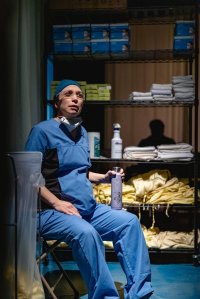
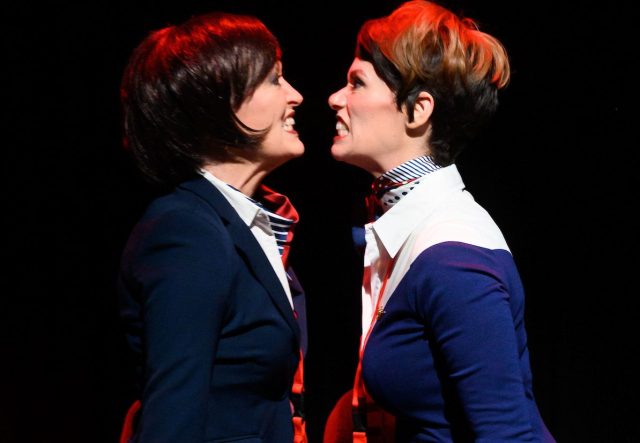
Heather Inglis and Darrin Hagen, Workshop West Playwrights Theatre. Photo by Ben Franchuk, supplied.

By Liz Nicholls, 12thnight.ca

There are dramatic schisms in history that divide our lives into the Before and the After. 9-11 was one. The pandemic is another, says Heather Inglis. “It’s the defining moment of our lifetime.”

“Something significant happened and it changed our lives forever. And of us have been touched by it.”

That, says the Workshop West Playwrights Theatre artistic producer, is the inspiration of Unsung: Tales From The Front Line, the ‘performance installation’ created by Inglis and actor/ playwright/ memoirist/ queer historian Darrin Hagen. It opens Friday at the Gateway Theatre.

“Last spring, in this political climate,” says Inglis, it felt like the contributions of health care workers hadn’t been honoured — people who had risked their lives for months and months, the incredible trauma of that.… Many people had died, and there’d been no moment to mark what had happened: no AIDS Quilt, no Vietnam war memorial.” 

There are reasons to sidle around the subject of COVID in theatre, of course, not least because of the familiar weight of existential dread and anxiety we’ve pocketed. “‘O gawd, please gawd, don’t let it be about COVID’ … both of us had heard that mantra over and over,” says Hagen. And yet, “we kept coming back to the idea of COVID as our defining moment…. How do you not make art about that? WTF are we supposed to be doing as artists if we’re not making art about that?” 

“Our goal,” says Inglis , “was to create a space to process what people had given and what they’d lost.” And for this, Workshop West’s new Gateway was ideal for brokering interaction between people beyond the stage — an Inglis specialty, witness such immersive theatre experiences as The Elevator Project, Flight,  Anxiety, all in unconventional spaces.

In interviews of anywhere from 90 minutes to two hours Inglis and Hagen gathered the stories of seven health care workers, from a variety of professions, demographics, genders, socio-cultural backgrounds. And Hagen created monologues using their words. For the safety (of jobs and patient information) their stories are all anonymous. In Unsung, which you visit like a gallery, moving around, choosing the order of your five-minute connections, you’ll meet them up close, telling their stories in their own words — as performed by seven actors. An ER doctor, an ICU nurse and an ICU doctor, a hospital manager, a paramedic, a health aide worker in a seniors complex among them: “they were in the jaws of the beast, and their experiences were radically different.”  

“It’s the difference between politicians talking about a war, and actually hearing from someone in the trenches,” as Inglis describes verbatim theatre, a form in which she and Hagen are experienced practitioners. By using their real words, verbatim theatre “allows people to speak the way they speak,” without the intermediary of characters and dialogue. 

In structure Unsung echoes Viscosity, a 2018 Theatre Yes initiative in which Inglis and her team gathered the first-hand stories of oil patch workers, and created monologues using their own words, performed by actors. I arrived at the show figuring I knew about oil workers and how they would think. And my preconceptions were pretty much exploded by the variety in what I encountered.   

“That’s one of the things theatre offers us,” says Inglis, “the opportunity to explore nuance and complexity in a way that can’t (exist) on social media platforms … to contemplate things from different perspectives and to offer voices to people that see things in a way most of us don’t.” 

Curating verbatim text is something of a Hagen specialty, too (“I am a writer created by the AIDS epidemic”), not only in The Queer History Project, but in his plays too. Witch Hunt at the Strand, for example, is built on real court transcripts in its exploration of a sorry chapter in Edmonton queer history. The Empress and the Prime Minister uses Trudeau speeches and the real words of gay activist ted northe to imagine a 1969  encounter that changed Canadian law. Even in a roistering Guys in Disguise entertainment like BitchSlap! Hagen was at pains to use real words from Joan Crawford and Bette Davis. “There’s something about that kind of authenticity,” he says.

“My mind has been blown,” he says of interviewing people for Unsung. “We’ve heard things that are so much deeper, darker, more intimate, more personal than anything the media has portrayed…. I don’t like the way the media dumbs everything down.” Not only is it repetitive and lazy, it hands the human narrative over to politicians. Inglis adds, “it’s a  cautionary tale, warning us against considering that all blocks of people all think the same.” 

“I felt so lucky,” says Hagen of his experience listening to real-life stories from people. “While doctors were out there saving lives I spent the pandemic in my pjs composing music and writing a play, and learning to use Garage Band. I was so insulated.”

As health care professionals began to understand, and see first-hand, what was happening, “some of them said they re-wrote their wills…. They left for work knowing they might not come back. That’s war!” Or they lived in isolation from their families, in the basement. Many spoke to the emotional moment of The Vaccine, says Hagen, “the relief of it, of knowing they could be around their families again.”

The interviews happened this past October and November, and reflect the world events of that time, too. “It’s really current,!” says Inglis. “Theatre in this (verbatim) form lends itself to that; documentary theatre can be very immediate.” There was a lots to work with. The biggest challenge was parting with “brilliant dramatic material” in the interests of fashioning a workable, performable theatre experience. Will Unsung have a future as a series? a podcast? a book? Inglis and Hagen are considering. “It’s tempting and maybe unavoidable,” says the latter.

“I’m terrified for a world where we don’t have universal health care,” says Inglis. “It’s being undermined in Alberta now…. I’m angered that people who have chosen radical compassion have been derided, punished, their waged and conditions degraded, people who wanted to help people.…”

The idea of Unsung  is “to bring people into a world the aren’t familiar with,” as Inglis puts it, “and let them move around in it.” Arrive any time between 7:30 and 9:30 p.m., and choose your own path through the human gallery.

PREVIEW

Unsung: Tales From The Front Line

Theatre: Workshop West Playwrights Theatre

Created by: Heather Inglis and Darrin Hagen

Where: The Gateway Theatre, 8529 Gateway Blvd.

Running: Friday through Feb. 12

Tickets: workshopwest.org

Posted in Previews | Tagged , , , , , | Comments Off on Unsung: Tales From The Front Line, real-life stories from health care workers in a new ‘performance installation’

Another F!*#@$G Festival! It’s at Theatre Network and the headliner is the Ronnie Burkett Theatre of Marionettes

Little Willy photo supplied by the Ronnie Burkett Theatre of Marionettes

By Liz Nicholls, 12thnight.ca

Not Another F!*#@$F Festival! You say that, Edmonton, but you know you love them. Theatre Network is launching a new festival at the Roxy, of the adult contemporary multi-disciplinary stripe, Feb 7 to 12. You get to name it. And here’s the capper: the great Ronnie Burkett is back, back in a theatre town where he has a huge following. The headliner is The Ronnie Burkett Theatre of Marionettes, with his latest production, Little Willy, currently premiering at the Cultch in Vancouver.

To help support 12thnight.ca YEG theatre coverage, click here.

Little Willy is a raucous version of Romeo and Juliet, as performed by the cast of The Daisy Theatre. All the leading ladies of the company, much loved by audiences, are contenders for the coveted role, including burlesque star Dolly Wiggler and that most jaded of divas Esmé Massingill. Audience faves Schnitzel and Mrs. Edna Rural, those noted Shakespeareans, are in the show as well. And as you’ll suspect from the title, the Bard himself will venture onto the marionette stage — if he dares. 

Ronnie Burkett

Theatre Network and Burkett have a history together that goes back to 1990, and Awful Manors, an startlingly intricate large-cast Gothic mystery thriller. And the distinguished, much awarded, highly original playwright, actor, artisan, designer, marionettist extraordinaire has been back at the Roxy with many other of his shows. 

Other productions and performances in the new festival will be announced in the coming weeks, says Theatre Network. Meanwhile Little Willy tickets are available at theatrenetwork.ca/events/littlewilly. And you can submit your brilliant idea for naming Another F!*#@$G Festival  either online at theatrenetwork.ca or in person at the Roxy. There’s a cool prize: a Theatre Network 49th season flex pass. 

Posted in News/Views | Tagged , , , , , , | Comments Off on Another F!*#@$G Festival! It’s at Theatre Network and the headliner is the Ronnie Burkett Theatre of Marionettes

I feel the earth move under my feet … Enough gets its Canadian premiere at Northern Light Theatre

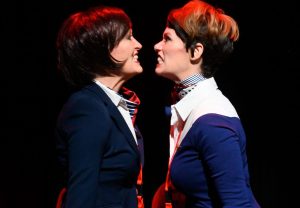
Linda Grass and Kristin Johnston in Enough, Northern Light Theatre. Photo by Ian Jackson, Epic Photography.

By Liz Nicholls, 12thnight.ca

“In every season there’s one show that scares me,” says Trevor Schmidt. “One show that challenges me as a director or designer. And this is the one.”

To help support 12thnight.ca YEG theatre coverage, click here.

Northern Light Theatre’s artistic director is talking about Enough, the intricate two-hander by Scottish playwright Stef Smith that gets its Canadian premiere Friday in the Studio Theatre in the ATB Financial Arts Barn. “Really difficult!” he says cheerfully. 

Enough is more than enough, theatrically speaking, as Schmidt explains. “It’s structurally unique. There’s first-person narrative, third-person narrative; there’s (dramatized) scene work, there are monologues, there’s movement, there’s repetitive beat poetry stuff, poetic imagery, huge themes, surrealism…. And it all switches on a dime!”

Sometimes one character addresses the audience personally; sometimes one character narrates. Sometimes they have naturalistic scenes together, with dialogue. “The performers have to be super-adept…. It’s a giant jigsaw puzzle.”

So what is this play with an enigmatic title and “a weird omniscience” that loops characters from the climax back to the beginning to fill in the blanks ? Air travel, infinitely aggravating, unreliable, anxious-making as it is in this part of the century, is the backdrop to Enough. In the play, a prize-winner at the 2019 Edinburgh Fringe, we meet two flight attendants, long-time friends, who preside professionally, with calm, smiling reassurance, over a contained world 30,000 above the ground. Welcome aboard.

Safety demonstrations abut “fanciful flights of imagination.” And a kind of existential dread has come to haunt two capable women — one married with kids, the other single in an unhealthy relationship. Something ominous is happening five miles below them, they sense. As Schmidt describes, “something on the earth is shifting, changing; they feel it, a kind of groaning under the earth. Something is coming and they don’t know what it is. There’s an undercurrent of anxiety, stress, disaster, impending doom….One reaches into her purse and her purse is filled with sand.”

Enough follows the solo horror show Squeamish in a three-production Northern Light season where all the roles are for women (the finale in April is the one-woman A Hundred Words For Snow, starring Dayna Lea Hoffman). And Schmidt thinks that “so much of this play, though written before #MeToo, is about womanhood,” and society’s impossible demands on women to be “beautiful, confident, sexy, wives, mothers…. How can you possibly be all of these?” 

Schmidt muses on the questions of the play, filtered through its characters. Why do women have to be jealous of each other? the characters come to wonder. “Why do people think that’s the only emotion we can have? I’m not jealous. I’ve made choices that are different than yours. I don’t want your life….”  

“At its core Enough is a play about female friendship, about women supporting each other,” Schmidt says. “We don’t see plays about platonic love very often…. I want to celebrate my female friendships.”

Speaking of which, for Enough Schmidt has paired two favourite actors with whom he’s frequently collaborated: Kristin Johnston and Linda Grass. “I am very fortunate! I get to choose who I work with,” says Schmidt. “Both actors are extremely funny in real life. Both are kind; both have the same kind of work ethic and come really prepared; both are flexible to direct.” Schmidt was sure they’d enjoy working together. “I want us to be happy,” he says of his directorial mantra. We’re not getting enough money to not have fun!”

The complications of the play have required a particularly intense kind of collaboration, says Schmidt. Movement designer is Ainsley Hillyard of Good Women Dance (and soon to be artistic director of Brian Webb Dance Company — “so kind, so creative about articulating movement in a way actors are comfortable to pick up.” She’s been part of the  production from day 1, he reports. So has sound designer Dave Clarke ,  “so joyous so clever. There’s always something witty about his designs.”  

There contributions aren’t mere interesting add-ons, says Schmidt. “For this one you actually need all these elements, or you don’t have the magic…. I think it’s going to something! I think it’s going to be exceptional.”

PREVIEW

Enough

Theatre: Northern Light

Written by: Stef Smith

Directed by: Trevor Schmidt

Starring: Linda Grass, Kristin Johnston

Where: Studio Theatre, ATB Financial Arts Barn, 10330 84 Ave.

Running: Jan. 20 to Feb. 4

Tickets: northernlighttheatre.com


Posted in Previews | Tagged , , , , | Comments Off on I feel the earth move under my feet … Enough gets its Canadian premiere at Northern Light Theatre

Fresh Hell: Career women Joan of Arc and Dorothy Parker hit the stage together (really!) in a new Conni Massing play

Sidney Williams and Kate Newby in Fresh Hell, Shadow Theatre. Photo by Ian Jackson, Epic Photogrqphy.

By Liz Nicholls, 12thnight.ca

The new play that premieres in the Shadow Theatre season this week has a premise that’s bound to make you smile.

Conni Massing’s Fresh Hell brings together on one stage two women who not only didn’t meet in real life, having died some 536 years apart, but are unlikely ever to meet in the afterlife, if there is one, either. One wielded a martini in one hand and a pen in the other. The other’s instruments of choice were the sword and the banner.   

Fresh Hell, named for the famous Dorothy Parker line “What fresh hell is this?” (so useful in all exasperating situations) imagines three encounters between that American wit and satirist and Joan of Arc, the sainted heroine of the Hundred Years’ War. 

To help support 12thnight.ca YEG theatre coverage, click here.

Both have been imagined as characters by the world’s playwrights before — but never together. Now, for the first time, thanks to Massing, they’re show-mates. “Where did the play come from?” laughs the playwright. “It’s a bit of a mystery to me, too….”

“I’ve always loved Joan of Arc,” says Edmonton-based Massing whose writing career encompasses theatre, TV, and film. “I think many teenagers fall in love with her; she’s the ultimate rebellious teenager, with an incredible life story…. And I played her in a high school production!” to wit Ponoka Composite High’s production of Anouilh’s The Lark.  

playwright Conni Massing. Photo supplied.

Massing, a conversationalist of puckish wit and good humour, is amused by the memory. “I decided on my own I should bind my breasts because Joan of Arc was flat-chested and I wasn’t. Yes, I took that on myself! I also decided I should wear sparkly blue eye shadow — because I was gonna spend so much time looking up at the sky…. And nobody stopped me from doing this! Clearly they were not monitoring my choices very closely.” What Dorothy Parker, would have made of the production — she was Vanity Fair’s theatre reviewer from 1918 to 1920 before getting fired when her caustic assessments scorched a few influential egos — must remain forever a mystery.

Sidney Williams and Kate Newby in Fresh Hell, Shadow Theatre. Photo by Ian Jackson, Epic Photography.

Massing fell in love with Parker later, at university. “I loved the savage wit, the short stories, the famous one-liners — I keep saying to people she’s the great precursor of Twitter.” And the bonus was Parker’s milieu, New York in the ‘20s and ‘30s, when everything was just somehow more interesting.”

So, Joan and Dot, a high-contrast pair if ever there was one. “At some point some years ago I somehow got the idea to put them both in the same play,” says Massing. “And the idea stuck with me. Eventually I succumbed, and started puddling around and researching.” 

Gradually Massing discovered things they had in common. “Which sounds mad, I know,” she says cheerfully. For one thing, “they both worked in a man’s world. For another, “they both faced death,” again and again. For Joan it was on the battlefield. Dorothy tried to commit suicide at least three and maybe as many as five times (unsuccessfully, she lived to be 71). 

And there’s this: “both battled with language.” Parker’s dexterity with the language is legendary, of course, her turns of phrase in reviews, short stories, poems, and off-the-cuff wisecracks, caustically funny and much-quoted. As she said “The first thing I do in the morning is brush my teeth and sharpen my tongue.”

But Joan “was very articulate in her own way,” a surprising skill in an illiterate peasant girl. The Joan who emerges from the transcripts of her trial, as Massing discovered reading them, “could duck and weave weaving around the highly educated men of the clergy.” She held her own, to the point that proceedings, “originally in a church where the cheap seats were filled with priests, were made more private, a testament to her general wit, and her conviction.”

The Massing theatre archive includes plays rooted in the prairies (The Aberhart Summer, Jake and the Kid), and ranging widely on the spectrum between light and dark, romantic comedy (The Invention of Romance) and prairie gothic (Gravel Run). Matara (2018) explores in a strange and haunting way the relationship between people and animals, a solitary elephant in a zoo dreaming of home. Still, plucking Dorothy Parker and Joan of Arc from the ether of free-floating centuries to meet in a play is a bold move.   

“There was obviously some fun to be had in putting two very different people together,” says Massing, one who died at 19 and one who died at 71 more than five centuries apart. And they both had “extraordinary event-filled lives.” But how to have them meet? “Dorothy is writing about Joan of Arc, and she’s being funny, rude, dismissive. So Joan is on Dorothy’s mind when (the warrior heroine) is summoned by her. It comes at a moment, in the assault on the fort Les Tourelles in 1429, when La Pucelle has been hit by an arrow and feared dead (later to return to battle). It’s a gap in the action, corresponding to a similar “window of opportunity” in Dorothy’s story. 

Sidney Williams and Kate Newby in Fresh Hell, Shadow Theatre. Photo by Ian Jackson, Epic Photogrqphy

As Massing explains, “Dorothy has slit her wrists, but phoned to the restaurant downstairs and ordered food. Which is how she’s saved…. In the play I’m proposing that both are pulled from the action at a moment of crisis, a pause in their stories” between life and death. 

“There was a period in her mid-‘60s when Dorothy, really not well as alcoholism caught up with her, stopped writing. Then a weird revival, a resurgence (of writerly activity) in the last couple of years of her life…. In the world of my play that rejuvenation is a result of this final encounter with Joan of Arc.” 

Kate Newby as Dorothy Parker in Fresh Hell, Shadow Theatre. Photo by Ian Jackson, Epic Photography

What made Parker so appealing to Massing as a writer herself was that “she’s so full of contradictions…. She could be so so savage, so mean, but was so generous with money. She spent a lot of time as an activist, involved in civil rights. She left her estate to Martin Luther King. She went on marches, protests, spoke at luncheons. She co-founded the Hollywood anti-Nazi League, and got blacklisted….” 

Of Parker’s brilliant writerly accomplishments — short stories published in prestige magazines like The New Yorker, poetry collections, captions for ads (“brevity is the soul of lingerie”), lyrics for musicals, essays, screenplays (she was the co-writer of A Star Is Born) — one eluded her. She never published a novel. “In her perfect universe she would have published a great novel, had a last drink, and slipped off the moral coil at 50,” says Massing. But she lived on, obsessed with ‘making it’, still trying to figure out how to be successful. “Not a lot of self-love there.”

As for Joan of Arc, who started to hear Voices at 17 and was executed at 19, “I’ll never get over being boggled by her early rise to power,” says Massing. “To be a child, a girl!, in the countryside, and convincing someone to take her to the next level, that led to her leading an army…. It’s so unlikely. She was powered by such incredible conviction. You meet those people now and then, and sometimes their convictions are disturbing. It’s hard to resist.”

The Shadow production at the Varscona brings the playwright together with director Tracy Carroll, a long-time collaborator. And it marks the return to Edmonton after many years of actor Kate Newby, “my dream Dorothy Parker,” as Massing says. Joan is played by newcomer Sydney Williams, notable in the premiere of Amanda Samuelson’s Pressure at last summer’s Fringe. 

Would Massing call Fresh Hell a comedy? She pauses, and laughs. “I’m leery of labelling things a comedy; it sets up an expectation. I hope there are many moments that’ll make people smile, or grin. Or laugh even. At this stage of my life I’ve decided you’re better off calling things a drama. And if people get some laffs, l-a-f-f-s, along the way, it’s a bonus.” 

PREVIEW

Fresh Hell

Theatre: Shadow

Written by: Conni Massing

Directed by: Tracy Carroll

Starring: Kate Newby and Sydney Williams

Where: Varscona Theatre

Running: Wednesday through Feb. 5

Tickets: shadowtheatre.org 

Posted in Previews | Tagged , , , , , , | Comments Off on Fresh Hell: Career women Joan of Arc and Dorothy Parker hit the stage together (really!) in a new Conni Massing play

A coming-of-age thriller: Freaky Green Eyes at Fringe Theatre, a review

Emma Houghton in Freaky Green Eyes. Photo by Brianne Jang, bbcollective

By Liz Nicholls, 12thnight.ca

The opening image of Freaky Green Eyes is a girl poised on a diving board, about to take the plunge.

To help support 12thnight.ca YEG theatre coverage, click here.

In Emma Houghton’s solo show, an artful stage adaptation of Joyce Carol Oates’s 2003 powerfully dark ‘young adult’ thriller, it’s a striking metaphor for a coming-of-age story. In Houghton’s a captivating performance, Franky takes a deep dive, as they say, into her past, a watery medium where memories have to be stripped of camouflage and re-assembled, in order to float. 

It’s moving from “a known territory to an unknown” thinks Houghton, “from a place where people know you to a place where people only think they know you.” And vice versa, as we discover along with Franky in the course of Chantelle Hans’s production (presented in association with Punctuate! and Fringe Theatre): a place where you know people to a place where you realize you only thought you knew them. 

Beyata Hackborn’s clever design of hanging photos is a veritable underwater memory gallery, set in shimmering motion by Tori Morrison’s projections and Kat Evans’ lighting. There are blurry family portraits, oddly angled photos of pale blank walls and stairs, smudgy close-ups of moments or unidentifiable details, the kind that memory toys with and won’t let go. They seem to appear and fade, change shape. 

And Franky, as conjured by Houghton, hustles through that world, looking for clarity. She populates it, too, with her little eight-year-sister Samantha, her artist mom, and her dad, a star football player turned star sportscaster. She adores him. And he calls the shots; he is the assignment editor, so to speak, of all decisions about family life.  

Houghton captures in such an appealing way Franky’s amusingly deadpan teen wit in describing, in a rush of words, her life. For our benefit she describes the big, expansive “post-modern” house they occupy, thanks to dad, as having “modular units instead of rooms.” At smart 15 she’s both knowing and innocent. Her perspective has been sharpened by a near-rape at a drunken party early in the play. Her inner resistor and ally, Freaky Green Eyes, has been unleashed, sticks up for her, and “saves my life.” Our heroine revels in her new sense of control. 

Emma Houghton in Freaky Green Eyes. Photo by Brianne Jang, bbcollective.

And it’s Freaky Green Eyes who is her inner voice of dissent when the family starts to disintegrate. Her mom, whom Franky accuses of having a “stapled-on smile,” grows ”tense and fidgety.” And she’s away from the family more and more. Is it abandonment, as dad says, or escape, as Franky comes, at some subterranean Freaky Green Eyes level, to suspect? 

“Why are you building a second life?” Franky demands. “Your mother is supposed to worry about you, not the other way around.” 

Franky is used to taking her cues from dad, a veritable repository of sports jargon about team spirit, fight or flight, fight fight fight, and all that. And gradually, the story takes on OJ Simpson contours when mom vanishes altogether. It’s a sinister mystery that Freaky Green Eyes urges Franky to de-construct. 

Emma Houghton in Freaky Green Eyes. Photo by Brianne Jan, bbcollective.

The moments between between Franky and her little sister, between teenager and child, are one of the particular delights of an absorbing evening. In those scenes, where Franky has to play consoling mom in the absence of the real one, Franky and Freaky Green Eyes improvise together, the former with less and less conviction. Houghton is very skilled at this, at differentiating the characters with minimal but telling adjustments in voice and body language. Mom emerges, too, calm but wary. 

To me the lab mic that artificially modulates Houghton’s voice, light as it is, for male characters is an idea that should be revisited. A case can be made for the artificiality of male-ness, I guess, in a memory play. But the effect is jarring, and quite unpersuasively grotesque, which colours the mystery from the start and doesn’t seem owned by Franky.

The show, the production, and Houghton’s performance, though, create a vivid and suspenseful world in which our vision darkens as the domestic mystery unravels. It’s an evocation, scary and irreversible, of the moment on the diving board when we look at our family in a different light, from the outside, as actual people. And we find ourselves, our inner Freaky, in doing it.

REVIEW

Freaky Green Eyes

Fringe Spotlight Series

TheatreEmma Houghton in association with Edmonton Fringe Theatre and Punctuate! Theatre

Adapted by: Emma Houghton from the Joyce Carol Oates novel

Directed by: Chantelle Han

Starring: Emma Houghton

Where: Backstage Theatre, ATB Financial Arts Barn, 10330 84 Ave.

Running: through Jan. 21

Tickets: tiered ticketing and offer-what-you-will, fringetheatre.ca.


Posted in Reviews | Tagged , , , , , | Comments Off on A coming-of-age thriller: Freaky Green Eyes at Fringe Theatre, a review

Sad news in Edmonton theatre: Judy Unwin, a theatre pioneer with the public service gene, is gone

Judy Unwin and actor Jason Hardwick. Photo by Jana Hove.

By Liz Nicholls, 12thnight.ca

At the start of the new year, there’s very sad news today in Edmonton theatre. 

With the untimely death, at 76, of Judy Unwin, we’ve lost a bona fide arts pioneer, a public-spirited artist who played many roles in the proliferation of live theatre in this theatre town — as an actor, a director, an artistic director, an administrator, a board member, a fund-raiser and donor, a theatre lover and lobbyist. She was even a Fringe theatre reviewer for multiple summers.  Her contributions are many and varied — she had the public service volunteer gene — and extend beyond the stage door out into the community at large. 

From a notable Edmonton theatre family (her father Jack Unwin was an influential director), Judy grew up in the arts. She figures prominently in the early history of civic kids theatre here, and of Walterdale, our venerable community theatre. In her teens she was the ringleted ingenue of the very first Walterdale Klondike melodrama in 1965 and many thereafter, then directed them, then served on the board, then became the artistic director.

When she directed the first Edmonton production of Mark Medoff’s Children of a Lesser God at Walterdale, she learned ASL, and retained connections to the Deaf community all her life.  She was on the board of the Varscona Theatre as it became a theatre consortium. From the start she played a big and practical part in arranging the Sterling Awards. She was someone who stepped up.

Judy was opinionated, stubborn, outspoken, and generous. She was a friend of mine. A more detailed 12thnight appreciation will follow soon. 

Posted in News/Views | Tagged , , , , | Comments Off on Sad news in Edmonton theatre: Judy Unwin, a theatre pioneer with the public service gene, is gone

The mystery behind the memory: Freaky Green Eyes, how a novel became a new play, premiering at Fringe Theatre

Emma Houghton in Freaky Green Eyes. Photo by Brianne Jan, bbcollective.

By Liz Nicholls, 12thnight.ca

“Hi! I don’t know if I have the right email address. I’m a theatre artist from Edmonton, Alberta. I really love your book. And I’d really love to adapt it into a stage show….” 

It took persistence and some ingenious sleuthing for Edmonton actor Emma Houghton to connect directly with the celebrated American writer Joyce Carol Oates. Ah yes, and an undimmed heart-on-her-sleeve fascination with Oates’ dark and mysterious “young adult” novel Freaky Green Eyes. That’s something Houghton, now 30, has retained since the moment, at age 11 or 12, when her mom gave her the book.

To help support 12thnight.ca YEG theatre coverage, click here.

It’s a well-thumbed copy. “It stuck with me; I’d re-read it every three or four years!” says Houghton, over a pre-rehearsal coffee last week. 

How that 2003 Oates novel has become the one-woman play, Houghton’s first play ever — three-and-a-half years and a pandemic in the making, opening Friday at the Backstage Theatre — is a dramatic story in itself. And, as Houghton tells it, in her funny, candid way, it has a looping, absurdist “cart before the horse” streak Kafka would have enjoyed. For starters, you can’t get a writing grant or book a theatre without having the rights to the novel: you can’t get the rights without having a theatre lined up. 

The route through the labyrinth of publishers and literary and theatrical agents into which the intrepid Houghton ventured in the summer of 2019 was full of discouraging delays, run-arounds and obstructionist silences. In the end it was the Ivory Tower that coughed up the prize info. Houghton’s email directly to the famous author, at 83 still a working prof at Princeton, got a response in three minutes flat. “Hello Emma. This sounds like a wonderful idea,. I’ve cc’d my theatrical agent, Best of luck….” 

Two Edmonton theatre companies, Fringe Theatre and Punctuate! Theatre, stepped up to lend their weight, and resources, to Houghton’s debut as a playwright and producer (Freaky Green Eyes is presented “in association with” them). And so did an impressive array of Edmonton and Calgary theatre artists, both veteran and emerging, including director Chantelle Han, designer Beyata Hackborn, choreographer Deviani Andrea. 

Houghton has a history with Edmonton audiences that extends through theatres large and small. “I’ve been onstage here since I was nine,” she grins, remembering her youthful debut as Tiny Tim in the Citadel’s A Christmas Carol. Last week she was musing on the original attraction of the novel for her 12-year-old self. “The story is told first-person, from the point of view of Franky, who’s 14 and reassessing the mysterious recent past. And she’s really strong. It’s a coming-of-age story; she’s figuring out who she is, who she wants to be, how to navigate people and situations — that’s what everyone figures out, constantly, their entire lives.”

“She’s in a lot of hard situations, trying to determine the truth…. Kids get lied to a lot — sometimes for their benefit, sometimes not,” as Houghton says. The children of divorce, for example, are enlisted by each parent as allies, hearing opposing stories  as they move between households. “Kids are constantly getting fractured realities about what is and what isn’t. Really hard for a kid to navigate.” 

Emma Houghton in Freaky Green Eyes. Photo by Brianne Jang, bbcollective

Franky has a sense that “something’s not quite right in the family, and she doesn’t know what, yet.” When Franky’s mom “vanishes,” she is moved to piece things together for herself, assisted by her inner voice Freaky Green Eyes. 

What Houghton has fashioned from the novel, she says, is a memory play, with the flavour of mystery and true crime about it. “Franky is telling the story, showing scenes from the last year; she’s both herself and her own narrator.” And Houghton the actor populates the stage with the characters in Frankie’s life — her mom, her little sister Samantha, her father, a teenage boy, her Aunt Vickie.

Emma Houghton as dad, Freaky Green Eyes. Photo by Brianne Jang, bbcollective.

It’s a plum acting assignment, Houghton agrees happily. If you write yourself a play to perform, why not? The book lends itself to a larger cast, of course, but “I have always wanted to do a one-woman show,” she says.  “It’s my dream.” So she has the fun of conjuring the characters in Franky’s world — some with changes in gesture or voice, some emerging as voice mail messages. For the male characters, Houghton uses a lab mic, a “voice modulator.”

The effect of the pandemic on theatre careers has been profound, and devastating. An 2017 acting grad from the U of A’s BFA program who hasn’t been onstage for three years till now, Houghton “felt on the cusp in my career” when the pandemic hit in March 2020. She was “three years out (of school),” mid-run in the two-hander Actually at Alberta Theatre Projects in Calgary when the abrupt shut-down happened on March 12 that year. “I had a bunch of opportunities; I had put time into both the Edmonton and Calgary communities.”

“I came back from Calgary; I broke my lease,” she sighs. “I sat at home not getting calls.” 

For a resourceful artist like Houghton, pandemical isolation has been a call to indie chutzpah. We can look for the launch in June of Scout, a new web series starring Houghton, Gabe Richardson and Hunter Cardinal as three estranged best friends who form a community news network to combat fake news. “All Edmonton writers!” she beams. 

Emma Houghton in Freaky Green Eyes. Photo by Brianne Jang, bbcollective.

“I threw myself into self-production,” she says. “I figured I really needed to make my own opportunities.” Since she’d already started working on a solo stage adaptation of Freaky Green Eyes, she kept at it. The new playwright wrote applications for writing grants, didn’t get them, and still kept at it. Playwright Matthew MacKenzie of Punctuate! Theatre, whose mentoring generosity is second to none,  offered her dramaturgical advice. 

The novel, Houghton figured, was a natural for theatre. It was first-person, for one thing. “We see the world through Franky’s eyes; she’s a fascinating character.….” And something mysterious is going on; perhaps a crime has been committed. Her memories align one way. Her mind, her inner voice, her outward influences are telling her something else. “But she can’t compute it. Eventually she has to de-program herself.” 

Theatre production in all its complications has been an education, and Houghton is an energetic self-educator. “Technically, I don’t fully own the play yet,” she says, “I own this version, for this presentation.” The rights and a flat fee up front came with elaborate specifications, about producing “in association with” Punctuate! (Houghton complied happily, since MacKenzie and Punctuate! producer Sheiny Satanove have been so helpful), about the maximum number of seats in the theatre, the maximum ticket price, the maximum number of performances. Fringe Theatre’s “offer-what-you-will” and tiered ticketing from $5 to $25 at the Backstage Theatre have aligned perfectly. And Houghton has a production that’s primed for touring in every way, including Hackborn’s portable design. 

And a 20-year-old novel has found new life on the stage, as a solo memory play. “I started adapting it pre-pandemic. But I’ve found the story so potent right now,” says Houghton. “The brainwashing of kids, their isolation at home, both parents manipulating the kids in certain ways, hiding things from them, not telling them the whole truth, the epidemic of domestic violence with everyone stuck in a contained space….”

“We’re inside Franky’s head, as she tells this story.”

PREVIEW

Freaky Green Eyes

Fringe Spotlight Series

TheatreEmma Houghton in association with Edmonton Fringe Theatre and Punctuate! Theatre

Adapted by: Emma Houghton from the Joyce Carol Oates novel

Directed by: Chantelle Han

Starring: Emma Houghton

Where: Backstage Theatre, ATB Financial Arts Barn, 10330 84 Ave.

Running: Jan. 10 through 21

Tickets: tiered ticketing and offer-what-you-will, fringetheatre.ca.

Posted in Previews | Tagged , , , , | Comments Off on The mystery behind the memory: Freaky Green Eyes, how a novel became a new play, premiering at Fringe Theatre

Wait, there’s more…. Act II of the theatre season is about to begin

Trouble In Mind, Citadel Theatre. Photo supplied.

By Liz Nicholls, 12thnight.ca

Stay tuned; face forward. There’s more!

To help support 12thnight.ca YEG theatre coverage, click here.

Intermission’s over, my friends, and Act II of the Edmonton theatre season is about to begin. Freaky Green Eyes, Emma Houghton’s original adaptation of the Joyce Carol Oates novel, premieres in the Fringe Theatre season next week (more about this in an upcoming 12thnight post).

Meanwhile, what looks too good to miss? From a long list of highly anticipated shows arriving onstage here in 2023, here’s a sampling (in no particular order). 

The Space Between Stars: Christine Lesiak, the artistic director of the Play The Fool Festival and a theatre artist of uncommon versatility (her exclusive career trajectory is space physicist-turned-clown), embraces her own unusual skill set in this stage adaptation of Saint-Exupéry’s classic The Little Prince. The mainstage feature at the 2023 SkirtsAfire Festival, The Space Between Stars includes live actors (Lesiak herself, with Sarah Emslie and Sahl Wilkie), puppets, and projections to tell the story of an astronomer and her memories of her son. It remains, to my knowledge, the only piece in #yeg theatre history to have a workshop at the U of A observatory. Tracey Carroll’s premiere production is in an actual theatre, the Westbury, March 2 to 12. 

Listen, Listen: Possibly the quizzical premise of 2023. this new play from Edmonton ex-pat playwright/screenwriter Elyne Quan launches an initiative of commissions created specially for the “comedy-forward” company Teatro Live!. In Belinda Cornish’s production (May 26 to June 11 at the Varscona), Farren Timoteo stars as a Muzak connoisseur on a heroic quest to save the dulcet elevator music he loves from extinction in an uncomprehending world. The cast includes Alex Ariate, Nadien Chu, and Nikki Hulowski.  

Fresh Hell by Conni Massing, Shadow Theatre. Photo supplied.

Fresh Hell: Speaking as we are of intriguing premises, consider the unlikely pairing of American wit Dorothy Parker and French hero Joan of Arc in Conni Massing’s play. They have much to talk and wrangle about, including subjects like living through the darkest of times. The co-stars of Tracy Carroll’s Shadow Theatre production (Jan. 18 to Feb. 5 at the Varscona) are Kate Newby and Sydney Williams. More about this in a 12thnight post coming soon. 

Trouble in Mind: Still remarkably timely 68 years after it was written, Alice Childress’s play-within-a-play has both heft and humour as an indictment of racism, power structures, and biases in the world of theatre. It takes us backstage at rehearsals for an anti-lynching play set in the Jim Crow South. The director is white; the star, a veteran Black actress, challenges the stereotyping of the Black characters. Trouble in Mind, which originally opened in a small Greenwich Village theatre in 1955, would have been the first play by a Black woman to arrive on Broadway two years later, but playwright Childress refused to make the changes demanded by white producers. The Citadel/ Royal Manitoba Theatre Centre co-production is directed by Audrey Dwyer (March 27 to April 16).

After Faust: The opening production of RISER Edmonton 2023, the #yeg branch of the national initiative launched to support indie producers, addresses an intriguing question. We all know what happened to Faustus, who bargained his soul away to the demon Mephistopheles for endless future considerations. What happened to the demon after that? Connor Yuzwenko-Martin’s play is all about that. The Invisible Practice production, performed in ASL by a deaf cast directed by Ebony Gooden, runs Jan. 31 to Feb. 5 at the Backstage Theatre.

Unsung: Tales From The Front Line. Based on verbatim interviews, the immersive seven-actor production created by Darrin Hagen and Workshop West artistic director Heather Inglis, is an homage to the healthcare workers who risked everything, and in a terrible political climate, to keep us safe, and alive, during the pandemic. Inglis directs the production, billed as “living portraits,” a gallery in which we move from frame to frame as we choose. Inglis directs the collaboration between Workshop West Playwrights Theatre, Theatre Yes, and Ground Zero Productions, running Jan. 25 to Feb. 12 at the Gateway. 

Gianna Vacirca in Sexual Misconduct of the Middle Classes, Theatre Network. Photo by Ryan Parker.

Sexual Misconduct of the Middle Classes: In her 2020 two-hander “comedy drama,” the mainstage finale of Theatre Network’s first full season at the Roxy (April 25 to May 14), the Canadian star playwright Hannah Moscovitch builds on, plays with, and subverts in surprising ways, a familiar trope: the inappropriate affair between a university professor and student. The Theatre Network production (originally slated for 2020) continues a long-standing relationship between Moscovitch and the company (witness East of Berlin, Little One, Infinity, What A Young Wife Should Know). Marianne Copithorne directs a great cast: Gianna Vacirca and John Ullyatt co-star. 

Twelfth Night: Shakespeare’s mysteriously madcap, light-dark, open-ended comedy (a favourite of mine, how can you tell?) is one of the two mobile productions in Freewill Shakespeare Festival’s upcoming 36th summer season. Displaced from Freewill’s home stage by the city’s three-YEAR renovation plans in Hawrelak Park, Twelfth Night hits the road through the city (locations to be announced) in rep with Romeo and Juliet, the former directed by up-and-comer Amanda Goldberg, the latter by Freewill artistic director Dave Horak. A cast of 10 alternates in the two Shakespeares, both in Freewill’s signature boldly contemporary style, in a travelling festival that runs late July to the end of August.   

Civil Blood: A Treaty Story: Set during the dying days of the fur trade, the play by Anishinaabe writer Josh Languedoc (Rocko and Nakota, IN-COR-RI-GI-BLE) and Neil Kuefler weaves a Romeo and Juliet tale of culture-cross’d lovers (a Nehiyaw huntress and a French scholar), into a high-tension dramatic tapestry of settler encroachment into First Nations territories, treaties, Canadian government enforcements. Epic in scale (2022 staged readings at Rubaboo, Flying Canoe Volant, and Found Fest have included casts of 12 and 15), it gets a workshop production May 28 in the 2023 season of new work to be announced by Thou Art Here Theatre Feb. 5.

A Hundred Words For Snow: The solo play by the English writer Tatty Hennessy is a coming-of-age story, an adventure quest undertaken by a 15-year-old who sets out to take her father’s ashes to the North Pole, the top of the world. Climate change, ice, polar bears … it should be meat and drink for Northern Light Theatre’s director Trevor Schmidt and designer Alison Yanota. Schmidt’s production, starring Dayna Lea Hoffman, runs April 21 to May 6 in the Studio Theatre in the ATB Financial Arts Barn.

First Métis Man of Odesa: Two theatre artists, Canadian playwright/actor Matthew MacKenzie (Bears, After The Fire) and Ukrainian actor Mariya Khomutova, real-life husband and wife take to the stage as characters in their own suspenseful, crazily looping, high-stakes story. In a dangerously volatile world, where pandemics erupt and borders snap shut,  they meet, they fall in love, they get married, they cross oceans, they have a baby. And in the newly expanded version that plays April 22 to May 14 in the Citadel’s Highwire Series, the stakes are raised even higher when a Russian tyrant invades Ukraine. Lianna Makuch directs the Punctuate! Theatre production. 

Romar Dungo and Maxwell Hanic in Boy Trouble, Fringe Theatre. Photo by Brianne Jang.

Boy Trouble: I first saw Mac Brock’s play at Nextfest in 2019 and was struck by its humour, its lively and lyrical writing, its insights into the fleeting encounters of the Grindr age in all their toxic masculinity.  The production happening in the Fringe Theatre season (May 16 to 27, directed by the playwright, has been reimagined: same world, the original characters and that same world of casual and mixed connections — but more of them, over more years. And all new text. The production directed by Brock stars Romar Dungo and Maxwell Hanic. 

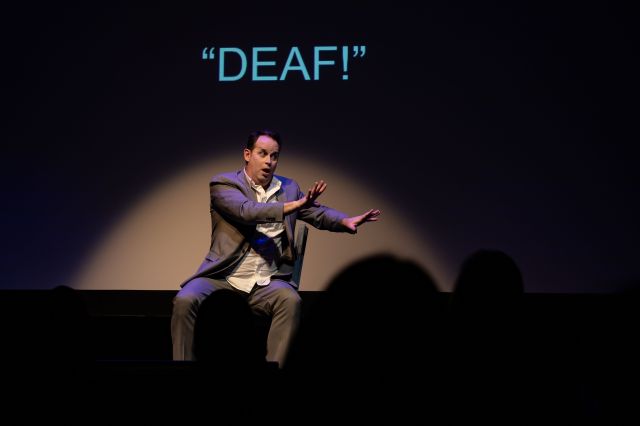
Chris Dodd in Deafy, Follow The Signs Theatre. Photo supplied

Deafy: This invitation into the challenging world of the Deaf is the creation of the remarkably charismatic Deaf actor Chris Dodd. He stars as a wry, very droll Deaf public speaker with a well-honed appreciation for absurdity. Nathan Jesper lives in three languages — spoken English, ASL, and captions. If you didn’t see the version  at the Fringe, and even if you did, you’ll want to see Ashley Wright’s production at the Citadel Jan 21 to Feb. 12.  

Prison Dancer, Citadel Theatre. Photo supplied.

Prison Dancer: the second of the Citadel’s two new Canadian musicals this season (the first: Almost A Full Moon) is the joint creation of the Filipino-Canadian team of Romeo Candide and Carmen De Jesus. It’s spun from a 2007 YouTube video, an instant viral sensation, which showed a big group of Filipino prisoners dancing to Michael Jackson’s Thriller. The musical is energized by the ways in which dance changed their lives. It runs May 6 to 28, the Citadel mainstage finale. 

Everybody Goes To Mitzi’s: There’s been a long pandemical preamble to Teatro Live’s revival of this delightful homegrown 2009 musical comedy by Teatro stars Jocelyn Ahlf and Andrew MacDonald-Smith with music by Ryan Sigurdson and lyrics by Farren Timoteo. It’s a love story set in the lively supper club world of Edmonton of the ’60s,  amongst the singing servers and the musicians, with the sassy proprietor who presides (Andrea House).  Kate Ryan directs the Teatro production running July 14 to 30.


Posted in Features | Tagged , , , , , , , , , , , , , , , , , | Comments Off on Wait, there’s more…. Act II of the theatre season is about to begin

Far From The Home I Love: a Fiddler on the Roof for our time. A review.

Jonathan Hashmonay as Tevye in Fiddler on the Roof, Broadway Across Canada. Photo by Joan Marcus

By Liz Nicholls, 12thnight.ca

In the opening moments of the grand touring production of Fiddler on the Roof that’s arrived at the Jube, a solitary man in a modern red parka walks onto the stage under a weathered train station sign. Anatevka.

To help support 12thnight.ca YEG theatre coverage, click here.

He reads from a book. “Every one of us is a fiddler on the roof, trying to scratch out a pleasant simple tune without breaking his neck. It isn’t easy….” He sheds the parka and a century or more, puts on a cap and a prayer shaw, and sings Tradition.  

There he is, Tevye, in the wonderfully comic and soulful performance by Jonathan Hashmonay the loveable beleaguered Jewish dairyman of the classic musical, in a Russian shtetl in the early 20th century. A fiddler right out of a Marc Chagall painting (Ali Marian Molaei) dances by him and the villagers appear from the mists of time behind him. 

Ali Marian Molaei in Fiddler on the Roof, Broadway Across Canada. Photo by Joan Marcus

And in the memorable contemporary framing of Bartlett Sher’s 2015 revival, Tevye returns us to the brute realities of the contemporary world at the end. In a moving final image, again in the red parka, he joins the long line of history and its endless waves of refugees, as the people of Anatevka are forcibly uprooted from their home, fleeing violence to face the dangers of the unknown. This is a revival of the great 1964 Jerry Bock/ Sheldon Harnick musical that really hits your heart with its sense of timelessness. 

Before that, in a performance that’s zestful, funny, and anguished, we see Hashmonay in his serial arguments with the Almighty. “I realize, of course, it’s no shame to be poor. But it’s no great honour either! So, what would have been so terrible if I had a small fortune?” as he sings in If I Were A Rich Man. Gazing skeptically heavenward, he shakes his fist, he shrugs ruefully, he captures the Catskills cadence of Tevye as he kibbutzes with himself, weighing the pros and cons of tradition and change. 

In a household with five daughters with ideas of their own and a forceful, harried wife (Maite Uzal in an impressive performance as Golde), Tevye is up against it. Even his horse won’t cooperate. And Hashmonay gives full weight to both comedy and tragedy, and the ambivalence of a man torn between the old ways and the new.  

Fiddler on the Roof, Broadway Across Canada. Photo by Joan Marcus.

The music, with its lush, klezmer flavours, comes at you in a lyrical rush in the production, both in intimate moments and ensemble scenes. Kudos to the choreography, re-thought from the Jerome Robbins original by the Israeli-born London-based Hofesh Shechter. It’s visceral in a contemporary but idiomatic way. The wedding scene, and its thrilling bottle-on-the-head dance is a highlight. So is the choreographic dynamic of the tavern scene in which the Jewish dancing is counterposed to dance from the outsider Russians. Tevye himself is in constant motion. The movement never seems forced, or thought out; it seems to erupt as a chaos, an amplitude, of human energy. 

Yardén Barr, Randa Meierhenry, GraceAnn Kontak in Fiddler on the Roof, Broadway Across Canada. Photo by Joan Marcus.

The momentum of the story, which accumulates in the three-hour evening, comes from the three oldest daughters who prove resistant to the demands of tradition as they find their own way in love and into marriage. Randa Meierhenry, GraceAnn Kontak and Yardén Barr as Tzeitel, Hodel and the bookish Chava have great charm and sisterly chemistry. And their shared song Matchmaker Matchmaker, as they dream of romantic happiness, is a knockout. So is Hodel’s delivery of Far From The Home I Love, a heartbreaking lament of displacement.

Randa Meierhenry and Daniel Kushner in Fiddler on the Roof, Broadway Across Canada. Photo by Joan Marcus.

None of the three men the girls fall for would be a papa’s choice. The rabbity tailor Motel (the terrific Daniel Kushner), the radical student Perchik (Austin J Gresham), and the completely unthinkable, a gentile Russian (Carson Robinette) — all are a test of Tevye’s traditional paternal authority. The ecstatic song in which Motel discovers a new manly resolve and wins the girl of his dreams, Miracle of Miracles, is a delight. “But like he did so long ago, in Jericho, God just made a wall fall down!”

GraceAnn Kontak’s The moment that Levy’s heart is broken by Chava, the daughter who finds love outside the faith, has a palpable force to it, as he physically draws the curtain across a vision of his little girl dancing. His signature inner dialectic, “on the one hand … on the other hand,” has run out of hands. Interestingly, the character with the least impact on proceedings in the rabbi (Christopher Hager). 

Maite Uzal and Jonathan Hashmonay in Fiddler on the Roof, Broadway Across Canada. Photo by Joan Marcus.

The textures of family and village life, the warmth and the harshness of it all, and the constant threat of Czarist authority, are beautifully captured in the production — in its theatricality and stagecraft, its design, and the weave of performances in a large cast. Sometimes the characters are in silhouette, sometimes in 3-D. The dream that Tevye imagines in order to convince his wife to accept Motel as a potential son-in-law is a bold pageant of masked grotesques and stiltwalkers. 

Michael Yearn’s ingenious design, with lighting by Daniel Holder, uses screens and set pieces. And then, in a folk tale sort of perspective, the village, seen in miniature floats in the air, like the fiddler on the roof. 

At this moment in human history, when anti-Semitism is on the rise, and life and whole communities can be displaced at the whim of tyrants, Fiddler on the Roof seems newly relevant. Maybe that’s true in every age. The cast dedicates their curtain call dance and song to the people of Ukraine, whose lives have been ruthlessly upended. The footing of our lives up on the roof remains precarious. 

REVIEW

Fiddler on the Roof

Broadway Across Canada

Created by: Joseph Stein, Jerry Bock and Sheldon Harnick from stories by Sholem Aleichem

Directed by: Bartlett Sher (reproduced for touring by Sari Ketter)

Starring: Jonathan Hashmonay, Maite Uzal

Where: Jubilee Auditorium

Running: through Sunday

Tickets: edmonton.broadway.com, ticketmaster.ca, 


Posted in Reviews | Tagged , , , , , | Comments Off on Far From The Home I Love: a Fiddler on the Roof for our time. A review.

2022: the year in Edmonton theatre, part 2

Peter Fernandes and Kendrick Mitchell in Almost A Full Moon, Citadel Theatre. Photo by Nanc Price.

By Liz Nicholls, 12thnight.ca

Here’s a small sampling, in no particular order, of assorted highlights from a year when live theatre on Edmonton stages rose to the occasion, and did what theatre can do best, conjure worlds through other eyes, argue in a show-not-tell way for other perspectives and alternative possibilities — and maybe kick chronology and probability in the butt.

To help support 12thnight.ca YEG theatre coverage, click here.

And then they sing about soup: 2022 was the year the Citadel premiered a highly unusual new holiday musical, Almost A Full Moon, that dips into the off-centre songbook of indie rocker/singer-songwriter Hawksley Workman for its score. Playwright Charlotte Corbeil-Coleman re-creates the strange, unexpected, possibly magical (and certainly hopeful) way strangers connect and form themselves into families over time, in a haunted season where the past and present are shape-shifters. Tiny moments, tangential thoughts, humble objects are the fabric of Workman’s winter songs. And Corbeil-Coleman constructs Almost A Full Moon that way, allowing them to gather meaning, happy and sad, in a weave of three generations that we, the audience, have the enjoyment of figuring out for ourselves. A different kind of musical theatre. See the 12thnight review

Christina Nguyen in Alina by Lianna Makuch. Photo by Alexis McKeown.

Performing a war: Alina. The Pyretic premiere production (directed by Patrick Lundeen) of Lianna Makuch’s gripping new play, inspired by on-location research, does something apparently impossible. It brings the multi-sense assault of a war, the horrifying one in which Ukraine is fighting for a future, to a tiny stage in a rib-rattling barrage of sound aggression (electronic composer Noor Dean Musani and sound designer Aaron Macri), light (Stephanie Bahniuk), and movement (choreographer Amber Borotsik) — and a remarkable solo achievement in first-person storytelling from actor Christina Nguyen. And in its story, inspired by a real person, it conjures the nightmare strangeness of the world transformed unrecognizably by PTSD. An extreme theatrical challenge. See the 12thnight review.

Only in Edmonton you say …

Seth Gilfillan and Josh Travnik in Conjoined: A New Musical. Photo supplied

•2022 was the year that Edmonton theatre hatched not one but TWO new coming-of-age musicals about conjoined twins, no kidding. Two-Headed/Half-Hearted, by Trevor Schmidt (book) and Kaeley-Jade Wiebe (music) at Northern Light Theatre, a coming-of-age prairie saga about sisters (see The Year in Edmonton theatre, part 1) with separate dreams and separation anxiety. The other? Conjoined, a clever, darkly funny rock musical by Stephen Allred and Seth Gilfillan, premiered in a Straight Edge at the Fringe. It explored the implications of sibling rivalry and self-discovery under the problematic conditions when “I” is “we.” The tale of two conjoined brothers, one a dominating over-achiever and the other seething with resentment that might even be murderous, was macabre and fun, ingeniously staged by Allred. Both shows should have a future, if there’s any justice. Read the 12thnight review.

Gianna Vacirca, Oscar Derkx in Evelyn Strange, Teatro Live. Photo by Marc J Chalifoux

• A Hitchcockian mystery/comedy with a bona fide multi-disciplinary arts joke, in which a seminal scene happens in a grand tier box at the Met during a production of Wagner’s five-hour Siegfried. The amnesiac title heroine (Gianna Vacirca) of Stewart Lemoine’s Evelyn Strange, revived at Teatro Live in a production directed by Shannon Blanchet, has a ticket in her pocket. And as in the case of many of the Lemoinian protagonists Edmonton audiences have come to know, music figures prominently in Evelyn Strange’s quest for self-knowledge. She needs time; Wagner provides, amply. Read the 12thnight review.

Cliff Cardinal, As You Like It, A Radical Retelling, Crow’s Theatre. Photo by Dahlia Katz.

A soft opening with a hard centre: No one in the audience in Theatre Network’s new Roxy expected what happened when As You Like It: A Radical Retelling by the Indigenous actor/playwright/provocateur Cliff Cardinal hit the Nancy Power mainstage in May. It came with strict instructions not to reveal the secret of the Crow’s Theatre production, the first show ever in the new 124th St. theatre. Audience response was very divided. Well, theatre goes on frequently about being risky, and you’d have to concede this was a genuinely provocative theatre experiment. Since then (with the prospect of a Toronto run in March), it’s gained a fuller, more revealing title: The Land Acknowledgement, Or As You Like It. All I can say is that I’ll never hear a show-opening land acknowledgment in quite the same way. A ballsy way to start a new era; people left the theatre saying “what the hell just happened in there?”.  Read the short (very short) 12thnight review here.

Technology is our friend, really. Well, maybe not… Geez. bots can actually write plays. Did we want to know that? Plays By Bots, written by a bot named Dramatron and presented at the Fringe, was by no means a flame-out (we’ve all seen much worse), only a bit flat. Which gave the comic improvisers of Rapid Fire Theatre a deadpan playground to climb all over. The 12thnight review is here.

Stepping bravely forward … 

Michelle Diaz, Matt Dejanovic, Bonnie Ings, Gabby Bernard (above), Jameela McNeil in Tell Us What Happened, Workshop West. Photo supplied.

a. A play that contains a sexual assault that treats the traumatized victim seriously, but is not in the end about the victim: Tell Us What Happened by Michelle Robb, which premiered in Heather Inglis’s Workshop West Playwrights Theatre production, wonders about justice, and what justice might mean in a world lived largely in the anti-nuance, Like/Not Like world of social media. Is the internet, where every impulsive reaction and emoji creates uncontainable ripples, a safe place for social discourse? A brave investigation by a young playwright (Robb was 20 when she wrote it). Read the 12thnight review.

Jade Robinson, Hayley Moorhouse in Smoke, the second cast in the Tiny Bear Jaws production. Photo by Brianne Jang

b. A play built on reactions to sexual assault (and consent) that’s not actually about sexual assault. Elena Belyea’s very challenging Smoke resists definitive answers about the cause of the assault, the blame, and even the “truth,” since the parties have unresolvable, opposing perceptions of what happened. Instead of weighting the smoky ‘he said/she said’ scenario, it seeks clarity about post-fire trauma, and what it will take to satisfy the traumatized person. Because gender and audience assumptions about gender, are factors, Jenna Rodgers’ Tiny Bear Jaws production ran with two alternating casts, one heterosexual one queer.  Read the 12thnight review.  

Davina Stewart and Trevor Duplessis in Cottagers and Indians, Shadow Theatre. Photo by Marc J Chalifoux.

Resisting classification: As the cheeky title hints, Cottagers and Indians, a two-hander by the Ojibwa playwright and humorist Drew Hayden Taylor, is surprisingly genial in tone given the stakes of the culture collision it chronicles. Heck, it might even be called a land-claim comedy, a theatrical category of which it might well be the sole occupant. Inspired by a real-life conflict in Ontario cottage country, the play is  set in motion when an enterprising Anishinaabe man revives an Indigenous tradition by seeding lakes with manoomin (wild rice) and thereby meets resistance from well-heeled white settlers who’ve claimed lake-front property for generations. Beautifully designed by Daniel vanHeyst, who figured out how to grow things on the Varscona stage John Hudson’s Shadow production starred Davina Stewart and Trevor Duplessis. Read the 12thnight review.

The Wolves, The Maggie Tree in the Citadel Theatre Highwire Series. Photo by Nanc Price for the Citadel.

OK, let’s hustle:  Vanessa Sabourin’s Maggie Tree production of The Wolves (an absorbingly insightful Sarah Lappe play that took us directly into the world of teenage girls) re-created the Citadel’s smallest house, the Rice, as a soccer field (designer: Whittyn Jason) with the spectators on either side, close enough to see the stitching on the ball. Sabourin’s warmingly diverse cast was constantly in motion. Read the 12thnight review.

Newcomer of the year: Alt-folk rocker Lindsey Walker made a striking debut in musical theatre with her score for a haunting new Catch the Keys Productions musical, ren & the wake. In the book created by playwright Megan Dart, we’re at a wake as a daughter tries to conjure their mother from the shards of memory. And each character is equipped with a signature song, lyrical and catchy, by Walker, who’s a find for musicals. Read the 12thnight review.

Evandalism by Henry ‘MC RedCloud’ Andrade

Memoir theatre: Evandalism was one of the surprises of the year, which premiered in Fringe Theatre’s season (Murray Utas directed). It was a funny, suspenseful, and unexpectedly moving account by and starring Henry Andrade aka MC ReCloud (Bear Grease), of growing up in the lethally tough L.A. street gang scene, and replacing one sort of foster family for another, more dangerous, family. It’s a dramatic, odds-against story:  again and again RedCloud, a Guinness Book record-holder in non-stop rapping, rejects the sentimental, the ideological, the conventional wisdom en route to the discovery of a new family — in the arts. A highly original testimonial. Read the 12thnight review.

Bone-headed move of the year: trophy goes to the City of Edmonton, determined to close Hawrelak Park for three YEARS, in effect evicting the Freewill Shakespeare Festival at a moment when they’ve finally returned to a real and equipped stage from their peripatetic pandemic life on the move.

Expressions we never want to hear in theatre ever again: I’m trying to sever all ties with “the new normal,” “unprecedented,” “supply chain issues,” “deep dive.” Theatre artists, by definition, are already sworn enemies of “it is what it is,” a passive acceptance of the status quo. 

Most useful take-away expression from theatre in 2022:  “Take a pew and button it” from Mamma Mia!. Andrea House delivered it definitely in the Mayfield production. The 12thnight review is here.

We’ve lost part of our history: with the passing of Tom Peacocke,  actor/ director/teacher/ mentor/ administrator/ advocate, we have lost a giant. See the 12thnight tribute to a great man here. 

Did you see The year in Edmonton theatre part 1? You can read it here.

Posted in Features | Tagged , , , , , , , , , , , , , , , , | Comments Off on 2022: the year in Edmonton theatre, part 2