Live theatre. It’s been a year, and Act II awaits

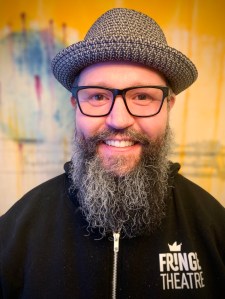
Glenn Nelson, Amber Borotsik in Heisenberg, Shadow Theatre, March 2020. Photo by Marc J Chalifoux.

By Liz Nicholls, 12thnight.ca

Hard to believe. But it’s been a year.

One year ago (or a lifetime) this very weekend our lives changed. In  ways that don’t feel temporary.

I went to the opening of Heisenberg at Shadow Theatre on the evening of March 12, and The Children, a Wild Side production, the next night. That was the evening the Citadel premiere production of The Garneau Block had its final dress rehearsal. And everything ended.

Or  did it?

It’s unquestionably been a year of overwhelming damage for theatre artists, indeed for the entire performing arts industry. Jobs, livelihoods vanished overnight, whole companies alongside creative projects still in the dreaming stage. The raison d’être of live theatre as a connection, exciting, surprising, and kinetic, between real people — artists and their audiences — sharing a room, seemed untenably dangerous, if not suddenly obsolete at very least on hold indefinitely. A close-to-the-bone operation at the best of times, theatre and its chief investors, its artists, have never sat on margins to cushion that fracturing fall.

If this year has been a long and devastating intermission, with irreplaceable losses, Act II promises to be very different from Act I. Not least its because our theatre practitioners, in sudden forced exile from their usual habitat, stepped up, with inspiring resourcefulness and invention, to learn and devise ways to connect with audiences when the video screen is a venue and not just a plus.

To help support 12thnight.ca YEG theatre coverage, click here

Little did I know that breaking the fourth wall, the mantra of immersive theatre, would be simplicity itself compared to breaking all the other walls that are built into digital technology.  And since March 13 2020 our resilient theatre practitioners have gotten more and more ingenious in their experiments. They’re quick learners. And they, along with their audiences, have had a chance to appreciate the work and spirit of companies from the Great Elsewhere too.

Act II, and the return to live theatre that’s live and not just a reminder (however imaginative a simulation) of what live is like, won’t be a mere continuation. Theatre has had to re-assess its own industry power structures, moved by the socio-cultural currents of the year towards greater diversity and a wider ethnic embrace of creative talent and audiences that reflect that.

Live theatre will be, must be, back after this terrible year. However gradually after so much loss, we will be together again. That much feels certain now. Its dimensions, its connection with a broader audience, its creative impulses … those remain to be discovered. Art will happen that helps us do just that.

Posted in Features | Tagged , , | Comments Off on Live theatre. It’s been a year, and Act II awaits

Finding a path forward for the Edmonton Fringe: Adam Mitchell has thoughts about that as he leaves the festival

Adam Mitchel, Executive Director of Edmonton Fringe Theatre, Photo supplied.

By Liz Nicholls, 12thnight.ca

In 25 years at the Fringe, he’s been the production manager, the technical director, the operations manager for a 33,000 square foot multi-theatre complex that started out as a bus barn. He’s been a Fringe venue technician, a show operator, a stage carpenter. He’s made theatres out of spaces that used to be greasy spoons, storage units, community halls; he’s built sets for indie theatres with big ideas and teeny budgets.

On March 26, after five years as the executive director of  Edmonton Fringe Theatre, Adam Mitchell officially steps away from the administrative job at the head of the theatre company that produces the continent’s oldest and largest fringe festival. A job poised delicately between artists, audiences, volunteers, infrastructure that is epically complicated, by any standards. And it just  got more tangled and demanding in the course of the most difficult, damaging, and trying 12 months that live theatre could possibly have.

Is that a wisp of the wistful in his voice? “It’s no doubt,” says Mitchell, who was born in Edmonton and grew up in Winnipeg, “that I’m leaving a place I love more than any other I’ve worked at….”

To help support 12thnight.ca YEG theatre coverage, click here

He tried to leave the Fringe once before, last year about this time. “I needed to re-charge my batteries,” Mitchell says simply. But it was “on the precipice of the pandemic,” so he was persuaded to stay. “Actually,” he laughs ruefully, “the challenge and chaos of the past year was quite rejuvenating … for all the wrong reasons. And it’s better to walk out feeling amazing about what we’d accomplished.”

That “challenge and chaos of the past year” have been, at heart, what exactly to do, times being what they are, with a festival that is the grassroots quintessence of the forbidden: live shoulder-to-rib gathering in intimate spaces. In the golden Before Time, the Fringe of 2019 had 258 shows from here, across the country and around the globe, in 50 venues, sold 147,358 tickets, and attracted a crowd surpassing three-quarters of a million. In the strange and uncertain world into which we were flung last spring, when the world still thought that pandemics had closing nights, the Fringe of 2020, aka “The Fringe That Never Was,” went from building stages to building platforms.

The festival figured out on the fly how to live-stream, create a video-streaming platform, support artist shows displaced by the pandemic into the ether, and generally be there in some fashion for a town where the mighty Fringe organizes the summer calendar.

A thoughtful sort of leader who seems to have a remarkable resistance to panic, Mitchell says “the Fringe, its community engagement, its relationship with artists, volunteers, patrons, have evolved in the last five or six years … and the way we have really focussed on supporting independent artists in their creative journeys” past August and into the theatre season.

The “re-envisioning of the Arts Barn as a community cultural hub” that was in progress at the Fringe in February 2020, “taking the essence of what the festival is, and applying it to the building — are now the building blocks with which we can help the community rebuild.”

“What can we do? What should we do right now?” Those were the critical questions for the Fringe in March 2020, “because we had no choice!” And they were quickly followed, says Mitchell, by this question: “if we invest in tools, in streaming equipment, in FringeTV the platform, would they be useful (to us and to other companies) beyond the days of The Fringe That Never Was?”

I guess we know the answer. And when some reduced distanced in-person audiences were allowed for a time last fall, “we had an immediate purpose for the building, too,” says Mitchell. “It gave us time to take what we were learning into our planning for 2021,” and Fringe #40.   
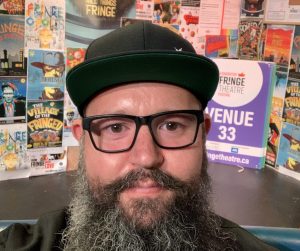
Edmonton Fringe Theatre’s Executive Director Adam Mitchel. Photo supplied.

A collaborator by nature, Mitchell is much more drawn to the pronoun “we” than “I” — not least because he appreciates his lively complementary rapport with Fringe artistic director (and actor/ playwright/ director) Murray Utas. “We don’t disagree very often; we volley ideas back and forth till we find the elegant solution! Mitchell is “so excited” that playwright/ events producer Megan Dart, Fringe Theatre’s communications specialist” will be interim Executive Director. “Perfect!”

“I’m very fortunate because, in whatever role I’ve had, I’ve always managed to be a collaborator with the artist in the room, whether a designer, a director … I really believe in the value of that type of collaboration; it’s part of the magic of what we’ve created at the Fringe.”

Mitchell, a graduate of the U of A’s technical theatre program, is steeped in Fringe, the concept and the execution. His first Fringe experience was in the late ‘90s, as a techie at both the Winnipeg and Edmonton festivals. Then he became the technical director of both Fringes, the two largest in the country. In Edmonton, his first year in the job was the Fringe’s last in the old Bus Barns, before the rebuild that opened as the Arts Barn in 2003.

Fringe touring? Mitchell has done that, with the sketch comedy troupe The Spleen Jockeys, and with Rick Miller, the star and creator of the widely travelled Fringe hits MacHomer and Bigger Than Jesus. “I got to see venues across North America — and hang out with a very cool artist. It was fun,” he says.

Theatre production resumés don’t come much more blue-chip and varied than Mitchell’s. He’s been the U of A drama department’s production manager, and the technical director at the Timms Centre for the Arts. He’s been the production manager at the Arden Theatre, the St. Albert Children’s Theatre, and the Kids’ Fest.

And he has big theatre experience too. He landed a “dream job” as the mainstage technical director for Canada’s oldest regional company, the venerable Royal Manitoba Theatre Centre. “After the very modern program at the U of A, and years of working in the scrappy indie theatre world, it was (like) going back to school.” Mitchell’s wife Keri Mitchell, the executive director of Theatre Alberta, headed the RMTC’s education and outreach programs.

“When I came back to the Fringe in 2015 (as executive director), I was coming home,” he says. And leaving that home wasn’t an easy decision. “I’m going back over to the production side,” he says of a theatre career that began with carpentry. Meet the new manager of Rock Solid Custom Cases, a locally-owned family-run 35-year-old outfit specializing in creating road cases for entertainment touring. It was recently bought by FM Systems (the audio production company that has long supplied Fringe venues, as well as the Grey Cup and the Junos).

Meanwhile Mitchell, the maestro of contingencies, has spent the last 12 months juggling multiple possibilities for Fringe 2021. Certainties are in short supply — beyond this one, perhaps: “it is not realistic to say we’re going to on the other side of COVID by August this year.” Health and travel restrictions, safety rules governing gathering, social distancing, house capacities, the zeitgeist for that matter, are all in a state of continual flux. How can there be a fixed Plan A with a back-up B? No, try F or G, or Q, and avoid “plan” in favour of “possible scenario.”

“We’re trying to extrapolate from what we’ve learned on the digital side, and create the opportunity for artists to build and simul-cast a version of their show for consumption over the internet,” says Mitchell of this year’s edition of our summer theatre extravaganza.

He’s hopeful that alongside the digital, “artists and audiences will be connecting again live in the theatre“ to some extent, however restricted that live indoor audience might have to be. Ideally, artists can sell whatever limited number of tickets for live consumption are available, and also market their show online.

The scale of the 40th annual Fringe will be strikingly different from its decades of predecessors. Mitchell can imagine, depending on restrictions, five or so lotteried venues and a handful of BYOVs, with a preference for cabaret-style seating and a dual focus: “maximizing safety and the ability to film.” The aim, says Mitchell, is “an aesthetic and a standard that honours the live theatre experience, and doesn’t try to be film or TV, but is still better than a single-camera locked in at the back of the house.”

Worst-case scenario: “if we’re not able to have a live audience indoor audience at all but can still facilitate live streams and film for local companies, we will do that.” And he and the Fringe team have considered every possible gradation in between.

“At the end if the day we believe the live theatre experience is what theatre is about…. We don’t want to compete with Netflix but we believe people still want to support creations by local artists in their community!”

“We’ve accomplished an incredible amount with a small team,” a fraction of the usual Fringe size, says Mitchell. “We remind ourselves every day that we’re the fortunate ones; the people we’re doing it for aren’t working right now.”

Posted in Features | Tagged , , , , , | Comments Off on Finding a path forward for the Edmonton Fringe: Adam Mitchell has thoughts about that as he leaves the festival

Finding your own story: Dana Wylie’s Makings of a Voice at SkirtsAfire

Makings of a Voice, by and starring Dana Wylie. Photo by April MacDonald Killins.

By Liz Nicholls, 12thnight.ca

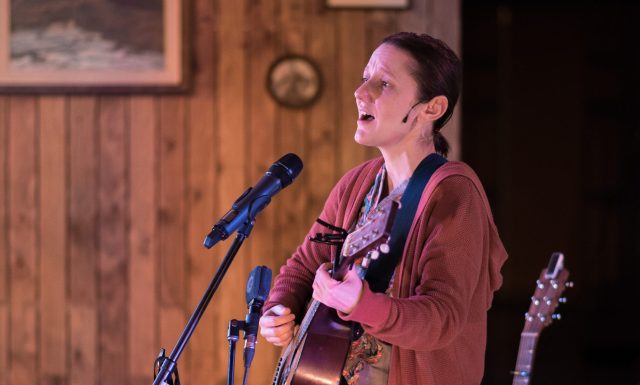
“I’m right here with you right now,” says Dana Wylie, looking intently right into our eyes at the outset of Makings of a Voice. Against the probabilities and across the screen (the defining demarcation of the times), damned if that isn’t how it feels.

Curious and rather wonderful, since Wylie’s solo “theatrical song cycle” comes at us (online) in the middle of a pandemic from the middle of a mysteriously vast, expansible, dark space that isn’t a stage, or maybe even a place. There Wylie is, gazing at us and holding our gaze, from a sort of arena circumscribed by lights, like a landing pad in the mind (designer: Elise CM Jason).

To help support 12thnight.ca YEG theatre coverage, click here

There are domestic touches, a lamp and painting; there are cosmic touches — a suspended slatted wooden orb that might be the moon or a rustic rendering of the moon (lighting by T. Erin Gruber). And there is a guitar.

If the world had been a different place, this unusual piece, which gets its premiere on this year’s SkirtsAfire Festival digital mainstage, would have been in a theatre (the Westbury at the Fringe). And Wylie would have been there onstage accompanied by three live musicians. But Vanessa Sabourin’s production, filmed in the empty, echoey old Army & Navy in Strathcona, has a kind of between-worlds dislocation that isn’t misplaced in a memoir from an artist making a return to a realm, the theatre, she left a decade ago to be in another, as a singer-songwriter.

And one of Wylie’s fortes as a performer, as you’ll experience in this odd and lovely show, is her conversational, direct-in-your-ear intimacy, backed up visually by Andrea Beça’s film-making, with its artful array of angled close-ups.

“We need to know we have a story,” Wylie tells us, from personal experience. “We need to know we are a story.” The term “narratable” doesn’t exactly shimmer (it’s new to me, and I probably won’t be using it any time soon), but, hey, it’s the only show in town where it comes into its own. The enigmatic title Makings of a Voice (lifted from a Wylie lyric) actually fashions a shape and a structure — which calls out for music, and gets it, original songs woven with spoken text. “I have the makings of a voice; I need a song, a source, a well.”

Dana Wylie, creator and star of Makings of a Voice. Photo by April MacDonald Killins.

The dramatic proposition of Makings of a Voice is that Wylie the artist and mother feels in need of a story, one that will weave the intergenerational strands of the maternal line (every daughter has a mother who has a mother who has a mother) together into a compelling inheritance:  “access to a cosmic source of creativity.”

As Wylie puts it, memorably, “I careened into my 30s as if I’d been flung from a faulty carnival ride….” And the impending birth of Wylie’s second child seems to make her quest  for a family story urgent. She’s sure she has one when she discovers, by chance a heroic anecdote about her great-grandmother Millie. And she, as the inheritor, will be empowered to have it all — baby, PhD, globe-trotting career.

Then there’s a crash: it’s a story about abandoning one affirming story and scrambling to find yourself another. I leave you to the pleasures of discovering the narrative route, where poetry meets drama. It doesn’t place Wylie’s songs the way musical theatre would. They do come at critical moments, yes, but they’re for second thoughts and reflections. And there’s this: music fans know know this already, I’m sure, but Wylie’s voice is luminous, clear with warm depths. Somehow she has the actor’s ability to make poetic lyrics seem possible as conversations with you.

There are lessons to be learned, including an appreciation for a heroism that’s quieter, more quotidian, more mundane than the borrowed narrative arcs of “the patriarchy culture” might invite. This will sound off-putting, and more abstract than it is, not least because the word “patriarchy” isn’t exactly lyrical. But the show is carefully, gracefully constructed; it’s built on birth — as both the most visceral and metaphorically powerful of experiences — and self-discovery. They are, after all, the exit from one world and the entrance into another.

“I will rhyme, I will chime, I will vibrate like a bell,” Wylie sings at one point. In Makings of a Voice, she does all three.

12thnight.ca interviews Dana Wylie here.

REVIEW

Makings of a Voice

SkirtsAfire Festival 2021

Written and performed by: Dana Wylie

Directed by: Vanessa Sabourin

Where: streaming on Fringe TV

Running: through March 14

Tickets: skirtsafire.com


Posted in Reviews | Tagged , , , | Comments Off on Finding your own story: Dana Wylie’s Makings of a Voice at SkirtsAfire

Makings of a Voice: the SkirtsAfire premiere brings Dana Wylie back to the theatre

Dana Wylie in Makings of a Voice, SkirtsAfire Festival. Photo by April MacDonald-Killins.

By Liz Nicholls, 12thnight.ca

“I don’t know who I am and where I fit into this world….”   

It’s one of those thoughts that touches down universally, and comes with its own personal question mark. And for a creative artist like singer-songwriter Dana Wylie, a questing traveller of an artist if there ever was one, it was a provocation.

To help support 12thnight.ca YEG theatre coverage, click here

It happened when Wylie was seven months pregnant with her second child in 2019, prompted by the companion thought that “in order to bring this child into the world I need to know….” And it’s the seed of Makings of a Voice, a solo “theatrical song cycle” that premieres Monday on the SkirtsAfire digital “mainstage.”

It marks the return of Wylie to theatre and acting, the world she left a decade ago to forge a career in music. It’s not exactly a play, as she describes, though there are characters (and an alter-ego protagonist named Dana). And it’s not exactly a musical revue or a cabaret, though it’s a memoir of sorts, and full of her original music. Part of her unusual creation is a story about storytelling: “The story I’m telling — it’s quite non-linear — is me trying to find my story and trying to tell that story.”

The setbacks and careening turns in that process are part of the story. “Just before I started writing it, I was told a story I’d never been told before…” says Wylie, who’s impressively insightful about artistic creation. “My great grandmother had marched in the 1919 Winnipeg General Strike, had been arrested for hitting a cop over the head with something, and had spent the night in jail.” A mystery: why was this not something the Wylies tell and re-tell, she wondered, a highlight of every Christmas dinner?

So Wylie felt empowered. “For the first time the character senses a point of connection with (her) maternal line … with a lefty, a socialist, a bad-ass rabble-rouser,” as Wylie puts it. I can feel like I come from somebody awesome…. Great Baba Millie becomes a real protagonist!”

“And because I was trying to engage with her past,” Wylie consulted Google. And there it was, in a junior edition of the Winnipeg Tribune in 1920, a picture of Great Baba Millie as a 12-year-old, part of a group of kids who’d won a Christmas writing competition.” And Wylie did the math, and knew the Strike story couldn’t be true. “It pulled the rug out from the writing process.”

“It had to go into the show,” says Wylie, of this deflating news. The story gods giveth and they taketh away. She found that revelation to be “personally as well as dramatically rich.” As the show took shape, it dislodged a narrative with a hero, “a bad-ass super-hero,” into a zone that’s “much more culturally complex than … the narratives that belong to our contemporary Western patriarchal culture.”

Dana Wylie, creator and star of Makings of a Voice. Photo by April MacDonald Killins.

“Then I’m just left with myself, and ultimately I have to be OK with that, with knowing, from my family history, that people have lived complicated lives and haven’t done heroic things. I can’t continue to insist to myself I be defined  by a story based on a hero’s journey.” Identity, lineage, and more specifically motherhood, make other kinds of demands than owning a heroic backstory. “It requires so much more than individual anything!”

There’s nothing predictable about the Wylie story, with its unplanned route from theatre into the world of music (and critically acclaimed albums). Not long after she graduated from MacEwan, and was out in the world working in musical theatre, “I just started writing songs; I’d never written songs before and I don’t exactly remember why.…” And not long after that came the realization that “this is what I want to do, I’m a musician in my heart more than I’m an actor. As I met more and more musicians I knew ‘this actually is my tribe’.”

Makings of a Voice, by and starring Dana Wylie. Photo by April MacDonald Killins.

At first her songs were of the musical theatre ilk, she laughs. “That was the world I was coming from; they all had a dramatic arc and went somewhere and someone learned something. I wasn’t well-versed in folk music, and certainly not pop, where you can be overcome by a feeling and just ruminate, where you can be in a place, and just be….”

Then Wylie up and moved to Taiwan, in search of a job teaching English and a cheaper way to live.

“Unbeknownst to me there was a rich scene of ex-pat artists of all kinds and music in particular that I fell into,” says Wylie. “And I ended up cutting my teeth (as a musician) there. I played in so many different kinds of bands, blues, bluegrass…. I really learned how to be a musician there, how to do gigs, how to do the equipment.”

Though big-cast musicals at the big regional theatres, the Citadel, the Royal Manitoba Theatre Centre, Theatre Calgary and others, occasionally came her way (Camelot, Evita…) a singer-songwriter had been born. “I didn’t know myself well but I had a sense that I wasn’t driven enough” to be in the high-stress world of auditioning actors, “living in a big city, being hungry and hustling for jobs…. I came into theatre working with (the late Edmonton musical theatre indie) Leave It To Jane. And I loved its smallness, the inventiveness of having four boxes instead of a set. There’s something that fires my imagination about that.”

Says Wylie, “I’m the same in the recording studio. I don’t mind having limits, budget or technical. That’s when my imagination comes alive…. Here’s what we can do!”

Maybe that’s why she hasn’t been entirely flummoxed by the serial pandemical limitations that have seen Makings of a Voice re-thought from a cancelled Fringe premiere last summer to a cancelled live premiere for a live SkirtsAfire audience, to the digital solo production shot at the old Army & Navy in Strathcona, minus the three musicians who were to have been onstage with her. “It’s a team of amazing creative people, really up for it!” she says feelingly of SkirtsAfire. “People who just take on the limitations, happily, and say ‘let’s come up with cool ideas….’.”

It was during three years in England, living in a little village north of London, that Wylie took a deep dive into the great “folk tradition,” and began to explore the sacred canon, Dylan and Mitchell and the rest. She and her English musician boyfriend constantly jammed in folk clubs and pubs. “It sounded very foreign to me at first; my ears didn’t quite get it. But once I got into it, the whole idea of a roots, of a deep cultural tradition, was very appealing to me, especially as a western Canadian.”

Just back from England in 2008, Wylie got a gig at the Mayfield, in the musical The Full Monty. And she actually lived at that hotel for a while. But musical theatre couldn’t woo her back. Wylie thinks of Makings of a Voice as “a way of integrating my background in music (which includes a U of A degree in musicology) with my background in theatre.”

After 10 years (her last theatre appearance was Kenneth Brown’s Cowboy Poetry), Wylie says “I don’t really consider myself an actor any more…. I feel more comfortable with storytelling; that’s what I love to do onstage, between songs. I’m a performer; that’s who I am. That’s what I do.”

But, under the direction of Vanessa Sabourin, a fine actor herself, Wylie has been nudged towards embodying the characters she’s written into the script. “And I’ve been looking forward to finding out what it feels like to be an actor as the person I am now, a 41-year-old instead of a 31-year-old.”

“It’s been a personal process,” says Wylie of creating Makings of a Voice. “And at points I’ve thought ‘who cares? does the world really need this story right now? is it just my story?’. And that’s all part of the narrative…. We don’t know how much we share; that’s the beautiful thing about sharing stories.”

In a world steeped in not-knowing, “I feel more seen, and I hope other people watching feel more seen too…. What I’d like to put out into the world, is whoever you are, wherever you are, however messy this all feels, you’re good!.”

PREVIEW

Makings of a Voice

SkirtsAfire Festival 2021

Created by and starring: Dana Wylie

Directed by: Vanessa Sabourin

Where: streaming on Fringe TV

Running: March 8 to 14

Tickets: skirtsafire.com


Posted in Previews | Tagged , , , , | Comments Off on Makings of a Voice: the SkirtsAfire premiere brings Dana Wylie back to the theatre

A concert for our time: UnCovered 2021 crosses the country on (digital) tour and arrives at Catalyst

Divine Brown, UnCovered: Notes From The Heart. Photo supplied.

By Liz Nicholls, 12thnight.ca

Your place. Saturday night. Drinks, snacks, songs. A cross-country meet-up between two of the country’s most distinctive theatre companies.

One is Toronto’s Musical Stage Company, a company with a musical theatre heart and a remarkable blue-chip record in developing, producing, and presenting them. The other (your genial presenter) is Edmonton’s Catalyst Theatre, whose original innovative musicals (Frankenstein, Nevermore, Vigilante among them) have been seen by audiences across the country and beyond.

To help support 12thnight.ca YEG theatre coverage, click here

With UnCovered: Notes From The Heart, The Musical Stage Company has created a digital version for 2021 of their hugely popular signature yearly concerts. They’re a 15-year tradition in which musical theatre stars invade the pop music repertoire. And, times being what they are — which is to say isolating, disconnecting, devastating for live performance — The Musical Stage Company has ventured into sharing the concert digitally with like-minded companies and their audiences across the country. Companies like Catalyst, under whose banner Saturday’s performance happens (charcuterie boxes by Dalla Tavola Zenari).

“It’s kinda like touring! Digital touring!” declares the cheerful energetic voice on the phone from Toronto. It belongs to Musical Stage Company founder and artistic director Mitchell Marcus. “We’re trying to figure out how to work together outside the box in this industry, and use this weird digital time to collaborate.” This year’s edition of UnCovered, which premiered in Toronto in November, has alighted so far at the Segal Centre in Montreal, the Belfry in Victoria, the Regency in Picton (Ont.), and will arrive in Newfoundland soon — just for starters.

And now Catalyst. Marcus, not coincidentally, is an admirer — familiar with Catalyst’s unusual musical theatre aesthetic (he was a producer at Luminato when that festival brought Nevermore to Toronto’s Wintergarden a decade ago). “I’m so honoured we can share something musical with Catalyst …. their work is just so interesting!” he says.

A keen interest in “digital touring” is something Marcus shares with Catalyst’s Jonathan Christenson, not least because “Catalyst was built to tour, and share our work abroad,” as the latter says. Until the next breath, Catalyst’s contribution to the National Arts Centre’s Grand Acts of Theatre, a cross-country series of outdoor experiments, is up on the NAC website. A proposed national tour of The Invisible, Christenson’s latest Catalyst musical play, awaits an alternative impetus. Could it be digital?

“This is an opportunity to feel connected to other companies, to audiences, to be reminded that other Canadians are wanting to reach out,” says Christenson of UnCovered. “The need has never been more potent.”

The 65-minute show features songs by heavy hitters like Leonard Cohen, Jann Arden, Bob Marley, Carole King, Billie Holiday, Elton John…. They’re performed by top Canadian performers, including Jackie Richardson, Sara Farb, Divine Brown, Andrew Penner. We can renew Edmonton connections in the 12-singer cast, actor/singer-songwriter Eva Foote for one. Hailey Gillis appeared in the debut production of Catalyst’s The Invisible. Farb was in Citadel productions of The Humans and Next To Normal. Citadel audiences have seen the work of The Musical Stage Company (formerly called Acting Up Stage Company) when their musical revue Do You Want What I Have Got? A Craigslist Cantata arrived on the Citadel’s downstairs cabaret stage in 2014.

The songs are delivered as music videos rather than from a concert stage, in a variety of locations in Toronto and elsewhere. It’s an extra layer, says Marcus, “being on a physical journey as well an an emotional one.” One camera person shot one performer, from a variety of camera placements, on location. Mostly, “it’s a love letter to Toronto.” But  Carole King’s So Far Away, assembles (digitally) a quartet of performers, one in Toronto, three who’d gone home, to Ottawa, Victoria, and in Foote’s case Edmonton, for COVID lockdown. Each of those four shot their own video. “Eva got some lovely footage driving from Toronto to Edmonton,” says Marcus.

As for the music, three musicians including pianist Reza, did all their rehearsing on Zoom, and passed files back and forth, adding layers. “They sound like 20,” Marcus says. The safety restrictions required intricate logistics. There were never more than two people in a room;  and recording studios with their glassed-in cubicles might have been designed with pandemics in mind.

UnCovered 2020, finale. Photo by Dahlia Katz.

What uncovered UnCovered 15 years ago, as Marcus explains, was a love of pop music he shared with his musical director/ collaborator Reza Jacobs. “In musical theatre our expertise is telling stories through words. Which is the opposite of pop music where the words are often unclear.… You’re in your car, singing along, and you think you know the words but really you’ve been singing the wrong words forever!”

“So we asked ourselves, what happens if you give pop music over to great storytellers? If you look at the song through a musical theatre lens?”

And that lens, he points out, is all about asking “who’s singing?’ who’s the character? what do they want? ‘what’s the journey through the song? It’s rare in musical theatre that you’re in the same place at the end of the song that you are at the beginning…. That, for 15 years, has been the experiment of UnCovered.” 

If you read the lyrics, a pop song like Jann Arden’s Good Mother, with its list of things to be grateful for, is full of feeling, but without “the specificity of a musical theatre song,” Marcus argues, as one example from the show. It’s open to the emotional heft and meaning that a great artist like Farb brings to her performance of it. The video has her in a tree house going through old family photo albums.

Pop songs, thinks Marcus, are a “container,” ready for meaning provided by the actors who perform them. They “give actors the space to really play.”

When COVID hit, The Musical Stage Company faced the prospect of trashing its entire season. “We thought we’d try to rebuild only things we thought were resonant. And UnCovered felt the most urgent for the moment,” says Marcus. Their usual practice has been to focus on catalogues of certain artists, often in pairs — Stevie Wonder and Prince one year, Joni Mitchell and Carole King, Dylan and Springsteen, Queen and Bowie. For this peculiar time in which we’re struggling, “we thought let’s look at songs written in moments of change or challenge, songs that contain hope or inspiration, (or speak to) loneliness. And let’s look at them again, with COVID being the storyline.”

“We asked the artists ‘what is your experience right now? what meaning do you see in the song’ — and then built their performance around that.”  

In the course of re-fitting UnCovered Marcus found himself “so enamoured” of the idea of digital touring, that his company has undertaken to reverse the idea, too. “We’re been taking our own audience on theatre-going trips,” presenting work from elsewhere, complete with pre- and post-show meet-ups. “We’ve gone to London (by licensing an Off-West End production of The Last Five Years for a night), to New York, to the Cultch in Vancouver….” More to come, and an Edmonton destination called Catalyst would be welcome.

“It’s such a cool opportunity to share,” says Marcus, “to introduce our audience to other things, but in our own time zone, on our own digital platform, and still under our own banner.… and bring our own context and experience to somebody else’s creation.”

As Christenson puts it,  “knowing you’re under a larger umbrella … makes you feel a little bit less alone.”

PREVIEW

UnCovered: Notes From The Heart

Theatre: The Musical Stage Company, presented by Catalyst Theatre

Musical direction by: Reza Jacobs

Video direction by: Victoria Barber

Where: online, from catalysttheatre.ca

Running: Saturday 8 p.m.

Tickets: catalysttheatre.ca


Posted in Previews | Tagged , , , , | Comments Off on A concert for our time: UnCovered 2021 crosses the country on (digital) tour and arrives at Catalyst

A festival reimagined, over and over: SkirtsAfire 2021

Makings of a Voice, by and starring Dana Wylie. Photo by April MacDonald Killins.

By Liz Nicholls, 12thnight.ca

Reimagine. Repeat. Reimagine. Repeat….

What does it take to open a theatre and multidisciplinary, multi-location arts festival in the ever-shifting COVID-ian landscape of March 2021? The 9th annual edition of SkirtsAfire, Edmonton’s ever-expanding wide-embrace showcase of the talents, the stories, the voices of women and non-binary artists, is something of a test case.

A rare and exquisite combination of adaptability, creativity and unstoppable persistence, the kind possessed only by the species Artist, in short, seems to be de rigueur. As the indefatigable festival director Annette Loiselle attests en route to Thursday’s “opening night” ceremonies, the exact configuration of online and live in this year’s 10-day SkirtsAfire, has been recalibrated constantly since the new year began. Not least because (a) the festivities include performance and exhibition: theatre, musical, poetry, dance, visual arts, in innovative combos, and (b) the official Alberta government Covid restrictions are bafflingly inconsistent when it comes to theatre.

To help support 12thnight.ca YEG theatre coverage, click here

Loiselle, an actor/ director/ playwright herself of buoyant personality who was a founding parent of another of E-town’s seminal cultural institutions (the Freewill Shakespeare Festival), knows what it’s like to back up the back-up plan of the back-up plan. The mainstage premiere of Makings of a Voice, Dana Wylie’s “theatrical song cycle,” an original musical exploration of intergenerational identity,  happens Monday, International Women’s Day, online in a film version — instead of a live-streamed version from the Westbury Theatre, instead of a live run for a reduced, socially distanced live audience in that venue. Tickets: skirtsafire.com.

Annette Loiselle, artistic director of SkirtsAfire Festival. Photo by April MacDonald Killins.

As Loiselle tells it, the route to Monday’s opening has been an arc of hopes and hopes dashed,  adjustments and readjustments.The AHS restrictions of December, which forbade gatherings of a live audience in theatres, allowed for exemptions for theatrical livestreaming, for solo shows with a distanced and reduced crew (like Northern Light Theatre’s The Look). Those exemptions were pulled in January. “So we started rehearsals on Zoom,” says Loiselle of Vanessa Sabourin’s production. “We had to lose the three live musicians,” she sighs, “not knowing if we could even use the Westbury.…” By January 29, all theatre venues were off-limits, unlike say hair salons or churches or film sets — ah, or markets. Enter the old Army and Navy in Strathcona.

The Key of Me, SkirtsAfire 2021. Photo by April MacDonald Killins

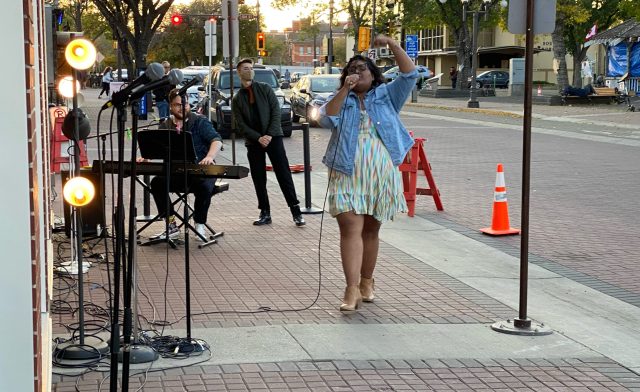
In a collaboration with the Wild Heart Collective, that venue is where filming of Makings of a Voice happened. “And we’re having a live music stage there, in the display window pumping music out into Strathcona,” says Loiselle. The Key Of Me stage features pop-up performances (Thursday through Sunday, and March 11 to 14), by a whole gallery of singer-songwriters, including two of the three musicians originally slated to play alongside Wylie in Makings of A Voice (Bille Zizi and Kirsten Elliott). They’re safely behind glass; the sound is for you to savour as you stroll by (masked and distanced, natch).

There’s irony attached, of course. “It goes against all our natural instincts to tell the audience not to gather,” as Loiselle says of the 10-person maximum on the street. But if there’s a silver lining, she thinks, it’s this: “having the festival out in the street is a chance to build a new audience.”

Visible from the street, as well, mounted in the A&N display windows (with The Key of Me musical accompaniment), is SkirtAfire’s visual art exhibition, Systemic Contractions. Curated by Stephanie Florence, its focus is our urgent need for connection, heightened by the crisis in which we live., which disproportionately affects the economically and racially disenfranchised, the elderly, front-line workers. Florence’s audio tour for your device is available to accompany your visit to the exhibition at skirtsafire.com.

This year, in a collaboration with the Old Strathcona Business Association, the finalists in the festival’s signature skirt design competition are displayed in six Strathcona retail establishments: the Bamboo Ballroom, C’est Sera, Woodrack Cafe, Red Pony Consignment, the Plaid Giraffe, and the Paint Spot — all visible from the windows with lighting by star theatre designer T. Erin Gruber. And your vote (either by email or on Instagram, #myskirtvote @skirtsafire) determines the winner.

Since last June, SkirtsAfire has assigned four diverse “story collectors” — Mackenzie Brown, Lebogang Disele, Jodi Calahoo-Stonehouse, Sang Sang Lee — to gather personal stories from people whose voices are rarely heard in the theatres of the land. The idea, says Loiselle, is a first-hand documentation of real-life experiences in this strange time, unfiltered by the literary or theatrical. The result is Covid Collections, a 25-minute film that offers us glimpses into communities we might never encounter day to day. And, times being what they are, we find these 12 storytellers Zoomed in from their own homes.

Says Loiselle, who directed the film (original music by Binaifer Kapadia, sound by Aaron Macri, videography by Katie Hudson), we meet, among others, “a high school teacher who runs the schools GSA (gay-straight alliance), a respiratory therapist, an elder from the Maskwacis Reserve, a mother who’s a long-term care worker and her daughter, a front-line care worker, an Indigenous drummer and activist, a South Asian consultant with a Jamaican husband. Loiselle’s own sister Rachel O’Brien, who had Covid in the fall and is suffering still its lingering effects, is included, “a good story and an important one,” as Loiselle says. The ethnicities and perspectives are widely varied. Only one contributor is a theatre artist. Lebogang Disele’s story, says Loiselle, “was just too good not to be included.”

Actor/writer Disele returned to her native Botswana last winter for a wedding, and was to have returned to Canada a week after her husband and kids did. Meanwhile, on March 31, the borders closed; she’s still in Africa separated from them.

Says Loiselle, “the end of the film is quite uplifting … a spark of something good that’s come out of Covid.” Covid Collections is available Thursday through March 31 at skirtsafire.com.

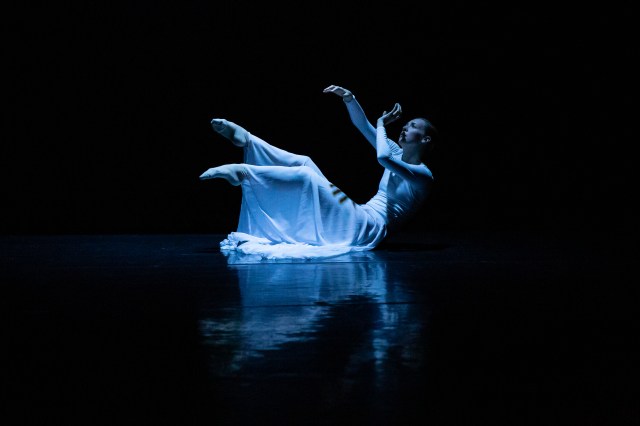
Body of Words, Ballet Edmonton. Photo supplied.

The 2021 festival includes a debut SkirtsAfire collaboration with Ballet Edmonton. In Body of Words, originally designed for live performance on (or from) the Westbury stage and now available for streaming March 7 to 14, choreographer Karissa Barry fuses poetry (by Edmonton poet laureate Nisha Patel and Medgine Mathurin) with dance, and sets it to music. A seven-dancer ensemble performs as part of the Ballet Edmonton season. Loiselle sought out the collaboration; she says “it grabbed me and shook me to the core!” Pay-what-you-can tickets are available at skirtsafire.com.

Thursday, 5 p.m., is showtime for this year’s festival. The opening ceremonies, which happen around the Fringe’s fire pit, include an excerpt from SkirtsAfire’s 2022 mainstage premiere, Ayita by Teniel Whiskeyjack, and remarks from Loiselle and this year’s “Honorary Skirt” Wanda Costen, dean of McEwan University’s school of business. You can see it all live on SkirtsAfire’s Facebook account.

PREVIEW

SkirtsAFire Festival 2021

Running: March 4 to 14

Where: online (skirtsafire.com) and live on Whyte Avenue, in the Army and Navy display windows and 6 Strathcona retail outfits

Tickets and schedule: skirtsafire.com

Posted in Previews | Tagged , , , , , , , | Comments Off on A festival reimagined, over and over: SkirtsAfire 2021

New faces in theatre: meet creator/performer/producer/activist Sue Goberdhan

They’re young, bright, and unstoppably creative. And, pandemic be damned, their adaptable, flexible talents are already lighting up the Edmonton theatre scene. In this 12thnight series you’ll meet some of E-town’s sought-after up-and-comers, artists whose work, on- and backstage, is already having an impact in this challenging age — and will have more when the theatre doors are open again. 

Meet  The series so far has included  designer/scenographer Elise CM Jason, techno whiz Bradley King, and triple-threat Chariz Faulmino, sketch and improv star Sydney Campbell and playwright/ dramaturge/ theatre scholar Mūkonzi wã Mūsyoki.

Sue Goberdhan in her Elf on The Shelf mode – Sister Act II and a Girl Named Sue.

By Liz Nicholls, 12thnight.ca

SUE GOBERDHAN, creator/ performer/ performer/ activist

If you saw Jason Chinn’s big-cast 2019 political comedy E Day — set in a makeshift NDP constituency office on the eve of an historic provincial election (yeah, that one) — you’ll have caught sight of a charismatic newcomer.

Sue Goberdhan played Sue, Safeway union worker cum campaign volunteer assigned to the lawn sign brigade — a ‘sure-no-problem!’ can-do sort with a beacon smile, her own running gag, and a crucial role in one of the play’s sinister mysteries. And she nailed it.

It was a sighting of a young theatre artist, in her mid-20s, who’s burst onto the scene in startling fashion, with an expanding array of talents, passions, and thoughtful ideas for changing the way theatre works in these parts.

To help support 12thnight.ca YEG theatre coverage, click here

Since then Edmonton audiences have caught the exuberant Goberdhan onstage, dancing along 83rd Ave whilst singing, in the Plain Janes’ Scenes From The Sidewalk. Azimuth Theatre has acquired a new co-artistic director (Goberdhan in tandem with Morgan Yamada). There’s a new Goberdhan podcast, A Bigger Table. Hey, maybe you already caught Fringe premieres of Almost Heroes or Marnie Day, two original musicals Goberdhan wrote with composer (and old friend) Matt Graham, Jasper Poole, and Kaleb Romano? Goberdhan and Graham, have their own musical theatre company, with a quizzical Goberhanian name, Could Be Cool Theatre.

Sue Groberdhan in Scenes From The Sidewalk, Plain Jane Theatre. Photo by Stephanie Wolfe.

She writes musicals and plays, she appears in them, she instigates and produces projects, both her own and others…. It’s no accident that Azimuth’s “Performance Lab #1” online Feb. 15 was “telling your own stories with Sue Goberdhan.” It’s a motif, a mission even, she cherishes. Her own story has a certain blithe unpredictability, true, but a certain inevitable momentum, too.

“I tried everything to not be an artist!” declares the effervescent voice on the phone. In this Goberdhan, who’s a funny, entertaining, unpretentious conversationalist, was following the advice Giancarlo Esposito (Gus in Breaking Bad) gave in response to a question about entering the field of acting. “‘Do everything else first; decide there’s nothing else in your life to do. If there is, do that!”

“So much less turmoil on the heart.” Goberdhan permits herself a sigh. “Ain’t that the truth?”

Goberdhan took theatre avoidance seriously. She lists her assortment of post-high school gigs: maternity store for five years, David’s Bridal, data entry clerk for a national oil outfit (“yeah I sold my soul; I needed the money”), a flower shop. “I don’t know what they were thinking hiring me. Annuals $3, perennials $5. I was like ‘how do you tell the difference?’. So I decided everything was three bucks. A lot of people got lucky that summer.”

Ever since junior high, theatre has been staking a claim, bigger and bigger, in Goberdhan World. There were, however, obstacles. Theatre was/is a white stronghold. “I knew I loved it. I was so sure. But I remember looking around me, at high school (theatre). And I was like ‘there is NOBODY onstage who looks like me doing this job’. So I didn’t think I could do it.”

Goberdhan is of Indo-Caribbean descent (her family is from Guyana in South America). “In Scarborough, where I grew up, half the kids at my school were Guyanese; some were my cousins.… I didn’t realize how multi-cultural my school was till I got here (for junior high), and didn’t meet another Guyanese person for five years!”

“What gave me permission to pursue theatre,” as Goberdhan puts it, was seeing “two brown girls” in a high school show, one in hijab. “OK, if they can do it I can do it,” she says. “It cracked the code for me. I knew I could have meaningful work.”

There’s another turning point in the Goberdhan story, too. And it has roots in a pop culture interview that stuck with her. “You’re a weird dude,” said Judd Apatow talking to Jason Segel at the Freaks and Geeks season wrap. “And you’re not going to get any meaningful work after this — if you don’t write it yourself.” Goberdhan took it to heart. “OK I’m a weird dude too. OK, write your own? Let’s do it! That’s all I needed.”

“We talk about this a lot at Azimuth,” she says of her campaign of empowering a diversity of theatre artists to create their own work.  “You have to start stacking hats on hats on hats … so you can actually get to a place where you’re happy with what you’re putting out. You’ve got to be a writer, a director, a producer….” The Fringe, where creators are of necessity producers, is, as Goberdhan points out, is the playground for that kind of exploration.

“I get asked ‘what’s a dream role for you?’. And I don’t really know how to answer that question. No one had me in mind when they were writing whatever they wrote. I was nobody’s first choice for anything…. So maybe my dream role is one I haven’t written yet. Right now it doesn’t exist.”

Sue Goberdhan

Goberdhan traces her love of writing back to a couple of high school projects. One was inspired by a 300-line Ferlinghetti (R.I.P) poem that unspools in metaphors. “We had to write our own.” The other was a stream of entries in a writing portfolio. “I didn’t really start writing (plays per se) until  Almost Heroes.” She describes her collaboration with Graham — “he was my first friend; we started writing together at 17 and never stopped” — as “a farcical musical comedy about what it really means to be extraordinary. It’s about superheroes who have really shitty powers and have to use them to protect their little town.”

“Matt has the music brain; I have the other one…. It’s a blessing to be his friend and watch his practice grow!” says Goberdhan, who’s a natural repository of exclamation points. Almost Heroes was seven years in the making before its 2017 Fringe debut. “We played the Garneau Theatre  — to never less than 100 people a night…. I was super-surprised! It just shows you a little bit of enthusiasm will take you so far!”

Their second musical, which explores grief, was “a complete 180,” she says. In Marnie Day five friends gather every year on the title day to honour a free-spirited friend who has passed away. “It’s about finding a way to move forward when you don’t think you can.”

As a musica theatre person Goberdhan gravitated to MacEwan University, didn’t quite grasp the intricacies of a musical theatre audition (finding sheet music, and a pianist, and all that), and ended up in the Arts and Cultural Management program instead. “I kicked myself down for it; for ages I couldn’t move past the fact I was already so many steps behind.… How did I not realize that if I wanted to be better at something I just have to practise the something?”

That’s why she’s so excited about the Azimuth job, Goberdhan says. “I have such an opportunity to fix things that were wrong when I was coming up…. People are at a point when they’re recognizing their own agency. And this is an opportunity to teach people the skills to explore that agency. People are just waiting for permission, for someone to tell them ‘you should do this because you’re going to succeed’.”

Goberdhan is “living proof,” she laughs, for the go-for-the-gusto model of self-discovery, of “opening your eyes” to your own talent. It applies to her big singing voice, to her ventures onstage in musicals she’s (co-) written, to forays into sketch comedy with Blackout (“I can’t write short form to save my life!”), to the kids’ theatre classes she teaches at Grindstone Theatre. “My whole practice in teaching is self-guided instruction!” she says.

“I’ve been lucky to bounce around from project to project, to do experimental things that aren’t necessarily ‘professional’,” she says.  Though “not an improv person,” she’s even tried that terrifying spontaneous form. What’s The Deal?, an improvised Seinfeld show in which she was the Kramer character, “is maybe my favourite thing I’ve ever done.” If they ever revive it, “I’m in!”

Warning: if Goberdhan gets an idea, she’s very apt to run with it. When she and Luc Tellier amused themselves in COVID-ian lockdown by creating kooky custom-made Elf on the Shelf memes for Edmonton theatre people, they ended up with a 2021 calendar that Goberdhan designed.

As an artist who’s also an appreciator and enthusiast, Goberdhan is all about empowering the reticent and the marginalized. “Accessibility” and “permission” are key words in the Goberdhan lexicon. “I get frustrated because our community is chock full of incredible talent, and a lot of it is stuck in the ‘community theatre’ lane, people that don’t have a way to get to the intersection with professional theatre, people doing it for zero compensation….”

I just think we’re really missing out…. We have so many performers who should have so many more opportunities than they do,” Goberdhan says. “And we need a way to make this whole process more equitable..”

“I think of all the times I’ve tried to open a door for myself and couldn’t. I needed someone to hold it open for me!” That door-opening someone could well be Goberdhan, paying encouragement forward.

“If we make space for people to tell their stories, our lives would be all the richer for that….”

Posted in Features | Tagged , , , , , , , | Comments Off on New faces in theatre: meet creator/performer/producer/activist Sue Goberdhan

Préparez vous, mes amis: Lucy Darling is back — with a bilingual magic/comedy show livestreaming from L’UniThéâtre

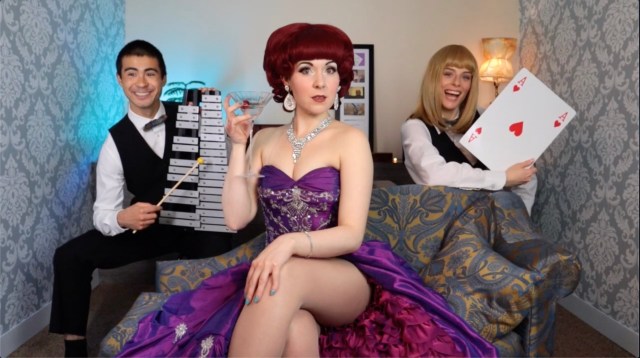
Lucy Darling (centre, aka Carisa Hendrix), with Richard Lee Hsi and Miranda Allen. Photo supplied.

By Liz Nicholls, 12thnight.ca

“What I love about magic as an art form,” declares magician Carisa Hendrix at a non-magical hour of the morning earlier this week, “what magic is really about, is the feeling that anything is possible.…”

To help support 12thnight.ca YEG theatre coverage, click here

The apparently impossible is Hendrix’s theatre and her métier — and the playground for her retro-glam magician persona Lucy Darling. “We are amazing and rationalizing creatures,” says Calgary-based/ Edmonton-quarantined Hendrix cheerfully, musing on her favourite subject. “Our brains are constantly looking for meaning in a world that’s pretty random and full of entropy.” Magic, she thinks, is validation for the liberating proposition that “I don’t need to know everything!”

“I’m a well respected, well established magician, and I get fooled all the time!”

You will, therefore, be in good company this weekend when you’re baffled by the magical mysteries in the online bilingual magic/ improv comedy live-streamed by L’UniThéâtre, Edmonton’s francophone theatre.

Mes amis, préparez vous: Lucy Darling revient, along with her two Edmonton collaborators, actor/escapologist Miranda Allen and actor/dancer Richard Lee Hsi.

Lucy Darling (aka Carisa Hendrix). Photo by Jon-Christian Ashby.

With Une Soirée Avec Lucy Darling/ An Evening With Lucy Darling, the quick-witted Lucy, a vintage diva with a golden age party frock and shellacked red bouffant coiffure, has acquired a third assistant for the occasion: actor/improviser Vincent Forcier, L’UniThéâtre’s artistic director. And what started with “a fun weird challenge” — “let’s do our show in French!” — has evolved into “a comedy about language, about misunderstanding and miscommunication,” says Hendrix.

Each of the four characters has “a different level of understanding…. Miranda’s character is under the impression that ‘bilingual’ means German. Richard’s character believes he speaks better French than he does. Lucy’s French (flamboyantly accented à la Piaf, and peppered with English) is OK, but she’s struggling.” So she’s hired a new  butler (Forcier) who constantly corrects her. “And you can imagine how that goes!” laughs Hendrix, whose français, which hasn’t been exercised for five or six years till now, has charted its own unique course. French Immersion in school, check. A French grandmother with whom she corresponded in French, check. Circus training in French in Montreal, check. Circus school (“mostly fire-related, and choreography”) in the Dominican Republic living in a condo “with all French speakers,” check.

“The feeling that anything is possible” seems to weave through  Hendrix’s own story — long before she set the Guinness world record for holding a lit torch in her mouth in 2014, and long before the 2016 SuperChannel documentary Girl On Fire.

As Hendrix explains, her Calgary childhood was spent juggling, doing magic tricks, walking on stilts — and volunteering with organizations that supported disabled or disadvantaged children. Her entry point into showbiz wasn’t theatre per se, or acting. “That felt fancy to me, and inaccessible. And somehow subjective. How do you know if you’re a good actor? I don’t know. How do you know if you’re a good juggler? Easy. You juggle.”

Childhood in a dysfunctional family ended abruptly. “I got kicked out of the house at 16 and needed to make money.” Hendrix worked two jobs, one at London Drugs before school, the other making smoothies at Jugo Juice after school, “eight dollars an hour, and it wasn’t enough.” When the manager of a haunted house offered her an entertainment job for 50 bucks a night, four shows a night for 30 nights,” Hendrix jumped at it. “The $1500 was more money than I’d ever seen. … I had no big ambition to be famous; it was how I survived.”

She landed a job at the Boys and Girls Club. “I loved teaching and I loved the kids, but I kept performing on the side because the money was good.” Bookings kept coming, and Hendrix found herself “juggling two lives,” a day life and a night-time life. When the ultimatum came to choose, and Hendrix picked “the noble option,” teaching, she knew it was wrong. “I burst into wet sobbing and disgusting tears, faced with the realization that somewhere along the way (showbiz) had become my calling….”

In the international world of magic, predominantly male, Hendrix is a star on the ascendancy, witness her string of awards, magic magazine cover stories, testimonial blurbs from the likes of Steve Martin and David Copperfield, and residencies in such magic strongholds as the Magic Castle in L.A. and the Chicago Magic Lounge. But Hendrix calls the tricks themselves, no matter how dazzling their execution, “ancillary…. Don’t get me wrong, I am a magician, and passionate about the art form. But as long as the audience is being entertained and is giving in to the experience, it doesn’t really matter what I’m doing. It’s the experience that matters.”

Generating wonder, overcoming human limitations (or maybe lighting them on fire) … that’s what it’s about. Take fire-eating, for example (I can’t believe I just wrote that sentence). “Fire is the destroyer,” Hendrix says. So fire-eating is wish fulfillment for the audience: “if she can be on fire and not get burnt, maybe I can, too.”

In a world of improbabilities, making an online magic show might be the trickiest trick of them all. But Hendrix argues that “magic has always valued cutting-edge technologies; magicians have always been very technically savvy…. In the Golden Age, magicians were making automatons.”

“So when there was talk early on in the pandemic about doing virtual shows, the community of magic was one of the first art forms to get on board and really embrace it.” The early shows she saw were “pretty awful,” Hendrix says. “Which the magicians who put them on would happily and graciously admit. But it was a learning curve.”

She admits to having been “trepidatious” about doing an online show with her Lucy Darling character, “mainly because I’ve had a lot of success with her, and I was a bit afraid to ruin it….” But then against the odds the Canada Council came though with a show grant. “Arts funding typically doesn’t go to magic, so I was certain they’d say no!”

Since last March, says Hendrix, “I’ve been lucky enough to be quarantined with Miranda and Richard. They’re not only overwhelmingly talented performers but also writers and designers!” The Edmonton showbiz couple, who’d met Hendrix by chance five years ago during a Nextfest gig, invited her to stay in their spare room. Lately the three artists have just moved 10 floors up in the couple’s apartment building to gain a workable studio space.

They’ve undertaken the digital challenge together. “We weren’t just trying to figure out how to do the tricks, but how to translate the feeling of what we do in traditional performances onstage,” says Hendrix of the audience interaction that seems indispensable to magic. “In a regular show I’d hand you a cup, or a rope, so you could examine it,” and verify that it was for real. “In this environment you’re relying subconsciously on the shine of something or the sound of the glass coming down on the table so your brain can go ‘OK, that’s really a glass’.”

There’s a reason most magic specials onscreen include footage of the live studio audience. “Without that, the magic can seem like a special effect “even if it’s not…. The audience IS the trick,”says Hendrix. She’s “too much of a purist to ever use a laugh track.” Instead, her sound engineer pal Chris Coombs, in a role called “audience manager,” live-mixes the audience sounds,  “so we get the live audience feel.”

That sensation is enhanced by the “meet and greet” with audience members in the Zoom gallery at the outset. “Basically, we’re building a cast of characters, and getting to know them a little… we’re helping you forget there’s a screen between you and us!”

Carisa Hendrix and her alter-egos (Lucy Darling right). Photo by Jon-Christian Ashby.

Hendrix has a half-dozen other alter-egos for her comedy/magic entertainments. But it’s Lucy Darling, vamping it up in her old-Hollywood ultra-glam way, who’s the people’s choice. Hendrix “adores” Lucy’s era with its ‘30s high-style screwball sass and charm, “Dorothy Parker, Mae West, Zsa Zsa Gabor . I could watch them all day.”  And in our own hard-driven hard-edged time — “an era of perfectionism and side hustle and Silicon Valley and optimizing time,” as Hendrix puts it — Lucy is a sort of fizzy antidote. “She walks onstage and you realize all she wants is a bubble bath and a glass of gin and a cupcake and a hug. She gives you permission for that to be OK….”

(12thnight caught An Exceptional Night In With Lucy Darling online in October. Have a peek at my review here).

PREVIEW

Une soirée avec Lucy Darling/An Evening With Lucy Darling

Theatre: Ballyhoo Entertainment

Presented by: L’UniThéâtre, in French and English

Starring: Carisa Hendrix, Miranda Allen, Richard Lee Hsi, Vincent Forcier

Where: online, live-streamed from L’UniThéâtre

Running: Friday and Saturday

Tickets: L’UniThéâtre  (tickets include a personalized L’UniThéâtre mask)

Posted in Previews | Tagged , , , , , | Comments Off on Préparez vous, mes amis: Lucy Darling is back — with a bilingual magic/comedy show livestreaming from L’UniThéâtre

The Edmonton Fringe bids farewell to Executive Director Adam Mitchell

Edmonton Fringe Theatre’s Executive Director Adam Mitchell. Photo supplied.

By Liz Nicholls, 12thnight.ca

Edmonton Fringe Theatre is bidding adieu to its Executive Director. After five years in the demanding administration job atop the company that presents Edmonton’s giant International Fringe Theatre Festival (the country’s oldest, largest, and most influential fringe)  every summer, Adam Mitchell is leaving that stage, effective March 26.

Mitchell, a multi-tasking fringe veteran of some 20 years standing much admired for his calm and thoughtful leadership, decided to leave once before, about a year ago. But he agreed to stay and shepherd the company through this challenging time of multiple uncertainties for the performing arts. This time, his exit is for real. He’ll be returning to his theatre production roots.

Edmonton Fringe Theatre will launch a search for Mitchell’s successor in the fall of 2021. In the meantime Megan Dart has been appointed Interim Executive Director, overseeing the team that will undertake the challenge of producing the 40th annual Edmonton Fringe, under circumstances and health and travel restrictions that are complicated, transforming, and, to understate the case, unpredictable.

To help support 12thnight.ca YEG theatre coverage, click here

Dart, Edmonton Fringe Theatre’s “communications specialist” and a playwright and events producer of note, is half of Catch The Keys Productions, an indie company with a distinguished history of original experiments in site-specific and immersive theatre — including the annual Dead Centre of Town forays into the spookiest niches of Edmonton history.

The 2021 Fringe will look and feel very different in another pandemic year when live-ness and intimacy, the Fringe trademarks, come with so many strings attached. Dart wonders if it means a return to earliest Fringe times, when our mammoth festivities were a mysterious “fringe theatre event.”

Stay tuned.


Posted in News/Views | Tagged , , , | Comments Off on The Edmonton Fringe bids farewell to Executive Director Adam Mitchell

The letters you wrote and never sent: Letters To No One, a new show from Dammitammy

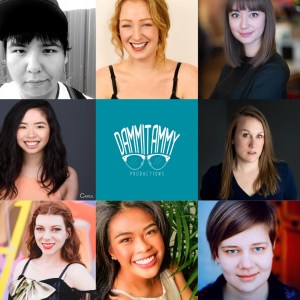
The cast of Letters To No One. Photo supplied.

By Liz Nicholls, 12thnight.ca

Everyone has a stash.

You know, the letters you wrote and you didn’t send.

Letters in which you confess your long-hidden love (possibly in free verse). Or your rage (likely in stinging prose). Or reveal your simmering grievances, regrets, grief, your subterranean resentments, your wounds. Letters where you admit your mistakes or declare ‘j’accuse’. Or set forth the views you squashed at the time in order to seem conciliatory. Or say the goodbyes or sorry’s you were too late to say in person.

That secret hoard of didn’t-send’s, wish-I’d-sent’s, glad-I-didn’t’s was Rebecca Merkley’s inspiration for Letters To No One, the Dammitammy production that opens online Feb. 26. The theatrical concept is simplicity itself, scarily so. A cast of eight actors read, for the first time, nine letters, written by each other, and anonymous. “You don’t know who wrote what, but you know you’re reading a letter by someone in the cast.” Envelope, please.    

It began a couple of months ago when Merkley was getting a new computer, and sifting through the stash of writing lodged in the old one — as one does during an endless pandemic. And there they were, “letters I’d saved to people I’d never sent, quite a few,” some of them dating back 20 years. “Letters it was good for me to write and get it out, but I just didn’t feel safe or comfortable sending them.… Painful moments, memories, but quite beautiful to read knowing what I went through at the time.”

To help support 12thnight.ca YEG theatre coverage, click here

“How could this turn into art?” Merkley, a diarist of long standing, wondered. Encouraged by fellow theatre artist Brianne Jang (the managing director of the SkirtsAfire Festival), the pandemic-friendly idea became a video project, and Merkley approached actors. “And everyone jumped right in.… They were, like, ‘I’m scared to do it, and I’m gonna do it!’” Which pretty much counts as perfect theatrical motivation in Merkley World.

“Sometimes we doubt our simple ideas!. Sometimes we overthink, especially right now…. We can’t gather and do the big fun spectacles, the stuff I normally do,” says producer/ actor/ playwright/ director/ singer/ musician/ composer Merkley.

The Unsyncables

“Fun spectacles” dot the Dammitammy Productions archive, which begins at the 2016 Fringe with the funny, spirited sleeper hit The Unsyncables, an original Merkley underdog comedy in which an aspirational amateur synchronized swim team goes up against a snazzy and arrogant swim “club.” (It remains the only production in the last two decades to my knowledge in which the characters remain in bathing caps throughout). It was followed by River City The Musical, based on the characters from the old Archie comics, and Merk Du Soleil, an original circus cabaret/ variety entertainment.

You can’t keep a creative spirit down, even in times that have been devastating for live performance. “How can we do theatre now? We have to evolve fast. We have no choice!” Merkley has been looking for do-able alternatives. Hence a couple of Dammitammy radio plays, Camp!, a Halloween offering, and the Christmas comedy They Wanted To Do Chekhov. With more to come, including a Merkley mystery, Murder At The Park And Sleep Inn Hotel, set to be unleashed on St. Patrick’s Day (and having “nothing whatsoever” to do with St. Patrick).

Meanwhile, there’s Letters To No One, woven from real letters to real people, “people who wounded us or people we never had the chance to say sorry, or goodbye to, or who we hurt, or who we have mixed feelings about,” as Merkley puts it. Rage is “the palate cleanser,” she laughs. Hence, one letter is by someone who works in retail, a grocery store, and “has to deal with people.” The fury potential is doubtless stratospheric.

The theatre repertoire has its share of plays constructed entirely of letters. 84 Charing Cross Road and Love Letters spring to mind. Letters To No One isn’t like that. “It’s not a monologue project,” says Merkley, explaining that’s the reason the actors don’t see the letter they’ll read till the moment they open the envelope online, with the camera rolling. “I didn’t want it to be ‘acting’…. I didn’t want (them) to ask ‘who are you talking to, and why?’ I need this to be what it is….” And what that is, as she describes it, is unfiltered, unprepared, responses from people, not actors rehearsing a character. “We get the real raw reaction. It’s what makes the project unique!”

COVID has certainly highlighted the resilience and adaptability of our theatre artists. Even by those standards Merkley’s career continues to unfold and zigzag in a remarkable way, accumulating skills as it goes. For her radio plays, she “had to learn audio editing from scratch.” Each took hundreds of hours in post-production, “no exaggeration.”

Merkley, originally from Creston B.C. (near to the home of the polygamous Mormon fundamentalists who are the subject of her play Bountiful), grew up listening to music, and kids’ story records. Thanks to her mom, “I  listened more than I watched TV.”

In high school, she was an athlete, in love with soccer and hockey. Music was “singing and playing guitar in my room.… It took a long time for me to be able to share,” Merkley says. In her five-year Grande Prairie period that followed, she was a career  singer/musician, hired as part of church youth outreach programs and summer camps designed “to create safe spaces for troubled youth.” And she toured the U.S. doing just that. “It was where I thought my life was heading.”

Then came a falling-out with the leadership, and the life-changing decision to accompany a friend to an audition for Oklahoma!. In a classic theatre story, he got Chorus; Merkley landed a lead role, Ado Annie, the girl who “cain’t say no.” Says Merkley, “it was fun. So good for me to discover a community, a bunch of oddballs I fit into…. Sometimes you need people in your life to give you permission,” she says. “I didn’t know I had (musical theatre) in me.”

In 2011, she rented a car, drove to Edmonton, and aced the last audition spot for MacEwan U’s musical theatre program. Soon the Canadian theatre repertoire would be expanding with new Merkley musicals. And plays.

Letters To No One required a further expansion of Merkley’s already startling theatre skill set. And that was assisted materially by acts of generosity, as she says gratefully. A Merkley pal Aaron Hart, a professional videographer (hartfeltmoments.com), offered his equipment to the production for free. Ditto his encouragement. “This isn’t my wheelhouse,” she says. But she’s discovered she enjoys video editing.

When it came time to shoot, the Woodrack Cafe in Old Strathcona offered Merkley the space for free. “It was sitting there empty and beautiful.” So the actors arrived, one at a time, on a strict schedule.

“It’s all an experiment,” she says. “Hey, maybe I should have a separate webpage for my Pandemic Art!” Merkley laughs. “We had fun. I thought it’d be more sad…. It’s people being themselves. It’s real. And it’s pure.”

PREVIEW

Letters To No One

Theatre: Dammitammy Productions

Created by: Rebecca Merkley

Featuring: Bret Jacobs, Brianne Jang, Calla Wright, Carol Chu, Chariz Faulmino, Kristina Hunszinger, Rebecca Merkley, Samantha O’Connor

Where: online, dammitammy.com

Running: Feb. 26 through March 15

Tickets: dammitammy.com/tixevents


Posted in Previews | Tagged , , , | Comments Off on The letters you wrote and never sent: Letters To No One, a new show from Dammitammy