Poly Queer Love Ballad at SkirtsAfire: negotiating romance in a complicated world

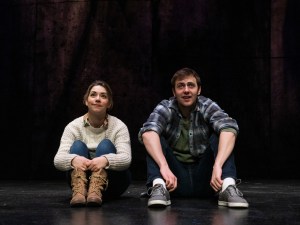
Sara Vickruck and Anais West in Poly Queer Love Ballad. Photo by Emily Cooper.

By Liz Nicholls, 12thnight.ca

Last night at SkirtsAfire, I caught a charming and  intricate new two-hander musical that explores, in an original way, how to tell a contemporary, perpetually-in-progress love story.

To help support 12thnight.ca YEG theatre coverage, click here

The eighth and (at 10 days) biggest-ever edition of E-town’s annual celebration of women artists, has acquired a hit from  last summer’s Vancouver Fringe and beyond. Slam poetry hooks up with folk-pop songwriting in unexpected and playful ways in Poly Queer Love Ballad by Sara Vickruck and Anais West. Love, like theatrical storytelling, is complicated, right?

Gaby and Nina meet at an open-mic night; their mutual attraction is instant and powerful. But in the classic rom-com infrastructure of relationship obstacles, here’s a challenging one: Gaby (Vickruck) is a monogamous lesbian singer-songwriter, an old-school romantic and “the straightest gay you’ll ever know.” Nina (West) is a polyamorous bisexual poet of the experimental stripe, a quester whose mantra is “no gender or genre unread.”

It’s “I’m in it for the long haul” from the songwriter versus “wanna be my primary partner?” from the poet. It’s “I need something that’s just ours” vs. “jealousy is a learned behavior.”

In Vickruck’s cleverly cheeky, rhymed songs and West’s unsettling erotic poetry, as well as funny jagged conversational fragments and juxtapositions, Poly Queer Love Ballad chronicles their fortunes in love and their search for a viable elasticized relationship. “You’re so genuine you startle my metaphors,” says the self-possessed Nina, rattled out of her composure.

Which might sound like heavy going, I realize. It isn’t, though. A puckish self-deprecating sense of humour is woven into the fabric of the piece. And performances by the creators, two likeable actors, are so appealing and self-aware you’ll fall a little in love with both of them.

As Gaby, the charismatic Vickruck plays guitar and sings, and uses loop pedals and the mic in amusingly inventive ways (her sly Tinder cellphone sound effect song is a hoot). West’s Nina, kitted out in a nerdy denim skirt and fanny pack, trots across the stage to deliver her poems — like “Is My Love Doomed?” complete with histrionic gestures. 

It’s fun, wistful, and genuinely experimental, in ways that are never pretentious.

As a bonus I got to see the last performance of Statue, a silent show in which a nude torso comes to life, in music and an expert kind of full-body puppetry by Quebec’s Kristina Troske and Céline Chévrier. A neutral vessel tests out male and female incarnations, in body language (and footwear), and rises above. Enchanting.

Poly Queer Love Ballad continues at SkirtsAfire Saturday and Sunday at the festival’s cabaret theatre, Alberta Avenue Community League (9210 118 Ave.). Tickets: TIX on the Square (780-420-1757, tixonthesquare.ca).  The full schedule of festival events is at skirtsafire.com.   

Posted in Reviews | Tagged , , , | Comments Off on Poly Queer Love Ballad at SkirtsAfire: negotiating romance in a complicated world

On the edge of the world: Come From Away. A review.

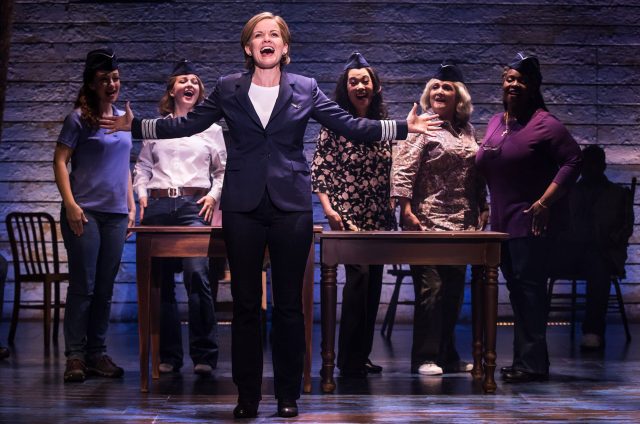
    Becky Gulsvig and Emily Watson (front) in Come From Away. Photo by Matthew Murphy.

By Liz Nicholls, 12thnight.ca

Welcome to the Rock. “You are here, at the start of a moment, on the edge of the world,” sings the ensemble in the opening number of Come From Away, the irresistibly warm-hearted Broadway hit that’s arrived on the Jube stage this week — in an American touring production that’s brought a story of Canadian-ness back to its country of origin.

To help support 12thnight.ca YEG theatre coverage, click here

And with this modest declaration in song, the story of what else happened on Sept. 11, 2001 finds its geographical coordinates, its true-life source, and its groove. In the immediate aftermath of the 9-11 terrorist attacks on New York, 38 international flights were diverted to Gander, Newfoundland. And a hospitable little town, population 9,000, “on an island in between there and here,” welcomed, housed, and fed nearly 7,000 stranded passengers in a newsworthy demo of generosity and kindness in a blasted world.

Becky Gulsvig centre) in Come From Away. Photo by Matthew Murphy.

The unusual musical, by the Toronto husband and wife team of Irene Sankoff and David Hein, is culled from real-life interviews with the townsfolk and the passengers. And there’s another Canadian story in its improbable route from a Sheridan College student workshop incarnation in honour of the 10-year 9-11 anniversary to premieres at Seattle Rep and the La Jolla Playhouse and on to massive successes in New York and now London. Come From Away has landed at its rapturous reception here on a jet stream of raves, major awards (including Dora Awards, a Tony for director Christopher Ashley, and now multiple Olivier nominations across the pond), and sold-out runs. The Mirvish Toronto production is now booking through September.

In this improbable and massive success  — in New York, it’s among a handful of shows that regularly gross more than a million dollars a week — it was materially assisted by timing. Its celebration of hospitality and generosity arrived on the big-stage international  theatre scene at the moment when America seemed particularly mean, stingy, xenophobic, closed to come-from-aways, and unusually receptive to an antidote, and from a country they’d barely noticed before.  

Yes, it’s not as if there’s no reason to be cynical in theory about Come From Away. There are so many ways it could have gone wrong, way wrong. A musical about 9-11? A musical about the upside of 9-11? Think about it. A musical without a star, about people being nice?

And, in truth, there are occasionally moments in Come From Away when you can’t help resisting the irresistible that’s coming at you: the perplexed and unnerved passengers have landed, albeit as a byproduct of a horrifying disaster they don’t know about yet, in a place where there are quirky individuals but nary an unkind jerk, or racist, or homophobe, much less an out-and-out villain. Friction is for the passengers, not the exemplary locals. As one of a splintering gay American couple both named Kevin notes near the outset, Newfoundland is “like going back in time.” 

But Come From Away is so smartly put together, musically and theatrically, and the piece so imbued with a self-deprecating and distinctive sense of humour, that it would take a rocky soul indeed not to be warmed by its unwavering celebration of human connectedness. 

The stage, as designed by Beowulf Boritt, is simply appointed. It’s dominated by a few bare trees, some wooden chairs, and a back wall of wood that turns out, at crucial moments, to be slatted (lighting designer: Howell Binkley). In one corner, a really excellent eight-piece band, including pennywhistle, fiddle, and bodhran, stands ready to deliver the Celtic-flavoured folk-rock of the score. And their rocking curtain-call number is celebratory, in all the right ways: it’s a kick-ass finale. 

The characters are winsomely individualized and quirky — an effect amplified by the reverb  that they’re based on real people. The dexterous 12-member ensemble in this fine touring production play the passengers and the Gander-ites interchangeably.

The fateful day in which 7,000 people from everywhere will spend that night and the next four, begins with Gander’s small-town daily morning rituals. “Everything starts and ends at Tim Horton’s,” declares the crusty Gander mayor, played outstandingly played by Kevin Carolan. True, there’s something you might want to call labour friction pertaining the school bus drivers. But, hey, that whole business stops for coffee too.

Other standouts include Julie Johnson as Beulah the teacher who bonds with another mother (Danielle K. Thomas), traumatized by the lack of information about her New York firefighter son. As Bob, a wary New Yorker who can’t quite believe his wallet is safe on the Rock, James Earl Jones II is genuinely amusing in his incredulity. And Becky Gulsvig as a groundbreaking pilot delivers, in compelling fashion, the show’s only bona fide solo, Me And The Sky. The nature of flying, her true passion in life, changes forever on 9-11. And in the course of the song she realizes it.

Nick Duckart, Kevin Carolan, Andrew Samonsky in Come From Away. Photo by Matthew Murphy.

Of the two couples in the piece, one comes together and one falls apart in the “who knows where” of the outer edge of Canada. Christine Toy Johnson as a middle-aged Texas divorcée, finds herself drawn to an awkward Englishman (Chamblee Ferguson, whose accent pushes its luck) who works for an oil company. In the least convincing scene, designed to show off comically the natural open-mindedness of the locals — some of their relatives are gay! — the couple of Kevins (Andrew Samonsky and Nick Duckart), who are used to being cautious about revealing their relationship, are caught off-guard by the progressive attitude of Gander. 

It’s at moments like that Come From Away pushes a wee bit too hard at its sentimental thought that on the periphery of tragedy, no one is untouched by Canuck worthiness. Much better is the way Come From Away astutely lays off co-opting an epic tragedy. It offers fleeting glimpses, in the mother’s vigil by the phone, and the harsh excluding treatment of the passenger from the Middle East (Nick Duckart), whose fortunes in the post-9-11 world will, as you know, be rocky.

Mostly it confines itself to odd, and endearing stories on the edge of that terrible main event: the rookie reporter on her first day, who lands the story of her career; the SPCA rep who gets a career high, too, when she saves a rare chimpanzee from the hold of the plane. 

The sharp inventiveness of the stagecraft is fun to see. An unobtrusive re-arrangement of the chairs, and voilà, we’re inside the plane, or the air traffic control tower, or the school. And the performances, as 12 actors of every size and shape reinvent themselves as 40-plus characters, is a match. 

The rollicking production number, a highlight bash in the Legion Hall, is riotously contagious. It feels like a party. If they’d been passing the Screech and the cod around, I’m sure we’d all have had a slug and a smooch. It’s a world afflicted by a deep mistrust of The Other, where, on the other hand, everyone has come from away, it’s the right moment for a musical like this.  

REVIEW

Come From Away

Broadway Across Canada

Created by: Irene Sankoff and David Hein

Directed by: Christopher Ashley

Where: Jubilee Auditorium

Running: through Sunday

Tickets: ticketmaster.ca


Posted in Reviews | Tagged , , , , , , | Comments Off on On the edge of the world: Come From Away. A review.

“You have to put it right!” Matilda the Musical, at the Citadel. A review.

John Ullyatt as Miss Trunchbull, Matilda The Musical. Photo by Ian Jackson, Epic Photography.

By Liz Nicholls, 12thnight.ca

Wicked, I tell you.

Wicked fun, that is, the smart, joyful musical that’s currently promoting anti-authoritarian resistance, empowerment, and self-determination  — for children! — from the Citadel’s Shoctor stage.

Based on Roald Dahl’s delightfully dark 1988 kids’ novel, Matilda follows the fortunes of a brilliant little girl, neglected and oppressed by fantastically dreadful parents, who finds her defence and refuge in … books, not TV. What a crushing disappointment to mom and dad (not to mention the culture at large).

To help support 12thnight.ca YEG theatre coverage, click here

When the other kids are apostrophizing their fawning parents in an early number (“my mummy says I’m a miracle”), Matilda, unperturbed, is singing “my mummy says I’m a lousy little worm/ my daddy says I’m a bore….”

Lilla Solymos as Matilda in Matilda The Musical. Photo by Ian Jackson, Epic Photography

Yes, Matilda Wormwood, bright and brave and bookish, is a born subversive, I’m afraid. As you find out in the musical ingeniously fashioned as stories within stories by playwright Dennis Kelly and the Australian composer/lyricist Tim Minchin, she’s a natural rally-er of forces against injustice, unfair punishments, tyranny, illiteracy, and general stupidity. At school, Crunchem Hall, where the terrifying headmistress Miss Trunchbull presides with an iron, er, hammer (she’s a British champion hammer thrower of yore), things are just as bad, maybe worse. 

The musical, which had its origins at the Royal Shakespeare Company in 2010 (before West End and Broadway incarnations), comes at us in a lavish, gothically high-style Daryl Cloran production courtesy of the combined forces of the Citadel, the Royal Manitoba Theatre Centre, and Vancouver’s Arts Club Theatre. And, as I can attest, it’s that rarest of showbiz commodities: clever and bracing for the ruling class (i.e. grownups who were once kids) as well as their offspring, who know full well what it’s like to be up against it in a crazy, mean-spirited world. 

Lucian-River Mirage Chauhan (centre) in Matilda The Musical. Photo by Ian Jackson, Epic Photography.

If ever there was an anthem to the prodigious possibilities built into children, it’s the musical itself. Matilda is a veritable singing/dancing testimonial. For the nearly three hours of Cloran’s production, you’ll see child performers right alongside their taller, older cast-mates, not indulged for cuteness, but bona fide working members of the excellent ensemble.

Locally recruited for the Edmonton run of a production that ran first in Winnipeg with Winnipeg kids, they sing confidently; they execute the intricacies of Kimberley Rampersad’s bold, crisply jagged, fist-first choreography with dazzling conviction. And under Cloran’s direction they know that being funny onstage is a matter of seriousness and stakes.    

At the centre, Dostoyevski and Dickens defiantly in hand, is Matilda, played by Edmonton’s Lilla Solymos (who alternates with Winnipegger Anna Anderson-Epp). And she’s wonderful in her grave solemnity, her plucky refusal to ingratiate or indulge pathos (she prefers revenge), and her general air of determination — not to mention her singing voice.

Julio Fuentes, Alison MacDonald and Lauren Bowler in Matilda The Musical. Photo by Ian Jackson, Epic Photography.

Her parents are a repository of brassy lunacy and hysterical self-centredness. Sleazy Mr. Wormwood, a used-car salesman whose attempts to sell old beaters to the Russian mafia (rarely a good idea), is played to cartoon comic excess by spaghetti-legged Ben Elliott. Lauren Bowler is very funny too as Mrs. Wormwood, obsessed with ballroom dance, her partner Rudolpho (Julio Fuentes)  and blonde highlights, in interchangeable order.

As Matilda’s older brother Michael, Corben Kushneryk takes sullen listlessness to a level of virtuosity rarely seen in a sentient being. I laughed every time I saw him onstage.

The epicentre of tyranny is the formidably scary Miss Trunchbull. Her reign of terror — introduced before we ever meet her in a set-up song by the students — is set forth in a showstopping performance of comic villainy from John Ullyatt. His delivery, which sharpens its edges on an English accent designed to amputate limbs, veers between a sinister faux silkiness (accompanied by a faux-pitying smirk), and bosom-levitating rage. Given the epic nature of that bosom, the world trembles.

Miss Trunchbull simmers ominously, like a volcano just before red-hot lava delivery, and can sniff out “the odour of rebellion, the whiff of insurgence, the stench of intent” before it even forms. Being sent to the principal’s office, under the circumstances, has something in common with getting sent to the guillotine in 1789.  

John Ullyatt (right) as Miss Trunchbull, Matilda The Musical. Photo by Ian Jackson, Epic Photography.

The sight of Ullyatt’s Miss Trunchbull in full gym garb vaulting over the pommel horse in that most dreaded of all punishments (well, second-most), phys-ed, is unforgettable. Equally, the sight of Miss Trunchbull winding up to fling a pupil by the pigtails, like a hammer, is something you’ll have for life. Ullyatt is, in all senses of the word, riotous. 

With foes like that, a kid needs friends. Matilda has two: the excitable librarian(Sharon Crandall) who’s addicted to her stories, and her teacher Miss Honey (sweet-voiced Alison MacDonald), torn between fear and conscience. The moment when Matilda by example mobilizes her quavering classmates into out-and-out rebellion is savoury indeed.

Lilla Solymos (centre) with Andrew MacDonald-Smith and Becky Frohlinger in Matilda The Musical. Photo by Ian Jackson, Epic Photography.

After all, as the insurrectionist Matilda has pointed out, in one of Minchin’s clever, witty, multi-syllabic songs, Jack and Jill, whose tumble is widely regarded as inevitable, should really have sucked it up and re-written their narrative. “Nobody’s gonna change my story but me….” In fact, as an imaginative child, she is tuned to stories — and storytelling, and the criss-crossing of narratives and life. Which explains why there’s an acrobat team in the show,  one of the many delights of Matilda.

A cavil: Speaking of the songs, Minchin’s incisively funny lyrics sometimes get lost in a bright, forward sound mix (Brad Danyluk) that’s otherwise fine. Perhaps it’s inevitable given the timbre of kid voices, but it’s still a loss.

The West End and Broadway productions were framed by a teetering proscenium of books that looked ready to fall. Cloran sets his large cast in motion on an amusing design by  Cory Sincennes that’s dominated by a wall of stylized bendy bookcases; they’re full of gray untitled volumes punctuated by intermittently by glowing TV screens, and have a wonky outsized frame that shines in the dark. Sincennes’ costumes, in flamboyant acid hues, are fun to look at. The show is luridly lit, in cartoon fashion, by Gerald King.

There’s a dark sense of humour at work in Matilda, which approaches loneliness and rejection in an appealingly oblique way. Matilda earns its sentiment (and, yes, your eyes will water, sometimes while you’re laughing!) and its heartbreak: it takes its cue from a heroine who doesn’t wear her heart on her sleeve. She keeps it tucked away, under the armour that activists wear, and saves it for her stories.

Wicked, as I say. Be a little naughty: step up to the revolution and get a ticket. Nobody’s gonna change your story but you.

REVIEW

Matilda the Musical

Theatre: Citadel, Royal Manitoba Theatre Centre, Arts Club Theatre

Written by: Dennis Kelly and Tim Minchin, from the Roald Dahl novel

Directed by: Daryl Cloran

Starring: Lilla Solymos, Anna Anderson-Epp, Ben Elliott, Lauren Bowler, Alison MacDonald, John Ullyatt, Alison MacDonald

Running: through March 17

Tickets: 780-425-1820, citadeltheatre.com


Posted in Reviews | Tagged , , , , , , | Comments Off on “You have to put it right!” Matilda the Musical, at the Citadel. A review.

The road to Mesa: a buddy pic with a difference. A review.

Julien Arnold and Richard Lee Hsi in Mesa, Atlas Theatre Collective. Photo by Mat Busby.

By Liz Nicholls, 12thnight.ca

Funny how the concept “road trip” conjures two sets of images, almost entirely contradictory.

One is fuelled by sheer romance, the cinematic sweep of conquering vastness in a first-hand way: the questing spirit with car keys, so to speak. The other is fuelled by the reality of being locked into a relatively teeny space with someone who, you’ll soon discover, doesn’t share your world view, or your taste in music or your pace in roadside pit stops. Sometimes they’re related to you. Often they snore.

To help support 12thnight.ca YEG theatre coverage, click here

This is the situation in Mesa, an odd and surprisingly surprising buddy-pic comedy by Calgary’s Doug Fisher, a founder of Ghost River Theatre. It’s the choice of the Atlas Theatre Collective, whose artistic director Julien Arnold is in the show, alongside Richard Lee Hsi. 

Julien Arnold, Richard Lee Hsi in Mesa, Atlas Theatre Collective. Photo by Mat Busby.

The opening image of Patricia Darbasie’s production is one to cherish: an old guy (Arnold) in one of those hats with major fur earflaps and a young guy (Lee Hsi) in a toque are sitting in the front seat of a car. OK, you have to imagine the front seat and the car, which is fine (the production is staged with astute simplicity). Yes, they are Canadians. And yes, they are driving south. They have 1500 miles (that’s an infinite number of kilometres) ahead of them, so “are we there yet?” has a particular edge.

Paul (Lee Hsi), a 35-year-old writer, struggling with both his career “as an artist” and, it turns out, his marriage, has agreed to drive 93-year-old snowbird Bud, his wife’s grandfather, to his retirement trailer in Mesa, Arizona.

The destination is a time-honoured punchline. But there’s the getting there. In this, the younger man has been moved by a desire for re-invention of self, for rebirth in a journey of discovery. What he’s anticipating, as he says, is the America of Georgia O’Keeffe, Ansel Adams, The Battle of Little Big Horn, the OK Corral, Monument Valley, the Grand Canyon.

Grandpa Bud, on the other hand, is all about getting to his trailer in Mesa. As soon as possible.

It’s not starting well. Paul is dreaming of “the backroads of America”; Grandpa Bud says “we’ll stick to the Interstate.” What they will see, to Paul’s mounting irritation, is the America of Motel 6s and Denny’s. Grandpa Bud is adamantine on the subject of schedule, and diet.

No, he won’t eat at Wendy’s. No, he absolutely refuses to stop in Ketchum, Idaho and see Ernest Hemingway’s house. “He won’t be there. He’s dead.” He insists on Idaho Falls. Why? The Denny’s is right next to the Motel 6. You can sense Paul grinding his molars even if you can’t hear it. 

The play, produced here by Workshop West in 2001 (in a production starring Ashley Wright and Teatro La Quindicina artistic director Jeff Haslam), hasn’t been updated. Times being what they are, you’re bound to notice that a Trump-ian America would have darkened (or politicized) Paul’s dreams. He might never have signed on to go anywhere near Arizona, for one thing. But Paul’s rhetorical awe, “how did we get from Sitting Bull to Denny’s in 100 years?” — Grandpa Bud’s lifetime — does still stick, even if the concept Trump infiltrates the mind’s eye.

The chemistry of these two excellent actors is what makes the play, and the production, tick. Arnold turns in an amazingly convincing performance as Grandpa Bud. And he does it largely through breathing (a lot of it) and fragmented rhythm, and a kind of stiff-legged gait — not a scratchy cliché old-guy voice. He barely moves his mouth when he talks, as if he’s making sure his teeth are in place.

It’s a strikingly unsentimental portrait of old age, in all its harsh cut-to-the-chase lack of interest in the new, and resistance to change of any kind. He’s pragmatic, petulant, opinionated, and given to tantrums when crossed. In Arnold’s performance, the contours are softened only in flashbacks, when Grandpa Bud steps out of the car and the ongoing journey, and remembers selected aspects of his life, mostly to do with his late wife and his music hobby.

Lee Hsi, who’s a subtle and appealing actor, conveys the sense of good intentions undermined by exasperation. And it’s infiltrated by a sense of the character’s dissatisfaction, his self-doubt, his need to fix his life.

When that change comes, or at least begins, it’s in an unexpected way. The play doesn’t explain it, just floats it, and let’s us be as surprised as Paul is. Proximity to old age, however irascible, and to death, has something to do with it. Paul has to reassess his reactions to the seniors of the Citrus Gardens trailer park, with their garden gnomes and their rituals, their Saturday night dances and bad jokes, their matter-of-fact view of mortality, their reviews of the dearly departeds.

Amusingly, the pre-show music is Sentimental Journey. And what’s puckish and wry at the beginning has a different feel at the end. It’s for Cathy Derkach to step away from the keyboard, where she weaves wispy fragments of golden oldies, to become Americans that Paul and Grandpa Bud meet. The sequences in a casino, for example, or in Tombstone, a detour where the famous OK Corral battle has devolved into a feud between two opposing gunfight “attractions,” seem a little over-extended on this viewing (I was kindly permitted to see a preview). But the combination of confrontational and cordial, with a little good ol’ American hustle, hits the mark.

Chantel Fortin’s design, with its cut-out Shangri-la mesas and cactus, seems just the right weight for the piece. The sunsets are by lighting designer Jeff Osterlin.

REVIEW

Mesa

Varscona Theatre Ensemble

Theatre: Atlas Theatre Collective

Written by: Doug Curtis

Directed by: Patricia Darbasie

Starring: Julien Arnold, Richard Lee Hsi, Cathy Derkach

Where: Varscona Theatre, 10329 83 Ave.

Running: through March 2

Tickets: varsconatheatre.com


Posted in Reviews | Tagged , , , , , | Comments Off on The road to Mesa: a buddy pic with a difference. A review.

Harry Potter and the Cursed Child: theatre magic in New York

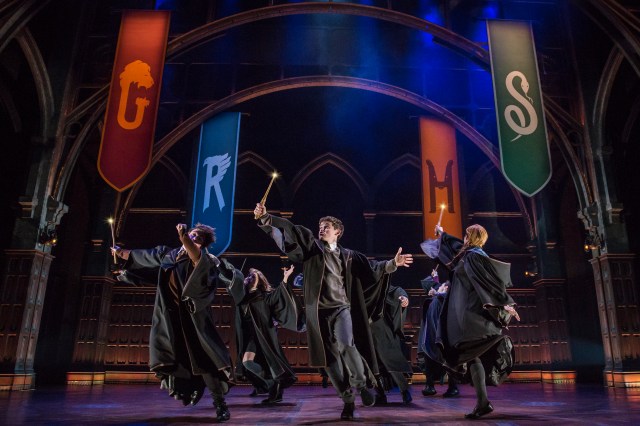
Harry Potter and the Cursed Child. Photo by Matthew Murphy

By Liz Nicholls, 12thnight.ca

NEW YORK — “Keep The Secrets” say the little buttons you get handed out when you leave the Lyric Theatre near Times Square.

I’m pretty sure that doesn’t apply to the golden star-studded blue ceiling in the lobby, or the new red carpet, woven with the insignia of the four houses at Hogwart’s. So before a Dementor gets me I’m telling you this: look up and look down.

To help support 12thnight.ca YEG theatre coverage, click here

But you’ll have to keep your voice down when you’re in a bistro, de-briefing with experts between Parts I and II of Harry Potter and the Cursed Child. Wednesdays, Saturdays, and Sundays are total-immersion Harry Potter days in New York, when you can see both parts of this thrilling non-stop extravaganza of storytelling and theatrical stagecraft, 2 and 7:30 p.m., set in motion by wizard director John Tiffany. That’s what we did.

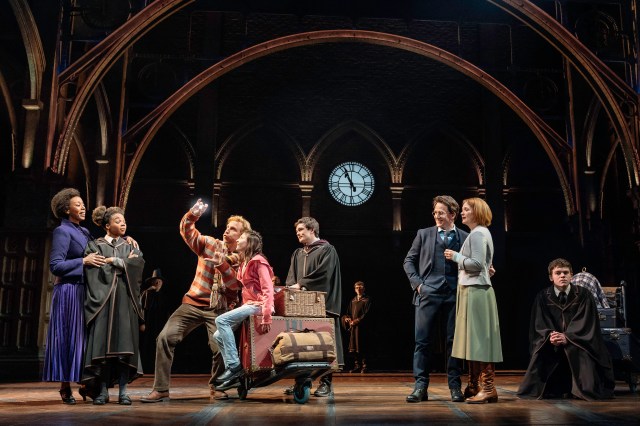
Harry Potter and the Cursed Child. Photo by Manuel Harlan.

The plot of the Jack Thorne’s two-part play (based on an original new story by J.K. Rowling, John Tiffany, and Thorne) is a a veritable 100-acre wood of complications (oops, wrong story), to put it mildly. And it takes nearly six hours, and two full-length plays, to negotiate it. But then, in truth, what true Harry Potter fan, seven intricate Harry Potter novels later, would be satisfied with simple? And besides, you don’t have to be a die-hard Potter-head (I’m not) to be dazzled by the experience, though it’s extra fun to know some of the back stories (remember Moaning Myrtle?). What is magical indeed is how the cast, 40 strong, manage the non-stop activity of two-show days.

Anyhow, time has flash-forwarded since last you met the characters. Harry Potter (the excellent Jamie Parker) is an anxiety-plagued grown-up, an employee of the Ministry of Magic. His boss is Hermione (Noma Dumezweni), who’s married to Ron Weasley (Paul Thornley. And as the show opens, Harry and his wife Ginnie née Weasley (Poppy Miller) along with Hermione and Ron are at King’s Cross station, platform 9 3/4, seeing their own kids off to Hogwart’s at the start of term.

Harry Potter and the Cursed Child. From left, Noma Dumezweni, Susan Heyward, Paul Thornley, Olivia Bond, Ben Wheelwright, Jamie Parker, Poppy Miller, Sam Clemmett. Photo by Manuel Harlan.

Their awkward younger son Albus (Sam Clemmett), who has a troubled relationship with his dad, will find a friend in the son of his dad’s arch-enemy Draco Malfoy. The elder Potter son James is played by Edmonton’s Ben Wheelwright (who’s been a Tiny Tim in the Citadel’s Christmas Carol in his time), among many other of his assignments in Harry Potter and the Cursed Child. And it’s a thrill to see him onstage in this spectacular hugely demanding diptych.

“It’s been a blast to be a part of,” says Wheelwright, whose first New York assignment was the alternate lead in the Broadway production of The Curious Incident of the Dog in the Night-Time. “Super exhausting at times, but I wouldn’t have wanted to spend this year doing anything but swishing cloaks and being part of all the magic.…The show is choreographed by the same person (Steven Hoggett) as Curious Incident. So when I signed up I knew the type of high-intensity, physical demand he asks of his actors….”

How Christine Jones’ vaulted set is transformed to the grand hall at Hogwart’s is wizardry all its own, and the same can be said for Neil Austin’s lighting. The wonderful thing about Harry Potter and the Cursed Child is that, despite its huge size (and budget: reportedly $68 million U.S.), the magic of the show is is magic of the theatre, created by the ingenuity, sophistication, and resourcefulness of theatre artists at the top of their game. It’s not some sort of showcase of cinematic special effects.

The actors are deeply committed. And in addition to its flamboyance with time travelling, the story itself has a coming-of-age heart, a human pulse you can feel — the craving for friendship, the bonds of parental love and expectation, guilt and the fear of being alone in the world. I loved it.


Posted in Features | Tagged , , , , , , , , | Comments Off on Harry Potter and the Cursed Child: theatre magic in New York

Haunted by the past: The Ferryman in New York

The Ferryman by Jez Butterworth, with (centre) Paddy Considine. Photo by Joan Marcus.

By Liz Nicholls, 12thnight.ca

NEW YORK – It’s a chilly winter’s night in New York (that’s “chilly” not “arctic”). And the mid-town working population — hotel bellpersons to parking valets to ticket takers to Sabrett’s hot dog vendors — seem to be walking ads for Canada, via its most conspicuous export here:  Canada Goose down coats.

Inside the Bernard B. Jacobs Theatre on West 45th, a vintage 1927 Broadway house decorated with fanciful “Spanish”-themed murals, a packed house will be breathless (i.e. holding their breath a lot of the time) for more than three fleet hours.

The play is Jez Butterworth’s The Ferryman. And it’s a big, thrilling experience in every way — crowded the way life is, with people and food, memories and stories, politics and poetry. To be in rural Northern Ireland in 1981 is to be in a place where the violent past won’t stay put and the IRA never lets go, even if you’re in a big multi-generational family in the countryside in County Armagh.

The Ferryman by Jez Butterworth. Photo by Joan Marcus.

Sam Mendes’ production, which began at London’s Royal Court Theatre in 2017 and has taken its British cast to New York, is a wild and irresistible swirl of characters — 21 of them, grown-ups and ancients, children of every age from infancy to teenagers, rushing in and out of doors, up and down stairs, dancing, singing, taking a nip of Bushmill’s, telling stories. Ah, and watering grievances with whiskey and opening old wounds.

And that’s not including the animals in the cast, notably a goose and a rabbit. The former is named Peggy (featured in a New York Times article) who really nails her scene with the play’s only Englishman, a gentle, slow-witted character who tucks her under his arm. Apparently, Peggy has been relaxed enough in showbiz to lay an egg offstage. The latter, a dwarf Netherland rabbit, is Pierce, named (according to the same article) because his fur markings resemble early Pierce Brosnan. Two babies play the baby: whichever one isn’t having a crisis gets to be onstage. You feel, in retrospect, that the stage manager should be part of the curtain call.

Justin Edwards with Peggy the goose, in The Ferryman by Jez Butterworth. Photo by Joan Marcus.

Against a backdrop where Bobby Sands et al are on a hunger strike in the Maze, we’re at the Carney farm at harvest time. Quinn Carney (Paddy Considine, the charismatic Irish star who’s, amazingly, making his stage debut with The Ferryman), presides over his brood. He’s haunted by the never-explained disappearance years before of his brother Seamus, whom he recruited for the IRA. And he’s troubled by his attraction, a mutual thing, to his sister-in-law (Laura Donnelly), whose widowhood has never been resolved.

His wife has grown ever-more distant; his auntie Maggie Far Away (Fionnula Flanagan) inhabits an ancient world of Irish fairies and folk legends, returning from time to time to the present to report. Uncle Patrick (Mark Lambert) is a storyteller in the grand Irish tradition, rooted in mythology. Aunt Pat (Dearbhla Molloy) is a fierce and unremitting republican whose grievances are unshakeably rooted in the ill-fated Easter Uprising of 1916.

And into this haunted environment, shaken by the discovery of a well-preserved body in a bog, an IRA hitman arrives with an ominous warning. 

The past is never buried and gone. Jerusalem, the last Butterworth play I saw in New York, effortlessly lived in the past and the present, too, as it probed the very heart of English-ness and what that means now. At its centre was the antic figure of the anarchist Johnny ‘Rooster’ Byron, in a mesmerizing performance from the great Mark Rylance a sort of Falstaffian figure-turned-drug dealer in the reduced circumstances of this green and pleasant land in the contemporary world. 

Mendes’ stagecraft — which extends in detail to the smell of burning peat, a cooked goose served up steaming for a harvest dinner, including potatoes roasted for every performance in duck fat — is an extraordinary achievement. His production revels in the way Butterworth’s play ripples with the sense that the past is alive, and still bloody, in Ireland. The ending is shattering. 

Posted in Features | Tagged , , , , , , , , | Comments Off on Haunted by the past: The Ferryman in New York

On the road again: Mesa is a trip across the border, and the generations

Julien Arnold, Richard Lee Hsi in Mesa, Atlas Theatre Collective. Photo by Mat Busby.

By Liz Nicholls, 12thnight.ca

You know what they say (it’s probably somewhere in the extra-fine print on the AMA website, just kidding): You never really know someone till you travel together.

The buddy pic/ road trip through America that opens Thursday on the Varscona stage, in an Atlas Theatre Collective production, is a comic testimonial to that effect — with a heart-tugging kicker.

In Mesa, a bittersweet two-hander comedy by Calgary playwright Doug Curtis (paranormal, The Carrot Warrior, Lester’s Hat), an unemployed, struggling 35-year-old writer (Richard Lee Hsi) has agreed to drive his 93-year-old snowbird grandfather-in-law (Julien Arnold) from Edmonton to his retirement trailer in Mesa, Arizona, a fair patch of real estate away. 

To help support 12thnight.ca YEG theatre coverage, click here

Julien Arnold, Richard Lee Hsi in Mesa, Atlas Theatre Collective. Photo by Mat Busby.

That’s a lot of Denny’s coffee and gas station bathrooms, a tally that Paul didn’t stop to consider when he agreed, lured by the theoretic romance of discovering America — its history, its scenic showstoppers, its “points of interest.” Grandpa Bud’s mindset isn’t in sync with that notion — at all. He’s 93, it may well be his last trip there, and time’s a wastin’.  Talk about mis-matched roommates (in a very small room, on wheels).  

Director/ actor/ playwright Patricia Darbasie. Photo by Ryan Parker.

Patricia Darbasie, best known to Edmonton audiences as an actor and playwright, is directing the piece. No wonder she’s got vehicles on her mind. “I love directing,” says Darbasie. “Being an actor is like getting to ride in the car, but being a director his like having the keys and driving the car. Getting keys away from someone who owns the car is not easy!”

The play, which premiered at One Yellow Rabbit’s High Performance Rodeo in Calgary in 2000 (and later toured the U.K.), got its Edmonton premiere a year later at Workshop West, in a Ron Jenkins production starring Jeff Haslam as Paul and Ashley Wright as Grandpa Bud. Darbasie, who last occupied the Varscona stage as an actor (Going To St. Ives, The Finest of Strangers), says what attracted her to the piece “is how fluid and fast-moving it is. Yes, the relationship between the men (is central), but the challenge for me is to focus a relationship that travels 1500 miles over numerous locations in less than 90 minutes.”

Darbasie arrived in Canada at age seven with her family from Trinidad. And she’s tapped her West Indian roots for several of her plays. West Indian Diary, which premiered in a Ground Zero production, explored the immigrant experience. Before that, Carnival Magic, a kids’ play commissioned by Concrete Theatre for its inaugural Sprouts Festival, combined personal experience and folk tales. Ribbon, the solo play Darbasie wrote for herself that garnered her an directing degree from the U of A, was inspired by our Alberta’s little known black history.

Directing Mesa, “the biggest challenge,” she thinks, “is keeping the action clear…. It’s a simple set, and we move from car to restaurant to hotel to bar all in the space of half a page (of script)…. The easy part is the characters. I think just about everybody who’ll come to see Mesa knows Bud and Paul. They are in your family, or they live next door. You know these two guys!”

Not only are their personalities high-contrast, but there’s a six-decade age gap — more of a chasm, really — between them. Paul is at a crossroads; Grandpa Bud has no time for regret. Is there a bond between youth and age, uncertainty and pragmatism? That’s for the characters to explore in the course of Mesa. None of Grandpa Bud’s reactions are what Paul expects; the younger man is constantly surprised.  

As for Darbasie, she says she went into directing “as a way to better understand the actor’s process… It’s clarified my own process as an actor and given me an opportunity to see how other actors work.” 

Has she found herself wanting to be in the show she’s directing? I really have not,” says Darbasie. “I want the actor who’s been cast to fully realize the part. It’s about how they move and think and what they bring to the role. When I put on my director’s hat … I move into thinking ‘wider picture!’”

And in Mesa, with a couple of Canadians en route to the Citrus Gardens Trailer Park, that wider picture includes a lot of America. 

PREVIEW

Varscona Theatre Ensemble

Mesa

Theatre: Atlas Theatre Collective

Written by: Doug Curtis

Directed by: Patricia Darbasie

Starring: Julien Arnold, Richard Lee Hsi, Cathy Derkach

Where: Varscona Theatre, 10329 83 Ave.

Running: through March 2

Tickets: varsconatheatre.com

Posted in Previews | Tagged , , , , , | Comments Off on On the road again: Mesa is a trip across the border, and the generations

“A little bit naughty”: Matilda rewrites her story in the hit musical opening at the Citadel

John Ullyatt (right) as Miss Trunchbull, Matilda The Musical. Photo by Ian Jackson, Epic Photography.

By Liz Nicholls, 12thnight.ca

We are revolting children/ living in revolting times. We sing revolting songs/ using revolting rhymes.

Kicking, punching, and stomping are de rigueur in the rehearsal rooms of the Citadel these days. “We talk about fighting, not about dancing,” says choreographer Kimberley Rampersad, with a smile.

To help support 12thnight.ca YEG theatre coverage, click here

“Let’s have less dancing, and more fighting,” she tells the brigade of kids, 10 strong, in the cast of Matilda, the much-awarded 2010 hit musical that opens Thursday at the Citadel, after a run at the Royal Manitoba Theatre Centre. “Too polite!” she sometimes tells them, surely music to the ears of the average kid. “Too lyrical!”

Defiance, after all, is the keynote of the smart and spirited eight-year-old heroine of Matilda, who resists the coercion of her grotesquely dreadful parents, the gorgon headmistress, and anything else that gets in the way of basic fairness in life. And Matilda’s resistance movement against just grinning and bearing whatever injustice comes at you will prove contagious in the 2011 musical based on the deliciously subversive 1988 kids’ novel by Roald Dahl. “By the time we get to the end, we’re using the vocabulary, the motifs, Matilda has taught to all her friends,” says Rampersad. 

Matilda the Musical, Citadel, Royal Manitoba Theatre Centre and Vancouver Arts Club Theatre. Photo by Ian Jackson, Epic Photography.

Rampersad, a rising star in Canadian theatre, made time for coffee in a week when that commodity, time that is, was at a particular premium. The dozen grown-ups in director Daryl Cloran’s cast, including Edmonton’s John Ullyatt as the monstrously terrifying Crunchem Hall School headmistress Miss Trunchbull (her motto: “children are maggots”), had arrived for the second leg of their three-city contract (Matilda opens at Vancouver’s Arts Club Theatre in May). Except for the alternating Matilda’s, though (Anna Anderson-Epp from Winnipeg,  and Lilla Solymos from Edmonton), the nine other kids in Matilda, five girls and four boys ages eight to 13, are all from Edmonton and all new to a show that’s hugely challenging — in music, in acting, in movement.

“I don’t want to stop them from doing what comes naturally … (but) we’re introducing them to other ways of expressing themselves,” says Rampersad of her rapport with kids. “Some have dance training, some have natural ability but not much training.” And some will be performing on a theatre stage for the very first time. Yes, it’s tricky, agrees the choreographer. “But it’s also beautiful because you watch them cross-pollinate,” some with the experience of training and discipline, some with more access to impulse and freedom….” she says of the fight lexicon she’s been using.

Choreographer Kimberley Rampersad, Matilda The Musical. Photo supplied.

“It’s a huge learning curve for them, to learn the whole show in just over a week. It’s crazy!” she says cheerfully of her game young charges. “On the plus side, in each community kids have the chance to inspire, to see their peers up onstage. “They’re going through a lot in their lives, being tested and tried and bullied, and here they are concentrating for eight hours, learning the choreography and the music, the tech, doing the costume fittings.… They’re just inundated with information.”

Rampersad jokes with them that “I have no heart…. But if I did, It would burst every time because I’m so proud of them. My job is to make them successful. That’s the amazing thing about young people; that’s what they’re built to do, rise to the impossible.”

“I’m relentless with them!” Rampersad declares. “And if you set the bar high, they will go down swinging to meet it!” Kids are the “OK! We’ll give it a shot” people, she says. And as for the adults in the cast, Rampersad has been impressed by their flexibility and delight in adjusting to the youthful newcomers. “It’s like having a new line in hockey. And they’ve been so graceful, and hilarious, about engaging the new cast.”

Lilla Solymos in Matilda the Musical. Photo by Ian Jackson, Epic Photography.

In an unusually long contract, December through July, “it’s something new and fresh for them….” It is for Rampersad, too, she says. “It’s such a nice piece to keep re-visiting,” she says of the musical that Dennis Kelly and the Australian comedian Tim Minchin spun from the Roald Dahl novel. “You think I should have done this or that, the first time, and now I can. The small adjustments, to refine the work, are making me excited too.…”

Matilda isn’t the first time Winnipeg-born and -based actor/dancer/ choreographer/ director has choreographed movement for a substantial contingent of young people. She thinks that first was Annie at Winnipeg’s Rainbow Stage. And that orphan brigade musical was the first she was ever in, age 10. “I come from a dance background,” she says of growing up as a “dance kid” in Winnipeg, where she taught for half a dozen years at the Royal Winnipeg Ballet’s ballet school, and in a high school performing arts program. “But I always wanted to be in theatre.” Why? “I always wanted to use multiple ways of telling stories….”

The life-changer, though, at age six, was a Harry Belafonte concert at Centennial Concert Hall in Winnipeg. “Dance, music, lights, singing! It was phenomenal! And I was apparently mesmerized,” she smiles. “The folklore in my family is that he leaned down and asked ‘Are you OK?’”

It was as an actor that Rampersad has worked before in Edmonton, in Guys and Dolls and Oliver! at the Citadel. In 2014 she was a member of the Stratford acting ensemble and a year later at Shaw, she played Nicky, Charity’s best friend, in Sweet Charity.   

Dance, choreography, and acting have led, “in a natural progression,”  to directing, Rampersad has found. As an actor from (the dance world), I’ve done a lot of ensemble work in a lot of musicals. And that gives you a bird’s eye view of everything….”  

She’s choreographed musicals of every size and shape and personality, from Passing Strange to Honk!, Hairspray to Miss Saigon. But by 2008, Rampersad was looking for chances to assistant-direct and apprentice. Since then she’s worked as an assistant director at Toronto’s Obsidian Theatre, at the Royal Manitoba Theatre Centre, and more recently at the Shaw Festival. Last season, in an apotheosis of showbiz multi-tasking, Rampersad did what few (if any) have done: she acted (in Shaw’s mainstage musical Grand Hotel) and directed (Bernard Shaw’s little-known one-act O’Flaherty VC.)  “Cuckoo!” she laughs.

And this spring, in a packed schedule of directing gigs across the country, she returns to Shaw to direct a full production of the great man’s Man and Superman, including — a theatre special occasion — its extended, rarely staged Don Juan In Hell scene. “This gives makes it the epic sweep, on the scale of ballet and opera, a style and weight I love,” she says.  

Rampersad’s Matilda day, post-coffee, includes Edmonton auditions for her upcoming production of the musical The Color Purple, opening the Citadel season in the fall. And when does this happen in Canadian theatre? She’s directing not one but two different productions of that musical this year, the first at Halifax’s Neptune Theatre in April.

“Very odd, but in a good way,” she grins. “I want, and need, them to be different….” As she points out, “it’s a big country, and there’s no shortage of talent. “I would always want to have an eye to the community the art is happening in — to invite, encourage, inspire, nurture, support and grow the community.”

Lilla Solymos in Matilda The Musical. Photo by Ian Jackson, Epic Photography.

Meanwhile it’s back to the prodigious little activist who steps up and sings “nobody but me is going to change my story!” There’s more than a little Matilda in Rampersad, and the way she’s built a theatre career.

“I love being everyone’s #1 cheerleader. But especially young people, Holding space for them and trying to get the best out of them. Believing in them so they can believe in themselves.”

PREVIEW

Matilda the Musical

Theatre: Citadel, Royal Manitoba Theatre Centre, Arts Club Theatre

Written by: Dennis Kelly and Tim Minchin, from the Roald Dahl novel

Directed by: Daryl Cloran

Starring: Lilla Solymos, Anna Anderson-Epp, Ben Elliott, Lauren Bowler, Alison MacDonald, John Ullyatt

Running: through March 17

Tickets: 780-425-1820, citadeltheatre.com

Posted in Previews | Tagged , , , , , , , | Comments Off on “A little bit naughty”: Matilda rewrites her story in the hit musical opening at the Citadel

Élise contre l’extinction totale: a new L’UniThéâtre show for and about kids – and the planet – hits the road

By Liz Nicholls, 12thnight.ca

Anxiety about climate change and the fate of the earth isn’t the exclusive domain of adults.

And “save the planet” isn’t vaguely theoretical, or metaphorical, or political: 16,306 species of animals are currently at risk of extinction, and the number is mounting. From the kid perspective, tuned to action and “doing,” what could be crazier, more maddening, than our collective inertia in the face of escalating threat?

To help support 12thnight.ca YEG theatre coverage, click here

The heroine of Elise contre l’extinction totale, a new and original play for kids and about kids, is in red-alert mode. In this new play by Paula Humby, premiering in a L’UniThéâtre production directed by Joëlle Préfontaine, she is desperate to find a plan of action, a project. “The end of the world” haunts her dreams; her single-mindedness threatens her friendship with Amal. And the play cuts to the chase: it engages kids via their love of animals.

In Préfontaine’s imaginative production, which got a public matinée Saturday before it hits the road, a trio of charming, high-energy performances set forth the stakes in a appealing way. The actors delighted little kids at the weekend performance that launches a three-month tour to francophone and French-immersion schools in Alberta, B.C. and Saskatchewan. By the time the tour ends, apparently, 18,500 kids will have seen the show. 

As Élise, Sophie Gareau-Brennan captures the passion and wide-eyed gravitas of a character with her dander up, a 10-year-old born-again radical. It’s for Jacob Holloway and Anna-Clauric Gouandjia to populate Élise’s fraught world and her frantic dreams. They’re comical and inventive. Holloway virtually catapults across the stage (choreography by Préfontaine). As the teacher Mme Langevin, Gouandjia is riotously unhinged; the kids loved how the authority figure was continually outfaced by her enlightened charges.

The sole prop is an outsized trunk, which turns out to be an all-purpose set piece. The costumes, like the performances, are high-colour, too (design: Kerri Strobl). And Dave Clarke’s amusing sound design has a kind of perky fairy tale quality that’s constantly going awry.

Jan Alexandra Smith in Vigilante, Catalyst Theatre. Photo by David Cooper.

Edmonton theatre’s other export of the week is Catalyst Theatre’s Vigilante, the 2015 rock musical in which the Black Donnellys hurtle towards us from beyond the grave, their grievances and their thirst for revenge unsatisfied after a century and a half.

Jonathan Christenson’s lavish production played a send-off performance this past week on the Maclab stage (unadorned for the occasion) before it took this wild true Canadian story across the country, back to the Grand Theatre in London, Ont. It’s in preview there now, opening Friday — in the heart of the place where this lurid chapter in Canuck history actually happened. The cast is riveting. 

What will the descendants of the Donnellys think? Stay tuned.

Posted in Reviews | Tagged , , , , , , , | Comments Off on Élise contre l’extinction totale: a new L’UniThéâtre show for and about kids – and the planet – hits the road

The tricky question of belief: We Are Not Alone at Theatre Network. A review

Damien Atkins, We Are Not Alone. Photo supplied.

By Liz Nicholls, 12thnight.ca

“What am I doing here?” asks Damien Atkins more than once in the course of his smart, sly, funny solo show We Are Not Alone.

To help support 12thnight.ca YEG theatre coverage, click here

Its declared subject is one that raises either your hopes or your hackles … just depending (Atkins and his play are ready for both): UFOs, extra-terrestrial visitations and abductions, the question of whether we’re the universe’s only intelligent life, or not. Like the protagonists of Hannah Moscovitch’s plays, Atkins is expecting resistance. And he gets it off the top from his friends. “Don’t make a home down the rabbit hole,” they advise him. 

Here’s a wonderland: A play about writing a play as performed by a playwright who can’t identify his attraction to writing the play in the first place may sound like a venture wrapped in so many layers of ‘meta-‘ that you’ll never be able to feel its pulse. Actually, We Are Not Alone is not like that. Not least it’s because the magnetic Atkins, one of this country’s most watchable actors, is so dexterous at populating the stage with distinct characters.

Damien Atkins, We Are Not Alone. Photo by Paul Aihoshi.

And as it plays with the idea of the interpenetration of worlds, outer and inner space and portals between the two, the show itself relishes the particular and improbable conjuring magic that is the natural home of live theatre. In a way, the play and its medium resonate in the same harmonic range.

In the first of its three “acts,” Atkins presents famous 20th century incidents and sightings, by single-handedly (and vividly) conjuring their spokespersons, their scientific and military witnesses, their commentators. In this atmospheric barrage of evidence  — the critical mass putting it to skeptics who argue that evidence is what they’re waiting for — he is assisted mightily by the inventive and ingenious lighting of Kimberley Purtell and sound designer Thomas Ryder Payne. The effects are, to say the least, strikingly persuasive. And maybe you’ll be apt to think, right then as I did, that, hey, isn’t science all about investigating (not rejecting) what’s “unidentified,” whether flying objects or strange lights?   

Anyhow, In the second part, a sort of black comedy of grotesques, Atkins goes to a UFO congress in Arizona, in the company of one of his two directors (Christian Barry, of 2b Theatre Company, in Atkins’ portrait a veritable vortex of positive energy and good cheer). And they encounter a variety of “contactees, abductees, experiencers,” and an honorary Sasquatch, who’s a hippie with a long ponytail who talks amiably about portals from other dimensions.

Actually meeting experiencers is something of a setback to his proposition. Atkins is taken aback by how freaky and “seriously weird” a lot of the participants are. The downside of  supporting belief, or at least promoting reserved judgment on it, is, in a word, believers. The high crackpot content — “is anybody else here afraid to walk on grass?” — makes him squirm. And the crop-circle filmmaker woman, a raving narcissist, drives him right out of the room.

In a tour de force scene of virtuoso comic precision, vocally and facially, Atkins, bounding from chair to chair, populates an entire “experiencer” circle, mostly women and including an “experiencer psychologist.” But there’s a tiny and heartbreaking moment when one woman’s personal story of losing two children stops him in his tracks. And a desert walk in Sedona with a woman who claims to be a human/alien hybrid and her partner, a specialist in “toning” and portals, is unexpectedly emotional and haunting.

In matters of belief and doubt We Are Not Alone seems to wonder, via its appealing protagonist, whether you can hold opposing or contradictory beliefs simultaneously. The irresistible question of whether we’re unique as sentient beings in the universe — and whether that matters — hovers over this mesmerizing play. But, then, one man onstage by himself can be many people: witness the theatrical experience we’re having. In live theatre, we are not alone.  

We Are Not Alone is fascination compendium of research and extrapolation in the human sphere, an exploration of belief and its repercussions, performed by a charismatic actor. We may each be, as the human/alien hybrid muses, “just a drop of water in the river.” But the river flows through other worlds. 

PREVIEW

We Are Not Alone

Theatre: Crow’s Theatre, Segal Centre For Performing Arts, in partnership with 2b Theatre Company

Written and performed by: Damien Atkins

Directed by: Chris Abraham and Christian Barry

Where: Theatre Network at the Roxy

Running: Thursday through March 3

Tickets: 780-453-2440, theatrenetwork.ca

Posted in Reviews | Tagged , , , , , , , , | Comments Off on The tricky question of belief: We Are Not Alone at Theatre Network. A review