The lost dreams of Roseglen: One Polaroid, the last of the trilogy. A Fringe review

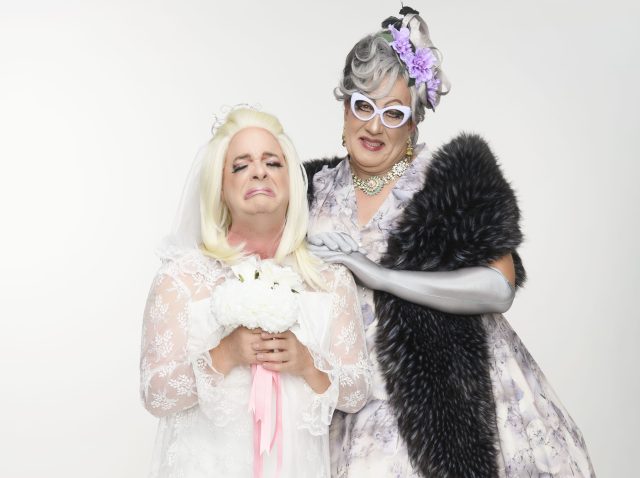
Boyan Peychoff, Julie Golosky, Jennifer Spencer in One Polaroid. Photo by Nathaniel Vance Hehir.

By Liz Nicholls, 12thnight.ca

One Polaroid (Stage 9, Telus Phone Museum)

What happens to golden moments and lost dreams anyhow? Judging by Michele Vance Hehir’s Roseglen plays, they linger in in the air of small prairie towns, contribute to sunsets, and melt past and future together into a perpetual present.    

One Polaroid, the third of the trilogy, takes us back to Roseglen, now a dying town in 1973. The school is gone, the train doesn’t stop there any more, the choir that once was isn’t. Roseglen is on a slow fade-out into the horizon. And two aging sisters, possibly its  last inhabitants, are endlessly playing out the repercussions of choices made long ago.

The days repeat on a loop. Jean (Julie Golosky) wants the radio on; Agnes (Jennifer Spencer) wants silence. Jean dotes on a cat named Lucky; Agnes grinds her teeth and sighs a lot about this. (Side note: Fear for Lucky. Cats, dogs, and even parakeets are apt to meet bleak ends in Canadian theatre of the naturalist type). 

Once a year on his birthday, a tradition the sisters cherish, their nephew Andrew (Boyan Peychoff) visits. There is a cake (always chocolate); there is fruit punch (always spiked with 7-Up). And there is a game (always guess-the-tune, artist first). 

But there are hints of change in the otherwise uninflected unspooling of days. Jean is prone to odd panic attacks. Agnes is determined that a long-buried family secret will get exhumed and revealed. And Andrew arrives, early, with news about his plans — plans that by definition include a jarring sense that time has a future tense.

It’s not a breathless intersection of high-speed forces, to say the least. The play paints a human landscape in a delicate, monochromatic palette that leans to the sepia end. And the production, directed by Vance Hehir, is punctuated — if that isn’t too strong a word — by long slow pauses in which the characters are remembering, or thinking, or thinking about remembering. In this crowd, a musical parlour game is a veritable rave.  

One Polaroid can’t be rushed that way. And the actors find the rhythm and the inner pulse of that kind of prairie minimalism rather beautifully. The tragedies of Roseglen have a lived-in feel about them. And secrets take a lifetime — or a trilogy — to get spilled. 

Posted in Fringe 2018, Reviews | Tagged , , , , , | Comments Off on The lost dreams of Roseglen: One Polaroid, the last of the trilogy. A Fringe review

The Coldharts are back, with another shivery show: Eddie Poe, a guest 12thnight Fringe review by Alan Kellogg

Katie Hartman and Nick Ryan in Eddie Poe, The Coldharts. Photo by Sara Erdman.

Eddie Poe (Stage 37, Auditorium at Campus Saint-Jean)

Brooklyn-based “minimalist music theatre artists” The Coldharts (Katie Hartman and Nick Ryan) are back with the second instalment of a triptych of their shows inspired by the Edgar Allan Poe semi-autobiographical doppelganger short story William Wilson, itself inspired by a Washington Irving story.

In this telling, we find 16-year-old Virginian Edgar Allan (Ryan) off from the capital in 1826 Richmond to Charlottesville’s University of Virginia in search of a B.A. in ancient and modern languages.

The preposterously solemn, seemingly rock-ribbed Edgar Allan has secretly been engaged to (Sarah) Elmira Royster, who extracts a promise from her husband-to-be to behave himself while away studying.

But of course this is not to be, as the evil inner Eddie (Hartman, among other roles) conspires to lure him into various debaucheries — drink, gambling, profligate spending, card cheating. There is more to come later in life, as we know. And none of this is good for his health, as you will come to understand. He strikes up a friendship with kindly and very rich Glendinning and makes a mess of that, too.

Things don’t go well.

The Coldharts are an impressive duo (Marge Ryan’s costumes are superb) and they do many things well. You won’t go wrong here to enjoy a top-drawer Fringe experience, cheap at half the price.

That said, I wonder if this iteration will garner the same consistently rave, best-of-show notices its predecessor racked up. For example, skilled as she is in various disciplines, Hartman seemed to be over-amping far too often, and she should really air-check her southern accent. A re-write might just be order.

It’s not a fair comparison, but I found myself drifting back to Catalyst Theatre’s Nevermore, the brilliant musical that has travelled the world. But again, there is more than enough in Eddie Poe to have us waiting for the next chapter….

Alan Kellogg, a graduate (references upon request) of Edgar Allan Poe Intermediate School, Annandale, Va.


Posted in Fringe 2018, Reviews | Tagged , , , , , , | Comments Off on The Coldharts are back, with another shivery show: Eddie Poe, a guest 12thnight Fringe review by Alan Kellogg

Let the experts make you laugh: TEDxRFT, a guest 12thnight Fringe review by Todd Babiak

Kory Mathewson and Julian Faid in TEDxRFT. Photo by Aaron Pedersen

TEDxRFT(Stage 11, Nordic Studio Theatre)

A TED talk, if you have escaped the phenomenon, is an opportunity for someone who knows a lot about something to talk about it for twenty minutes, usually without notes, usually with slides.

These are experts and enthusiasts, typically with a lesson to impart.

Kory Mathewson and Julian Faid, two of the city’s finest improvisers, have a unique take on the TED talk: what if our presenters knew nothing about their subject? What if, instead of being experts, they are simply enthusiasts?

The format of this hilarious hour of nerdery is simple: Mathewson builds the slides for Faid, and vice-versa. Neither of them has seen the slides before arriving on stage. The audience comes up with the title and… voilà, we watch two very funny young men suffer a lot of intellectual discomfort.

Mathewson and Faid have travelled the world with their know-nothing TED talks. The one thing they both know a lot about is the process of improvisation, and how to make an audience laugh.

This may be among your last opportunities to see a TEDxRFT (the RFT stands for Rapid Fire Theatre). Our expert non-experts have received a cease-and-desist letter from TED, a rather well-resourced and non-comedic enterprise.

Todd Babiak


Posted in Fringe 2018, Reviews | Tagged , , , , , , , , | Comments Off on Let the experts make you laugh: TEDxRFT, a guest 12thnight Fringe review by Todd Babiak

A timely look at a hot topic: Wellspring, a guest 12thnight.ca Fringe review by Alan Kellogg

Natasha Napoleao in Wellspring, Frente Theatre Collective. Photo supplied.

Wellspring (Stage 13, Old Strathcona Public Library)

From Edmonton’s fearless Frente Theatre Collective, the same folks who brought us a play about tailings ponds, here is a meditation on fracking. Even largely unrepentant lefties like yours truly might try to toss off a snarky, disparaging one-liner or two on the artistic merits of tackling seemingly intractable topics like this for the theatre.

Which only goes to prove that smug predictions often blow up in your face. For, following a very brief, unfortunate opening (and closing), here is a tight, engaging 60-minute production, particularly well-timed politically for Albertans. And, as it happens, not just for us, since it actually premiered in Texas.

To help support 12thnight.ca YEG theatre coverage, click here

The arc of a small, foothills oil patch boomtown powered by fracking is well-told, sometimes powerfully so, by three townswomen.

Gabby (Janelle Jorde) is an upbeat teenager who cheerfully tries to make sense of the increasing tensions overtaking her town.

Rita (Natasha Napoleao) has moved from Atlantic Canada in search of the cash to fund the B&B she dreams of starting back east.

Bernadette (Rebecca Starr) is a devout widow who is steadfastly connecting the dots leading to her loss. Her dream is to visit Lourdes as a pilgrim.

For those of us who share the POV here (mea culpa), our views will be validated re: the dark side of the petro economy — and on a human scale at that. But you’d think that even those who give the industry more credit would have to be impressed with playwright Leslea Kroll’s sympathetic treatment of the townsfolk. For example, Rita, who is in denial for much of the story, just wants a decent job so she can return home.

Fringe festivals have a long, proud history in showcasing activist theatre. May it continue, and may Wellspring find the audience it deserves.

Alan Kellogg


Posted in Fringe 2018, Reviews | Tagged , , , , , | Comments Off on A timely look at a hot topic: Wellspring, a guest 12thnight.ca Fringe review by Alan Kellogg

A century after its premiere, The Soldier’s Tale comes to the Fringe. A review

Andrea House and Oscar Derkx in The Soldier’s Tale. Photo supplied

By Liz Nicholls, 12thnight.ca

A Soldier’s Tale (Stage 5, King Edward School)

A Fringe Tale. A multi-disciplinary cross-section of talents — a symphony orchestra conductor, seven professional musicians, three actors, a dancer — gather on a a stage in a small make-shift theatre carved from a school to make something rare happen. For you. For 16 bucks (including surcharge).

So, The Soldier’s Tale. A collaboration between the Russian master Stravinsky and a Swiss writer C.F. Ramuz with a Russian folk tale to hand, it premiered in 1918 in the dying days of World War I. A century later Fringe audiences will be the first in Alberta ever to see it.

The Soldier (Oscar Derkx) is marching home after the war “marching marching all the day, soon he will be home to stay,” says The Narrator (Davina Stewart) in a jaunty rhyming text translated from French and tuned up for his forces by director Farren Timoteo. 

To help support 12thnight.ca YEG theatre coverage, click here

“Will his journey never end?” Ah, there’s a folk tale question for you. En route Joseph meets the Devil (Andrea House), an alluring figure with come-hither eyes and a sexy French accent. She talks him into trading his cheap fiddle for a red book containing the secrets of unlimited post-war wealth (plus three days of bliss on a soft bed). And he agrees.

Bad choice, Joseph. It’s the start of a whole series of events, in which the Devil and man’s corrupting venality figure prominently. For starters, Joseph finds that time has passed magically. And he is “a ghost among the living,” a tragic wandering figure with nothing, not even his graceful, smiling beloved (the dancer Camille Ensminger, in lovely sequences choreographed by Laura Krewski). “What can I do to be what I used to be?”

The score has a vivid, brightly jagged, modernist drive to it, as delivered by the crack ensemble conducted by Alexander Prior, the ESO’s charismatic chief conductor. And Timoteo synchronizes the play to the memorable music, in inventive ways. Stewart is a wry and not entirely unsympathetic narrator and annotator, declaring and then sliding into scenes. Derkx is just right as the soldier whose best intentions tend to dissolve in the heat of the moment, and cede to the prospect of gain. And House is magnetic as the Devil. Nothing really makes sense if the Devil isn’t alluring.

A memorable Fringe experience.

Posted in Fringe 2018, Reviews | Tagged , , , , , , , , | Comments Off on A century after its premiere, The Soldier’s Tale comes to the Fringe. A review

Flying too near the sun: Scorch. A Fringe review

Julie Niuboi Ferguson in Scorch, Blarney/ Bustle & Beast. Photo by Liam Mackenzie.

By Liz Nicholls, 12thnight.ca

Scorch (Stage 28, The Playhouse)

This absorbing, moving little solo play, by the Irish writer Stacey Gregg, was inspired by a real U.K. court case in which a teenager was found guilty of “gender fraud” for starting a sexual relationship with a girl who thought she was a boy. And went to jail.

In Brenley Charkow’s production, a collaboration between Blarney Productions and Bustle & Beast, the stage is inhabited by a semi-circle of three life-sized translucent plastic people, lit from within. There are two empty chairs, and we’re there to complete the LBGTQ support circle. And there’s Kes.

We meet Kes (played by the trans non-binary performance artist Julie Niuboi Ferguson) as a funny, lively eight-year-old, preferring vests to dresses, trying to pee standing up like her bro. And she — who’s starting to feel like it’s pretending to even use that pronoun — takes us into the mind of Kes at 12, 13, 14. They’re the kid who’s disconcerted to wake up with boobs (“nobody asked me! Arghh, Alien!”), always choosing “dude” avatars in video games, having the hots for Ryan Gosling, in the more particular sense of wanting to be him.

To help support 12thnight.ca YEG theatre coverage, click here

The online world, where “you can be whoever you want … “dude or mushroom,” is a liberation from the “real” world of assigned identity. “Everyone needs somewhere to live in capitals! says Kes. And that’s where Kes meets Jules, and a relationship starts: texting, then Skype, then a meeting, then more, and more.

The exhilaration of first love is captured, compellingly, in Ferguson’s performance. And then bewilderment and heartbreak, as the world, and the law, crash in, with terms like “sexual assault but penetration” and “fraud.” And the helping profession chips in “gender dysfunctional.”

True, Kes has never told Jules they’re not a boy. But for Kes, there’s a beautiful truth at work. “Jules said I lied to her. But I don’t think I did…. I’m not pretending.”

Scorch is all about gender identity, mixed signals, teenage first love. It’s a tribute to the life force, the against-the-odds something that’s unquenchable inside that’s all about joy. As Ferguson conveys, there’s a certain innocence about Kes, and a capacity for happiness in a hard world that cannot be suppressed. And at moments of extremity, they break into a wild, unclassifiable dance. 

Posted in Fringe 2018, Reviews | Tagged , , , , , , , | Comments Off on Flying too near the sun: Scorch. A Fringe review

Surveillance and the modern corp: Contractions, a Fringe review

April Banigan and Kristi Hansen in Contractions. Photo supplied.

By Liz Nicholls, 12thnight.ca

Contractions (Stage 13, Old Strathcona Public Library)

What makes this chilling tightly-wound little Brit two-hander so horrifying is its smooth plausibility. At every step of the way, it sounds exactly like like the kind of corporate logic you hear when you step into an HR office.

Mike Bartlett’s play, originally written for radio in 2008 (the big economic downtown year), is all about the increased invasion of corporations into the private lives of their employees — with the ultimate leverage, their jobs.

You’d call it an absurdist fantasy, but is it? In a series of 14 “performance interviews,” an HR manager — played with supreme blandness and deadening professional calm by April Banigan in Tracy Carroll’s production — summons an employee (Kristi Hansen) in sales. Incrementally, step by step, the latter, and her personal life, even her sex life, become the property of the corp.

To help support 12thnight.ca YEG theatre coverage, click here

It starts with the contract that calls for full disclosure of all personal connections between co-workers, for signs of “romantic” and “sexual” content. Emma is being monitored by the company,  always on the grounds of “safety and fair practice” or “relevant staff projections” or “a duty of care.” At every step, it’s more invasive. From questions about the dinner Emma shared with a colleague (“apparently, there was a candle on the table?”) to “how did you find the sex?.” And beyond, way beyond.

Emma is wary and hostile, even defiant, but up against it; she capitulates at every turn. She needs the job. And resistance is futile. “If we don’t have facts, we’ll go on assumptions,” warns the silky-voiced HR manager. And so the gradual ownership and humiliation of Emma continues apace, to lethal conclusions.

The pacing and the sinister looping of scenes in Carroll’s production are spot on. With her usual subtlety Hansen chronicles the incremental colonization of Emma from initial perplexity and seething resentment to acquiescence and beyond. And as the impervious manager of ill-named “human resources,” the smiling blank of bureaucracy to which no argument sticks, Banigan is simply terrifying.

Posted in Fringe 2018, Reviews | Tagged , , , , , , | Comments Off on Surveillance and the modern corp: Contractions, a Fringe review

A gentle, playful musical folktale for little kids: Fossegrim & Nøkk, a guest 12thnight Fringe review by Todd Babiak

Fossegrim & Nøkk (Stage 6, Strathcona Community League)

An adventurous little girl named Saga is burdened by an unadventurous mother. All Saga can do is sing to herself, at night, about the magical world outside her bedroom window.

Until a naughty fairy arrives to take her away. The fairy’s motivation is unclear but her destination is the dreamland of two siblings of the woods.

Fossegrim & Nøkk are the names of a magical brother and sister who happen to be looking for a girl like Saga, though they don’t agree on what they should do with her.

This is a small stage for four people but it’s part of the show’s success: there isn’t a moment of inaction. The performers are members of Alberta Opera, and they sing beautifully. But the songs don’t interrupt the flow of the story. They are tied into the rules of the universe and the logic of the play.

Based on a Scandianavian folk take, Fossegrim & Nøkk is a gentle, playful children’s show — best for kids under 10.

Todd Babiak


Posted in Fringe 2018, Reviews | Tagged , , , , , , , | Comments Off on A gentle, playful musical folktale for little kids: Fossegrim & Nøkk, a guest 12thnight Fringe review by Todd Babiak

Answering the siren call: Atlas Theatre’s Sirens, a Fringe review

Julien Arnold and Louise Lambert in Sirens, Atlas Theatre. Photo by Mat Busby.

By Liz Nicholls, 12thnight.ca

Sirens (Stage 12, Varscona Theatre)

It is understandable if the prospect of a comedy about a middle-aged couple off on an anniversary cruise to revive their stale marriage fills you with a certain dread. Even if it’s a cruise to the Greek Isles, which of course enhances the lighting.

It’s not as if the theatre repertoire is starved for light-hearted predictable comedies about middle-aged couples reviving stale marriages — by camping (tragic, really), by purchasing vacation homes in the outback, by purchasing how-to-revive sex manuals, by bonding with other livelier couples, by play-acting as versions of their younger selves, by dancing to ABBA, etc. It is a baleful list.

Sirens, though, by the American playwright Deborah Zoe Laufer, sets itself apart in a number of heartening ways. And so does Kate Ryan’s well-acted Atlas Theatre production. For one thing, Greek mythology is involved. You may not have seen that coming from the title (c’mon, it could have signalled a comedy about table-dancers or the impending apocalypse). Anyhow, the Sirens, you may recall, are the brigade of Mediterranean temptresses whose job (as detailed in Homer’s Odyssey) is to sing so irresistibly that sailors are lured to their watery deaths just hearing it.

To help support 12thnight.ca YEG theatre coverage, click here

There is one of those mysteriously lethal songstresses in Sirens. And she’s pretty funny, especially since Louise Lambert is playing her and she has a smart phone from the gods. In addition to her shift work luring men to their deaths, the Siren spends her time playing Solitaire (her stats are very high) on her “little magic box” from the gods. Death? Whatever, and your problem is…? Batteries are the problem.

Back to the couple. Simon (Julien Arnold) is a song-writer who hasn’t had a hit after his first, 25 years ago, inspired by mad pash for Rose. He’s looking for inspiration from Facebook friends, who tend to be young and female. The tart-tongued Rose (Stephanie Wolfe) is having trouble getting his full attention. Are their “thrilling” days over?

Hence the cruise (and the pert ministrations of a travel agent, also played by Lambert). And it has to be special “I did not put up with you for 25 years to go to the Jersey Shore,” says Rose. Anyhow Arnold and Wolfe have an easy, convincing rapport, and, as possessors of first-rate comic timing, a convincing rapport as well with the lines. They’re real pros, and it’s fun to see their dexterity in Ryan’s production.

There are playful sitcom developments — let’s not call them obstacles because that would imply surprise — both in Greece and back in New York. And Mat Busby has a very funny cameo as a guy from high school Rose contacts back home. He gets mixed signals; the way he says” “ Long Island” is a corker, and should be X-rated. 


Posted in Fringe 2018, Reviews | Tagged , , , , , | Comments Off on Answering the siren call: Atlas Theatre’s Sirens, a Fringe review

“Ludicrously entertaining” and at the heart of Fringehood: Gordon’s Big Bald Head, a guest 12thnight Fringe review by Todd Babiak

Gordon’s Big Bald Head: New World Hors d’oeuvres. Photo supplied

Gordon’s Big Bald Head: New World Hors d’oeuvres (Stage 12, Nordic Studio Theatre)

It’s mysterious why Edmonton and its promotional machines have not sold the Fringe Festival more passionately outside the city’s borders. This local invention is the biggest and baddest on the continent, yet it still feels as small and strange and dirty as ever: a perfect expression of what the city and its people do best.

Word-of-mouth is cheaper, of course, and in recent years it has worked. Our basement is crammed with visitors every year, and the one show I always insist on, for first-timers, is Gordon’s Big Bald Head.

This is not news to anyone who has ever been to the Edmonton Fringe. Nearly every performance sells out, for good reason. One of the city’s finest cultural outputs is the professional improviser and here we have three of them.

Mark Meer and Jacob Banigan perform around the world. The third member in their crew, Chris Craddock, has been replaced this year by the brilliant Ron Pederson — another Edmontonian who has been discovered by global audiences.

None of the genius of the show has been lost with the personnel change. As always, they choose a Fringe show at random, read the description, and improvise it.

Is it different? Yes, it is. The good new is: it’s still the ludicrously entertaining Gordon’s Big Bald Head.

Todd Babiak


Posted in Fringe 2018, Reviews | Tagged , , , , , | Comments Off on “Ludicrously entertaining” and at the heart of Fringehood: Gordon’s Big Bald Head, a guest 12thnight Fringe review by Todd Babiak