Catching ‘starstuff’ onstage: Peter and the Starcatcher at the Citadel

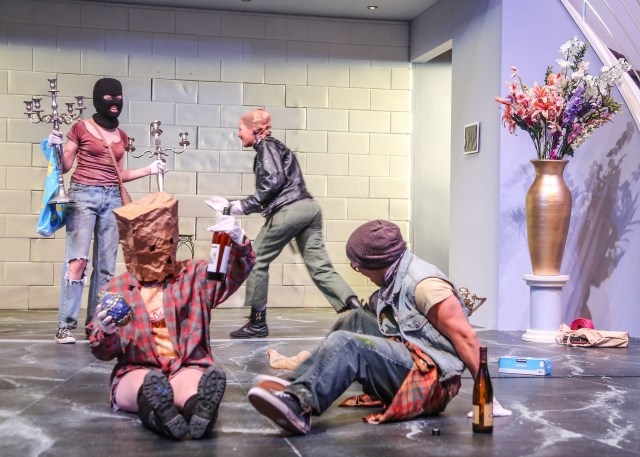
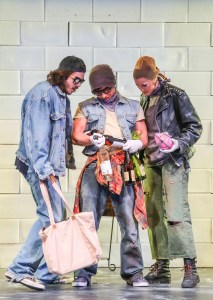
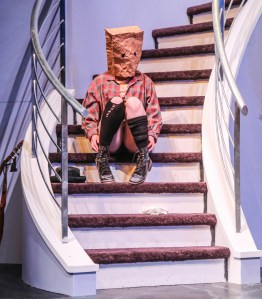
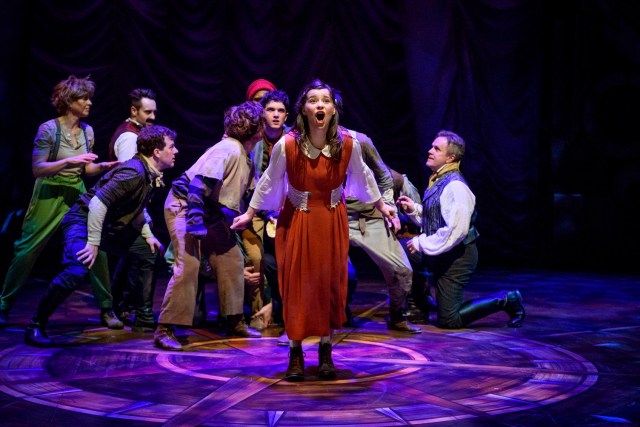
Andrea Rankin as Molly in Peter and the Starcatcher. Photo by Ian Jackson, Epic Photography.

By Liz Nicholls, 12thnight.ca

“Use your thoughts to hoist the sails,” advises the stalwart Victorian captain of a British frigate in the prologue to Peter and the Starcatcher, opening on the Citadel’s Maclab stage Thursday.

Which is exactly what director James MacDonald and his cast of 12 Edmonton actors have been up to as they rehearse this madcap prequel to Peter Pan’s adventures in Neverland with the Darling family.    

The 2011 play, spun by Rick Elice (Jersey Boys) from a 2004 Dave Barry/Ridley Pearson kids’ novel, isn’t a high-tech extravaganza. The fun, as Broadway audiences improbably discovered in 2012, is that it’s not. No, this kind of low-budget magic is a test of ingenuity, and a certain willingness to give your imagination a play-date with simple props, costume pieces, and physical ingenuity.

In telling the backstory of how a morose orphan became Peter Pan, a dozen actors play more than a hundred characters — narrators, sailors, pirates, dancing mermaids, dancing mollusks — and the odd inanimate object. The adventure begins on the high seas: the SS Neverland is bound for Rundoon, with a cargo of something magical and life-changing called “starstuff.” And after an epic maritime battle it arrives on a mysterious tropical island where the inhabitants have their own lingo.

 “It’s a case of ‘happy surprises’,” grins MacDonald, on the subject of making magic the playful way. “A prop that’s supposed to be one thing turns into something else when you pick it up. That could be this! This could be that!”

Garett Ross and Glenn Nelson, Peter and the Starcatcher, Citadel Theatre. Photo by Ian Jackson, Epic Photography.

It’s a mantra of playful theatricality that appeals mightily to MacDonald. “It’s a really hard show to plan for and design,” he grins. “You don’t want to over-design it, but you want to make sure you have all the stuff you’re going to want.” Like ladders, maybe. Or a pineapple. Or something to make outsized jungle leaves out of. 

“Rope is big,” smiles Andrea Rankin. Yup, you can make doorways and docks and ships from rope.

Among the multitude of characters Rankin plays in the course of Peter and the Starcatcher, there’s Molly, a brisk, bossy little upper-class girl with a repertoire of bedtime stories (ring a bell?). There are pirates, including a particularly flamboyant one with an impressive moustache (hint hint). There’s a crocodile (another hint).
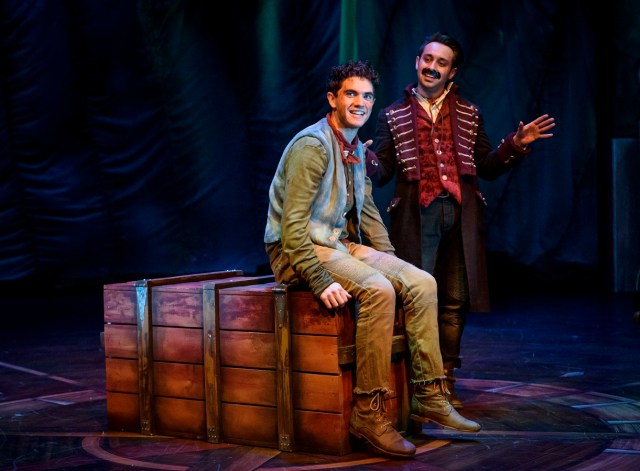
Oscar Derkx as Boy and Farren Timoteo as Black Stache in Peter and the Starcatcher. Photo by Ian Jackson, Epic Photography.

There are orphan boys, including a particularly glum one called simply Boy, who’s always lived in the dark, hates grown-ups, and never never wants to be one. “I love the theatricality of it,” says Oscar Derkx. He plays Boy, who will acquire a more memorable name in the play. “It’s not just massive fireworks; I feel like we’re inviting the audience to imagine along with us, to inhabit this world with us.”

“It’s actors’ theatre, it’s storyteller theatre,” says Derkx, like Rankin a U of A theatre school grad. Derkx is called upon to transform from Boy to bloodthirsty pirate in a split second. “We’re creating with fabric, lights, soundscape. And our bodies too! At one point I jump into a shimmering pool of golden water, and I ‘make’ the pool with my own physicality….”

Peter and the Starcatcher, Citadel Theatre. Photo Ian Jackson, by Epic Photography.

For Montreal-born MacDonald, recently appointed to the helm of Western Canada Theatre in Kamloops, the production is a homecoming to the city where he went to theatre school (the U of A), launched his theatre career as an actor and then a director, and co-founded a summer Shakespeare festival (Freewill). And it’s a return, as well, to the theatre where he’s directed close to two dozen productions. “It’s pretty great, pretty emotional, for me to come back and work with actors I know!” he says feelingly. Having Edmonton talent in the show was important to him. 

Peter and the Starcatcher isn’t MacDonald’s first encounter with that Neverland brouhaha. He was Captain Hook in a 1994 musical version of Peter Pan at the long-gone kids’ theatre Stage Polaris. Glenn Nelson was in that cast; so were Garett Ross and Clinton Carew. Nelson and Carew, incidentally, were in the production of Peter Pan that opened the Maclab Theatre in 1984. And now they’re reunited in the prequel.  

Rankin and Derkx played Scrooge’s beloved sister Fannie and his younger self, when MacDonald starred as Scrooge in the Citadel’s A Christmas Carol.

Along with MacDonald, they love the way the Maclab’s thrust stage locates the actors amidst the audience. As MacDonald points out, the logistics of staging a scene for audiences on three sides may be tricky; ditto magical transformations. But when you’re after “a conversation, a relationship, with the audience,” nothing beats a thrust.
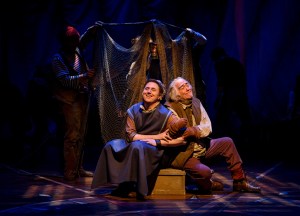
Garett Ross and Glenn Nelson, in Peter and the Starcatcher, Citadel Theatre. Photo by Ian Jackson, Epic Photography.

“For me, the show is all about the joy of being a child,” says Derkx of the story. “It’s about childhood and what it is to grow up….” Rankin points to the wistfulness the original Peter Pan story generates, “the moment Peter realizes the world is going to grow up without him….”

“Molly is going to grow up.  And there’s a certain sadness to that. But, as she says, just because something ends doesn’t mean it hasn’t mattered…. It’s the dark that makes the light possible.” That’s the thing about playing a kid, she says: “you feel everything! And things can change in a second, the high-highs and the low-lows.”

Playing a kid isn’t about a squeaky kid voice or a funny kid walk. “It’s more about ‘how can I believe fully, in a fully committed way, to this moment and then switch instantly (to another),” says Rankin. “Adults brood.”

MacDonald laughs. “Can you think of anything more completely opposite to the last show I did here?” That would be last season’s Who’s Afraid of Virginia Woolf?, where every utterance has ominous nuances, and every scene is coloured by the tensions of the past. 

In rehearsal MacDonald tells his actors “you have to be goldfish,” he laughs, demonstrating the quick zigzags with his hand. “That’s what kids do. You’re completely committed to something, then something happens and you instantly completely change direction!…. All the characters behave that way.”

MacDonald, who’s on the faculty of the Citadel/Banff Professional Program, uses the famous Abbott and Costello “who’s on first?” routine to teach actors the difference between “playing the comedy and playing the lack of comprehension.” The latter, he says, “is basically what theatre is about, people figuring out things.”

Molly is both a little girl and the woman she’ll become, Rankin is finding. “You can see she’s going to be an amazing woman. There’s a kind of grace and strength to her. She’s grown up with adults; she’s strong, smart…. The next moment she’s having a tantrum; she doesn’t know how to talk to boys; she has no friends.”  Rankin smiles. “She’s growing up and we see the beginning of that.”

As for the eternal boy, Derkx feels that Boy is in a constant state of wonder in the play. Being a kid is wonder…. Every scene’s a massive new experience for him, seeing a girl, hearing her talk about all the magic in the world, seeing the sun, being in a jungle.”

“Girls grow up faster,” MacDonald grins. “Some boys never grow up!”

PREVIEW

Peter and the Starcatcher

Theatre: Citadel

Written by: Rick Elise

Directed by: James MacDonald

Starring: Oscar Derkx, Andrea Rankin, Farren Timoteo, Garett Ross, Doug Mertz, Ryan Parker, Stephanie Wolfe

Running: through April 23

Tickets: 780-425-1820, citadeltheatre.com
Posted in Previews | Tagged , , , , | Comments Off on Catching ‘starstuff’ onstage: Peter and the Starcatcher at the Citadel

Lighting a (bon)fire under improv

Photo by Andrew Paul

By Liz Nicholls, 12thnight.ca

Wrap your mind around this terrifying idea for an improv show: 

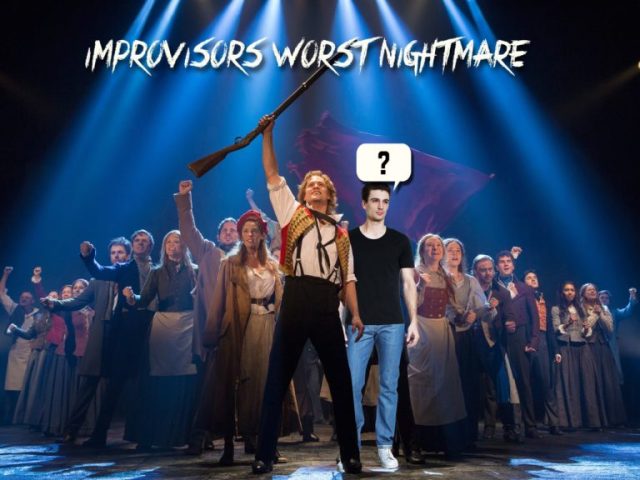
What if an improviser found himself onstage in a fully rehearsed, costumed, blocked 30-minute play he knows nothing about — without a script, as a character he hasn’t met?   

The idea for Improvisers Worst Nightmare, the brainchild of Joe Vanderhelm, is either brilliant or insane. It’s impossible to know in advance. Which is the whole point of Rapid Fire Theatre’s annual Bonfire Festival.

Bonfire, which ignites its flammable 20 experiments in long-form improv comedy Tuesday, for the sixth annual edition of the festivities, is what happens when you say YES! instead of ‘You’ve GOT to be kidding!.’

Bonfire Festival 2016. Photo by Andrew Paul.

“Who knows? We say Yes, and see what happens,” says Rapid Fire artistic director Matt Schuurman calmly. “Unhinged? Exactly!” Unhinged from the standard, the usual, the reasonable: of Bonfire’s 20 experiments in improv comedy this year, 20 have never been tried by the company before.

They could go either way. “Some of these experiments become our Next Big Thing. Some we’ll never hear from again. It’s our comedy laboratory.” 

As for Improvisers Worst Nightmare, says Schuurman, “it’s the inverse of Rapid Fire’s Christmas special, where the actor who plays Scrooge (in the Citadel production of A Christmas Carol) appears on the show, and says all the lines he always says, and we improvise a show around him.”

Saturday’s grand finale show, Burlesqueprov!, sounds equally terrifying. “It’s a blend of burlesque and improv,” says Schuurman, amused. “Theatresports and striptease…. A few of our performers and a few of the Send In The Girls (burlesque troupe).”

Bonfire is fed by what-if? ideas pitched by members of the Rapid Fire ensemble, about 50 strong. “We have a pitch session for everyone,” explains Schuurman. “Directors come forward with an idea, and there are sign-up sheets. It’s so exciting!”

Bonfire Festival 2016. Photo by Andrew Paul.

It’s a measure of the improvisers’ love of risk — “or possibly that we’re suckers for punishment,” laughs Schuurman — that the first  sign-up sheet to fill up was Punish Prov, opening the festival tonight. Joey Lucius’s idea, which came from a university science course, is based on behaviour modification principles, explains Schuurman. “Can we make someone a better improviser using that?

This involves “a small electrical shock” applied to improvisers on audience command after an improv scene. After this, “they will  attempt the scene again.”

Punish Prov, incidentally, isn’t Bonfire’s first dalliance with science. In last year’s edition scientist Kory Mathewson improvised with an artificial intelligence, in the festival’s highest-tech show.

As always, some of the Bonfire experiments are about sustaining quickie improv games into a full 30- or 45-minute show. Genre Rollercoaster, a Vincent Forcier initiative, is an escalating high-speed thrill ride through movie genres, for example. Jessie McPhee’s 4Square confines four participants and four storylines in a box.

Bonfire Festival 2016. Photo by Andrew Paul.

Some experiments are responses to the peculiar nooks and crannies of pop culture that intrigue members of the ensemble. Rapid Fire Walk With Me is inspired by the surrealist adventure of David Lynch’s Twin Peaks. The Navidson Improv (House of Leaves) is spun from an obscure, hard-to-read cult novel. Karaoke Bar, well, I’m just going to leave that idea with you; it has a gruesome hilarity all its own.

“It’s all comedy research,” says Schuurman. “We have to be students of, well, everything: pop culture, literature, science, math…. Our audience is all those things, so we have to be too.”

“There’s a family show on opening night, there’s burlesque, there are immigrant stories that connect real-life to improv…. Bonfire reinvigorates our ensemble. They come out so thrilled, so pumped!”

  Like the man said, unhinged.

PREVIEW

Sixth Annual Bonfire Festival

Theatre: Rapid Fire Theatre

Where: Citadel Theatre, 9828 101 A Avenue

Running: Tuesday through Saturday

Tickets and full schedule: rapidfiretheatre.com/festival/bonfire

Posted in Previews | Tagged , , , | Comments Off on Lighting a (bon)fire under improv

The Maggie Tree presents 9 Parts of Desire: the women of Iraq

9 Parts of Desire, a production by The Maggie Tree. Photo by Marc J. Chalifoux.

By Liz Nicholls, 12thnight.ca

Survival: Life and love in a time of war and occupation.   

There is nothing simple about the lives of the nine Iraqi women we meet in the 2003 play cum theatrical documentary that opens Thursday in a Maggie Tree production.

In 9 Parts of Desire by the Iraqi-American actor Heather Raffo,  characters step forward into the light from a dark canvas of oppression and brutality. And while they are a study in contrast — in age, education, economic class, religious and political attitude — they all know something profound about suffering and violence, compliance and resistance. 

Among the women who own the nine monologues we meet a doctor, a kid enamoured of American culture, a Bedouin matron, an artist who both prospers in the Saddam Hussein regime and records its savagery. In fact, as Raffo has explained, in her playwright’s notes to the script, it was a painting called Savagery in the Saddam Art Centre that inspired her artist character, Layla, in 9 Parts of Desire.

Amid the official portraits of Saddam, there it was, a portrait of a naked woman, clinging to a tree. That mysterious sighting happened during Raffo’s family visit to Baghdad in 1993, not long after the First Gulf War. After that came the decade of interviews, strangers and family friends and acquaintances, that formed the fabric of her play, named for an Imam Ali saying: “God created sexual desire in 10 parts; then he gave nine parts to women, and one to men.”   

.The Maggie Tree, an award-winning Edmonton collective devoted to providing opportunities for female artists, and enhancing their profile, has long been intrigued by 9 Parts of Desire. But, a half a world away from its characters, and many years away from its creation, the play came with daunting challenges, says director Vanessa Sabourin, a co-founder (with Kristi Hansen) of The Maggie Tree.

Relevance wasn’t one of them, says Sabourin. “It seemed to be more and more relevant as we thought about it. The refugee crisis, the bombings in Syria, Trump was running…. And it resonated in Canada. We are still an occupied country; we still haven’t resolved basic stuff like access to drinking water for Indigenous people.”

Authenticity of voice was a crucial question for the Edmonton theatre. In its Off-Broadway run, 9 Parts of Desire came to the stage as a solo show: Raffo herself played all the parts. “She could do it, (a) she wrote it, (b) she’s Iraqi and American,” says Sabourin.

But that wouldn’t work for an Edmonton theatre company. So “other conversations followed,” Sabourin says. “Conversations about diversity in theatre, voice appropriation. Who can tell whose story?” The play was written for Western audiences, as she points out. “But do our communities mingle enough?”

The Maggie Tree considered a three-actor production, and then decided on a cast of nine for the monologues. When the first audition calls didn’t produce much age range, they auditioned again. “Not many aboriginal artists came,” says Sabourin. “I felt it was important to have at least one…”

“We need to put a piece of ourselves in this. What is relevant to us?”

For The Maggie Tree, it’s become not just a production, but a whole project in mind-expansion and “learning about somebody else,” Sabourin says. “With nine people, there are more smart brains in the room.”

“What does Canada look like? It’s important for us to be asking because of the divisive conversations now. It raises questions like how complacent should we be? How can we make positive choices?”

“Our nine actors are all Canadians but represent different heritages and life experiences,” says Sabourin. “They connect to the script from different backgrounds, different perspectives.”

“Occupation is highly complicated. Motivation is complicated too; it’s so often about power, money, oil…. Always innocent civilians pay the price.”

To help them approach the complexities of Iraqi culture, Sabourin and Kristen found themselves two Iraq consultants, Jalal Barzanji and Mona Esmjaeel. The lobby artist Fordos Lateef is Iraqi. The production team, including the musicians, have diverse ethnic backgrounds.

“For us, it’s been a huge thought bomb!” declares Sabourin. “Huge!” 

“It’s about surviving. It’s about the human spirit. And it’s also about love.. There’s no Us or Them. There’s only Us. That’s why we wanted to do this piece.” 

PREVIEW

9 Parts of Desire

Theatre: The Maggie Tree

Written by: Heather Raffo

Directed by: Vanessa Sabourin

Starring: Nadien Chu, Alison Wells, Christine Frederick, Patricia Darbasie, Rebecca John, Amena Shehab, Nicole St. Martin, Natasha Prasad, Nimet Kanji

Where: Varscona Theatre, 10329 83 Ave.

Running: Thursday through April 15

Tickets: TIX on the Square (780-420-1757, tixonthesquare.ca)

Posted in Previews | Tagged , , , | Comments Off on The Maggie Tree presents 9 Parts of Desire: the women of Iraq

Bright Burning: a conflagration in the class divide. A review

Bright Burning by Colleen Murphy, Studio Theatre production. Photo by Ed Ellis.

By Liz Nicholls, 12thnight.ca

A sense of absurdity hangs over the group portrait in constant motion in Colleen Murphy’s Bright Burning, currently trashing a beautiful set on the Timms Centre stage.

A kid (Jake Tkaczyk) comes down a marble staircase lugging a grandfather clock.“Can’t take that on the LRT,” another kid notes. “We’ll get a taxi,” says a third. They aren’t kidding — well, not exactly.

Later, amid the jumble of 24-carat vibrators, TV monitors, candelabra and cases of vintage wine that the awestruck looters score, they will actually consider the possibility of dismantling a Bosendorfer grand piano. 

Any gang invasion in which the participants arrive on the bus and play dress-up feels somehow doomed in advance. Which is exactly what the new play — commissioned from the award-winning playwright specially for the 12 actors of the U of A’s graduating BFA actors — explores: the futility of upward mobility for the working poor.

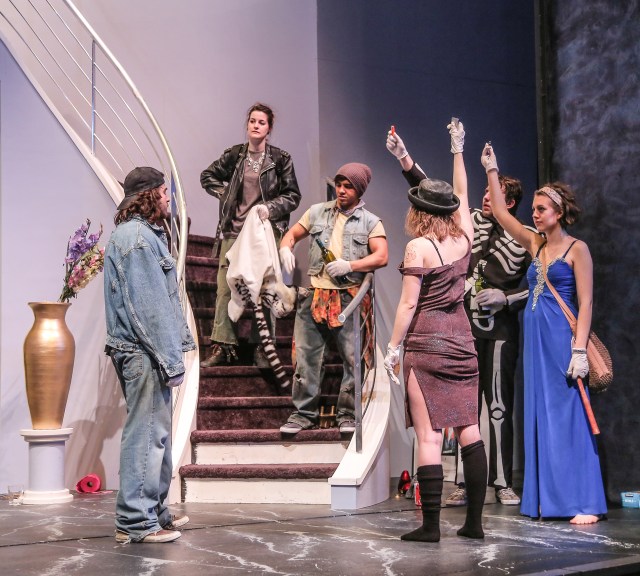
They are foul-mouthed and dangerous, the six hopped-up kids who arrive at a suburban Edmonton mansion to score enough stuff to pay a drug debt. For Jan Selman’s production, designer Robert Shannon, Lee Livingstone and LLARS Design create and light a classic double-staircase architecture, opulently finished and topped by an abstract chandelier, which figures in the action and is not a reference to a certain well-known musical.

Beyond paying off Fleur (Jaimi Reese), the hard-ass dealer who shows up with the stoned-out girlfriend she pimps out (Chayla Day), their dreams are modest. Lou (Alex Dawkins), who works as a shlepper in a vet clinic, wants to buy a dog. Ari (Jordan Buhat) thinks of buying a guitar case “with my new wealth portfolio” and buying his sick mom jewellery from the shopping channel. Emily (Sarah Ormandy), a chatterbox savant with a photographic memory for arcane information and no self-editing mechanism, wants to create art cards.

But the insight of Murphy’s play is that, modesty notwithstanding, their dreams are outlandish, absurd, unattainable, lost in the vast unbridgeable gulf between the rich and the poor. They are scrambling outsiders. And they’re looking in with a combination of wonder, and mounting rage.

As Selman’s mesmerizingly hyperactive, hard-driving, sensory-overload production discloses, their exclusion isn’t a discovery for the characters. It’s re-discovery of something they knew all along, a sort of sinking feeling about invisibility speeded up into a frantic high. Bright Burning, incidentally, is a rarity, a play that contains meth, but isn’t really about drugs.

Selman’s actors attack, and convincingly, Murphy’s staccato bursts of overlapping dialogue, non sequiturs, tangents, and furious fragments. It’s often very funny: Philip Geller gets (and deserves) big laughs as a deadpan pizza delivery guy with anxiety issues, who arrives in the midst of the chaos. “I can’t stay here it’s too stressful,” he says. With bleak hilarity, the most menacing of the characters, J the dealer’s enforcer (Jacob Holloway), offers advice from his “suicide prevention group.”

Bright Burning has the feel of a black comedy teetering on the edge of something tragic. The only pause, for example, isn’t really a pause at all; it’s fast and furious playtime in the boat — really! — they’ve dragged from the garage into the mansion. It’s an absurd, and somehow touching, image. Where would you like to sail? the landlocked ask each other to imagine, abandoning hostilities temporarily to play, like kids, with the idea of possibility.

The arrival of the owner’s daughters, Ruby (Emily Howard) and her kid sister Sam (Emma Houghton) ups the stakes. The former will argue that entitlement cuts both ways, that being rich isn’t a choice and that, in any case, wealth doesn’t cause poverty. The American playwright Wallace Shawn, in The Fever, would beg to differ; his protagonist is shaken to the core by the thought that his own privilege is actually underwritten by poverty.

Sam, the little rich kid in this crowd, has a certain amusing clarity: self-interest. “Yeah, steal anything you want but leave us with our lives and our futures because I’m going to camp today for two weeks.”

The texture of the production, and its performances, feel full. And Murphy expertly structures the play so that characters gradually emerge from the group portrait to be dimensional individuals, each with slight variations in speediness. 

Cast of Bright Burning by Colleen Murphy, a Studio Theatre production. Photo by Ed Ellis.

It’s one of those plays that tests the inevitability of its storytelling with a horrifying ending that would seem outlandish — if there hadn’t been the play first. It’s a structure, an escalation, that requires duration, and repetition. And both begin to seem a little over-extended and relentless late in the production — which is to say you start to notice them. The performances, though, anchored by Dawkins as Lou and Ormandy as the fatally visionary Emily, remain fierce, committed, and fresh.  

And a play custom-made for its youthful actors, that began with entrances in the dark, ends with exits in the dark.

REVIEW

Bright Burning

Theatre: Studio Theatre

Written by: Colleen Murphy

Directed by: Jan Selman

Starring: Alex Dawkins, Marc Ludwig, Sarah J. Culkin, Sarah Ormandy Jake Tkaczyk, Jordan Buhat, Jaimi Reese, Jacob Holloway, Chayla Day, Philip Geller, Emily Howard, Emma Houghton

Where: Timms Centre for the Arts, U of A, 112th St. and 87th Ave.

Running: through April 8

Tickets: 780-492-2495, ualberta.ca/artshows

Posted in Reviews | Comments Off on Bright Burning: a conflagration in the class divide. A review

Art and politics mix it up at Gravity cabaret

Todd Houseman and Ben Gorodetsky in Folk Lordz. Photo by Curtis Comeau.

By Liz Nicholls, 12thnight.ca

The situation is … grave. And getting graver.

Yup, Gravity, “the cabaret of art and politics” that made its debut 18 months ago, has a lot to work with this time out. 

We’re at a moment in history, when time seems to be unspooling backwards into the 1950s at a great rate and chaos seems nigh. Monday night at Metro Cinema, Edmonton’s merry band of theatre, dance, comic improvisers, visual and spoken word artists, filmmakers step up to create new work that explores the situation. The “Trump Edition” of the cabaret is created jointly by Theatre Yes artistic producer Heather Inglis and Mike Hudema of Greenpeace Canada.

“We thought it might be a colossal disaster,” says Inglis cheerfully of Gravity’s debut edition, poised between the 2015 NDP Alberta win in the spring of 2015 and the Liberals’ federal win that fall.  “But 300 people showed up. It was an exciting evening!”

“How different everything feels, since that exceedingly optimistic fall,” she says. “The last few months have been quite devastating for people. We’re providing a platform for artists to express their reactions….”

“A great diversity of artists,” as Inglis puts it, stepped up to the call for “unabashedly opinionated responses.” So the political discussion will be far-ranging: immigration bans, disability access, gender fascism, the environment….

There are poets: the Somalian spoken word poet Ahmed Knowmadic, a winner in the recent Canadian Festival of Spoken Word, and Edmonton Youth Poet Laureate Nasra Adem, among them. There are theatre artists: Nicole Schafenaker and Kate Stashko have fashioned a dance piece about over-consumption. There’s an Adam Bentley film about Inuit culture, and a Danielle Peers film about disability and access. 

The Gravity lineup also includes dance/performance artist Julie Ferguson, burlesque queen Violette Coquette; Doctor Professor Lavernius Cumquat, a clown satirist of the commedia tradition; the all-female improv comedy troupe The Sphinxes.

Dustin Allen as Dr. Professor Lavernius Cumquat. Photo supplied.

The multi-instrumentalist aboriginal hip-hop artist Mitchmatic leads a dance party finale.

Returning is the highly original Folk Lordz duo of Todd Houseman and Ben Gorodetsy, Rapid Fire Theatre improv stars both, who specialize in pairing the Indigenous oral tradition of storytelling with Russian literary character drama.

“There’s a lot of fertile material at the moment,” says Gorodetsky drily. He and Houseman, who take cues from the audience for their unique Folk Lordz improv, are also the joint mc’s of the evening’s entertainment.  “We’ll be increasing tension, or releasing it — as necessary!”

PREVIEW

Gravity: A Cabaret of Art and Politics (Trump Edition)

Where: Metro Cinema at the Garneau Theatre, 8712 109 St.

Running: Monday 6:30 p.m.

Tickets: metrocinema.org or at the door

Posted in Previews | Comments Off on Art and politics mix it up at Gravity cabaret

Colleen Murphy: burning brightly at Studio Theatre

Bright Burning by Colleen Murphy, Studio Theatre. Photo by Ed Ellis.

By Liz Nicholls, 12thnight.ca

“Our big fat myth,” declares Colleen Murphy (whose declarations tend to have a combustible edge to them) “is that we’re a classless society.”

“The tremendous gap between the wealthy and the working poor, and the rage beneath”: there’s the tinder for Bright Burning, the new Murphy play that ignites Thursday at Studio Theatre. It was commissioned, and custom-made, for the U of A’s graduating actors, all 12 of them, the grand finale of Murphy’s three-year Lee Playwright-in-Residence appointment.

Playing with fire isn’t a wild departure in the career of the Toronto-based star Canadian playwright/filmmaker. Murphy won the second of her Governor General’s Awards this past year for the fearless and disturbing Pig Girl, provoked by the grisly career of serial killer Robert Pickton.  The first, in 2006, was for December Man, which explored the fall-out of another horrific burst of violence, the 1989 shooting massacre at Montreal’s École Polytechnique.

Bright Burning, which arrives on the Timms Centre stage trailing warnings for “strong language, violence, sex, substance abuse,” has a similarly inflammatory sense of danger about it. “What planted the seed,” says Murphy over pre-rehearsal lunch this week, “is an article about so-called ‘ghost parties’: a bunch of young disenfranchised, marginalized kids who broke into a mansion, trashed the place and left… The police found them; the kids had taken selfies there.”

Bright Burning by Colleen Murphy, at Studio Theatre. Photo by Ed Ellis.

In Bright Burning, a gang of six break into a posh suburban mansion with the idea of looting stuff to pay off a drug debt. Simmering resentment escalates into crazy violence that’s not without its black comedy. A meth dealer and her girlfriend arrive. A pizza delivery guy shows up. So do the daughters of the owners. “And the shit hits the   fan,” as Murphy says succinctly. “I took the idea and played it to its emotionally logical extreme….”

“I don’t know what people will do with that,” she shrugs cheerfully. That thought appeals to her. “For the first 10 minutes, the lights are off. We’re in the dark. There aren’t even any (stage) marks…. This is a show with a lot of physical challenges.”

“How would I break into a house? Well, I wouldn’t turn on the lights till I knew no one was there,” grins Murphy, noting mildly that “it’s not the most politically correct sort of play.” 

Which brings us to the chandelier. Murphy laughs. “If you’ve a got a chandelier, you’ve gotta swing on it!” And people do.

Murphy has particular praise for the dramaturgical expertise of director Jan Selman. The U of A’s department of drama “has thrown everything they have on this project: designers, staff, actors, a fight director! Amazing! I’m so lucky to be that playwright! (Laughs). So I just went whole hog!”  

Who doesn’t arrive? “Nobody plays ‘adults’, nobody plays cops,” says Murphy. The cast of 12, four times the size of the Canadian theatre average in this age of shrinkage, are all in the 10 to 25 age range. So are the individual characters Murphy has created for them. So “the challenge for the actors isn’t age,” she points out. It’s class. “It’s a challenge for theatre school actors to portray a different class.”

Bright Burning, Studio Theatre. Photo by Ed Ellis.

“I know this world, and it’s not a polite world. The possibility of violence, drugs…. Like all people, in life and in drama, (the characters) are searching for meaning.”

playwright Colleen Murphy

She had her own challenges with Bright Burning, says a playwright for whom “challenge” has a come-hither allure. For one thing, in an era of small-cast theatre, it’s a rare opportunity for a playwright to populate the stage. “Twelve people, and you want each one to have a character to play who has an arc, a life in this story.”

“We should be peopling our stages!” says Murphy, who “loves conflict, action, tension” in theatre. And this is the season she demonstrates. In The Breathing Hole, premiering this summer at Stratford (directed, incidentally, by U of A grad Renata Arluk), a cast of 19 plays 48 characters — in a story Murphy describes as “the life and death of a 500-year-old polar bear.”

In her opera Oksana G, (with Edmonton-born composer Aaron Gervais) — which debuts in May at Toronto’s Tapestry Opera  — a cast of 16, singing in Russian, Ukrainian and English, brings to life the world of sex trafficking.

For Bright Burning  Murphy “set myself the challenge of writing a play in one scene, in real time, in the same location…. It was hard, in an exciting way, to keep track of where the hell everyone is at any moment.”

“Also, the story demanded it,” as Murphy points out. “Intermission wouldn’t make sense.”

If Murphy’s plays all have striking differences in form, it’s because of the particular demands of the particular story, she says. “The idea dictates the structure; I really pay attention to that! I have to be able to tell the story in a ruthless formal container; that’s part of the storytelling.” She assesses her new phrase, “ruthless formality,” and likes it. 

In Pig Girl, for example, time operates in two different configurations, both onstage simultaneously. Dying Girl’s fatal and heroic confrontation with Killer happens in real time; meanwhile, Sister and Police Officer experience time over nine years, a damning indictment of the official indifference to a horrifying accumulation of evidence.  “It came to me in that form,” says Murphy simply.

In December Man, time spools in reverse. When actors tried reading the play in forward chronology, as an experiment, “it didn’t allow the same insights,” says the playwright, who has a sturdy resistance to sentimentality.

In The Breathing Hole, set in the Far North, time is as epically expansive as the setting is compressed. As Murphy describes it, The whole play happens at the same breathing hole. In three acts, a “magical bear” takes the audience through a story that begins in 1534, with the arrival on these shores of Jacques Cartier, and ends on New Year’s Eve 2034, when ice has vanished from the earth. “A vast tragic arc,” as Murphy puts it, of our wilful inattention to climate change.

With its single scene, in real time, and the occupation of the stage by at least half the 12 characters at any given moment, Bright Burning offers a different kind of formal challenge.

If you saw Murphy’s Armstrong’s War at Theatre Network, where two characters develop a friendship without ever agreeing, you’ll know that her plays don’t stack the deck by presenting thoughts you already agree with. In Bright Burning, with its insights into the rage of the working poor, “there’s a fulsome argument, both sides,” says Murphy. “You watch the trains collide, head on….”

In her acceptance speech at the Governor General’s Award gala earlier this winter, Murphy cited the British playwright Edward Bond. “ ‘If you can’t face Hiroshima in the theatre, you eventually end up in Hiroshima itself’. I take that to mean if we cannot face our own catastrophes in the theatre to gain some insight into why they happened then we risk repeating them.”

It will be for the audience to react in “whatever way they react,” says Murphy of the new play. “Love it, be outraged by it…. All those reactions are valid. The audience can feel whatever they wish. It’s an experience.”

“It may not entirely surprise you that the Shakespeare tragedy Murphy has taken in hand to adapt as satire, for an upcoming production commissioned by Vancouver’s edgy Rumble Theatre, is his goriest, Titus Andronicus. In The Society For The Destitute Presents Titus Bouffonius, five outcasts scramble to perform their own version of the Shakespeare play, and the audience is encourage to hurl buns at the stage at moments of high offence.

“I write theatre I’d like to see, and I’m not interested in theatre that just upholds whatever I already think…. Theatre isn’t about pleasing people; it’s about exciting people.”

PREVIEW

Bright Burning (I Hope My Heart Burns First)

Theatre: Studio Theatre

Written by: Colleen Murphy

Directed by: Jan Selman

Starring: the 2017 graduating class of BFA actors

Where: Timms Centre for the Arts, 112th St. and 87th Ave.

Running: through April 8

Tickets: 780-492-2495, ualberta.ca/artshows


Posted in Previews | Comments Off on Colleen Murphy: burning brightly at Studio Theatre

MacEwan’s new downtown arts centre: a peek inside

MacEwan University’s Centre for Arts and Culture. Photo by MacEwan University.

By Liz Nicholls 12thnight.ca

There’s a surprise waiting for Edmonton downtown. It’s in an elegant glinting glass-wrapped box that catches the light on all sides. And it’s tied up with lime green ribbons.

Here’s impossible magic for you: what’s contained inside seems bigger than what’s outside. When you enter, the building unfolds and expands in a mysterious way, a sort of light-up architectural origami. That’s what I discovered last week touring MacEwan University’s striking new $181 million Centre for Arts and Culture, currently in progress on 104th Avenue and set to open in September.

Not that the building — the new home for MacEwan’s Faculty of Fine Arts and Communications and its programs in theatre, visual arts, design, music, and more — is secretive. As befits a place for both fine arts training and performance/exhibition, for students and for public audiences, it opens both inward and outward.

MacEwan University’s Centre for Arts and Culture. Photo by MacEwan University

The design is by the late great Vancouver-based architect Bing Thom — partnering with the Edmonton firm Manasc Isaac — whose stunningly diverse archive of fine arts buildings includes the Arena Theatre in Washington D.C., Hong Kong’s Xiqu Chinese opera house, and the Chan Centre in Vancouver.   

We’re on the fourth floor of five, looking up a little and down a lot in the grand but gracefully airy central atrium. It’s a light-drenched hall, occupying the full height of the 428,000-foot structure and encircled at the very top by a clerestory, a continuous strip of skylight. The space is criss-crossed with an unusual geometry of angled staircases. At either end are angled galleries of “nesting spaces” for students to read scripts, learn their lines, debrief their minds, check their mail.

Central atrium, MacEwan University Centre for Arts and Culture. Photo by MacEwan University

Manasc Isaac’s Shafraaz Kaba, the project architect, explains that the atrium, like the whole building, and not just its performance spaces, “is designed with acoustics in mind.” He imagines art openings, installations, gala events in that atrium. The walls, treated with acoustic plaster, are “gallery white”: “we anticipate all the walls covered with student art.”

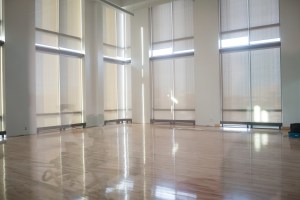
In the course of the tour with Kaba and Clark Builders project manager Charles Tolley, we’ll venture from the atrium into three dance studios with blonde wood floors and floor-to-ceiling windows either one or two storeys high. Since the MacEwan theatre specialty is musical theatre, the vigorous art of tap dance gets a studio to call its own, where the floor stands ready to take a relentless pounding from student hoofers.

MacEwan University’s Centre for Arts and Culture: a dance studio. Photo by MacEwan University

We’ll see engineered sound labs, some 20 sound isolation booths, a percussion lab, music practice studios, photography studios with curved white walls, dark rooms, video editing studios, painting studios, two state-of-the-art recording studios in the basement. We’ll wander by classrooms, conference rooms, gallery spaces waiting for the new generation of creators and their mentors.

And on to matters theatrical: we’ll see the spacious woodworking, painting, set-, prop- and costume-building shops and studios where theatre artisans learn their craft, and theatre production careers are launched.

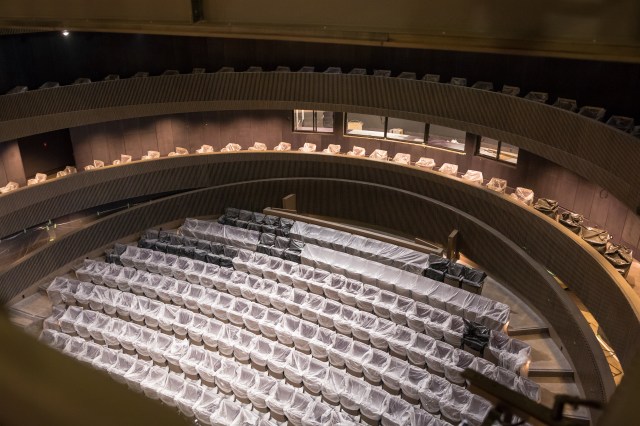
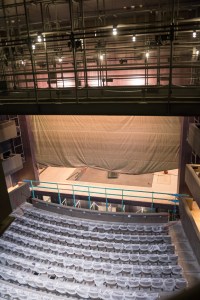
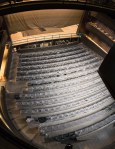
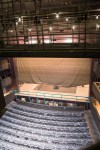
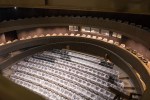
Which brings us to the centrepiece of MacEwan’s new performance spaces: an elegant, slightly curvaceous, galleried 430-seat proscenium theatre, complete with fly tower, a catwalk system on all four sides. Ah yes, and an orchestra pit: MacEwan is well known for its full-bodied musicals.

MacEwan University’s Centre for Arts and Culture: the largest theatre

The seats are divided among the main floor and two single wrap-around balcony tiers of swivelled seats. Under each main floor seat is an air vent. The idea of “displacement ventilation,” as Tolley explains, is to to avoid the noise of forced air.

The acoustics are the work of New York’s Stages, an offshoot of the company that created the rarefied sound landscape of the Winspear Centre. The seats, still under their plastic wraps last week, are designed by the Quebec company Ducharme. Unlike, say, the smaller 300-seat Westbury Theatre in Strathcona, MacEwan’s new proscenium house feels intimate. 

Stage left gives directly on the set assembly shop, an arrangement that saves time and back-breaking labour, with the loading dock nearby.

MacEwan University’s Centre for Arts and Culture. Photo by MacEwan University.

“With a fly system in the large theatre, the possibilities are endless!” says Jim Guedo, the director MacEwan’s head of Theatre Arts. “While we’ve always been able to satisfy the acting needs of Theatre Arts students, the new proscenium theatre will have many more options for the Theatre Production students….” Audiences take note: “something like Guys and Dolls has never actually been done at MacEwan. That’s definitely a possibility!”

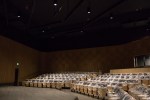
The floor was getting its finish last week, so we could only peek at the flexible two-storey black box theatre. It can be reconfigured show to show, with a 150-seat maximum, about double the capacity of the current Theatre Lab, aka Room 1-89, at MacEwan’s Jasper Place stronghold. The Faculty of Arts and Communications moves downtown in the course of the summer.

“We hope to return to a four-show season again, with plays as well,” says Guedo. “Shakespeare in the round, for example, large-cast shows like The Skin of Our Teeth, The Women, The Laramie Project, Love and Information. As well as chamber musicals.” 

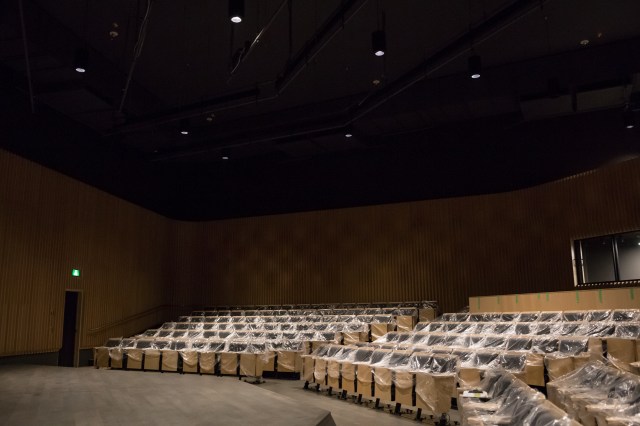
MacEwan University’s Centre for Arts and Culture: the recital hall. Photo: MacEwan University

The elegant 220-seat recital hall, lighter in hue than the theatres, is lined with an undulating surface of corrugated wood slats, a millwork challenge that’s a work of art in itself. “The hall takes into account MacEwan’s music specialties in teaching, which run to jazz and rock,” says Kaba. “But it’ll be great for a string quartet too.”

To prevent sound and vibration bleed, the performance spaces are essentially designed as a building within a building.

How accessible the new theatres are to Edmonton theatre companies remains to be seen, of course. It’s a university, so student productions come first. But as for Edmonton theatre-goers, there’s something very inviting, and connected to the world, about the new Centre for Arts and Culture.

That’s the magic of living in a glass house. By day the dance studios, for example, are light-filled. By night, they’re lit from within, and passersby can glimpse jazz dance classes in progress. There’s an art gallery for student and faculty work on the main floor. The restaurant planned for the southwest corner, near one of the two main entrances, will give on the outside world of downtown Edmonton, too. “There’s a street connection,” as Tolley says.

Dinner and a show? That’s what cities are for.

Posted in Features | Comments Off on MacEwan’s new downtown arts centre: a peek inside

The house of the rising son: The Fall of the House of Atreus, a review

Morgan Grau, Sarah Feutl, Graham Mothersill in The Fall of the House of Atreus. Photo supplied.

By Liz Nicholls, 12thnight.ca

Selfie opp: “I Survived The Fall Of The House Of Atreus” says the hand-lettered sign in the lobby of the Backstage Theatre. “Yee Haw!” And there’s helpful signage, too, for the confused, the bemused, the congenitally tentative: One arrow points to Old West; the other to Ancient Greece.

Yes, my philosophical friends, grab a drink and follow the arc of western civilization into the theatre. The opening image, the slow progress of a light-up cowboy hat across the stage, is probably the calmest moment in The Fall of the House of Atreus. Breathe, people, and hold the thought of that hat for later.

Catharsis can be yours, in slightly less than an hour. Impossible Mongoose’s madcap cavort, by Jessy Ardern, flings you (and its participants) at top speed through five generations of creative assassinations, murderous plots, instant betrayals, sex and violence, treacherous and/or vengeful relatives, near-relatives, and second cousins twice removed.

Did I mention the sex? Nothing like a fling with a god to make your love life more, like, mythic. Did I mention the curses, regularly recurring, signalled by a blast from a party horn? Did I mention … well, let the cannibalism be your own special discovery (note to self: verify all mystery meat). 

As Ardern and director Kushneryk have gleaned, Greek tragedy, with its loops of bad behaviour and unfortunate choices, has everything you need for comedy and its meaner party-animal sibling, farce. The key is speed. As John Mortimer has said, farce is tragedy played at a thousand revolutions per minute.  And Kushneryk’s riotously inventive production, which brought hilarity to its Fringe audiences last summer, takes that idea to heart, in this new edition of the show.

On an all-white set, with its own all-white clouds, a white-faced cast of three — Morgan Grau, Graham Mothersill, Sarah Feutl, all excellent — enter and exit at a burn-out pace, flinging cheap-theatre props, puppets, and puns as they go. The design is by director Kushneryk.

The show’s inspiration is to combine Greek-style declamation, in all its stylized solemnity, with pop culture in all its cheesy extensions — to uncover the recurring pattern of dysfunction. “We are the Furies; we are the kindly ones,” declare the three, appointing themselves the Greek chorus. They know a good riff when they hear it. “We are the mothers of vengeance and the fathers of blood.”

Amusingly Ardern has recognized that Greek style of promotional self-introduction as modern currency. “Hi, I’m Pelops; I like naming peninsulas after myself.” When Pelops unexpectedly gets raised from the dead — his dad had him cooked and served to the gods at a feast — he falls big-time for Princess Hippodamia, their compatibility exploration has a certain ring to it. “What’s your favourite pizza topping?” Olive? Wow, me too! This little show is one of the contemporary theatre’s most comprehensive repositories of olive jokes (Ariel Levine gets the credit for this supply in the program).

At high speeds, there’s undeniably a daffy side to the heaping of terrible events. The time-strapped (and Classics drop-outs) should note that you get the entire Trojan War, years of it, including build-up and aftermath, in a matter of minutes. There is a brief pause, as announced, “for character development,” before the shameless punning and cheap-theatre joking resumes.

The fun is in direct proportion to the smallness of the cast and the budget. Ingenuity gets the nod over pity and terror. And ingenuity is exactly what Kushneryk’s production delivers as the monumental gets cut down to recognizable human scale. The House of Atreus is the ultimate fixer-upper in that way.  

It’s a clever kind of zaniness, from a company to keep your eye on. If you missed the show last summer, you’ve had a reprieve. And as The Fall of the House of Atreus will reveal, take reprieves when they’re offered; the gods don’t offer twice.

REVIEW

The Fall of the House of Atreus

Theatre: Impossible Mongoose Productions partnering with Blarney Productions

Written by: Jessy Ardern

Directed by: Corben Kushneryk

Starring: Morgan Grau, Graham Mothersill, Sarah Feutl

Where: Backstage Theatre, ATB Financial Arts Barns, 10330 84 Ave.

Running: through April 2

Tickets: 780-409-1910, fringetheatre.ca 

Posted in Reviews | Comments Off on The house of the rising son: The Fall of the House of Atreus, a review

The Fall of the House of Atreus: fun and games with Greek tragedy

Morgan Grau, Sarah Feutl, Graham Mothersill as the Furies in The Fall of the House of Atreus. Photo supplied.

By Liz Nicholls, 12thnight.ca

“Three actors, 300 prop gags!”

“It’s either the highest of the lowbrow or the lowest of the highbrow. One or the other!” declares playwright Jessy Arden cheerily of The Fall of the House of Atreus, the high-speed, gleefully murderous 60-minute comic extravaganza she’s fashioned from Greek mythology.

Poisoning, strangling, backstabbing, usurpation, incest, cannibalism.… The gore-spattered five-generation epic cycle of the family that has pretty much nailed down dysfunction for all time is a generous vein of possibilities. And, lord, what these House of Atreus people can do with a grudge! You don’t have to be a Greek scholar to be impressed by the sheer creative permutations.

The Impossible Mongoose production directed by Corben Kushneryk dazzled small but enthusiastic audiences who ventured into a slightly off-centre Fringe venue in an ex-church last summer. There was lots of repeat business. It’s back this week, in collaboration with Blarney Productions, re-tuned for a run in a real theatre (The Backstage).

Arden and Kushneryk have added a scene or two (“the judgment of Paris is in!”), subtracted others. And Kushneryk has ramped up his striking chalky white-on-white design and reassembled the same agile trio of actors and rowdy ensemble of sock-puppets. “It’s not your great great great great grandmother’s Greek theatre,” grins Kushneryk. “A lot of murder in 60 minutes!” And not, I need hardly add, a lot of sitting around being mopey.

“People always ask me what part’s from Greek tragedy and what I made up,” laughs Ardern. “The most bizarre, the most outlandish (plot developments) are the truest to mythology.”

There are touchstones for us in the lurid tale of vengeful relatives and step-relatives. Clytemnestra stabbing her hubby Agamemnon to death in the bathtub: that rings a bell with everyone. Ditto Helen of Troy or the Trojan Horse. But How many of you (hands up! know about Princess Hippodamia? “She’s not one who got passed down by movies,” shrugs Kushneryk.

“What makes it so appealing,” thinks Ardern, “is the way it loops: we don’t learn from history. This is the story of five generations who continue to make the same mistakes.”

Morgan Grau, Graham Mothersill, Sarah Feutl as the Furies in The Fall of the House of Atreus. Photo supplied.

As the writer and director explain, the show we’ll see at the Backstage is the third iteration of a production that began life in 35-minute form at the Thousand Faces Festival, devoted to the mythic in theatre, a couple of years ago. “The visual language of the play has evolved since that first workshop,” says Kushneryk. “We were throwing spaghetti at the wall and seeing what stuck…. We’ve let it grow as it needs to.”

He and Arden met as student actors at the University of Alberta theatre school. In one way, they’re a study in contrasts. He’s steeped in musical theatre; he arrived at the U of A with a MacEwan degree and a history of directing “weird little boutique musicals,” like Coraline which played the Fringe. She arrived in Edmonton from seven years with a Winnipeg indie theatre, The Struts and Frets Players, devoted to productions based on mythology. “And this is our horrible Greek baby!” smiles Kushneryk.

Even before they graduated with fine arts degrees from the U of A last spring, they had hatched theatre together three times as a writer/director team. Kushneryk directed Arden’s “living room satire” Harold and Vivien Entertain Guests, which he describes as “Who’s Afraid of Virginia Woolf? as if it were written by Christopher Durang.”

“We share an odd sense of humour,” smiles Kushneryk. “Demented!” says Arden, who amends to “small-a absurdist… We have a very collaborative relationship; the play is just a blueprint!”

“Some moments are script moments; some are director moments,” she says. “And a lot of credit goes to the actors.”

Kushneryk says he started with signature features of Greek theatre, the masks, the declamatory style of speech, and the chorus. “The fun is to see the deviations!” he says. The chorus here consists of the Furies, back from hell to educate humanity …. The three are trying to put on what they think we want, a Greek play.”  And, hey, they get a song, thanks to Kushneryk’s musical theatre bent. 

After The Fall of the House of Atreus, Impossible Mongoose’s first collaboration with Blarney, Kushneryk goes into rehearsal at the Mayfield; he’s in Jesus Christ, Superstar. And Arden is in a university production of the brainiac Michael Frayn play Copenhagen.

But Impossible Mongoose, the indie founded by Kushneryk and Arden with Kristen Papayas, will be back. “We’re keeping our eyes out for the little weird things,” says Kushneryk. “We also love to create and get our hands dirty.”

“Zeus-ical the Musical?” laughs Arden. “The show no one asked for?”

PREVIEW

The Fall of the House of Atreus

Theatre: Impossible Mongoose and Blarney Productions

Written by: Jessy Ardern

Directed by: Corben Kushneryk

Starring: Graham Mothersill, Sarah Feutl, Morgan Grau

Where: The Backstage Theatre, ATB Financial Arts Barns, 10330 84 Ave.

Running: Friday (opening night) through April 2

Tickets: 780-409-1910, fringetheatre.ca


Posted in Previews | Comments Off on The Fall of the House of Atreus: fun and games with Greek tragedy

Edmonton theatre veteran arrested on the charge of possessing child pornography

By Liz Nicholls, 12thnight.ca

The Edmonton theatre community has been shocked by sad bad news today. Playwright/designer/sometime comic improviser David Belke was arrested and charged with possession of child pornography.

Belke “has resigned from Shadow Theatre,” where he was a company member and playwright-in-residence. says board president Donal O’Beirne. “The charges have nothing to with his work at Shadow or the Varscona.”

Belke is a longtime fixture in the Edmonton theatre scene, where his contributions have been unusually varied. The dual entry points of his theatre career, in the 1980s, were design and comic improv.

But it’s as a playwright, the award-winning Belke has mostly made his mark. He made his debut as a playwright at the 1990 Fringe with Swordplay. And there have been dozens of Belke premieres at the festival since then, many of them genre spoofs or romantic comedies. His plays have often found their way into Shadow Theatre seasons; a revival of his comedy The Red King’s Dream launched Shadow’s 25th anniversary season this past October.

This year’s upcoming production (May 5) by Players de Novo  — a troupe of public-spirited members of Edmonton’s legal community who devote the proceeds to a different theatre company annually — is Belke’s Forsooth, My Lovely, directed by Workshop West’s Vern Thiessen.

In the last few years, Belke has become the playwright-in-residence and curator of the programming at Strathcona’s arts-friendly Holy Trinity Anglican Church. He was one of the founders of Script Salon, a monthly series of staged readings of new scripts, co-sponsored by the Alberta Playwrights Network and the Playwrights Guild of Canada. and improv actor.

His non-theatre between-engagements work was as a substitute teacher.

Belke is scheduled to appear in court April 6.


Posted in News/Views | Comments Off on Edmonton theatre veteran arrested on the charge of possessing child pornography