Cinderella: the Prince is having a ball! and also an election. A review

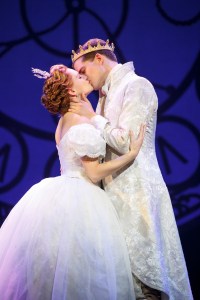
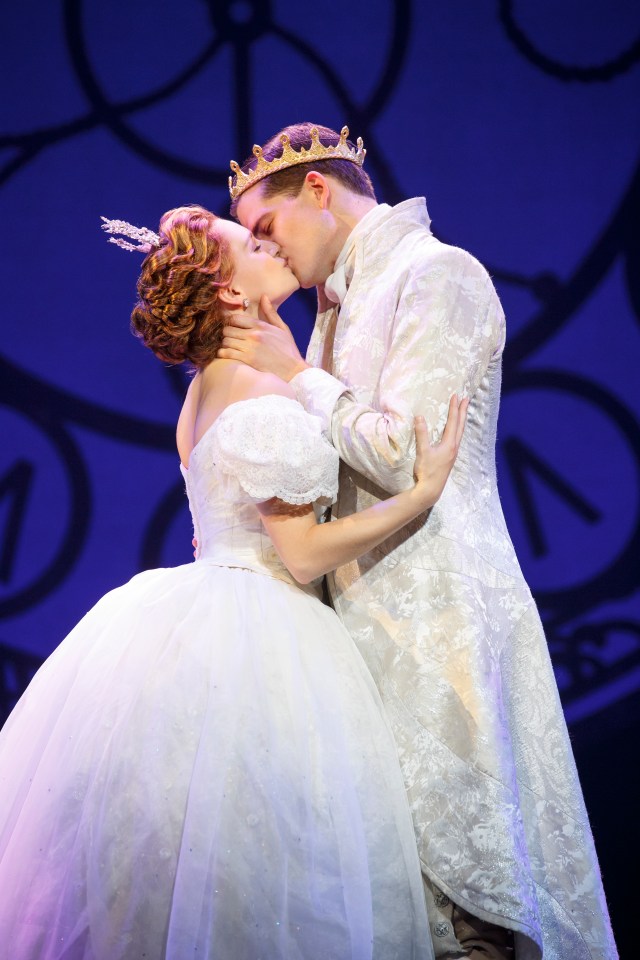
Rodgers and Hammerstein’s Cinderella. Photo supplied by Broadway Across Canada

By Liz Nicholls, 12thnight.ca

Cinderella has always been the poster girl for the poor but upwardly mobile. Bide your time, miserable lackey: your dreams can come true.

Karma’s on your side, long-term, if you’re oppressed by snarly step-relatives and a dreary job. You too can go to the ball and find true love.  Providing of course your rustic proletariat-wear gets a spectacular makeover, including proper footwear, you can rocket clean past the scrabbling peasantry and the clamouring  bourgeoisie, straight to the top.

Rescue by handsome prince, a tale-as-old-as-time (oops, wrong story), courtesy of the 17th century Charles Perrault classic, is an open invitation, not to say a red flag, to a contemporary makeover. Which is the backstory of this agreeably wiseacre 2013 update of Rodgers and Hammerstein’s Cinderella, the only musical the pair ever wrote for television. The CBS broadcast, starring Julie Andrews, planted visions of sugarplums in the heads of some 107 million viewers on a Sunday night in 1957. 

This Broadway touring production waltzes its way across the Jube stage in full fairy tale regalia, with dreamy dappled lighting, lovely singing, romantic choreography, charming performances. And most of all, magical onstage costume transformations (designer: William Ivey Long) to top any transformations provided by the story, or its quip-enhanced new book by playwright Douglas Carter Beane.

And, although Cinderella was always a story where shoe size figured prominently, you could argue that there’s something a bit lopsided when you leave a show humming the gowns. Say what you will, though, those moments of bewitching shimmer are very welcome, and applause-worthy in their own right. (note to fashion bloggers: this goes way beyond mere accessorizing). 

Anyhow, R&H’s generically lush and dreamy score is present and accounted for, enhanced for the occasion with songs from elsewhere in the canon. But now, there’s the fun of seeing it juxtaposed to jokey modern throwaways, fun that occasionally presses its luck and feels like weight instead of buoyancy. 

Cinderella, the sad-eyed orphan stuck in a dead-end job, has a subtext now beyond landing the Prince Charming of her dreams and bonding with woodland creatures (a genuinely amusing Disney joke, with fur). She’s progressive; she feels the plight of her fellow plebs keenly, and wants to do something about it.

Tatyana Lubov, who has a silky singing voice, is sweet and plucky without being saccharine on the one hand,  or the l’il Orphan Annie of the medieval period on the other.

Fellow orphan Prince Topher, in Hayden Stanes’s delightful performance, is an adorably clueless, self-effacing naif. He’s a university grad (phys-ed major perhaps?) who’s a dab hand at slaying monsters and giants but doesn’t have the foggiest idea about conditions in the kingdom. He has a vague idea that “I should be doing something more important with my life,” as he sings Me, Who Am I? originally from Rodgers and Hammerstein’s Me and Juliet. Maybe he should have a go at the over-amplified sound that mars Act I in particular; it’s an equal-opportunity obliterator of lyrics. Just a thought.

Prince Topher has hitherto been putty in the hands of a manipulative, power-hungry advisor (Ryan M. Hunt, in droll-villain-foiled-again mode). On an expedition into the woods — “you there! impoverished person” — he’s all for charity. “You’re going to give her some of your things, so she won’t have a revolution and take all of your things.”

Rodgers and Hammerstein’s Cinderella. Photo supplied by Broadway Across Canada.

The Ugly Stepsisters have had an update, too. Charlotte, played by Joanna Johnson in a performance (and wig) you could genuinely call riotous, is a sulky, malicious little upstager, with grievances. In all of the above she’s trained by her imperious mama (Sarah Primmer), an expert in the joint arts of ridicule, outrage, and minute adjustments in the class system. “We’re teetering precariously on the edge of the upper middle-class and the lower upper-class!” she snaps, by way of pep talk to her daughters.

Tall, gawky nerd sister Gabrielle (Mimi Robinson), curiously, has a secret soft-spot for the poor, and a crush on the local radical Jean-Michel (Chris Woods). “He’s a firebrand!” she says admiringly.

It’s a slightly awkward retro-fit: puckish asides,  ultra-romantic music, politically correct activist theme. But the show seems to know it, at crucial moments, and this is part of the fun.  But the activist save-the-world thread puts a little too much weight in Cinderella’s carry-on. C’mon, the Fairy Godmother is all about dreaming and being whatever you want to be and finding a dream date; she doesn’t really get into saving the world through political reform.
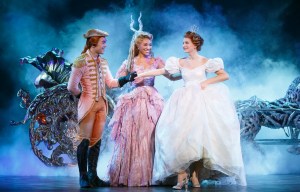
Rodgers and Hammerstein’s Cinderella. Photo supplied by Broadway Across Canada

The Prince’s identity crisis turns out to be all about the need for democracy, a prime minister, and consultation with the peasantry about land rights and inequitable distribution of wealth. The charm of the performers, even a particularly ravishing Fairy Godmother from Leslie Jackson, won’t quite get you there, in truth.

Concentrate instead on the felicities, both musical and visual, of a lavish touring production. And dream of romance.

REVIEW

Rodgers and Hammerstein’s Cinderella

Broadway Across Canada

Directed by: Mark Brokaw (originally) and Gina Rattan (tour

Starring: Tatyana Lubov, Hayden Stanes, Ryan M. Hunt, Leslie Jackson, Sarah Primmer, Mimi Robinson, Joanna Johnson, Chris Woods

Where: Jubilee Auditorium

Running: through Sunday

Tickets: ticketmaster.ca


Posted in Reviews | Comments Off on Cinderella: the Prince is having a ball! and also an election. A review

Chris Craddock talks about Irma Voth: novel, theatre, and film meet onstage

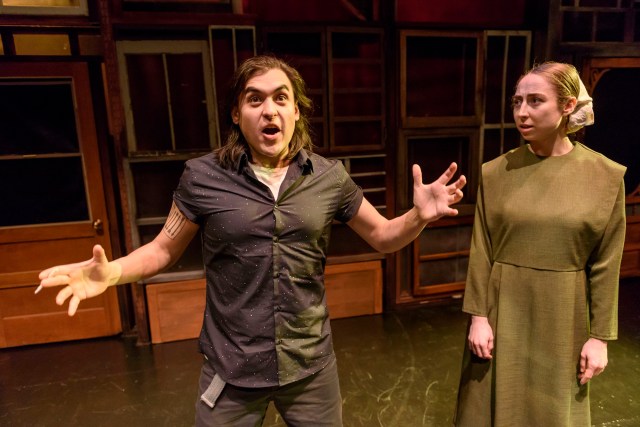
Andréa Jorawsky, Chris Craddock in Irma Voth, Theatre Network. Photo by Ian Jackson

By Liz Nicholls, 12thnight.ca

Naturally playwright/ actor/ master improviser/ filmmaker/ screenwriter/ “double-dad” Chris Craddock is relaxed at pre-12-hour rehearsal breakfast in Strathcona last week. Why wouldn’t he be?

Surely, his life of late is a flat landscape of non-eventful tranquillity en route to Thursday’s opening night of his new play Irma Voth at Theatre Network, with its long history of Craddock premieres.

WAIT: Except, of course, for the Craddock feature film (It’s Not My Fault And I Don’t Care Anyway, based on his 2011 solo play Public Speaking) which is, incidentally, now available for rental on iTunes, negotiations in progress with HBO in eastern Europe. Ah yes, and except for the kooky comic TV show he writes for (and acts on); you can catch three of season 4’s episodes of Tiny Plastic Men on YouTube. 

And did I mention the new baby? He’s Dylan (“after Bob Dylan”), nine days old, thoughtful of aspect in his proud dad’s phone photo, but just a bit young to be a satisfying playmate for 4 1/2-year-old big bro Callum, by double-dad report a comic storyteller of note. Craddock and his wife Jania Teare have devised a schedule that involves sleep in two-and-a-half hour increments, which the former pronounces fine.

And there is the far-from-small matter of this new play, a swirling rebellion/ escape adventure adapted from the 2011 novel by Miriam Toews. Irma Voth locates our title heroine and her younger sister Aggie in an ultra-strict Mennonite  community in the northern Mexican desert.

Craddock is in the cast. And like three of his four cast-mates in Bradley Moss’s production — all but Andréa Jorawsky as Irma — he plays multiple characters. Not only that, but there’s a movie embedded in Toews’ story, since the catalyst for change is a famous Mexican film-maker who comes to make a film in the Mennonite community. And Craddock is shooting it, as the play’s grand finale.

The first time that award-winning playwright Craddock met award-winning novelist Toews, there was no thought of how to transpose her funny, knowing but vulnerable, characters from one medium to another. Not immediately, anyhow.

“She was married at the time to a street performer, street name Young Raoul,” says Craddock genially. “That’s how I got to know her first, as a friend of the ‘family’.” He means the family of street performers, the virtuosos of improbable skills who know how to coax a loony out of a pocket (yours) into a hat (his) — among them Craddock’s sometime writing partner Darrin Hagen (Tranne of Green Gables among others), who spent his summers on the street as an outsized mermaid with a particular affinity for the accordian.

“She was along. She was cool. She had a book,” remembers Craddock. Intrigued, he read Toews’ first novel, Summer of My Amazing Luck — a road-trip serial adventure in which a couple of plucky welfare moms from a Winnipeg housing project go on the lam from the flood in that city, and in the process rediscover an exhilarating sense of possibility.

“What attracted me was Miriam’s storytelling,” Craddock muses, of that reading experience. “Her single mom (heroine), the finding joy through community despite poverty, the fighting the system. The experience of a flood and what it means to have a natural disaster run through all the personal disasters,” says Craddock. “All of that.”

Did Amazing Luck, with its eight subplots and multiple locations, cry out to be a stage play? Did that even seem possible? Craddock laughs. “You’d think this should be a 12-part mini-series! It’d be a heck of a movie!”

Instead, Craddock made theatre with it. Playful theatre for three (extremely agile) actors and an inventive director. Bradley Moss’s ingenious production, in which Craddock himself played all the male characters, premiered at Theatre Network in 2005, then toured the country after that.

Irma Voth offers similarly dizzying challenges for live theatre that doesn’t have a budget like a plastic surgeon’s annual income. “That’s where the creativity and fun comes in!” declares Craddock. Moss’s five actors play at least 30 characters. “The cast has been so brilliant,” Craddock says feelingly, “really active and engaged with the piece, a real collaboration.”

Todd Houseman, Andréa Jorawsky in Irma Voth, Theatre Network. Photo by Ian Jackson.

Craddock muses on the arc between then and now. “Back then I was a young playwright, and Miriam was a young novelist,” says the Kitchener native who moved to Spruce Grove at 13 to be with his dad. “Interesting, I think, to come together later, on our continuums…. We’ve both gotten older and more experienced….”

The theatrical lure, in both Summer of My Amazing Luck and Irma Voth, he thinks, is that “Miriam gives you this great narrator, a wonderful narrative voice, sweet and funny and vulnerable.” In the former, it’s Lucy, who hooks up with her edgier friend Lish to find themselves some fun in a stern and joyless system. In Irma Voth, it’s subversive Irma who, defying her abusive environment and father’s thundering disapproval, takes a job as a translator for the Mexican movie-maker.

“Miriam arranges her stories in a series of anecdotes that invite staging,” says Craddock of the episodic narrative that opens the eyes of the sisters to the world of art and its volatile practitioners, and flings them out into a big bad world of possibilities. The other attraction of Toews’ writing, for Craddock, is her dialogue. “It’s great!” he declares. A lot of time I use it verbatim; I can’t improve it…. At other times I take a lot of liberties. Miriam’s always been very generous with that.”

The differences between Amazing Luck, Toews’ breakthrough novel and Irma Voth, are “pretty stark,”  says Craddock, himself an artist who has tapped a darker emotional palette over the years. “But there are similarities: a young woman seeking freedom and self-expression in an oppressive environment….” In Irma Voth, that environment is an isolated sect and a fanatical, abusive father.   

“ Religious extremism, I think, has this terrible habit of killing women…. Miriam is exploring that really deftly in her own own way: humour in tragedy. That’s what draws me as a playwright to her.”

Both the playwright and the novelist draw on personal experience in original ways. Craddock’s 2001 solo show Moving Along, to take one example from his work, translated the rapid-fire zigzag of memory into the vivid theatrical image of a man in an “electric chair” pushing buttons to light a path through a troubled past, with allusions to Craddock’s own.

In a bizarre collision of cultures that found its way into Irma Voth, Toews, who grew up in the Manitoba Mennonite community of Steinbach, starred in a strange 2008 movie Silent Light, set in a Mennonite outpost in the Mexican outback. She’d been importuned by the celebrated Mexican avant-gardiste director Carlos Reygadas who’d seen her picture on the dust jacket of her novel A Complicated Kindness. Much of the script was in low German which neither Toews nor Reygadas spoke.

“There are many elements of true story in it,” as Craddock says of Irma Voth. Artistic creation works in mysterious loops. “Miriam does this movie and comes home and writes a book about it. And now I’m adapting the book into a play. And that’s necessitated that I go out and shoot a movie.”

“The other big theme is the redemptive power of art…. As the girls escape, we get to see them experiencing art for the first time. And hopefully we get to ask ourselves about that.” Craddock points to the scene where Irma finds her sister in front of a huge Diego Rivera mural in Mexico City, wonderstruck that a grown person could make such a thing.

Craddock smiles. “When you have children, and you see through  their eyes, when they experience something for the first time, it  refreshes your sense of wonder with the world.”

With a thought about wonder, he’s off to a complicated rehearsal day that will go late into the night. “The cues are adding up, I’m afraid,” he grins ruefully. “It’s going to be a technical show. But I hope it won’t feel like one, ‘cause it’s not about that….”

“Every time there’s a story of people being brave and escaping, making a change, maybe that inspires you to make that change in your own life…. I like to think so.”

PREVIEW

Irma Voth

Theatre: Theatre Network

Written by: Chris Craddock

Directed by: Bradley Moss

Starring: Andréa Jorawsky, Kendra Connor, Kristi Hansen, Todd Houseman, Chris Craddock

Where: The Roxy on Gateway, 8529 Gateway Blvd.

Running: Thursday through May 7

Tickets: 780-453-2440, theatrenetwork.ca 

Posted in Previews | Tagged , , , , , | Comments Off on Chris Craddock talks about Irma Voth: novel, theatre, and film meet onstage

The end of the line in Dublin by night: the poetry of Mark O’Rowe’s Terminus

By Liz Nicholls, 12thnight.ca

Irish triptych: Three brick gangways, with the sinister look of  autopsy slabs waiting for a body, up against three brick walls that tip forward and loom. Eerie industrial white noise as static in a dark theatre.

In its interlocking trio of monologues, Mark O’Rowe’s Terminus is an antidote to every sentimental thought you’ve ever had about Irish eyes and the way they smile.

The latest from the  Edmonton indie Wild Side Productions, which has introduced us to such fulsomely original contemporary pieces as Sarah Ruhl’s Passion Play and Will Eno’s The Realistic Jones, takes us on a wild and fantastical chase through the darkness of a Dublin night. It’s a world where winged demons made of worms make advances and shy men turn out to be psychopaths. 

For each of the unnamed characters it’s a leap into the unknown, a freefall of violent, or erotic, or violently erotic, impulses. It’s a weird mythical vision of an urban over-and-underworld where where winged demons might come to your rescue, or not. Where a shy man might bargain with the devil for the gift of song. Where gangs of lesbians perform gruesome backstreet abortions with broom handles and girls step in front of runaway trucks.

It’s set forth in a muscular sort of profane poetry where  heartbreak and horrifying gruesome comedy collide and blister in internal rhymes, and unexpected images pop out.

The story though is something you’ll have to unravel and re-ravel for yourself. As you’ll find out in Jim Guedo’s resonant production, Terminus happens in rhythmic outbursts as three stories that start in parallel tangle together at the end.

Sometimes you seem to be on a luge that leaves your stomach at the top of the run. Sometimes the storytelling is a slingshot that kicks back and smacks you right between the eyes when you don’t expect it. Speaking of eyes, they may not be smiling on the Emerald Isle conjured by O’Rowe, but the Irish gift of the gab is unimpaired.

A (Christine MacInnis) is a tart-tongued middle-aged ex-teacher who volunteers at a phone-in help centre. On a day she hears a voice she recognizes, she surprises herself by setting forth on an unstoppable quest — by cab, by bus, on foot — to find and save a pregnant girl. Her journey through the Dublin demi-monde is, to remain vague on your behalf, haunted by her past. And it’s fraught with startling encounters and lurid violence. MacInnis gives this fierce party a bleak sense of humour and self-discovery.

B (Morgan Donald) is a lonely Dublin chick, an underachiever in the date department — she “knows the drill: bed alone, and tears” — who just goes out to the pub for some drinks with a couple she knows. 

She gets picked up by a man “with a smile to be filed/ under most attractive I’ve seen for a while” and ends up on a building-site crane with an unparalleled view of “the city’s sullied magnificence. The bizarre is both disgusting and, in B’s acceptance of the erotic, no matter the source, is kind of beautiful. Donald captures B’s surprising lack of surprise with a surprising  aplomb.

The best of all, in its mixture of horror and self-mocking humour, is the monologue that belongs to Ben Stevens’ C, a shy virginal fellow with a bright nervous smile and a penchant for murder. He yearns for romance, and realizes too late that those who make deals with the Devil had better “check out the fine print.” The only momentum, when you’re putting pedal to the metal in a getaway truck to elude your fate, is forward.

The wildly improbable intersection of the three stories is a matter for O’Rowe’s bold swirl of language. And it’s the test as well, for Guedo’s actors. You very nearly believe two of them; the third you follow straight to hell.

REVIEW

Terminus

Theatre: Wild Side Productions

Written by: Mark O’Rowe

Directed by: Jim Guedo

Starring: Christine MacInnis, Morgan Donald, Ben Stevens

Where: Studio Theatre, ATB Financial Arts Barns, 10330 84 Ave.

Running: through April 23

Tickets: 780-409-1910, fringetheatre.ca

Posted in Reviews | Tagged , , , , | Comments Off on The end of the line in Dublin by night: the poetry of Mark O’Rowe’s Terminus

The resurrection of Jesus Christ Superstar at the Mayfield: a review

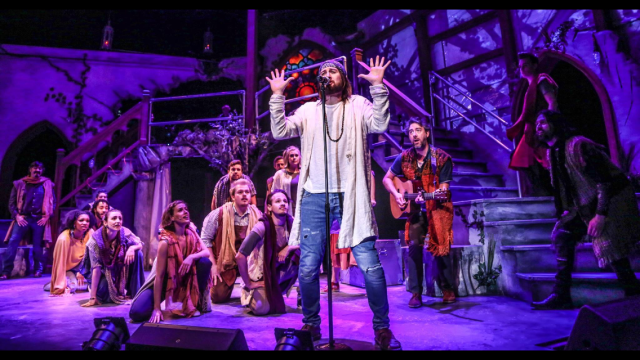
Brad Wiebe in Jesus Christ Superstar, Mayfield Theatre. Photo by Ed Ellis.

By Liz Nicholls, 12thnight.ca

It’s a diverse T-shirt and jean crowd that drifts onto the Mayfield stage at the start of Jesus Christ Superstar. There’s even a swaggering older dude in a suit who strides in, and looks slightly sinister as he checks out the scene. 

Too elegant to be the roadie? The star’s manager? The producer, maybe? You’ll see: in fact, contract riders figure prominently in the story.    

Anyhow, they flip open large metal touring trunks — one is marked Fragile — and pull out bits and pieces of costumes with hints of the biblical (designer: Stephanie Bahniuk) for the show, and drift away.

Since its origins as a recorded single, then a concert, then a 1971 Broadway production, the groundbreaking Andrew Lloyd Webber/ Tim Rice rock opera has arrived onstage propelled by every kind of director’s concept. Sometimes it’s a robe and sandal affair, sometimes (like the New York-bound Stratford production of 2011) a flamboyant neon apotheosis of kitsch-ianity. At the Mayfield, Kate Ryan takes her musically impressive and beautiful production back to its origins — its origins as a musical that is. 

In the canon of Lloyd Webber musicals that link the idea of showbiz stardom to religion (Joseph and the Amazing Technicolour Dreamcoat) or political movements (Evita), Jesus Christ Superstar remains its most audacious — with the attendant controversies to prove it (the Vatican didn’t say it was OK till 1999). It re-casts a  famous story, with a famous hero, as the history of a rising star who, like many in the rock star field, emerges from humble origins, and rockets to superstar immortality by an early death (and a spectacular resurrection and revival tour).

Brad Wiebe in Jesus Christ Superstar, at the Mayfield. Photo by Ed Ellis.

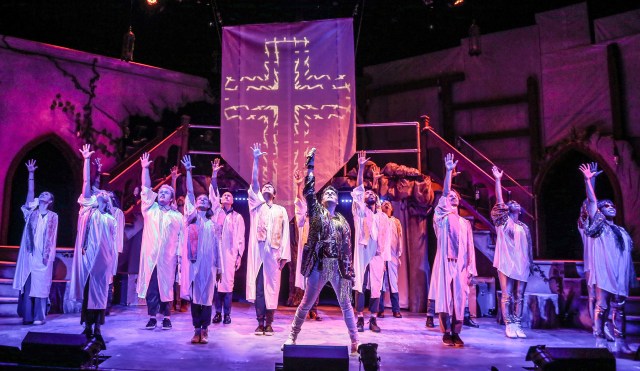
It’s a theatrical tale about charisma and the high cost of celebrity, told entirely in song. And this compelling production references a time-honoured theatrical motif to match: the costume trunk, the divvying up of parts, the gradual emergence of characters from the 18-member ensemble. Individuals return from time to time to to group tableaux artfully arranged by Ryan and lit, with a painterly glow, by Leigh Ann Vardy.

The striking set, by the highly original designer T. Erin Gruber, conjures a derelict church: stained glass window, timbers askew in projections that hint at scaffolding, crumbling walls ensnared by branches from a spreading tree of life that is the production’s visual centrepiece. As events hurtle to fatality, her projections, which play on banners and around around the tarnished enamelled surfaces of the space, will survey Christian iconography, and along with Vardy’s stunning lighting effects, hint at supernatural interventions.

The band led by musical director/arranger Van Wilmott is up in a sort of dim choir loft, where he, along with guitarist Harley Symington and an excellent band play the devil’s music, devilishly well. 

Robert Markus as Judas in Jesus Christ Superstar at the Mayfield. Photo by Ed Ellis.


Jesus gets the billing. But at the heart of the enterprise is Jesus’s angry, baffled “right-hand man” Judas and his impulse “to strip away the myth from the man,” as he puts it in his opening number Heaven On Their Minds. “You’ve started to believe/ the things they say of you,” he accuses his friend. “You’ve begun to  matter more than the things you say.”

The kinetic Robert Markus translates fury and obsession into a charismatic performance as the man who’s being set up for for tragedy — railroaded into being the eternal villain by the act of betrayal without which Jesus’s superstardom will not be possible. Markus has the kind of edge and energy, both dramatically and musically, that are the raison d’être of rock. In the hell scene, Judas rocks out in white satin, with an angelic back-up trio on one side and a more worldly sequined trio on the other: he’s conflicted to the end. 

And you can see how Brad Wiebe’s calm, watchful, rather morose Jesus could really get on his nerves. Especially given the latter’s preference for the company of Pamela Gordon’s touchy feely Mary Magdalene (Pamela Gordon), who can’t keep her hands off him. She pats him instantly, not just to reassure him to “try not to turn on to problems that upset you” (in one of Rice’s less successful lines) but to reassure herself he’s really there and still “just a man.”

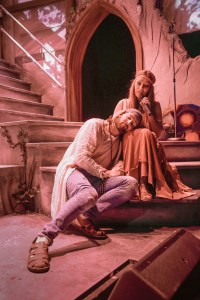
Brad Wiebe as Jesus, Pamela Gordon as Mary Magdalene in Jesus Christ Superstar at the Mayfield. Photo by Ed Ellis.

It will not surprise you that Gordon, who has a lustrous and ample voice and stage presence to match, delivers a killer version of the detachable pop ballad Don’t Know How to Love Him.

No wonder Mary is  confused. Jesus is unquestionably a mysterious figure in Jesus Christ Superstar, revealed more in his effect on others than in his own motivation. And Ryan’s production makes use of that in stagecraft. Jesus’s band of followers, who have a blithe and cheerful hippie solidarity, don’t take criticism well; they turn into a murderous rabble when the going gets tougher.

Wiebe’s Jesus is no gleaming evangelist. An air of anxiety is the keynote of the performance; he’s a baleful outsider in his own story, a man with a sense of what’s to come. It’s not exactly charisma, but it’s certainly haunted. 

When Jesus lets loose in full-throttle rock fury in the temple scene, it’s a startling moment for everyone onstage, including the merchants and the Jewish high priesthood. Wiebe has considerable vocal variety at his command. And he uses it affectingly in scenes of Jesus’s doubt about his fate. 

The authorities, both the Roman and the Jewish, are strikingly played. Vance Avery brings a ribcage-rattling bass baritone to bear on the high priest Caiaphas. Larry Mannell is an urbane Pontius Pilate, shocked out of his coolness by Jesus’s refusal to plead for himself, and by the crowd’s blood lust. And Corben Kushneryk is a high-camp King Herod, taunting and malicious, who arrives onstage trailing a decadent court of dancers. Laura Krewski’s choreography throughout is a clever blend of rock motifs, ‘70s allusions, flavours of the Middle East.

There is, of course, something impressively weird about watching the Last Supper at a “dinner theatre” — on Good Friday yet. But in repertoire, casting, and execution, the Mayfield, under Wilmott’s artistic directorship, has exploded conventional limitations. And this production, dramatically and musically powerful, is an exciting demonstration. 

REVIEW

Jesus Christ Superstar

Theatre: Mayfield Dinner Theatre

Directed by: Kate Ryan

Starring: Brad Wiebe, Robert Markus, Pamela Gordon, Vance Avery, Larry Mannell, Corben Kushneryk

Running: through June 11

Tickets: 780-483-4051, mayfieldtheatre.ca

Posted in Reviews | Tagged , , , , | Comments Off on The resurrection of Jesus Christ Superstar at the Mayfield: a review

Get your Fairy Godmother on the case: Cinderella is coming to town

Rodgers and Hammerstein’s Cinderella. Photo supplied by Broadway Across Canada

By Liz Nicholls, 12thnight. ca

“Impossible, for a plain yellow pumpkin to become a golden carriage./ Impossible, for a plain country bumpkin and a prince to join in marriage….” 

Impossible? Well, hang on … actually, there is a precedent.

And you’ll see it set forth in the 1957 Rodgers and Hammerstein musical that alights on the Jube stage Tuesday with a full complement of ball gowns — and has to end before midnight (or your coach gets towed and your tiara gets repossessed).

I don’t know what your own Fairy Godmother has been warning you about unrealistic romantic expectations. But in this 2013 Broadway revival of Cinderella — its Broadway debut, after 60 years, incidentally — the mopey girl with the bad-ass step-relatives you remember from the old French fairy tale, doesn’t just want a magical makeover (and glass party pumps and, of course, a Prince). “She wants to make a difference in the world,” as Cinderella tour director Gina Rattan puts it. She’s got a  progressive social activist streak; she doesn’t like what’s happening to the peasants, and wants to be a force for good in the kingdom.

Rewritten by American playwright Douglas Carter Beane (The Nance, The Little Dog Laughed), the new book for Cinderella is the latest update in the many-update history of the only musical Rodgers and Hammerstein ever wrote for television. The original 1957 broadcast starring Julie Andrews, fresh from her Eliza Doolittle triumph, attracted a whopping 107 million viewers.

As Rattan explains, that 90-minute CBS version, which dislodged Ed Sullivan from his theatre and his time-honoured Sunday 8 p.m. slot for the night, has been amplified into the classic Broadway configuration: two acts with intermission. “There’s more singing,” she says of a score that’s been ramped up with songs from the R & H canon originally written for other musicals (Now Is The Time, for example, was cut from South Pacific). In that way, it’s like Crazy For You, a ’90s musical that expanded the ‘30s original with a new Ken Ludwig book and songs from the Gershwin hit parade.

For this Cinderella, characters have been added (a machiavellian court adviser to the naive prince for one) and cut (the King and Queen). Not only that, but “the characters have motivations and back stories,” says Rattan, of a book that gives separate identities to the Ugly Stepsisters, who have hitherto mostly arrived onstage as comic grotesques. “Here, it’s less about their being ugly,” more about their behaviour, Rattan explains. 

Rodgers and Hammerstein’s Cinderella. Photo supplied by Broadway Across Canada.

Some things, however, never change. “The Stepmother is still the antagonist, making Cinderella’s life miserable.” 

“So, yes, Cinderella has been updated as to who the characters are, and how their stories play out…. But it still delivers on the magic of the fairy tale. It’s still about the right people finding each other,” says Rattan.

Rodgers and Hammerstein’s Cinderella. Photo supplied by Broadway Across Canada

“But Cinderella and the Prince aren’t just two pretty people who inevitably end up together. Cinderella wants to make a difference.” And Prince Topher, a naive young leader who’s being led astray by bad advice, needs guidance to get his regime on track and do the right thing vis-à-vis the people.

The biggest Wow in the Broadway production, the one that landed it a Tony amongst multiple nominations, was the array of ballgowns, designed for magical transformations by William Ivey Long. “All the original Broadway costumes are on the road,” says Rattan, a veteran musical theatre director, and experienced in live TV adaptations (NBC’s live Peter Pan and The Sound of Music on NBC). She was in Red Earth, Colorado. directing Evita the morning we talked on the phone.

The touring sets, Rattan says, are the Broadway originals, too, reworked to crack apart for travelling. So is the lighting. “You’ll feel like you’re watching the Broadway production.”

PREVIEW

Rodgers and Hammerstein’s Cinderella

Broadway Across Canada

Where: Jubilee Auditorium

Running: April 18 to 23

Tickets: Ticketmaster (1-855-985-5500, ticketmaster.ca)

Posted in Previews | Tagged , , , | Comments Off on Get your Fairy Godmother on the case: Cinderella is coming to town

Wanna tour night-time Dublin? Terminus takes us on a “metaphysical odyssey”

By Liz Nicholls, 12thnight.ca

“Good storytelling isn’t just telling,” says director Jim Guedo. “A good storyteller makes you feel it’s happening in the present…. It’s in the now.” 

And that ‘now’ gets darker, stranger, more brutal in the fantastical urban journey charted by the Irish playwright Mark O’Rowe in Terminus. The 2007 play opening Friday in a Wild Side production is your ticket to a wild side night out in Dublin.

“Three characters on one night, a long journey into the darkness of Dublin, in three fractured, intersecting monologues!” as Guedo intriguingly describes Terminus. “It’s not immediately apparent how they’re interconnected …. the audience has to pick up the (threads). We’re blindsided by how their actions come together!”

The older of the two women is an ex-teacher (Christine MacInnis) who works at a phone-in help centre. “Recognizing the name and vote of a former student, she sets forth on a good samaritan journey, and gets drawn into the dark underbelly of Dublin.”

The younger (Morgan Donald), “lonely and frustrated with her life, goes out, and gets drawn into a relationship that sweeps her in,” says Guedo mysteriously. And as for the third character (Ben Stevens), he’s a shy man who’s made a Faustian bargain.

“Their paths don’t cross till the end of the play,” Guedo says. “All three have amazing journeys on the night. They go to places they’ve never gone before…. They’re very different in tone, in energy. It never settles into one sort of metabolism.”

Like his fellow Irish playwright Martin McDonagh, he of the viciously funny black comedies, O’Rowe’s “original inspiration wasn’t theatre, but film,” says Guedo, who’s had his eye on Terminus for years. O’Rowe’s weapon of choice is language, in Terminus much of it rhymed. “He crafts whole chase scenes, grotesque and surreal, through the words….”

At the movies when you can’t stand to watch the gruesome or the shocking, you can flinch and hide your eyes. “You can’t un-hear something!” says Guedo cheerfully,. “Your mind makes the image and fills in the blanks.”

And, evidently, with O’Rowe plays like Howie The Rookie and Crestfall, they have. “He’s invited controversy, yes,” says Guedo, the head of MacEwan University’s theatre arts department. “They’re raw, potentially graphic, but all talked about…. Acted out, re-enacted, they would lose their force.” Terminus, he says, “is almost like a virtual reality.”

“Great hockey announcers, doing the play-by-play, do that: it’s  always in the present, thinking forward, moving forward.”

Is it a horror story? Guedo considers. “There’s a lot of horror,” he says, like Pulp Fiction structurally, “but Irish, in its hard, unsentimental, bleak humour. And moments of beauty.”

The last Wild Side production, 10 out of 12, took us into the fascinating minutiae of the dread “technical rehearsal” that is part of preparing the cues for a show. This “long night of the soul, which leaves narrative realism behind” couldn’t be more different,  says Guedo. “You’ll get surprised by the turns it takes; it’s unpredictable. It never goes in a way you think. ”

PREVIEW

Terminus

Theatre: Wild Side Productions

Written by: Mark O’Rowe

Directed by: Jim Guedo

Starring: Christine MacInnis, Morgan Donald, Ben Stevens

Where: PCL Studio Theatre, ATB Financial Arts Barns, 10330 84 Ave.

Running: through April 23

Tickets: 780-409-1910, fringetheatre.ca

Posted in Previews | Tagged , , , , | Comments Off on Wanna tour night-time Dublin? Terminus takes us on a “metaphysical odyssey”

9 parts of desire: a review of The Maggie Tree production

Nimet Kanji, right, in 9 Parts of Desire, The Maggie Tree. Photo by Marc J Chalifoux

By Liz Nicholls, 12thnight.ca

War can be survived (humans are extraordinarily resilient). But the experience can never be un-experienced.

You’ll be carrying that thought with you out of the theatre when you see 9 Parts of Desire, the remarkable documentary/play The Maggie Tree has brought to the Varscona stage.

9 Parts of Desire is a nine-character testimonial of oppression, brutality and carnage in a haunting, and haunted, part of the world. It was created by the Iraqi-American actor Heather Raffo from a decades’ worth of interviews of Iraqi women of every age and perspective after the first Gulf War, and it debuted in 2003, at the time of the second.

So you’re bound to wonder, in advance, whether this is art as artifact. But you don’t need special heat-seeking sensors to feel the stepped-up topicality in a week when America is bombing Syria. Reality is competitive that way. 

9 Parts of Desire remains a gutsy choice for a Canadian collective 2017, to be sure, as The Maggie Tree seems to have realized in both casting the production and the ancillary program of panel discussions about “diversity in theatre,” accessibility, and the ownership of stories.

No, there aren’t nine Iraqi actors in Vanessa Sabourin’s production. There is, however, a carefully deliberate assortment of ethnic backgrounds and colours (including one white, one black, and one aboriginal performer), amongst the actors and onstage musicians. And the production is staged physically by Sabourin to suggest that, in this country of immigrants, refugees, and Indigenous cultures — where the word “multi-cultural” is as watered down as “fusion” in the culinary industry — oppression is a shared residue, part of a Canadian’s baggage, a connective tissue to something ancient.   

As a woman steps forward, to deliver a monologue, the group onstage watches, and folds the woman sympathetically back into the group tableau when it ends, no matter what perspective she’s expressed. The movement and pattern of survivors  onstage implies a kind of shared female experience of the brutalized that’s more powerful than political differences.

“Underneath my country there is no paradise of martyrs; there is only water,” says the professional mourner (Christine Frederick) who offers a kind of invocation to the dead at the outset as she drops old shoes, “worn soles,” into the river. 

Alison Yanota has designed and lit in an eerie glow a kind of cave that turns out to be the burned-out hollow of a building, with rebar hanging from the ceiling.

The monologues seem variable in the quality of the writing. But they do have a cumulative impact, in committed performances by Sabourin’s cast. Nadien Chu delivers a scorcher as a London-educated doctor who’s returned to her home in Iraq, appalled by the horrifying birth defects and cancers she sees in her patients.

One fierce old cosmopolite ex-Commie (Patricia Darbasie), drinking scotch in London, muses on the ironies of history as she details the horrific three-decade savagery of the Saddam Hussein regime. That “American-supported blood bath” made her, “against all my beliefs,” a supporter of the war in Iraq. But look where that disastrous invasion led? as she points out sadly. “I don’t believe any more in revolution.”

A Bedouin woman (engagingly played by Nimet Kanji) searches for peace and joy in her love life, in a checkered marital history that includes a lot of fleeing.

The youngest character, a fretful teenager (Rebecca John) housebound since the American invasion, yearns for American pop music, identifies bombs by the sound, and collects bullets as bling. The oldest (Alison Wells) is a street peddler, a survivor of 23 revolutions, who is rueful about the objects looted from museums, but sells them anyway. “I have to eat.”  

The most conflicted, and therefore dramatic, character is the artist Layal (Amena Shehab), a worldly, self-loathing collaborator who paints official Saddam and co portraits, but resists the dehumanizing force of the regime by painting nudes.

Alison Wells in 9 Parts of Desire, The Maggie Tree. Photo by Marc J Chalifoux.

There’s even an American (Nicole St. Martin), disintegrating with emotional anxiety about her Iraqi family half a world away. “I should go to the gymn!” she interrupts her own anti-war commentary. “People work out to the war. On three channels.”

But perhaps the most affecting portrait, in a performance of eerie quiet by Natasha Prasad, is the caretaker at the Amiriya shelter, bombed by the Americans in 1991. It’s a mass Iraqi grave, full of ghosts, she tells us, pointing to walls embedded with the hair and skin of the “vaporized.” She has taken the name of her young daughter as a kind of continuity beyond the grave. 

The dead are not lost. That’s what haunting means. And the haunted are among us in this country.

REVIEW

9 Parts of Desire

Theatre: The Maggie Tree in association with Theatre of the New Heart

Written by: Heather Raffo

Directed by: Vanessa Sabourin

Starring: Amena Shehab, Nicole St. Martin, Nadien Chu, Rebecca John, Alison Wells, Christine Frederick, Nimet Kanji, Patricia Darbase, Natasha Prasad

Where: Varscona Theatre, 10329 83 Ave.

Running: through April 15

Tickets: TIX on the Square (780-420-1757, tixonthesquare.ca)

Posted in Reviews | Comments Off on 9 parts of desire: a review of The Maggie Tree production

How Peter Pan got his groove: Peter and the Starcatcher at the Citadel

Peter and the Starcatcher, at the Citadel. Photo by Ian Jackson, Epic Photography.

By Liz Nicholls, 12thnight.ca

“To have faith is to have wings,” declares says the earnest little smarty-pants Molly (Andrea Rankin) to a gaggle of skeptical onlookers in Peter and the Starcatcher.

Faith, that is to say, in the theatre and the way it gets airlift from your imagination. And then, by golly, doesn’t our Molly float inches up off the deck of the ship? “Satisfied?!” she says smugly to the ragged onlookers. They are.

And so are we. This gravity-defying coup owes something to the transformation of a visible plank into a make-shift teeter totter thanks to human intervention. Faith and improvised wings get to the heart of this giddy, scrambling high-seas adventure, an epic with a mock-epic spirit.

The faith in cheap-theatre wit burns bright in the spirited James MacDonald’s Citadel production currently getting playful in every corner and aisle of the Maclab Theatre. A certain hectic, frantic, scrambly quality is built into this kind of physical storytelling, and this production doesn’t fall short in that department. There are stretches, though, where the “wings” seem to flapping awfully hard to get us through an adventure that tells us at the outset that “nothing lasts forever” but starts to make you wonder about that by mid-Act II.   

Not, I hasten to add, that this points to a lack of bright ideas, possibly the reverse: overload in that cargo. And not because the performances from MacDonald’s cast, which assembles some of Edmonton’s brightest comedic talents, aren’t inspiration-studded.Possibly the production hasn’t yet quite found its sea-legs, or a rhythm that is forward and adrenalized without being just a wee bit relentless.

But there’s this: At the centre is a bravura performance of riotous and riveting, not to say show-stealing, hilarity from Farren Timoteo as the pirate king Black Stache, who will lose an appendage and gain an eternal following in what we’ll call the sequel (three guesses…) More of the Stache later.

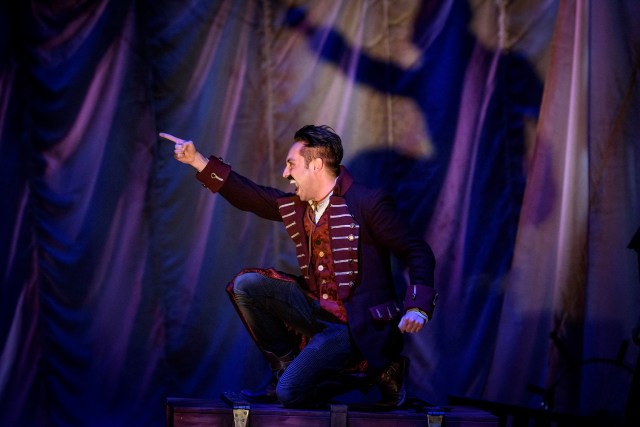
Farren Timoteo as Black Stache in Peter and the Starcatcher, Citadel Theatre. Photo by Ian Jackson, Epic Photography.

Rick Elice’s cleverly intricate 2011 play, fashioned from the 2004 Dave Barry/ Ridley Pearson kids book, is designed as a backstory to the famous skirmishes in Neverland set forth by J.M. Barrie. And a big part of the fun of Peter and the Starcatcher is the way we gradually spot characters we’ve known forever from Peter Pan emerging,  in their formative years, from sly hints and loops in the storytelling. So when the cast of 12, assembling on the bare stage, tell us at the outset that “everything ends,” they are starting the story that will end at the beginning of Peter Pan.

The once-upon-a-time is this: a Victorian sea voyage, two ships, a mix-up of two trunks identical “in their trunk-ness,” a cargo of orphan boys bound for slavery, a contraband treasure of life-transforming “starstuff” too dangerous to let fall into the wrong hands. Ah, and speaking of hands, did I mention the pirates? Everyone washes up on a mysterious tropical isle ruled by a size-large croc where the inhabitants speak entirely in vocabulary borrowed from Italian menus.

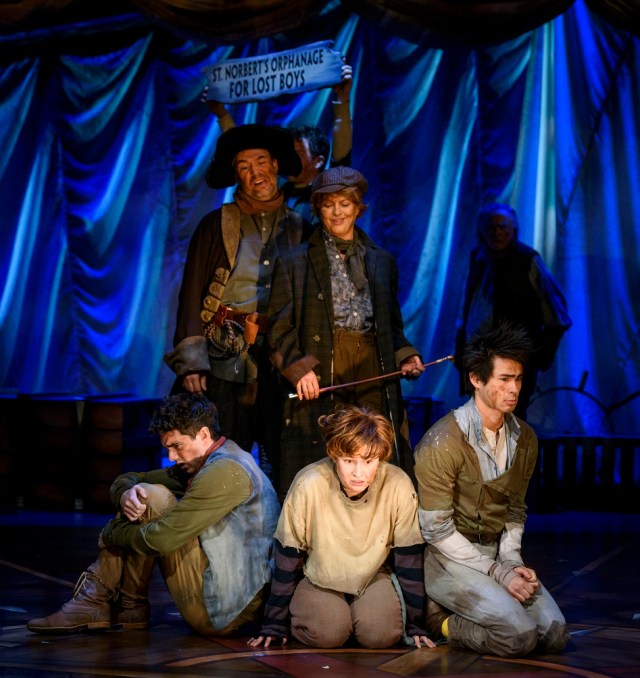
Oscar Derkx as Boy and Farren Timoteo as Black Stache in Peter and the Starcatcher. Photo by Ian Jackson, Epic Photography.

The most despondent orphan, Boy (Oscar Derkx), who “hates, hates HATES grownups,” will reclaim his lost boyhood and get a proper name and a home in the course of events. But before that, he’ll rise to an occasion that includes a mighty sea battle, a shipwreck, two high-contrast sea captains (Clinton Carew, Ryan Parker), a number of eccentric island cannibals, and (did I mention?) pirates. Ah yes, and the discovery of the opposite sex, bedtime stories, and the notion of family.

Peter and the Starcatcher is an enjoyable jumble of theatrical forms, and MacDonald’s production savours that. It’s part-musical comedy, with a live score and sound effects provided by musical director Erik Mortimer and Nich Davies. It’s part-pantomime, with all the shameless punning, mouldy  jokes, double-entendres, and blithe insertion of topical anachronisms that designation implies. You’ll hear a wispy reference to Crazy For You float by; there’s a cameo from another Citadel hit.

Garett Ross is droll as the panto Dame, Molly’s exasperated, tart-tongued nanny Mrs. Bumbrake. Addicted to alliteration, she’s been around the poop deck a few times, as they say, and she isn’t above a little slap-and-tickle on the side from a romantic old salt Alf (Glenn Nelson). “If you touch a hair on her legs …” the latter valiantly warns their pirate captors.  

It’s part-music hall and part-fantasy epic. The Act II opener, a chorus line of fish-turned mermaids, with fantastical bosom support from costume designer Megan Koshka, is a bit of both. And so is Koshka’s set, framed as an old-fashioned Victorian theatre, slightly askew, as if it’s lost its moorings and might end up slipping off a pier into the sea. It gets exactly the right kind of period melodrama lighting from Narda McCarroll. 

It’s part coming-of-age comedy, witness wistful scenes between Peter and Molly, as one captures a childhood he never had, and the other starts to grow out of hers and move on. And the show even makes fun of its own storyteller theatre roots when Molly objects to the orphan boys’ improvised version of Sleeping Beauty. They have, she notes briskly, “abused the concept of the theatre collective.” Everyone’s a critic, eh?

Anyhow, some scenes are more fun than others. I loved Molly’s expedition through the depths of the ship, chamber after chamber, created entirely by human agency: ensemble members hold up slatted all-purpose planks as doors, which open on a variety of amusing tableaux vivant and slam shut. The Act II encounter with the Mollusks and their leader, Fighting Prawn (Stephanie Wolfe), and the fun of their language (“cannelloni! lasagne!”), on the other hand, doesn’t get much comic traction.

As the Boy, a naif made sullen by privation, Derkx turns in a performance that charts, delightfully, the birth and tentative growth of amazement about the world and its wonders. As the wiseacre of his two orphan companions — the one obsessed by being The Leader — Richard Lee Hsi is particularly amusing in his adult tone. 

Rankin captures Molly’s competitive streak — “it isn’t a contest, but if it was I’d win” — and the way her certainties about her superior skills and knowledge are always getting undermined by the human factor. Molly has a slightly preposterous upper-class accent, and an air of noblesse oblige that will make you smile, in a performance smartly created from the friction between pompous, and rueful.

Back to the Stache and his “one for all and all for me!” piratical mantra. A production that can sometimes seem cluttered finds its comic starstuff treasure in Timoteo’s hysterical performance, well worth the price of admission. Vainglorious but craven, a self-dramatizing, self-enchanted Mrs. Malaprop of the high seas, Black Stache ignites the stage whenever he’s on it (matches provided by Peter Fernandes’s helpful Smee). 

Instantly exasperated whenever anyone else gets a stage Moment — “enough of this non-versation!” — Black Stache pursues the  treasure with flamboyant showbiz charm and a daffy but elegant store of contemporary references. Alas, it is “as elusive as a Philip Glass opera.”

The hand-severing scene in which Black Stache assures his eternal future as Peter Pan’s eternal arch-enemy Captain Hook is a riot. “I have a whole armada of possibilities at my former fingertips.” Timoteo doesn’t just negotiate the role, he embraces it and catapults off it.  And the whole enterprise springs forward.

“You sound older already,” says the eternal boy formerly known as Boy, accusingly, to Molly near the end. The rest of us, though, feel younger when Black Stache assures us he’ll be back, “just when you least expect it, there’ll I’ll be, The Stache, right under yer nose.”

REVIEW

Peter and the Starcatcher

Theatre: Citadel

Directed by: James MacDonald

Starring: Oscar Derkx, Andrea Rankin, Farren Timoteo, Peter Fernandes, Doug Mertz, Garett Ross, Glenn Nelson, Richard Lee Hsi, Ryan Parker, Clinton Carew, Stephanie Wolfe, Morgan Yamada

Running: through April 23

Tickets: 780-425-1820, citadeltheatre.ca

Posted in Reviews | Comments Off on How Peter Pan got his groove: Peter and the Starcatcher at the Citadel

La Raccourcie: a father/son confrontation at L’UniThéâtre

André Roy, Steve Jodoin in La Raccourcie, L’UniThéâtre. Photo by db photographics

By Liz Nicholls, 12thnight.ca

There are mysteries at the heart of La Raccourcie, the 1991 two-hander by Quebec writer Jean-Rock Gaudreault that opens at L’UniThéâtre this week, in French with English surtitles.

It’s a father-son confrontation in the woods that comes with intriguing questions for the audience. Jean-Joseph has been leading a solitary, hermetic existence in the northern Quebec woods for five years. Hmmm, that’s one “why?.” And here’s another: his son Victor arrives, in shirt and tie, having scrambled through the bush for days to find him. What is he fleeing? Is it a “heart of darkness” type quest?

And here’s a third “why?”: “le raccourci” means “shortcut” in English. But La Raccourcie? It’s a river, possibly fictional, possibly mythical.

“You find out the answers,” says director Brian Dooley. “That’s what the play is for!”

For his production director Dooley has paired veteran francophone actor and former broadcaster André Roy with L’UniThéâtre’s Steve Jodoin. Roy, says Dooley, “has quite a following for his work in comedies…. This one has its funny elements, for sure, but it’s a serious relationship between a father and son — funny but not a rib-tickler…. André has been so committed! He and Steve have a great chemistry.”

In the course of the play, as Dooley describes it (with deliberate vagueness), “a young man confronts an existential choice.” And, as a parallel, not entirely welcome to either character, emerges, the son discovers that his dad did exactly that at an earlier time.

You wouldn’t call the encounter in the woods amicable, Dooley hints. “Barbed” is the word he uses. “The son is there to catch his father up; dad has a few things to learn about what he left behind when he left wife and home, all the things he’s buried…. At first the father is resentful. Slowly, persistently, the son wears him down; he’s like his dad that way.”

“There’s a real meat and potatoes feel to this,” says Dooley of the visceral encounter. “You need two actors who can wrestle!”

PREVIEW

La Raccourcie

Written by: Jean-Rock Gaudreault

Directed by: Brian Dooley

Starring: André Roy, Steve Jodoin

Where: La Cité francophone, 8627 91 St.

Running: April 5 to 8 and 12 to 15. Note: all but the April 8 evening and the April 15 matinée performances have English subtitles

Tickets: lunithéâtre.ca


Posted in Previews | Tagged , , , , , | Comments Off on La Raccourcie: a father/son confrontation at L’UniThéâtre

Players De Novo replaces Belke play as annual fundraiser

By Liz Nicholls, 12thnight.ca

Five weeks before opening night Players de Novo and Workshop West Playwrights Theatre announced their decision Wednesday to replace David Belke’s Forsooth My Lovely as their upcoming fundraising production. 

This is their statement: “After careful consideration, Players De Novo and Workshop West Playwrights’ Theatre have decided to replace our upcoming fundraising show of Forsooth My Lovely by David Belke with Village of Idiots by John Lazarus. With only 5 weeks to go, we are proceeding full steam ahead on our new play which will be presented as planned at Victoria School of the Arts on May 5.”

The much-produced Village of Idiots, a charming and humorous Jewish folk tale from the pen of Canadian playwright Lazarus, chronicles the fictional town of Chelm through eyes of a deserter from the Russian army, who arrives on the eve of a Cossack incursion.

Players De Novo is a troupe comprised of members of the legal community, who stage an annual production to benefit an Edmonton theatre company, which provides the director for the show. This year’s recipient is Workshop West Playwrights Theatre; the director is WW artistic director Vern Thiessen.

The replacement comes on the heels of the March 21 news that Forsooth My Lovely playwright Belke was arrested and charged with possession of child pornography. He is scheduled to appear in court April 6.     

Posted in News/Views | Comments Off on Players De Novo replaces Belke play as annual fundraiser