Art: is the price right? A review of the Shadow season finale

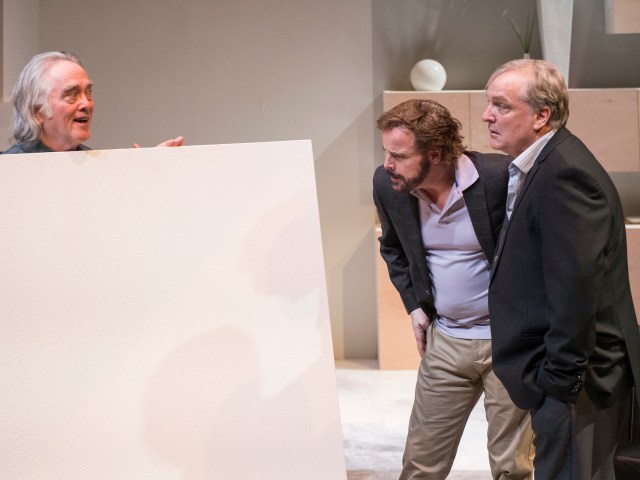
Glenn Nelson, Frank Zotter, John Sproule in Art, Shadow Theatre. Photo by Marc J Chalifoux

By Liz Nicholls, 12thnight.ca

The centrepiece of Art, the Shadow Theatre season finale, is the quintessential modern provocation/sight gag: a big-ticket white-on-white painting by someone famous.

“Modern art” is a perennially combustible subject. Trust me, you can’t be a reviewer and not know that white-on-white diagonal stripes, like beauty, truth, cloud shapes, and good government, are in the eye of the beholder. But in Yasmina Reza’s, er, artful 1994 comedy, a hit (and star magnet) around the world, it’s not so much the painting but its acquisition that’s the canvas for a witty, perceptive exploration of male friendship.

When Serge (Glenn Nelson), a successful dermatologist, lays down 200,000 francs for the all-white Antrios — and moreover loves it — the purchase triggers near-fatal fractures in a long-time three-way friendship.

The white painting is a red flag to Serge’s friend Marc (John Sproule), an aeronautical engineer who prides himself on his skepticism and immunity to trendiness. He laughs out loud when he sees it — and calls it “shit.”

Their younger friend Yvan (Frank Zotter), indecisive and conciliatory by nature, is caught in the middle. Impaled, actually. He’s enlisted as an ally by both, is cautiously affirmative to both, and gets attacked by both for cowardice and treachery. Marc calls him “disastrously open-minded”; later in the play he gets called an amoeba.

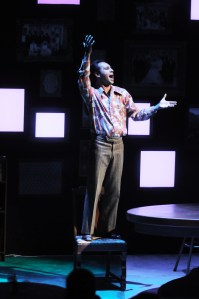
The characters step out of the frame from time to time — in squares of light wittily designed by Stephanie Bahniuk to be a counterpoint to the white canvas— to make their case directly to us, in a play of power struggles and shifting alliances. The first scene,  where Serge shows off the Antrios to Marc, is a little silent physical comedy of quizzical head tilts of appraisal and hand gestures. You’ll recognize them immediately: the gestures (like Serge’s) that invite enthusiastic praise, of the ‘so waddy think? pretty great eh?’ stripe; the gestures (like Marc’s) of being taken aback (‘you’re kidding right?), then getting exasperated. In John Hudson’s production Nelson and Sproule set up a combustible chemistry.

Art proceeds in brushstrokes, by minute escalations and niggling assessments, to arrive at an explosion of long-standing grievances, frictions, resentments, regrets — a point of ignition where using the word “deconstruction” is like throwing a live grenade, and calling something a “motel painting” is like beheading someone’s dog. Even the term “artist” is a touchy one to Marc, whose initial incredulity progresses to outrage, and then the fury of the betrayed.
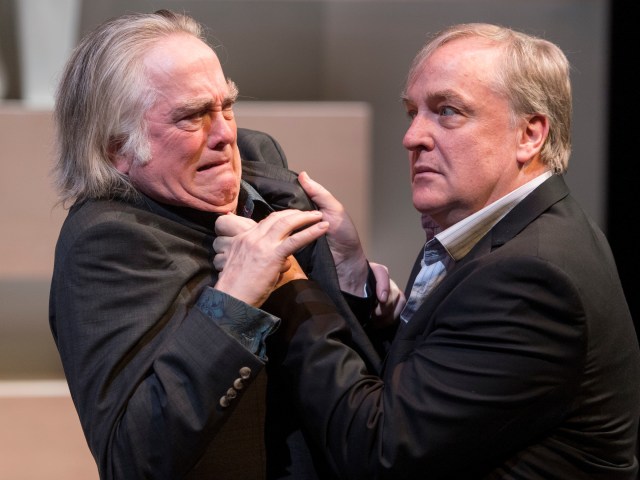
Glenn Nelson, John Sproule in Art, Shadow Theatre. Photo by Marc J Chalifoux.

The performances have big, colourful, emotional pay-offs.  Sproule as the furious Marc, and Zotter as the breathless Yvan, who’s adopted a certain wheedling agility to survive, are up for that, and then some. Nelson has a certain dry urbanity as Serge. And there’s a brief respite in the funny scene where they argue about where to eat; you don’t very often get to overhear three men argue about a restaurant without the clutter of women.

But the production seems rather overheated: it doesn’t so much escalate as explode, immediately. This mis-calibration of fire-power is a little hard on incremental tension and mounting dread: almost immediately Art has nowhere to go but louder. Which means that (a) Zotter’s Yvan gets robbed of the full comic impact of his hilarious show-stopper of a rant  about the infinite complications of his upcoming wedding and (b) even a sleek 90-minutes can seem over-extended. 

There’s no shouty about C.M. Zuby’s elegant white set, a reference to expensive minimalism,. Amusingly Serge’s place gets transformed into Marc’s and Yvan’s apartments simply by adding paintings signally their respective tastes, or lack thereof. And Bahniuk’s lighting, which adds slats of illumination in geometric shapes and cut-outs is a work of art in itself. 

The jaunty music, salsa-diluted jazz, speaks the language of sitcom. But as the questions about art cede to questions of friendship  — can it survive incompatible aesthetic judgments? is it better in the end to opt for the white lie, so to speak, over total brute honesty? — Art is moving. 

When she picked up an Olivier Award for comedy for Art in  London in 1996, the Parisian playwright famously said “I’m surprised. I thought I’d written a tragedy.” She was probably joking.

REVIEW

Art

Theatre: Shadow

Written by: Yasmin Reza

Directed by: John Hudson

Starring: Glenn Nelson, John Sproule, Frank Zotter

Where: Varscona Theatre, 10329 83 Ave.

Running: through May 14

Tickets: 780-434-5564, TIX on the Square (780-420-1757, tixonthesquare.ca
  

Posted in Reviews | Tagged , , , , , | Comments Off on Art: is the price right? A review of the Shadow season finale

Prima viene la famiglia! Farren Timoteo’s Made In Italy, a review

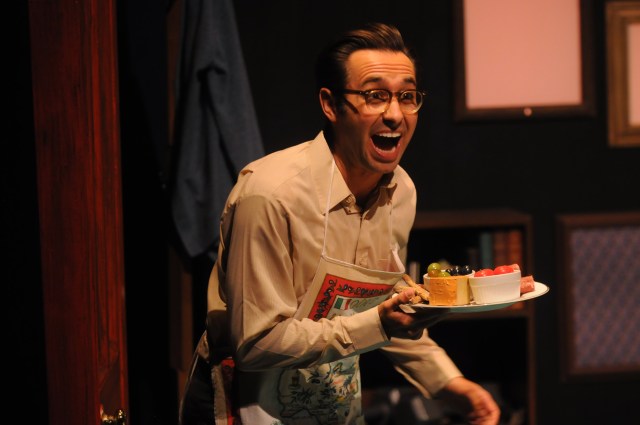
Farren Timoteo, Made In Italy. Photo by Murray Mitchell

By Liz Nicholls, 12thnight.ca

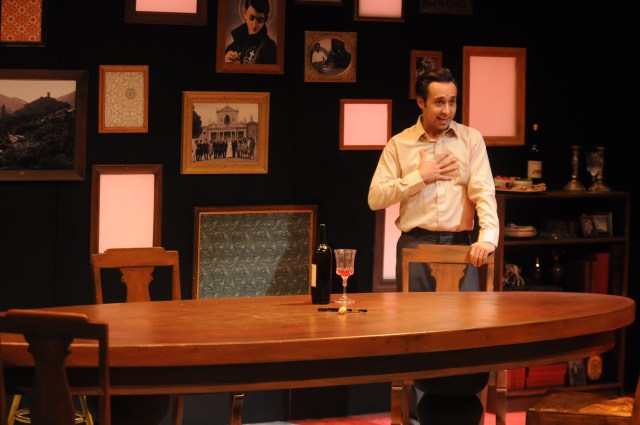
The centrepiece of Made In Italy is a long wooden dining room table.

In the course of the funny, touching, many-character solo play by Farren Timoteo, its agile creator and star will sit behind it and also answer the riddling age-old question ‘how can one man be said to sit around a table?’. He will sing and dance on it, lift weights on it, catapult off it, open bottles of wine on it, bring course after course of signature Italian dishes to it, create an entire family of characters around it. Single-handedly.

It’s not just a piece of furniture, as old Salvatore, the father, tells us at the outset, from his dining room stronghold (designer: Cory Sincennes). It’s the heart of the house, a symbol of everything that’s right about being Italian. Isn’t there something irresistible about a convivial, flavourful culture that sings its songs, discusses its issues, resolves its problems, makes its plans, together over great food and wine?

You know this, my pasta-seeking friends. Playwright Timoteo knows this (since he’s drawing on his own family experiences and structuring his play as a series of courses). Salvatore Mantini, transplanted Italian in Jasper, Alberta, knows this. Salvatore’s brother and their wives and assorted Mantinis  on both sides of the Atlantic know this. Salvatore’s unhappy teenage son Francesco, however, just wants to fit in, to disappear into the great Canadian homogeneity instead of being bullied by it.

And when there are sausages hanging from the front porch, bocce balls all over the lawn, and red wine-making stains on the driveway, this seems to be impossible. Francesco remembers his six-year-old self, opening his eyes to the reality of being different. “It was the single worst day of my life!” 

 The tensions built into the immigrant experience, between the first and second generations — the familial expectations of the first and the guilt-making departures of the second — escalate in the coming-of-age story that unfolds, course by course, aperitivo to dolce, in Made In Italy. It’s not easy to be the only Italians in Jasper, Alberta in the 1960s and 1970s. The epithets lanced your way are harsh; you’re very apt to get your ass kicked when your dad makes you wear a suit to school. 

Whazza matter your head?” cries Francesco’s perplexed dad as his outcast kid starts “getting into trouble” at school. “I get mad to him,” Salvatore tells us. His constant refrain is “How come I take the boat across the ocean?! This is why we come to Canada?”

It’s a warm-hearted show; Timoteo has large affection for both father and son. That both characters on which his story is strung are played by the same protean actor, gives a certain resonance, a fine-tuned humour/heartbreak blend, to the notion of  family: Francesco in the end is his father’s son. That all the other characters, cocky cousins and sidekicks, idiosyncratic uncles, lugubrious aunties, exotic Italian sirens in the homeland, are created by the same virtuoso actor, in staccato scenes — even, impossibly, at the same dinner party — is a major part of the fun, in Daryl Cloran’s production.

Farren Timoteo, Made In Italy. Photo by Murray Mitchell

It’s a bravura performance from a startlingly multi-talented playwright/ actor/ singer and — as we see before our very eyes in very funny scenes choreographed by Laura Krewski — acrobatic contortionist dancer. The vocal and physical transformations, sometimes happening mid-sentence, are hilariously precise. And, in Cloran’s rhythmic production, they’re paced to accelerate.

Francesco is prepared to consult with St. Gabriel, according to him one of the Italian saints “who doesn’t exist just for swearing.” 

Farren Timoteo, Made In Italy. Photo by Murray Mitchell

But redemption from a terminal disaffection with everything Italian comes not from saintly counsel, but the inspiration of one man: Rocky Balboa, the Italian stallion. And there’s disco, and John Travolta, as Timoteo sets forth in riotous scenes of preening self-improvement. Time invested in good hair is never wasted, he explains, and demonstrates in one of the show’s funniest scenes.

As for the venue, the Citadel Club, there is something exactly right about hoisting a glass of wine in the company of the charismatic twinkly old fellow who’s hoisting one in yours. Capiche? 

REVIEW

Made In Italy

Theatre: originally produced by Western Canada Theatre, Kamloops

Written by and starring: Farren Timoteo

Directed by: Daryl Cloran

Where: Citadel Club

Running: now through May 7

Tickets: 780-425-1820, citadeltheatre.com

Posted in Reviews | Tagged , , , , , | Comments Off on Prima viene la famiglia! Farren Timoteo’s Made In Italy, a review

Keep making sense: Sense and Sensibility at the Citadel, a review

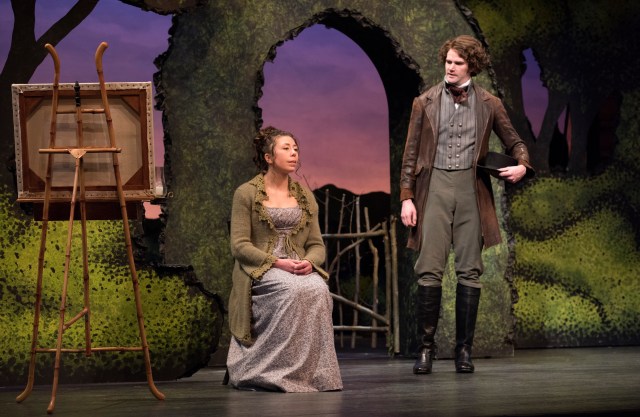
Madison Walsh and Patrick Dodd in Sense and Sensibility, Citadel Theatre. photo by David Cooper

By Liz Nicholls, 12thnight.ca

In the Citadel of an evening, you can overhear talk of annual incomes, real estate and mortgages, annuities and entailments, wills and estates, pre-nups. And, of course, renos. 

And no, gentle reader, it isn’t in the lobby. It’s coming from the stage.

Remarkably, it’s the hard-headed, essentially modern, comic brilliance and social savvy of Jane Austen’s first novel Sense and Sensibility, coming at us from the 1790s — and captured in a radiant, compulsively entertaining new adaptation by Tom Wood.

The quest to find true love is universal and evergreen; it’s  especially thorny in an age ruled by social accountants, a world of extravagant sleeves that hearts weren’t meant to be worn on. Austen knew it. Wood makes a heartfelt and funny romantic comedy of it. And the zestful theatricality of Bob Baker’s production sets it into urgent motion from the outset.

A very English idyll, a Sussez still-life in an elaborate golden frame, with a painterly sunset (lighting by Stencil Campbell), cut-out greenery and one pianoforte, is suddenly alive, and busy, and dimensional. Real plants arrive onstage, along with lamps, elegant windows, rolling furniture. Suddenly, there’s music (original, apt lilting tunes by Allan Gilliland), and people, people with pressing social and/or romantic goals.

Suddenly, we meet a mother with marriageable daughters, a go-for-the-gusto widow, an arriviste with a pliable ninny for a husband; we meet conniving fiancées, eligible cads, thuggish rich kids, bookish misfits. And, as per the title, two sisters, one restrained and measured, the other impulsive and histrionic. There’s a third sister, too, the youngest who doesn’t get to be in the title, but gets a charming comic role in Wood’s adaptation.

They’re the Misses Dashwoods. The eldest, Elinor (Madison Walsh) advises caution and discretion in dealing with the setbacks brought on by the death of their father, and dispossession by their weakling step-brother’s awful wife Fanny. “We must all live together.” It’s a social credo that will be sorely tried by a world that is hyper-alert to the minutiae of income.

Her sister Marianne (Julia Guy), the musician of the family (with a lovely Gilliland song to sing) places no such restrictions on behavior, but plunges directly and openly into the life of the passions.

Young Margaret (Emily Siobhan McCourt), who’s more Marianne than Elinor, is the family diarist, gleefully putting the details of their world into lurid novellas-in-progress and “theatricals” where bad people will meet gruesome ends. 

The design, by the great Leslie Frankish, sees into the heart of a production that’s all about changing the surfaces of a period landscape, both rustic and urban, into drama. Which counts as a witty visual thought about the page-to-stage provenance of the whole enterprise. And when you see Julien Arnold, in an ample brocade waistcoat, coming around a cut-out hedge to enter as the expansive country gentleman Sir John Middleton, in a marvellously exuberant 3-D comic performance, you’ll know exactly what I mean. 

Sense meets sensibility in Baker’s expert stagecraft: Re-decorating (and the servants to do it) is a way to chart the aspirational thrust of a society that is vigilante about every step in upward mobility. So is Frankish’s extravagantly amusing assortment of gowns and frock coats and millinery, mop-cap to  bonnet to full feathered, taffeta-trimmed extravaganza.

The director/designer Baker-Frankish partnership is one of the outstanding features of Baker’s 17-year artistic directorship at the Citadel, just ended. And this is a production that amply reveals its rewards.

Threading through Wood’s adaptation is the theme of portraiture. Elinor is a painter, and the notion of seeing beyond surface features into the hidden “essence” behind respectability, is a thought that ripples through Sense and Sensibility. “I could not live without my pencils and paint,” Elinor tells the diffident Edward Ferrars (Patrick Dodd), who admires her at her easel. “They enable me to sort things out.”

Things will, indeed, take some sorting out. The plot is all about the fortunes, social and romantic, of the penniless Dashwood girls as they take up a life of “reduced circumstance” in deepest Devonshire. Sir John, the country squire who befriends them, fears there’s a shortage of eligible men in the neighbourhood. Well, it may not be raining men. But suitors appear.

Julien Arnold, Robin Craig, Madison Walsh in Sense and Sensibility adapted by Tom Wood, Citadel Theatre. Photo by David Cooper.

And so does Sir John’s companion Mrs. Jennings. A performance of perfectly-pitched hilarity and bustle from Robin Craig is, along with Arnold’s as Sir John, the comic centrepiece of the evening. She’s a peppy, “particularly gifted” expediter of marital arrangements, voluble, well-meaning, alert to every clue. “Are you married?” she asks brightly, by way of introducing herself to each Miss Dashwood. “No? We’ll certainly have to remedy that!”

As for the men, there’s Willoughby (Matt O’Connor), a young man for whom the term “dashing” was probably invented. Marianne abandons all caution and falls head over heels for his flashy charms. The onward momentum of Wood’s artfully streamlined adaptation falters only once, when it gives the longest speech of the evening, by far, to a remorseful Willoughby late in the evening, once everyone has lost interest in him.

There’s Edward, sweetly shy, unflashy and tongued-tied in Patrick Dodd’s performance. A magnet for awkwardness, he often seems to be held up by his boots. Elinor’s affection, challenged by machinations around her, continues steadfastly, in its undemonstrative way. She cautiously calls it “high esteem” instead of the flashier “love”.

In outer orbit from the intricacies of the plot is Edward’s braying and absurdly acquisitive brother Robert (Sanders).

And there’s the mysteriously gloomy Colonel Brandon (Stephen Gartner), whose advanced age of 35 diminishes his potential considerably in Marianne’s eyes. Thirty-five! she cries. “He must have long outlived every sensation of the (romantic) kind … it’s too ridiculous!”

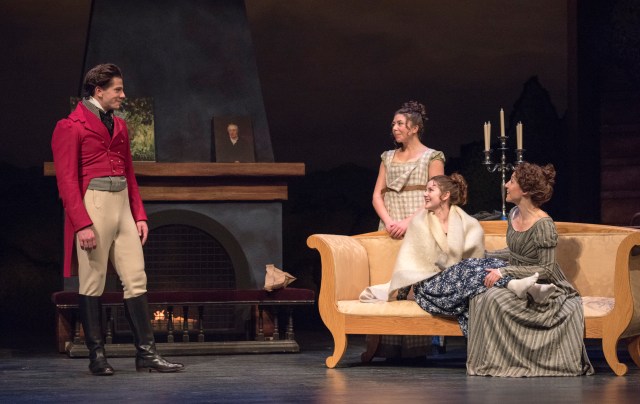
Sense and Sensibility adapted by Tom Wood, Citadel Theatre. Photo by David Cooper

Most of Baker’s cast are participants in this year’s Citadel/Banff Professional Program. And the Elinor and Marianne of the production are wonderfully cast. To Madison Walsh as Elinor falls the assignment of conveying an intensity of feeling she will not permit herself to reveal. And this the actor does, in a performance of beautiful and expressive restraint. She’s matched by Julia Guy’s fresh, funny, heartbreaking performance as the volatile Marianne.

As their widowed mother, Belinda Cornish turns in a performance of agreeable maternal warmth and slightly addled cordiality, in a role that’s been sanded of some of the delicate comic contours it has in the novel. 

On the other hand there are performances where the full-blooded comic vigour of the production bursts through the the decorous surfaces of the 18th century altogether. Kristin Johnston’s as Fanny is one. In the performance, the villainously mean and avaricious wife of the feckless Mr. John Dashwood is heightened into a sort of cartoon grotesque. Her comic excesses are amusing but misjudged, inflated well beyond plausibility.

You find you care about the heroines; they’re up against it, and you want them to succeed. The storytelling of both the adaptation and Baker’s lavish and vigorous production share a kind of breathless but natural pace. It’s a seductive evening, propelled by “the promise of deeper possibilities” as Edward puts it. He’s talking about painting but he might be talking about theatre.

Sir John promises early on “there will be capering!” He’s spot on. 

REVIEW

Sense and Sensibility

Theatre: Citadel

Adapted by: Tom Wood from the Jane Austen novel

Directed by: Bob Baker

Starring: Madison Walsh, Julia Guy, Belinda Cornish, Julien Arnold, Robin Craig, Patrick Dodd, Stephen Gartner, Matt O’Connor

Running: through May 14

Tickets: 780-425-1820, citadeltheatre.com

Posted in Reviews | Tagged , , , , , , , | Comments Off on Keep making sense: Sense and Sensibility at the Citadel, a review

But is it Art? three guys sitting around discussing a painting at Shadow Theatre

Glenn Nelson, Frank Zotter, John Sproule in Art, Shadow Theatre. Photo by Marc J Chalifoux Photography 2017

By Liz Nicholls, 12thnight.ca

Scene: Three guys in a room discussing a play about three guys in a room discussing a painting.

The play under discussion is Art, the elegantly minimalist 1994 play by Parisian actor/playwright Yasmin Reza that’s the finale to Shadow Theatre’s 25th anniversary season. The three guys discussing it are the actors in John Hudson’s production. And the room? They’re hanging out in the hospitably appointed new green room at the new Varscona Theatre  — “same ambience! without the smell!” as Glenn Nelson gracefully puts it. There is no argument about this.

There is, however, about the painting. It’s a bone of contention for the three old friends in Art and it’s an intriguing point of departure for veteran stage actors who are used to contradictory responses — it’s dreck! it’s a masterpiece! — to every play they’ve ever been in. “It’s wonderful, amazing, great, to do a play that’s so well-written,” says John Sproule, to general assent and a rueful group sigh. They’re remembering plays they’ve been in where those adjectives would just not apply. In a million years.    

The painting in Art is a big-ticket piece of modern art, a white-on-white painting by someone famous that bends the geometry of a three-way male friendship to the breaking point.

Glenn Nelson, Frank Zotter, John Sproule in Art, Shadow Theatre. Photo by Marc J Chalifoux

Serge (Nelson) is the successful dermatologist who’s just shelled out big-time for it. His friend Marc (John Sproule), an engineer, is outraged, by the painting, the price, the implications. And Yvan (Frank Zotter), — who’s about to get married to someone both his friends hate — is the conciliatory type who’s constantly getting caught in the middle, and then getting accused of being wishy-washy.

“I’m their punching bag,” grins Zotter. “I go home and cry quite often…. In fact, I could cry right here, but then they’d win.”

Art was written originally in French, translated by the British playwright Christopher Hampton. ‘Blanc’ is funnier than ‘white’,” laughs Sproule. And begtween ‘merde’ and ‘shit’, “merde is much the funnier word,” adds Nelson. 

“Marc calls the painting ‘shit’! Serge wasn’t expecting lavish praise maybe, or praise at all. But ‘shit’!?”

“That’s harsh,” agrees Zotter.

It’s by escalations like that the argument in Art becomes, as Sproule puts it, “inherently personal…. Someone who’d buy that painting isn’t the Serge Marc thought he knew. It’s a personal affront.” Nelson nods. “Art is about friendship. The painting is a character in the play.”

Sproule is a big Reza fan; he was in a Shadow production of Reza’s The Unexpected Man in the early 2000s. And he’s struck by the way she “can create comic suspense from ordinary circumstances.” In Art, it’s the tension of watching a play about a painting become a play about friendship, and you think “O my gawd, the trains are heading toward each other.…” Zotter agrees. “It feels like inevitability.”

“It’s not so often men speak so personally about their friendship,” Sproule says. “Straight men anyhow,” amends Zotter. Straight anglophone men, anyhow.

“It’s all about keeping the love, and it puts Yvan into a terrible position of having to choose between his friends…. These guys are like two dads to me,” Zotter says of the character he plays. “And they’re destroying the most important relationship in my life. It’s like being a kid and seeing your parents fighting.”

The “discussion” in Art devolves into “funny, petty arguments about each other’s sincerity,” as Sproule puts it. “And they realize it’s petty,” says Nelson. “They realize it’s just a painting; ‘why are we fighting?’”

“So often when you do a comedy, you talk about whether this or that is funny,” says Nelson who has spent the last weeks rushing between Art rehearsals and performances of Peter and the Starcatcher at the Citadel. With Art, “we’ve never once talked about the comedy of it. I don’t even think about it. These guys are beyond serious….” 

As for the painting, “I’ve never been in a play where a prop set piece has mattered so much!” laughs Zotter, fresh from a run of Mary Vingo’s Refuge at the Firehall in Vancouver. Next year he’s “the guinea pig” in a new master’s degree program in acting at U.B.C.

The contentious canvas has been painted by designer C.M. Zuby to have a pebbly surface, so the characters might, as per the play, plausibly find threads of other colours in it (Serge makes a case for red). 

Does Serge really love the painting? Nelson thinks he does. Does he love it because the painter is a big deal, along with the price tag? Hmm. “What is truth?” says Nelson. “The harder you work on it, the harder it is to answer that….”

PREVIEW

Art

Theatre: Shadow

Written by: Yasmina Reza

Directed by: John Hudson

Starring: Glenn Nelson, John Sproule, Frank Zotter

Where: Varscona Theatre, 10329 83 Ave.

Running: Thursday through May 14

Tickets: 780-434-5564, TIX on the Square (780-420-1757, tixonthesquare.ca)

Posted in Previews | Tagged , , , , | Comments Off on But is it Art? three guys sitting around discussing a painting at Shadow Theatre

The world of Jane Austen comes to the stage in Tom Wood’s new adaptation of Sense and Sensibility

Sense and Sensibility, adapted by Tom Wood, Citadel Theatre. Photo by David Cooper

By Liz Nicholls, 12thnight.ca

With Sense and Sensibility, premiering on the Citadel MainStage Thursday in a Bob Baker production, playwright Tom Wood returns to the small-town Regency life into which he first tumbled, without Jane-ite baggage (even carry-on), in 2008.

Then it was Pride and Prejudice, Jane Austen’s sharp-eyed tart-tongued comic novel of 1813. Wood’s stage adaptation was specially created for the debut participants in the Citadel/Banff Professional Program.

Now, in honour of the 200th anniversary of Austen’s death, the playwright/actor returns happily to “that world I fell in love with.” He’s created a play for this year’s Citadel/Banff actors from Austen’s first full-length novel — the first of her six — written at age 19 in 1795.

So, Tom and Jane: What is it about Austen World from the start that attracted the playwright/actor, who has always been a connoisseur of the possibilities in comedy? Last week, he took time to consider. Austen’s eagle-eyed comic portraiture, the dry ironies of her observations, her tough-mindedness about the harsh social realities of the day, “especially for the women of the age, looking for love but having to marry for security, to not lose their place to live, to survive …”

“Women do really smart work-arounds…. They take that horrible situation (the strategic marriage) and work it, in a way that gives the male system the finger! Austen’s heroines are quite remarkable!” declares Wood, whose series of Citadel adaptations includes Chekhov’s Uncle Vanya, the Goldoni farce A Servant of Two Masters, the Dumas swashbuckler The Three Musketeers, and the hit stage version of A Christmas Carol that’s become a veritable Edmonton institution.

He’s musing at the moment on Pride and Prejudice’s smart,  resourceful Lizzie Bennett, the second of five girls in a family with a problematic surplus of marriageable daughters and an equally pressing, and related, shortage of money. “The way she’s able to run into a Mr. Darcy and be every inch his match!”  Wood shakes his head in admiration.

Let no one argue the Austen canon is anything but rich when it comes to appealing and substantial women’s roles, as generations of filmmakers, TV writers, librettists and playwrights haven’t failed to notice. And that, says Wood, is a considerable attraction for director Baker, the Citadel’s former artistic director who heads the Citadel/Banff program.

With Sense and Sensibility (originally titled Elinor and Marianne), there’s not one heroine, but two. The Dashwood sisters seem to  represent the polar axes suggested by the title: head vs. heart, prudent and restrained vs. expressive and emotional.

“One is practical and calm. Since Mrs. Dashwood is a lightweight, Elinor becomes the real mother of that family,” as Wood describes it. “Marianne is the drama queen,  emotional and not at all practical…. And the story is how they fare. We watch how they cope with what comes at them.”

Sense and Sensibility adapted by Tom Wood, Citadel Theatre. Photo by David Cooper

“It’s so worthy of drama! So satisfying! A great big feast!” says Wood, who has devised a way for a cast of 14 to populate the world of the story. “And the characters they encounter are so vivid…. The costumes are on fire from all the quick changes.”

The plot is set in motion by the plummeting of the Dashwood family fortune. As per inheritance law, the estate has gone to the son, whose mean, avaricious wife prevents any largesse toward the widowed Mrs. Dashwood and her three daughters. Early in the novel, and Wood’s adaptation, they lose their home.

When you can’t work and you can’t inherit — the situation for genteel women — your only prospect is in an advantageous marriage.  “The minute a man enters the room, it’s ‘what does he make?’ And ‘is he tolerable? Can I stand to be with him?’” 

Sense and Sensibility adapted by Tom Wood, Citadel Theatre. Photo by David Cooper.

The cliché about period English drama is that it’s “ye olde ruffles,” grins Wood. Wrong wrong wrong. “Austen’s observations,” says Wood, “are brilliant, hard-headed. And the characters are dead serious, which is what makes it funny.” 

And there are stakes. “As in Dickens, there’s no safety net for a family who’s had a lot of money and now has none. They are instantly desperate. What do you do? You downsize. You write your relatives. You tell your mom she can’t have this or that….” He laughs. “In Downton Abbey, not Austen, you hold your nose and get yourself a rich American.”

Adapting any novel for the theatre starts with  rejecting narration, Wood thinks. “No narration!” is his mantra. “Narration is for novels! The lifeblood of theatre is dramatic action, when one person wants something and the other person doesn’t want to give it to them.”

Austen’s lines sparkle. But Sense and Sensibility is particularly tricky, because usable dialogue is at a premium. In fact, as Wood points out, the novel’s first incarnation was a series of letters, back and forth. And description doesn’t have a natural home onstage. It is a truth universally acknowledged that a playwright in possession of a good novel must be in want of … dialogue, not description.

So the playwright had to step up. When you’re sharing writing duties with Austen, you’ve got to be delighted whenever the cast didn’t know whose lines were whose. Wood admits he was.

In a society with a thick carapace of proprieties and manners, what is not said is often more meaningful than what gets verbalized. “When you’re in a medium, like theatre, with no close-ups, in a period when women can’t say what really think, you have to be really clever at showing the subtext.”

“Elinor has to be the rock of the family; she has to undergo all her pain and suffering in silence. I had to find ways to reveal what she’s feeling so I made her a painter…. In portraiture she can express what she feels.” What is she painting? A portrait of the beloved house they’re about to leave. It speaks volumes about loss when she can’t.

Says Wood, “it’s a great novel. And she’s a great heroine.”

PREVIEW

Sense and Sensibility

Theatre: Citadel

Adapted by: Tom Wood from the Jane Austen novel

Directed by: Bob Baker

Starring: participants of the Citadel/Banff Professional Theatre Program, as well as Julien Arnold and Jamie Williams

Running: Thursday through May 14

Tickets: 780-425-1820, citadeltheatre.com

Posted in Previews | Tagged , , , , , , , | Comments Off on The world of Jane Austen comes to the stage in Tom Wood’s new adaptation of Sense and Sensibility

Fun with the famiglia: Farren Timoteo talks about Made in Italy

Farren Timoteo, Made In Italy. Photo by Murray Mitchell.

By Liz Nicholls, 12thnight.ca

When Farren Timoteo was seven years old, he arrived home from school one day to be greeted by his dad with the following (delivered in a portentous tone): “I think you’re old enough now.” 

Luigi was holding two VHS tapes, and he put them on: Rocky and Rocky II. It was, says Timoteo, “an important coming-of-age moment. A cultural moment.”

As he explains, Rocky finds its way into Made In Italy, his one-man show inspired by the story of his Italian family. It gets its Edmonton premiere Thursday in the Citadel Club. It’s a turning point for the young protagonist, who’s having a tough time of it growing up Italian in a small, virtually Italian-less Alberta town. “In Rocky Francesco finds the Italian role model he’s looking for.”

Farren Timoteo, Made In Italy. Photo by Murray Mitchell

As for the young Timoteo himself, “I flipped out for Rocky. I was a Rocky freak! We had to rent it every week,” he laughs. “What I really wanted to do was a Rocky play with my friends. Which really meant jumping around on a mattress in the basement…. I remember going round to all the neighbours to invite them. Nobody came. And thank god for that! Except for my mom, of course….”

He laughs. “Well, it’s pretty weird to be 33 and still jumping around on mattresses…. But I get paid to do it!”

Maybe it was only a matter of time till the actor/ director/ artistic director/ playwright created a show inspired by the Italian family he grew up in. Looking back on it one morning last week — his day off from the acrobatic challenges of a sensational performance as pirate king Black Stache in Peter and the Starcatcher — he muses that there were signs everywhere.

“As a performer I’d impersonate my family for laughs. For them.” In high school, he did stand-up “using my Italian family as material.” When he auditioned for the Christmas pageant in high school, he did original vignettes of “Italians at Christmas.” In theatre school, when there were solo performance sketches to be created, Timoteo’s were Italian.

When Timoteo and his Alberta Opera partner (the late Jeff Unger) were creating their cheeky original fairy tale musicals, they lighted on the bizarre convolutions of Carlo Collodi’s Pinocchio. And they went Italian, in both book and music. “It was one of those markers,” says Timoteo.

He went back to his alma mater to direct Light in the Piazza, the Craig Lucas/ Adam Guettel musical set in Florence and galvanized by the seductive idea of Italian romance. And he was in the Theatre Calgary production of last season. 

And OK, more recently, there’s this (and, ladies and gentlemen, can it be mere coincidence?): In Peter and the Starcatcher, the Mollusks, exotic island cannibals led by Fighting Prawn, speak a lingo derived exclusively from Italian cuisine. Every night while Timoteo was bringing down the house as Black Stache, he’d hear exclamations like “manicotti!” and “prosciutto!” float by. And even, in an improbable Act II plot development, “pasta fazool.” Says Timoteo, it’s always been my favourite! I’ve learned to make it!”

Inevitable, really, that Made In Italy would come to pass. Especially since Timoteo had a fascinating story to work with. “I started to understand that my family had a really unique story,” says Timoteo. “Emigrating specifically to Alberta, and what that was like for them. My father’s story growing up in a small-town with not many Italians at all….” 

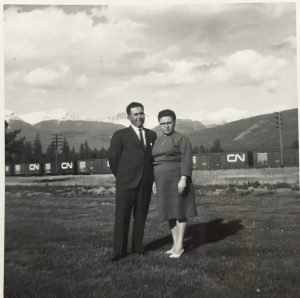
That would be Jasper, AB. where Timoteo’s grandfather had arrived from Abruzzo in the ‘50s, with the idea of getting a job (he did, on the railway), bringing his family, creating a better life.

Farren Timoteo’s grandparents. Photo supplied.

“I had never considered before that it might have been difficult to be Italian,” Timoteo says. “My whole life has been pretty awesome. It’s great to be Italian! And I’d never considered there’d be a time and place when it wasn’t…. I took a bigger interest in my family than ever before. And, theatre aside, that was such a beautiful thing to be doing.”

“So I had this idea for an Italian-themed show,” says Timoteo, born and raised in Edmonton. “But I told Patricia (his actor wife Patricia Zentilli), I couldn’t even consider doing it till I’d been to Italy,” and specifically Abruzzo, ancestral home of the Timoteos. Then, for his 30th birthday, just after his Sterling Award-winning turn in the Citadel’s Spamalot (significantly, as a knight who is more interested in singing than fighting), it happened.  

And his last excuse for delay was gone, as Zentilli reminded him. That’s when Daryl Cloran, then the artistic director of Western Canada Theatre in Kamloops, got involved as director and dramaturg. And Made in Italy had its premiere run in Kamloops.

Since then Cloran has moved to Edmonton, Timoteo’s home town, to be the Citadel’s artistic director, just the kind of plot loop you find in  screwball comedies or O. Henry short stories. 

“This is what I know; this is what I think I know; this could happen next….” That’s how Timoteo describes his starting point two years ago, when the fictionalizing impulse took over. “A lot was invented and a lot really did happen; it’s a jumble!” he smiles.

The names are changed; the Timoteos have become the Mantinis. And “there’s no Farren or Farren-like character in the show…. It’s  about the relationship between an Italian father who emigrated from Italy and his teenage son who grew up in Jasper in the ‘70s.” So, “two perspectives and in two different time lines.”

The father has striking resemblances to Timoteo’s beloved Italian grandfather, who passed away last July. “I don’t really impersonate him. But his spirit is very much alive in Salvatore:  spunky, loved kids, loved to laugh, really joyous and passionate, made his own wine.. just a huge lust for life! And I get to carry that with me onstage.”

Farren Timoteo’s
grandmother. Photo supplied

“There was always going to be music!” Timoteo says happily, of a show where, yes, there’s disco! In this he was partly inspired by his dad Luigi, “a musician to this day,” who sang and taught himself the guitar (his band recently had a reunion). “Music is important to him and important to me…. Maybe it’s all those musicals I’ve written, and seeing the energy music brings to a show.” he says thinking of all the insubordinate musical versions of fairy tales he’s created for Alberta Opera. 

Timoteo has fond childhood memories of huge Italian dinner parties. “Relatives from all over the province would come. The Timoteos of Jasper would be there (laughter); yes, relatives, including my grandmother’s sister, still live there. And they’re coming to the show!” 

Farren Timoteo, Made In Italy. Photo by Murray Mitchel

It seems absolutely right, therefore, that Cory Sincennes’ set would be “a great big Italian dining room, with a huge dinner table, and a back wall plastered with photos of Salvatore’s family — “that just happen to be pictures of my family.” And Timoteo, who plays 19 characters in all — mostly older than Francesco and “mostly amalgams” — has created “a dinner table scene I just love to do, where I play everyone!”

In preparation for Made In Italy Timoteo researched one-man shows of every possible kind: stand-up comedians, pop stars, dance solos,  “anything where one person was on the hook to tell the whole story.” He studied Justin Timberlake concerts, Spalding Gray’s Swimming to Cambodia, Billy Bishop Goes To War. Ah yes, and Métis Mutt, a brilliant one-man show by Edmonton’s Sheldon Elter.

“I wanted to create something that’s fun and is a one-person show for a reason, not just because I wanted to tell it by myself,” he smiles. There were more than a few times when he thought “hey, I could solve this (problem) with another performer”.

“And I had to ask ‘would that be better?’ It made me have to justify my sense that it needed to be told by a one person. And in the end, I think, it paid off.”

“I have such a personal connection to the material,” says Timoteo. His grandfather’s passing is on his mind. “We’re a short people…. It was very sad, but I looked at him and thought ‘he’s done SO much with this life, this little body….”

” I get to be in a profession with our own ways to say goodbye.” 

PREVIEW

Made In Italy

Written by and starring: Farren Timoteo

Directed by: Daryl Cloran, in association with Western Canada Theatre

Where: Citadel Club

Running: Thursday through May 6

Tickets: 780-425-1820, citadeltheatre.com

Posted in Previews | Tagged , , , , , , , , | Comments Off on Fun with the famiglia: Farren Timoteo talks about Made in Italy

O those dancing bones and the story of Alberta: The Bone Wars, a review

The Bone Wars or The Curse of the Pathological Palaeontologists, Punctuate! Theatre. Photo by Mat Simpson.

By Liz Nicholls, 12thnight.ca

There’s something pretty wacky and exhilarating about catching a musical comedy about warring palaeontologists any time — but especially on Earth Day and the March For Science weekend. Take it as a sign of global heartwarming.

But then, we’re in Alberta. And the brontosauran-size cast (13 strong) of The Bone Wars: The Curse of the Pathological Palaeontologists are singing and dancing on the “greatest dinosaur graveyard in the world.”

Science nerds and showbiz come together and kick up their heels to a backdrop of hoodoos in this new Matthew MacKenzie comedy, designed for both kids and grown-ups. The Bone Wars premieres in a startlingly large and appealingly kooky production directed by Chris Bullough for the Edmonton indie company Punctuate! Theatre.

It is, not unexpectedly, a comedy with questions to ask. MacKenzie’s 2015 Bears is, to my knowledge, the repertoire’s only “multi-disciplinary comedy about the Northern Gateway Pipeline.” His macabre black comedy Bust, which debuted at Theatre Network earlier this endless winter, was set in Fort McMurray, against the backdrop of the fire and the declining fortunes of that oil boom town.

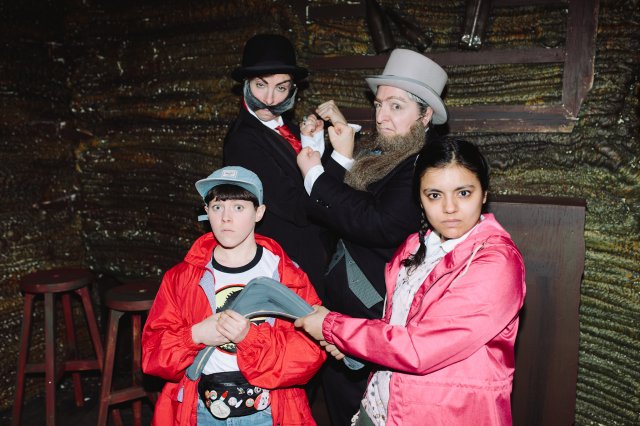
This time, the playwright’s muse has been oiled, you might say, by the distinctively weird history of Alberta — and specifically the history that put the fossil into fossil fuel in the first place. Still, the sight of Davina Stewart and Leona Brausen in top hats and tail coats duking it out riotously as the two legendary Victorian dinosaur bone hunters Edward Cope and Othniel Marsh, claims new territory in theatrical unexpectedness. And they are very funny; vaudeville comes to palaeontology. Finally.

The Bone Wars or The Curse of the Pathological Palaeontologists, Punctuate! Theatre. Photo by Mat Simpson

These Victorian scientists were former friends turned arch-rivals. Their insatiable one-upmanship, pursued to absurd lengths, launched the so-called “bone wars.” Being a destination for rapacious bone pillagers was part of the Wild West of Alberta history, as we learn in a highly entertaining, slightly chaotic way in MacKenzie’s tale of science and friendship gone wrong.

Long before Alberta’s oil rush, and long before we were busy co-opting the Klondike gold rush for promotional purposes, there was a bone rush. Bones were gold, dinosaurs were the rage, and the Badlands were big.

Marsh and Cope figure prominently in a story where time travelling happens the old-fashioned way — by canoe, on the Red Deer River — in a part of the world haunted by the ghosts of gigantic beasts.

A terrible storm drives four kids on a Badlands expedition — one observes mordantly that they’ve been aboard “the good ship Catastrophe” — to take cover in an abandoned mine.  When these junior palaeontologists use their expeditionary skills (“commence dinosaur discovery protocol!”), the past comes to life, dinosaurs, dinosaur-hunters, dinosaur profiteers and all.  As one of Laura Raboud’s jaunty songs has it, “the key to the future is dug up from the past.”

Dinosaurs. There’s something about them. Even more than they love the spectacle of adult palaeontologists behaving in outrageously childish ways, kids love dinosaurs. In the interests of accuracy my 10-year-old companion for the evening carefully amended that to “I like dinosaurs” at the outset.

Unlike yours truly, he was well acquainted with many of the dinosaurs in the poster catalogue on the lobby wall; he had thoughts, for example, about pterodactyl vs. pterodon nomenclature. He discussed with a passing theatre director the latter’s preference for the triceratops over other dinosaurs. He had things to say about the founding of the Tyrrell Museum.

In short, dinosaur enthusiasts who are also kids watching adult actors be kids make for a very discerning theatre audience on both counts. And I can report that my companion was highly entertained by the spirit and theatrical ingenuity of Bullough’s production. 

The kid group dynamic captured by sharp-eared MacKenzie, is amusingly set forth by an A-team of actors. A brave expeditionary force of earnest science aficionados led by their teacher (Chantelle Han), they’re hungry for skeletal signs of the dinosaurs “who tragically lost their lives 63 million years ago.” 

The performances are absolutely convincing: good grief, were these people once children? Elena Belyea and Kristen Padayas are hilariously fierce as competitors. Colin Dingwall is the helpful explanatory one, who remembers everything from the manual. Philip Nozuka plays a beaming kid, invariably a beat behind the rhythm of the exchanges, with his own original looped take on proceedings. “I love that guy!” said my companion.

The kids are torn between anxiety, excitement over a discovery, and righteous disapproval of the bone poaching that has corrupted the record of the past. Particularly timely for #marchonscience weekend is their absolute incredulity that there could be anyone alive, ever, who didn’t believe in evolution. I leave you to ponder, momentarily, the story of modern politics and the vagaries of time-travelling backwards.

The Bone Wars or The Curse of the Pathological Palaeontologists. Photo by Mat Simpson.

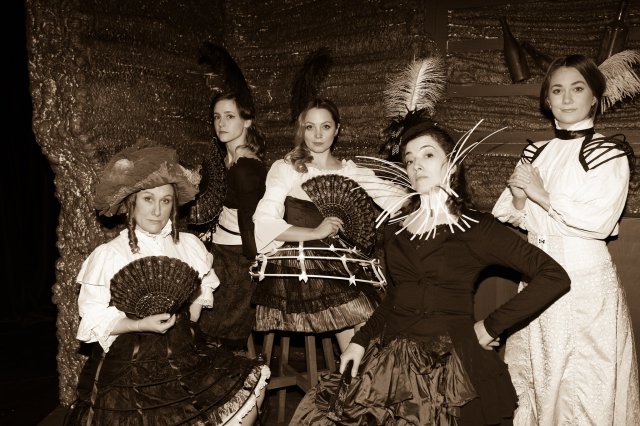
Anyhow, the arrival of a mysterious and spirited troupe of ladies in full 19th century dance-hall regalia, a team of Edmonton theatre faves led by Beth Graham, startles the expeditionary force, understandably. “I don’t think they’re from around here,” notes one.   

They sing, they dance, they conjure. Unlike Macbeth’s witches with their eye of newt, etc. they conjure “by the pterodon’s wings.” Their story of exploitation and the difficulty of finding a fair price for dinosaur bones,” the currency of their time, is all new to me. 

I can give you a rough idea of the plot, but it’s a bit of a maze, in truth. The two legendary rivals Marsh and Cope, appear, in person, competing for the secrets of a mad trapper. The latter is played by Fringe director Murray Utas, in a go-for-the-gusto performance of growly eccentricity my companion found particularly amusing. His loony mad trapper’s duds (designer: Brianne Kolybaba) did not go unnoticed.

The kids must lift “the curse of the pathological palaeontologists” by resolving the infamous Marsh/Cope rivalry (it’s a given; don’t ask). What they decide has implications for the here and now, and into the future of the place where dinosaurs once roamed.

Meanwhile, there’s the theatre fun of The Bone Wars and a subject matter normally addressed by big-budget movies. My companion was particularly struck, as was I, by the inventive movement design of Amber Borotsik. Group dances gradually coalesce; the actors come together to conjure spiny-backed dinosaurs. And there’s a song-and-dance tyrannosaurus who does a mean soft-shoe.

He also had kudos for Raboud’s music, and the live soundscape provided by Stefan Kijek and Allyson MacIvor, and pronounced the lighting on the hoodoos (by designer Zsófia Opra Szabó) “just like in Drumheller.” 

The thing about science, we glean, is that it’s a quest, which might be the shorthand for questions. As the scientist Richard Feynman said (cited on #marchforscience) “I would rather have questions that can’t be answered than answers that can’t be questioned.”

Apparently it’s quite a bit like theatre that way.

REVIEW

The Bone Wars: The Curse of the Pathological Palaeontologists

Theatre: Punctuate! in association with Fringe Theatre Adventures

Written by: Matthew MacKenzie

Directed by: Chris Bullough

Starring: Leona Brausen, Davina Stewart, Elena Belyea, Kristen Padayas, Beth Graham, Murray Utas

Where: The Backstage Theatre, ATB Financial Arts Barns, 10330 84 Ave.

Running: through April 29

Tickets: 780-409-1910, fringetheatre.ca

Posted in Reviews | Tagged , , , , , | Comments Off on O those dancing bones and the story of Alberta: The Bone Wars, a review

Celebrate Will’s birthday: see who he cut from Hamlet before opening night

By Liz Nicholls, 12thnight.ca

Thoughts for Shakespeare’s birthday weekend.…

It’s entirely possible there’s a theatre play ready for germination in every playwright brain.

By that I mean a play about the theatre, and there’s a wealth of raw material to work with. The eccentricities of its high-strung, high-spirited, mouthy practitioners and their large but fragile egos. The scramble to get a script ready to stand on its own too-few legs. The desperate and/or shamelessly creative quest for a grant or a rich patron. Backstage romantic intrigues and rivalries, feuds about the green room fridge, rehearsal insurrections. Onstage disasters with rickety sets or AWOL props, lighting cues, lines, actors….

OMG, there’s just so much that can go wrong or drive you crazy when you’re creating a live world for a live audience to imagine in. And come to think of it, what about that live audience themselves? Infiltrated by loons and drunks answering their phones or laughing in all the wrong place, shouting their disapproval at the stage, or snoring so loudly their fellow theatre-goers fantasize about smothering them. 

Vicious critics, opening night nerves, inebriated leading men, corpses that won’t stay dead. Really, the list is endless. And the repertoire is full of playwrights who took the advice to “write what you know.”

Funny how most of them are comedies. Michael Frayn’s Noises Off (the most sublime of modern farces), Alan Ayckbourn’s A Chorus of Disapproval, David French’s Jitters, Chris Craddock’s early spear-carrier satire The Peons, The Farndale Avenue Housing Estate Townswomen’s Guild Dramatic Society Murder Mystery, Moss Hart’s Light Up The Sky, Ronald Harwood’s The Dresser…. A Brit concoction called The Play That Goes Wrong, apparently a revealing title, is currently flirting with disaster on Broadway. Even David Mamet has a theatre play (A Life In The Theatre).

The Citadel opens its upcoming season with a stage version of the Tom Stoppard film Shakespeare In Love, in which we get to meet a certain up-and-comer (“he has potential,” says the theatre manager) who’s battling writer’s block, struggling with his new work-in-progress Romeo and Ethel. We get to hang out with his theatre pals, drinking in the pub, bitching about scripts.

Even the great man himself, celebrating the big 4-5-3 Sunday, embedded theatre plays in his plays. In Shakespeare’s A Midsummer Night’s Dream, rustics led by the unstoppable thesp Bottom the Weaver put on a play for the entertainment of the court. Centuries later it remains one of the funniest scenes in the history of English theatre.

Tonight, at this year’s edition of Stage Struck, Edmonton’s venerable One-Act Play Festival, you have a chance to catch a short, funny 1985 play populated by the characters who got axed from the scripts of famous plays before opening night. They’re in a retirement home together. In Lyle Victor Albert’s Cut!, you’ll meet Hamlet’s older, more decisive brother Clyde, Stanley’s mom Mrs. Kowalski, Oedipus’s sister Nippletitus.

Gerald Osborn directs, and his rep company (Ruby Swekla, Francie Goodwin-Davies, Jim Zalcik, John Dolphin and Clayton Plamondon) have at a juicy little script full of in-jokes about Citadel flops and long-gone theatre general managers. Curtain time at La Cité francophone, 8627 91 St., is 7 p.m. And the evening, the second of two at this year’s Stage Struck, includes Scot Robinson’s one-act Five Dollar Kick.

And as for tomorrow, you could spend your day speaking only in iambs, as an homage. You could gather the family together, and do a staged reading of The Scottish play in your basement. You could sing some of the well-known songs from Shakespeare’s plays. It’s April in Edmonton: Start with “Blow, blow, thy winter wind” from As You Like It.

Posted in Features | Tagged , , , , , | Comments Off on Celebrate Will’s birthday: see who he cut from Hamlet before opening night

Escape into the playful grown-up world of art: Chris Craddock’s Irma Voth at Theatre Network. A review

Andréa Jorawsky as Irma in Irma Voth, premiering at Theatre Network. Photo by Ian Jackson/ EPIC Photography

By Liz Nicholls, 12thnight.ca

Enter the Roxy, and see what a sense of possibility looks like.

 A shallow stage is dominated by a beautiful translucent wall made entirely of framed windows. Windows that will glow promisingly, conjure paintings or cityscapes, send reflections back at you, open to reveal shadowy glimpses of the what-might-be beyond. Sometimes, amusingly, they’ll just pop open for an talking head cameo, cuckoo-clock fashion. 

In Bradley Moss’s production, Megan Koshka’s design — with ingenious assistance from Scott Peters lighting, Ian Jackson’s videography, Aaron Macri’s soundscape — gets unerringly to the heart of Irma Voth. And I do mean heart. Chris Craddock’s captivating new play, adapted from the Miriam Toews novel, is all about the opening of windows: the possibility of change, light, vision, in sealed-up blinkered lives.

The world, it turns out, is not opaque — even though it never occurs to you to think otherwise when you’re a girl like Irma. And you live in an isolated, fanatically conservative Mennonite sect in the middle of nowhere in the Mexican desert. And you’re at the mercy of a brutally abusive father. It is, as Irma astutely observes, “a very dark pitch-black part of the world” when your only power source is a flashlight.

In the wall of windows there are two screen doors, one that revolves (flinging characters in and out of sight) and one that slams. Now, there’s a metaphor for what’s going on in the lives of two plucky Mennonite sisters, with a baby sister in tow, who find themselves on the lam from their joyless oppression.

And the doors are crucial as well to Moss’s careening, high-speed five-actor many-many-character production. It’s an escape adventure that happens in episodic increments, as Craddock’s play charts in its rapid-fire volley of scenes. The distance between “father will kill you!” and “don’t fuck with the Voth girls!”  — may be totted up in tiny telling moments. But it adds up to light years, as Irma herself (Andréa Jorawsky) concludes as she assesses her break for freedom with her sister Aggie (Kendra Connor).

Kendra Connor as Aggie in Irma Voth, Theatre Network. Photo by Ian Jackson/ EPIC Photography.

Rule-breaking starts with a rodeo, and Jorge (Todd Houseman), the Mexican boy that Irma falls for and precipitously marries, a change-in-status that happens so fast you barely have time to grasp it. Then there’s the Mexican film crew, led by a famous director, that arrives in the community to make a movie about  Mennonites.   

Diego (Kristi Hansen) offers Irma a job translating; his German leading lady doesn’t speak Spanish. “I want her eyes to harm me!” he declares, by way of explaining his Euro casting choice. “She should be too big for her body, so that she is squeezed out through here,” he adds, touching his forehead.

He might have been talking about wide-eyed Irma herself. Which only goes to show you that even peripheral exposure to art and artists can rock your world.

Suddenly, the arid air is invaded by ideas, inspirations, arguments, music, laughter, questions and the people who don’t know the answers but are trying to find them while also getting laid. And, of course, bullshit. Art may be a revelation, a life-changer. But one of the appealing things about Irma Voth is its refusal to be worshipful or grand about artists, or the self-identified “artistic.”

Instead, it takes a tone of amused indulgence about, say, the film techie who explains his whole theory of dreams and survival. Ditto the preposterously married Mexican couple (Craddock and Hansen), a veritable cartoon of play-acted bliss, who give Irma and Aggie a place to live.

In a pellmell escalation not without its scramble farcical elements, there’s life’s rich pageant in Mexico City, full of oddballs, questers, risk, the tango, spontaneous acts of charity, incipient chaos — and art.

“I didn’t know grown-up people could do that,” explains Aggie (Connor), a feisty little insurrectionist, on her knees crying in front of a giant Diego Rivera mural in Mexico City. She’s wonderstruck by the sheer unexpected improbability of art — the impulse to create something beautiful that could express an entire history of human sorrow.

Speaking as we are of the improbability of art, reimagining a novel as a small-cast play is a sort of test case for grown-up playfulness — and theatrical ingenuity, from director and cast. As they ricochet from character to character, there are occasional signs of strain and disintegration, in truth, in a production that’s after the speed of farce but the depth of coming-of-age drama.

At the centre, though, is Jorawsky’s luminous anchoring performance as Irma. She steps in and out of the frame of her story, as both its narrator, increasingly wry in her assessments, and  a player in her own story. It’s an appealingly funny, honest, heart-cranking performance:  Irma is a watchful, open-hearted Candide who valiantly pries herself loose from the lethal shackles of her known world into a brave new one.

And she takes her little sister with her. Aggie, a fierce and funny sidekick and personal goad-er, gets a starchy comic performance from the resourceful Connor. 

Around this sisterly double-axis, the gallery of characters whirl, as Moss’s inventive casts finds ways — some of them less successful than others — to transform on a peso. Among his 10 assignments, including staccato cameos from miscellaneous assorted doctors, cab drivers, film types, Craddock is genuinely scary as the violent, sadistic Mennonite father. Even his beard is pretty ferocious.

Hansen as his long-suffering wife, reduced to secret meetings with her daughters, is a compelling woman of griefs and sorrows. Her performance, though, as the larger-than-life Diego, an artist of outsized passions, seems curiously small-scale, quiet, reasonable even instead of imperious. With his command of precise physicality, Houseman has comic impact in a variety of guises.

It would be the height of socio-cultural irresponsibility were I to explain the machinations of the story before you have a chance to see this very entertaining evening of theatrical storytelling. Suffice it to say light gets shed on the mysterious relocation of the family to Mexico, and there’s a special bonus at the end, a big finish where comedy and heartbreak and even a whiff of satire come together.

The playwright has always been dexterous and smart with the ever-expanding, non-resolvable comic resolution. You’ll already know this if you saw his Summer of My Amazing Luck with its thought that you have to take chances if you want to have a life that turns out “fun and funny and lucky and good.”

After all, freedom is a big-ticket item, as Irma, sadder and wiser and funnier, comes to realize. You have to save up for it. It comes with uncertainty, risk, guilt. And you can’t sit near the exit.

REVIEW

Irma Voth

Theatre: Theatre Network

Written by: Chris Craddock, adapted from the Miriam Toews novel

Directed by: Bradley Moss

Starring: Andréa Jorawsky, Kendra Connor, Todd Houseman, Chris Craddock, Kristi Hansen

Where: Roxy on Gateway, 8529 Gateway Blvd.

Running: through May 7

Tickets: 780-453-2440, theatrenetwork.ca

Posted in Reviews | Tagged , , , , , , | Comments Off on Escape into the playful grown-up world of art: Chris Craddock’s Irma Voth at Theatre Network. A review

Battle of the bone hunters: The Bone Wars is Punctuate!’s biggest show yet

The Bone Wars: The Curse of the Pathological Palaeontologists, Punctuate! Theatre. Photo by Mat Simpson.

By Liz Nicholls, 12thnight.ca

The Bone Wars wasn’t always going to be theatre for grown-ups to take kids to. Far from it.   

Punctuate! Theatre, after all, got its raison d’être, and exclamation point, tackling plays about the conflicted descendants of Nazis (East of Berlin) or Canadian soldiers traumatized in Afghanistan (This Is War) or The Suburban Motel Plays of George F. Walker that look at what the terminally dysfunctional and/or criminal get up to behind the flimsy walls of cheap motels.

But that was before playwright Matthew MacKenzie went on a field trip — to the Tyrell Museum in Drumheller. “We knew we wanted it to be ambitious!” he grins. The Bone Wars “was gonna be just for adults…. Originally I had the idea of making something like There Will Be Blood, which seems to me like one of the most Alberta movies ever made — but with dinosaurs! It just seemed like a hilarious thing to do.” 

The playwright and Punctuate!’s can-do young producer Sheiny Satanove sat down last week to explain the change in plans for their dinosaur show. At the centre of The Bone Wars: The Curse of the Pathological Palaeontologists is the rivalry between legendary Victorian era dinosaur bone hunters Edward Cope and Othniel Marsh, played by Teatro La Quindicina leading ladies Davina Stewart and Leona Brausen. “The rivalry devolved and mutated, into something nutty!, and reached a cartoon-level absurdity by the end,” grins MacKenzie. The escalations of these so-called “bone wars” — bribery, theft, back-stabbing, public smears— bankrupted both wealthy fossil aces, and fuelled a great period of discovery.

There was no end to their competitiveness, MacKenzie discovered. One proposed having his brain officially preserved after death, in order to enable precise measurement of his nemesis’ brain when the time came, so the world would finally see who was smarter. His opposite number apparently didn’t sign off on the idea.

The Bone Wars: The Curse of the Pathological Palaeontologists, Punctuate! Theatre. Photo by Mat Simpson

At 13 actors and two musicians, The Bone Wars: The Curse of the Pathological Palaeontologists, billed as “a time-travelling musical comedy for all ages,” is the biggest production ever from the enterprising indie theatre. Biggest, and possibly heaviest, pound for pound. Last week MacKenzie and Satanove earned a late-day beer with a day that included the unusual theatrical task of moving a custom-made steel triceratops ribcage through a stage door, thanks to a friend with a moving company. “Who’d build a theatre set out of steel?” Satanove laughs and rolls her eyes.

But then, why dinosaurs? “It’s Alberta!” declares Satanove, who found herself painting giant hoodoos last week.   

Alberta is a veritable hotbed of elite dinosaurs, as MacKenzie had confirmed years ago prowling through the Natural History Museum in New York. There’s an Albertosaurus or two in that august institution (big head, skinny legs, “saw-edged flesh-slicing teeth,” as the museum website has it). And the Edmontosaurus, a relatively modest 7,500-pounder in his previous life, has a New York pied à terre there, too.  

Back to the Tyrrell. MacKenzie and his fellow traveller, one of the cast members of The Bone Wars, were, he says, “the only people there without kids. And it was quite cool to see the dinosaurs through the kids’ eyes.” The attention span of the average four-year-old, taxed to the max by eating one bowl of Cheerios while sitting down, can easily encompass 15 triceratops skeletons, no problem. “We look around. The parents are exhausted; the kids are just going for it!”

Yes, kids love dinosaurs. The affection of kids for dinosaurs, even the homely ones, is one of the great mysterious bonds of modern times. And, as Satanove puts it, “it just seemed mean to do a show about dinosaurs that wasn’t accessible for kids!”

Affirmations are everywhere. When Satanove got picked up for a  Passover dinner last week, her little cousin, in the single-digit age bracket, was glued to The Land Before Time in the car. She took this to be a sign. 

MacKenzie grins. “Not only are kids interested, but they have this bizarre advanced knowledge.” They know their tyrannosauruses from their stegosauruses, their pterosaurs from their iguanodons.

Kristen Padayas and Elena Belyea in The Bone Wars: The Curse of the Pathological Palaeontologists, Punctuate! Theatre. Photo by Mat Simpson.

The idea of The Bone Wars, says Satanove, was a show that’s kid-friendly but with a lot of jokes for grown-ups too. Which is the m.o. of the Pixar canon, as she points out. MacKenzie discovered the felicities of that double-optic with Tick, his kids’ play about youthful protest that was his exit project at Montreal’s National Theatre School. “I found out how much fun adults have watching kids laugh, and the reverse.”

Two of the youthful characters of Tick, including its spirited title heroine, find their way into The Bone Wars. And two of the actors in Chris Bullough’s cast, Elena Belyea and Philip Nozuka, are fresh from a Tick run in St. Catharines.

A trio of 11-year-olds on a canoe trip down the Red Deer River to the Badlands — prime dinosaur bone territory — take shelter in an abandoned mine. And they find themselves in the Wild West of Alberta’s bone rush, judging the celebrated palaeontologist rivalry.

Tick has its comic moments, says MacKenzie of his story of a girl who goes up against City Hall, armed with heroes like Che. The Bone Wars “has way more slapstick elements,” he says, reporting that he was inspired by an unstoppably funny cast in rehearsal, and director Bullough’s own “expert sense of physical comedy. “The climax is a big physical theatre number that’s right out of Bugs Bunny.” At a run-through last Saturday, “I laughed myself into a really bad headache.”   

There’s music. Laura Raboud composed the songs. MacKenzie laughs, “it’s totally Bollywood; anything can happen: incantation, rhyming, actual numbers.” There’s a soundscape too, created live by a couple of inventive musicians, new to theatre, who were to be seen in a parking lot a few weeks ago, making a thunder machine out of a bicycle. “The buy-in has been complete with everyone.”

There’s choreography. “No CGI!” says Satanove. “We wanted to use the magic of theatre.” And MacKenzie is a believer in “the power of movement.” In his Bears, for example, choreographer Ainsley Hillyard devised the protagonist’s cross-mountain journey with a sort of dance chorus. This time, the answer to the question “how do we do the dinosaurs?” is choreographer Amber Borotsik.

The scale is rare enough in large theatre companies, and unheard of for indie operations like Punctuate!, as the playwright happily  acknowledges. “Just to have 13 people all onstage pretty much all the time!” he beams. “When you don’t ever write for more than four actors! It’s super-challenging. Amazing!” 

“We like massive,” grins Satanove, who shepherded Punctuate!’s six-play Suburban Motel series into a rep series in 2015. ”We’ve written so many grant applications!” she says permitting herself a sigh.

“It’s about creative art; it’s also about creating jobs in the industry.”

PREVIEW

The Bone Wars: The Curse of the Pathological Palaeontologists

Theatre: Punctuate! in association with Fringe Theatre Adventures

Written by: Matthew MacKenzie

Directed by: Chris Bullough

Starring: Davina Stewart, Leona Brausen, Murray Utas, Beth Graham

Where: The Backstage Theatre, ATB Financial Arts Barns, 10330 84 Ave.

Running: through April 29

Tickets: 780-409-1910, fringetheatre.ca


Posted in Previews | Tagged , , , , , | Comments Off on Battle of the bone hunters: The Bone Wars is Punctuate!’s biggest show yet