Negotiating the darkness of the world: thoughts about This Is The Story Of The Child Ruled By Fear

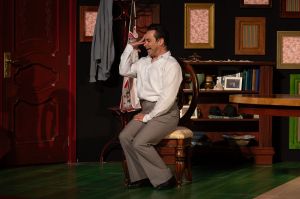
David Gagnon Walker in This Is The Story Of The Child Ruled By Fear, Strange Victory Performance. Photo by Gergo Koroknay

By Liz Nicholls, 12thnight.ca

We are, none of us, dread-resistant, times being what they are. That sense of being alone and untethered in a universe that’s a chaos of crises and emergencies is a feeling lots of us know.

It’s no way to live, you could argue. The show that’s arrived at Workshop West (for a short run till Sunday) wonders about that. This Is The Story Of The Child Ruled By Fear, which premiered at Common Ground’s Found Fest in 2021, is David Gagnon Walker’s bold experiment in theatrical collaboration.

In this it takes theatre, always mouthy, at its word. A communal experience, live engagement between artists, and between artists and their audiences, is at the heart of things, fuelled by stories, as theatre is fond of saying, of itself. All true, of course. The explicit proposition on offer here, which ups the ante by lowering the stakes and whisking the fourth wall away, is that theatre creation contains a chemistry in community-building for an evening, one that can produce energy and joy.

To help support 12thnight.ca YEG theatre coverage, click here.

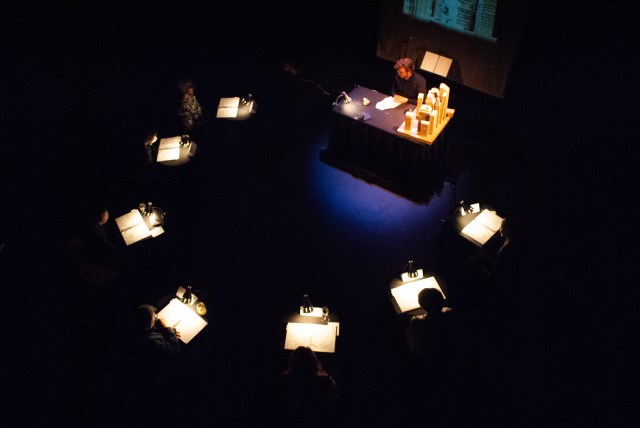
In The Story Of The Child Ruled By Fear, a homecoming for the Edmonton ex-pat artist after multiple cross-country successes, Gagnon Walker and the audience share a story by actually telling it together, reading it out loud. Led by the playwright as the narrator and a projection-scape by designer Tori Morrison, seven audience volunteers, seated at tables with a lamp and a script, take on characters (the title character is divvied among them). The rest of us, sitting in the usual theatre seats, are a Greek chorus who can join in on group delivery of projected lines. Or not. The intersection between art and life, a spiritual and aesthetic tenet of the live theatre, is explicit: “We’re real. We’re real. We’re real.”

I know what you’re thinking, and so, evidently, does Gagnon Walker, who arrives onstage in unique fashion. “My name is David. Right now I have a bucket on my head.” Yup, audience participation, very often an exercise in group alienation (speaking as we are of universal dread), makes it work. But this participation is so chill, so easy-going and unforced, that joining in is pretty much irresistible. There is, quite literally, no reason not to.

The story that unfolds in a series of scenes is a fable about an imaginary child in an imaginary world, where an imaginary civilization magically rises around them, and falls. The poetic text has a simple incantatory quality about it, with humorous, sometimes jarring,  interpolations, some of them from Gagnon Walker’s own life in Edmonton and all of them inconclusive. And Morrison’s video- and soundscape mingle, in an intriguing an oftn amusing way, a wash of imagery and specific storybook detail.

I don’t want to tell you more, because the “discovery” of the story, in the shared telling, is crucial to the whole experience. There is the unexpected pleasure that we’ve been invited to participate in the process of artistic creation, not usually available to non-artists (like me). Suffice it to say that there was much laughter, and something easeful too, in the impulse to share — and the proposal that there is a way, if not to conceal or obliterate, to negotiate the terrors of the world and the rule of fear.  Communally.

The truism that we’re all in this together has been at crucial moments in our history, to be sure, a sort of universal excuse for passivity (the disastrous escalation of environmental destruction, for example, under the ‘it is what it is’ mantra). But in This Is The Story Of The Child Ruled By Fear, the demonstration of human connectivity and an invitation into the world of theatre creation aren’t just a consolation, or a flotation device.

I left the theatre, and a discussable and pleasurable evening, with a renewed appreciation that theatre, the art form of real people together in the same room sharing an experience, is on the right track. We’ve always known it: it’s validating to have a demo from an artist, a true original, that it’s meaningful, even cathartic, to tell stories together about what haunts us, scares us, weighs us down. There’s wonder in it. And wonder is enlivening.

REVIEW

This Is The Story Of The Child Ruled By Fear

Theatre: Strange Victory Performance at Workshop West Playwrights Theatre

Created and performed by: David Gagnon Walker 

Directed by: Christian Barry and Judy Wensel

Where: Gateway Theatre, 8529 Gateway Blvd.

Running: through Sunday

Tickets: workshopwest.org  

Posted in Reviews | Tagged , , , , , , | Comments Off on Negotiating the darkness of the world: thoughts about This Is The Story Of The Child Ruled By Fear

David Gagnon Walker invites us to tell a story together: This Is The Story Of The Child Ruled By Fear at Workshop West

David Gagnon Walker, This Is The Story Of The Child Ruled By Fear. Photo by Henry Chan/

By Liz Nicholls, 12thnight.ca

“What is this theatre thing?” asks the innovative theatre experimentalist David Gagnon Walker. “This strange thing we do, getting 50 or 50 people in a room together to tell a story together … What’s unique about theatre? What can it do that other art forms can’t do as effectively?”

To help support 12thnight.ca YEG theatre coverage, click here.

This Is The Story Of The Child Ruled By Fear, the Gagnon Walker play that opens a short run Wednesday in the Workshop West season is an immersive theatre experiment on that very subject. It’s a personal invitation from one of the country’s most exciting and adventurous young theatre artists to join him in reading aloud a story together. It’s a story “in the register of fable or a Grimm’s fairy tale,” he says, of the rise and fall of an imaginary civilization in an imaginary land. “Dark, fantastical, and full of monsters and magical occurrences….. More like the real Grimm, darker than the stories we usually tell children at bedtime.”

“It’s the kind of story that, culturally, we know how to tell out loud…. Reading a story is something anyone who’s spent any time hanging out with children knows how to do.”

Gagnon Walker started writing it just before the pandemic, and the experience it offers resonates with our moment, heavy and getting heavier all the time. And, he thinks, it brings the specialness of theatre to bear on “the anxiety, the dread, the panic, the loneliness we all feel privately…. It’s the special thing the theatre situation can do with those feelings, feelings that are dark and isolating, and turn them into an opportunity to connect with other people.”

“I didn’t write a show about depression, anxiety, loneliness because I’m not familiar with them.”

“This show is all about that, trying to create some kind of communal experience from feelings that are not normally communal.… It’s a bit of a paradox I guess: I like writing about isolation for the theatre. I’m interested in that! ” And there is, he thinks, a kind of catharsis in that gathering, the sharing, the laughing and breathing together. “It’s recognition … the thought that I’m not the only person who feels that way.”

Audience participation, two words that tend to fling some of us back cowering into our seats, eyes to the floor. This is different. There’s no yanking or coaxing. The experience is all to your own comfort level; “people can determine how involved they want to be.” As the playwright/performer explains, seven volunteers join him onstage, at seven tables, each with a script and highlighted lines — “just like actors do on the first day of rehearsal.” That first day of rehearsal, says Gagnon Walker feelingly, “has always been lightning in a bottle for me. There’s just something that happens the first time a group of people read a play together.”

Everyone else can sit back and watch, and if they choose get in on moments — “there’s a big video event in the show” — “of choral group chanting of lines.”

David Gagnon Walker in This Is The Story Of The Child Ruled By Fear, Strange Victory Performance. Photo by Gergo Koroknay

“It’s a big ask,” Gagnon Walker acknowledges. “We’ve done a lot of thinking about how to make it gentle and friendly, as fun and funny as possible, as un-intimidating as we can. But once we actually start, the audience always knows how to do it; everybody just automatically remembers that we already know how to do this.”

Since its 2020 development in Halifax — Gagnon Walker, fresh out of the National Theatre School at the time, was 2b theatre’s ‘emerging playwright-in-residence’ — This Is The Story Of The Child Ruled By Fear has travelled the country. Eight cities later, the production by Gagnon Walker’s own Strange Victory Performance returns the playwright to his home town, and the play to the place where it was born.

The idea came to Gagnon Walker in 2017 in an experiment at Edmonton’s Found Festival, a celebration of unexpected encounters between artists and audiences.  For Productive Time, the festival sourced him an apartment, “and I locked myself in for 72 hours, live-streaming myself writing a new solo play.” When the time was up, “I invited an audience into the apartment and I performed it for them.”

“During the performance I printed out script pages for audience members and handed them out to the audience. We read aloud a 10-minute section…. For me it was a real lightbulb moment…. It was my favourite part of the project, reading aloud with other people and telling the story together.”

It planted the irresistible idea of “making a whole show like that,” Gagnon Walker says of the interactive theatre for which he’s become known. And at Found in 2021, This Is The Story Of The Child Ruled By Fear premiered here before it set forth across the country.

Paradoxes, the kind that theatre revels in, attract Gagnon Walker. “Trying to write about loneliness for groups of people” is one. And there’s this:  The Child Ruled By Fear “is such an analogue experience in so many way, real people breathing together and telling a story together. And it’s also a fairly high-tech show,” as multiple live video cameras attest.

The projections are the work of the multi-talented sound and video designer Tori Morrison, Gagnon Walker’s partner and the co-producer of Strange Victory Performance (as well as the artistic producer of Tiny Bear Jaws and the production manager of Outside The March). “She’s the one making all the magic happen,” says Gagnon Walker. “She has a very deep bag of technical tricks, but also a sharp dramaturgical mind. The tech stuff is never for its own sake, always in service of the story, and what the show is trying to do.” Their collaborations happen at the moment of conception, the “question of what’s the situation we’re inviting people into.”

Gagnon Walker himself was an actor at the outset, or more precisely (he laughs) “an acting school drop-out.” After the first two years of the U of A’s acting program, “I had an epiphany. I need to be writing. I felt urgently that auditioning for Shakespeare for the rest of my life wasn’t going to work for me. And that was a really hard decision, a big thing to walk away from.”

At the time he was convinced he was “leaving theatre behind to go and be a poet.” A degree in creative writing in Montreal followed. “Two years later I’d written three plays and done Fringe shows…. I ended up a playwright by quitting acting and thinking I was quitting theatre.”

It was the energy and sparkle of collaboration he found he missed, “figuring things out with other people. And it’s still my favourite thing…. I’ve tried. But you can’t get that sitting alone in your apartment.”

That’s why he values so highly the sense, “surprising and interesting,” of offering people a glimpse into the artistic process, the particular creative energy of a first day of rehearsal. “In my own life it has been the best thing I have going for me.”

And it’s why, after three or four years of touring, “I never get tired of doing the show,” he says of This Is The Story Of The Child Ruled By Fear.” There’s a new cast every night. And, especially, the seven volunteers witting with me onstage are completely different, with different energies. Some are nervous, some are totally rock stars…. They’re equally appealing to me.”

But maybe the most special nights, he thinks, happen when “somebody volunteers who clearly doesn’t do this kind of thing very often, or ever, and is taking a chance on us and our show, hoping to have a nice time, then having an experience that’s joyful for them … the arc of going from being nervous to feeling relieved, happy, and part of a community.”

“It feels really good.”

(Playwright/ performer/ producer David Gagnon Walker is also, as Bigfin Squid, a singer-songwriter. Catch him at the Aviary Feb. 5).

PREVIEW

This Is The Story Of The Child Ruled By Fear

Theatre: Strange Victory Performance at Workshop West Playwrights Theatre

Created and performed by: David Gagnon Walker 

Directed by: Christian Barry and Judy Wensel

Where: Gateway Theatre, 8529 Gateway Blvd.

Running: through Sunday

Tickets: workshopwest.org  

Posted in Previews | Tagged , , , , | Comments Off on David Gagnon Walker invites us to tell a story together: This Is The Story Of The Child Ruled By Fear at Workshop West

The Citadel unveils a new season of 10 shows. Here’s the 2024-2025 lineup

By Liz Nicholls, 12thnight.ca

Shakespeare gets reimagined in two high-contrast productions in the upcoming $13 million 2024-2025 season unveiled by Citadel Theatre artistic director Daryl Cloran Monday night.

To help support 12thnight.ca YEG theatre coverage, click here.

Of the four musicals announced in the 10-show lineup at Edmonton’s biggest playhouse (up from nine show this season), one’s a version of the Bard’s most popular comedy, one’s a Broadway blockbuster, one’s Broadway-bound, and one is a small-scale Alberta-made Indigenous version of a ‘70s classic.

Big productions, with international connections, will be onstage next season. And, by way of balance, “we get behind local artists and small innovative Canadian projects, too … an important part of our job,” says Cloran, of a lineup that includes a new mainstage crime caper of Alberta provenance.

Taking its cue from the continuing success of his much-travelled border-crossing As You Like, a romantic comedy partnership between Shakespeare and the Beatles, Cloran is devising (and directing) a big new ‘70s musical version of A Midsummer Night’s Dream, which premieres Feb. 22 to March 23. It match-makes Will and David, Shakespeare and Bowie respectively, in a glam-rock era production that capitalizes on “the fantastical elements of Dream,” says Cloran. It’s easy to see Puck in that world, looking like a David Bowie.”

“So much of Dream is about performance,” he says. “The ‘mechanicals’ are building a show, and it’s easy to see them as a struggling rock band…. So there’s great room for song. And that period in particular felt like a fit” for Bowie, Elton John, the BeeGees, Marvin Gaye, Olivia Newton-John et al. The Citadel is currently at work acquiring rights to that ear-worm repertoire. Cloran’s script-adaptation partner is Kayvon Khoshkam, artistic director of Shakespeare on the Saskatchewan, memorably funny as the clown Touchstone in the Beatles-infused As You Like It.

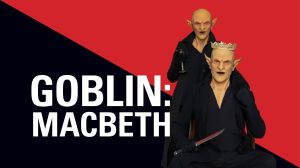
A Midsummer Night’s Dream: The 70s Musical, premiering on the Maclab stage), has a highly unusual companion piece in the Citadel’s Rice Theatre. A trio of goblins, in full goblin gear, happen upon a Complete Works of William Shakespeare, and pick the goriest to perform. Goblin:Macbeth (Jan. 11 to Feb. 2), which arrives trailing raves from successful runs at Vancouver’s Bard on the Beach, Stratford and currently Calgary’s Vertigo Theatre, is the work of the unstoppably inventive theatre artist Rebecca Northan (Blind Date, Undercover) along with Bruce Horak. And this Spontaneous Theatre Creation re-launches the Citadel’s Highwire Series after a year’s hiatus. “Everything you love about Rebecca Northan…. Such a cool mix of the improv and the Shakespeare,” as Cloran describes. “Great comedy and moments of profound Shakespeare acting.”

The “big family musical” in the lineup is Disney’s Frozen: The Broadway Musical (Feb 1 to March 2). Rachel Peake (The Garneau Block, 9 to 5), whose Citadel production of The Sound of Music is coming up in March, directs the new production of the 2018 hit. Among other contagious songs by Kristen Anderson-Lopez and Robert Lopez, it contains Let It Go, which, as every adult knows, once heard never lets go. “Big production values, big costumes, big design challenges,” says Cloran. “A coup to get the rights!”

With The Ballad of Johnny and June (Nov. 2 to 24), the Citadel collaborates with the La Jolla Playhouse — the California theatre where many Broadway musicals, including Come From Away and Jersey Boys, got their start — on a new musical love story about country music stars Johnny Cash and June Carter. The production “has its sights set clearly on Broadway,” says Cloran. And it brings back to Canada notable director Des McAnuff, whose resumé includes a stint as Stratford Festival artistic director, and Broadway hits like Ain’t Too Proud, the Donna Summer Musical, and The Who’s Tommy.

McAnuff’s assistant director in his Stratford days, incidentally, was Cloran, who worked on Shaw’s Caesar and Cleopatra (starring Christopher Plummer) and the musical A Funny Thing Happened On The Way To The Forum.

The fourth of the season’s musical offerings is the LightningCloud production of Bear Grease (Oct. 17 to 27). It’s a much-travelled Indigenous take by (and starring) the Edmonton couple Crystle Lightning and Henry RedCloud Andrade (Evandalism) of the Enoch Cree Nation, on the 1978 classic Grease. “Super-fun,” says Cloran of the piece, which premiered at the Edmonton Fringe. “Really smartly done…. And they have big dreams for the show.” Inclusion in the Highwire Series, returning after a year’s hiatus, is “a great way for us to showcase local artists, get behind a local group and amplify their success, shine a light on it nationally,” says Cloran.

The 2024-2025 season opens (Sept. 21 to Oct. 13) with Cloran’s own production of A Streetcar Named Desire, the Tennessee Williams masterwork he has long wanted to direct, as he says. “A great story, iconic characters,” he says of the co-production with Theatre Calgary. Casting announcements await.   

The mainstage season includes a new play by Alberta writer Arun Lakra, a rare, possibly unique, example of opthalmologist-turned-playwright. Heist (March 22 to April 13), developed as part of the Citadel’s 2022-23 Playwrights Lab and currently onstage at Calgary’s Vertigo Theatre, is a crime caper which gets its inspiration from films like Ocean’s Eleven. “Arun has landed on something very cool here,” says Cloran. Figuring out how to put a heist onstage, the complications of a perfect robbery complete with diamonds, lasers, guns, double-crosses, betrayals, will be the intriguing challenge for a director as yet unannounced.

The season finale (May 3 to 25, 2025), is the North American premiere of a London stage production of Rod Serling’s The Twilight Zone, in the playwright’s 100th anniversary year. A hit at London’s Almeida Theatre which transferred to the West End, the production is an adaptation by Keith Reddin (Life During Wartime) and Anne Washburn (Mr. Burns, a post-electric play) of multiple Twilight Zone stories from the CBS TV series. And after a New York workshop the show brings to Edmonton  the much-awarded English director Richard Jones, to build and hone at the Citadel with an eye to Broadway, à la Hadestown and Peter Pan Goes Wrong in which the theatre had a hand.

As Cloran describes, the piece “takes a bunch of Twilight Zone stories, intertwines them (with the story of an astronaut abandoned in space), and leans into the theatricality.” As in the case of Hadestown and Six, “the international partnership allows not only allows our audiences to see shows first, but us to do a bigger (budget) productions than we could afford to do on our own.”

Before the season starts, the Citadel’s summer production  (July 6 to Aug. 4), is is by Henry Lewis, Henry Shields and Jonathan Sayer, the Mischief Theatre trio who brought Citadel audiences Peter Pan Goes Wrong in 2022. In fact, the 2011 comedy of near-misses and incipient chaos is a precursor of sorts, in which we first meet the earnest, accident-prone thesps of the Cornley Drama Society as they struggle valiantly to put on a 1920s-style murder mystery. Dennis Garnhum, the former artistic director of both Theatre Calgary and the Grand Theatre in London, Ont., directs the Citadel/ Royal Manitoba Theatre Centre/ Theatre Calgary co-production.
No holiday season in Edmonton is conceivable without A Christmas Carol onstage at the Citadel. It’s just that way here. A Christmas Carol returns for a 25th anniversary and the sixth iteration of David van Belle’s 1950s adaptation, Nov. 23 to Dec. 24. And in a cast of more than 30, John Ullyatt returns to the role of the flinty Ebenezer. Lianna Makuch, who has assistant-directed the lavish production for the past few season, steps up to direct.

2024-2025 season packages go on sale, citadeltheatre.com, Jan. 29. Casual tickets for The Play That Goes Wrong are on sale March 14, and the rest of the season July 4. Meanwhile the current season continues with Rubaboo, The Sound of Music, The Mountaintop, and The Three Musketeers.

Looking ahead at the Citadel’s 2024-2025 season: 

Mainstage series: A Streetcar Named Desire (Sept. 21 to Oct. 13, 2024); The Ballad of Johnny and June (Nov. 2 to 24, 2024); Disney’s Frozen: The Broadway Musical (Feb. 1 to March 2, 2025); A Midsummer Night’s Dream: The ’70s Musical (Feb. 22 to March 23, 2025); Heist (March 22 to April 13, 2025); The Twilight Zone (May 3 to 25, 2025).

Summer presentation: The Play That Goes Wrong (July 6 to Aug. 4, 2024)

Highwire Series: Bear Grease (Oct. 17 to 27, 2024); Goblin: Macbeth (Jan. 11 to Feb. 2, 2025).

Holiday production: A Christmas Carol (Nov. 23 to Dec. 24, 2024).


Posted in Features, News/Views, Previews | Tagged , , , , , , , , , , | Comments Off on The Citadel unveils a new season of 10 shows. Here’s the 2024-2025 lineup

Stories and who gets to tell them: The Drawer Boy, funny and moving at Shadow Theatre, a review

Reed McColm, Glenn Nelson, Paul-Ford Manguelle in The rawer Boy, Shadow Theatre. Photo by Marc J Chalifoux

By Liz Nicholls, 12thnight.ca

With The Drawer Boy, Shadow Theatre revives a play that both in itself and its inspiration proved a defining moment for a truly Canadian theatre — and does it proud.

To help support 12thnight.ca YEG theatre coverage, click here.

In Michael Healey’s heartwarming and tough-minded 1999 hit, a naive and earnest young actor from a Toronto theatre company arrives at the door of an Ontario farmhouse. Miles is on location to research farm life for an original collective production. That this imagines, in an amused and amusing way, the art/ real life collision in the creation of  the ‘70s Canuck landmark The Farm Show, is telling, to be sure. And the clash of urban and rural will make for some affectionate comedy in the course of a play whose complications expand in absorbing, fascinating layers.

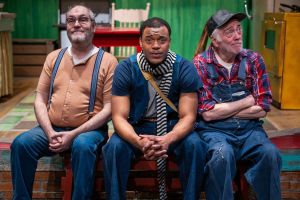
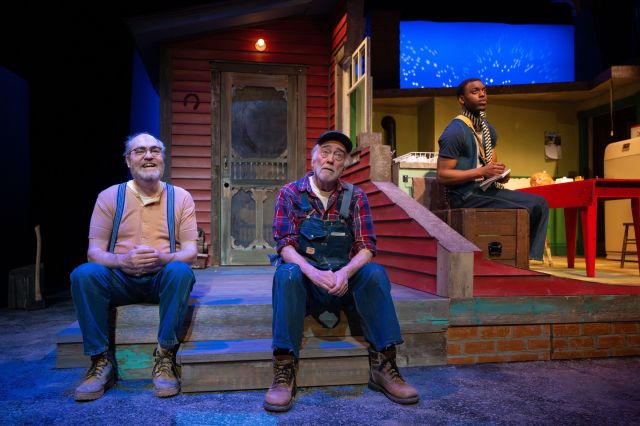
Notebook in hand, Miles (newcomer Paul-Ford Manguelle) is full of questions for the two elderly bachelor farmers, old friends, who live there. “Do cows mind being milked?” he asks Morgan (Glenn Nelson), the crustier, more cogent of the pair, clearly in charge. Miles insists “I’ve done hard things.” After all, he played a hedgehog in a show last year, and it was three hours long!

Reed McColm, Glenn Nelson, Paul-Ford Manguelle in The Drawer Boy, Shadow Theatre. Photo by Marc J Chalifoux

Angus (Reed McColm) is simple, his memory damaged by a World War II head injury. And in his relationship with Morgan, beautifully set forth by the two veteran actors, is a life-sustaining story — a story of friendship, memory, and loss that unlocks other stories. The Drawer Boy confirms in a poignant and dramatic way the power of storytelling and theatre itself. And it’s set in motion when Miles overhears Morgan re-telling to Angus the oft-told narrative of how they came to be where they are, and borrows the real-life story as his contribution to the theatre collective. Theatre seems to unlock Angus’s memory, and the seam between life and art opens dangerously.

Manguelle captures the eager-beaver self-importance of the young actor, who’s gradually struck by the realization, first, that he’s the butt of Morgan’s deadpan mockery, and then by knowing that his certainties aren’t weight-bearing.

Nelson’s sardonic Morgan, who bustles through his world stiff-legged and at high speed, more irascible than taciturn. Seeing the care-giver escalate to panic as the lines between fiction and truth get blurred (or clarified) is a real achievement. McColm the production finds an endearing Angus, bewildered a lot of the time, living in a foggy world lit by disconcerting flashes of the past.

Reed McColm, Paul-Ford Manguelle and Glenn Nelson in The Drawer Boy, Shadow Theatre. Photo by Marc J Chalifoux.

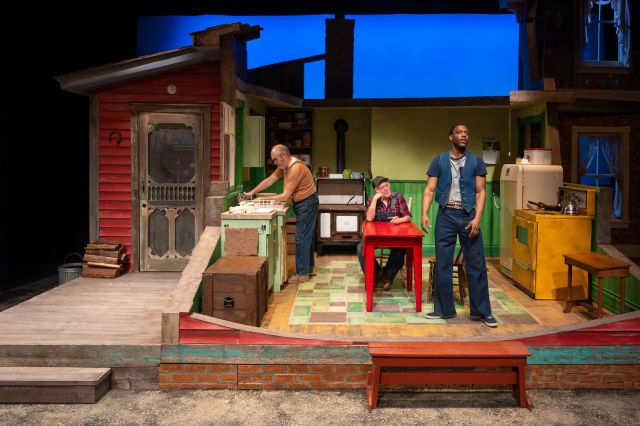
In John Hudson’s spacious production, the characters inhabit an atmospheric old farmhouse that’s designed in glorious detail, down to the screen door and the linoleum, by Daniel vanHeyst. His lighting calibrates time, dawn to dusk, in rural southern Ontario. The scenes are separated by time and Dave Clarke’s apt sound score, cranked a little high perhaps.

After all these years The Drawer Boy remains ready, funny and insightful as it is, to ask perpetually hard questions about who owns stories, and who gets to tell them. It’s a moving experience. If you haven’t seen the play it’s your moment; it you have, it’s time to renew.

REVIEW

The Drawer Boy

Theatre: Shadow Theatre

Written by: Michael Healey

Starring: Reed McColm, Glenn Nelson, Paul-Ford Manguelle

Where: Varscona Theatre, 10329 83 Ave.

Running: through Feb. 4

Tickets: shadowtheatre.org


Posted in Reviews | Tagged , , , , | Comments Off on Stories and who gets to tell them: The Drawer Boy, funny and moving at Shadow Theatre, a review

Up against a dark and maddening universe: Donna Orbits The Moon, a review

Patricia Darbasie in Donna Orbits The Moon, Northern Light Theatre. Photo by Brianne Jang, BB Collective.

By Liz Nicholls, 12thnight.ca

If you’ve ever found yourself furious (and really who hasn’t?) for no reason you can pinpoint, you’ll take to Donna.

To help support 12thnight.ca YEG theatre coverage, click here.

The middle-aged woman we meet in Donna Orbits The Moon is used to being cheerful and even-tempered, famous at bake sales for her gooseberry blondies. Lately, as Donna reports to us, she finds herself explosively angry, leaving a trail of shattered glass, holes in the wall, perplexity amongst her family and friends. And the triggers are unpredictable: rude drivers, vacuum cleaners, the minor pushiness of other people….

In the 2010 solo play by the American writer Ian August, currently running at Northern Light Theatre in a visually beautiful Trevor Schmidt production starring Patricia Darbasie, Donna is up against the mystery of … herself.

Why on earth, for example, would she slap a woman reaching for the same bag of all-purpose flour on a grocery shelf? Why would she grind her husband’s rib-eye steak dinner into the floor, or unleash a string of obscenities at a teenage driver who cuts her off in traffic? It’s so not Donna, as Darbasie appealingly conveys. She’s mystified by her own anger.

“You’re not yourself these days,” says Donna’s husband. Church is not a calming refuge. “It is not the place to discuss the potential homicide of other church-goers,” as she points out, implying that discussion might well take place elsewhere.

Patricia Darbasie in Donna Orbits The Moon, Northern Light Theatre. Photo by Brianne Jang, BB Collective.

The play rolls out an escalating series of episodes in which colours flash, and Donna feels herself spinning out of control in Outer Space, in a fathomless cosmos. And she’s begun to hear a man’s voice in her head. God? The Devil? Some kind of ghost? No, it’s the voice of astronaut Buzz Aldrin, advising her enigmatically to “go up” before she can “come down.”

Describing episodes as they happen is an extreme single-handed dramatic challenge for an actor: is the character re-creating them for us, or experiencing them onstage? The play, the production, and Darbasie’s performance, tries to float both possibilities, which is tricky. But, after all, mysteries are all about holding back.

Patricia Darbasie in Donna Orbits The Moon, Northern Light Theatre. Photo by Brianne Jang, BB Collective.

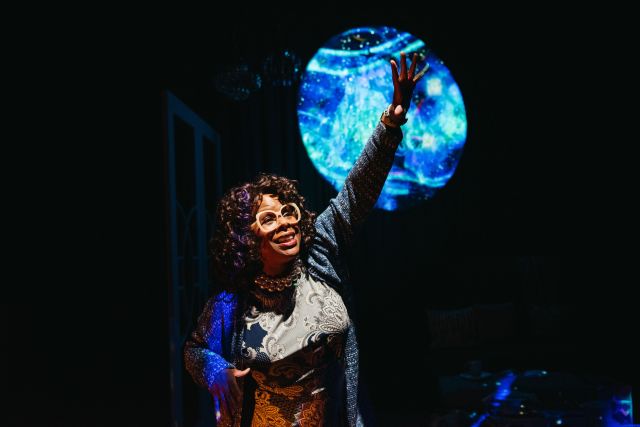
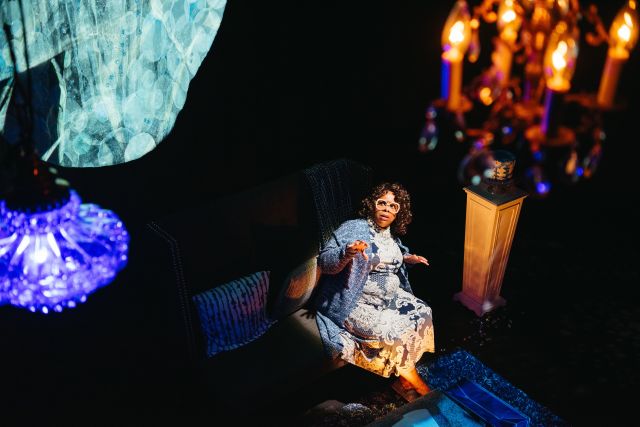
These chapters, each a minor variation, are charted by the striking visuals of Schmidt’s design. The stage is overhung by a giant orb, whose textured surfaces catch the light in subtle ways that suggest the moon, or a disc of veined and beautiful granite, dusted by something sparkly. Rae McCallum’s lighting and Matt Schuurman’s projections exert a kind of magic on the story being told onstage, in a blue-hued room by a blue-clad woman.   

After each”episode,” Donna scrambles to be conciliatory, repeatedly avowing to everyone that she’s fine. Darbasie’s performance conveys a kind of cordiality that gradually turns to desperation. The arc of her unravelling seems to happen in fits and starts; the character becomes less confident, more scattered, and her fury more thinly covering a secret sorrow. The audience will see into the mystery of Donna’s bad behaviour long before her control over it finally fractures and she reveals it.

In the course of the 90-minute play, the nature of Donna’s alliance with the audience seems to change. It won’t give away too much to say that she’s harbouring a terrible heartbreak, a shattering grief, and that the play is a psychological study in denial.

After all her delays, when Donna finally lands, as Buzz Aldrin has advised, the pay-off is release into a dark universe that may be directionless but is full of shimmering stars. The human predicament in a nutshell.

REVIEW

Donna Orbits The Moon

Theatre: Northern Light

Written by: Ian August

Directed and designed by: Trevor Schmidt

Starring: Patricia Darbasie

Where: Studio Theatre, Fringe Theatre Arts Barns

Running: through Feb. 3

Tickets: northernlighttheatre.com

Posted in Reviews | Tagged , , , | Comments Off on Up against a dark and maddening universe: Donna Orbits The Moon, a review

The ‘bad bitches who bought the palace’: The Spinsters, a little review

Christine Lesiak and Tara Travis in The Spinsters, Small Matters Productions. Photo by Ian Walker

By Liz Nicholls, 12thnight.ca

I’m late to the ball, but in the nick of time — it ends today — I caught The Spinsters. And I want to tell you about this highly unusual dark off-centre comedy (for the +14 crowd only).

To help support 12thnight.ca YEG theatre coverage, click here.

The stars of The Spinsters, the latest from the subversives at Small Matters Theatre, hail from the fairy tale repertoire. And they emerge from the wings of one its most durable stories of unregenerate upstaging, Cinderella.

As the title tips us, the siblings we meet in this kooky original created and performed by Christine Lesiak and Tara Travis did not get the handsome, eminently eligible Prince. Or even a minor small-p prince, or maybe a count or duke. Nope. And it’s not like the Prince had impossible standards, fixated as the guy was pretty much exclusively on shoe size. Not only that, the Ugly Stepsisters didn’t even get billing as top-drawer villains — much less back stories or voices, or even names.

Think about it: jealous, vain gold-digger stepmothers, rotten to the core, are everywhere in fairy tales. It does cross your mind, from time to time, that fairy tale fathers have terrible taste in women, but I digress. Snow White’s homicidal stepmother, for example, tormented by toxic vanity, tries to poison her in inventive ways. She’s memorable.

Tara Travis and Christine Lesiak in The Spinsters, Small Matters Productions. Photo supplied.

As for the daughters of vicious stepmothers? Nope. Cinderella’s Ugly Stepsisters are remembered exclusively for being unaccountably mean, the meanest siblings ever, to an annoyingly humble, hard-working, uncomplaining victim. The latter, who has occasionally raised feminist ire for being such a passive ninny, is a paragon who gets the handsome, eminently eligible Prince because she acquires a fancy ballgown (courtesy of a fairy godmother), and has small feet. How exasperating is that kind of cosmic unfairness? And what does it say about the Prince anyhow, come to that?

The fun of The Spinsters, both in the writing and the theatrical execution of Jan Selman’s production, is that it’s payback time. And, after an amusingly annotated shadow puppet theatre intro (directed by Jen Cassady), with a more official version of Cinderella — the step-sisters appear, anonymous no longer.

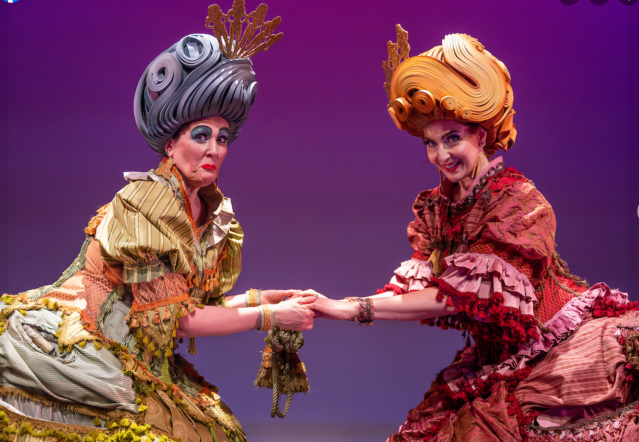
Tormentia (Lesia) and Atrocia (Travis) know how to make an entrance. They sail across the stage, spinning in magical eddies, in show-stopper gowns that seem, in the astonishing design by fairy godmothers Adam Dickson and Ian Walker, to have a showbiz life of their own. The step-sisters are like outsized figures in a high-glam music box, with jointed arms and moveable torsos, and a mysterious rolling mechanism (by Ian Walker) instead of legs under those elaborately tiered shirts. Who needs glass slippers anyhow? You feel sure this pair could glide up the palace walls, or into the audience to flatten skeptics, a veritable armada in party frocks. The witty choreography, hinged in the middle and full of snarky noblesse oblige arm gestures, is by Ainsley Hillyard.

Christine Lesiak and Tara Travis in The Spinsters, Small Matters Productions. Photo by Ian Walker.

Atop  these giant moveable wedding cake sisters are sculpted hairdos that swirl magnificently like icing (design by Dusty Hagerüd with Steven Snider). The limelight has been a long time coming: they are a sight to behold, and they know it. And they’re here, in middle age, to rub it in, reclaim the story that shunted them aside, dish the dirt on the little weasel who has upstaged them. They’re the underdogs of the feminist can-do narrative, the demi-mondaines of the sisterhood, so to speak.

We’ve been invited to a ball at their palace (yup, they bought it), for an evening of “spectacular spectacle” and “glamorous glamour” at “the ball to end all balls.”

“We’re thrilled you could make it,” they say, trying half-heartedly to conceal the gloat. “You’ve been here before, but not since we moved in…. We’re the bad bitches who bought the palace!” And “don’t you love what we’ve done with the place!”

The performances have the dynamic of a clown duo. And both artists are terrific comic performers, at ease interacting with the audience. Lesiak’s Tormentia, the elder of the two and the boss, is snarkier and more calculating about image and damage control. She’s made a name for herself in the field of “fantasy non-fiction.” Travis’s dimbulb Atrocia, a noted scrunchie designer, is scattier, more impulsive and digressive.  

And what emerges from the playful theatricality of the piece (the list of contributing theatre artisans is impressively long), their joint hosting squabbles, and a need for recognition that has gone unsatisfied for centuries, is a surprise I wouldn’t dream of revealing. Suffice it to say the surprise even surprises the characters, as their grand ball at the palace gets away from them in an unexpected way.

The show, which takes on Cinderella from an unusual angle, is ingenious, kooky, and fun. You have two chances today to catch it.

REVIEW

The Spinsters

Theatre: Small Matters Productions and Edmonton Fringe Theatre

Created by and starring: Christine Lesiak and Tara Travis

Where: Westbury Theatre, Fringe Theatre Arts Barns, 10330 84 Ave.

Running: through Jan. 27

Tickets: fringetheatre.ca

Posted in Reviews | Tagged , , , , | Comments Off on The ‘bad bitches who bought the palace’: The Spinsters, a little review

Why is Donna so angry? Trevor Schmidt talks about Northern Light Theatre’s Donna Orbits The Moon, a preview

Patricia Darbasie in Donna Orbits The Moon, Northernm Light Theatre. Photo by Brianne Jang, BB Collective.

By Liz Nicholls, 12thnight.ca

Something weird is happening to the woman we meet in the solo play that opens Friday at Northern Light Theatre, starring Patricia Darbasie. What’s going on with Donna, loving wife, mother, and bake sale celeb?

To help support 12thnight.ca YEG theatre coverage, click here.

With Donna Orbits The Moon, a 2010 comedy/drama by the American playwright Ian August, Trevor Schmidt, NLT’s indefatigable deep-dive theatre researcher artistic director, adds another distinctive woman’s story to the company’s very considerable archive. Says Schmidt, who directs and designs the production, it lobs “a little psychological mystery our way.” And Donna herself is mystified.

Donna is  “likeable and funny” (which sounds a bit like a pocket description of actor/director Darbasie herself, as Schmidt points out). But the character has been having “incidents of inexplicable rage,” as he describes. “Why is she behaving in ways that are very out of character for her?”

Patricia Darbasie, star of Donna Orbits The Moon, Northern Light Theatre. Photo supplied,

Her episodes of bad behaviour not only perplex the people around her — “her husband, her daughter, her friends are all completely confused” — they baffle Donna too. What’s fuelling this unexpected, out-of-character rage? She’s deeply in denial about what’s motivating these episodes.” Schmidt points to theory that anger isn’t a primary emotion, like love or fear. It’s an offshoot, a reaction, a funnel from other things.

“Public appearance and reputation are very important to Donna … appearing a certain way, formality, discretion, conservatism, And lot of church. She’s ‘what would people think if they knew? How could I face them again?’”

“Religion isn’t a major part of this show, but the church is,” says Schmidt. “It’s never about what God would think of me for doing this. It’s what would the other church members think of me…. When she starts hearing a voice it’s not God, it’s Buzz Aldrin.”

The tone reminds Schmidt of The Pink Unicorn, a surprisingly humorous solo play by the American writer Elise Forier Edie about a Christian widow who has to choose sides in her conservative Texas when her teenage daughter announces she’s gender queer. It was an Sterling Award-winner and hit for Northern Light in the 2014-2015 season. As in the case of that protagonist, Donna is “very specific, very likeable, and we care about her emotional dilemma.”

Patricia Darbasie in Donna Orbits The Moon, Northern Light Theatre. Photo by Brianne Jang, BB Collective.

“It’s quite whimsical, I think. And also a mystery you have to slowly piece together, with clues along the way. You have to discover it as she discovers it…. Once you get to the end it all makes sense.”

Cued by the way Donna “finds herself in Outer Space,” Schmidt’s design is inspired, he says, “by the image of a living room floating in space”

Solo shows are, of course, a particular challenge to the actor who has to populate the play, or create a world, single-handedly onstage, in charge of all the words in the play. Darbasie herself wrote and appeared in one: Ribbon, an exploration of Alberta’s Amber Valley, at Studio Theatre. And they’re something of a specialty at Northern Light. The company has a long and varied history with solo shows, like Colm Toíbín’s The Testament of Mary, Schmidt’s multi-character thriller We Had A Girl Before You, the cabaret Baroness Bianka’s Bloodsongs, and more recently the memorably queasy horror story Squeamish. Schmidt himself has performed a few, including Nick Green’s Coffee Dad, Chicken Mom and the Fabulous Buddha Boi.

“I literally thought I might have a heart attack I was so anxious backstage,” he admits. Only the “astute and insightful advice of a sympathetic director” quelled his nerves. She told him “people have come because they like you; they’ve come to support you…. you love the three characters and you’re here to share them.” First-hand experience has made Schmidt empathetic to actor daunted by sole possession of the stage.

“By now we can track where people are at,” he says. He and his frequent stage-manager Liz Alllison-Jorde, an actor/director herself, refers to the second Thursday of the rehearsal period as Crying Day. For the record Darbasie, who directs The Mountaintop at the Citadel later this season, didn’t succumb, says Schmidt cheerfully. And rehearsals for a solo play are shaped by the performer’s own way of working. “It’s not your job to work my way; it’s my job to figure out how you work….”

Patricia Darbasie in Something Unspoken, Northern Light Theatre. Photo by Epic Photography

Darbasie is an adventurous theatre artist.  In the Northern Light production of Tennessee Williams’ rarely produced two-hander Something Unspoken two seasons ago, she played the long-time secretary to a wealthy white spinster in the South of the ‘50s. That she is an actor of colour, a departure in the scant history of that play, was an experiment, as Darbasie told 12thnight at the time. It upped the ante, adding dimensions to the subtle homoerotic tensions of the employer-employee relationship that thread through the play. The mysteries of Donna orbiting the moon solo and looking for a stable landing are well within her compass.

Meanwhile, two new Schmidt plays get their premieres in the second half of the season. Robot Girls, about four teenage girls in a science club struggling to build a robot for a competition, opens at Shadow Theatre (directed by John Hudson) in March. “I have to actually build a robot,” says Schmidt the designer. “There will be a couple of days of Googling for that!” he laughs. In April, Candy & The Beast, his “new multi-disciplinary murder mystery/ thriller,” is the finale of the Northern Light season. It has the ring of prairie goth about it: a girl and her little brother set forth from their trailer court to track down a serial killer in the small town of Black Falls.

“It will be weird,” says Schmidt. “That’s my promise!”

PREVIEW

Donna Orbits The Moon

Theatre: Northern Light

Written by: Ian August

Directed and designed by: Trevor Schmidt

Starring: Patricia Darbasie

Where: Studio Theatre, Fringe Theatre Arts Barns

Running: Friday through Feb. 3

Tickets: northernlighttheatre.com


Posted in Previews | Tagged , , , , | Comments Off on Why is Donna so angry? Trevor Schmidt talks about Northern Light Theatre’s Donna Orbits The Moon, a preview

Meet Paul-Ford Manguelle, the multi-talented newcomer who joins two veterans in The Drawer Boy at Shadow Theatre

Reed McColm, Paul-Ford Manguelle and Glenn Nelson in The Drawer Boy, Shadow Theatre. Photo by Marc J Chalifoux.

By Liz Nicholls, 12thnight.ca

“We’re here to get your history and give it back to you.” — The Drawer Boy

Paul-Ford Manguelle. Photo supplied.

In Michael Healey’s 1999 play The Drawer Boy, a naive young actor from a Toronto theatre company ventures into rural Ontario to research farm life on location for a new collective creation. In the course of Miles’s stay with two elderly bachelor farmers, art and real life collide with memory and identity in intricate and mysterious ways that confirm the power of stories and storytelling.

A bona fide Canadian classic, with a history that includes the landmark collective The Farm Show that came out of the hinterland adventure, The Drawer Boy arrives in Shadow Theatre’s 30th anniversary season Thursday. John Hudson’s production, the first Drawer Boy to be seen here for two decades or so, stars two theatre veterans Glenn Nelson and Reed McColm. And the young urban actor, who arrives on location figuring to write about the rich inner lives of cows, is played by … a young urban actor, a relative newcomer to the scene who seems to have arrived, a fully formed triple-threat with startling natural gifts for comedy, at ease in the acrobatic reaches of dance and song.

To help support 12thnight.ca YEG theatre coverage, click here.

“Miles is a lot like me,” says Paul-Ford Manguelle cheerfully of his Drawer Boy assignment, his first professional gig in a straight play. “Just about my age (he’s 21), and hasn’t been on a farm, or done (that kind of) labour.” So, an innocent out in the countryside? “100 per cent.”

Glenn Nelson, Reed McColm in The Drawer
Boy, Shadow Theatre. Photo supplied.

If you saw Die Harsh, Grindstone Theatre’s clever and very funny holiday musical mash-up of that action thriller and A Christmas Carol, you won’t have forgotten Manguelle’s multiple contributions or his comic dexterity in negotiating them. Among his 13 or 14 roles (and precision high-speed quick-changes of voice, gesture, and hat to match) were a cop and a code-breaker, not to mention a rapping limo driver who delivers one of Simon Abbott’s most memorable songs (Let’s Take A Ride), and his own favourite character, Mary the pregnant hostage. “I workshopped her at the time,” he says. “It was funny and I was proud of her.”

Paul-Ford Manguelle, Mhairi Berg, David Findlay, Evan Dowling, Mark Sinongco in Die Harsh The Christmas Musical, Grindstone Theatre. Photo by Adam Goudreau

Paul-Ford Manguelle, Mhairi Berg, David Findlay, Evan Dowling, Mark Sinongco in Die Harsh The Christmas Musical, Grindstone Theatre. Photo by Adam Goudreau

“It’s a sprint,” he laughs, looking for a descriptive for this kind of crazy stage (and backstage) busy-ness. “It’s daunting at first, but after a few runs at it, it does get easier,” he says. “And you feel you have a lot more time.”

I heard “who is that guy?” a lot from admiring fellow audience members on opening night. Manguelle’s own story criss-crosses art and life in highly unusual ways. He arrived in Canada in 2011 with his family from Cameroon in West Africa, at age eight a francophone  without any English. And after eight months in Quebec, the Manguelles moved to Edmonton, “more opportunities for my parents,” as he says of their government jobs. “A little accent pops up some times,” laughs Manguelle, who speaks French at home with his parents and idiomatic, perfectly unaccented English the rest of the time.

He wasn’t a theatre kid. Did he grow up singing? “No, absolutely not!” he says definitively. Soccer was his jam. “I wanted to play professional soccer; I had family in Europe,” Manguelle says. “My professor in high school — he was the only reason there was drama there in the first place — was pushing kids to try it….”

Paul-Ford Manguelle. Photo supplied

“At some point I’d seen Hairspray.” Seaweed’s solo (Run And Tell) struck a chord. What impressed him was “somebody that sort of looks like me, and is doing (acting) professionally…. So from that point I was looking at it as something not so far-fetched. It was there a little spark happened.” He laughs. “I had to get my friends to also do it (laughter); I wasn’t going to do it by myself.” ”

“From my background, if you tell people you want to be an actor they say ‘what? what do you actually mean’? Manguelle feels “very lucky; my parents are the most supportive people in the world!”

By Grade 11 at J.H, Picard, the francophone high school, he was smitten by theatre. “My first show was West Side Story … then a small part in (Brecht’s) The Life of Galileo.” Then he tried out for Anything Goes. “Billy Crocker was the part I wanted to go for. And I was ‘OK, I don’t have such a bad voice; I may have something here’. And from then on, people told me ‘hey Paul you have a good voice! You do have some talent; you should try it!’ External approval is a big thing, right? It was a catalyst.”

“My parents raised me to believe nothing was out of my reach if I worked at it….” Theatre was, he says, “something new. And in high school you know what the pressure is like: Oh, this guy’s weird or whatever. But I was gonna try. And it was a great decision I made.”

Encouraged by Grindstone’s resident musical director/composer Abbott to audition for “this thing we’re doing at Grindstone,” he didn’t even ask what it was. He just said “Hey sure!” And so it came to pass that a 17-year-old kid “with no dance background at all” landed a starring dance part as the perpetual motion blue cat Panthro in the Byron Martin/Abbott Cats parody ThunderCats in 2022. “When Byron told me what it entailed I told him ‘I don’t think I’m good enough for any of this’. It was a lot. Ballet, too.” In the event, he took to the show’s most strenuous role with remarkable ease.

Meanwhile as the gigs accumulate, Manguelle is “undergoing” as he puts it, a business degree “I’m very business-savvy. It’s a field I’m interested in. And super-necessary if you want to be an actor, or performer of any kind.” So the schedule in fall and winter is “class in the morning, other classes and work, then rehearsal, then (at the end of the night) studying. “I’m so young and I have so much energy now,  I’m better doing the the most difficult things right now rather than later.” His mom is the schedule-keeper. “I’m not doing this alone!” he says.

Manguelle’s last show in high school was Cyrano de Bergerac. He occupied the title role as the man equally adept with word and sword. And he’s slated to take sword in hand again, in the season finale Citadel production of The Three Musketeers, understudying D’Artagnon, and also Porthos and Buckingham, as well as playing in the ensemble. The country’s foremost fight instructor J.P. Fournier, one of his high school instructors, assisted Manguelle in preparing his fight audition.

“It’s huge for me! I’m, super-excited. There’s a lot for me to learn, personally and professionally!”

Paul-Ford Manguelle and Glenn Nelson in The Drawer Boy, Shadow Theatre. Photo by Marc J Chalifoux

And there’s a lot to learn, as he says humbly, from his cast-mates Nelson and McColm in The Drawer Boy. “I look at them as veterans. They’ve done so much. And they’ve been so kind. And so funny. Rehearsals are the smoothest chillest process ever.”

There’s a mystery in The Drawer Boy, and a tribute to storytelling, sacrifice, and friendship. “It’s a beautiful show…. And Miles’s arc, as the catalyst, is amazing,” says Manguelle. “He essentially learns that as artists, it’s not our right to tell people’s stories if they don’t want us to, As creatives we’re looking for material all the time. And sometimes, are we intruding on people’s personal experiences? By the end of the play he realizes this is not my story to tell….”

“Beautiful.”

PREVIEW

The Drawer Boy

Theatre: Shadow

Written by: Michael Healey

Starring: Reed McColm, Glenn Nelson, Paul-Ford Manguelle

Where: Varscona Theatre, 10329 83 Ave.

Running: Thursday through Feb. 4

Tickets: shadowtheatre.org

Posted in Previews | Tagged , , , , , , , | Comments Off on Meet Paul-Ford Manguelle, the multi-talented newcomer who joins two veterans in The Drawer Boy at Shadow Theatre

Heart and hilarity: Made In Italy at the Citadel, a review

Farren Timoteo in Made In Italy, Citadel Theatre. Photo by Nanc Price.

By Liz Nicholls, 12thnight.ca

There has to be a big table.

To help support 12thnight.ca YEG theatre coverage, click here.

That’s what Salvatore, the eminently hospitable patriarch of the Mantini clan, tells us at the outset of Made In Italy. And that’s what its creator and star Farren Timoteo will confirm, theatrically, in a display of virtuoso physical comedy in the course of this funny, touching, insightful many-character solo show.

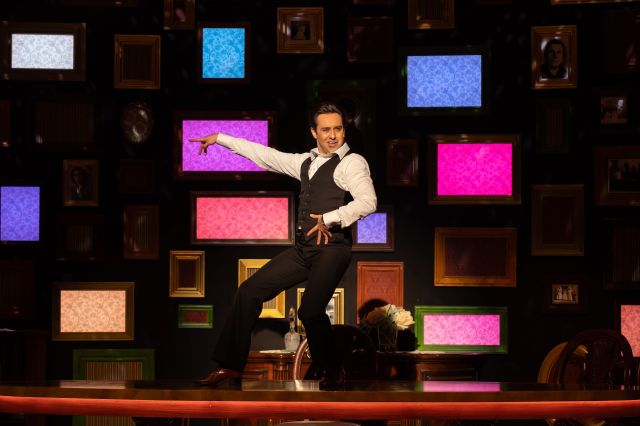
In scenes that gather momentum, at speed in Daryl Cloran’s production, Timoteo will create an entire Italian family of vivid characters around it, single-handedly and with great precision — hypochrondriac aunties, quirky uncles, smarty-pants cousins, assorted sidekicks in both the Old and New Worlds. It’s his stage. He will sing and dance on it, lift weights on it, do push-ups on it, leap off and onto it in a high-speed profusion of guises. And in the course of a play based on Timoteo’s own immigrant family experiences and structured as courses of an Italian dinner, he’ll bring to it the traditional succession of dishes, from the aperitivo to the dolce. At one point, amazingly, he will populate an entire dinner party — molto vivace and with great clarity.

Farren Timoteo in Made In Italy, Citadel Theatre. Photo by Nanc Price.

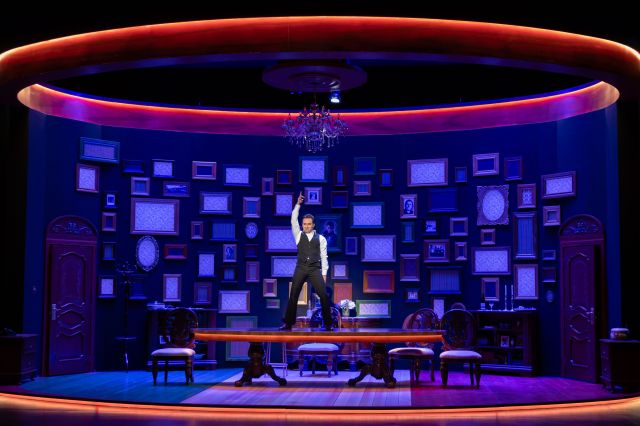
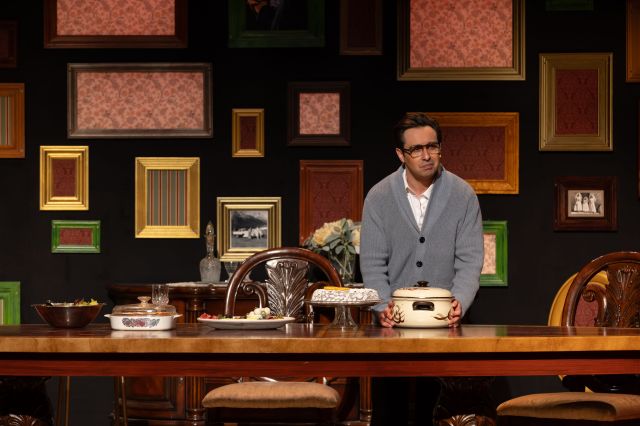
Which is a way of saying that the handsome centrepiece of Cory Sincennes’ atmospheric dining room set, the one essential piece of furniture as Salvatore insists (“the heartbeat” of family life), is built to last. It takes a beating, in a good way, in Made In Italy.

And lasted it has. Since its premiere up seven years ago up close in a studio space at Kamloops Western Canada Theatre and then Citadel’s smallest house the Rice after that, Made In Italy has toured. Sold-out and repeat engagements in theatres of every size and shape —  mainstages across the country these days — are in its history. And there is something just right, of course, about the return of this homegrown hit to Edmonton and the Shoctor stage, in the biggest playhouse in Timoteo’s home town. There is also something challenging about a solo show on a vast stage.

Farren Timoteo in Made In Italy, Citadel Theatre. Photo by Nanc Price.

Sincennes’ set, backed by a wall of glowing multicoloured stained glass ‘windows’ and (real-life) Timoteo family photos, lands like a bright idea (lighting by Conor Moore and Celeste English) far back in the darkness of that stage. What you lose is the sense of raising a glass with Salvatore in his dining room. What you gain is a certain presentational pizzaz. After all, our joint protagonists are father and son, who share a coming-of-age story driven by the tensions built into the immigrant experience. And Salvatore’s teenage kid Francesco is a singer, an aspiring band leader who breaks out of the family expectations … by performing.    

There is something pretty irresistible about a culture that gravitates to music and art, celebrates its history and traditions, finds its consolations and its particular flavours, together — in all-ages gatherings over great food and wine. But it’s no picnic to be the only Italians in Jasper, Alberta in the 1970s. That’s where Salvatore, inspired by Timoteo’s grandfather, arrived from Abruzzo in the ‘50s to seek out “a better life.”

The moment of truth, for Francesco at six, is a sort of revelation of his outsider status in this alleged “better life.” His eyes are suddenly opened to the sight of sausages hanging from the family porch, wine stains on the driveway, bocce balls all over the lawn. It was, remembers his teenage self, “the single worst day of my life.” So much for Canadian complacency about welcoming multi-cultural divergence. In small-town Alberta the disaffected Italian teenager, a fictionalized version of Timoteo’s dad, is an outsider. He’s bullied constantly, targeted by awful ethnic slurs.

While Salvatore, the transplanted Italian is extolling the beautiful differences of his culture (and, arghhh, making his kid wear a suit to school), Francesco’s goal is to belong, to fit in, to be unremarkable unto invisible in generic Canadian-ness. “What can I doooooo?” he laments.

Francesco starts getting into trouble at school, much to the dismay of his dad. “How come I take the boat across the ocean?” Salvatore says accusingly, in a very funny escalating self-dramatization of his immigration story. “This is why I risk my life to come to Canada? Wazza wrong with you head?”

Farren Timoteo in Made in Italy, Citadel Theatre. Photo by Nanc Price.

What turns it around for Francesco is the inspiration of an Italian underdog-turned-hero, one Rocky Balboa, the Italian stallion. Francesco’s preparations for a new life chapter as a warrior occasion some of show’s most hilarious sequences, as he undertakes a riotous campaign of self-improvement. What one extraordinarily gifted physical actor/dancer can do in a comic pas de deux with weights is a showstopper (choreography by Laura Krewski). Ditto the hilarious Act II opening scene, as Francesco tells, and shows, us that time spent on good hair is never wasted, especially in the disco era.

Timoteo is a actor and dancer of acrobatic physical and verbal dexterity, and the impressive physical comedy of the show is such a major contributor to the fun of the evening. The cameos of fellow contestants in an Alberta’s Got Talent-type competition in Act II do seem peripheral to the story-telling in a two-hour show, in truth, funny as they are. But, hey, Timoteo is always fun to watch.

I’d forgotten how skilled he is at aging in the course of the show. Francesco seems to viscerally thickens as he coarsens musically, in expert pastiches of lounge-y songs (Timoteo is the most versatile of singers). What I did remember from previous experiences at the show was the blend, beautifully judged, of comedy and heartbreak in a coming-of-age story about the strains between first- and second-generation immigrants in this country of transplants — the expectations, the pressures, the guilt. Made In Italy has such a warm and affectionate embrace of its characters of all ages. You feel it as a generous squeeze in the theatre. And there’s dessert. Saluti.

Have you read the 12thnight PREVIEW interview with Farren Timoteo. It’s here.

REVIEW

Made In Italy

Theatre: Citadel

Created by and starring: Farren Timoteo

Running: Thursday through Jan. 28

Tickets: citadeltheatre.com, 7890-425-1820


Posted in Reviews | Tagged , , , , | Comments Off on Heart and hilarity: Made In Italy at the Citadel, a review

Did Cinderella’s Ugly Stepsisters get a bum rap? They’re out to prove history wrong in The Spinsters

Christine Lesiak and Tara Travis in The Spinsters, Small Matters Productions. Photo by Ian Walker.

By Liz Nicholls, 12thnight.ca

“It’s all about The Dress.”

Birth of a show. It’s 2017, and a man walks six feet behind two strong, tall (funny) women as the three theatre artists stumble home from the Winnipeg Fringe beer tent at the end of a summer night.  An image comes to the man. He imagines the women, “seven feet tall, formidable figures, gliding in elegant dresses.”

To help support 12thnight.ca YEG theatre coverage, click here.

The man is Ian Walker, mechanical engineer turned theatre designer. The women are Christine Lesiak (FOR SCIENCE!, The Space Between Stars) and Tara Travis (Til Death: The Six Wives of Henry VIII, Who Killed Gertrude Crump?), star theatre creators both.

“Great!” says Lesiak, like Travis intrigued by the image conjured by Walker (Lesiak’s real-life partner). “So …  what’s the story?”

Ah, that was the question. And it took a while to answer. Six years and a pandemic later, we’re about to find out, when The Spinsters opens on the Westbury stage Jan. 19, in a Small Matters production that is far from small, except perhaps in cast size.

Lesiak and Travis, veterans of original performance theatre on the cross-country Fringe circuit, one Edmonton- and the other Vancouver-based, had known each other for a decade or more. “We always admired each other and each other’s work — and looked for an excuse to work together,” says Lesiak, a space physicist-turned-theatre artist whose show FOR SCIENCE! combines science and clowning. “A cross-province creation,” says Travis, who’ll  be back at the Edmonton Fringe this summer for the first time since 2016 in a new Monster Theatre production.

Christine Lesiak and Tara Travis in The Spinsters, Small Matters Productions. Photo by Ian Walker

A “giant magical dress show” (with footwear and big hair) had its origin image, but  but got its narrative legs, so to speak, in “isolation times,” as Travis puts it. “When we were allowed, we decided to bubble up in a cabin, on a lake.” Half-way between Vancouver and Edmonton, in the Rockies, “ducks swimming; how did we stand all that tranquility?”

“We shared experiences growing up tall and feeling awkward, bonding over our awkward youths, having bad posture, trouble finding clothes that felt right. And one of us said something like ‘I always felt more like an ugly stepsister than Cinderella…. We looked at each other and … DING!”

“It’s all about The Dress,” though the Brothers Grimm didn’t put it that way in their aspirational fairy tale about the put-upon but upwardly mobile girl, victimized by the meanest step-sisters in sibling history, who gets to rock at the ball and nab the prince. “If you have The Dress you can be anything you want,” as Lesiak puts it. “It’s about access — to the illusion of wealth and class. If you have The Dress you can change your life, and the way everyone sees you, effectively how you’re received.” Travis laughs. “A mask of epic proportions!”

The infamous squabbling duo are the underdogs of the fairy tale world, overshadowed by their famously annoyingly goodie two-shoes (sorry, shoe singular) step-sister. Finally, with The Spinsters, they’re stars. Over coffee, Lesiak and Travis, who have a sisterly hilarity about them and crack each other up constantly, are joined by their amused director Jan Selman. “We meet them after their youths, middle-aged (and single) and still needing all that approbation they never feel they got enough of…. Cinderella had a fairy godmother and they didn’t and it’s really Not Fair.”

And, to add insult to injury, admit it, you don’t even know their names. “They’re tired of the lies always told about them. And they’re wanting to write their own story,” says Lesiak. “They’re trying to reclaim the narrative,” says Travis. “They feel they’re owed.”

Tara Travis and Christine Lesiak in The Spinsters, Small Matters Productions. Photo supplied.

So “no voice, no names, upstaged all the time by Cinderella….” What did they do? “They’ve set out to prove history wrong,” says Travis. “They bought the freakin’ palace,” says Selman. “They’re making good, or at least good enough,” says Lesiak. “And they’re hosting a ball for you, just like the good old days. They’re choosing to perform….”

“We’ve got a point to prove, and we’re gonna prove it,” says Travis. “If it kills us!” says Lesiak.

Selman calls The Spinsters “a big-splash coming-out party. They’ve invited us all; they’ve got a show for us. In their minds they’re opening in Vegas. They set out to show off to the nines, and rehearse the heck out of it. And (mysterious laughter) other things ensue.”

Which is which? “I’m the elder sister,” says Lesiak of her character. “I’m the one who’s more fiscally responsible. I take care of the palace insurance!” She and Travis, who finish each other’s sentences, burst out laughing. “I’m the short-attention gal,” says the latter. “Very impulsive, basically informed by my neurodivergence; yup, I’m an ADHD-er!”

“The sister dimension is so rich,” says Travis, who has several sisters and is very close to them. In a way, she argues, sisterhood is “a more emotionally intimate relationship” than romantic ones; “sisters are  vaults for each other’s secrets.”

“I find working on this I’m always thinking of my sister and our relationship and how it’s changed over the years,” says Selman, a U of A drama prof. “Love and rivalry all bundled together.” Lesiak grins. “I’m the only one here who doesn’t have a sister. And now I feel like I have one.” “You are my chosen sister,” says Travis consolingly.

“It’s a delicate balance” with the stepsisters, she says, “between them in cahoots, then in competition and how quickly that can switch: instant hate, instant love.” Lesiak laughs. “At the end of the end everyone wants the prince.”

The pair assembled their dream team of six design collaborators, some from Vancouver some from Edmonton, and all with innovative theatre cred. As Selman discovered when she joined the team last summer, when “the play existed but was still developing,” they’re “each mad geniuses in their own way, with an intense area of experience.”

The dresses, say the actors and their director, are architectural wonders, engineered (and that’s the right word) by Walker who invented structures for the show, including a chandelier. “Once he entered my life, my envisioning of shows got a lot more complicated when I saw what he could do,” says Lesiak. 1,100 hours of sewing went into the frocks built by Adam Dickson and a team of nine sewers.

How to move in them was the challenge of coach and choreographer Ainsley Hillyard. Puppet designer Dusty Hagerüd (did I mention there are puppets?), had to figure out how his vertiginous wigs — which instantly add at least a foot to already tall women —  could be worn “without pinning them into our heads!” as Travis says with a grin. Composer/sound designer Michael Caron is currently working on Catalyst Theatre’s revival of The Invisible: Agents of Ungentlemanly Warfare about to open at the Grand Theatre in London, Ont.   

Physical comedy is something both Lesiak and Travis lean into. Is The Spinsters a clown show? Selman says no. “But they’re bringing their ‘clown stuff’ with them — elevated choices, a great capacity to engage directly with the audience on the spot. Really fun!” There is, after all, no fourth wall in the palace. “There’s always room for the new on any given night,” says Lesiak. “That’s the liveness of live theatre.”

Surprise! “Every scene is a little different in style,” says Selman of the show, which had a short inaugural run in Vancouver before Christmas. “Just when you think you get it, it flips around on you. Physical theatre, yes, but other things too. Stand-up at moments, but not really….” Travis says “you’ll never know what’s next. Unless you’re a very gifted psychic.”

“Bonkers. Yup.” says one. “The most bonkers show either of us has ever been at the root of, for sure,” says the other.

PREVIEW

The Spinsters

Theatre: Small Matters Productions and Edmonton Fringe Theatre

Created by and starring: Christine Lesiak and Tara Travis

Where: Westbury Theatre, Fringe Theatre Arts Barns, 10330 84 Ave.

Running: Jan. 16 through 27

Tickets: fringetheatre.ca

Posted in Previews | Tagged , , , , | Comments Off on Did Cinderella’s Ugly Stepsisters get a bum rap? They’re out to prove history wrong in The Spinsters