Pith! The return of a signature Teatro comedy and Jana O’Connor’s ‘dream role’

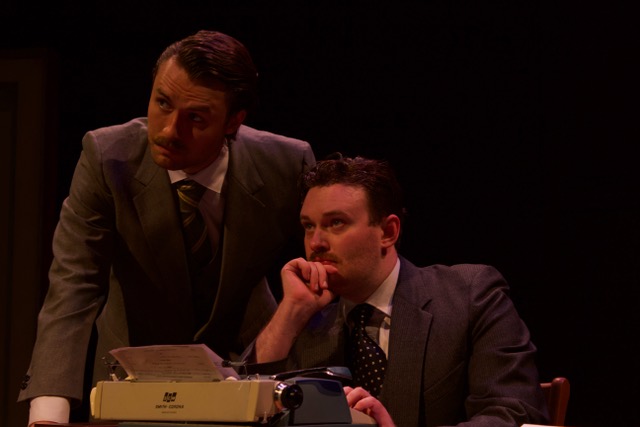
Kristin Johnston, Andrew MacDonald-Smith and Jana O’Connor in Pith!, Teatro Live. Photo by Marc J Chalifoux.

By Liz Nicholls 12thnight.ca

Jana O’Connor has been hearing stories in the rehearsal room. Stories which live on in the Teatro Live! archives, of the memorably frantic, complicated journeys to opening nights of Teatro’s most travelled, most often revived, arguably most popular, play ever.

To help support 12thnight.ca YEG theatre coverage, click here.

Three actors, four chairs, a rug, a phonograph…. Since its 1997 premiere at the Fringe, Stewart Lemoine’s Pith! — in itself the story of “a journey of epic proportions through the simplest possible means,” as the playwright’s stage directions prescribe — has travelled widely. It’s been on the Varscona stage in three revivals. It’s played cities across Canada. It’s been in New York no fewer than three separate times, including an Off-Broadway run.

Starting Friday, Pith! is back onstage at the Varscona, directed by Lemoine, with a cast that includes O’Connor, Kristin Johnston, and Andrew MacDonald-Smith, the company’s current artistic director. Which is why the multi-talented O’Connor, a long-time Teatro fave, a playwright herself, a star improviser and the executive director of Edmonton’s LitFest, who’s in Pith! for the first time, is hearing “the great history” of a signature play from the assembled raconteurs of the Teatro ensemble.

Two days before the New York opening of 2006, the Pith! props and costumes still hadn’t arrived. “If that’s going to happen, your best-case scenario is that you have Leona Brausen with you,” O’Connor says of Teatro’s resident costume designer who has a special touch in vintage. Brausen, who originated the role of Nancy, the appealing character O’Connor has inherited in the current production, immediately went shopping at Macy’s, buoyed by their flexible return policy. Gigantic as it is, Macy’s, however, does not carry pith helmets, you may not be surprised to learn. These were brought to ground at a 42nd Street army surplus.

Pith helmets? MacDonald-Smith returns to the role he last played in 2012, in Teatro’s 30th anniversary season: Jack Vail, a mysterious itinerant seaman who arrives at a Providence, R.I. pie social in 1931. In improvising a bare-stage imaginary adventure into the heart of the South American jungle for a woman who’s been imprisoned for 10 years in the fortress of her own grief, Jack gives Mrs. Virginia Tilford (Johnston) back her life. Along with Jack, Virginia and Nancy, her warm-hearted wise-cracking sidekick (O’Connor) never leave the room.

Jana O’Connor

O’Connor, delighted, reports that “when you tell people you’ll be in Pith! they go Ohhhhh. Such a big reaction! It is so loved.” Not only is it a tribute to the life-changing power of the imagination, and of theatre, “to me it’s a showcase of all the best things about Stewart’s writing: it’s absolutely hilarious, but also has such a beautiful heart at the core.”

As the director of a literary festival —  and books are of course another way to have exotic journeys without leaving the room — she appreciates the Lemoinian language. “So challenging and beautiful and unexpected…. Some of the monologues and sentences are journeys in themselves! Sentences with some heft. And you can really relish them, and go on a journey with the character as they express that thought.”

“I’ve ended up at this point in my career,” O’Connor says, “having the amazing opportunity to bring together two of my greatest loves as an artist. Improv and Teatro!” She laughs. “Improv! My family and I (she’s married to actor/director Chris Bullough, with kids) live our lives madly scrambling to re-arrange the furniture … and wearing funny hats!”

O’Connor’s entry point into theatre and performance came right after high school via the impulse of a friend to take a Rapid Fire Theatre improv workshop. “It wasn’t even my idea.” A talent was revealed. Then came an invitation to play Theatresports, and a berth on RFT’s monthly sketch comedy 11:02 Show. Teatro founder Lemoine and leading man Jeff Haslam both directed editions of 11:02, and discovered a droll and quick-witted performer there, perfect for Teatro. “And that was my introduction to them, to the Varscona, to the opportunity to be part of that community…. Such strange little choices that can lead to such amazing career-changing opportunities.”

“Everything I’ve learned about theatre is from that world,” she says of Teatro and the Varscona.

Mathew Hulshof and Jana O’Conner in The Margin of the Sky, Teatro La Quindicina. Photo by Marc J Chalifoux, 2022

O’Connor’s introduction was Teatro’s contribution to a Catalyst Theatre initiative, Fusion, an invitation to writers and companies to bring short pieces to a particular set. “Josh Dean and I were on separate staircases .. in a quick, fun, back and forth kind of (Lemoine) piece.” She stage-managed the original 2003 production of Lemoine’s The Margin of the Sky, 20 years before she inherited Brausen’s role in the play in a 2022 revival.

Her first performances with the company came with the Lemoine comedy A Rocky Night For His Nibs (possibly the only play in Canadian theatre in which the Prince of Wales Hotel in Waterton figures prominently) and Haslam’s Citizen Plate. And there have been many Teatro roles since, some of them — as per Lemoinian practice — written with her particular comic talents in mind.

The route from improv to playwriting is by no means an outlandish detour into the outback, as this theatre town’s roster of actor/playwright/improvisers demonstrates over and over. In a way, O’Connor thinks, in improvising,” you’re writing the play as you go, in your head,” creating scenes and, in long-form improv, creating a dramatic arc.

On the O’Connor resumé is sketch comedy (for CBC Radio’s The Irrelevant Show and Caution: May Contain Nuts) and a short piece inspired by Jane Austen for Panties Productions. And then came Lonely Hearts, a play inspired by a chance meeting with Famous Last Words, a book from the novelty rack at the U of A Bookstore where she worked at the time. “I came across (serial killer) Martha Beck,” says O’Connor. “I’d never heard of her…. But I found it so compelling that here was a woman who’d murdered all these people, but her biggest sin was being a larger woman.” Bullough directed a Fringe production starring Belinda Cornish.

“A gratifying experience,” she says, and laughs. “Not the voice people would expect from me — creepy, freaky, darkly comic. Enjoy!” That’s the beauty of the Fringe.

playwright Jana O’Connor and the cast of Going, Going, Gone!, Teatro La Quindicina. Photo supplied.

Going, Going, Gone!, a comedy she calls a “screwbelle” in honour of its female protagonist, was a more likely O’Connor play, and “a natural extension of (Teatro World).” Intricate hilarity is triggered “when someone grabs someone else’s luggage at the train station.” She wrote with particular actors in mind, and the Teatro production starred MacDonald-Smith, Rachel Bowron, with the protean Mark Meer in seven or eight roles.

In addition to returning to Teatro, at a well-timed period between annual October editions of LitFest, O’Connor has returned to Rapid Fire improv this past year. Kidprovisers was “a treat … performing for my kids on my birthday!.” For the last performance of The Blank Who Stole Christmas, RFT’s ingenious holiday comedy — a fusion of scripted and improvised with a different Blank every night — she picked Mrs. Claus.

Now there’s a subversive, cheeky choice, she acknowledges. “Mrs. Claus was against the patriarch, ready to bring it all down,” O’Connor laughs. “Christmas was her idea and her husband took it over…. Really fun! A full circle to get a chance to be part of an improv family.”

Meanwhile, there’s “a dream role” in a uniquely theatrical play from ta company dedicated to exploring the elastic frontiers of comedy. For women with kids and diverse pursuits and jobs, it’s tricky to find stability “without letting go of opportunities to have your voice heard,” as O’Connor puts it. “Teatro has always provided incredible opportunities for women to shine.”

PREVIEW

Pith!

Theatre: Teatro Live!

Written and directed by: Stewart Lemoine

Starring: Andrew MacDonald-Smith, Kristin Johnston, Jana O’Connor

Where: Varscona Theatre, 10329 83 Ave.

Running: Friday through Feb. 25

Tickets: teatrolive.com

Posted in Previews | Tagged , , , , , | Comments Off on Pith! The return of a signature Teatro comedy and Jana O’Connor’s ‘dream role’

‘How did you get to be here?’ Theatre adventures in NYC

Daniel Radcliffe, Jonathan Groff, Lindsay Mendez in Merrily We Roll Along. Photo by Matthew Murphy.

By Liz Nicholls, 12thnight.ca

NEW YORK — Here I am, 10 days ago, sitting in a vintage wooden booth in the Old Town Bar (an 1892 classic just off Union Square) eating fried clams. Overhearing from the next table a cheerfully loud — New Yorkers aren’t, by and large, a sotto voce crowd — assessment of a football game. Reviews are mixed: “I don’t see it! I don’t see it!”

And I’m musing on the uncanny way theatre here, whatever its original age, experienced in a cluster in this richly endowed theatre destination, seem to speak to The Moment. And it comes with visual art to match.

To help support 12thnight.ca YEG theatre coverage, click here.

Maria Friedman’s wonderful Broadway production of the 1981 Sondheim musical Merrily We Roll Along — hitherto regarded as a combination of  glorious music and an elusive, possibly unstageable, George Furth book— seems destined to lodge forever, rent-free, in the mind. Not least because of the superb, interlocking performances of the appealing trio of actors at its centre, Jonathan Groff as composer Franklin, Daniel Radcliffe as playwright Charley, and Lindsay Mendez as novelist turned theatre critic Mary.

This Merrily comes after many valiant revivals — “after 43 years in the wilderness” as The New Yorker put it — that have never quite risen to its challenge of relationships that unspool backwards in time scene by scene. I remember seeing one of those ‘nice try but no’ revivals,  the undersung 2019 Fiasco production. In a way it’s a coming-of-age story in reverse, a story of growing up as disillusionment, a story of a three-way friendship, and a betrayal of friendship, ideals, and talent. We meet Franklin, successful, rich and a sell-out, at a Hollywood party packed with sycophants. Mary (Lindsay Mendez) is an unravelling drunk; Charley is nowhere to be seen.

Lindsay Mendez, Jonathan Groff, Daniel Radciffe in Merrily We Roll Along. Photo by Matthew Murphy.

“How did you get to be here?” The question (a profound one for every era, and maybe especially ours) gets tossed our way in the opening number. “What was the moment?” And in this beautiful and heartbreaking musical with the marvellous score, the answer unrolls, incrementally, in reverse. Back 20 years to the world-is-your-oyster moment of infinite possibility on a rooftop, and the exhilarating anthem Our Time, “it’s our time, breathe it in: worlds to change and worlds to win….”

A band of 13 sits above the stage and its serviceable far-from-lavish design (Radcliffe must be the first Broadway star to wear a brown knitted argyle vest for almost the whole show). And the delicious irony of Merrily finally hitting its true stride as a hit, with a song about young struggling, aspirational artists, wonderstruck the first time they hear audience applause and know they have a future, is lost on none of us cheering at the Hudson Theatre.

Annaleigh Ashford and Josh Groban in Sweeney Todd. Photo by Matthew Murphy and Evan Zimmerman

Not least because its current Broadway mate is the 1979 Sondheim masterwork Sweeney Todd in a grand-scale production, with its thrilling wall of sound from a band of 25 — and the starry pairing of Josh Groban as the demon barber of Fleet Street and Annaleigh Ashford as his ever-creative capitalist partner Mrs. Lovett. They’ve now left the show, and about to step up to the killing floor, so to speak, are Aaron Tveit and Sutton Foster.

At Under The Radar (a festival nearly lost to post-pandemic malaise and rescued in the nick of time), Volcano, a four-hour dance/theatre amalgam by the Irish artist Luke Murphy at St. Ann’s Warehouse adopts the form of the contemporary TV mini-series. In four 45-minute episodes for two performers (Murphy and Will Thompson) encased in a glass living room with shabby accoutrements, we glean they’ve signed on to an experiment in defining humanity for potential extraterrestrial life. And within the pod apparently travelling through space the piece unfolds in a explosively inventive pas de deux, pop culture homage scenes (like William Shatner’s spoken-word version of Rocketman), and more baffling lost-in-space explorations.

With Purlie Victorious, a 1961 satire by the American actor/ director/ playwright/ activist Ossie Davis, with its jaunty subtitle A Non-Confederate Romp Through The Cotton Patch, returns to the Broadway stage in a Kenny Leon production. A comedy about race and racism revived 60 years later? It would seem, in theory, to be a risky prospect.

I’ve never seen anything quite like this ebullient, funny, wildly raucous farce, a highly original combination of sassy, scathing and, in its own way, affectionate. The star is the  charismatic Leslie Odom Jr. (the original Aaron Burr of Hamilton) as the hustling, fast-talking travelling preacher of the title. Purlie returns to his rural Georgia town to reclaim an inheritance that’s been co-opted by white blowhard plantation owner (Jay O. Sanders). The law has proclaimed de-segregation, but is that the reality?

The entire cast fearlessly sets forth stereotypes, and explodes them. Billy Eugene Jones as Gitlow, a yes-man to Ol’ Cap’n the boss, whose subservience is a savvy performance designed to inflate and lull the boss’s gullibility, is outstandingly funny. “What’s wrong with running? It emancipated more people than Abe Lincoln ever did.”

As the stock character of the dimbulb country maid, Lutiebelle Gussiemae Jenkins, Kara Young is especially hilarious. The scenes where Gussiemae, on a roll, disastrously improvises, are laugh out loud. In this entertaining and insightful play, complacency gets mocked, in a spirit that recognizes and revels in the  outrageous and the absurd.

Outside The Palace Of Me by Shary Boyle, American Museum of Art and Design.

Intriguingly, a rainy late January day the day gains a special New York coherence about it, with a stunning multi-media exhibit at the Museum of Arts and Design at Columbus Circle. Theatre, and the idea of performance as a way of testing out identities, is the premise of Outside The Palace Of Me, a solo show — playful, ingenious, full of pop-culture references, with a taste for the surreal — by the Canadian artist Shary Boyle. And it happens in a variety of forms and materials. Overhead projections, animation, video, film, puppetry, ceramics, sculpture, porcelain. And they’re set forth like a theatrical production. Part I, The Dressing Room, is all about the mirrored gaze, Part II; Part II, The Stage; then The Star and The March/Parade (“one person’s parade is another’s riot.”).

Outside The Palace of Me by Shary Boyle, Museum of Arts and Design in NYC.

Appropriate, a title that works both as an adjective and verb, is the Broadway debut of Black playwright Branden Jacobs-Jenkins (Everybody, The Comeuppance). And it’s a barn-, er estate-burner, a full-bodied full-throttle intergenerational — and white — family drama, a (very) dark comedy à la August: Osage Country about damning secrets, brute agendas, a cultural inheritance that is really a haunting.

What brings a scattered white family, siblings and kids, back to an Arkansas plantation on the eve of an estate auction, is the recent death of the patriarch, in debt and given to hoarding. And what gets unearthed, along with simmering grievances and agendas, is something appalling and shameful, the legacy of a whole secret life.

Sarah Paulson and Elle Fanning in Appropriate. Photo by Joan Marcus

Should it be acknowledged as a responsibility? Should it be denied? Should it explained away (or, worse, sold on eBay)? And there’s this: is atonement, or forgiveness, or change, even possible? Appropriate wonders.

The characters, led by Toni, a churning reservoir of toxic fury and fierce denial in Sarah Paulson’s blistering performance, are vividly positioned, and at different angles, to questions of racism, consumerism, responsibility. Rachel (Natalie Gold of Succession fame), who’s  married to Toni’s avaricious brother, has overheard the father referring to Bo’s “Jew wife.” Lila Neugebauer’s production is intricate, thoughtful, and absorbing. And it saves some of its secrets for a big reverberant ending.

Appropriate comes with a Chekhov epigraph, the peasant Lopakhin gloating over his triumphant purchase of the fateful cherry orchard from the landed aristocracy. More directly from the Chekhovian orchard is Aristocrats by the Irish playwright Brian Friel and part of Irish Repertory Theatre’s Friel Project. A kind of group portrait of a decaying and inert Irish land gentry at the dead end of entitlement, the play from the author of Dancing At Lughnasa and Translations, is pretty dull, in truth (and makes you appreciate the humour and nuances of Chekhov by contrast). And there isn’t anything about Charlotte Moore’s production that will reinvent or enliven it.

The Connector, MCC Theater, Photo by yours truly

The Connecter, the new musical by Jason Robert Brown (The Last Five Years, Parade) and Jonathan Marc Sherman at MCC Theatre, and brought to the stage in a scintillating way (designed by Beowulf Boritt) by the composer’s longtime collaborator Daisy Prince, has the singe of real life fire about it. First, its story is inspired by the falsified news stories by Steven Glass and Jayson Blair that sucked in The New Republic and the New York Times. And second, though it’s been in the works since 2011 evidently, its relevance to a world where “truth” has been contaminated beyond redemption and fact and fiction have no meaningful frontier, has only been enhanced by the Trumpist declension into chaos.

To me, Sherman’s storytelling, which seems set forth as a tale of seduction by the escalating demands and lure of success, has a fundamental flaw. If the apparently idealistic young writer whose fabrications at a New Yorker-type magazine are discovered and brought home in the course of the musical, is corrupt from the start.

Brown’s score and lyrics are unfailingly witty. And, as you might imagine, a story of the demise of real journalism is an alluring subject for exploration. As in the song from Merrily, Now You Know.

Posted in Features | Tagged , , , , , , , , | Comments Off on ‘How did you get to be here?’ Theatre adventures in NYC

The Mayfield announces an upcoming big five-oh anniversary season

By Liz Nicholls, 12thnight.ca

The Mayfield Theatre turns the big five-oh next season — and achievement in itself in the rigorous world of commercial theatre.

To help support 12thnight.ca YEG theatre coverage, click here.

And as a milestone birthday bonus, as artistic director Van Wilmott announced Monday, the lineup comes with not one but two big Broadway musicals. Plus salutes to a storied five-decade history.

The season, Wilmott’s 17th at the helm, launches, as promised, with the next instalment of the Mayfield’s original Musicians Gone Wild series by Wilmott and playwright Tracey Power, designed to celebrate seminal eras in pop culture history. It premiered this past September with Rock The Canyon, a 10-musician extravaganza which took audiences to Laurel Canyon in the Hollywood Hills in the late ‘60s early ‘70s, a communal incubator of a starry genealogy and the ‘California sound’. Next season’s Nashville: Music City (Sept. 3 to Nov 3, 2024) focuses, as Wilmott puts it, on “the story of a place in the middle of nowhere and how it became the poster child of country music.”

That story, he says, has deep roots. goes way back, to the Carter family, back to Hank Williams, “the Gretzky of the late ‘40s,” back to the Ryman Auditorium, the original home of the Grand Ole Opry. The show capitalizes on the Mayfield’s greatest strength, music, as Wilmott says. “And country music is huge, with massive instrumentation.” It demands the versatility of the 10 musician performers on a variety of instruments, guitar, ukulele, mandolin, lap steel, fiddle, among them.

The “Christmas show,” the Mayfield’s perennial best-seller — this season Canada Rocks: The Reboot had a record-breaking run — is an original homage to the theatre’s 50th. Flashback Fever (Nov. 12 2024 to Jan. 26 2025), billed as a “rock and roll dinner party,”  assembles “the best 50 tunes, the 50 great musical moments, of the last 50 years,” as Wilmott puts it. “Great musical moments, the great, the hilarious, the terrible! A flashback of the last 50 years in the world of music.” Wilmott and “a handful of other writers” will put it together.

The collars are blue in both of the Broadway musicals in the Mayfield lineup. The Mayfield’s biggest cast of the season (16 or so, plus the band) happens in The Full Monty (Feb. 4 to March 30, 2025). Heartwarming and funny, the 2000 hit spun from the 1997 Brit film, tells a classic underdog triumph story. A group of unemployed steelworkers in rustbelt Buffalo — “it’s a slow town when you don’t know where to go” as the opening number has it — get a bright idea for redeeming their tattered masculinity, and generating some cash. They form a strip act. The book is by the star American playwright Terrence McNally, and the clever, appealing score is by David Yazbeck (Dirty Rotten Scoundrels, The Band’s Visit, Tootsie).

Jersey Boys (April 8 to June 8, 2025) finds its blue-collar pizzaz in the mean streets of New Jersey. And it gets its dramatic traction from telling a real-life story, grit included: the rise from obscurity to top-40 stardom of The Four Seasons. That’s what sets this Tony- and Olivier Award-winner apart from the jukebox musical crowd — that, and a string of two dozen indelible chart-topping hits, including the likes of Sherry, Big Girls Don’t Cry, Walk Like A Man. “A great musical, perfect for our audience and our venue,” says Wilmott, buoyed by the availability of rights between American tours of Jersey Boys, and undaunted by the recent Citadel production. As for The Full Monty, the cast and director have yet to be announced.

The summer of 2025 (June 17 to July 20) is the perennially popular 1986 solo play Shirley Valentine by the Brit playwright Willy Russell. It’s been 14 years since the Mayfield last produced it. The middle-aged title character is a veritable poster child for life-changing re-discovery. When Shirley steps out of the rut of her humdrum life with an emotionally distant husband and wins a trip to Greece, nothing will ever be the same.

Meanwhile, the current season continues with this week’s opening of One Night With The King, an original tribute show starring Matt Cage, last seen here as Elvis in the Mayfield production of Million Dollar Quartet in 2019. It runs through March 31, followed by a production (April 9 to June 16)  of Grease, the musical that takes us all back to our universal alma mater Rydell High. Kate Ryan directs. And the summer show (June 25 to July 28) is On Golden Pond, the Ernest Thompson chestnut set in the frictions of a long marriage and the intergenerational divide.

Tickets and subscriptions: mayfieldtheatre.ca, 780-483-4051.   

Posted in News/Views, Previews | Tagged , , | Comments Off on The Mayfield announces an upcoming big five-oh anniversary season

Negotiating the darkness of the world: thoughts about This Is The Story Of The Child Ruled By Fear

David Gagnon Walker in This Is The Story Of The Child Ruled By Fear, Strange Victory Performance. Photo by Gergo Koroknay

By Liz Nicholls, 12thnight.ca

We are, none of us, dread-resistant, times being what they are. That sense of being alone and untethered in a universe that’s a chaos of crises and emergencies is a feeling lots of us know.

It’s no way to live, you could argue. The show that’s arrived at Workshop West (for a short run till Sunday) wonders about that. This Is The Story Of The Child Ruled By Fear, which premiered at Common Ground’s Found Fest in 2021, is David Gagnon Walker’s bold experiment in theatrical collaboration.

In this it takes theatre, always mouthy, at its word. A communal experience, live engagement between artists, and between artists and their audiences, is at the heart of things, fuelled by stories, as theatre is fond of saying, of itself. All true, of course. The explicit proposition on offer here, which ups the ante by lowering the stakes and whisking the fourth wall away, is that theatre creation contains a chemistry in community-building for an evening, one that can produce energy and joy.

To help support 12thnight.ca YEG theatre coverage, click here.

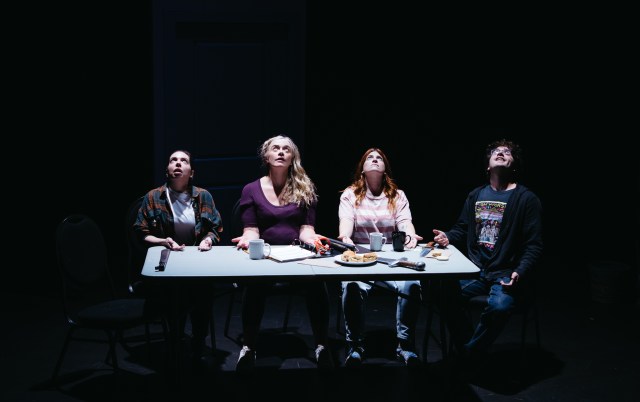
In The Story Of The Child Ruled By Fear, a homecoming for the Edmonton ex-pat artist after multiple cross-country successes, Gagnon Walker and the audience share a story by actually telling it together, reading it out loud. Led by the playwright as the narrator and a projection-scape by designer Tori Morrison, seven audience volunteers, seated at tables with a lamp and a script, take on characters (the title character is divvied among them). The rest of us, sitting in the usual theatre seats, are a Greek chorus who can join in on group delivery of projected lines. Or not. The intersection between art and life, a spiritual and aesthetic tenet of the live theatre, is explicit: “We’re real. We’re real. We’re real.”

I know what you’re thinking, and so, evidently, does Gagnon Walker, who arrives onstage in unique fashion. “My name is David. Right now I have a bucket on my head.” Yup, audience participation, very often an exercise in group alienation (speaking as we are of universal dread), makes it work. But this participation is so chill, so easy-going and unforced, that joining in is pretty much irresistible. There is, quite literally, no reason not to.

The story that unfolds in a series of scenes is a fable about an imaginary child in an imaginary world, where an imaginary civilization magically rises around them, and falls. The poetic text has a simple incantatory quality about it, with humorous, sometimes jarring,  interpolations, some of them from Gagnon Walker’s own life in Edmonton and all of them inconclusive. And Morrison’s video- and soundscape mingle, in an intriguing an oftn amusing way, a wash of imagery and specific storybook detail.

I don’t want to tell you more, because the “discovery” of the story, in the shared telling, is crucial to the whole experience. There is the unexpected pleasure that we’ve been invited to participate in the process of artistic creation, not usually available to non-artists (like me). Suffice it to say that there was much laughter, and something easeful too, in the impulse to share — and the proposal that there is a way, if not to conceal or obliterate, to negotiate the terrors of the world and the rule of fear.  Communally.

The truism that we’re all in this together has been at crucial moments in our history, to be sure, a sort of universal excuse for passivity (the disastrous escalation of environmental destruction, for example, under the ‘it is what it is’ mantra). But in This Is The Story Of The Child Ruled By Fear, the demonstration of human connectivity and an invitation into the world of theatre creation aren’t just a consolation, or a flotation device.

I left the theatre, and a discussable and pleasurable evening, with a renewed appreciation that theatre, the art form of real people together in the same room sharing an experience, is on the right track. We’ve always known it: it’s validating to have a demo from an artist, a true original, that it’s meaningful, even cathartic, to tell stories together about what haunts us, scares us, weighs us down. There’s wonder in it. And wonder is enlivening.

REVIEW

This Is The Story Of The Child Ruled By Fear

Theatre: Strange Victory Performance at Workshop West Playwrights Theatre

Created and performed by: David Gagnon Walker 

Directed by: Christian Barry and Judy Wensel

Where: Gateway Theatre, 8529 Gateway Blvd.

Running: through Sunday

Tickets: workshopwest.org  

Posted in Reviews | Tagged , , , , , , | Comments Off on Negotiating the darkness of the world: thoughts about This Is The Story Of The Child Ruled By Fear

David Gagnon Walker invites us to tell a story together: This Is The Story Of The Child Ruled By Fear at Workshop West

David Gagnon Walker, This Is The Story Of The Child Ruled By Fear. Photo by Henry Chan/

By Liz Nicholls, 12thnight.ca

“What is this theatre thing?” asks the innovative theatre experimentalist David Gagnon Walker. “This strange thing we do, getting 50 or 50 people in a room together to tell a story together … What’s unique about theatre? What can it do that other art forms can’t do as effectively?”

To help support 12thnight.ca YEG theatre coverage, click here.

This Is The Story Of The Child Ruled By Fear, the Gagnon Walker play that opens a short run Wednesday in the Workshop West season is an immersive theatre experiment on that very subject. It’s a personal invitation from one of the country’s most exciting and adventurous young theatre artists to join him in reading aloud a story together. It’s a story “in the register of fable or a Grimm’s fairy tale,” he says, of the rise and fall of an imaginary civilization in an imaginary land. “Dark, fantastical, and full of monsters and magical occurrences….. More like the real Grimm, darker than the stories we usually tell children at bedtime.”

“It’s the kind of story that, culturally, we know how to tell out loud…. Reading a story is something anyone who’s spent any time hanging out with children knows how to do.”

Gagnon Walker started writing it just before the pandemic, and the experience it offers resonates with our moment, heavy and getting heavier all the time. And, he thinks, it brings the specialness of theatre to bear on “the anxiety, the dread, the panic, the loneliness we all feel privately…. It’s the special thing the theatre situation can do with those feelings, feelings that are dark and isolating, and turn them into an opportunity to connect with other people.”

“I didn’t write a show about depression, anxiety, loneliness because I’m not familiar with them.”

“This show is all about that, trying to create some kind of communal experience from feelings that are not normally communal.… It’s a bit of a paradox I guess: I like writing about isolation for the theatre. I’m interested in that! ” And there is, he thinks, a kind of catharsis in that gathering, the sharing, the laughing and breathing together. “It’s recognition … the thought that I’m not the only person who feels that way.”

Audience participation, two words that tend to fling some of us back cowering into our seats, eyes to the floor. This is different. There’s no yanking or coaxing. The experience is all to your own comfort level; “people can determine how involved they want to be.” As the playwright/performer explains, seven volunteers join him onstage, at seven tables, each with a script and highlighted lines — “just like actors do on the first day of rehearsal.” That first day of rehearsal, says Gagnon Walker feelingly, “has always been lightning in a bottle for me. There’s just something that happens the first time a group of people read a play together.”

Everyone else can sit back and watch, and if they choose get in on moments — “there’s a big video event in the show” — “of choral group chanting of lines.”

David Gagnon Walker in This Is The Story Of The Child Ruled By Fear, Strange Victory Performance. Photo by Gergo Koroknay

“It’s a big ask,” Gagnon Walker acknowledges. “We’ve done a lot of thinking about how to make it gentle and friendly, as fun and funny as possible, as un-intimidating as we can. But once we actually start, the audience always knows how to do it; everybody just automatically remembers that we already know how to do this.”

Since its 2020 development in Halifax — Gagnon Walker, fresh out of the National Theatre School at the time, was 2b theatre’s ‘emerging playwright-in-residence’ — This Is The Story Of The Child Ruled By Fear has travelled the country. Eight cities later, the production by Gagnon Walker’s own Strange Victory Performance returns the playwright to his home town, and the play to the place where it was born.

The idea came to Gagnon Walker in 2017 in an experiment at Edmonton’s Found Festival, a celebration of unexpected encounters between artists and audiences.  For Productive Time, the festival sourced him an apartment, “and I locked myself in for 72 hours, live-streaming myself writing a new solo play.” When the time was up, “I invited an audience into the apartment and I performed it for them.”

“During the performance I printed out script pages for audience members and handed them out to the audience. We read aloud a 10-minute section…. For me it was a real lightbulb moment…. It was my favourite part of the project, reading aloud with other people and telling the story together.”

It planted the irresistible idea of “making a whole show like that,” Gagnon Walker says of the interactive theatre for which he’s become known. And at Found in 2021, This Is The Story Of The Child Ruled By Fear premiered here before it set forth across the country.

Paradoxes, the kind that theatre revels in, attract Gagnon Walker. “Trying to write about loneliness for groups of people” is one. And there’s this:  The Child Ruled By Fear “is such an analogue experience in so many way, real people breathing together and telling a story together. And it’s also a fairly high-tech show,” as multiple live video cameras attest.

The projections are the work of the multi-talented sound and video designer Tori Morrison, Gagnon Walker’s partner and the co-producer of Strange Victory Performance (as well as the artistic producer of Tiny Bear Jaws and the production manager of Outside The March). “She’s the one making all the magic happen,” says Gagnon Walker. “She has a very deep bag of technical tricks, but also a sharp dramaturgical mind. The tech stuff is never for its own sake, always in service of the story, and what the show is trying to do.” Their collaborations happen at the moment of conception, the “question of what’s the situation we’re inviting people into.”

Gagnon Walker himself was an actor at the outset, or more precisely (he laughs) “an acting school drop-out.” After the first two years of the U of A’s acting program, “I had an epiphany. I need to be writing. I felt urgently that auditioning for Shakespeare for the rest of my life wasn’t going to work for me. And that was a really hard decision, a big thing to walk away from.”

At the time he was convinced he was “leaving theatre behind to go and be a poet.” A degree in creative writing in Montreal followed. “Two years later I’d written three plays and done Fringe shows…. I ended up a playwright by quitting acting and thinking I was quitting theatre.”

It was the energy and sparkle of collaboration he found he missed, “figuring things out with other people. And it’s still my favourite thing…. I’ve tried. But you can’t get that sitting alone in your apartment.”

That’s why he values so highly the sense, “surprising and interesting,” of offering people a glimpse into the artistic process, the particular creative energy of a first day of rehearsal. “In my own life it has been the best thing I have going for me.”

And it’s why, after three or four years of touring, “I never get tired of doing the show,” he says of This Is The Story Of The Child Ruled By Fear.” There’s a new cast every night. And, especially, the seven volunteers witting with me onstage are completely different, with different energies. Some are nervous, some are totally rock stars…. They’re equally appealing to me.”

But maybe the most special nights, he thinks, happen when “somebody volunteers who clearly doesn’t do this kind of thing very often, or ever, and is taking a chance on us and our show, hoping to have a nice time, then having an experience that’s joyful for them … the arc of going from being nervous to feeling relieved, happy, and part of a community.”

“It feels really good.”

(Playwright/ performer/ producer David Gagnon Walker is also, as Bigfin Squid, a singer-songwriter. Catch him at the Aviary Feb. 5).

PREVIEW

This Is The Story Of The Child Ruled By Fear

Theatre: Strange Victory Performance at Workshop West Playwrights Theatre

Created and performed by: David Gagnon Walker 

Directed by: Christian Barry and Judy Wensel

Where: Gateway Theatre, 8529 Gateway Blvd.

Running: through Sunday

Tickets: workshopwest.org  

Posted in Previews | Tagged , , , , | Comments Off on David Gagnon Walker invites us to tell a story together: This Is The Story Of The Child Ruled By Fear at Workshop West

The Citadel unveils a new season of 10 shows. Here’s the 2024-2025 lineup

By Liz Nicholls, 12thnight.ca

Shakespeare gets reimagined in two high-contrast productions in the upcoming $13 million 2024-2025 season unveiled by Citadel Theatre artistic director Daryl Cloran Monday night.

To help support 12thnight.ca YEG theatre coverage, click here.

Of the four musicals announced in the 10-show lineup at Edmonton’s biggest playhouse (up from nine show this season), one’s a version of the Bard’s most popular comedy, one’s a Broadway blockbuster, one’s Broadway-bound, and one is a small-scale Alberta-made Indigenous version of a ‘70s classic.

Big productions, with international connections, will be onstage next season. And, by way of balance, “we get behind local artists and small innovative Canadian projects, too … an important part of our job,” says Cloran, of a lineup that includes a new mainstage crime caper of Alberta provenance.

Taking its cue from the continuing success of his much-travelled border-crossing As You Like, a romantic comedy partnership between Shakespeare and the Beatles, Cloran is devising (and directing) a big new ‘70s musical version of A Midsummer Night’s Dream, which premieres Feb. 22 to March 23. It match-makes Will and David, Shakespeare and Bowie respectively, in a glam-rock era production that capitalizes on “the fantastical elements of Dream,” says Cloran. It’s easy to see Puck in that world, looking like a David Bowie.”

“So much of Dream is about performance,” he says. “The ‘mechanicals’ are building a show, and it’s easy to see them as a struggling rock band…. So there’s great room for song. And that period in particular felt like a fit” for Bowie, Elton John, the BeeGees, Marvin Gaye, Olivia Newton-John et al. The Citadel is currently at work acquiring rights to that ear-worm repertoire. Cloran’s script-adaptation partner is Kayvon Khoshkam, artistic director of Shakespeare on the Saskatchewan, memorably funny as the clown Touchstone in the Beatles-infused As You Like It.

A Midsummer Night’s Dream: The 70s Musical, premiering on the Maclab stage), has a highly unusual companion piece in the Citadel’s Rice Theatre. A trio of goblins, in full goblin gear, happen upon a Complete Works of William Shakespeare, and pick the goriest to perform. Goblin:Macbeth (Jan. 11 to Feb. 2), which arrives trailing raves from successful runs at Vancouver’s Bard on the Beach, Stratford and currently Calgary’s Vertigo Theatre, is the work of the unstoppably inventive theatre artist Rebecca Northan (Blind Date, Undercover) along with Bruce Horak. And this Spontaneous Theatre Creation re-launches the Citadel’s Highwire Series after a year’s hiatus. “Everything you love about Rebecca Northan…. Such a cool mix of the improv and the Shakespeare,” as Cloran describes. “Great comedy and moments of profound Shakespeare acting.”

The “big family musical” in the lineup is Disney’s Frozen: The Broadway Musical (Feb 1 to March 2). Rachel Peake (The Garneau Block, 9 to 5), whose Citadel production of The Sound of Music is coming up in March, directs the new production of the 2018 hit. Among other contagious songs by Kristen Anderson-Lopez and Robert Lopez, it contains Let It Go, which, as every adult knows, once heard never lets go. “Big production values, big costumes, big design challenges,” says Cloran. “A coup to get the rights!”

With The Ballad of Johnny and June (Nov. 2 to 24), the Citadel collaborates with the La Jolla Playhouse — the California theatre where many Broadway musicals, including Come From Away and Jersey Boys, got their start — on a new musical love story about country music stars Johnny Cash and June Carter. The production “has its sights set clearly on Broadway,” says Cloran. And it brings back to Canada notable director Des McAnuff, whose resumé includes a stint as Stratford Festival artistic director, and Broadway hits like Ain’t Too Proud, the Donna Summer Musical, and The Who’s Tommy.

McAnuff’s assistant director in his Stratford days, incidentally, was Cloran, who worked on Shaw’s Caesar and Cleopatra (starring Christopher Plummer) and the musical A Funny Thing Happened On The Way To The Forum.

The fourth of the season’s musical offerings is the LightningCloud production of Bear Grease (Oct. 17 to 27). It’s a much-travelled Indigenous take by (and starring) the Edmonton couple Crystle Lightning and Henry RedCloud Andrade (Evandalism) of the Enoch Cree Nation, on the 1978 classic Grease. “Super-fun,” says Cloran of the piece, which premiered at the Edmonton Fringe. “Really smartly done…. And they have big dreams for the show.” Inclusion in the Highwire Series, returning after a year’s hiatus, is “a great way for us to showcase local artists, get behind a local group and amplify their success, shine a light on it nationally,” says Cloran.

The 2024-2025 season opens (Sept. 21 to Oct. 13) with Cloran’s own production of A Streetcar Named Desire, the Tennessee Williams masterwork he has long wanted to direct, as he says. “A great story, iconic characters,” he says of the co-production with Theatre Calgary. Casting announcements await.   

The mainstage season includes a new play by Alberta writer Arun Lakra, a rare, possibly unique, example of opthalmologist-turned-playwright. Heist (March 22 to April 13), developed as part of the Citadel’s 2022-23 Playwrights Lab and currently onstage at Calgary’s Vertigo Theatre, is a crime caper which gets its inspiration from films like Ocean’s Eleven. “Arun has landed on something very cool here,” says Cloran. Figuring out how to put a heist onstage, the complications of a perfect robbery complete with diamonds, lasers, guns, double-crosses, betrayals, will be the intriguing challenge for a director as yet unannounced.

The season finale (May 3 to 25, 2025), is the North American premiere of a London stage production of Rod Serling’s The Twilight Zone, in the playwright’s 100th anniversary year. A hit at London’s Almeida Theatre which transferred to the West End, the production is an adaptation by Keith Reddin (Life During Wartime) and Anne Washburn (Mr. Burns, a post-electric play) of multiple Twilight Zone stories from the CBS TV series. And after a New York workshop the show brings to Edmonton  the much-awarded English director Richard Jones, to build and hone at the Citadel with an eye to Broadway, à la Hadestown and Peter Pan Goes Wrong in which the theatre had a hand.

As Cloran describes, the piece “takes a bunch of Twilight Zone stories, intertwines them (with the story of an astronaut abandoned in space), and leans into the theatricality.” As in the case of Hadestown and Six, “the international partnership allows not only allows our audiences to see shows first, but us to do a bigger (budget) productions than we could afford to do on our own.”

Before the season starts, the Citadel’s summer production  (July 6 to Aug. 4), is is by Henry Lewis, Henry Shields and Jonathan Sayer, the Mischief Theatre trio who brought Citadel audiences Peter Pan Goes Wrong in 2022. In fact, the 2011 comedy of near-misses and incipient chaos is a precursor of sorts, in which we first meet the earnest, accident-prone thesps of the Cornley Drama Society as they struggle valiantly to put on a 1920s-style murder mystery. Dennis Garnhum, the former artistic director of both Theatre Calgary and the Grand Theatre in London, Ont., directs the Citadel/ Royal Manitoba Theatre Centre/ Theatre Calgary co-production.

No holiday season in Edmonton is conceivable without A Christmas Carol onstage at the Citadel. It’s just that way here. A Christmas Carol returns for a 25th anniversary and the sixth iteration of David van Belle’s 1950s adaptation, Nov. 23 to Dec. 24. And in a cast of more than 30, John Ullyatt returns to the role of the flinty Ebenezer. Lianna Makuch, who has assistant-directed the lavish production for the past few season, steps up to direct.

2024-2025 season packages go on sale, citadeltheatre.com, Jan. 29. Casual tickets for The Play That Goes Wrong are on sale March 14, and the rest of the season July 4. Meanwhile the current season continues with Rubaboo, The Sound of Music, The Mountaintop, and The Three Musketeers.

Looking ahead at the Citadel’s 2024-2025 season: 

Mainstage series: A Streetcar Named Desire (Sept. 21 to Oct. 13, 2024); The Ballad of Johnny and June (Nov. 2 to 24, 2024); Disney’s Frozen: The Broadway Musical (Feb. 1 to March 2, 2025); A Midsummer Night’s Dream: The ’70s Musical (Feb. 22 to March 23, 2025); Heist (March 22 to April 13, 2025); The Twilight Zone (May 3 to 25, 2025).

Summer presentation: The Play That Goes Wrong (July 6 to Aug. 4, 2024)

Highwire Series: Bear Grease (Oct. 17 to 27, 2024); Goblin: Macbeth (Jan. 11 to Feb. 2, 2025).

Holiday production: A Christmas Carol (Nov. 23 to Dec. 24, 2024).


Posted in Features, News/Views, Previews | Tagged , , , , , , , , , , | Comments Off on The Citadel unveils a new season of 10 shows. Here’s the 2024-2025 lineup

Stories and who gets to tell them: The Drawer Boy, funny and moving at Shadow Theatre, a review

Reed McColm, Glenn Nelson, Paul-Ford Manguelle in The rawer Boy, Shadow Theatre. Photo by Marc J Chalifoux

By Liz Nicholls, 12thnight.ca

With The Drawer Boy, Shadow Theatre revives a play that both in itself and its inspiration proved a defining moment for a truly Canadian theatre — and does it proud.

To help support 12thnight.ca YEG theatre coverage, click here.

In Michael Healey’s heartwarming and tough-minded 1999 hit, a naive and earnest young actor from a Toronto theatre company arrives at the door of an Ontario farmhouse. Miles is on location to research farm life for an original collective production. That this imagines, in an amused and amusing way, the art/ real life collision in the creation of  the ‘70s Canuck landmark The Farm Show, is telling, to be sure. And the clash of urban and rural will make for some affectionate comedy in the course of a play whose complications expand in absorbing, fascinating layers.

Notebook in hand, Miles (newcomer Paul-Ford Manguelle) is full of questions for the two elderly bachelor farmers, old friends, who live there. “Do cows mind being milked?” he asks Morgan (Glenn Nelson), the crustier, more cogent of the pair, clearly in charge. Miles insists “I’ve done hard things.” After all, he played a hedgehog in a show last year, and it was three hours long!

Reed McColm, Glenn Nelson, Paul-Ford Manguelle in The Drawer Boy, Shadow Theatre. Photo by Marc J Chalifoux

Angus (Reed McColm) is simple, his memory damaged by a World War II head injury. And in his relationship with Morgan, beautifully set forth by the two veteran actors, is a life-sustaining story — a story of friendship, memory, and loss that unlocks other stories. The Drawer Boy confirms in a poignant and dramatic way the power of storytelling and theatre itself. And it’s set in motion when Miles overhears Morgan re-telling to Angus the oft-told narrative of how they came to be where they are, and borrows the real-life story as his contribution to the theatre collective. Theatre seems to unlock Angus’s memory, and the seam between life and art opens dangerously.

Manguelle captures the eager-beaver self-importance of the young actor, who’s gradually struck by the realization, first, that he’s the butt of Morgan’s deadpan mockery, and then by knowing that his certainties aren’t weight-bearing.

Nelson’s sardonic Morgan, who bustles through his world stiff-legged and at high speed, more irascible than taciturn. Seeing the care-giver escalate to panic as the lines between fiction and truth get blurred (or clarified) is a real achievement. McColm the production finds an endearing Angus, bewildered a lot of the time, living in a foggy world lit by disconcerting flashes of the past.

Reed McColm, Paul-Ford Manguelle and Glenn Nelson in The Drawer Boy, Shadow Theatre. Photo by Marc J Chalifoux.

In John Hudson’s spacious production, the characters inhabit an atmospheric old farmhouse that’s designed in glorious detail, down to the screen door and the linoleum, by Daniel vanHeyst. His lighting calibrates time, dawn to dusk, in rural southern Ontario. The scenes are separated by time and Dave Clarke’s apt sound score, cranked a little high perhaps.

After all these years The Drawer Boy remains ready, funny and insightful as it is, to ask perpetually hard questions about who owns stories, and who gets to tell them. It’s a moving experience. If you haven’t seen the play it’s your moment; it you have, it’s time to renew.

REVIEW

The Drawer Boy

Theatre: Shadow Theatre

Written by: Michael Healey

Starring: Reed McColm, Glenn Nelson, Paul-Ford Manguelle

Where: Varscona Theatre, 10329 83 Ave.

Running: through Feb. 4

Tickets: shadowtheatre.org


Posted in Reviews | Tagged , , , , | Comments Off on Stories and who gets to tell them: The Drawer Boy, funny and moving at Shadow Theatre, a review

Up against a dark and maddening universe: Donna Orbits The Moon, a review

Patricia Darbasie in Donna Orbits The Moon, Northern Light Theatre. Photo by Brianne Jang, BB Collective.

By Liz Nicholls, 12thnight.ca

If you’ve ever found yourself furious (and really who hasn’t?) for no reason you can pinpoint, you’ll take to Donna.

To help support 12thnight.ca YEG theatre coverage, click here.

The middle-aged woman we meet in Donna Orbits The Moon is used to being cheerful and even-tempered, famous at bake sales for her gooseberry blondies. Lately, as Donna reports to us, she finds herself explosively angry, leaving a trail of shattered glass, holes in the wall, perplexity amongst her family and friends. And the triggers are unpredictable: rude drivers, vacuum cleaners, the minor pushiness of other people….

In the 2010 solo play by the American writer Ian August, currently running at Northern Light Theatre in a visually beautiful Trevor Schmidt production starring Patricia Darbasie, Donna is up against the mystery of … herself.

Why on earth, for example, would she slap a woman reaching for the same bag of all-purpose flour on a grocery shelf? Why would she grind her husband’s rib-eye steak dinner into the floor, or unleash a string of obscenities at a teenage driver who cuts her off in traffic? It’s so not Donna, as Darbasie appealingly conveys. She’s mystified by her own anger.

“You’re not yourself these days,” says Donna’s husband. Church is not a calming refuge. “It is not the place to discuss the potential homicide of other church-goers,” as she points out, implying that discussion might well take place elsewhere.

Patricia Darbasie in Donna Orbits The Moon, Northern Light Theatre. Photo by Brianne Jang, BB Collective.

The play rolls out an escalating series of episodes in which colours flash, and Donna feels herself spinning out of control in Outer Space, in a fathomless cosmos. And she’s begun to hear a man’s voice in her head. God? The Devil? Some kind of ghost? No, it’s the voice of astronaut Buzz Aldrin, advising her enigmatically to “go up” before she can “come down.”

Describing episodes as they happen is an extreme single-handed dramatic challenge for an actor: is the character re-creating them for us, or experiencing them onstage? The play, the production, and Darbasie’s performance, tries to float both possibilities, which is tricky. But, after all, mysteries are all about holding back.

Patricia Darbasie in Donna Orbits The Moon, Northern Light Theatre. Photo by Brianne Jang, BB Collective.

These chapters, each a minor variation, are charted by the striking visuals of Schmidt’s design. The stage is overhung by a giant orb, whose textured surfaces catch the light in subtle ways that suggest the moon, or a disc of veined and beautiful granite, dusted by something sparkly. Rae McCallum’s lighting and Matt Schuurman’s projections exert a kind of magic on the story being told onstage, in a blue-hued room by a blue-clad woman.   

After each”episode,” Donna scrambles to be conciliatory, repeatedly avowing to everyone that she’s fine. Darbasie’s performance conveys a kind of cordiality that gradually turns to desperation. The arc of her unravelling seems to happen in fits and starts; the character becomes less confident, more scattered, and her fury more thinly covering a secret sorrow. The audience will see into the mystery of Donna’s bad behaviour long before her control over it finally fractures and she reveals it.

In the course of the 90-minute play, the nature of Donna’s alliance with the audience seems to change. It won’t give away too much to say that she’s harbouring a terrible heartbreak, a shattering grief, and that the play is a psychological study in denial.

After all her delays, when Donna finally lands, as Buzz Aldrin has advised, the pay-off is release into a dark universe that may be directionless but is full of shimmering stars. The human predicament in a nutshell.

REVIEW

Donna Orbits The Moon

Theatre: Northern Light

Written by: Ian August

Directed and designed by: Trevor Schmidt

Starring: Patricia Darbasie

Where: Studio Theatre, Fringe Theatre Arts Barns

Running: through Feb. 3

Tickets: northernlighttheatre.com

Posted in Reviews | Tagged , , , | Comments Off on Up against a dark and maddening universe: Donna Orbits The Moon, a review

The ‘bad bitches who bought the palace’: The Spinsters, a little review

Christine Lesiak and Tara Travis in The Spinsters, Small Matters Productions. Photo by Ian Walker

By Liz Nicholls, 12thnight.ca

I’m late to the ball, but in the nick of time — it ends today — I caught The Spinsters. And I want to tell you about this highly unusual dark off-centre comedy (for the +14 crowd only).

To help support 12thnight.ca YEG theatre coverage, click here.

The stars of The Spinsters, the latest from the subversives at Small Matters Theatre, hail from the fairy tale repertoire. And they emerge from the wings of one its most durable stories of unregenerate upstaging, Cinderella.

As the title tips us, the siblings we meet in this kooky original created and performed by Christine Lesiak and Tara Travis did not get the handsome, eminently eligible Prince. Or even a minor small-p prince, or maybe a count or duke. Nope. And it’s not like the Prince had impossible standards, fixated as the guy was pretty much exclusively on shoe size. Not only that, the Ugly Stepsisters didn’t even get billing as top-drawer villains — much less back stories or voices, or even names.

Think about it: jealous, vain gold-digger stepmothers, rotten to the core, are everywhere in fairy tales. It does cross your mind, from time to time, that fairy tale fathers have terrible taste in women, but I digress. Snow White’s homicidal stepmother, for example, tormented by toxic vanity, tries to poison her in inventive ways. She’s memorable.

Tara Travis and Christine Lesiak in The Spinsters, Small Matters Productions. Photo supplied.

As for the daughters of vicious stepmothers? Nope. Cinderella’s Ugly Stepsisters are remembered exclusively for being unaccountably mean, the meanest siblings ever, to an annoyingly humble, hard-working, uncomplaining victim. The latter, who has occasionally raised feminist ire for being such a passive ninny, is a paragon who gets the handsome, eminently eligible Prince because she acquires a fancy ballgown (courtesy of a fairy godmother), and has small feet. How exasperating is that kind of cosmic unfairness? And what does it say about the Prince anyhow, come to that?

The fun of The Spinsters, both in the writing and the theatrical execution of Jan Selman’s production, is that it’s payback time. And, after an amusingly annotated shadow puppet theatre intro (directed by Jen Cassady), with a more official version of Cinderella — the step-sisters appear, anonymous no longer.

Tormentia (Lesia) and Atrocia (Travis) know how to make an entrance. They sail across the stage, spinning in magical eddies, in show-stopper gowns that seem, in the astonishing design by fairy godmothers Adam Dickson and Ian Walker, to have a showbiz life of their own. The step-sisters are like outsized figures in a high-glam music box, with jointed arms and moveable torsos, and a mysterious rolling mechanism (by Ian Walker) instead of legs under those elaborately tiered shirts. Who needs glass slippers anyhow? You feel sure this pair could glide up the palace walls, or into the audience to flatten skeptics, a veritable armada in party frocks. The witty choreography, hinged in the middle and full of snarky noblesse oblige arm gestures, is by Ainsley Hillyard.

Christine Lesiak and Tara Travis in The Spinsters, Small Matters Productions. Photo by Ian Walker.

Atop  these giant moveable wedding cake sisters are sculpted hairdos that swirl magnificently like icing (design by Dusty Hagerüd with Steven Snider). The limelight has been a long time coming: they are a sight to behold, and they know it. And they’re here, in middle age, to rub it in, reclaim the story that shunted them aside, dish the dirt on the little weasel who has upstaged them. They’re the underdogs of the feminist can-do narrative, the demi-mondaines of the sisterhood, so to speak.

We’ve been invited to a ball at their palace (yup, they bought it), for an evening of “spectacular spectacle” and “glamorous glamour” at “the ball to end all balls.”

“We’re thrilled you could make it,” they say, trying half-heartedly to conceal the gloat. “You’ve been here before, but not since we moved in…. We’re the bad bitches who bought the palace!” And “don’t you love what we’ve done with the place!”

The performances have the dynamic of a clown duo. And both artists are terrific comic performers, at ease interacting with the audience. Lesiak’s Tormentia, the elder of the two and the boss, is snarkier and more calculating about image and damage control. She’s made a name for herself in the field of “fantasy non-fiction.” Travis’s dimbulb Atrocia, a noted scrunchie designer, is scattier, more impulsive and digressive.  

And what emerges from the playful theatricality of the piece (the list of contributing theatre artisans is impressively long), their joint hosting squabbles, and a need for recognition that has gone unsatisfied for centuries, is a surprise I wouldn’t dream of revealing. Suffice it to say the surprise even surprises the characters, as their grand ball at the palace gets away from them in an unexpected way.

The show, which takes on Cinderella from an unusual angle, is ingenious, kooky, and fun. You have two chances today to catch it.

REVIEW

The Spinsters

Theatre: Small Matters Productions and Edmonton Fringe Theatre

Created by and starring: Christine Lesiak and Tara Travis

Where: Westbury Theatre, Fringe Theatre Arts Barns, 10330 84 Ave.

Running: through Jan. 27

Tickets: fringetheatre.ca

Posted in Reviews | Tagged , , , , | Comments Off on The ‘bad bitches who bought the palace’: The Spinsters, a little review

Why is Donna so angry? Trevor Schmidt talks about Northern Light Theatre’s Donna Orbits The Moon, a preview

Patricia Darbasie in Donna Orbits The Moon, Northernm Light Theatre. Photo by Brianne Jang, BB Collective.

By Liz Nicholls, 12thnight.ca

Something weird is happening to the woman we meet in the solo play that opens Friday at Northern Light Theatre, starring Patricia Darbasie. What’s going on with Donna, loving wife, mother, and bake sale celeb?

To help support 12thnight.ca YEG theatre coverage, click here.

With Donna Orbits The Moon, a 2010 comedy/drama by the American playwright Ian August, Trevor Schmidt, NLT’s indefatigable deep-dive theatre researcher artistic director, adds another distinctive woman’s story to the company’s very considerable archive. Says Schmidt, who directs and designs the production, it lobs “a little psychological mystery our way.” And Donna herself is mystified.

Donna is  “likeable and funny” (which sounds a bit like a pocket description of actor/director Darbasie herself, as Schmidt points out). But the character has been having “incidents of inexplicable rage,” as he describes. “Why is she behaving in ways that are very out of character for her?”

Patricia Darbasie, star of Donna Orbits The Moon, Northern Light Theatre. Photo supplied,

Her episodes of bad behaviour not only perplex the people around her — “her husband, her daughter, her friends are all completely confused” — they baffle Donna too. What’s fuelling this unexpected, out-of-character rage? She’s deeply in denial about what’s motivating these episodes.” Schmidt points to theory that anger isn’t a primary emotion, like love or fear. It’s an offshoot, a reaction, a funnel from other things.

“Public appearance and reputation are very important to Donna … appearing a certain way, formality, discretion, conservatism, And lot of church. She’s ‘what would people think if they knew? How could I face them again?’”

“Religion isn’t a major part of this show, but the church is,” says Schmidt. “It’s never about what God would think of me for doing this. It’s what would the other church members think of me…. When she starts hearing a voice it’s not God, it’s Buzz Aldrin.”

The tone reminds Schmidt of The Pink Unicorn, a surprisingly humorous solo play by the American writer Elise Forier Edie about a Christian widow who has to choose sides in her conservative Texas when her teenage daughter announces she’s gender queer. It was an Sterling Award-winner and hit for Northern Light in the 2014-2015 season. As in the case of that protagonist, Donna is “very specific, very likeable, and we care about her emotional dilemma.”

Patricia Darbasie in Donna Orbits The Moon, Northern Light Theatre. Photo by Brianne Jang, BB Collective.

“It’s quite whimsical, I think. And also a mystery you have to slowly piece together, with clues along the way. You have to discover it as she discovers it…. Once you get to the end it all makes sense.”

Cued by the way Donna “finds herself in Outer Space,” Schmidt’s design is inspired, he says, “by the image of a living room floating in space”

Solo shows are, of course, a particular challenge to the actor who has to populate the play, or create a world, single-handedly onstage, in charge of all the words in the play. Darbasie herself wrote and appeared in one: Ribbon, an exploration of Alberta’s Amber Valley, at Studio Theatre. And they’re something of a specialty at Northern Light. The company has a long and varied history with solo shows, like Colm Toíbín’s The Testament of Mary, Schmidt’s multi-character thriller We Had A Girl Before You, the cabaret Baroness Bianka’s Bloodsongs, and more recently the memorably queasy horror story Squeamish. Schmidt himself has performed a few, including Nick Green’s Coffee Dad, Chicken Mom and the Fabulous Buddha Boi.

“I literally thought I might have a heart attack I was so anxious backstage,” he admits. Only the “astute and insightful advice of a sympathetic director” quelled his nerves. She told him “people have come because they like you; they’ve come to support you…. you love the three characters and you’re here to share them.” First-hand experience has made Schmidt empathetic to actor daunted by sole possession of the stage.

“By now we can track where people are at,” he says. He and his frequent stage-manager Liz Alllison-Jorde, an actor/director herself, refers to the second Thursday of the rehearsal period as Crying Day. For the record Darbasie, who directs The Mountaintop at the Citadel later this season, didn’t succumb, says Schmidt cheerfully. And rehearsals for a solo play are shaped by the performer’s own way of working. “It’s not your job to work my way; it’s my job to figure out how you work….”

Patricia Darbasie in Something Unspoken, Northern Light Theatre. Photo by Epic Photography

Darbasie is an adventurous theatre artist.  In the Northern Light production of Tennessee Williams’ rarely produced two-hander Something Unspoken two seasons ago, she played the long-time secretary to a wealthy white spinster in the South of the ‘50s. That she is an actor of colour, a departure in the scant history of that play, was an experiment, as Darbasie told 12thnight at the time. It upped the ante, adding dimensions to the subtle homoerotic tensions of the employer-employee relationship that thread through the play. The mysteries of Donna orbiting the moon solo and looking for a stable landing are well within her compass.

Meanwhile, two new Schmidt plays get their premieres in the second half of the season. Robot Girls, about four teenage girls in a science club struggling to build a robot for a competition, opens at Shadow Theatre (directed by John Hudson) in March. “I have to actually build a robot,” says Schmidt the designer. “There will be a couple of days of Googling for that!” he laughs. In April, Candy & The Beast, his “new multi-disciplinary murder mystery/ thriller,” is the finale of the Northern Light season. It has the ring of prairie goth about it: a girl and her little brother set forth from their trailer court to track down a serial killer in the small town of Black Falls.

“It will be weird,” says Schmidt. “That’s my promise!”

PREVIEW

Donna Orbits The Moon

Theatre: Northern Light

Written by: Ian August

Directed and designed by: Trevor Schmidt

Starring: Patricia Darbasie

Where: Studio Theatre, Fringe Theatre Arts Barns

Running: Friday through Feb. 3

Tickets: northernlighttheatre.com


Posted in Previews | Tagged , , , , | Comments Off on Why is Donna so angry? Trevor Schmidt talks about Northern Light Theatre’s Donna Orbits The Moon, a preview