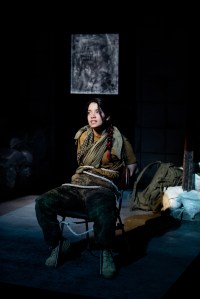
The building of Pressure, at Nextfest. Meet playwright Amanda Samuelson

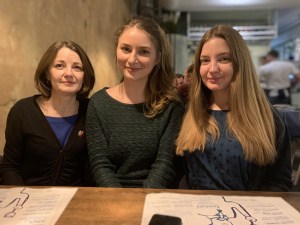
Playwright Amanda Samuelson, Nextfest 2022. Photo by Mat Simpson

By Liz Nicholls, 12thnight.ca

Amanda Samuelson remembers the moment Pressure began to build. 

Her play, which gets a workshop reading at Nextfest Saturday and then becomes Nextfest’s first-ever official Fringe show in August, began in the winter of 2018. In a playwriting course at NYU, where Samuelson went to school (and got her BFA), the pressurized assignment was “to incorporate three ingredients into a two-page scene…. Hunger,  astrology, a synthetic body part.” What could be more playful, or more impossibly daunting?

To help support 12thnight.ca YEG theatre coverage, click here.

Pressure has changed, and grown, and expanded incrementally from two pages to a fulsome 80 since then, as the playwright, now in her mid-20s, describes. But that first two-page scene, between protagonist Grace and her non-binary ex-partner Ricky, is still in place; in fact, Pressure opens with it. And, amazingly, “all the ingredients are incorporated,” Samuelson laughs.

In its non-chronological scenes — present-day Grace, Grace at 15, the last time Grace spoke to her father, Grace and Ricky break up … — Pressure charts “one woman’s  experience of depression” Says Samuelson, it’s “based on my own experience,” says Samuelson. “I tend to do that, to get inspired by real life, and fictionalize .” 

“In your mind, having thoughts like ‘everyone hates me’, or ‘this person must think that about me’…. It’s living too much in your head. And your thoughts take you into some other reality, the worst possible scenario. It’s not true, but you convince yourself to believe things that are bad about yourself.” 

Astrology? “It’s incorporated through the entire play,” says Samuelson of the “fake horoscopes,” written by Grace herself and reflecting her state of mind. “Today’s horoscope: you’re a big fat failure.” 

Synthetic body part? When her partner leaves to go to school, they give Grace a hand to hold while they’re gone.” 

In this, Samuelson has flipped the real-life experience of a long-distance relationship when she left her home town of Grand Prairie, and her boyfriend of the day, to go to NYU to be an actor. And like Samuelson, Grace is an artist: “I made her a struggling writer,” whose lack of confidence prevents any enjoyment of success. “When her play is selected for production in New York, she doesn’t want to get her hopes up; she’s sure something will go wrong.”

In successive incarnations, Pressure gained not only length but a third character, Grace’s mother, who’ll be played by Kate Ryan in the Nextfest reading directed by Emma Ryan. And the play’s mother-daughter relationship is fraught with push-pull tensions.

It was in the course of her studies in New York that Samuelson discovered herself as a writer. In the NYU studio where she happened to be placed,  Playwright Horizons, “you take all the classes — acting, directing, movement, design, playwriting. So I got a full (theatre) education, and that’s where I took my first playwriting class. After the first year I found I liked playwriting a lot more, and I started focussing on that. I realized hey, this is something I might actually be good at and really enjoy!” 

By the time Samuelson got back to Edmonton, she was a veteran creator of very short plays. Gate D-98, about two people in an airport, and My First Greek Sunset, about a sexual assault, were chosen for successive years of EdmonTEN, an annual showcase of that very difficult achievement of storytelling in a 10-minute span. Pressure, which had started as a two-page scene, became a 10-minute play, then a short one-act play which would have premiered at the U of A’s Stagestruck Festival in 2020 had it not been for The Great Pause. 

“I took a break from it for a while; I was feeling a bit stuck,” says Samuelson. Then came an invitation from Workshop West’s Heather Inglis to bring Pressure to the Springboards Festival in March. The 20-minute excerpt Inglis chose  “happened to be the newest scene I’d written…. I ended up changing the entire scene.” 

“Being able to hear it out loud, this play that had been inside my head, was super-helpful,” Samuelson says. “And now it’s at a point it really needs an audience,” so Saturday’s Nextfest workshop reading comes at the best possible moment…. I know it’s not perfect, but it’s as good as I can get it for now.”

Trained as an actor, Samuelson has been in both Fringe and Nextfest casts. But as for Nextfest’s debut venture into presenting at the Fringe, Samuelson is happy to not to be in Pressure herself. “I want to be able to experience it from the outside, to watch someone else bring the character to life in their own way. That for me is the most exciting part.”

Pressure happens in Nextfest’s Workshop Reading series Saturday at 6 p.m. in the Roxy’s Rehearsal Hall. Look for it in the Lorne Cardinal Theatre, a BYOV at the Fringe. 

Further information, tickets, full schedule at nextfest.ca.

Posted in Previews | Tagged , , , , , , | Comments Off on The building of Pressure, at Nextfest. Meet playwright Amanda Samuelson

Nextfest 2022, live and under one roof, at the new Roxy

By Liz Nicholls, 12thnight.ca

When you ask Nextfest artistic director Ellen Chorley what’s new at the festival this year, she laughs. “Everything!” she says of the 27th annual edition of the influential multi-disciplinary festival that showcases and celebrates emerging artists.

To help support 12thnight.ca YEG theatre coverage, click here.

“Really, the whole thing is about being new — new projects, new artists, new connections, new building!” Yes, after two years of its creative captures of live-ness online, not only is Nextfest back live Thursday, it’s in a deluxe new building, Theatre Network’s Roxy Theatre on 124th Street. “Really, the only thing that’s constant about the festival,” as Chorley says, “is that it’s still 11 days (and nights).” 

Starting Thursday, Nextfest will be happening “in a wealth of venues … under one roof!” And not just under but on that roof. “It’s so beautifully built for a return to live; we’re so excited to be gathering! There’s nothing like being in the same room with people,” says Chorley, from her new location in the glass-walled office on the Roxy’s second floor. “Folks can show up at 10 a.m. and stay in the building all day long. And pop out to The Duchess for a coffee and a treat and then keep going with us till 2 a.m.!”

Nextfest artists, who number just over 500 at the moment, are poised to invade every nook and cranny of the building. No, there’s nothing officially programmed in the deluxe, very elegant Art Deco-inspired bathroom at the moment. But the curators of Nextfest’s signature themed performance Nite Clubs “are talking about it… Maybe you’d go into a stall and have a moment to write down your biggest fear or something like that,” declares Chorley, a multi-faceted theatre artist herself (actor/ playwright/ director/ producer/ mentor) who’s an indefatigable talent scout and perpetually in brainstorming mode.

Photo by Theatre Network

As she explains, three of the six mainstage theatre offerings, and all the dance (some nine new pieces grouped into three productions), happens in the Nancy, the 200-seat Nancy Power Theatre. The three other mainstage theatre productions, and all the high school theatre shows, are in the Lorne, the re-configurable “close and personal” downstairs black box Lorne Cardinal Theatre. It’s attached to the lobby bar where Nextfest artists and audiences will congregate.   

The multi-disciplinary festival and its 50-plus “events” are our window into the creative minds of the next generation of artists: game-changers in theatre, music, dance, film, visual arts, comedy, poetry…. and the performance art that resists every category. 

It all happens under the banner “come for the art, stay for the party.” Says Chorley, “meeting new people, introducing people, making new connections and starting collaborations that go on for decades … is a big part of what we do.” She points to her own theatre career which dates back to high school involvement in Nextfest.

“Nothing is based on ticket sales…. It’s a presentation model. We pay projects an honorarium to be part of the festival (Theatre Network keeps the ticket sales), and they divide it how they want…. Artists just have to be in charge of making the art, not the selling of the art, filling seats, marketing.”

Theatre at Nextfest exists in a three-tiered way, tailored to scripts at every stage of development. The bright, airy above-ground rehearsal hall is the site of four ‘workshop readings’. For a playwright, “it’s a first opportunity to hear their play read out loud to an audience — by actors, not just the voices in their head,” as Chorley puts it.

Nextfest director Ellen Chorley.

There are three ‘progress showings’, which Chorley describes as involving “a little bit of tech … a bit past a workshop reading but not a whole mainstage production.” Two of the three creators have been at Nextfest before, with other projects. For the last two years Lauren Brady, for example, has done “clown-based movement work in our online festivals. InterWEBBED, billed as “a sci-fi clown thriller,” capitalizes on that experience. It’s “a solo show about the uses of technology through the eyes of a clown,” as Chorley describes the piece, en route to a fully realized stage version. 

The six high-contrast “mainstage shows” each with four performances, vary in their Nextfest history and development. Gabby Bernard’s Stone and Soil, for example, has a Nextfest history: it was an online reading last year. One, Host Town, is a concert/ song cycle. Chuckle Ruckus is sketch comedy. Moonie and Maybee is set in a graveyard by moonlight. The Shadow and the Fool; a Progress Showing for a Process Growing is billed as a “hybrid lecture-performance.”

“It’s important to us to meet a project where it’s at,” says Chorley. Shyanne Duquette’s Omisimawiw (Cree for older sister) tells a remarkable sibling story, “one that’s really important to the playwright so we didn’t want to rush it…. It was about getting the script in front of the audience and getting their feedback.” It will be on the Nancy Power stage as a workshop reading.

You’ll meet Nexfest playwrights in upcoming 12thnight posts. 

In an age where creating and producing are more closely linked than ever before — and on the extremely persuasive theory that producers are taught not born — Nextfest’s new “emerging producer” program fills a niche. The two traditional routes — maxing your credit card for a Fringe show (“I’m still paying it off!” says Chorley) and taking arts admin at MacEwan University — aren’t accessible to everyone.  

Six participants took Producing 101 every Monday evening starting in January. And now, thanks to a provincial multi-cultural Indigenous inclusion grant, they’re “assistant producers” in charge of hands-on projects at festivals (Nextfest,  SkirtsAfire, Found Fest, and the Fringe). 

“The pandemic forced people to ask themselves what kind of artist am I going to be? And how am I going to get my art out there?” says Chorley, a playwright who started a kids’ theatre company and a burlesque troupe to produce her own work. “I love producing! And producing really changed the game for me,”   

When you come to Nextfest you can see visual art exhibitions and installations in three gallery spaces. You can watch films made by up-and-comers (or save those experiences for online). There’s a choose-your-own-journey podcast (created by playwright Hayley Moorhouse); there are talkbacks, workshops, showcases. There’s even online content (“we had to learn so much the last two years”). And back live, which is where they work best, there are four niteclubs (including the time-honoured Smut Cabaret and a Pride night), fashioned and produced by young arts presenters and troupes. They’ll have the run of the building.

But first there’s opening night. It starts across 124th St. at The Lot Thursday night, and moves back into the Roxy. Says Chorley, “a lot of artists will be in the building for the first time during the festival. I betcha by next year, there’ll be a show in the elevator, or on the stairs!” 

PREVIEW

Nextfest 2022

Theatre: Nextfest Arts Company

Where: Theatre Network‘s Roxy Theatre, 10708 124 St.

Running: Thursday through June 12

Tickets and complete schedule: nextfest.ca

Posted in Previews | Tagged , , , , , , | Comments Off on Nextfest 2022, live and under one roof, at the new Roxy

Art will prevail: a change of venue for L’UniThéâtre’s season finale

By Liz Nicholls, 12thnight.ca

If the last two years have taught us anything it’s that art will prevail. And so will Art, the, er, art-ful 1994 Yasmina Reza hit comedy that is  L’UniThéâtre’s season finale. 

Last Friday night’s storm and the sewer back-up that followed have meant that the theatre at La Cité francophone, L’UniThéâtre’s home base, is unusable for the time being. Josée Thibeault’s production of Art will open Wednesday and run through Saturday, exactly as scheduled. But there’s been a last-minute change of venue: Art will happen instead at the Gateway, Workshop West’s new theatre in Old Strathcona. 

“We were just finalizing the set,” sighs L’UniThéâtre artistic director Steve Jodoin, who’s a member of the three-actor cast. Since Jonathan Beaudoin’s design for the play involved walls (the location is an apartment) and they’d been built onstage, they couldn’t be moved. So a play about the reaction of three friends to a minimalist white-on-white painting just got more minimalist, in the production re-worked for its run at the Gateway. 

“No walls….That works!” says Jodoin, of a play, returned to its original French (with English subtitles), in which a three-way friendship fractures spectacularly over modern art, and the big money laid down by one of them for an all-white  canvas by a famous artist.  

He notes that the occupants of La Cité, including Le Café Bicyclette, have been given “a 10-day window,” with reassessment then about the timeline for repairing the damages. La Cité’s patio and wedding season schedule are on hold; the busy Fringe season awaits. 

Art, starring Steve Jodoin, Bernard Salva and François Pageau, runs Wednesday through Saturday at the Gateway Theatre, 8529 Gateway Blvd. Tickets: lunitheatre.ca 


Posted in News/Views | Tagged , , , , , | Comments Off on Art will prevail: a change of venue for L’UniThéâtre’s season finale

A comedy thriller with a Wagnerian reverb: Evelyn Strange at Teatro, a review

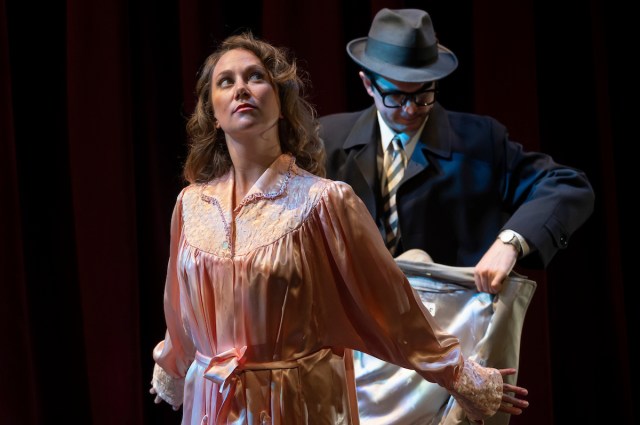
Gianna Vacirca, Oscar Derkx in Evelyn Strange, Teatro La Quindicina. Photo by Marc J Chalifoux

By Liz Nicholls, 12thnight.ca

A beautiful amnesiac in a trench coat finds herself in a grand tier box at the Met c. 1955, sitting through a performance of Wagner’s five-hour Siegfried. She needs time to think and, hey, The Ring Cycle is ideal for that.

To help support 12thnight.ca YEG theatre coverage, click here.

“I’m happy things aren’t going too fast,” she tells another occupant of that darkened box. “I can’t be rushed. Not tonight.”

That’s the unusual opening scene of Evelyn Strange, Stewart Lemoine’s witty, high-style 1995 comedy/ thriller/ romance/mystery, now getting a revival in Teatro La Quindicina’s 40th anniversary season. The opera-loving playwright has concocted a Hitchcockian mystery plot with Wagnerian reverb, in which a reluctant Siegfried will rescue a strangely somnambulant Brunnhilde with no ID. True, the mysterious Miss Strange (Gianna Vacirca) isn’t catching zzz’s behind a wall of flame, but her mind seems to be on indefinite pause. 

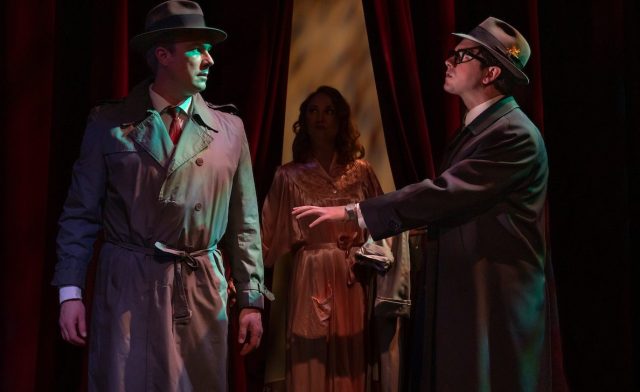
Jesse Gervais, Gianna Vacirca, Oscar Derkx, Evelyn Strange, Teatro La Quindicina. Photo by Marc J Chalifoux

Evelyn Strange is more homage than parody, to be sure. It’s a ticklish thing to wrap noir-ish suspense around comedy (or possibly vice versa). And it’s fun, and funny, to see it done so neatly, and with so much pizzaz, in the production directed by Shannon Blanchet (who made her professional debut in the title role of the play’s 2006 revival).  

Lemoine’s worldly sophisticates are ideally suited to breezily tossing off their views on opera (opera jokes aren’t everywhere in Canadian theatre, I find). Nina Ferrer, the tigerish Westchester society matron  played to a perfect cutting edge of sharpness by Belinda Cornish, isn’t short on views on the subject. In one of my favourite pieces of worldly advice ever, she advises Perry Spengler (Oscar Derkx), the sub-editor who works for her publishing magnate husband, that with Wagner there’s no real need to read the program notes in advance. It’s better to prepare by “practising breathing as slowly as possible so you can lower your heart rate.”

Nina bolts at the first intermission (Siegfried is amply supplied with those). Spengler, a young man with an adorable open-faced charm about him in Derkx’s funny performance, opts to stay: “I wouldn’t mind seeing the dragon in Act II.”

Oscar Derkx and Gianna Vacirca in Evelyn Strange, Teatro La Quindicina. Photo by Marc J Chalifoux.

It’s a fatal curiosity. Perry Spengler will find himself fascinated against his better judgment by the mysterious stranger who doesn’t know who she is and how she got a ticket to the Met. And he’s cornered, by his own instinctive helpfulness and good manners, into squiring her through her journey of self-discovery.

In the great theatrical repertoire of comically awkward first “dates,” their après-opera time together at the Automat has a special place. “Chicken,” he notes, watching her dismember a pot pie, “makes you happy in a way Wagner never could.”  

In her smart, stylish performance as the mysteriously blank Hitchcock blonde, Vacirca charts Evelyn Strange’s calibrated course through a world in which everything is perplexing and unfamiliar until, gradually, it’s not. She graduates from dazed to cinematic. “There’s nowhere to go but Manhattan,” she sighs dramatically. “And I’m a stranger there.” 

Jesse Gervais is riotously manic as Perry Spengler’s  work-mate at the publishing house, and a self-styled roué and man about town. Lewis Hake positively glints with malicious glee; seductive poses are his specialty. When the time comes for pyjamas, and a sex scene at his place, you will laugh out loud. And you’ll have further  opportunities for public laughing in a theatre when you see Cornish as Ferrer, entering a room on high heels propelled by her own shopping bags, or hear her tartly advise Miss Stranger that if she needs lunch she should have a rum flip. “It has an egg in it.”  

This pair have a hilarious scene together at Grand Central Station for reasons I must not divulge, where they both come unglued, but in different registers. “If a train for South America passes, I will catch it,” she snaps frantically. 

The fun of all this unravelling is enhanced by the visuals: a tip of the fedora to Leona Brausen’s glamorous ‘50s costumes, witty in themselves. Chantel Fortin’s set pieces produce the Met, the Automat, Grand Central Station, in the most economical way, appearing onstage by human agency. 

A special word is de rigueur for Narda McCarroll’s lavish and suspenseful film noir lighting, all shadows and sidelights. It makes red velvet curtains and fedoras especially worthwhile. 

The bonus, of course, is that the comedy unfolds to a score by Wagner, whose moments of making audiences laugh have hitherto been few and far between. And there’s this: you don’t have to actually sit through Siegfried to hear the highlights.

REVIEW

Evelyn Strange

Theatre: Teatro La Quindicina

Written by: Stewart Lemoine

Directed by: Shannon Blanchet

Starring: Gianna Vacirca, Oscar Derkx, Belinda Cornish, Jesse Gervais

Where: Varscona Theatre, 10329 83 Ave.

Running: through June 12

Tickets: teatroq.com


Posted in Reviews | Tagged , , , , | Comments Off on A comedy thriller with a Wagnerian reverb: Evelyn Strange at Teatro, a review

The one-way time portal into war: Alina, a review

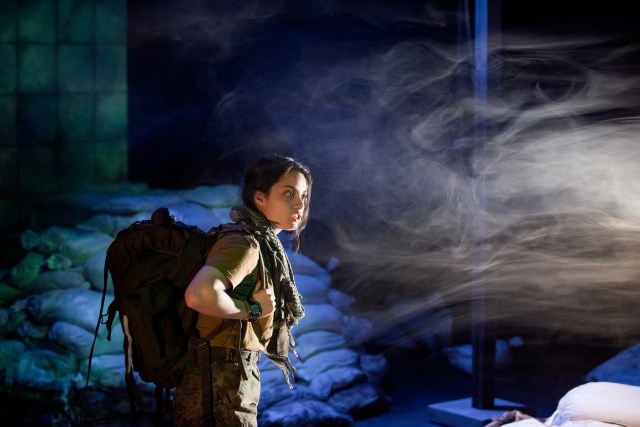
Christina Nguyen in Alina, Pyretic Productions. Photo by Brianne Jang, bb collective.

By Liz Nicholls, 12thnight.ca

“Trains, they’re like time portals,” says the title character of Alina, who steps into one at the outset. On a train you leave one world and you arrive in another. 

The question the drives the gripping new play by Ukrainian-Canadian playwright Lianna Makuch, premiering in Patrick Lundeen’s veritable barrage of a production, is whether you can ever come back.

To help support 12thnight.ca YEG theatre coverage, click here.

Makuch’s story of Alina and her milieu of extraordinary “ordinary” people who step outside their lives and volunteer to fight for Ukraine’s future — inspired by on-location research in Ukraine —are a powerful indicator that in war there are no return tickets. The “real world” and the you who moved through it cannot be found; they no longer exist.  

Lundeen’s Pyretic production, in the tiny Studio Theatre venue, is a test case for theatrical invention in flinchingly close quarters. It’s a bone-rattling first-person solo evocation of the horrifying multi-sense assault of war, and the nightmare strangeness of PTSD — in sound (electronic composer Noor Dean Musani and sound designer Aaron Macri), in lighting (Stephanie Bahniuk), in virtuoso movement (choreographer Amber Borotsik), and in a remarkably vivid performance by Christina Nguyen.  

Nguyen literally ricochets through a world framed by the sandbags and stark collapsible beams of Bahniuk’s set. She stars as the fierce, impatient, hot-tempered 19-year-old university kid who boards the train that goes to the front line of a war: the escalating battleground near Donetsk Airport in eastern Ukraine, during the 2014 Russian invasion. She’s armed with a backpack, supplies for front-line volunteers, and the memory of a 2013 student protest in the main square of Kyiv that was brutally suppressed by police enforcers of the Russian puppet regime and “changed nothing.”

Christina Nguyen in Alina by Lianna Makuch. Photo by Alexis McKeown.

What motivates Alina? It’s a play of double-negatives that don’t cancel each other out: “I can’t do nothing any more,” Alina declares. “This will not all be for nothing.” War, in short, is something you can’t not do when the chips are down, which is where they’ve been for countless years in Ukraine.   

Alina, though, doesn’t explain — and arguably doesn’t set about explaining — the mystery of a restless character with an impressive, built-in defiance about her, a certain pressure-resistant pro-active anti-authoritarian streak, and a short fuse. At 19, she takes on everything that’s stacked against her choice to go to war —  her mother’s objections (and safety), her friends’ easy compliance with the status quo (“the front? the front of what?”), even the volunteer brigades who initially refused “a 19-year-old girl” on the grounds of both age and gender. 

She’s not an easy person, as Nguyen’s performance, unafraid of harshness, amply conveys. “I never want to be you!” she says on the phone to her worried factory-worker mother (Lora Brovold, who has a late-play cameo). Then she hangs up on her, and refuses to respond to her messages.

Significantly, the only softness to Alina is a certain rapport with children, and the lingering childhood memory of a sun-dappled day in Independence Square in Kyiv. 

Hers is a story full of adventures (all culled from real-life interviews), which unfold to a sound track of booms, explosions, and echoing thuds, the electronic pulse of tension, weird vibrations, a sheen of industrial buzz. The sound provided by Musani and Macri is an outstandingly dramatic participant in the storytelling. And the eerie glow, flashes, and  shadows of Bahniuk’s stunning lighting design conjure a shattering world of terrors. 

Christina Nguyen in Alina, Pyretic Productions. Photo by Brianne Jang, bb collective,

Alina poses as a journalist and is found out and arrested as a spy (“c’mon, I have 2,500 Twitter followers”). She jumps from the third floor of a burning building. Without either military or medical training, she’s suddenly a front-line medic, flailing in blood, struggling to find the vein and give a horribly wounded man an injection.

“Don’t worry,” says a fellow volunteer. “It’s not brain surgery. (Pause). Most of the time.” To the soundtrack is added the script’s repeating chorus of gruesome injuries – shrapnel wounds, concussions, collapsed lungs, frostbite, wounded bodies coded 300 for saveable, 200 for dead. 

Between assignments when she returns to the civilian world, Alina doesn’t recognize her former life. It’s an aggressive chaos of grotesque noise, people drinking and talking about nothing in clubs, a disconnection conjured by the production. “I pass people just living, smoking, laughing, kissing. And they look through me like I don’t exist.” She’s furious one moment, and struck by the strangeness of tiny things — a cat, the sight of two old men in caps — the next. 

She can’t get rid of the metallic taste of blood on the tip of her tongue. And eeriest of all, over and over, when she looks in the mirror she sees a death’s head. The image of Alina impaled between the V of two poles in a spotlight is a graphic theatricalization of PTSD and an overpowering sense of unreality. That this is all delivered by Nguyen in motion and in the present tense as it’s happening, a mode of storytelling fraught with the risk of artifice, is a startling (and aerobic) achievement in physical theatre.  

Since Alina was written before the current deluge of Russian invasion atrocities in Ukraine, the frame and shape of the play have undoubtedly changed. And the ending of the play, infused with a certain hope for healing and the passionate belief that solidarity counts, has darkened considerably. What was hopeful is now heartbreaking.

“There is no future right now,” says Alina. “We’re in between…. We’re fighting for a future.” It’s never been more in doubt. 

Read the 12thnight interview with the playwright here, including details about donating to Ukrainian humanitarian efforts.

REVIEW

Alina

Theatre: Pyretic Productions in association with Punctuate! Theatre

Written by: Lianna Makuch

Directed by: Patrick Lundeen

Starring: Christina Nguyen and Lora Brovold

Where: Studio Theatre, ATB Financial Arts Barn

Running: through June 5

Tickets: pyreticproductions.ca 

Posted in Reviews | Tagged , , , , , | Comments Off on The one-way time portal into war: Alina, a review

Destination Fringe: Edmonton Fringe Theatre is back with a moniker, a live festival, and a curated season of productions

By Liz Nicholls, 12thnight.ca

The Edmonton Fringe is back, live, this summer, for a big 41st edition, in a place where that really matters. And its name speaks volumes: Destination Fringe.

Yes, fellow travellers, as live theatre emerges from the most punishing and chaotic time it’s ever known, you have a festive destination this August (11 to 21). And after last year’s 40th birthday edition, Together We Fringe: A Fringe Event, creatively trimmed for safety to some 64 live shows in a dozen venues, our summer theatre extravaganza in 2022 is a destination that feels wide and unpredictable in advance. Just the way we like it.   

While its dimensions aren’t as gargantuan as the 2019 Fringe, with its record-breaking 260 shows in 50-plus venues, Destination Fringe feels expansive, as Fringe director Murray Utas and Fringe Theatre executive director Megan Dart outlined it Thursday: 160 shows in some 27 venues, eight of them programmed by lottery and 19 BYOVs, acquired and outfitted by artists themselves.

To help support 12thnight.ca YEG theatre coverage, click here.

The Fringe is a destination for kids: The Kids Fringe, on hold for a year, is back (and free), directed by Girl Brain’s Alyson Dicey. International groups, who couldn’t bring their shows to Edmonton for the last two summers, are in Destination YEG mode, restoring a missing dimension to the show lineup. And the Fringe will be a more expansive destination for Indigenous artists too. Instead of last year’s one venue (pêhonân) dedicated exclusively to Indigenous shows (and highly successful), Indigenous artists will perform across the Fringe — on its outdoor stages, its late-night cabarets, in roving performances leading audiences to the Indigenous Art Park, in short, “anywhere you Fringe,” as Dart says. 

Fringe Revue has returned, too. At Wednesday night’s launch, live and on Fringe TV (one of the great successes of pandemical times), Utas and Dart outlined Fringe Theatre’s curated 2022-2023 season of productions, a destination for some of Edmonton’s most adventurous young indie artists. 

Actor Emma Houghton turns playwright with her adaptation of Joyce Carol Oates 2003 ‘young adult fiction’ novel Freaky Green Eyes, “a coming-of-age crime drama” as she describes it,  for the stage as a one-woman play. “The Great Pause empowered me to create my own work,” she told the audience Wednesday. The production runs in January at the Backstage Theatre. 

André Moreno performed an excerpt from Botticelli in the Fire, Jordan Tannahill’s queer theatrical fantasia on the life and times of Renaissance painter Sandro Botticelli as he works on his masterpiece The Birth of Venus. The large-cast production runs in April, directed by Sarah Emslie and produced by Common Ground Art Society’s Mac Brock. 

The Fringe Theatre curated season also includes Evandalism by MC RedCloud, the very engaging co-creator of Bear Grease, the hit Indigenous adaptation of the famous musical that sold out every performance at last summer’s Fringe and has toured across the border to full houses since then. His new play is spun from MC RedCloud’s own life; Utas directs. Dates to be announced. 

But first, Destination Fringe. “It’s a fuller-scale festival this year,” as Dart puts it, simply. After two years of creative work-arounds and resourceful online adaptations — no theatre company has been more supple at improvising workarounds —  our Fringe is again a destination for artists, audiences, and live experimenting by both. Our theatrical GPS is on course: straight on till August.
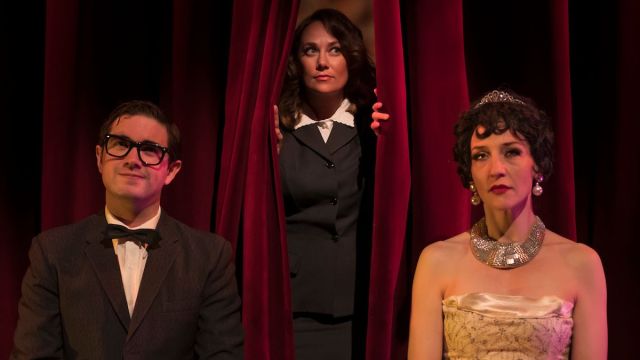
Tickets for Destination Fringe go on sale Aug. 3. Check out fringetheatre.ca for more information.


Posted in News/Views, Previews | Tagged , , , | Comments Off on Destination Fringe: Edmonton Fringe Theatre is back with a moniker, a live festival, and a curated season of productions

The strange cycles of theatre: Shannon Blanchet returns to Teatro to direct the vintage comedy thriller Evelyn Strange

Oscar Derkx, Gianna Vacirca, Belinda Cornish in Evelyn Strange, Teatro La Quindicina. Photo by Marc J Chalifoux

By Liz Nicholls, 12thnight.ca

Every once in a while the world of live theatre pulls off one of those satisfying but fanciful multi-strand time loops that wouldn’t be out of place in a play. Opera is involved; so is comedy. Shakespeare has a supporting role. How often does that happen? 

Evelyn Strange, the Teatro La Quindicina revival that opens Friday on the Varscona stage — in a darkened box on the grand tier of the Metropolitan Opera — returns Shannon Blanchet to the theatre town where she made her busy career as an actor till last summer. Back to the company where she has a long history as a leading lady, and where she got her first professional gig out of U of A theatre school. And back to the very play in which that happened.

To help support 12thnight.ca YEG theatre coverage, click here.

Blanchet played the title role in a 2006 revival of Stewart Lemoine’s 1995 mystery/ thriller/ comedy/ romance, as the beautiful amnesiac who discovers an opera ticket in her pocket. This time Blanchet won’t be onstage. She’s making her directing debut with Evelyn Strange, set in 1955, in which Wagner’s opera Siegfried, part three of the Ring Cycle, is the opening gambit. (Gianna Vacirca is the new Evelyn Strange). 

The distinctive Blanchet voice, with its interesting edges and hints of husky (BioWare was quick to appreciate that voice in video game gigs) is on the phone. She’s explaining a move to Saskatoon last summer to take an assistant professorship of voice and acting in the University of Saskatchewan drama department. 

“It’s a bit of an odd thing to move to a new city in the middle of a pandemic,” she concedes. But it’s “exactly what I went to school for,” she says of her U of A master’s degree in “voice pedagogy,” a field that is not, contrary to popular opinion, about singing. It’s a line of work Blanchet summarizes as “personal trainer meets drama teacher meets speech pathologist meets public communication coach.”

The soft ‘50s cadence of the Evelyn Strange characters is right up her alley, “the fading trans-Atlantic dialect, the slightly elongated vowels … everything took a little longer then, the tune of the language.” 

Blanchet entered the Teatro ensemble via … Shakespeare. First it was the Freewill Shakespeare Festival’s glam Hollywood McCarthy era production of Love’s Labour’s Lost, with Blanchet as Rosaline. Then it was a Studio Theatre production of As You Like It, with Blanchet as the witty cross-dresser Rosalind. Lemoine and Jeff Haslam saw both shows; they’d found their Evelyn Strange.

“I just remember the fun of it,” she says of the experience of playing the mysterious character who knows nothing about herself except that she’s sitting through Siegfried at the Met. “I tend to be a serious, no, intense, person…. It was a revelation to me that (theatre) could be fun, after being so serious for so long.” And she remembers being “wholly intimidated” by her Evelyn Strange castmates (Haslam, Davina Stewart and Ron Pederson), “lovely and welcoming though they were.” 

The first Teatro show she’d seen was The Vile Governess, Lemoine’s “Ibsenesque romp,” as he’s described it. “I remember laughing till my sides ached, thinking ’what the hell IS this? It was like nothing I’d ever seen before….”

“Actually, most of Stewart’s plays have an element of ‘what the hell is this?’” Blanchet muses. “He mixes and stretches and pushes and pulls genres…. Many dimensions of comedy, a word you come to realize (with Teatro) is more a category and not really a descriptive.” 

Jesse Gervais, Gianna Vacirca, Oscar Derkx, Evelyn Strange, Teatro La Quindicina. Photo by Marc J Chalifoux

And so it is, she thinks, with Evelyn Strange. “You have opera, you have a mystery, and you have romance, and you have comedy. And it’s fantastic to figure out how far to lean into all those elements at any given moment.” There are noir-ish affinities to Hitchcock — Kim Novak in Vertigo — as Blanchet points out. “And what a yummy thing for design… But how do you balance that so people know they can laugh?” 

It’s tricky. And so is memory, she finds, coming back to a play she loves after a decade and a half. “I’m sure there was a wall. No, there were no walls…. Then, wait, ah I remember, it was on the old pie-shaped stage (in the old pre-reno’ed Varscona). Different theatre.” Blanchet is happy about the proscenium (framed) stage in the re-born Varscona. “A proscenium is really where it’s meant to be. It starts at the Metropolitan Opera, so it makes perfect sense for there to be big beautiful drapes!”

Oscar Derkx and Gianna Vacirca in Evelyn Strange, Teatro La Quindicina. Photo by Marc J Chalifoux.

It also makes sense for there to be music, of course. And as in so many Lemoines, it’s part of the story, a life-changer. “The first thing I wanted to do was listen to the music, she’s found in her inaugural directing assignment. “You hear the opening tymp roll, hmm, and then you jump to the end, the high C and the rejoicing, and OK, so there’s the journey of the play!” She reports that Vacirca and co-star Oscar Derkx actually sat through all five hours of a German production of Siegfried the other night, a testament to extreme commitment. “Mine doesn’t extend that far,” she laughs. 

Someone in the crew, Blanchet reports, observed that “you’d think the music was written for the play, and not the reverse. Reverse engineering!” She remembers how much hearing the music helped her understand her character —“a romantic vision in some other character’s head” — in another Lemoine, The Adulteress.  

Gianna Vacirca, Oscar Derkx in Evelyn Strange, Teatro La Quindicina. Photo by Marc J Chalifoux

“I’m always amazed at designers,” Blanchet says. “I’ve asked Chantel (set designer Chantel Fortin) for the moon. And she has really delivered…. Narda (lighting designer Narda McCarroll in her Teatro debut) says ‘wait, o, do you want the moon?’ Amazing.” And a play set in the ‘50s unleashes Teatro’s costume designer Leona Brausen in a period she loves. “The costumes tell you how to move; there are certain things you cannot do in a suit from 1950. Nope, you won’t be lifting your arms that way.” 

As Blanchet knows from first-hand experience, the actor’s ultimate nightmare is playing an amnesiac, a character with a blank slate of motives and no back story. “It’s really really hard to accept ‘do less do less do less do nothing’…. You have to think all the thoughts but don’t do anything!” 

She herself is revelling in her own back story of “growing up wth a company, and being trusted with increasing levels of responsibility,” as she puts it. We haven’t lost her to university life. “It’s especially important for people to remain active, in the industry and the community.” She’ll be back. Meanwhile she’s preparing to direct a university production of Lemoine’s The Margin of the Sky in Saskatoon at Greystone Theatre, slated to happen just after Teatro’s own season-ending revival here for the Fringe. 

“Ask me where I’m local,” she says. “That feels like a good question.” 

PREVIEW

Evelyn Strange

Theatre: Teatro La Quindicina

Written by: Stewart Lemoine

Directed by: Shannon Blanchet

Starring: Gianna Vacirca. Oscar Derkx, Belinda Cornish, Jesse Gervais

Where: Varscona Theatre, 10329 83 Ave.

Tickets: teatroq.com 

Posted in Previews | Tagged , , , , , , | Comments Off on The strange cycles of theatre: Shannon Blanchet returns to Teatro to direct the vintage comedy thriller Evelyn Strange

The inheritance of war and the passion for freedom: Alina is a Ukrainian story

Christina Nguyen in Alina by Lianna Makuch. Photo by Alexis McKeown.

By Liz Nicholls, 12thnight.ca

In early 2015, a 19-year-old woman left Kyiv, and everything in her life there — and she went to the front line of the war zone in eastern Ukraine.

To help support 12thnight.ca YEG theatre coverage, click here.   

Alina was not a soldier. She was a university student, a language major. She’d tried to volunteer but had been turned away as too young. She went anyway, posing as a journalist, and was arrested as a spy by Ukrainian counter-intelligence. As the battle for Donetsk Airport raged on, one of the deadliest of the war — a war that as the world now realizes in a horrifying way has never really ended — she became a volunteer combat medic. 

Alina Viatkina in Poland 2022, with donations

Alina is the brave, fiery young woman Ukrainian-Canadian playwright Lianna Makuch and her Pyretic Productions cohorts — fellow playwright/ dramaturge Matthew MacKenzie and director Patrick Lundeen — met on a research trip to Ukraine in 2017. And her highly dramatic story, with its aftermath of PTSD, found its way into the Makuch play named after her: Alina premieres Thursday at the Studio Theatre at Fringe headquarters, in a Pyretic production directed by Lundeen. 

In 2017, as Makuch explains, the Pyretic trio had “travelled all over the country meeting people, talking to them, learning their perspective.” It was an exploration inspired by her Ukrainian cultural roots — “western Ukraine is my ancestral homeland” —  and her discovery five years before of her grandmother’s 1944 journal, a record of the cross-border nightmare of fleeing on foot a war-ravaged country. 

Patrick Lundeen, Lianna Makuch Matthew MacKenzie in Eastern Ukraine, 2017. Photo supplied.

The three collaborators returned the next year, to workshop Makuch’s Blood of Our Soil, since renamed Barvinok (Ukrainian for periwinkle, a delicate flower of remarkable beauty and resilience) at Kyiv’s Wild Theatre. It premiered in Edmonton in 2018, ran in Toronto, and is slated to tour Alberta in the fall. 

There can be no argument about the timeliness of a season of Ukrainian plays; the horrifying news re-confirms it on a daily basis. “I sometimes wish our plays weren’t so perpetually relevant,” sighs Makuch, who has a BFA in acting from the U of  A. “But that’s who we are….”

“There’s an inter-generational quality about the stories,” she says. Centuries of struggle and bloodshed are written into Ukrainian history. “Because I’m Ukrainian-Canadian, with Ukrainian grandparents and parents, it’s always just been part of my world. But now, it’s been pushed into the world view,” at a moment in time when the rebellion of 2013 (“the Revolution of Dignity”) and the Russian invasion of 2014 had, as Makuch puts it, “slipped out of people’s minds” and off the international stage.

Alina Viatkina and Lianna Makuch in Kyiv. Photo supplied.

As storytellers, artists, she thinks, have a particular ability to inspire “human connection, to create a time capsule, to evoke emotional empathy and insight … sharing human stories people can understand universally.”

“When I started on my artistic journey I never considered that my Ukrainian identity could or would fuel my artistic career. But it feels to me now that, as an artist, your identity IS your art, in a way.” 

The “relatable human story” Makuch tells in Alina is “the regular people in Ukraine who are going to war. That’s who Alina was. And is…. Of all the veterans we spoke to, nobody had military training, but they all felt there was no other option.” The term freedom has, as we know, been much abused of late. But “this is a fight for freedom in its most bare (and basic) context.” 

It was Pyretic’s main contact Dmytro Lavenchuk, a 2014 veteran and a Russian speaker (whom Pyretic brought to Edmonton to see Blood of Our Soil) who introduced them to Alina. “We were so inspired by the tight-knit community of veterans we met,” says Makuch. “Most were men, and we wanted to speak to a woman.”  

“Small but mighty, demanding respect from people.” That was Makuch’s first impression. “She doesn’t have time for people’s bullshit…. So much of her adult life (she’s now mid-20s) has been defined by war.” 

For Alina, as Makuch explains, it started with the student protest of 2014, which the riot police had tried to suppress violently. A million people showed up in Independence Square in Kyiv; the protest lasted three months. 

The steel in Alina was forged in the fire of that protest. “It changed her life. And it changed the course of an entire generation in Ukraine…. There was no stopping the revolution. People were chasing their future, and they didn’t want to go backward in time, to the old Soviet ways.”

Alina Viatkina and Lianna Makuch at Veteran Hub, Kyiv. Photo suppied

By 2018, Makuch was fashioning a play (“not a biopic”) inspired by Alina’s story, and the experiences of others as well. And it was further developed and researched in longer interviews, and a three-week residency (the first-ever by Canadian artists) in February 2020 at Kviv’s Izolyatsia Institute, —  the name means “solitary” in Ukrainian — where Alina was working at the Veteran Hub. Of necessity the institute had relocated in 2014 from Russian-occupied Donetsk, where the building is now a prison notorious for the torture and relocation of prisoners to Russian penal colonies. 

Olha Voldymyrivna (Alina’s mother), Lianna Makuch, Alina Viatkina in Kyiv, 2020

Makuch had the opportunity to talk to Alina’s mom (who makes a cameo appearance in Alina, played by Lora Brovold). “It was remarkable,” says the playwright of connecting with the mother who’d insisted that “language was a root connecting you to your ancestors.” Makuch, a fluent Ukrainian speaker, agrees enthusiastically.  

The little kid Alina, reports her mom, was a fierce, brave little kid, even at age three unafraid to snap back at men in their apartment building who challenged her.  

PTSD meant that interviews with Alina had to happen in “very specific environments” to mitigate her anxiety, mostly public spaces, says Makuch.  What struck the playwright was that “the return to ‘peaceful civilian life’ (which seems now permanently in quotation marks) is fraught and arduous, maybe impossible, for veterans. “I fear for the future,”
 she says of a kind of national collective PTSD. “They’ve worked so hard to learn to heal and live ‘real life’. And now they’re back at war.” 

War never ended; it just changed. “You used to be able to take a train to war, and then take a train back from war.” Not any more. Makuch, MacKenzie and Lundeen always asked their interview subjects if they’d ever go back to war. “And every single one of them said ‘if I had to’.” As Alina told Pyretic, “I couldn’t do nothing.” 

The fateful events of Feb. 24, when Russia launched another brutal invasion of Ukraine, have meant that the story of Alina “does exist in a new context.” Makuch, grateful for a workshop at the Citadel’s Collider Festival (“it came at such a perfect time”) did write and test a coda. In the end, though, she didn’t update the play. “It’s set in a time and place. And audiences can draw lines, extrapolate, understand what has brought us to where we are now.” 

Alina and her boyfriend managed to extricate her mother from Kyiv on Feb. 24. They drove her to safety in Poland; she stayed with Canadian theatre artist Michael Rubenfeld, and now has her own apartment there. She’s even thinking about coming to Canada, Makuch says. And, though plans for Alina to see the show are now on hold indefinitely, it will happen somewhere, somehow. Meanwhile, Makuch is developing the story into a feature-length screenplay. And next season in the Citadel’s Highwire Series she will direct the premiere of First Métis Man of Odesa, by MacKenzie and his now wife Ukrainian actor Mariya Khomutova, who met on one of Pyretic’s research trips. 

“I hope people will feel a personal connection to Alina’s story,” says Makuch. “You don’t have to be Ukrainian to understand.” That, after all, is what art is for.  

Pyretic supports Alina’s fund-raising campaign to purchase supplies for Ukrainian front-line volunteers: supportalinaukraine.com. 

PREVIEW

Alina

Theatre: Pyretic Productions in association with Punctuate! Theatre

Written by: Lianna Makuch

Directed by: Patrick Lundeen

Starring: Christina Nguyen and Lora Brovold

Where: Studio Theatre, ATB Financial Arts Barn

Running: Thursday through June 5

Tickets: pyreticproductions.ca 

Posted in Previews | Tagged , , , , , , , | Comments Off on The inheritance of war and the passion for freedom: Alina is a Ukrainian story

An ensemble devoted to expanding the comedy spectrum: Teatro at 40, the birthday season continues

Gianna Vacirca, Evelyn Strange, Teatro La Quindicina. Image supplied.

By Liz Nicholls, 12thnight.ca

Teatro La Quindicina at 40. An artist-run company specially tuned to comedy, with co-artistic directors who both made their Teatro debuts as actors: same season (2005-2006), different plays, roles written specially for them by playwright/Teatro muse Stewart Lemoine.

To help support 12thnight.ca YEG theatre coverage, click here.

Seventeen years later Belinda Cornish and Andrew MacDonald-Smith have chosen a live 40th anniversary Teatro season of four high-contrast Lemoine comedies — all of them revivals, each revealing another facet of the company’s unusual temperament,  aesthetic, modus operandi, and devotion to expanding the “comedy” spectrum. They themselves are part of that unique history of originals. 

Cornish and MacDonald-Smith are thinking about that in the lead-up to the second production of the Teatro season, Evelyn Strange, opening next week at the Varscona in a production directed by ensemble member Shannon Blanchet. 

Cornish’s introduction to Teatro was Lemoine’s first-ever farce, A Grand Time in the Rapids, in 2006, “the same year I became a Canadian citizen!” she says. The role Lemoine created for the London-born actor/playwright/director in his four-door three-actor farce was a Brit mystery widow who hailed (as the character told us brightly) “from a ludicrous and unappealing part of England.” Thalia Cumberland enlists the advice of an etiquette expert to assist with any awkwardness attached to having a suitor. 

Farren Timoteo, A Grand Time in the Rapids, Teatro La Quindicina. Photo suppkied.

“A classic farce!” declares Cornish, who will direct this birthday season’s revival July 8 to 24, starring MacDonald-Smith, Kristen Padayas and Farren Timoteo. Doors slam, towels drop, “yes, unconscious people are dragged through doorways.… It’s every classic farce trope through a Lemoine lens.”

Cornish recalls the memorable night during the debut 2006 run that the towel fell off altogether and actor Jeff Haslam “left the stage very fast wearing nothing but a very small tea towel.” This hasty exit was “so agonizingly funny that the Ron (Ron Pederson in the role of an etiquette expert) “put his whole face in the ice bucket.”

MacDonald-Smith’s Teatro debut wasn’t quite as convulsive but was equally memorable. It came in the 2006 premiere run of The Salon of the Talking Turk, a curious Lemoine comedy in which an automaton, a life-sized fortune-telling mechanical, enters the world of 20s New York high society. Since the part of Wally Peverell, a breezy over-achieving orphan, was written specially for him, “I was so flattered; I couldn’t wait to see what what kind of character Stewart Lemoine read me as.” 

He laughs. “It turned out I was someone who’s basically good at putting things from IKEA together .… Which is so absolutely true! I love putting IKEA furniture together. And I’m very good at it.”

MacDonald-Smith has used the name as his alias ever since; “Wally Peverell is my favourite name, my game tag online….” 

MacDonald, a recent MacEwan grad at the time, had just returned from a never-ending tour of Jack and the Beanstalk with classmate Farren Timoteo. They dreamed of working for Teatro. “We felt a specific kindred spirit with the shows and how Stewart never did the expected.”

He and Cornish have put together a season of Lemoine comedies to prove the point. Since the Teatro archive is fulsome — at least 75 comedies since that first Lemoine, All These Heels, at the first Fringe in 1982 — how did they choose? “What went into deciding the shows wasn’t chronology,” says MacDonald-Smith, currently appearing in 9 to 5 at the Citadel. “It was more based on the over-arching history of Teatro; ’what are the values Teatro has had over the years?’”

Their season opener was an unclassifiable oddball of a comedy, Caribbean Muskrat — a 2004 collaboration between the resident playwright and Josh Dean, a member of the young Teatro acting company at the time. “Collaboration, mentoring first-time and early stage playwrights … that’s part of Teatro history,” says MacDonald-Smith. 

Like Cornish, whose own plays (Thrubwell’s Pies, Diamond Dog) have premiered in Teatro seasons, MacDonald-Smith himself has been a beneficiary of that ensemble spirit; He’s the co-writer (with fellow Teatro star Jocelyn Ahlf) of the musical Everybody Goes To Mitzi’s with fellow (music by Ryan Sigurdson, lyrics by Timoteo), that was slated for revival at the moment the pandemic hit. 

“Teatro,” says Cornish, ‘has always been an ensemble, onstage and off-.” And their skill sets are constantly expanding. Company  member Blanchet, for example, who played the title role herself in a 2006 revival, makes her directing debut with Evelyn Strange. Rachel Bowron, another Teatro leading lady, is designing costumes for A Grand Time in the Rapids. Cornish, who has designed and painted Teatro sets occasionally, is directing the season’s farce, and acting in Evelyn Strange. MacDonald-Smith, who has stage managed Teatro shows in his time, and co-written one, is acting in A Grand Time In The Rapids. The co-artistic directors are learning theatre administration on the job.   

Evelyn Strange (May 27 to June 12), is a distinctive “mystery/comedy/thriller” of the Hitchcockian persuasion, set in ‘50s New York. Blanchet’s production stars Gianna Vacirca as the beautiful amnesiac who finds an opera ticket in her pocket. The cast includes Cornish, Oscar Derkx, and Jesse Gervais.

Evelyn Strange shows off the company’s affinity for the cadence, style and look of the ‘30s to ‘50s era. It’s a particular favourite of resident costume designer Leona Brausen, whose Teatro history goes back to Teatro’s origins and includes many appearances onstage. “There I was, this 6’4” kid who’d never had someone look at me and tell me exactly the size of suit I would wear in the ‘40s,” MacDonald-Smith laughs.  

Mathew Hulshof, The Margin of the Sky, Teatro La Quindicina. Photo supplied

As often happens in Lemoine plays, important moments in life are attached to music. In Evelyn Strange, it’s Wagner’s Siegfried (the eponymous heroine finds herself in a box at the Metropolitan Opera). In The Margin of the Sky, Teatro’s Fringe offering (Aug. 13 to 28), it’s Schoenberg’s Gurrelieder that plays “an actively dramatic part” in the play. “Stewart wrote the dialogue to match the emotional licks of the music,” says MacDonald-Smith. “He writes with the sound design in mind.” 

And speaking as we are of the festival at which Teatro was born, Cornish and MacDonald-Smith felt it was important to end the anniversary season at the Fringe where the company began 40 summers ago. Besides, The Margin of the Sky,  which hasn’t been seen since its 2003 premiere, is all about inspiration, and the act of creation. And that’s something that has driven Teatro for four decades, 


Posted in News/Views, Previews | Tagged , , , , | Comments Off on An ensemble devoted to expanding the comedy spectrum: Teatro at 40, the birthday season continues

Sexual assault in the world of Friend or Unfriend: Tell Us What Happened at Workshop West. A review.

Michelle Diaz, Matt Dejanovic, Bonnie Ings, Gabby Bernard (above), Jameela McNeil in Tell Us What Happened, Workshop West. Photo supplied.

By Liz Nicholls, 12thnight.ca

In Michelle Robb’s tense new play, premiering at Workshop West in Heather Inglis’s production, young characters slam up hard against complicated questions — at contradictory angles.

To help support 12thnight.ca YEG theatre coverage, click here.

But here’s the rub: they live in a world that trashes complication, social media either-or’s, For or Against, Follow or Unfollow, Friend or Unfriend, Like or Delete.  

True, these roommates share a real-life apartment, with a real door, a real fridge, a real couch, Red Bull, junk food (designer: Brian Bast). And the play and Inglis’s production convincingly and at length set up a collegiate domestic scene in all its jostling dynamic, interruptions, cross-hatched exchanges, running teases. So, yes, there is a “real” world. But it’s just a landing pad for occasional use. 

Clutching their cellphones, the characters ricochet through a twinkling galaxy of keyboard symbols and happy, sad and heart emojis (designer: Ian Jackson). And their soundtrack (designer Kiidra Duhault) is the ubiquitous percussion of computer clicks and pings.  

Charlie (Bonnie Ings) and her roommates run a private Facebook group called Tell Us What Happened with 438 members and a worthy goal: to provide an online “safe space” where members can share their stories and be listened, believed unconditionally, supported.

Robb, who wrote the play at age 20 (she’s now 25), puts the idea of the internet as a “safe space” up for perusal, and finds that it explodes on contact. The only narrative arc in social media is escalation. There’s no such thing as a throwaway line or self-exploration; every impulsive reaction is written in indelible ink, and spreads. The same thought powers the musical Dear Evan Hansen, as the title teenage protagonist discovers, to his sorrow. 

And as for the internet as an instrument of justice, Robb’s play wonders about that, too. Which is brave, because the issue at hand couldn’t be more horrifying: sexual assault. 

Tell Us What Happened, Workshop West Playwrights Theatre. Photo supplied

When their friend Leah (Jameela McNeil), a 17-year-old university student, posts to the group that she’s been sexually assaulted after a drunken party, others report similar experiences … with the same young man. It’s prime Tell Us What Happened FB territory, and the roommates prepare to step up on behalf of the victim, in ways they’ve mandated. But the terrible fracturing discovery that the serial transgressor is Josh (Matt Dejanovic), an amiable pal to all and Charlie’s best friend, puts the group into crisis mode.

For Charlie, torn between the competing calls of social conscience and friendship, it’s a nightmare. Not least because the FB group was her idea and Josh was the stand-up friend who came to her rescue when she herself was sexually brutalized as a young teenager. 

Of Charlie’s two roommates, Zoey (Michelle Diaz), Leah’s cousin, is the fiery enforcer of “group protocol,” who has no inside voice and is one of those rare people who probably shouldn’t give up smoking. She knows no such ambivalence, countenances no nuanced response. When Charlie struggles, Zoey is remorseless. “Good things don’t count if a bad person did them,” she says definitively. When Leah expresses uncertainties about what happened to her, Zoey pushes her through them towards a public interface, on the grounds that “the system must change” and “it’s our time to win.”  

Piper (the appealing Gabby Bernard), who has taken refuge from heartbreak in art, is more obliquely involved, there to be enlisted as an ally. As stress is upped, she begins to lose her grip; she’s collateral damage on shaky legs. 

Meanwhile, “a storm of sad emojis” rages through social media, gathering force. And the stress fractures widen, dividing a household and a community of friends, upping the stakes. It’s a tense evening of questions and mounting dread: by the end I found I’d been clutching my reading glasses so hard in one hand I’d bent them out of shape.

In wondering about justice, and what that might mean in the forum of instant judgment where musing can’t happen. Tell Us What Happened does treat Leah seriously. How could it not? As McNeil’s performance conveys, she has been traumatized, changed by the experience of sexual assault. Unusually, though, this is a play that’s not really about the victim. It’s about the consequences of sexual assault on other people, and the pursuit of justice, or even some sort of emotional reckoning, in the time of social media.

It takes time, two intermission-less hours, but seems to need its hammering duration to build to a gut-wrenching finale. In a repertoire of foregone conclusions, this new play is impressively fearless.

REVIEW

Tell Us What Happened

Theatre: Workshop West Playwrights Theatre

Written by: Michelle Robb

Directed by: Heather Inglis

Starring: Gabby Bernard, Matt Dejanovic, Michelle Diaz, Bonnie Ings, Jameela McNeil

Where: The Gateway Theatre, 8429 Gateway Blvd.

Running: through May 22

Tickets: workshopwest.org


Posted in Reviews | Tagged , , , | Comments Off on Sexual assault in the world of Friend or Unfriend: Tell Us What Happened at Workshop West. A review.