The door slams and they’re off! The Fiancée, a deluxe new farce at the Citadel. A review.

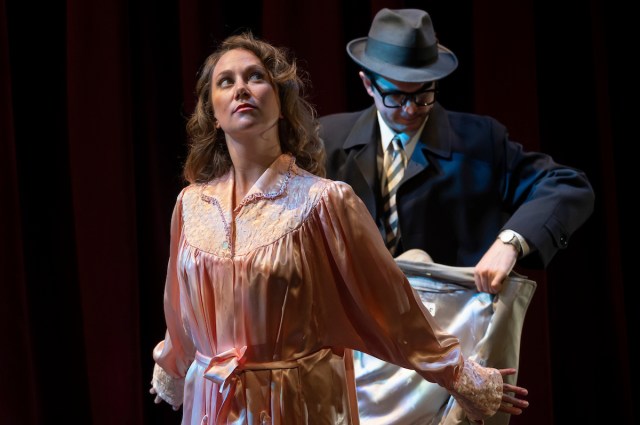
Helen Belay and Farren Timoteo, The Fiancée, Citadel Theatre. Photo by Nanc Price.

By Liz Nicholls, 12thnight.ca

There they stand before us, seven closed doors.

A tidy pink and cream apartment (designer: Whittyn Jason). A vision of domestic harmony: orderly arrangements of size-gradated kitchen canisters, a slice of cake under a glass dome, a nearly complete set of encyclopedias on a shelf over the fridge. Enter a woman with the final volume, the v to z’s, tucked under her arm and a smile of triumph on her face.

To help support 12thnight.ca YEG theatre coverage, click here.

What could possibly go wrong?

Well…. Those doors, my friends, are the world-wide theatrical sign of farce — of fate being tempted and riot being incited, comically speaking. The first sound you hear from the stage in The Fiancée, an exhilarating new farce by Holly Lewis premiering at the Citadel and directed by Daryl Cloran, is a door slam, the first of many in an evening of fun in the theatre.

Helen Belay, Patricia Cerra, Sheldon Elter in The Fiancée, Citadel Theatre. Photo by Nanc Price.

What follows this opening gambit is spiralling complication in the lives of Lucy (Helen Belay) and her sister Rose (Patricia Cerra). It’s 1945 in Edmonton. The war has ended; the men are coming home. And Rose, the sensible working woman of the pair, is about to discover, incrementally, that her sis, a sweet-natured would-be actress who can’t say no, has said yes a few — quite a few — too many times.

This congenital yay-sayer has gotten herself engaged to not one man, not two, but three, as they left for World War II. And, wouldn’t you know — farces are as rigorous about inevitability as Greek tragedy — all three are arriving back on the same day. Which is the very day the rent is due. And it’s in a building reserved exclusively for the respectably married, run by a rule-bound new tyrant landlady Ms. Crotch (Lora Brovold). And, by the way, the ever-pliable Lucy has just said yes to a new vacuum cleaner, and forked over the rent money.

In farce the percussion track of doors being knocked on and slammed is the sound track of the ante being upped. Buried, and not too deeply, in the escalating lunacy of every farce, is a simple but profound insight about life, my friends. You’ve suspected it lately, who wouldn’t?, and it’s true: the orderly universe is an illusion. There is a thin line between order and chaos. The intricate architecture of farces, like our lives, is a teetering affair, built on quicksand. Mayhem is just an impromptu lie, a miscue, a mistaken identity, a preposterous disguise, a pratfall, a slammed door or an opened one, away.

The Fiancée is a deluxe piece of farce engineering, with an unusual  premise and feminist buttresses. And it’s dressed to the nines by costume designer Leona Brausen, a specialist in ’40s visuals. It’s a post-war world where women like Rose and the formidable Ms. Crotch are wearing the pants (and look great in them). And they’ve had a taste of being in charge. “What happened?” Lucy asks Rose, who’s just been fired from her factory job. “Men happened,” she says grimly of the unwelcome return to a tired status quo.

Cloran’s highly entertaining production starts fast (possibly a little too fast) and gets faster. Rigorously timed as it is, it crucially never loses the farcical sense of careening physical comedy being improvised on the spot. That’s the great attraction of the near-miss (which appeals to the dark side of our human nature; we should be ashamed of ourselves). The cast, divided between the women who are the active instigators and the men who are the hapless satellites in orbit, all deliver nimble comic performances.   

Patricia Cerra, The Fiancée, Citadel Theatre. Photo by Nanc Price.

It’s Rose, the thorny one, who takes charge of chaos control. And in a terrific comic performance from Cerra, we see her backed into ever-tighter corners, having to improvise ever more acrobatically on revelations from a sister who congenitally tells people what they want to hear. Rose is the smartest person in the room, the problem-solver, always thinking, always on the edge of exasperation, always having to act against her better judgment and watching herself, appalled. And Cerra captures it all to a T.

Helen Belay, The Fiancée, Citadel Theatre. Photo by Nanc Price.

Belay, who has a smile that could melt icing off a cake (her favourite crisis food) in a snowstorm, is a hoot as the sweetly dazed and daffy Lucy. When caught out by her sister she throws up her hands: “What could I say? What could I do?” The obverse side of making the kindly choice is taking the line of least resistance. And Lucy is a chronic hedger. She’s so guileless she’s been working at Eaton’s without being hired, a tale of non-employment that occasions a very funny shaggy dog story. The sight of Lucy attempting to hide in the fridge is one of the lingering images of the evening.

I loved Brovold as the acidic landlady who continually peels the grapes of wrath with her mordant wit. She has the snarly presence (and hair) of a ‘40s movie star, delivering grimly sardonic bytes like someone spitting out bad cashews. She is very funny.

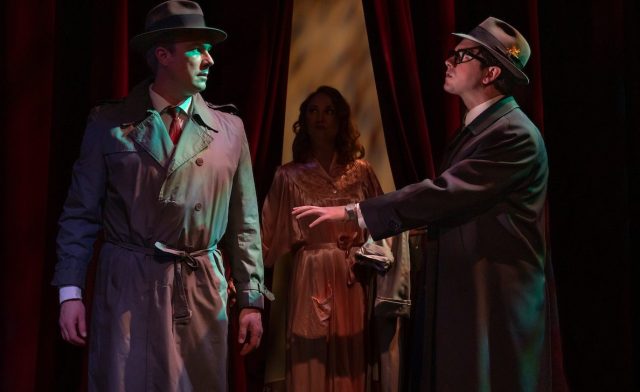
Tenaj Williams, Sheldon Elter, Farren Timoteo, The Fiancée, Citadel Theatre. Photo by Nanc Price.

The trio of ridiculous male characters, who must not meet, ricochet around the women getting shoved through the seven doors. Which is why it inevitably comes to pass, for example, that a rabbity man with no mechanical prowess whatsoever will be mistaken for a plumber, and later appear in a skimpy towel. That would be Manny, a meticulous list-maker played hilariously by Farren Timoteo. “I’m not really a tool guy,” he ventures. (Rose snaps “every guy’s a tool guy”).

Sheldon Elter is the adamantine soldier’s soldier. “I don’t change my mind,” he declares. “I’m a captain in the Canadian armed forces.”  Tenaj Williams is handsome, swaggering Dick, “God’s gift to Edmonton,” as he says modestly of himself, while his name gets bandied about, sportingly. Rose is unimpressed. “You’re not even God’s gift to Leduc”.

One of the great appeals of The Fiancée is that woven into its barbs is a shameless affection for dumb jokes, both physical and verbal. I leave you to savour those on the spot  when you see The Fiancée which I highly recommend you do. (But here’s a teeny, possibly enigmatic, hint: cake in The Fiancée is like Chekhov’s gun). In these uncertain times, there’s nothing like other people’s panic to quell your own.

REVIEW

The Fiancée

Theatre: Citadel

Written by: Holly Lewis

Directed by: Daryl Cloran

Starring: Helen Belay, Lora Brovold, Patricia Cerra, Sheldon Elter, Farren Timoteo, Tenaj Williams

Running: through Nov. 28

Tickets and masking/vaccination requirements: 780-425-1820, citadeltheatre.com.


Posted in Reviews | Tagged , , , , | Comments Off on The door slams and they’re off! The Fiancée, a deluxe new farce at the Citadel. A review.

Jason Kenney’s Hot Boy Summer, frat party kegger of a satire. A review.

Donovan Workun and Abby Vandenberghe in Jason Kenney’s Hot Boy Summer The Musical, Grindstone Theatre.

By Liz Nicholls, 12thnight.ca

“I would never lie; I’ve taken poli-sci.”

This declaration in song from the goofball hero got a big laugh from the preview night crowd at Grindstone Theatre’s new musical satire Jason Kenney’s Hot Boy Summer.

Hey, people, I hear the incredulity in your voice. Hero? Jason Kenney? Yup, in the musical created by the Grindstone team of Byron Martin and Simon Abbott, Kenney (Donovan Workun) is the newly elected Summer Session Students’ Union President at Alberta University c. 1983; we see the ballot box being stuffed. He leads a frat boy crusade to ensure that The Best Summer Ever will happen. And let’s face it, The Best Summer Ever can’t be best without a rockin’ rodeo party and hot cowboys. Priorities, people, priorities.

Yes, Kenney will have moments of self-doubt, well, OK, paranoia. Heavy is the head that wears the … whatever. Yes, his heroic quest will be thwarted by an outbreak of the flu (don’t you hate when that happens?). Yes, he will have moments when it dawns on him that everything is screwed up. Yes, he will even make discoveries and learn stuff: “Wow! I didn’t even know science was real,” he tells Dr. Deena Hinshaw (Abby Vandenberghe). “I always thought it was a myth.”

To help support 12thnight.ca YEG theatre coverage, click here.

And his nemesis, the bad guy with the villain laugh, is Rachel Notley (Stephanie Wolfe). She’s outraged that funding to the jazz club has been diverted by Kenney et al towards partying. She’s outraged by the mess in the quad, outraged by flagrant rule-breaking, and really really outraged by losing the summer session election. “How could I lose to such idiots? It shoulda been me; it shoulda been mine!” she shouts at her boyfriend Justin Trudeau (Malachi Wilkins), shaking her fist like a Greek tragedian at the cosmic injustice of it all.

There are amusing shivs, like Justin’s outrage that the drama club funding got cut just when he got a starring role … as Othello. But the strokes, as you will glean, are generally broad in Jason Kenney’s Hot Boy Summer. We’ll meet the younger “versions” — singing and dancing ’80s college kids — of characters whose names we know even if we don’t entirely recognize them: Tyler Shandro, Tracy Allard, Kaycee Madu, Justin Trudeau (son of the Dean).

Stephanie Wolfe and Malachi Wilkins, Jason Kenney’s Hot Boy Summer, Grindstone Theatre.

In these appalling times, does this upending whereby JK is the hero (and Notley is the villain) actually work? Don’t go to Jason Kenney’s Hot Boy Summer expecting a stinging surgical dissection of the scene — the one that  turned Alberta infamously into a how-not-to guide to pandemics and sent Kenney plummeting to most-hated status at the bottom of the polls. A dunce cap and a red nose lets the guy off easy, of course. But that’s not what this is. It’s a high-spirited, giddy, oddly genial affair, more a fraternity party roast rather than a scathing satire. Claire Theobold’s set, assembled and re-assembled with dispatch, captures that rollicking feel, too.

Donovan Workun and Abby Vandenberghe in Jason Kenney’s Hot Boy Summer The Musical, Grindstone Theatre.

The script gives a cast of actors with comic chops a menu of grotesqueries to work with. Workun’s amusing performance fashions Kenney as a self-centred ignoramus, a dazed party-hearty dimbulb, too dumb to even be unscrupulous. In a hilariously physical performance, full of semaphore arms, Wolfe creates Notley from keynotes of quivering righteous indignation. Vandenberghe turns into comedy the blandly monotonous government doctor we know from catastrophic ‘updates’ and the uninflected overuse of the word “concerning.” Which is an achievement.

Wilkins will make you laugh as Trudeau, dancing across hot coals at all times, exiting histrionically like the Prince in Swan Lake, pausing oddly in the middle of sentences.

The story has its patchy bits, to be sure. And there’s a certain scrambly goofball quality to the whole thing. The real success of the new musical is the music. It’s accompanied by a first-rate live three-piece band led by composer Abbott at the keyboard. The songs are genuinely impressive — catchy, complex, with clever lyrics — in a variety of styles.

Stephanie Wolfe and Malachi Wilkins, Jason Kenney’s Hot Boy Summer, Grindstone Theatre.

Martin and Abbott know their musical theatre, expertly locating the songs, the weave of solo and ensemble numbers. The evening has an energizing Broadway-style production number to open, led by the frat boys of Upsilon Kappa Pi. And it’s bookended with an equally fab closer. In between you’ll hear solos, duets, trios. In the way it has fun with the conventions of musical theatre, it reminds me a little of the mocking but chin-up spirit of The Book of Mormon, turning villains into dopes.

Trudeau gets a very funny song, Ottawa, woven with three- syllable rhymes. Deena Hinshaw, the ultimate science nerd, gets a G&S style epidemiology patter song (really) and a  romantic solo about how unromantic she is (Immune To Love). Fuck Kenney, Shandro’s number, is a driving  assortment of off-rhythms.

Not all of the cast are great singers but, damn!, they all know how to power a song. And in the end, there’s something valiant about creating something fun, with smart songs, from the grim and awful raw material at hand.

REVIEW

Jason Kenney’s Hot Boy Summer the musical

Theatre: Grindstone Comedy Theatre and Bistro

Written by: Byron Martin and Simon Abbott

Directed by: Byron Martin

Starring: Donovan Workun, Abby Vandenburghe, Stephanie Wolfe, Malachi Wilkins, Kathleen Sera, Mark Sinongco, Tyra Banda, Sarah Dowling

Where: Campus St.-Jean Auditorium, 8406 91 St.

Running: through Nov. 21

Tickets, masking and vaccination requirements: grindstone theatre.ca


Posted in Reviews | Tagged , , , , | Comments Off on Jason Kenney’s Hot Boy Summer, frat party kegger of a satire. A review.

‘Our opportunity to meet the moment’: 366 Days, the latest from Major Matt Mason

366 Days, Major Matt Mason Collective. Photo supplied.

By Liz Nicholls, 12thnight.ca

Here’s a strange, unsettling thought: We are all hybrid creatures. That’s how we have to live now, forever straddling the live and the digital, not fully existing in one world or another. Are we then our own artistic creations, our own live-streamed works of art? Discuss.

To help support 12thnight.ca YEG theatre coverage, click here.

There’s a play about that — by David Gagnon Walker, directed by Geoffrey Simon Brown — opening online this week. Or, wait, is it a play? The “live-action hallucinatory freak-out,” as 366 Days is billed, “is our opportunity to meet the moment,” says Brown of the latest from the high-profile experimental theatre collective he co-founded, Major Matt Mason. “It’s theatrical, but we’re deciding whether or not we feel it’s a play.”

“It’s a weird thing,” says Brown (whose own play Michael Mysterious recently premiered in a Pyretic production here). “Unlike anything I’ve done before.” Which is a declaration that counts, considering the original innovative experiments that make up the Major Matt Mason Collective archive.

366 Days, he says, is “exclusively built for the medium it’s on,” or in, since it’s set in the overlap between live and virtual space, a theatre “where the medium meets the message, and lines are blurred.” It’s live, it’s digital, it’s live-streamed, and “reality” has live animation layers to it, too.

“Whenever we come up with a project we ask ‘why is this live?”“Why does it have to be in front of an audience? And if we can’t come up with an answer, we don’t do the project,” says Brown of “one of our guiding philosophies as a live performance company.” With 366 Days, “we flipped the question. Why does it have to be online? Why does the audience have to engage with it in a digital space?”

366 Days, Major Matt Mason Collective. Photo supplied

For one thing, the narrative demands it. The person we meet in 366 Days lives there. “He’s trapped himself in that space,” as Brown explains. And we’re meeting him there, on his home turf, so to speak. Blair has spent a year in self-imposed penitential isolation in a small apartment, connected by live-stream to the internet. His presence in the world is virtual.

The story in 366 Days picks up Blair, the other characters, and the narrative after the events of Premium Content, the Gagnon Walker play Edmonton audiences would have seen live last fall if COVID hadn’t been continuing its rampage. “It was about the intersection between art and the internet and real life,” Brown says.

The new piece, commissioned by Major Matt Mason, takes us into Blair’s digital world, into the art he’s creating from his life, into his website, into his head. Brown credits the animator Tyler Klein Longmire with integrating live performance and animation in ways he’s “never seen anywhere else before — all executed live.”

“The real room can be toggled into a digital room that looks exactly the same. So a forest can grow out of it. Or it can float into space…. Other characters come in as floating heads wearing masks of their own faces…. The play exists half in live recorded video and half in animation. And all of it happens live.”

Like Premium Content, 366 Days “asks a lot of questions about art.” What is it made of? “What are you allowed to use from your life? What are you seeking by bringing your own life into?” And then it goes further: “can you solve anything in your life, can you heal, making yourself into art?”

The process of making art about the blurred boundaries between real and digital blurs the boundaries between real and digital. The creation of 366 Days has a certain striking synchronicity with its content. For one thing, it assembles talent across the country. “Four or five of us are working in person. Thirteen or 14 or us are working remotely,” says Brown. The full set is in a Calgary studio. And that’s where the animator (Klein Longmire), the stage manager (Meredith Johnson), and the designer (Lauren Acheson) are located. One performer is in Vancouver, one in Toronto, two in Calgary. Director Brown (who is also the producer, alongside Evan Medd) and the costume designer (Whittyn Jason) are in Edmonton.

In addition to the challenges of isolation, “I’m feeling a lot of ‘imposter syndrome’,” laughs Brown. “Especially when it comes to animation and streaming…. Suddenly I find myself directing the movement of an animated cast. In live theatre I don’t know how to hang and focus lights, but I know how long it takes. With this, I have no idea how much time it takes to build the world!”

At every step the play re-invented the way of producing it. “Did I want to come into the room and direct from the space?” On reflection Brown decided no. “When I direct a stage play I don’t do it from the stage; I direct from where the audience is going to sit. And with this play the audience is going to be sitting on the other side of a screen.”

And as for acting, “our performers are also puppeteers of animation, acting and puppeteering their digital avatars…. It’s a little bit like rubbing your belly and patting your head at the same time,” says Brown. “There are moments in digital puppeteering where movements need to be more exaggerated than onstage. Sometimes, when the masks are dropped, that theatrical language has to fade away and become far more intimate than we’d do on any stage.”

“We’re all trying to figure out which tool to pull from our various tool kits,” says Brown of a collective process that’s been evolving since 2018. “We’re trying to do something we’ve never done before, and create an experience we haven’t seen before.” Welcome to the theatre of our new world.

PREVIEW

366 Days

Theatre: Major Matt Mason Collective

Written by: David Gagnon Walker

Directed by: Geoffrey Simon Brown

Animation and video design: Tyler Klein Longmire

Performed by: Mikaela Cochrane, Vanessa Jetté, Evan Medd, Jay Northcott, Mike Tan

Where: streaming online

Running: Nov. 11 to 13

Tickets: pay-what-you-can, mmmtheatrecollective.com

Posted in Previews | Tagged , , , , , | Comments Off on ‘Our opportunity to meet the moment’: 366 Days, the latest from Major Matt Mason

The Best Summer Ever, mantra for a musical satire: Jason Kenney’s Hot Boy Summer

Donovan Workun in Jason Kenney’s Hot Boy Summer the musical, Grindstone Theatre. Photo supplied.

By Liz Nicholls, 12thnight.ca

The Best Summer Ever. Four words destined to live in infamy.

An open invitation to disaster, as well we know (and everyone knew at the time). And, hey, a banner for Alberta to carry onto the national (and international) stage as a world COVID infection giant. It produced head shakes, double-takes, out-and-out incredulity — and now an original musical satire.

To help support 12thnight.ca YEG theatre coverage, click here.

Jason Kenney’s Hot Boy Summer, a creation of Grindstone Comedy Theatre premiering Wednesday at the Campus St.-Jean auditorium, has black comedy in its heart and ridicule on its mind. Byron Martin, Grindstone’s indefatigable triple-threat artistic director, co-wrote the “80s frat party musical” with musical director Simon Abbott.

It’s a flashback to Kenney in college (Alberta University, 1983),”  Martin explains. “And it opens with him winning Summer Session Students’ Union President, and Rachel Notley losing….” In fact, as Kenney and his Upsilon Kappa Pi buds plan “the hottest year-end party ever,” she’s the villain of the piece, a party pooper out for blood. And Justin Trudeau is her boyfriend. “They’re all in school together.”

The most reviled premier in Alberta history as the hero of the story? Really? “That makes it pretty heavy satire…. It’s kinda awful to watch in a way!” says Martin cheerfully. “Really it’s written from the perspective that maybe Jason Kenney wrote this play. The whole idea that he’d be the hero of the play is, you know, so ridiculous!”

“When I tried writing it the other way around, with Jason Kenney the villain, it wasn’t funny. That’s just real life. Not cathartic at all…. It takes turning it on its head to be able to laugh at it.”

That’s what happens with Notley, too, the villain of this ‘80s frat world. Stephanie Wolfe “does an amazing job,” says Martin. “She’s so funny…. And in real life Rachel Notley is pretty normal, nice, wholesome.”   

The original impulse for the musical, originally planned for last summer’s Fringe, was a series of funny satirical videos that had Donovan Workun as Kenney and Abby Vandenberghe as Dr. Deena Hinshaw doing “updates,” à la Saturday Night Live. The sketches found their way into the 2020 Grindstone Christmas special.

“The musical is very different from the sketches,” says Martin.“We were wanting to write a satire about him, and wondering what the vehicle for that would be…. Musical theatre in itself is an exaggeration; it lends itself to satire.”

For his part Workun, one of the most fearless, funniest comic improvisers in this improv town, laughs “as soon as (the UCP) got into power, somebody was ‘hey you kind look like Jason Kenney; you should play him. That would be funny’.” He sighs. “Chubby, middle-aged white guy, great!” Of the TikTok videos that preceded the musical, he particularly remembers ‘Jason Kenney and the 1-800-sex chat Santa’. Both right in my wheelhouse.” He sighs again.

For a comedian/ satirist it wasn’t easy to suss out a Kenney keynote on which to hang a performance. “This guy doesn’t have a personality,” says Workun. “I don’t know what I should be doing.” And then it came to him.

When Martin persuaded him to do the video sketches on short notice, Workun had pleaded for a teleprompter. “Reading without my glasses was so hard … and I realized that reading poorly from the teleprompter is exactly what Jason Kenney does…. It’s the essence of him. His speech pattern is that it’s the first time he’s seeing whatever he’s reading and he has no idea what’s coming out of his mouth. I embraced that.”

Since a “bumbling fool” is the ‘hero’ of a two-act musical, the real question for Workun was “how do I help carry a show that’s funny and awesome and interesting when the two main characters are a little boring? Abby does the Deena Hinshaw monotone, and it’s funny. But how do I play JK, frat boy?” He channelled his own 19-year-old self, he says.

Like Martin, Workun thinks that making Kenney the villain of the piece would have been “way too easy.” Making him the hero is “the ultimate form of mockery…. ” It reminds him of Kurt Russell’s Jack Burton in Big Trouble In Little China. “He seems to be the hero but actually doesn’t do anything. Everyone just assumes he’s saving the day. But in reality it’s everybody else around him. And hey that’s another thing that’s pure JK: not doing much, screwing things up when he does, never picking up the tab…. It’s always on somebody else.”

“Pure Trump. Never apologize. It’s never your fault. It’s always somebody else who is incompetent….”

Though Workun is not principally known for musicals, he did star in Plain Janes revivals of Ankles Aweigh and Fiorello some years ago. “Martin asked me to do this, and I have trouble saying No,” he says happily. “If something really terrifies me, that’s the thing I should try. I’m going to learn something…. Improv is easy compared to this; I’d rather do a thousand improv shows than one of this!

With its three-piece band and eight-member cast, Jason Kenney’s Hot Boy Summer is a big project for Grindstone, “the biggest production budget we’ve worked with to date,” Martin says. In addition to Kenney, Hinshaw, Notley and Trudeau, and the dread Tyler Shandro, we’ll meet a gallery of supporting characters, including Tracy Allard, Kaycee Madu, and Sarah Hoffman. Allard, the ex minister of municipal affairs who notoriously went on a family holiday while the rest of us were following the rules, “brings mono back from Hawaii, and then there’s a big mono breakout.”

And everybody sings. Allard’s number? Aloha, natch. The song list includes Kenney’s two signature songs There’s Nothing Like A Rodeo and an ‘80s rock ballad Unify My Heart, Hinshaw’s Immune To Love, and Shandro’s Fuck Kenney. Martin declares Trudeau’s song, Ottawa, to be “one of the funniest in the show.” And c’mon, have you ever tried to rhyme Ottawa?

Notley’s anthem? It’s Only Just Begun.”

Topical political satires in this part of the world are pretty hard to find. Egged on by their friends, Martin and Abbott stepped up. And it’s a little nerve-wracking, Martin admits. He doesn’t want to name the company that wouldn’t let them run show billboards. The U of A, from which the College St.-Jean theatre is rented, wouldn’t let them put up signs.

But the show sold out its run in short order (with extra performances and a streamed version pending). And “the reaction so far has has been really awesome. The cast talks about how funny it is, and how much we’re laughing in rehearsal…. In the end, I’m really happy to be doing this,” Martin says. “Other people aren’t taking it on.”

PREVIEW

Jason Kenney Hot Boy Summer the musical

Theatre: Grindstone Comedy Theatre and Bistro

Written by: Byron Martin and Simon Abbott

Directed by: Byron Martin

Starring: Donovan Workun, Abby Vandenburghe, Stephanie Wolfe, Malachi Wilkins, Kathleen Sera, Mark Sinongco, Tyra Banda, Sarah Dowling

Where: Campus St.-Jean Auditorium, 8406 91 St.

Running: Wednesday through Nov. 21

Tickets: grindstone theatre.ca


Posted in Previews | Tagged , , , , , , , , | Comments Off on The Best Summer Ever, mantra for a musical satire: Jason Kenney’s Hot Boy Summer

‘That piano arrived in my life for a reason’: Metronome, a new Darrin Hagen solo show premieres at Workshop West

Darrin Hagen at the keyboard, Metronome, Workshop West Playwrights Theatre. Photo by Ian Jackson

By Liz Nicholls, 12thnight.ca

“Have you ever tried something new, and instantly thought ‘O! I feel like I’ve been doing this my whole life?’”

That’s how Darrin Hagen remembers the exact day when everything changed for the small-town Alberta trailer park kid that he was, at seven. “Grandma had a little chord organ in her dining room” is his once-upon-a-time. And from that all else follows — Hagen the composer, the sound designer, the author, the playwright, the actor, the director, the drag queen — as we find out in Metronome, the new Hagen solo memoir  that launches the Workshop West Playwrights Theatre season Nov. 12.

To help support 12thnight.ca YEG theatre coverage, click here.

“I was always fascinated by piano keys,” declares the ebullient Hagen, “the way they’re laid out, the way they play.” While Grandma was cooking on the fateful day, the junior Hagen, completely untrained in matters musical, sat down at the keyboard and “figured it out…. I’d never had a lesson, but somehow it made perfect sense to me.”

That day ended with “a little concert” for Grandma and her three sisters, featuring On Top of Old Smokey, to general amazement. And the capper was that Great Aunt Ruby, a music teacher, said “you need to get that kid some music lessons….”

“Everything else comes from that moment, the moment you suddenly realize O, this is something I’m good at. And everyone around you goes, O, this is something he’s good at.”

Darrin Hagen at seven. Photo supplied.

His mom and dad found him a teacher and a $50 used entry-level accordion with 12 bass buttons “to see what would happen when I’d played it for a year.” And Hagen’s progress was exponential as he cut a swath through the Palmer Hughes accordion course. A particular fave was Two Guitars, mainly because “it had that middle-European sound, it got faster and faster, it was in a minor key, and it had a big loud finish.”

After three months Hagen advanced to a 48-bass accordion, then within a year a 120-bass instrument. After three years, he’d surpassed the skills of his teacher Mrs. Bonde, who suggested a change in instrument: the piano. And so it came to pass that Hagen’s parents raced to Sylvan Lake to trade an old lady $700 for her “big old upright mahogany grand,” an Ennis & Sons his mom had heard about on CKRD’s Swap Shop.

“It took four or five men, including my dad, to move it into the trailer,” says Hagen. His mom and her friends were the inspiration for his solo show Tornado Magnet. Metronome is his dad’s first appearance in a Hagen play: he does the heavy lifting throughout. The first big question on moving day: “will this fall through the floor?”

“It was the biggest piece of furniture we owned; it occupied as much space as the couch. And there was only one place it could go. In the front room against an interior wall so the weather wouldn’t throw the tuning off.”

The piano was a life-changer for a kid growing up gay in Rocky Mountain House. “It was my soul-mate; this was a love affair,” declares Hagen, who was teaching piano by age 12 (“before my job at the IGA, before the Dairy Queen”). And he ascribes magical powers to its 88-key allure. “It’s a character with huge significance in my life; it’s the reason I’m in the arts…. Without music lessons I’d like to think I’d have ended up somehow in theatre, but I’m not sure I would ever have figured out how.”

Darrin Hagen in Tornado Magnet. Photo by Ian Jackson.

For some people, the route to their inner creativity is  dance, for others painting. Hagen’s way in was music. “I’m a big believer that once you tap into your creative reserve, that river that’s inside you, it’s a matter of learning different skills. Music taught me to access it. And once I did I felt like I could do anything … write, act, do drag.”

Metronome didn’t start out to be a play. What Hagen had in mind was “a little anthology of piano-themed stories,” including one he’d written 30 years ago about him and his Grandma, and another from 2009. “I still think there’s a book down the road.” Hagen’s The Edmonton Queen, he points out, was like that too, finding its form as a solo play and a book.

It was Workshop West artist director Heather Inglis who’d called him on a hunch: “I have a feeling you might be working on something.” When she read the stories, she was sure they could be a play. “A solo show! It terrifies me, are you kidding!” he declares. “After the last one (Tornado Magnet at Theatre Network in 2014) I vowed I’d never do another one!”

“We talked long and hard about whether there should be a piano onstage, and if it was there whether I should play it — and if I didn’t, would that just piss people off?” In the end, Hagen won’t be sharing the stage. “It’s not a show about me playing the piano. It’s about how the piano changed my life….”

Darrin Hagen at the piano, Metronome, Workshop West. Photo by Ian Jackson

And there’s this: he doesn’t actually have the magical piano any more. He still has nine accordions, of various sizes and showbiz embellishments. But for 22 years he’s been piano-less. In 1999 he gave his piano away, “to my cousin’s blind daughter. Because it had another life to save. And I’ve never regretted it. It changed her life; the magic went to her. It was the right thing to do.”

With music, says Hagen, “you learn to access the truth inside you.”  Somehow, he thinks, “music has a magical effect on us emotionally,” an effect beyond language, beyond cultures and borders. Why do minor chords make you feel sad? “It’s a great mystery…. You let your emotions pour through the piano and into the air. And after you learn how to do that, all other art forms follow.”

“Mom never had to tell me to practice. Never. Not once! I loved every second, I’d have practised 12 hours a day if I could’ve,” says Hagen. “The only reason I ever stopped playing was that the piano was in the same room as the TV,” he laughs. “My mom loved to hear me play; she loved the World Series even more.”

Hagen “started to play weddings, trade fairs, old folks’ homes, contests; I was the go-to kid for school assemblies.” He wrote the song for his high school graduation ceremony (he remembers being too afraid to go to the party). He and his friend Shanann (“we were the Rocky version of Buckingham-Nicks”) won an ACT Search For Talent competition.

Growing up gay in small-town Alberta is no picnic. “You want to be invisible, but you’ve chosen a path that makes you SO visible…. When the bullying started, it was music that saved me,” Hagen says. “The piano is the reason I’m alive; I say that without hesitation…. My piano was my rock.”

Darrin Hagen the mermaid at City Hall. Photo supplied

For a kid “who was gay, had bad glasses and played the accordion,” the piano was also “a step toward non-nerdism,” Hagen laughs. When he left Rocky and moved to Edmonton and his new drag queen life, “it went from being covered with trophies to being covered with crowns, ashtrays, feather boas. It has a story to tell….”

In Metronome, Hagen “skips over the drag years,” as he says. “They’re a hiccup in a much longer plan. And I’ve told that story in many ways before…. This is about the stuff that got me to Edmonton. It really is an origin story, about my piano and me. It’s a miracle it happened at all; something, music I think, was looking out for me!”

There’s always a sound track playing in Hagen’s head, he says. “Millions of tunes in my head always, at the same time. Ready to pulled forward.” The piano, he says, is “a conduit to songs that are attached to memories.” Donna Summer figures prominently (her 17-minute disco version of MacArthur Park “was my go-to piece for competitions).” Heart, Rickie Lee Jones, Joni Mitchell … they tap into moments in Hagen’s story. Workshop West’s outreach coordinator Liam Salmon, a playwright himself, has compiled a Spotify playlist of references.

It’s all got Hagen thinking about having a piano again after two decades. “It’s time.” He’s been eying kijiji. “It’s sad,” he says. “The piano used to be the most valuable thing in any room; now they’re giving them away.” He’s auditioned a few, but hasn’t found his perfect mate yet. “It’s got to be love at first sight….” He doesn’t want “too bright, too brassy. I need something a little darker, smokier, fuller. The keys have to fight back a bit.”

“Music arrived in my life for a reason,” he says. “That’s what Metronome is about.”

PREVIEW

Metronome

Theatre: Workshop West Playwrights Theatre

Written and performed by: Darrin Hagen

Directed by: Heather Inglis

Where: Backstage Theatre, ATB Financial Arts Barns, 10330 84 Ave.

Running: Nov. 12 to 21

Tickets and mask/vaccination requirements: workshop west.org

.

Posted in Previews | Tagged , , , , , , | Comments Off on ‘That piano arrived in my life for a reason’: Metronome, a new Darrin Hagen solo show premieres at Workshop West

A spiral into comic chaos, through 7 doors: The Fiancée, a new farce by Holly Lewis, premieres at the Citadel

The Fiancée by Holly Lewis, premiering at the Citadel Theatre. Poster image.

By Liz Nicholls, 12thnight.ca

Theatre is a serious work, my friends. It requires commitment, bold attack, research, tough backstage choices approached face-on.

Holly Lewis walked into a rehearsal room at the Citadel after lunch one day a couple of weeks ago. “The production team had been having a meeting,” she says of preparations for The Fiancée, her new comedy.“They’d set up different six different kinds of cake, with icing…. One of the actors would have to stick their face into all six, to see how each one sticks.” The rehearsal in question was listed on the call sheet for Friday as “a run with the cakes.” Lewis couldn’t stop laughing.

To help support 12thnight.ca YEG theatre coverage, click here.

A “six-actor farce with six actors, seven characters, and seven doors,” and cake, The Fiancée, winner of the Alberta Playwriting Competition Novitiate Award,  starts previews Saturday in a production directed by Daryl Cloran. And its stage logistics are exponentially intricate, quintessentially farcical one might say.

In Lewis’s farce, set in ‘40s Edmonton during World War II, we meet Lucy, a generous-minded young woman who accepts proposals from three men,— “no one should have to go overseas without someone to come home to” — expecting that they won’t all make it back. But they do. All three. On the same day.

Lucy’s world teeters precariously on the precipice of chaos. Doors are slammed, wigs are donned and doffed. Formerly sane people find themselves reduced to ducking behind things, or vaulting over couches, or getting shoved into closets.

Playwright Holly Lewis, whose farce The Fiancée is premiering at the Citadel. Photo supplied.

Then you have to set a clock!” says Lewis, a remarkably funny, effervescent conversationalist much prone to laughter. Eviction hangs over Lucy (Helen Belay) and her sister (Patricia Cerra). “They’ve just got a new landlady, they don’t have the money to pay the rent, and they have to come up with it! By 6 o’clock!.” AND there are proprieties to be dodged: it’s a ‘family building’: visitations by a surplus of fiancés is a no-no.

This flirtation with cosmic chaos is only enhanced by having six actors play seven characters. Sheldon Elter (the star of Bears, recently closed) plays two; late in the play they appear in the same scene, says Lewis with unmistakeable glee. “And I like that! I love those moments that make theatre feel like a sport, and you’re not sure if the goal is going to happen…. It’s exciting for the audience; it’s exciting and terrifying for the actor!”

Elter had a hair-raising 30 seconds to make the costume change.“That was the day I needed to be in rehearsal hall and ask ‘how do we buy him another five seconds’?” He got them. Other re-writes happened, Lewis reports, because of the sheer comic inventiveness of the actors. “Actors are so brilliant…. In some places what the actor is doing with their body is funnier than what I’ve written so I can pull some things out.” The script, she says, “is three pages shorter than when we went into rehearsal.”

The Fiancée isn’t Lewis’s playwriting debut. She was a co-creator of two high-profile international collaborations undertaken by Theatrefront, the Toronto indie company founded in 1999 by an ensemble including Cloran and Lewis, who are married. One was Ubuntu: The Cape Town Project (Citadel audiences saw it in 2017). The other, Return: The Sarajevo Project, produced in Bosnia and Toronto in 2006, “is still the production I’m most proud of,” she says. The whole experience was so full…. I actually ended up going back to university after that, in Peace and Conflict studies.”

And there’s Lewis’s 15-minute kids’ play, Sisters, for Concrete Theatre’s 2018 Sprouts Festival. But The Fiancé, fully seven years in the making, is “my first full-length complete play written solo, by me alone,” she says. Why start with farce, the most intricate,  dauntingly complicated of theatrical forms? “What I was going to be when I grew up was an engineer,” she says. “Math, physics, that’s my jam.…”

Lewis is in an undoubtedly exclusive subset of Queen’s University transfers from engineering to theatre school. That’s where she met Cloran (and “we’ve been collaborators ever since”). “I’d finished my first year of university,” says the Scarborough native. “I went to Toronto to a play and the lights went down and I just started to cry. I cried for the first two scenes. And it was a comedy! It was then I realized I’d made a wrong choice….”

The precarious architecture of farces is a magnet to a mind like Lewis’s. “The thing about farces, there’s so much structure and math to them, speaks to my other passion,” she says “You take a play and reverse-engineer it, see how it works, rebuild. Math and laughter: how can you do better than that?”

How on earth does the playwright keep track of who’s behind which door when? Lewis hauls around a cork board that only an engineer manqué could love, with an elaborate system of cue cards colour-coded to reveal who’s in a room and who’s not. “And it’s quite beautiful!” Lewis says. “In an attempt to understand structure,” she’s even written a modern adaptation of The Three Sisters set in Edmonton (the three sisters used to be in a band). “It sounds crazy to choose Chekhov,” she says. “But within each of his beats, the structure is really clear….”

Cloran has said “secretly, if Holly could be anyone, she’d be Lucille Ball.” Lewis loves comedy. “Early in my acting career I did tragedy after tragedy. And I was, like, what if tripped on the stairs? No!” she laughs. In a Toronto production of A Midsummer Night’s Dream, in which she played Hermia, one of her cast-mates was a Cirque du Soleil clown. “I begged him to teach me to do a stair fall.” He did; a farceur was born in that lesson.

The first draft of The Fiancée took five years. “I finished it just before the pandemic.” Lewis gathered friends and they read it aloud “to see it if was funny…. We laughed and laughed.”

“Proof of concept! It was funny; it had funny things in it. But it was missing its middle. The gears didn’t drive you forward to the end,” she says. “ So that was the work of the pandemic for me…. I knew what was going to happen in the end. But how to make that inevitable?”

The ‘40s look and performance style is “very delightful,” as Lewis says. “A lot of eye candy, fantastic costumes. and there’s something about the actors from that time period too, the Katherine Hepburns of the world, letting you see a different way of being being a woman and making choices.”

The starting point for Lewis was a question: “What would be a situation where it could happen that a woman would juggle three men?” a reversal of the more usual farce situation, where the escalating panic of a man is at the centre. In Boeing Boeing, for example, a man’s complicated romantic predicament is the result of having three flight attendant girlfriends, grounded on the same night due to global bad weather.

And Lewis had another condition. She didn’t want her protagonist “to be manipulative in the situation; I wanted to make a kinder protagonist; I wanted her to stay the hero.” Lucy’s motivation for letting herself get engaged to three guys is kindly, generous.

“Her challenge is my challenge,” says Lewis, laughing. “I do have have a hard time saying no and setting boundaries…. I’m a people-pleaser and I want people to feel good. And that can get you into a lot of trouble…. And (that womanly predicament) is still happening. Making it funny is a way of questioning it without judging it.”

“At the end of the day it’s not wrong to say Yes to things. It’s just you have to say Yes to the things you want, and No to the things you don’t want!”

Says Lewis “I tried to create a comedy where everyone in the audience is going to have an amazing time … because nobody is the butt of the joke.” She points to the first season of Ted Lasso, “laugh out loud  funny but no one is ever targeted in a mean way…. It’s a challenge because so much of comedy is about making fun of people.”

The farce archive is dotted liberally with examples that are pretty much unplayable in the modern world, “plays where making fun of people with different cultural backgrounds or physical differences is part of the engine of the farce,” as Lewis puts it. Humour tends to be time-sensitive. But there are classics that are perennially hysterical. The ne plus ultra farce in the contemporary repertoire? Noises Off,  says Lewis without hesitation. One Man Two Guvnors is a contender, too.

She thinks “you can learn a lot about the mechanics of a farce” from the 19th century master farceur Georges Feydeau. A Flea in Her Ear is often compared in its initial structural impulse to Othello. In Shakespeare, a misplaced handkerchief precipitates the declension into tragedy; in Feydeau a pair of suspenders gone AWOL leads to “outlandish comedy.”

“The hero of comedy doesn’t have time to think; they have to act immediately. And it leads them to ridiculous decisions and, of course, to happy endings. But the stakes are equally high…. As Daryl always says of farce, what the characters want they want so badly they’re willing to climb over a couch to get it!”

“Coming out of the pandemic, ha, there’s an optimistic phrase, I want to really laugh and enjoy myself,” says Lewis happily. “For me, sitting in my house imagining little pieces that will make people laugh is so good for my mental health. It’s driven me through to this point!”

“A writer writes for seven years in silence in their room…. And this is what we do it for. This is like a dessert buffet for me.” And there will be cake.

PREVIEW

The Fiancée

Theatre: Citadel

Written by: Holly Lewis

Directed by: Daryl Cloran

Starring: Helen Belay, Lora Brovold, Patricia Cerra, Sheldon Elter, Farren Timoteo, Tenaj Williams

Running: Saturday through Nov. 28

Tickets and masking/vaccination requirements: 780-425-1820, citadeltheatre.com.


Posted in Previews | Tagged , , , , , | Comments Off on A spiral into comic chaos, through 7 doors: The Fiancée, a new farce by Holly Lewis, premieres at the Citadel

What’s up in Edmonton theatre this weekend? Have a peek

By Liz Nicholls, 12thnight.ca

What’s up in Edmonton theatre this weekend? Oh, you know, the usual…. A new theatre is glowing from the inside out. Shows are ending their runs, a live season of Die-Nasty is about to begin, Opera Nuova is back, live. Walterdale Theatre goes live this week, RISER Edmonton has chosen its four indie projects to support. And, hey, the Fringe has excellent news for us.

•The glowing yellow Roxy is a ray of sunshine direct to the heart, as work continues on the new home of Theatre Network, getting built on the footprint of the old. Now have a boo at the projections in the big glass front window giving on 124th St. They’re testing their new equipment, with cool imagery in honour of the spooky season (till the end of Halloween night). Soon, theatre-goers, soon, you’ll be there. The new Theatre Network welcomes audiences in January.

•This week Fringe Theatre had good news for us. Megan Dart, an unstoppably creative and multi-faceted theatre artist/ arts producer/ event planner, officially brings that formidable skill set to the Fringe, as the company’s Executive Director. She’s been in that uniquely demanding job on an interim basis since the departure of Adam Mitchell last March.

Fringe Theatre Executive Director Megan Dart

Fringe 2021 had to be the craziest, most challenging audition in history, surely. Our Fringe, the oldest and biggest of its kind in North America, turned 40 this past summer under circumstances that were, to say the least, a test of inventiveness and flexibility for a festival . Along with fellow artist Fringe director Murray Utas, Dart, the co-founder and co-artistic producer of Catch the Key Productions (an indie specializing in original, immersive theatre), devised a route through the intricacies of the moment. And they were daunting: how to respond to the ever-changing pandemical restrictions, how to make the Fringe, against the odds, happen live, and also have an online presence, how to retain a breath of its signature festive spirit and identity in a smaller version of something gigantic.   

Organizing anarchy has a certain paradoxical delicacy. It requires smarts, a deft touch, an instinctive inclination to say Yes, a collaborative temperament, rapport with fractious artists, audiences, and administrators.… Dart is ready, impressively, for all of it.

RISER participants (clockwise) Cuban Movements Dance Academy, NASRA, Even Gilchrist, Tai Amy Grauman. Photo supplied.

•RISER, the innovative project initiated by Toronto’s Why Not Theatre in 2014, was envisioned to initiative  designed to address the daunting challenges in producing indie theatre. Its first national expansion was announced for Edmonton last March. A jury has selected four participants: Tai Amy Grauman, Even Gilchrist, NASRA, and Cuban Movements Dance Academy. We’ll get to see their projects at the Backstage Theatre in February.

•Walterdale Theatre, Edmonton’s venerable community playhouse, launches their live season Wednesday with Colleen Murphy’s gut-wrenching Governor-General’s Award-winning The December Man (L’Homme de décembre). Its eight scenes unspool backwards from an egregious act of public violence, the murder of 14 women students in Room 303 of Montreal’s École Polytechnique in 1989. It’s not about the act itself, it’s about the fallout on one survivor, a young man and his parents. Alex Hawkins’ production runs Nov. 3 through 13. Tickets: tixonthesquare.ca.

Sheldon Elter in Bears, Punctuate! Theatre. Photo by Alexis McKeown.

It’s the last weekend for:

Bears, Matthew MacKenzie’s imaginative, gorgeously theatrical fantasia on Nature, a man’s transformation as he journeys into it, in flight, and what we stand to lose if we screw it up. The Punctuate! Production is back here where it started, and this time it’s on the big stage. At the Citadel through Sunday. Don’t miss. Tickets: citadel theatre.com, 780-425-1820.

Hiraeth, a mysterious dark comedy by Belinda Cornish premiering in a Bright Young Things production at the Varscona through Saturday. An audaciously unsettling combination of heartbreaking and funny, and what to do if you can’t get what you really really want. Tickets: varsconatheatre.com.

Mathew Hulshof and Kristen Padayas in A Fit, Happy Life, Teatro La Quindicina. Photo by Adam Kidd.

Lost Lemoine Part 1, A Second Round of Seconds: Lost Lemoine Part 2, and A Fit, Happy Life, the three streamed productions that launched Teatro La Quindicina’s 2021 season (the fourth production, Fever Land, ran live). All are by Teatro’s resident playwright Stewart Lemoine, unearthed from the impressively huge original Lemoine comedy archive.  And all were filmed on the stage of Teatro’s home, the Varscona Theatre, behind the red velvet curtain. Ingenious, quixotic, and fun. Streaming passes: teatroq.com.

We Had A Girl Before You, a solo gothic thriller (yes, amazing!) by Northern Light Theatre’s Trevor Schmidt, starring Kristin Johnston, remains available for streaming through Halloween night. It’s a corker. Passes: northernlighttheatre.com.

Little Women, Opera Nuova. Photo by Nanc Price.

It’s the only weekend for: 

… Little Women, the Broadway musical spun from the evergreen Civil War era Louisa May Alcott novel about the four March sisters and their mama.  Opera Nuova makes a welcome return to live, in four performances through Sunday at the Maclab Theatre in Leduc, with streaming possibilities too. Kim Mattice Wanat directs (and plays Marmee). And her cast includes Hannah Wigglesworth, Elizabeth Chamberlain, Julia van Dam, Errin Pettifor, Ruth Alexander, Kaden Forsberg, Rob Herriot, Jackson Card, and Kael Wynn.  Tickets: Ticketpro.ca, 1-800-655-9090, or 780-487-4844.


Posted in News/Views | Tagged , , , , , , , , , , , , | Comments Off on What’s up in Edmonton theatre this weekend? Have a peek

Noodling with The Stroganoffs: Die-Nasty returns with the first of three mini-seasons

By Liz Nicholls, 12thnight.ca   

A weekday morning in the life of an improviser:

Wayne Jones is hanging with Chekhov. He’s spent the a.m. watching The Seagull and Uncle Vanya. Who does that?

To help support 12thnight.ca YEG theatre coverage, click here.

The producer/artistic director of the 30th annual edition of Die-Nasty, Edmonton’s venerable live weekly improvised soap opera (returning Monday to the Varscona stage), is in research mode.

The Stroganoffs, the first of Die-Nasty’s three “mini-seasons” this year, will take us to pre-Revolutionary Russia c. 1900. And Jones, a veteran improviser who cheerfully admits that theatre history isn’t his jam (“I don’t have a big background in plays”), is soaking up the flavour, the atmosphere, the character types, the cadence of the era, via Chekhov. “I’m immersing myself in the time,” he says. “Detail, specificity is one of the secrets of doing good improv…. It helps you commit to the character!”

And there’s this: “If you paint the picture of something the audience recognizes, in detail,” laughter ensues, says Jones, who has an impressive archive of comedy stage gigs on both sides of the border to prove it. He remembers improv classes at 2nd City in Toronto: “you’d have to make a sandwich in front of the class, and describe every single item, every colour, that went into it….”

The Stroganoff era is rich in suds potential: inflammatory passions, treachery, betrayals, agendas both romantic and political. The core cast of deluxe improvisers, including Jones, has spent the week mulling over character possibilities for the mini-season that Stewart Lemoine and Jana O’Connor will jointly direct.

Like the best of the Die-Nasty season concepts — which have launched from such settings as Ancient Rome, 19th century Brontë world, the Golden Age of Hollywood, the early days of vaudeville, Lord of Thrones, Westerns —the gallery of pre-Revolution Russians is gloriously expansive. Aristocrats both entitled and faded, land-owners, peasants, climbers, arrivistes, plutocrats, political insurgents and infiltrators, artistes, bon vivants, émigrés….

Jones, who grew up in Edmonton — “it’s my home base but I have a hard time sitting still”— has spent much of his showbiz comedy career living and working in Toronto and L.A. He wasn’t a theatre kid per se, he says. He was the kid who “was always trying to make people laugh, being silly all the time….”

“I was in a band, I was pretty serious about hockey.… All through my 20s I was planning events, parties, hosting them. I’d rent night clubs and invite a couple hundred people, and I’d get onstage with a mic and hire a DJ, tell jokes, roast people.…”

Jones worked construction; he got a degree in criminology (he mentions this as an afterthought). He even considered going to law school, attracted mainly by the idea of performing in court, he says. “The one thing I seemed to be best at was bringing people together for a good time, making them laugh.”

So Jones’ inner career-planner stepped up with a question: “what kind of comedy can I do where I can just sort of wing it?”

Bingo. He left Edmonton for Toronto: “I needed to start new; in a new place I could reinvent myself…. I’m so happy that I was able to do what I love to do, and figure out how to make it into a job! When you’re surrounded by people who love what they do, Wow! It’s not just me trying to figure it out. There’s a whole community  here!”

It was in Toronto, where he’s a key player in the improv troupe White Rhino Comedy, that he got his start in improv in 2010. A man of engaging enthusiasm and modesty, he re-creates his thinking at the time. “The scene was so vibrant and strong out there…. I thought ‘holy cow, people are so talented! I figured I was good at bringing people out and promoting shows.  So if I could get those people to do a show with me, I’d get a lot better a lot faster. I’d have to do everything I could to keep up’….”

A few years later it was in Toronto that Jones made his Edmonton connections, among them Die-Nasty’s Dana Andersen and Amy Shostak, the artistic director of Rapid Fire Theatre at the time. His Edmonton improv family expanded when Die-Nasty played Toronto, at Soulpepper Theatre. A world-record 55-hour Soap-A-Thon at Soulpepper Theatre attracted a stage guest list of Toronto’s best (including re-located Edmontonians Ron Pederson and Matt Baram and their National Theatre of the World) and some high skilled imports from across the pond (among them Adam Meggido, who will direct Peter Pan Goes Wrong at the Citadel later this season).

“It was a festival of the best improv from around the world. I barely squeaked in the door,” laughs Jones, whose improv history has included training in such hotspots as Chicago, New York, and L.A. .

Jones, who’s toured with Colin Mochrie (“a dream come true!”) and done Edmonton improv gigs with Pederson, has been a Die-Nasty guest ever since 2014. In that Downtown Abbey season, one of his faves, he guested as “a steel salesman from Pittsburgh, in England to seal a deal with the family…. And I was blown away: packed houses, such talent. Edmonton really has something Toronto doesn’t have.”

“When you get called into a scene with people so talented, who know how to commit, and you know they’re gonna give it their all because they’re trained stage actors, it’s such a treat.”

He played the Norse demi-god Cannabis The Chosen One (“powerful, but a stoner too, always forgetting where he put his weapons”) in the Viking year. He was “an Italian business magnate,” with a particularly snazzy costume, in the Medici year. At last summer’s Fringe edition of Die-Nasty, he was a celebrity realtor, whose face was on every bus stop bench in Strathcona.

“I was very lucky,” Jones muses, “to be from here, and be sort of an out-of-town guest in my own home town.”

Although he’s constantly out of town for gigs, Jones has lived in Edmonton since 2017. He moved back from Toronto when his dad became very ill. One of his “biggest joys” was that his dad in his final years was in the front row when he and Mochrie played big theatres like the Citadel’s Shoctor and the Martha Cohen in Calgary.

This year’s experiment in dividing the Die-Nasty season into three series, each with its own genre and characters, is a response to the long-term uncertainties built into these pandemical times. “The cast can commit to shorter periods. And it keeps things really fresh.”

What kind of Stroganoff will he be (and what kind of hat will he wear, to ask a crucial question)? As his Chekhov binge continues, Jones is considering a character inspired by Konstantin, the high-anxiety playwright in The Seagull. “He wants to be somebody. He doesn’t know much about the world, but he wants to change the world.”

“I purposely leave myself in the dark until a day or two before,” Jones says, “The adrenalin kicks in; the danger and risk get stronger. That’s the energy that’s so exciting to me about improv…. I’m a thrill-seeker.”

PREVIEW

Die-Nasty Presents: The Stroganoffs

Directed by: Stewart Lemoine and Jana O’Connor

Starring: Tyra Banda, Delia Barnett, Hunter Cardinal, Belinda Cornish, Tom Edwards, Jesse Gervais, Kristi Hansen, Nikki Hulowski, Wayne Jones, Mark Meer, Matt Schuurman, Stephanie Wolfe, and special guests

Where: Varscona Theatre, 10329 83 Ave.

Running: every Monday through late December. A second Die-Nasty mini-series (to be announced) begins in January, and a third will run through May.

Tickets: $15 at the door, or varsconatheatre.com.

Safety protocols and proof of vaccine requirements: varsconatheatre.com/covid19 


Posted in Previews | Tagged , , , , , | Comments Off on Noodling with The Stroganoffs: Die-Nasty returns with the first of three mini-seasons

The comedy of excavation: Hiraeth at the Varscona in a Bright Young Things production. A review.

Rochelle Laplante (top) and Kristi Hansen in Hiraeth, Bright Young Things. Photo by Mat Busby.

By Liz Nicholls, 12thnight.ca

In a visceral way, there’s nothing more gut-wrenching than hope. It puts your dreams into a never-ending spin cycle. You can’t get a grip on grief, or heartbreak. You can’t even grab onto sadness properly, much less arrive at a catharsis.

To help support 12thnight.ca YEG theatre coverage, click here.

There’s a new comedy about this. Belinda Cornish’s Hiraeth, which gets its name from an elusive, untranslatable Welsh word — “the longing for a home you never had, or to which you can never return” — is premiering at the Varscona in a Bright Young Things production. The two-hander is the latest from the prodigiously multi-talented actor/playwright Belinda Cornish, whose full-bodied comedy The Garneau Block, after many pandemical delays, has recently finished its premiere run at the Citadel. The director of both plays is Rachel Peake, on loan from the Vancouver Arts Club.

The theatre repertoire is full of aspirational pep-talk dreamer comedies and their conceptual opposite, the slacker fixer-upper comedy. Hiraeth isn’t like either. There’s also an ample complement of odd-couple comedies, where the utterly mismatched learn something about getting along, and there’s a comic resolution. With its two characters, in close quarters, who couldn’t be more different, Hiraeth tilts unexpectedly toward that, but in ways that will intrigue and surprise you.

The crux of the matter is in vitro fertilization (IVF). It’s a subject that’s a lot edgier in odd-couple comedy than discovering, say, that a flamenco troupe has moved in upstairs, and your building has hardwood. Which goes to show how elastic “comedy” can be.

One of its two characters, Sidi (Kristi Hansen), is an accomplished, 40-ish woman who works at home, an environmental economy consultant with her own business. She has an absentee husband, some sort of outdoor guide who seems to be successful, too. “Go show tourists the wonders of the wilderness!” she says affectionately in one of the series of phone calls which constitute his presence in Sidi’s daily life, and the play.

Kristi Hansen and Rochelle Laplante in Hiraeth, Bright Young Things. Photo by Mat Busby.

Which brings us to the matter of the baby. Sidi doesn’t have one, but she’s trying. She’s in the midst of a third round of complicated IVF treatments, appointments, blood work. Her life is work phone calls interspersed with calls from the doctor’s office, with news that’s a matter of three-day waits, probabilities and percentages, temporary jubilation, tempered follow-ups, sucked-up disappointments.

Her fingers are permanently crossed, so to speak. Sidi, as Hansen’s performance conveys so unerringly, is absolutely functional at landing “tier 3 contracts” but emotionally harried, perpetually hopeful on the brink of conception.

And it’s on that edge that it happens: thunderous sound effects from the basement. Then a mysteriously kooky young woman bursts into Sidi’s kitchen, announcing she’s moved in.

Kristi Hansen and Rochelle Laplante in Hiraeth, Bright Young Things. Photo by Mat Busby.

Bean (Rochelle Laplante), whose profession at the moment is making sock monkeys, immediately starts rummaging through the kitchen drawers — “wow, are you, like apocalypse-hoarding?” — and “borrowing” stuff from Sidi’s fridge. No one has ever arrived in adulthood without enduring a neighbour or roommate who plays music you hate really really loud. And Daniela Fernandez has the fun of making her sound designer debut with a score that includes a barrage of sound effects, echoing flushing, party-hearty thumping, undefinable noise, and high-volume Duran Duran.

Bean is everything Sidi is not. She’s in her 20s, for one thing. She’s impulsive, scattered, invasive, cavalier about other people’s personal privacy (and their food supply). Her non-stop free-associative chatter, which seems to unerringly press on Sidi’s bruises about conceiving a baby (“what if your baby had a heart defect … it’s more likely since you’re old”) is a volley of contradictory sound bytes and bubbles.

Doors, much less the concept of knocking first, mean nothing to Bean, in an oddly sparse house designed by Madi Blondai to seem not quite lived in. “It’s like no one even lives here!”, Bean declares. And that has a stabbing truth to it: Sidi has never really moved in; she lives on the phone.

Laplante, so impressive in last summer’s Freewill Shakespeare Festival production of a three-actor Macbeth, has a great speaking voice. She captures the maddening youthful charisma and good cheer of a character who takes charge of both tone and space.

And gradually, Sidi, who’s appalled at first with this infuriating neighbour, finds herself confessing to private medical details, then the heartache and frustration of trying to conceive. And in the pinball machine of Bean’s roll-out of observations about feral camels in Australia or “a massive societal breakdown” or plans to be a tree surgeon “or maybe a chef,” little insights do randomly land, hard. Life, Beans notes in passing, “isn’t fair or kind.” And the “silver wheel” just rolls ahead.

Peake’s production charts the odd topsy-turvy growth of a relationship that starts in comic irritation. In Hansen’s intelligent and moving performance, we can actually feel layers of reserve — carefully and hopefully constructed — getting gradually peeled off formidable emotional fortifications. Change is painful and it’s slow work.

The secret of the ending, and the part Bean plays in it, is safe with me. But I can tell you this: Hiraeth is a dimensional comedy, an excavation of sorts: it’s funny on the surface, and underneath it’s not. And it’s got two fine performances to take you there.

REVIEW

Hiraeth

Theatre: Bright Young Things

Written by: Belinda Cornish

Directed by: Rachel Peake

Starring: Kristi Hansen and Rochelle Laplante

Where: Varscona Theatre, 10329 83 Ave.

Running: through Oct. 30

Tickets and proof of vaccine requirements: varsconatheatre.com


Posted in Reviews | Tagged , , , , , | Comments Off on The comedy of excavation: Hiraeth at the Varscona in a Bright Young Things production. A review.

An ode to bountiful Nature on the big stage: Bears at the Citadel. A review.

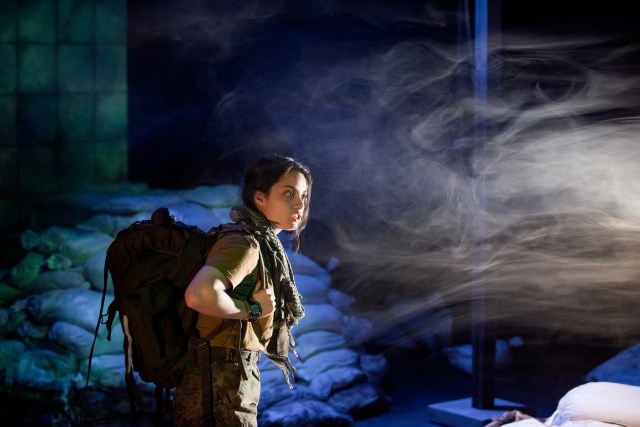
Sheldon Elter (centre) and the Bears ensemble. Photo by Alexis McKeown.

By Liz Nicholls, 12thnight.ca

“If there was one thing Floyd loved, it was bears,” says Floyd of himself near the outset of Matthew MacKenzie’s boldly weird and wonderful play.

In the course of Bears, Floyd, a Métis oil patch worker (the tremendous Métis actor Sheldon Elter), who’s the prime suspect in a “workplace accident,” will have to get out of town. He’s on a flight from authority that takes him into the glorious wilderness, from “the city of yesterday’s champions” west through the mountains to the sea. In the course of his trip — not coincidentally along the route of the Trans Mountain pipeline, with big-oil enforcers, the RCMP and bounty-hunters in hot pursuit — he will find himself becoming what he loves.

To help support 12thnight.ca YEG theatre coverage, click here.

Since it’s a chase, there’s suspense. And it comes with a visceral environmental drive, so you’ll find yourself desperate for the burly protagonist to resist capture, and for Nature, beautiful and fragile, to triumph.

To journey into the heart of Nature (this is the kind of play that makes you want to use the capital-N) is to be transformed, re-born so to speak, by the continuity between man and the natural world, a harmony sacred to the Indigenous vision. And it’s conjured in the strangest, most entertainingly quirky and ingenious juxtaposition of poetic text, humorous asides, choreographed movement, light, and sound, as you’ll see in the Punctuate! Theatre production that puts the multi- back into the much-battered term multi-disciplinary. Directed by MacKenzie, it’s at the Citadel through Oct. 31.

I’ve seen Bears twice before, in very different incarnations in tiny spaces (its Pyretic Productions premiere in 2015, its Punctuate! touring version in 2018). This time, seeing how imaginatively it occupies the big thrust stage in this theatre town’s biggest playhouse (at the preview I was kindly allowed to attend), I was struck by the magical way MacKenzie’s fantasia on nature, a world in perpetual motion, is linked to the human resourcefulness on which theatre is built.

Christine Sokaymoh Frederick and Sheldon Elter in Bears, Punctuate! Theatre. Photo by Alexis McKeown.

There’s Floyd himself, who has a magnetic presence in the agile person of Elter. He’s big and compelling as both narrator of memory and immediate experience, and active participant. His memories, like dreams linked to images and crises, gravitate to his mother, played onstage by Christine Sokaymoh Frederick; she’s an earthy kind of haunt-er, in jeans and boots. And Floyd’s breathless journey through Nature — through cedar forests and receding glaciers, alpine meadows, rivers, bridges, white water canyons, whirlpools, and a toxic tailings pool — is populated by the seven-member chorus of dancers, choreographed with witty, often humorously self-aware, invention by Monica Dottor.

Bears by Matthew MacKenzie, starring Sheldon Elter.Photo by Alexis Keown

The dancers, most of them Indigenous artists, are prairie gophers, chickadees or bees, otters, circles of bison, salmon, lake trout, grouse, wild strawberries, bighorn mountain sheep.… This is storytelling at its cheekiest; animals, birds, insects are Floyd’s allies and save his bacon again and again. But its choreographed playfulness takes hold.

Erotic pas de deux for bears aren’t a dime a dozen on theatrical stages. You just have to be pretty much wonderstruck when it happens: a comic novelty becomes something quite beautiful as Floyd meets his first “grizzly friend” (Gianna Vacirca).

Bountiful Nature puts on quite a show in Bears. Designer T. Erin Gruber, an expert in video and projection design, gives it a glow-in-the dark playground of cutouts: mountains, clouds, the firmament, the outline of water or sense of trees. And lighting and projections continually transform it. Sometimes it’s the glow of sunlight hitting rock or dappling onto water, sometimes the aurora borealis, the starry sky or the flickering invasion of light onto ice or into the tangle of cedar branches.

Full of industrial buzz, hums, pulses, heartbeats, the soundscape created by Noon Dean Musani (aka dj Phatcat), an electronic music specialist, moves Floyd through time and space too. I appreciated the sound even more in the large theatre, where the bare stage is bigger and barer.

MacKenzie, a citizen of the Métis Nation of Alberta, is a funny writer. The script is built on unexpected juxtapositions, similes mostly and mostly from the human world. The silt of the Athabasca River “accepts his weight like an enormous Posturepedic mattress.” Insects stir up the riverbed “like the mother of all protein shakes.” Chickadees, says Floyd, “were something a guy could count on, like caffeine and momentum.”

The Chorus, that corps of lyrical movers, occasionally joins in, with amusingly starchy annotations. As Floyd considers the romantic fortunes of an importuning grouse, they note “nothing kills the mood like a fuckin’ clear-cut.” Floyd’s inner grizzly, gradually getting unleashed in the wild, reflects on the declining population of prairie songbirds, and they add “fuck progress!.”

Bears doesn’t step back from spirited activism. But it comes at things as a rear-guard action, from the perspective of conjuring natural wonder and setting forth theatrically the high price of risking it. Pipelines are risky. We have a lot to lose.

REVIEW

Bears

Theatre: Punctuate! and Dreamspeakers at the Citadel

Written and directed by: Matthew MacKenzie

Choreography by: Monica Dottor

Starring: Sheldon Elter, Christine Sokaymoh Frederick, Gianna Vacirca, Rebecca Sadowski, Zoë Glassman, Skye Demas, Karina Cox, Shammy Belmore, Alida Kendell

Running: through Oct. 31

Tickets: 780-425-1820, citadeltheatre.com


Posted in Reviews | Tagged , , , , , , | Comments Off on An ode to bountiful Nature on the big stage: Bears at the Citadel. A review.