The wave, in free-flow dance form: Water, a Fringe review

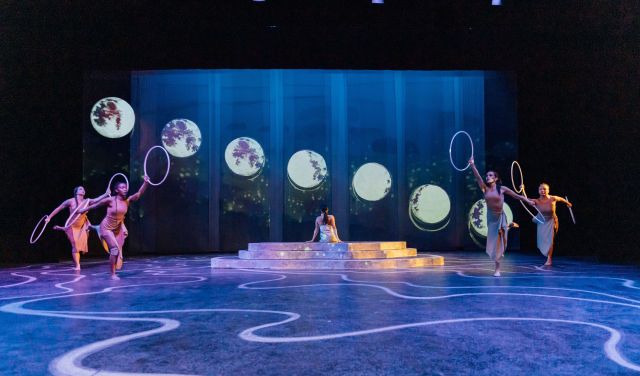
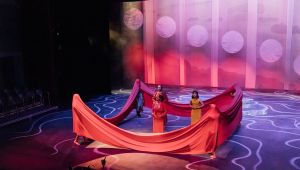
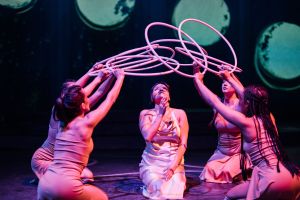
Water, Viva Dance Company. Photo supplied.

By Liz Nicholls, 12thnight.ca

Water (Westbury Theatre)

The creator and the destroyer, the enigmatic element that makes us who we are, floats our boats, and drowns our hopes…. Water is the inspiration (and title) of an imaginative, free-flow new contemporary dance production by Viva Dance Company.

Its prevailing metaphor is the wave, a veritable wellspring of invention for a director/choreographer/designer/playwright (Viva’s artistic director Stephanie Lilley) with an ensemble of dancers at her disposal. But in its series of dances, Water comes to us in splashes, too, in stormy lashings, whirlpools, ebbs and flows, from white-water tempests to tiny drops.

To help support 12thnight.ca YEG theatre coverage, click here.

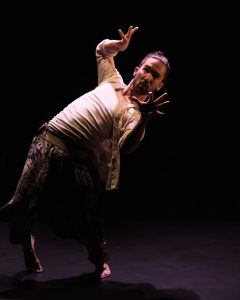
Water is in perpetual motion in Lilley’s production. Dancers accumulate gradually onstage, gather force and speed in synchronized wave movement, then subside. Storms are generated in collisions of bodies. A solo exploration of depression as drowning, the feeling of being at the bottom of the sea or the proverbial ‘slough of despond’, weighted down and unable to move — “how can nothingness feel so big?” — happens under a fine-web net. Dancers break free, come up for air so to speak, and vigorous athletic bursts of movement happen.

The crash/subside cycle is reflected both in lighting, and in the way groups of dancers form, then re-form. The lyrical gives way to the acrobatic, with music from pop-rock ballads to more hard-driving choices. The image of a tableau of dancers to one side, with a soloist centerstage, then joined by others, is repeated.

There is nothing prosaic about the way Lilley sets her cast in motion to music. The spoken text, though, is less poetic than the movement text. Calling water a “basic necessity,” true as it is, feels a bit like someone wearing a suit and oxfords to a deep dive, an intrusion from a land-locked medium of communication. Ditto “Clean water is a right not a privilege.”

But once you get, er, splashed by the visual metaphor, there’s a kind of immersion to the experience. Water is free-associative fuel for the artists at work here. Surf’s up and they dive in.

Posted in Fringe 2021, Reviews | Tagged , , , , | Comments Off on The wave, in free-flow dance form: Water, a Fringe review

Finding your place in the world: The ADHD Project, a Fringe review

By Liz Nicholls, 12thnight.ca

The ADHD Project (La Cité francophone Auditorium)

The woman before us onstage is her own best evidence that having ADHD (attention deficit hyperactivity disorder) has its up sides.

To help support 12thnight.ca YEG theatre coverage, click here.

The energy of Carlyn Rhamey’s solo show is so attractive, and its creator/star so appealing, so ready to see the comical side of her own storytelling, that you’ll want to cheer. But growing up “special,” being a bit different in a world that rewards sameness, has its sadnesses and struggles too, as you’ve probably always suspected. And is confirmed, in a personal, first-hand way, in The ADHD Project.

Rhamey herself is “the project.” Her show is a first-hand chronicle of what it’s like to be barraged by challenges that include (as we learn) frantic fidgety energy, impulsive behavior, inability to pay attention, faulty memory. And she has the anecdotes and a supply of droll family photos, videos, and report cards — annotated with a comical slant, to document it.

The subtext, which gradually seeps through the bright surfaces of comedy, is a sense of exclusion, of loneliness. Kids have a cruel instinct for sussing out misfits: her younger self is a target for bullying — and it’s in both the classic styles. Her classmates either attack her or they pretend she doesn’t exist. The birthday party anecdotes are a heartbreaker.

Turning personal confession directly into theatre is a challenge in itself, as you know if you’ve spent any time fringing in the last 40 summers. The ADHD Project, thankfully, is decidedly not an example of personal therapy for the person onstage, depositing their supply of grievances, or the contents of their mind, into your lap. This is a show about stepping bravely into the fray, and thinking positive. ADHD people, after all, tend to be high-energy creative thinkers, problem-solvers par excellence. “Their brains are on fire,” says Rhamey. So it’s good to have them on hand when the world is burning.

Rhamey talks about the feeling she had, as a kid, “that no matter what I do I can’t find my place.” The fact that she’s in a theatre, a bright and user-friendly presence, making us laugh and teaching us something as she tells her own story, is a tip-off that her place has been found.

Posted in Fringe 2021, Reviews | Tagged , , , , | Comments Off on Finding your place in the world: The ADHD Project, a Fringe review

The impossible, pulled off brilliantly: Gordon’s Big Bald Head in MasterThief Theatre, a Fringe review

Gordon’s Big Bald Head: MasterThief Theatre.

By Liz Nicholls, 12thnight.ca

Gordon’s Big Bald Head: MasterThief Theatre (Varscona Theatre)

If there ever was a way to celebrate the return of live fringing to our summer — and simultaneously gloat that Edmonton has something no one else has — it’s getting a ticket for Gordon’s Big Bald Head.

To help support 12thnight.ca YEG theatre coverage, click here.

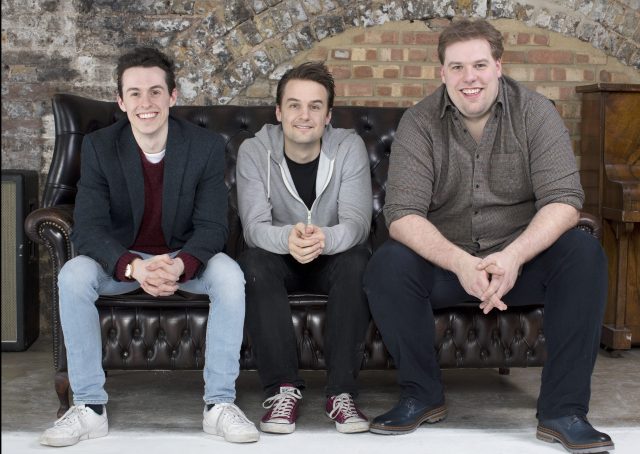
This deluxe trio of improv virtuosos — Mark Meer, Ron Pederson, Jacob Banigan — does something crazily difficult, maybe impossible, better than anyone else anywhere. Yes, world, we have a trio of improvisers so deluxe they invent an entire original  Fringe show at every performance — a version of a show chosen randomly from the Fringe program by a member of the audience. Armed with the title and the program description (and three chairs), they’re off.

This year’s edition, MasterThief Theatre, introduced with suitable PBS gravitas by Mark Meer, is specially tailored for the Fringe in its 40th year. Since there’s no weighty Fringe tome to flip through, the trio arrive onstage with a stack of programs from Fringes past the past.

I caught the show on the weekend. Fringe Daze, the 1988 edition of the Fringe, chosen randomly by a “criminal mastermind” in the audience, offers up, from Stage 14 that year, The Return of the Bride by the notable Canadian playwright Brad Fraser. Judging by the description it’s a thriller in a sinister mansion with a werewolf, Frankenstein, and other genre accoutrements.  Just for good measure, GBBH offered to throw in a few extras, a mummy and Dracula.

What happened then was a hilarious hour of entertainment, a mixed-monster plot of utmost intricacy, woven with dramatized bit and narration, and a wild assortment of characters set in non-stop motion with very funny physicality, cross-references, recurring gags, asides. The trio’s powers of concentration must be ferocious, but I have to say it looks utterly easeful. Comic chemistry at its finest.  

So what goes on in that big bald head of Gordon?

For one thing, as we’ve found out Fringe after Fringe, there are three remarkably alert, agile theatre brains synchronizing in there, alongside a comic timing device with a hair-trigger mechanism, and an archive of genres with a retrieval system that’ll make you blink in wonder.

Give yourself a treat. Fun fun fun.

Posted in Fringe 2021, Reviews | Tagged , , , , , , | Leave a comment

Off the page and onto the stage, with murderous intent: Murder He Wrote, a Fringe review

John D. Huston as Charles Dickens in Murder He Wrote. Photo by David Whitely

By Liz Nicholls, 12thnight.ca

Murder He Wrote: A Dickens Of An Hour (La Cité francophone theatre)

The stories are vividly dramatic, ’tis true. But the translation of Charles Dickens’s rich, descriptive prose style, and his gallery of vivid characters, into solo theatre is work for the pros.

To help support 12thnight.ca YEG theatre coverage, click here.

You’re in luck, fringers. John D. Huston is back at the Fringe with a two-part Dickens show he last performed here nearly three decades ago. Murder He Wrote is old-fashioned storytelling as performance, a virtuoso weave of narration, voices, very particular accents, expressive gestures, facial adjustments.

Part 1, Sikes and Nancy, a set-piece culled from Oliver Twist, take us into the criminal London demi-monde. The man who stands before us is Dickens, or a contemporary re-creation thereof, in vintage lecture wear (with Dickens hair), at a podium. Huston’s predecessor in this enterprise, a violent crime thriller, was the man himself. Dickens apparently took it on the road for his lucrative “Readings” series in 1868. It was, perhaps unsurprisingly, a hit. Nothing like lurid violence to draw in the Victorian thrill-seekers.

It’s a measure of Huston’s expertise that he sets in motion, with impressive precision, a cast of individual characters and the successive locales of a nocturnal pursuit, with annotations about the spooky shadows and lighting. You know exactly who’s who, in accent, cadence, and timbre.

The poster child for good-hearted women doomed by their attraction to bad men, sweet Nancy has terrible taste in boyfriends: he’s the brutish thug housebreaker Bill Sikes. On the night in question, she’s followed by a spy to a nocturnal encounter with a rich gentleman. It will not end well for her. And as for Sikes … well, Dickens as we know, is good on hauntings.

The companion piece, Captain Murderer, a droll confection adapted from a Dickens short story, is a macabre black comedy about a serial husband with a particular way of dispatching his wives. The characters are heightened, the surprise twists amusing. All good unwholesome fun. And fun, too, to see how an expert lifts storytelling out of the library, off the page, and onto the stage.

Posted in Fringe 2021, Reviews | Tagged , , , , | Leave a comment

What are friends for? Everything Is Beautiful, a Fringe review

By Liz Nicholls, 12thnight.ca

Everything is Beautiful (La Cité francophone theatre)

Two old guys on a park bench: a study in contrast. One is a gloomy gus scowler; one is a determinedly chipper smiler. One accuses restaurant servers of purposely seating oldsters at the back to avoid reminding people of their mortality. One says he actually prefers to sit near the kitchen.

To help support 12thnight.ca YEG theatre coverage, click here.

They’ve been needling, volleying barbs, and generally irritating the hell out of each other for 50 years. They are best friends. And what they play out, every time they meet you figure, is a sort of comedy of bad manners à la Neil Simon.

In this English adaptation of France Levasseur-Ouimet’s much-travelled Prends mes yeux, tu vas voir, two of franco-albertan theatre’s best-known actors, André Roy and Gilles Denis, tuck gleefully, and amusingly, into the fragments, interruptions, gestures, edits, asides that go into a long-standing friendship. And they have chemistry.

The play is built on a comical assortment of observations about old age — its physical humiliations, its social grievances, its neglect at the hands of a youth-worshipping culture — played on a loop. The characters have been around the block with each other’s stories. Jean, for example, consults an itemized history of his assorted infirmities and their outcomes. Cancer? “That story doesn’t get more interesting the more you tell it,” says Robert, unsympathetically.

But there’s heart, too, in happy shared memories too, doled out more grudgingly (one word: hockey). Gradually, in different ways, they admit to feelings of loneliness and exclusion. It’s poignant to realize that Robert (Roy), the grouchier one of the pair, comes to the park bench almost daily, hoping to catch a glimpse of his grandson in the schoolyard, his only connection.

Everything is Beautiful is a photo album of an old friendship, not a ground-breaking motion picture. But it does arrive at a question. How can two old guys remain current in a world where everyone is younger, and has a job or kids or both? That’s not the drift of things. Thinking young won’t quite do it. Jean, the sunnier one (Denis), has an idea. And it helps to have a pal.


Posted in Fringe 2021, Reviews | Tagged , , , , | Leave a comment

The world is on fire and there’s silence in the land of dreams: Patina, a Fringe review

By Liz Nicholls, 12thnight.ca

Patina (Old Strathcona Performing Arts)

What in the world is happening to the world? It’s on fire. It’s drowning. It’s melting. Its axis is slipping.

Patina Bellweather (Rebecca Starr), the official child minder in Smaland, “the land of dreams,” is trying to keep her spirits up. And she’s still up for a round of Fun Facts or “Where in the world are you?” if you want to play, just to remind herself that despite everything there are still random wonders left in the world. But there’s an unmistakeable air of desperation about her efforts. In a global emergency, time is running out, and her heart has “lost its lustre.”

“I have to be honest, you’re not exactly who I was hoping to see,” she says at the outset of Patina. She was hoping for a return of Smals to Smaland. But there’s “nothing but silence in the space where there should be children.”

The Frente Collective is dedicated to taking a strong climate-change  message onto the stage, and that’s a worthy and important mandate. Subtlety and oblique angles are not their thing, although Leslea Kroll’s new play takes its imagery from the playroom in the land of flat-box Scando furniture you have to assemble yourself, and meatballs.

Patina gets its inspiration from the children’s climate strikes launched by Greta Thunberg. Ah, so Smaland is deserted because the Smals are off, gainfully employed spreading ecological knowledge, doing the work the “biggers” should be doing but clearly aren’t. Which makes the absence of Smals is a good thing, right? (not least because meatballs are a notable heart-stopper).

Patina is a disillusioned idealist; her “heart bells” have stopped ringing. But being a character isn’t really her strong suit. True, she’s been hiding her light under a bushel (of coloured balls) in Smaland. But explaining her state of mind, for example, as “a vexation of spirit,” a phrase she credits to Robert Burton’s hefty 1621 volume The Anatomy of Melancholy (while marvelling at its 900-page heft) pretty much boots her out of her twinkly ‘collector of fun facts’ persona.

Starr is an engaging performer, who makes skilful off-centre choices onstage in trying to fashion an arc of discovery in the protagonist. But Patina is a spokesperson, not really a character. And the theatrical framework is there to temporarily camouflage the revelations attached to a passionate message. And it doesn’t quite pay off, on a pound for pound basis.

It feels like Patina is waiting, biding its time to say what it’s come for. “We do not get a do-over … no one is too small to make a difference.” That is loud and clear, in primary colours.

Posted in Fringe 2021, Reviews | Tagged , , , , , | Leave a comment

Coming out, in a brand new musical: One Song, a review.

Jaimi Reese, Ceris Backstrom, Manny Aguerrevere, Josh Travnik in One Song, Margin Release at Edmonton Fringe 2021. Photo supplied.

By Liz Nicholls, 12thnight.ca

One Song (La Cité Auditorium)

“I think I just met myself … ” sings Rye (Manny Aguerrevere) in the opening number of One Song, a striking new musical for young audiences about being young, coming out, and being a friend.

To help support 12thnight.ca YEG theatre coverage, click here.

It’s by the team of Calla Wright (book and lyrics) and Daniel Belland (music). And it’s at the Fringe in staged reading form, an exciting reminder of something the festival is for: young talent testing something brand new in front of a live audience. And that something brand new is an amazingly accomplished piece of musical theatre.

We’re in the 90s, and Rye and her best friend Jackson (Josh Travnik) have just seen the rock musical Rent, with its easy mix of gay and straight characters. Rye’s mind is blown by the new thrill of self-knowledge and belonging, “feeling like a part of things,” of opening the door on a world where there are other people “on the same path going the same way.”

In his more tentative and cautious way, Jackson senses the same growing discovery about his own sexuality and place in the world — “I was wooden and now I’m real.” Rye understands her pal. But Jackson’s way of coming out, yet to be figured out, will be a different, less demonstrative  way than hers. And Rye’s failure to get that lands their friendship on the rocks.

Jaimi Reese plays mom, and gets a lovely song Not This, about the struggle to make your life choices your own. The other characters are there to offer different perspectives on being a queer creative — with songs to match. Chris Backstrom plays two. Paul (Ceris Backstrom), a friend of Rye’s mom, is a repository of examples of seminal queer performers, from Stormé DeLarverie to k.d. lang.. Toast (Backstrom) is a drag queen, whose mantra is direct connection to the audience. You can “lose the paint, lose the music,” she sings. “Just remember me.”

In its storytelling, the warm, wide embrace of  One Song is intrinsic to its appeal. But I wonder, on this first viewing, if the scene involving Rye’s mom and her own best friend, especially as a climactic  catalyst to resolving the conflict, could use a re-think. It seems a little forced at the moment.

Belland and Wright’s songs — their unexpected imagery, their sense of discovery and emotional impact on  the storytelling — are fresh and affecting. One Song is many songs, of course, and their stylistic confidence will knock you back in your seat. A highlight is Jackson’s killer song Quiet, musically complex and emotionally rich. It’s delivered beautifully by Travnik. My eyes are watering to think of it now.

Posted in Fringe 2021, Reviews | Tagged , , , , , | Comments Off on Coming out, in a brand new musical: One Song, a review.

A cultural survey of Cuba in a hot dance musical: Mi Habana Querida, a Fringe review

Mi Habana Querida, Cuban Movements Dance at Fringe 2021. Photo by Tyler Baker.

By Liz Nicholls, 12thnight.ca

Mi Habana Querida (Westbury Theatre)

The idea is intriguing: a cultural survey of Cuba in a dance musical. And so is the Romeo and Juliet theatrical premise, a tale of lovers, one Cuban and one American, separated by the Cuban Revolution.

To help support 12thnight.ca YEG theatre coverage, click here.

None of this, however, prepares you for the startling explosion of colour, the riot of gorgeous costumes (don’t get me started on the shoes) and the sexy moves that set them in non-stop motion, the irresistible music, and knockout dance numbers of Mi Habana Querida.

It’s a veritable extravaganza of romance, brought to the Fringe by Cuban Movements, the Edmonton dance company founded by Cuban-Canadian artistic director/choreographer Leo Gonzalez (they’re the recipient of the Fringe’s 2021 Mowat Diversity Award). And the operative word is hot, in all its implications, including a reminder of the perpetual summer we only dream about (did I mention the shoes?).

Mi Habana Querida is, you will glean, on a production scale you just don’t expect to find at the Fringe. It unfolds like a Cuban fan (fans are big in this show) in a sort of collage of dance solos, pas de deux, and ensemble numbers, fleeting dramatic scenes, flashbacks, and large-scale projection footage of seminal cultural events: the capital’s lavish pre-Revolutionary nightclub scene, the carnival, street parties, Afro-Cuban choirs, an impassioned revolutionary speech by Castro (who was, in case its slipped anyone’s mind, a great orator).    

Madrina (producer Cecilia Ferreyra) presides. She’s the engaging proprietor of the title Havana club, a self-styled “hopeless romantic” who introduces the scenes, narrates, plays yenta, joins in, or shoos everyone off the stage when the police are raiding. When the Revolution comes, it is, says Madrina, “the end of life as I know it.”

The natural rhythm of the numbers for the men, Gonzalez and Raydel Martinez-Portuondo, seems to be escalation — faster, higher, more and more acrobatic. The women, led by Amalia Cameron who plays half of star-cross’d pair of lovers with Gonzalez, are graceful, elegant, balletic.

The show pays tribute to Cuba’s Afro-Cuban culture, too, and its distinctive musical and choreographic personality, in forceful, visceral solos (and an entirely different set of costumes).

In the end, Ferreyra tells us sadly, “life is hard in Cuba … especially for the Afro-Cuban population.” Some day, says Gonzalez, Cuba will “get the smiles and the happy back.” The Revolutionary mantra of “Nation or Death” will cede to “Nación y Vida,” Nation and Life. And there’s a big flamboyant finale as a demo.

If you’re up for going out, try to see them live. It’s a treat.


Posted in Fringe 2021, Reviews | Tagged , , , , , | Leave a comment

Landing lightly on a shameful chapter in our history: Camping, a Fringe review

By Liz Nicholls, 12thnight.ca

Camping (Vanta Group Outdoor Stage)

Breathing life into our history onstage is the raison d’être of MAA and PAA Theatre. This little 35-minute play, by David Cheoros and his 10-year-old daughter Sophia Cheoros, alights on a shameful chapter in the Canadian story, the internment of Eastern Europeans as enemy aliens during World War I.

To help support 12thnight.ca YEG theatre coverage, click here.

How to shed light in a kids’ play on the bad exclusionary behaviour of a country that talks a good game about international kindness? In Camping, team Cheoros imagines a chance encounter in a Banff Park woods between a seven-year-old in 2021 and a Ukrainian man in 1916, imprisoned by the War Measures Act.

Nikki (Gabby Bernard) has her grievances. In an act of egregious unfairness her mom has taken her camping (a word she delivers like with eight or so grudging syllables) when the world should know that Nikki had her heart set on going to her BFF’s birthday party in town.

Nick (Matt Mihiliewicz) isn’t so keen on camping either, needless to say, since he’s been a starving prisoner for a year in a hard labour camp. He’s amazed that anyone who has access to an apartment that’s warm, dry, and safe in a city would choose to be spend time in a tent.

Both of them are surprised by the difference a century can make. Nikki is shocked that he’s cutting down a tree in a national park. “I only know how to plant trees,” she says. It’s a skill he’s never run across.

In the course of their encounter, as they pass the time, Nikki learns a little something about hardship, about dreams of a better life in a new country that didn’t come true. “Nobody invited him to the party,” she concludes, exploring the concept of the outsider in her own terms.

It’s simple; it lands lightly, even humorously; it’s a little eye-opener. The prisoner treats the kid kindly. And the actors are charming.   

Posted in Fringe 2021, Reviews | Tagged , , , , | Leave a comment

A play date with … us: Merk du Solapocalypse, a Fringe review

Merk du Solapocalyse. Photo by Brianne Jang.

By Liz Nicholls, 12thnight.ca

Merk du Solapocalypse (Westbury Theatre)

In this latest instalment of Dammitammy Productions’ loopy Merk du Soleil series, the twin concept goofy/giddy really comes into its own.

To help support 12thnight.ca YEG theatre coverage, click here.

There is no real way to explain the nutbar down-at-heel charms of an entertainment that weight-lifts with pool noodles, revels equally in terrible puns and wigs, and introduces acts that include a stand-up comedian so spectacularly atrocious that he counts as a satire of stand-up, or maybe spoken word performance. And then the show suddenly cuts to an original song that really catches the ear.

Hang on. Merk du Solapocalypse has showbiz roots. It borrows — well, pilfers — from circus, old-school vaudeville, and cabaret. And there’s a premise. Merk (Rebecca Merkley, creator/ director/ composer/ Dammitammy muse), the headliner of a circus troupe with no interest in circus acts, has called it quits on live theatre in “the shitshow we call 2021.” Who’s gonna argue with that?

She’s sold off the theatre to some religious outfit. But then, as one of her very likeable trio of Sideshow Boobs (Carol Chu, Yvonne Boon, Kristina Hunszinger) notes, their “open-door policy” meant that the door was actually open and their stuff got stolen. Odds against notwithstanding, the Boobs say “the show must go on, jump jump jump jump kick.” Words to live by.

It’s what they do. And, hey, there seems to be an audience, so why the hell not?

What ensues has something to do with time-travelling, back back back to when there was no art. There were, however, cows (or do they come later? my notes are unclear on this point). And by then, we get to be part of a survey of our biggest beefs in order. (Anti-vaxxers got the biggest boo, at the performance I caught; the government was a contender).

Anyhow, in a stop along the space-time continuum, Jesus shows up with a parable. There’s Bible study that loses interest in itself and wanders off. It’s just one thing after another at the Solapocalypse, a high-speed entertainment with an attention deficit. Scenes end before the punch line; so do jokes, a vaudevillian take on nihilism perhaps.

The whole thing — including the sound which could use a boost — has an air of scrambled spontaneity that makes improv look planned out (back to goofy/giddy). You’ll have fun if you just sit back, relax, and go with free association and the non sequitur as a concept. And you’d have even more fun, I think, if you could hear everything better.

It’s a play date — with us. And the “us” is, in the end, the heart of the banter. “It was you who kept us breathing,” the beaming cast tells us. Yup, we’re back to live.


Posted in Fringe 2021, Reviews | Tagged , , , , , | Leave a comment