And behind the door … a stranger. A Second Round of Seconds, Lost Lemoine part 2 at Teatro. A review

Lost Lemoine Part 2: A Second Round of Seconds, Teatro La Quindicina. Photo supplied.

By Liz Nicholls, 12thnight.ca

Anyone unalterably convinced that a life of celibacy is much to be preferred to a blind date with a stranger should probably avoid Lost Lemoine Part 2: A Second Round of Seconds at all costs.

To help support 12thnight.ca YEG theatre coverage, click here.

On the other hand, awkwardness, other people’s that is, is a great source of gruesome hilarity. And A Second Round of Seconds, the second of the three Teatro La Quindicina streaming productions in their 2021 season, is dating gone hilariously wrong, fast, in an intricate structure of speedy meet-and-greets, one on one. It’s a veritable comedy mini-series in under an hour.

“At Teatro we pogo,” explained playwright Stewart Lemoine,  interviewed on the Varscona stage Friday by the company’s co-artistic producers Belinda Cornish (the director of the piece) and Andrew MacDonald-Smith at the big-screen launch of the filmed production designed for domestic consumption. This is as good a description of the structure and pace of the piece as you can get.

Originally written for Teatro’s adjunct company of “lawyers by day actors by night” (The Novus Players) in 2016, A Second Round of Seconds is “speed dating with a difference!.”

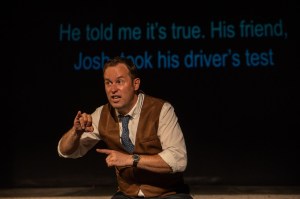
That’s what Milo (Josh Travnik), the unsquelchably perky “founder and CEO” of Sudden Sparks, tells the three women and three men who have showed up for a “superior” life-changing experience. “Predictability is a no-no!” beams this corporate existentialist, explaining the rules of “a series of brief encounters” (later “a roundelay of romance”) designed as “an extension of life itself!”

What could go wrong?

Behind the red velvet theatre curtain on the screen that’s behind the identical red velvet curtain on the Varscona stage, the line-up of three yellow doors (design: Chantel Fortin) is a tip-off. They are the world-wide theatrical signal for farce. Behind those mystery doors three women will wait, in a cafe, a salon, a bar, for a stranger to enter, for a rendezvous of unpredictable duration (and a variety of drinks) that ends with a bell, two actually, and an exit.

Ask not for whom the bells toll … I am not giving anything away to reveal that this always happens at the most awkward moment. As people at bus stops or in elevators have always known, time with strangers is invariably either way too long or way too short. You’re either stranded on the silent shoals of eternity awaiting rescue, or you’re left hanging with a pocketful of unanswered questions and unsaid zingers,

And the permutations prescribed by Sudden Sparks mean that the most awkward encounters get a round #2, which amplifies the instant incompatibilities of round one. That’s how comic mayhem grows, and in A Second Round of Seconds it’s at a farcical pace.

As Cornish’s production reveals, and delightfully, this speed-up concept is a playground for the specific choices, physical inventions, and uncanny timing of eight very skilled comic actors. Strangers when we meet them, we, along with their partners of the moment, learn things about them, fast. Or in the case of the relentlessly grim-visaged Sylvia (Jocelyn Ahlf), we don’t learn things, fast. “I’m going to level with you …” she eventually reluctantly tells her unlucky speed-date partners, who naturally wonder what on earth she’d doing at Sudden Sparks. Then, always, inevitably, before her answer … a bell.

To see Andrea House’s Janice, mysteriously flirtatious in a prim, bowed, white blouse, attempt to arrange herself seductively on a couch is to see an expert at work. She puts the physical comedy back into what would online be the arid theoretical reaches of social media self-profiling. And she is very funny.

I laughed out loud to see Jesse Gervais entering the room — can you enter a room ‘heartily’? — declaring himself a banker. Ditto Mark Meer in rabbity mode, with an apologetic ponytail, being tentative about everything in his initial encounter with Leslie. As the latter, Helen Belay is the straight-person, the foil to the oddities around her, scrambling to smooth things over, find commonalities, and move them along. “My sister is a dentist,” she gamely tells a dental supplies salesman, quickly followed by a look that says she knows she’s just pushed herself into a conversational sinkhole.

Oscar Derkx is amusing too, as a pleasant guy confronted by the implacable Sylvia and hoping for a breakthrough in that human fortress. “May I join you?” he says politely, meeting wth a stony gaze. “You can try,” she says.

Cornish has devised a speed dating pace that’s both spontaneous and arranged, frantic and full of agonizing (or appalled, or panicky) silences. And it’s calibrated for the escalating modifications in Lemoinian rejoinders, witty and/or laconic, that booze, hot wings, and revelations, bring on in rounds 2 and 3.

Kudos to Gianna Vacirca, who makes the tiny role of Crystal, the smiling server of drinks and non-sequiturs, something funny too. Life is mysteriously amusing, my friends. And so is the human pageant,  especially when it’s arranged sequentially. People are all strangers — until they’re not.

Pour yourself a drink, and watch at home, through Oct. 31. Streaming passes: teatroq.com.


Posted in Reviews | Tagged , , , , | Comments Off on And behind the door … a stranger. A Second Round of Seconds, Lost Lemoine part 2 at Teatro. A review

After a year of streaming, the Métis version of Mary’s Wedding is back, and live, at the Citadel. A review.

Todd Houseman and Tai Amy Grauman in Mary’s Wedding, Citadel Theatre. Photo by Arthur Mah.

By Liz Nicholls, 12thnight.ca

There are layers of wispy fiddle music like aural smoke in the air, a haze of past and present.

To help support 12thnight.ca YEG theatre coverage, click here.

“Tonight is just a dream,” advises Charlie (Cree actor/playwright Todd Houseman), the lovestruck Métis boy who leads us into a story of first love that works the way dreams do, in loops of memory that transcend time and place, sleeping and waking.

He’s pretty much nailed the occasion, too. The Citadel production of Mary’s Wedding, Tai Amy Grauman’s reimagining for Métis characters of the classic Canadian love story by Stephen Massicotte, finally arrived onstage last night live, and in front of a live (distanced, masked) audience to dream with.

There’s something of looped dream logic in the reversals of a year that’s been a lifetime. Jenna Rodgers’ Citadel production of Mary’s Wedding was mere days before its opening night last November when COVID restrictions shut that down. It opened instead onscreen, in a filmed version that began streaming just before Christmas, with thoughts of a live production in the new year. Meanwhile, designer Brianna Kolybaba’s slatted wooden installation sat gathering dust and dreaming of characters on the Shoctor stage, while the film production kept streaming (it still is, through Nov. 30).

And now, here we are, happy new year!, on a live opening night for a production that has looped back on the usual live-to-streaming chronology, as if a year had vanished into the ether. It feels like a special occasion. Time can resume now.

I saw the streamed version (my 12thnight review was posted on Jan. 4, remember January?). And I thought at the time how “theatrical” this memory play was on film, happening on a lighted set that seemed to float in darkness, “on the mind’s stage” so to speak. As you might expect, it feels different live — brighter, less faraway, more forward in shaping its characters when real live actors, Grauman herself and Houseman, are there with us.   

In the poetic dreamscape that is Mary’s Wedding, a Romeo and Juliet story of young prairie lovers up against it plays out against the nightmare landscape of World War I an ocean away. It’s the night before Mary’s wedding in 1920, and we’re inside the bride-to-be’s dream of her first love, as it slides in a non-linear way from memory to memory. In this, the production is assisted dramatically by Patrick Beagan’s evocative ocean-crossing lighting, and Dave Clarke’s sound score, which finds the continuity between prairie thunder and the boom of warfare.

In Massicotte’s original, Charlie is a shy Canuck farm boy who loves to ride horses; Mary  is an English rose, the daughter of  class-conscious Brit immigrants. Grauman, a Métis/ Cree/ Hausenosaunee artist, reimagines the colonial nuances  with Métis characters. And it’s striking how beautifully that works, not least by upping the ante on the stakes for Charlie as he leaves home to be a soldier across the sea.

Mary is from the “scrip” world (an initiative of farm land allotments designed to assimilate Métis families into the mainstream). The unschooled Charlie is from a hard-scrabble “road allowance” family, marginalized in every way by both First Nations reserves and white culture, and even by scrip mothers who dream of English suitors for their daughters. Even their language divides them: Mary’s Cree is limited to a single word; Charlie speaks Michif, a French/Cree hybrid.

Charlie’s only hope of being “somebody … a Canadian” is, he thinks, fighting for a country that has shoved him to the margins, a heartbreaking poignancy that hovers over that fateful decision to leave home. And he learns to write especially so he can send letters back to Mary.

For her part, Mary inhabits the letters. She remembers, and she imagines herself with him in the trenches, as his sergeant Gordon Flowerdew. “You’ll see her in everyone, in everything you do.” It’s the triumph and the tragedy of love — “kinda scary but good” — and it’s the same for her.

On screen, the dynamic between the actors is coloured by close-ups, and every exit from the light is a kind of vanishing. In Rodgers’ live production, the dynamic between the actors has greater physicality. The past and the present intersect by human agency. You see Charlie put on his soldier’s jacket to enter the scene, hunched in dread. You see Mary holding on to Charlie for dear life on horseback in a more visceral way. Live theatre is just more alive.

Tai Amy Grauman and Todd Houseman in Mary’s Wedding, Citadel Theatre. Photo by Arthur Mah.

Grauman’s performance as Mary continues to be an original take on the dreamer. This one is no fragile romantic, no introspective Lady of Shalott; she’s quite brisk, earthy, almost matter-of-fact, who’s bemused to discover herself in love. She seems to be aware there’s an audience in the house. And Houseman’s Charlie has a tentative, awkward, aspirational sort of charm to him. Charlie in love, or at a society tea instead of on a horse, is a veritable human question mark in Houseman’s performance. “I was thinking, Mary, that maybe … I’m … not… the right sort….” I love his observation that, no, he has never seen the ocean, “but I’ve heard good things about it.”

Mary’s Wedding had its origins here, in a Workshop West Springboards reading in 2001 and a premiere at Alberta Theatre Projects’ late lamented PlayRites Festival in Calgary a year later. Productions proliferated across the country, and beyond, after that. Grauman’s Métis adaptation brings it back home — both its pair of mis-matched lovers who hide from storms in a prairie barn, and its anti-war thrust that sees through the slats of odes to bravery like Tennyson’s The Charge of the Light Brigade, and finds the “valley of death” within.

The obligatory masks may muffle the Mary’s Wedding inevitable soundtrack of snuffling from the audience. But Charlie’s advice for us at the outset still stands. “There are sad parts. Don’t let that stop you from dreaming too.”

REVIEW

Mary’s Wedding

Theatre: Citadel

Written by: Stephen Massicotte

Adapted by: Tai Amy Grauman

Directed by: Jenna Rodgers

Starring: Tai Amy Grauman, Todd Houseman

Running: through Sept. 12

Tickets: citadeltheatre.com

Posted in Reviews | Tagged , , , , | Comments Off on After a year of streaming, the Métis version of Mary’s Wedding is back, and live, at the Citadel. A review.

‘Burning it down, admitting defeat, and starting over’: Northern Light Theatre announces its 46th season

Two-Headed/ Half-Hearted, Northern Light Theatre. Poster photo by Ian Jackson, Epic Photography.

By Liz Nicholls, 12thnight.ca

Here’s a question that speaks, with eerie precision, to our moment: how do we find the resilience to start again after a setback?

To help support 12thnight.ca YEG theatre coverage, click here.

The three mainstage plays in Northern Light Theatre’s live upcoming 46th season, “Burning It Down, Admitting Defeat, And Starting Over” are all about that struggle, says artistic director Trevor Schmidt. Two are premieres by Edmonton artists; the third is by Chicago playwright Mickle Maher. “They’re stories about people who fail at something and have to start over. Artists who attempt something that gets stopped, or obstacles happen.… People who have to decide whether to try again. Or not.” We all know something about that.

The season opener, which brings Northern Light back to the Varscona Theatre stage for the first time since 2010, sets this proposition forth in a graphic way. Based on a true story, The Great Whorehouse Fire of 1921 takes us to Big Valley, AB where an entrepreneurial woman has started a brothel. “Spoiler alert! The house burns down!” says Schmidt.

The Great Whorehouse Fire of 1921, Northern Light Theatre. Poster photo by Ian Jackson, Epic Photography.

Linda Wood Edwards’s two-hander imagines the madam’s unlikely friendship with a prim and proper church lady. The brothel conflagration, reported in the Big Valley News, happened on Dec. 26, 1921. No investigation ever took place and charges were never laid, though the assumption is that the townswomen joined forces to do it.

The earliest incarnation of Wood Edwards’s play was at the 2018 Fringe, the work of Maa and Paa Productions, an indie company devoted to animating the historical archive. And the season theme of rebounding after setbacks resonates weirdly with the play’s history. Sue Huff, who co-stars in Schmidt’s NLT production with Twilla MacLeod, was in that Fringe debut outing of The Great Whorehouse Fire. Mere weeks before the Fringe she was felled by a terrible mystery infection and could scarcely move for a time. The staging was re-conceived so that she could play Mme Hastings — “earthy, rough, funny,” as Schmidt describes the character — in the sitting position.

The Great Whorehouse Fire of 1921 runs Nov. 19 to 28. Schmidt directs. Alison Yanota designs set, lighting and costumes.

The Hunchback Variations, Northern Light Theatre. Poster photo by Ian Jackson, Epic Photography.

The Hunchback Variations, an absurdist comedy in 11 scenes by Mickle Maher (the co-founder of Chicago’s Theatre Oobleck), pairs two of history’s best-known Deaf artists. Beethoven and Quasimodo, the bellringer of Notre Dame. They’re collaborating to find a sound,  Chekhov’s famously enigmatic stage direction at the end of The Cherry Orchard: “ Suddenly a distant sound is heard, coming as if out of the sky, like the sound of string snapping, slowly and sadly dying away.”

“Funny but extremely moving,” says Schmidt, who has a history at Northern Light of introducing us to the work of playwrights we didn’t know about. The Hunchback Variations is a discovery of a few years ago, he says of the 2015 play that is only the third in his tenure of nearly two decades at NLT to feature an all-male cast.

The elliptical structure is highly unusual, as he describes. “It starts and goes back and starts over and goes back and….” And the questions it asks, in its unique way, speak powerfully in 2021. “It’s about collaborating as artists, and if you can actually do that and be successful. How do you come back from artistic failure? Bolster your own ego in order to face a failure and move on? It’s the idea of ‘you’re only as good as your last (creation)’….”

The last few years have taken a toll on artists, not least working in a part of the world where the whole industry is treated with so little respect. “Your identity as an artist has been shaken. It’s ‘why am I doing this? Am I ever going to get anywhere? Is my time up? Am I still relevant?’”

Schmidt’s production, the professional Canadian premiere (Jan. 14 to 29, 2022), stars Ian Leung as Beethoven and Dave Clarke (a sound designer himself as well as an actor/ playwright) as Quasimodo.

The grand finale, Two-Headed/Half-Hearted, is the NLT premiere of an original “small-scale musical” by Schmidt and Kaeley Jade Wiebe, a young Métis singer-songwriter/ actor/ visual artist (and recent U of A theatre school grad). Schmidt describes his collaborator as “an exceptional up-and-comer who’s really exploded onto the indie music scene this spring and summer.”

Two-Headed/Half-Hearted, which tells the story of conjoined twins Juno and Venus Hollis, “isn’t your standard musical,” says Schmidt, who’s written ‘non-standard’ musicals before (Klondykes with Darrin Hagen and Water’s Daughter with Ryan Sigurdson). He calls it “a prairie gothic song cycle” in which “the twins talk about the mythology of their family and other conjoined twins in history. And whether they can survive, as independent people apart from each other.”

Needless to say, the premise poses unusual physical challenges for the cast. Wiebe’s co-star Rebecca Sadowski, a theatre creator best-known perhaps for dance and choreography, will have the movement challenge of “not being able to separate herself from another body,” as Schmidt says. “Between them, they have three arms in the show, and they’re going to play the guitar! One has to do the finger, the other the strumming.”

Two-Headed/Half-Hearted runs April 22 to May 7, 2022 in the ATB Financial Arts Barn.  

An add-on to the season is an online encore Oct. 1 to 31 of the only production from NLT’s 45th anniversary season that happened live and in-person. For the spooky season Kristin Johnston will reprise for streaming her stellar performance in Schmidt’s gothic tale We Had A Girl Before You.

Subscriptions to the three-production 2021-2022 live season are available at northernlightthteatre.com (single tickets on sale in October). Following the live run of the opener The Great Whorehouse Fire of 1921, a digital streaming version will be available for screening. And in the changing COVID-ian landscape other streaming options for the season are possible. Says Schmidt “I’m ready to pivot at any point.”

Posted in News/Views, Previews | Tagged , , , , , , , | Comments Off on ‘Burning it down, admitting defeat, and starting over’: Northern Light Theatre announces its 46th season

Fun on film: Lost Lemoine Part 1 opens the Teatro season. A review.

Jocelyn Ahlf, Jesse Gervais in The Ugly Meadow, Lost Lemoine Part 1, Teatro La Quindicina. Photo by Adam Kidd.

By Liz Nicholls, 12thnight.ca

“You aren’t a very interesting patient,” says the psychiatrist (Mark Meer) to the imperturbable woman on the consultation couch (Jocelyn Ahlf) in The Crazy Woman, one of the six short plays in the Lost Lemoine Part 1 collection. “You accept everything. You deal with things.”

To help support 12thnight.ca YEG theatre coverage, click here.

Developments ensue. It’s a quixotic little comedy of reversal (two reversals, actually), less than 10 minutes long and complete in itself, that starts an on-screen theatrical entertainment.

What follows are five more petite comic gems, models of compression,  some of them sitcom spoofs, some sharp-eared genre homage/parodies — and all of them meat and drink to the eight-actor ensemble, directed by Belinda Cornish.

The live Teatro La Quindicina audience Friday night was at the Varscona for a first: to launch the company’s 39th season with a debut venture into producing theatre on film. And there was a bonus in the pre-screening chat with co-artistic directors Cornish and Andrew MacDonald-Smith, the rare sighting of playwright Stewart Lemoine onstage, in person. Speaking as we are of lost Lemoines, the last time that happened, according to my sources, was in a Lemoine adaptation of King Lear that happened before Teatro was born 39 seasons ago.

The wry playwright explained that the origins of Lost Lemoine Part 1 are to be found in his pandemic project, to digitize his archive of plays, 100 pieces or more strong, and many of them before the mid-90s written on typewriters. Some, evidently, have been updated; others are, hilariously, timeless. Erik Mortimer’s original music is hip to that; it’s a clever mixture of the “classical” and motifs that seem to capture a more screwball levity.

The sets are stylized in a theatrical way (designer: Chantel Fortin). And Cornish threads the locales together with sprightly set changes that are, amusingly, modern dance numbers of the ‘60s and ‘70s— you know, the artsy kind where the company appears in black leotards, exiting at speed towards unknown existential crises with outstretched arms.

Mark Meer and Andrea House in Fatalism In The New World, Lost Lemoine Part 1, Teatro La Quindicina. Photo by Adam Kidd.

Vague Harvest, a name that nails the drifting non-sequiturs of the New Wave avant-garde, is a hilarious repository of breathy pauses, moody gazes into the mid-distance, and solemn randomness passing itself off as deeply meaningful. “Have you seen the Steinway?” asks a soulful artist (Gianna Vacirca) in a beautiful floaty gown (costumes by Leona Brausen). “It was here this morning.”

Gianna Vacirca and Jesse Gervais in Vague Harvest, Lost Lemoine Part 1, Teatro La Quindicina. Photo by Adam Kidd.

The fun of the performances is its real raison d’être. I laughed out loud to see Vacirca, Andrea House, and Jesse Gervais as the love triangle of tortured characters, with their vague harvest of mittel-Euro accents. (House’s entrances and exits are worth the price of admission in themselves). Director Cornish and cinematographer Adam Kidd capture them in self-important soul-searching angles, close-ups, silhouettes.

With their exotic characters and witty way with words (that they actually speak to each other), Lemoine’s comedies have always been located at the opposite pole to prairie naturalism. In Fatalism in the New World, Meer and House are highly amusing as a couple of cracker stoics on a porch, preparing for the worst and following their own depressing logic to its reducto ad absurdum.

The Ugly Meadow is a bite-sized “memory play” of escalating convolutions, and extreme gravitas. “I have had a picnic here before.” Ludicrous Pie is more specific in its references. In this country it’s been up to Lemoine (The Vile Governess) to restore that Norwegian laff-meister Henrik Ibsen to his rightful place in the world of comedy. “At least you are not drowned,” says Mrs. Tubing, advising a young man (Oscar Derkx) to look on the bright side. He does. “Only death can save me,” he says.

Though fetchingly acted by Helen Belay and Josh Travnik, The Gauntlet, a blind date-gone-south playlet, isn’t quite up to those sublime reaches.

The whole thing is larky, a sort of theatrical hors d’oeuvre platter of absurdist flavours that reveals the depth of the Lemoine collection, and the comic dexterity of playwright, director, and actors. Warning: avoid if you have allergies to the nutty. You can have the fun of sampling at home online through Oct. 31 (streaming passes at teatroq.com).

Lost Lemoine: A Second Round of Seconds opens Sept. 3, with a live gala at the Varscona, then online, too.

REVIEW

Lost Lemoine Part 1

Theatre: Teatro La Quindicina

Written by: Stewart Lemoine

Directed by: Belinda Cornish:

Filmed by: Adam Kidd

Starring: Helen Belay, Mark Meer, Jocelyn Ahlf, Jesse Gervais, Oscar Derkx, Andrea House, Josh Travnik, Gianna Vacirca

Where: online, teatroq.com

Streaming: through Oct. 31


Posted in Reviews | Tagged , , , , | Comments Off on Fun on film: Lost Lemoine Part 1 opens the Teatro season. A review.

Teatro’s screen debut: three streamed productions launch the 2021 season, the fourth is live

Jocelyn Ahlf, Gianna Vacirca, Oscar Derkx in Lost Lemoine Part 1, Teatro La Quindicina. Photo by Adam Kidd

By Liz Nicholls, 12thnight.ca

For the first time ever, Teatro La Quindicina launches a summer season, its 39th, with a live gala screening.

To help support 12thnight.ca YEG theatre coverage, click here.

This is happening in a real theatre (the Varscona) — with real opening night snacks and drinks, and real people including the playwright and director. After that, minus the playwright and director of course, screenings can happen at your place, with scheduling created by … you.

Lost Lemoine Part 1, a collection of six short, vintage Stewart Lemoine comedies, is the  first of the three digital streamed productions in a four-show season with a live in-person production finale (a revival of Lemoine’s Fever-Land). Directed by Belinda Cornish, a Teatro star and playwright herself, it went on an exploratory mission in the furthest reaches of the Lemoine collection, short play division, back into the ‘80s.

The playwright’s “pandemic project” has been digitizing his work. “Anything before 1996 was written on a typewriter,” says Lemoine. “Initially, in the ‘80s, it was a manual, shortly thereafter an electric one with automatic white-out.” Longhand? “I haven’t had to do that for years,” he says. “By now, my signature is just a feeling.”   

Of the 20 or so contenders, culled from a catalogue of 100 or more plays, co-artistic directors Cornish and MacDonald-Smith, with Lemoine, picked six for Lost Lemoine Part 1, varying from five to 10 minutes each and all with only two, three, or in one case four, actors in a scene together at a time. All had been seen before, in assorted permutations for special occasions or in vignette collections like The Argentine Picnic, but some of them not for decades.

The  criteria were tricky. Which would work best on film? Which were irretrievably “of the theatre,” as Lemoine puts it? How would they fit together? How would they work with the actors already named to the cast? And how adaptable were they to rehearsals in COVID-ian times?

Teatro was at pains to employ actors already signed for productions, like Evelyn Strange and Everybody Goes To Mitzi’s, that didn’t happen when the 2020 season was cancelled altogether, and were postponed again this year. “It was touch-and-go for so long,” sighs Lemoine. “And people had held the place….”

The six lost Lemoines of Part 1, he says, “were rehearsed, live, as theatre (on Teatro’s home stage, the Varscona), then adapted for the screen….” Which was possible because of generous support from the Edmonton Community Foundation and EPCOR’s Heart and Soul Fund. “It’s certainly a roll of the dice for us,” says Lemoine, “as far as predicting how it’s going to be attended. But we didn’t have to worry so much about ticket sales.”

The results, says Lemoine decisively, are “not Zoom! These are filmed with costumes and set…. We’re using the stage and not apologizing for being in a theatre. And they’re clearly plays.”

There are even scene changes, something of a Teatro specialty and definitely not a filmic device. Lemoine has always considered scene changes “an opportunity to energize a comedy. We work hard on them…. You don’t want things to go slack for a minute!” With a lively scene change, the audience arrives at the next scene pumped, he thinks. And Lost Lemoine Part 1, with its sextet of plays, is a veritable showcase for that art.

The possibilities of film have intrigued him, the interplay of close-ups and long shots, the assortment of camera angles, the imaginative use of recurring imagery devised by director Cornish. The filmmaker Adam Kidd has been invaluable, says Lemoine. Taking a cue from Ludicrous Pie (“Ibsen-esque” as he describes), one of the six plays of Lost Lemoine Part 1, the image of actor Gianna Vacirca working on an actual pie recurs throughout, as the pastry rollout proceeds. “A little extra narrative to move things along,” says Lemoine. “Belinda has created a through-line, with set changes and images.”

Lost Lemoine Part 1, Teatro La Quindicina. Photo by Adam Kidd.

Some of the six are “situational comedy,” says Lemoine. In The Gauntlet, for example, “a blind date goes very strangely.” The Crazy Woman features a woman in a psychiatrist’s office, “in a banal conversation that gradually twists and turn into something unexpected.”

Vague Harvest is much different. Lemoine cites the French avant-garde film Last Year at Marienbad to describe the ‘60s way “people drift in and out of rooms saying pretentious things…. I hope people don’t dive too deep — because there is really only a surface.”

Lost Lemoine Part 2: A Second Round of Seconds, also directed by Cornish, opens Sept. 3 at a second live gala screening and then available online. Originally written for The Novus Players, Teatro’s subsidiary company of lawyer actors, to perform in 2016, it’s spun from the idea of speed dating, a concept Lemoine felt needed improvement. “And I was willing to take this on.”

“Although there are there are eight people in the cast, there are only two in any given scene … with only one scene of convergence,” which made it a worthy COVID project.

The logistics are that a woman stays put in a cafe, or a salon, or a bar. And when the bell rings, “it’s the man who rushes off, room to room, to the next encounter.” Cornish and film-maker Kidd opted to shoot it out of sequence, “so we could build a more convincing version of the room, not just a table and chair surrounded by darkness,” says Lemoine. “It goes together like a sitcom but with the pace of a farce.”

Kristen Padayas in A Fit, Happy Life, Teatro La Quindicina. Photo by Adam Kidd.

The third of Teatro’s digital productions, opening Sept. 10 with a third live gala at the Varscona, is A Fit, Happy Life. It’s a reworked (and re-named) version of a 1985 play Lemoine wrote for a three-night run at the long-defunct Phoenix Downtown. Mathew Hulshof plays an earnest department store bed salesman having an unusually busy morning; Kristen Padayas has the challenge, and fun, of being the series of customers, all five of them.

These high-speed transformational changes are made possible by the medium of film. In the original stage production, the customers were all played by different actors. Rachel Bowron, a favourite Teatro leading lady herself, gets her first design credit doing the costumes. Lemoine and Cornish jointly direct.

“It’s been really educational!” declares Lemoine of the three digital streamed productions that start Teatro’s 2021 season. “Belinda really got on board with the possibilities…. She was all about the performances, and (devising) the storytelling in a different way…. I wandered around making sure the words were right.”

And the Varscona, with its big screen and sound system, gets to play movie theatre for three big gala performances.

Booking, and the subscription permutations for the season, are available at teatroq.com. The three filmed productions, opening on successive Fridays — Aug. 27, Sept. 3 and Sept. 10 — are available for streaming through Oct. 31. Fever-Land runs live in-person at the Varscona Sept. 23 through Oct. 9. Check out 12thnight’s conversation with Teatro’s joint artistic directors Belinda Cornish and Andrew MacDonald-Smith here.


Posted in Previews | Tagged , , , , | Comments Off on Teatro’s screen debut: three streamed productions launch the 2021 season, the fourth is live

‘A lovely step back into live performing’: What was it like to be a Fringe artist in 2021? We asked.

Laura Raboud, Nadien Chu, Rochelle Laplante in Macbeth, Freewill Shakespeare Festival. Photo by Marc J Chalifoux.

By Liz Nicholls, 12thnight.ca

For artists, the Fringe has always been an experiment. Does their new show have potential? Will it attract an audience? How will the audience react? Will they get it? Laugh in weird places?

To help support 12thnight.ca YEG theatre coverage, click here.

In 2021, when a live Fringe itself was an experiment in making something big smaller, and safe in dangerous times, artists weren’t even sure how they could rehearse together, much less what would happen in Old Strathcona on Aug. 12.

How did it work out? We caught up with some Fringe artists on the last Sunday of the festivities.

•For the first time in its 32-year history the Freewill Shakespeare Festival went fringing. It was with Much Ado About Nothing and Macbeth, Dave Horak’s two portable small-cast 70-minute productions honed especially for taking to parks and people’s back yards this summer. Both shows sold out their allotted 60 per cent houses early in the week.

From more than one angle, Horak is happy with the results of the cross-festival experiment. “It accomplished what I wanted,” he says, “which was to hire back some the actors (who lost the gig) when we cancelled last season, and do versions of the plays originally programmed” before he got the artistic director job. “So I can come back next year with my own programming.”

The Fringe shows and the summer pop-ups “reached a different  audience than we would normally get,” Horak thinks. “I was surprised that both shows shows got such great response…. I think we brought in some of our usual Amphitheatre (Heritage Amphitheatre) but I also know we reached some new folks.”

“I designed Much Ado,” a riotous high-speed version of the multi-hued comedy, as a ‘kids show’ since we were on the (Vanta) Youth Stage, and it was great seeing kids in the audience laughing at Shakespeare.” He got positive feedback, too, from stalwart Freewill fans about Macbeth as an inventive all-female black comedy with satirical edges. “That was great too since there’s alway a risk messing with Shakespeare too much…. I think we were able to experiment a bit because it was the Fringe.”

“And most important we’ve been able to keep everyone healthy and safe!”

Incidentally, if you couldn’t score a ticket, here’s an option. Freewill is doing one more week of pop-up shows; some are private but a bunch are open to the public. Check freewillshakespeare.com for the schedule.

Whizgiggling Productions premiered a new play, Destination Wedding, a frothy concoction expertly made from comedy and mystery by playwright/ director/ designer Trevor Schmidt, Northern Light Theatre’s artistic director. “I think we were quite fortunate with both our location and having Trevor’s name attached to our show,” says Whizgiggling’s Cheryl Jameson, one of the three actors in the show. “We did quite well!”

“It felt weird being on site and crossing through the main outdoor stage area,” she says of that main Fringe thoroughfare, usually packed with people. “And there was almost never anyone in the beer tents, even the performer beer tent.”

She describes the 2021 experiment as a Fringe with “a small-town fringe festival feel to it, which isn’t necessarily bad, but there were no sounds and crowds and energy we were used to…. But I had an an amazing cast, we had great technicians and a great venue (the Westbury Theatre), so we ended up having a really great experience.”

“We are just thrilled to be back onstage doing live theatre in front of people instead of my cat.”

Carlyn Rhamey is one of a small number of artists who brought a show from the great big Canadian Elsewhere (in her case Hamilton). The ADHD Project is a captivating solo demo of how to use real-life personal documentation, to fashion a play. “Our venue (La Cité Auditorium) is a 200-seater, so at 100 seats (reduced capacity) it was perfect for me!” she says. “I enjoy a more intimate performance space…. Overall I did all right.”

At this year’s edition, which didn’t have crowds to pitch shows to, “ I found not being able to flyer more of a struggle, as I often get a chunk of audience through that,” Rhamey says. “But overall still a successful Fringe, and a nice easy intro back into touring and festivals.”

•Ashley Wright, director of Chris Dodd’s Deafy, a funny and moving solo show that took us vividly into the world of the Deaf, was pleased with the Fringe’s dual live/online face this year. “We did well at the box office. But we’ve also appreciated the opportunity to let people see it online. For those who are still hesitant to be out and about in crowds, or for folks who aren’t in Edmonton, the online version of Deafy (available now through Aug. 31) proved to be a big success.”

Jaimi Reese, Ceris Backstrom, Manny Aguerrevere, Josh Travnik in One Song, Margin Release at Edmonton Fringe 2021. Photo supplied.

•Calla Wright and Daniel Belland brought One Song, a startlingly impressive new musical about coming out for young audiences, to the Fringe in staged reading form, to test it out on a live audience. And the live audience loved it. At a festival where new work often gets lost in the fray of more polished crowd-pleasers, it was a happy experience, Wright says.

“It actually worked out great!” she says. “We never sold out or anything, but we had really solid houses of 15 to 45 people every performance. Our expenses were relatively low — just the space and Fringe fee (lowered to reflect the 60 per cent capacity rule) plus a few technical rentals and minor costume pieces — so we were actually able to break even, and pay the company a profit-share.”

“It was also very useful in terms of taking the show elsewhere! It was great for us to see the show eight times, and get a sense of how audiences reacted to various parts. We also found all our reviews gave us great feedback, which gives us a really solid jumping-off point for improvements.”

So a new musical that deserves a bright future was launched at the Fringe, in this strange year. Wright thinks the experience will take One Song forward. “We had some teachers come to the show and express interest in a future school tour, which was one of our big goals.”

“Definitely a weird Fringe…. I really missed seeing all the shows I normally do, and the en masse family reunion the Fringe usually is for theatre artists. But for us, One Song was a really lovely step back into live performing! It was incredible to be back rehearsing with new and old friends….”

“We felt so supported and safe to share our process with Edmonton. And I think we’re all feeling really fulfilled.”


Posted in Features, News/Views | Tagged , , , , , , , | Comments Off on ‘A lovely step back into live performing’: What was it like to be a Fringe artist in 2021? We asked.

The finale, an update: The Fringe returned, small but live, and the people came…

By Liz Nicholls, 12thnight.ca

“A grand experiment.” That’s that’s how Megan Dart, Fringe Theatre’s interim executive director, describes this year’s trimmed one-of-a-kind adaptation of the Edmonton Fringe which ends its 11-day run tonight. “Like any good show you don’t know what is it till you get an audience.”

To help support 12thnight.ca YEG theatre coverage, click here.

Together We Fringe faced, head-on, the most controversial, logistically challenging, loaded concept of the year: togetherness. It’s always been a specialty at this, the continent’s oldest and biggest Fringe, with huge crowds outdoors, and audiences crammed into little theatres (many of them makeshift, and none of them roomy) indoors.

In this changeable late-pandemic moment, when the tension between human gathering and social-distancing continues after 18 devastating months, Together We Fringe celebrated 40 years of fringing by inviting theatre-goers back to the live theatre experience (with a digital option available for all shows in the official Fringe venues).

Would theatre-goers come? Inside (and with their masks on) to see live shows? No one could say for sure.

They did. A Fringe like no other (last summer’s was cancelled) in a year like no other was downsized by about three-quarters to 61 shows (from 260 in 2019) and 421 performances in 11 venues (down from 50), each reduced to 60 per cent of house capacity for social distancing.

By Sunday night, 71 percent of the available indoor show ticket inventory for this reduced-capacity Fringe, had been sold (some 37,307 tickets). Which is, impressively, a higher percentage than the 54 per cent of available tickets sold at 2019’s giant, with its record-busting 147,358 in ticket sales. And it’s not over. All digital Fringe performances are held over, online, till Aug. 31.

“We did our job! We’re a theatre festival!” Dart declared happily on Sunday morning, echoed by Fringe director Murray Utas. Of the five scenarios Dart, Utas and their team juggled in the landscape of ever-changing restrictions during this past year, one was to go all-digital, as other Fringes across the country (including Winnipeg) have opted to do this summer. “We didn’t want to go there,” says Utas.

Both he and Dart feel their “grand experiment” in going live has been validated. After a Zoom-laden year “people were missing it. Live theatre. Edmonton is a theatre town.” The streamed versions of shows produced (and paid for) by the Fringe were both “a gift to the artists, who can take them wherever they go, and insurance for us,” says Dart, in this landscape of changing restrictions. The streamed shows are all held over on Fringe TV through Aug. 31. So far they’ve sold 2,426 tickets (pay-what-you-can, with a $5 minimum), Dart reports.

Edmonton is a theatre town, yes; it’s also a summer festival party town. And the Fringe’s massive outdoor scene (in 2019 estimated at nearly 850,000 site visits) has been perhaps the biggest challenge of all to make over at a moment in history when public safety requires social-distancing. How do you prevent too many people from fringing together at close quarters, and still be a festive experience?

Utas and Dart experimented. Their initial try was a no-go, as they admit freely: a two-hour $20 entry ticket into the ATB (Gazebo) Park, gated for the first time, to see outdoor shows, grab a green onion cake and beer, and feel kind of Fringe-y. “”Murray and I stood in the park (on the first Friday), looked around, and knew it wouldn’t work,” says Dart. “We knew before we even opened.” Says Utas, “we’re just not gates and fences. We’re all about being accessible.… But we also knew we couldn’t welcome the masses” as usual. On a busy Fringe Saturday, it wouldn’t be unusual to attract 20,000 people to the site,  predominantly in the ATB Park and clustered in circles around street performers.

The entire park was licensed, which explains why the Fringe’s beer tents (“we had too many,” says Dart) seemed eerily empty. The $20 ticketing idea was jettisoned on the spot the first Saturday morning, adjusted to pay-what-you will tickets, with the money going directly to the outdoor artists in lieu of the audience bucks that would normally drop into their hats, busking style. “We’d already filled their hats,” says Dart of the Fringe’s direct contributions. By Saturday afternoon, the park had sold out (to wit, 500 Fringe-goers, at distanced picnic tables), and remained so almost every night. “It was an incredible success.” And somehow, “organically” laughs Dart, it was never over-capacity.

“I’m so proud of our team,” she says of production forces led by Chris Kavanagh. “Such care and heart to make sure it was a comfortable experience….”

In the end, the pay-out to Fringe artists (who chose the ticket price to a $13 max, and kept the gate minus the $3 Fringe service change) will amount to some $350,000. It’s a fraction of 2019’s $1.4 million, but  the artist roster is much smaller than usual. And Together We Fringe gave artists a chance to return to performing live in front of a live audience after a shutdown year. “No one had their legs under them,” as Utas puts it. 12thnight chatted to a selection of Fringe artists; look for their comments here.

Together We Fringe was a quieter, smaller, gentler version of something noisy, hustling, and big. But 154 of the 421 performances (389 of them indoor), more than a third, sold out (their 60 per cent max), reports Dart of performances in venues varying in size from the Garneau and Westbury Theatres to tiny Grindstone. To cite just a couple of examples from the range of Fringe “theatres,” there wasn’t a ticket to be had for either of the Freewill Shakespeare Festival’s two shows, Macbeth and Much Ado About Nothing, after the first Fringe weekend. Die-Nasty sold-out seven of its nine performances at the Varscona. Every performance but one of Trevor Schmidt’s new play Destination Wedding at the Westbury was sold out. All the available tickets for the Fringe’s own Late-Night Cabaret at the Backstage Theatre, reduced to 68 seats, were instantly snapped up….

What will the Fringe team hang onto for the future? Digital versions of Fringe productions, say Utas and Dart decisively. Streaming is a great enhancer of audience outreach for one thing: fringers in 19 countries tuned in, and bought tickets (so far, another $7,000 to artists).

The experiment of a venue dedicated to Indigenous artists (curated by Josh Languedoc) is a keeper too. Quickly, tickets for the one-off performances at pêhonân were nearly impossible to land. “That they sold as quickly as they did (and to such a wide audience demographic) is so revealing about how necessary it was. It shouldn’t have taken so long!” says Dart. “Such a gathering of community and generations! This is just step 1….”

There were “a lot of firsts,” says Utas of Fringe 2021’s roster of game artists. “A lot of first-timers!” Dart points to “the significant piece of our festival ecology that was missing, the international artists, and a certain hum.”

“There’s no party to this one,” says Utas of Fringe 2021. “But it was kind, a kind version of the festival.” And, against the odds, it was back.

Posted in Fringe 2021, News/Views | Tagged , , , | Comments Off on The finale, an update: The Fringe returned, small but live, and the people came…

The killer comedy of Die-Nasty, a Fringe review (or thought for the day or discussion point or whatever)

Mark Meer and Jacob Banigan in Die-Nasty, Edmonton Fringe 2021.

By Liz Nicholls, 12thnight.ca

Die-Nasty (Varscona Theatre)

Well, this is a bit awkward.

I finally caught up mid-week with Die-Nasty, the improvised serial  soap with the late-night Fringe edition that’s actually set at the Fringe and about the Fringe (and let’s face it, the Fringe is pretty weird.) In this fringified town it’s a must-see comedy institution. It takes that meta-phenom of the Fringe show about Fringe shows to an entirely new and stratospheric level.

The Die-Nasty cast, with guests, rotates through the nightly performances, directed by Ron Pederson, with scene intros that are hilarious in themselves. Yup, there was Mark Meer’s very funny Hunter S. Thompson character, renamed Fisher T. Johnson, conducting interviews for his podcast Children of a Lesser Pod. His interviewee Wednesday night was Bart Gold (Wayne Jones), celebratory realtor, whose face is on every bus stop bench in Old Strathcona. As we learn in the improvised self-introductions at the outset, he’s not at the Fringe to find the next great Edmonton play (unlike everyone else … just kidding) but on the lookout for his fourth (“and best”) wife.

Here’s a hoot: Jacob Banigan is Spiro Gerussi, swaggering heir to the Canadian star legacy (a possible oxymoron) of his dad Bruno, of ancient Beachcombers legend. Reeking of entitlement, he’s in a Fringe play. And cowboy-turned-playwright Cooter James (Tom Edwards) isn’t happy with his work: Spiro has skewed the delicate tragic-comic (or is it comi-tragic?) balance of the piece.

Dr. Grimshaw (Stephanie Wolfe), the chief psychiatric officer of the Fringe, has a lot to work with, lie about, fudge, etc. She was having a day about town Wednesday night. The Mill Woods mall got a mention.

Naturally, there’s an emerging playwright (Tyra Banda), taking the momentous next step after Nextfest, premiering her gritty new play Fuck You Stephanie. There’s the Toronto actor of Method stripe and all-black wardrobe (Emma Ryan), reeking of noblesse oblige, who’s at the Edmonton Fringe to seek out pain.

And then, O No, there was a hapless, dithering theatre reviewer (Kristi Hansen) with a name similar (well, identical) to mine. She’s been cutting a swath through the Fringe. “I’ve recently become a murderer and an artistic director,” she says apologetically. Apparently the night before, Liz strangled rumpled, entirely affable Fringe artistic director Murray Utas (Matt Schuurman) in a fit of … what? pique? deadline pressure? murderous rage? evil? ruthless ambition (from seeing too many productions of the Scottish play)? Is this a natural extension of the theatre reviewer’s job (discuss amongst yourselves). I’m sure Liz has an entirely viable watertight alibi.

At last night’s Die-Nasty, I’m told, Liz was at it again. OK, one murder could be, like, accidental, right? Making a habit of it, well….

How can it all be resolved? This is the big unknown I leave you with. Meanwhile, I really have to do something about my hair.

Posted in Fringe 2021, Reviews | Tagged , , , , , | Comments Off on The killer comedy of Die-Nasty, a Fringe review (or thought for the day or discussion point or whatever)

Living between cultures, with a legacy of secrets: Feast, a Fringe review

By Liz Nicholls, 12thnight.ca

Feast (Old Strathcona Performing Arts Centre)

In Feast, you will see an Indigenous man in a T-shirt that says “You Are Living On Stolen Land” dancing gamely with a settler woman to ABBA’s The Winner Takes It All.

As you can gather, there’s a certain satirical sense of humour at work in Feast, brought to the Fringe by the puckishly named Indigenized Indigenous Theatre. Cultural juxtapositions and tensions are everywhere in this latest from Josh Languedoc (Rocko & Nakota), the multi-faceted Anishinaabe actor/playwright who’s the Fringe’s new director of Indigenous strategic planning.

At the centre of Feast are two lovers (Sheldon Stockdale and Marissa Gell), who fall in love across the Indigenous/settler divide. Each is haunted by voices, a dark legacy of secrets from their very different pasts. Is their relationship on a collision course?

To help support 12thnight.ca YEG theatre coverage, click here.

The roar that Gabe that carries in his head is his uncle’s voice, and reverberates from a mysterious coming-of-age incident with this formidable, imperious masculine figure in the woods. The uncle commands the boy to be a man. “Cmon boy, stand strong!.” “Cmon boy, walk faster!” “You have to learn to fight!” Gabe is struggling to write the story of that night.

Gabe’s unstable high-maintenance actor settler girlfriend Jocelyn (Marissa Gell) still hears the voice of a former lover in her ear. It’s a barrage of abusive remarks from the creepy and toxic director who played a bit part in shattering her self-esteem. “I’m not worthy to be loved,” she says. “All I ever do is push people away.”

On this first viewing — Feast is getting its first public audiences at the Fringe — the real heart of the play, to me, isn’t the relationship of the man and woman, except to know that it’s disintegrating. Jocelyn’s anxieties (theatre freelancing and an overbearing mother) are less gripping than the relationship between the Indigenous boy and the man he becomes, the spirit world Gabe once shared and the “real world” where people grow up and leave their roots behind.

The boy plays in a colourful, magical world co-habited by four companions, the animals of the Anishinaabe medicine wheel, who talk to him, run with him, protect him. And on a graceful set of stylized pillars — totems? — designed by Sarah Karpyshin, that world is rich,  animated, and individualized, by Rebecca Sadowski’s choreography, a weave of traditional Indigenous and contemporary movement motifs. The dancers — Emily Berard, Sydney Williams, Demaris Moon Walker, Kristin Unrah — are eloquent, both in speech and movement.

The man has arrived in adulthood trailing vestiges, and hearing echoes, of a boyhood spent more vividly among traditional Indigenous spirits. And the play leans into the question of whether (and how) that spirit world from his past can live in the adult still. That’s more fascinating, and more theatrically realized, I think, than the ups and of downs of Gabe’s romance with a needy actor.

But, hey, maybe that’s the point. Languedoc is a fluid writer of breezy dialogue; his muse tends to the comic. With this new play, the playwright is applying that dexterity to exploring the tensions of living bi-culturally, of hearing Indigenous voices from an Indigenous past filter into a present that tries in every way to dim that pulsing sound.

Posted in Fringe 2021, Reviews | Tagged , , , , , | Comments Off on Living between cultures, with a legacy of secrets: Feast, a Fringe review

You’ll laugh (a lot) and wince: The Disney Delusion, a Fringe review

By Liz Nicholls, 12thnight.ca

The Disney Delusion (Grindstone Comedy Theatre)

I don’t know if “wince-laughing” is a term yet in the audience reaction theatre handbook. If not, consider this clever, very funny solo play by and starring Leif Oleson-Cormack to be its official calling card.

To help support 12thnight.ca YEG theatre coverage, click here.

Wince-laughing will come naturally to you in the course of a show in which the man before us, who has a lighthouse beacon smile and a gift of the gab, tells a personal — hilariously, ruefully, yes wincingly, personal — story of his younger self.

This Leif, whom the current bisexual Leif conjures unflinchingly, with an air of “I know, right?,” is a sexual naïf with an MFA in playwriting, self-esteem issues, and unrequited romantic hopes in 2006. Imagine the sense of futility attached to a college education and chalking up mountainous student debts without ever losing your virginity. Wincing, right?

Anyhow our hero’s crackpot calculations vis-a-vis Arthur, a hunky crush he never seems to be able to land, go way south in the escalating chaos of a trip to Disneyland. Oleson-Cormack’s transparently ulterior motive vis-à-vis Arthur is a day of going on all the rides, with a carefully plotted progression towards the more romantic ones like Pirates of the Caribbean, and a movie kiss timed for the exact moment the nightly fireworks go off. What could go wrong?

The story of how he and Arthur are diverted by a sugar daddy doctor on the make before they even get to Anaheim, and end up in West Hollywood on the very night of Obama’s first victory, ups its ante in a crescendo of comic dread and hilarity. The gin-and-tonics are triples; “drunk logic” is disastrously applied. And did I mention the Frank Sinatra impersonator? The Disney Delusion is masterfully told, and annotated liberally with smart observational humour by Oleson-Cormack, a winsome performer, spontaneous and engaging.

“An (unfortunately) true story” as billed, the show is an unusual fusion of stand-up comedy and theatre. And it capitalizes on the particular appeals of both — the bright forward energy (and sharp-eyed comic observations) of the former, the narrative structure and momentum of the latter. Both the current and the younger Leif’s occupy the stage, in a vivid way. And they make great company for a Fringe hour.

Posted in Fringe 2021, Reviews | Tagged , , , , | Comments Off on You’ll laugh (a lot) and wince: The Disney Delusion, a Fringe review