New faces in theatre (the series continues): meet designer Alison Yanota

They’re young. They shine brightly. And their talents are already lighting up the Edmonton theatre scene. 12thnight talked to six starry and sought-after up-and-comers, artists whose work, on- and backstage, will have a big impact on theatre here when the doors are open again, and we can once more share the live experience.

Meet designer Alison Yanota. And look for the others in this continuing 12thnight.ca New Faces series. First up was actor Helen Belay; read the story HERE.

The Nine Parts of Desire, The Maggie Tree, design by Alison Yanota. Photo supplied.

By Liz Nicholls, 12thnight.ca

ALISON YANOTA, designer

“Quirky. Weird. Offbeat.… I always describe my work that way,” says the cheerful voice on the phone. “Normal,” on the other hand,  is not a descriptive that designer Alison Yanota would seek out.
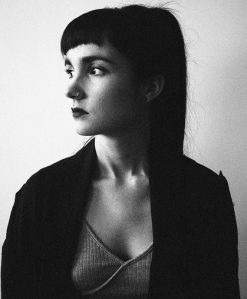
designer Alison Yanota

Her design portfolio, which includes productions with such experimental indie theatres as Punctuate!, Cardiac, Ghost River, Tiny Bear Jaws, Bustle and Beast, Major Matt Mason, Fu-GEN, the Maggie Tree — as well as larger subscription companies like Shadow, the Citadel, Vertigo — shimmers with startling images, surreal inspirations, mysterious reinventions of space with light. If you saw the Shadow premiere of Neil Grahn’s The Comedy Company, a test of comedy in a World War I setting, you’ll have seen Yanota’s beautiful work: a kind of sepia-drenched trench that slashed the stage diagonally, overhung with gauzy tatters, perhaps bandages, that fluttered like the remnants of an apocalyptic festival.

It’s possible that the cosmos has its own designs on Yanota: the play that’s followed her around since high school, she says, production after production, is  A Midsummer Night’s Dream, with its fantasy world of improbable transformations. This is telling: “I guess I live in a more surreal sort of world most of the time,” she says, a shrug in her voice.

It’s probably why the first theatre that appealed to Yanota, growing up in Calgary and gravitating to drawing, making music, dance, wasn’t earnest TYA (theatre for young audiences): “I didn’t like how much they pandered to me as a kid.” What filled her with wonder was the Cirque du Soleil. At 13, she even joined a touring youth circus; “I did contortion, and spun hula hoops on my feet….”

John Ullyatt in Every Brilliant Thing, Citadel Theatre. Photo by Nanc Price.

Yanota, who appreciates “a mom who really promoted the arts for me!,” remembers the younger self who was a multi-tracker: “I wanted to sculpt, I wanted to paint, make props, do costumes.… I just didn’t have a point of view yet.” The “technical theatre” program at Mount Royal University, recommended by a high school drama teacher, and then theatre design at the U of A (she has bachelor and a master’s of fine arts degrees) — “seven years in school!” perfectly suited a multi-faceted talent. “I’m so lucky to have gone that route,” says Yanota. “It’s allowed me to achieve a lot on small budgets, in indie theatre. I like knowing how things are made….”

To help support 12thnight.ca YEG theatre coverage, click here

“I learned so much about technique, how to be in a room and collaborate, when to stick up for yourself and stand behind your work,” Does she have a design specialty? “I like having a hand in all of it,” laughs the exuberant Yanota, now 29. “Especially when the time is short.”

Elena Belyea in Miss Katelyn’s Grade Threes Prepare For The Inevitable. Photo by Laurence Philomene.

She’s especially drawn to immersive theatre experiences, like Elena Belyea’s Miss Katelyn’s Grade Threes Prepare For The Inevitable, a Tiny Bear Jaws production in which the audience gets to be the class in an escalating exploration of apocalyptic anxiety. Or the Citadel production of Every Brilliant Thing (directed by Dave Horak, starring John Ullyatt) that had the audience collaborate with the protagonist on a list of what makes life worth living. Yanota’s design included a floor on which the audience members stuck notes, their individual contributions to “an Edmonton list of brilliant things” that grew every night of the run. It was, she reports, a fascinating cumulation.
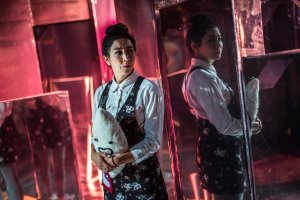
Mixie and the Half Breeds, Fu-Gen Theatre. Photo by Dahlia Katz.

“Everyone’s so tied to screens, to 2-D things all the time…. People want to feel part of something; there’s more of a craving for that then ever.” And design that creates “a grand sculpture or a space where people feel they’re in it” delights her. “I’ve always been an escapist at heart,” she laughs. “The abstract is a world I enjoy living in; it’s always interesting to see how people interpret….”

The strangest theatrical challenge in her portfolio? Louise Casemore’s Scent Bar, part of Ghost River’s “senses” project, which plays with the audience’s sense of smell .   

Yanota’s professional debut, though, was lighting a fourth-wall classic, the thriller Wait Until Dark at Vertigo Theatre. “A box set, and the planning to make  a ground plan work … it’s not the way my mind naturally works,” she says. “The (U of A design) professor I learned the most from was Lee Livingstone. So valuable!” 
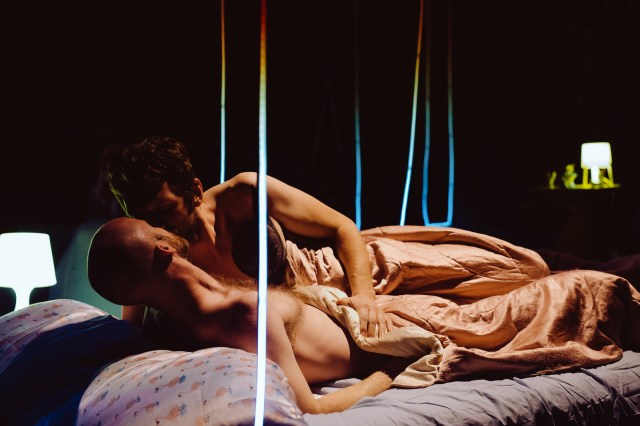
Premium Content, Major Matt Mason Collective. Photo by Tye Carson

Experimental new work figures prominently in Yanota’s portfolio. This fall, she hopes, we’ll be able to see Premium Content, a hit from Calgary indie Major Matt Mason If things had been different, Tiny Bear Jaws’ The Worst Thing I Could Be Is Happy would be running now at Toronto’s Riser Fest.

Theatre is all about inviting an imaginative response. “Humans are storytellers,” says Yanota. “They take something simple, a box onstage, and build stories from it, puzzle out meanings…. The theatre itself, for that matter: a room painted black, turn on the lights, and you’re in a different time and place.”

The gaping uncertainties of the moment haven’t flummoxed her. “Much as I hate to say it, this time has been very valuable to me…. I’ve been able to dig into sewing and art projects I’ve never had time for…. It’s less trying to look ahead and more ‘what can I mess around with now?’ If it’s seeds for the future, great. If not, great.” 
Posted in Features | Tagged , , , , , , , , | Comments Off on New faces in theatre (the series continues): meet designer Alison Yanota

Teatro La Quindicina postpones its 2020 summer season for a year

Everybody Goes To Mitzi’s, 2009. Photo supplied.

By Liz Nicholls, 12thnight.ca

The upcoming Teatro La Quindicina 2020 summer season, which would have launched at the end of May with a revival of Stewart Lemoine’s Evelyn Strange, has been postponed by a year.

To help support 12thnight.ca YEG theatre coverage, click here

Be patient, theatre fans. The entire line-up, a quartet of Lemoine comedies planned by Teatro’s outgoing artistic director/producer Jeff Haslam, has been rebooked, intact, for almost identical dates in 2021. The uncertainties attached to live gatherings, compounded by the cancellation of this year’s Fringe Festival, prompted the 12-month adjustment, says Lemoine of a decision to adjust in a big bold way instead of “speculating, then cancelling one production after another.” Clearly a case of ‘think big AND go home’.     

 As Lemoine, Teatro’s resident muse and playwright, explains, all 2020 subscriptions will automatically be converted into subscriptions for the 2021 season — unless subscribers want to donate that money, and receive a tax receipt. In the event a refund is required, that can happen, too. The response to the decision has been overwhelmingly positive, says Lemoine. “Everyone gets it on a basic level.”

Under Haslam, Teatro introduced to Edmonton the idea of a summer season to May to September, in the theatrical off-season. Born at the first Fringe in 1982, the company has made a Fringe run part of its subscription line-up.

“It gives us time to set up our new company structure post-Jeff,” says Lemoine of Teatro’s season jump ahead to 2021. Details await. But the general idea, he says, is “sharing the responsibilities amongst the ensemble,” an organizing principle with no equivalent here in a theatre company of any size (you’d have to look to ensemble companies like Chicago’s Steppenwolf for similarities).

Audience expansion requires time, thought, planning. “We have time to think about marketing, selling subscriptions to new people, getting the brochure out months, instead of A month, in advance.”  Besides, Lemoine argues, “people will be so excited to come back to the theatre!” 

“And now we have a fully planned 2021 season, we can really figure out our 40th anniversary season in 2022.” For his part Lemoine is finally able to remove the phrase “If I only had the time…” from his lexicon. “O wait, I do!”

Radical? “Well, these are radical times, and you have to be making big decisions,” declares Lemoine. “It’s pragmatic and gutsy, and those two don’t always go together.” 

Here’s the season of Lemoine plays Teatro audiences will see in 2021:

Evelyn Strange, directed by Shannon Blanchet (May 27 to June 12)

Everybody Goes To Mitzi’s, directed by Kate Ryan (July 8 to 24)

A new Lemoine play, directed by Stewart Lemoine (Aug. 12 to 28)

Fever-Land, directed by Belinda Cornish (Sept. 23 to Oct. 9) 

Posted in News/Views | Tagged , , , , | Comments Off on Teatro La Quindicina postpones its 2020 summer season for a year

New faces in theatre: six up-and-comers whose talents will have an impact on the scene. First, Helen Belay

By Liz Nicholls, 12thnight.ca

They’re young. They shine brightly. And their talents are already lighting up the Edmonton theatre scene. 12thnight talked to six starry and sought-after up-and-comers, artists whose work, on- and backstage, will have a big impact on theatre here when the doors are open again, and we can once more share the live experience.

First, meet actor Helen Belay.  And look for the others in this 12thnight.ca New Faces series. 

Andrew MacDonald-Smith, Belinda Cornish, Helen Belay, Chris Pereira in Vidalia, Teatro La Quindicina. Photo by Mat Busby.

HELEN BELAY, actor

If you got dizzy following the zigzag of three identical briefcases through a world of espionage (and escalating chaos) in Teatro La Quindicina’s revival of Vidalia last fall, you were embroiled in a high-speed Stewart Lemoine screwball comedy set in motion by a bright, breezy, impulsive heroine with a gift of the gab.

To help support 12thnight.ca YEG theatre coverage, click here

This quick-witted meddler, stirring things up with the estimable goal of making life more, well, entertaining, was the assignment of a charismatic newcomer with a galactic smile and expert coming timing. In Helen Belay’s professional debut she slipped into the blithe literate wit of the signature Teatro style with the ease of a veteran. “Very smart!” she says of the tickling humour and the volley of ideas she found in the vintage Lemoine comedy. “Just fun! Jubilant!”

Since Belay emerged from the U of A theatre school last May — and lead roles in such Studio Theatre production as All For Love (she was Cleopatra) and Concord Floral — her name has come up regularly in conversations with directors and artistic directors across town. Edmonton audiences were the beneficiaries.

Helen Belay and Nicole St. Martin in The Blue Hour. Photo supplied.

In 2020 SkirtsAfire Festival’s mainstage premiere The Blue Hour, Michele Vance Hehir’s unusually intricate coming-of-age drama, Belay was striking as a teenage girl stuck in a small prairie town iron-clad in fundamentalism, dreaming of love, music, and the big wide world. An articulate and genial conversationalist, she’s fulsome in her appreciation for the play: “a beautiful piece of writing that allows for time and contemplation … such a rich and thought-out world.”

By day, in “a bit of an overlap with a very different kind of play” (she laughs at the understatement), Belay was “in a world of chaos and godlessness!” She was in rehearsal for Theatre Network’s production of an  outrageous black comedy, Colleen Murphy’s The Society For The Destitute Presents Titus Bouffonius, in which a band of misfits, played by macabre bouffon clowns, get their mitts on Shakespeare’s grisliest most gore-splattered revenge tragedy, Titus Andronicus.

Helen Belay in The Society For The Destitute Presents Titus Bouffonius. Photo by Ian Jackson, Epic Photography.

Going between the two might well be the wildest cross-hatching of the season. Belay  played Aaron, a vengeful, evil-soaked plotter full of murderous malice. The audience was part of the show, acknowledged at every turn. And it was impossible to predict how an audience would react to the shocking developments onstage. “It changed from night to night,” says Belay. ” Things that would get a laugh one day got deafening silence the next.”

Belay, who’s in her early ‘20s, remembers thinking after the first run, “dear god, are we going to make it? We must! We have to! The show is going to open!” People laughed, or they were shocked, or offended, or some edgy hybrid of all of the above. Some walked out, she reports. “Was it improv? Absolutely,” says Belay, who had never done improv officially until a five-hour shift last fall in Die-Nasty’s annual Soap-A-Thon. “I loved it! Scary, yes. But the opposite side of the coin (from) fear is excitement….”

Bouffons don’t give two hoots about the audience liking them. Au contraire. “A few times I’d snap at an audience member so fiercely I wondered if I’d crossed the line, gone too far. It was like that for all of us!”

Helen Belay, Cinderella, Globe Theatre Regina. Photo by Chris Graham.

Goading an audience to the breaking point wasn’t anything the England-born Belay could have predicted when she was growing up in north Edmonton, the child of Ethiopian immigrants. She wasn’t a die-hard theatre kid but “a pretty hardcore academic” whose parents were, like many immigrants, keen from the outset for their offspring to salute “the holy trinity,” as she puts it cheerfully, “medicine, law, engineering.” And for a time she found herself, fretful and unhappy, in computer science at the U of A. “My heart wasn’t in it,” she says of her  younger self.

On a semester off, on dad’s prescient suggestion, she tried an acting class with the Citadel’s Young Company. It was an instant life-changer. “On the train ride home, I’ll never forget, I was filled with … just an electric thrill!” Happiness is at stake, as her parents have recognized. When she was starring in Cinderella, in a new adaptation of the old tale at the Globe in Regina this past Christmas, her parents drove there, to see the show “and make sure I had people to spend Christmas with…. I’m lucky!”  And lucky, too, she says, “to have so many artists I respect and admire give me a shot!” 

That thrill of knowing your calling propels her forward through a summer that’s started with the indefinite postponement, three days into rehearsal, of the Citadel/Arts Club co-production of Peter Pan Goes Wrong, which would have played Edmonton and then Vancouver. She was slated to play the young niece of the assistant director, cast as one of the Lost Boys, a character who has horrific stage fright and keeps getting injured. And she still will, if her increasingly busy schedule permits when the production returns to the stage. 

“OK, you choose a life in the arts, to some extent. But it very much chooses you,” says Belay.  “I feel like I was grabbed by a skeletal hand and dragged toward my future!” she laughs. Meanwhile, she’s taught herself to play the ukulele and make sourdough bread.  

Posted in Features | Tagged , , , , , , , , | Comments Off on New faces in theatre: six up-and-comers whose talents will have an impact on the scene. First, Helen Belay

Happy birthday Shakespeare: a pandemical celebration

Hunter Cardinal in Hamlet, Freewill Shakespeare Festival, 2018. Photo by Ryan Parker.

By Liz Nicholls, 12thnight.ca

“I could be bounded in a nutshell and count myself a king of infinite space, were it not that I have bad dreams.” — Hamlet

No one ever said he was a repository of positive thinking, but for self-help in times of self-isolation, Hamlet was on to something. The big day, Shakespeare’s 456th birthday, is Thursday. And, alas, it arrives with you bounded in a nutshell, alone in a sea of cancellations, postponements, Zoom-laden simulations.

To help support 12thnight.ca YEG theatre coverage, click here

Much has been made of how much Shakespeare got done in plague years when the theatres were shut down, and the world’s greatest playwright was at home and presumably wearing sweatpants not doublet-and-hose. In 1592 he wrote great big hit poems like Venus and Adonis. In 1606, there was King Lear and probably Macbeth, with Anthony and Cleopatra as a topper. True, he didn’t have to worry about feeding his sourdough starter or learning to use the subjunctive in Spanish. But still….

Edmonton’s Freewill Shakespeare Festival, incidentally, celebrates by appointing a new artistic director (Dave Horak, check out his plans here) — and promising to return next summer with this summer’s pair of alternating plays (Much Ado About Nothing and Macbeth).

The Folger Library’s suggestion of DIY Shakespeare at home — “speak the speech” or “strike a pose” or “make a picture,” and then #ShareYourShakespeare, might just be too terrible to contemplate. (I shudder to remember my worst-ever idea on the theatre beat, a contest that invited readers to send in their own versions of Macbeth’s “sound and fury” speech. What was I thinking?). But in honour of their resident playwright, some of the world’s great theatre companies, with a demonstrable expertise in HD, have stepped up for April 23 by culling from their catalogues of great productions with free screenings.

The National Theatre in London continues its marvellous weekly Thursday night dip into a great archive (the National Theatre at Home) with Twelfth Night, a gender-fluid 2017 production directed by Simon Godwin (available from noon, if you’re up for a matinee).

The Stratford Festival here in Canada is streaming the towering Colm Feore King Lear of 2014, directed by Antoni Cimolina Thursday on YouTube, starting at 5 p.m. The tragedy seems newly minted for the moment — not least, incidentally, because its world is infiltrated by toxins. Lear himself speaks of  “the plagues that hang in this pendulous air.”

Shakespeare’s Globe, on location in London, is offering its 2009 production of Romeo and Juliet on YouTube for a couple of weeks. Ah, there’s a tragedy whose very story depends on an outbreak of the plague; it’s why Romeo doesn’t receive the letter detailing the Friar’s plan for Juliet to fake her own death.

The Royal Shakespeare Company – 18 of their stellar productions, including David Tennant, who’s a marvellously maddening and well-spoken Richard II, are available on Marquee TV. You can subscribe for a 14-day free trial.

The Donmar Warehouse in London, has its Shakespeare Trilogy, Phyllida Lloyd’s all-female trio of Shakespeares, set in a women’s prison — Julius Caesar, Henry IV, The Tempest  on Marquee TV as well. This sounds impossibly artificial, I know, but Harriet Walter is riveting.


Posted in Features | Tagged , , , , , , , | Comments Off on Happy birthday Shakespeare: a pandemical celebration

Just in time for Will’s birthday, the Freewill Shakespeare Festival has a new artistic director: Dave Horak

Freewill Shakespeare Festival 2021

By Liz Nicholls, 12thnight.ca

Many happy returns, Will.

Dave Horak, the new artistic director of the Freewill Shakespeare Festival.

True, the 32nd edition of E-town’s outdoor festival in his honour has, alas, been cancelled this summer, postponed till 2021, and for entirely good reasons. But there’s welcome news to be had nonetheless: In honour of Shakespeare’s birthday on Thursday the big 4-5-6, the Freewill Shakespeare Festival has a new artistic director.

He’s award-winning director/ actor/ mentor/ teacher Dave Horak. And he’d have been directing the Freewill production of Much Ado About Nothing, slated to alternate with Macbeth (directed by Nancy McAlear) and open mid-June in Hawrelak Park, had the world been a different, safer place.

To help support 12thnight.ca YEG theatre coverage, click here

“I know, it’s quite the time to jump into a job like this!” he laughs. He didn’t have to make the call to cancel at least, he says. Which by any standards would be a discouraging opening gambit for a new artistic director. His plans start with the aftermath. First up, “I’m really hoping we can bring everybody back for the two shows next year.” 

Horak takes over a company with a $650,000 operating budget that turned the bright idea of six friends — newly graduated actors from U of A theatre school in 1989 — into a much-loved civic institution. A decade later, Freewill had expanded its audience enough to run two Shakespeares, a comedy and a tragedy, in rep. And Horak has expansion plans of his own, for a supplementary pairing of plays — with thoughts of “a venue change down the line” from the Heritage Amphitheatre in Hawrelak Park, where invasive and lengthy renovations are being planned by the city.

Horak’s appointment comes after more than a year in which the company neither had an artistic director nor announced that absence. His immediate predecessor in the gig was Marianne Copithorne, who left the company after a decade in February 2019. Like every Freewill artistic director starting with James MacDonald, she’d first been in the acting ensemble (a 1999 production of Macbeth). And so was Horak, who played the Fool to John Wright’s Lear in 2013, before returning to direct The Comedy of Errors in 2018 and The Winter’s Tale last summer.

But Horak and Freewill go way back — to the very start of the company and his days as a student actor in the now-defunct theatre program at Mount Royal University. “Shakespeare,” he says, “has followed me around … though I never thought I’d ever be running a Shakespeare company”

He was part of the company, half theatre students from Mount Royal and half from the U of A, who launched Calgary’s outdoor summer Shakespeare in the Olympic Plaza in downtown Calgary in 1988 — and inspired the birth of Freewill the next year. He was Flute, the bellows-mender-turned thespian in “a big circus-themed production of A Midsummer Night’s Dream” directed by Tom Kerr, late of the Stratford Festival. And it was a life-changer, Horak says.

“I was so struck by how really great those BFA actors (from the U of A) were,” he says of MacDonald, Annette Loiselle, and the rest of his cast-mates from Edmonton. “So confident and comfortable with the language. And so physical.… They were the reason I wanted to come to Edmonton and train at the U of A.” Which he did.

“It made me really love Shakespeare and working outdoors,” Horak says. “The Olympic Plaza felt so open. It wasn’t a destination; people discovered it….” He’s felt the same in Hawrelak Park on a beautiful summer night. “It feels so democratic somehow … such a different, special experience outside the confine of walls.”

“Of course it has its challenges too,” Horak adds. “You don’t get to do the fancy lighting; you don’t get to control all the elements…. But the actors and the audience are sharing the exact same space; they’re in exactly the same situation. And there’s something kind of electric in that.” 

“Often somebody’s first experience with Shakespeare is outdoors. It really was mine….”

For his own company, the Sterling magnet Edmonton Actors Theatre, Horak has often chosen plays that approach the classics from oblique angles. In 2013, it was The Bomb-Itty of Errors, a four-actor rap version of The Comedy of Errors. Fat Boy was a contemporary take on Ubu Roi; Stupid Fucking Bird a Chekhov spin-off. And he brings that sensibility to his new gig.

One of Horak’s proposals is to expand Freewill programming into a four-play season instead of two,” he says. “Two mainstage Shakespeares, and two ‘response plays’, plays that respond to the Shakespeare plays. One example that’s caught his eye is John Fletcher’s 1611 A Woman’s Prize: The Tamer Tamed, a commentary of sorts on Shakespeare’s The Taming of the Shrew. But there’s a wealth of modern examples, too, musicals like Kiss Me Kate or The Boys From Syracuse. He points to Colleen Murphy’s The Society for the Destitute Presents Titus Bouffonius, recently at Theatre Network. Stewart Lemoine’s Mother of the Year is a version of Titus Andronicus, too.

“Eventually, it would be cool to get local playwrights to write the ‘response plays’,” Horak thinks. “When I’m teaching (which he has done at MacEwan University, and will continue this fall at the U of A and Concordia), students are fascinated by the way Shakespeare plays resonate in popular culture…. It’s a big selling point of Shakespeare.”

“I don’t know when exactly that expansion can happen,” says Horak, whose recent credits extend to such adventurous indies as the Plain Janes (Fun Home), Bright Young Things (the rarely produced The Skin of Our Teeth), the Serial Collective (E Day), as well as the Mayfield Dinner Theatre (Lend Me A Tenor), and the Citadel (Every Brilliant Thing). But a change in venue, to enable two stages, is built into that thought, “whether it’s a covered tent or a more permanent structure.…

“Wouldn’t that be awesome, to build a real outdoor theatre down in the river valley somewhere? Where we could control the space and it would be ours? A great thing for Edmonton. After 30 years, it’s high time….” He laughs. “You gotta dream big, right?”

As for the Shakespeares we’ll see at Freewill, Horak has pitched plays from rarely produced corners of the canon, to be “balanced against a hit” with a recognizable name. He’s suggested “plays I’ve always wanted to do, like Pericles (a late rarely produced romance). Or Richard II: Every time I see Trump pouting and complaining I’m reminded of him, the baby king.”

And as for the artist roster, Horak says “I like the idea of an ensemble  company, and great performers people recognize and remember. But I’d like to bring a diversity of new people into the festival — designers, performers, exciting new directors.” 

“To create a more diverse artistic team, we need to reach out,” says Horak. “One of my other ideas is to expand the festival to the off-season…. Perhaps I’ll take some of the company members and do residencies in high schools and universities … maybe even tour hour-long Shakespeare with company members.”

Meanwhile, he’s keen to preserve “that feeling of an event, a unique experience” for people venturing forth to a park to see a professional production in a festive, informal, beer and popcorn sort of way. “When we go through a summer without a Fringe, we’re going to be so thirsty for our festivals…. I’m hoping there’ll be real public support. I’m going to have my fingers crossed that we see the value….”

The Freewill Shakespeare Festival returns to Hawrelak Park (“possibly for the last time” in that location) June 15 to July 11, 2021, with Much Ado About Nothing and Macbeth.

Posted in Features, News/Views | Tagged , , , , , , , | Comments Off on Just in time for Will’s birthday, the Freewill Shakespeare Festival has a new artistic director: Dave Horak

And back at the Citadel — a theatre update

The Garneau Block by Belinda Cornish, based on the Todd Babiak novel

By Liz Nicholls, 12thnight.ca

It’s not easy to plan, or even to use the word “postpone,” when the “until…” is up in the (thin) air. As Daryl Cloran says, circumstances “are constantly moving the goal post.”

We checked back with the Citadel artistic director this week. And what remains firm, despite the necessary vagaries, is the commitment of Edmonton’s largest playhouse to bring two of the current season’s theatrical victims, The Garneau Block and Peter Pan Goes Wrong (world and North American premieres respectively), to audiences as a number 1 priority.

To help support 12thnight.ca YEG theatre coverage, click here

As Cloran puts it, The Garneau Block, cancelled by matters COVIDian the night before the final dress rehearsal, “will be a really great way to gather again when we can … a celebration of community!” It is, after all, a Citadel commission of a thoroughly Edmonton story, adapted by an Edmonton playwright (Belinda Cornish) from a hit novel by an Edmonton writer (Todd Babiak) that’s Edmonton in every particular, from Die-Nasty to the Sugar Bowl.

“It’s ready for an audience,” says Cloran. “We just left the set there (on the Maclab stage) and locked the door….”

Peter Pan Goes Wrong, the work of the Brit comedy outfit Mischief Theatre, was to have been running as you read this, in a production featuring 12 Canadian actors directed by Londoner Adam Meggido. It got three days into rehearsal before the pandemic closed it down. “We built the set,” says Cloran. “It’s still sitting in our shop.”
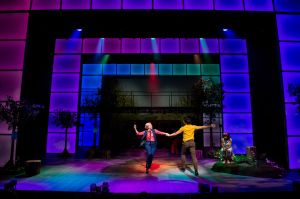
A comedy about theatre in which everything goes wildly wrong is the kind of hilarity that speaks to the moment. “When people come back (to the theatre), they’re going to want to laugh,” says Cloran.

The two shows aren’t cancelled. “Our plan right now is to do one  of them as soon as we can, late in the summer, maybe, or into next season….” Which means that the 2020-2021 lineup dates might have to be adjusted. And that is a complicated prospect, Cloran points out, since “next season has many co-productions. So it’s never just us when we make changes….”

Meanwhile ELVIS has left the building (possibly to check into the Heartbreak Airbnb). But he’ll be back — a year from now. 

The Citadel and the Vancouver Arts Club have put their joint production of ELVIS: the Musical (which was to premiere here in July, in an Ashlie Corcoran production) on hold till the summer of 2021. 

As You Like It. Photo by Dylan Hewlett.

Cloran, who was to have been in Chicago this week rehearsing a Chicago Shakespeare Theatre production of his festive Beatles-themed As You Like It, permits himself a sigh. Constant re-jigging and “shuffling around” a season lineup isn’t the most fun an artistic director can have. “I can’t wait to be back in a rehearsal room…. Today, someone asked me a question about something artistic  And it felt like such a glimmer of hope and light!” he laughs.

The COVID casualties of the current season include the presentation of Punctuate! Theatre’s After The Fire, Matthew MacKenzie’s dark comedy set in the aftermath of the Fort McMurray fire. But MacKenzie’s Bears will be, as scheduled, part of next season’s Highwire series of riskier fare in January 2021. 

Although the debut Collider Festival of new work, slated for this current season, has been cancelled, the Citadel is maintaining its new-play program. Amongst its six scripts at every stage of development is Prison Dancer, a new transmedia musical spun from a hit video about Filipino prisoners and their dance project. Another is Almost A Full Moon, a new Hawksley Workman/ Charlotte Corbeil-Coleman collaboration.

Meanwhile, the Citadel’s Young Musical Company continues to rehearse — on Zoom — their production of Stephen Sondheim’s Assassins, directed by Kate Ryan. Alex Donovan is directing the Young Acting Company rehearsals for The Wonderful World of Dissocia. And Tracy Carroll continues work with the Young Playwriting Company. 

As an alternative to refunds, tickets for postponed events will be honoured later, or the price can be donated. And 2020-2021 subscriptions, helpful in sustaining the theatre through these calamitous times, are available at 780-425-1820 or citadeltheatre.com.

Check out the Citadel’s Stuck in the House series —Edmonton artists creating, performing, and sometimes just chatting, from their own homes, to yours.

Posted in News/Views | Tagged , , , , , , , | Comments Off on And back at the Citadel — a theatre update

Theatre heartbreak: a summer without the Edmonton Fringe

By Liz Nicholls, 12thnight.ca

Here’s the saddest of theatre news: brace yourself, Edmonton, for a summer without the Fringe. The upcoming 39th edition of our mighty Fringe, slated for Aug. 13 to 23, has been cancelled. The (250) shows cannot go on.

The uncertainties attached to the pandemic have made a live gathering on the scale of our biggest and most celebratory summer festival — and the first and largest of its kind on the continent — too risky, too precarious. “So heartbreaking,” says Fringe director Murray Utas of the hard decision. “We tried. We tried everything we could. We looked at every possible scenario of what it could look like (in August). And we just couldn’t see a path forward….”

To help support 12thnight.ca YEG theatre coverage, click here

“What about going back to our grassroots as a local festival? The internationals would have to make decisions and soon that we wouldn’t have answers for. And the nationals, would they even be able to travel? What would our outdoor site look like? And there’s this: Will people even want to gather? They can’t even leave their houses at the moment…. What is our social responsibility in all of this?”

“There were so many unknowns,” says Utas. Isolation “is the opposite of the energy that makes our Fringe so special…. We’re thinking about the human beings.” In the Fringe’s long list of stake-holders, “we considered every one….” He adds, “because of our size we have to be this far out in front.” 

Murray Utas, 2017 photo by Marc J Chalifoux.

Refunds will be made to all Fringe artists slated to perform at the 2020 Fringe. For the artists in the Fringe’s dozen official lotteried venues, their spot will be held for next summer’s Fringe; “they have first right of refusal,” says Utas.

The Fringe returns next summer for a 40th anniversary edition, Aug. 12 to 22, 2021. Meanwhile, as Edmonton contemplates the dark vision of a summer without the Fringe, the company at the ATB Financial Arts Barn is making plans. “Who are we?” says Utas. “We’re going to be the organization, the pivot that helps rebuild our community on the other side of this…. We’re going to bring artists together to create, to jam, to connect. We want to be a cultural community hub, a home for artists.”

Further announcements await. Today we mourn. 


Posted in News/Views | Tagged , , , | Comments Off on Theatre heartbreak: a summer without the Edmonton Fringe

How does it feel to have your face misrepresented? Whiteface, the play and now the film

Todd Houseman and Lady Vanessa Cardona in Whiteface. Photo supplied.

By Liz Nicholls, 12thnight.ca

At the outset of Whiteface, a smug chalky-faced couple chat over dinner about their culinary and entertainment options.“Here we go,” sighs the woman, overcome with ennui and exasperation. “We’re always the monsters….” The man rolls his eyes. “I know, we’re always being attacked by reverse racism.”

To help support 12thnight.ca YEG theatre coverage, click here

In the boldly configured 2018 play by, and starring, Lady Vanessa Cardona and Todd Houseman, jaded comes in layers — and masks — of white. Now, Whiteface — by Houseman, who’s Indigenous, and Cardona, a Colombian refugee — is a film. Artful and beautifully designed in light and sound, it’s the work of Everett Sokol, an award-winning Indigenous film director/ writer/ producer/ theatre artist whose startling breadth of skills puts him in a highly selective subset of creatives.

As Houseman explains — from Montreal where’s he’s a production away from graduating as an actor at the National Theatre School —  Whiteface began life as an experimental 15-minute performance at Mile Zero’s Dirt Buffet Cabaret. “And we started gradually expanding it, adding things here and there, trying new things” as the show made its way to from Winnipeg to the Edmonton Fringe in 2018, and last year to the the Poetic Arts Festival in Saskatoon.

Todd Houseman and Lady Vanessa Cardona in White. Photo supplied.

The imaged that gripped them from the start, Houseman says, “the idea of Indigenous actors painted in whiteface.… We wanted to show people the real price of cultural appropriation, how it feels to see your face misrepresented. A very conscious stereotyping of the White Face to tell this story of cultural appropriation.” In the course of Whiteface he and Cardona wrestle, in powerful choregraphed sequences, with layers of grotesque, white-faced masks, a tangible demonstration of how hard it is to peel off a distorted stereotype.   

Lady Vanessa Cardona in Whiteface. Photo supplied.

Whiteface directs its zingers at white entitlement, the insatiable appetite to take over other cultural identities, to claim credit for reconciliation or inclusivity. Houseman and Cardona’s “response to the legacy of cultural appropriation” especially targeted Westerns, “which are such a huge part of our narrative history,” as the former points out. The vast archive of Westerns is a veritable repository of Max Factor tan makeup: Indigenous characters played by white people are everywhere. Whiteface hones its satirical edge on that: “Indigenous actors playing white actors playing Indigenous actors.” 

Cardona’s experience with stereotyping as an immigrant had similar resonances.  “A lot of the ideas are universal to people of colour,” says Houseman of “the feeling of seeing something that is yours taken from you and misrepresented…. We wanted to offer people a broad perspective.” After all, there’s an assortment of racisms in North America, as he points out, “xenophobic, or class-based, or Indigenous racism which is a real part of this country….”

When Sokol caught Whiteface at the Edmonton Fringe, he saw a project admirably suited to his training in both theatre (at Grant MacEwan) and film (at Red Deer College). “I’d been keeping my eye open for a way to archive theatre in a film data base, that still complements it as theatre.”

He was attracted both to the inherent stylized theatricality of the show, and to its cultural thrust. “This is a show that has a lot of very absurd elements, with masks and (choreographed) dance, and a very important, relevant discussion point. And it’s done in a way that’s so bold and so confident!”

Todd Houseman in Whiteface. Photo suppied.

The trio were selected by Telus’s Storyhive initiative, and set about adapting the play for the screen. And as soon as the virus pipes down, Whiteface will be on the film festival circuit that includes Dreamspeakers, originally slated for the end of April and now on indefinite hold. And Sokol has plans for a feature-length film of Whiteface that will restore parts of the play that were cut for the short film version you’ll see on his website, and on YouTube.

“We didn’t know how audiences would receive it,” says Houseman of the satirical layers of white stereotypes, along with an indictment of white complacency that we’re living in times of reconciliation, of post-colonial post-racist harmony. “We built in pauses, gaps without dialogue, to be able to listen to the audience.” There have been objections, and the odd walk-out — and he and Cardona are far from amazed. 

What kinds of backlash have they encountered? “This is racist!” Houseman has heard, along with the thought that it’s wrong to marginalize white people. “Actually, it’s insecurity, it’s not wanting to be treated themselves the way their arguments treat people of colour.” 

Look for Whiteface at everettsokol.com/whiteface.

Posted in Features, News/Views | Tagged , , , , , , , | Comments Off on How does it feel to have your face misrepresented? Whiteface, the play and now the film

Can live theatre live online? Ask improv and video expert Matt Schuurman

Rapid Fire players, rehearsing on Zoom from their own homes.

By Liz Nicholls, 12thnight.ca

It’s a strange moment in history when live theatre has been struck down by the lack of its traditional venue (and raison d’être) — the room where people gather, and actors and audiences connect, in person.

So, the internet as theatre venue? Matt Schuurman, who’s both the artistic director of Rapid Fire Theatre and an award-winning video designer, thinks of it as a kind of role reversal. “Video used to be in live theatre … an element there to support the storytelling and the action. At the moment, live theatre is in video….” But is that a sort of cultural oxymoron?

To help support 12thnight.ca YEG theatre coverage, click here

“We’re looking for ways to say Yes to this, and look for the fun in it,” says Schuurman of the corps of elite Rapid Fire performers who’ve been online with each other for a couple of weeks, brainstorming, experimenting, and workshopping new programming ideas for the improv comedy company.

“Let’s stop trying to do traditional theatre in a non-traditional space — because you’re never going to be able to deliver.” Instead, ask “what is the gift this new non-geographical venue gives us?” He and his RFT cohorts are, he says, “looking for innovative ways to share our programming, deliver our mission for a while rather than disappearing.”

Rapid Fire, devoted to improv in all its forms, has long been the most internet-savvy theatre company in town. “In the old days,” at the company’s original digs, the previous incarnation of the Varscona Theatre where long queues waited outside to see their Friday late-night shows, they shared the stage with whatever set from whatever theatre production was in place or under construction. “It changed on a weekly basis, Shadow, Teatro … that’s what we had to adapt to,” says Schuurman. “It was a blessing and a curse…. Some sets were were extraordinarily fun to play on, some were extraordinarily restrictive — though there can be fun in those restrictions too.” 

What the Rapid Fire improvisers inherited when they moved downtown, as the sole occupants of Zeidler Hall in the Citadel complex, was “a big empty stage with a movie screen behind it. And we said Yes to that as well….We started incorporating a lot of video into our shows.”

At Improvaganza, RFT’s annual festival of long-form improv experiments, they tinkered with integrating live performers and lifestream video. Or cellphone texting as the source of audience cues. In the astonishing TEDxRFT, Julian Faid and Kory Mathewson devise an improvised Ted Talk on the spot, complete with screen imagery, on a subject chosen by the audience.

“Now we’ve been dabbling in livestream rehearsals,” on a variety of video conferencing platforms, Zoom, Facetime, Google Hangouts… At the click of a button you can turn off your camera. And poof, you’re gone. Entrances and exits can be mischievous. Or magical. Something to play with….”

Matt Schuurman, artistic director of Rapid Fire Theatre. Photo by Aaron Pedersen.

Schuurman created his first video design for theatre in Azimuth’s 2008 production of Su-Kat at the now-defunct Living Room Playhouse. “I had an animation degree; I was involved in theatre. I’d never had the opportunity to marry the two” till Murray Utas and Steve Pirot proposed show, “actually about animation and dream worlds,” and asked for his help pulling it off.

“I refocussed my education towards animation, thinking I’d end up in film and TV or maybe video games,” says Schuurman. “And instead it’s come full circle; it’s looped back to theatre.” Since then he’s created video designs for a wide variety of theatre companies and productions. “Some are developed with video in mind, like Su-Kat or Surreal SoReal’s Genius Code. With others it’s a complementary element, a choice like lighting or a set piece: ‘we need a beautiful sunset’. 

But through it all, the crucial question is “how does the video contribute to the other elements,” says Schuurman, “to pull off a successive cohesive piece.” In screen productions and adaptations, as he points out, “the medium is the finished project, the entire experience. For theatre, video is a piece of a larger puzzle, with the end goal of supporting the story.”

In the new, temporary, reality for live theatre, struggling as it is to make its presence felt in the online world, can its essence, the live, shared experience, be simulated? Experiments of every budget and technical expertise abound. Some are signposts to the main event. You can see actors performing excerpts from productions, or reciting poetry, in their living rooms; I point you to Broadway star Patti LuPone’s kooky series of Twitter videos from her basement. Or the Citadel’s engaging Stuck in the House series on YouTube. Or the wonderful Zoom sing-out by the original Hamilton cast of that show’s opening number, actor by actor — as a birthday present for a star-struck nine-year-old — on John Krasinski’s YouTube series Some Good News

Some are ingenious re-thinks. Die-Nasty has reimagined its live serial soap episodes at the Varscona as an online (YouTube) improvised radio play.

Some are full-scale productions, like Broadway Live or the National Theatre’s superlative screen series from their archive that began last week with One Man Two Guvnors, and continues tonight with Jane Eyre.

Schuurman points out that much depends on the intention. “If the idea is just a catalogue, an archive to be referenced, just turn on the camera and let it roll, it’s generally not very watchable….” For one thing, “a lot of our venues aren’t designed, or well equipped, to be TV studios.” And at home we have to rely on phones or laptops.

“I have yet to see a tool that can replace the experience of being in a room with people, sharing a story,” says Schuurman. “That’s what we’ve discovered in rehearsal, how much you feed off the energy of the crowd, the feedback of their laughs and their responses.” As the director of an online rehearsal, he’s learned to leave his mic on, so the performers can hear him laughing, or breathing.

But “if we’re spending a lot of time and resources on a temporary fix, maybe there are things that can continue,” says Schuurman. Stay tuned. In the next couple of weeks, Rapid Fire will be rolling out new adventures in online programming. “We’re looking at this as an offer, a challenge, an opportunity to find new ways to play.”


Posted in Features, News/Views | Tagged , , , , | Comments Off on Can live theatre live online? Ask improv and video expert Matt Schuurman

Freewill Shakespeare Festival reschedules for 2021

By Liz Nicholls, 12thnight.ca

Alas, one woe doth tread upon another’s heel.…

The COVID crisis has claimed another arts victim. Not unexpectedly, the 2020 edition of the Freewill Shakespeare Festival, the Bard’s annual summer foray into Hawrelak Park, has been cancelled. And its two alternating productions, Much Ado About Nothing and Macbeth, originally slated to open on the Heritage Amphitheatre stage mid-June, have been rescheduled for the summer of 2021, June 15 to July 11.

Yesterday Freewill’s sister festival in Vancouver, Bard on the Beach, announced a similar decision to defer its slate of productions till next year.

As Freewill’s new managing director Nikola Tonn explains, “we looked at every option” and contingency. Postponing dates till later in the summer in a much-used city-owned venue was an unlikely prospect, as was relocating on short notice. The festival’s only excursion into an indoor venue, SUB Theatre, several summers ago, proved financially disastrous.

To help support 12thnight.ca YEG theatre coverage, click here

“With the current information before us it is the best decision for the safety of crew, cast, volunteers and patrons….”

“Next Monday our stage would be getting built,” says Tonn. “Rehearsals were scheduled to begin the second week of May.” The uncertainties, renewed on two weeks’ notice at every level of government, were untenable. She hopes that directors Dave Horak and Nancy McAlear, who were to have staged this year’s offerings, will be available for the 2021 productions. 

“Trying to balance a budget looks very different now,” says Tonn. “Ticket and concession revenue accounts for about half our budget,” which runs to about $630,000, depending on the productions. The annual artist budget is about $300,000. For the summer, a staff of two becomes 50, including administrators, artists, designers, and crew.

Festival passes and VIP passes for the 2020 festival went on sale at Christmas; refunds or deferments are available. Further announcements of summer activities (plus the introduction of Freewill’s new artistic director) await, slated for Shakespeare’s birthday, April 23.

Posted in News/Views | Tagged , , , , , | Comments Off on Freewill Shakespeare Festival reschedules for 2021