And back at the castle: a radio play version of Guys in Disguise’s Dragula

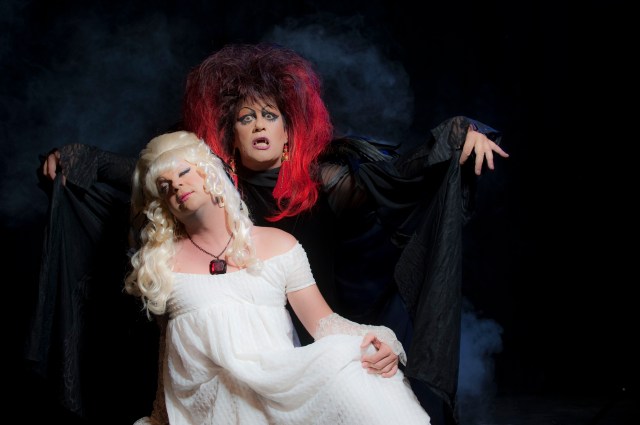
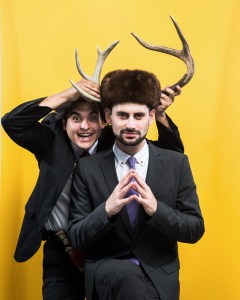
Trevor Schmidt and Darrin Hagen in Dragula, Guys in Disguise. Photo by Ian Jackson.

By Liz Nicholls, 12thnight.ca

It sounds like a sublime punchline: a drag show, in all its be-wigged glam-frocked glory, as a radio play?

True, there’s a certain captivating perversity about the Guys in Disguise revival of their hit Fringe show Dragula  — opening aurally this week.

To help support 12thnight.ca YEG theatre coverage, click here

But when you hear the very funny trailer for the radio play version of Darrin Hagen’s and Trevor Schmidt’s spoof-y gothic romance, with its creaky doors, eerie whooshes, and strange echoes — not to mention the wooden high-pitched tones of the dimbulb virginal heroine — you’ll catch the drift of the pluses, too.

Guys in Disguise, a company with more a three decade-plus archive in bending gender and match-making drag and theatre, premiered Dragula 10 Fringes ago on the Varscona stage. The absence of that massive showcase, where Guys in Disguise are bona fide stars, is the immediate impetus behind this new version (though they’d been thinking of re-doing it as a podcast, Schmidt says).

If it hadn’t been for COVID, there would be a new Schmidt/Hagen hot ticket running at the Fringe as you read this, starring its two creators along with Jake Tkaczyk and Jason Hardwick. “Crack in the Mirror,” which we are now officially missing, “is set in a women’s community group in the late ‘70s,” says Schmidt of the might-have-been. The theme of the monthly meeting is “mirror mirror on the floor.” The principal prop? Hand mirrors; you can take it from there.

Dragula, explains Schmidt, “marries gothic to the Hammer (horror) films from the late ‘60s…. Everything looks gothic except the hair!”  He’s amused to remember a prime question from every radio interview he and Hagen have done about their Guys in Disguise Fringe productions. “‘Can you describe to our audience what you’re wearing?’ Darrin would be in his cargo shorts and Hawaiian shirt and I’d be in a tank top and whatever. And we’d lie!”

So in a nod to this venerable media tradition, I ask Schmidt (who’s also the resident Guys in Disguise costume designer) on the phone what he’s wearing as virginal heroine Virginia Hymen, possessor of the hilarious voice, “dumb as a sack of hammers, quite blank.” He obliges: “A perfect dress. A seersucker-sucker stretch gothic gown, empire waist. Lace gauntlets. A beautiful antique lace negligee with a long train. Off-white….. And a huge beehive.”

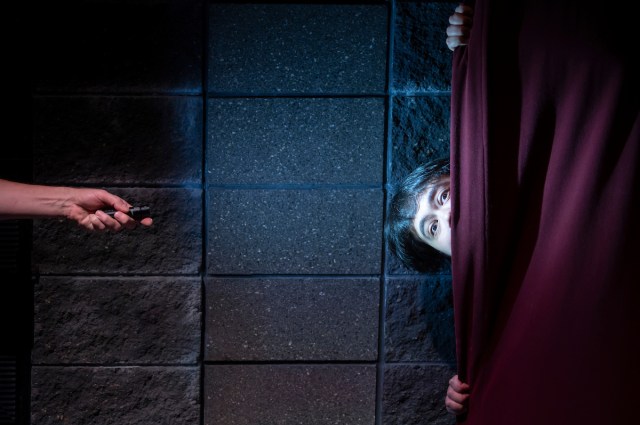
The poster art is a tip-off, and owes its inspiration to “pulp novel covers,” says Schmidt. “Almost always a young woman running away from a castle. Usually at night.”

Trevor Schmidt and Darrin Hagen, Dragula. Photo by Ian Jackson.

The gist of Dragula, he says, is “young virgin goes off to castle and discovers intrigue,” etc. Naturally, Virginia, who’s playing with more than a few cards short of a deck, “takes a candle and wanders the castle at night, through towers and dungeons….” As sound designer/actor Dave Clarke has fashioned this abode, it’s a veritable repository of aural effects: wind, screams, barking dogs, slamming doors….

OK, you can’t see the garlic sausage in this aural version. Or the spooky lighting, or the giant picture frame the actors carried around the stage to change the setting. Or the two wooden stakes, one big one small, “for the Big Moment,” as Schmidt says. But, says Hagen, “you feel the set and taste the costumes…. And Trevor’s voice is so funny! He wasn’t sure people would realize how jaw-droppingly stupid his character is” without the visual accompaniment of blank looks. Hagen assures us that we will. The heroine’s “wooden flat delivery, without subtext of any kind” is a show-stopper for aural theatre.

The castle’s proprietor, as you will have surmised, is the Countess (imagine the statuesque Hagen in a selection of glamorous goth attire) with the sinister outgrowth in dentition. Virginia’s uncle Professor Dick Von Dick (Clarke) is a manly vampire-slayer. Wilma Fingerdo (Davina Stewart) is the Countess’s henchperson and former lover (“we don’t sleep in the same coffin any more”). Needless to say Wilma is a bit snarly about the arrival of a rival, especially a young and virginal one with a girly high-pitched voice. The narrator is voiced by Patricia Darbasie.

As in so many Guys in Disguise comedies, the serious — feminism, sexual politics, thoughts about the patriarchy, gender politics — is approached playfully, outrageously. “Sneaky fun,” says Hagen, whose play 10 Funerals is the grand finale of the upcoming Shadow Theatre season. “I really like to tackle big subjects with humour, and slip in the ‘lesson’,” says Schmidt.

Playwright/actor/activist/ queer historian Hagen calls Dragula “an allegory of homosexuality,” and vampire lesbianism is centrestage. Von Dick is the representative of the patriarchy, “saving women from their own lust…. Hey, a battle of good and evil!”

“It’s the first play where we purposely didn’t have swears,” says Schmidt, who’s currently working on a Bollywood-style indie film. “We wanted to see if we could do it.”

Have a peek at the trailer: https://guysindisguise.bandcamp.com/releases. That link is where you can get the $10 tickets soon. And hey, it’s a bargain. Hagen pictures you and your pals listening in your backyard “after midnight.”

Posted in Previews | Tagged , , , , , | Comments Off on And back at the castle: a radio play version of Guys in Disguise’s Dragula

Signs of life: live theatre is coming back, with cautious first steps

Shaun Smyth in Playing with Fire: the Theo Fleury Story, at Persephone in Saskatoon, 2016. Photo by Electric Umbrella/ Liam Richards.

By Liz Nicholls, 12thnight.ca

And they’re back!

Very cautiously, of course, experimentally, a little tentatively, with ultra-sanitized jazz hands. And not full-blast: nary a large-scale musical in sight, needless to say. But live theatre is starting to be back … live and with live audiences.

For an arts industry whose raison d’être is the excitement of real live in-person experience, it’s been a wintry four-and-a-half months. And you’ve got to admire the resourcefulness, the resilience, the sheer tooth-gritting persistence of our theatre artists, who’ve devised ways to translate performance onto screens.

To help support 12thnight.ca YEG theatre coverage, click here

But 2-D imaging does whet the appetite for 3-. Three theatres are up for the complicated challenge of inviting real live audiences, albeit a fraction of their usual capacity, back and on location: Edmonton’s biggest playhouse, the Citadel; Edmonton’s tiniest, Grindstone; and the venturesome Mayfield Dinner Theatre.

Start with the smallest first. Next week Grindstone Theatre in Old Strathcona is launching a Re-Set Theatre Fest in person (or online). As the company’s tireless artistic director Byron Martin describes, Re-Set is a mini-Fringe of sorts. Nine sketch, stand-up and improv comedy shows rotate five performances each, from Wednesday through Aug. 30, at the Grindstone’s bistro headquarters (10019 81 Ave.) and the nearby Sewing Machine Factory (under the Mill Creek Cafe, 9562 82 Ave.).

A socially-distanced audience of 36 max at either 84-seat venue, will catch sketch comedy troupes like The Debutants or Marv N Berry. Or a BIPOC standup showcase, Black Laughs Matter, hosted by Natasha Lyn Myles. The lineup includes You Might Notice Something Different About Me, from trans standup comic Cindy Rivers. There’s an improvised Yeg DND, to make the nerd crowd happy. And there’s even a puppet talk show, Gabbin’ With Gobber, with Malachi Wilkins. See the whole line-up and schedule at grindstonetheatre.ca  

It’s not exactly curated. Word got out, “people applied, and we waived all producer fees” in favour of a $2 surcharge on tickets, Martin explains. “Ever since Phase 2 in July, we’ve started exploring the possibilities with our producers,” he says of the Grindstone’s weekly roster of troupes. “Everyone feels differently; everyone has a different comfort level.”

The pandemic check-list is reassuring, both in detail and enforcement. “The audience must wear masks. So, distancing and masks, sign-ups (at the start of every show) for contact tracing, hand sanitizing, separate entrance and exit, someone to seat people and make sure the rules are followed… We have to have a staff technical director onsite for every show, and we used to let the producers bring their own.Technicians have to wipe down everything between shows.” The list goes on. “And it’s a lot of work,” Martin admits. “But people are hungry for a live experience. And we’re very glad to be able to be open.”

Can the money work with an audience of 36?  “We have an average audience size of 30 anyway,” says Martin. “It works with 20 people watching.” And if your basic pandemic anxiety level isn’t tuned down yet to venturing forth in person, the shows will be live-streamed, with digital tickets available.

•The Citadel’s return to live in-person performance after the long intermission is their experimental two-night Horizon Lab, a two-night “celebration of Albertan BIPOC, LGBTQ+ and disabled artists’ stories,” on the Shoctor stage Aug. 28 and 29. One hundred (free) tickets a night are available for masked, socially-distanced audiences in the scrupulously sanitized 681-seat Shoctor Theatre. For those not ready to gather, a video version will be available a couple of weeks after the live run.

Helen Belay, Cinderella, Globe Theatre Regina. Photo by Chris Graham.

The summer’s artistic associate team — Helen Belay, Tai Amy Grauman and Mieko Ouchi — has already launched a Horizon Series, now underway at citadeltheatre.com, in which they interview leading BIPOC artists about their work, their experiences working on Canadian stages, their plans. Now the three have assembled five teams of BIPOC, LGBTQ+ and disabled artists, to devise a 10-minute piece each, in a months, for Horizon Lab. 

The prompt they offered artists was a question: “where are your stories?,” inspired by If This Is Your Land, Where Are Your Stories? Finding Common Ground, by the Canadian writer J. Edward Chamberlin. “The teams could choose to be their own performers, or bring others in,” explains Belay. 

Designer Elise Jason created a stage environment full of possibilities, “a palimpsest of artistic creation,” as Belay puts it. “There’s a hint of it in the graphic (above): A trio of celestial … suns? presences? in the sky. In beautiful rich course evocative of the landscape.”

“We asked ourselves what can we do right now that can serve the community. After the kind of miasma we’ve all been slogging through … everyone feels a real need for a 3-D space to gather. We’ve been inundated by screens. We just felt we had to incorporate a live element.”

“AND we wanted to put some money in the pockets of artists we believe in.”

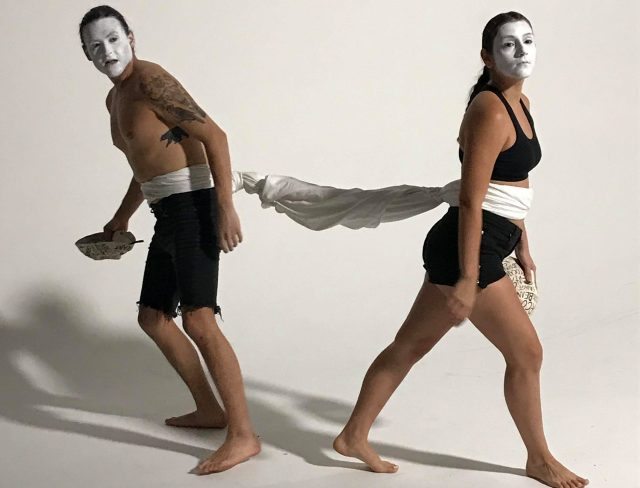
Teams like Todd Houseman and Lady Vanessa Cardona (who created a piece for Christina Nguyen and Sheldon Stockdale), had worked together before. You may have seen their show The Whiteface Cabaret on FringeTV’s opening night Thursday. Other connections are new, “to plant seeds for future collaborations, to invest in relationships, and hopefully to change the landscape we live in, long-term,” says Belay. In the case of playwright/actor Mac Brock and Pepper’d co-founder Tasana Clarke, “they were two up-and-coming artists doing cool things…. Let’s see if they’d be interested in working together!”

The teams include a diversity of talents: Richard Lee Hsi and Morgan Yamada, both expert physical performers; Patricia Cerra, Carly Neis and Cynthia Jimenez-Hicks; Mohamed Ahmed and Elena Eli Belyea with Mahalia Carter-Jameson.

Says Belay “It’s been so fascinating, a privilege to be part of this moment, which hopefully will roll over into something for the future. Quite the illuminating experience!”

Tickets are free but required, with donations encouraged: citadeltheatre.com.

• The hit solo show Playing With Fire: The Theo Fleury Story is up on its skates once more — and back in a hockey-mad town staring Sept. 8. That’s when the Mayfield Dinner Theatre re-opens, in a socially distanced new configuration — with the magnetic Shaun Smyth as the NHL star haunted, and nearly derailed, by dark turbulence of his past as a victim of sexual abuse.

Ron Jenkins’ electrifying production, which happens entirely on skates on a specially designed rink, was on tour at the Citadel five years ago.  It returns, with Smyth in the title role, to tell (and show) the story of a small-town kid from a chaotic home life, with an extraordinary talent in a world that celebrated it, and then threatened it.

It runs Sept. 8 through Oct. 25. The Mayfield buffet has been replaced with table service. And theatre-goers can only remove their masks once they’re seated at the table.

Tickets and a list of precautions: mayfieldtheatre.ca or 780-483-4051.   


Posted in Features, Previews | Tagged , , , , , | Comments Off on Signs of life: live theatre is coming back, with cautious first steps

The might-have-been hits home: it’s Fringe Eve in Edmonton

Katie Hartman in The Unrepentant Necrophile, The Coldharts. Photo by Dan Norman.

By Liz Nicholls, 12thnight.ca

For months I knew it would come. The weirdest week of a weird summer. The week the Fringe doesn’t happen. It’s a might-have-been that leaves us face to face with the strangest, most unrecognizable of vistas … a Fringe-less August in Edmonton.

For 38 summers, it has never happened till now. In all the time I’ve been a theatre writer, since Fringe #2 in 1983 when my editor sent me out to investigate a bizarre little eruption of theatre in Old Strathcona, the Summer and the Fringe have been completely interchangeable terms. The calendar always, naturally, arranged itself around festivities that always started a week after the Folk Fest.

I know I risk sounding hopelessly self-centred, at a moment that hits thousands and thousands of other people, in the profoundest of ways — life, death, livelihood. But I can’t quite believe it, in truth.

In Might-Have-Been World on the eve of Fringe opening night, which changed from Friday to Thursday more than a decade ago, I’d be scrambling to write something more about shows I can’t wait to see, and how much the festivities have grown, shamelessly over-using “fringe” as a verb (an Edmonton contribution to world theatre lexicon). I’d be scrambling to unknot the contradictions in my ridiculously intricate Fringe schedule, hunting down an extension cord and power bar, lining up for a press pass (a tradition always accompanied by a lemon pizza lunch in  Strathcona to prepare the digestion for an onslaught of trail mix, green onion cakes and fried objects).

I’d be getting butterflies preparing to enter the high-energy world of jostling crowds, late late nights, lingering mini-donut smell in the air, and shows with no sets to speak of, enigmatic descriptions, and titles with multiple exclamation marks. And I’d be marvelling at the grand good fortune brought to us by the exciting Fringe mix of new, emerging talent and veteran artists, from here and the great big world, trying out shows, theatrical ideas, techniques, or skills they didn’t get the chance to exercise during the season. Like you I’d be preparing to be surprised, if that isn’t a contradiction in terms.

Well, 2020, an iffy proposition at best so far, has just flung itself willy-nilly, into Outer Space.

To help support 12thnight.ca YEG theatre coverage, click here

A veritable tsunami of wistfulness is upon us. And the Fringe knows heartbreak when it sees it: they are after all, a festival facing a ruinous $3 million loss, surrounded by artists left stranded by the cancellation of their income. They’ve launched a fund-raising appeal they’ve christened Tears, Beers & Tickets You’ll Never Use — tickets to shows you can only dream about, beers you’ll never drink (not to mention horrifying pizza-in-a-cone things you’ll never eat). Check it out at fringetheatre.ca.

And since Fringe habits die hard, as well I know, Fringe #39, The Fringe That Never Was, has assembled free digital programming nightly for the festival duration: fringe shows, interviews with fringe artists from here there and everywhere, music, conversation…. It kicks off with Thursday night’s “opening ceremonies” at 6 p.m. on FringeTV, and runs there through Aug. 23. T

The full line-up is at fringetheatre.ca/festival/events. And you can check out the 12thnight.ca Fringe That Never Was survey piece HERE.

Todd Houseman and Lady Vanessa Cardona in Whiteface. Photo supplied.

Thursday night on FringeTV, in a collaboration with FringeLiveStream, Todd Houseman and Lady Vanessa Cardona translate their edgy 2018 Fringe satire Whiteface into The Whiteface Cabaret (7 p.m.).

Friday night at 7 p.m. (also Aug. 19 at 7), Brooklyn’s The Coldharts (Edgar Allan) reveal a digital Fringe version of The Unrepentant Necrophile, a punk rock musical with an alluringly unusual true-life premise, a love story between an apprentice embalmer and a corpse. Read my 12thnight interview with Katie Hartman and Nick Ryan about the show HERE.

Josh Languedoc in Rocko and Nakota. Photo supplied.

Josh Languedoc, a great Indigenous storyteller, has re-worked his much-travelled solo show Rocko and Nakota for the Fringe’s digital series (Aug. 18, 7:30). And before that (6 p.m.) this smart and genial artist hosts Irreconcilable Spaces of Cultural Identity: A BIPOC Fringe artist conversation. 

There are many more fringe-y things to see every night (except Monday), including a Virtual Wine Tent (Thursday through Saturday and Aug. 18 through 22, 8:30 p.m.). And, look on the bright side, there’s this: you can drink your plonk in a proper glass and not in those little plastic stemmed things that always tip over on your program.


Posted in Features, Previews | Tagged , , , , , | Comments Off on The might-have-been hits home: it’s Fringe Eve in Edmonton

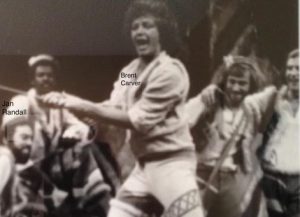
Remembering the enchantment: Brent Carver in Edmonton

Brent Carver and Nicky Guadagni in Romeo and Juliet, directed by John Neville. Photo from Citadel Theatre.

By Liz Nicholls, 12thnight.ca

There was an unmistakeable magic about seeing Brent Carver onstage. People felt it; they remembered the enchantment. I was struck again by that with the many heartfelt responses that came my way with the terrible news last week that he had passed away, at 68.

To help support 12thnight.ca YEG theatre coverage, click here

Some conjured the impact that seeing his Romeo 44 years ago, in the 1976 John Neville production that opened the Citadel’s new brick-and-glass playhouse downtown. For some, Carver’s performance in that Romeo and Juliet was their “first theatrical experience ever,” the one that drew them into to a life-long love affair with theatre, as an artist or an audience member. Once seen never forgotten. For some it was Carver as Feste in the Citadel’s Twelfth Night a season later.

Brent Carver in Joseph and the Amazing Technicolour Dreamcoat, 1975. Citadel Theatre.

Others went back even farther for their life-changing moment, to the original Sally Ann citadel on 102 St.  — and Carver as the title star of Joseph and the Amazing Technicolour Dreamcoat.

His stellar seasons at Stratford, nine in all (the first in 1980), reveal his extraordinary range, Hamlet to Tartuffe to Tevye via Dr. Frank N Furter. And they’re well documented. But his connection to Edmonton goes way back. In 1973, a 22-year-old actor from Cranbrook, B.C. with a gentle smile and delicately chiselled features, was the callow Claudio in Much Ado About Nothing, Neville’s regime-launching bell-bottomed Tex-Mex production at the old Citadel.

Brent Carver in rehearsal for Romeo and Juliet, 1976. Citadel Theatre.

I wasn’t around then (in Edmonton, I mean). But in the 90s I was in the audience for Carver as a quicksilver Robin Hood at the Citadel. And I’ll never forget the magic of his utterly captivating performance as Cyrano, the big-nosed swordsman with the soaring romantic imagination and the otherworldly gift of poetry, in the Citadel production directed by Robin Phillips. It’s an evergreen memory for a lot of other people too, judging by my messages of last week.

Actor/improviser/director Ron Pederson, now Toronto-based, was an Edmonton kid of 14 when he saw Cyrano at the Citadel. “And in that one performance I realized what theatre was for and what an actor could be, and that being a Canadian actor was a real thing…. I went back three more times to see if I could see where it was coming from, how he was doing it. I’m happy I’ll never know. He changed my life; a Canadian actor going where his soul led him and sharing it all along the way.”

Brent Carver, right, with Kate Newby and Andrew Jackson in Cyrano, 1994, Citadel Theatre

Cyrano was Carver’s first first theatrical stop after 18 months of electrifying Broadway and West End audiences in the musical Kiss of the Spider Woman. His startling and original performance as Molina, a gay window dresser who conjures old movies (enacted by co-star Chita Rivera) to beguile his cellmate, won him the best actor Tony Award in 1993.

I remember seeing his dazzling performance in New York, and waiting by the stage door to meet up with him afterward. The assembled crowd, it turned out, was there for Rivera; the curly-haired soft-spoken Canadian with the ratty backpack (and the 20-year resumé of classical roles across the border) slipped away with me for a drink without any fan attention at all. 

Carver left splashy Broadway success after a year and a half — to come back to Canada. “And I left satisfied,” he told me in an Edmonton Journal interview in 1995. “There came to be more output than input…. There are many ways to make money. Your priority has to be the people you work with.”

The season after Cyrano, he was back in Edmonton at the Citadel to be Richard III in Phillips’ production. In his sexy, funny, dangerous performance, Carver played the hunch-backed master manipulator as a sort of evil urchin, appalling and seductive in equal measure. I’ll never forget the opening image: Richard rolls towards us, silently in an electric wheelchair, a dark and sinister figure lolling asymmetrically in the corner of the seat. And then suddenly, he was out of the chair, in a powerful kind of lopsided explosion, to tell us acidly about the winter of his discontent.

I interviewed Carver a few times in my decades at the Edmonton Journal. And I always found him funny and kind, very humble and non-starry, a bit shy, deeply thoughtful about theatre (well, about everything actually) but not following conventional tracks. He had a free-associative zigzag way of talking about things that was all his own. As a writer I found that very hard to capture on the page, that elusive, free-floating, pinball quality — without making him sound a bit loopy or wispy, which was absolutely not the case. The contradiction between the gentle, almost ethereal quality of the guy and his immense power as an actor were so intriguing. 

“Language,” Carver said of Richard III (in my 1995 Journal interview), “is a turn-on. It touches you everywhere: your heart, your head, under your skin. It creeps in and caresses you.”

I’m not sure how Canadian theatre can do without him.

Posted in Features | Tagged , , , , , , , , | Comments Off on Remembering the enchantment: Brent Carver in Edmonton

The loneliness of the long-distance playwright: have a one-on-one consultation with Workshop West’s new resident dramaturg

By Liz Nicholls, 12thnight.ca

Got a script in your sock drawer? A draft in your Google Docs? An idea for a play rattling around in your head? Workshop West Playwrights Theatre has an invitation for you.

To help support 12thnight.ca YEG theatre coverage, click here

Their latest initiative, under WWPT’s new artistic producer Heather Inglis, is to provide free-of-charge, custom-made, one-on-one feedback, dramaturgical consultation and support to anyone who submits a script. “No barriers.”

From the start, Workshop West Playwrights Theatre (the only producing company in the country with “playwrights” in its official name) was a writer’s theatre. For four decades it has been, at heart, all about the discovery, care, development, and deployment of new Canadian work — a company surrounded by playwrights and scripts in every stage of development, from the bright idea on up.

The program invites Edmonton writers of every age, every background, every creative goal, every degree of experience (including zero), to have their work read and dramaturged by award-winning playwright/actor Beth Graham (Pretty Goblins, The Gravitational Pull of Bernice Trimble, Slight of Mind). And that dauntingly elusive term “dramaturgy” can mean whatever you need it to mean, says the new “dramaturg-in-residence,” who knows what it’s like to be a lonely playwright sitting in front of a screen week after week.

“I’m here,” she says, “to make it not so lonely … to support writers in creating what they want to write.” After a draft, the lonely playwright is up against the question “now what?.” Until May, Graham is their “now what.”

“I’ll read the script — I try to do that in one sitting — jot down thoughts, and reply to the playwright to ask if they want to follow up with a one-on-one talk, a phone call or Zoom meeting. The idea “is to support people in what they want to write. Sometimes people are clear about what they’re trying to do, sometimes not.”

“It’s about support and letting the playwright come up with a plan. And not to put up obstacles,” says Graham, currently the U of A’s playwright-in-residence and leader of a playwrights’ circle there. “Do no harm. Support.” That’s her double-sided dramaturg mantra. And it involves asking a lot of questions, many familiar to actors: “what are your objectives? what are the complications?” — and extrapolating from there. “‘The feeling I’m getting is this: is that where you’re going with it? Or ‘that’s an interesting complication!’ Or ‘how can you raise the stakes on that?’”

As an actor-turned-playwright, Graham, who spent a season as Workshop West’s playwright-in-residence (ex-artistic director Vern Thiessen was dramaturg, along with Colleen Murphy, on Pretty Goblins), is a veteran recipient of countless dramaturgical interventions. And she knows full well that some are more productive than others. “O my gawd, yes. Sometimes I’ve come away so blocked. Sometimes I’ve come away with a plan, inspired and rarin’ to go!.”

The goal is “to give the writers the courage to keep going, to be inspired!”

Workshop West is accepting scripts till October 15. And they’re just starting to come in, Graham reports. Already there’s a striking variety: “comedies, dramas, politically motivated stuff, some things based on true events. All over the place, and that makes it fun! I’m really interested to see how these times will show up in them….”

Graham herself has a play in the works, “not about the pandemic” she hastens to add. “Actually I have a few; I call them ‘my drawer plays’,” abandoned drafts and ideas for scripts. The haul has turned up a variety: “Some I’m pulling out definitely need some work. Some have interesting stuff in them….”

Posted in News/Views | Tagged , , , , | Comments Off on The loneliness of the long-distance playwright: have a one-on-one consultation with Workshop West’s new resident dramaturg

What do you know now that you didn’t know on March 12? 12thnight asked theatre artists

Kristi Hansen and Sheldon Elter rehearsing the online Sterling Awards in their back yard. Photo supplied.

By Liz Nicholls, 12thnight.ca

“It’s been a learning curve.”

Once more, with feeling. Since March I’ve heard the line from theatre artists too many times to count. And it’s been delivered in every intonation and cadence: exasperation (sardonic or direct), rueful sigh, make-the-best of-it-shrug, plucky chin-up show-must-go-on vocal smile, bright exclamatory brio.

To help support 12thnight.ca YEG theatre coverage, click here

Ever since the devastating moment four-and-a-half months ago live theatre suddenly ceased to be a matter of real live people sharing a room with real live performers, theatre artists, who are after all trained in the art of social non-distancing, have been learning new skills, complicated screen technologies, new ways of rehearsing and performing and thinking about their industry (not to mention new ways of paying rent with no money). And, coupled with the critical momentum of Black Lives Matter, they’ve had time to think about theatre itself, what they value, what should change.

What do you know now that you didn’t know March 12? That’s the question I asked a selection of theatre artists. Their thoughts about what they’d learned were very different. Some were hopeful about ‘digital theatre’; some were not. Here’s some of what they had to say.

Sheldon Elter in Métis Mutt. Photo by Ryan Parker.

Sheldon Elter (actor, playwright, musician):

“I didn’t realize how important our jobs were until everything was shut down. We are more vital than we think we are as ‘live performers’. There’s only so much Netflix a person can watch before you’re craving a live experience you can share with other people: friends AND strangers. I love the idea of people trying to do something: Zoom performances, backyard shows…. But I really do miss being close to a stranger in a seat next to me. Sharing laughs. Hilariously, the ‘infection’ of laughs and joy and tears is important. It’s what truly brings us together as audiences. And we are affected by each other when in CLOSE proximity.”

Kristi Hansen (actor, director, co-artistic director of Azimuth Theatre, leaving to make room for young BIPOC talent; co-artistic director of The Maggie Tree):

“March 12 is the day we did the dress rehearsal of Candide for Edmonton Opera in the morning. I went home and had a nap and when I woke up it was cancelled. I don’t think I’d even clocked that a shutdown was possible. And now, four months later, I’m very aware that CERB is coming to an end and artists need to start getting paid to work. Safely. And that our rights as theatre workers ARE workers’ rights: health and safety, pay equity, anti-racist policies in action…. Now is a great time to examine HOW we work instead of always defaulting to ‘the show must go on’.”

Playwright/performer Josh Languedoc. Photo supplied by Thousand Faces Festival.

Josh Languedoc, actor, playwright, improviser, Indigenous storyteller (Rocko & Nakota), newly appointed Youth and Education Coordinator at Workshop West Playwrights Theatre:

“A few random thoughts that jump out at me: One thing I didn’t know was how human the theatrical experience is. Not only do we create art for the public, we desperately miss being around them! Almost as if the tribal gathering of people in a theatrical space means more to the artists than the act of creating art itself. In short, digital theatre just isn’t the same!

I didn’t know how to stream shows over the internet. Frankly this is still something I don’t know a ton about. But through my work with FringeLiveStream I’ve been able to understand streaming platform basics something like OSB software. Still feels confusing but it’s interesting at the same time!

I was also surprised to see the federal government support the arts as much as they have during this pandemic. So many grants and programs made available to artists that allowed them to create. Conversely it’s NOT surprising our provincial government has done the exact opposite — slashed funds and cut off significant revenue sources to artists. This switch has genuinely surprised me!

In general, I’ve also realized how desperately we need each other. We truly are social beings who crave social spaces.

I’ve also come to seek wisdom in these times. I’ve learned really strong art is made in times of transition. And when people create from a place of ‘unknowing’ some really powerful material can be made. I cannot wait to see what strong narratives of culture, resilience and community come out of these strange times!”

Helen Belay, Cinderella, Globe Theatre Regina. Photo by Chris Graham.

Helen Belay, actor (The Blue Hour, Vidalia), storyteller, member of Citadel Theatre Associate Artist summer team:

“The digitization of our form is possible. Technology is so advanced now, and what I’ve noticed is that when we lean into the form of whatever we’re using — a recent and brilliant example is Gender? I Hardly Know Them’s httpeepee — you can make something really special. And beyond performance too — workshopping new works and auditions? Also possible. That being said, I miss sharing experiences and stories with other bodies and hearts in space. There is something incredibly magical about that….

Andrew MacDonald-Smith, Belinda Cornish, Helen Belay, Chris Pereira in Vidalia, Teatro La Quindicina. Photo by Mat Busby.

The times we’re in right now have also made me realize that while I have lived experience and a decent base of knowledge around race and race politics, there are people smarter than me who have years of experience, study and vernacular…. So I’ve been reading up and thinking deeply on that. The book I’m currently chipping away at is Reni-Eddo Lodge’s Why I’m No Longer Talking To White People About Race … and am planning to follow that up with Bob Joseph’s 21 Things You May Not Know About The Indian Act…. I think striving for specificity of thought and action in the context of history and politics is needed to effectively tell the stories we want and need to tell in this era of social change.

I’ve also been relearning how to simply be. I think a lot of us forget how to — because, hello!, children can whittle away the hours with ease AND enjoy it AND feel accomplished after the fact.

FINALLY … for years, I have thought I might never learn how to play barre chords on the guitar. But with a slow and steady effort, built out of a few minutes a day, I’ve found hope.

Mac Brock. Photo supplied.

Mac Brock, playwright (Boy Trouble, Tracks), actor, producer (Amoris Projects):

There’s been a slow yet constant thudding feeing tugging at me for the last few months. Our industry prides itself on adaptability and open arms, but it feels even now like we’re sitting on our hands, waiting for the few at the helms to make space for new creators, new stories etc. What I’ve been learning is that there’s a brilliant next act bubbling through his intermission: one of young, or long-underseen, creators flipping the tables and making the space they wish to see in the city.

I miss liveness. I miss audiences. I miss the joy of a really good idea done really well. But I don’t look forward to it returning to normal. I look forward to seeing how a new generation transforms how we make theatre magic. And oh, will there be magic!


Posted in Features | Tagged , , , , , , | Comments Off on What do you know now that you didn’t know on March 12? 12thnight asked theatre artists

Portrait of an Indigenous artist in a Fringe-less summer: Todd Houseman

Todd Houseman and Lady Vanessa Cardona in Whiteface. Photo by Emily Randall.

By Liz Nicholls, 12thnight.ca

To help support 12thnight.ca YEG theatre coverage, click here

A summer without Fringes? Without real live audiences to test new material?

“It’s been a deeply reflective time,” says Todd Houseman thoughtfully, of the four months-plus since in-person performances suddenly vanished from the land. “A time for creativity, revolutionary protests….”

Todd Houseman. Photo by Maxime Côté.

The formidably versatile Indigenous actor/ playwright/ filmmaker/ Rapid Fire Theatre improv star, is on the phone, across the country from home in Montreal, where he’s one production short of his impending acting degree from the National Theatre School.

The co-creator and co-star of Whiteface (with Lady Vanessa Cardona) and Folk Lordz (with Ben Gorodetsky) has found the time productive. “In a time of hardship, there’s more of a motivation I guess,” he muses, of his work as a writer. “It comes out way faster; it seems more fuelled….”

Had times been different, this is the year that the film version of Whiteface, a 2018 Fringe hit adapted for the screen by award-winning Indigenous film and theatre artist Everett Sokol, would have been touring film festivals. The play and film have a sharply honed edge of satire about cultural misrepresentation; it couldn’t be more timely, as you might surmise. Cardona, a Colombian refugee, and Houseman, who’s Cree, perform in white masks, in a demo, as Houseman has put it, of “the real price of cultural appropriation, how it feels to see your face misrepresented: a very conscious stereotyping of the White Face.”

Todd Houseman and Ben Gorodetsky in Folk Lordz. Photo by Curtis Comeau.

“This has been a time to look at film-making and performance,” Houseman says of the hiatus in theatre and film production. He’s currently editing a theatre school film project with masks. “Film can add a certain level to storytelling….” It’s something that particularly interests Houseman. Original new forms of storytelling are the inspiration for Folk Lordz, a unique long-form improv which pairs  Houseman’s skills in the Cree oral tradition and Gorodetsky’s heritage in Russian folk tales and literary character drama.

Of necessity, this has been a time for “making art at great distances, in a short time.” He and Cardona have collaborated on a 10-minute piece for the Citadel’s Horizon Series. And they’re working on a digital version of Whiteface, spun from the same techniques and insights. We’ll see it as part of the Edmonton Fringe’s upcoming online incarnation, alongside an interview by Fringe director Murray Utas.”I love talking to Murray! I’m really looking forward to that!” 

He’s struck by the coincidence that the pandemic has left them both locked into place “on very important land,” meaningful to both their identities. “North of here,” he says of Montreal, “is where my Cree ancestors are from.” Cardona is trapped on location in her home country of Colombia. “Our ultimate goal is to create a very loose cabaret … like Whiteface in its bite but loose enough for anyone to join.”

Black Lives Matter has been an inspiration for people to re-examine their relationships with people marginalized by race, colour, gender, sexuality. Houseman, too,“as a cis hetero man,” has been pondering the implications. As an Indigenous artist frequently consulted for insights on the Indigenous experience, he’s wanting to spread the attention around.

“A learning experience,” he says. “There are newer and braver emerging voices that I’ve wanted a chance to listen to…. People should be listening to the Tiny House Warriors, the Beaver Hill Warriors.”

As for improv, “most of the skills are transferrable” to the Zoom world, thinks Houseman, who’s about to teach improv online to people  in Vancouver. Zoom can satisfy “a need for validation and a sense of play” with other performers. But as with film, the question of the audience is more problematic. “Who’s there? It can seem almost an echo chamber.”f

Meanwhile, Houseman the writer is making isolation work for him, enhancing his film skill set as he goes. As for the material hardships as Fringe cancellation season rolls on? “I’m OK for now…. I’m used to a  ‘for now existence’. After that … “I don’t know.”


Posted in Features, Previews | Tagged , , , , | Comments Off on Portrait of an Indigenous artist in a Fringe-less summer: Todd Houseman

A Telethon kicks off the strange summer when the Edmonton Fringe went online

Fringe director Murray Utas. Photo by Marc J Chalifoux Photography

By Liz Nicholls, 12thnight.ca

Everything that’s happening is changing the landscape…. Let’s make our own destiny!” — Edmonton Fringe director Murray Utas

The Fringe, Edmonton’s beloved August giant of a theatre festival, and a game-changer for this town in every way, needs some audience participation.

To help support 12thnight.ca YEG theatre coverage, click here

At a time of major heartbreaking might-have-been’s here’s a seminal one. Next Wednesday (by tradition a theatrical red-letter day), the Fringe box office would have opened and tickets would have gone on sale for this year’s 250 (or so) Fringe shows. But the 39th annual Fringe, alas, has been cancelled. Instead, The Fringe That Never Was is holding an all-day Telethon Aug. 5 (phone lines at 780-448-9000 9 a.m. to 9 p.m., and livestream on Fringe TV 12 to 4 p.m.). Tears, Beers & Tickets You’ll Never Use is the first event of its kind here — and the kick-off to the digital version of the Fringe that will take the annual festivities online to Fringe TV Aug. 13 to 23.

The goal of the Telethon is to raise $1 million for the festival, of which 30 per cent will go to an endowment fund for artists, for emergency services in times of need — like this one, which continues to be devastating. And 70 per cent will go to the continuing operations of a festival that will suffer a punishing $3 million loss this year of cancellation, with a view to ensuring its return in August of 2021.

It will feature a live assortment of theatre artists and musicians, with Fringe faves and guest celebs taking pledges. And, says Utas, it’s exactly the artist/community interaction that’s always been at the heart of the festival.

“I’m asking everyone ‘do you really care?’ Can you imagine Edmonton without the Fringe? In a year when the Fringe can’t be there for the community, what can the community do for the Fringe? It’s our time of need!”

And this city owes. The Fringe has changed the face of Edmonton theatre (and its profile), and kept our artists here, and creating, all year round. It’s a magnetic force field for community cohesiveness. The biggest Fringe in North America, and the prototype for the rest, is probably Edmonton’s brightest, most influential idea. And there’s this: beyond the $1.5 to $1.6 million in ticket sales that go directly back to 1600 or so Edmonton Fringe artists, the festival is “a major economic driver that’s not happening this summer. Eateries, shops, mercantile….” as Utas points out. The estimated spin-off is in the $15 to $17 million range annually.

The Fringe is inviting Fringees to donate their yearly Fringe budget — what you’d spend every year on shows, on the program, on beer and green onion cakes — to support the festival that has given Edmonton so much. “Buy a beer you won’t be drinking,” says Utas. “Buy a ticket for the show you won’t be seeing.… We’re close to the bone here. And beyond the Now, how do we keep this going?”

“People need us. People need joy. People need something to look forward to.”

The Telethon is the kick-off. While they won’t have a Fringe to go to this summer, the people will have an online Fringe to experience, as Utas explains. “We needed to honour the dates.” Every night of The Fringe That Never Was (except Sunday), starting at 5:45 p.m., there will be digital programming, including performances, conversations, interviews with artists, audience members, volunteers. And since the Fringe community is “inclusive, and international,” there will be surprises, Utas promises.

Performances by theatre stars like Farren Timoteo, Andrea House, Todd Houseman will be accompanied by meet-the-artist conversations with Utas about their work, the impact of COVID on their lives, their plans-in-progress, their thoughts about theatre, their dreams.

“I ask everybody three questions,” says Utas. “Why is the Fringe important to you? What do you love about the Fringe? What will you miss most this year?”

With the participation of FringeLiveStream, the lottery-drawn showcase of Fringe shows that continues through the country’s cancelled fringe festival circuit. our viewing entertainment includes The Collapsing Future Cabaret (with artists of every stripe from four continents, Aug. 20 and 21, 6 p.m.). You’ll see new Fringe contributions from Todd Houseman and Lady Vanessa Cordona (creators of Whiteface), and the innovative Vancouver puppet company Mind of a Snail (Aug. 13 and 20, respectively, 7 p.m.). You’ll see digital adaptations of shows by Josh Languedoc (Rocko and Nakota: Tales From The Land) and The Coldharts (The Unrepentant Necrophile), Aug. 13, 14, 18, 19, 20. 

Says Utas, “I’ve had to call in a ton of favours! I don’t have a budget for artists, but I gave them what I do have!”

The IBPOC Circle Conversation (Aug. 18, 6 p.m.) features some of the country’s most exciting young talent. There’s episode 3 of Fringe Revue (Aug. 15, 7 p.m.). To combat your festival wistfulness, the Virtual Wine Tent comes to you with a half-hour of live music from local talent at 8:30 p.m. nightly. And, yes (in answer to your implied question about Fringe tradition), the Friday night Fire Show, featuring an international array of inflammable street artists, is happening (Aug. 21, 7 p.m.). And so is the Fringe’s Late Night Cabaret (Aug. 22, at the non-insomniac hour of 7 p.m.).

“Come and go as you like, just like the Fringe,” says its exuberant director. “And it’ll stay online after the night. But if you tune in live, there will be stuff just for you on the night!  Come join us and it will be worth your while!

Check out the digital venue, Fringe TV, for the full schedule of dates and times. And the 12thnight.ca interview with the multi-talented Indigenous theatre/ film artist Todd Houseman is coming up soon.

Posted in Previews | Tagged , , , , , , , | Comments Off on A Telethon kicks off the strange summer when the Edmonton Fringe went online

Live theatre: has it found a footing on a platform instead of a stage in Zoom-laden times?

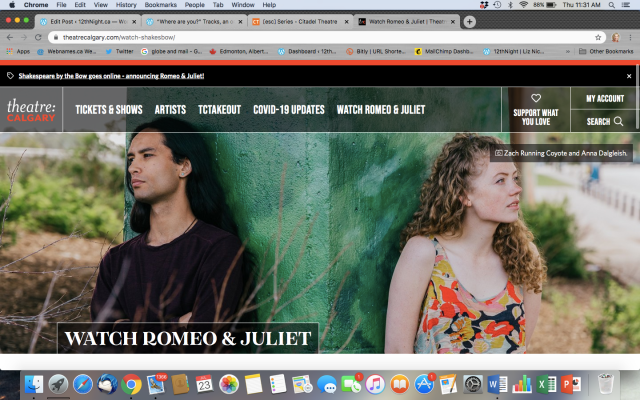
Romeo and Juliet, Shakespeare By The Bow, Hit & Myth, Theatre Calgary. Screen shot.

By Liz Nicholls, 12thnight.ca

A lifetime ago (March 25, 2020 to be precise), Malachite Theatre’s resourceful artistic director Benjamin Blyth explained to me that the company had borrowed an interactive online platform from the business world for a new venture.

On Shakespeare Sundays, an international assortment of artists and audience members would gather for a Zoom reading and discussion of a Shakespeare play, starting with Richard II.  Zoom was a word we were destined to hear over and over, noun and verb. 

Two weeks earlier, live theatre here and everywhere had shut down completely — with bone-rattling immediacy, sometimes mid-run, even mid-rehearsal. Along with its traditional raison d’être as a kinetic interaction of real people occupying a real space together, theatre artists (actors, directors, writers, designers, artisans, backstage crew) lost their jobs and their livelihood to the pandemic. Productions, festivals, whole seasons got cancelled, or punted into the distant future. 

Faced with this (continuing) industry-wide devastation, our theatre practitioners, ever-resourceful, were amazingly quick to wrap their wits around the challenges of exile from their usual shared habitat.

To help support 12thnight.ca YEG theatre coverage, click here

As the Fringe and an ever-expanding coterie of site-specific artists have always demonstrated, live theatre can flourish in all kinds of spaces, from specially designed theatre venues to public streets, parks, parkades, church halls, clubs, hotel rooms…. Who knew, though, that live theatre would find itself trying to find its footing on a platform instead of a stage? Or that the video screen would be a theatre venue, and not just a design element or a prop in a production? 

Since that fateful moment in March, like you I’ve seen all kinds of video-ed performances, staged readings, rehearsal shots, workshops, seminars, out-takes, cast reunions, highlight excerpts, sing-alongs, chat-rooms, interviews — all online. You have to admire the questing spirit in every case; theatre artists have had to learn as they go. But some, I have to say (under the cone of understatement), are considerably more engaging than others, and more inventive at using digital platforms. And, increasingly, as theatre gets the hang of working on unfamiliar terrain and grapples with the un-theatrical  concept of distancing, more are playful, ingenious, provocative.   

As the weird prospect of a Fringe-less August approaches, it’s a moment to reflect on some of Edmonton theatre’s most intriguing experiments in tapping the shared imagination of artists and their audiences in new and unfamiliar ways.

The most successful, I think, find some resonance in using the online platform (in all its fits and starts) to explore the alienating effects in modern culture. Mac Brock’s Tracks, which ran in May, was one. Specially created for an interactive digital platform, it was live-streamed each night of the run. So: nine young artists, in home “theatres” rehearsing alone on Zoom, filming themselves in solo scenes of their own device, casting light at a variety of oblique angles on what it means to make art.
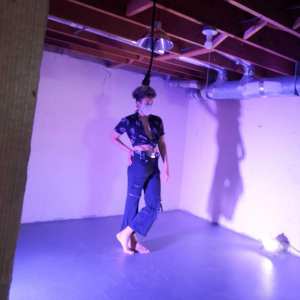
A home set-up for Tracks. Photo supplied.

As its title suggests, the show, put together by director Beth Dart, was an audience adventure in choosing a route, and putting the pieces together into a sort of group portrait. Fascinating — not least since the play actually was in synch with the constraints of the platform: the isolation of artists, solitary in their individual habitats, was part of the point. 

 The ongoing Citadel’s [esc] Series is an invitation to E-town theatre artists to explore online storytelling. Pitch, Please, in June, was set by its collaborators Paul Blinov, Christine Lesiak, Suzie Martin and Andrew Paul in the pandemic world, constructed of a hilarious series of panicky brainstorming phone calls between two pals. They’re struggling madly to come up with the digital performance piece they had blithely pitched as “a multi-disciplinary synthesis of harmony and discord that dramatizes comedy and finds dark humour in grave stoicism, bringing together parodic reimaginings of both precise order and careful chaos as it separates its permanence from the concept of impermanence itself.” Very funny. Their rejects are a hoot.  
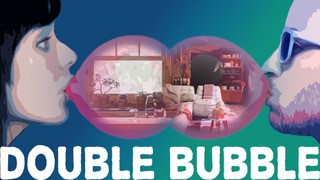
Double-Bubble, a three-part rom-com (from Amiel Gladstone, Rachel Peake and Amy Lynn Strilchuk) was set in, and about, the pandemic age of online wine and dinner dates. It followed the awkward romantic fortunes of two mid-period people whose lives are complicated not only by distancing but by the intrusion of other generations. The quartet of actors, incidentally, included two stellar theatre family pairings, George Szilagyi and his daughter Rain Matkin Szilagyi, and Kate Ryan and her mother Maralyn Ryan.   

Girl Brain. Photo by Brianne Jang, BB Collective Photography.

Via the fractured-screen landscape of Zoom, Die-Nasty re-worked its ‘golden age of vaudeville’ season as an online radio show for all its episodes, from mid-March on. The online world was both the playground and the frequent target for the queer comedy duo Gender? I Hardly Know Them in their recent online sketch show httpeepee. The new series of Girl Brain YouTube videos are comedy sketches about, and set in, dating and relationships in the tech-fraught socially-distanced Age of Zoom. Since online dating has always been a prime target of their sassy humour, adding another frame so that we watch them onscreen watching their cellphone dating apps, is a natural (have a peek at Plenty of Men With Fish on their YouTube channel.

You have to be resolute to ignore the possible oxymoron in the term ‘online festival’. Nextfest, the influential celebration of emerging artists at Theatre Network, moved its entire 25th anniversary edition online, with mainstage shows that (mostly) favoured the monologue over dramatization).

The mighty Edmonton Fringe, prototype for all the North American fringes, pulled the plug mid-April on its no-longer-upcoming 39th annual edition. To console us they’re producing a monthly (then quarterly) series of Fringe Revues, variety/talk shows featuring assorted Fringe artists in performance and conversation (episode 2, a blend of live and pre-recorded segments, opens Saturday night).
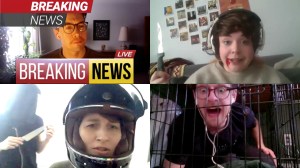
Rapid Fire players, rehearsing on Zoom from their own homes.

Matt Schuurman, artistic director of Rapid Fire Theatre (a notable video designer himself),  long our most online-savvy company, mused to 12thnight in April that success in the pandemic theatre world won’t come by trying, however valiantly, to reproduce traditional stage plays on screen — even if you could figure out how to rehearse them at a safe distance. It’ll come by playing with and enjoying the things that video-conferencing does make possible — close-ups, magical entrances and exits, changes in setting. There is fun to be had, he argued. And RFT has the archive of experiments to prove it.

Watching an hour-long online Romeo and Juliet (Theatre Calgary, Shakespeare by the Bow, Hit & Myth) last night, (the actors are distanced, in Edmonton and Calgary) I was reminded of Schuurman’s advice. Haysam Kadri’s modern-dress emerging artist production starts with the thought that R&J is a tragedy of crossed wires. Shakespeare’s lovers are not just star-cross’d, but message-cross’d and screen-cross’d, in a plague-riddled world of mixed signals and distanced communications gone awry. And the show plays with a whole arsenal of technology to match — texting shorthand and emojis,  Facetime, Zoom-like split screens of Romeo and his buddies Benvolio and Mercurio in their respective bathrooms getting spruced up for a night out. “Where are you?? Dude? At your father’s house?” @benvoli_bro wants to know, via text. The eight-actor cast (there’s a cameo by Mayor Nenshi, and Hawksley Workman does the Prologue) are  distanced, in Edmonton and Calgary.

The Capulets’ masked ball is … masked. And the removal of masks (after hand-sanitizing) for a real kiss (the excellent Zach Running Coyote and Anna Dalgleish are real-life partners) becomes that rare thing in R&J productions, genuinely monumental, irreversible, fateful.

The fight scenes are virtual-reality cartoons. There’s detailed work in connecting gestures across screens, so a ring tossed in one is caught in another. The plague and quarantine, not “ancient feud,” provide the stakes. But the trouble with cellphone technology in any Romeo and Juliet is, of course, that it fatally breaks down the storytelling. In a culture of messaging, why on earth is there a tragic problem in relaying the crucial info about Juliet’s sleeping potion? What, are all cellular networks down in Mantua? Why is someone delivering print info? Anyhow, apart from that the production is inventive, entertaining, and savvy.   

As you’ll doubtless have discovered by now, full-bodied screen versions of productions, large or small, that actually capture live theatre energy and dimensionality aren’t a dime a dozen. Dimes have nothing to do with such starry, big-budget multi-camera affairs as the free offerings from the vaults of London’s National Theatre, Shakespeare’s Globe, the Royal Shakespeare Company, or in this country the Stratford Festival. Here, that kind of money (or prescience) for multi-camera fully-directed productions hasn’t been available. Without it, filmed versions of stage productions can look awfully flat, inert, stop-gap, a bit like vegan cheese, so to speak.

The Old Vic, incidentally, has opted for a different kind of solution. Witness a recent revival of Lungs, a two-hander performed by stars Claire Foy and Matt Smith on its bare stage in the empty theatre. The distancing of the two actors onstage was a perfectly judged reflection of the emotional distances of two people in a flawed world. 

Anyhow, four months (and counting) into this strange Zoom-laden time, the appetite for live theatre can’t quite be satisfied in onscreen transplantations. And theatre artists, our specialists in creative solutions, are devising platform hybrids, and welcome live antidotes to screen fatigue.
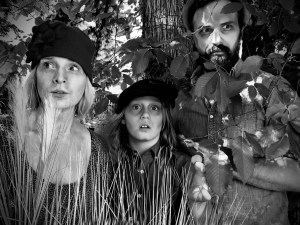
Nicole St. Martin, Michael Bradley and son Luc in Chamber Obscura, Found Festival 2020. Photo supplied.

Can you be homesick for going out? At the Found Festival, always a repository of bright ideas, Chamber Obscura had a theatre family trio (Michael Bradley, Nicole St. Martin and their son Luc) performing a 15-minute gothic folk tale for you live as a drive-in — for and your COVID vehicle-mates, one car at a time.

Lodestar Theatre will deliver a production from their menu direct to your backyard (they started with A Midsummer Night’s Dream in July, and are adding a double bill every two weeks). Similarly, in Road Trip, the Citadel will bring you and your distanced friends, live, a 40-minute set from one of three pairs of Edmonton musical stars (Farren Timoteo and Jennifer McMillan, Oscar Derkx and Jameela McNeil, or Chariz Faulmino and Steven Greenfield).

It takes thinking big to make theatre small. When live theatre returns, those lessons in distanced intimacy (an oxymoron for our time) won’t be lost. 


Posted in Features, Reviews | Tagged , , , , , , , , , , , , , , , , , , | Comments Off on Live theatre: has it found a footing on a platform instead of a stage in Zoom-laden times?

The Fringe That Never Was comes to you, with Fringe Revue episode 2

Gordie Lucius, Fringe Revue, spieode 2. Photo by Marc J Chalifoux Photography

By Liz Nicholls, 12thnight.ca

The fateful moment of the Fringe-less August approaches in the distance (OK, let’s not think about that right now). I know I know. You can’t actually go to the Fringe this year. But The Fringe That Never Was, edition #39 of Edmonton’s massive festival success story, is alive, and coming to you instead.

The second episode of Fringe Revue, the Fringe’s new digital variety show — a blend of music, theatre, comedy, dance, storytelling, spoken word, conversation — arrives online Saturday night July 25, from the Westbury Theatre at Fringe headquarters. It’s hosted by Rapid Fire Theatre improv stars Joleen Ballendine and Kelly Turner.

As you know if you caught the debut edition in June, the inspiration is the Fringe’s hit late-night cabaret, with its what-just-hit-me? collision of satire, concertizing, games, dance, theatrical performance, And other stuff: Episode 1 even came with its own reviewer. Paul Blinov, Rapid Fire’s master of deadpan, reviewed The Pandemic, running at BYOV 57, as an interactive, point-of-view experience. And he pointed out (I think quite rightly), the serious limitations of the cellphone as a theatrical device. 

In the spirit of the mighty Fringe itself, Episode 2 is at the intersection of a wide and unpredictable diversity of talents. Fringe faves Mind of a Snail, the brilliantly off-centre Vancouver shadow puppet company that’s brought us such original hits as Caws & Effect and Multiple Organism, is creating something especially tailored for The Fringe That Never Was. We’ll see the dance troupe Cuban Movements in performance. Ditto actor/escape artist Miranda Allen, who recently wowed Penn & Teller in their Fool Us season with her death-defying escape from chains in a locked barrel full of red wine.

To help support 12thnight.ca YEG theatre coverage, click here

Theatre artists Amber Borotsik and Jesse Gervais return for another edition of the dance break segment, a kooky Fringe work-out that will be part of every Fringe Revue. The Currently Current, which artists create live from the headlines of the week, is assembled this time out by actor/spoken word artist/ activist Nasra Adem. The musical guest is Jay Gilday; the house musician is the versatile Jason Kodie.

FringeLiveStream, Jon Paterson’s bright idea of an online fringe festival of uncharted uncensored performances, will do its August draw for weekly slots on the show. What also gets drawn on Saturday night’s show is the winner of the BYOBT (bring-your-own-beer-tent) contest, which starts Monday.

Yes, the Fringe (along with Big Rock Brewery, Special Events Rentals, Chianti, ATB Financial) will bring to your backyard or deck or back 40, etc. Aug. 14 to 17 an actual beer tent with all the trimmings, including booze, food, a live artist performance, decorations, “yard games.” Answer daily clues on the Fringe’s Facebook, Twitter, or Instagram accounts, or fill out the BYOBT form at fringetheatre.ca

“Watch at your leisure!” says Utas of Saturday’s new episode of Fringe Revue, with its weave of interviews, performances and salon conversations that amplify them, fun facts, interviews, musical interludes from “a virtual wine tent series.”

Production values are up from episode 1, declares Utas the director. “We haven’t got the money to do everything live. But we’re looking to phase out the pre-recorded.” Designer Tessa Stamp creates a series of sets.

And — this is important to Utas — the artists all get an honorarium. “Artists deserve to be paid for their work!”

PREVIEW

Fringe Revue Episode 2

Theatre: Edmonton Fringe Theatre

Directed by: Murray Utas

Where: fringetheatre.ca

Running: from Saturday July 25


Posted in Previews | Tagged , , , , , , , , | Comments Off on The Fringe That Never Was comes to you, with Fringe Revue episode 2