In hot pursuit of justice: The Ballad of Peachtree Rose. A review of Workshop West’s season-opener

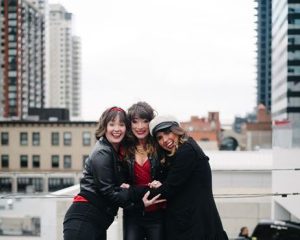
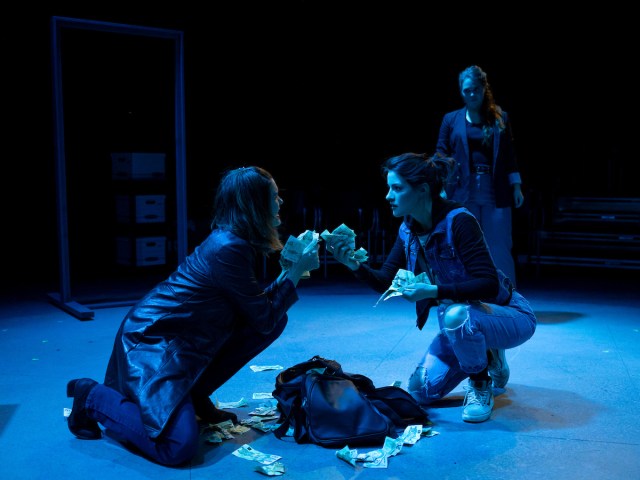
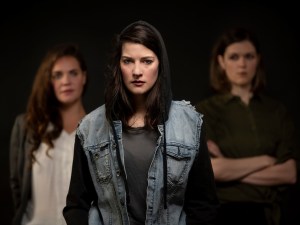
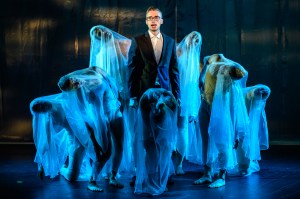
Laura Raboud, Alexandra Dawking and (rear) Bobbi Goddard, The Ballad of Peachtree Rose. Photo by Marc J Chalifoux Photography.

By Liz Nicholls, 12thnight.ca

“Welcome to the team!” says a mysterious executive (Laura Raboud), to the street kid she’s just recruited. “I really believe in you.”

To help support 12thnight.ca YEG theatre coverage, click here

Team spirit: It’s music to the ears of Peach (Alexandra Dawkins), who ricochets through a desperately lonely, hard-scrabble existence of low-level crime, minor scores, temporary fixes. Even more seductive to the wary new recruit is the concept of family, sisterhood, home. And ah, the beautiful two-storey family house with a wrap-around porch that is the physical embodiment of the abstract concept “rich.” 

Nicole Moeller’s intriguingly crafted new thriller The Ballad of Peachtree Rose, premiering at Workshop West Playwright’s Theatre, unspools from the worldly skepticism that all rescues come with strings attached. There’s a price tag on love and the precious sense of belonging. A taste of it is never enough. And that being the case, what does justice mean?          

Here’s another question that occurred to me, watching The Ballad of Peachtree Rose: Who writes stage thrillers? In this country, almost no one.  And you can see why; they’re hard to pull off. The storytelling is tricky: what starts in mysterious murk is gradually lit. The plot has to take expected turns and angles that surprise the characters (or some of them) as much as us. Information is withheld and leaked out, bit by bit; suspense escalates. Moeller scores on all of the above, with the bonus of a social perspective on crime. And we have the fun of connecting the dots — or arguing that they don’t quite connect. 

(This is not, of course, an evening about the professional challenges of theatrical scribes. But it’s devilishly hard to write about a thriller without spilling a spoiler. Just saying.)

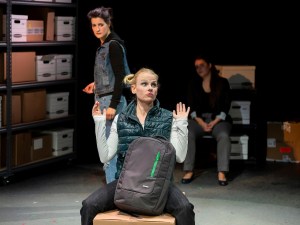
Shannon Blanchet (front), Alexandra Dawkins, Bobbi Goddard, The Ballad of Peachtree Rose. Photo by Marc J Chalifoux Photography.

I digress. The play, and Brenley Charkow’s adrenalized production, land us, instantly, into a high-speed swirl, with characters who don’t explain who they are, and where they’ve been. Who is Max, anyhow? Everything about Max’s line of work, including the other employees and associates (all played, with smart precision, by Shannon Blanchet), is shady. Clearly she works for a high-level criminal organization with cross-country connections, and an aversion to using FedEx. OK, fancy parties in Toronto are one thing; but no one just ups and goes to Winnipeg for no reason.

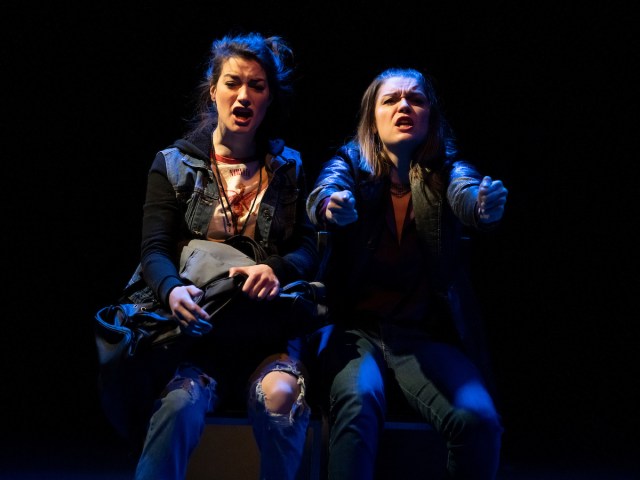
Alexandra Dawkins, Laura Raboud in The Ballad of Peachtree Rose. Photo by Marc J Chalifoux Photography.

Max undertakes a makeover upgrade on the latest ragtag employee: shopping, a Saskatchewan Drive apartment with a view, fancy clothes, free drinks, a more confident walk. “Confidence means you could kill someone, but you choose not to.” (note to self … oh, never mind).

Daniela Masellis’s clever minimalist set speaks volumes: a warehouse of unmarked cardboard storage containers (that Max expressly forbids Peach to open) on moveable shelving that reconfigures the playing space. So does Sauvé MacBean’s score, dominated by the sounds of the Tragically Hip. In the Backstage Theatre we surround the action in a U-shape configuration. 

Weaving through the play, on the sidelines waiting for a turn to speak, is Belle (the excellent Bobbi Goddard) who mourns, furiously and feelingly, her loss: in an unsolved crime her mother was murdered and no application of “justice” will ever be a proper redress. She’s a little repetitive, in truth. But I guess you could argue that’s what it means to be a victim, trapped in a memory by anger undimmed by time. And Belle has narrative duties, too, announcing the passage and dislocations of time that move the play forward and backward. “one month goes by…”     

The characters are engagingly set forth by Charkow’s cast, who are tasked with holding dark secrets close to the chest and letting them loose sparingly. As the twitchy Peach, Dawkins compellingly conveys the sense of a predator/prey whose existence has always depended on alertness and perpetual motion. Raboud’s brisk and vivid Max, whose cunning operates at a more refined level than that of her new associate, can (and does) wield the mantra “honesty, loyalty, integrity” on a spectrum from irony to absolute sincerity. She doesn’t walk if she can stride; she appears and exits at top speed.  Is she a hard heart softened by Peach? A criminal stage manager? Blanchet has the fun of playing a gallery of losers and winners.

And speaking as we are of fun, you’ll be able to claim the thriller fun of arguing about the outcome (so far I’ve heard three possible interpretations, convincingly promoted, by three different people). What seems more certain is that the world — Edmonton, actually — is a harsh and treacherous place for the characters of The Ballad of Peachtree Rose. Its victims are its victimizers, its betrayals and its rescues are indistinguishable at 100 paces. And justice is an elusive concept, a matter of deal-brokering not truth. 

Meet the playwright in this 12thnight PREVIEW.

REVIEW

The Ballad of Peachtree Rose

Theatre: Workshop West Playwrights Theatre

Written by: Nicole Moeller

Directed by: Brenley Charkow

Starring: Alexandra Dawkins, Laura Raboud, Bobbi Goddard, Shannon Blanchet

Where: Backstage Theatre, ATB Financial Arts Barns, 10330 84 Ave.

Running: through Nov. 10

Tickets: TIX on the Square (780-420-1757, tixonthesquare.ca).   


Posted in Reviews | Tagged , , , , , | Comments Off on In hot pursuit of justice: The Ballad of Peachtree Rose. A review of Workshop West’s season-opener

What to see this weekend on E-town stages (don’t stay home)

James Gnam in Running Piece, Grand Poney. Photo supplied.

By Liz Nicholls, 12thnight.ca

Time (a possible paradox). There’s never enough of it. It never stands still. It’s almost impossible to make a dent in it. You can move forward through it, but are you actually standing still? 

To help support 12thnight.ca YEG theatre coverage, click here

The show that comes to the Mile Zero Dance season tonight for one night only is all about that. Running Piece, by Jacques Poulin-Denis for the Montreal-based company Grand Poney, is a 55-minute work for dancer and treadmill. The former (James Gnam of Vancouver’s Plastic Orchid Factory) never leaves the latter, which should give you a shudder of recognition.

It’s at the Westbury Theatre (ATB Financial Arts Barns, 10330 84 Ave.) tonight. Tickets: 780-409-1910, fringetheatre.ca

Bobbi Goddard, Alexandra Dawkins, Laura Raboud, in The Ballad of Peachtree Rose, Workshop West. Photo by Marc J Chalifoux.

•”Who are the monsters?” Playwright Nicole Moeller wonders about that in her new thriller The Ballad of Peachtree Rose, bringing car chases, illicit money, smuggling, an high-speed criminality, to the  Workshop West season tonight at the Backstage Theatre (where it runs through Nov. 10. Tickets: TIX on the Square (780-420-1757, tixonthesquare.ca). Like so many of Moeller’s plays, this one was inspired by the news. 12thnight.ca had the chance to talk to her in this preview. You can check it out here.

•At La Cité francophone, you’ll meet beleaguered Gordon, whose life is unravelling to a soundtrack of scratching and chewing, a home invasion by vermin and a yard invasion by insect forces. Will an obsessively regular routine by day save him from desperation by night?

Simon Bracken and The Mourners, The Particulars. Photo by Dahlia Katz

The show is Matthew MacKenzie’s black comedy The Particulars. The Punctuate! Theatre production directed by the playwright returns from a hit Toronto run for a two-night run (tonight and Saturday). Tickets: TIX on the Square (780-420-1757, tixonthesquare.ca). 12thnight.ca talks to the playwright in this preview.   

•At the Varscona Theatre, two mis-matched roommates, both women and both in their ‘50s, continue to resolve their differences in the quest to change their lives. Jen Silverman’s comedy The Roommate opens the Shadow Theatre season; Nancy McAlear’s production, starring Coralie Cairns and Nadine Chu, runs through Nov 10. Tickets: 780-434-5564, shadowtheatre.org. 12thnight.ca talks to the playwright in this preview. Read the 12thnight review here.

Kristin Johnston in Baroness Bianka’s Bloodsongs, Northern Light Theatre. Photo by Ian Jackson, Epic Photography.

• Come to the cabaret. Baroness Bianka sips her last suspiciously red cocktail this weekend. Saturday is your last chance to find out if you’re her type: that’s when Northern Light’s production of Baroness Bianka’s Bloodsongs, directed by Trevor Schmidt, turns off the i.v. 12thnight meets the star Kristin Johnston in this preview. Have a peek at the 12thnight review here.   

•In six days during the Blitz, the darkest days of World War II, Noel Coward dashed off a new comedy poised on the threshold between the dead and the living. Coward, a blithe spirit himself, said of Blithe Spirit “I knew it was witty, I knew it was well constructed and I also knew that it was going to be a success.”

Comic chaos is unleashed when a highly eccentric medium, Mme Arcati, inadvertently introduces a deceased first wife into the urbane household of the second. Novelist Charles Condamine thereby finds himself in a marital predicament; is he, as he points out, an “astral bigamist?”.

That’s the frothy comedy that opens the theatre season at Concordia University of Edmonton. Glenda Stirling directs the student production, which runs tonight through Sunday, and Nov. 8 to 10 at Concordia’s Al and Trish Huehn Theatre (7128 Ada Boulevard). Tickets: TIX on the Square (780-420-1757, tixonthesquare.ca) or at the door.   

Posted in News/Views, Previews | Tagged , , , , , , , , , , | Comments Off on What to see this weekend on E-town stages (don’t stay home)

The Particulars: the invasion of the minutiae. Punctuate! is back in town

Simon Bracken and “the Mourners” in The Particulars, Punctuate! Theatre. Photo by Alexis McKeown.

By Liz Nicholls, 12thnight.ca

Poor Gordon. He has a complicated problem. His life, an infestation of minutiae moment to moment, is driving him crazy. Especially at night.

The scratching of vermin in the walls. The chewing of insects in his yard. The drip of a tap. The sound of breathing.… The Particulars, says Gordon’s creator, playwright Matthew MacKenzie  “is not about pest control.” It’s “about a guy who goes on with living without his reason for living.”

To help support 12thnight.ca YEG theatre coverage, click here

MacKenzie’s spring-loaded black comedy for one unravelling man and seven dancers makes its way back to Edmonton Friday and Saturday in a Punctuate! Theatre production, after an impressively successful run at The Theatre Centre in Toronto.  “At first you laugh at him,” says MacKenzie of the insomniac obsessive at the centre of “a very funny one-man epic.” And then, when you discover something of the mystery of Gordon’s past, “you’re implicated for having laughed at him. But by then you’re strapped in for the rest of the ride.”

“I wrote it 15 years ago, after a bad heartbreak,” MacKenzie explains. “And the story grew.” The 20-minute “mini-show for myself” at the National Theatre School expanded into a full-fledged solo play that, directed by Patrick Lundeen and starring Simon Bracken, was a sleeper hit at the 2008 Edmonton Fringe. In a 2013 incarnation MacKenzie himself starred as Gordon. What happened in that version wasn’t dance, he laughs. “Not really. Just me running around the stage like Oedipus with his eyes put out.”

The Particulars, Punctuate! Theatre. Photo by Alexis McKeown.

And now, in this latest version of The Particulars, the beleaguered Gordon (Bracken again) has acquired a Greek chorus of seven dancers called Mourners, who create the abstract maze and signposts of Gordon’s interior world. 

Dance, says MacKenzie, Punctuate! artistic director, is a way of arriving at “a heightened state” that often eludes a single actor alone on a stage. The Particulars isn’t the only time that MacKenzie has populated a “solo” show with dancers. In Bears, his captivatingly strange and imaginative 2015 piece — which won awards both for its Edmonton and Toronto productions — the playwright set his Indigenous protagonist forth on a transforming journey into the wilderness, with oil company enforcers in hot pursuit. In the decade’s only “multi-disciplinary comedy about the Trans-Mountain Pipeline,” the visceral Indigenous connection with nature was brought to life by a chorus of dancers who were wildflowers, birds, animals, a shrinking glacier. 

The Other, produced by Punctuate!’s sibling indie company Pyretic Productions (MacKenzie and Lundeen were co-founders and they email each other as Pyrunctuate!) starred a woman who is somehow an outsider to herself, a spectator looking in on her life. A corps of dancers set that intricate idea in theatrical motion, in a production that starred actor/dancer/choreographer Amber Borotsik, .

Simon Bracken and The Mourners, The Particulars. Photo by Dahlia Katz

MacKenzie thinks The Particulars, in its current incarnation, might be the trickiest theatrical challenge of all — as three workshops in the past year will attest. Choreographer Alida Kendell of Good Women Dance, “laid down the law,” MacKenzie grins. “She didn’t want dance to be decorative,” movement pasted on to a text. It had to be organic.

He’s the director, but MacKenzie is keen to avoid the perception that The Particulars is “the Matthew MacKenzie show.” He says “Alida’s voice is the most prominent in the room, definitely; she casts all her dancers.”

In a way the evolution of The Particulars as dance theatre is the story of a theatre company aesthetic. By now, at Punctuate!, “the majority of artists we hire are dancers,” says MacKenzie. “My chief collaborators are dancer/choreographers…. The possibilities with dance (in theatre) are really limitless.” He points to the Jonathon Young/ Crystal Pite collaboration Betroffenheit. “I don’t want to mimic it, of course, but it’s powerful as hell! The term ‘art’ his thrown around a lot. But that’s art!”

“I want words and dance…. That’s where the magic is for me!”

If dance has been one of MacKenzie’s prime theatrical motivators, the other has been the discovery and exploration of his own Indigenous (Cree, Métis, Iroquois) roots. Bears was a bold declaration. Now he’s working with Bears star Sheldon Elter, a Métis actor of huge charisma, on a new solo show, Poster Boy.

The Situation We Find Ourselves In Is This, MacKenzie’s new solo show, is in progress after a September workshop production in Toronto. It’s about his time with the great Canadian theatre mentor/ dramaturge Iris Turcott during her final days. He’s off to the Ukraine in February with Pyretic’s Lundeen and Lianna Makuch (Blood of Our Soil); the latter is developing a new play spun from her heritage in that war-ravaged part of eastern Europe. And in April, After The Fire, a re-thought re-worked version of Bust (first seen at Theatre Network) — MacKenzie’s very dark comedy set in Fort McMurray in the aftermath of the devastating 2016 fire there — plays the Citadel’s inaugural Highwire series.   

But first, after “a couple of years of urban frenzy,” MacKenzie does what he always does to clear his head and recharge his creative skills. He heads to nature — specifically to Canmore for “some time in the woods.”  As Turcott used to say to her playwright charges, “get yourself a six-pack. You’re going to need it!” 

PREVIEW

The Particulars

Theatre: Punctuate! Theatre

Written by: Matthew MacKenzie

Directed by: Matthew MacKenzie, choreographed by Alida Kendell

Starring: Simon Bracken, Amber Borotsik, Bridget Jessome, Richard Lee Hsi, Krista Lin, Rebecca Sadowski, Kate Stashko, Raena Waddell

Where: La Cité francophone, 8627 91 Street

Running: Friday and Saturday

Tickets: TIX on the Square (780-4201757, tixonthesquare.ca)

Posted in Previews | Tagged , , , , , | Comments Off on The Particulars: the invasion of the minutiae. Punctuate! is back in town

Crime plays: The Ballad of Peachtree Rose, a new thriller from Nicole Moeller, opens the Workshop West season

Bobbi Goddard, Alexandra Dawkins, Laura Raboud, in The Ballad of Peachtree Rose, Workshop West. Photo by Marc J Chalifoux.

By Liz Nicholls, 12thnight.ca

“Who are the monsters?”

That’s what playwright Nicole Moeller wonders. It’s what she’s always drawn to wonder in her plays, and the answer is never clear-cut. She asks again in the new high-speed thriller that premieres Friday to launch the Workshop West Playwrights Theatre season.

“It’s fun! It’s exciting! A criminal organization, car chases, smuggling, money!” she says of the sensational world of The Ballad of Peachtree Rose. “But underneath it asks a lot of questions…. How do we end up doing the things we do? How far are we willing to go for a new start and a new life?”

To help support 12thnight.ca YEG theatre coverage, click here

Like so many of her plays, this latest, five years in the making, was originally inspired by the news, says Moeller who came to playwriting via musical theatre and a degree in journalism. True crime: “a case about a young street kid who got involved in a criminal organization.”

For Moeller, a thoughtful and rather soft-spoken sort, the news has always been a theatrical magnet. But she gravitates to the oblique angles, the ambiguous underside views, the side players. In The Mothers, for example, which premiered at the 2015 SkirtsAfire Festival, a teenager has taken a gun to school, with terrible results. Moeller didn’t investigate the kid’s elusive motive; she wrote a play about his mother, and her life. 

Moeller’s award-winning 2011 play An Almost Perfect Thing was inspired by a luridly awful 2006 news story about a young Austrian girl, kidnapped at 10, who’d escaped her captor after eight years as a prisoner in an improvised basement dungeon under her house. The public turned on her when she refused to play victim; instead she took charge of her fortunes, manipulated her image, and became a media star. 

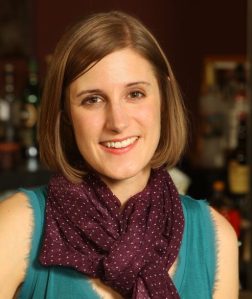
playwright Nicole Moeller

Monsters tend to come in black and white; Moeller’s preferred colour palette, as she acknowledges cheerfully, is gray. Moeller’s 2017 The Preacher, The Princess, And A Crow paints a shaded portrait of a man, both his own prisoner and jailer, who struggles against his predatory demons.    

Five years ago — “it takes me a long time to write; ideas stay in the back of my brain” — the news came through again with theatrical inspiration.  And  Vern Thiessen’s first official meeting in his new job as Workshop West artistic director, was with Moeller to discuss the true crime idea that would become The Ballad of Peachtree Rose. Friday’s opening night at the Backstage Theatre is the grand finale of his last week on the job.

Typically, Moeller, the company’s playwright-in-residence at the time, immersed herself in first-person research. “I wanted to look at crime from all angles,” says Moeller. “It was not a world I understood.” She sat through trials, including the high-profile Travis Vader double-murder trial, “just to see what that world was. I spoke with lawyers, police, people who’d been victims of crime.…”

“It was good to embed myself into that world and put a face on it, try to understand,” she says. “And that also made it more difficult: What story am I going to tell? Whose story do I have the right to tell?”

Volunteer work with people who’ve been through the criminal justice system was revealing: “I can see how they’re led into that life.” What research for her new play offered additionally, says Moeller, was the chance to “to see their effect on victims. And that can really hit home…. You can see what questions are being asked and how they’re being asked. When you read, things are black and white. But if you’re there, experiencing that world, you sense a lot more gray.…”

Says Moeller, “it opened up my world to meet the people. Writing is so isolating…. I could write five plays from the research I did! And you never know how research is going to inform you.” Eventually, in the surfeit of fascinating possibilities she uncovered, she had to choose. 

“I ended up focussing on two women,” says Moeller of her deliberate choice of female characters. “You don’t very often see women having those roles onstage….” Women are often victims of violence, in life and in theatre. But “women who inflict violence?” Not so much. “It creates and a complexity and a rage we need to explore,” Moeller thinks. “This isn’t girls playing boys…. Women are monsters, too.” There is violent crime in The Ballad of Peachtree Rose, and there is “victim representation.”

Peach (Alexandra Dawkins) is a kid who’s “involved in street crime but at a lower level.” Her chance encounter with Max (Laura Raboud), who works for one of the country’s notorious criminal organizations, changes both their lives.

“When I started this play, ‘true crime’ was just gaining its popularity — it raises a lot of ethical questions since it involves real people,” Moeller says. “I’m attracted to the sensational, yes. But what I like to do is draw people in, then ‘what universal questions can you ask?’” In The Ballad of Peachtree Rose, says its creator, “we meet people involved in crime. And we meet someone whose family has been affected by criminal violence.”

In rehearsals for Brenley Charkow’s production, Moeller is struck by the irony that “we’re working on a play that’s interested in exploring how you can get caught up in the world of crime. And here we are, rehearsing, and (that world) is exciting, and fun, and seductive!”

The play is set in Edmonton. “And I’d like to do that more,” says the playwright. It’s fictional, yes, but “it was inspired by something that happened in Alberta — in our own backyard. We should be doing that more. It makes the questions tougher; you don’t get to run away from them as easily….”

One of those questions is about justice. “Where is justice for someone with no options? Someone who comes from poverty and abuse?…. It’s such a hard concept, justice. So it’s good we wrestle with it.”

“I almost had more questions at the end of this than the beginning.” Which is exactly how Moeller likes her theatre. 

PREVIEW

The Ballad of Peachtree Rose

Theatre: Workshop West Playwrights Theatre

Written by: Nicole Moeller

Directed by: Brenley Charkow

Starring: Alexandra Dawkins, Laura Raboud, Bobbi Goddard, Shannon Blanchet

Where: Backstage Theatre, ATB Financial Arts Barns, 10330 84 Ave.

Running: Friday through Nov. 10

Tickets: TIX on the Square (780-420-1757, tixonthesquare.ca).   


Posted in Previews | Tagged , , , , , | Comments Off on Crime plays: The Ballad of Peachtree Rose, a new thriller from Nicole Moeller, opens the Workshop West season

Women in their 50s get sitcom Botox: The Roommate opens the Shadow season. A review.

Coralie Cairns, Nadien Chu in The Roommate, Shadow Theatre. Photo by Marc J Chalifoux.

By Liz Nicholls, 12thnight.ca

It’s impossible to know anything about the season-opening two-hander comedy at Shadow Theatre — including its title — without thinking of Neil Simon’s The Odd Couple (female version).

To help support 12thnight.ca YEG theatre coverage, click here

The Roommate, by the young (and multi-award-winning) American playwright Jen Silverman, brings together two mismatched characters sharing a house in Iowa. The only thing this high-contrast pair have in common is that they’re both women and both in their ‘50s.

Sharon (Coralie Cairns) is the local, a recent divorcée in a place that is, as she says earnestly, “known for corn. And space.” She’s advertised for a roommate, and gets Robyn (Nadien Chu), an urbanite direct from the Bronx — ex-potter, ex-slam poet, ex- (and possibly not so ex-) a lot of edgier activities.

“What do you do?” Robyn asks in response to a persistent questioning from Sharon. “I’m retired,” says Sharon. “From what?” “My marriage.” Now, there’s a Simon-esque sitcom line if there ever was one. And The Roommate is peppered liberally with others.

So why is a gay vegan pot-smoking New Yorker in the Iowa boondocks anyhow? “I thought I’d raise bees,” Robyn says, citing the salutary benefits of “restorative manual labour.”

Sharon’s main activity is phoning her unresponsive son in New York. He’s a fashion designer, and according to Sharon, certainly not gay. Absolutely not; he has a girlfriend. Who happens to be a lesbian. Iowa must be the land where time has stopped, and everyone pronounces homosexual with all its syllables intact and equally weighted. Robyn’s main activity is evading questions, and smoking, cigs and also pot. 

Nadien Chu, Coralie Cairns in The Roommate. Photo by Marc J Chalifoux.

The real curiosity of The Roommate is that, although it’s of recent vintage and by a young playwright whose archive seems full of sassy titles (Collective Rage: A Play In Five Betties), it feels somehow dated. New Yorker shocked that Iowans don’t lock their doors: it doesn’t feel very fresh as comic material. What? They make milk out of almonds? There’s something they don’t sell at the gas station. Similarly a scene where someone prim smokes dope and gets high was past its best-before date some time ago (I’m sure there’s one in Shakespeare somewhere). It takes a certain fortitude to commit to a contemporary scene where one character says “drugs” and the other counters “medicinal herbs.” Bravo Cairns and Chu; they step up, in exemplary fashion.

The idea that it’s never too late to get a sense of adventure and make radical changes in your life is, however, evergreen in theatre: the leaves never fall off. This development, with its whiffs of Thelma and Louise and (as billed) Breaking Bad, happens in a way that’s so surprising it actually feels unbelievable here. I sure didn’t see it coming.

Anyhow, in short the stars of Nancy McAlear’s lively and handsome production are up against some pretty well-trod theatrical inspirations. And they devote themselves in a selfless way to making a thinnish play generate some heart from the age and gender of the characters. 

As the voluble Sharon, Cairns has a kind of tentative, daffy cordiality to her. Sharon is eager to please, forever trying to conceal that she’s shocked by what she’s managed to pry out from her new roommate. Her amusingly earnest way of processing new information in an effort to be non-judgmental will make you smile. So will her outfit (designer: Trevor Schmidt), in neutral colours and buttoned assiduously to the neck. 

As the worldly New Yorker with a secret-crammed past, Chu’s performance, never over-played, shows striking restraint and smart comic timing. Her answer to Sharon’s question “what do you write about?” is a look so nuanced — tinged with a grimace, superiority and a soupçon of amusement — that seasoned slam poets everywhere will feel the sympathetic vibe in their molars.    

McAlear’s production moves this pair expertly around an impressively bright, airy, antiseptically clean two-storey set designed by Daniel vanHeyst. The semi-lit choreographed scene changes are fun. And the music composed and assembled by Leif Ingebrigtsen is tied to character in witty ways.

There’s fun to be had, watching what the Shadow forces make of the play. It’s the play itself that makes you wonder.

REVIEW

The Roommate

Theatre: Shadow

Written by: Jen Silverman

Directed by: Nancy McAlear

Starring: Coralie Cairns, Nadien Chu

Where: Varscona Theatre, 10329 83 Ave.

Running: through Nov. 10

Tickets: 780-434-5564, shadowtheatre.org

Posted in Reviews | Tagged , , , , | Comments Off on Women in their 50s get sitcom Botox: The Roommate opens the Shadow season. A review.

Writing for women of a certain age: meet Jen Silverman, the author of The Roommate

Coralie Cairns (front) and Nadien Chu in The Roommate, Shadow Theatre. Photo by Marc J Chalifoux.

By Liz Nicholls, 12thnight.ca

playwright Jen Silverman

Jen Silverman is the New York-based playwright/ screenwriter/ novelist who wrote the comedy The Roommate. Last produced at Chicago’s Steppenwolf in 2018, it’s the season-opener at Shadow Theatre. She made time in her schedule for some questions.

You write, have always written, in a startling variety of forms. Could you riff, as a multi-lingual world traveller, on your initial attraction to theatre? And your entry point into writing for the stage? 

I didn’t grow up going to the theatre – I stumbled into it by accident my freshman year of university and was absolutely electrified. I thought I’d discovered something secret and magical that was just for me. I thought that nobody else had ever felt the way I was feeling. When I’m making a play now, I think about plays as gifts or invitations to the audience. And that’s the feeling I try to write from: Let me tell you something that’s just for you.

Whom do you consider mentors in playwriting? I’ve read that Paula Vogel was an inspiration for you. 

I had an amazing first teacher, Emily O’Dell, who gave me an introduction to theatre that was full of powerhouse female playwrights: she introduced me to plays by Sarah Kane, Caryl Churchill, Naomi Iizuka and Paula Vogel (who was Emily’s teacher, and later briefly mine). Other mentors of mine along the way included David Adjmi and Naomi Wallace, who I studied with in grad school. And I saw plays by playwrights such as Marcus Gardley, Young Jean Lee, Branden Jacobs-Jenkins and Basil Kreimendahl, that really shaped my idea of what theatre could be.

To help support 12thnight.ca YEG theatre coverage, click here

Could you take us back to the seed that germinated as The Roommate? 

It’s rare for us to see exciting, provocative, complicated, morally ambiguous portraits of older women onstage or on screen. There’s something so sanitized about the images we receive of women who are, say, over thirty-five – and that image doesn’t actually mesh with the 50 and 60 year old women I know, who are hilarious and complex and fascinating. I wanted to write a play that gave two female characters the same due that older male characters receive much more often.

The origin point of the play is that my partner’s mother was, briefly, living with a roommate her age. Hearing her stories, I was fascinated by what it means for two adult women to navigate living together, and my imagination took off from there.  (My mother-in-law is not running any kind of criminal endeavour, for the record.)

Many of your plays seem to feature women characters pushing for change in their lives, or chafing at the lack of it. Could you expand a little on that? 

I think we all reach moments in our lives where we feel trapped by the accumulated decisions we’ve made, by the things we’ve become accustomed to. We may not even be aware that we’re unhappy – we’re just mired in the status quo. Sharon’s status quo is her loneliness and her feeling of being invisible; similarly, Robyn has been moving through the world as a lone wolf of sorts, although in much different circumstances. The two of them create a combustible energy together – they can imagine themselves differently, because they create a new space of imagining together. Once you can see a new life for yourself, the natural next step is to reach for it.

A lot of my plays are about people seeking or finding transformation – people who are either succeeding or failing at pursuing a different vision of themselves or their lives. In this way The Roommate is in direct conversation with plays that are stylistically very different, like the absurdist comedy Collective Rage: A Play In 5 Betties (Woolly Mammoth, MCC), or the gothic-absurdist The Moors (Yale Rep, Playwrights Realm).

Do politics, and the current “populist” regressive craziness of the world, impinge with any directness, on your work?  

As a queer woman raised in a number of different countries, I bring a specific lens to my work. I am fascinated by power dynamics, and the many kinds of power and disempowerment that can exist simultaneously within a relationship – or a culture. When it comes to theatre, I’m interested in a political vocabulary that is complex, contradictory, and built on questions instead of answers. That said, to ask burning questions — especially now — is inherently political.

The Roommate by Jen Silverman, currently onstage at the Varscona Theatre, runs through Nov. 10. Nancy McAlear’s production stars Coralie Cairns and Nadien Chu. Tickets: 780-434-5564,  shadowtheatre.org  

Posted in Previews | Tagged , , , , | Comments Off on Writing for women of a certain age: meet Jen Silverman, the author of The Roommate

Do shebangs come in partials? Simone et le whole shebang opens the L’UniThéâtre season

Nicole St. Martin and Crystal Plamondon in Simone et le whole shebang. Photo by db photographics.

Gaetan Benoit and André Roy in Simone et le whole shebang. Photo by dbphotographics.

By Liz Nicholls, 12thnight.ca

There’s a certain heat-seeking rom-com engine driving Simone et le whole shebang, the raucous, tart-tongued season-opener at L’UniThéâtre, Edmonton’s francophone theatre. At the centre is an unexpected encounter between two hostile, elderly characters, who are up against the ravages of time and place.

To help support 12thnight.ca YEG theatre coverage, click here

Jessy is an old New Brunswick Acadian, a singer/songwriter who’s spent 35 body-breaking years working the Alberta oil patch, and paid the price in mobility. Simone is a Montreal actor whose star has faded, dimmed by the encroachments of  Alzheimer’s. And they’re battling on foreign soil, so to speak — in Fort McMurray, in a care facility. 

The play, by Quebec’s Eugénie Beaudry, isn’t kidding about “le whole shebang.” The mind-body duality is just the start of it, in a play that embraces dreams, aging, memory, choice vs. compromise, east vs. west, free will, assisted death, jobs and the economic downturn, the generation gap.… It’s possible that a partial shebang might be more workable and feel less scrambly, in truth; Simone et le whole shebang spreads itself widely (and thin). 

It relies on vivid performances for impact, and it gets them in Vincent Forcier’s entertaining production, which fluidly moves through the intricacies — and Brianna Kolybaba’s atmospherically rustic design, lit by Larissa Pohoreski — in a strikingly artful way. In many ways, the play is about the opening and shutting of doors. And the design and Forcier’s stagecraft are as punctuated by that as any door-slamming farce.   

Jessy (André Roy) is haunted by his party-hearty younger self (Gaetan Benoit), a singing cowboy who delivers a melancholy song about aging, poverty, and underachievement at the top of the show. He’s come to the West, age 35, to make some quick money. And “quick” turns out to be measured in decades. He surveys the wreckage of his older self with a mixture of pity and exasperation, and annotates accordingly.

Simone (Crystal Plamondon) is haunted too — by past glories and the actor’s nightmare of not remembering her lines. Her memory works in fits and starts, a process of fleeting confusion captured beautifully in this smart performance. Which is why her daughter (Nicole St. Martin), a brisk transplanted Montrealer working in Fort McMurray and struggling with a failing marriage, has re-located her mother to the wild west.

The daughter is haunted by her neglectful husband, a presence via his voice on the phone, and the absence of children in their marriage. And the play drifts towards her resolution, gathering steam and invective.   

Simone et le whole shebang is playful about stereotypes, and deals in them. And the performances in Forcier’s production flesh them out in 3-D. As Jessy the elder — prickly, raspy-voiced and vigorously foul-mouthed in a ripe conglomeration of both of our official languages — Roy is a charismatic presence. “That’s how I roll, bitch,” he says to Simone, bragging about his prodigious archive of lovers. “Chicks are like jobs; I’ve done them all.” 

The latter, whose grip on reality is variable (ditto her feelings about the facility), is remarkably unassailed by the assault of Jessy’s cockiness and language. “Eat shit,” she says with surprising calmness. “I’m not lost; I’m jet-lagged.” Plamondon’s comic timing is impeccable; it invariably includes a thoughtful pause before she volleys back.

Gradually, the two old characters come to appreciate each other — for their waywardness, for their losses, for their morbid humour. “You’re a flower growing in a field of shit,” Jessy says to Simone. Surprising developments, and laughter, ensue, to be deliberately vague. And the actors commit to a variety of comical moments.

In young Jessy, Benoit creates a character fuelled by sardonic humour and disappointment. St. Martin is forceful as the daughter, harried by her mother’s resistance, by anxiety turning into panic, by the knowledge that her domestic future is gradually eluding her grasp.

The invasion of French by English phrases, in a land where francophones are the minority, has a bright startling colour palette. “Ils sont gone,” says the young Simone later in the play. “Un monumental fuck you.” There’s something irresistibly western Canadian about that. And this is the week to appreciate L’UniThéâtre’s bold, gutsy, cross-country choice.

REVIEW

Simone et le whole shebang

Theatre: L’UniThéâtre

Written by: Eugénie Beaudry

Directed by: Vincent Forcier

Starring: André Roy, Crystal Plamondon, Gaetan Benoit, Nicole St. Martin

Where: La Cité francophone, 8627 91 Street

Running: through Oct. 26. In French, most performances with English subtitles

Tickets: lunitheatre.ca


Posted in Reviews | Tagged , , , , , | Comments Off on Do shebangs come in partials? Simone et le whole shebang opens the L’UniThéâtre season

Type A fabulous: Baroness Bianka’s Bloodsongs at Northern Light. A review.

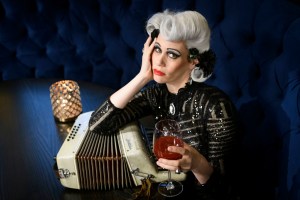
Kristin Johnston, Baroness Bianka’s Bloodsongs, Northern Light Theatre. Photo by Ian Jackson, Epic Photography.

By Liz Nicholls, 12thnight.ca

The chandeliers give off a lurid red glow. The bandstand will make you smile; a sparkly set of outsized teeth with pointy incisors, the inspiration of director/ set and costume designer Trevor Schmidt. The stage accoutrements? One accordion, one intravenous pole with cheery red hanging blood bags.

To help support 12thnight.ca YEG theatre coverage, click here

“Velcome to ze Addiction Room!,” cries the exotic cabaret artist who appears between the upper and lower choppers in a flash of lightning and a crack of thunder (lighting by Elise Jason, soundscape by Darrin Hagen). Some people just have a knack for making an entrance.

Kristin Johnston, the star, and sole occupant, of Baroness Bianka’s Bloodsongs by the Australian songwriter/playwright Joanna Weinberg, is a vision of old-school sultry. Which is to say red-lipsticked, born to wear sequins, statuesque in her sexy form-fitting black and silver gown. Her hair is a platinum sculpture, film noir in the front, mid-period Mozart in the back.

The fabulous Baroness has got killer charisma, and she knows it, in Johnston’s cordial, funny, delish performance, with its winking air of ‘I know what you’re thinking’ about it. She’s here to tell her story, “for the wery first time.” It’s a confessional with musical theatre songs and a predilection for rhyme, starting with the catchy opening number “Everybody has got a leetle addiction.” It’s an extended list (spanking, banking, planking…) that ends with a crucial question. “How far will you go … until you’re caught and conwicted?.”

Kristin Johnston in Baroness Bianka’s Bloodsongs, Northern Light Theatre. Photo by Ian Jackson, Epic Photography.

The blueblood Baroness is addicted to red blood. She’s addicted to the look of it, the feel of it, the heady metallic bouquet of a nice A (or B, or AB, or, as she says, her favourite A Rhesus Negative). She wouldn’t kick an O out of bed, though it’s pretty common (her own type, with clotting factor 3.5), the mere merlot of blood types. She sniffs the audience like the connoisseur she is, and susses out possibilities at each table. 

“Blood excites me ewer since I vuss leetle girl,” she tells us, recounting her tale of escalating immersion from childhood (she was “blood sisters with whole neighbourhood”) to the thrill of menstruation — and a career choice that was a natural. Nursing.

Guess what’s in the Baroness’s fridge? After a stressful day on the job, nothing beats a relaxing bloodbath. As addictions go, blood (unlike smoking or pork rinds or meth) connects you arterially with the “source of life itself.” A brief period of Biblical research confirms it, with all that inspirational talk of being “washed in the blood of the Lamb.”

I’ll leave the Baroness to tell you the tale and the backstory. As she learns, the family genealogy is revealing. You’ve heard perhaps of Elisabeth Bathóry, a Hungarian aristocrat and serial killer, with a prodigious resumé in the slaughter of children for cosmetic reasons.   

Photo by Ian Jackson, Epic Photography.

“Blood madness” can get you in a lot of trouble, and is greedy with the blood supply. And self-help has its limits for curing addictions, our star finds. Showbiz confession is helpful. And so, here we are, together in the Addiction Room, contemplating the season’s only rhyming (so far) of “illusion” and “transfusion.”

Weinberg’s songs, eight originals and two on loan from Tom Lehrer and Queen, are variable in quality, in truth (unlike Hagen’s musical arrangements, which are invariably high-quality). But when Weinberg nails it, in jaunty patter songs or plaintive ballads with a twist, the results have a comical breeziness or oddball wistfulness.

Johnston throws herself with zest into the fun of this stylish little show. Sometimes the Baroness accompanies herself with a tambourine, Gypsy-style. Sometimes she straps on the accordion — Johnston was tutored, from scratch, by musical director Hagen, a mean hand at the instrument himself. His arrangements include judicious applications of sepulchral chimes, a nice Transylvanian touch.

Never has Lehrer’s The Masochism Tango had more literal relevance. When the Baroness tells us she has blood on her hands, she’s not kidding. Our inspirational quadruple threat — singing, dancing, acting, bloodletting — may be starring in an allegory, but she’s not dancing in metaphors. 

So grab yourself a Bloody Mary at the bar, find yourself a table at the cabaret, old chum, and feel the life force coursing through your veins.

REVIEW

Baroness Bianka’s Bloodsongs

Theatre: Northern Light Theatre

Written by: Joanna Weinberg

Directed by: Trevor Schmidt

Starring: Kristin Johnston

Where: Studio Theatre, ATB Financial Arts Barns, 10330 84 Ave.

Running: Friday through Nov. 2

Tickets: 780-471-1586, northernlighttheatre.com

Posted in Reviews | Tagged , , , , | Comments Off on Type A fabulous: Baroness Bianka’s Bloodsongs at Northern Light. A review.

A rare backstage pass: E Day takes you behind the scenes of an election. A review of Jason Chinn’s new political comedy

Candace Berlinguette in E Day. Photo by Dave DeGagné

By Liz Nicholls, 12thnight.ca

“Welcome! Thanks for volunteering your time,” says a bright young woman with a smile and a clipboard as you enter the theatre.

To help support 12thnight.ca YEG theatre coverage, click here

You’ve wandered into a cluttered makeshift office (designer: Beyata Hackborn, lighting by Scott Peters), the kind of temporary operation that rents space in anonymous strip malls: cheap-o coffee maker and supplies (with sign that says MAKE SURE COFFEE POT IS TURNED OFF AT THE END OF THE DAY), jars of pencils, laptops, water dispenser, fold-up tables, a notice board with clippings, maps, calendars with tear-off pages: “E minus 24.” You feel you might have to answer one of the phones; they’re within reach and everyone else is busy.

Suddenly, you’ve arrived in 2015 — at a political pop-up. And you have a backstage pass to grassroots democracy at work.

Despite the fluorescent tube lighting (the unforgivingly prosaic kind that makes everyone look just a bit pale green), there’s an eerie, almost mythic, glow coming off E Day, an absorbing new political comedy by Jason Chinn premiering in Theatre Network’s Performance Series.

Chinn’s play goes behind the scenes at an event of historical reverb in the history of Alberta: the election that, against all odds (and media prophecies), swept the NDP into office in a landslide. As the brisk office manager Amena (the amusing Amena Shehab) puts it, in a rare moment of wistfulness, “just once I would like to feel what it’s like to win.” 

And what is behind the scenes in politics, anyhow? Dave Horak’s captivating Serial Collective production — with its configuration in the round and its unusually ample acting ensemble of 12 — immerses you, in detail, in a perpetual motion machine. Welcome to an NDP constituency office in north Edmonton, on the countdown to the big day.

“Immerse” is the right word, both for the play and the production. We surround the action, up close. And, like the new volunteers we are, we meet many people we don’t know, all at once. The characters, whose names are the actor’s names, are in the middle of something and they never stop moving — busy on the office phone, ending cellphone calls from the private lives they’ve put on hold, writing things down on little bits of paper they give to someone else to write on bigger bits of paper, re-organizing assignments on the fly, making coffee, drinking coffee, picking up snacks, arguing about snacks, bickering about the staff hierarchy and division of work, leaving to canvass, arriving from canvassing….

They seem to be short of time, and they certainly don’t stop to explain who exactly they are. They have a script for this play within a play. “I’m so glad we can count on your support. Can we drop off a sign for your lawn?”

Gradually, a full-bodied human comedy emerges in E Day, peopled by individuals who, like “voter contact organizer” Sheldon (Sheldon Elter),  the harried guy in charge and the candidate’s best friend, have life partners they never see. Or union jobs at Safeway, like volunteers Lora (Lora Brovold) and Sue (Sue Goberdhan). Or jobs they used to have, like the candidate herself, Candace (Candace Berlinguette), a kindergarten teacher who saw kids in need of “just a little bit of help to get that leg up,” as she says when she has a moment later to remember her original motivation for unleashing chaos into multiple lives (including her own) by running for office.

Rachel Notley is, needless to say, a big player in this world of non-stop movement. She makes a brief appearance as a character (Beth Graham in a blond wig). And at Friday’s performance the former Premier was there in person in the audience, roaring with the laughter of recognition or grimacing sympathetically.  Actually, it seemed to be a little bit of both simultaneously as the show opens in an argument ignited about a Tupperware of spaghetti missing from the group fridge. You’re close enough to hear Sheldon grinding his molars, or was that my imagination?

It’s a community of veterans (“this ain’t our first rodeo”) and newcomers thrown together by a common goal, an extended family of sorts that actually includes a mother and daughter, as it turns out. 

In a world where the big things, like NDP victories, seem unlikely, aggravations get momentous. When the improbable starts to get less and less unlikely, suspense builds. And with suspense, tension, as Horak’s production chronicles in a sneaky, sweaty, incremental way. You may know (or think you know) the outcome of it all, but you find you care about the characters, like the novice phone canvassers David (Singai David Madawo) and his prickly table-mate Asia (Asia Bowman). Or Sheldon’s ever-smiling assistant Kiana (Kiana Woo).

In the texture of workplace relationships created so compelling in the production, there are setbacks. And they add up to a plot. NDP lawn signs keep mysteriously getting knocked down. The candidate’s restaurateur spouse Beth (Beth Graham) is volatile, a loose cannon who panics under pressure and will probably need therapy after the election. It makes you wonder about her restaurant.

The arrival of the first outsider, an election day organizer who arrives from Vancouver by bicycle with talk of chakras and a list of food allergies (Linda Grass), is funny. The arrival of the second, an arrogant Toronto campaign manager (Ian Leung) with a past and an agenda, is more threatening, a bona fide crisis.

Candace Berlinguette in E Day. Photo by Dave DeGagné

Berlinguette, an actor of huge emotional openness, turns in a  revelatory performance as the candidate, in a luminous state beyond fatigue. Candace seems to have washed up on an unfamiliar shore, struck by a sense of the unreality of a roomful of people working their butts off on her behalf, clinging to familiar bits and pieces (her mom’s vintage crockpot for one). She watches herself teeter precariously between panic and despair.

As the practised hand at motivating campaign volunteers, Elter is droll and affecting as Sheldon. He sees his organizational task as part logistical (the reshuffling of never-quite-enough volunteers), part encouragement, part turning setback and incipient chaos into a workable challenge. Ah, except when it comes to his stalled relationship with April (April Banigan), the director of the leader’s tour and his life partner.

The ensemble is strong, convincingly natural in its dynamic and rhythms. May I single out Shehab as Amena, a Canadian of recent vintage and the only character who shows up for work in high heels? Shehab, who breaks into Arabic from time to time — you’re convinced you’re learning the Arabic for “you have got to be friggin’ kidding me” — is propelled around the office on a jet stream of exasperation.     

It’s a fascinating group portrait, painted at a startling moment in the history of a province (in)famous for its resistance to political change. On the eve of a federal election of shameful vulgarity, consider this. In a country where topical political theatre has been in short supply, a playwright known for his specialty in absurdist black comedy has put his heart on his sleeve, with this ode to the little guy, citizens who work their butts off in unseen stop-gap offices to get democracy up on its feet and moving.

To the theatre (and the polling booths), my friends. 

PREVIEW

E Day

Theatre Network Performance Series

Theatre: Serial Collective

Written by: Jason Chinn

Directed by: Dave Horak

Starring: April Banigan Candace Berlinguette, Lora Brovold, Asia Bowman, Sheldon Elter, Sue Goberdhan, Beth Graham, Linda Grass, Ian Leung, Shingai David Madawo, Amena Shehab, Kiana Woo.

Where: Theatre Network at the Roxy, 8529 Gateway Blvd.

Running: through Oct. 27

Tickets: 780-453-2440, theatrenetwork.ca


Posted in Reviews | Tagged , , , , , , , | Comments Off on A rare backstage pass: E Day takes you behind the scenes of an election. A review of Jason Chinn’s new political comedy

Fight Night gets the vote out, in a fun and disconcerting way

Fight Night, Ontroerend Goed. Photo by Sara Eechaut.

By Liz Nicholls, 12thnight.ca

Uncanny. It’s all about us.

Sorry to be self-centred, but it’s hard to believe that Fight Night, a fascinating five-year-old show from the innovative Belgian collective Ontroerend Goed, wasn’t custom-made for us, right now.

To help support 12thnight.ca YEG theatre coverage, click here

So here we are, Canadians in the final days of a vicious Canadian election campaign, who talk big about democracy, but signally fail to show up and vote. And here’s a show that arrives at the Citadel in its international travels with questions about why we vote the way we do.

Fight Night doesn’t just wonder vaguely or abstractly about that, as it alights in countries around the world. The fun of this playful, smartly entertaining experiment is that it launches questions at us, and tallies the result percentages, on the spot. It hands you a clicker (your own private hand-held voting booth) as you enter the theatre. It presents you with five candidates — two women and three men — strangers about whom you know nothing, and asks you to make a choice, and vote. So, who do you like? In each round of questions, one candidate gets eliminated, and has to leave the ring — until there’s a winner.

First, though, the moderator — the amusingly calm, deadpan Angelo Tijssens, in a jaunty plaid suit — grabs the dangling microphone in fight night fashion and launches a demographic survey of us, the audience. Of the 229 people present on opening night  63.3 per cent are women; 60 per cent of those present are in a relationship or married. 

Our host, who has a dry under-the-radar wit about him, moves on to age, and finds, via the show’s sophisticated instant polling technology, that “we’re waiting for 17 people.” If you’re hesitating to commit on your age, he advises, just press the button for “60-plus.”

Five candidates in hooded robes à la boxing enter the “ring.” Ding. The bell goes, and we’re asked to choose our favourite candidate, based on nothing but … appearance? a hunch? random chance? Each steps forward and speaks.“This is my voice, the voice that comes with my face,” says the winner of the first round. “I hope I’m not ruining anything.” The loser says “please like me more. I will be your underdog.”

No issues are invoked, which is part of the provocative, and disconcerting, liveliness of the whole enterprise. Who will vote for you? the moderator asks a black candidate. “White people,” he responds instantly.”Go Oilers,” says another.

Before the loser leaves the stage, strategy and coalitions start happening (does that ring a bell, fellow Canadians?). As one candidate puts it, if you notice strategy then it isn’t working. The questions, to both the audience and the candidates, get more broadly socio-cultural, all about who you trust, what qualities you admire, what qualities you identify in yourself. “Are you a bit racist? a bit sexist? a bit violent? none of the above?”

The result of the latter, like all the results of this lively and surprising evening, might take you aback; in a Canadian theatre crowd, that bastion of left-leaners, an unexpectedly hefty 40.8 per cent admit to being a bit racist. Director Alexander Devriendt told me last week that of the show’s world-wide stops before now, the results almost invariably skew to “none of the above,” except in Australia.f

In a list of tabu pejoratives, which is the most offensive to you? the moderator asks the candidates and us. And then we vote again. I don’t want to reveal too much about the questions themselves; you’ll be engaged and startled by what you see. I heard discussions (hey, I was in one of those) continuing on the way out of the theatre and down the stairs to the parking lot.

Fight Night. Photo supplied.

There’s a certain sly and plausible escalation at work in the course of the show. Can the rules of engagement change? Fight Night asks that, too, in its interactive, increasingly confrontational, way. Can a show be both sneaky and forthright? The results will be different every performance: on opening night, the loser of round 1 turned out to be the ultimate winner. How did that happen? Why didn’t I notice as it was happening? 

The music (sound designer David Heinrich) has a subtle electronic buzz and pulse to it. At the busy intersection between real life and theatre, where you don’t quite know where to look before crossing, Ontroerend Goed seems to have eliminated acting altogether. It’s a powerful and persuasive illusion, one that leaves the pretences of social media — and the idea that somehow those platforms capture the zeitgeist — in the junk file.  Instead it cuts to the chase in sharp satirical fashion, a prickly thought for an election eve.

Does voting matter? How on earth can democracy work if it needs voting to mean something? Fight Night is cynical enough to wonder, and game enough to bring it on.    

REVIEW

Fight Night

Theatre: Ontroerend Goed

Written by: Ontroerend Goed

Directed by: Alexander Devriendt

Starring: Julia Ghysels, Aaron Gordon, Aurélie Lannoy, Bastiaan Vandendriessche, Max Wind, Angelo Tijssens

Where: Citadel Macab Theatre

Running: through Oct. 27

Tickets: 780-425-1820, citadeltheatre.com

Posted in Reviews | Tagged , , , , , | Comments Off on Fight Night gets the vote out, in a fun and disconcerting way