A Man Draws A Bird “because he wants to fly”: theatre, music, and Taiko drumming in a new Booming Tree show

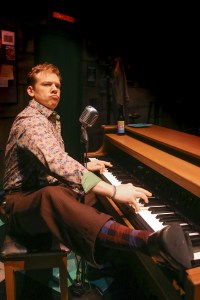
Greg Shimizu and Twilla MacLeod, A Man Draws A Bird. Photo supplied.

By Liz Nicholls, 12thnight.ca

As in so many life-changers, there was a moment when it all could have been different. And that was the moment — on one of those lingering Edmonton summer evenings in 2012 — that Greg Shimizu got on his high-end carbon fibre bike to go for a spin.

To help support 12thnight.ca YEG theatre coverage, click here

Shimizu, a seven-time Canadian national team triathlon athlete, in training for the world championships in his age group, was super-fit, pumped, adrenalized, chafing at the bit after a three-day break in Victoria where his dad was getting an honorary degree. 

His favourite route took him through Hawrelak Park and into the Legislature grounds. He liked it because it was , “treed, peaceful, green, calming.” The last thing he remembers about that ride, “a flicker of a memory really,” was riding down a hill. A van was coming up, and hung a sudden U-turn in front of him. 

The next thing he remembers was opening his eyes in the hospital. “What happened?” asked actor/musician Twilla MacLeod, his partner in life and in Booming Tree Taiko, their drumming duo. The answer was simple, and revealing. “I don’t know.”

Broken bones, cracked ribs and torn-up AC joints eventually mend;  smashed cheekbones reassemble themselves after a traumatic accident. To the naked eye and the mirror, you are your old self. But in the shadowy shifting world of brain injury into which you’re violently reborn, nothing is the same. You are only a reasonable facsimile of you, a doppelgänger not quite put together the same way. For you or your partner. As Shimizu puts it, “I was in the earthquake; Twilla was hit by the tsunami….”

Twilla MacLeod and Greg Shimizu, A Man Draws A Bird. Photo supplied.

That’s the world into which Shimizu and MacLeod take us in A Man Draws A Bird, a unique fusion of theatre, true story, music, and Taiko drumming premiering tonight at the Backstage Theatre. A show about identity — “part theatre/ part concert” as MacLeod puts it — it was developed with the material assistance of the Westbury Family Fringe Theatre Award.

“We didn’t hear the word ‘concussion’ at all,” says MacLeod of the aftermath of Shimizu’s accident seven years ago. Five hours later, Shimizu was home.

His nightmare was about to begin. “You assume your (inner) computer processor will just re-boot,” he says. “It’s like the first time you’re drunk, and you think what the hell’s the matter with me? And you assume that you’ll bounce back, like a hangover, that everything will be all right.”

What ensued was seven years of crushing fatigue, constant headaches, sleeplessness, and the sense that a self had somehow fractured and slipped away, in shards. Shimizu has been “the reverse of a vampire; night is the worst time for me,” he says. “Concussion slowly, slowly, takes things from your life…. Your work, your relationships with people, your energy, your focus, your personality.” Ah, and your memory. Who are you without your memories?

The commonplace advice to “rest,” proved counter-productive for Shimizu. “I have to make myself do things! It’s like walking on fire; you have to keep moving to distract you from pain…”

“It takes so much more energy to do things,” says the vigorous, vivid multi-tasker, one of the world’s natural extroverts. In addition to age-group triathlons and Taiko drumming, Shimizu had owned, and worked, the Whyte Avenue bar/cafe The Pour House. It was too much: He had to sell it, a further blow to his sense of self. But Booming Tree he couldn’t give up. “It gave Greg so much joy,” says MacLeod of the duo that performs at a wide variety of Edmonton events and festivals.

“I couldn’t let (concussion) take away our Taiko,” says Shimizu, an activist for brain injury causes. “It’s the glue that holds us together, connects us to each other and who we are….” Macleod nod. “It’s our craft and our identity.”

Unlike his partner (MacLeod is a U of A theatre and music grad), Shimizu isn’t a trained actor. Now, in the expanding sense of possibility that A Man Draws A Bird has galvanized, his creative energy is directed into performing in an original theatre piece spun from his own experience. Together the pair has gathered collaborators, including Newfoundland-based playwright/director Charlie Tomlinson and jazz musician Farley Scott.

MacLeod describes the score, which includes seven original songs, as a “folky, roots, old-style country” melange. Taiko drumming is there, not as part of that score but “because it’s a big part of our life,” says MacLeod of Booming Tree. “Taiko is such a big powerful voice,” she says of the challenging, highly physical Japanese art form. “And our story is mall.”

Rehearsals haven’t been without challenges, as MacLeod and Shimizu point out. If memory is problematic in the story, it remains so in real life too. And Shimizu can’t ever quite predict when his energy is going to crash.

But “in year 7 I’m SO much better,” grins Shimizu. “And this is is cathartic!” says MacLeod. “A man draws a bird because he wants to fly…. It’s not ‘woe is me’. It’s about survival, and the music is all happy!”

PREVIEW

A Man Draws A Bird

Theatre: Booming Tree and Fringe Theatre Adventures

Created by and starring: Twilla MacLeod and Greg Shimizu

Where: Backstage Theatre, ATB Financial Arts Barns, 10330 84 Ave.

Running: tonight through May 11

Tickets: tickets.fringetheatre.ca

Posted in Previews | Tagged , , , , , , , , | Comments Off on A Man Draws A Bird “because he wants to fly”: theatre, music, and Taiko drumming in a new Booming Tree show

Have you met our new friend? thoughts on Nassim at the Citadel

Playwright Nassim Soleimanpour. Photo supplied.

By Liz Nicholls, 12thnight.ca

There are many things I can’t tell you about Nassim (tempting though it is).

To help support 12thnight.ca YEG theatre coverage, click here

(a) It just wouldn’t be fair. The show created by the Iranian playwright artist Nassim Soleimanpour, who travels the world with it, is not only surprising, but it’s actually designed as a surprise — for you, and for the actor who’s in it. And (b) it wouldn’t even be revealing. At every performance, a different local actor walks out onstage in Nassim and sees the script, and its stage directions, for the first time. The old theatre truism that every show is a different experience is on the money!

Nassim. Photo supplied.

Sometimes the playwright’s instructions are flat and precise (“read whatever appears on the screen in a loud voice”). Sometimes they’re puckish and you have the fun of watching a top-flight actor put on the spot. Sometimes they’re open-ended and enigmatic; reflexes are tested and choices are called for. Nassim is playful that way, an impromptu theatrical encounter between a resourceful playwright and his audience via a game actor.

On Tuesday night, that actor was the alert, impressively dexterous Belinda Cornish who is (not coincidentally) a star improviser. She gave every indication of enjoying herself in the course of connecting with her new friend. And we got to meet the quick-witted Soleimanpour himself, in person this time, though silent, as a stage partner/stage manager/actor’s assistant. Jeff Haslam, Farren Timoteo, NASRA, Sarah Chan and John Ullyatt get their turn in Nassim in the course of the week.

In Soleimanpour’s White Rabbit Red Rabbit, a sort of animal fable/adventure about the ripple effects of oppression which played the 2013 Canoe Festival, the actor onstage has never seen the script before he/she/they open a sealed envelope onstage. Since playwright was prevented by the regime from leaving the country, that fable had a personal and political edge: Soleimanpour had never been able to see his own play onstage in his own language, Farsi. 

Now Soleimanpour can travel (he lives in Berlin), though his plays have never been performed in his home country or language. Onstage the playwright has a certain playful charm about him. And that sweet quality fuels a play that’s all about language, and making friends across the language divide. Nassim is also about what we share — a complex wistfulness about home and what that means, the universal urge to tell stories that start with “once upon a time.”

Is Nassim a play? So much of it fractures, or winks at, the usual framing of plays you’re thinking that, no, it’s in a theatre but why not call it a theatrical experience instead? And yet it is a play: there are characters who connect, there are stories, there’s an arc. This much I can tell you: What happens will captivate you, make you smile and sometimes laugh, and in the end touch your heart. 

Nassim runs through Sunday in the Citadel’s Rice Theatre. You’ll never have seen anything quite like it. Tickets: 780-425-1820, citadeltheatre.com.

Posted in Reviews | Tagged , , , , , , | Comments Off on Have you met our new friend? thoughts on Nassim at the Citadel

The Shadow knows: putting the comedy back into Chekhov, and the new season

By Liz Nicholls, 12thnight.ca

“If everyone took anti-depressants, Chekhov would have had nothing to write about….”

The playwright himself called it “Chekhov in a blender.” But Vanya and Sonia and Masha and Spike, by the raucous American absurdist Christopher Durang (Sister Mary Ignatius Explains It All For You, Laughing Wild, For Whom The Southern Belle Tolls), is so much more. Nothing less than “Greek tragedy to Neil Simon” is the scope of the 2013 Tony Award winner that is Shadow Theatre’s final production of the season, says director (and Shadow artistic director) John Hudson.

To help support 12thnight.ca YEG theatre coverage, click here

He’s had his eye on the comedy for a while now. But its dimensions — a cast of six and “a major set” — put it beyond the resources of the company till more recently. In three years, says Hudson, “we’re up 35 per cent,” in attendance, subscriptions, and box office revenue. And that success makes Vanya and Sonia and Masha and Spike feasible.  

The production reunites onstage Coralie Cairns (who’s also the company general manager) and John Sproule, who have a long Shadow history. They’ve been onstage together in Shadow shows since 1991 and Shaun Johnston’s Catching The Train,  “our first production outside the Fringe,” as Hudson says. They’ve been Shakespeare’s Beatrice and Benedick in Much Ado About Nothing; they’ve been George and Martha in Who’s Afraid of Virginia Woolf?. The list of shared Shadow curtain calls is long. 

In Durang’s comedy they play the bickering, regretful middle-aged siblings Vanya and Sonia, named for Chekhov characters by professor parents “active in community theatre.” They’ve put their  dreams on hold and stayed home at the family estate in the Pennsylvania boondocks. Meanwhile the third sibling Masha (Davina Stewart), whose movie star income funds the operation, has been “off gallivanting, having a life,” as Sonia puts it resentfully. The engine of the comedy is Masha’s return, accompanied by her latest boy-toy Spike (Jamie Cavanagh).

Hudson’s cast also includes Rachel Bowron and Michelle Todd. The production runs at the Varscona (10329 83 Ave. Thursday through May 19. Tickets: shadowtheatre.org.

In its upcoming season at the Varscona, Shadow premieres two new Canadian plays, one by an Edmonton actor/writer, the other by a Toronto-based actor-turned-writer who graduated from the U of A drama department. The latter is award-winning Nick Green. And his edgy new comedy Happy Birthday Baby J (Jan. 22 to Feb. 9), says Hudson, is all about “taking the piss out of political correctness.” A couple is celebrating the second birthday of their kid J, whom they’re are raising gender-free. Says Hudson, “you laugh out loud, and then you catch yourself: should I really be laughing?”

The Wrong People Have Money (April 29 to May 17), billed plausibly as “the funniest play ever written about moving Greenland,” is by Edmonton actor/playwright Reed McColm.  The comedy, nicely honed to a political edge, concerns a proposed capitalist venture to monetize Greenland by moving it farther south.  

Cairns co-stars with Nadien Chu in the inaugural production of Shadow’s upcoming season, directed by Nancy McAlear. The framework of The Roommate (Oct. 23 to Nov. 10), by the American writer Jen Silverman, is pure Odd Couple: two 50-ish women of widely contrasting personalities and habits — a Midwesterner and a worldly New Yorker on the rebound from her previous life — find themselves sharing a house. In Iowa.

Heisenberg (March 11 to 29) is by the English playwright Simon Stephens (The Curious Incident of the Dog in the Night-Time), “a rock star in our industry” as Hudson puts it. The two-hander explores the unlikely relationship between an older man and a much younger woman, strangers who meet by chance in a railway station. Hudson describes it not as a love story but “a story of human necessity…. We need human contact. We’re not meant to be alone.” The Shadow production stars Amber Borotsik and Glenn Nelson. 

Subscriptions to the 2019-2020 season are available at 780-434-5564 or shadowtheatre.org


Posted in News/Views, Previews | Tagged , , , , , | Comments Off on The Shadow knows: putting the comedy back into Chekhov, and the new season

Nassim, an adventure in language and connection: meet playwright Nassim Soleimanpour

Nassim Soleimanpour in Nassim. Photo supplied.

By Liz Nicholls, 12thnight.ca

The last time I talked to Nassim Soleimanpour, six years ago, the Iranian playwright was in the middle of Tehran on a cellphone that kept fading out, and I had laryngitis. There’s got to be an absurdist comedy of communication in that, just waiting to be written. 

It’s right up Soleimanpour’s alley.

His play White Rabbit Red Rabbit — which exhorts audiences to keep their cellphones on throughout, and email or text him photos —  had been seen around the world, in theatre capitals and at prestigious festivals, and translated into 25  languages. Toasted in London, New York, Toronto, it was about to open in Edmonton, at the 2013 Canoe Festival. And not only did the globally-connected Soleimanpour know where that was, he had good theatre friends here.

To help support 12thnight.ca YEG theatre coverage, click here

Its author, though — genial, much inclined to laugh, and nothing if not cosmopolitan — had never left his home country. He’d never been allowed a passport (as a conscientious objector he hadn’t done the obligatory military service). And, although a front-row seat was always reserved for him at every performance everywhere of this play with no director, no set, and a different actor nightly who’d never seen the script until the moment onstage, that chair was always empty.

Life, like theatre, is full of surprises and dramatic changes. Six years later, Soleimanpour lives in Berlin, a city he likes “for its history, for its green spaces,” its proximity to British theatre, and for the fact that his agent is based there. He’s fresh from New York and a four-and-a-half month run of his play Nassim, doing eight shows a week. Ah, and in his non-existent spare time, writing a little American Gothic play (Down By The Creek, set in rural Arkansas) for the New York TimesT magazine, America 2024 issue.

And he’s making up for lost travel time. In November alone, Soleimanpour was in eight countries with Nassim, “running from one continent, one airport, to another” as he says.

Belinda Cornish stars in Tuesday’s performance of Nassim at the Citadel. Photo supplied.

Starting Tuesday, he’ll be in Edmonton, onstage in the Citadel’s Rice Theatre in Nassim, with a succession of intrepid different Edmonton stars at each show, who (as in White Rabbit Red Rabbit), have never before seen the script till the moment it’s fetched from a sealed box.  

“I was trying to evolve this form,” says Soleimanpour of his fascination with “cold read” theatre and its coterie of undirected unrehearsed actors who’ve never seen the script before being onstage on the night. It started with White Rabbit Red Rabbit and his own situation, grounded in Iran. Now, “with each (play) I think, OK, this is the last one; I don’t want to get trapped here. And then I find something new and I have to go back and finish my job, develop the form into something a bit more complicated.“

That was one of his starting points for Nassim, he says. “Second was the idea of language,” he says. “I’m a Farsi speaker, then I learned English since I was a kid. It’s still a struggle (Soleimanpour’s English is excellent) but I’ve been working on it for so long now. And suddenly it’s 2015 and I move to Berlin, and someone has hit the re-reset button,” he laughs. “O my god I’m 30something and I can’t even say ‘I’m hungry’. So I have to learn a new language…. When I go to German classes it brings me back to my childhood and memories of my mom telling me I shouldn’t be lazy and I should practice my English!”

“The last bit of the (Nassim) puzzle  was meeting my amazing friend Omar Elerian, the director of the show,” he says. In 2013, they found themselves at Theatretreffen, a major festival. “We made friends very quickly…. I was working on another play (Blind Hamlet, an actor-less piece on its way to the LIFT Festival in London. “Omar is London-based. And he cooks very good pasta. So we kept talking and eating pasta….”

“He asked me ‘do I want to write a play for him?’. But I said ‘you’re a director. And I write plays without directors…. Very smartly he said ‘you keep mentioning you like challenges. And here is a challenge’.”

The swirl of languages became an inspiration for Nassim. The pair shared English, but Elerian is Italian, with a Palestinian father, who learned French at theatre school and then moved to London more than a decade ago. “So we were left struggling with questions like ‘where is home?’, ‘what is my language?’. That was the combination of three corners that shaped the triangle of Nassim,” says Soleimanpour.

Playwright Nassim Soleimanpour. Photo supplied.

He’d written White Rabbit Red Rabbit for export only and in his English not his native Farsi, sadly knowing that his mother would never get to see or understand it. “And Nassim is the solution!” he says cheerfully. His mom, who’s visited him in Berlin a couple of times, “gets to hear some parts of the show at the end of every performance,” he says mysteriously (he wants to keep the surprises under wraps).

He does reveal, though, that in the course of performances “we laugh a lot and then we cry a lot.” Especially he says, during the bows and the hugs.

In the age of Trump’s travel ban Iranian passports aren’t exactly a recipe for quick visa negotiations.Welcome to a  nightmare tangle of applications, rejections, waivers declared eligible then refused then delayed. It took six or seven months to get a U.S. visa for Nassim in New York, “the longest process ever!” despite petitions on his behalf from Lincoln Centre and other notable American theatre organizations. In his four-and-a-half months in New York, he never did succeed in getting one for his wife, a painter who is executive director of Nassim Soleimanpour Productions.

His own visa was nail-bitingly late in coming (and involved a last-minute flight to Madrid and back in a day while he was on tour in the Far East). The visa came finally on Dec. 4. He arrived in New York from Europe on Dec. 5, the very day of dress rehearsal. “The whole team was wondering ‘will he make it?’. The first show I was totally jet-lagged.”

A buoyant sort, Soleimanpour permits himself a sigh. “Weird. Brexit! Are you kidding me? What are we doing? Going backwards?”

New York is emphatic in its demeanour vis-à-vis Trump. “Every Nassim show we ask the local audience to teach us one word in their language, a sophisticated word,” he says. “I have a notebook, and I write them down, in the hope of learning new words.” In English-speaking destinations, words like “onomatopoeia” and “serendipity” come up a lot. “But here’s a totally New York phenomenon! One word kept getting repeated, at least twice every week. And that was ‘impeachment’.”

“I’m in love with New York!” Soleimanpour declares feelingly, of the storied city and its audiences, “so loud, so nice, so emotional.” He found it “a bit crowded” at the beginning, and he missed his wife. “But in the course of 160 shows there, I made a lot of friends.” He laughs. “I got treated to a lot of breakfasts.”

Big New York stars — Nathan Lane, Brian Dennehy, Whoopi Goldberg among them — had stepped up to take the leap into the unknown with White Rabbit Red Rabbit.  With Nassim (which premiered in London at the Bush Theatre in 2017), it happened again. New York audiences saw a galaxy that included Michael Urie, Michael Shannon, Tracy Letts, Letts’ wife Carrie Coon. 

John Ullyatt stars in the May 5 performance of Nassim. Photo supplied.

“I’ve learned a lot from every single actor who’s done the show,” Soleimanpour says. He jokes “I got my M.A. in acting watching these legendary actors … how they treat the script, how they think, their choices, where they stand, where to sit, when to pause. O my god, sometimes I’m like ‘I don’t believe it that you didn’t rehearse!’ ” he laughs.

The performances of Nassim vary widely, actor by actor, he reports. “I use the metaphor of a car…. With someone licensed to drive it’s supposed to be safe; if it crashes because it isn’t then it’s my fault as the designer. But the way you drive is your choice. You can decide to listen to rock music and drive fast. Or you can enjoy silence and stop every now and again and look at the scenery. I’m physically sitting next to you as your navigator. I don’t talk but I give you liberty and freedom. Do you want to turn left? No? That’s OK, do what you want to do….”

In 300 shows,  “there are no car crashes. And every driver is different.”

PREVIEW

Nassim

Citadel Beyond The Stage Series

Theatre: Bush Theatre and Nassim Soleimanpour Productions

Directed by: Omar Eulerian

Starring: Belinda Cornish, Jeff Haslam, Nasra, Farren Timoteo, Sarah Chan, John Ullyatt on successive nights — with Nassim Soleimanpour

Where: Citadel Rice Theatre

Running: Tuesday through May 5

Tickets: 780-425-1820, citadeltheatre.com   

Posted in Previews | Tagged , , , , , | Comments Off on Nassim, an adventure in language and connection: meet playwright Nassim Soleimanpour

Romance into tragedy: the dark, violent, original new hearing-deaf Tempest at the Citadel. A review.

Lorne Cardinal (top) and Nadien Chu in The Tempest. Photo by Ian Jackson, Epic Photography

By Liz Nicholls, 12thnight.ca

It never stops raining in the version of The Tempest that’s now lashing and splashing and skidding across the Citadel mainstage. As the Fool in Twelfth Night sings (borrowed by this wettest of Tempests for the occasion), “the rain it raineth every day.” 

It’s a measure of dark originality of Josette Bushell-Mingo’s high-precipitation production that its opening pair of images, wordless both, are juxtaposed so violently.

To help support 12thnight.ca YEG theatre coverage, click here

Rain lashes a huge, looming wreck of a ship (designer: Drew Facey) as a father in its shadow cradles his daughter protectively as she sleeps. In the other image, that father, kneeling and compliant, shouts in agony as a tattered figure hammers a long spike into his bare back, over and over. Torture? Self-willed flagellation? Moral retribution? An over-empowered tattoo artist with an ax to grind? When he turns we see a black circle, like a noose, engraved on the father’s flesh.

And that is how we meet Prospero (Lorne Cardinal), a rightful duke with a gift for the dark arts, fuming in exile on a remote island ever since he was deposed by an evil brother. And his innocent daughter Miranda (the luminous Thurga Kanagasekarampillai). And a forlorn local islander with grievances of his own, Caliban (Ray Strachan).

It’s been a season at the Citadel that has ventured into new ways of storytelling — witness the simultaneous pairing of an immersive free-associative comedy and a full-on door-slammer of a farce with a single cast (The Party and The Candidate, just ended). And now, as the season finale (and finale of the Citadel-Banff Professional Program that trains the cast), Edmonton’s largest playhouse takes a leap into complex inclusivity in a 90-minute bilingual (spoken English/ ASL) production with a multi-cultural ensemble of deaf and hearing actors.

Half speak; half do not. All, however, embrace a heightened acting style, flamboyant physicality, and hurl themselves into the striking theatricality of Bushell-Mingo’s stagecraft and water-soaked imagery. May I single out an outstanding performance from Braydon Dowler-Coltman as Ferdinand, flung to the watery deep again and again by Prospero’s dark magic? Or Nadien Chu as the queen of Naples, stabbed to death by a treacherous ally and springing back to life over and over, as pulled upright by Prospero’s unseen power?

The tricky business of interpretation across the language and sound/sight divide has ingenious solutions in the production: there are half a dozen versions of Ariel, Prospero’s disaffected sprite assistant. And, like an energetic zombie chorus, they carry out his orders and interpret — some ASL to spoken English, some English to ASL. Sometimes speech is chanted in unison, sometimes not.

Thurga Kanagasekarampillai, Braydon Downler-Coltman in The Tempest. Photo by Ian Jackson, Epic Photography

Not only is there less of the poetry of The Tempest, there are interpolations from other Shakespeare plays that land nimbly on their feet in the production. You’ll hear fragments of Romeo and Juliet in the charming budding-romance scene between Ferdinand (Dowler-Coltman) and Miranda (Kanagasekarampillai), for example, where their struggle for communication —he hears and speaks; she is deaf and signs — is lyrically invoked as part of the storytelling. They write in the water on the stage; they find common ground in the ASL and English signs for “heart.”

You’ll hear Lady Macbeth’s pep talk in the murderous subplots involving Prospero’s shipwrecked enemies, with a little Midsummer Night’s Dream thrown in for some tweaking of the interplay between Caliban and the comic characters. 

Purists may balk. But purists have always been nonplussed by The Tempest. And why wouldn’t they be? For centuries this most mysterious of Shakespeare’s plays, a late-period romance full of magical interventions and spectacle, has always invited — demanded, really —strangeness and original re-invention. Hey, when the goddess Iris just drops an enchanted banquet into the proceedings, the director has to step up, right?.

This condensed version does something unusual: it reimagines Shakespeare’s late-period romance and turns it into an out-and-out tragedy. Prospero the magus is not just the stage manager of the tempest, the conductor of the storm that brings his enemies within his grasp. His fury is the tempest. And his all-consuming thirst for revenge, which conjures the other characters from the foggy, lurid hold of the phantom ship, destroys his world.

“We are such stuff as dreams are made on” will become the stuff of nightmares. And when Prospero the dad finally wakes up it’s to a “reality” that will allude, both in word and image, to another Shakespearean dad, who made some disastrous choices about his third daughter and his kingdom.

Although he presides from the very top deck of the ship, there is nothing serene and magisterial — to invoke the most persistent 19th century clichés — about Cardinal’s Prospero. Cardinal, who has a four-square incantatory style of delivery, is a formidable presence. But, in the interests of focus, he’s asked to hit the same note of vengeful anger, so often and so relentlessly, that a certain repetition begins to weigh on the production.

And you may well feel you’re missing something of the poetic arc of a play that finds a route, however circuitous or difficult or costly, to a kind of resolution. This is especially true in a production that acknowledges the toxic colonial strain of dispossession built into Prospero’s situation: a victim of usurpation who becomes himself an usurper. As Caliban points out repeatedly “this island in mine!”. 

Pure rage is a difficult emotion to sustain indefinitely onstage. And so are the comic antics of the phantasmagorical pageant of thugs, led by Stephano (Troy O’Donnell) and Trincula (Elizabeth Morris). Although set forth with sprightly invention on the water-covered stage, they are tiring company in the long (OK, the medium) haul of the production.

The Tempest. Photo by Ian Jackson, Epic Photography.

But I think you’ll be fascinated by the production’s stunning interconnected imagery, enhanced dramatically by the gorgeous lighting of Bonnie Beecher and a remarkable sound design by composer Dave Clarke. The latter has a thunderous rumbling buzz and the industrial roar of tectonic plates, or a kind of cosmic heart-beat drumming, that will vibrate in every ribcage. It’s sound to be felt not heard.

The glass cage in which one of the Ariels is encased, and against which the force of Prospero’s wrath hurls Ferdinand again and again, is linked to the scene in which Ferdinand and Miranda overcome their sense of the Other, and “discover” each other. Which might be a metaphor for the entire production.

And that, in the end, is what this “insubstantial pageant faded,” does leave behind, beyond the thought that vengeance might be a dead end (move on Prospero, move on). The zombies vanish into the netherworld. The world of theatre is there for the sharing. It’s all a matter of communication, and a wide embrace.

REVIEW 

The Tempest

Theatre: Citadel

Directed by: Josette Bushell-Mingo

Starring: Lorne Cardinal, Thurga Kanagasekarampillai, Braydon Dowler-Coltman, Nadien Chu, Jarret Cody, Derek Kwan, Ray Strachan, Troy O’Donnell, Elizabeth Morris, Barbara Poggemiller, Denise Read, Hodan Youssouf, Hayley Hudson, Sage Lovell, Suchiththa Wickremesooriya

Running: through May 12

Tickets: 780-425-1820, citadeltheatre.com


Posted in Reviews | Tagged , , , , , , , | Comments Off on Romance into tragedy: the dark, violent, original new hearing-deaf Tempest at the Citadel. A review.

Two big birthdays, one big bash: Rubaboo and Dreamspeakers festivals

Josh Languedoc in Rocko and Nakota. Photo supplied.

By Liz Nicholls, 12thnight.ca

The celebration of Indigenous artists and their many-sided contributions to our shared culture takes another step forward with the tandem anniversary editions of the Rubaboo Arts Festival and the Dreamspeakers Film Festival today through May 7.

Rubaboo, named in the Michif language (a mixture of Cree and Métis French) for a traditional multi-ingredient stew to feed the soul, celebrates 10 years of multi-disciplinary showcases. First up Friday evening, after the 4 p.m. cedar smudge opening ceremonies, is Rocko & Nakota. Josh Languedoc’s solo show, which premiered at the Thousand Faces Festival and crossed the country at Fringes last summer, is framed by two characters, a little boy sick in the hospital and his grandfather Rocko, who arrives with a cache of traditional (and specially created) Indigenous stories.

In the course of his hit show, the multi-talented Languedoc conjures a dozen characters, humans, spirits, animals, even trees. It flips back and forth between past and present, in which Rocko is telling his own stories. The Theatre Prospero production directed by Barry Bilinsky runs at the Alberta Avenue Community Centre, 9210 118 Ave. tonight through April 30.

Actor/playwright/director/improv star Josh Languedoc talked to 12thnight.ca last spring before the 2018 Fringe tour of Rocko & Nakota; read the interview here. 

Other Rubaboo highlights include Kaha:wii Dance Theatre’s Blood, Water, Earth; an indigenous burlesque, Sovereign Bodies, starring Vancouver’s Virago Nation with local artists Iskotew Iskwewak and Audra Dacity, and film by Janet Rogers; and Making Treaty 7’s Kaahsinnoniks. There are workshops, visual arts exhibitions, musical offerings. Ah yes, and the annual Rubaboo Cabaret, which as its name suggests, embraces every art form and then some. But you’ll need to check out the entire lineup (and schedule) of shows, workshops, and panels at dreamspeakers.org.

The 25th anniversary edition of Dreamspeakers, wide-ranging, international in scope, and crammed with choices, includes such features as Falls Around Her, a Darlene Naponse film starring Tantoo Cardinal (Saturday, 8 p.m. at Metro Cinema) and Carla Ulrich’s Three Feathers (Sunday, 7 p.m. at Metro). The full annotated lineup is at dreamspeakers.org.

Rubaboo tickets are at the door of the venues. Dreamspeaker tickets are at metrocinema.org.

Posted in Previews | Tagged , , , , , | Comments Off on Two big birthdays, one big bash: Rubaboo and Dreamspeakers festivals

“The hour’s now come”: deaf and hearing actors together in The Tempest at the Citadel

By Liz Nicholls, 12thnight.ca

The Tempest, Citadel Theatre. Photo by Ian Jackson, Epic Photography

“O brave new world, that has such people in’t,” as Miranda, the daughter of a deposed ruler in exile, says in wonder towards the end of one of Shakespeare’s most mysterious and haunting plays.

To help support 12thnight.ca YEG theatre coverage, click here

In the version of The Tempest opening Thursday at the Citadel, Miranda herself plays a part in defining that brave new world of inclusivity. And so does her father.

For more than four centuries The Tempest’s open-ended magic and mysteries, its strange mélange of dramatic moments and presentational pageantry, have invited every kind of interpretation and director’s concept. In a first for Canadian mainstage theatre, the 15-member acting ensemble of Josette Bushell-Mingo’s innovative bilingual production, an offshoot of the Citadel/Banff Professional Program, is almost equally divided amongst deaf and hearing artists. They perform in American Sign Language and spoken English — in addition to “the language of the body.”

Prospero, a rightful duke exiled to an island by the evil machinations of an usurper brother, is played by the award-winning Canadian Indigenous artist Lorne Cardinal, best known to smiling television audiences in this country as Sgt. Davis Quinton on the comedy series Corner Gas. Prospero’s daughter Miranda, who discovers love in the course of The Tempest, is played by the young deaf Tamil-Canadian theatre artist Thurga Kanagasekarampillai, Toronto-based and making her professional theatre debut across the country from home. The experience, say both of them, has been a life- and career-changer.

“Hi Dad!” says the sociable, puckish 25-year-old Kanagasekarampillai (through an interpreter), over dinner last week, as we’re joined by Cardinal. He’s been touring his dog Jake, a patient attender of rehearsals, through the downtown Edmonton streets.

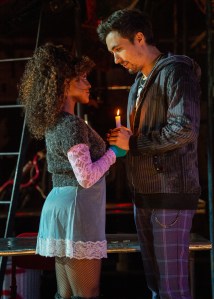
Thurga Kanagasekarampillai, Braydon Downler-Coltman in The Tempest. Photo by Ian Jackson, Epic Photography

Cardinal and Kanagasekarampillai have a jocular, easy offstage rapport, communication assisted materially by the latter’s mobile facial expressiveness and galactic smile. Did “Dad” arrive in Banff — from his West Coast home in Squamish two weeks into the four-week training intensive — knowing any sign language? She laughs. “Zero…. He was ‘OK, what am I gonna do?’ It was all over his face. And we were, like ‘it’s OK; it’s gonna be OK!’”

“All of us, hearing and non-hearing actors together, had to tell a fairy tale — without using sign or spoken language,” says Cardinal of the new versions of The Ugly Duckling; it was fun. I was thrown into what they were doing. And I become the lead swan!”

“And you were fabulous!” Kanagasekarampillai teases. “I felt the stress disappear right away; (the deaf actors) were so supportive, so helpful to the hearing actors,” says Cardinal, whom Edmonton audiences know in person from Theatre Network productions of Thunderstick and Where The Blood Mixes. Kanagasekarampillai reports a similar experience. “Our first language is ASL, and English is challenging for us,” she says. “But we’ve had so much support from our fellow actors. We draw so much from their understanding.”  

“It’s very physical; our storytelling based in that, so everything is smooth and flowing, with bigger gestures.”” says Cardinal of the production conceived by Bushell-Mingo, the former artistic director of Tyst Teater, Sweden’s National Deaf Theatre. This suits him fine. “Before I even went to the U of A (Cardinal was the first-ever aboriginal Fine Arts acting grad in 1993) I was in physical comedy, mask, clown. That’s how I got inspired….”

Kanagasekarampillai, who graduated from George Brown College in 2016 with a degree in Acting For Media, concurs. “Your body can say so much without words; you don’t even know how much….”

The fascinating and sometimes fraught father-daughter relationship in The Tempest becomes even more complex, of course, when one hears and the other doesn’t. “I think I draw from my real experience,” says Toronto-born Kanagasekarampillai, whose parents emigrated from Sri Lanka. “My father does not know ASL. But I love him dearly. We have a physical connection; we can communicate. It’s a quiet language between the two of us: eye gazes, body movement … it’s challenging because I want to talk to my dad, and know who he is, and know his family history…. I think I bring that to the (theatrical) experience.”

“I think my character is still learning as we go, trying to figure it out, to find other ways of communication. And (she smiles) that’s the story behind Miranda and Prospero: we still don’t communicate 100 per cent.”

As a deaf artist Kanagasekarampillai is, of course, very tuned to matters of communication, in  theatre and in life. There are four sisters in the family. She and her immediately older sister are deaf, bookended by the oldest and the youngest who aren’t, and are therefore are enlisted for the interpreting. “They sign and they’re fluent, but they’re not interpreters. So there’s always been that communication gap.”

The high-altitude attractions of Banff aren’t inconsiderable: “the mountains! nature! I’m fascinated by nature, why wouldn’t I want to travel there?” But the real draw of the Citadel/Banff program and the Citadel Tempest for Kanagasekarampillai is the fact that deaf actresses, much less deaf actresses of colour, are so rarely seen on the country’s stages and screens. “So this is my shot at making that change,” she smiles. “And when I got to Banff and met the ensemble, it’s been so worth it, 100 per cent-plus, the training, the program, the breadth and depth of it all!”

Lorne Cardinal (top) and Nadien Chu in The Tempest. Photo by Ian Jackson, Epic Photography

“Prospero is not going to be the traditional old guy with the stick,” says Cardinal of off-the-rack interpretations that have presented the magician in autumnal retirement mode (often linked to Shakespeare’s own career) as he abjures his “rough magic” in favour of forgiveness. The active, compelling need for vengeance is central to Prospero in the production we’ll see, he says. “Bad vengeance really poisons his mind, and poisons his connection with his daughter as well. He’s taken his magic into places he maybe shouldn’t…. So it’s an interesting telling….” 

Cardinal, who was assistant-director (and in the cast) of Peter Hinton’s 2012 all-aboriginal King Lear at the National Arts Centre, feels a kinship with the struggles of his deaf cast-mates. “Every one one of them as been told throughout their lives they can’t do this, be actors. And I’ve faced the same thing as an Indigenous person. We’re told we can’t do Shakespeare because we have lazy tongues. Or we don’t have the emotional depth. Because we’re shy and protective, people mistake that for being not intelligent, not aware…. “

“I’m hoping this doesn’t become a one-off, that it opens up opportunities,” says Cardinal of his first experience in a mixed hearing/deaf cast. “We should be doing a documentary of this production, the way we worked, and rehearsed, together…. ASL actors are fearless and talented, brilliant. And hard-working. Hearing people don’t understand how hard deaf people work, just to survive in this society. It’s inspiring for me to work with them onstage because they give so much. They work so hard; they’re so focused.”

Getting hired was Kanagasekarampillai’s first surprise, she says cheerfully of the process of sending video auditions. “Completely unexpected!” she says. “Finally, there were no barriers for me to cross. And there are more opportunities moving forward. Like Lorne says, there are negative reactions and the expectation we can’t do things. We’re proving that wrong….

As Prospero, the tempest-maker, says at the outset, “the hour’s now come….”

PREVIEW

The Tempest

Theatre: Citadel

Directed by: Josette Bushell-Mingo

Starring: Lorne Cardinal, Thurga Kanagasekarampillai, Braydon Dowler-Coltman, Nadien Chu, Jarret Cody, Derek Kwan, Ray Strachan, Troy O’Donnell, Elizabeth Morris, Barbara Poggemiller, Denise Read, Hodan Youssouf, Hayley Hudson, Sage Lovell, Suchiththa Wickremesooriya

Running: Thursday through May 12

Tickets: 780-425-1820, citadeltheatre.com

Posted in Previews | Tagged , , , , , , , | Comments Off on “The hour’s now come”: deaf and hearing actors together in The Tempest at the Citadel

The House Series: comedy, cabaret, and music at the Citadel next season

Caley Suliak, Ellie Heath, Alyson Dicey, Girl Brain. Photo supplied.

By Liz Nicholls, 12thnight.ca

Girl Brain, the sketch comedy troupe that zigzags through the lively minds of three smart and funny women, is being lured downtown for a weekend next season at the Citadel.

Alyson Dicey, Caley Suliak and Ellie Heath, who perform their sketch comedy regularly at the tiny Grindstone Comedy Theatre & Bistro in Strathcona, will join the Citadel’s new House Series November 8 and 9. New sketch comedy like Girl Brain, new cabarets from favourites like John Ullyatt, Patricia Zentilli, Kate Ryan, Steven Greenfield, music from such burgeoning musical talents as Audrey Ochoa, are part of this debut six-show Citadel series next season — along with the big-draw L.A. a cappella pop group The Filharmonic

Formerly known as Beyond The Stage, the House Series happens with one exception in the Citadel’s smallest, most intimate theatre space, the Rice, formerly known as the Club (formerly known as the Rice). Its entertainment sibling series in the Citadel 2019-2020 lineup (already announced) is Highwire, a new three-production alternative theatre series that also takes place mostly in the Rice.

To help support 12thnight.ca YEG theatre coverage, click here

The idea, says Citadel artistic director Daryl Cloran, is to present plays from the challenging, immersive, innovative end of theatrical spectrum under the Highwire banner, and to cluster experiments in comedy, cabaret and music in The House Series.

“I grew up with Much Music’s live shows, where you’d go in person and find yourself sitting on the bass player’s amp,” says Cloran.“It’s that kind of intimate, casual feel….” The House Series, he says, “is a chance to connect our audiences with that kind of experience, and to highlight the work and amplify the reach, and national profile, of local talent….”

Patricia Zentilli, John Ullyatt in What The World Needs Now, Citadel Theatre. Photo supplied

John Ullyatt and Patricia Zentilli, favourites with Citadel audiences have devised a new cabaret to celebrate the evergreen music of hit-spinning composer Burt Bacharach. What The World Needs Now (Oct. 17 through 19) assembles such iconic songs as Always Something There To Remind Me, Walk On By, Raindrops Keep Falling On My Head…. The list is long and memorable. Ullyatt and Zentilli are joined by a jazz quartet led by Jason Kodie. We’ll see Ullyatt in the Highwire series, too: he stars in the solo play Every Brilliant Thing (Feb. 1 to 23) directed by Dave Horak.

Kate Ryan, artistic director of The Plain Jane Theatre Company, whose production of Fun Home has just closed, joins forces with the multi-talented actor/ singer/musical director Steven Greenfield, a fellow musical theatre obsessive, to create a new cabaret spun from stories of travel and adventure. Café Wanderlust runs in the Rice Jan. 10 and 11.

The run of Broadway-bound Hadestown at the Citadel in the fall of 2017 brought to the attention of theatre audiences the startling talent of rising Canadian jazz star Audrey Ochoa. The trombonist wrapped her supple stylistic wits around the jazzy/folky Anaïs Mitchell score in a notable way. The composer/performer, who’s about to release a third album, is onstage in the House Series March 20 and 21 in Audrey Ochoa and Friends.

The series opens Sept. 27 and 28 with Diyet and The Love Soldiers, an alternative folk-roots-rock-country band with traditional Indigenous credentials. “Their star is taking off,” says Cloran of the wife/husband duo from the Yukon.

The grand finale, which takes the series to the 700-seat Maclab May 8 and 9. is The Filharmonic , a five-member Filipino -American a cappella group with “a huge international following” for their blend of hip hop, pop, and ‘90s nostalgia. They’ve been in movies (Pitch Perfect 2); they’ve been on The Late Late Show.

Cloran says he got the idea from the Citadel executive director Chantal Ghosh, who connected with The Filharmonic in her previous job with Spirit Airlines in the U.S..

The Citadel, says Cloran, has commissioned a new musical-in-progress, Prison Dancer, with Filipino characters, planned for a premiere a couple of years hence. “And this is a way to start the conversation with Edmonton’s Filipino community. 

House Series subscriptions are available at 780-425-1820, citadeltheatre.com.

Posted in News/Views, Previews | Tagged , , , , , , , , | Comments Off on The House Series: comedy, cabaret, and music at the Citadel next season

“Congratulations, Your Majesty!” The Empress and the Prime Minister at Theatre Network. A review

Darrin Hagen and Joey Lespérance in The Empress and the Prime Minister, Theatre Network. Photo by Ian Jackson.

By Liz Nicholls, 12thnight.ca

In a week when inclusivity, tolerance, equality took a major body blow in the Alberta election, it was particularly moving — almost uncanny, really — to see The Empress and the Prime Minister at Theatre Network.

To help support 12thnight.ca YEG theatre coverage, click here

The latest from playwright/ actor Darrin Hagen, premiering in a Bradley Moss production, is an homage to real-life (and little-known) activist drag queen ted northe who threw off the cloak of invisibility in a brave and strikingly regal showbiz way.

It’s his story, and it’s the story of an unexpected collaboration between activism, drag, and politics on the long, stony, agonizingly incremental (as we’ve just been reminded), march of progress. And it involves the stepping up of a charismatic young justice minister whose sense of justice and “a just society” was offended by the systemic persecution of homosexuality: one Pierre Elliot Trudeau.

Our first sight of the Empress of Canada (Hagen), in full queenly regalia, is in a witty drag number set, amusingly, to an iconic Canuck anthem. “Spread your tiny wings and fly away,” sings ted northe, flinging stuffed birds our way in a cannonade of feathers. Our first sight of Trudeau (Joey Lespérance) is a shrewd shrug of a man, intrigued by the source of a letter-writing campaign that has deluged his desk.

Hagen’s play unfolds — and that, for once, is the right word —  in northe’s biographical flashbacks “told” to Trudeau and, as he steps back into and out of his past, populated by  the dexterous Lespérance in a gallery of characters. The making of a drag queen and resistance fighter from a questing young gay Canadian nurse and part-time Arthur Murray dance instructor in the ‘50s is fascinating. And it’s chilling in its ruthlessness and cruelty. In a year when it would take a lot to surprise anyone about the corruption in the Catholic clergy, the opera-loving opium-smoking Monsignor in L.A. who tries in the end to run over his rebellious, too-young Canadian lover with his car might still make you blink.

Darrin Hagen and Joey Lespérance, The Empress and the Prime Minister. Photo by Ian Jackson

The emotional fabric of The Empress and the Prime Minister is the interplay between a passionate, outraged torch-bearer on the one hand, and a wry, understated assessor of the status quo on the other. One talks — and occasionally speechifies in a way that even a magnetic performer like Hagen can’t quite make sound like someone in conversation. The other listens, and throws in the odd question or prompt or practical aside: “politics is about timing” or “churches have influence” or “why do you dress like a woman?”  northe’s answer to the latter is barbed: “ I dress like a women; I don’t need to be a woman: I already know what it’s like to be a second-class citizen….”

“Your passion makes you care. But your reason is what will make you effective,” says Trudeau to northe. “See the change happening. And then figure out how to exploit it.” The combination is instructive, though perhaps this week in Alberta isn’t the most encouraging test case for effecting change. 

northe’s discovery of flamboyance and pride after growing up in an identity shrouded in shame and secrecy is chronicled, as you might expect, with authentic commitment in Hagen’s performance. Who better to deliver “the revolution is finally here…. I need to find something to wear.”? The actor/playwright/activist grew up in small-town Alberta and as a teenager moved to the big city, and the drag queen life. 

In performance, Hagen’s towering size actually gives him a certain poignance as he re-creates northe’s wide-eyed boyhood self, the gay kid who discovers something exciting and something scary about the big wide world in the time he spends south of the border (he studied nursing in the U.S. because in Canada at the time you couldn’t be a boy and a nurse).

Joey Lespérance, The Empress and the Prime Minister. Photo by Ian Jackson

Last seen here in such L’UniThéatre productions as Fort Mac, Lespérance is a master of the gallic Trudeau shrug. His lean features conjure that stylish intelligence without crude impersonation. And he bites zestfully into a selection of characters, including northes’s arch, sassy drag mentors Mama José and Auntie Mame who (to be vague and not spoil your fun) enter with pizzaz. In this they are assisted by sparkly glam (and copious fake hair) from designer Tessa Stamp. The bi-level design, by Stamp and lighting whiz Scott Peters, works well for the double-optic of showbiz and Canadian politics.

Lespérance populates the Leader’s debate and the Bill C150 arguments in the House (conjuring Trudeau, Tommy Douglas, Robert Stanfield, Réal Caouette) simultaneously) in scenes amusingly staged by director Moss.

This being the 50th anniversary of the decriminalization of homosexuality in this country, we know from the outset, on the political side, how things will turn out in 1969. And The Empress and the Prime Minister is at pains to explain what this historic moment does not mean for the lives of the LGBTQ community. The story of pioneer activist ted northe, though, is something remarkable — and new for many of us I venture to say, speaking for myself.

The play is unafraid of explaining its own importance — and there are occasional moments when it seems a bit over-written. On the other hand, it’s woven with cheeky asides and humorous annotations. “Heavy lies the wig that wears the crown,” northe tells us in a theatrical enterprise that sets about shedding light on the activist heart of drag.

“I’ve always been proud of my country… always loved it,” northe tells Trudeau near the end, “But I still need to learn to trust it.” I guess we understand more fully than ever just what that means.

12thnight.ca talked to playwright Darrin Hagen and his co-star Joey Lespérance HERE.

REVIEW

The Empress & the Prime Minister

Theatre: Theatre Network at the Roxy

Written by: Darrin Hagen

Directed by: Bradley Moss

Starring: Darrin Hagen, Joey Lespérance

Where: The Roxy on Gateway, 8529 Gateway Blvd.

Running: Thursday through May 5

Tickets: 780-453-2440, theatrenetwork.ca

Posted in Reviews | Tagged , , , , , , | Comments Off on “Congratulations, Your Majesty!” The Empress and the Prime Minister at Theatre Network. A review

Sanctifunkadelic: Sister Act at the Mayfield. A review


Katrina Reynolds in Sister Act, Mayfield Theatre. Photo by Ed Ellis.

By Liz Nicholls, 12thnight.ca

“Raise the stakes! Raise the game! Raise your voice,” sing the nuns of Sister Act, newly kitted out as a showbiz soul ensemble by the latest recruit to the Sisterhood.

“Feel the flow, dig the scene. Shake it like you’re Mary Magdalene.”

To help support 12thnight.ca YEG theatre coverage, click here

What they and their disapproving Mother Superior discover in the course of the high-spirited Broadway musical currently raising rafters at the Mayfield is that making a joyful noise gets better pay-off if there’s (a) a common key and (b) an audience in the pews.

What the creators of this 2011 musical (music by the go-to Disney composer Alan Menken, lyrics by Glenn Slater) spun from the 1992 Whoopi Goldberg hit movie, have nailed is the reliable comic attraction of nuns in full black-and-white regalia getting down and being fabulous. Sisters and sequins and the advice to “boogie till you feel your spirit move”: a no-fail spring tonic (kickier than communion wine) judging by the production directed by Jim Guedo.

Sister Act, as you’ll know from the movie, is set in motion when an aspiring disco diva in ‘70s Philadelphia, Deloris Van Cartier by name (Katrina Reynolds), has the bad timing to witness her mobster boyfriend (Michael-Lamont Lytle) murdering someone. Which is how the exuberant Deloris finds herself hiding out under a wimple in a convent. “Is there a smoking section?”

Katrina Reynolds in Sister Act, Mayfield Theatre. Photo by Ed Ellis.

The showbiz gene being contagious, Deloris can’t help herself  transforming a lack-lustre if dutiful choir with an infusion of Philly soul, R&B and disco, and some flashy moves (choreographer Christine Bandelow). And Reynolds, who has a charismatic energy about her, turns in a flamboyant performance as a star-in-progress who learns something about ensemble work back from the nuns, too. 

Susan Gilmour in Sister Act. Photo by Ed Ellis.

The purse-lipped Mother Superior (Susan Gilmour) is appalled by the disruption: “My life’s like the Stations of the Cross. But without the laughs.” But when the pews, long empty, begin to fill (along with the church restoration fund), the Monsignor (Garett Ross) is overjoyed.“Give yourselves a big round of applause,” he says to the assembled, digging the producer groove. “Let’s hear it for the balcony!”

What the Monsignor has discovered, bless his soul, is something the Mayfield knows all about: musical theatre is a big draw — mass appeal, as you might say. “The reviews are in! ’If you see only one Roman Catholic mass this season, let this be the one!’” Ross is highly amusing in negotiating this transformation.

Guedo’s production is fuelled by the fun of a gallery of individualized sisters. Pamela Gordon is very funny as the acerbic, whisky-voiced Sister Mary Lazarus, along with Michelle Diaz as the buoyant nun fangirl Sister Mary Patrick. The vocal and comic lustre is enhanced by such top-flight actors as Cathy Derkach and Andrea House, among others. And Jill Agopsowica is delightful as the convent postulant who really lands her wistful, then fiery, solo number The Life I Never Led. Gilmour applies herself to Mother Superior deadpan (top-notes of exasperation) with notable God-give-me-patience results, even in comic lines that aren’t Sister Act’s best feature by a long shot. It’s a kick-ass — or should I say “sanctifunkadelic”? — ensemble.

One of the funniest numbers of the evening belongs to guys, though. In The Lady in the Long Black Dress, the mobster’s hapless trio of hitmen — Brad Wiebe, Jahlen Barnes and Nelson Bettencourt — show off the smooth ‘70s moves that no mere nun will be able to resist. Lytle and Aaidin Church as the mob boss and the underachiever cop are excellent. 

The band, as you have come to expect at the Mayfield, is just first-rate — in ‘70s pastiche numbers, in comic patter songs, in Broadway-type ballads, in every style the musical throws at them. And since the music in Sister Act is sharper than the book, this is crucial. And speaking of transformation, kudos to set and video designer T. Erin Gruber who, assisted by lighting designer Kevin Humphrey, creates the worlds within and outside the convent walls — the pious and the Philly cheesesteak tacky — by playing ingeniously with glass bricks and scaffolding.

The “Sunday morning hustle,” in all its infectious glory, is available nightly. Spread the love. 

REVIEW

Sister Act

Theatre: Mayfield Dinner Theatre, 16615 109 Ave.

Created by: Alan Menken (music), Glenn Slater (lyrics), Cheri Steinkellner and Bill Steinkellner (book) with additional book material by Douglas Carter Beane

Directed by: Jim Guedo

Starring: Katrina Reynolds, Susan Gilmour, Michael-Lamont Lytle, Garett Ross

Running: through June 9

Tickets: 780-483-4051, mayfieldtheatre.ca

Posted in Reviews | Tagged , , , , , | Comments Off on Sanctifunkadelic: Sister Act at the Mayfield. A review