The crazy spirit of the Fringe, on legs: Are You Lovin’ It?, a guest 12thnight Fringe review by Alan Kellogg

Are You Lovin’ It? Theatre Group GUMBO, photo by Sue Brenner

Are You Lovin’ It (Venue 5, King Edward School)

By Alan Kellogg

Need a non-alcoholic break from one too many coming-of-age identity plays or satanic jugglers? Look no further, dear festival-goers. Relief is available from Osaka’s Theatre Group GUMBO.

Here is, I dunno, a company of Japanese Dadaist clowns or something like that, some dressed as WacDonalds employees. They gleefully, energetically, deliver a naughty, certifiably mad and political (but-endearingly not politically-correct) hour of vignettes and audience participation bits that will leave you sputtering with joy and amazement.

Dancing turds, Donald Trump, fast-food One World milkshakes including, well, a whizzed-up baby, intestines that reach into the audience and serve as a limbo stick and jump rope, a stereotypical maniacally laughing Japanese businessman no one but a countryman could get away with, a dancing, prancing Jesus Christ character complete with a crown of thorns — are you getting the gist of this?

So if you’re not revolted, by all means catch this one, which approaches a kind of kinked genius for the not-faint of heart. Now that’s it’s legal and as long as you’re not driving, might I suggest a dropper of Aurora oil to complement the show….

Posted in Fringe 2019, Reviews | Tagged , , , | Comments Off on The crazy spirit of the Fringe, on legs: Are You Lovin’ It?, a guest 12thnight Fringe review by Alan Kellogg

And the kids came through! Raymond and the Monster, a guest 12thnight Fringe review by Marc Horton

Raymond and the Monster.

By Marc Horton

Raymond and the Monster (Stage 16, Sanctuary Stage at Holy Trinity Anglican Church)

In the interests of full and complete disclosure, I must say that I didn’t want to review this play. What if the kids in Raymond and the Monster couldn’t sing? Couldn’t dance? Couldn’t act?

What if Raymond and the Monster was boring? Unwatchable? Awful?

If all those dire things turned out to be true, it would ruin next Christmas and many Christmases to come in our house; it would make my life hell on all sorts of levels. You see, my granddaughter Poppy has a role in Raymond and the Monster — she’s the cute 10-year-old in the blue smock — and it is very, very, very important to her.

I am unbelievably happy to report that Christmas in our house is safe, and that Raymond and the Monster and its cast of more than two dozen kids from age 8 to 15 are a thorough delight. These youngsters can sing, can dance, can act. This play is wonderfully inventive, superbly presented and undeniably funny.

Whew.

Full credit must go to directors Alyson Connolly and Elaine Dunbar who put this show together over the course of a nine-day camp. One can only admire the patience, the skill and the dedication required to fashion something as accomplished as this over the course of just a little over a week.

The seemingly simple story has villagers in an unnamed village in thrall to a wicked ruling duchess, played with a perfect blend of venality and menace by a terrific Pearl Philip. The duchess has convinced the villagers that she alone can control a monster held in her castle’s dungeon, but that keeping it penned up is costly indeed.

Thus, she taxes everything: milk, shoes, water, beds … children.

And should the parents not come up with the necessary gold pieces that are a head tax on their kids, well, things could get rough for everyone. The duchess has specific plans for all the loot she’s collecting. She wants to purchase the Camelon sceptre from her broke but aristocratic cousin and would-be sonneteer, the Count of Camelon, played with much charm by Ronan Faria

It seems that the only thing standing between the kids and being tossed into the dungeon is Raymond, the town scamp and an orphan who has no one to pay for him. He’s an inventive lad — Edward Bennett brings a proper impishness to the part — and while we all know things will likely turn out for the best, there’s a lot of fun to be had watching it all unfold as it should.

A word here about the music. There are some surprisingly strong voices in this young cast, notable among those is Chloe Brinco who plays the village seamstress and the mother of two, and Sam Michaelchuk, the town crier.

The best tune among the half dozen songs is The Sonnet Song written by Elaine Dunbar. It’s full of wonderful word play and manages to explain, more or less, the difference between Shakespeare’s sonnets and those of a more Petrarchan bent. I loved it.

—  Marc Horton is the former movie reviewer and books editor at the Edmonton Journal. We compared Fringe credentials with Poppy when they met for a post-show burger. His said “Media,” hers said “Artist.” Hers looked better.


Posted in Fringe 2019, Reviews | Tagged , , , , , | Comments Off on And the kids came through! Raymond and the Monster, a guest 12thnight Fringe review by Marc Horton

Full of sound and fury and signifying … you know. I Hate Shakespeare!, a guest 12thnight Fringe review by Marc Horton

By Marc Horton

I Hate Shakespeare! (Stage 2, Backstage Theatre)

When Hamlet and Laertes face off at the end of Act V and engage in swordplay that will see bodies litter the stage, the would-be ref in the scrap judges one sword thrust as a “hit, a very palpable hit.”

I judge I Hate Shakespeare!, a 75-minute spoof that seems much, much longer, a “miss, a very palpable miss.” The six-member cast struggles, and struggles mightily, but to little avail before it all comes to a welcome end.

I checked my watch at about minute 20 and then regularly from then on. Trust me, the hands on my timepiece crept on at a petty pace from minute to minute to the last syllable of would-be satire.

The show is predicated on the fact that to many these days, the Bard is too wordy and the words he uses are too, well, old. (That criticism is, of course, silly. It’s akin to saying Mozart used too many notes or Rembrandt too much dark paint.)

Some parts of this skit-ish show come close to working. the cleverest of the lot involves bottling Shakespeare’s wit where come-uppance quips spew forth after gulping the equivalent of literary Red Bull. It works, and at least made me smile.

But another where Juliet appears on a dating game show was decidedly dated and shopworn. Ditto for another that lamely tried to use Jerry Springer as a hook. Who, pray, watches Springer anymore? Is he even a thing nowadays?

And a skit that attempts to mine Titus Andronicus for jokes doesn’t work either. It’s the Bard’s most bizarre play that involves hands, feet, tongues and heads being lopped off. There are folks ground up and baked into pies, and one hapless character buried chest deep and left to die of thirst and starvation.

Titus Andronicus is goofy enough all by itself. It doesn’t need help.

Unfortunately,  I Hate Shakespeare! does need help. The whole thing seems overwritten and sadly under-rehearsed. The timing too often lacks the rhythm that might have given some of the scenes more bite.

I didn’t hate I Hate Shakespeare!, but I sure didn’t like it much either.

Marc Horton is the former movie reviewer at the Edmonton Journal. His favourite Shakespeare-on-film is Laurence Olivier’s Richard III which proves he has an absurdly forgiving nature when it comes to hammy performances.


Posted in Fringe 2019, Reviews | Tagged , , , | Comments Off on Full of sound and fury and signifying … you know. I Hate Shakespeare!, a guest 12thnight Fringe review by Marc Horton

It ends in tears (and a minor key): The Legend of White Woman Creek, a guest 12thnight Fringe review by Alan Kellogg

The Legend of White Woman Creek, The Coldharts.

The Legend of White Woman Creek  (Venue 3, Walterdale Theatre)

By Alan Kellogg

Fringe favourites New York’s The Coldharts – Katie Hartman and Nick Ryan – return to Edmonton reprising this song cycle that has played here twice before. Clever and accomplished though they certainly are, they might consider putting this one on the shelf of  Gothic American preserves for a time, at least here. And, it must be said, in spite of the fact that the cautionary tale couldn’t be more timely and resonating for Western Canadians. And this comes from a sincere admirer, who just bought the CD.

Things begin with an academic specializing in matters paranormal explaining that, after lighting candles in a circle, she will summon the spirit of Anna Morgan Faber.

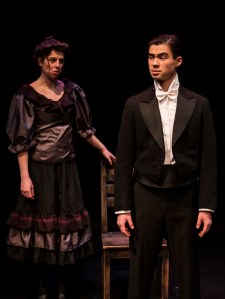
Anna appears in a 19th century period frock wielding an acoustic six-string and proceeds to sing her tragic story. It begins in what is now West Virginia and travels west to Kansas and eventually back home. If you’ve never seen the Coldharts, by all means give this a shot, because they always provide something serious to admire. I’ll leave Anna’s ghost to tell you about her sad journey.

Hartman is a wonderful singer and competent finger-picker, and the storytelling here is crisp and understandable throughout, no simple task. The tale itself is also worthwhile, especially for white folks, grim as it is. I’d suggest a clown show (maybe not) or a visit to the beer tent for a bracer or two afterwards.

But many of the songs are in the same key and come off oddly repetitive, not to mention unrelentingly dirge-like. And the cumulative effect of all this somehow lessens the impact of the production. The Coldharts are always welcome here, but they might consider pulling something new out of their (period) valise next year. That said, the packed house loved it, and you may too.

Posted in Fringe 2019, Reviews | Tagged , , , , , | Comments Off on It ends in tears (and a minor key): The Legend of White Woman Creek, a guest 12thnight Fringe review by Alan Kellogg

“What do you see?” Portrait of the artist as a waning star in Red, a Fringe review

Michael Peng and Braden Butler in Red. Photo by Mat Simpson.

By Liz Nicholls, 12thnight.ca

Red (Stage 5, King Edward Elementary School)

At the outset of Red, a man stares out at us from the stage with such fierce unblinking intensity you might have to look away before his eyes drill a hole in you.

It’s the abstract expressionist Mark Rothko. And, as Leigh Rivenbark’s wonderfully acted Wishbone Theatre production of Red begins, Michael Peng as Rothko is gazing at one of his paintings in such an active, penetrating, visceral way you suspect it might actually blister the colours right off the invisible canvas.

To help support 12thnight.ca YEG theatre coverage, click here

“What do you see?” Rothko demands from his newly hired assistant Ken (Braden Butler), a young up-and-comer painter. That question is crucial to Rothko’s artist’s credo, his world view, his soci0-cultural engagement vis-a-vis his “audience.” Poor Ken. As you suspect from the start, he’s in tough no matter what he answers — and “red?” is definitely not going to get a gold star from the master, who’s dogmatic, confrontational, tyrannical, and blessed with a formidable gift of the gab. 

We’re where the sun don’t shine— in Rothko’s sealed New York studio in the late ‘50s. He’s working on a series of commissioned murals for the new restaurant in the Four Seasons. And he has lots to say, none of it good, about the kind of rich insensible philistines who are his clientele.   

As a theatrical prospect, Red could have been like watching paint dry, literally. But John Logan’s Tony Award-winning 2010 two-hander feels very active and alive. For one thing, there’s the excitement of the performances. Peng has never been better than here, as the bitter, mercurial, competitive, and witty artist who sense that his status as a titan in the art world is being supplanted by a new generation of artists. Newcomer Butler as the assistant is excellent, chronicling in a compelling way the arc by which the young man, at first cowed and humble, seems gradually to be energized and empowered as a spokesman for the “new.”

Rothko’s aphorisms, which have surprise stingers, are vigorous and enlivening — “Nature doesn’t work for me; the light’s no good.” His sense of humour has a signature Jewish sense of anti-climax. “We’re a smiling nation living under the tyranny of ‘fine’.” But he doesn’t just stand there yakking with Ken. The pair are actually, convincingly, at work in the authentically spattered, crammed studio space Daniel Van Heyst.

A canvas gets stretched on a frame; the primer gets cooked. And then, in an exhilarating moment (accompanied by triumphant orchestral music), the primer gets hurled at the red-hued canvas. And Rothko readies his brush, playing with the bristles, like Federer with his racket or Horowitz warming up for the Hammerklavier sonata. “There’s tragedy in every stroke,” he says. 

It’s a fast, muscular, stimulating 90 minutes in the theatre. And what better place than the Fringe to ask “what do you see?”. After all, a play that explores the relationship between art, artists, and audiences seems made for a festival like this one.

Posted in Fringe 2019, Reviews | Tagged , , , , , , | Comments Off on “What do you see?” Portrait of the artist as a waning star in Red, a Fringe review

“Affecting and compelling”: The Green Line, a guest 12thnight Fringe review by Alan Kellogg

The Green Line. Photo supplied.

The Green Line (Venue 3, Walterdale Theatre)

By Alan Kellogg

Here is an affecting, well-written piece by Edmonton playwright Makram Ayache (last year’s stellar Harun) that travels to a surprisingly wide variety of places over 75 compelling minutes.

The setting is war-torn Beirut during the Lebanese Civil War (1975-1990) and follows the lives of four young adults caught in the figurative and actual middle of the insane conflict between Muslims and Christians. The Green Line of the title began as a line of demarcation between the polarities and eventually became an actual natural reality.

There are also lines – and connections – between the characters for other reasons, as if potential imminent death wasn’t enough, including family issues, sexuality, university pressures, national identity, suppressed desire, financial control and sheer survival, each linked together in simple and profound ways.

The producers, In Arms Theatre Collective, “an independent ad hoc queer theatre group” has fashioned a strong national cast of Navtej Sandhu, Liana Bdewi, Maher Sinno, and Ayache, who acts as well as he writes. Kudos also accrue to the rest of the team including director Desiree Leverenz, who keeps things moving briskly (and thoughtfully) throughout.

This is a universal, first-class production more than worthy of your attention. If your heart beats, you will be moved. And you’ll be thinking about it the next day.

Posted in Fringe 2019, Reviews | Tagged , , , | Comments Off on “Affecting and compelling”: The Green Line, a guest 12thnight Fringe review by Alan Kellogg

Cuckoo! Embrace nonsense! Bright Young Things brings us The Bald Soprano, a Fringe review

By Liz Nicholls, 12thnight.ca

The Bald Soprano (Stage 12, Varscona Theatre)

Give your mental synapses a warm-up rattle, pry your sense of causality loose from its moorings. Get those sticky fingers of language off meaning, and free-associate like there’s no tomorrow, since tomorrow never comes. Ionesco, the Romanian-French master of the theatre of the absurd, is back at the Fringe.

To help support 12thnight.ca YEG theatre coverage, click here

And it’s with his influential first play (he called it an “anti-play”), his landmark 1950 comedy The Bald Soprano, the world record-holder for most continuous performances in the same Paris theatre (since 1957). Bright Young Things, the indie company that has brought us revivals of Coward, Stoppard, Rattigan, yes even Sartre and other stars of the last mid-century, embraces its dizzying architecture of inanity and nonsense in a manically captivating production directed by Dave Horak.

“We’ve eaten well this evening,” says Mrs. Smith (Belinda Cornish) brightly to Mr. Smith (John Ullyatt) at the outset of Ionesco’s take on the very English domestic comedy. “That’s because we live in the suburbs of London, and because our name is Smith.” Mr. Smith, reading the newspaper, clicks his tongue. A cuckoo clock goes off randomly.

The Smiths are serious people. Which is why they’re funny, as Horak’s actors understand perfectly; Cornish and Ullyatt play with extravagant  cartoon precision. Mr. Smith announces that  conscientious doctors should die with their patients. What ensues is a detailed discussion of a couple who, along with their children, are all named Bobby Watson.

Another couple, the daffy Martins (the excellent team of Mat Busby and Rachel Bowron), arrive for dinner, which never, incidentally, gets served. Once across the Smith threshold they don’t recognize each other and start the process of discovery until they realize they’re married. “Darling, let’s forget all that has not passed between us….”

The banter is free-floating; apparently, the inspiration was the phrase books Ionesco used when he was learning English. “Yogurt is excellent for the stomach, the kidneys, appendicitis and apotheosis.”

The disconnections continue with the appearance of a hilariously saucy maid (Shannon Blanchet), and the arrival of a fireman (Chris Pereira), even though there isn’t a fire right now but there could be at some undetermined future point. He stays to tell stories because “firemen’s stories are always true,” and, it turns out, he’s the maid’s lover. I’m going to step out and call the sex scene the funniest at the Fringe. Prove me wrong, people.

It’s a bright, crisp production. And it makes of The Bald Soprano, the precursor to the Pythons, Albee, Stoppard and the rest, a veritable seminar in making nonsense a fine art. The non-sequiturs fly. The assumption that language is a means of communication explodes in a giddy shower of small-talk and fractured logic. Experience tells us that if the doorbell rings repeatedly and no one is there, naturally it means that the doorbell rings because there’s no one ever there.

As the Martins say about their discovery that they have the same address and sleep in the same bed, “ how curious it, how bizarre, and what a coincidence!” 

Posted in Fringe 2019, Reviews | Tagged , , , , , , | Comments Off on Cuckoo! Embrace nonsense! Bright Young Things brings us The Bald Soprano, a Fringe review

Engaging comedy from Egypt! 7 Days, a guest Fringe review by Alan Kellogg

7 Days at Edmonton Fringe 2019. Photo supplied

7 Days (Venue 36, La Cité Auditorium)

By Alan Kellogg

Clothes are scattered all over the floor and  two brothers are variously sacked out on a desk and a bed in their modest apartment. The door knocks a few times and finally, after a couple of false starts, a visitor in a nice suit with a large suitcase arrives.

He is the chef. The brothers haven’t a clue why he’s there, along with his much-loved dog. But the chef, with a confident air, seems to know. And then it happens. The canine has made it to kitchen and snarfs down a whack of rat poison, with predictable results.

The chef’s sorrow quickly morphs into anger, and a threat. How to punish these two idiots? Well, he offers the siblings a choice. Either they will fast for seven days in penance and do anything the chef tells them to do or – brandishing a pair of handcuffs – he will turn them into the police.

They pick the former, and then the fun — call it what you will — begins. We enjoy being along for the ride, including the surprise ending, rich in regional irony.

Hailing from Alexandria, Egypt, this engaging trio of Mohamed Breaka Ali Elsaeid, Eslam Awad Mohamed Elnagdy and Eslam Eissa Abdelbaset Essa have staged the play by Aly Abdelnabi Alzaidi in five countries to date and it works just fine here. They combine well-spoken English with Egyptian Arabic, and the combination of the two somehow adds a piquancy and extra comic texture to the proceedings, even if most of us don’t understand half the dialogue. Trust me, these actors have the expressive skills to happily carry us along, regardless.

They’re welcome back anytime.


Posted in Fringe 2019, Reviews | Tagged , , , , , | Comments Off on Engaging comedy from Egypt! 7 Days, a guest Fringe review by Alan Kellogg

The Lear sisters host ‘a celebration of life’: Queen Lear Is Dead, a Fringe review

Sarah Feutl, Carmen Osahor, Jessy Ardern in Queen Lear Is Dead. Edmonton Fringe 2019.

By Liz Nicholls, 12thnight.ca

Queen Lear Is Dead (Stage 46, Strathcona Baptist Church)

The premise is downright fascinating: While King Lear is busy running the family business, the kingdom, and all that, and playing his daughters off against each other, where’s his wife? Surely Lear wasn’t always a single father.

It’s too late to meet mom in person (just like it’s too late to run into Hamlet at college bitching about his marks). In Jessy Ardern’s Queen Lear Is Dead, the Lear sisters,  Cordelia, Regan, and Goneril, have announced the sudden passing of their mother. And they’ve invited family and friends to a “celebration of life” in her honour.

What? You didn’t know the Lears were Baptists? Me neither. The first official act of this immersive, site-specific adventure through the labyrinth of the church is to shed light on the locale. Dad, incidentally, hasn’t shown up yet; he keeps phoning Cordelia (Sarah Feutl) who smiles apologetically every time her cellphone rings. Goneril, Gee for short (Carmen Osahor), smiles too, but professionally, between clenched teeth, like someone trying not to let on she’s just bitten down on a bad cashew. Freewheeling, blowsy Regan (Ardern) is late, just like Dad. She rushes in, breathless, loud, stoned, and dying for a cig.

Guess what? The three Lear daughters just don’t get along. This prequel traces the roots of dysfunction in one of the theatre’s great dysfunctional families, back to childhood. It turns out the Lears have stored up a lifetime of flammable little grievances that add up, and ignite from time to time — especially since all three work for the family business. And they need hardly a nudge to start spilling their secret jealousies and resentments.    

Valerie Planche’s production lets us decide which daughter to follow, and listen to, in a variety of church nooks and crannies. (In one, there are cupcakes, but I’m not telling which). The actors are convincing: the cool, appraising gaze of Osahor’s Goneril, the exhibitionist neediness of Ardern’s Regan, the ingratiating charm of the baby of the family, Feutl’s Cordelia.  And as you’ll know from plays like The Fall of the House of Atreus and Prophecy, Ardern is a smart, witty writer. But judging by this premiere production, the premise is punchier than the play.

Largely, I think, it’s because the monologue scenes, with their self-justifications, seem over-extended, the flare-ups a little repetitive (and trimmable). The sheer familiarity of  sibling rivalry is part of the comic point, of course. But the most surprising scene belongs to Goneril, who has a secret sorrow.

The finale, for which we all re-assemble in the sanctuary, reveals something about the sparky sense of humour of the late Queen. It’s a gem.    

Posted in Fringe 2019, Reviews | Tagged , , , , , , | Comments Off on The Lear sisters host ‘a celebration of life’: Queen Lear Is Dead, a Fringe review

Canadian history in motion: The Flying Detective, a guest Fringe review by Alan Kellogg

The Flying Detective, Accidental Humour Co. at Edmonton Fringe 2019.

The Flying Detective (Venue 1, Westbury Theatre)

By Alan Kellogg

If there is a downside to Fringelandia, it is that economics, time and generally good sense militate against staging lavish productions, although inventive set design can spring from the most modest materials.

Well, thanks to the producing Edson & District Historical Society and a long list of sponsors, here is a bona fide production directed by Taylor Chadwick and worthy of any mainline professional regional theatre company season — complete with exceptional filmed sequences and impressive (!) props. In the latter case, I’ll leave it to you to witness the showstopper, a local take on Miss Saigon, if you will.

Yes, the provenance here might indicate to some a 90-minute of turgid, if well-intentioned, good-for-you CanLit historical fiction. But the good news here is that Brent Felzien’s The Flying Detective, if based on a true local story (with embellishments) is a lot of fun, and very easy on the eyes and spirit.

It involves the 1919 murder of an Edmonton constable, and the pursuit of his killer by an obsessed, dour Socttish-Canadian detective, one James Campbell (Cody Porter). In the trek to Edson, he’s joined by the celebrated war hero and aviation pioneer Wilfred “Wop” May (William Banfield) who is about to revolutionize transportation in Western Canada.

We’re engaged with the chase to find the grizzled killer, who escapes for a time before he meets his destiny. The filmed visuals are terrific.

Yep, there are some glitches here, in dialogue, story exposition and performance, although Porter and Banfield acquit themselves well enough. That said, the packed Westbury crowd stood up as one at the end, which only goes to prove that Canadian history delivered by the right hands can be a well-loved story worth telling.


Posted in Fringe 2019, Reviews | Tagged , , , , | Comments Off on Canadian history in motion: The Flying Detective, a guest Fringe review by Alan Kellogg