Capturing a complicated holiday: a new Canadian musical by Charlotte Corbeil-Coleman, with songs by Hawksley Workman

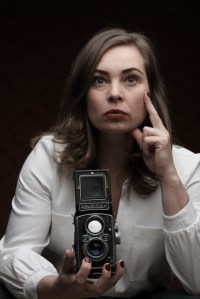
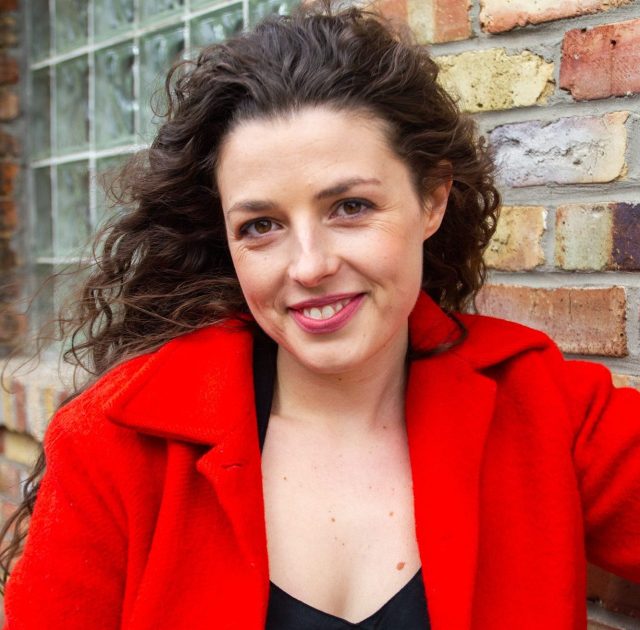
playwright Charlotte Corbeil-Coleman. Photo by Hannah Endicott-Douglas.

By Liz Nicholls, 12thnight.ca

“It’s the first snow of the year/ Guess it happens once a year….” from Almost A Full Moon, Hawksley Workman

“Christmas is a complicated holiday,” says playwright Charlotte Corbeil-Coleman, pausing to consider the multiple facets of that show-stopping calendar centrepiece. “So so complicated. Well, it’s about family. And family is complicated.” 

It’s the raison d’être of Almost A Full Moon. the new Canadian holiday musical commissioned by the Citadel, where it officially premieres next week in a production directed by Daryl Cloran. It’s set to the evergreen 20-year-old Christmas album of that name, a sort of seasonal song cycle by Canadian indie rocker/ singer-songwriter Hawksley Workman. And it has lured Toronto-based Corbeil-Coleman, one of the country’s younger generation of playwriting stars (Scratch, The End of Pretending, Guarded Girls), into the world of musicals for the first time. Ah, and into writing about a holiday with which, as she says, “I have a very complicated relationship myself….”

To help support 12thnight.ca YEG theatre coverage, click here.

“That for me was THE most nerve-wracking part of signing on to this project,” Corbeil-Coleman says. Hers is a holiday history steeped in sorrow. “My mother (novelist and arts journalist Carole Corbeil) died when I was young. And what had been this really magical holiday became all about really missing someone, about grief.”

And both the idea and the circumstances of creating a multi-generational show about family — finding one, having one, being in one — have been “transformative” in redeeming the beauty and joy of the holiday season for her, as Corbeil-Coleman explains in her exuberant way. A joint inspiration of the Citadel artistic director Daryl Cloran (who’s talked about his family’s annual bonding with the album) and Workman, the notion of the musical floated her way in 2018. 

For her, its creation is part of a birth and rebirth story. She smiles. “Having a child really did transform Christmas,” says Corbeil-Coleman, who’s married to Globe and Mail theatre critic Kelly Nestruck. “I found out I was pregnant when I had my first official meeting,” she says. “I pitched Daryl and Hawksley my idea. And they were so excited, so generous, so I just went for it!” Four months after the birth of her son Dash in 2019, she wrote the first draft of Almost a Full Moon. “And we’ve been developing it ever since,” she says of a show history that has included five weeks with the late lamented Canadian Musical Theatre Project at Sheridan College, a Zoom workshop as part of the Citadel’s Collider Festival and a live Christmas concert version last year. 

And now, as opening night approaches, Corbeil-Coleman, pregnant again and due in February, laughs that she is making a second baby in addition to a first musical. And actually she has a second musical (with Greg Morrison of Drowsy Chaperone fame) in gestation, too. 

Hawksley Workman. Photo supplied.

One of the draws of an Almost A Full Moon musical for her was that she is by her own description “a huge Hawksley fan… I saw him in concert when I was 17 or 18, and it transformed me. I became obsessed. His sound, his writing … there is something in his music that really spoke to me.” Later in the playwriting program at the National Theatre School, he was her creative soundscape. “I wrote to his music…. If I could go back in time and my 20-year-old self (got told) I’d be writing a musical with this person some day, I’d have lost it!”

Corbeil-Coleman was both an actor and a playwright when she co-wrote (with her best friend Emily Sugarman) and performed in her first play The End of Pretending in 2001. She grew up surrounded by writers and theatre artists (her dad is actor/director Layne Coleman). “But it was the death of my mom (in 2000) that really made me a writer,” she thinks. “It was for me a real coping mechanism at the beginning…. It was the tool I had to express myself, and I really needed to express myself.” 

Post-NTS, she pretty much stopped acting (“I was much happier writing”). An exception, though, was her contribution this past year to Year of the Rat, a series of original solo pieces commissioned by Factory Theatre, and streamed live from each playwright’s own home. Corbeil-Coleman’s Want Now (a title borrowed from the immediate demands of toddler Dash) had to do with living in a house bequeathed to her by her surrogate mother, playwright/actor Linda Griffiths (who passed away in 2014), always wondering if she’s “acting” her life. “When I’m telling my own story, being the face of it … I’m interested in that kind of storytelling.” 

What is it about Workman’s music that appeals so strongly? “I felt very familiar with his voice…. It’s a sense of humour that really aligns with my humour,” she considers. “And leading with the heart: that also runs in my work.” 

“He captures a feeling really really well,” she says of Workman’s gift for storytelling through music. And, as his history as a cabaret performance artist attests — witness his cabaret The God That Comes — Workman is a musician strikingly tuned to theatricality, and to characters as the ‘voices’ of his songs. “I was really able to feel the story coming off of them.. I did a lot of listening, a lot of imagining and letting the images come!” 

In short, “I knew this was a match that could work,” she says. “Now I’ve listened so much to his music. And I wake up every morning with another song from a musical in my head!” The song list from the musical — 10 actors strong with a six-member band — is joined by songs from elsewhere in the Workman canon. “Always room for discovery!” 

“When I was pitching my idea, I explained that I had different relationships with Hawksley’s music at different stages of my life.… That’s what so wonderful about music. About any art, right? You can explore it when you’re a teenager, and in your 20s or 30s it changes….”  

That thought has found its way into the structure of Corbeil-Coleman’s new musical, with its weave of generations, of three stories from different time periods. “I was interested in having people share songs in different times, and having it mean something different….”   

For the playwright it’s been important that the musical capture the holiday, “in all its beauty, the complications, and yes the sadness…. I wanted people to be able to bring all their feelings to the musical and feel they were seen a little.”

As for three-year-old Dash, who’s visiting from Toronto for a week, he’ll be bringing his own excitement to the theatre — though perhaps not to the house seats. ‘We’ll bring him in for part of the music rehearsal,’ says Corbeil-Coleman, who doesn’t quite trust Dash yet not to talk and ask questions out loud all the way through the show. “Because he just loves music. Ryan (musical director Ryan DeSouza) is going to take him down to the pit to meet the band. I’ll be great!”

PREVIEW

Almost A Full Moon

Theatre: Citadel

Written by: Charlotte Corbeil-Coleman

Music by: Hawksley Workman

Directed by: Daryl Cloran

Starring: Alicia Barban, Felix deSousa, Chariz Faulmino, Peter Fernandes, Kayden Forsberg, Kendrick Mitchell, Amanda Mella Rodriguez, Luc Tellier, Lyne Tremblay, Patricia Zentilli

Running: Nov. 5 to 27

Tickets: 780-425-1820, citadeltheatre.com 

Posted in Previews | Tagged , , , , , | Comments Off on Capturing a complicated holiday: a new Canadian musical by Charlotte Corbeil-Coleman, with songs by Hawksley Workman

Love takes us backstage at a kids’ TV show: Die-Nasty lathers up for a new season of Monday night episodes

By Liz Nicholls, 12thnight.ca

Suds alert: We’re backstage at DNTV, a television studio where tensions are on red alert and the real drama happens in this age of streaming. 

TV executives, actors both human and puppet, camera people, script writers and doctors, directors, production assistants, make-up artists, assorted showbiz egos are working up a lather. Studio boss Sidney Caulfield (Tom Edwards) is clutching his two top shows: Helping Hands for kids and the reality show Thirst Trap Island for, you know, the seekers of guilty pleasures.  

What could possibly go wrong, right?

To help support 12thnight.ca YEG theatre coverage, click here.

Die-Nasty, Edmonton’s deluxe Canadian Comedy Award-winning improv company, returns Monday night with a new season. And like its immediate predecessor Die-Nasty’s 32nd year of live all-improvised serial soap, Love, Death, and Doctors divides the season into three eight-week mini-series. The first, which runs Monday nights through Dec. 19) is set backstage in the TV studio, “a cross between 30 Rock, Sesame Street and Noises Off.” The second, Death, is a murder mystery lit in noir-ish tones. The third, Doctors, is something medical, which implies that the odd corpse may be involved.   

In uncertain times, improvisers (who tend to come from the theatre in this theatre town) are way more able to commit short-term, as the company’s new co-artistic director Jason Hardwick (who shares the gig with Delia Barnett) explains. And “after a rocky two years” of pandemical hard-scrabble it makes sense to start with Love, he says. “Die-Nasty has always been such a fun-loving place and it had started to feel like ‘real work’. I just want to get that family feeling back…. I want this to be a fun place to be.” 

Hardwick, a dancer and tap-dancer specialist by trade (and a Grant MacEwan musical theatre grad “in the Tim Ryan years”), laughs. “I learned everything I know about acting doing Die-Nasty with (the likes of) Jeff Haslam, Cathleen Rootsaert, Stephanie Wolfe….” He first guested on Die-Nasty in “the Italian fashion year,” as Bob Fussy. And “the Tennessee Williams year” was a Hardwick favourite too. 

What he and Barnett are after, he says, is “soapy layers,” a mingling of drama and laughter. “We’re funny, we’re serious, we’re funny because we’re serious.… It can be over the top, big choices, a heightened sense of reality.” Ellen Chorley is the director of Love. And she’s a perfect fit: a playwright, the director of Nextfest and the artistic director of both a kids’ theatre company (Promise Productions) and a burlesque troupe (Send in the Girls). 

The idea of puppet characters mingling with human characters was his. “Bonkers,” he admits cheerfully. “All of us love puppets!” he says of the discovery at preliminary workshops that the ensemble is full of people who live with them. “Who knew?” His own blue wide-mouthed puppet, featured on the poster, may well turn out to be a production assistant, or an ingenue. 

The prevailing idea of Die-Nasty that sets it apart, is a dramatic storyline, made up on the spot before your very eyes, that plays out in weekly instalments. It’s so fluent, so expert, that you sometimes have to wonder if it’s scripted and rehearsed: it’s not. 

Hardwick and Barnett are planning a new website (“with a catch-up feature: what happened last week?”) and a newsletter. Every Monday night, after the improvisers briefly introduce their characters (“the hot 30s”), he’s thinking of a “Previously On … with three lines from the previous episodes. Yup, stolen from Netflix.”

In the new year,  after Love, mystery novelist Janice MacDonald returns to direct the murder mystery series Death. Everything about Doctors, the finale 8-week mini-series, is to be announced. 

Die-Nasty star Stephanie Wolfe has long referred to Die-Nasty as “bowling night.” Hardwick laughs. “This is bowling night, with a bowling trophy.”

PREVIEW

Love

Die-Nasty: The Live Improvised Soap Opera

Directed by: Ellen Chorley

Starring: Stephanie Wolfe, Kristi Hansen, Jason Hardwick, Vincent Forcier, Nikki Hulowski, Kelly Turner, Delia Barnett, Joey Lucius, Gordie Lucius, Kirsten Throndson. With special guests

Where: Varscona Theatre, 10329 83 Ave.

Running: Mondays (starting Oct. 31) through Dec. 19, followed by two other 8-week mini-series

Tickets: dienastysoaps.com/tickets or at the door


Posted in Previews | Tagged , , , , , | Comments Off on Love takes us backstage at a kids’ TV show: Die-Nasty lathers up for a new season of Monday night episodes

Flying too near the sun: the hunger for artistic inspiration in Dora Maar: the wicked one, a review

Daniela Vlaskalic in Dora Mar: the wicked one, GAL Productions with Hit & Myth. Photo by Ian Jackson, Epic Photography.

By Liz Nicholls, 12thnight.ca

Images of fire, flames, burning, melting are everywhere in Dora Maar: the wicked one, a compelling new solo play by Beth Graham and Daniela Vlaskalic (The Drowning Girls, Comrades, Mules) presented by Workshop West Playwrights Theatre to launch their new season.

At its centre is an insight into the high price tag on artistic inspiration. We meet an artist who plays with fire to be near a heat source.

To help support 12thnight.ca YEG theatre coverage, click here.

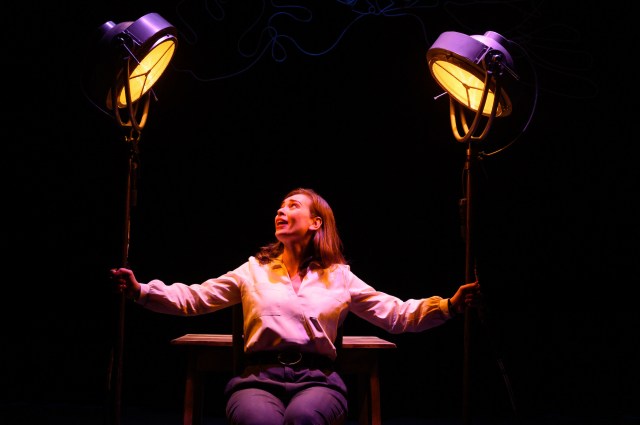
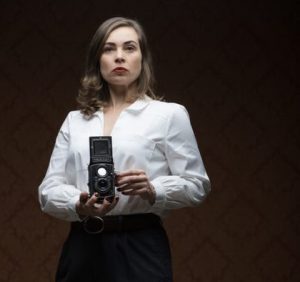
The most famous artist in the world, both a heavy-hitter and a celebrity, is in the play. But Picasso isn’t onstage. The stage, bare save for two photography lights, belongs to Dora Maar, an innovative French photographer, 29 when she met the 55-year-old star painter, at the start of her own bright career. Ah, as she says at the outset, the moment “when life was a hydrogen balloon, going up and up and up.” 

Dora’s story loops back, again and again, to the Greek myth of Icarus, who leapt into the wild blue yonder on his wax and feather wings, flew too close to the sun, thrilled by its beauty and his own freedom — and plummeted into the sea.  

It’s not easy to capture the heat of inspiration onstage (as we know from the deadening experience watching characters with furrowed brows bent furiously over their computers or in front of their easels). In Dora Maar, best known since the 30s and 40s as Picasso’s lover, model, and muse, Graham and Vlaskalic have fashioned a character irresistibly attracted to the seductive energy of creation, in herself and in others. She expresses herself in playful, extravagant ways. “He burns so brightly,” she says of Picasso. “We drink to the agony of creation … we drink to the shape of my earlobe!” she laughs, reporting the high-wattage of her new relationship.  

The mercurial character we meet in Vlaskalic’s alert, charismatic performance has a kind of confident sparkle at the outset; she exults in her world — her friendships with the big shots of Surrealism, her experiments in marrying photography to Surrealism in original montages. Even her commercial photographs, for high-end fashion and booze clients, have bold weirdness to them: severed limbs, bizarre contortions, a ceiling that’s a floor, human chandelier, a Chanel-draped model with a cut-out star for a head. Dora wants to surprise, and she “likes being seen.” 

Daniela Vlaskalic in Dora Maar: the wicked one, GAL Productions with Hit & Myth. Photo supplied.

Additionally (and perhaps this is the photographer in her), she brings a leftist spirit to her aesthetic. She’s hip to the dark political drift to the right in the late ‘30s and feels the responsibility of expressing that in art. The play’s multi-faceted portrait of the artist — photographer, painter, documentarian, poet — is in sync with Picasso’s celebrated portraits of Dora Maar — all intersecting planes, fractures, distortions, in profile and full-face simultaneously. She seems to look in several directions at the same time, and inwardly too. So does this new play, that premiered this past spring at the High Performance Rodeo in Calgary.

One of the appeals of the play, and of Dora Maar as its amused observer, is the eloquent capture of a City of Light milieu and period that seems fantastical to us now. Paris in the ‘30s, “another party, another chateau,” more champagne, more sex, outrageous influencers who were actually talented, Man Ray emerging from a birdcage where he’s been “taking pictures of his penis … again!” An astonishing array of groundbreakers, where the answer to every question is “why don’t you ask Gertrude Stein?” There is, as per Dora Maar’s fascinating survey of a world soon to be at war, a lot to lose. Peter Moller’s evocative modernist soundscape, with its ominous undercurrents, glints with memories.

As Blake Brooker’s elegantly minimalist staging conveys, Dora Maar had found her light, in the cross-beam of two lamps. And her fall from sky into the darkness of a full-fledged breakdown, is a tragic one, as we see vividly in Vlaskalic’s performance. It’s an image captured by the stage’s sole embellishment — two birds, one with melted wings by T. Erin Gruber, and by the dramatic lighting designed by David Fraser. After a decade in which Dora Maar has supported, even propelled, Picasso through dangers and terrors of the Occupation, their passionate, tempestuous relationship (“beyond sex, beyond love, beyond comprehension”) stops.  

Having supplanted both his wife (the Russian ballerina Olga Khokhlova) and his mistress (Marie-Thérèse Walter, the mother of his daughter) as lover and muse, Dora, feisty and outspoken, is replaced, brutally, by a younger more compliant woman. The cruelty of an artist who needs fresh young blood for inspiration is shocking. Picasso the bull is a beast. And the insight into artistic creation and the magnetism of power, fame, and ego is tough-minded, to say the least.

The vivacious young artist, who revels in new ideas, seems almost physically reduced, to the vanishing point. Vlaskalic’s performance lingers in the mind.

The playwrights and director Blake Brooker talked to 12thnight in a PREVIEW. Check it out here.

Dora Maar: the wicked one

Theatre: GAL Productions with Hit & Myth, presented by Workshop West Playwrights Theatre

Written by: Beth Graham and Daniela Vlaskalic

Directed by: Blake Brooker

Starring: Daniela Vlaskalic

Where: The Gateway Theatre, 8529 Gateway Blvd.

Running: through Nov. 6

Tickets: workshopwest.org

Posted in Reviews | Tagged , , , , , , , , , | Comments Off on Flying too near the sun: the hunger for artistic inspiration in Dora Maar: the wicked one, a review

Theatres are haunted places. A ghostly meet-and-greet in Dead Centre of Town XIII

Dead Centre of Town, Catch the Keys Productions. Photo by Mat Simpson.

By Liz Nicholls, 12thnight.ca

Imagine, if you will, a place where where live people are haunted by imaginary people. Where they inhabit the lives of others, and stories come to life when the lights are out. A place of strange rituals, where “break a leg!” is a slogan of good luck….  

Yes, theatres are genuinely eerie places. They’re inhabited by ghosts — of people who existed and people who were imagined by people who existed.

To help support 12thnight.ca YEG theatre coverage, click here.

Catch the Keys Productions knows where the bodies are buried. For their 13th nocturnal excursion into our our civic history Dead Centre of Town takes us into a real theatre, the vintage Capitol Theatre on 1920 Street in Fort Edmonton Park. It’s a beautiful reproduction of a theatre (c. 1929) that was once to be found on Jasper Avenue, in the heart of a lively entertainment district that is no more.  

It’s one of their best. Even when theatres are dark, they’re never really empty, after all. There’s always a single ‘ghost light’ hanging over the stage, just to make sure the resident phantoms feel at home. 

Fort Edmonton at night is a shivery spot; you’re walking into the graveyard where the secrets of our macabre civic history lie slumbering. And, as playwright Megan Dart has found, stories can come to life. As always in Dead Centre of Town, you start around a bonfire under the dark sky, the traditional gathering place of ghost stories and their tellers.  

Colin Matty, Dead Centre of Town, Catch the Keys Productions. Photo by Marc J Chalifoux

Expertly managed by pale spectres (Christine Lesiak and Adam Keefe look freshly dug up, so to speak), and narrated by tall lanky Colin Matty, Beth Dart’s production immerses us in the mysterious world of theatre. It’s crammed with theatre stuff, old costumes, ropes, heads where wigs once stood (designed by John and Kat Evans and Ian Walker). We loop from onstage to backstage, through the dimly lit hallways of the theatre labyrinth the audience never gets to see into prop rooms, the shop where sets were made. We see the view from the house seats, we hear the ghostly sound of two hands clapping. Where’s the laughter coming from? (designer: Michael Caron). We find ourselves in the lobby, the portal to the so-called “real” world. 

And we meet the unruly theatre ghosts who never sleep because, as we all know, theatre is all-consuming. There’s the projectionist at the Garneau Theatre who may have met a terrible fate (Jake Tkaczyk); the ‘princess’ of the Princess Theatre (Sarah Emslie); the undead fireman (Murray Farnell) who haunts the ex-firehall Walterdale Theatre; the ghost of the Bus Barns (Max Hanic) where the Fringe now creates theatre. And we meet an uncanny little girl (Dayna Lee Hoffman) who seems to know every nook and cranny of the Capitol. 

“Edmonton’s only live action thriller” has found its natural home. You have till Sunday to catch it there (7:30 and 9:30 p.m. nightly).  Tickets (which can be bundled with Dark): fortedmontonpark

12thnight talks to playwright Megan Dart in this preview.


Posted in Reviews | Tagged , , , , , , , , , | Comments Off on Theatres are haunted places. A ghostly meet-and-greet in Dead Centre of Town XIII

‘Everyday horror’ mined for comedy: that’s Girl Brain, and they’re back

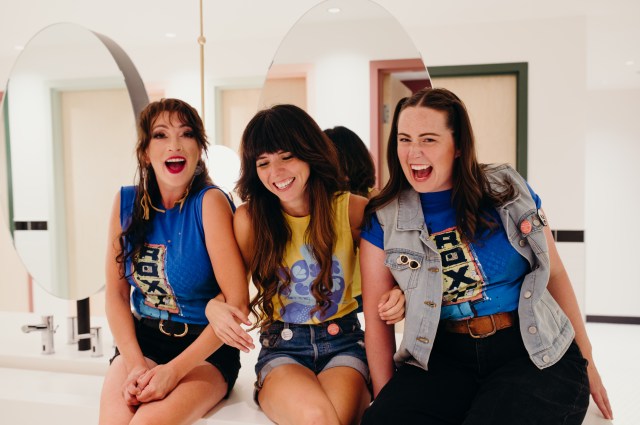
Caley Suliak, Ellie Heath, Alyson Dicey of Girl Brain, in the luxury bathroom at Theatre Network. Photo by Brianne Jang, bb collective.

By Liz Nicholls, 12thnight.ca

There’s nothing like a pandemic to make a sketch comedy trio revel in being together again — in person, in a spanky theatre, rehearsing a new show, with a fog machine. 

“Where are we?” says Ellie Heath in something like wonder. “The delight! The excitement! We’re like little girls at a sleepover putting on a show for our parents….”

To help support 12thnight.ca YEG theatre coverage, click here.

Where Girl Brain is this weekend, Thursday through Sunday, is the beautiful Lorne Cardinal black box theatre at Theatre Network’s Roxy. Where Heath, Alyson Dicey and Caley Suliak were to be found Monday afternoon is in their separate apartments, in the living room called Zoom sharing a screen. 

It’s especially sweet to be doing a live in-person full-length show, says Suliak, after a summer of busy-ness in which the three had very separate gigs, positive reinforcement for the link between sketch comedy and theatre. Both she and Heath had solo Fringe shows, The Paladin and Fake n’ Bake respectively, the one at La Cité francophone and the other at the Roxy. Dicey got bronzed out in the sun in a perpetual motion multi-tasking assignment running the KidsFringe. They’ve been writing sketches for the new show ever since. 

Togetherness, just hanging out, seems like a treat. “So great to be collaborating with my besties,” Suliak says. “Having somebody to pump you up backstage … after doing a solo show and being by myself in the dressing room,” the very definition of solitude,   

After a couple of years of bizarre, often lonely, and far from comical, pandemic separateness, they wondered (as we all do) who they are and what still makes them laugh in the fall of 2022. “The heart of what we do remains intact!” she says. 

Caley Suliak, Alyson Dicey, Ellie Heath of Girl Brain, at Theatre Network. Photo by Brianne Jang, bb collective

The three actors/ writers/ best friends who share Girl Brain specialize in mining the “ordinary” absurdities and hypocrisies of the world. Which, unsurprisingly, have not gone away. You know, those familiar moments of life when, as Dicey says, “you wish you could just dissolve into the wall.” Or moments of maximum irritation when regular people overstay their welcome and turn into  “nightmare people.” And as for dating? An endless treasure trove of embarrassment, aggro … and sketch possibilities. 

All of the above find their way into the Girl Brain show we’ll see at the Roxy, a mix of the new and “the re-vamped and improved,” as Dicey says. In honour of the spooky season, they’d originally thought of “true crime” as a through-line. Now it’s a a riff on Halloween that she calls “everyday horror.” 

Naturally, Dicey’s thoughts turned instantly to costumes. ‘What is my biggest pet peeve? I’ll dress as that…. People who don’t follow through with the promises they make to you.” Costume concepts don’t come more impossible than that. Not going to happen. Incidentally, feel empowered to attend Girl Brain wearing a costume yourself; there’s a costume contest, with prizes, every show.

“All our shows are scary, kind of spooky in a way,” Dicey laughs, “because we’re always talking about the things that annoy us, things in life that are scary…. Yup, everyday horror.” 

“The Overstayers,” for example, was inspired by her brother’s experience on a joint cabin holiday retreat with another couple and their kids who more or less moved in, ate all the food, drank the booze even though they had their own cabin. And how’s this for everyday horror? “The ex- of the guy you just started dating shows up at a party, and you think, at the moment, ‘this is the worse moment of my life’…. Later, it’s ‘what was I thinking? If only I could have seen how silly it really was’.”  

Suliak plays “a lot of men in the show,” she says. “Which is not horrifying to me, but might be them!” (laughter all round). “One sketch took me quite a bit of time to write because it was actually very personal, dredging up those feelings…. How do I make this funny? I don’t want to revisit this. But I should. Because I think it’s relatable.” 

And “relatable” is a veritable mantra with Girl Brain. As Heath says, “it’s fun to find parts of our every day lives that get under our skin…. In rehearsal, we get together and have creative conversations about the little things that make us laugh….” It’s how Girl Brain came into being in the first place. 

They play a wide assortment of characters in the sketches they write, sometimes for themselves to play and sometimes with each other in mind. Heath’s specialty, she thinks, is “high-strung female characters. I like really wacky, crazy characters. Kooks…. Actually I think we all do. That’s probably why we get along.”

Favourite characters in the show? For Dicey it might be the woman who’s unstoppably excited about her Bosch washer and drier, “Inspired by my mom but bigger and sillier!” For Suliak “there are so many lovable, ridiculous, and yes hatable characters in the show that I can’t pick just one.”  

As for Heath, it’s “The Weeping Vag,” a recurring sketch she narrates, à la Masterpiece Theatre, “as a storytelling nymph.” Her Girl Brain cohorts nod their assent. For the new show designer Tessa Stamp has fashioned them a handsome historical tome, a volume apparently direct from the medieval period. It looks “so ancient, so precious,” as Dicey says, “containing the stories and traumas of womanhood we need to pass on.…” 

Stamp wondered if she might decorate the grand volume “like an ornate vagina,” Heath reports. “Absolutely!” Then “is a tampon string hanging from it too much?” Nope, “great!” was the response.

“With a book mark that’s furry,” smiles Heath sweetly, and pauses. “Yup, we’re back!” 

[And they’re back again at the Roxy with another new show Dec. 16 to 18, too]. 

PREVIEW

Girl Brain

Starring: Alyson Dicey, Ellie Heath, Caley Suliak, with special guests Natasha Lyn Myles (Oct. 27) and Tiff Hall (Oct. 28 to 30)

Where: Theatre Network at the Roxy, 10708 124 St.

Running: Thursday through Sunday 

Tickets: theatrenetwork.ca

Posted in Previews | Tagged , , , , , , | Comments Off on ‘Everyday horror’ mined for comedy: that’s Girl Brain, and they’re back

A cutting edge artist in her own right: Dora Maar: the wicked one, at Workshop West

Dora Maar: the wicked one, Workshop West. graphic by db photographics

By Liz Nicholls, 12thnight.ca

In the solo play that launches the Workshop West Playwrights Theatre season Thursday you’ll meet a remarkable artist, a multi-media groundbreaker in the ‘30s and ‘40s. She was a cutting edge photographer with commercial cred and a unique vision, an accomplished painter, a leftist political activist, a poet.

To help support 12thnight.ca YEG theatre coverage, click here.

You might not know her name. 

In a Paris cafe in 1935, Dora Maar met the most famous artist in the world, Pablo Picasso, and fell in love. And both their lives changed.  

In Dora Maar: the wicked one, by the playwriting duo of Beth Graham and Daniela Vlaskalic (The Drowning Girls, Comrades, Mules), the woman herself, played by Vlaskalic, talks to us. The production, the work of the playwrights’ GAL Productions and Calgary’s Hit & Myth, is directed by Blake Brooker, a playwright of note himself and the co-founder of the zestfully experimental performance theatre company One Yellow Rabbit. The three made time to chat on Zoom on a break from rehearsals in Calgary. 

The play, which premiered at the delayed spring edition of the High Performance Rodeo in Calgary, isn’t the first time Graham and Vlaskalic have put Dora Maar onstage. She was one of the five talking paintings in The Last Train (Shadow Theatre, 2003), a Nazi train filled with looted “degenerate art” including Picasso’s fractured portraits of his lover and muse, and bound for possible oblivion. 

“We weren’t done with her,” says Graham of their undimmed attraction to their subject. Dora Maar “is one of those artists.… We were intrigued by her sensibility, her photos and her art work” — her paintings in a striking variety of styles, photographs that marry the eye of the camera to Surrealism. “One of the few women working in that medium at all, she bridged the two worlds and she was commercially successful. Such an interesting woman.… We wanted to crawl into that mind, that world. And we’d just scratched the surface.” 

Daniela Vlaskalic in Dora Maar: the wicked one, GAL Productions with Hit & Myth. Photo supplied.

What interested the playwrights, too, was “how that vibrant, exciting new artist disappeared,” says Vlaskalic. “If people know her at all, it’s for The Weeping Woman and other multi-angled faces in Picasso paintings. But they don’t anything about the woman.” Only in the last few years, as she notes — a 2019 exhibition at the the Pompidou in Paris and the Tate Modern in London — has Dora Maar’s independent profile as an artist has started to be visible on the international stage.

Ah yes, a liaison with Picasso that has left him with Maar’s photo-documentation of his masterwork Guernica and her with the label ‘muse’. Graham, whose play Weasel premiered at Studio Theatre two weeks ago, says “one of the things that interested us was her relationship with fame…. Picasso was already famous when she met him and entered into that relationship. She already had this artistic identity; how does it bump up against someone that famous? How does she navigate that? Such an interesting thing to explore.” 

“Who’s the most famous and powerful artist in the world now?” Brooker wonders. The answer isn’t obvious. “Who’s the Picasso … Banksy? Jeff Koons?” Drake maybe? “But Picasso and Maar were in the same medium, and that’s different,” as Graham points out. 

“They deal with this (question of fame) in such a fascinating way,” says Brooker of the playwrights. “Original, idiosyncratic, very pleasing.” The setting, too, 1935 to 1945 in Paris, is resonant. “A time of great upheaval in the Western world… And here we are, finding ourselves back at a moment, or series of moments, of great upheaval. The terms and conditions of this play cleave into notions of artistic creation, censorship, warfare, occupation, the rising right….” 

Ring any bells? The leitmotif of the play, as Brooker puts it, is the Spanish Civil War, and the fit with the moment, including the brutality in Ukraine, is unmistakeable. “Part of the beauty of Dora Maar,” says Graham, “was the way her art work was responding to the politics, the rising fascism, of the time.” 

“These guys,” he says affectionately of Graham and Vlaskalic, “have caught this. And I think it’s lightning in a bottle… not least of which is finding a personality as magnetic, as storytelling-worthy, as Dora Maar.” 

Daniela Vlaskalic in Dora Maar: the wicked one, GAL Productions with Hit & Myth. Photo supplied.

“So many dramatic angles,” he says of the multiple facets of Dora Maar’s story. “The City of Light in black-out, the pressure-cooker of Occupation….And everything about her story is so sexy. An incredible artist, friends with all the cool Surrealists (like) Man Ray and Marcel Duchamps. Love, heartbreak, obsession.… A snapshot of 10 years in 78 minutes! It deserves a mini-series.” Vlaskalic laughs and nods. “A lot does happen within the world and within the art.”  

Vlaskalic, whose play Sleight of Mind, premiered this month at Western Canada Theatre in Kamloops, explains that Dora Maar: The Wicked One is the joint cross-country work of the pandemic. “A Zoom-created play I guess,” originally scheduled for the Rodeo’s original January slot then delayed for COVIDian reasons till May. She and Graham, the one Toronto-based and the other in Edmonton, enlisted One Yellow Rabbit’s Brooker, who has a long and distinguished history with new plays. He’d directed a version of The Drowning Girls for Vertigo Theatre. He’d directed Vlaskalic in Karen Hines’ Drama: Pilot Episode. 

“He’s really pushed us to find the voice of the piece,” says Graham, “the voice of the character and what we want for our voice within the piece.” 

For his part, Brooker says “I consider these two among the finest dramatists on the scene in Canada … an almost undiscovered treasure of beautiful writing and ideas. And I also consider them to be very intuitive and accurate with the zeitgeist.”

“This play comes to grips with really serious notions around a creative life, and also the ongoing, amazing danse macabre, the crazy energy between men and women that drives the world…. There is nothing more interesting than observing another human being concentrating and going through problems. We love to watch the concentrated presence on stage.” 

PREVIEW

Dora Maar: the wicked one

Theatre: GAL Productions with Hit & Myth, presented by Workshop West Playwrights Theatre

Written by: Beth Graham and Daniela Vlaskalic 

Directed by: Blake Brooker

Starring: Daniela Vlaskalic

Where: The Gateway Theatre, 8529 Gateway Blvd.

Running: Thursday through Nov. 6 

Tickets: workshopwest.org

Posted in Previews | Tagged , , , , , , , , | Comments Off on A cutting edge artist in her own right: Dora Maar: the wicked one, at Workshop West

Who am I really? Squeamish, a scary solo thriller from Northern Light. A review

Davina Stewart in Squeamish, Northern Light Theatre. Photo by Ian Jackson, Epic Photography

By Liz Nicholls, 12thnight.ca

There’s blood, a lot of blood, dripping and pooling and trailing through the macabre one-woman thriller you’ll find in the near-dark of the Studio Theatre in the ATB Financial Arts Barn. You can practically taste it.

To help support 12thnight.ca YEG theatre coverage, click here.

Which is weird, since Squeamish is a story. And the storyteller, Davina Stewart in a bona fide 90-minute tour de force, is just sitting in a chair in the shadows, talking. There’s atmosphere aplenty in Trevor Schmidt’s production. The room has an eerie sort of elegance, beautifully designed by Schmidt. Chris Dela Cruz’s lighting, which brings colour to the dark, is a virtuoso display of unease in itself, with its single light source.

Side note: never let it be said that Northern Light Theatre doesn’t embrace the spirit of the season. In 2020 about this time of year, in honour of scaring the people, they premiered Trevor Schmidt’s solo gothic thriller We Had A Girl Before You.   

In this ever-creepier monologue by the New York playwright Aaron Mark (who seems to specialize in such matters since Squeamish is the third of a trilogy), Sharon, an Upper West Side therapist, has arrived at the home of her own therapist in the middle of the night.  

Sharon hasn’t seen Dr Schneider for five months, but this is an emergency, and “I’m a totally different person.” Just back from Texas and the funeral of her nephew Eddie, who’s committed suicide, she’s telling her fellow shrink what’s been happening to her, culminating in the fateful trip. For one thing she’s discovered the disturbing coincidence that Eddie died bleeding out in a bathtub, covered in cuts — just the same way Sharon’s own suicidal mother was found years before. Is it in the blood?  

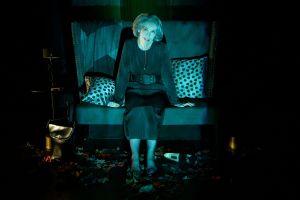
As Stewart’s virtuoso performance conveys, Sharon may look confidently Upper West Side (black dress and shoes, chic silver coif, expensive purse), but she seems anxious, rattled, breathless. She talks, spontaneously, in a volley of fragments, add-ons, and cavils as  details occur to her. Her hands, pale and lit in the dark, are in constant motion, fluttering, gesturing, signalling. Listening to anxious smart people is anxiety-producing, don’t you find? 

Davina Stewart in Squeamish, Northern Light Theatre. Photo by Ian Jackson, Epic Photography.

Davina Stewart in Squeamish, Northern Light Theatre. Photo by Ian Jackson, Epic Photography.

Anyhow, we learn that Sharon — recovered alcoholic, extreme hemophobe (a mosquito bite throws her into a frenzy of revulsion), and coffee junkie — comes from a family with a history of mental illness, suicide, and addiction. Inspired by the oddly serene Eddie who’d visited her in New York months before, Sharon’s taken herself off the psychotropic drugs she’s been on since she was 13. “I needed to find out who I really am. Now. Without dependence on some chemical substance….”

That’s the (blood) red-alert state in which Sharon arrives in Lubbock, from whence she’d fled to New York and a professional career decades before. A certain morbid sense of humour attaches to her views of Texas. “Maybe it’s not sad to die in Texas,” she reflects. The Lubbock chamber of commerce will not be using this slogan any time soon. 

Stewart conjures the characters, including her blood relatives, that Sharon meets, with minimal but telling adjustments of voice and hands. Cara, Eddie’s girlfriend, is warm and empathetic, and shows up later by the pool in the hotel where Sharon is staying. “We’re kindred spirits,” says Cara, a consoling sort of person who counsels balance and eats only healthy food.   

And secrets about Eddie begin to unspool. I can’t tell you more particulars about the story of Squeamish. Except that it escalates — from unsettling to disturbing to horrifying. If you feel queasy and have to avert your eyes when they extract a routine blood sample at the lab (guilty), you’ll think of the title often. I did.  There was one walk-out on opening night, and I suspect that’ll happen at every performance.   

Squeamish is not about the fear of the creeping stalker with the knife. Fear lives closer to home than that (and it suggests, vividly, that there are worse addictions than caffeine). In his notes the playwright argues that phobias and compulsions are two sides of the same coin; I’d have to think more about that. But this play speaks to that view (or rather, it whispers that in your ear). “I wanted to find out who I really am,’ says Sharon to her shrink. “Now I have my answer…. I am a horror.” 

It’s in the blood. 

REVIEW

Squeamish

Theatre: Northern Light Theatre

Written by: Aaron Mark

Directed and designed by: Trevor Schmidt

Starring: Davina Stewart

Where: Studio Theatre, ATB Financial Arts Barns, 102330 84 Ave.

Running: through Nov. 5

Tickets: northernlighttheatre.com


Posted in Reviews | Tagged , , , | Comments Off on Who am I really? Squeamish, a scary solo thriller from Northern Light. A review

‘Imaginative solutions for impossible scenarios.’ The Wrong People Have Money at Shadow Theatre, a review

Elena Porter, Andrea House, Julien Arnold, Steven Greenfield in The Wrong People Have Monday, Shadow Theatre. Photo by Ian Jackson, Epic Photography.

By Liz Nicholls, 12thnight.ca

“In this class,” says star professor Martin Delancey of York University in The Wrong People Have Money, “we’re going to explore the impossible. We’re going to ‘tether the moon’.”

To help support 12thnight.ca YEG theatre coverage, click here.

It’s a course, standing room only, in creative thinking, in devising “imaginative solutions for impossible scenarios.” And one of those is moving Greenland, lock stock and iceberg, a couple of thousand miles south in the Atlantic Ocean.  

In Reed McColm’s comedy, launching the Shadow Theatre at the Varscona in a John Hudson production, an international investment consortium with deep pockets, NexThought, takes the good professor at his word. In an assignment that’s pure Delancey, a mysterious and glamorous Mme d’Aulnoy challenges him to investigate the feasibility of a Greenland relocation to somewhere nicer, greener, more habitable (and hence profitable). Actually, the greening of Greenland is probably already in progress, thanks to global warming, but never mind…. 

Anyhow, Mme d’Aulnoy pays Professor Delancey handsomely “to explore the question.” As she says, “when you are funded you are credible.” That’s the proposition on which McColm’s satire is built. 

What starts in the alluring pedagogical idea of putting human creativity up against probability — “every daring progression in history began as a crazy idea” — gets fast-tracked by money. It starts in the (pretty much instant) co-opting  of academia, amusing in itself. Then interest expands exponentially on the global stage. International media, scientists, pop-culture gurus, late-night comics, Christian churches, big oil, Oprah, whole countries … everyone wants a slice of the action. Economic summits, innovation conferences, meet-and-greets in Dakar, ensue, and Delancey is awash in interviews.

It’s only well into the launch of the sensation that someone on Delancey’s team pauses to say, with a certain incredulity, “there are people in Greenland?” Who knew? 

The fun is in the comic performances. A cast of five is led by Julien Arnold, perfectly professorial as Professor Delancey. He positively exudes academia, in all its pomposity, practised geniality and noblesse oblige. After an introduction by one of his two enablers, teaching assistant/class advisor Conrad (nailed amusingly by Steven Greenfield), Delancey’s first entrance, to us students in the class, is a practised and lordly combination of anecdotes, stories about improbable scientific achievement, timed performance gestures, and the obligatory professorial touching of the tortoiseshell glasses.

Julien Arnold, Steven Greenfield, Andrea House, Linda Grass in The Wrong People Have Money, Shadow Theatre. Photo by Ian Jackson, Epic Photography

His assistant and go-fer Annie is played by Andrea House, all droll pseudo-deference, confidential eye-rolls and whispered asides. She knows more about the world, and her boss, than the people around her: “you never heard of Wikipedia?” Annie and Conrad, Delancey’s roadies so to speak, are charged with ensuring that no student ever gets to actually meet him in person. Clearly, he’s used to student adulation, from afar. “He doesn’t take walk-in’s,” says Conrad when Mme d’Aulnoy (Linda Grass in slinky red lipstick mode with an unidentifiably international accent) approaches him after a class. 

Interestingly, the only character who wonders about the ethics of just taking an autonomous country “with real people in it” and moving it is a lawyer, Sutton, convincingly played by Elena Porter. 

The seduction of Delancey by the dual prospect of big money and female glamour happens so fast you’ll wonder if you blinked and missed it. So much for lofty academic perspective when money is involved, I guess. Anyhow, suddenly the professor is in an imperious frenzy, bombarding Conrad, Annie, and Sutton with orders. Darrin Hagen’s sound score overlays human breath over exotic tracks.

Steven Greenfield, Andrea House, Elena Porter in The Wrong People Have Money, Shadow Theatre. Photo by Ian Jackson, Epic Photography.

The most broadly comic performances, sketch-worthy and detachable, are from House and Greenfield as they populate a mythical “Greenland” (“the Land of Great Length”) cartoon-style. This is an amiably scatty sort of play. Greenfield beams beatifically as the Minister of Fishing, surprised to be visited by a human and not a goat. House is the morose Minister of International Relations and Tourism (there isn’t any).

She is seething with anti-Canadian resentment, in a show-stopping rant, that includes such sacred Canadiana as curling and the CBC. “You Canadians. You think everyone likes you. Always wearing a maple leaf on your lapel flaunting yourself. ‘Look, I’m from a country with trees. Nyah Nyah’.” Later House plays an unstoppably pushy American presidential spokesperson on an interview show, who constantly interrupts to note that America, and The President, have already thought of everything smart.

CM Zuby’s bi-level design doesn’t exactly reek of global consortium money, in truth, but serviceably takes the action from classroom to well-heeled high-rise Toronto to the mythical Greenland of the play. Leona Brausen’s costumes are genuinely amusing — the taupe fashion lexicon of academia, fur ear flaps, the elegant evening wear of Mme d’Aulnoy. I particularly enjoyed Annie’s auburn wedge hair, solid as a pyramid. 

The escalations of the comedy are calibrated to the deceptions and corruptions of money, as the title suggests, rather than human ingenuity. So the ending got away from me, I think. But there’s fun to be had in watching actors rise to the lure of peopling a multi-national trend.

Speaking of tethering the moon, might Canada be moved a little farther from the U.S.? Sounds impossible, I know, but…. “Listen to everything after the ‘but’,” as Professor Delancey tells us.

Have you seen 12thnight’s interview with playwright Reed McColm? Check it out here.

REVIEW

The Wrong People Have Money

Theatre: Shadow

Written by: Reed McColm

Starring: Julien Arnold, Linda Grass, Andrea House, Steven Greenfield, Elena Porter

Where: Varscona Theatre, 10329 83 Ave.

Running: Oct. 20 through Nov. 6

Tickets: 780-434-5564 shadowtheatre.org


Posted in Reviews | Tagged , , , | Comments Off on ‘Imaginative solutions for impossible scenarios.’ The Wrong People Have Money at Shadow Theatre, a review

You go girls: The Wolves at the Citadel, a review

The Wolves, The Maggie Tree in the Citadel Theatre Highwire Series. Photo by Nanc Price for the Citadel.

By Liz Nicholls, 12thnight.ca

“Teamwork makes the dream work,” says the teenage captain of the Wolves, #25, quoting her coach dad, and applying herself sturdily to holding the soccer team together through every kind of teenage girl friction. “Hustle ladies, hustle.”

To help support 12thnight.ca YEG theatre coverage, click here. 

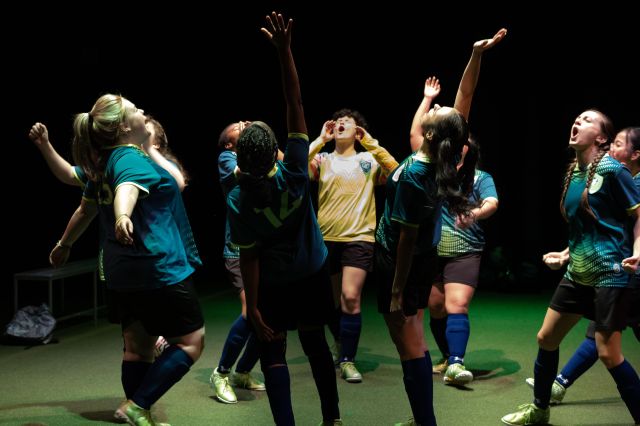
The Wolves immerses you — no exposition and no names, only numbers — in the world of teenage girls. And it’s a full-body dunking. There are nine teenage characters, players on an indoor soccer team,  and they chatter and banter and argue over top of each other constantly as they warm up in sync for their weekly Saturday games. The tenth character, the only adult, is a soccer mom who appears very late in the play. 

What makes the Pulitzer-nominated play by the young American writer Sarah DeLappe (her first to be produced) so intriguing to experience is the gradual, sneaky way that individual characters emerge from the “team.” For 20 minutes you think you’re drowning in cross-hatched fragments of conversations that loop back to each other or refer to offstage events. And then, as you’ll see in Vanessa Sabourin’s Maggie Tree production (part of the Citadel’s Highwire Series), it dawns on you that individual people have emerged from the ensemble buzz of talk and movement, and you don’t need names to differentiate them. 

By the time the characters don team jackets, and thus hide even the numbers on their jerseys, you know them a bit, for their distinctive locations in the rocky terrain between childhood and adulthood, where identity is formative rather than finished. They’re emerging personalities, confident and assertive one moment and crushed into partial retreats the next. The kind of attentiveness this invites — well, requires — of us is live, and fun.

So there we are, improbably in the Citadel’s small downstairs theatre, the Rice, on either side of an Astroturf field (designer: Whittyn Jason). And we’re tuning in to teen girls, in perpetual motion (movement director Amber Borotsik), arriving from their weekday lives on successive Saturday morning sessions. The scenes are separated by an ominously thudding sound score (Kiidra Duhault) I didn’t really get.  

The Wolves, a Maggie Tree production at the Citadel Theatre. Photo by Nanc Price for the Citadel.

It all feels unfiltered, in both subject matter and tone. Earnestness and teen girl off-handedness swirl together. The smalltalk is a melange of the particular and glimpses of the great big world — periods, life-sized zits, and Cambodia, the pronunciation of Khmer Rouge, the detainment of Mexican children in cages at the border, whether they have Twitter in China. “The internet isn’t the internet everywhere you guys,” says #25, who seems to have a reserve of resistance in Marguerite Lawler’s appealing performance. 

To throw out a small selection of examples, #11 (Pauline Miki) is a study-er, with opinions about the world and its moral complications. #13 (Michelle Diaz) is a wiseacre, the class clown with the arsenal of comebacks. #8 (Asia Weinkauf-Bowman), a late-bloomer, relies on references to Harry Potter and the Shire. “I don’t get the big deal about self-knowledge.” Fragile #2 (Sokhana Mfenyana) has a possible eating disorder. The anxiety-plagued goalie, #00 (Dean Stockdale), doesn’t speak; she rushes off the field to throw up before every game.

The most aggressive one, #7 (Daniela Fernandez), who has a college boyfriend and a predilection for the  F-bomb, resorts to macho-style mockery when challenged. #14 (Jameela McNeil), whom her teammates think is either Mexican or Armenian, defers to #7 — until she doesn’t. The outsider, #46 (Kaeley Jade Wiebe), is a mystery to the others, home-schooled, living in a yurt, with a formidable array of soccer skills that threatens the existing pecking order. “Is she even like American?” wonders one of her new teammates.  

The Wolves, a Maggie Tree Production at the Citadel Theatre. Photo by Nanc Price for the Citadel

They seem to have assigned roles in the great scheme and teen idiom of things. But — this is one of the beauties of the play — they can surprise you, each other, and themselves.

Fernandez’s #7, for example, who seems set forth as the A-type Mean Girl, rises unexpectedly to passion about the political limbo of immigrant kids on the border, a view possibly inspired by her dad. Wiebe’s #46, the tentative outsider, steps up to the team joke about her with a chant, as she demonstrates her fancy footwork. “I live in a yogurt; my feelings don’t get hurt.” 

The Wolves, in short, is a trickier, more intricate acting assignment than just having youthful, fresh, hormonal energy. And the ensemble gathered by The Maggie Tree, warmingly diverse as it is, and dotted with actors to keep your eye on, is variable in experience and skill. And that unevenness does show, in truth. Some of the characters do seem more inhabited than others, more able to negotiate the transitional teen mix of earnestness, bad jokes, spontaneous reactions, automatic throw-aways. Whenever the production seems careful, or delivered as a text, it falters. 

Having said that, though, I really appreciated the immersive experience. and its authentic texture of insights in the jostling camaraderie of Sabourin’s production. The jarring arrival of the soccer mom, played beautifully by Lebo Disele, in the play’s only real plot development makes you realize how fully engaged by the characters you’ve been for 90 minutes. It’s the most obliquely delivered bombshell ever.

The Wolves gives us a world in motion, not a story. Being a teenage girl, both an individual and a member of a team, en route to adulthood, is stakes enough.

REVIEW

The Wolves

Theatre: The Maggie Tree in the Citadel Highwire Series

Written by: Sarah DeLappe

Directed by: Vanessa Sabourin

Starring: Michelle Diaz, Lebo Disele, Daniela Fernandez, Marguerite Lawler, Jameela McNeil, Sokhana Mfenyana, Pauline Miki, Dean Stockdale, Asia Weinkauf-Bowman, Kaeley Jade Wiebe

Where: Citadel Rice Theatre

Running: through Oct. 30

Tickets: 780-425-1820, citadeltheatre.com

Posted in Reviews | Tagged , , , , , | Comments Off on You go girls: The Wolves at the Citadel, a review

‘I would never do that.’ A different kind of horror in Squeamish at Northern Light Theatre

Davina Stewart in Squeamish, Northern Light Theatre. Photo by Ian Jackson.

By Liz Nicholls, 12thnight.ca

A couple of weeks ago director Trevor Schmidt and an actor friend were driving back from a day’s excursion to Calgary where she had an audition. “It was getting dark, and we put on a recording of Squeamish,” he says. “And Kristin nearly drove us off the road.”

To help support 12thnight.ca YEG theatre coverage, click here.

“It’s ‘Oh no no NO. O no, you’re not gonna …’ (breath intake, wince … ) Schmidt says of the line-crossing escalations of the one-woman horror story by the New York playwright Aaron Mark, launching the Northern Light Theatre season Friday.

Davina  Stewart, who stars in Schmidt’s production of Squeamish, says that when she first picked up the script she couldn’t read it straight through. “There was a moment I had to put it down for a while. It was … too much.” Stage manager Liz Allison-Jorde nods. So does Schmidt. “It gets ya!”

When rehearsals started, it was on Zoom because Schmidt was out of town, on the stage himself in a Calgary production of The House of Bernard Alba at Sage Theatre. The cast and crew watched each other flinch in horror reading the script.    

Squeamish comes equipped with a content warning to the squeamish: there will be blood. But it’s not a matter of buckets of it, or a stage awash in gore. “It’s all words,” says Stewart. It’s storytelling. “Yup, it’s just a story,” says Schmidt cheerfully. “And it gets creepier and darker and scarier.”

Stewart plays Sharon, a New York Upper West Side therapist who has shown up in the middle of the night at the home of her own therapist. She’s just back from Texas and the funeral of her nephew, who committed suicide. And, “shrink to shrink,” she’s telling the ever-more terrifying story of what’s happened on this trip. Sharon never  leaves her chair — possibly (as Stewart points out) the modern New York equivalent of the campfire around which scary stories traditionally get told.

Horror for the stage takes a deft hand — especially if it’s a one-hander. Schmidt has written one-woman horror plays before now. We Had A Girl Before You — a Gothic thriller in which we’re never sure if the woman before us, telling us the story, has cast herself as the heroine of a romantic novella — was a Halloween season hit in 2020. 

As you quickly find out in Squeamish, Sharon’s is a family with a long history of mental illness, addiction, and suicide. An extreme hemophobe and recovered alcoholic, Sharon has been on psychotropic drugs since she was 14. And, in an urge “to find out who she really is,” beyond the agents of numbing as Stewart puts it, she makes the decision to go on the fateful trip without them. “Maybe I’m some alien creature,” says Sharon, “and I’m just not fundamentally equipped to participate in this indulgent, needy, whiny, vain, overmedicated digital age, where nobody can sit still for five minutes, nobody knows to have a basic human interaction anymore….”

“We talk about things being second nature,” says Stewart. “So what is our first nature? How do we discover what has been suppressed? Finding out what’s ‘normal’ is a big part of it: what does it even mean to be normal post-trauma in a toxic world?   

“To me, it’s a play about addiction, and the horror of what we put ourselves through. Even though we know we are harming ourselves and others. Even though we know it will end badly.” Coffee, binge-watching, smoking, video games  … we all have our addictions, she argues. Without acknowledging, or facing, the need to escape or numb our pain, we just keep trading one for another.

The confidence that we are in control is a kind of arrogance. As Schmidt says, “you go ‘I would never do that. I would never cross that line; I would never go that far’…. And then you find yourself going that far.”

“What is your true nature? Who are you really?” Squeamish is horror that’s scares you in a much different way than sci-fi horror or supernatural horror, or being chased by a killer down a cul-de-sac. Schmidt calls it ‘body horror,” a sub-genre occupied by the Saw movies, Black Swan, Kafka’s Metamorphosis, Mary Shelley’s Frankenstein, all with disturbing violations of the body  

“I can be startled by Alien. But this is the kind of horror story that really scares me,” says Allison-Jorde. “This is real horror.” In her work, she always worries about accidentally dropping spoilers at home with the family. With Squeamish? “Absolutely not going to happen.”

 “The choices we make lead us to the horror,” says Stewart. “And these are real, possible choices,” says Schmidt.

PREVIEW

Squeamish

Theatre: Northern Light Theatre

Written by: Aaron Mark

Directed and designed by: Trevor Schmidt

Starring: Davina Stewart

Where: Studio Theatre, ATB Financial Arts Barns, 102330 84 Ave.

Running: Oct. 21 to Nov. 5

Tickets: northernlighttheatre.com

Posted in Previews | Tagged , , , | Comments Off on ‘I would never do that.’ A different kind of horror in Squeamish at Northern Light Theatre